• Home
  • About The Herald
  • Local Agencies
  • Daily Email Update
  • Legal Notices
  • Classified Ads

Contra Costa Herald

News Of By and For The People of Contra Costa County, California

  • Arts & Entertainment
  • Business
  • Community
  • Crime
  • Dining
  • Education
  • Faith
  • Health
  • News
  • Politics & Elections
  • Real Estate

Assemblywoman Wicks announces agreement with governor, big tech claiming to support work of CA journalists who oppose it, using private and taxpayer funds

August 22, 2024 By Publisher Leave a Comment

Instead of passing bill she carried – See UPDATE with details of “Deal Framework”

But CA journalists “oppose this disastrous deal”

“The future of journalism should not be decided in backroom deals…Not a single organization representing journalists and news workers agreed to this undemocratic and secretive deal with one of the businesses destroying our industry.” – Media Guild of the West

Senator Glazer who has his own bill on the matter opposes deal says it, “seriously undercuts our work toward a long term solution to rescue independent journalism” and doesn’t include Meta (Facebook, Instagram) and Amazon

By Allen D. Payton
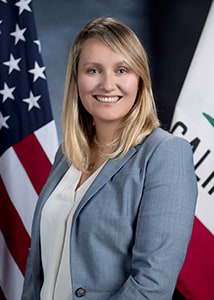
Assemblymember Buffy Wicks (D-15, Oakland)

SACRAMENTO – On Wednesday, August 21, 2024, Assemblymember Buffy Wicks (D-AD15, Oakland) announced the establishment of a first-in-the-nation partnership with the State, news publishers, major tech companies and philanthropy, unveiling a pair of multi-year initiatives to provide ongoing financial support to newsrooms across California and launch a National AI Accelerator.

Together, these new partnerships will provide nearly $250 million in public and private funding over the next five years, with the majority of funding going to newsrooms. The goal is to front-load $100 million in the first year to kick-start the efforts. The total investment could increase over the next several years if additional funding from private or state sources becomes available.

“This agreement represents a major breakthrough in ensuring the survival of newsrooms and bolstering local journalism across California — leveraging substantial tech industry resources without imposing new taxes on Californians,” said Governor Gavin Newsom. “The deal not only provides funding to support hundreds of new journalists but helps rebuild a robust and dynamic California press corps for years to come, reinforcing the vital role of journalism in our democracy.”

Assemblymember Wicks, who represents portions of Western Contra Costa County, authored AB 886 to help ensure the sustainability of local journalism, as news outlets across the country are downsizing and closing at alarming rates. A Northwestern University study published last year found an average of two and a half newspapers in the United States close every week, and that our nation has lost two-thirds of its newspaper journalists since 2005. California has lost more than 100 newspapers in the last decade alone.

The new suite of initiatives includes multi-faceted support for publishers across California to address challenges that have impacted the depth and breadth of news coverage in the state. They will help ensure the sustainability of existing and new online publications – with an emphasis on small, local outlets and community-facing journalism.

“As technology and innovation advance, it is critical that California continues to champion the vital role of journalism in our democracy,” said Wicks. “This partnership represents a cross-sector commitment to supporting a free and vibrant press, empowering local news outlets up and down the state to continue in their essential work. This is just the beginning. I remain committed to finding even more ways to support journalism in our state for years to come.”

California news publishers will be the beneficiaries of a News Transformation Fund, to be administered by the UC Berkeley School of Journalism, providing financial resources that preserve and expand California-based journalism. The funding will include contributions from technology platforms and the State of California, supporting innovative new investments that promote local journalism. The funding will support California-based state and local news organizations, particularly those serving California local news deserts, underserved and underrepresented communities, and outlets that prioritize California coverage.

“The University of California is proud to partner with Governor Newsom and legislative leaders to bolster the critical work of local news organizations and journalists in California,” said UC President Michael V. Drake, M.D. “Californians depend on robust local and diverse news organizations to stay informed about their communities, and the University and specifically the UC Berkeley School of Journalism stand ready to support this endeavor.”

Funding for the initiative would be complemented by direct support from the State, helping news organizations keep and grow newsroom staff and offsetting the costs of producing local news and information.

“A vibrant press is crucial for strong communities and a healthy democracy. This is a first step toward what we hope will become a comprehensive program to sustain local news in the long term, and we will push to see it grow in future years,” said California News Publishers Association CEO Chuck Champion and Board Chair Julie Makinen. “We will work with the state and tech companies to make the most of this initiative. We’re grateful to Assemblymember Wicks for her passionate advocacy on behalf of our 700-plus member newsrooms.”

Partners in this initiative also reiterated their strong commitment to strengthening newsroom and ownership diversity for ethnic and underserved communities. The Governor also announced his support for AB 1511 (Santiago), which aims to increase the state’s ongoing commitment to place official marketing, advertising and/or outreach advertising with local and underrepresented media outlets.

“Ethnic and community media outlets in California have a long history of serving as trusted messengers of culturally responsive news to historically underrepresented and underserved communities,” said Assemblymember Miguel Santiago. “These initiatives ensure that California is embracing private sector innovation while developing partnerships with and seeding investments from the public sector to empower local publishers and journalists that are vital to a healthy, thriving democracy.”

Additionally, researchers and businesses will have access to new resources to explore the use of AI to tackle some of the most complex challenges facing society, and strengthen the workforce through a new National AI Innovation Accelerator. This will be administered in collaboration with a private nonprofit, and will provide organizations across industries and communities — from journalism, to the environment, to racial equity and beyond — with financial resources and other support to experiment with AI to assist them in their work. The AI accelerator will empower organizations with the new technology, and complement the work of the Journalism Fund by creating new tools to help journalists access and analyze public information.

“We appreciate the thoughtful leadership of Governor Newsom, Assemblymember Wicks, Chair Umberg, and Senator Glazer on these issues,” said Kent Walker, President of Global Affairs and Chief Legal Officer for Alphabet (Google’s parent company). “California lawmakers have worked with the tech and news sectors to develop a collaborative framework to accelerate AI innovation and support local and national businesses and non-profit organizations. This public-private partnership builds on our long history of working with journalism and the local news ecosystem in our home state, while developing a national center of excellence on AI policy.”

“A strong press is a key pillar of democracy, and we’re proud to be part of this partnership to utilize AI in support of local journalism across California,” said Jason Kwon, Chief Strategy Officer for OpenAI. “This initiative builds on our longstanding work to help newsrooms and journalists around the world leverage AI to improve workflows, better connect users to quality content, and help news organizations shape the future of this emerging technology.”

Work will begin immediately to stand up both initiatives, which will go live in 2025. Included below is a range of quotes from additional supporters.

What others are saying:

“The work of local independent publishers is essential to a well-functioning democracy, and this new public-private partnership provides immediate and needed relief. Lawmakers should be proud of this program, which builds on California’s innovative Local News Fellowship with millions of new dollars in a way that prioritizes small publishers and those serving underrepresented groups.” – Chris Krewson, Executive Director of Local Independent Online News (LION) Publishers, a national nonprofit with 76 of its 600 publisher members in California

“The new public-private partnership provides a pioneering, ambitious program that will offer significant help to local newsrooms that give Californians the information they need to participate in a healthy democracy. It’s encouraging that lawmakers and tech platforms found a way to work together to forge an innovative solution that can be a model for other states.” – Lance Knobel, CEO of Cityside Journalism Initiative, the nonprofit behind Richmondside, Oaklandside and Berkeleyside

“California is leading the way with this first-in-the-nation investment to protect the press and sustain quality journalism. This fund will help news outlets and journalists adapt to a changing landscape with new tools and funding to embrace emerging technologies. This is especially helpful for ethnic and community media which is comprised largely of under-resourced family businesses whose strongest connections are to their community.” – Regina Wilson, Executive Director, California Black Media

“California is home to the largest concentration of multilingual news outlets serving immigrant and ethnic communities in the US. This breakthrough public private partnership to support local journalism brings welcome recognition of the ethnic media sector’s indispensable role in connecting these diverse communities to each other and to the wider public realm.” – Sandy Close, Director of Ethnic Media Services (EMS), a California-based nonprofit which works with 2000 ethnic news outlets nationwide, including over 300 in California

“It represents an equity-media model for the nation,” added Julian Do, EMS Co-Director

“Protecting and rebuilding California’s robust media ecosystem and ensuring it serves immigrants, Latinos and communities of color equally requires an important role for philanthropy, our tech and private sector, and yes, California’s State Government. We see this historic agreement as just the first major step where the State of California can lead the way in building a sustainable media ecosystem for the most diverse state in the Union.” – Arturo Carmona, President of the Latino Media Collaborative

“This is a win for all Californians. Disinformation flourishes when quality journalism disappears. This critical funding will help local publishers survive and keep their communities informed and engaged.” – Neil Chase, CEO of CalMatters and former editor of The Mercury News and East Bay Times

“The revival of a strong, independent community-minded local press is vital for California. All things considered, this agreement both injects new money into doing that and helps spur the innovation, tech and otherwise, required at this moment. As a companion to the California Local News Fellowship, it’s another brick in the rebuilding of California journalism.” – Ken Doctor, Newsonomics news analyst and Lookout Local founder and CEO

“Supporting local news and journalism is vital to enabling a fully informed and engaged community. We are very pleased to see California as a leader in building this public-private partnership that will substantially impact local journalism and essential news coverage in communities throughout California. This vital funding will support our local news and will enable an expansion of our initiative to add to the depth of our bilingual coverage and journalists in Napa Valley – where 40% of the population is Latino.” – Marc Hand, CEO and Board Chair of Highway 29 Media, a publisher of newspapers serving communities in Napa Valley

California Journalists’ Guild Opposes Deal, Calls it a “Shakedown”

In addition, the Media Guild of the West, which represents journalists and had supported Wicks’ bill, issued a statement on Wednesday opposing the deal entitled, “California’s journalists do not consent to this shakedown.”

The guild’s representatives and signatories to the statement (see below) wrote, “This afternoon, Google, California Assemblymember Buffy Wicks, California Governor Gavin Newsom and many of California’s publishing lobbies announced ‘a first-in-the-nation partnership with the State, news publishers, major tech companies and philanthropy, unveiling a pair of multi-year initiatives to provide ongoing financial support to newsrooms across California and launch a National AI Accelerator.’

After two years of advocacy for strong antimonopoly action to start turning around the decline of local newsrooms, we are left almost without words. The publishers who claim to represent our industry are celebrating an opaque deal involving taxpayer funds, a vague AI accelerator project that could very well destroy journalism jobs, and minimal financial commitments from Google to return the wealth this monopoly has stolen from our newsrooms.

Not a single organization representing journalists and news workers agreed to this undemocratic and secretive deal with one of the businesses destroying our industry. Moments ago, the following opposition letter was filed with the California legislature:

We represent journalists and news workers who provide essential news for millions of Californians in print, digital, broadcast, commercial and nonprofit newsrooms.

The future of journalism should not be decided in backroom deals. The Legislature embarked on an effort to regulate monopolies and failed terribly. Now we question whether the state has done more harm than good.

California’s journalists and news workers OPPOSE this disastrous deal with Google and condemn the news executives who consented to it in our names.

Signed,

Matt Pearce, President, Media Guild of the West, The NewsGuild-CWA Local 39213
Jon Schleuss, President, The NewsGuild-CWA
Annie Sciacca, President, Pacific Media Workers Guild, The NewsGuild-CWA Local 39521
Carrie Biggs-Adams, President, NABET-CWA Local 51
Javad Ayala, President, NABET-CWA Local 53
Kevin Gallo, Regional Vice President 5, NABET-CWA
Frank Arce, Vice President, Communications Workers of America District 9

Glazer Also Opposes Agreement, Calls it “Inadequate”

State Senator Steve Glazer (D-SD7, Orinda)

State Senator Steve Glazer (D-SD7, Orinda), who represents most of Contra Costa County and has his own bill on the matter, SB911, also does not support the deal and on Wednesday issued the following “Statement on Wicks-Google Agreement”:

“Despite the good intentions of the parties involved, this proposal does not provide sufficient resources to bring independent news gathering in California out of its death spiral.

Google’s offer is completely inadequate and massively short of matching their settlement agreement in Canada, in supporting on-the-ground local news reporting.

Democracies live and die based on the free exchange of information and oversight between government and its people. Autocracies and dictatorships thrive when that information is constrained or manipulated.

The hollowing out of independent news gathering and the monopoly power of these digital platforms is an existential threat to our democratic republic.

This agreement, unfortunately, seriously undercuts our work toward a long term solution to rescue independent journalism

There is a stark absence in this announcement of any support for journalism from Meta (parent company of Facebook and Instagram) and Amazon. These platforms have captured the intimate data from Californians without paying for it. Their use of that data in advertising is the harm to news outlets that this agreement should mitigate.”

Questions for Wicks About the Agreement and Initiatives Go Unanswered

Questions were emailed Wednesday night to Wicks’ Director of Communications, Erin Ivie, asking, “Do you email out press releases to media that cover her district? Was there a press conference held announcing the agreement?”

Other local media publishers in Contra Costa County didn’t receive the press release about the agreement nor an invitation to any press conference at which it was announced, either.

She was also asked the following:

“Why didn’t she reach out to the local media that cover her district for our input like Congressman Mark DeSaulnier did for his legislation?

Which news publishers, major tech companies and philanthropy are party to the agreement?

Can you ease provide copies of the two initiatives mentioned in the press release or the link to where they can be found?

What are the definitions of ‘newsroom’, ‘local journalist’ and ‘local news outlets’ mentioned in the press release, including in a quote by the Assemblywoman?

Which newsrooms will qualify for the funds? Who will determine which newsrooms will receive the funds and how much they will receive?

Will the funds be provided directly from the tech companies and philanthropy to the newsrooms, or will they be funneled through a state government agency? Will there be an application process and to whom will the applications be submitted?”

Finally, Ivie was asked, “Who will be working on both initiatives? How does a local news publisher get involved in the process?”

UPDATE: Wicks’ Staff Provides Details of Deal

In response, Ivie provided the “Deal Framework, Measures to support democracy, journalism and AI innovation” (see below). In addition, she provided answers to the Herald’s questions:

“Eligible for the funding are nonprofit and for-profit news organizations who have been around for at least two years. The funding is awarded by headcount, overseen by a diverse board (outlined further down).

The one exception is commercial broadcasters, who were carved out of the agreement because they continue to generate healthy profits from advertising dollars.

The funds will be distributed by the UC Berkeley School of Journalism, by an approved claims administrator who typically handles complex distributions of class action settlements. Details of the application process are forthcoming, but in the meantime, anyone interested can contact our office to get on a list to receive those details.

The state is currently committed to providing a minimum of $70M over 5 years, and that commitment is limited to the journalism fund only. Google has committed to $110M minimum over the same time frame, plus $62.5M for their AI accelerator.

That means that taxpayer funds could be used to support the journalism fund, but not the work of the AI accelerator. It will not require legislation to be passed, but it will require a budget allocation (in January), which the Governor has already committed to.

Our office, Google, the UC Berkeley School of Journalism, plus a seven-member governing board. That board will consist of two CNPA members, one member from Ethnic Media Services, one from Local Independent Online News (LION), one from Latino Media Collaborative, one from California Black Media, and one from Media Guild of the West.

Any local news publisher who wants to get involved can email our office and be brought into the fold. If you’re interested, please email our Legislative Director Zak Castillo-Krings at zak.castillo-krings@asm.ca.gov.

The agreement was made in lieu of AB 886, and the bill will no longer move forward.”

Deal Framework

Measures to support democracy, journalism and AI innovation

  1. Summary: Creation of first-in-the-nation partnerships that will provide nearly $250 million in public and private funding over the next five years, with the majority of going to support newsrooms. The goal is to front-load $100 million in the first year to kickstart the efforts. Total investment could increase over the next several years if additional funding from private or state sources becomes available.
  2. State Contribution: 30mm in year one. 10mm in each of the next four years (years 2-5). All money will be contributed to a new fund established at UC Berkeley School for Journalism.
  3. Google Commitment to Journalism, up to 30mm a year, as follows:
  4. Year one:

$15mm to the Journalism Fund

$5mm to AI fund accelerator

$10mm in funding for existing journalism programs

  1. Years 2-5: Google continues its contribution to Journalism Fund at 10mm minimum. Google maintains 10mm in funding for existing journalism programs
  2. National AI Accelerator
  3. Managed by as-yet-to-be finalized non-profit organization, under terms to be

defined by funders

  1. Google commitment of additional 10mm to Accelerator
  2. Google commitment of additional 2.5mm to fund AI research
  3. Additional contributions from other tech companies
  4. UC School of Journalism non-profit public charity
  5. Administration costs are not to exceed a customary overhead
  6. Purpose is to bolster UC’s efforts to support and catalyze local news

throughout the state

  1. Overseen by a 7-member governing board:
  2. CNPA member
  3. CNPA member

iii. Ethnic Media Services

  1. Local Independent Online News
  2. Latino Media Collaborative
  3. California Black Media

vii. Media Guild of the West

  1. Funds allocated by board to be distributed by claims administrator
  2. 12% of funding reserved for locally focused publications and publications targeting underrepresented groups
  3. The function of the board will be to validate the distribution formula based on the number of journalists per publication. Funds to be distributed to eligible organizations by dividing the number of eligible journalism positions or

freelancers of each organization by the total number of overall eligible positions multiplied by the total eligible amount in the fund consistent with the current language of AB886. The board will have no other discretion relative o the distribution of funds.

  1. The definition of a journalist does not include broadcasters
  2. Additional State Support:
  3. California will work with its departments on plans to prioritize state government advertising in local publications and publications in underserved markets, with the goal of redirecting millions in advertising dollars.

Erin Ivie, Director of Communications, Office of Assemblymember Buffy Wicks and Steven Harmon, Communications Director for the Office of State Senator Steve Glazer contributed to this report.
Filed Under: Business, Government, Journalism, Labor & Unions, News, State of California, Taxes

Scathing State Audit confirms Labor Commissioner’s 47,000 backlogged claims at end of 2022-23

May 29, 2024 By Publisher 2 Comments

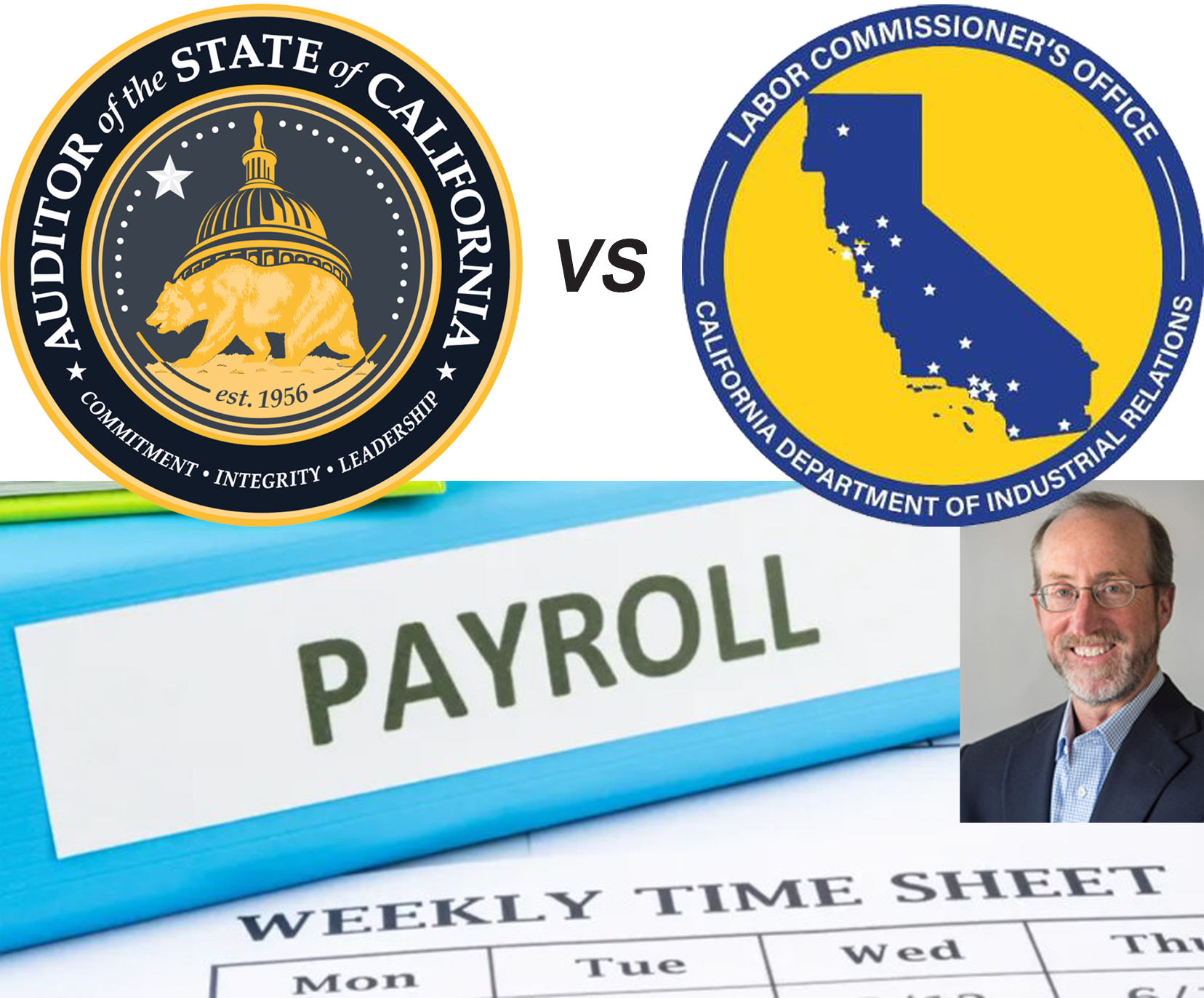
Payroll graphic source: CA State Auditor

Senator Glazer’s request leads to findings of workers cheated out of $63.9 million in past wages

Calls it a failure to act on behalf of workers

Report claims inadequate staffing, poor oversight have weakened protections for workers

SACRAMENTO – California Labor Commissioners have stood idly by as a massive backlog in wage theft cases piled up worth $63.9 million in lost wages to workers as its enforcement unit failed to enforce and collect wages in 76 percent of cases in which employers were found to owe wages, according to a report released Wednesday by Grant Parks, the California State Auditor.

The scathing audit came as a result of a March 2023 request through the Joint Legislative Audit Committee by Senator Steve Glazer, D-Contra Costa, and Assemblyman David Alvarez, D-San Diego. It was based on news reports about the lack of wage theft enforcement.

Parks reported his findings to the Governor, President pro Tempore of the Senate and Speaker of the Assembly about the “Department of Industrial Relations’ Division of Labor Standards Enforcement, also known as the Labor Commissioner’s Office (LCO).” Lilia García-Brower is the current state Labor Commissioner and was appointed to the position by Governor Newsom in July 2019. Neither her name or photo appears on the website for the Labor Commissioner’s Office. Ironically, according to the agency’s website, “The mission of the LCO is to ensure a just day’s pay in every workplace in the State and to promote economic justice through robust enforcement of labor laws. By combating wage theft, protecting workers from retaliation, and educating the public, we put earned wages into workers’ pockets and help level the playing field for law-abiding employers.”

The audit “reviewed the backlog of wage claims submitted by workers from fiscal years 2017–18 through 2022–23, and determined that the LCO is not providing timely adjudication of wage claims for workers primarily because of insufficient staffing to process those claims.”

Furthermore, the state Auditor reported, “In addition to its delays in processing wage claims, the LCO has not been successful in collecting judgments from employers. A possible factor contributing to its low collection rate is that the Enforcement Unit does not consistently use all of the methods available to it for collecting payments owed to workers.”

Senator Glazer released this statement on the audit’s findings:

“The California State Auditor’s report makes clear that our State Labor Commissioner is a toothless enforcer of our wage theft laws. This deeply troubling assessment exposes a system that has fundamentally failed the workers it is supposed to protect. According to the auditor, there is a backlog of 47,000 claims registered on June 30, 2023. This is a state embarrassment and a stain on the department that workers depend on for justice.

The report also highlights an alarming increase in the average number of days to resolve claims, which has skyrocketed from 420 days in 2017/18 to an astounding 890 days in 2022/23. This drastic decline in efficiency is not just a statistic; it represents thousands of workers enduring prolonged injustice and financial hardship.

This lack of enforcement emboldens companies to exploit workers, knowing they can likely escape any real consequences, thus perpetuating and increasing further abuse. These findings paint a grim picture of an agency overwhelmed and ineffective, leaving workers vulnerable and without recourse. Immediate and decisive action to restore integrity and effectiveness to the Labor Commissioner’s office is needed. The workers of California deserve nothing less than a robust system that ensures timely and fair resolution of wage theft claims.”

The report can be found here: www.auditor.ca.gov/reports/the-california-labor-commissioners-office/

Allen D. Payton contributed to this report.

Filed Under: Employment, Finances, Government, Jobs & Economic Development, Labor & Unions, Legal, News, State of California

Bill to mandate ‘science of reading’ in CA schools faces teachers’ union opposition

April 6, 2024 By Publisher Leave a Comment

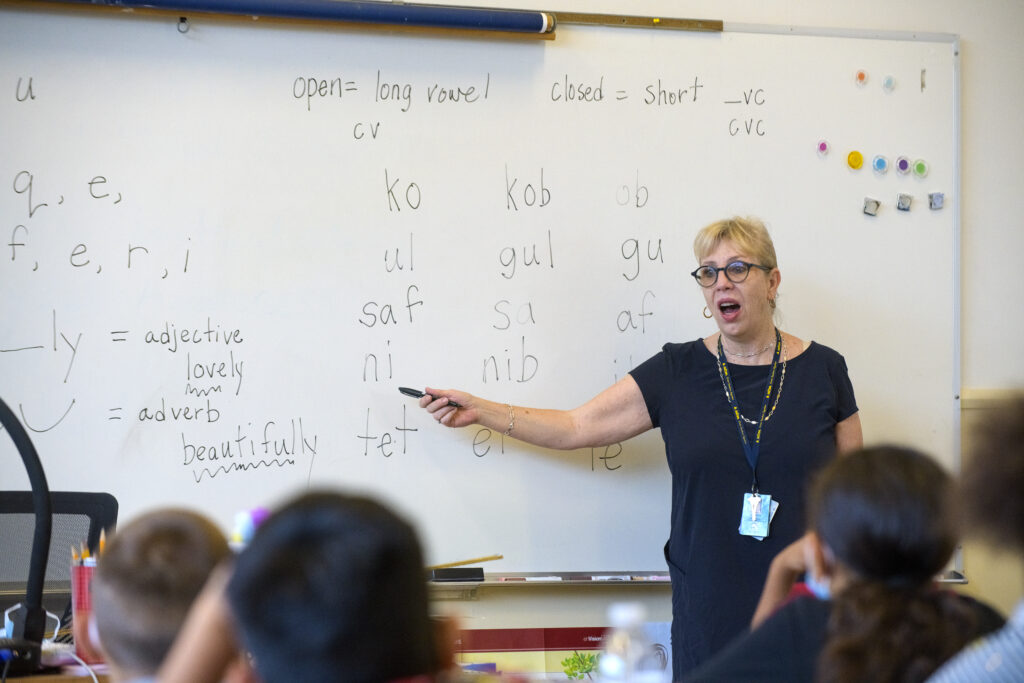
Teacher Jennifer Dare Sparks conducts a reading lesson in her 3rd/4th class at Ethel I. Baker Elementary School in Sacramento, Calif. Thursday, Jun. 2, 2022. Photo credit: Randall Benton / EdSource

Part of nationwide push to bring back phonics, sponsors seek compromise, CTA refuses to negotiate

By DIANA LAMBERT, JOHN FENSTERWALD, ZAIDEE STAVELY, EDSOURCE.org

California’s largest teachers’ union has moved to put the brakes on legislation that mandates instruction, known as the “science of reading,” that spotlights phonics to teach children to read.

The move by the politically powerful California Teachers Association (CTA) puts the fate of Assembly Bill 2222 in question as supporters insist that there is room to negotiate changes that will bring opponents together.

CTA’s complaints include some recently voiced by some advocacy organizations for English learners and bilingual education that oppose the bill and have refused to negotiate any changes to make the bill more acceptable.

The teachers union put its opposition to AB 2222 in writing in a lengthy letter to Assembly Education Committee Chairman Al Muratsuchi last week. The committee is expected to hear the bill, introduced in February, later this month.

The letter includes a checklist of complaints including that the proposed legislation would duplicate and potentially undermine current literacy initiatives, would not meet the needs of English learner students and cuts teachers out of the decision-making process, especially when it comes to curriculum.

“Educators are best equipped to make school and classroom decisions to ensure student success,” the letter said. “Limiting instructional approaches undermines teachers’ professional autonomy and may impede their effectiveness in the classroom.”

Marshall Tuck, CEO of EdVoice, an advocacy nonprofit co-sponsoring the bill, said he was surprised that CTA would oppose legislation that would ensure all teachers are trained to use the latest brain research to teach children how to read.

“Unfortunately, a lot of folks in the field haven’t actually been trained on that, and a lot of the instruction materials in classrooms today don’t align with that,” Tuck said.

Tuck said CTA appears to misunderstand the body of evidence-based research known as the science of reading. It “is not a curriculum and is not a program or a one-size-fits-all approach,” he said. “It will give teachers a foundational understanding of how children learn to read. Teachers will still have a lot of room locally to decide which instructional moves to make on any given day for any given children. So, you’ll still have significant differentiation.”

A nationwide push

California’s push to adopt the science of reading approach to early literacy is in sync with 37 states and some cities, such as New York City, that have passed similar legislation.

States nationwide are rejecting balanced literacy as failing to effectively teach children how to read, since it trains children to use pictures to recognize words on sight, also known as three-cueing. The new method would teach children to decode words by sounding them out, a process known as phonics.

Although phonics, the ability to connect letters to sounds, has drawn the most attention, the science of reading focuses on four other pillars of literacy instruction: phonemic awareness, identifying distinct units of sounds; vocabulary; comprehension; and fluency. It is based on research on how the brain connects letters with sounds when learning to read.

Along with mandating the science of reading approach to instruction, AB 2222 would require that all TK to fifth-grade teachers, literacy coaches and specialists take a 30-hour-minimum course in reading instruction by 2028. School districts and charter schools would purchase textbooks from an approved list endorsed by the State Board of Education.

The legislation goes against the state policy of local control that gives school districts authority to select curriculum and teaching methods as long as they meet state academic standards. Currently, the state encourages, but does not mandate, districts to incorporate instruction in the science of reading in the early grades.

“It’s a big bill,” said Yolie Flores, president of Families in Schools, a co-sponsor. “We’re very proud that it’s a big bill because that means it is truly consequential in the best way possible for children. It’s not a sort of tweak around the edges kind though, it’s the kind of bill that really brings transformation. So we are hoping that the Legislature sees beyond the sort of typical pushback and resistance, and in the end, I think, teachers will see that this was a huge benefit for them.”

Seeking compromise

The bill’s author, Blanca Rubio, D-Baldwin Park, said she took CTA’s seven-page letter not as an outright rejection but as an opportunity for negotiations.

“I’m glad they sent this letter,” she said. “They outline their objections and the reasons why, and that’s something I can work with. It’s not a flat, ‘No, we don’t want you to do it.’ They gave me specific items that I can look at and have a conversation about.”

She said that Assemblymember Muratsuchi asked her to work with the CTA on a compromise. She is also meeting with consultants for Assembly Speaker Robert Rivas, D-Salinas, “to look at the big picture,” she said.

But Flores says the state’s budget problems, with predictions of no money for new programs, may be a bigger hurdle to getting the bill passed than the CTA opposition. The cost of paying for the required professional development for teachers would total $200 million to $300 million, she said. Because it is a mandate, the state would be required to repay districts for the cost.

“That is a drop in the bucket for something so transformational, so consequential,” Flores said. “I hope that the Legislature really comes to that realization. We’re in a budget deficit, but our budget is a statement of priorities.”

Advocates say that it is imperative that California mandate instruction in the science of reading. In 2023, just 43% of California third graders met the academic standards on the state’s standardized test in 2023. Only 27.2% of Black students, 32% of Latino students and 35% of low-income children were reading at grade level, compared with 57.5% of white, 69% of Asian and 66% of non-low-income students.

“It’s foundational,” Flores said. “It’s not the only thing teachers need to know. It’s not the only thing that teachers will need to do and to adhere to, but it’s sort of the basic foundational knowledge of how children’s brains work in order to learn to read.”

The bill would sunset in 2028 when all teachers are required to have completed training. Beginning in July, all teacher preparation programs would be required to teach future educators to base literacy instruction on the science of reading.

Needs of English learners

The CTA and other critics of AB 2222 charge that it ignores the need of English learners for oral language skills, vocabulary and comparison between their home languages and English, which they need in order to learn how to read. Four out of 10 students in California start school as English learners.

Tuck disputes this. “We actually emphasize oral language development,” he said. “This would be the first statute that would say when instructional materials are adopted, and when teachers are trained in the science of reading, they must include a focus on English learners and oral language development.”

Representatives from Californians Together, an advocacy organization for English learners and bilingual education, applauded the CTA’s opposition to the bill. They oppose the bill, rather than suggest amendments, because they disagree with its overall approach.

“We just don’t think this is the right bill to address literacy needs,” said Executive Director Martha Hernandez. “It’s very restrictive. We know that mandates don’t work. It lacks a robust, comprehensive approach for multilingual learners.”

Instead, Californians Together and the California Association for Bilingual Education have both said they would prefer California fund the training of teachers and full implementation of the English Language Arts/English Language Development Framework.

The framework was adopted in 2014 and encourages, but does not mandate, explicit instruction in foundational skills and oral language development for English learners.

The California Language Teachers Association has requested the bill be amended to include information about teaching literacy in languages not based on the English alphabet, such as Japanese, Chinese or Arabic, according to Executive Director Liz Matchett. However, the organization has not yet taken a position on the bill.

“I agree that we want to support all children to be able to read. If they can’t read, they can’t participate in education, which is the one way that is proven to change people’s circumstances,” said Matchett, who teaches Spanish at Gunn High School in Palo Alto. “There’s nothing to oppose about that. I’m still a classroom teacher, and all the time, you get kids in high school who can’t read.”

Education Trust-West urges changes in the bill to center the needs of “multilingual learners” — children who speak languages other than English at home — and to include more oversight and fewer mandates, such as those that may discourage new teachers from entering the profession.

“If our recommended amendments were to be accepted, EdTrust-West would support it as a much-needed solution to California’s acute literacy crisis.”

Claude Goldenberg, professor emeritus of education at Stanford University, said “it was disappointing” to see CTA’s opposition, particularly because the union did not suggest amendments. He said he had met with representatives from CTA and urged them to identify what could be changed in the bill.

In a recent EdSource commentary, Goldenberg urged opponents to “do the right thing for all students. AB 2222’s introduction is an important step forward on the road to universal literacy in California. We must get it on the right track and take it across the finish line.”

Referring to the CTA’s opposition, Goldenberg said, “Obviously my urgings fell flat. They identified why they’re opposing, but there’s no indication of any possible re-evaluation.”

Goldenberg, who served on the National Literacy Panel, which synthesized research on literacy development among children who speak languages other than English, has called on the bill’s authors to amend it to include a more comprehensive definition of the “science of reading” and include more information about teaching students to read in English as a second language and in their home languages.

The CTA has changed its position on bills related to literacy instruction in the last two years. It had originally supported Senate Bill 488, which passed in 2022. The legislation requires a literacy performance assessment for teachers and oversight of literacy instruction in teacher preparation. The union is now in support of a bill that would do away with both.

The change of course was attributed to a survey of 1,300 CTA members, who said the assessment caused stress, took away time that could have been used to collaborate with mentors and for teaching, and did not prepare them to meet the needs of students, according to Leslie Littman, vice president of the union, in a prior interview.

Veteran political observer Dan Schnur said he’s not surprised CTA would oppose the bill since some of its political allies are against it; the question is how important CTA considers the bill.

“If it becomes a pitched battle, CTA will have to decide whether it is one of its highest priorities in this session,” he said.

Gov. Gavin Newsom hasn’t indicated his position yet, but Schnur, the press secretary for former Gov. Pete Wilson, who teaches political communications at UC Berkeley and USC, said, “This is not the type of fight Newsom needs or wants right now. If he has strong feelings, it’s hard to see him going to war for or against.”

Filed Under: Employment, Labor & Unions, Legislation, News

Unions backing Wilson in Assembly race spend $253K attacking opponent Mitchoff

February 29, 2024 By Publisher Leave a Comment

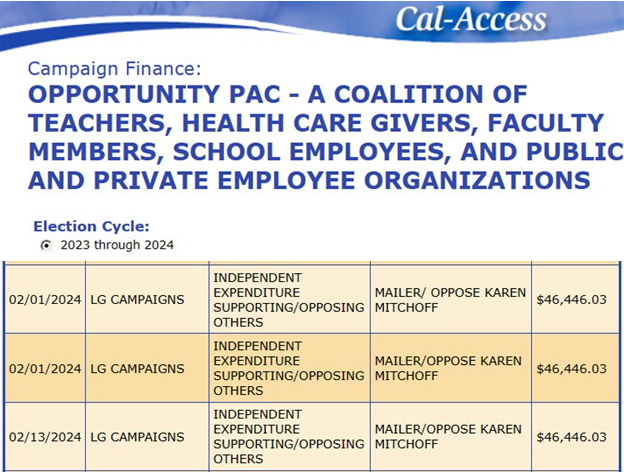
The Opportunity PAC’s financial disclosure reports show expenditures for three of the four “hit piece” mailers against Karen Mitchoff in the Assembly District 15 race. Source: Cal-Access

By Allen D. Payton

One of four mailers opposing Mitchoff paid for by Opportunity PAC with funds form by unions.

Some of the same unions backing Antioch Mayor Pro Tem Monica Wilson in the Assembly District 15 race on the March primary ballot have spent almost $253,000 attacking one of her three opponents, former Contra Costa County Supervisor Karen Mitchoff.

At least four mailers have been sent to Democrat voters in the district criticizing Mitchoff’s pay raise she voted for while on the board, and her votes against pay raises for county employees.

Two of the mailers obtained by the Herald show they were paid for by “Opportunity PAC – A coalition of teachers, health care givers, faculty members, school employees, and public and private employee organizations.” The political action committee’s Top Funders for the mailers are listed as SEIU (Service Employees International Union) California State Council, California Faculty Association (of the UC and CSU systems) and California School Employee Association.

Another of four mailers opposing Mitchoff paid for by Opportunity PAC with a similar message about her vote for a pay raise for the Board of Supervisors.

When asked about the mailers Mitchoff said they’re all pretty much about the same issue. The same group with the same message. My decision was made over 10 years ago and I wanted to make sure the county supervisors were paid to make it a full-time position.” She also pointed out that she did vote for pay raises for county employees, “in 2022, giving them 5% a year for four years, for a total increase of 20%.”

The interesting part is that some of the state teachers’ unions including college and university faculty and staff are helping pay for the mailers, even though as a member of the Board of Supervisors, Mitchoff had no say about education funding.

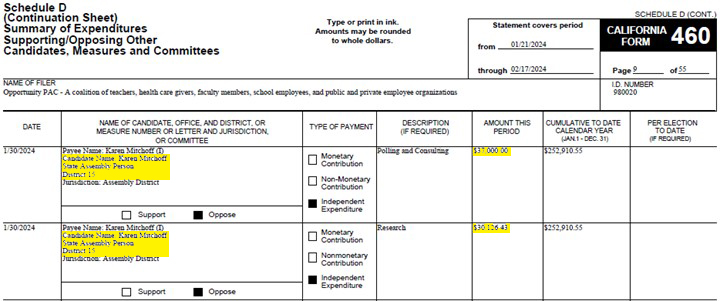
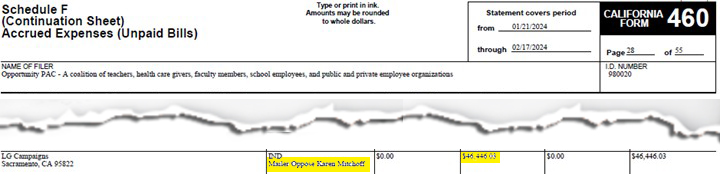
According to Cal-Access, the California Secretary of State’s campaign finance reporting website, so far, the PAC has made three expenditures of $46,446.03 each for three mailers opposing Mitchoff, two on Feb. 1 and one on Feb. 13, 2024. The cost for a fourth mailer that appear under the PAC’s Accrued Expenses show an additional $46,446.03. That totals $185,784.12. In addition, the PAC spent $37,000.00 on polling and consulting and $30,126.43 on research in their effort against Mitchoff.

Other Opportunity PAC Expenditures opposing Mitchoff were for polling, consulting and research. Source: Cal-Access

Contributions to PAC Total Over $2.5 Million

The PAC is supporting and opposing a variety of candidates throughout the state. Their most recent Form 460 financial disclosure report dated Feb. 17, 2024, shows they have raised $1.715 million this year and their report ending Dec. 31, 2023, shows $803,500 was raised last year for a total of $2,518,500. They had cash on hand of over $1.1 million as of Feb. 17th.

Contributions include the following amounts and sources:

$750,000 from the California Teachers Association Independent Expenditure Committee;

$534,500 from SEIU California State Council for Working People;

$225,000 from PACE (Political Action for Classified Employees) of California School Employees Association;

$190,000 from Smart Justice California Action Fund;

$150,000 from United Food and Commercial Workers Western States Council Independent Expenditure PAC;

$150,000 from California Federation of Teachers COPE (Committee on Political Education);

$150,000 from Service Employees International Union Local 1000, Keeping California Healthy, Safe and Strong;

$100,000 from Service Employees International Union Local 721 CTW, CLC Workers’ Strength Committee;

$75,000 from SEIU United Healthcare Workers West PAC;

$59,500 from Faculty for Our University’s Future, a committee sponsored by California Faculty Association;

$59,500 from Standing Committee on Political Education of the California Labor Federation AFL-CIO;

$50,000 from the LGBT (Lesbian, Gay Bisexual & Transgender) Caucus Leadership Fund; and

$25,000 from SEIU California State Council (nonprofit 501 (c)(5))

Opportunity PAC Accrued Expenses as of their Feb. 17, 2024 report includes $46,446.03 for a fourth mailer opposing Mitchoff. Source: Cal-Access

Wilson’s Backers Funding Mitchoff Opposition Effort

Wilson’s campaign has been the beneficiary of support from many of those same unions. On her campaign website, Wilson shows endorsements by the California Faculty Association, SEIU California, National Union of Healthcare Workers (NUHW) and United Food & Commercial Workers Local 5, as well as unions that are members of the AFL-CIO.

Wilson and Mitchoff also face two others in the race, including County School Board Trustee Anamarie Avila Farias and Realtor Sonia Ledo in the March 5th primary election next Tuesday. The top two will face off in the November election.


Filed Under: Finances, Labor & Unions, News, Politics & Elections

CTA-sponsored legislation would remove one of state’s last required tests for teachers

February 25, 2024 By Publisher Leave a Comment

First grade teacher Sandra Morales discusses sentences with a student. Credit: Zaidee Stavely / EdSource

State could retain unpopular written literacy test

By Dana Lambert, EdSource.org – Republished with permission

Newly proposed legislation sponsored by the California Teachers Association would eliminate all performance assessments teachers are required to pass, including one for literacy that it supported three years ago. The result could leave in place an unpopular written test that the literacy performance assessment was designed to replace.

Senate Bill 1263, authored by state Sen. Josh Newman, D-Fullerton, would do away with the California Teaching Performance Assessment, known as the CalTPA, through which teachers demonstrate their competence via video clips of instruction and written reflections on their practice.

Eliminating the assessment will increase the number of effective teachers in classrooms, as the state continues to contend with a teacher shortage, said Newman, chairman of the Senate Education Committee.

“One key to improving the educator pipeline is removing barriers that may be dissuading otherwise talented and qualified prospective people from pursuing a career as an educator,” Newman said in a statement to EdSource.

The bill also would do away with a literacy performance assessment of teachers and oversight of literacy instruction in teacher preparation programs mandated by Senate Bill 488, authored by Sen. Susan Rubio, D-West Covina, in 2021.

The literacy performance assessment is scheduled to be piloted in the next few months. It is meant to replace the Reading Instruction Competence Assessment (RICA) set to be scrapped in 2025.

New law could leave RICA in place

The proposed legislation appears to leave in place a requirement that candidates for a preliminary multiple-subject or education specialist credential pass a reading instruction competence assessment, said David DeGuire, a director at the California Commission on Teacher Credentialing.

“At this time, it is unclear what that assessment would look like, but it could be that the state continues to use the current version of the RICA,” he said.

Newman will present the legislation to the Senate Education Committee in the next few months. Discussions about whether the RICA remains in use are likely to take place during the legislative process.

Rubio recently became aware of the new legislation and had not yet discussed it with Newman.

“For three years, I worked arduously and collaboratively with a broad range of education leaders, including parent groups, teacher associations and other stakeholders to modernize a key component of our educational system that in my 17 years as a classroom teacher and school administrator I saw as counterproductive to our students’ learning,” Rubio said of Senate Bill 488.

Teachers union changes course 

The California Teachers Association, which originally supported Senate Bill 488, now wants all performance assessments, including the literacy performance assessment, eliminated.

“We are all scratching our heads,” said Yolie Flores, of Families in Schools, a Los Angeles-based education advocacy organization. “We were really blindsided by this (legislation), given the momentum around strengthening our teacher prep programs.”

The results of a survey of almost 1,300 CTA members last year convinced the state teachers union to push for the elimination of the CalTPA, said Leslie Littman, vice president of the union. Teachers who took the survey said the test caused stress, took away time that could have been used to collaborate with mentors and for teaching, and did not prepare them to meet the needs of students, she said.

“I think what we were probably not cognizant of at that time, and it really has become very clear of late, is just how much of a burden these assessments have placed on these teacher candidates,” Littman said.

Teacher candidates would be better served if they were observed over longer periods of time, during student teaching, apprenticeships, residencies and mentorship programs, to determine if they were ready to teach, Littman said. This would also allow a mentor to counsel and support the candidate to ensure they have the required skills.

California joins science of reading movement

California has joined a national effort to change how reading is being taught in schools. States nationwide are rethinking balanced literacy, which has its roots in whole language instruction or teaching children to recognize words by sight, and replacing it with a method that teaches them to decode words by sounding them out, a process known as phonics.

Smarter Balanced test scores, released last fall, show that only 46.6% of the state’s students who were tested met academic standards in English.

Last week Assemblymember Blanca Rubio, D-Baldwin Park, introduced Assembly Bill 2222, which would mandate that schools use evidence-based reading instruction. California, a “local control” state, currently only encourages school districts to incorporate fundamental reading skills, including phonics, into instruction.

“It (Newman’s SB 1263) goes against not only the movement, but everything we know from best practices, evidence, research, science, of how we need to equip new teachers and existing teachers, frankly, to teach literacy,” Flores said. “And that we would wipe it away at this very moment where we’re finally getting some traction is just very concerning.”

Lori DePole, co-director of DeCoding Dyslexia California, said the proposed legislation would cut any progress the state has made “off at the knees.”

Among her concerns is the elimination of the requirement, also authorized by Senate Bill 488, that the California Commission on Teacher Credentialing certify that teacher preparation programs are teaching literacy aligned to state standards and a provision that requires the commission to report to the state Legislature annually on how stakeholders are meeting the requirements of the law.

“It would be going away,” DePole said. “Everyone agreed with SB 488, all the supporters agreed, this was the direction California needed to go to strengthen teacher prep with respect to literacy. And before it can even be fully implemented, we’re going to do a 180 with this legislation. It makes no sense.”

Flores said teachers want to be equipped to teach reading using evidence-based techniques, but many don’t know how.

“We know that reading is the gateway, and if kids can’t read, it’s practically game over, right?” said Flores. “And we are saying with this bill that it doesn’t matter, that we don’t really need to teach and show that teachers know how to teach reading.”

Teacher tests replaced by coursework, degrees

California has been moving away from standardized testing for teacher candidates for several years as the teacher shortage worsened. In July 2021, legislation gave teacher candidates the option to take approved coursework instead of the California Basic Education Skills Test, or CBEST, or the California Subject Examinations for Teachers, or CSET. In January’s tentative budget, Gov. Gavin Newsom proposed eliminating the CBEST and allowing the completion of a bachelor’s degree to satisfy the state’s basic skills requirement.

Littman disagrees with the idea that there will be no accountability for teachers if the legislation passes. “There’s always been, and will continue to be, an evaluation component for all of our teachers in this state,” she said. “It just depends on what your district does and how they implement that. There’s always been a system of accountability for folks.”

Filed Under: Education, Labor & Unions, Legislation, News, State of California

Non-union construction coalition warns of Project Labor Agreements being considered by local governments in Contra Costa, East Bay

February 15, 2024 By Publisher Leave a Comment

By Allen D. Payton

The Coalition for Fair Employment in Construction (CFEC) issued a warning this week about Project Labor Agreements being considered by local governments throughout the state, including two in Contra Costa County, as well as by the East Bay Municipal Utilities District (East Bay MUD).

PLA’s First Implemented in Contra Costa County

According to CFEC, “In 1992, California construction trade unions were given a new scheme for regaining their severely-eroded market share and making extra money on projects. The U.S. Supreme Court ruled that governments could act as a ‘market participant’ to negotiate and sign Project Labor Agreements (PLAs) and then require contractors to sign those union agreements as a condition of work.

In 1994, the Contra Costa County Board of Supervisors voted 4-1 for the first government-mandated Project Labor Agreement in California. At the instigation of unions, local governments throughout the state soon followed, with their own Project Labor Agreement mandates on public works contracts. These Project Labor Agreements were discouraging bidders, increasing costs, and reducing bid participation from minority and women-owned small businesses.”

CFEC Executive Director Eric Christen claims “PLA’s rob workers of their hard earned pay” and explains the organization’s position in a YouTube video from a presentation to the San Gabriel Unified School District which “illustrates how the non-union worker loses out on over $10,000 in hard earned pay working under a PLA as opposed to working without one.”

Less Than 11% of Construction Workers Nationwide are Union Members, 21% in Contra Costa

The organization offers a variety of studies about the costs of union-only PLA’s. They also shared a Jan. 31, 2024, report entitled, “A Record 89.3% of the U.S. Construction Industry Is Not Part of a Union”. It claims, “According to an Associated Builders and Contractors analysis of the U.S. Bureau of Labor Statistics’ 2023 Union Members Summary released Jan. 23, 2024, a historic low of 10.7% of the construction industry belongs to a union, a decline from 11.7% in 2022.”

Asked for the statistics in Contra Costa County Christen responded, “according to the Bureau of Labor Statistics, CC County has a 21% union density level in the construction industry.”

CFEC warns of three agencies considering PLA’s including, “City of Hercules: This Bay Area city has begun looking into the use of a PLA. Mount Diablo Unified School District: This Contra Costa County school district is considering a Project Labor Agreement for all its bond work. East Bay MUD: This Bay Area entity continues to look into the use of a PLA for some of its work. CFEC and our allies have worked hard to keep it PLA-free for decades.” The organization asks for those interested to contact them to help keep the local governments “PLA-free”.

ABOUT CFEC

Non-union and union contractors, business and community leaders, and taxpayer advocates recognized Project Labor Agreements as a looming threat to fiscal responsibility, fair and open competition, and freedom of choice in training in California. In May 1998, state leaders attended a strategic conference in Sacramento to develop a plan to protect fair and open competition in the awarding of construction contracts.

By the end of the year, the Coalition for Fair Employment in Construction (CFEC) was incorporated. Its sole responsibility: protect fair and open bid competition on construction contracts through education. When the California Supreme Court in 1999 permitted the San Francisco Airport Commission to continue its Project Labor Agreement mandate, the educational role of CFEC became extremely important to stopping this union favoritism.

The Coalition for Fair Employment in Construction is dedicated to guaranteeing genuine accountability and results for taxpayers by ensuring a fair and competitive construction industry. CFEC educates taxpayers and public officials about waste, fraud and abuse associated with lobbyist brokered Project Labor Agreements (PLAs). It’s our right and responsibility to hold our elected officials accountable for pushing special interest backroom deals that favor special interests over the public interest. That’s what we do.

Through education and advocacy, CFEC stands up for taxpayers, construction workers, contractors and developers so that the public can get the best quality work at the best price. To learn more visit http://opencompca.com/.


Filed Under: Construction, East Bay, Government, Jobs & Economic Development, Labor & Unions, News

Valentine’s Day marchers call on UC Regents, Chancellors to “Break Up with Blackstone”

February 15, 2024 By Publisher Leave a Comment

Marches at two of seven UC campuses on Valentine’s Day. Source: AFSCME 3299 Facebook page

Hundreds of students, workers, tenants participate at 7 UC campuses; claim UC is major shareholder in $3.5B controversial private equity investment trust that’s been linked to state’s housing affordability Crisis

On Valentine’s Day, Wednesday, Feb. 14, 2024, students, the University of California’s (UC) union of low-wage frontline service and patient care workers – members of AFSCME Local 3299 – alongside Blackstone tenants and community members with the Alliance of Californians for Community Empowerment (ACCE) called on UC Chancellors to “Break up with Blackstone” and invest in affordable housing. The global Wall Street private equity firm Blackstone has become the largest landlord in America and has been accused of worsening high housing costs and evictions.

Actions were held across the state in seven locations on the campuses of UC Berkeley, UC Davis, UC Santa Cruz, UCLA, UC Riverside, UC Santa Barbara and UC San Diego. The renewed call to divest from Blackstone follows the announcement of its $3.5 billion acquisition of Tricon Residential Inc. UC invested $4.5 billion in Blackstone’s BREIT in 2023 to boost investor confidence amid a wave of shareholder redemptions.

Blackstone went on an aggressive buying spree in 2021 and 2022, expanding its residential real estate empire, and adding over 200,000 housing units to its portfolio, including 5,600 naturally occurring affordable housing units in the San Diego area. ACCE released a report earlier this year with the Private Equity Stakeholder Project showing that Blackstone had raised rents in some units in San Diego between 43% – 64% in two years. Even before its announced acquisition of Tricon Residential, Blackstone owned more than 300,000 housing units, including a majority stake in the nation’s largest provider of student housing. As California becomes increasingly unaffordable, throwing more families into homelessness, Blackstone’s aggressiveness as one of the largest landlords in the state in hiking up rents for its thousands of units only adds to the problem.

UC acknowledged last year that its staff vacancy rate had tripled under the weight of California’s housing affordability crisis since the start of the COVID Pandemic, but has thus far failed to act on calls from students and workers to divest from Blackstone and invest in more affordable housing.  The University currently houses just 38% of its students in places that cost 30% more, on average than comparable campus communities nationwide. Recent news reports have chronicled the struggles of UC’s low-wage service and patient care workers being forced to commute several hours or sleep in their cars to maintain their employment.

AFSCME Local 3299 represents more than 33,000 Service and Patient Care Technical workers at UC’s 10 campuses, 5 medical centers, numerous clinics, research laboratories, and UC Law, SF.

The Alliance of Californians for Community Empowerment (ACCE) Action is a grassroots, member-led, statewide community organization working with more than 16,000 members across California. ACCE is dedicated to raising the voices of everyday Californians, neighborhood by neighborhood, to fight for the policies and programs we need to improve our communities and create a brighter future.

Filed Under: Employment, Finances, Labor & Unions, News, State of California

CSU to provide faculty with 5% pay increase effective January 31, 2024

January 20, 2024 By Publisher Leave a Comment

But faculty union wants 12% pay raise

By CSU Strategic Communications and Public Affairs

​The California State University (CSU) announced on January 9, 2024, that it will be providing all instructional faculty, librarians, counselors and coaches with a general salary increase of 5% effective January 31, 2024, concluding contract negotiations and exhausting the state’s impasse process. This decision was made after the latest round of negotiations with the California Faculty Association (CFA) failed to yield an agreement that would provide faculty salary increases while still allowing the CSU to best serve students within the limits of its resources.

However, according to the CFA, they’re demanding a 12% pay increase. (See related article)

Throughout the bargaining process, the CFA never veered from its initial salary demand, which was not financially viable and would have resulted in massive cuts to campuses — including layoffs — that would have jeopardized the CSU’s educational mission. In addition to the general salary increase, the CSU will be increasing department chairperson pay and allowing for modest parking fee increases.

“With this action, we will ensure that well-deserved raises get to our faculty members as soon as possible,” said Leora Freedman, vice chancellor for human resources. “We have been in the bargaining process for eight months and the CFA has shown no movement, leaving us no other option.”

The 5% salary increase is consistent with agreements the CSU has already reached with five of its labor unions.

“Our overriding responsibility is to manage a systemwide budget in a fiscally sustainable manner,” said Freedman. “We are committed to paying fair, competitive salaries and benefits for our hard-working faculty members, who are delivering instruction to our students every day and are the cornerstone of our university system. But we must also operate within our means to protect the long-term success and stability of the university, our students and our faculty.”

Without a change in bargaining position by CFA, this concludes bargaining on their contract reopener. The CSU and CFA can now begin successor bargaining on the full contract. The CSU remains committed to the collective bargaining process.

CSU Agrees with Majority of Neutral Factfinder Recommendations in Labor Negotiations with Faculty Union

On Dec. 1, 2023, the CSU announced that it is prepared to agree to the vast majority of the recommendations contained in a neutral factfinder report addressing negotiations between the CSU and the California Faculty Association (CFA). The report was made public today following a state-mandated 10-day “quiet” period.

“We believe that the factfinder’s report offers many thoughtful recommendations and a pathway to resolving all of the open issues,” said Leora Freedman, vice chancellor for human resources. “CSU is prepared to get back to the bargaining table with CFA at any time to reach a fiscally sustainable agreement that provides salary increases for our valued faculty.”

The independent factfinder provided recommendations on all open issues, which fall into 15 categories. On 13 of the 15 categories, CSU indicated in its response that it is prepared to agree to the factfinder’s recommendations, subject to bargaining with the CFA. These recommendations include increasing paid parental leave from six to eight weeks and improving the alternative paid workload reduction program for faculty with new children by increasing the workload reduction from 40% to 60%. Recommendations also address issues such as minimum pay ranges for lecturers, additional pay for department chairs, workload, personal leave, counselor ratios, gender-inclusive bathrooms and lactations spaces, parking and other issues.

On salary, the factfinder recommended using changes in the Consumer Price Index for goods and services (CPI-U) to propose a 7% general salary increase plus other adjustments. CSU has proposed 15% in general salary increases for faculty over three years, plus additional increases that would make some faculty eligible for up to 20.3% in salary increases. CSU’s proposal would provide general salary increases for all faculty that exceed the anticipated increase in the CPI-U over the next three years.

CFA has demanded a 12% general salary increase for one year, which would cost $380 million in new recurring spending. For context, CFA’s salary demand would cost $150 million more than the funding increase that the CSU received from the State of California for all operations in 2023-24.

“CSU strives to provide fair, competitive pay and benefits for all of our employees.  We recognize the need to increase compensation and are committed to doing so, but our financial commitments must be fiscally sustainable,” said Freedman.

The CSU has reached agreement with four employee unions representing about 26,000 employees. The CSU has yet to reach agreement with the CFA and Teamsters Local 2010 who represent skilled trade employees including electricians, plumbers and facilities maintenance workers. The CSU is at impasse with the Teamsters and will begin the statutory factfinding process with the union in the next few weeks.

The CFA has announced that it will conduct one-day strikes the following week at four CSU campuses.

“We respect the right of our labor unions to engage in strike activities, and we are prepared to minimize any disruptions to our campuses,” said Freedman. “Our hope is that the planned strike activities pose no hardships on our students and that we can get back to the bargaining table as soon as possible with the CFA to come to an agreement.”

For more information, view the factfinder’s​ report on the CSU Labor and Employee Relations website.

About the California State University 

The California State University is the nation’s largest four-year public university system, providing transformational opportunities for upward mobility to more than 450,000 students from all socioeconomic backgrounds. More than half of CSU students are people of color, and nearly one-third of them are first-generation college students. Because the CSU’s 23 universities provide a high-quality education at an incredible value, they are rated among the best in the nation for promoting social mobility in national college rankings from U.S. News & World Report, the Wall Street Journal and Washington Monthly. The CSU powers California and the nation, sending nearly 127,000 career-ready graduates into the workforce each year. In fact, one in every 20 Americans holding a college degree earned it at the CSU. Connect with and learn more about the CSU in the CSU newsroom.​​

Allen D. Payton contributed to this report.

 

Filed Under: Education, Labor & Unions, News

California Faculty Association to picket CSU East Bay in Hayward during system-wide strike

January 20, 2024 By Publisher Leave a Comment

California Faculty Association protest. Source: Facebook posted on June 1, 2023.

Jan. 22-26 calling for “Equity and fair labor conditions to meet the needs of our students.”

Teamsters support effort announce settlement; Associated Students also support strike

By Kevin Pina, calfac.org

In a decisive move for educational equity and fair labor conditions, the California Faculty Association (CFA) has announced a strike set to take place from January 22-26, 2024. CFA is a union of 29,000 professors, lecturers, librarians, counselors, and coaches who teach and provide services to the California State University system’s 485,000 students.  During the strike, members of CFA will be picketing the entrances of California State University, East Bay (CSUEB) in Hayward California (Carlos Bee Blvd. & Harder Rd). This decision comes after extensive negotiations and discussions with the California State University (CSU) Chancellor’s office have broken down. 

To kick off the first day of the strike at the CSUEB Hayward campus on Monday, January 22, Assemblymember Liz Ortega, California 20th Assembly District and Keith Brown, Executive Secretary-Treasurer of the Alameda Labor Council, AFL-CIO, will join the rally at Carlos Bee Blvd. in support of CFA’s bargaining positions.  

The primary focus of the strike is to draw attention to how poor working conditions and remuneration for CFA members negatively impacts the education offered to California State University (CSU) students. The CFA is advocating for a 12% wage increase for all faculty, reasonable workload requirements, longer parental leave, and broader access to campus facilities. The goal is to create an environment that fosters academic excellence, while ensuring the well-being of those who dedicate their careers to shaping the minds of the next generation. 

A Dec. 20, 2023, post on the CFA Facebook page claimed the strike is also for “more mental health counselors…and safe campuses.”

The decision to strike was not taken lightly, and the CFA has exhaustively engaged with the CSU leadership to seek alternative solutions. Unfortunately, the inability to reach a mutually beneficial agreement has led to the inevitable decision to strike. 

The strike garnered the support of the Teamsters of CSU which announced a settlement with CSU in a post on the CFA Facebook page on Saturday, Jan. 20th.

Source: CFA Facebook page

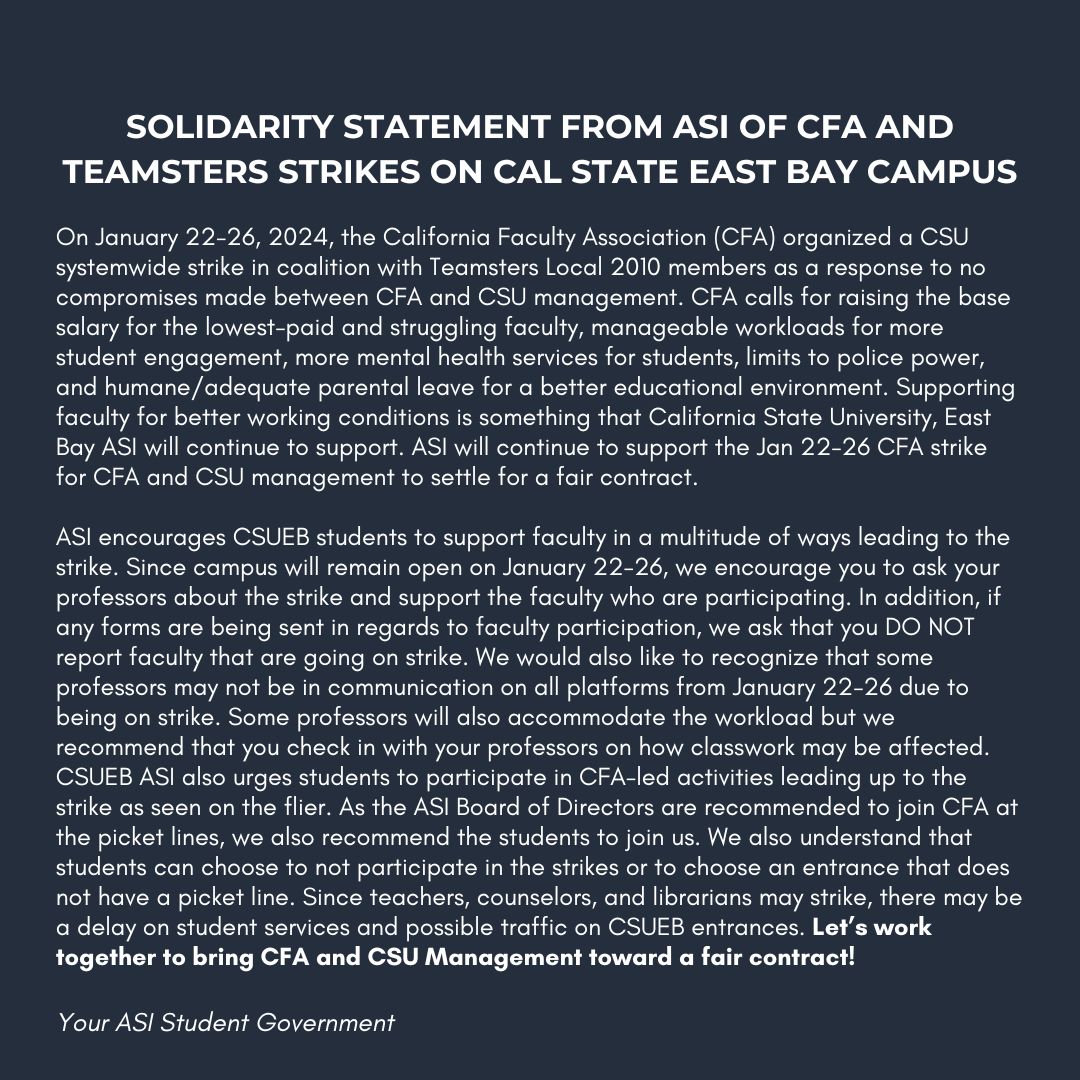
The strike is also supported by the Associated Students, Incorporated of Cal State East Bay. The following “Solidarity Statement” was posted on the CFA Facebook page on Friday.

The CFA remains committed to open dialogue with university administrators and encourages them to prioritize the needs of faculty members and our students. CFA believes that through collective efforts, a resolution can be achieved that benefits both faculty and the institutions they serve. 

Allen D. Payton contributed to this report.

 

Filed Under: East Bay, Education, Labor & Unions, News

SEIU-United Healthcare Workers West president issues statement on new state minimum wage law

December 12, 2023 By Publisher Leave a Comment

OAKLAND, Calif.  – SEIU-United Healthcare Workers West President Dave Regan issued the following statement on California’s healthcare worker minimum wage law (SB 525):

“California’s healthcare worker minimum wage law (SB 525) addresses critical staffing shortages by helping to retain existing healthcare workers and attract new caregivers to the industry. The state needs to hold fast to its commitment to invest in its healthcare workers and solve the staffing crisis in our hospitals, clinics, and medical centers.

Passed overwhelmingly by the state legislature and signed by the Governor, the bill had backing from across the healthcare industry, including the California Hospital Association and frontline healthcare workers.

The impact of the new healthcare minimum wage on the state budget has been severely overstated. As part of a compromise among healthcare stakeholders, the minimum wage will be gradually phased in over the next few years. In addition, a UC Berkeley Labor Center report states that the impact on the California budget will be partially or fully offset by low-paid workers no longer relying on Medi-Cal for their healthcare coverage.

With billions in profits, the healthcare industry has the financial resources to raise wages for their lowest-paid workers. Even before Governor Newsom signed the healthcare worker minimum wage into law, many healthcare employers had already implemented or incorporated a path to a $25/hr minimum wage for their workforce, including Stanford Healthcare, Fresenius Medical Care, Satellite Healthcare, and the biggest healthcare provider in the state, Kaiser Permanente in its largest labor contract.

Frontline healthcare workers are counting on the state of California not to waver from its commitment to addressing the patient care crisis and supporting those who provide that care.”


Filed Under: Health, Labor & Unions, Legislation, News

  • « Previous Page
  • 1
  • 2
  • 3
  • 4
  • …
  • 6
  • Next Page »
Free Kids Fishing Derby 10-10-26
RepublicServices-Antioch-ad (1)
Monica's Riverview 10-26 B
Celia's-10-26
Delta-RC-B 07-26
Deer-Valley-Chiro-06-22

Copyright © 2026 · · Contra Costa Herald · All Rights Reserved