• Home
  • About The Herald
  • Local Agencies
  • Daily Email Update
  • Legal Notices
  • Classified Ads

Contra Costa Herald

News Of By and For The People of Contra Costa County, California

  • Arts & Entertainment
  • Business
  • Community
  • Crime
  • Dining
  • Education
  • Faith
  • Health
  • News
  • Politics & Elections
  • Real Estate

CA says you must affirm gender ideology to keep your job

August 16, 2026 By Publisher 1 Comment

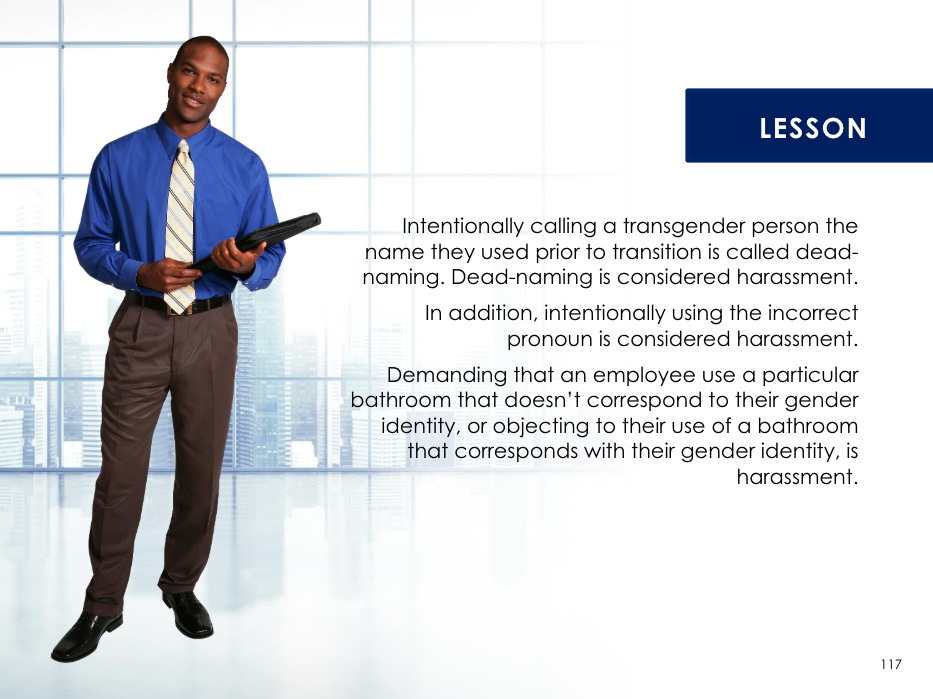
Sexual harassment training slide. Source: CA Civil Rights Department

“Misusing a coworker’s pronouns is sexual harassment”

By California Family Council

SACRAMENTO, CA —  Christian radio host Dennis McCourt sat down at his computer earlier this year to complete a training California law required. He got a few slides in, read a question asking him to affirm that misusing a coworker’s pronouns is sexual harassment, and stopped.

“There’s absolutely no way I’m going to do this,” McCourt said in an interview. “You could put a gun to my head. I won’t do it.”

McCourt works for an out-of-state Christian software company with two employees in California. That was enough to pull his employer into one of the most far-reaching workplace training mandates in the country, a law that requires employees to affirm concepts about gender identity that some religious workers say conflict with their faith. Whether the law exempts religious employers at all is a question no court, regulator, or state agency has definitively answered.

A Law That Grew

California has required sexual harassment training since 2005, but two later bills changed its scope substantially. In 2017, then-state Sen. Ricardo Lara authored SB 396, requiring employers with 50 or more employees to add training on harassment based on gender identity, gender expression and sexual orientation. The following year, then-state Sen. Holly Mitchell authored SB 1343, which dropped the threshold to five employees and extended the one-hour training requirement to all employees, not just supervisors. Both are now part of Government Code section 12950.1, and the next compliance deadline for covered employers is Jan. 1, 2027.

The law’s reach surprises many employers. A company must train its California workers if it has five or more employees anywhere in the country, even if only one works in California and the company is headquartered elsewhere, which is how McCourt’s employer became subject to it.

Sexual harassment training slide. Source: CA Civil Rights Department

An Unanswered Exemption Question

California’s Fair Employment and Housing Act generally excludes nonprofit religious organizations from the definition of “employer”, shielding churches and qualifying religious groups from many discrimination and harassment claims. But the training mandate in section 12950.1 defines “employer” on its own terms, covering any business with five or more workers, without mentioning religion or nonprofit status.

The Church Law Center of California, a firm that represents churches and religious nonprofits statewide, tells its clients they are not exempt from the training requirement. Separately, the employment law firm Weintraub Tobin has noted that other FEHA provisions requiring “all” employers to comply only “impliedly” carry forward the religious exemption found elsewhere in the code, leaving open whether that exemption applies to the training mandate specifically.

California Family Council, a Fresno-based Christian advocacy organization that tracks religious liberty issues in state law, says it has found no published court decision, no attorney general opinion, and nothing on the Civil Rights Department’s website that resolves the question. The department’s guidance repeats that the requirement applies to “all employers with five or more employees” without addressing religious organizations directly.

Even if courts eventually find that the law does reach religious employers, a further question remains untested: whether the First Amendment requires an exemption when a religious organization’s staff are asked to affirm gender identity content as a condition of compliance. Employment attorneys say that question has not yet been litigated in this context.

Sexual harassment training slide. Source: CA Civil Rights Department

What the Training Covers (see training slides here…)

The Civil Rights Department’s free supervisor training, posted at calcivilrights.ca.gov/shpt, goes beyond conduct rules into concepts about gender. One slide defines “gender identity” as a person’s internal sense of being male, female, a combination of the two, neither, or nonbinary and states that gender identity can differ from the sex a person was “assigned at birth”.

The training also walks supervisors through a scenario in which a transgender employee reports that a coworker keeps using their prior name and pronouns and has objected to their use of the women’s restroom. The training’s slides state that continuing to use a person’s prior name after a gender transition, known as “dead-naming”, “is considered harassment”, that intentionally using the wrong pronoun “is considered harassment”, and that objecting to a coworker’s restroom use based on their stated gender identity “is harassment”.

Under that framing, an employee who voices disagreement with a coworker’s restroom use, without any complaint, rudeness, or other conduct involved, has engaged in harassment as the state defines it.

Supervisors also required to watch the following video about gender and sexual orientation ideology. Notice how everything in this video is stated as facts with no acknowledgement that some employers and employees might have differing viewpoints that should also be respected. Watch here. 

The training separately warns supervisors that they can be held personally, not just professionally, liable: one slide states that employees who believe they were harassed “can sue the person who harassed them for money damages,” in addition to any action taken against the employer.

California’s own list of protected characteristics places “religion, creed” and “gender identity, gender expression” side by side as equally protected classes. Critics of the training, including McCourt and California Family Council, argue that the material puts those protections in direct tension by casting a sincerely held religious view about sex and gender as itself a form of discrimination.

Sexual harassment training slide. Source: CA Civil Rights Department

One Employee’s Refusal

McCourt’s employer required him to affirm the training’s gender identity statements before he could move to the next slide. The platform allowed a comment field, and McCourt used it on every page to record his objection rather than let a silent click stand in for agreement.

“It’s not simply passively listening to the theory,” McCourt said. “It’s having to affirm it to get to the next page, to comply with the state’s requirement and my employer’s requirement.”

McCourt’s objection is rooted in a traditional Christian reading of Genesis, which he and many other Christians understand as teaching that God created human beings male and female. For McCourt, being asked to affirm a different framework in writing is not a minor technicality but a direct conflict with that belief.

He has told his employer he cannot comply and is seeking either a religious accommodation or an alternative curriculum, and is reaching out to Christian legal organizations for help. Federal and state law both generally require employers to accommodate a sincerely held religious belief unless doing so would impose a genuine undue hardship on the business, a standard that predates this training mandate. Whether that standard applies here, and how, is the question now taking shape.

McCourt is also asking pastors in his network to speak out on the mandate.

“I have a genuine concern regarding my fellow brothers and sisters in Christ being discipled by the state of California regarding their sexual ethic,” he said. “The fact that thousands of pastors in CA are not even aware that their church members are being forced into this indoctrination is very disturbing.”

Greg Burt, vice president of California Family Council, argues the training crosses a line. “California isn’t just regulating workplaces anymore. It’s dictating what its citizens must believe,” Burt said. “No state agency has the authority to force a Christian to affirm, in writing, a view of gender he doesn’t hold. That isn’t harassment prevention. That’s compelled speech.”

McCourt points to a passage in Acts 5:29, in which the apostles tell religious authorities they “must obey God rather than men,” when they were told they should not longer speak about Jesus and his teachings. This is the biblical text he and other Christians draw on when they say conscience should take precedence over a legal requirement they believe conflicts with their faith.

Sexual harassment training slide. Source: CA Civil Rights Department

A Broader Pattern

California Family Council says this case fits a pattern it has documented in other settings, including gender-identity training for public school teachers through the state’s PRISM program, pronoun policies at the University of California, and training mandates for healthcare workers. In each case, the organization argues, Californians have faced pressure to affirm a contested view of sex and gender or risk professional consequences.

What Happens Next

California Family Council is compiling a list of pastors, employers and employees willing to go on record about the training requirement ahead of the Jan. 1, 2027 compliance deadline. The organization says it is continuing to consult attorneys on the exemption question and plans to press the Civil Rights Department and state lawmakers for clarity on whether religious organizations are covered.

About California Family Council

California Family Council works to advance God’s design for life, family, and liberty through California’s Church, Capitol, and Culture. By advocating for policies that reinforce the sanctity of life, the strength of traditional marriages, and the essential freedoms of religion, CFC is dedicated to preserving California’s moral and social foundation.

Filed Under: Employment, Faith, Legal, Legislation, News

Oakland USPS hosting Maintenance jobs hiring event Aug. 12

August 5, 2025 By Publisher 1 Comment

Source: USPS

Work for the Post Office and earn up to $35.95/hour

OAKLAND, CA — The U.S. Postal Service is hosting a free hiring event to help future employees create their online profile and immediately start applying for jobs in Maintenance.

As part our innovative 10-year-plan, Delivering for America, the Postal Service is focused on building a more stable and empowered workforce. Our employees are our greatest asset, and we are investing in our new employees by providing robust training and on-the-job support.

The Postal Service is a great place to work, with job security, career advancement opportunities and benefits. The Postal Service has an immediate need for the following positions to be filled:

  • Electronic Technician – $35.95/hour
  • Building Equipment Mechanic – $34.16/hour
  • Maintenance Mechanic (Mail Processing Equipment) – $34.16/hour
  • Maintenance Mechanic – $27.32/hour
  • Laborer Custodial – $21.52/hour

Please attend the Oakland Maintenance Hiring Event:

Location: Oakland P&DC located at 1675 7th Street, Oakland, CA 94615

Time: 10:00 am to 2:00 pm

Date: Tuesday, August 12, 2025

Applicants must be 18 years or older. All applicants must be able to pass drug screening and a criminal background investigation. Some positions require an exam. Any position that has a driving requirement will also require a valid driver license and clean DMV two-year driving history. Citizenship or permanent resident status is required.

The Postal Service is an equal opportunity employer offering a fast-pace, rewarding work environment with competitive compensation packages, on-the-job training, and opportunities for advancement. Learn more at: Careers – About.usps.com.


Filed Under: Employment, Post Office

Contra Costa Event Park seeks applications for new CEO

February 15, 2025 By Publisher Leave a Comment

Home of the Contra Costa County Fair

ANTIOCH – The Board of Director of the Contra Costa Event Park, Home of the Contra Costa County Fair announce their search for a new Chief Executive Officer (CEO). Current CEO Joe Brengle announced that he would be retiring at the end of June 2025.

Under the Board’s guidance, the CEO plans, executes and manages the annual Contra Costa County Fair. In addition to the Annual Fair, the CEO leads the planning, organization, recruitment, and management of the Contra Costa Event Parks facility rental program (Interim Events), along with negotiating and facilitating long term rental agreements.

Current CEO Joe Brengle with a character during the 2024 Contra Costa County Fair. Photo: CC Event Park

The Monthly Salary Range for the position is $8,630 – $10,567. The salary will be based on the successful candidate’s qualifications with CalHR approval. An example of additional benefits include: State of California, Public Employment Retirement System (PERS), Vacation & Sick Leave, Health Plan, Dental Plan, Vision Plan and State Holidays.

A full description of the position and application process is available on the Fairs website CEO-Flyer.pdf, or can be picked up at the Fair Administration Office, 1201 W. 10th Street, Antioch.

Mark your calendars for the 2025 Contra Costa County Fair May 15 – 18, with the theme “Let’s Go Country”.

Allen D. Payton contributed to this report.

Filed Under: East County, Employment, Fairs & Festivals, Government, News

CA Controller publishes 2023 payroll data for local governments

June 25, 2024 By Publisher Leave a Comment

Of 11,946 Contra Costa County employees, Administrator highest paid at $494,001

SACRAMENTO — State Controller Malia M. Cohen has released the 2023 self-reported payroll data for cities and counties on the Government Compensation in California website. The data covers 517,358 positions and a total of more than $40.72 billion in 2023 wages.

Users of the site can:

  • View compensation levels on maps and search by region;
  • Narrow results by name of the entity or by job title; and
  • Export raw data or custom reports.

The newly published data includes 462 cities and 52 counties. The City of Hayward had the highest average city employee wage in California, followed by Atherton, Pleasant Hill, and Beverly Hills. The counties with the highest average employee wages were Alameda, Contra Costa, Napa, Monterey, and Ventura. The city employee with the highest total wages in California was a police officer for the City of Santa Monica, while the top 20 highest-paid county employees work in health care professions.

Data for Contra Costa County show 11,946 employees worked sometime during the year and were paid $1,137,258,564 in wages and $470,014,925 in retirement and health contribution. The highest paid employee was the County Administrator with $494,001 total pay, which included $466,378 in regular pay, $20,423 in lump sum payment, described as paid to the employee for one-time cash-outs (including, but not limited to, paid excess vacation and sick leave, and legal settlements), and $7,200 for other pay, described as any other pay not reported as regular pay, overtime pay, or lump-sum pay such as car allowances, meeting stipends, incentive pay, bonus pay, etc.

California law requires cities, counties, and special districts to annually report compensation data to the State Controller. The State Controller also maintains and publishes state and CSU salary data. Five counties and 20 cities failed to file or provided incomplete or late information. San Francisco is both a city and a county; the website reports San Francisco as a city.

Since the website launched in 2010, State Controller’s Office has published pay and benefit information on more than two million government jobs in California, as reported annually by each entity.

As the chief fiscal officer of California, Controller Cohen is responsible for accountability and disbursement of the state’s financial resources. The Controller has independent auditing authority over government agencies that spend state funds. She is a member of numerous financing authorities, and fiscal and financial oversight entities including the Franchise Tax Board. She also serves on the boards for the nation’s two largest public pension funds. Follow the Controller on X at @CAController and on Facebook at California State Controller’s Office.


Filed Under: Employment, Government, News, State of California

Scathing State Audit confirms Labor Commissioner’s 47,000 backlogged claims at end of 2022-23

May 29, 2024 By Publisher 2 Comments

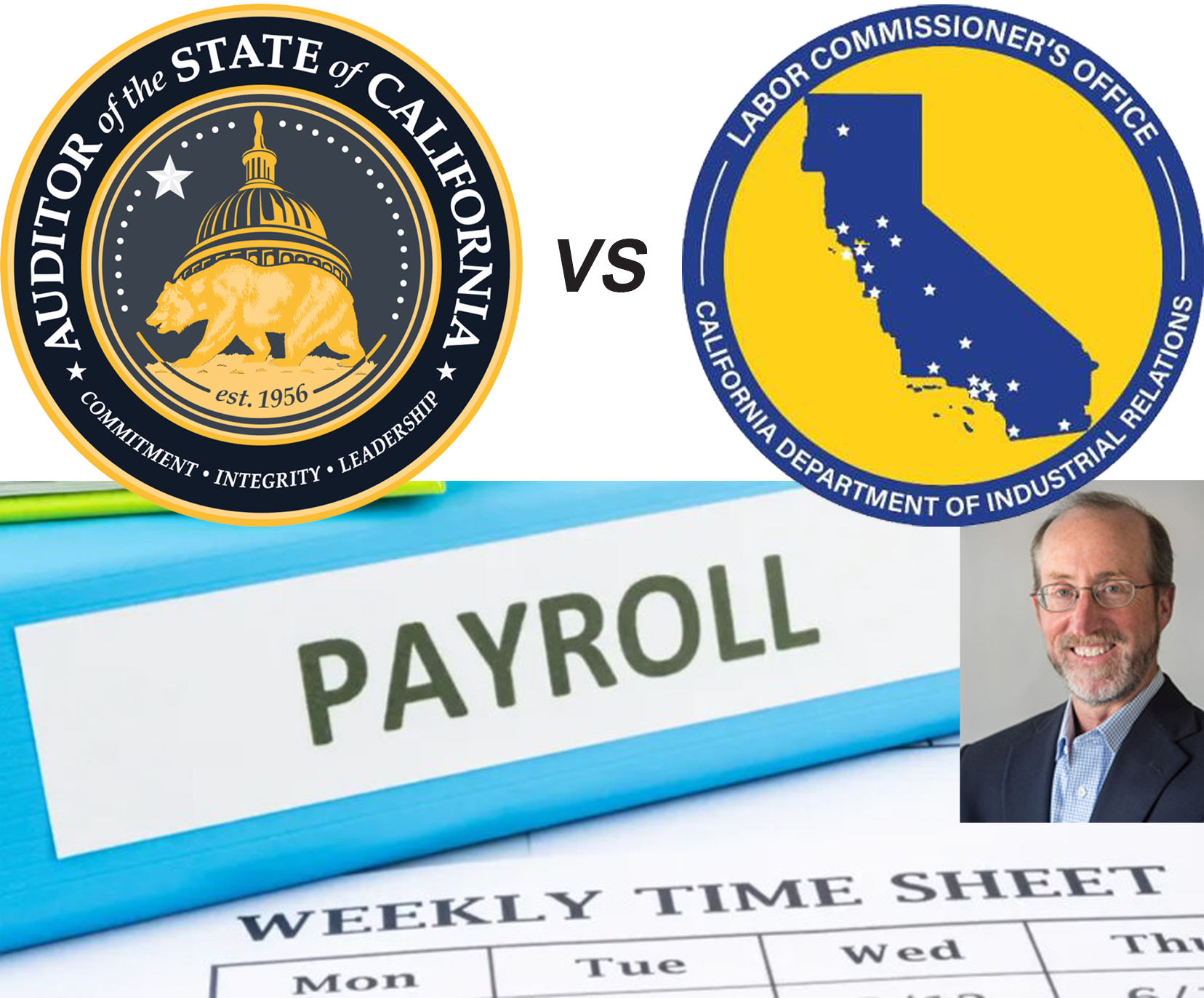
Payroll graphic source: CA State Auditor

Senator Glazer’s request leads to findings of workers cheated out of $63.9 million in past wages

Calls it a failure to act on behalf of workers

Report claims inadequate staffing, poor oversight have weakened protections for workers

SACRAMENTO – California Labor Commissioners have stood idly by as a massive backlog in wage theft cases piled up worth $63.9 million in lost wages to workers as its enforcement unit failed to enforce and collect wages in 76 percent of cases in which employers were found to owe wages, according to a report released Wednesday by Grant Parks, the California State Auditor.

The scathing audit came as a result of a March 2023 request through the Joint Legislative Audit Committee by Senator Steve Glazer, D-Contra Costa, and Assemblyman David Alvarez, D-San Diego. It was based on news reports about the lack of wage theft enforcement.

Parks reported his findings to the Governor, President pro Tempore of the Senate and Speaker of the Assembly about the “Department of Industrial Relations’ Division of Labor Standards Enforcement, also known as the Labor Commissioner’s Office (LCO).” Lilia García-Brower is the current state Labor Commissioner and was appointed to the position by Governor Newsom in July 2019. Neither her name or photo appears on the website for the Labor Commissioner’s Office. Ironically, according to the agency’s website, “The mission of the LCO is to ensure a just day’s pay in every workplace in the State and to promote economic justice through robust enforcement of labor laws. By combating wage theft, protecting workers from retaliation, and educating the public, we put earned wages into workers’ pockets and help level the playing field for law-abiding employers.”

The audit “reviewed the backlog of wage claims submitted by workers from fiscal years 2017–18 through 2022–23, and determined that the LCO is not providing timely adjudication of wage claims for workers primarily because of insufficient staffing to process those claims.”

Furthermore, the state Auditor reported, “In addition to its delays in processing wage claims, the LCO has not been successful in collecting judgments from employers. A possible factor contributing to its low collection rate is that the Enforcement Unit does not consistently use all of the methods available to it for collecting payments owed to workers.”

Senator Glazer released this statement on the audit’s findings:

“The California State Auditor’s report makes clear that our State Labor Commissioner is a toothless enforcer of our wage theft laws. This deeply troubling assessment exposes a system that has fundamentally failed the workers it is supposed to protect. According to the auditor, there is a backlog of 47,000 claims registered on June 30, 2023. This is a state embarrassment and a stain on the department that workers depend on for justice.

The report also highlights an alarming increase in the average number of days to resolve claims, which has skyrocketed from 420 days in 2017/18 to an astounding 890 days in 2022/23. This drastic decline in efficiency is not just a statistic; it represents thousands of workers enduring prolonged injustice and financial hardship.

This lack of enforcement emboldens companies to exploit workers, knowing they can likely escape any real consequences, thus perpetuating and increasing further abuse. These findings paint a grim picture of an agency overwhelmed and ineffective, leaving workers vulnerable and without recourse. Immediate and decisive action to restore integrity and effectiveness to the Labor Commissioner’s office is needed. The workers of California deserve nothing less than a robust system that ensures timely and fair resolution of wage theft claims.”

The report can be found here: www.auditor.ca.gov/reports/the-california-labor-commissioners-office/

Allen D. Payton contributed to this report.

Filed Under: Employment, Finances, Government, Jobs & Economic Development, Labor & Unions, Legal, News, State of California

Bill to mandate ‘science of reading’ in CA schools faces teachers’ union opposition

April 6, 2024 By Publisher Leave a Comment

Teacher Jennifer Dare Sparks conducts a reading lesson in her 3rd/4th class at Ethel I. Baker Elementary School in Sacramento, Calif. Thursday, Jun. 2, 2022. Photo credit: Randall Benton / EdSource

Part of nationwide push to bring back phonics, sponsors seek compromise, CTA refuses to negotiate

By DIANA LAMBERT, JOHN FENSTERWALD, ZAIDEE STAVELY, EDSOURCE.org

California’s largest teachers’ union has moved to put the brakes on legislation that mandates instruction, known as the “science of reading,” that spotlights phonics to teach children to read.

The move by the politically powerful California Teachers Association (CTA) puts the fate of Assembly Bill 2222 in question as supporters insist that there is room to negotiate changes that will bring opponents together.

CTA’s complaints include some recently voiced by some advocacy organizations for English learners and bilingual education that oppose the bill and have refused to negotiate any changes to make the bill more acceptable.

The teachers union put its opposition to AB 2222 in writing in a lengthy letter to Assembly Education Committee Chairman Al Muratsuchi last week. The committee is expected to hear the bill, introduced in February, later this month.

The letter includes a checklist of complaints including that the proposed legislation would duplicate and potentially undermine current literacy initiatives, would not meet the needs of English learner students and cuts teachers out of the decision-making process, especially when it comes to curriculum.

“Educators are best equipped to make school and classroom decisions to ensure student success,” the letter said. “Limiting instructional approaches undermines teachers’ professional autonomy and may impede their effectiveness in the classroom.”

Marshall Tuck, CEO of EdVoice, an advocacy nonprofit co-sponsoring the bill, said he was surprised that CTA would oppose legislation that would ensure all teachers are trained to use the latest brain research to teach children how to read.

“Unfortunately, a lot of folks in the field haven’t actually been trained on that, and a lot of the instruction materials in classrooms today don’t align with that,” Tuck said.

Tuck said CTA appears to misunderstand the body of evidence-based research known as the science of reading. It “is not a curriculum and is not a program or a one-size-fits-all approach,” he said. “It will give teachers a foundational understanding of how children learn to read. Teachers will still have a lot of room locally to decide which instructional moves to make on any given day for any given children. So, you’ll still have significant differentiation.”

A nationwide push

California’s push to adopt the science of reading approach to early literacy is in sync with 37 states and some cities, such as New York City, that have passed similar legislation.

States nationwide are rejecting balanced literacy as failing to effectively teach children how to read, since it trains children to use pictures to recognize words on sight, also known as three-cueing. The new method would teach children to decode words by sounding them out, a process known as phonics.

Although phonics, the ability to connect letters to sounds, has drawn the most attention, the science of reading focuses on four other pillars of literacy instruction: phonemic awareness, identifying distinct units of sounds; vocabulary; comprehension; and fluency. It is based on research on how the brain connects letters with sounds when learning to read.

Along with mandating the science of reading approach to instruction, AB 2222 would require that all TK to fifth-grade teachers, literacy coaches and specialists take a 30-hour-minimum course in reading instruction by 2028. School districts and charter schools would purchase textbooks from an approved list endorsed by the State Board of Education.

The legislation goes against the state policy of local control that gives school districts authority to select curriculum and teaching methods as long as they meet state academic standards. Currently, the state encourages, but does not mandate, districts to incorporate instruction in the science of reading in the early grades.

“It’s a big bill,” said Yolie Flores, president of Families in Schools, a co-sponsor. “We’re very proud that it’s a big bill because that means it is truly consequential in the best way possible for children. It’s not a sort of tweak around the edges kind though, it’s the kind of bill that really brings transformation. So we are hoping that the Legislature sees beyond the sort of typical pushback and resistance, and in the end, I think, teachers will see that this was a huge benefit for them.”

Seeking compromise

The bill’s author, Blanca Rubio, D-Baldwin Park, said she took CTA’s seven-page letter not as an outright rejection but as an opportunity for negotiations.

“I’m glad they sent this letter,” she said. “They outline their objections and the reasons why, and that’s something I can work with. It’s not a flat, ‘No, we don’t want you to do it.’ They gave me specific items that I can look at and have a conversation about.”

She said that Assemblymember Muratsuchi asked her to work with the CTA on a compromise. She is also meeting with consultants for Assembly Speaker Robert Rivas, D-Salinas, “to look at the big picture,” she said.

But Flores says the state’s budget problems, with predictions of no money for new programs, may be a bigger hurdle to getting the bill passed than the CTA opposition. The cost of paying for the required professional development for teachers would total $200 million to $300 million, she said. Because it is a mandate, the state would be required to repay districts for the cost.

“That is a drop in the bucket for something so transformational, so consequential,” Flores said. “I hope that the Legislature really comes to that realization. We’re in a budget deficit, but our budget is a statement of priorities.”

Advocates say that it is imperative that California mandate instruction in the science of reading. In 2023, just 43% of California third graders met the academic standards on the state’s standardized test in 2023. Only 27.2% of Black students, 32% of Latino students and 35% of low-income children were reading at grade level, compared with 57.5% of white, 69% of Asian and 66% of non-low-income students.

“It’s foundational,” Flores said. “It’s not the only thing teachers need to know. It’s not the only thing that teachers will need to do and to adhere to, but it’s sort of the basic foundational knowledge of how children’s brains work in order to learn to read.”

The bill would sunset in 2028 when all teachers are required to have completed training. Beginning in July, all teacher preparation programs would be required to teach future educators to base literacy instruction on the science of reading.

Needs of English learners

The CTA and other critics of AB 2222 charge that it ignores the need of English learners for oral language skills, vocabulary and comparison between their home languages and English, which they need in order to learn how to read. Four out of 10 students in California start school as English learners.

Tuck disputes this. “We actually emphasize oral language development,” he said. “This would be the first statute that would say when instructional materials are adopted, and when teachers are trained in the science of reading, they must include a focus on English learners and oral language development.”

Representatives from Californians Together, an advocacy organization for English learners and bilingual education, applauded the CTA’s opposition to the bill. They oppose the bill, rather than suggest amendments, because they disagree with its overall approach.

“We just don’t think this is the right bill to address literacy needs,” said Executive Director Martha Hernandez. “It’s very restrictive. We know that mandates don’t work. It lacks a robust, comprehensive approach for multilingual learners.”

Instead, Californians Together and the California Association for Bilingual Education have both said they would prefer California fund the training of teachers and full implementation of the English Language Arts/English Language Development Framework.

The framework was adopted in 2014 and encourages, but does not mandate, explicit instruction in foundational skills and oral language development for English learners.

The California Language Teachers Association has requested the bill be amended to include information about teaching literacy in languages not based on the English alphabet, such as Japanese, Chinese or Arabic, according to Executive Director Liz Matchett. However, the organization has not yet taken a position on the bill.

“I agree that we want to support all children to be able to read. If they can’t read, they can’t participate in education, which is the one way that is proven to change people’s circumstances,” said Matchett, who teaches Spanish at Gunn High School in Palo Alto. “There’s nothing to oppose about that. I’m still a classroom teacher, and all the time, you get kids in high school who can’t read.”

Education Trust-West urges changes in the bill to center the needs of “multilingual learners” — children who speak languages other than English at home — and to include more oversight and fewer mandates, such as those that may discourage new teachers from entering the profession.

“If our recommended amendments were to be accepted, EdTrust-West would support it as a much-needed solution to California’s acute literacy crisis.”

Claude Goldenberg, professor emeritus of education at Stanford University, said “it was disappointing” to see CTA’s opposition, particularly because the union did not suggest amendments. He said he had met with representatives from CTA and urged them to identify what could be changed in the bill.

In a recent EdSource commentary, Goldenberg urged opponents to “do the right thing for all students. AB 2222’s introduction is an important step forward on the road to universal literacy in California. We must get it on the right track and take it across the finish line.”

Referring to the CTA’s opposition, Goldenberg said, “Obviously my urgings fell flat. They identified why they’re opposing, but there’s no indication of any possible re-evaluation.”

Goldenberg, who served on the National Literacy Panel, which synthesized research on literacy development among children who speak languages other than English, has called on the bill’s authors to amend it to include a more comprehensive definition of the “science of reading” and include more information about teaching students to read in English as a second language and in their home languages.

The CTA has changed its position on bills related to literacy instruction in the last two years. It had originally supported Senate Bill 488, which passed in 2022. The legislation requires a literacy performance assessment for teachers and oversight of literacy instruction in teacher preparation. The union is now in support of a bill that would do away with both.

The change of course was attributed to a survey of 1,300 CTA members, who said the assessment caused stress, took away time that could have been used to collaborate with mentors and for teaching, and did not prepare them to meet the needs of students, according to Leslie Littman, vice president of the union, in a prior interview.

Veteran political observer Dan Schnur said he’s not surprised CTA would oppose the bill since some of its political allies are against it; the question is how important CTA considers the bill.

“If it becomes a pitched battle, CTA will have to decide whether it is one of its highest priorities in this session,” he said.

Gov. Gavin Newsom hasn’t indicated his position yet, but Schnur, the press secretary for former Gov. Pete Wilson, who teaches political communications at UC Berkeley and USC, said, “This is not the type of fight Newsom needs or wants right now. If he has strong feelings, it’s hard to see him going to war for or against.”

Filed Under: Employment, Labor & Unions, Legislation, News

Contra Costa Advisory Council on Equal Employment Opportunity seeks three members

February 20, 2024 By Publisher Leave a Comment

One Business member, two Community members

The Contra Costa County Advisory Council on Equal Employment Opportunity (ACEEO) has one vacant Business seat and two vacant Community seats open to applicants. The successful candidate for the Business seat must own a business within the county, and candidate(s) for the Community seats must either work or reside within the county. All candidates must have an interest in equal employment matters. The ACEEO meets on the fourth Friday of each month from 9:30 a.m. to 11:30 a.m., except for holidays.

The ACEEO assists with the implementation of the County’s Equal Employment Opportunities and Contracting Programs and serves as an advisory committee to the Board of Supervisors. The ACEEO reviews the Equal Employment Opportunities Program and recommends actions to facilitate the attainment of the County’s goals for equal employment opportunities regardless of gender and race/ethnicity.

The Board of Supervisors established the ACEEO on July 9, 1991. The Council has thirteen (13) seats representing the following groups: 4 Community seats; 2 Labor seats; 2 Management seats; 1 Educational seat; 1 Disability seat; 1 Business seat; 1 Veteran seat; and 1 Labor/Trade seat.

Application forms can be obtained from the Clerk of the Board of Supervisors by calling (925) 655- 2000 or visiting the County webpage at www.contracosta.ca.gov/3418. Applications should be returned to the Clerk of the Board of Supervisors, 1025 Escobar St., 1st Floor, Martinez, CA 94553. Applications can also be emailed to ClerkoftheBoard@cob.cccounty.us.

Applicants should plan to be available for public interviews. For further information about the ACEEO, please contact Antoine Wilson at antoine.wilson@riskm.cccounty.us or (925) 335-1455. You can also visit the web page at www.contracosta.ca.gov/4503/Advisory-Council-on-Equal- Employment-Opp.


Filed Under: Employment, Government, News

Valentine’s Day marchers call on UC Regents, Chancellors to “Break Up with Blackstone”

February 15, 2024 By Publisher Leave a Comment

Marches at two of seven UC campuses on Valentine’s Day. Source: AFSCME 3299 Facebook page

Hundreds of students, workers, tenants participate at 7 UC campuses; claim UC is major shareholder in $3.5B controversial private equity investment trust that’s been linked to state’s housing affordability Crisis

On Valentine’s Day, Wednesday, Feb. 14, 2024, students, the University of California’s (UC) union of low-wage frontline service and patient care workers – members of AFSCME Local 3299 – alongside Blackstone tenants and community members with the Alliance of Californians for Community Empowerment (ACCE) called on UC Chancellors to “Break up with Blackstone” and invest in affordable housing. The global Wall Street private equity firm Blackstone has become the largest landlord in America and has been accused of worsening high housing costs and evictions.

Actions were held across the state in seven locations on the campuses of UC Berkeley, UC Davis, UC Santa Cruz, UCLA, UC Riverside, UC Santa Barbara and UC San Diego. The renewed call to divest from Blackstone follows the announcement of its $3.5 billion acquisition of Tricon Residential Inc. UC invested $4.5 billion in Blackstone’s BREIT in 2023 to boost investor confidence amid a wave of shareholder redemptions.

Blackstone went on an aggressive buying spree in 2021 and 2022, expanding its residential real estate empire, and adding over 200,000 housing units to its portfolio, including 5,600 naturally occurring affordable housing units in the San Diego area. ACCE released a report earlier this year with the Private Equity Stakeholder Project showing that Blackstone had raised rents in some units in San Diego between 43% – 64% in two years. Even before its announced acquisition of Tricon Residential, Blackstone owned more than 300,000 housing units, including a majority stake in the nation’s largest provider of student housing. As California becomes increasingly unaffordable, throwing more families into homelessness, Blackstone’s aggressiveness as one of the largest landlords in the state in hiking up rents for its thousands of units only adds to the problem.

UC acknowledged last year that its staff vacancy rate had tripled under the weight of California’s housing affordability crisis since the start of the COVID Pandemic, but has thus far failed to act on calls from students and workers to divest from Blackstone and invest in more affordable housing.  The University currently houses just 38% of its students in places that cost 30% more, on average than comparable campus communities nationwide. Recent news reports have chronicled the struggles of UC’s low-wage service and patient care workers being forced to commute several hours or sleep in their cars to maintain their employment.

AFSCME Local 3299 represents more than 33,000 Service and Patient Care Technical workers at UC’s 10 campuses, 5 medical centers, numerous clinics, research laboratories, and UC Law, SF.

The Alliance of Californians for Community Empowerment (ACCE) Action is a grassroots, member-led, statewide community organization working with more than 16,000 members across California. ACCE is dedicated to raising the voices of everyday Californians, neighborhood by neighborhood, to fight for the policies and programs we need to improve our communities and create a brighter future.

Filed Under: Employment, Finances, Labor & Unions, News, State of California

Brentwood to provide space for remote workers

September 6, 2023 By Publisher 1 Comment

Tech MeetUp launches Sept. 13

By Darin Gale, Brentwood Assistant City Manager

The City of Brentwood will launch the Brentwood Tech MeetUp at the Brentwood Community Center, 35 Oak Street, beginning Wednesday, September 13th at 9 am. The City’s Economic Development team is spearheading this effort in order to provide an alternative workspace for the hundreds of hybrid and remote tech workers residing in the City.

“The Tech MeetUp will serve to provide hybrid and remote tech workers a break from working at home and an opportunity to network with others in similar industries, seek new jobs or ventures with like-minded individuals”, shared Ricardo Noguera, Economic Development Manager.

The Tech MeetUp will operate from 9:00am – 4:00pm on Mondays, Wednesdays and Thursdays in a casual drop-in setting, offering, free Wi-Fi connection and complimentary coffee, refreshments and snacks. “Just bring your laptop, phone, etc. to work and connect with other passionate tech workers in Brentwood”, added Abraham Salinas, Senior Economic Development Analyst.

To learn more please visit, Brentwoodca.gov/tech-meetup or contact Ricardo Noguera, Economic Development Manager at RNoguera@brentwoodca.gov or (925) 516-5118.


Filed Under: Business, East County, Employment, Jobs & Economic Development

Applicants sought for Contra Costa Advisory Council on Equal Employment Opportunity

May 6, 2021 By Publisher Leave a Comment

The Contra Costa County Advisory Council on Equal Employment Opportunity (ACEEO) has one (1) vacant Community seat open to applicants. The successful candidate must reside within Contra Costa County and have an interest in equal employment matters. The ACEEO meets the fourth Friday of each month from 9:30 a.m. -11:30 a.m. except for holidays.

The ACEEO assists with the implementation of the County’s Equal Employment Opportunity and Contracting Programs and serves as an advisory committee to the Board of Supervisors. The Council reviews the Equal Employment Opportunities Program and recommends actions to facilitate the attainment of the County’s goals for equal employment opportunities regardless of gender, and race/ethnicity.

The Board of Supervisors established the ACEEO on July 9, 1991. The Council has thirteen (13) seats representing the following groups:  4 Community seats; 2 Labor seats; 2 Management seats; 1 Educational seat; 1 Disability seat; 1 Business seat; 1 Veteran seat; and 1 Labor/Trade seat.

Application forms can be obtained from the Clerk of the Board of Supervisors by calling (925) 655-2000 or visiting the County webpage at www.contracosta.ca.gov/3418.  Applications should be returned to the Clerk of the Board of Supervisors, 1025 Escobar St., 1st Floor, Martinez, CA 94553 no later than 5:00 p.m. on Monday, May 31, 2021. Applications can also be emailed to ClerkoftheBoard@cob.cccounty.us.

Applicants should plan to be available for public interviews on June 7, 2021. Due to COVID-19, interviews will be conducted via Zoom.  For further information about the ACEEO, please contact Antoine Wilson at antoine.wilson@riskm.cccounty.us or (925) 335-1455. You can also visit the web page at www.contracosta.ca.gov/4503/Advisory-Council-on-Equal-Employment-Opp.


Filed Under: Employment, Government, News

  • 1
  • 2
  • Next Page »
RepublicServices-Antioch-ad (1)
Monica's dinner 05-26 CCH
Delta-RC-B 07-26
Deer-Valley-Chiro-06-22

Copyright © 2026 · · Contra Costa Herald · All Rights Reserved