• Home
  • About The Herald
  • Local Agencies
  • Daily Email Update
  • Legal Notices
  • Classified Ads

Contra Costa Herald

News Of By and For The People of Contra Costa County, California

  • Arts & Entertainment
  • Business
  • Community
  • Crime
  • Dining
  • Education
  • Faith
  • Health
  • News
  • Politics & Elections
  • Real Estate

5th Annual Mount Diablo Beacon Lighting on Veterans Day Nov. 11

November 9, 2026 By Publisher Leave a Comment

Source: Veterans of Foreign Wars, Post 75, Danville, CA

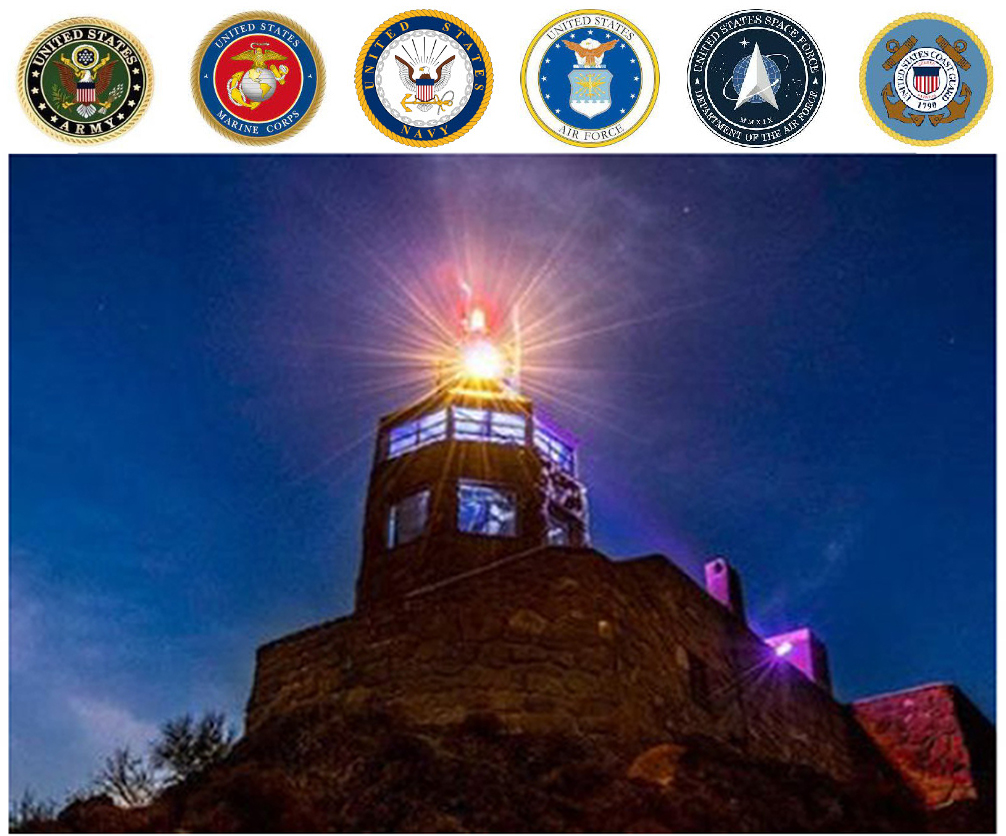
To be lit at sunset to honor those who have served in the U.S. Military

By Sean Gannon, VFW Post 75 (Danville, CA), Commander, U.S. Navy (retired)

Join local veterans and the Mayor of Danville at 4:40 pm by the Flagpole in front of the Veterans Memorial Building in Danville as they press the button at 5:00 pm to light the Beacon atop Mount Diablo.

A proclamation was signed on February 25, 2022, in the Veterans Memorial Building in Danville to light the Beacon on Mount Diablo not only on Pearl Harbor Day, but also on Memorial Day and Veterans Day.

Special thanks to California State Parks, Save Mount Diablo and the Town of Danville for all of their amazing support to honor veterans!

Sponsored by the Veterans of Foreign Wars, Post 75, Danville, CA

Please contact Sean Gannon with any questions at SeanAnonGannon@outlook.com or (843) 564-6753.

Filed Under: Holiday, Military, San Ramon Valley

CA State Parks promotes safe, responsible recreation during Off-Highway Vehicle Safety Week Nov. 14-22

November 9, 2026 By Publisher Leave a Comment

During OHV Safety Week, free safety classes for all-terrain vehicles, recreational off-highway vehicles and motorcycles will be offered at several state vehicular recreation areas. Photo from California State Parks.

FREE off-highway vehicle (OHV) safety classes and events will be offered throughout the state

By CA State Parks

SACRAMENTO – California State Parks will be offering 17 OHV safety courses and events during the fifth annual OHV Safety Week (Nov. 14-22). Off-road enthusiasts can learn about the Off-Highway Motor Vehicle Recreation (OHMVR) Division’s “Ride to Ride Again” OHV Safety Week theme, which emphasizes the importance of riding responsibly and respectfully. Visitors can also participate in hands-on safety activity events during the week at several state vehicular recreation areas (SVRA).

“California’s state vehicular recreation areas offer some of the most spectacular and diverse riding terrains in the world,” said Jack Gorman, OHMVR Division assistant chief. “But it’s important that visitors understand the risks and know how to ride and drive responsibly. During the week, we want to remind all riders that the best day on the trails is a safe day. That’s why we’ve partnered with the All-Terrain Vehicle Safety Institute, Motorcycle Safety Foundation and Recreational Off-Highway Vehicle Association to make training free for all California residents.”

Key Safety Tips In collaboration with RideOHV.com, State Parks reminds all riders of the importance of responsible recreation. Following a few key safe practices helps ensure that everyone can continue to enjoy these great experiences.

  • Get trained: Take advantage of free online all-terrain vehicles (ATV) and side-by-side safety training, then sign up for hands-on training to build skills and ride with confidence.
  • Wear the right protective gear: Always wear a Department of Transportation (DOT)-compliant helmet and appropriate protective gear every time you ride. In a side-by-side, always wear your seat belt.
  • Ride and drive responsibly: Stay on designated trails and riding areas, follow posted signs, travel at a safe speed and help protect the trails for the future.
  • Choose age-appropriate vehicles: ATVs are not one-size-fits-all, and young riders should ride on models designed for their age and size. With side-by-sides, drivers must be 16 years or older with a valid driver’s license.
  • Keep off-road vehicles off paved roads: ATVs and side-by-sides are designed for off-road use only.

Everyone on the trail has a responsibility to contribute to a safer, more informed off-highway recreation community.

Throughout OHV Safety Week, free ATV, side-by-side and motorcycle safety classes will be offered statewide in collaboration with RideOHV.com. California’s SVRAs will offer OHV safety-focused programming, such as junior ranger programs, informational pop-ups and a poker ride. The week will culminate by celebrating Ocotillo Wells SVRA’s 50th anniversary on Saturday, Nov. 21.

Prairie City SVRA will host the “Ride to Ride Again” Poker Run, which includes educational stops to instruct riders about the aspects of pre- and post-mechanical inspections and other safety principles. Riders can score points for prizes and will receive a commemorative patch at the end of the run. A free RIDE Day event at the Honda Rider Education Center in Colton, Nov. 21 and 22, will provide an opportunity for new users to experience ATVs or side-by-sides with a training demo. Vehicles, riding gear and coaches will be provided at no cost. Information about the event is also available at RideOHV.com. For further information about these and other scheduled events and free safety classes during OHV Safety Week, visit the OHMVR Division website or RideOHV.com.

For additional resources on OHV safety or to find a SVRA near you, visit ohv.parks.ca.gov.

About the OHMVR Division California’s OHMVR Division was created in 1971 out of the critical need to better manage the growing demands for OHV recreation, while fostering respect for private property rights and protecting the state’s natural and cultural resources. Today, there are nine SVRAs across California: Carnegie, Clay Pit, Eastern Kern County Onyx Ranch, Heber Dunes, Hollister Hills, Hungry Valley, Oceano Dunes, Ocotillo Wells and Prairie City. The OHMVR program also supports safe and responsible OHV recreation beyond the state park system. Since 1971, more than $884 million in grants, managed by the OHMVR Division, have been awarded to federal and local partners, funding acquisition and development, resource protection, safety and education, and law enforcement for OHV recreation. For more information about the OHMVR Division, including grant opportunities, please visit ohv.parks.ca.gov.

In October 2020, the California OHMVR Commission passed a resolution dedicating one week of the year to promote and focus on safe and responsible OHV practices.

California State Parks and the recreational programs supported by its divisions of Boating and Waterways, Historic Preservation and Off-Highway Motor Vehicle Recreation provide the opportunity for families, friends, and communities to connect. Off-highway motor vehicle recreation, boating activities, horseback riding, cycling, hiking, camping, rock climbing, tours, hikes, school group enrichment, and special events are just some of the activities enjoyed in 280 park units organized into 21 field districts throughout the state. Learn more at www.parks.ca.gov.


Filed Under: News, Parks, Recreation, State of California

Guest Column: Alzheimer’s patients deserve answers sooner

November 9, 2026 By Publisher Leave a Comment

By Kenneth E. Thorpe

Nearly half of American voters have a loved one who has been diagnosed with Alzheimer’s. And Alzheimer’s will touch even more families in the years ahead, as the number of Americans living with the fatal disease nearly doubles by 2050.

Thankfully, scientists are developing new tools to help diagnose and manage Alzheimer’s. Among the most promising are blood tests that could help millions of Americans receive diagnoses earlier — so they can start treatment sooner.

But it’s not enough for these tools to exist. Patients need access to these promising tests as soon as they’re approved. For that to happen, Congress will need to pass legislation ensuring Medicare can cover new screening tests — and cut the red tape that currently risks preventing Alzheimer’s patients from getting the care they need.

A bipartisan bill, the Alzheimer’s Screening and Prevention (ASAP) Act, would do precisely that. The bill offers lawmakers an opportunity to remove a barrier standing between patients and earlier diagnosis, potentially allowing patients to get valuable time back.

Historically, Alzheimer’s was difficult to diagnose. Initial symptoms can be hard to recognize, particularly among older adults experiencing general cognitive decline. Doctors had to rely on a combination of medical history, physical exams, brain scans, and cerebrospinal fluid testing.

As a result, it can take patients over three years after symptoms first emerge to receive an official diagnosis.

Now, new tools are emerging that could dramatically speed up this timeline. Last year, the FDA cleared the first blood test used to help diagnose Alzheimer’s. The test detects biological markers in the blood associated with the disease, offering an easier and less invasive testing option. In the future, doctors could use similar blood tests as screening tools to identify Alzheimer’s far earlier — long before symptoms worsen.

That kind of earlier diagnosis can make an enormous difference.

For one, it gives families more time to plan and prepare for the financial and caregiving burdens that come with Alzheimer’s. Long-term care services can cost $72,800 to $115,000 annually. Many family members of patients with Alzheimer’s and other dementias become caregivers themselves, collectively providing more than 19 billion hours of unpaid care worth over $446 billion.

Alzheimer’s damages the connections between brain cells. Once those neurons are lost, they can’t be repaired or regenerated. Alzheimer’s treatments therefore generally focus on preventing damage and slowing the disease’s progression. And after a certain point, patients simply aren’t eligible for treatment anymore.

Yet for patients to benefit from recent diagnostic advances, Medicare needs to cover them.

Policymakers shouldn’t stop there, though. As Alzheimer’s science continues to advance, Medicare needs to keep pace by removing unnecessary barriers and ensuring that patients can actually access the new diagnostics and treatments that researchers develop.

We increasingly have the tools to change the trajectory of early-stage Alzheimer’s. But first, we must ensure that patients can access those tools in time. Doing so would create wide ripple effects of positive impact on millions of individuals and families facing this staggering diagnosis.

Kenneth E. Thorpe, PhD, is the Robert W. Woodruff Professor of Health Policy at the Rollins School of Public Health at Emory University and the honorary Chair of the Partnership to Fight Chronic Disease. This piece originally ran in DCJournal.com.

Filed Under: Government, Health, Legislation, Opinion, Seniors

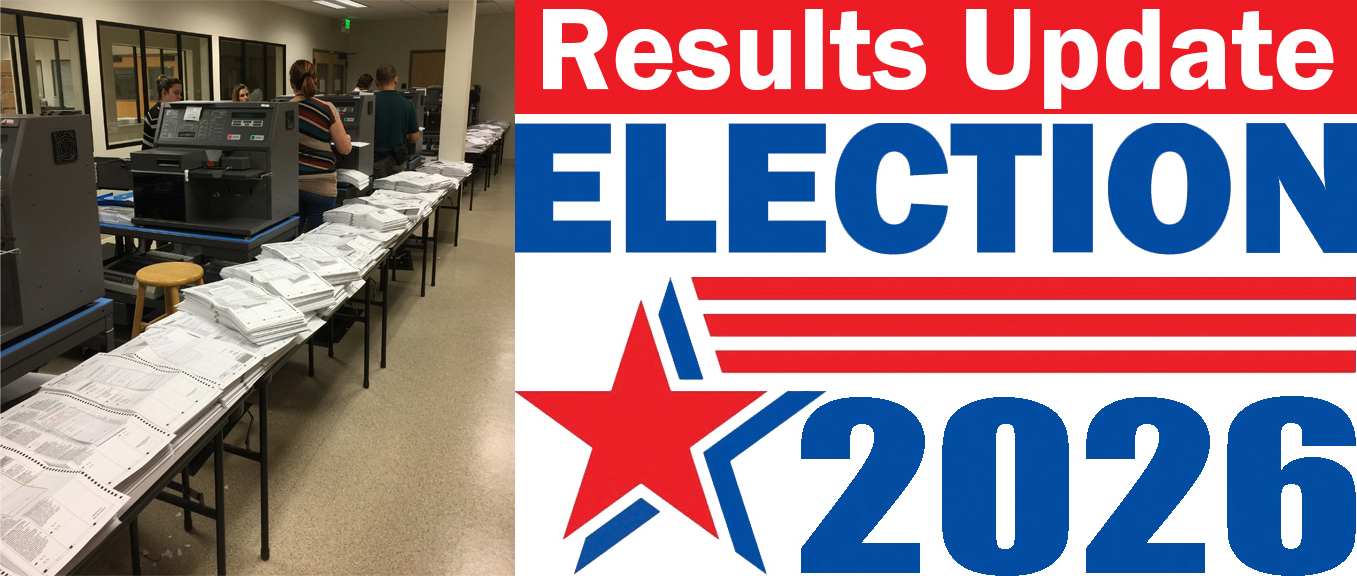
Over 184,000 estimated ballots left to count in Contra Costa

November 5, 2026 By Publisher Leave a Comment

Source: Herald file photo

Could affect outcomes in close races

By Allen D. Payton

As of Thursday afternoon, Nov. 5, 2026, the Contra Costa Elections office announced there are 184,200 unprocessed ballots remaining to be counted in the county from Tuesday’s election.

Also, they announced the next results update is expected to be provided Friday afternoon, Nov. 6 at 4:00 p.m.

The remaining ballots could affect the outcome of several close races in the county.

Following is the breakdown of the Estimated number of unprocessed ballots:

Ballots voted at a voting location – 200

Vote-by-mail ballots received on or before Election Day – 165,000

Vote-by-mail ballots received after Election Day – 12,000

Provisional ballots – 500

Conditional Voter Registration Provisional ballots – 4,000

Other (In Review, Damaged) – 2,000

Total – 184,200

Next Results Expected (date and time): Friday, 11/6/2026 – 4:00 PM.

As of Wednesday morning’s update at 12:12 AM, a total of 280,686 ballots had been counted, out of 733,037 registered voters in the county. The remaining ballots make up almost 40 percent of the total 464,886 estimated ballots cast. They don’t include ballots that can still arrive by next Tuesday at 5:00 p.m. that were mailed and postmarked this past Tuesday.

Filed Under: News, Politics & Elections

CA Rental Housing Association opposes Bay Area Air District’s gas appliance ban amid affordability concerns

November 5, 2026 By Publisher Leave a Comment

Said at yesterday’s meeting amendments don’t go far enough to address costs of mandated appliance renovations

By Keegan Coleman, Director, Actum

SAN FRANCISCO – The California Rental Housing Association (CalRHA) issued a statement after the Bay Area Air Quality Management District (BAAQMD) Board of Directors yesterday voted to adopt amendments to Rule 9-6, the district’s ban on the sale and installation of new natural gas water heaters.

According to a post on the Air District’s X account Wednesday afternoon, “The Air District Board approved updates to the zero-NOx water heater rule that delay implementation to January 2028 and allow exemptions for low-income homeowners, properties with electrical limitations and space-constrained homes.” (See meeting agenda and presentation, watch video and see related article)

CalRHA was joined by hundreds of Bay Area residents including housing and property organizations, such as Better Housing Policies, Business and Housing Network, Santa Clara Association of Realtors, San Mateo County Association of Realtors, East Bay Rental Housing Association, Berkeley Property Owners Association, South County Business Alliance, Silicon Valley Business Alliance, and Small Property Owners of San Francisco Institute, in opposing the gas appliance ban and testifying at the Air District’s September, October and November board meetings. CalRHA will continue to advocate for policies that protect residents, small rental property owners and the renters who depend on them.

“Today’s vote to delay implementation by one year happened despite concerns from Board members over costs, impact to seniors and families on fixed incomes, and electric grid blackouts,” said Adam Pearce, President, CalRHA. “We are grateful to every member, affiliate and coalition partner who spoke out at the September, October, and November Board meetings, and took time away from their families and businesses to make their voices heard. But a delay and set of unworkable exemptions don’t fix the core problem. A hard sales ban tied to replacement cycles still puts the financial and logistical burden on housing providers.

Under the amended rule, a gas water heater that fails after the compliance date must be replaced with an electric model, which in many Bay Area buildings constructed before 1980 means new circuits, upgraded electrical panels and often new service lines from the street. Upgrading panels and service lines alone can cost from $11,500 to more than $120,000 per building, according to a 2023 California Public Utilities Commission report.

“We have asked the Air District for a new cost analysis that reflects what conversion really costs in older buildings,” added Pearce. “We have also asked for alternative financial incentives, so mom-and-pop housing providers already dealing with rent control, rising insurance premiums and thinning margins aren’t left to absorb those costs on their own. We share the goal of clean air, and we will keep working with the Air District to reach it without making housing more expensive or pushing small housing providers out of the industry.”

For a small property owner with a duplex or fourplex, compliance could cost six figures across the property and wipe out years of net operating income, and where rent control applies, capital improvement pass-throughs are slow, contested and often capped far below actual costs.

About the California Rental Housing Association

The California Rental Housing Association represents 14,000+ members totaling more than 805,000+ units, made up of small, medium, and large rental housing owners throughout the State of California. Our purpose is to advocate for the best interests of the rental housing industry and collectively address industry needs.

Filed Under: Bay Area, Environment, Finances, Government, Health, Housing, News

Bay Area Air District Board adopts water heater rule amendments, delays implementation to Jan. 2028

November 5, 2026 By Publisher 1 Comment

Source: BAAQMD

Directly address affordability concerns and installation barriers while maintaining public health benefits

One of Contra Costa’s three representatives, Gioia votes in favor, Carlson, Adams absent

By Bay Area Air Quality Management District Communications

SAN FRANCISCO – The Bay Area Air District Board of Directors voted on Wednesday, November 4, 2026, to amend Rule 9-6, delaying the zero-NOx residential water heater requirement by one year and establishing exemptions for low-income property owners and for properties where electrical or space constraints make the transition especially difficult. The motion passed 14-1 with eight directors absent.

The amendments delay the compliance date from January 2027 to January 2028. The standard applies only when a property owner replaces an existing water heater. It does not require any household to remove a working appliance, and it does not apply to stoves, dryers or fireplaces.

“Water heaters are a significant source of air pollution in the Bay Area, and cleaner alternatives can help people live longer, healthier lives,” said Dr. Philip Fine, executive officer of the Air District. “With these practical amendments, the Board focuses the rule on the properties that can most easily make the switch and gives relief to households that cannot afford the change without financial assistance.”

“The Board raised real questions about cost and implementation in May. Staff did the work, and the rule we adopted today reflects what we heard,” said Air District Board Chair Lynda Hopkins. “This decision protects public health and respects what households can manage. I thank the residents, contractors and local governments who took part in this process.”

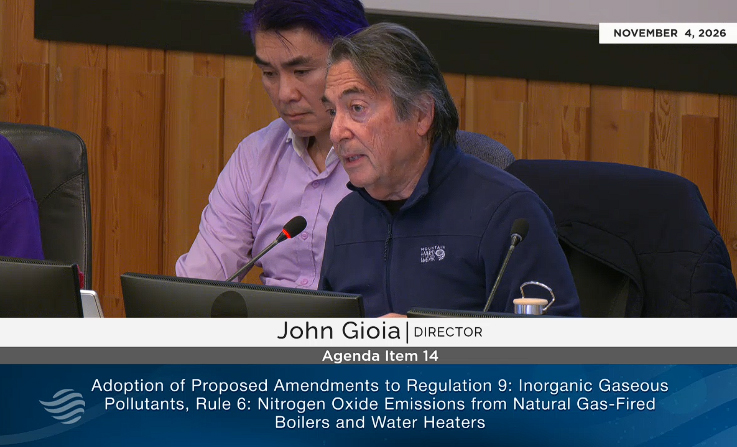
Contra Costa County District 1 Supervisor John Gioia explains his vote in favor of the amendments to Rule 9-6 at the Bay Area Air District Board of Directors meeting on Wednesday, Nov. 4, 2026. Video screenshot

During the Board discussion, Contra Costa County District 1 Supervisor John Gioia, who is one of three representatives to the regional agency, along with District 4 Supervisor Ken Carlson and Pittsburg’s current Mayor Dionne Adams, said, “…when we started this rule, we said we’re going to check in and that’s what we’ve done. We’ve checked in a couple times. We’re actually delaying the rule so we can allow more time. That was a promise we made to the public and that’s what we’re doing.”

“If this was the previous version as last year I wouldn’t be voting for it,” he continued. “But I think it’s come to us in a way to make it possible to vote for it, continue to evaluate, get what changes that need to be made, and we’re moving this industry to making higher quality, cheaper heat-pump water heaters and…there’s going to be plenty of health benefits…and in time, we’re going to get a better piece of equipment.”

“I want to get us to the point where we help lower-income residents take advantage of the incentives, so they don’t have to be exempt. The exemption is voluntary,” Goia added before voting in favor of the motion to adopt.

Neither Adams nor Carlson attended the meeting. He was sick, according to his Supervisor’s Office staff.

The Air District Board of Directors voted on November 4 to amend Rule 9-6, delaying the zero-NOx residential water heater requirement by one year and establishing exemptions for low-income property owners and for properties where electrical or space constraints make the transition especially difficult.

The Air District published the draft amendments on July 14, 2026, a rule proposal package on October 2, 2026, and accepted public comment through the fall.

The amendments establish exemption categories:

  • Low-income property owners, defined as those earning less than 80 percent of Area Median Income and including participants in programs such as Medi-Cal or CalFresh; or households paying more than 28 percent of their income toward their mortgage and property taxes.
  • Space-constrained properties without enough room or ventilation to install a compliant unit.
  • Properties with electrical limitations, such as panels below 100 amps, insufficient panel capacity or a need to run electrical lines more than 50 feet.

The adopted amendments also include allowances for temporary installations for emergency situations and a further delayed compliance date to January 1, 2033, for water heaters installed in multifamily buildings and deed restricted affordable housing as well as certain product categories such as hydronic units, specialized high heat uses, and large water heaters. Water heaters with capacity of 30 gallons or less and mobile home water heaters are not required to comply with the zero-NOx standard.

Rule 9-6 has been in place since 1992, limiting emissions of nitrogen oxides, or NOx, from natural gas-fired water heaters. The Air District amended the rule in 2023 to set a zero-NOx standard. NOx contributes to smog and fine particulate matter, and Air District analysis found that pollution from gas-fired water heaters and furnaces cause as many as 85 premature deaths and 15,000 asthma attacks in the Bay Area each year.

Property owners can find guidance on the compliance timeline, the exemption categories and available rebates on the Air District’s Building Appliances web page.

The Bay Area Air District is the regional agency responsible for protecting air quality in the nine-county Bay Area. Connect with the Air District via X, Facebook, Instagram and YouTube.

Filed Under: Bay Area, Government, Health, News

CAL FIRE expands night operations capability statewide with specialized training Nov. 4-6

November 4, 2026 By Publisher Leave a Comment

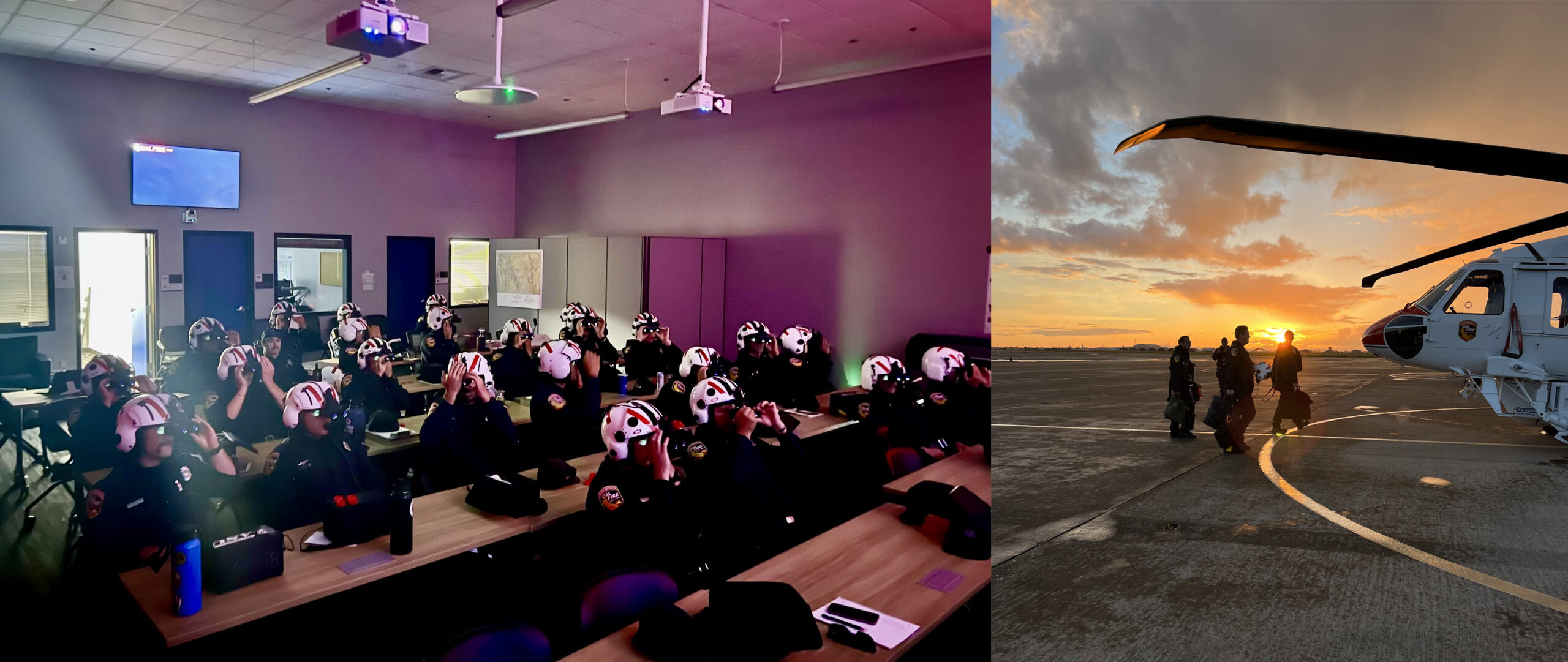
CAL FIRE crewmembers participate in classroom training on Night Vision Goggles (NVG) and nocturnal flight safety at the CAL FIRE Aviation Training Center. Classroom instruction on night vision technology, spatial awareness, and crew coordination precedes simulator exercises and night flights during the weeklong joint training program (Left). CAL FIRE Helitack crewmembers walk toward a CAL FIRE HAWK (S-70i) helicopter on the tarmac as the sun sets. The training week marks a major milestone for CAL FIRE’s Aviation Program as it completes night operations capability across all 11 of its Helitack bases statewide. (Right) Photos courtesy of CAL FIRE Aviation

Expect helicopter activity around Rio Vista

By Linnea Edmeier, Aviation Communications Officer II, California Department of Forestry and Fire Protection

Sacramento, CA — CAL FIRE’s Aviation Program reaches a milestone as it conducts night operations training this week for crewmembers from three helitack bases—Kneeland and Bieber Helitack from Northern California, and San Diego Helitack from Southern California.

This training officially expands night firefighting capabilities to all 11 CAL FIRE Helitack crews statewide. Standardizing night operations across every base ensures that crews can seamlessly integrate during nighttime assignments anywhere in the state.

Context & Milestones

  • 2020: CAL FIRE introduced the CAL FIRE HAWK (S-70i) into its aerial fleet, laying the groundwork for advanced night-vision operations.
  • 2025: Virtual Reality Air Rescue Hoist Simulator introduced at the CAL FIRE Aviation Training Center (CATC). By year’s end, six simulators were operational: OV-10, S2T Airtanker, C130H Airtanker, S70i Helicopter, S70i Helicopter (NVG compatible), Hoist Air Rescue.
  • May 2026: CAL FIRE achieved two major milestones—the addition of its 11th Helitack base, thereby completing a full Helitack transition from the UH-1H Huey to the CAL FIRE HAWK.
  • November 2026: Night operations capability achieved across all 11 bases.

Importance of Night Operations Training

Nighttime operations are demanding and require advanced training that begins with classroom instruction on night vision, its limitations and crew coordination, followed by flight simulator exercises and nighttime flight training. While simulator hours reduce equipment wear and reduce operational risk, simulated environments cannot fully replicate the sensory inputs, spatial cues, and lighting of live nocturnal flight.

During night exercises, crews gain experience using Night Vision Goggles (NVG) for water drops and low-light navigation while building the coordination needed to operate safely and effectively after dark.

Community and Safety Notice

All training flights are conducted in accordance with Federal Aviation Administration (FAA) regulations and CAL FIRE safety protocols.

Residents in and around the McClellan and San Diego training areas can expect helicopter activity during evening hours, concluding by 11:00 PM, Wednesday, November 4 – Friday, November 6. Training areas near McClellan include Mammoth Bar and Folsom Lake along with regional airports including Placerville, Georgetown, Grass Valley, and Rio Vista.

Areas in and around Ramona Airport in Southern California, including San Vicente, El Capitan, Henshaw, and Sutherland Reservoirs will experience helicopter activity.

We prioritize safety and are committed to minimizing local disruptions. CAL FIRE appreciates the community’s support as we prepare our Helitack crews for night operations.

Learn more at CAL FIRE Aviation Program.

Filed Under: Fire, News, State of California

Bay Point drug trafficker sentenced to six years in prison

November 4, 2026 By Publisher Leave a Comment

By William Elwood, Public Affairs Officer, U.S. Attorney Northern District of California

OAKLAND – Carson Fries was sentenced today to 72 months in federal prison for drug trafficking.  U.S. District Judge Haywood S. Gilliam, Jr. handed down the sentence.

Fries, 34, of Bay Point, California, was charged by Criminal Complaint on September 22, 2025, and charged by Information on May 12, 2026.  Fries pleaded guilty on July 29, 2026, to Possession with Intent to Distribute 50 Grams or More of a Mixture or Substance Containing a Detectable Amount of Methamphetamine, in violation of 21 U.S.C. § 841(a)(1) and (b)(1)(B)(viii)).  Fries was a significant drug supplier in Contra Costa County.  According to the plea agreement, Fries admitted to selling large quantities of meth on at least three instances between August 29, 2025, and September 9, 2025, in Bay Point.  On August 29, 2025, he sold approximately 478 gross grams of methamphetamine.  On September 3, 2025, Fries sold approximately 518 gross grams of methamphetamine.  And on September 9, 2025, Fries sold approximately 506 gross grams of methamphetamine.  Additionally, 160 grams of methamphetamine and 33 firearms and a stockpile of ammunition were found at Fries’ residence during a search conducted pursuant to a search warrant.

United States Attorney Craig H. Missakian and Drug Enforcement Administration (DEA) Special Agent in Charge Bob P. Beris made the announcement.  In addition to the prison term, Judge Gilliam also sentenced the defendant to four years of supervised release.

Assistant U.S. Attorney Ivana Djak is prosecuting the case with the assistance of Jessie Chelsea and Amala James.  The prosecution is the result of an investigation by the DEA and the Concord Police Department.

According to localcrimenews.com, the six-foot, one-inch tall, 200-pound Fries is White and was previously arrested Jan. 11, 2014 by CHP – Contra Costa for evading a police officer.

Further Information:

Case No. 26-CR-231

Electronic court filings and further procedural and docket information are available at https://ecf.cand.uscourts.gov/cgi-bin/login.pl. Judges’ calendars with schedules for upcoming court hearings can be viewed on the court’s website at www.cand.uscourts.gov.

Allen D. Payton contributed to this report.

Filed Under: Crime, DOJ, East County, News, U S Attorney

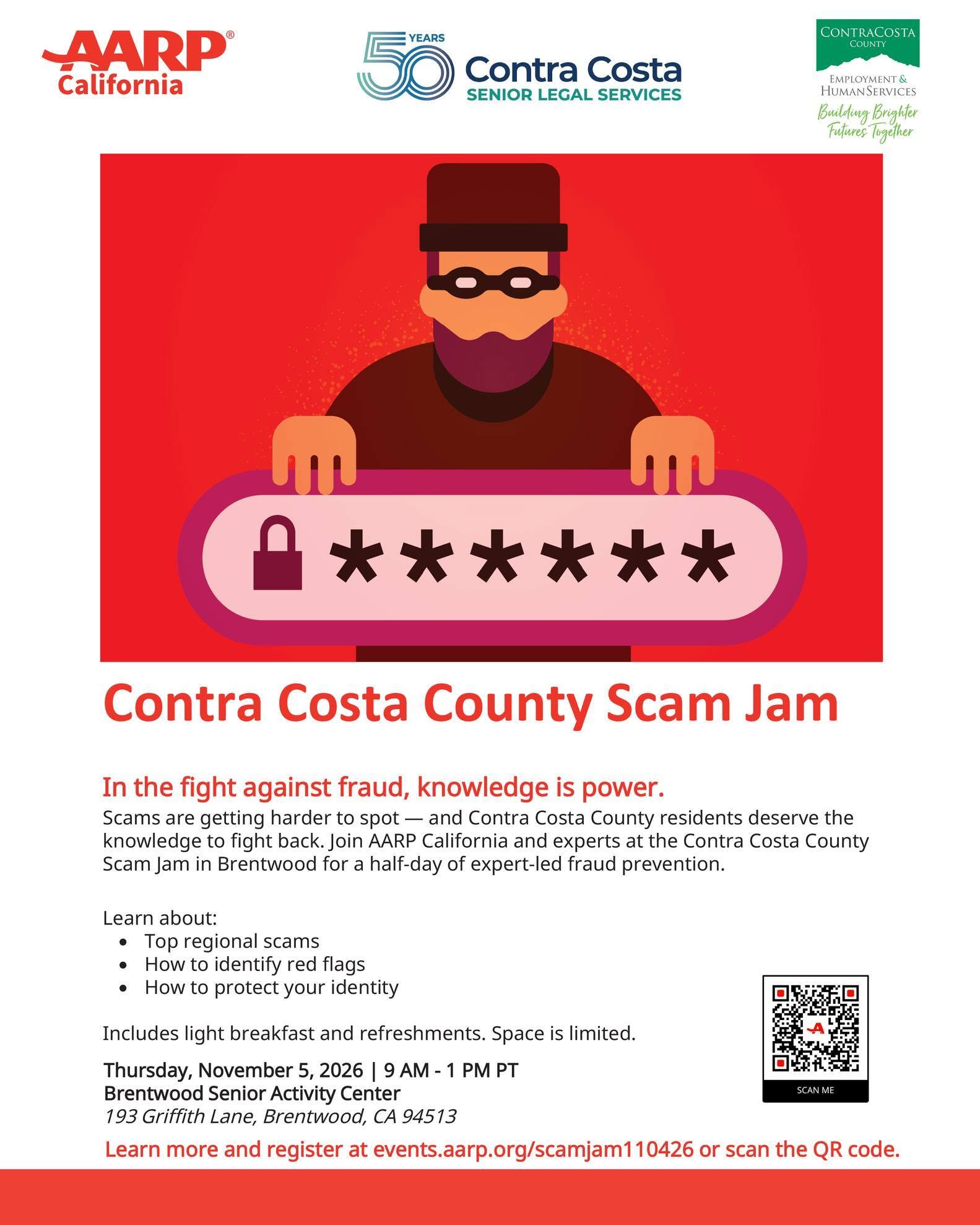
Contra Costa County Scam Jam empowers residents to fight fraud Nov. 5

November 4, 2026 By Publisher Leave a Comment

In Brentwood

By Alan Wang, Community/Media Relations, Contra Costa County Employment & Human Services Department

Free Nov. 5 event to help residents recognize scams and protect their identities

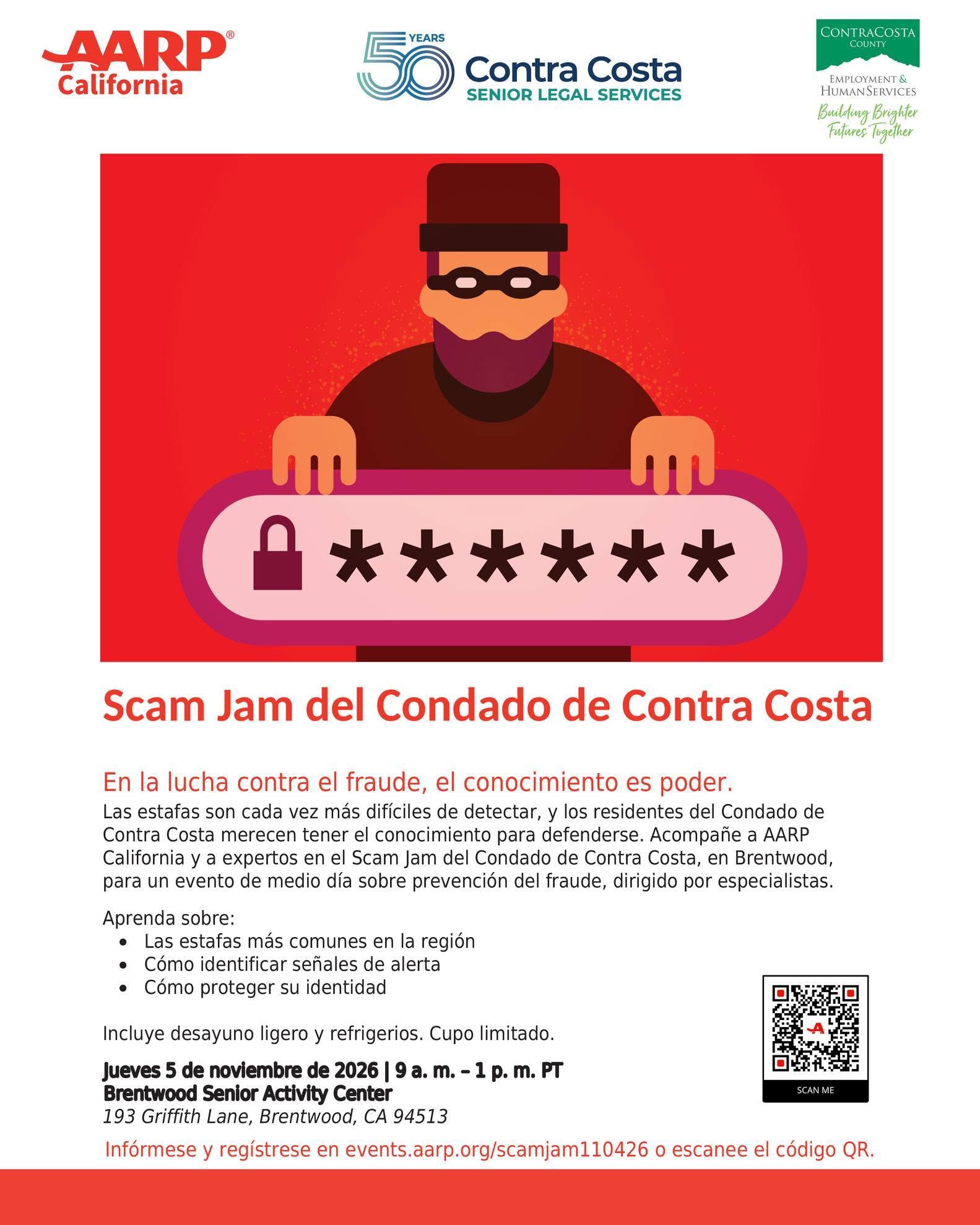
MARTINEZ, Calif. (November 3, 2026) – In the fight against fraud, knowledge is power. As scams become increasingly sophisticated and difficult to recognize, Contra Costa County Employment & Human Services Department (EHSD) invites residents to learn how to protect themselves at the Contra Costa County Scam Jam, a free, half-day fraud prevention event hosted in partnership with AARP California and EHSD’s Aging & Adult Services.

The event is Thursday, November 5, from 9 a.m. to 1 p.m. at the Brentwood Senior Activity Center, 193 Griffith Lane, Brentwood.

Attendees will hear directly from experts who will share information about some of the most common scams that target local residents, plus warning signs and practical steps to safeguard personal information and prevent identity theft.

Expert speaker lineup for media availability:

Mary Blumberg, Assistant District Attorney, Contra Costa County

Kerry O’Brien, Regional Director, Federal Trade Commission

Bryce Avelos, California Privacy Protection Agency

Alfredo Cadenas, California Department of Financial Protection and Innovation

Preview video clip: https://vimeo.com/1243012933?share=copy&fl=sv&fe=ci

Whether it’s a suspicious phone call, a convincing email, an online impersonation or a financial scheme, scammers are constantly finding new ways to target unsuspecting victims. The Scam Jam will give residents the information and tools they need to recognize potential threats, make informed decisions and avoid becoming victims of fraud.

Light breakfast and refreshments will be provided. Space is limited, so residents are encouraged to register in advance.

LEARN MORE AND REGISTER at events.aarp.org/scamjam110426 or scan the QR code.

EVENT DETAILS

WHAT: Contra Costa County Scam Jam – Fraud Prevention Event

WHEN: Thursday, November 5, 2026 | 9 a.m. – 1 p.m.

WHERE: Brentwood Senior Activity Center, 193 Griffith Lane, Brentwood

WHY: To educate residents about emerging scams, identity theft prevention and ways to protect themselves from fraud.

About Contra Costa County Employment & Human Services Department

Contra Costa County Employment & Human Services Department (EHSD) provides a wide range of services and resources that support individuals, families and communities throughout the county. Guided by its commitment to Building Brighter Futures Together, EHSD works to improve the well-being of residents through education, assistance, advocacy and community partnerships.

Filed Under: East County, Finances, Seniors

Former BART Director Debora Allen responds to apparent passage of Measure RTM

November 4, 2026 By Publisher Leave a Comment

Says, “The election may be over, but the fight for accountability is not”

By Debora Allen

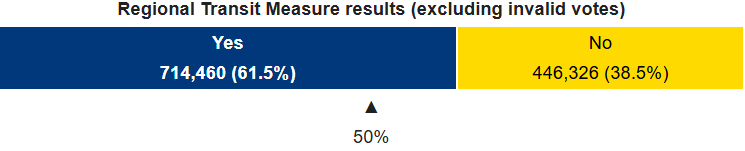
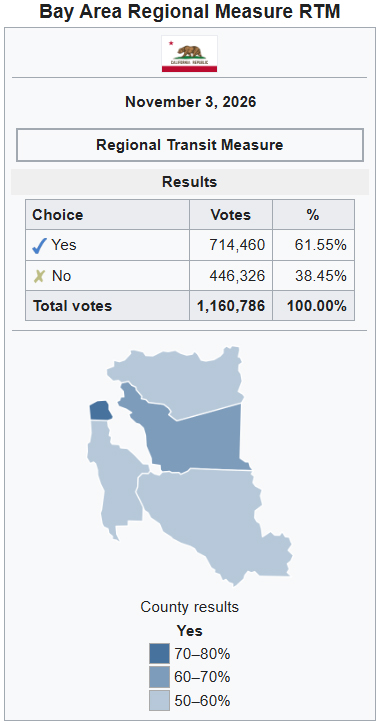
WALNUT CREEK, CA — Following the apparent passage of Measure RTM, former BART Board Director Debora Allen, a leading critic of the regional transit sales tax measure, issued the following statement:

I have never been afraid to be a minority voice, nor have I been afraid of losing while fighting for the right cause.

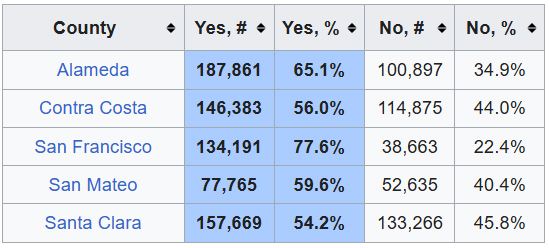
Nearly half a million Bay Area voters have already joined me in saying that fiscal responsibility and meaningful accountability for government spending of our tax dollars matter. With hundreds of thousands of ballots still to be counted, that number could grow substantially. That’s a powerful voice that deserves to be heard, regardless of the election outcome.

The apparent passage of Measure RTM is disappointing, but hardly surprising.

Source: Wikipedia

The transit industry and its corporate and labor allies raised almost $10 million in reported direct contributions to the Yes campaign, not including additional spending on member communications by labor unions and nonprofits. Meanwhile, the volunteers fighting this tax increase operated on roughly $20,000. That’s a spending advantage approaching 500 to 1. The corporate and labor interests had millions to sell their message. The people opposing this tax had volunteers, research, and determination.

Source: Wikipedia

The authors of Senate Bill 63, the enabling legislation for Measure RTM, had one overriding objective: secure billions in new funding for Bay Area transit agencies. Yet they acknowledged in the legislation that “financial efficiency and transparency are imperative to build public confidence and support for public transit.” SB 63 was their opportunity to deliver meaningful, independent oversight in exchange for asking voters to raise sales taxes in five counties. Instead, they created an oversight process that lacks meaningful independence and enforceable financial reforms. The Legislature had the opportunity to demand real accountability before committing billions in taxpayer dollars. It failed. That is why I opposed Measure RTM.

The Yes campaign was filled with misleading narratives about the spending habits of Bay Area transit agencies, promises of accountability measures that lack meaningful independence, and frightening predictions of traffic Armageddon if voters rejected the tax. These were carefully crafted public relations messages designed to convince voters that higher taxes were the only alternative to transit collapse.

Much of this effort was driven by three influential Bay Area nonprofits: the Bay Area Council, San Francisco Bay Area Planning and Urban Research (SPUR), and Seamless Bay Area. These well-funded organizations, backed by powerful corporate and labor interests, have spent years advancing a vision of a denser, more urbanized Bay Area, with transit-oriented housing and concentrated employment centers throughout the region.

These organizations aren’t simply advocating for transit funding. They are helping shape where and how millions of Bay Area residents will live, work, and travel. Voters deserve to understand whose interests are driving those plans, who finances them, and who ultimately benefits.

I’ve lost elections before. Losing is always disappointing, but winning an election isn’t the only measure of success.

Throughout this campaign, the volunteers of CABAT (Committee for Affordable Bay Area Transit), SHIFT (Sustainability in Housing, Infrastructure, Finance, Transportation), and Contra Costa Taxpayers’ Association did phenomenal work. They uncovered troubling facts, challenged questionable claims, and learned a great deal about how powerful corporate and labor interests use their financial resources and political influence to sell tax increases to the public.

Source: Wikipedia

Most importantly, together we exposed serious questions about transit agency spending, financial sustainability, and the lack of truly independent oversight. Those questions do not disappear because a tax measure passes.

This was meaningful work. It will continue, and it will expand. The passage of Measure RTM doesn’t relieve transit agencies of their responsibility to reform their operations, control spending, or deliver the accountability promised to voters. In fact, with billions of additional taxpayer dollars at stake, the need for independent scrutiny is greater than ever.

Last night, at an election gathering, someone approached me and said, “We are so thankful for you fighting for us. You have guts.”

That meant more to me than any election result.

Because if you want to change anything, you’ve got to have guts.

And we’re not finished.

About Debora Allen

Debora Allen served eight years as an elected BART Board Director and six years as a trustee of the Contra Costa County Employees’ Retirement Association. A business owner, CPA (inactive), and former CFO and Tax Manager, Debora is a longtime advocate for fiscal accountability. She continues to work on government oversight, financial transparency, and taxpayer protection throughout the Bay Area.

Filed Under: BART, Bay Area, Finances, Opinion, Politics & Elections, Transportation

  • 1
  • 2
  • 3
  • …
  • 542
  • Next Page »
RepublicServices-Antioch-ad (1)
Monica's Riverview 10-26 B
Delta-RC-B 07-26
Deer-Valley-Chiro-06-22

Copyright © 2026 · · Contra Costa Herald · All Rights Reserved