• Home
  • About The Herald
  • Local Agencies
  • Daily Email Update
  • Legal Notices
  • Classified Ads

Contra Costa Herald

News Of By and For The People of Contra Costa County, California

  • Arts & Entertainment
  • Business
  • Community
  • Crime
  • Dining
  • Education
  • Faith
  • Health
  • News
  • Politics & Elections
  • Real Estate

Kaiser Permanente, Coalition of Kaiser Permanente Unions reach new tentative agreement

October 13, 2023 By Publisher Leave a Comment

More than 85,000 Kaiser Permanent healthcare workers win landmark new contract

On heels of historic strike, on-the-ground engagement from Acting U.S. Labor Secretary Julie Su helped bring sides to agreement 

Frontline healthcare workers secure deal for critical workforce investments that bolster patient care 

The 4-year tentative agreement increases wages, expands job training, and improves performance sharing plan; now goes to employees for ratification

From Coalition of Kaiser Permanente Unions:

LOS ANGELES – More than 85,000 Kaiser Permanente healthcare workers reached a historic tentative agreement today for a new contract that will bolster patient safety and make critical investments in the healthcare workforce at hundreds of Kaiser facilities across California, Colorado, Oregon, Washington, Hawaii, Maryland, Virginia, and the District of Columbia.

The deal was reached on the heels of Acting U.S. Labor Secretary Julie Su traveling back to her home state of California to engage in the most recent talks. Su arrived Thursday evening to successfully help the sides bridge the gap on key lingering issues.

“We’re incredibly grateful to acting U.S. Labor Secretary Julie Su and the Biden administration for supporting workers’ right to collective bargaining. Acting Secretary Su was instrumental in advancing talks and helping to facilitate a successful conclusion to these negotiations,” said Sarah Levesque, Secretary-Treasurer of OPEIU Local 2.

“What the parties have achieved here in Oakland demonstrates, once again, that collective bargaining works. When workers have a voice and a seat at the table, it can result in historic gains for workers, their employer, and our country,” said Acting Secretary of Labor Julie A. Su. “The President and I congratulate the parties on reaching a mutually beneficial deal that delivers important stability for this critical workforce, for Kaiser Permanente, and for the patients in their collective care.”

The landmark deal follows months of tireless advocacy from thousands of frontline healthcare workers.

“This deal is life-changing for frontline healthcare workers like me, and life-saving for our patients,” said Yvonne Esquivel, a pediatric medical assistant at Kaiser Permanente in Gilroy, California. “Thousands of Kaiser healthcare workers fought hard for this new agreement, and now we will finally have the resources we need to do the job we love and keep our patients safe.”

Details of the tentative agreement include:

  • Addressing the staffing crisis by raising wages by 21% over four years to better retain current healthcare workers
  • Establishing a new healthcare worker minimum wage – $25/hr in California and $23/hr in other states where Kaiser Permanente operates
  • Protective terms around subcontracting and outsourcing, which will keep experienced healthcare workers in jobs and provide strong continuity of care for patients
  • A wide variety of initiatives to invest in the workforce and address the staffing crisis, including streamlining hiring practices, increased training and education funding, mass hiring events, and a commitment to upskill existing workers and invest in the training of future healthcare workers.

“Millions of Americans are safer today because tens of thousands of dedicated healthcare workers fought for and won the critical resources they need and that patients need,” said Caroline Lucas, Executive Director of the Coalition of Kaiser Permanente Unions. “This historic agreement will set a higher standard for the healthcare industry nationwide.”

In California, the tentative deal has set a new potential bar for negotiations already underway at Prime Healthcare and other area health systems. Nearly 2,000 Prime workers are concluding a five-day unfair labor practice strike today as their management threatens and intimidates workers, and refuses to bargain in good faith to fix unsafe working and patient care conditions caused by the short-staffing crisis.

The Coalition of Kaiser Permanente Unions represents 85,000 Kaiser healthcare workers in seven states and the District of Columbia. In April, the Coalition began its national bargaining process ahead of the September 30th contract expiration. The Coalition and Kaiser Permanente had last negotiated a contract in 2019, before healthcare workers found themselves on the frontlines of the COVID pandemic that has worsened working conditions and exacerbated a healthcare staffing crisis.

From Wednesday, October 4 to Saturday, October 7, 75,000 Kaiser healthcare workers held an unfair labor practice strike. The actions, led by workers across multiple states and in Washington, D.C., constituted the largest strike of healthcare workers in U.S. history. On October 9, Coalition unions issued a second 10-day notice for a strike that would have commenced on November 1 and included an additional 3,000 healthcare workers in Seattle.

Frontline healthcare workers in the Coalition of Kaiser Permanente Unions are expected to begin voting to ratify the agreement starting October 18.

Kaiser Also Announces Agreement

OAKLAND, Calif. – Kaiser Permanente and the Coalition of Kaiser Permanente Unions are pleased to jointly announce that in the early hours of October 13, 2023, we reached a tentative agreement for a renewed National Agreement, bringing the nearly seven months of contract negotiations to conclusion. 

The Coalition and Kaiser Permanente wish to thank Acting U.S. Secretary of Labor Julie Su for her instrumental involvement in bringing negotiations to a close.

The tentative agreement now goes to the more than 85,000 Kaiser Permanente employees who are represented by Coalition unions for ratification. The ratification process will begin October 18. Once ratified, the agreement will have an effective date of October 1, 2023.

The new 4-year agreement will offer Coalition-represented employees competitive wages, excellent benefits, generous retirement income plans, and valuable job training opportunities that support their economic well-being, advance our shared mission, and keep Kaiser Permanente a best place to work and receive care.

The tentative agreement:

  • Establishes new minimum wages over three years for Coalition-represented employees, that will reach $25/hour in California and $23/hour in other states where Kaiser Permanente operates
  • Provides guaranteed across-the-board wage increases totaling 21% over four years
  • Enhances employees’ Performance Sharing Plan with minimum payout opportunities and a substantial maximum payout opportunity
  • Increases investments in professional development and job training, and includes other initiatives to help address the staffing crisis in health care

Further details of the agreement will be made available later.

The Coalition unions have withdrawn their notices for a November strike.

About the Coalition of Kaiser Permanente Unions

The Coalition of Kaiser Permanente Unions unites more than 85,000 health care workers at Kaiser Permanente facilities in California, Colorado, Oregon, the District of Columbia, Hawaii, Maryland, Virginia, and Washington.

About Kaiser Permanente

Kaiser Permanente is committed to helping shape the future of health care. We are recognized as one of America’s leading health care providers and not-for-profit health plans. Founded in 1945, Kaiser Permanente has a mission to provide high-quality, affordable health care services and to improve the health of our members and the communities we serve. We currently serve 12.7 million members in 8 states and the District of Columbia. Care for members and patients is focused on their total health and guided by their personal Permanente Medical Group physicians, specialists, and team of caregivers. Our expert and caring medical teams are empowered and supported by industry-leading technology advances and tools for health promotion, disease prevention, state-of-the-art care delivery, and world-class chronic disease management. Kaiser Permanente is dedicated to care innovations, clinical research, health education, and the support of community health. For more information visit about.kp.org.
Filed Under: Health, Labor & Unions, News

Unions serve Kaiser executives with official notice that follow-up strike is possible

October 11, 2023 By Publisher Leave a Comment

Could occur Nov. 1 – 8

Kaiser Permanente “will continue to bargain in good faith with the Coalition”

By Allen D. Payton

Ahead of continued negotiations scheduled for Thursday and Friday the Coalition of Kaiser Permanente Unions issued the following press release on Tuesday, October 10, 2023:

As an acute and dire staffing crisis continues at hundreds of their facilities, Kaiser executives have been served official notice that another significant work action by their employees could be possible from November 1 to November 8, 2023. Those employees remain concerned about unsafe staffing levels, the company’s labor law violations, securing adequate wages to stay on the job and attract new workers, and the company’s outsourcing threats against workers just recently hailed as heroes during the COVID-19 pandemic.

Outsourcing, in particular, has emerged as a major sticking point in negotiations, as Kaiser executives have refused to agree to common sense limitations on subcontracting and outsourcing, which keep experienced healthcare workers in jobs and provide strong continuity of care for patients.

“It’s simple: Kaiser executives need to be investing in healthcare workers right now amidst this short staffing crisis, not discarding them through a variety of expensive outsourcing schemes,” said Tamara Chew, a Healthcare Plan Representative, Kaiser Permanente, Roseville. “I can’t understand why anyone in the Kaiser boardroom thinks corporate outsourcing threats are the way to treat a workforce that just a short time ago were being hailed as heroes.”

Frontline healthcare workers say they will wait until November 1 for any potential further strike action, when an additional contract covering workers in Seattle expires, and to give Kaiser executives more time to organize themselves around viable proposals. The Seattle contract’s expiration on October 31, 2023 at midnight would enable another 3,000 healthcare workers also impacted by the Kaiser short staffing crisis to join strike lines in another major west coast metropolitan area. Workers in southern Washington state were part of the initial wave of action, and now those actions could be taking place at Seattle facilities, representing a significant potential expansion of the labor actions at Kaiser. Seattle is one of Kaiser’s newer emerging markets and an area that has been targeted by the company for future corporate growth.

If healthcare workers strike again on November 1, the strike will begin at 6 AM local times and continue until November 8, 6 AM local times.

Healthcare workers have made clear they hope not to strike again and that while taking the legal steps necessary to prepare for that possibility, they are primarily focused on encouraging Kaiser executives to follow the law and to listen to the needs of patients and healthcare workers who are buckling under the current short staffing crisis within Kaiser facilities. Bargaining resumes on October 12 and October 13.

“For months, Kaiser executives failed to listen to the feedback from frontline healthcare workers about the need for executives to follow the law in negotiations and about the impacts that the Kaiser short staffing is having on patients,” said Caroline Lucas, Executive Director of the Coalition of Kaiser Permanente Unions. “This week, Kaiser executives will have another opportunity to listen to frontline staff, to follow the law in formal discussions, and to begin investing in ways that will solve the Kaiser short staffing crisis.”

The Kaiser workers are united within the Coalition of Kaiser Permanente Unions, a coalition of eleven unions that spans Washington, D.C. to the U.S. West Coast.

That coalition expects to hold a media briefing following the conclusion of this Friday’s negotiation sessions, unless those sessions continue further into the weekend, at which time an alternate briefing time may be announced.

Similar to the first strike, a potential second strike would involve workers from Kaiser facilities in California, Colorado, Washington, Oregon, Virginia, and Washington, D.C.

It would include frontline healthcare workers employed as registered nurses, licensed vocational nurses, emergency department technicians, radiology technicians, ultrasound sonographers, teleservice representatives, respiratory therapists, x-ray technicians, optometrists, certified nursing assistants, dietary services, behavioral health workers, surgical technicians, pharmacists and pharmacy technicians, transporters, home health aides, phlebotomists, medical assistants, dental assistants, call center representatives, and housekeepers, among hundreds of other positions.

Background:

The Coalition of Kaiser Permanente Unions represents 85,000 Kaiser healthcare workers in seven states and the District of Columbia. In April, the Coalition began its national bargaining process ahead of the September 30th contract expiration. On September 22nd, Coalition unions representing 75,000 Kaiser healthcare workers gave Kaiser executives 10-day notices for an unfair labor practice strike beginning Oct. 4. Last week’s actions led by workers across multiple states and in Washington, D.C. constituted the largest strike of healthcare workers in U.S. history, running from Wednesday, October 4 – Saturday, October 7, as frontline healthcare workers from hundreds of Kaiser facilities took to picket lines decrying the company’s unfair labor practices and chronic short staffing practices. On October 9, Coalition unions issued a second 10-day notice for a strike that may commence on November 1. The Coalition and Kaiser Permanente last negotiated a contract in 2019, before healthcare workers found themselves on the frontlines of the COVID pandemic that has worsened working conditions and exacerbated a healthcare staffing crisis.

At issue, healthcare workers say, are a series of unfair labor practices related to bargaining in bad faith, along with simmering staff concerns related to unsafe staffing levels that can lead to dangerously long wait times, mistaken diagnosis, and neglect. Outsourcing threats by Kaiser executives have also emerged as a sticking point in negotiations. After years of the COVID pandemic and chronic understaffing, Kaiser healthcare workers are calling on management to provide safe staffing levels.

Workers say that Kaiser is committing unfair labor practices and also that understaffing is boosting Kaiser’s profits but hurting patients. In a recent survey of 33,000 employees, 2/3 of workers said they’d seen care delayed or denied due to short staffing. After three years of the COVID pandemic and chronic understaffing, healthcare workers at Kaiser Permanente are calling on management to provide safe staffing levels.

Kaiser has reported ​​$3 billion in profits in just the first six months of this year. Despite being a non-profit organization – which means it pays no income taxes on its earnings and extremely limited property taxes – Kaiser has reported more than $24 billion in profit over the last five years. Kaiser’s CEO was compensated more than $16 million in 2021, and forty-nine executives at Kaiser are compensated more than $1 million annually. Kaiser Permanente has investments of $113 billion in the US and abroad, including in fossil fuels, casinos, for-profit prisons, alcohol companies, military weapons and more.

—————-

Kaiser Responds

In response, Kaiser Permanente issued the following statement: “We have received notice from the Coalition of Kaiser Permanente Unions for a potential second strike, beginning November 1 to November 8. We are scheduled to return to the bargaining table on October 12 and Kaiser Permanente remains committed to reaching an agreement that is good for our employees, our members, and our organization, and we will continue to bargain in good faith with the Coalition.”

The Coalition of Kaiser Permanente Unions unites more than 85,000 healthcare workers at Kaiser Permanente facilities in California, Colorado, Oregon, the District of Columbia, Hawaii, Maryland, Virginia, and Washington.


Filed Under: Health, Labor & Unions, News

Historic Kaiser healthcare worker strike continues into third day

October 6, 2023 By Publisher Leave a Comment

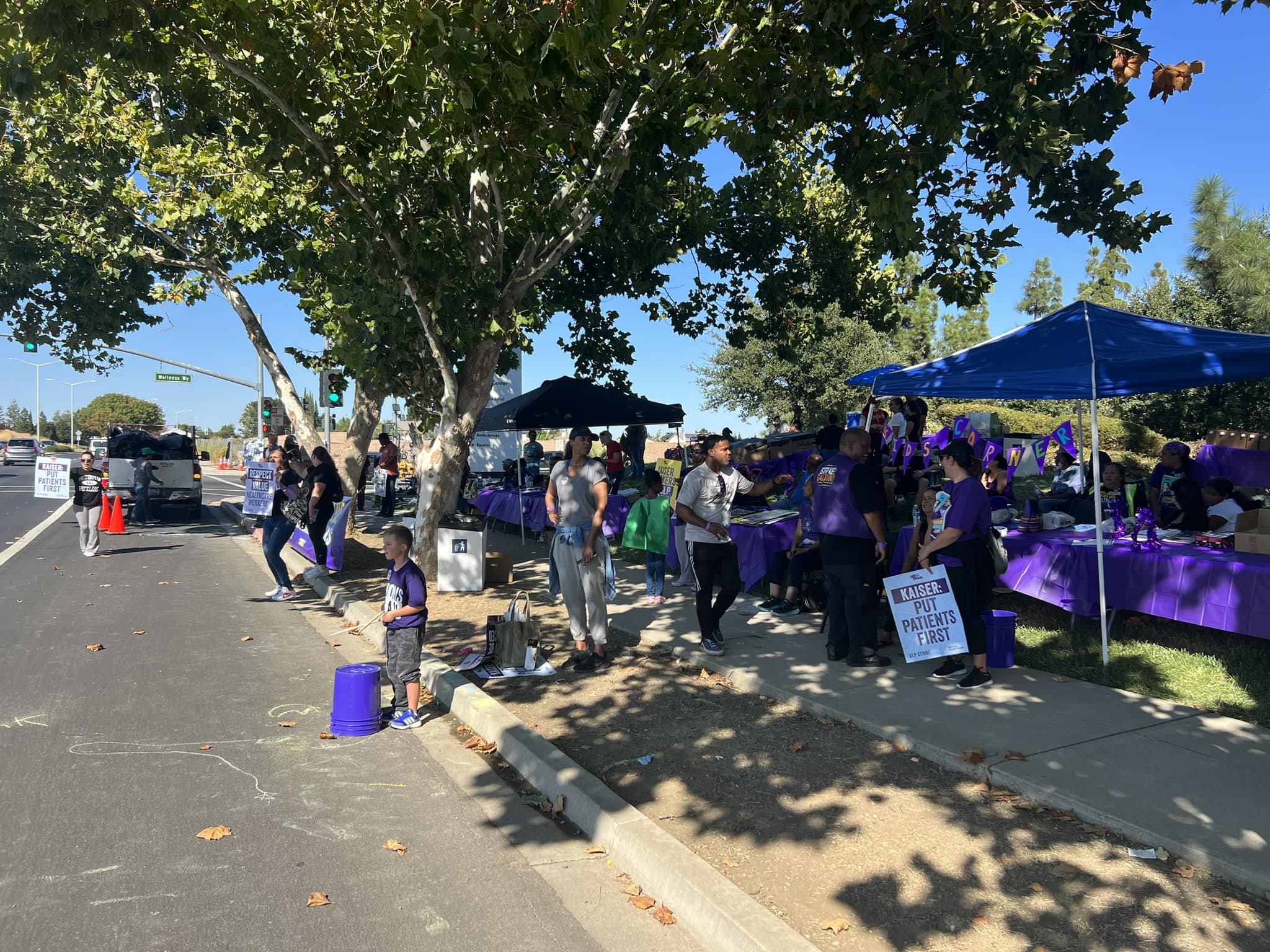
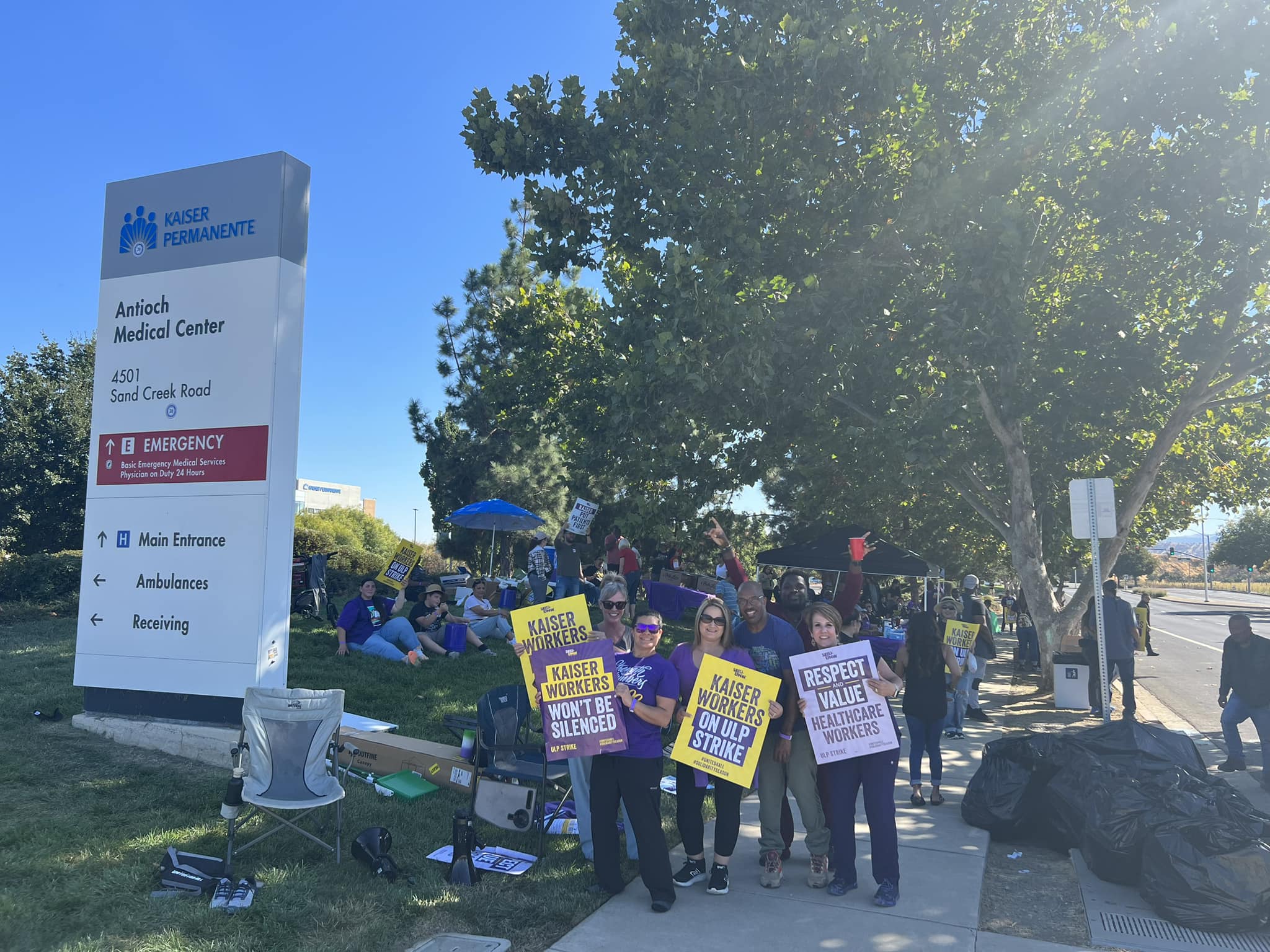
Healthcare workers participate in the strike at Kaiser Permanente’s Antioch Medical Center on Tuesday, Oct. 3, 2023. Photos by Allen D. Payton

Largest healthcare worker strike in U.S. history spans hundreds of hospitals and facilities across the nation 

Includes Antioch, Richmond and Walnut Creek hospitals

Outsourcing and under-staffing emerge as key sticking points

Bargaining scheduled to continue Oct. 12

On Friday morning, October, 6, 2023, SEIU-United Health Workers union issued the following announcement:

More than 75,000 Kaiser Permanente workers in multiple states are continuing their historic three-day strike to protest unfair labor practices and Kaiser executives’ failure to bargain in good faith over unsafe staffing levels and outsourcing protections at hundreds of Kaiser hospitals and facilities across the United States.

In Contra Costa County, the strike includes workers at Kaiser facilities in Antioch, Richmond and Walnut Creek. During the strike at Antioch Kaiser, today – part of a nationwide action – Antioch resident Angela Glasper, who has been a Kaiser employee for 35 years working as an optical services clerk, said, “We’re not backing down.”

The strike at Kaiser facilities expanded from coast to coast this week, following months of bad faith bargaining activity by Kaiser executives and repeated appeals by frontline workers for Kaiser executives to make the kinds of investments in staffing that could help stem employee turnover and reduce growing patient wait times.

The strike began in DC and VA at 6AM ET on Wednesday morning at 6AM EST, expanded to CO at 6AM MT, then culminated with tens of thousands of workers striking in CA, OR, and WA at 6AM PT. It is already the largest healthcare worker strike in U.S. history. The current strike is expected to conclude on Saturday, October 7, 2023 at 6:00 A.M. It is possible that the coalition will issue a 10-day strike notice after Saturday, which could lead to further striking by Kaiser employees after those ten days if Kaiser executives continue to commit unfair labor practices and bargain in bad faith.

Additional bargaining sessions were scheduled by the parties this morning for the dates of Thursday, October 12 and Friday, October 13, 2023.

Kaiser Permanente confirmed that in the following statement issued Friday morning, Oct. 6: “The next bargaining session has been scheduled to begin on October 12. We look forward to reaching a new agreement that continues to provide our employees with market-leading wages and benefits, and ensures our high-quality care is affordable and available to meet our members’ needs.”

Outsourcing of critical healthcare duties has become a key sticking point in negotiations in recent days, as Kaiser executives have refused to put limitations on subcontracting and outsourcing, which keep experienced healthcare workers in jobs and provide strong continuity of care for patients.

“Now more than ever Kaiser Permanente needs to retain and attract qualified healthcare professionals. Outsourcing and subcontracting would have the opposite effect,” said Kathleen Coleman, Medical Assistant Message Management, Arapahoe Primary Care in Colorado.

“Frontline healthcare workers continue to await meaningful action by Kaiser executives to address our key priorities, including safe staffing, outsourcing protections for incumbent healthcare workers, and fair wages to reduce turnover,” said Gwendolyn Holloway, a Contact Lens Technician at Kaiser Permanente Vallejo Medical Center.

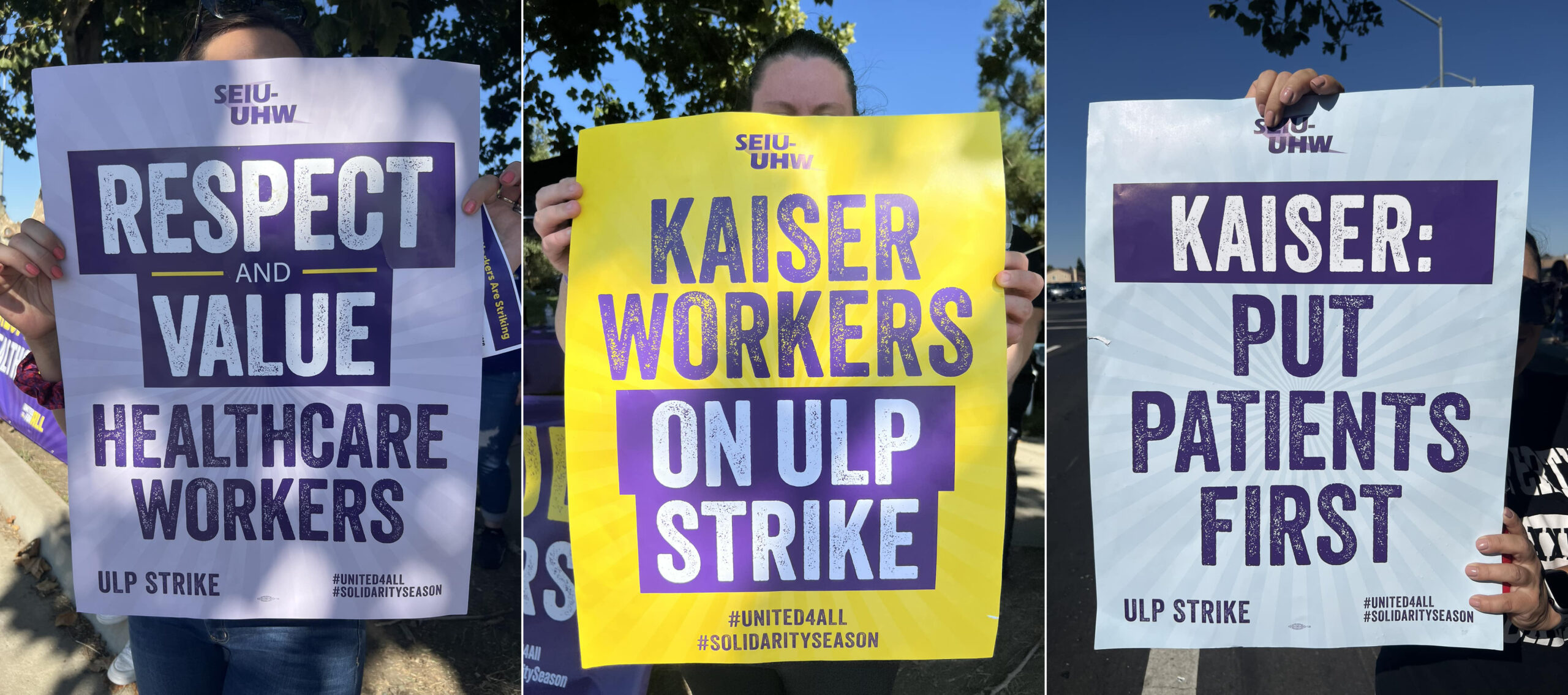
Signs carried by healthcare workers on strike at the Kaiser Permanente Antioch Medical Center.

Workers on strike include those employed as licensed vocational nurses, emergency department technicians, radiology technicians, ultrasound sonographers, teleservice representatives, respiratory therapists, x-ray technicians, optometrists, certified nursing assistants, dietary services, behavioral health workers, surgical technicians, pharmacists and pharmacy technicians, transporters, home health aides, phlebotomists, medical assistants, dental assistants, call center representatives, and housekeepers, among hundreds of other positions.

WHAT: 75,000 healthcare workers are on strike at Kaiser Permanente hospitals across the U.S.

WHEN: Today, Friday, October 6th, 2023 @ 6AM – Afternoon times TBD  

WHERE: Hundreds of Kaiser Permanente hospitals and facilities in California, Colorado, Washington, Oregon

CONTRA COSTA COUNTY

ANTIOCH: Kaiser Permanente Antioch Medical Center, 4501 Sand Creek Rd, Antioch, CA 94531

RICHMOND: Kaiser Permanente Richmond Medical Center, 901 Nevin Ave., Richmond, CA 94801

WALNUT CREEK: Kaiser Permanente Walnut Creek Medical Center, 1425 S Main St, Walnut Creek, CA 94596

BACKGROUND

The Coalition of Kaiser Permanente Unions represents 85,000 Kaiser healthcare workers in seven states and the District of Columbia. In April, the Coalition began its national bargaining process ahead of the September 30th contract expiration. On Sept. 22, Coalition unions representing 75,000 Kaiser healthcare workers gave Kaiser executives 10-day notices for an unfair labor practice strike beginning Oct. 4. The Coalition and Kaiser Permanente last negotiated a contract in 2019, before healthcare workers found themselves on the frontlines of the COVID pandemic that has worsened working conditions and exacerbated a healthcare staffing crisis.

At issue, healthcare workers say, are a series of unfair labor practices related to bargaining in bad faith, along with simmering staff concerns related to unsafe staffing levels that can lead to dangerously long wait times, mistaken diagnosis, and neglect. After years of the COVID pandemic and chronic understaffing, Kaiser healthcare workers are calling on management to provide safe staffing levels.

Workers say that Kaiser is committing unfair labor practices and also that understaffing is boosting Kaiser’s profits but hurting patients. In a recent survey of 33,000 employees, 2/3 of workers said they’d seen care delayed or denied due to short staffing. After three years of the COVID pandemic and chronic understaffing, healthcare workers at Kaiser Permanente are calling on management to provide safe staffing levels.

Kaiser has reported ​​$3 billion in profits in just the first six months of this year. Despite being a non-profit organization – which means it pays no income taxes on its earnings and extremely limited property taxes – Kaiser has reported more than $24 billion in profit over the last five years. Kaiser’s CEO was compensated more than $16 million in 2021, and forty-nine executives at Kaiser are compensated more than $1 million annually. Kaiser Permanente has investments of $113 billion in the US and abroad, including in fossil fuels, casinos, for-profit prisons, alcohol companies, military weapons and more.

The Coalition of Kaiser Permanente Unions unites more than 85,000 healthcare workers at Kaiser Permanente facilities in California, Colorado, Oregon, the District of Columbia, Hawaii, Maryland, Virginia, and Washington.

Allen D. Payton contributed to this report.

Filed Under: Health, Labor & Unions, News

Kaiser provides updated statement in response to strike

October 4, 2023 By Publisher Leave a Comment

SEE 10/4/23 3:30 PM UPDATE: While bargaining ended without a contract settlement 5 tentative agreements reached

“Operations continue as normal”

Kaiser Permanente Statement on National Bargaining with the Coalition of Kaiser Permanente Unions

Kaiser Permanente and leaders and members of the Coalition of Kaiser Permanente Unions were bargaining through the weekend to reach an agreement.

We continue to make progress on key issues such as a redesigned performance sharing plan with updated payout opportunities. Last week we reached tentative agreements in four key areas:, travel for continuing education, the use of temporary workers such as traveling nurses, tracking of staffing vacancies, and dispute resolution.

It is important to know that while the current national agreement expired at midnight PDT on September 30, operations continue as normal, and we will continue to honor all current contract provisions. Contract expirations do not mean a strike will happen. We remain optimistic that we will reach an agreement and avoid an unnecessary strike, which the Coalition unions have called for starting on Wednesday morning, Oct 4.

Wages

We lead total compensation in every market where we operate, and our proposals in bargaining would ensure we keep that position. In some places, a Kaiser Permanente employee leaving for a similar job at another organization would face a 20-plus percent pay cut, and lower benefits.

Included in our current offer are guaranteed across-the-board wage increases and a proposed $21 minimum wage in Washington, Oregon, Colorado, the Mid-Atlantic States (Virginia, Maryland, and the District of Columbia), and Hawaii starting in 2024; and a $23 minimum wage starting in 2024 in California.

Hiring and Staffing

Despite the acute shortage of health care workers nationally, we have been able to hire more than 50,000 frontline employees in the last two years: 29,000 people in 2022, and another 22,000 so far this year. Included in this year’s new hires are more than 9,800 people hired into jobs represented by the Coalition. Kaiser Permanente and the Coalition agreed in April to a goal of hiring 10,000 new people for Coalition-represented jobs by the end of 2023. We expect to reach the 10,000 new hire goal by the end of October, if not sooner, and we won’t stop there. We are committed to addressing every area of staffing that is still challenging. Additionally, our attrition rate of 7% is roughly a third of the industry average and continues to fall. These achievements underscore the value of a Kaiser Permanente job and reinforce our position as a leading health care employer.

Potential Strike Starting Wednesday

In the case that a strike does begin on Oct. 4, we have contingency plans in place to ensure members continue to receive safe, high-quality care for the duration of the strike. Our hospitals and emergency departments will remain open. Kaiser Permanente members can get updates on appointments, pharmacy guidance and where to get care on kp.org.

We’ll continue to bargain in good faith until we reach a fair and equitable agreement to ensure Kaiser Permanente continues to attract and retain the best people in health care — and remains a best place to work and get care. And that includes meeting our responsibility to continue to balance taking care of our employees and being more affordable to our members.

October 4, 2023 3:30 pm UPDATE:

After 6 months of bargaining with the Coalition of Kaiser Permanente Unions, including a marathon effort that went through last night and into today, our bargaining sessions unfortunately ended without a settlement, and the Coalition strikes began.

While we have not reached a contract settlement, we have been able to reach a number of tentative agreements in bargaining, and our offers to date address the unions’ priorities, including:

  • Across-the-board wage increases in all markets over the next four years.
  • Updating the Performance Sharing Plan to include a minimum payout opportunity and potential for up to a $3,750 payout.
  • Offering minimum wages of $23/hour in California and $21/hour in markets outside of California.
  • Continuing and enhancing our existing excellent health benefits and retirement income plans.
  • Renewing our strong tuition assistance and training programs, and increasing funding of the education trusts.

We remain committed to reaching a new agreement that continues to provide our employees with market-leading wages, excellent benefits, generous retirement income plans, and valuable professional development opportunities.

Together, we have faced the toughest challenges over the past three years. Kaiser Permanente, our industry, and our employees are now operating in a new cultural, labor, and post-pandemic environment that we are all working hard to understand. We are committed to finding workable solutions for this new environment that meet our responsibility to balance taking care of our employees and being affordable to our members.

We will coordinate with Coalition leaders to reconvene bargaining as soon as possible. We will work hard to reach an agreement so that together, we can all return to delivering on the mission of Kaiser Permanente for the benefit of our members, patients, employees, physicians, customers, and communities.

Meeting our shared staffing goal

On the same day that the Coalition strikes began, we’re pleased to confirm that we’ve met our goal of hiring 10,000 new Coalition-represented employees by year-end – and it is only October 4th. We’re not done yet. We are committed to addressing every area of staffing that is still challenging.

As a reminder: In April we agreed with the Coalition to a joint goal of hiring 10,000 people by the end of this year into jobs the Coalition cares about. We agreed this would be a great success if we could hire that many people into Coalition roles by the end of this year. We hit the goal three months early.

In total over the past two years, Kaiser Permanente has hired more than 50,000 people to join our teams.

Meeting our members’ needs

The health and wellbeing of our members and patients is our top priority. Because we are such a large organization, with multiple ways that members can access care, the impact of the strike is different at various locations.

We have robust plans in place to ensure members continue to receive safe, high-quality care during the strike.

All our hospitals and emergency departments remain open. Our facilities will continue to be staffed by our physicians, trained and experienced managers, and our great staff. Thousands of qualified and trained contract staff are joining our Kaiser Permanente teams this week as well, to help meet our members’ and patients’ needs. We thank those Coalition-represented employees who have chosen to come to work and care for our patients, members, and communities.

Members who need urgent or timely medical care should continue to seek it at our hospitals and medical facilities. A strike should not dissuade anyone from seeking necessary care.

We will contact members affected by any necessary changes in our services. We may need to reschedule non-emergency and elective services in some locations out of an abundance of caution. Our members can follow any important updates to our care delivery on kp.org.


Filed Under: Health, Labor & Unions, News

Two Bay Area unions approve sympathy strike to support SEIU-UHW Kaiser Permanente workers

October 4, 2023 By Publisher Leave a Comment

By Renée Saldaña, SEIU, Press Secretary, SEUI – United Healthcare Workers West

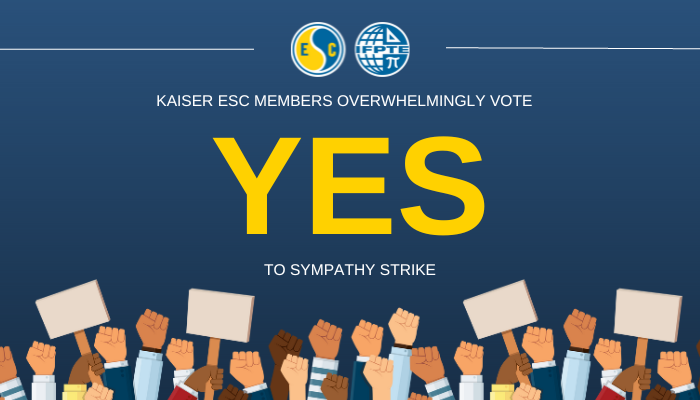
OAKLAND, Calif. – Bay Area unions IFPTE Local 20 and OPEIU Local 29 have approved a sympathy strike in support of the unfair labor practices strike at Kaiser Permanente hospitals and medical offices in California being called for by SEIU-United Healthcare Workers West between October 4-6.

A “sympathy strike” occurs when one union supports another union that is directly involved in a labor dispute.

“Kaiser’s unfair labor practices against SEIU-UHW in our local bargaining have not been remedied,” said Erica Chinchilla, a respiratory therapist at Kaiser Antioch. “A sympathy strike is a powerful act of solidarity where workers strike to support or aid another group of workers. We appreciate our Coalition partners’ willingness to stand with us as we protest these unfair labor practices committed by Kaiser in local bargaining against SEIU-UHW and its members.”

SEIU-UHW members include frontline workers such as respiratory care practitioners, dietary, environmental services, and nursing staff. OPEIU Local 29 represents office, technical and professional employees at Kaiser Permanente. IFPTE Local 20 represents clinical lab scientists, home health therapists, optometrists, genetic counselors, and other technical and professional employees at Kaiser.

Laboratory scientists provide information medical doctors need to properly diagnose and treat patients, as well as ensure correct blood products are given to patients during surgery or an emergency. Kaiser has not informed IFPTE Local 20 of coverage plans of this important work.

Unions in Oregon, Southwest Washington, Colorado, Virginia, Maryland, and Washington, D.C., which are part of the Coalition of Kaiser Permanente Unions, are also planning unfair labor practices strikes at the same time.

SEIU-United Healthcare Workers West (SEIU-UHW) is a healthcare justice union of more than 100,000 healthcare workers, patients, and healthcare activists united to ensure affordable, accessible, high-quality care for all Californians, provided by valued and respected healthcare workers. Learn more at www.seiu-uhw.org.


Filed Under: Health, Labor & Unions

Largest healthcare worker strike in U.S. history spans hundreds of Kaiser Permanent hospitals and facilities across the nation

October 4, 2023 By Publisher Leave a Comment


75,000 U.S. healthcare workers of the Coalition of Kaiser Permanente Unions protest claims of unfair labor practices

By Isaac Reese, 617 Media Group

More than 75,000 Kaiser Permanente workers in multiple states are now on strike to protest unfair labor practices and Kaiser executives’ failure to bargain in good faith over unsafe staffing levels at hundreds of Kaiser hospitals and facilities across the United States.

Over the course of just three hours, the strike at Kaiser facilities expanded from coast to coast, following months of bad faith bargaining activity by Kaiser executives and repeated appeals by frontline healthcare workers for Kaiser executives to make the kinds of investments in staffing that could help stem employee turnover and reduce growing patient wait times.

The strike began in DC and VA at 6AM ET this morning, expanded to CO at 6AM MT, then culminated with tens of thousands of workers striking in CA, OR, and WA at 6AM PT.

In the vast majority of locations, barring an agreement, the strike is expected to last for three days. It is already the largest healthcare worker strike in U.S. history.

Healthcare workers are taking the work action to protest Kaiser executives’ bad faith bargaining, which is getting in the way of finding solutions to solve the Kaiser short-staffing crisis by investing in its workforce.

In recent days, Kaiser executives maintaining aggressive threats of outsourcing became a sticking point in negotiations, especially at a time when the company is failing to retain key employees.

“Kaiser executives are refusing to listen to us and are bargaining in bad faith over the solutions we need to end the Kaiser short-staffing crisis,” said Jessica Cruz, a licensed vocational nurse at Kaiser Los Angeles Medical Center. “I see my patients’ frustrations when I have to rush them and hurry on to my next patient. That’s not the care I want to give. We’re burning ourselves out trying to do the jobs of two or three people, and our patients suffer when they can’t get the care they need due to Kaiser’s short-staffing.”

Strike lines are set up at Kaiser Permanente hospitals and medical office buildings across the country, including California, Colorado, Washington, Oregon, Virginia and Washington, D.C.

Workers on strike include those employed as licensed vocational nurses, emergency department technicians, radiology technicians, ultrasound sonographers, teleservice representatives,  respiratory therapists, x-ray technicians, optometrists, certified nursing assistants, dietary services, behavioral health workers, surgical technicians, pharmacists and pharmacy technicians, transporters, home health aides, phlebotomists, medical assistants, dental assistants, call center representatives, and housekeepers, among hundreds of other positions.

BACKGROUND

The Coalition of Kaiser Permanente Unions represents 85,000 Kaiser healthcare workers in seven states and the District of Columbia. In April, the Coalition began its national bargaining process ahead of the September 30th contract expiration. On Sept. 22, Coalition unions representing 75,000 Kaiser healthcare workers gave Kaiser executives 10-day notices for an unfair labor practice strike beginning Oct. 4. The Coalition and Kaiser Permanente last negotiated a contract in 2019, before healthcare workers found themselves on the frontlines of the COVID pandemic that has worsened working conditions and exacerbated a healthcare staffing crisis.

At issue, healthcare workers say, are a series of unfair labor practices related to bargaining in bad faith, along with simmering staff concerns related to unsafe staffing levels that can lead to dangerously long wait times, mistaken diagnosis, and neglect. After years of the COVID pandemic and chronic understaffing, Kaiser healthcare workers are calling on management to provide safe staffing levels.

Workers say that Kaiser is committing unfair labor practices and also that understaffing is boosting Kaiser’s profits but hurting patients. In a recent survey of 33,000 employees, 2/3 of workers said they’d seen care delayed or denied due to short staffing. After three years of the COVID pandemic and chronic understaffing, healthcare workers at Kaiser Permanente are calling on management to provide safe staffing levels.

Kaiser has reported ​​$3 billion in profits in just the first six months of this year. Despite being a non-profit organization – which means it pays no income taxes on its earnings and extremely limited property taxes – Kaiser has reported more than $24 billion in profit over the last five years. Kaiser’s CEO was compensated more than $16 million in 2021, and forty-nine executives at Kaiser are compensated more than $1 million annually. Kaiser Permanente has investments of $113 billion in the US and abroad, including in fossil fuels, casinos, for-profit prisons, alcohol companies, military weapons and more.

The Coalition of Kaiser Permanente Unions unites more than 85,000 healthcare workers at Kaiser Permanente facilities in California, Colorado, Oregon, the District of Columbia, Hawaii, Maryland, Virginia, and Washington

Kaiser issued a statement last month responding to the then-threatened strike.

Allen D. Payton contributed to this report.

Filed Under: Health, Labor & Unions, News

Kaiser Permanente issues statement on threatened strike

August 27, 2023 By Publisher 2 Comments

By Antonia Ehlers, PR & Media Relations, Kaiser Permanente Northern California

Kaiser Permanente is the largest union-represented health care employer in the U.S. – with nearly 75 percent of our employees represented by unions. We are currently bargaining with the Coalition of Kaiser Permanente Unions, which represents about 88,000 employees in a variety of roles. The Coalition is part of our historic, 26-year-long Labor Management Partnership, the longest-lasting partnership of its kind in the country.

Kaiser Permanente is fully committed to reaching an agreement with the unions affiliated with the Coalition just as we have done in every national bargaining since 1999. Our priority is to reach an agreement that is mutually beneficial and ensures we can continue to offer our people market-competitive pay and outstanding benefits. We are confident that we will reach an agreement that achieves that goal, before the contract expires on September 30. And we are confident that our new agreement will strengthen our position as a best place to work and ensure the high-quality care our members expect from us remains affordable and easy to access.

Strike Authorization Vote

Strike authorizations are a common bargaining pressure tactic that give union leaders the ability to call for a strike in the future. Throughout our negotiations we have seen Coalition leaders attempt to rally their unions’ members to threaten a strike despite important progress made through negotiations.

This tactic does not reflect any breakdown in bargaining, nor does it indicate a strike is imminent or will happen at all. It is a disappointing action considering our progress at the bargaining table. It does not reflect our commitment to reaching an agreement that ensures we can continue to provide market-competitive pay and outstanding benefits.

We urge our employees to reject any call for a strike and continue to focus on providing care and service to the patients who need them. We take any threat to disrupt care for our members seriously and have plans to ensure continued access to health care by our members, patients, and the communities we serve, should any union call for a strike. Our members, patients, and our communities need us to be there for them.

Allegations of Unfair Labor Practices

From the start, we have bargained in good faith to come to an agreement, working diligently in partnership to address the many complex issues at the table. This week, over the course of our sixth formal negotiation session since national bargaining began in April, we offered proposals on important issues including improvements to the performance sharing bonus plan (PSP) and an enterprise-wide guaranteed minimum wage for our Coalition-represented employees. In addition, committees met on staffing, operational savings, and local bargaining agreements.

As always, one of the key issues in this bargaining involves compensation and Kaiser Permanente has made clear we are standing by our proven commitment to provide market-competitive wages and excellent benefits. In fact, as a leading employer, our philosophy is to pay our employees above the local market, to attract and retain the best employees.

Bargaining is dynamic and involves give-and-take. Accusations from union leaders that Kaiser Permanente has not bargained in good faith are unfounded and counterproductive.

We take bargaining seriously and believe that our employees deserve market competitive wages and excellent benefits. We are hopeful union leaders will set aside the counterproductive tactics of this week, so we can focus on working together to deliver an agreement. We remain committed to bargaining with our Coalition unions in good faith and in the spirit of partnership. We will focus our energy on frank and productive discussions that lead to an agreement, and to doing our part to ensure there are no disruptions to the high-quality care we provide.

Staffing

We, like all health care organizations, have experienced staffing challenges driven by the pandemic and its lasting effects. For healthcare systems this has been made worse by the backlog in care and the increase in needs and acuity we’re seeing across the country.

While Kaiser Permanente has experienced the same pressures, through diligent work and an unwavering commitment to our people, we have weathered these staffing challenges better than most health care organizations. Kaiser Permanente’s average employee turnover rate of 8.5 percent, as of June 2023, is significantly lower than the rate of 21.4 percent across health care. Talented people who recognize the value of our current wage and benefit offerings want to work at Kaiser Permanente, which is why about 96 percent of candidates for Coalition-represented positions accept our employment offers—significantly above the industry average.

Kaiser Permanente and the Coalition have agreed to work together to accelerate hiring, and we set a joint goal in bargaining of hiring 10,000 new people for Coalition-represented jobs in 2023. Kaiser Permanente’s efforts to date have resulted in more than 6,500 positions filled, and we are aggressively recruiting to fill more.

Our staffing approach reflects our shared commitment to ensure every Kaiser Permanente patient receives extraordinary care, every time and in every place.

Wages and Benefits

We are leaders in employee wages and benefits, and we have reiterated our commitment in bargaining to continuing to provide market-competitive wages and outstanding benefits. In fact, our philosophy is to deliver compensation that provides wages above the local market (up to 10 percent above market) to attract and retain the best employees.

Kaiser Permanente also offers employees opportunities to learn new skills and grow their careers, and we’re committed to providing a safe and equitable work environment. In addition, we want to ensure that we help our employees build long-term economic security with low-cost health insurance, industry-leading retirement plans, and other benefit programs to support their health and well-being.

It’s also worth remembering that during the pandemic, we took extraordinary steps to support and protect our workforce, and to support their mental as well as physical health. We provided $800 million in employee assistance to ensure that front-line employees had access to alternate housing options, special child care grants, and additional paid leave for COVID-19 illness and exposure.

The unions’ current negotiating position is that wage increases should not be market-based. This prevents us from addressing wage disparities that exist in in many of Kaiser Permanente’s markets where, for some jobs, wages are significantly higher than our targeted wage level, and in other cases our employees’ wages are below other competitors in the market, impacting our ability to attract and retain the best people.

While being a best-in-class employer is a fundamental part of who we are, we cannot continue a national approach for determining wages and ignore local market conditions. We also have a responsibility to make health care more affordable for our patients, members, and customers, including government agencies. For many families and businesses, health care costs are increasingly unaffordable, and growing. Wages and benefits make up about half the cost of health care, across the country. We must work together with unions on the critical goal of ensuring that health care remains affordable.

We are committed to our philosophy of providing market-competitive pay and excellent benefits, and we’ve made that clear in bargaining. We are committed to addressing areas where staffing is challenging, and we are making great progress. And we are committed to doing all this while striving to help health care be more affordable.


Filed Under: Bay Area, Health, Labor & Unions, News

Labor’s next big fight in the Bay Area: Largest single-employer union negotiation in the U.S. inches closer to strike

August 27, 2023 By Publisher Leave a Comment

85,000 Kaiser Permanente healthcare workers to hold strike authorization vote Monday over what they claim are unfair labor practices, say chronic under-staffing is driving a growing patient care crisis

By Renée Saldaña, Press Secretary, SEUI – United Healthcare Workers West

A strike may be looming at one of the nation’s largest employers.

On Monday August 28, Kaiser workers in California, including Antioch, will start to vote to authorize a strike over unfair labor practices. The voting ends September 12th.   The unions will strike dates soon after we get the results of the vote. The contract expires for a large bulk of the Kaiser workers in the coalition (58,000) on September 30th, so a strike could potentially start as early as October 1.

We are expecting a majority of the workers to vote in favor of a strike. We will keep you posted on any other developments.

On Thursday, August 24, healthcare workers employed by Kaiser Permanente announced details of a potential strike authorization vote at a hybrid in-person and virtual press conference.

Following the UPS labor settlement with the Teamsters, the labor negotiations covering 85,000 Kaiser healthcare workers – represented by the Coalition of Kaiser Permanente Unions – have now become the largest single-employer labor negotiations occurring in the United States. The Coalition unites healthcare workers at Kaiser Permanente facilities in California, Colorado, Oregon, the District of Columbia, Hawaii, Maryland, Virginia, and Washington.

At issue, healthcare workers say, are a series of unfair labor practices related to contract bargaining, along with simmering staff concerns related to unsafe staffing levels that can lead to dangerously long wait times, mistaken diagnosis, and neglect.

If Kaiser executives don’t take swift action to rectify the unfair labor practices that detailed at the press conference, workers say they’ll have no choice but to strike. Workers also say the company needs to immediately and substantively address the growing care crisis at its hospitals and clinics.

Barring a breakthrough in the ongoing negotiations including a resolution of the unfair labor practices in question, the healthcare workers announced the strike authorization vote date and plans.

“Kaiser cannot keep bargaining in bad faith and committing unfair labor practices. Kaiser is facing chronic under-staffing because workers can’t afford to live in LA on the low wages they pay us,” said Miriam de la Paz, a unit secretary at Kaiser Permanente in Downey, California. “If Kaiser’s millionaire executives won’t work with us on a plan to hire more people so we can give every patient the attention they deserve, we’re prepared to vote for an unfair labor practice strike.”

“We want Kaiser to stop committing unfair labor practices, and bargain in good faith. It’s heartbreaking to see our patients suffer from long wait times for the care they need, all because Kaiser won’t put patient and worker safety first,” said Paula Coleman, a clinical laboratory assistant at Kaiser Permanente in Englewood, Colorado. “We will have no choice but to vote to strike if Kaiser won’t let us give patients the quality care they deserve.”

“Our patients expect more from a healthcare system that reported $3 billion in profits in the first half of this year alone, and so do we,” said Nahid Bokaee, a Pharmacist in Sterling, Virginia. “Kaiser can afford to end this dangerous understaffing, but they choose not to. For the sake of our patients and our colleagues, we’re prepared to authorize a strike because Kaiser cannot keep bargaining in bad faith and committing unfair labor practices.”

BACKGROUND

The Kaiser healthcare workers are members of the Coalition of Kaiser Permanente Unions, which represents more than 85,000 healthcare workers in seven states and the District of Columbia. In April, the Coalition began its national bargaining process. The Coalition and Kaiser Permanente last negotiated a contract in 2019, before healthcare workers found themselves on the frontlines of the COVID pandemic that has worsened working conditions and exacerbated a healthcare staffing crisis.

Tensions have been rising as the workers’ contract expiration looms. Earlier this month tens of thousands of healthcare workers picketed Kaiser hospitals across the U.S. to protest the company’s growing care crisis.

Workers say that Kaiser is committing unfair labor practices and also that under-staffing is boosting Kaiser’s profits but hurting patients. In a recent survey of 33,000 employees, two-thirds of workers said they’d seen care delayed or denied due to short staffing. After three years of the COVID pandemic and chronic understaffing, healthcare workers at Kaiser Permanente are calling on management to provide safe staffing levels.

Even as some frontline healthcare heroes live in their cars and patients wait longer for care, Kaiser released new financials this month indicating they made ​​$3 billion in profit in just the first six months of this year. Despite being a non-profit organization – which means it pays no income taxes on its earnings and extremely limited property taxes – Kaiser has reported more than $24 billion in profit over the last five years. Kaiser’s CEO was compensated more than $16 million in 2021, and forty-nine executives at Kaiser are compensated more than $1 million annually. Kaiser Permanente has investments of $113 billion in the US and abroad, including in fossil fuels, casinos, for-profit prisons, alcohol companies, military weapons and more.


Filed Under: Bay Area, Health, Labor & Unions, News

During labor negotiations dialysis caregivers to picket Fresenius Kidney Care, Satellite Healthcare over understaffing, low-wages, patient care crisis

August 2, 2023 By Publisher Leave a Comment

At Antioch and other locations in California; Fresenius says they’re “committed to bargaining in good faith”

By Renée Saldaña, SEIU-United Healthcare Workers West (SEIU-UHW)

Fresenius and Satellite Healthcare dialysis caregivers across California are the latest round of healthcare workers to join statewide protests over the short-staffing crisis in the state’s healthcare system. Protests will be held on August 9th and 10th at 21 locations, including Antioch, San Francisco, San Jose, San Diego, Riverside, and Orange.

“We are severely understaffed and stretched so thin. We used to have a one to three patient ratio, but over the years it’s become one to eight, and if someone calls out sick it becomes one to twelve. It happens a lot,” says Jose Manuel Gonzalez, a certified hemodialysis technician preceptor III at Fresenius Kidney Care for over 25 years. “We have to rush, to work as fast as we can, and the quality of service really suffers. I’m considering patient care, regardless of how the company treats us. The company should care more.”

In response to caregivers’ attempts to improve care and safety for dialysis patients, management has violated United States labor law. Both employers have threatened and intimidated caregivers, including firing caregivers for leading the organizing efforts and speaking out to improve patient care. The union has filed unfair labor practice charges with the National Labor Relations Board against both companies for these illegal acts, including one against Satellite Healthcare for canceling all bargaining sessions scheduled for July and August.

Legislators are also lending their support to the struggle of dialysis caregivers to improve conditions. In a letter of support, U.S. Representative Robert Garcia (D-CA-42), wrote:

“Across the industry, I understand that dialysis clinic caregivers continue to struggle with low wages, inadequate training, and chronically low staffing levels. These working conditions often lead to high turnover as caregivers leave the industry because of burnout or transfer to another healthcare sector where pay is higher. These factors deprive patients of experienced and consistent support.”

The ongoing protests by dialysis and other healthcare workers are part of a larger movement of workers across the country who are taking a stand against poor working conditions, low wages, exorbitant corporate profits, and excessive executive pay. Dialysis workers are joining over 85,000 Kaiser Permanente, Prime, and other healthcare workers who launched protests in July to improve patient care and staffing.

The chronic short-staffing in dialysis care has allowed for-profit dialysis corporations to make hundreds of millions in profits. Fresenius medical care made nearly $720 million in profits and paid its CEO nearly $5 million in compensation in 2022. Satellite Healthcare made $16.7 million in profits and paid its CEO $1.5 million in compensation in 2021.

In contrast, many dialysis caregivers make as little as $20 an hour and routinely hold two or more jobs just to make ends meet.

SEIU-UHW represents more than 600 dialysis caregivers at Fresenius and Satellite Healthcare in various job classes including registered nurses, patient care technicians, licensed vocational nurses, certified clinical hemodialysis technicians, dietitians, social workers, clinical administrative coordinators, and receptionists.

SEIU-United Healthcare Workers West (SEIU-UHW) is a healthcare justice union of more than 100,000 healthcare workers, patients, and healthcare activists united to ensure affordable, accessible, high-quality care for all Californians, provided by valued and respected healthcare workers. Learn more at www.seiu-uhw.org.

Fresenius Kidney Care Responds

In response, Fresenius issued the following statement: “There is nothing more important than the safety of our patients and our team members. In fact, in 2022, for the seventh consecutive year, Fresenius Kidney Care led the industry with 99.63% of our facilities, achieving 5-Diamond Patient Safety status, a program endorsed by the American Nephrology Nurses’ Association (ANNA) and several other organizations in the industry.

We use a staffing tool to align staffing needs with patient care requirements in order to provide safe and effective care. We constantly monitor census and staffing fluctuations and redeploy staff accordingly to maintain safe staffing levels. We maintain staff float pools and use both internal and external agency support to fill gaps.

Healthcare as an industry in general continues to face staffing challenges. We continue to address the recruitment needs where we provide care and are actively hiring for clinical care roles.

We recently began negotiations with SEIU-UHW and are committed to bargaining in good faith to reach agreements that are fair to team members and enable Fresenius Kidney Care to continue its mission of providing life-sustaining care to patients. 

We fully believe that the dedication and passion of all our team members should be recognized and rewarded. That’s why we offer competitive compensation, benefits and development programs that support our team members personally and professionally.”

Allen D. Payton contributed to this report.


Filed Under: Health, Labor & Unions, News

During bargaining Coalition of Kaiser Permanente Unions holding nationwide protests this week

July 26, 2023 By Publisher Leave a Comment

Kaiser says pickets, actions at hospitals July 24-29 aren’t strikes, facilities remain open

By Allen D. Payton

The 85,000-member Coalition of Kaiser Permanent Unions is holding nationwide pickets and actions at Kaiser hospitals and facilities, this week, July 24-29 to protest staffing shortage and wages, less than three months from their contract expiration on September 30. The two sides are in the midst of bargaining and the next session is scheduled for Tuesday, August 1. The protest at Kaiser Medical Centers in Antioch and Richmond were held yesterday, Tuesday, July 25 and the protest at Kaiser-Walnut Creek is occurring, today.

The Coalition unites 85,000 members of four international unions at Kaiser hospitals, clinics, and facilities throughout the United States.

In a July 13, 2023 post on their website labeled “Bargaining Update 4”, the coalition claims, “At bargaining this week, the ‘non-profit’ that pays its CEO $16 million a year gave a clear message to the EVS (environmental services) worker raising a family on $48K a year in LA: ‘You make too much money.’

It’s unbelievable. Kaiser pays 49 executives more than a million dollars a year, but they think a PCT (patient care technician) earning $52K a year in Portland is making Kaiser unaffordable. The corporation that has over $113 billion in investments – including questionable ventures around the world – believes they are paying healthcare workers $450 million a year too much in wages that are ‘over market.’

We will be submitting a full economic proposal – including wages – at our next bargaining session on August 1, but the fault lines in negotiations are becoming more and more clear: our Coalition spoke about how we are falling behind, struggling to afford living where we work, and losing ground to rising costs. Kaiser spoke about outsourcing more of our work to low wage, for-profit companies – undermining middle class jobs.”

The unions have offered a list of concerns and demands:

  • We want Kaiser to grow as a union company with leading wages, benefits, and quality care. Instead, Kaiser is spending $5 billion of our patients’ premiums to launch a non-union, non-partnership company that will lower labor standards.
  • We want a guaranteed PSP payout we can count on when we reach our goals. Kaiser is still defending their shameful decision to deny frontline caregivers our PSP while paying big bonuses to managers.
  • We want Kaiser to make meaningful investments in solving the staffing shortage: increase training funds, eliminate barriers to promotion, justify unposted vacancies, create paid externships, provide referral/ retention and recruitment bonuses, and dial back wasteful registry spending.

The coalition further claims, “It’s clear that the only way that we will get Kaiser to listen to us is to make some noise.”

Kaiser Responds: Not Strikes, Hospitals & Facilities Remain Open

Kaiser Permanent responded with a statement that the events are not strikes and their facilities remain open.

Following is the complete Statement from Kaiser Permanente on Coalition picketing July 24 to 29:

“It’s important for our members and patients to know that these events are not strikes. Our medical facilities will remain open and operate normally.

Kaiser Permanente is the largest union-represented health care employer in the U.S. — with nearly 75% of our employees represented by unions. We are currently bargaining with the Coalition of Kaiser Permanente Unions, which represents about 88,000 employees in a variety of roles and is part of our historic Labor Management Partnership.

Our priority is to reach an agreement that ensures we can continue to provide market-competitive pay and outstanding benefits. We are confident we’ll be able to reach an agreement that strengthens our position as a best place to work and ensures that the high-quality care our members expect from us remains affordable and easy to access.

Given where we are in the bargaining process, it’s clear the picketing by the Coalition isn’t about drawing attention to new issues, but rather an attempt to create bargaining leverage.

We have been and will continue to address the real issues that are affecting health care and our employees. On the heels of the global pandemic and given today’s economy, these challenges include inflation and rising costs to deliver health care, increasing competition from nontraditional businesses, labor shortages, supply chain disruptions, and increases in the demand for access to health care. We look to the Coalition to be a constructive partner in helping address these and other challenges affecting us all.

Staffing

The staffing challenges mentioned by the Coalition have been happening all across health care but are actually less true at Kaiser Permanente now than elsewhere.

It’s worth remembering that during the pandemic, we took extraordinary steps to support and protect our workforce. This included providing $800 million in employee assistance to ensure that front-line employees had access to alternate housing options, special child care grants, and additional paid leave for COVID-19 illness and exposure.

The average employee turnover rate across health care is 21.4% (Source: PwC Saratoga 2022 Survey). While it crept up a bit during the height of the pandemic, we are thankful that our current rate of 8.5% as of June 2023 is significantly lower than the rest of health care.

At the beginning of bargaining in April, Kaiser Permanente and the Coalition agreed to a joint goal of hiring 10,000 new people for Coalition-represented jobs in 2023. We are making great progress toward achieving that goal.

Talented people want to work at Kaiser Permanente, which is why 96% of candidates accept our employment offers, which is 5.3% above the U.S. health care industry average (Source: PwC Saratoga 2022 Survey).

Our staffing approach reflects our shared commitment to ensure every Kaiser Permanente patient receives extraordinary care, every time and in every place.

Wages and Benefits

We are one of the leaders in employee wages and benefits in every market we’re in. We offer employees market-competitive pay and outstanding benefits, opportunities to learn new skills and grow their careers, and we’re committed to providing a safe and equitable work environment. We also want to ensure that we help our employees build long-term economic security with low-cost health insurance, industry-leading retirement plans, and other benefit programs to support their health and well-being.

We have discussed with the Coalition that in some regions Kaiser Permanente is paying Coalition-represented employees up to 28% above the market average wage rates — impacting our overall costs and ability to attract new members. In other regions, we are paying at or slightly above the market average, which hurts our ability to attract new employees and retain the excellent employees we already have.

We look forward to continuing to work collaboratively with our union partners in bargaining. We will reach a great agreement. To get there, we all need to be responsible stewards of our members’ and customers’ needs and resources and be mindful of the rising costs of health care and our collective role in addressing it.”

Filed Under: Central County, East County, Health, Labor & Unions, News, West County

  • « Previous Page
  • 1
  • 2
  • 3
  • 4
  • 5
  • 6
  • Next Page »
Free Kids Fishing Derby 10-10-26
RepublicServices-Antioch-ad (1)
Monica's Riverview 10-26 B
Celia's-10-26
Delta-RC-B 07-26
Deer-Valley-Chiro-06-22

Copyright © 2026 · · Contra Costa Herald · All Rights Reserved