• Home
  • About The Herald
  • Local Agencies
  • Daily Email Update
  • Legal Notices
  • Classified Ads

Contra Costa Herald

News Of By and For The People of Contra Costa County, California

  • Arts & Entertainment
  • Business
  • Community
  • Crime
  • Dining
  • Education
  • Faith
  • Health
  • News
  • Politics & Elections
  • Real Estate

Kaiser issues update on labor negotiations, strikes to begin Thursday and Friday

November 18, 2021 By Publisher Leave a Comment

By Antonia Ehlers, PR and Media Relations, Kaiser Permanente Northern California

In response to the planned healthcare worker strikes beginning today and tomorrow, Thursday and Friday, Nov. 18 and 19, Kaiser Permanente issued the following statement:

We are extremely grateful for all our frontline health care workforce, whose commitment to providing care and service throughout the COVID-19 pandemic has been nothing short of inspiring. We recently reached successful agreements with dozens of unions that represent more than 60,000 Kaiser Permanente employees that demonstrate our commitment to providing excellent wages and benefits for all employees while meeting our commitment to delivering high-quality, affordable care for our members and patients. These are market-leading contracts, reached through constructive and reasonable bargaining.

Bargaining with Local 39 IUOE

Kaiser Permanente has been bargaining in good faith with Local 39 IUOE, the union that represents about 600 Kaiser Permanente operating engineers, for several months. The union decided to call a strike and have kept employees out for more than two months. We are offering Local 39 employees wages that are similar to our other employees’ and that, on top of Local 39’s generous medical and the richest retirement benefits, will keep our engineers among the best compensated in their profession, at an average of more than $180,000 in total wages and benefits. We are not proposing any take-aways and our proposals do not differentiate between current and future employees. But union leadership wants more, asking for unreasonable increases far beyond any other union at Kaiser Permanente.

UPDATE: Unfortunately, after many hours bargaining on Tuesday and Wednesday, there is no movement in negotiations with Local 39. The union insists it receive much more – in some cases nearly 2 times more – than other union agreements covering Kaiser Permanente employees.

Michelle Gaskill-Hames, Senior Vice President of Hospital and Health Plan Operations for Kaiser Permanente Northern California spoke via video about the workers and patient care during the strike.

We are optimistic that we can resolve the remaining issues with Local 39 at the bargaining table and reach an agreement that continues to reward our employees and supports health care affordability, just as we have with several unions this week.

Sympathy strikes

As one of the largest health care union employers in the United States — with nearly 75% of our employees working under collective bargaining agreements — we fully understand solidarity among unions. But given the demands of Local 39, on top of the already market-leading compensation and highest retirement benefit of any represented employee in our organization, we believe that sympathy strikes are not appropriate in this case. We are asking our staff to choose to be there for our patients, and to come to work.

We question why leaders of other unions are asking their members to walk out on patients on Nov. 18 and 19 in sympathy for Local 39. This will not bring us closer to an agreement and most important, it is unfair to our members and patients to disrupt their care when they most need our employees to be there for them.

Several unions have submitted sympathy strike notices: SEIU-UHW, Local 20, and Local 29 on Thursday, November 18 and the California Nurses Association, Friday, November 19. Kaiser Permanente is not in bargaining with these unions, and each has a current contract. In fact, we have informed SEIU-UHW, Local 20, and Local 29 union leaders that we believe in accordance with their contracts, these sympathy strikes are not protected by law.

We are also in bargaining with NUHW, the union that represents our mental health professionals. NUHW has announced a one-day strike for Friday, November 19.

We have taken steps to ensure that our members and patients will continue to receive high-quality, safe care and service should these strikes occur.

We have prepared thoroughly to care for our patients in the event of a strike and are working diligently to reduce the impact.

  • During the strike, care will be provided by physicians and experienced clinical managers and staff, with the support of trained and qualified contingency staff.
  • Some non-urgent medical appointments or procedures may be affected, and we will reach out to patients to reschedule or convert appointments to phone or video if that is appropriate. We will not postpone any urgent or emergency care, or critical medical appointments.
  • We encourage members to schedule an appointment should they need lab, optometry, or radiology services this week as some of our locations will be temporarily closed or operating with reduced hours. If a member has an urgent need for services, they should call the Appointment and Advice Call Center, which is available 24 hours a day, 7 days a week.
  • Some outpatient pharmacies will be temporarily closed from Nov. 18 and 19.  If a member does not need their refill right away, any closed pharmacies will reopen on Saturday, Nov. 20. Our Mail Delivery pharmacy will remain open during the strike to order refills at kp.org or by phone.
  • In the event an urgent prescription is needed and the outpatient pharmacy is closed, Kaiser Permanente staff will provide members with direction on how to fill their prescription at an open Kaiser Permanente pharmacy or at a retail pharmacy. Hospital pharmacies for inpatient care and critical infusion services will remain in operation.
  • All our hospitals and emergency departments will continue to be open during a strike and remain safe places to receive care.

As this is an evolving situation, we will continue to communicate directly with our members and post updates on kp.org as they are available.

We are very sorry for any disruption members may experience as we take steps to ensure that we continue to provide high-quality, safe care during this union strike.

Kaiser Permanente is indisputably one of the most labor-friendly organizations in the United States.

Our history and our future are deeply connected to organized labor. Labor unions have always played an important role in our efforts to provide more people with access to high-quality care and to make care more affordable.

It’s unconscionable that union leaders would ask health care workers to walk away from the patients who need them and deliberately disrupt their care.
 

Filed Under: Health, Labor & Unions, News

Pharmacy strike canceled as tentative agreement reached with Kaiser Permanente and the Guild for Professional Pharmacists

November 15, 2021 By Publisher Leave a Comment

Statement from Kaiser Permanente

November 15, 2021

By Deniene Erickson, Issues Manager, Kaiser Permanente Northern California

We are very pleased to announce that at about 1:00 a.m. this morning, Kaiser Permanente and the Guild for Professional Pharmacists reached a tentative agreement for a new 3-year contract for pharmacists in our Northern California region. The tentative agreement reflects our respect for Kaiser Permanente pharmacy professionals and the exceptional care they provide and provides industry-leading wage and benefit packages. The agreement is aligned with our commitment to high quality, affordable health care and to being the best place to work in health care, and includes the following:

  • Wage increases: Guaranteed across-the-board wage increases each year through the duration of the three year contract
  • Health benefits: No reductions or takeaways to already low-cost family medical and dental coverage with the same low copays for prescriptions and office visits
  • Retirement benefits: Maintains generous retirement income benefits and employer-subsidized retiree medical.
  • Bonus opportunities: Higher incentive bonus opportunities
  • Agreement on important operational matters

In light of this, the Guild for Professional Pharmacists has canceled the strike that was expected to begin November 15 and our pharmacies will return to normal operations later today.

This agreement comes on the heels of Saturday’s landmark tentative agreement between Kaiser Permanente and the Alliance of Health Care Unions, affecting nearly 50,000 Kaiser Permanente employees across the enterprise.

We are continuing to bargain in good faith with Local 39 Operating Engineers and the National Union of Healthcare Workers (NUHW), and are confident we will reach agreements with these unions very soon. At this time there is no change in the Local 39 Operating Engineers strike. Other unions have not yet rescinded their one-day sympathy strike notices for Thursday, November 18 and Friday, November 19. NUHW, the union that represents our mental health professionals has also announced a one-day strike for Friday, November 19, which remains in effect.

As always, our first priority is our members and patients and we have taken steps to ensure they will continue to receive high-quality, safe care and service should these strikes take place.

Filed Under: Health, Labor & Unions, News

Healthcare workers to protest short-staffing at Sutter hospitals throughout Northern CA with “Danger Zones”

July 6, 2021 By Publisher 1 Comment

Workers, elected leaders to highlight understaffing, long patient wait times, worker safety issues

OAKLAND, Calif., July 5, 2021 /PRNewswire/ — During the month of July, Sutter Health caregivers and allies will be protesting at facilities across northern California to expose the threat to workers and patients caused by understaffing, long patient wait times and worker safety issues at Sutter facilities.

“While Sutter has been driving up costs, they’ve been driving down the quality of care, staffing and safety at our hospitals. Just about every department is understaffed. Workers are getting run ragged with no time for breaks, and patients are suffering with long wait times for the care they need,” said Stefanye Sartain, Respiratory Therapist, Sutter Delta Medical Center. “It’s time for Sutter Health management to put patient and caregiver safety first. Listen to caregivers. Stop short-staffing and lowering the quality of patient care.”

Despite making $189 million in profits in 2021, receiving $843 million in taxpayer money during the COVID-19 pandemic, and paying out millions of dollars in executive salaries and bonuses, Sutter Health has announced layoffs of workers and continues to short-staff their hospitals.

WHAT: Healthcare workers will set up a danger zone with large signs and other visuals,
caregivers in their uniforms, PPE and safety gear. They will hold a rally, give speeches, and hold signs in protest of Sutter Health’s understaffing, long patient wait times and worker safety issues.
WHERE & WHEN: 11 am – 1 pm (Workers & Elected Leaders speaking at 11:30 am)
• July 7: Sutter Delta Medical Center, 3901 Lone Tree way, Antioch, CA 94509
• July 7: Sutter Santa Rosa Regional Hospital, 30 Mark West Springs Rd, Santa Rosa, CA 95403
• July 14: Sutter Eden Medical Center, 20103 Lake Chabot Rd, Castro Valley, CA 94546
• July 14: Sutter Solano Medical Center, 300 Hospital Dr., Vallejo, CA 94590
• July 21: Sutter Roseville Medical Center, One Medical Plaza, Roseville, CA 95816
• July 21: Sutter California Pacific Medical Center-Mission Bernal, 3555 Cesar Chavez Ave, San Francisco, CA 94110
• July 28: Sutter Lakeside Hospital, 5176 Hill Road East, Lakeport, CA 95453
• July 28: Sutter Alta Bates Summit Medical Center, 350 Hawthorne St., Oakland, CA 94609

SEIU-United Healthcare Workers West (SEIU-UHW) is a healthcare justice union of more than 100,000 healthcare workers, patients, and healthcare activists united to ensure affordable, accessible, high-quality care for all Californians, provided by valued and respected healthcare workers. Learn more at www.seiu-uhw.org.


Filed Under: East County, Health, Labor & Unions, News

Lift Up Richmond coalition strongly opposes Mayor Butt’s budget proposal

February 23, 2021 By Publisher Leave a Comment

Saying “Richmond’s residents deserve better”, community and labor groups united in the Lift Up Richmond coalition reject Mayor Tom Butt’s consultant’s budget proposal as vague, misguided, anti-democratic, and bad for Richmond’s residents

Richmond, California – Consultant group Management Partners is scheduled to present a set of so-called budget guidelines at Richmond’s City Council meeting on Tuesday, February 23: the Lift Up Richmond coalition of community and labor groups is demanding these guidelines be scrapped and calling on the Mayor to start the process of creating a fiscal policy from scratch, this time, beginning with input from the community, including City Council, labor unions, small businesses, and community organizations.

The proposal prioritizes cutting City spending and building up reserve fund balances, a year into a global health and economic crisis that has killed millions and put countless people out of work. Developed without collaboration with Richmond’s City Council, small businesses, community members, and labor organizations, the policies are vague, leaving terms like “significant” completely undefined, and where the policies are clear, they are poor, such as giving the City Manager blanket authority to make cuts, and leaving City Council powerless to invest in much-needed services for Richmond residents.

According to Ballotpedia, Richmond voters overwhelmingly approved Measure U in November, “authorizing a business tax of 0.06% to 5% of gross receipts, with higher rates being assigned to marijuana businesses, firearm businesses and big businesses, generating an estimated $9.5 million per year for city services including emergency response, street repair, homeless services and youth services.”

“Budgets are not just numbers in a spreadsheet,” said Gregory Everetts, a Parks and Landscape Division worker with the City of Richmond and president of the Richmond chapter of SEIU Local 1021, “Budgets show what our values really are. The City of Richmond needs a fiscal policy, but the residents of Richmond need that policy to reflect their needs, not just the administration’s desire to fatten up the reserve fund while the people of Richmond are suffering. Richmond’s residents deserve better than this.”

The undersigned individuals and organizations call on City Council to reject this proposal and begin crafting a common-sense fiscal policy that puts services for residents first, over building up reserve funds, and is built collaboratively, inclusively, and transparently, with input from the community members with a stake in Richmond’s budget and the values it puts into action.

The Lift Up Richmond coalition is made up of Richmond community and labor groups, including ACCE Action, APEN, IFPTE Local 21, the Richmond Progressive Alliance, RYSE, and SEIU Local 1021.

Allen Payton contributed to this report.

Filed Under: Finances, Labor & Unions, News, West County

Senator Glazer calls BART labor contract extension “premature”, “big mistake”, Director Allen one of two to oppose

December 4, 2020 By Publisher 1 Comment

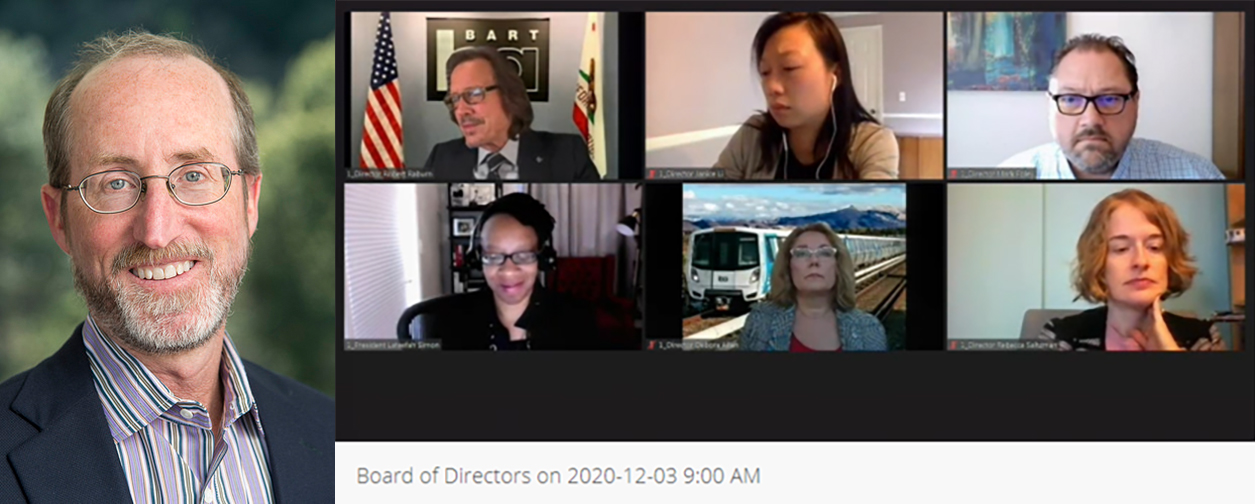
State Senator Steve Glazer and screenshot of BART Board meeting, Thursday, Dec. 3, 2020.

Board approves contract “after secret negotiations were held during BART Directors’ campaign elections” he said.

“…giving space to someone who can’t pronounce our past GM’s name or spell eBART correctly and someone who makes false claim after false claim is a disservice to the public and spreads lies.” – BART Director Li

“These agreements offer BART budgetary stability as we plan our recovery from COVID-19.” – Board V.P. Foley who voted in support.

“The contract extensions come seven months before the contracts are due to expire, locking in employee costs at pre-pandemic levels…at the level that it was when we were carrying 410,000 riders each week day and now we carry about 50 (thousand).” – BART Director Allen

By Allen Payton

In an attempt to get them to reconsider the proposed labor contract with employee unions, State Senator Steve Glazer challenged the BART Board during their meeting on Thursday, Dec. 3. He asked why they were considering the contract long before it’s set to expire, and more is known about the impacts of COVID-19 next year. In response, he was called a liar by one director.

Nevertheless, the BART Board voted 7-2 in favor of the contract, with Directors Debora Allen from Contra Costa County and Liz Ames from Alameda County casting the votes against. Board Vice President Mark Foley who represents other portions of Contra Costa County voted in favor of the contract extension.

Glazer issued a statement earlier this week about BART’s announcement “on Thanksgiving eve…(about) a tentative labor contract with their represented groups, after secret negotiations were held during BART Directors’ campaign elections.”

“Along with other specific contract changes, this tentative agreement is premature and a big mistake and will likely harm BART riders, commuters and taxpayers through fare hikes and service erosion,” his statement continued.

Glazer read most of the statement during the Thursday meeting, but offering additional comment.

“I want to be clear what I have to say reflects my views of accountability and trust that the public expects from all of us,” he said. “I think we all agree that BART is in a financial meltdown due to the pandemic and it’s not clear to me that you have a clear plan for recovery. The district’s own financial analysis projects a shortfall of tens of millions of dollars by next summer amidst the steepest decline in ridership in your agency’s history. My view, the district needs all the flexibility it can to avoid a financial disaster. Yet, BART is tying its hands with this agreement.”

“In the first half of 2021 BART will have a clearer idea about the COVID-19 vaccine availability, ridership improvements, any potential financial bailout assistance from the federal government, and the results of your early retirement incentives that have already been offered to existing employees,” Glazer explained. “All of these potential outcomes will provide important budgetary insight that should shape any new contract terms. But instead of waiting for that information, you are now rushing to approve a contract, negotiated behind closed doors, with no public notice and it will prevent you from making any kind of targeted salary reductions if your revenues do not recover. This will likely lead to service reductions and fare increases which will hurt the very people you are here to serve.”

His statement issued on Monday adds, “BART is leaving few options but to lay off employees and curtail the number of trains, which would further depress ridership and deepen the agency’s financial crisis.

“So, I come here with a question,” Glazer continued during the meeting. “The current labor contract with your representative employee groups doesn’t expire until July 1st, 2021. So, why did the district make an early agreement with so many economic unknowns?”

“It’s my understanding that BART has not even done a salary survey of other transit districts and public agencies to determine if the current salaries called for in this agreement are needed to recruit and retain qualified employees, basic data needed to inform any effective negotiation,” he said. “I question whether the failure to conduct a salary survey is keeping with board policy and procedures.”

“Now, the public was never told when your negotiations started. I’m told these negotiations were initiated by the Board in September and October. If true, that means that directors were negotiating with BART unions on their salaries and benefits on one hand, while asking the same unions for campaign contributions with the other hand. This is an outrageous injection of politics in a hugely consequential employer-employee agreement. And by setting the terms of the agreement at three years rather than four years based on past contract durations, the future contract will be negotiated during another election year.”

“You know that, Board members, before you came to this board for the most of you, had worked for a long time to ensure the contract negotiations would not be immersed in politics and election year circumstances. So, that four-year duration was done purposely. You unravel that in this proposed contract before you.

“In this agreement, for the most part, you’ve abandoned any of the work rule changes that were central to the 2013 contract negotiations. Where have those work rules been laid out, publicly disclosed and discussed, so that we can understand why they’ve been abandoned in this agreement.”

“You know, when the strike happened in 2013, BART management was clear that the work rules were probably more important than the salaries and benefits being negotiated. It had that kind of consequence and impact on the agency. But there’s a complete void of understanding or knowledge about what efforts were made to negotiate those work rules.”

It reversed important e-BART reforms that were instituted by former General Manager Grace Crunican. Again, BART, the board members, and the management (were) very involved in establishing those eBART reforms which you’re throwing out in this proposed contract.”

So, it’s not surprising to me, that you are moving forward with due haste to approve these negotiations and rush this contract through with very little public review, and I think that it’s because the details and the consequences are uncomfortable.

“I would hope that you will reconsider what you are doing, today and take a more deliberate and cautious approach to these negotiations as you consider the full impact of the pandemic on our economy. It would be best for your financial well-being and more importantly for BART riders throughout the Bay Area.”

“In conclusion, let me just say that the foundation of your service as board members is to ensure that this transportation system is able to function during good times and bad times. This contract continues the limitation against training management to run the trains during a work stoppage. So, all of BART riders, many of them low-income people who can’t afford to stay home, will be prevented from getting to work under this contract provision. We’re talking about teachers and nurses, social workers, grocery clerks and other essential workers, who will all be left stranded if your trains stop running because you created this self-inflicted problem.”

“This strike protection provision is an abdication of your sacred duty and will limit future boards from helping the commuters when matters cannot be worked out at the bargaining table. And listen, we all would strongly hope that all matters can be worked out at the bargaining table.”

In  his issued statement, Glazer included, “BART’s management doesn’t want the public to see what they are doing because they know that BART riders and other Bay Area residents would not support this agreement if they understood its details and its consequences.”

The BART Directors then took up the issue of the labor union contract.

General Manager Robert Powers responded to Glazer, saying, “I was the one…negotiating these tentative agreements with our labor partners. There were no elected officials in those discussions. I was supported primarily by our chief labor negotiations officer as well as our AGM of Operations. I wanted to be…crystal clear that it was me leading these negotiations under the authorization granted to me by the BART Board.”

During public comments, Sal Cruz, president of AFSCME Local 3093 said, “Our work has accelerated during this pandemic at great risk to our employees, as we position ourselves for the recovery we know will come. Proper positioning will be critical for the survival of all transit and for the Bay Area economy that is now linked to BART. Thank you for your leadership during these challenging times. Every transit agency in the country is in the same position as you are, now. The decision before you, today, is not an easy one. But it allows us to focus on rebuilding o ur system, continuing to provide safe transportation for our essential workers and preparing for the return of our riders. The workforce is behind you, the riders are behind you and the Bay Area is behind you.”

Li Calls Out Glazer

BART Director Li speaks in favor of the contract. Video screenshot of board meeting, Dec. 3, 2020.

BART Director Janice Li, who represents District 8 which includes portions of San Francisco, spoke next calling out Glazer for lying, mispronouncing the past general manager and misspelling eBART (it was spelled “e-Bart” in his statement from earlier in the week.

“I am proud to vote yes on this action, today. A yes vote, today is a yes vote for BART, is a yes for our riders and a very, very important yes for our workers,” she said. “Voting no makes BART an enemy to our workers and our riders.”

“There has been a lot of talk about this decision coming forward as too early or as a result of private meetings. I just want to be very clear that this claim is factually not true,” she stated. “First, I’m a member of the board’s labor negotiations review committee. We have been meeting since May of this year, then again in July, then again in August. These meetings are open to the public. They are publicly noticed and at subsequent board meetings we always give updates during board reports.”

“Second, we have held multiple closed session meetings regarding labor relations in recent months, and once again they have always been noticed as part of our board agenda,” Li continued. “Third, people who are saying that this is too early are saying that because the financial situation ahead is so unclear and that the board should wait until more is known. The truth is that things will inevitably change. But our staff has been doing excellent work in scenario planning and being transparent about all the potential futures, both good and bad. Furthermore, this contract is not one in the same as our budget revisions. In fact, this does not mean layoffs can’t or won’t happen. So, saying that by voting, yes it ties our hands or limits our options is incorrect.”

“And fourth, respectfully, I strongly refute the false claims made by Senator Glazer. Honestly, giving space to someone who can’t pronounce our past GM’s name or spell eBART correctly and someone who makes false claim after false claim is a disservice to the public and spreads lies. The idea that this was timed with elections is wrong and I will speak for myself, I was not up for election, re-election and I have not raised a cent for re-election, this year and I was not even endorsed by unions when I first ran in 2018.”

“So, what we actually have before us is a result of an incredible collaboration between BART management and labor unions and at the end of the day, who benefits?” she asked. “It’s our riders.”

She then thanked “the entire BART team for rebuilding trust with our labor unions and of course I want to thank our labor union partners for being collaborative at an incredibly difficult time.”

“As a board member I’m incredibly grateful that this decision is coming to us sooner rather than later so we can get back to focusing on running a safe system for our essential workers and implement a successful recovery plan during and through the pandemic that has raged every public transit agency, every public institution and every aspect of our lives. Let’s vote yes on this, today and if you remember our new slogan from the board workshop, earlier this year which, I know feels like years ago, ‘Let’s Go,’” she concluded.

Allen Offers Arguments Against Contract

BART Director Debora Allen speaks during the board meeting on Thursday, Dec. 3, 2020. Video screenshot.

Director Allen spoke against the contracts and supported what Glazer said.

“First, I want to touch on the private meetings because that seems to be a contentious little dialogue. I believe that is absolutely how these contracts come to be,” she said. “It is unfortunate the board discussion about these agreements doesn’t happen in public session. I believe we shouldn’t be discussing the contract extensions in closed door sessions where board members may say things that they would not say in public. In addition, I really do believe not enough of our own closed board discussion has occurred prior to this day of ratification.”

“There’s so much operational uncertainty, right now for BART and I’m not comfortable that the financial projections and plan give us the data we need for this decision,” Allen continued. “It’s really hard to say whether these are fair contracts. But despite having received $377 million in federal CARES Act subsidies already, this year, BART  projects another $210 million deficit over the next 18 months and that is the case after we slashed the capital and pension funding allocations from the Fiscal Year ‘21 budget, along with the load shedding to the capital budget that has occurred throughout this year.”

“From my view we should be receiving regular updates of projected deficits for three years…and that information should be part of any decision by this board to extend labor contracts for three years out. They go together. Labor is 80% of our budget,” she stated.

“So, now we are all hopeful that another $377 million will come to us from D.C. and we’re hopeful that the retirement incentive will induce enough people to retire from exactly the right positions that we can afford to eliminate which we know is not really a reasonable assumption. We already know that some people are retiring from positions that we are going to have to turn around and refill,” Allen said. “We shouldn’t be budgeting to hopeful or aspiration. This is what we did back in June when we passed the budget, and it didn’t work out. We really projected far more revenue than we have. But, if even if those other things come true…it will likely only fund another three-quarters to one year of operating deficits. And it won’t do anything to make up for the lack of capital funding and pension funding that we put aside in ’21 and are likely to do, again in Fiscal Year ’22.”

“The contract extensions come seven months before the contracts are due to expire, locking in employee costs at pre-pandemic levels even as revenue projects remain wildly uncertain well into the next couple of years,” she explained. “Costs will be locked in at the level that it was when we were carrying 410,000 riders each weekday and now, we carry about 50 (thousand).”

Foley Speaks in Support

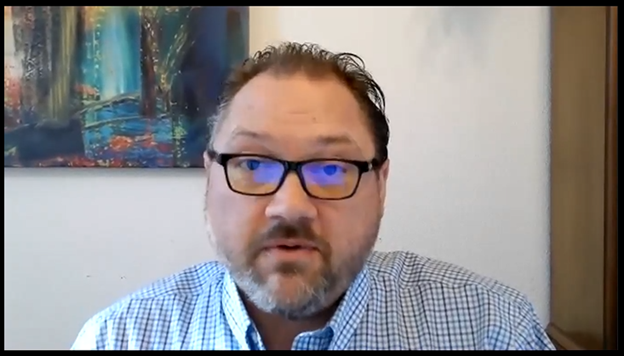
Board Vice President Mark Foley speaks on the matter during the meeting on Thursday, Dec. 3, 2020. Video screenshot.

Foley shared his thoughts in support of the contract.

“There was a lot of hard work that went in to making this happen. I am fully in support of this prudent approach to labor negotiations during the pandemic,” he said. “These agreements offer BART budgetary stability as we plan our recovery from COVID-19. A wage freeze, next year, coupled with two years, of at most, very modest increases, increases that are directly tied to returning ridership and BART’s financial recovery, is a responsible course of action to take.”

“More importantly, you know these contracts provide language to allow us to reopen negotiations, a necessary safety net during these challenging times,” Foley continued. “These proactive steps are being taken to hopefully avoid further service cuts, like closing stations, eliminating weekend service or laying off employees, employees that will be needed when we ramp up service.”

“And to those employees I say thank you. You are BART’s most important asset,” he stated. “We wouldn’t have been successful if not for the collaboration of your union leadership and union partners.”

“And lastly, I’d like to thank the district secretary’s office for bringing this item, publishing this agenda to the board, two days early rather than publishing it during the Thanksgiving holiday. This gave us additional transparency around this action. I urge my fellow board members to vote in support of these tentative agreements and I fully support this motion,” Foley concluded.

Other board members spoke, mainly in favor of the contract extension and they then voted 7-2 to approve.

Filed Under: BART, Finances, Labor & Unions, News

Texas man charged with defrauding Operating Engineers Local Union No. 3 of $4.5 million

June 27, 2020 By Publisher Leave a Comment

Scheme allegedly involved kickbacks paid in bricks of cash wrapped in silver bags

OAKLAND – Scott A. Wilson was arrested today in connection with a complaint unsealed in Oakland alleging that he defrauded the Operating Engineers Local Union No. 3, based in Alameda, California, of approximately $4.5 million, announced United States Attorney David L. Anderson, Federal Bureau of Investigation Special Agent in Charge John L. Bennett, and U.S. Department of Labor Office of Inspector General Special Agent in Charge Quentin Heiden.

According to the complaint, Wilson, 52, of Corsicana, Texas, was the director of the union’s information technology department, where he had authority to purchase goods and services.  While working for the union, Wilson allegedly set up a front company called OST.  Using the alias, “John Lasson,” Wilson allegedly used OST to receive funds from the union, at first directly and then through two other front companies set up by a friend and a relative under Wilson’s direction.  Between 2011 and 2017, Wilson allegedly used these front companies to fraudulently invoice the union for IT-related goods and services that were never to be delivered, taking some funds directly through OST, and others through kickbacks paid by his friend and relative.  Wilson also allegedly used the front companies to conceal payments made with union funds to his own family members, primarily for work that was never done.  At one point, according to the complaint, Wilson arranged for the union funds to be withdrawn from the front companies’ accounts and delivered to him at various restaurants around the Bay Area in the form of cash, wrapped in the shape of bricks and placed in silver bags.

The complaint alleges that over the course of six years, in total Wilson fraudulently directed approximately $4.5 million to the front companies, of which $2.5 million was kicked directly back to Wilson in various ways.  The complaint further alleges that Wilson used the allegedly embezzled funds to, among other things, purchase land in Corsicana, Texas, and build himself a house there.

According to the complaint, the scheme was discovered when the union’s finance department learned that Wilson had concealed that he was the principal behind one of the front companies with which his IT department was conducting business.

Wilson was arrested on June 26, 2020, in Corsicana, Texas, and made an appearance in federal court in Dallas this afternoon.   He was ordered to appear in federal court in Oakland on July 13, 2020.

A complaint merely alleges that crimes have been committed, and all defendants are presumed innocent until proven guilty beyond a reasonable doubt. If convicted, the defendant faces a maximum sentence of 20 years in prison, and a fine of up to $250,000, along with potential restitution and forfeiture.  However, any sentence following conviction would be imposed by the court after consideration of the U.S. Sentencing Guidelines and the federal statute governing the imposition of a sentence, 18 U.S.C. § 3553.

The case is being prosecuted by the Special Prosecutions Section of the U.S. Attorney’s Office for the Northern District of California.  The prosecution is the result of an investigation by the Federal Bureau of Investigation, and the Department of Labor’s Office of Inspector General and Office of Labor Management Standards.


Filed Under: Crime, Labor & Unions, News, U S Attorney

Union agreement with Kaiser will help healthcare workers treating COVID-19 patients

April 13, 2020 By Publisher Leave a Comment

80,000 workers who are members of the Coalition of Kaiser Permanente Unions covered by agreement

By Steve Trossman, Service Employees Union International

OAKLAND, Calif. – An agreement with healthcare giant Kaiser Permanente will ease some of the major burdens facing workers on the frontlines of the coronavirus pandemic, including assistance with childcare and temporary shelter, and extra leave for workers who are tested or diagnosed with COVID-19.

The measures provide support for 80,000 workers who are members of the Coalition of Kaiser Permanente Unions, more workers than covered by any such agreement in the nation. They apply to full-time, part-time and per-diem employees and can serve as a model for other hospitals and health systems to protect healthcare workers and the public.

“As healthcare workers in the middle of this pandemic, we know our duty is to our patients and the community, and we take that duty very seriously. But we can only give our best if we know our own lives and our families are protected as well,” said Juanita Kamhoot, who works in surgical survices at Kaiser Sunnyside Medical Center in Clackamas, OR. “This agreement will make a real difference at a time when we need every healthcare worker on the job and focused on taking care of COVID-19 patients.”

The agreement focuses on three key areas:

CHILD-CARE ASSISTANCE: With schools closed, many healthcare employees are having difficulty finding affordable childcare. Under the agreement, Kaiser employees who work 32 hours a week or more in a KP facility will be eligible for a grant of $300 per week to pay for childcare for children 14 or younger (and disabled, dependent children). It can be used to pay for their own caregiver (as long as they are not a spouse or domestic partner) or to find childcare outside of the home.

The stipend will last until May 31, 2020 and will be pro-rated for employees who work between 20 and 32 hours (including per-diem employees) with a minimum of $210 a week.

TEMPORARY SHELTER: Kaiser will work with several hotel chains to provide alternative shelter for employees who:

  • Test positive for COVID-19;
  • Work a double shift;
  • Work multiple 12-hour shifts;
  • Have fewer than 8 hours between shifts; or
  • Have a household member who either has COVID-19 or is in a CDC-defined vulnerable group.

Eligibility applies to all employees working at least 20 hours per week (including per-diem employees) at a KP facility between April 13 and May 31, 2020.

EIGHTY ADDITIONAL HOURS OF LEAVE FOR EMPLOYEES WHO TEST POSITIVE FOR COVID-19: Employees working at a KP facility more than 20 hours a week (including per-diem employees) who test positive for COVID-19 will receive up to 80 hours of administrative leave. This is above and beyond regularly accrued leave. Employees who are sent home from Kaiser and are awaiting a test result will also be covered.

The Coalition of Kaiser Permanente Unions comprises labor unions in California, Oregon, Washington, Colorado, Hawaii, Virginia, Maryland and the District of Columbia, representing more than 80,000 Kaiser caregivers. To learn more, visit https://www.unioncoalition.org/.

Filed Under: Health, Labor & Unions, News

Kaiser Permanent responds to strike vote by SEIU United Healthcare Workers

August 14, 2019 By Publisher Leave a Comment

In response to the vote to strike by the Service Employees International Union – United Healthcare Workers (see related article), John Nelson, Vice President, Communications, Kaiser Permanente issued the following statement:

Kaiser Permanente and SEIU-UHW have been working together toward a mutually beneficial agreement as part of the national bargaining with the Coalition of Kaiser Permanente Unions that began in April. Unfortunately, UHW leadership has decided to use the threat of a strike as a bargaining tactic, designed to divide employees and mischaracterize Kaiser Permanente’s position, even though most of the contracts don’t expire until October.

We believe the result of the strike vote reflects obviously misleading ballot questions used by the union:

  • “I vote YES to authorize our bargaining team to call for a strike to protest Kaiser’s illegal behavior and unfair labor practices and to show my support for a contract with good raises, no take-aways and a ban on subcontracting.” 
  • “I vote NO and am willing to accept a contract that increases our medical costs, cuts our pensions and retiree medical benefits, offers lower pay scales and raises that are less for Oregon and Washington than California.”

To be clear, Kaiser Permanente has presented a contract proposal that would provide annual pay increases that would keep our employees compensated higher than market averages and maintain excellent benefits. Contrary to the union’s claims, there are no pay cuts and no changes to our employees’ defined pension benefit, under our proposal.

It is important to understand that a strike vote does not mean that a strike is imminent, although it does place Kaiser Permanente in the position of having to spend millions of dollars preparing for the threat of a strike event. Our first priority is always continuity of care for our patients and members.

SEIU-UHW leadership is more interested in a power play to position themselves vis a vis other Kaiser Permanente unions – rather than focusing on what is best for their membership.  At a time when we are working hard to keep our care affordable, the Coalition’s demands are not fair to our members and the communities we serve. Coalition-represented employees are already compensated 23% above market rates—we pay well and we have markets where our wage rates are challenging our ability to be affordable. The Coalition’s proposal would actually increase our wages on average 32% above the market over the next five years, adding a billion dollars to our labor costs.

Despite the union leadership’s disruptive tactics, we are hopeful that our employees will value our proposal and SEIU-UHW and the other Coalition unions will move forward with us to reach a new agreement. Our goal is to continue to make Kaiser Permanente a great place to give and receive care.

Proposed Contract Offer

Kaiser Permanente’s bargaining proposal would provide employees with the following best-in-class conditions:

  • Solid wage increases. The average salary of Coalition-represented employees is already higher than market averages. Mindful of our goal to improve the affordability of health care and engage our employees in the effort, the current proposal provides guaranteed wage increases across the board each year through 2022 of 3% each year in Northern and Southern California.
  • Opportunities for new hires. Kaiser Permanente and the Coalition are proposing a $40 million Workforce Development Fund and creation of new-hire training positions, all part of the solution to address the national shortage of health care workers and help develop the next generation of unionized workers in health care.
  • Retirement security. The proposal preserves the existing defined pension plan along with other strong retirement benefits.
  • Career mobility. The proposal includes a more robust tuition reimbursement program for employees that allows more funds to be used for travel.
  • Affordable health care. The proposal includes a pharmacy utilization approach that incents employees to take greater responsibility for their health by rewarding them for increasing their use of mail-order prescriptions.

Just last year SEIU-UHW touted what it described as “strong wages and benefits” in the agreement it reached with Dignity Health, which included lower wage increases (13% over 5 years plus a one-time 1% bonus) than being offered by Kaiser Permanente, and only $2.5 million for workforce development, as compared to $40 million in Kaiser Permanente’s current proposal. (Source: SEIU-UHW press release, March 2018, http://www.seiu-uhw.org/archives/26114)

Filed Under: Health, Labor & Unions, News

Kaiser Permanente workers in Contra Costa, state vote to support strike beginning in October

August 14, 2019 By Publisher 1 Comment

Strike would affect more than 24,000 Kaiser Permanente workers in the Bay Area. Voting results in five other states, D.C. expected by September; would be nation’s largest walkout since 1997

OAKLAND, CA –  Kaiser Permanente workers in California poured out in large numbers to overwhelmingly authorize a strike in early October that would be the biggest in the United States in more than two decades.

Becoming the first of more than 80,000 Kaiser workers to vote, members of the Service Employees International Union – United Healthcare Workers West (SEIU-UHW) across the state voted between July 29 and Aug. 11 whether to approve the unfair labor practices strike at Kaiser Permanente hospitals and clinics. More than 37,000 cast ballots in support of a strike (98 percent) while only 867 voted to oppose (2 percent). The turnout was uncommonly high for a strike vote in any industry, with two-thirds of workers casting ballots.

Strike authorization votes among other groups of Kaiser workers in California, and Kaiser Permanente employees in Oregon, Washington, Colorado, Maryland, Virginia and the District of Columbia run through mid-September. The strike would start in early October and be the nation’s largest since the Teamsters’ walkout at United Parcel Service in 1997.

“Kaiser workers all over California are putting a stake in the ground that it’s time for this corporation to get back on track and live up to its mission to help patients, workers and communities thrive, said Heather Wright, a women’s health clerk at Kaiser Permanente in Santa Clara, Calif. “This strike vote is about stopping Kaiser’s unfair labor practices. This company should be all about providing the best possible patient care, but unfortunately its focus in recent years has been on making billions of dollars in profits and millions of dollars for Kaiser executives.”

Workers want Kaiser Permanente to bargain in good faith and stop committing unfair labor practices, and are fighting for a new contract that would:

  1. Restore a true worker-management partnership, and have Kaiser bargain in good faith;
  2. Ensure safe staffing and compassionate use of technology;
  3. Build the workforce of the future to deal with major projected shortages of licensed and accredited staff in the coming years; and
  4. Protect middle-class jobs with wages and benefits that can support families.

As a non-profit entity, Kaiser Permanente is supposed to serve the public interest in exchange for billions of dollars in tax breaks. But in recent years, the corporation has departed from its mission:

  • Profits: Kaiser made more than $5.2 billion in profits during the first half of 2019, bringing its profits to more than $11 billion since Jan. 1, 2017. The company also sits on $35 billion in reserves.
  • Executive pay: Kaiser gave its CEO a $6 million raise to $16 million a year and pays at least 36 executives a million dollars or more a year.
  • Care for low-income patients: Kaiser provides very little care to Medicaid patients, far less than other non-profit health systems, even though it gets massive tax breaks in exchange for supposedly working in the public interest.
  • Financial transparency: Kaiser lacks transparency and operates in the shadows. It is exempt from many of the financial reporting requirements of other hospitals and health systems. Operating secretly allows Kaiser to avoid the kind of scrutiny consumers, employers, unions and regulators need to protect themselves and the public.
  • Turning its back on workers: Kaiser has worked to destroy what had been the most successful and largest worker-management partnership in the country that was a source of innovation and problem-solving for many years; it has committed numerous unfair labor practices, including refusing to bargain in good faith.
  • Destroying good jobs. Kaiser is actively destroying good jobs by outsourcing them to companies that pay low wages with few benefits, and wants to limit the wages and cut the benefits of its frontline healthcare employees.

The workers’ national contract expired Sept. 30, 2018, and in December 2018 the National Labor Relations Board charged Kaiser Permanente with failing to bargain in good faith. Since then, Kaiser has continued to commit unfair labor practices.

The Coalition of Kaiser Permanente Unions comprises labor unions in California, Oregon, Washington, Colorado, Hawaii, Virginia, Maryland and the District of Columbia, representing more than 80,000 Kaiser caregivers. To learn more, visit www.KaiserKeepThriveAlive.com.     

Filed Under: Health, Labor & Unions, News

Frazier bill increasing representation for individuals with disabilities on Apprenticeship Board signed by governor

August 1, 2019 By Publisher Leave a Comment

Assemblyman Jim Frazier

SACRAMENTO – Last night, Governor Gavin Newsom signed AB 1019 by Assemblymember Jim Frazier (D-Discovery Bay) that would add two additional seats to a statewide advisory committee on apprenticeships and had overwhelming and bi-partisan support in both the Assembly and Senate.

AB 1019 would add both the Director of Rehabilitation and the Executive Director of the State Council on Developmental Disabilities to the Interagency Advisory Committee on Apprenticeships (IACA). This move would be to specifically address job and apprenticeship rates for Californians living with Intellectual and Developmental Disabilities (IDD) by the creation of a subcommittee with that exact purpose.

“Since 2013, California has had an employment first policy for the IDD community,” Assemblymember Frazier said. “Yet California has seen minimal growth in the employment rate for persons living with disabilities despite continued economic growth since the great recession.”

The American Community Survey reports that in 2017, the employment rate of working age people living with a disability (ages 21 to 64) in California was 36.9 percent compared to the percentage of working age people without a disability which was 77.3, a stark difference of 40.5 percent. Additional data from 2017 shows that 23.1 percent of working age people living with a disability on California are living in poverty.

Filed Under: Labor & Unions, Legislation, News

  • « Previous Page
  • 1
  • …
  • 3
  • 4
  • 5
  • 6
  • Next Page »
Free Kids Fishing Derby 10-10-26
RepublicServices-Antioch-ad (1)
Monica's Riverview 10-26 B
Celia's-10-26
Delta-RC-B 07-26
Deer-Valley-Chiro-06-22

Copyright © 2026 · · Contra Costa Herald · All Rights Reserved