• Home
  • About The Herald
  • Local Agencies
  • Daily Email Update
  • Legal Notices
  • Classified Ads

Contra Costa Herald

News Of By and For The People of Contra Costa County, California

  • Arts & Entertainment
  • Business
  • Community
  • Crime
  • Dining
  • Education
  • Faith
  • Health
  • News
  • Politics & Elections
  • Real Estate

Connect Bay Area campaign raises nearly $3 million to support signature gathering for regional transit tax measure

January 15, 2026 By Publisher Leave a Comment

Multiple Bay Area transit agencies would benefit from the five-county sales tax measure. Photo: MTC. Graphics source: Connect Bay Area

Businesses, labor unions, civic foundations join effort for 5-county Nov. 2026 ballot measure to prevent threatened catastrophic transit service cuts, promote reliable, safe public transit

Includes Contra Costa; would generate about $1 billion per year

SAN FRANCISCO BAY AREA, CA — The Connect Bay Area Transit committee today announced that it has already raised nearly $3 million to support a region-wide effort to qualify Connect Bay Area, a voter-proposed regional transportation funding measure, for the November 2026 ballot. With strong early financial backing secured, the campaign will now begin signature gathering while continuing to fundraise to qualify and pass a five-county sales tax to save public transit.

About the Tax Measure

The measure if adopted would increase the sales tax in Contra Costa, Alameda San Mateo and Santa Clara Counties by a half cent and one cent in San Francisco County for 14 years. As previously reported, the measure would generate approximately $980 million annually across the five counties.

Revenue from the tax measure will benefit multiple transit agencies in the region including Tri Delta Transit, County Connection and WestCat, as well as AC Transit and BART which serve Contra Costa County residents.

Following is a county-by-county breakdown of the County Specific Dollars. It does not include money going to BART, Muni, AC Transit and Caltrain, or to regional improvements that aren’t designated by county, such as coordinated fare programs and accessibility improvements.

County Agencies:

  • Contra Costa County Transportation Authority (2.5%, $26.51M)
  • Alameda County Transportation Commission (1%, $10.26M)
  • San Mateo County Transit District (4.7%, $50M)
  • Santa Clara Valley Transportation Authority (25.1%, $264.07M)

Small Operators:

  • Contra Costa County small operators (1.5%, $15.75M)
  • Alameda County small operators (0.5%, $5.25M)
  • SF Bay Ferry (0.7%, $7M)
  • Golden Gate Transit (0.1%, $1M)

Without new and sustainable operations funding, the Bay Area will face a true emergency:

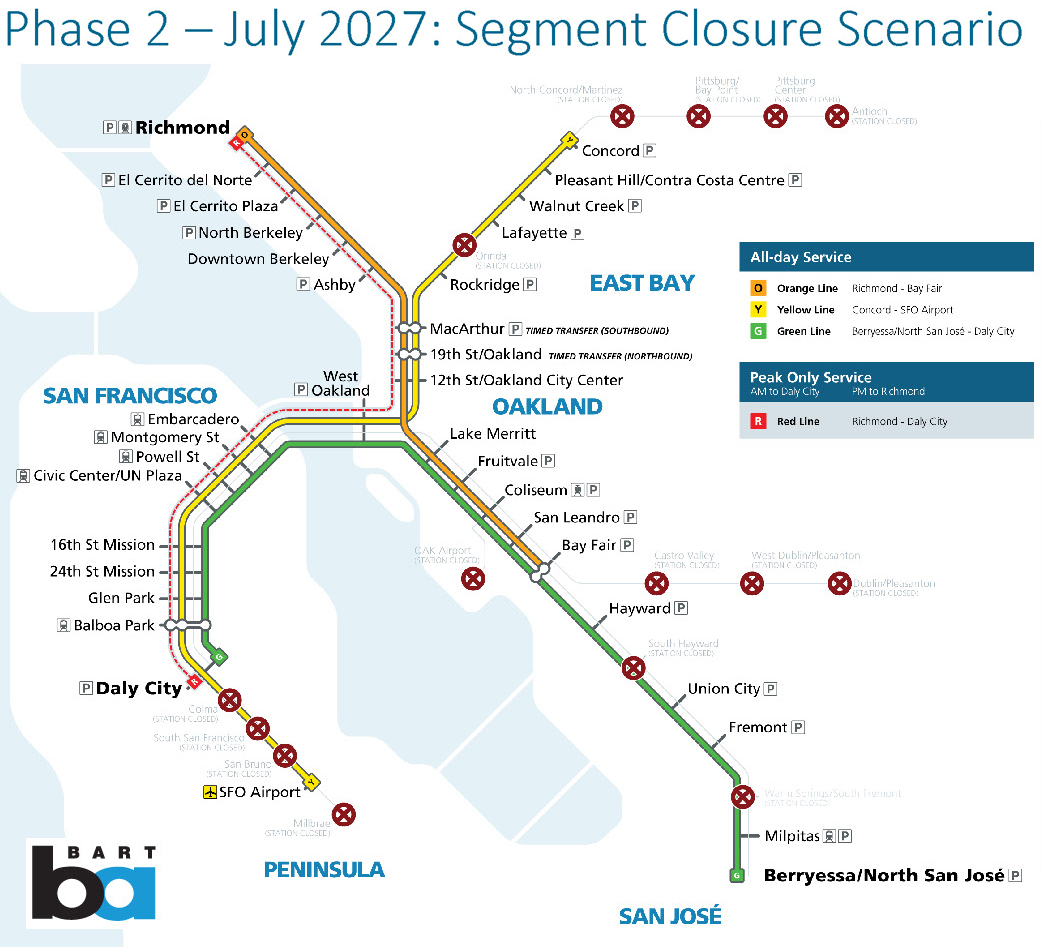
  • BART: Could shut down two of its five lines, reducing service from 4,500 trains per week to just 500, with trains running only hourly and no weekend service.
  • AC Transit: Would reduce service by 37%, bringing operations down to just half of pre-pandemic levels.
  • Muni: Would face 50% cuts to all bus and Metro lines, including elimination of entire neighborhood routes and San Francisco’s iconic historic trolleys and cable cars.
  • Caltrain: Trains would run only once per hour, end service by 9 p.m. on weekdays, and eliminate all weekend service.

The Connect Bay Area measure will support the future of public transportation in the Bay Area:

  • Protect and improve service on BART, Muni, Caltrain, SamTrans, VTA and AC Transit
  • Prevent catastrophic service cuts that could devastate the Bay Area
  • Keep traffic and emissions down, preventing gridlock and protecting climate progress;
  • Support the Bay Area’s economy, ensuring that downtown recovery and regional mobility remain strong.

The Connect Bay Area Transit measure will include strong accountability provisions. This ensures new funding delivers real improvements, not just short-term fixes. Transit agencies must:

  • Independent financial review and cost-efficiency: Operators will undergo a third-party financial review and be required to improve financial efficiency and use public funds wisely
  • Better regional coordination to benefit riders: Operators will be required to comply with MTC’s Regional Network Management Policies to coordinate across systems and simplify fares and signage to create a more seamless experience for riders.
  • Oversight Committee: An oversight committee will ensure that the expenditure plan is adhered to and hold MTC and operators accountable to all provisions of SB63.

About the Campaign

The campaign’s initial fundraising success reflects broad alignment across business, labor, philanthropy, and community leaders that a reliable, safe, and efficient public transportation system is vital to the future of the Bay Area. Major early donors include Chris Larsen, Herzog Contracting Corporation, Genentech, HNTB Corporation, Meta, and SEIU 1021. For a full list of donors, see below.

“Public transportation connects everyone. We are proud of the broad coalition uniting to prevent catastrophic service cuts and to build an affordable, safe, and efficient public transportation system,” said Jeff Cretan, a spokesperson for the Connect Bay Area Transit Committee. “The commitments we are seeing from business, labor, and civic leaders shows that everyone is ready to get this measure across the finish line in November.”

Connect Bay Area is a five-county regional tax measure designed to prevent catastrophic transit service cuts and provide reliable operating funding for major transit systems and local bus operators throughout the region. The measure also funds improvements to transit systems, capital projects within counties, and targeted road improvements. The measure is critical to supporting the Bay Area’s economy, promoting an affordable region, reducing traffic congestion, and ensuring access to jobs, schools, and healthcare.

Early financial support for the campaign includes commitments from:

  • Chris Larsen
  • Herzog Contracting Corporation
  • Genentech
  • HNTB Corporation
  • Meta
  • SEIU 1021
  • Jacobs
  • Silicon Valley Community Foundation
  • ATU Local 1555
  • PG&E
  • San Francisco Foundation
  • WSP
  • Golden State Warriors
  • AFSCME Local 3993
  • Boston Properties
  • Visa
  • AFSCME Council 57
  • T.Y. Lin
  • GILLIG
  • HDR, Inc.
  • Fehr & Peers
  • AFSCME 3916
  • Arup North America
  • Olson Remcho

Additional major employers, labor organizations, and philanthropic partners have indicated commitments that are expected to be finalized as the campaign continues to build momentum.

With signature gathering starting, the Connect Bay Area campaign will focus on qualifying the measure for the ballot while continuing to expand its coalition across the region. The Campaign must secure over 186,000 signatures from the five counties by June 6, 2026 to qualify for the November ballot.

The campaign’s early momentum comes as Bay Area transit agencies face an unprecedented funding crisis. Without a sustainable solution, public transportation in the the region could see devastating impacts, including:

  • BART could eliminate 2 full lines, stop service at 9pm on weekdays, and eliminate all weekend service.
  • Muni could eliminate entire routes, make 50% cuts to major bus and metro lines, gut historic train and cable car service.
  • Caltrain could cut weekday service to once an hour, stop service at 9pm on weekdays, and eliminate all weekend service.
  • AC Transit could cut up to 37% of overall service.

Recent polling on the proposed Connect Bay Area measure shows a clear path to passage, with strong support across counties and voter demographics. A survey conducted by EMC Research for the Metropolitan Transportation Commission found that 59% of Bay Area voters would support a proposed regional sales tax measure for public transportation. The threshold for passage for a signature-gathering initiative is 50%+1.

For more information about Connect Bay Area, visit ConnectBayArea.com.

About the Connect Bay Area Transit Committee

The Connect Bay Area Transit Committee is led by labor, business, and transit supporters, including the Bay Area Council, SEIU 1021, ATU 1555, SPUR, SAMCEDA, among others, as well as a broad advocacy council. The advocacy council includes more than 20 organizations including transit advocates, housing advocates, safe streets advocates, senior and disability advocates, and environmentalists. The Committee is focused on delivering a successful 2026 ballot measure that will strengthen public transportation to keep the Bay Area affordable for residents and support critical economic growth and climate resilience.

Allen D. Payton contributed to this report.

Filed Under: BART, Bay Area, News, Politics & Elections, Taxes, Transportation

Signatures-In-Lieu of filing fees collection period for June Primary candidates open through Feb. 4

December 27, 2025 By Publisher Leave a Comment

By Dawn Kruger, Community and Media Relations Coordinator, Contra Costa County Clerk-Recorder-Elections Department

Candidates can now collect signatures from registered voters in lieu of filing fees for the June 2, 2026 Primary Election. This part of the candidate filing process, known as Signatures-In-Lieu, began Friday, December 19th, and runs through February 4th.

State and County Candidates for Voter-Nominated offices may obtain forms from the Contra Costa County Elections Office at 555 Escobar Street in Martinez for circulating petitions to secure Signatures-In-Lieu of all or part of the filing fee. Signatures may also be applied to the nomination signature requirements for the office. This is an optional filing process to assist candidates who wish to collect signatures to offset the filing fee to run for office in the June 2, 2026 Primary Election.

For further information on this Primary Election and key dates, go to www.contracostavote.gov

“Our office is ready for the start of the 2026 Primary Election Process which begins with the Signatures-in-Lieu period,” said Kristin B. Connelly, Contra Costa Clerk-Recorder and Registrar of Voters. “We want to be sure that interested candidates in Contra Costa County are made aware of important dates as they prepare to run. This is especially important in light of recent redistricting changes for the United States House of Representatives because of the passage of Proposition 50.”

The nomination period for the June 2nd election opens February 9, 2026.

If you would like to speak to someone regarding candidate filling, please contact the Elections Office at (925) 335-7800 or via email at candidate.services@vote.cccounty.us.

Filed Under: News, Politics & Elections

Tips and reminders for voting in the November 4th statewide Special Election

October 31, 2025 By Publisher Leave a Comment

5 Regional Early Voting Sites in Brentwood, Pittsburg, Richmond, San Ramon, Walnut Creek open today

Some polling places in Antioch, Bay Point, Lafayette, Pinole, Pittsburg, San Pablo and San Ramon have changed.

 By Dawn Kruger Community and Media Relations Coordinator Contra Costa County Clerk-Recorder-Elections Department

Regional Early Voting Sites open today, Friday, October 31st and polling places are open on Election Day, Tuesday, November 4th from 7:00 AM to 8:00 PM.

Voters can still return their ballots by mail, postmarked on or before Election Day – to ensure your mailed ballot is received on time, mail ballots before Election Day. Voters can drop their ballot off at one of the County’s 45 official drop boxes before 8:00 PM on Election Day, to ensure we receive your ballot on time.

“Voters have many opportunities to cast their ballot early,” said Kristin B. Connelly, the County’s Registrar of Voters. “The Contra Costa County Elections Office is here to ensure voters can cast their ballots safely, early, and conveniently to make sure their voices are heard.”

In-Person Voter Services

If you prefer to vote in-person or need in-person services to cast your ballot, Contra Costa County residents have early voting options at five Regional Early Voting sites throughout the county.

All Contra Costa registered voters will be able to vote at any of the Regional Early Voting locations, which will be open Friday, October 31st from 11:00 AM to 6:00 PM; Saturday, November 1st from 9:00 AM to 3:00 PM; and Monday, November 3rd from 11:00 AM to 6:00 PM.

Here are the locations of Contra Costa’s Regional Early Voting sites:

  • Brentwood Community Center, 35 Oak Street, Brentwood
  • Pittsburg Library-Community Room, 80 Power Avenue, Pittsburg
  • Richmond Memorial Auditorium, 403 Civic Center Plaza, Richmond
  • San Ramon Valley United Methodist Church, 902 Danville Boulevard, Alamo
  • Walnut Creek City Hall, 1666 North Main Street, Walnut Creek

Polling Places

Polling places will be open on Election Day, Tuesday, November 4th from 7:00 AM to 8:00 PM.  Please go to our website and check “My Voting Information.” to find your assigned polling place. Please note that some polling places in Antioch, Bay Point, Lafayette, Pinole, Pittsburg, San Pablo and San Ramon have changed.

Conditional Voter Registration

If you missed the voter registration deadline, you can still register and vote in-person using Conditional Voter Registration. It is a one-stop opportunity to register and cast your ballot and is available (1) at our office at 555 Escobar Street in Martinez, (2) at Regional Early Voting sites, and (3) at all polling places.

Accessible Voting Equipment and Additional Language Access

Official ballots and voting instructions are provided in English, Spanish, and Chinese. Additional language resources are available through ballot translation guides which are available online and at in-person voting locations. Ballot marking equipment with accessible features is available at every in-person voting location for voters with disabilities who may need assistance.

Be Prepared

If you vote in person, many voters find it helpful to come prepared. Make your choice ahead of time and bring your pre-marked Sample Ballot to the polls to help you save time. Copies of the Voter Information Guide are available at the polls and the information is also available online.

Leave the Campaign T-Shirts, Buttons, and Hats at Home

Please remember that voters have the right to cast a ballot free from intimidation or distraction. Under California law, electioneering is prohibited within 100 feet of any voting location.  Anyone wearing items promoting any position in this election will be asked to remove or cover them while they are at the voting location.  Please help our poll workers by refraining from electioneering and leave your campaign t-shirts, buttons and hats at home.

For more information on voting options for the Statewide Special Election, visit www.contracostavote.gov or call 925.335.7800.

Filed Under: News, Politics & Elections

Newsom signs bill authorizing Nov. 2026 Bay Area transit tax measure

October 14, 2025 By Publisher 2 Comments

Photo: MTC

Five-county half-cent sales tax would include Contra Costa County, last 14 years; in addition to existing half-cent BART operations sales tax

By John Goodwin, Assistant Director of Communications & Rebecca Long, Director, Legislation & Public Affairs, Metropolitan Transportation Commission 

Gov. Gavin Newsom today, Monday, October 13, 2025, signed into law state Senate Bill 63, authorizing a November 2026 ballot measure to prevent major service cuts at BART and other Bay Area transit systems and to make improvements to transit affordability, accessibility and reliability in the region. The new law allows the measure to be placed on the ballot either through action by a newly formed Public Transit Revenue Measure District governed by the same board as the Metropolitan Transportation Commission (MTC) or via a citizen’s initiative.

The half-cent sales tax would be in addition to the half-cent sales tax for BART operations in Contra Costa, Alameda and San Francisco counties in place since the 1960’s.

Enactment of the bill — authored by state senators Scott Wiener (D-11) of San Francisco and Jesse Arreguín (D-7) of Berkeley, and co-authored by Sen. Laura Richardson of Los Angeles County and Assemblymembers Mia Bonta (D-18) of Alameda County and Matt Haney (D-17) and Catherine Stefani (D-19) of San Francisco — clears the way for voters in Alameda, Contra Costa, San Francisco, San Mateo and Santa Clara counties to consider a 14-year regional transportation sales tax that would generate approximately $980 million annually across the five counties. The bill authorizes voter consideration of a half-cent sales tax in Alameda, Contra Costa, San Mateo and Santa Clara counties and a one-cent sales tax in San Francisco.

Approximately 60 percent of the revenue that would be raised if voters approve the measure will be dedicated to preserving service on BART, Muni, Caltrain, AC Transit — which an independent analysis confirmed face annual deficits of more than $800 million annually starting in fiscal year 2027-28 — as well as San Francisco Bay Ferry and smaller transit agencies providing service in the five counties to keep buses, trains and ferries moving. About one-third of the revenue would go to Contra Costa Transportation Authority, Santa Clara VTA, SamTrans and the Alameda County Transportation Commission, with flexibility to use funds for transit capital, operations, or road paving projects on roads with regular bus service.

If a regional tax measure wins voters’ approval next fall, about 4.5 percent, equivalent to $43 million in fiscal year 2027-28, will go toward improving the rider experience, funding priorities identified in the 2021 Bay Area Transit Transformation Action Plan.

“In addition to averting major service cuts for regional operators, MTC advocated for the measure to include dedicated funding to make Bay Area transit more affordable, reliable, and easy to use so that it becomes a system that will attract more riders,” noted Commission Chair and Pleasant Hill Mayor Sue Noack.

The suite of rider-focused improvements includes:

  • Free and reduced-fare transfers that could save multi-agency riders up to $1,500 per year and are estimated to increase transit ridership by some 30,000 trips per day.
  • Expansion of the Clipper START® program, which provides a 50% fare discount, to reach 100,000 additional low-income adults.
  • Improvements to accessibility for seniors and people with disabilities.
  • Transit-priority projects to make bus trips faster, and mapping and wayfinding improvements to make transit easier to use.

Bay Area transit riders take more than 1 million trips each day, with over 80 percent of these trips on Muni, BART, Caltrain or AC Transit. Riders include tens of thousands of students, seniors, people with disabilities, and low-income residents who can’t afford to own a car. Clipper START customers accounted for nearly 400,000 transit trips across the region in August 2025 and the fare-discount program is growing at a rate of more than 20,000 customers each year.

SB 63 includes several oversight and accountability provisions to reassure voters their tax dollars will be used responsibly. These include establishing an independent oversight committee to ensure expenditures are consistent with the law. Membership will include at least one representative from each county in the Public Transit Revenue Measure District, appointed by each county’s board of supervisors.

The new law also requires BART, Muni, Caltrain and AC Transit to undergo a two-phase independent third-party financial efficiency review overseen by its own oversight committee composed of four independent experts, four transit agency representatives, and an MTC Commissioner. MTC is responsible for procuring the third-party consultant to conduct the review and for staffing the Oversight Committee.

A maintenance-of-effort clause in SB 63 requires BART, Muni, Caltrain, AC Transit, Golden Gate Transit, SF Bay Ferry and the bus operators in Alameda and Contra Costa counties to maintain existing levels of funding for operating purposes if a 2026 tax measure is passed by voters. The legislature established this requirement to ensure the measure supplements, rather than replaces, current operations support, with provisions for exceptions that are subject to MTC approval.

To provide additional oversight regarding the quality of the transit service provided in each county participating in the measure, the legislation allows a county transportation agency or board of supervisors within the District’s geography to require review by an ad-hoc adjudication committee if they believe a transit agency funded by that county’s portion of the measure’s revenue is not applying standards (such as service levels, fare policy, cleanliness, maintenance, access and safety) consistently across counties or if those standards disproportionately disadvantage service or transit equipment/station quality in that county. The committee is composed solely of representatives from counties contributing revenue measure funds to the transit agency under review. Its determinations are binding and may result in withholding up to 7 percent of the transit agency’s funds, a strong incentive for agencies to deliver high quality service that follows consistent standards across all five counties.

What Local Transportation Officials are Saying: 

“The BART Board of Directors supported SB 63 because it will cover a significant portion of BART’s operating deficit caused by remote work and will allow us to maintain current service levels and improve the rider experience,” said BART General Manager Bob Powers.

“SB 63 is a step towards protecting essential Muni service and will equip us with resources to continue meeting the needs of San Francisco and the growing region,” said Julie Kirschbaum, San Francisco Municipal Transportation Agency Director of Transportation.

“Through Governor Newsom’s leadership and the support of voters, SB 63 will help protect transit for our more than three million monthly riders. In fact, this summer, we took proactive steps to preserve service by redesigning 103 bus lines through our new Realign network. Designed over two years, this all-new network maintains service at 85 percent of pre-pandemic levels. SB 63 gives voters a chance to ensure that these vital bus lines – and our riders’ lifelines – are protected for the future,” said AC Transit Board President Diane Shaw.

“Caltrain has been reinvented as a state-of-the-art rail system, delivering the best service this corridor has seen in its 161-year history. We are seeing the benefits every day with growing ridership, cleaner air, quieter trains, and less-congested roads. To sustain these benefits, it is essential that Caltrain be funded. We are deeply grateful to Governor Newsom and the California Legislature for their leadership in crafting and supporting this legislation, which gives voters the opportunity to consider the vital Connect Bay Area measure in November 2026,” said Caltrain Executive Director Michelle Bouchard.

“SB 63 represents a transformative opportunity to invest in the future of public transit,” she said. With this measure, we can deliver faster, more frequent service and ensure better connections for all riders across Santa Clara County,” said Carolyn Gonot, Santa Clara Valley Transportation Authority General Manager and CEO.

“We’re excited the Connect Bay Area Act is moving forward and voters will soon have the opportunity to shape the future of public transit along the Peninsula and surrounding Bay Area communities. Next November’s vote will be a pivotal moment to secure reliable, connected and sustainable transportation. With this measure, we can ensure SamTrans, Caltrain and our regional transit partners have the stable funding needed to serve riders for years to come,” said SamTrans Board of Directors Chair Jeff Gee.

MTC is the transportation planning, financing and coordinating agency for the nine-county San Francisco Bay Area.

BART Issues Statement of Support

BART issued the following statement on Governor’s signing transit funding measure SB 63:

“BART is grateful to Governor Newsom for signing Senate Bill (SB) 63 into law. The Governor has been a steadfast advocate of transit and BART specifically, recognizing our role in moving the region and strengthening the economy. SB 63 is a historic opportunity to allow voters in five counties of the Bay Area to consider a sales tax measure in November 2026 aimed at preserving and improving transit.

A regional transportation funding measure would provide a reliable funding source for BART and other agencies to address deficits caused by remote work. The BART Board of Directors supported SB 63 because it will cover a significant portion of BART’s operating deficit and allow us to maintain current service levels and improve the rider experience.

Before measure funds become available, BART will rely on internal cuts, efficiency measures, and a series of one-time solutions to pay for operations. BART will continue to identify additional cost savings and efficiencies to address our deficit, and we welcome the enhanced accountability measures and financial efficiency review included in SB 63.

BART is also grateful to Senators Scott Wiener and Jesse Arreguín for championing this legislation and their fierce advocacy for transit funding.”

Allen D. Payton contributed to this report.

Filed Under: BART, Bay Area, Legislation, News, Politics & Elections, State of California, Transportation

Guest Commentary: Elections and constitutional law attorney offers reasons behind Texas’ redistricting vs. California’s Prop 50

October 10, 2025 By Publisher 1 Comment

2021 Houston, Texas area Congressional District maps that the state was sued over by the Biden Administration DOJ. Source: Mark Meuser on X

“To put Proposition 50 on the ballot for the voters of California to decide, the California legislature had to violate the California Constitution multiple times.”

By Mark Meuser, Attorney

I am tired of hearing that California is redistricting to combat President Trump and Texas redistricting efforts. Texas was forced to redistrict because the Biden DOJ sued Galveston County and lost which changed the law thus making four Texas Congressional Districts unconstitutional.

When Texas drew its congressional districts in 2021, they created four congressional districts where they combined two minority communities to create a minority-majority district (Coalition minority districts).

On March 24, 2022, the Biden DOJ sued Galveston County Commissioners because Galveston did not draw a coalition minority district for the Black and Latino population.

On October 13, 2023, a Federal Judge agreed with Biden’s DOJ and found that Galveston County was required to draw a Commissioner seat by combining two minority communities.

On November 10, 2023, a three Judge panel of the 5th Circuit found that combining two minority groups to create a minority-majority district was unconstitutional and thus asked for an en banc panel to review the issue to overturn prior precedents.

On Aug. 1, 2024, the en banc panel of the Fifth Circuit concluded “that coalition claims do not comport with Section 2’s statutory language or with Supreme Court cases interpreting Section 2.” The Fifth Circuit ruled coalition minority districts are unconstitutional.

On July 7, 2025, President Trump’s DOJ sent a letter to Texas highlighting the 5th Circuit Order, pointing out that there are four coalition minority congressional districts that are now unconstitutional and that Texas needed to fix the problem.

Texas Houston area Congressional District maps 2021 (left) and 2025 (right). Source: State of Texas

Texas made a prudent choice to redraw the congressional districts so as to save their taxpayers the expense of litigating the losing case of defending minority coalition districts.

Texas did not have to redraw four minority coalitions districts because of President Trump. Texas had to redraw the lines because Biden sued Galveston County and the law was clarified that coalition minority districts were unconstitutional.
It is important to understand that the 2021 lines drawn by the California Independent Redistricting Commission have never been challenged in Court as unconstitutional because districts were drawn to create coalition minority districts.
Since Texas law requires that the Texas legislature draw the congressional districts, the Texas legislature followed the law.

However, the California Constitution prohibits the California legislature from drawing congressional districts and instead places that responsibility on the Independent Redistricting Commission.

To put Proposition 50 on the ballot for the voters of California to decide, the California legislature had to violate the California Constitution multiple times.

The California legislature is asking the voters of California to forgive them for violating the California Constitution when they should have asked the voters for permission to draw the maps.

I was a part of two lawsuits filed before the California Supreme Court asking the Court to stop Proposition 50 before it went to the voters because the California legislature violated the California Constitution. Unfortunately, the California Supreme Court refused to require the California legislature to defend their unconstitutional acts and simply dismissed the Writ without even deciding the merits of the matter

While I am preparing the next lawsuit that will be filed, it is important that the voters of California stand up against the unconstitutional actions of Gavin Newsom and the California legislature by voting No on November 4th to Proposition 50.

The next time someone tells you that Newsom had to Gavinmander the State of California, remind them that the reason Texas had to redraw Congressional Districts is because Biden sued and lost which resulted in Texas having to redraw its lines.

Meuser practices election and constitutional law at the Dhillon Law Group.


Filed Under: Legal, Opinion, Politics & Elections

Contra Costa Elections to test public ballot tabulation equipment to ensure accuracy Oct. 10

October 9, 2025 By Publisher Leave a Comment


Herald file photo

By Dawn Kruger, Community and Media Relations Coordinator, Contra Costa County Clerk-Recorder-Elections Department

Ballots have been mailed for the November 4, 2025 Statewide Special Election and the Elections Office is ready to receive voted ballots sent by mail or dropped in drop boxes. The Contra Costa County Elections Division will perform the County’s official logic and accuracy testing on central ballot tabulation and processing equipment at 10:00 am Friday, October 10, 2025, a at the Elections Office, located at 555 Escobar Street in Martinez and the public is invited to observe.

Logic and accuracy testing is a standard pre-election procedure. The test will confirm that all central count equipment is in working order and functioning properly. A set of test ballots will be run through each scanner to ensure they are properly programmed and operating as expected.

If you would like to observe this process, we encourage you to let us know in advance by contacting the Elections office at 925-335-7800. On the day of testing, visitors will be asked to check-in at the Elections lobby on the first floor.

Filed Under: Government, News, Politics & Elections

Ballots for upcoming statewide Prop 50 Special Election are in the mail

October 7, 2025 By Publisher Leave a Comment

By Dawn Kruger Community and Media Relations Coordinator Contra Costa County Clerk-Recorder-Elections Department

Contra Costa County—Registered voters in Contra Costa County will soon receive their Official Ballots for the upcoming November 4, 2025, Statewide Special Election. Ballots are at the post office as of Monday, Oct. 6 and should arrive in mailboxes beginning this week.  If you do not receive your ballot by October 13th, call our office at (925) 335-7800.

“The Statewide Special Election was not approved by the California State Legislature until late August, and I want to make sure that all registered Contra Costa County voters know what they can expect as we get closer to Election Day,” said Kristin B. Connelly, Contra Costa County Clerk-Recorder and Registrar of Voters. “Our office wants to ensure that every Contra Costa County Voter is fully informed about how to participate in this election.”

In the coming days and weeks, the Contra Costa Elections Division will be sharing important logistical information about this election with local residents at ContraCostaVote.gov and on our social media.

Under Proposition 50, five Republican-held congressional districts would shift to become more Democratic, based on presidential election results from 2024. Kamala Harris (D) would have won three—District 1, District 3, and District 41—with margins above 10%. District 48 would lean Democratic, with a margin of 3%. District 22 would have shifted four percentage points toward Democrats; however, Donald Trump (R) would have won the district with a margin of 2%. The table above provides additional information about these five districts. Source: Ballotpedia

Some key dates:

– State Voter Information Guide mailed out/online: by Sept 20

– County Voter Information Guide sent to Registered Voters: by September 25

-Vote-by-Mail ballots sent to registered voters: by Oct 6

– Contra Costa Elections Office opens for early voting: Oct 6

– Deadline for registering to vote online via RegisterToVote.ca.gov: Oct 20

– Regional Early Voting open: Oct 31

– Polling places open: Election Day, Nov 4 (7am to 8pm)

– Vote-by-Mail ballots must be postmarked on or before Nov 4

The Contra Costa County Clerk-Recorder-Elections Department offers many ways for voters to cast their ballot early and ensure it is included in the first report on Election Night. Voters can send their ballot through the US Mail in their postage pre-paid ballot envelope. They can put it in one of 45 secure Contra Costa Dropboxes located throughout the County, or they can bring it to our office at 555 Escobar Street in Martinez between 8 am and 5 pm Monday through Friday. The Elections Division also offers Regional Early Voting sites for those who need to register and/or vote in person.

For more information about the November 4, 2025 Statewide Special Election visit Proposition 50 | Official Voter Information Guide | California Secretary of State, or go to the Contra Costa County Elections Office, your trusted source of nonpartisan election information, visit the website at www.contracostavote.gov, or call 925-335-7800 M-F 8 am to 5 pm.

Filed Under: News, Politics & Elections, Post Office

CA Secretary of State announces mistake in special Prop 50 election Voter Information Guide Map, correction mailing

October 1, 2025 By Publisher 1 Comment

Under Proposition 50, five Republican-held congressional districts would shift to become more Democratic, based on presidential election results from 2024. Source: Ballotpedia

“Will cost taxpayers millions of dollars” more

Sacramento, CA – The California Office of the Secretary of State announced on Monday that a correction notice will be mailed to voter households in response to the discovery of a map labeling error in the official 2025 Voter Information Guide (VIG).

On page 11 of the guide, a proposed congressional district contained in the map provided by the Legislative Analyst’s Office (LAO) was inadvertently labeled as District 22 instead of District 27. A separate map provided by the LAO on page 15 included the correct identification of District 27.

To ensure voters receive accurate information, a correction postcard will be mailed to all voter households who received the guide with the typo. The “https://voterguide.sos.ca.gov/“ website has also been updated to reflect the corrected map.

“Accuracy in voter information is essential to maintaining public trust in California’s elections.” said Weber.  “We are taking swift, transparent action to ensure voters receive correct information. This mislabeling does not affect proposed districts, ballots, or the election process; it is solely a labeling error. Every eligible Californian can have full confidence that their vote will be counted and their representation is secure.”

According to a report by the L.A. Times, “There are 23 million registered voters in California, but it’s unclear if the postcards will be mailed to each registered voter or to households of registered voters. Even if the corrective notices are mailed to voter households rather than individual voters, the postage alone is likely to be millions of dollars, in addition to the cost of printing the postcards. The special election, which the legislature called for in August, was already expected to cost taxpayers $284 million.”

“When politicians force the Secretary of State to rush an election, mistakes are bound to happen,” said Amy Thoma, a spokesperson for one of the campaigns opposing the effort. “It’s unfortunate that this one will cost taxpayers millions of dollars.”

The election is Tuesday, Nov. 4. (See more information at Pros and Cons of Proposition 50 events Sept 30, Oct 2 & 9).

Allen D. Payton contributed to this report.

Filed Under: News, Politics & Elections, State of California

Pros and Cons of Proposition 50 events Sept 30, Oct 2 & 9

September 22, 2025 By Publisher 1 Comment

Under Proposition 50, five Republican-held congressional districts would shift to become more Democratic, based on presidential election results from 2024. Kamala Harris (D) would have won three—District 1, District 3, and District 41—with margins above 10%. District 48 would lean Democratic, with a margin of 3%. District 22 would have shifted four percentage points toward Democrats; however, Donald Trump (R) would have won the district with a margin of 2%. The table above provides additional information about these five districts. Source: Ballotpedia

Presented in Concord, Antioch, San Ramon and online by League of Women Voters of Diablo Valley

Learn the Pros and Cons of Proposition 50, the Election Rigging Response Act, a temporary redistricting measure on the statewide election scheduled for November 4. The League of Women Voters of Diablo Valley will sponsor three in-person events and one online session for the public to hear arguments and funding for and against the measure, which has potential nationwide impact.

Ballots will be mailed October 6.

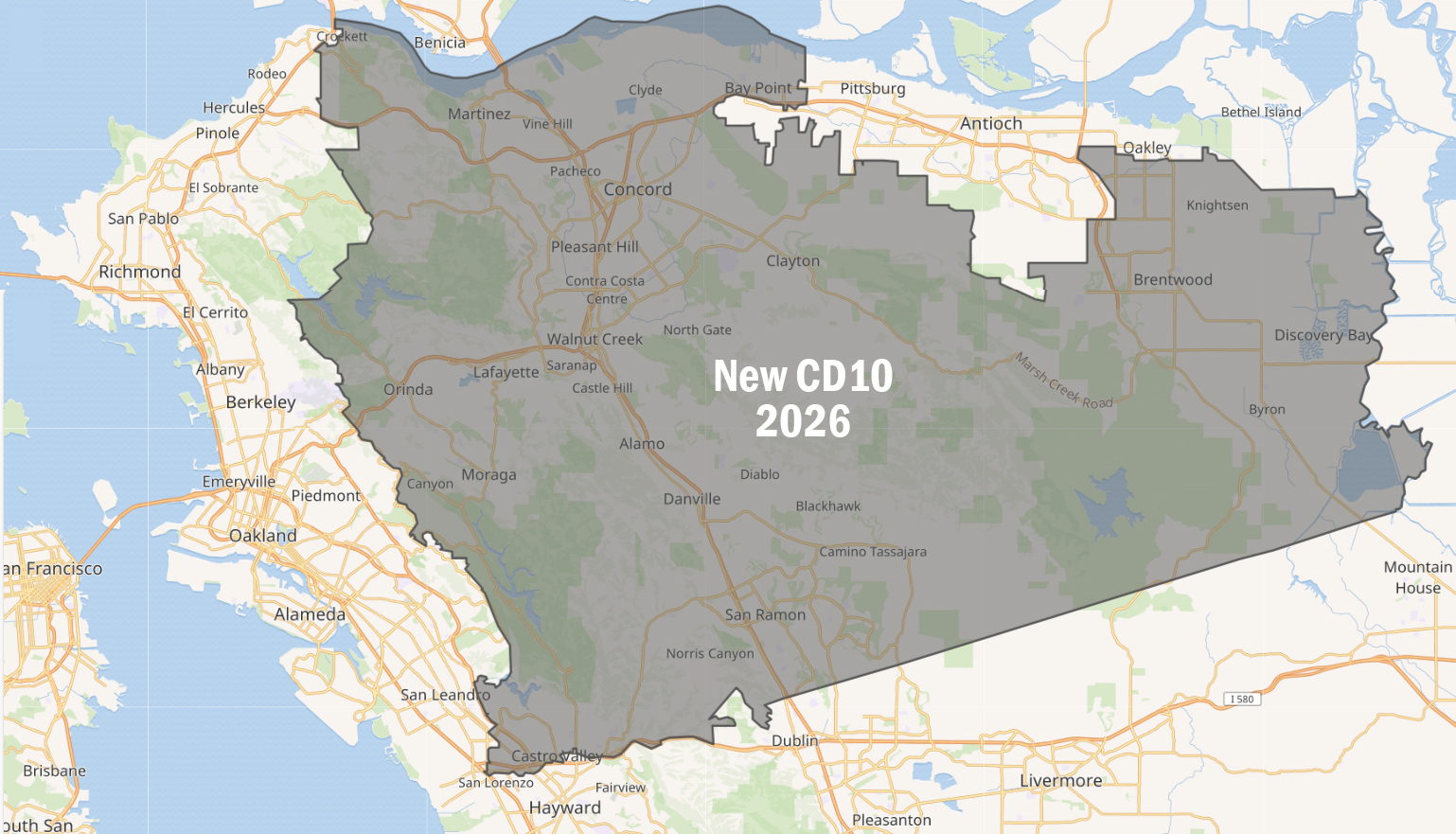
Proposed new California Congressional District 10 map if Prop. 50 passes. Source: California State Assembly Elections Committee AB604

Background

Proposition 50 was a response by Governor Newsom and the California State Legislature to Texas Legislature’s recent mid-cycle redistricting. But the California ballot measure was approved and signed into law on Aug. 21 before Texas’ new congressional district were approved on Aug. 29, which was done in response to a lawsuit by the Biden Administration’s Department of Justice.

According to a report by Democracy Docket, the lawsuit was “filed in 2021 by the DOJ under the Biden administration that alleged the state’s new redistricting plans drawn with 2020 census data violated Section 2 of the Voting Rights Act because they ignored the Lone Star State’s growing minority population and instead diluted the voting strength of voters. The lawsuit was later consolidated with several other similar lawsuits.”

Proposed new California Congressional District 9 map if Prop. 50 passes. Source: California State Assembly Elections Committee AB604

While in March the Trump Administration’s DOJ “dropped its claims against Texas that its…state legislative and congressional maps violate the Voting Rights Act, litigation is ongoing, with a coalition of pro-voting groups — including the League of United Latin American Citizens, the Southwest Voter Registration Education Project, Mi Familia Vota and others — continuing their legal efforts for fair maps in Texas.”

Later, according to a July 15th report by Politico, President Trump told reporters he wanted Texas to attain five additional Republican congressional seats in the 2026 election through redistricting, in order to maintain a Republican majority in the U.S. House of Representatives.

Proposed new California Congressional District 8 map if Prop. 50 passes. Source: California State Assembly Elections Committee AB604

According to the LWV, “The California measure’s stated intent is to counteract Texas’ actions and help ensure that the 2026 U.S. mid-term elections are conducted on a level playing field, without an unfair advantage for either party.” While California’s Prop 50 puts the decision in the hands of California voters the new district lines were drawn and approved by the Democrats in the state legislature and Governor Newsom.

UPDATE: Unlike California’s redistricting requirements included in Article 21, Section 2 of the state’s constitution which, by a vote of the people, mandated the creation of the independent Citizens Redistricting Commission to redraw district lines each decade following the Census, according to the State of Texas redistricting website, “No Texas constitutional or statutory provisions address congressional redistricting…Unlike legislative redistricting, congressional redistricting does not come within the authority of the Legislative Redistricting Board if the legislature fails to enact a valid plan during the regular session that is meeting when the decennial census is published. The issue may be taken up in a subsequent special session of the legislature or, if the legislature fails to enact a congressional plan or if the governor does not call a special session, the districts may ultimately be drawn by a state or federal district court.” So, the Texas legislature is responsible for redrawing congressional district lines to create new maps.

California voters will decide in November whether or not to confirm the proposed, new Congressional district maps for our state.

See Prop. 50 proposed Congressional Districts Map.

See current maps drawn by Citizens Redistricting Commission.

Source: Ballotpedia

Event Details: 

Events are free to the public. Registration is appreciated.

Tuesday, September 30, 6:00– 7:00 p.m. – Concord Library, 2900 Salvio Street, Concord.  To RSVP for this event, email marion@lwvdv.org.

Thursday, October 2, 7:00 – 8:00 p.m. – Genesis Church, 1800 Woodland Drive, Antioch.  RSVP for this event.  To RSVP for this event, email marion@lwvdv.org

Thursday, October 2, 7:00 – 8:00 pm – Dougherty Station Library, 17017 Bollinger Canyon Road, San Ramon.  Register for this event.

Thursday, October 9, 1:00 – 2:00 p.m. – Virtual; this event will have simultaneous Spanish translation and will be recorded for future viewing online. Registration is required to receive the link. Register for this event.

For more information, contact janet@lwvdv.org.

The League of Women Voters is a non-partisan, grassroots organization working to protect and expand voting rights and ensure everyone is represented in our democracy.  We empower voters and defend democracy through advocacy, education, and litigation at the local, state and national levels. For more information visit www.lwvdv.org.

Gail Murray and Allen D. Payton contributed to this report.

Filed Under: News, Politics & Elections

BART seeks professionals to serve as members for RR Bond Oversight Committee

August 1, 2025 By Publisher Leave a Comment

1 Civil Engineer, 1 Electrical Engineer and 1 Certified Public Accountant

By San Francisco Bay Area Rapid Transit District

BART is recruiting volunteer candidates to fill three vacant seats on the Measure RR Bond Oversight Committee. The committee provides diligent and public oversight of the expenditure of funds from bond sales associated with Measure RR, which is a $3.5 billion bond measure approved by BART District voters in 2016 to rebuild the system’s core infrastructure. Members of the Bond Oversight Committee represent a diversity of expertise, geography, and demographic characteristics. BART is looking for candidates to fill the electrical engineer, civil engineer, and Certified Public Accountant seats on the committee. All committee members are unpaid volunteers.

Candidates must live in either Alameda County, Contra Costa County or San Francisco City and County.

Source: BART

About Measure RR

Voters approved Measure RR, a $3.5 billion bond, in November 2016. The bond proceeds fund a portfolio of projects including replacing 90 miles of severely worn tracks, repair tunnels damaged by water intrusion and upgrade the aging train control system. Learn more at bart.gov/rebuilding/projects.

About the Committee

The independent Measure RR Bond Oversight Committee consists of five professionals in the areas of engineering, auditing, public finance, construction project management, and two members from the League of Women Voters. Learn more at bart.gov/bondoversight.

Committee Responsibilities

Members of the Committee are responsible for the following:

  • Assess how bond proceeds are spent.
  • Assess that work is completed in a timely, cost effective and quality manner.
  • Communicate its findings and recommendations to the public.
  • Publish an annual report.

Source: BART

Time Commitment

The minimum time commitment is about 10 to 15 hours per year. There are typically four in person meetings annually, which are open to the public

Compensation

Committee members are volunteers. However, BART will compensate members for their travel on BART to and from meetings.

INTERESTED?

Contact Rachel Russell at (510) 418-0859 or measurerrcommittee@bart.gov to discuss next steps.

DEADLINE

Friday, August 15, 2025, 5pm Pacific Time. Submit cover letter and resume to Rachel Russell for consideration.

Learn more about applying here.

Filed Under: BART, Finances, Government, Politics & Elections

  • 1
  • 2
  • 3
  • …
  • 45
  • Next Page »
Monicas-11-25
Deer-Valley-Chiro-06-22

Copyright © 2026 · Contra Costa Herald · Site by Clifton Creative Web