• Home
  • About The Herald
  • Local Agencies
  • Daily Email Update
  • Legal Notices
  • Classified Ads

Contra Costa Herald

News Of By and For The People of Contra Costa County, California

  • Arts & Entertainment
  • Business
  • Community
  • Crime
  • Dining
  • Education
  • Faith
  • Health
  • News
  • Politics & Elections
  • Real Estate

CTA-sponsored legislation would remove one of state’s last required tests for teachers

February 25, 2024 By Publisher Leave a Comment

First grade teacher Sandra Morales discusses sentences with a student. Credit: Zaidee Stavely / EdSource

State could retain unpopular written literacy test

By Dana Lambert, EdSource.org – Republished with permission

Newly proposed legislation sponsored by the California Teachers Association would eliminate all performance assessments teachers are required to pass, including one for literacy that it supported three years ago. The result could leave in place an unpopular written test that the literacy performance assessment was designed to replace.

Senate Bill 1263, authored by state Sen. Josh Newman, D-Fullerton, would do away with the California Teaching Performance Assessment, known as the CalTPA, through which teachers demonstrate their competence via video clips of instruction and written reflections on their practice.

Eliminating the assessment will increase the number of effective teachers in classrooms, as the state continues to contend with a teacher shortage, said Newman, chairman of the Senate Education Committee.

“One key to improving the educator pipeline is removing barriers that may be dissuading otherwise talented and qualified prospective people from pursuing a career as an educator,” Newman said in a statement to EdSource.

The bill also would do away with a literacy performance assessment of teachers and oversight of literacy instruction in teacher preparation programs mandated by Senate Bill 488, authored by Sen. Susan Rubio, D-West Covina, in 2021.

The literacy performance assessment is scheduled to be piloted in the next few months. It is meant to replace the Reading Instruction Competence Assessment (RICA) set to be scrapped in 2025.

New law could leave RICA in place

The proposed legislation appears to leave in place a requirement that candidates for a preliminary multiple-subject or education specialist credential pass a reading instruction competence assessment, said David DeGuire, a director at the California Commission on Teacher Credentialing.

“At this time, it is unclear what that assessment would look like, but it could be that the state continues to use the current version of the RICA,” he said.

Newman will present the legislation to the Senate Education Committee in the next few months. Discussions about whether the RICA remains in use are likely to take place during the legislative process.

Rubio recently became aware of the new legislation and had not yet discussed it with Newman.

“For three years, I worked arduously and collaboratively with a broad range of education leaders, including parent groups, teacher associations and other stakeholders to modernize a key component of our educational system that in my 17 years as a classroom teacher and school administrator I saw as counterproductive to our students’ learning,” Rubio said of Senate Bill 488.

Teachers union changes course 

The California Teachers Association, which originally supported Senate Bill 488, now wants all performance assessments, including the literacy performance assessment, eliminated.

“We are all scratching our heads,” said Yolie Flores, of Families in Schools, a Los Angeles-based education advocacy organization. “We were really blindsided by this (legislation), given the momentum around strengthening our teacher prep programs.”

The results of a survey of almost 1,300 CTA members last year convinced the state teachers union to push for the elimination of the CalTPA, said Leslie Littman, vice president of the union. Teachers who took the survey said the test caused stress, took away time that could have been used to collaborate with mentors and for teaching, and did not prepare them to meet the needs of students, she said.

“I think what we were probably not cognizant of at that time, and it really has become very clear of late, is just how much of a burden these assessments have placed on these teacher candidates,” Littman said.

Teacher candidates would be better served if they were observed over longer periods of time, during student teaching, apprenticeships, residencies and mentorship programs, to determine if they were ready to teach, Littman said. This would also allow a mentor to counsel and support the candidate to ensure they have the required skills.

California joins science of reading movement

California has joined a national effort to change how reading is being taught in schools. States nationwide are rethinking balanced literacy, which has its roots in whole language instruction or teaching children to recognize words by sight, and replacing it with a method that teaches them to decode words by sounding them out, a process known as phonics.

Smarter Balanced test scores, released last fall, show that only 46.6% of the state’s students who were tested met academic standards in English.

Last week Assemblymember Blanca Rubio, D-Baldwin Park, introduced Assembly Bill 2222, which would mandate that schools use evidence-based reading instruction. California, a “local control” state, currently only encourages school districts to incorporate fundamental reading skills, including phonics, into instruction.

“It (Newman’s SB 1263) goes against not only the movement, but everything we know from best practices, evidence, research, science, of how we need to equip new teachers and existing teachers, frankly, to teach literacy,” Flores said. “And that we would wipe it away at this very moment where we’re finally getting some traction is just very concerning.”

Lori DePole, co-director of DeCoding Dyslexia California, said the proposed legislation would cut any progress the state has made “off at the knees.”

Among her concerns is the elimination of the requirement, also authorized by Senate Bill 488, that the California Commission on Teacher Credentialing certify that teacher preparation programs are teaching literacy aligned to state standards and a provision that requires the commission to report to the state Legislature annually on how stakeholders are meeting the requirements of the law.

“It would be going away,” DePole said. “Everyone agreed with SB 488, all the supporters agreed, this was the direction California needed to go to strengthen teacher prep with respect to literacy. And before it can even be fully implemented, we’re going to do a 180 with this legislation. It makes no sense.”

Flores said teachers want to be equipped to teach reading using evidence-based techniques, but many don’t know how.

“We know that reading is the gateway, and if kids can’t read, it’s practically game over, right?” said Flores. “And we are saying with this bill that it doesn’t matter, that we don’t really need to teach and show that teachers know how to teach reading.”

Teacher tests replaced by coursework, degrees

California has been moving away from standardized testing for teacher candidates for several years as the teacher shortage worsened. In July 2021, legislation gave teacher candidates the option to take approved coursework instead of the California Basic Education Skills Test, or CBEST, or the California Subject Examinations for Teachers, or CSET. In January’s tentative budget, Gov. Gavin Newsom proposed eliminating the CBEST and allowing the completion of a bachelor’s degree to satisfy the state’s basic skills requirement.

Littman disagrees with the idea that there will be no accountability for teachers if the legislation passes. “There’s always been, and will continue to be, an evaluation component for all of our teachers in this state,” she said. “It just depends on what your district does and how they implement that. There’s always been a system of accountability for folks.”

Filed Under: Education, Labor & Unions, Legislation, News, State of California

Non-union construction coalition warns of Project Labor Agreements being considered by local governments in Contra Costa, East Bay

February 15, 2024 By Publisher Leave a Comment

By Allen D. Payton

The Coalition for Fair Employment in Construction (CFEC) issued a warning this week about Project Labor Agreements being considered by local governments throughout the state, including two in Contra Costa County, as well as by the East Bay Municipal Utilities District (East Bay MUD).

PLA’s First Implemented in Contra Costa County

According to CFEC, “In 1992, California construction trade unions were given a new scheme for regaining their severely-eroded market share and making extra money on projects. The U.S. Supreme Court ruled that governments could act as a ‘market participant’ to negotiate and sign Project Labor Agreements (PLAs) and then require contractors to sign those union agreements as a condition of work.

In 1994, the Contra Costa County Board of Supervisors voted 4-1 for the first government-mandated Project Labor Agreement in California. At the instigation of unions, local governments throughout the state soon followed, with their own Project Labor Agreement mandates on public works contracts. These Project Labor Agreements were discouraging bidders, increasing costs, and reducing bid participation from minority and women-owned small businesses.”

CFEC Executive Director Eric Christen claims “PLA’s rob workers of their hard earned pay” and explains the organization’s position in a YouTube video from a presentation to the San Gabriel Unified School District which “illustrates how the non-union worker loses out on over $10,000 in hard earned pay working under a PLA as opposed to working without one.”

Less Than 11% of Construction Workers Nationwide are Union Members, 21% in Contra Costa

The organization offers a variety of studies about the costs of union-only PLA’s. They also shared a Jan. 31, 2024, report entitled, “A Record 89.3% of the U.S. Construction Industry Is Not Part of a Union”. It claims, “According to an Associated Builders and Contractors analysis of the U.S. Bureau of Labor Statistics’ 2023 Union Members Summary released Jan. 23, 2024, a historic low of 10.7% of the construction industry belongs to a union, a decline from 11.7% in 2022.”

Asked for the statistics in Contra Costa County Christen responded, “according to the Bureau of Labor Statistics, CC County has a 21% union density level in the construction industry.”

CFEC warns of three agencies considering PLA’s including, “City of Hercules: This Bay Area city has begun looking into the use of a PLA. Mount Diablo Unified School District: This Contra Costa County school district is considering a Project Labor Agreement for all its bond work. East Bay MUD: This Bay Area entity continues to look into the use of a PLA for some of its work. CFEC and our allies have worked hard to keep it PLA-free for decades.” The organization asks for those interested to contact them to help keep the local governments “PLA-free”.

ABOUT CFEC

Non-union and union contractors, business and community leaders, and taxpayer advocates recognized Project Labor Agreements as a looming threat to fiscal responsibility, fair and open competition, and freedom of choice in training in California. In May 1998, state leaders attended a strategic conference in Sacramento to develop a plan to protect fair and open competition in the awarding of construction contracts.

By the end of the year, the Coalition for Fair Employment in Construction (CFEC) was incorporated. Its sole responsibility: protect fair and open bid competition on construction contracts through education. When the California Supreme Court in 1999 permitted the San Francisco Airport Commission to continue its Project Labor Agreement mandate, the educational role of CFEC became extremely important to stopping this union favoritism.

The Coalition for Fair Employment in Construction is dedicated to guaranteeing genuine accountability and results for taxpayers by ensuring a fair and competitive construction industry. CFEC educates taxpayers and public officials about waste, fraud and abuse associated with lobbyist brokered Project Labor Agreements (PLAs). It’s our right and responsibility to hold our elected officials accountable for pushing special interest backroom deals that favor special interests over the public interest. That’s what we do.

Through education and advocacy, CFEC stands up for taxpayers, construction workers, contractors and developers so that the public can get the best quality work at the best price. To learn more visit http://opencompca.com/.


Filed Under: Construction, East Bay, Government, Jobs & Economic Development, Labor & Unions, News

Valentine’s Day marchers call on UC Regents, Chancellors to “Break Up with Blackstone”

February 15, 2024 By Publisher Leave a Comment

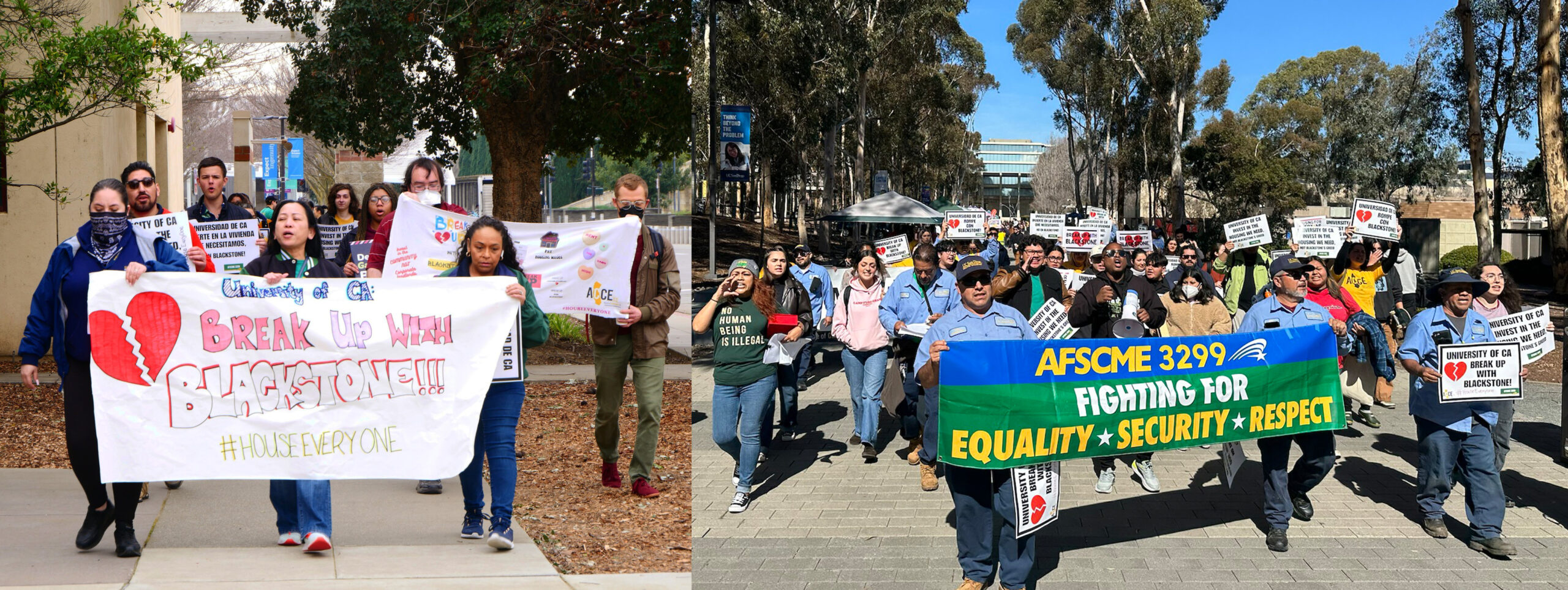
Marches at two of seven UC campuses on Valentine’s Day. Source: AFSCME 3299 Facebook page

Hundreds of students, workers, tenants participate at 7 UC campuses; claim UC is major shareholder in $3.5B controversial private equity investment trust that’s been linked to state’s housing affordability Crisis

On Valentine’s Day, Wednesday, Feb. 14, 2024, students, the University of California’s (UC) union of low-wage frontline service and patient care workers – members of AFSCME Local 3299 – alongside Blackstone tenants and community members with the Alliance of Californians for Community Empowerment (ACCE) called on UC Chancellors to “Break up with Blackstone” and invest in affordable housing. The global Wall Street private equity firm Blackstone has become the largest landlord in America and has been accused of worsening high housing costs and evictions.

Actions were held across the state in seven locations on the campuses of UC Berkeley, UC Davis, UC Santa Cruz, UCLA, UC Riverside, UC Santa Barbara and UC San Diego. The renewed call to divest from Blackstone follows the announcement of its $3.5 billion acquisition of Tricon Residential Inc. UC invested $4.5 billion in Blackstone’s BREIT in 2023 to boost investor confidence amid a wave of shareholder redemptions.

Blackstone went on an aggressive buying spree in 2021 and 2022, expanding its residential real estate empire, and adding over 200,000 housing units to its portfolio, including 5,600 naturally occurring affordable housing units in the San Diego area. ACCE released a report earlier this year with the Private Equity Stakeholder Project showing that Blackstone had raised rents in some units in San Diego between 43% – 64% in two years. Even before its announced acquisition of Tricon Residential, Blackstone owned more than 300,000 housing units, including a majority stake in the nation’s largest provider of student housing. As California becomes increasingly unaffordable, throwing more families into homelessness, Blackstone’s aggressiveness as one of the largest landlords in the state in hiking up rents for its thousands of units only adds to the problem.

UC acknowledged last year that its staff vacancy rate had tripled under the weight of California’s housing affordability crisis since the start of the COVID Pandemic, but has thus far failed to act on calls from students and workers to divest from Blackstone and invest in more affordable housing.  The University currently houses just 38% of its students in places that cost 30% more, on average than comparable campus communities nationwide. Recent news reports have chronicled the struggles of UC’s low-wage service and patient care workers being forced to commute several hours or sleep in their cars to maintain their employment.

AFSCME Local 3299 represents more than 33,000 Service and Patient Care Technical workers at UC’s 10 campuses, 5 medical centers, numerous clinics, research laboratories, and UC Law, SF.

The Alliance of Californians for Community Empowerment (ACCE) Action is a grassroots, member-led, statewide community organization working with more than 16,000 members across California. ACCE is dedicated to raising the voices of everyday Californians, neighborhood by neighborhood, to fight for the policies and programs we need to improve our communities and create a brighter future.

Filed Under: Employment, Finances, Labor & Unions, News, State of California

CSU to provide faculty with 5% pay increase effective January 31, 2024

January 20, 2024 By Publisher Leave a Comment

But faculty union wants 12% pay raise

By CSU Strategic Communications and Public Affairs

​The California State University (CSU) announced on January 9, 2024, that it will be providing all instructional faculty, librarians, counselors and coaches with a general salary increase of 5% effective January 31, 2024, concluding contract negotiations and exhausting the state’s impasse process. This decision was made after the latest round of negotiations with the California Faculty Association (CFA) failed to yield an agreement that would provide faculty salary increases while still allowing the CSU to best serve students within the limits of its resources.

However, according to the CFA, they’re demanding a 12% pay increase. (See related article)

Throughout the bargaining process, the CFA never veered from its initial salary demand, which was not financially viable and would have resulted in massive cuts to campuses — including layoffs — that would have jeopardized the CSU’s educational mission. In addition to the general salary increase, the CSU will be increasing department chairperson pay and allowing for modest parking fee increases.

“With this action, we will ensure that well-deserved raises get to our faculty members as soon as possible,” said Leora Freedman, vice chancellor for human resources. “We have been in the bargaining process for eight months and the CFA has shown no movement, leaving us no other option.”

The 5% salary increase is consistent with agreements the CSU has already reached with five of its labor unions.

“Our overriding responsibility is to manage a systemwide budget in a fiscally sustainable manner,” said Freedman. “We are committed to paying fair, competitive salaries and benefits for our hard-working faculty members, who are delivering instruction to our students every day and are the cornerstone of our university system. But we must also operate within our means to protect the long-term success and stability of the university, our students and our faculty.”

Without a change in bargaining position by CFA, this concludes bargaining on their contract reopener. The CSU and CFA can now begin successor bargaining on the full contract. The CSU remains committed to the collective bargaining process.

CSU Agrees with Majority of Neutral Factfinder Recommendations in Labor Negotiations with Faculty Union

On Dec. 1, 2023, the CSU announced that it is prepared to agree to the vast majority of the recommendations contained in a neutral factfinder report addressing negotiations between the CSU and the California Faculty Association (CFA). The report was made public today following a state-mandated 10-day “quiet” period.

“We believe that the factfinder’s report offers many thoughtful recommendations and a pathway to resolving all of the open issues,” said Leora Freedman, vice chancellor for human resources. “CSU is prepared to get back to the bargaining table with CFA at any time to reach a fiscally sustainable agreement that provides salary increases for our valued faculty.”

The independent factfinder provided recommendations on all open issues, which fall into 15 categories. On 13 of the 15 categories, CSU indicated in its response that it is prepared to agree to the factfinder’s recommendations, subject to bargaining with the CFA. These recommendations include increasing paid parental leave from six to eight weeks and improving the alternative paid workload reduction program for faculty with new children by increasing the workload reduction from 40% to 60%. Recommendations also address issues such as minimum pay ranges for lecturers, additional pay for department chairs, workload, personal leave, counselor ratios, gender-inclusive bathrooms and lactations spaces, parking and other issues.

On salary, the factfinder recommended using changes in the Consumer Price Index for goods and services (CPI-U) to propose a 7% general salary increase plus other adjustments. CSU has proposed 15% in general salary increases for faculty over three years, plus additional increases that would make some faculty eligible for up to 20.3% in salary increases. CSU’s proposal would provide general salary increases for all faculty that exceed the anticipated increase in the CPI-U over the next three years.

CFA has demanded a 12% general salary increase for one year, which would cost $380 million in new recurring spending. For context, CFA’s salary demand would cost $150 million more than the funding increase that the CSU received from the State of California for all operations in 2023-24.

“CSU strives to provide fair, competitive pay and benefits for all of our employees.  We recognize the need to increase compensation and are committed to doing so, but our financial commitments must be fiscally sustainable,” said Freedman.

The CSU has reached agreement with four employee unions representing about 26,000 employees. The CSU has yet to reach agreement with the CFA and Teamsters Local 2010 who represent skilled trade employees including electricians, plumbers and facilities maintenance workers. The CSU is at impasse with the Teamsters and will begin the statutory factfinding process with the union in the next few weeks.

The CFA has announced that it will conduct one-day strikes the following week at four CSU campuses.

“We respect the right of our labor unions to engage in strike activities, and we are prepared to minimize any disruptions to our campuses,” said Freedman. “Our hope is that the planned strike activities pose no hardships on our students and that we can get back to the bargaining table as soon as possible with the CFA to come to an agreement.”

For more information, view the factfinder’s​ report on the CSU Labor and Employee Relations website.

About the California State University 

The California State University is the nation’s largest four-year public university system, providing transformational opportunities for upward mobility to more than 450,000 students from all socioeconomic backgrounds. More than half of CSU students are people of color, and nearly one-third of them are first-generation college students. Because the CSU’s 23 universities provide a high-quality education at an incredible value, they are rated among the best in the nation for promoting social mobility in national college rankings from U.S. News & World Report, the Wall Street Journal and Washington Monthly. The CSU powers California and the nation, sending nearly 127,000 career-ready graduates into the workforce each year. In fact, one in every 20 Americans holding a college degree earned it at the CSU. Connect with and learn more about the CSU in the CSU newsroom.​​

Allen D. Payton contributed to this report.


Filed Under: Education, Labor & Unions, News

California Faculty Association to picket CSU East Bay in Hayward during system-wide strike

January 20, 2024 By Publisher Leave a Comment

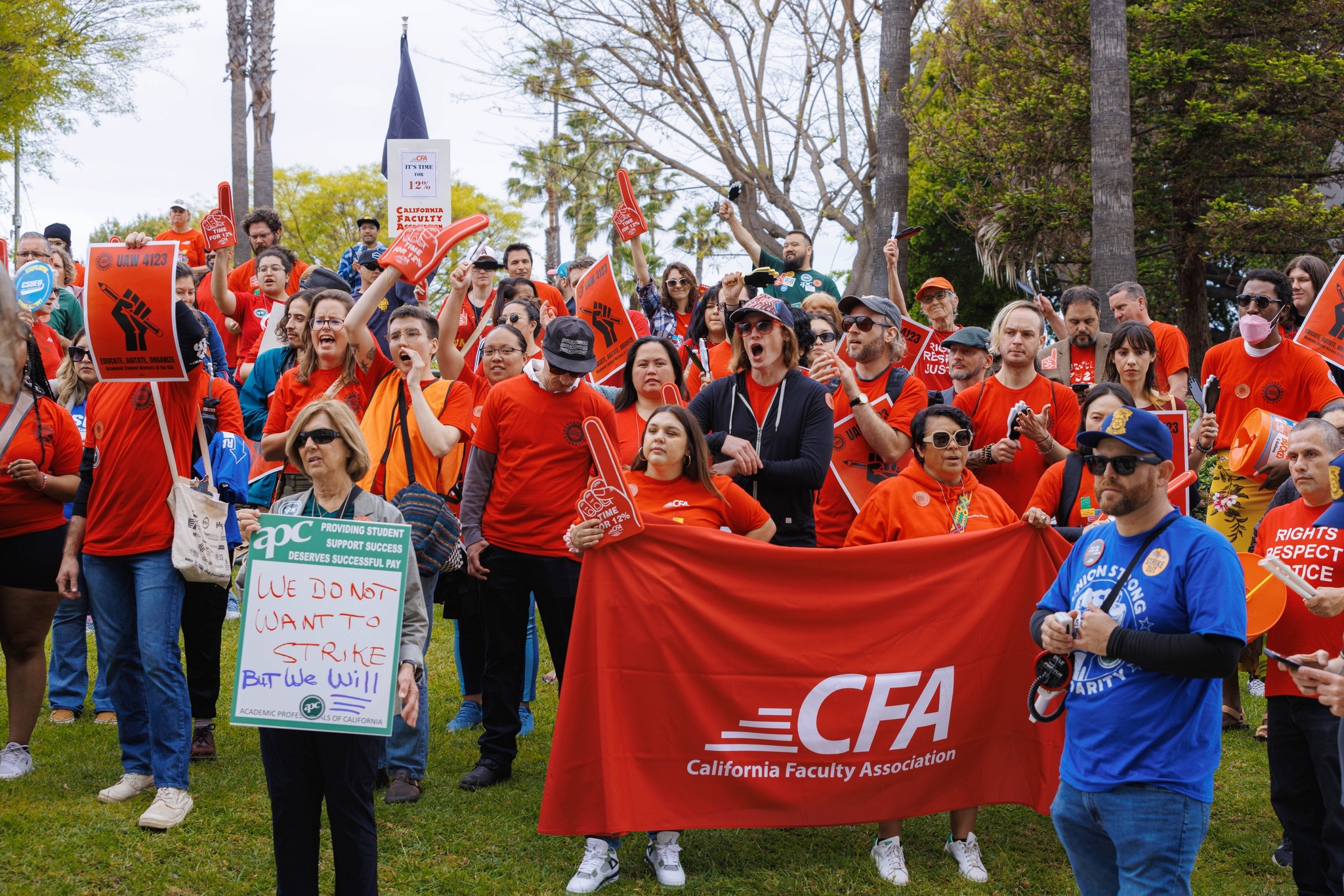
California Faculty Association protest. Source: Facebook posted on June 1, 2023.

Jan. 22-26 calling for “Equity and fair labor conditions to meet the needs of our students.”

Teamsters support effort announce settlement; Associated Students also support strike

By Kevin Pina, calfac.org

In a decisive move for educational equity and fair labor conditions, the California Faculty Association (CFA) has announced a strike set to take place from January 22-26, 2024. CFA is a union of 29,000 professors, lecturers, librarians, counselors, and coaches who teach and provide services to the California State University system’s 485,000 students.  During the strike, members of CFA will be picketing the entrances of California State University, East Bay (CSUEB) in Hayward California (Carlos Bee Blvd. & Harder Rd). This decision comes after extensive negotiations and discussions with the California State University (CSU) Chancellor’s office have broken down. 

To kick off the first day of the strike at the CSUEB Hayward campus on Monday, January 22, Assemblymember Liz Ortega, California 20th Assembly District and Keith Brown, Executive Secretary-Treasurer of the Alameda Labor Council, AFL-CIO, will join the rally at Carlos Bee Blvd. in support of CFA’s bargaining positions.  

The primary focus of the strike is to draw attention to how poor working conditions and remuneration for CFA members negatively impacts the education offered to California State University (CSU) students. The CFA is advocating for a 12% wage increase for all faculty, reasonable workload requirements, longer parental leave, and broader access to campus facilities. The goal is to create an environment that fosters academic excellence, while ensuring the well-being of those who dedicate their careers to shaping the minds of the next generation. 

A Dec. 20, 2023, post on the CFA Facebook page claimed the strike is also for “more mental health counselors…and safe campuses.”

The decision to strike was not taken lightly, and the CFA has exhaustively engaged with the CSU leadership to seek alternative solutions. Unfortunately, the inability to reach a mutually beneficial agreement has led to the inevitable decision to strike. 

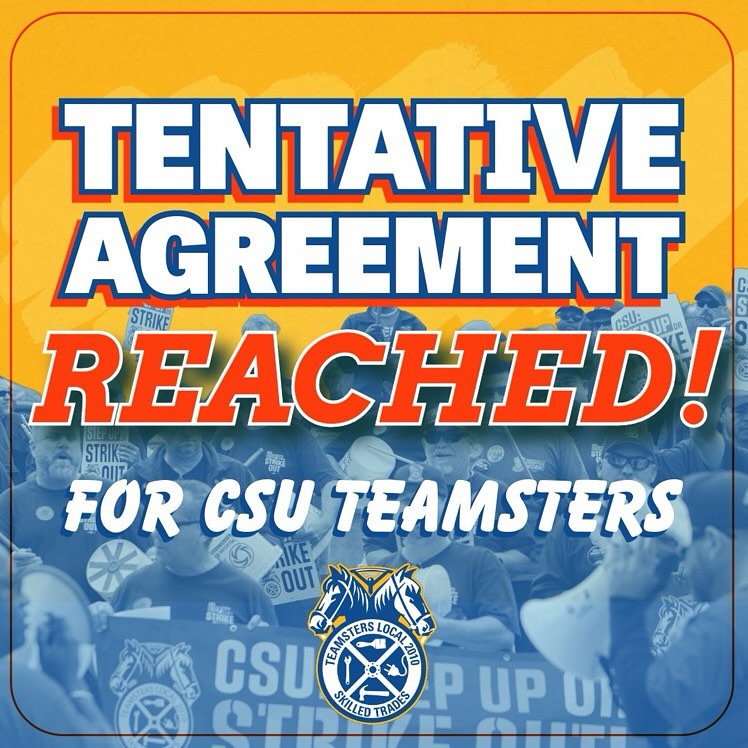
The strike garnered the support of the Teamsters of CSU which announced a settlement with CSU in a post on the CFA Facebook page on Saturday, Jan. 20th.

Source: CFA Facebook page

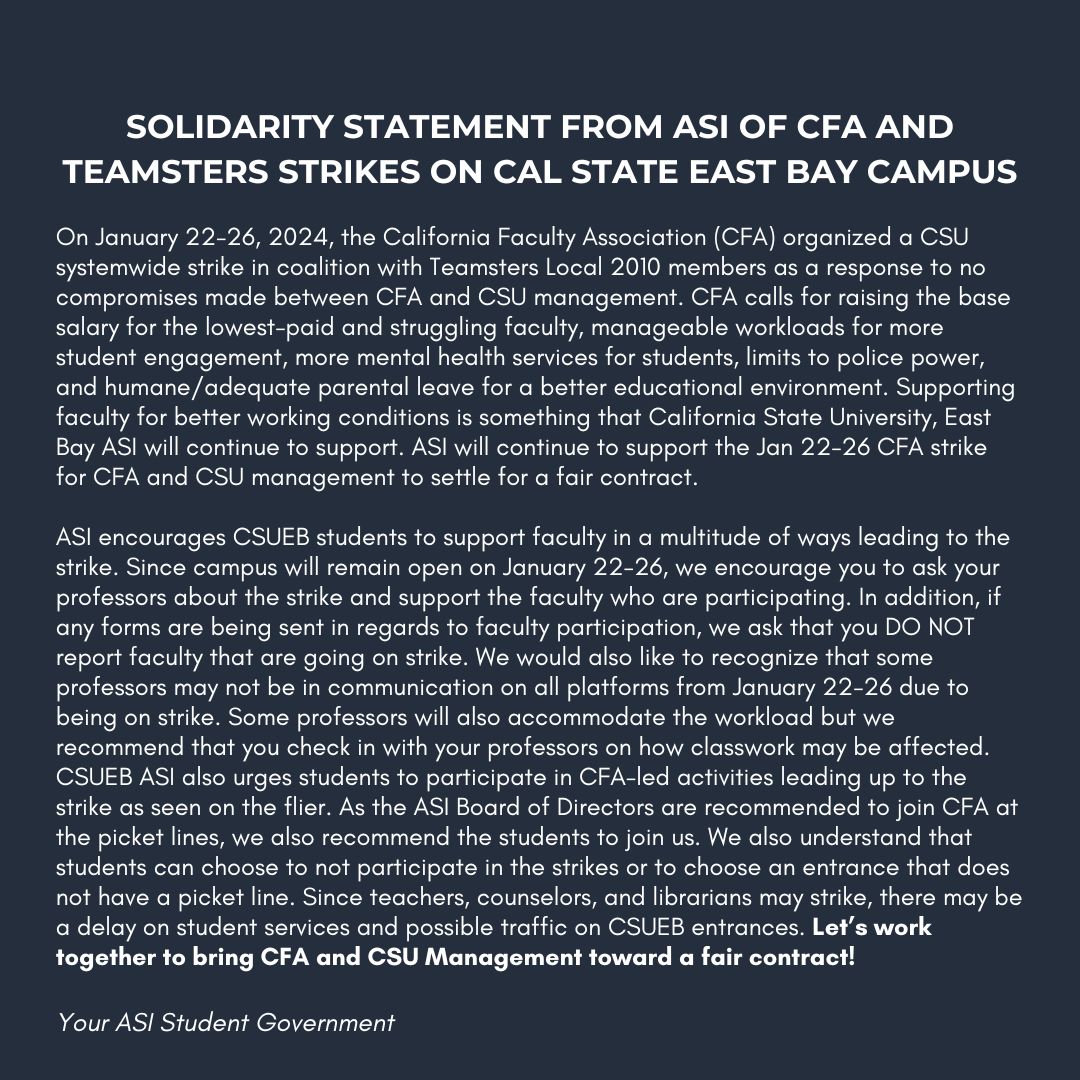
The strike is also supported by the Associated Students, Incorporated of Cal State East Bay. The following “Solidarity Statement” was posted on the CFA Facebook page on Friday.

The CFA remains committed to open dialogue with university administrators and encourages them to prioritize the needs of faculty members and our students. CFA believes that through collective efforts, a resolution can be achieved that benefits both faculty and the institutions they serve. 

Allen D. Payton contributed to this report.


Filed Under: East Bay, Education, Labor & Unions, News

SEIU-United Healthcare Workers West president issues statement on new state minimum wage law

December 12, 2023 By Publisher Leave a Comment

OAKLAND, Calif.  – SEIU-United Healthcare Workers West President Dave Regan issued the following statement on California’s healthcare worker minimum wage law (SB 525):

“California’s healthcare worker minimum wage law (SB 525) addresses critical staffing shortages by helping to retain existing healthcare workers and attract new caregivers to the industry. The state needs to hold fast to its commitment to invest in its healthcare workers and solve the staffing crisis in our hospitals, clinics, and medical centers.

Passed overwhelmingly by the state legislature and signed by the Governor, the bill had backing from across the healthcare industry, including the California Hospital Association and frontline healthcare workers.

The impact of the new healthcare minimum wage on the state budget has been severely overstated. As part of a compromise among healthcare stakeholders, the minimum wage will be gradually phased in over the next few years. In addition, a UC Berkeley Labor Center report states that the impact on the California budget will be partially or fully offset by low-paid workers no longer relying on Medi-Cal for their healthcare coverage.

With billions in profits, the healthcare industry has the financial resources to raise wages for their lowest-paid workers. Even before Governor Newsom signed the healthcare worker minimum wage into law, many healthcare employers had already implemented or incorporated a path to a $25/hr minimum wage for their workforce, including Stanford Healthcare, Fresenius Medical Care, Satellite Healthcare, and the biggest healthcare provider in the state, Kaiser Permanente in its largest labor contract.

Frontline healthcare workers are counting on the state of California not to waver from its commitment to addressing the patient care crisis and supporting those who provide that care.”


Filed Under: Health, Labor & Unions, Legislation, News

Kaiser Permanente, Coalition of Kaiser Permanente Unions reach new tentative agreement

October 13, 2023 By Publisher Leave a Comment

More than 85,000 Kaiser Permanent healthcare workers win landmark new contract

On heels of historic strike, on-the-ground engagement from Acting U.S. Labor Secretary Julie Su helped bring sides to agreement 

Frontline healthcare workers secure deal for critical workforce investments that bolster patient care 

The 4-year tentative agreement increases wages, expands job training, and improves performance sharing plan; now goes to employees for ratification

From Coalition of Kaiser Permanente Unions:

LOS ANGELES – More than 85,000 Kaiser Permanente healthcare workers reached a historic tentative agreement today for a new contract that will bolster patient safety and make critical investments in the healthcare workforce at hundreds of Kaiser facilities across California, Colorado, Oregon, Washington, Hawaii, Maryland, Virginia, and the District of Columbia.

The deal was reached on the heels of Acting U.S. Labor Secretary Julie Su traveling back to her home state of California to engage in the most recent talks. Su arrived Thursday evening to successfully help the sides bridge the gap on key lingering issues.

“We’re incredibly grateful to acting U.S. Labor Secretary Julie Su and the Biden administration for supporting workers’ right to collective bargaining. Acting Secretary Su was instrumental in advancing talks and helping to facilitate a successful conclusion to these negotiations,” said Sarah Levesque, Secretary-Treasurer of OPEIU Local 2.

“What the parties have achieved here in Oakland demonstrates, once again, that collective bargaining works. When workers have a voice and a seat at the table, it can result in historic gains for workers, their employer, and our country,” said Acting Secretary of Labor Julie A. Su. “The President and I congratulate the parties on reaching a mutually beneficial deal that delivers important stability for this critical workforce, for Kaiser Permanente, and for the patients in their collective care.”

The landmark deal follows months of tireless advocacy from thousands of frontline healthcare workers.

“This deal is life-changing for frontline healthcare workers like me, and life-saving for our patients,” said Yvonne Esquivel, a pediatric medical assistant at Kaiser Permanente in Gilroy, California. “Thousands of Kaiser healthcare workers fought hard for this new agreement, and now we will finally have the resources we need to do the job we love and keep our patients safe.”

Details of the tentative agreement include:

  • Addressing the staffing crisis by raising wages by 21% over four years to better retain current healthcare workers
  • Establishing a new healthcare worker minimum wage – $25/hr in California and $23/hr in other states where Kaiser Permanente operates
  • Protective terms around subcontracting and outsourcing, which will keep experienced healthcare workers in jobs and provide strong continuity of care for patients
  • A wide variety of initiatives to invest in the workforce and address the staffing crisis, including streamlining hiring practices, increased training and education funding, mass hiring events, and a commitment to upskill existing workers and invest in the training of future healthcare workers.

“Millions of Americans are safer today because tens of thousands of dedicated healthcare workers fought for and won the critical resources they need and that patients need,” said Caroline Lucas, Executive Director of the Coalition of Kaiser Permanente Unions. “This historic agreement will set a higher standard for the healthcare industry nationwide.”

In California, the tentative deal has set a new potential bar for negotiations already underway at Prime Healthcare and other area health systems. Nearly 2,000 Prime workers are concluding a five-day unfair labor practice strike today as their management threatens and intimidates workers, and refuses to bargain in good faith to fix unsafe working and patient care conditions caused by the short-staffing crisis.

The Coalition of Kaiser Permanente Unions represents 85,000 Kaiser healthcare workers in seven states and the District of Columbia. In April, the Coalition began its national bargaining process ahead of the September 30th contract expiration. The Coalition and Kaiser Permanente had last negotiated a contract in 2019, before healthcare workers found themselves on the frontlines of the COVID pandemic that has worsened working conditions and exacerbated a healthcare staffing crisis.

From Wednesday, October 4 to Saturday, October 7, 75,000 Kaiser healthcare workers held an unfair labor practice strike. The actions, led by workers across multiple states and in Washington, D.C., constituted the largest strike of healthcare workers in U.S. history. On October 9, Coalition unions issued a second 10-day notice for a strike that would have commenced on November 1 and included an additional 3,000 healthcare workers in Seattle.

Frontline healthcare workers in the Coalition of Kaiser Permanente Unions are expected to begin voting to ratify the agreement starting October 18.

Kaiser Also Announces Agreement

OAKLAND, Calif. – Kaiser Permanente and the Coalition of Kaiser Permanente Unions are pleased to jointly announce that in the early hours of October 13, 2023, we reached a tentative agreement for a renewed National Agreement, bringing the nearly seven months of contract negotiations to conclusion. 

The Coalition and Kaiser Permanente wish to thank Acting U.S. Secretary of Labor Julie Su for her instrumental involvement in bringing negotiations to a close.

The tentative agreement now goes to the more than 85,000 Kaiser Permanente employees who are represented by Coalition unions for ratification. The ratification process will begin October 18. Once ratified, the agreement will have an effective date of October 1, 2023.

The new 4-year agreement will offer Coalition-represented employees competitive wages, excellent benefits, generous retirement income plans, and valuable job training opportunities that support their economic well-being, advance our shared mission, and keep Kaiser Permanente a best place to work and receive care.

The tentative agreement:

  • Establishes new minimum wages over three years for Coalition-represented employees, that will reach $25/hour in California and $23/hour in other states where Kaiser Permanente operates
  • Provides guaranteed across-the-board wage increases totaling 21% over four years
  • Enhances employees’ Performance Sharing Plan with minimum payout opportunities and a substantial maximum payout opportunity
  • Increases investments in professional development and job training, and includes other initiatives to help address the staffing crisis in health care

Further details of the agreement will be made available later.

The Coalition unions have withdrawn their notices for a November strike.

About the Coalition of Kaiser Permanente Unions

The Coalition of Kaiser Permanente Unions unites more than 85,000 health care workers at Kaiser Permanente facilities in California, Colorado, Oregon, the District of Columbia, Hawaii, Maryland, Virginia, and Washington.

About Kaiser Permanente

Kaiser Permanente is committed to helping shape the future of health care. We are recognized as one of America’s leading health care providers and not-for-profit health plans. Founded in 1945, Kaiser Permanente has a mission to provide high-quality, affordable health care services and to improve the health of our members and the communities we serve. We currently serve 12.7 million members in 8 states and the District of Columbia. Care for members and patients is focused on their total health and guided by their personal Permanente Medical Group physicians, specialists, and team of caregivers. Our expert and caring medical teams are empowered and supported by industry-leading technology advances and tools for health promotion, disease prevention, state-of-the-art care delivery, and world-class chronic disease management. Kaiser Permanente is dedicated to care innovations, clinical research, health education, and the support of community health. For more information visit about.kp.org.

Filed Under: Health, Labor & Unions, News

Unions serve Kaiser executives with official notice that follow-up strike is possible

October 11, 2023 By Publisher Leave a Comment

Could occur Nov. 1 – 8

Kaiser Permanente “will continue to bargain in good faith with the Coalition”

By Allen D. Payton

Ahead of continued negotiations scheduled for Thursday and Friday the Coalition of Kaiser Permanente Unions issued the following press release on Tuesday, October 10, 2023:

As an acute and dire staffing crisis continues at hundreds of their facilities, Kaiser executives have been served official notice that another significant work action by their employees could be possible from November 1 to November 8, 2023. Those employees remain concerned about unsafe staffing levels, the company’s labor law violations, securing adequate wages to stay on the job and attract new workers, and the company’s outsourcing threats against workers just recently hailed as heroes during the COVID-19 pandemic.

Outsourcing, in particular, has emerged as a major sticking point in negotiations, as Kaiser executives have refused to agree to common sense limitations on subcontracting and outsourcing, which keep experienced healthcare workers in jobs and provide strong continuity of care for patients.

“It’s simple: Kaiser executives need to be investing in healthcare workers right now amidst this short staffing crisis, not discarding them through a variety of expensive outsourcing schemes,” said Tamara Chew, a Healthcare Plan Representative, Kaiser Permanente, Roseville. “I can’t understand why anyone in the Kaiser boardroom thinks corporate outsourcing threats are the way to treat a workforce that just a short time ago were being hailed as heroes.”

Frontline healthcare workers say they will wait until November 1 for any potential further strike action, when an additional contract covering workers in Seattle expires, and to give Kaiser executives more time to organize themselves around viable proposals. The Seattle contract’s expiration on October 31, 2023 at midnight would enable another 3,000 healthcare workers also impacted by the Kaiser short staffing crisis to join strike lines in another major west coast metropolitan area. Workers in southern Washington state were part of the initial wave of action, and now those actions could be taking place at Seattle facilities, representing a significant potential expansion of the labor actions at Kaiser. Seattle is one of Kaiser’s newer emerging markets and an area that has been targeted by the company for future corporate growth.

If healthcare workers strike again on November 1, the strike will begin at 6 AM local times and continue until November 8, 6 AM local times.

Healthcare workers have made clear they hope not to strike again and that while taking the legal steps necessary to prepare for that possibility, they are primarily focused on encouraging Kaiser executives to follow the law and to listen to the needs of patients and healthcare workers who are buckling under the current short staffing crisis within Kaiser facilities. Bargaining resumes on October 12 and October 13.

“For months, Kaiser executives failed to listen to the feedback from frontline healthcare workers about the need for executives to follow the law in negotiations and about the impacts that the Kaiser short staffing is having on patients,” said Caroline Lucas, Executive Director of the Coalition of Kaiser Permanente Unions. “This week, Kaiser executives will have another opportunity to listen to frontline staff, to follow the law in formal discussions, and to begin investing in ways that will solve the Kaiser short staffing crisis.”

The Kaiser workers are united within the Coalition of Kaiser Permanente Unions, a coalition of eleven unions that spans Washington, D.C. to the U.S. West Coast.

That coalition expects to hold a media briefing following the conclusion of this Friday’s negotiation sessions, unless those sessions continue further into the weekend, at which time an alternate briefing time may be announced.

Similar to the first strike, a potential second strike would involve workers from Kaiser facilities in California, Colorado, Washington, Oregon, Virginia, and Washington, D.C.

It would include frontline healthcare workers employed as registered nurses, licensed vocational nurses, emergency department technicians, radiology technicians, ultrasound sonographers, teleservice representatives, respiratory therapists, x-ray technicians, optometrists, certified nursing assistants, dietary services, behavioral health workers, surgical technicians, pharmacists and pharmacy technicians, transporters, home health aides, phlebotomists, medical assistants, dental assistants, call center representatives, and housekeepers, among hundreds of other positions.

Background:

The Coalition of Kaiser Permanente Unions represents 85,000 Kaiser healthcare workers in seven states and the District of Columbia. In April, the Coalition began its national bargaining process ahead of the September 30th contract expiration. On September 22nd, Coalition unions representing 75,000 Kaiser healthcare workers gave Kaiser executives 10-day notices for an unfair labor practice strike beginning Oct. 4. Last week’s actions led by workers across multiple states and in Washington, D.C. constituted the largest strike of healthcare workers in U.S. history, running from Wednesday, October 4 – Saturday, October 7, as frontline healthcare workers from hundreds of Kaiser facilities took to picket lines decrying the company’s unfair labor practices and chronic short staffing practices. On October 9, Coalition unions issued a second 10-day notice for a strike that may commence on November 1. The Coalition and Kaiser Permanente last negotiated a contract in 2019, before healthcare workers found themselves on the frontlines of the COVID pandemic that has worsened working conditions and exacerbated a healthcare staffing crisis.

At issue, healthcare workers say, are a series of unfair labor practices related to bargaining in bad faith, along with simmering staff concerns related to unsafe staffing levels that can lead to dangerously long wait times, mistaken diagnosis, and neglect. Outsourcing threats by Kaiser executives have also emerged as a sticking point in negotiations. After years of the COVID pandemic and chronic understaffing, Kaiser healthcare workers are calling on management to provide safe staffing levels.

Workers say that Kaiser is committing unfair labor practices and also that understaffing is boosting Kaiser’s profits but hurting patients. In a recent survey of 33,000 employees, 2/3 of workers said they’d seen care delayed or denied due to short staffing. After three years of the COVID pandemic and chronic understaffing, healthcare workers at Kaiser Permanente are calling on management to provide safe staffing levels.

Kaiser has reported ​​$3 billion in profits in just the first six months of this year. Despite being a non-profit organization – which means it pays no income taxes on its earnings and extremely limited property taxes – Kaiser has reported more than $24 billion in profit over the last five years. Kaiser’s CEO was compensated more than $16 million in 2021, and forty-nine executives at Kaiser are compensated more than $1 million annually. Kaiser Permanente has investments of $113 billion in the US and abroad, including in fossil fuels, casinos, for-profit prisons, alcohol companies, military weapons and more.

—————-

Kaiser Responds

In response, Kaiser Permanente issued the following statement: “We have received notice from the Coalition of Kaiser Permanente Unions for a potential second strike, beginning November 1 to November 8. We are scheduled to return to the bargaining table on October 12 and Kaiser Permanente remains committed to reaching an agreement that is good for our employees, our members, and our organization, and we will continue to bargain in good faith with the Coalition.”

The Coalition of Kaiser Permanente Unions unites more than 85,000 healthcare workers at Kaiser Permanente facilities in California, Colorado, Oregon, the District of Columbia, Hawaii, Maryland, Virginia, and Washington.


Filed Under: Health, Labor & Unions, News

Historic Kaiser healthcare worker strike continues into third day

October 6, 2023 By Publisher Leave a Comment

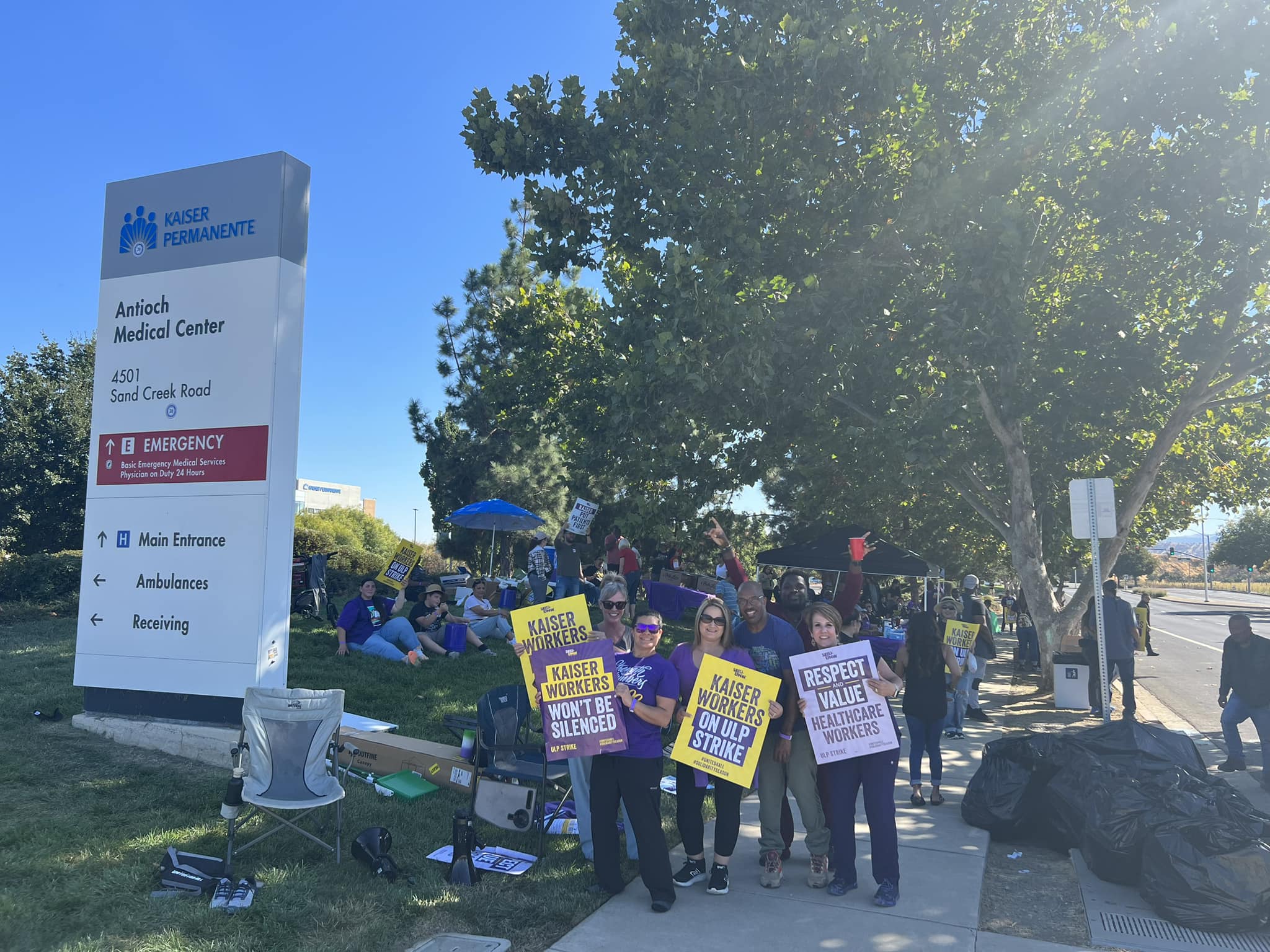
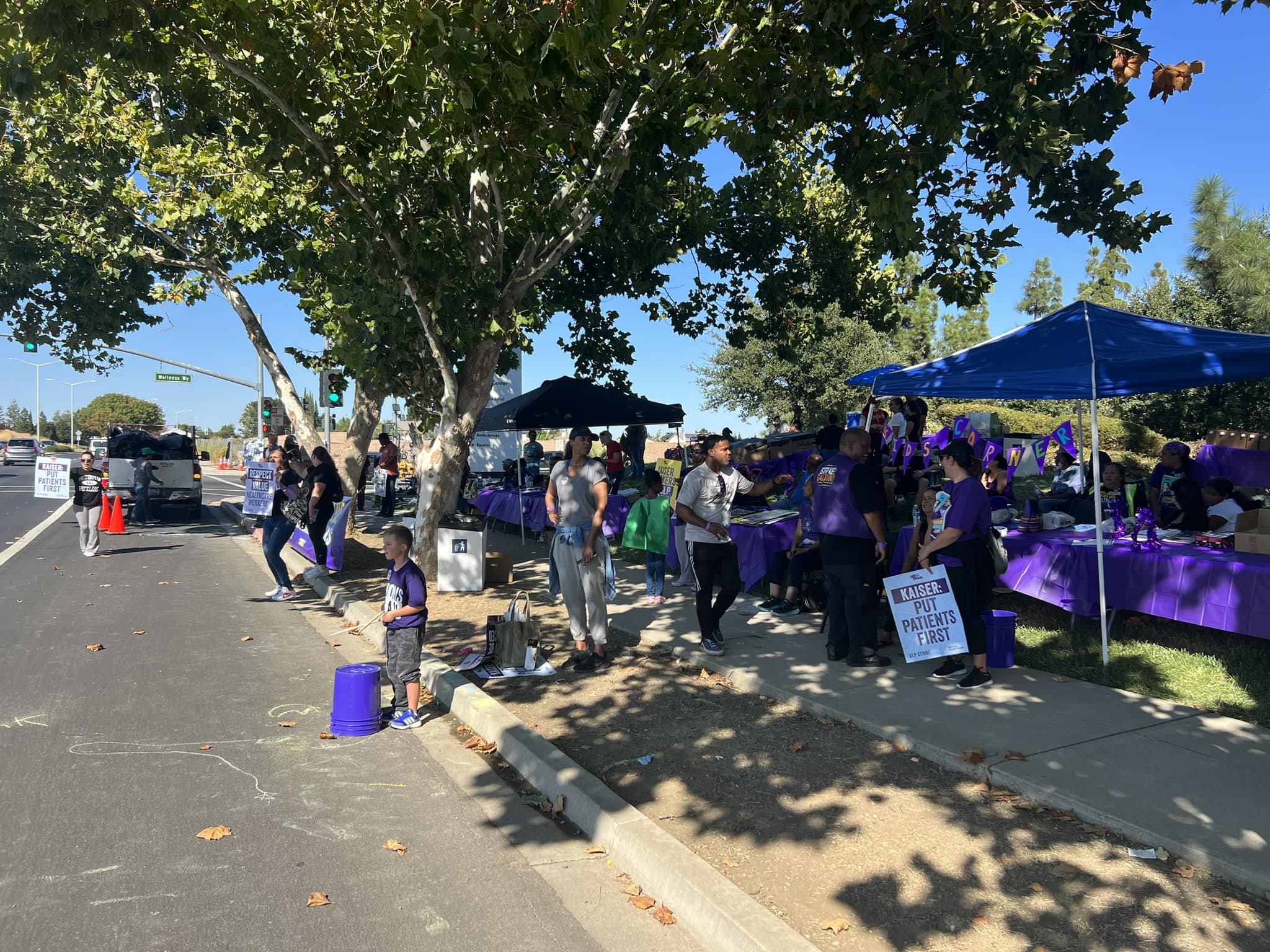
Healthcare workers participate in the strike at Kaiser Permanente’s Antioch Medical Center on Tuesday, Oct. 3, 2023. Photos by Allen D. Payton

Largest healthcare worker strike in U.S. history spans hundreds of hospitals and facilities across the nation 

Includes Antioch, Richmond and Walnut Creek hospitals

Outsourcing and under-staffing emerge as key sticking points

Bargaining scheduled to continue Oct. 12

On Friday morning, October, 6, 2023, SEIU-United Health Workers union issued the following announcement:

More than 75,000 Kaiser Permanente workers in multiple states are continuing their historic three-day strike to protest unfair labor practices and Kaiser executives’ failure to bargain in good faith over unsafe staffing levels and outsourcing protections at hundreds of Kaiser hospitals and facilities across the United States.

In Contra Costa County, the strike includes workers at Kaiser facilities in Antioch, Richmond and Walnut Creek. During the strike at Antioch Kaiser, today – part of a nationwide action – Antioch resident Angela Glasper, who has been a Kaiser employee for 35 years working as an optical services clerk, said, “We’re not backing down.”

The strike at Kaiser facilities expanded from coast to coast this week, following months of bad faith bargaining activity by Kaiser executives and repeated appeals by frontline workers for Kaiser executives to make the kinds of investments in staffing that could help stem employee turnover and reduce growing patient wait times.

The strike began in DC and VA at 6AM ET on Wednesday morning at 6AM EST, expanded to CO at 6AM MT, then culminated with tens of thousands of workers striking in CA, OR, and WA at 6AM PT. It is already the largest healthcare worker strike in U.S. history. The current strike is expected to conclude on Saturday, October 7, 2023 at 6:00 A.M. It is possible that the coalition will issue a 10-day strike notice after Saturday, which could lead to further striking by Kaiser employees after those ten days if Kaiser executives continue to commit unfair labor practices and bargain in bad faith.

Additional bargaining sessions were scheduled by the parties this morning for the dates of Thursday, October 12 and Friday, October 13, 2023.

Kaiser Permanente confirmed that in the following statement issued Friday morning, Oct. 6: “The next bargaining session has been scheduled to begin on October 12. We look forward to reaching a new agreement that continues to provide our employees with market-leading wages and benefits, and ensures our high-quality care is affordable and available to meet our members’ needs.”

Outsourcing of critical healthcare duties has become a key sticking point in negotiations in recent days, as Kaiser executives have refused to put limitations on subcontracting and outsourcing, which keep experienced healthcare workers in jobs and provide strong continuity of care for patients.

“Now more than ever Kaiser Permanente needs to retain and attract qualified healthcare professionals. Outsourcing and subcontracting would have the opposite effect,” said Kathleen Coleman, Medical Assistant Message Management, Arapahoe Primary Care in Colorado.

“Frontline healthcare workers continue to await meaningful action by Kaiser executives to address our key priorities, including safe staffing, outsourcing protections for incumbent healthcare workers, and fair wages to reduce turnover,” said Gwendolyn Holloway, a Contact Lens Technician at Kaiser Permanente Vallejo Medical Center.

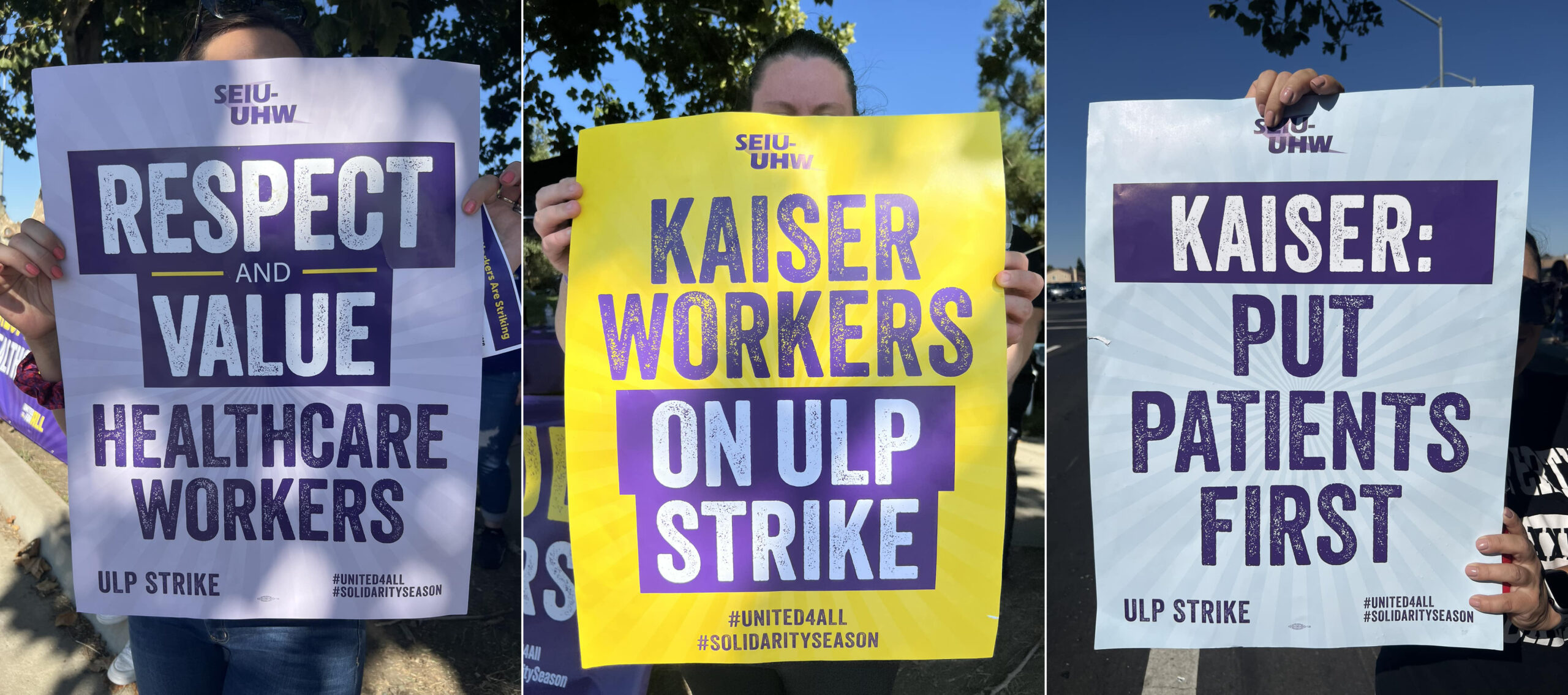
Signs carried by healthcare workers on strike at the Kaiser Permanente Antioch Medical Center.

Workers on strike include those employed as licensed vocational nurses, emergency department technicians, radiology technicians, ultrasound sonographers, teleservice representatives, respiratory therapists, x-ray technicians, optometrists, certified nursing assistants, dietary services, behavioral health workers, surgical technicians, pharmacists and pharmacy technicians, transporters, home health aides, phlebotomists, medical assistants, dental assistants, call center representatives, and housekeepers, among hundreds of other positions.

WHAT: 75,000 healthcare workers are on strike at Kaiser Permanente hospitals across the U.S.

WHEN: Today, Friday, October 6th, 2023 @ 6AM – Afternoon times TBD  

WHERE: Hundreds of Kaiser Permanente hospitals and facilities in California, Colorado, Washington, Oregon

CONTRA COSTA COUNTY

ANTIOCH: Kaiser Permanente Antioch Medical Center, 4501 Sand Creek Rd, Antioch, CA 94531

RICHMOND: Kaiser Permanente Richmond Medical Center, 901 Nevin Ave., Richmond, CA 94801

WALNUT CREEK: Kaiser Permanente Walnut Creek Medical Center, 1425 S Main St, Walnut Creek, CA 94596

BACKGROUND

The Coalition of Kaiser Permanente Unions represents 85,000 Kaiser healthcare workers in seven states and the District of Columbia. In April, the Coalition began its national bargaining process ahead of the September 30th contract expiration. On Sept. 22, Coalition unions representing 75,000 Kaiser healthcare workers gave Kaiser executives 10-day notices for an unfair labor practice strike beginning Oct. 4. The Coalition and Kaiser Permanente last negotiated a contract in 2019, before healthcare workers found themselves on the frontlines of the COVID pandemic that has worsened working conditions and exacerbated a healthcare staffing crisis.

At issue, healthcare workers say, are a series of unfair labor practices related to bargaining in bad faith, along with simmering staff concerns related to unsafe staffing levels that can lead to dangerously long wait times, mistaken diagnosis, and neglect. After years of the COVID pandemic and chronic understaffing, Kaiser healthcare workers are calling on management to provide safe staffing levels.

Workers say that Kaiser is committing unfair labor practices and also that understaffing is boosting Kaiser’s profits but hurting patients. In a recent survey of 33,000 employees, 2/3 of workers said they’d seen care delayed or denied due to short staffing. After three years of the COVID pandemic and chronic understaffing, healthcare workers at Kaiser Permanente are calling on management to provide safe staffing levels.

Kaiser has reported ​​$3 billion in profits in just the first six months of this year. Despite being a non-profit organization – which means it pays no income taxes on its earnings and extremely limited property taxes – Kaiser has reported more than $24 billion in profit over the last five years. Kaiser’s CEO was compensated more than $16 million in 2021, and forty-nine executives at Kaiser are compensated more than $1 million annually. Kaiser Permanente has investments of $113 billion in the US and abroad, including in fossil fuels, casinos, for-profit prisons, alcohol companies, military weapons and more.

The Coalition of Kaiser Permanente Unions unites more than 85,000 healthcare workers at Kaiser Permanente facilities in California, Colorado, Oregon, the District of Columbia, Hawaii, Maryland, Virginia, and Washington.

Allen D. Payton contributed to this report.

Filed Under: Health, Labor & Unions, News

Kaiser provides updated statement in response to strike

October 4, 2023 By Publisher Leave a Comment

SEE 10/4/23 3:30 PM UPDATE: While bargaining ended without a contract settlement 5 tentative agreements reached

“Operations continue as normal”

Kaiser Permanente Statement on National Bargaining with the Coalition of Kaiser Permanente Unions

Kaiser Permanente and leaders and members of the Coalition of Kaiser Permanente Unions were bargaining through the weekend to reach an agreement.

We continue to make progress on key issues such as a redesigned performance sharing plan with updated payout opportunities. Last week we reached tentative agreements in four key areas:, travel for continuing education, the use of temporary workers such as traveling nurses, tracking of staffing vacancies, and dispute resolution.

It is important to know that while the current national agreement expired at midnight PDT on September 30, operations continue as normal, and we will continue to honor all current contract provisions. Contract expirations do not mean a strike will happen. We remain optimistic that we will reach an agreement and avoid an unnecessary strike, which the Coalition unions have called for starting on Wednesday morning, Oct 4.

Wages

We lead total compensation in every market where we operate, and our proposals in bargaining would ensure we keep that position. In some places, a Kaiser Permanente employee leaving for a similar job at another organization would face a 20-plus percent pay cut, and lower benefits.

Included in our current offer are guaranteed across-the-board wage increases and a proposed $21 minimum wage in Washington, Oregon, Colorado, the Mid-Atlantic States (Virginia, Maryland, and the District of Columbia), and Hawaii starting in 2024; and a $23 minimum wage starting in 2024 in California.

Hiring and Staffing

Despite the acute shortage of health care workers nationally, we have been able to hire more than 50,000 frontline employees in the last two years: 29,000 people in 2022, and another 22,000 so far this year. Included in this year’s new hires are more than 9,800 people hired into jobs represented by the Coalition. Kaiser Permanente and the Coalition agreed in April to a goal of hiring 10,000 new people for Coalition-represented jobs by the end of 2023. We expect to reach the 10,000 new hire goal by the end of October, if not sooner, and we won’t stop there. We are committed to addressing every area of staffing that is still challenging. Additionally, our attrition rate of 7% is roughly a third of the industry average and continues to fall. These achievements underscore the value of a Kaiser Permanente job and reinforce our position as a leading health care employer.

Potential Strike Starting Wednesday

In the case that a strike does begin on Oct. 4, we have contingency plans in place to ensure members continue to receive safe, high-quality care for the duration of the strike. Our hospitals and emergency departments will remain open. Kaiser Permanente members can get updates on appointments, pharmacy guidance and where to get care on kp.org.

We’ll continue to bargain in good faith until we reach a fair and equitable agreement to ensure Kaiser Permanente continues to attract and retain the best people in health care — and remains a best place to work and get care. And that includes meeting our responsibility to continue to balance taking care of our employees and being more affordable to our members.

October 4, 2023 3:30 pm UPDATE:

After 6 months of bargaining with the Coalition of Kaiser Permanente Unions, including a marathon effort that went through last night and into today, our bargaining sessions unfortunately ended without a settlement, and the Coalition strikes began.

While we have not reached a contract settlement, we have been able to reach a number of tentative agreements in bargaining, and our offers to date address the unions’ priorities, including:

  • Across-the-board wage increases in all markets over the next four years.
  • Updating the Performance Sharing Plan to include a minimum payout opportunity and potential for up to a $3,750 payout.
  • Offering minimum wages of $23/hour in California and $21/hour in markets outside of California.
  • Continuing and enhancing our existing excellent health benefits and retirement income plans.
  • Renewing our strong tuition assistance and training programs, and increasing funding of the education trusts.

We remain committed to reaching a new agreement that continues to provide our employees with market-leading wages, excellent benefits, generous retirement income plans, and valuable professional development opportunities.

Together, we have faced the toughest challenges over the past three years. Kaiser Permanente, our industry, and our employees are now operating in a new cultural, labor, and post-pandemic environment that we are all working hard to understand. We are committed to finding workable solutions for this new environment that meet our responsibility to balance taking care of our employees and being affordable to our members.

We will coordinate with Coalition leaders to reconvene bargaining as soon as possible. We will work hard to reach an agreement so that together, we can all return to delivering on the mission of Kaiser Permanente for the benefit of our members, patients, employees, physicians, customers, and communities.

Meeting our shared staffing goal

On the same day that the Coalition strikes began, we’re pleased to confirm that we’ve met our goal of hiring 10,000 new Coalition-represented employees by year-end – and it is only October 4th. We’re not done yet. We are committed to addressing every area of staffing that is still challenging.

As a reminder: In April we agreed with the Coalition to a joint goal of hiring 10,000 people by the end of this year into jobs the Coalition cares about. We agreed this would be a great success if we could hire that many people into Coalition roles by the end of this year. We hit the goal three months early.

In total over the past two years, Kaiser Permanente has hired more than 50,000 people to join our teams.

Meeting our members’ needs

The health and wellbeing of our members and patients is our top priority. Because we are such a large organization, with multiple ways that members can access care, the impact of the strike is different at various locations.

We have robust plans in place to ensure members continue to receive safe, high-quality care during the strike.

All our hospitals and emergency departments remain open. Our facilities will continue to be staffed by our physicians, trained and experienced managers, and our great staff. Thousands of qualified and trained contract staff are joining our Kaiser Permanente teams this week as well, to help meet our members’ and patients’ needs. We thank those Coalition-represented employees who have chosen to come to work and care for our patients, members, and communities.

Members who need urgent or timely medical care should continue to seek it at our hospitals and medical facilities. A strike should not dissuade anyone from seeking necessary care.

We will contact members affected by any necessary changes in our services. We may need to reschedule non-emergency and elective services in some locations out of an abundance of caution. Our members can follow any important updates to our care delivery on kp.org.


Filed Under: Health, Labor & Unions, News

  • « Previous Page
  • 1
  • 2
  • 3
  • 4
  • …
  • 6
  • Next Page »
Monica's-Riverview-Jan-2026
Liberty-Tax-Jan-Apr-2026
Deer-Valley-Chiro-06-22

Copyright © 2026 · Contra Costa Herald · Site by Clifton Creative Web