• Home
  • About The Herald
  • Local Agencies
  • Daily Email Update
  • Legal Notices
  • Classified Ads

Contra Costa Herald

News Of By and For The People of Contra Costa County, California

  • Arts & Entertainment
  • Business
  • Community
  • Crime
  • Dining
  • Education
  • Faith
  • Health
  • News
  • Politics & Elections
  • Real Estate

Save Mount Diablo launches Advisory Council

October 10, 2025 By Publisher Leave a Comment

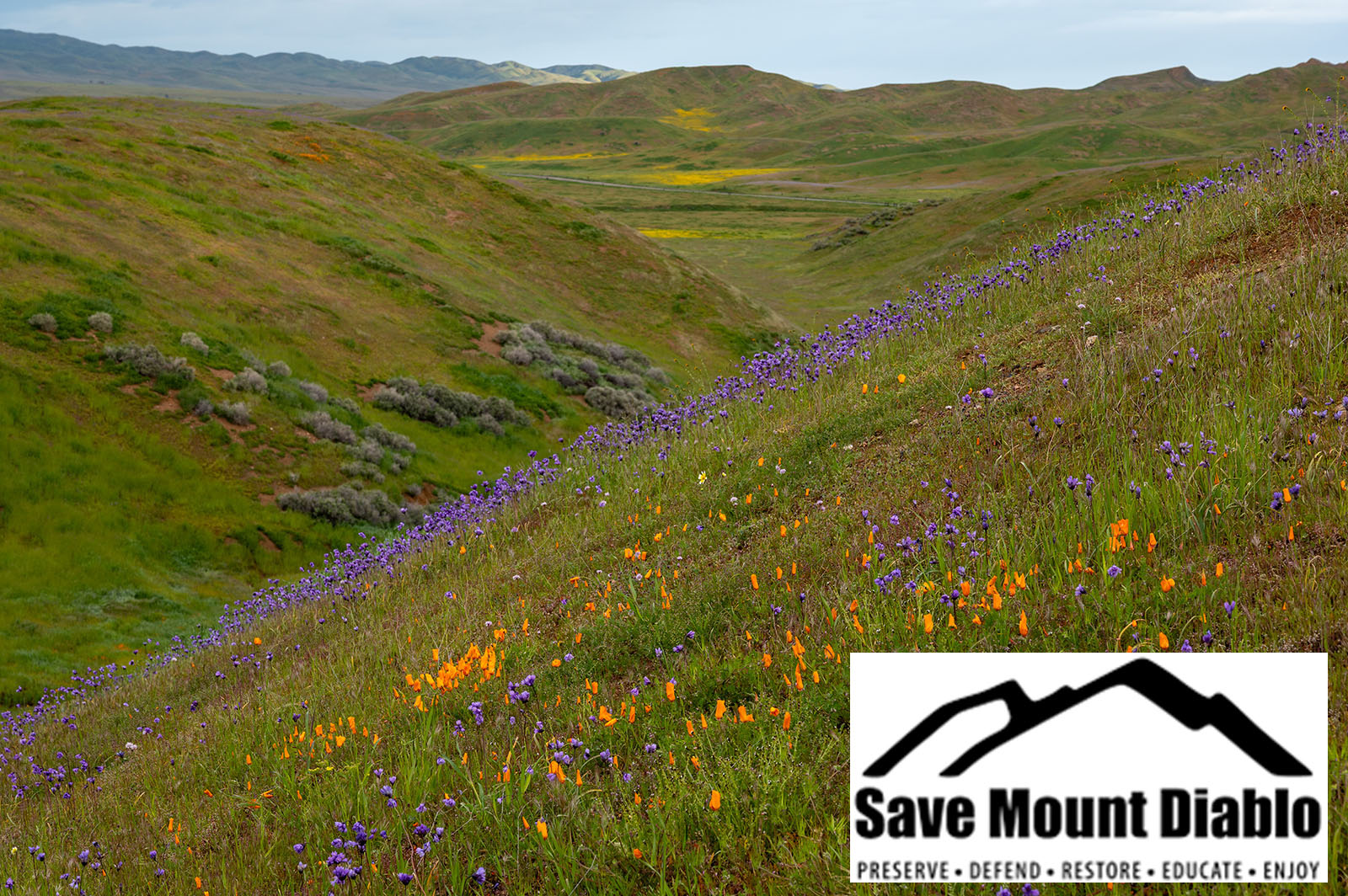
Wildflowers in the Panoche Valley and Hills, southern Diablo Range. Photo: Scott Hein

10-member, all-volunteer Council will further land conservation mission

By Laura Kindsvater, Senior Communications Manager, Save Mount Diablo

WALNUT CREEK, CA—Save Mount Diablo has created an Advisory Council to help further our organization’s land conservation mission for Mount Diablo and the mountain range it is a part of and sustained by, the Diablo Range.

Save Mount Diablo’s all-volunteer Advisory Council consists of distinguished individuals who are willing to contribute their expertise, guidance, connections, and support to further the organization’s mission.

The organization’s Board of Directors and staff will benefit from the knowledge and expertise of the Advisory Council members. Advisors will also act as ambassadors for Save Mount Diablo helping the organization positively connect with strategic peoples and communities.

There are multiple reasons why Save Mount Diablo created its Advisory Council. It gives the organization a way to honor and recognize individuals for their distinguished service to Save Mount Diablo.

It provides a way to involve people who are willing to give critical assistance but have limited time. It provides a way of involving people who would be good candidates for the Board of Directors, but who are unable, or may not be ready, to serve in that role right now.

It provides a way to keep important supporters closely connected to the organization. It creates a direct link to important professional and technical expertise. It elevates and empowers selected people to serve as ambassadors for the organization.

It is a way to assist in efforts to increase philanthropic support. It enlists various types of needed help from the Advisors and their networks.

The basic structure of Save Mount Diablo’s Advisory Council is as follows. The organization’s Board Governance and Nominating Committee reviews and recommends appropriate Advisory Council candidates to the Board of Directors for approval.

Advisors must be elected by the Board of Directors. Advisory Council members advise and assist the organization largely on an as-needed basis. The Advisory Council will be invited to meet at least once annually, typically as part of a Board of Directors meeting or event.

Organizational communications with the Advisory Council, as a group or individually, will typically come from the Executive Director or Board President. The Advisory Council has no governing function within the organization.

The Board of Directors will determine term lengths, if any, the total number of members for the Advisory Council, and other related details.

After careful consideration, the Board of Directors approved creating an Advisory Council at their January 2025 annual Strategic Plan retreat.

After that, Save Mount Diablo’s Board Governance and Nominating Committee worked on creating a list of talented people to invite to be part of the inaugural class of the Advisory Council.

This inaugural class for our Advisory Council, which was approved by the Board of Directors at their October 1, 2025, meeting, consists of the following people:

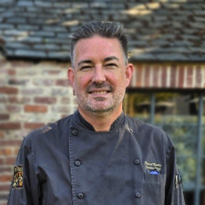
Stewart Beatty

Stewart Beatty is the Head Chef at Postino, where he specializes in creating farm-to-table dishes that highlight fresh, locally sourced ingredients. A lifelong resident of the Mount Diablo area and current Clayton resident, Stewart has a deep connection to the region and its community. He generously shares his culinary talents by providing meals for Save Mount Diablo’s Four Days Diablo and summit dinners, bringing people together to celebrate and support local land conservation efforts.

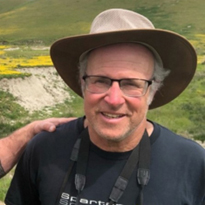
Joseph Belli

Joseph Belli has been a dedicated Save Mount Diablo donor since 2021 and is a conservation biologist and author, widely recognized as one of California’s leading experts on the Diablo Range.

His deep knowledge and passion for the region have made him an invaluable contributor to Save Mount Diablo’s mission. Joseph has participated in our BioBlitz events and Mary Bowerman Science and Research program, and served as the opening speaker for our first annual Diablo Range Convening in June 2025. In July 2025, he was also featured as a speaker for Save Mount Diablo’s Executive Director Speaker Series, sharing his insights on the unique ecology and conservation challenges of the Diablo Range.

Tom Dowd

Tom has a passion for helping organizations and individuals and transforming people’s lives. He was the founder and CEO of a chemical distribution company (Dowd and Guild, Inc.); he serves on the John Muir Health Foundation Board of Directors as well as on the Advisory Board of Heritage Bank of Commerce. Tom founded Keiretsu Forum Charitable Foundation, a nonprofit organization that raised $1 million for more than 100 charities. After selling Dowd and Guild, Inc., Tom has shifted to full-time charitable work.

Robert E. Doyle        

Robert E. Doyle, General Manager Emeritus, East Bay Regional Park District, worked for 47 years as a park professional at the East Bay Regional Park District in Oakland, California. Bob was a founding Board member of Save Mount Diablo, working with California State Parks to expand one of the original “Olmsted State Parks.” He was also a founding Board member of the East Bay Conservation Corps. Bob currently serves as Board member and Advocacy Co-Chair of the Washington, DC–based City Parks Alliance. He has served as a Board member for the National Association of Olmsted Parks and is a member of the American Academy for Park and Recreation Administration, where he was awarded the prestigious Cornelius Pugsley Medal. In 2024, Bob joined the San Francisco–based Save the Redwoods League Board of Councilors. Bob has received a Save Mount Diablo Mountain Star award for his good work.

Peter Frazier

Peter Frazier, a retired investment professional, has been a Save Mount Diablo supporter for over 40 years, demonstrating a strong commitment to land conservation and environmental education. As a dedicated contributor, Peter helps support programs that inspire and educate future generations about the importance of protecting the Diablo Range and its natural resources. Peter has also helped make possible other important projects for Save Mount Diablo, like the organization’s 50th anniversary oral history project with the Bancroft Library at the University of California, Berkeley.

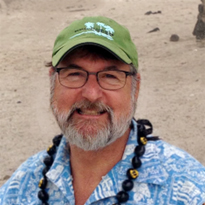
John Kiefer

John Kiefer is a retired systems applications specialist at Pacific Bell, inventor of the Kiefer Sustainable Chicken Coop, and a longtime supporter of Save Mount Diablo since 1975! He has remained deeply involved through leadership, advocacy, and community building. He is especially supportive of Save Mount Diablo’s environmental education programs and efforts to connect more people to nature and each other. Over the years, John has led hikes on Mount Diablo and has supported Save Mount Diablo in many ways, from hosting events at his home to funding community breakfasts and other events. His passion for trails and open space led to his service on the Lafayette Parks, Trails, and Recreation Commission (1986–1994), where he worked hands-on to maintain trails, collaborated with landowners to create public access, and later served as the city’s field representative for trails. In recognition of his contributions, the John Kiefer Trail was dedicated in his honor in 2014.

Beverly Lane

Beverly Lane has been a dedicated Save Mount Diablo supporter since 1988 and is a respected local historian, published author, and curator of the Museum of the San Ramon Valley. She helped found the Contra Costa History Alliance and the Tri-Valley History Council, fostering the preservation of regional history. Beverly served as Mayor of Danville and represented central Contra Costa County as a Director for the East Bay Regional Park District from 1994 to 2022. She is also an active member of the Anza Trail Foundation, which promotes the Juan Bautista de Anza National Historic Trail, and Friends of San Ramon Creek, reflecting her lifelong commitment to conservation, history, and community.

Doug McConnell

Doug McConnell is a long-time Save Mount Diablo supporter and renowned television host and storyteller with a passion for exploring and protecting the natural world. He hosted NBC Bay Area’s OpenRoad with Doug McConnell beginning in 2009 and served as host and editor of the beloved series Bay Area Backroads from 1993 to 2008. Doug is the founder of Convergence Media Productions, creating content that highlights conservation and outdoor adventure. In addition to his media work, he serves as an Advisory Board member for San Francisco Baykeeper, advocating for the protection and preservation of the Bay Area’s natural resources. Doug has received a Save Mount Diablo Mountain Star Award for this good work.

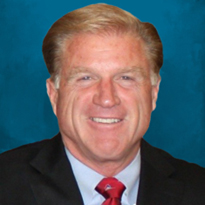
Jeff Stone

Jeff Stone is the CEO of Diamond Construction and co-founder of Enkasa Homes, bringing extensive expertise in environmentally sensitive building and development to his work. A dedicated supporter of land conservation, Jeff served as a Save Mount Diablo Board member (2016–2025). He continues to contribute his leadership, expertise, and passion to support Save Mount Diablo’s land conservation work.

Jeanne Thomas

Jeanne Thomas has been a Save Mount Diablo donor since 1989 and is a proud member of the Diablo Legacy Circle. A retired employee of Kaiser Industries, Jeanne has been a steadfast supporter of Save Mount Diablo for decades, serving on the Development Committee from 2006 to 2014. She has played a vital role in supporting events, acting as a liaison to the Rossmoor retirement community, and was honored with the Mountain Star Award for her dedication. An avid nature enthusiast, Jeanne has spent countless hours hiking Mount Diablo and photographing its wildflowers, reflecting her deep love for the land she helps protect.

We are very grateful that this talented and special group of people answered the call to serve on Save Mount Diablo’s Advisory Council!

With the creation of our Advisory Council, made up of such terrific people, Save Mount Diablo has successfully and strategically expanded our team to help further our land conservation work for Mount Diablo and its Diablo Range.

About Save Mount Diablo

Save Mount Diablo has been preserving lands on and around Mount Diablo and educating the public to the mountain’s natural values since 1971. We are biologists, conservationists, hikers, bikers, equestrians, bird watchers, and people who just love to look at the mountain. Save Mount Diablo is a tax-exempt nonprofit 501(c)(3) organization (tax ID 94-2681735). For more information visit savemountdiablo.org.

Filed Under: Environment, News, Non-Profits, Parks, People

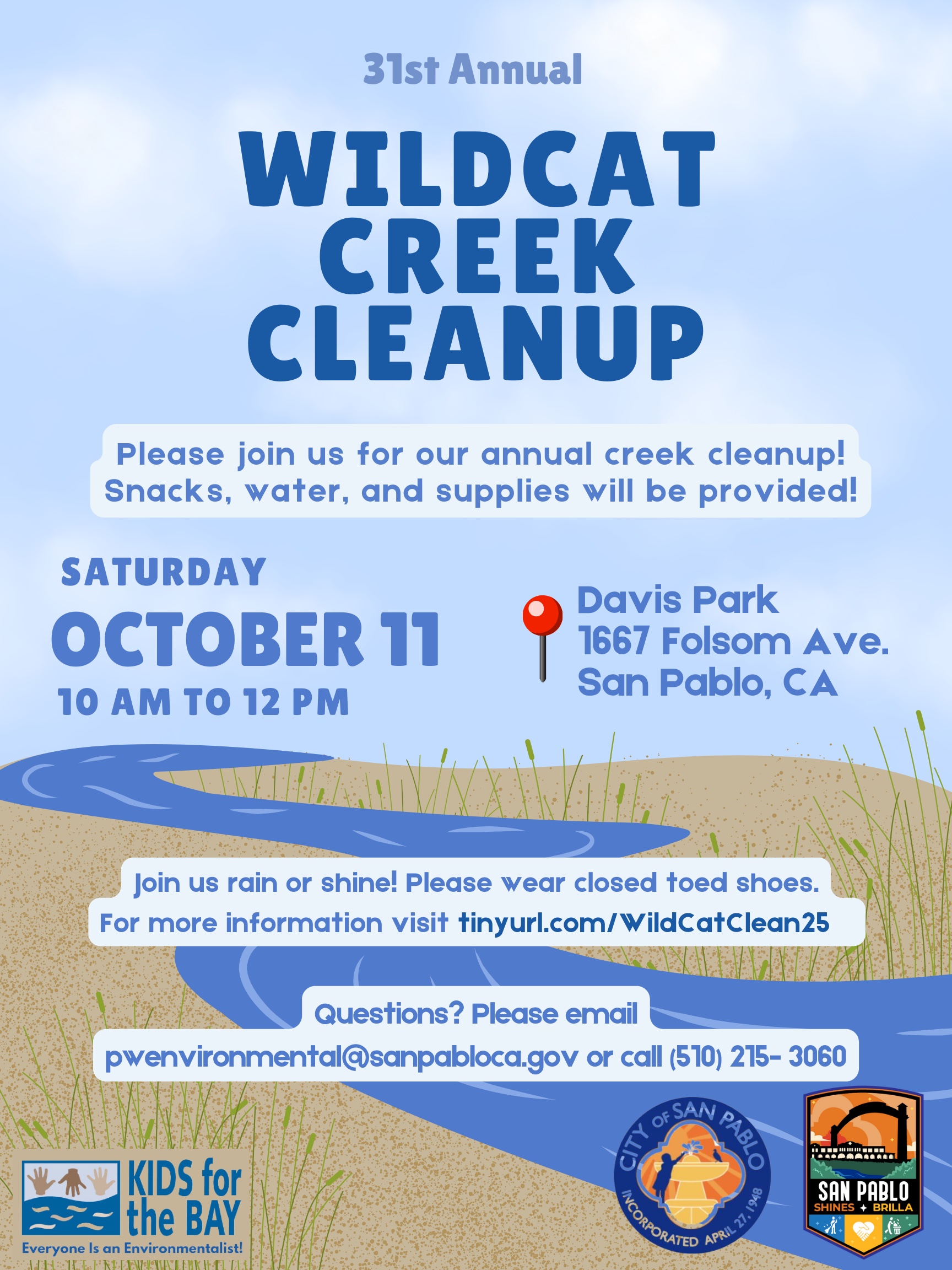
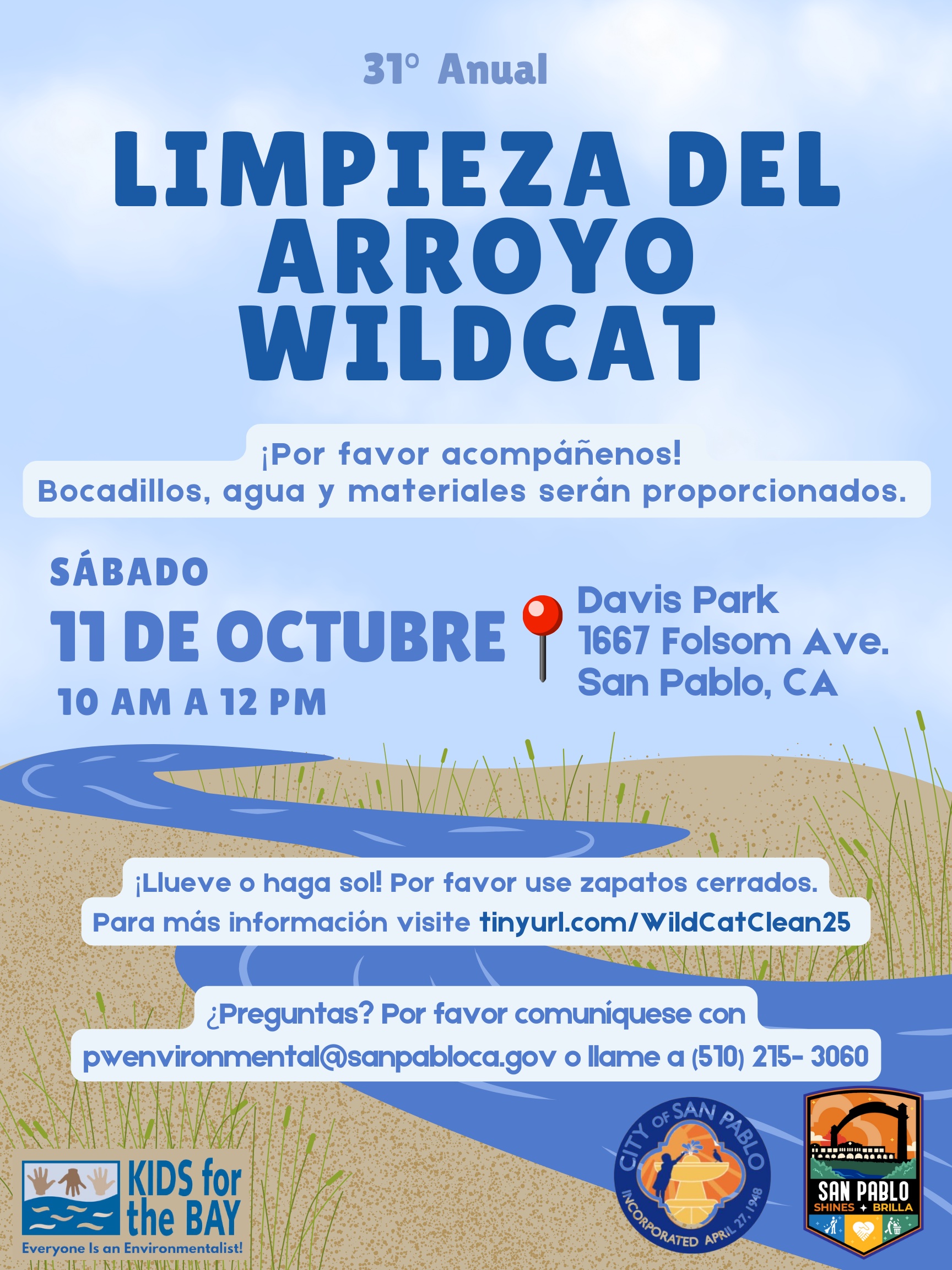
31st Annual Wildcat Creek Cleanup in San Pablo Oct 11

October 9, 2025 By Publisher Leave a Comment

By City of San Pablo

We hope you can join Saturday! Join Kids for the Bay & the City of San Pablo for the 31st Annual Wildcat Creek Cleanup!

  • Saturday, October 11, 2025
  • 10 AM – 12 PM
  • Davis Park, 1667 Folsom Ave.

This family-friendly event welcomes all ages to help care for our creek and community. Snacks, water, and cleanup supplies will be provided. Please remember to wear closed-toe shoes and bring your community spirit! We’ll see you there, rain or shine.

Únete a Kids for the Bay y a la Ciudad de San Pablo para la 31ª Limpieza Anual de Wildcat Creek

  • Sábado, 11 de octubre de 2025
  • 10 AM a 12 PM
  • Davis Park, 1667 Folsom Ave.

Este evento familiar da la bienvenida a todas las edades para ayudar a cuidar nuestro arroyo y nuestra comunidad. Se proporcionarán bocadillos, agua y suministros de limpieza. Por favor recuerde usar zapatos cerrados y traer su espíritu comunitario. ¡Nos vemos allí, llueva o truene! #WildcatCreekCleanup #SanPabloShines #SanPabloBrilla

Filed Under: Community, Environment, Water, West County

Mt. Diablo Resource Recovery announces partnership with Colgate-Palmolive and Glacier robotics for recyclable plastic squeeze tubes

September 24, 2025 By Publisher Leave a Comment

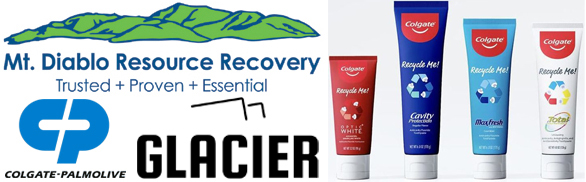
Effective immediately, MDRR’s residential recycling program will officially accept #2 plastic squeeze tubes in the blue recycling cart.

By Nicole Impagliazzo, Executive Director, Mt. Diablo Resource Recovery

Pittsburg, California – Mt. Diablo Resource Recovery (MDRR), an industry-leading company dedicated to diverting as much material as possible from landfills, is excited to announce a partnership with Colgate-Palmolive and Glacier robotics to gather data on the recovery of recyclable plastic squeeze tubes.

Colgate-Palmolive, an innovative growth company that is reimagining a healthier future for all people, their pets, and our planet, pioneered the development of a first-of-its-kind recyclable tube made from High-Density Polyethylene (HDPE), the same No. 2 plastic used for milk and detergent bottles, which launched in 2019. The company shared its patented technology and approach with tube suppliers, other brands, and interested parties. As of 2025, it is estimated that approximately 95% of toothpaste tubes and 85% of all HDPE tubes are designed for recycling, based on industry data compiled by Stina Inc., which leads the Plastic Squeeze Tube Recycling Project.

Now, using Glacier’s AI-powered cameras, Mt. Diablo Resource Recovery will be able to collect real-time data on toothpaste tubes and other non-toothpaste tubes—like lotion and shampoo—coming through the facility.

“We are excited to partner with Colgate and Glacier. It represents a significant step forward in our mission to divert as much material as possible from landfills. By leveraging advanced technology, we can improve our recycling and communication practices and contribute to a greener future.” Kish Rajan, MDRR, CEO

Recycle Your Squeeze Tubes – Residential Program Expansion Alert!

Effective immediately, MDRR’s residential recycling program will officially accept #2 plastic squeeze tubes in the blue recycling cart.

#2 Lotion, Toothpaste, Sunscreen, and Cosmetic plastic squeeze tubes now go into the blue!

Before placing them in your cart, please be sure they are:

  • Plastic (no metal tubes)
  • As empty as possible
  • With the cap on

Tubes should be placed loose in your blue recycling cart, not bagged.

This program expansion means that more of the items you use daily can stay out of the landfill and enter a recovery pathway, supporting a cleaner, greener community for everyone.

About Mt. Diablo Resource Recovery:

Mt. Diablo Resource Recovery serves our customers, communities, and environment responsibly by optimizing the use of discarded materials.

Today, Mt. Diablo Resource Recovery serves over 250,000 residents and thousands of businesses throughout Contra Costa, Napa, and Solano Counties. It combines excellence in customer service with competitive rates and operates recycling and recovery programs designed to increase sustainability and reduce greenhouse gas emissions.

Mt. Diablo Resource Recovery’s Material Resource Facility in Pittsburg, California, contains the area’s largest state-of-the-art recycling processing center and C+D line to keep items out of the landfill.

Our company continues to grow and change to prepare our communities for the future. Consistent with our business values, we invest in programs and technology that maximize diversion and maintain customer convenience and service.

Filed Under: Environment, Garbage, News

West County: Contra Costa DA reaches settlement with C&H Sugar Company, Inc. for 2022 air emission violations

September 17, 2025 By Publisher Leave a Comment

Crockett-based company will pay $500K in penalties & costs

By Ted Asregadoo, Public Information Officer, Contra Costa County District Attorney’s Office

Martinez, California – Contra Costa County District Attorney Diana Becton announced Tuesday, Sept. 16, 2025, a settlement with C&H Sugar Company Inc. for odor violations in 2022.

The emissions violations by C&H Sugar occurred on various dates between September 8th and October 14th, 2022, at a wastewater treatment plant the company jointly owns at Dowrelio Drive in the unincorporated community of Crockett.

Operational disruptions at the wastewater treatment plant generated excessive sewage odors that adversely affected Crockett residents. The problem was exacerbated by unusually high temperatures in the area during those periods.

Following an investigation by the Bay Area Air Quality Management District (BAAQMD), the case was referred to the Contra Costa County District Attorney’s Office for enforcement action.

“Working with BAAQMD during this process produced a compliance framework to help prevent future public nuisances,” said District Attorney Diana Becton. “C&H Sugar was cooperative throughout the process and agreed to specific enhanced compliance measures.”

The judgment provides for $400,000 in civil penalties, $100,000 in costs and C&H Sugar will implement the following compliance measures: purchase and install a backup generator, replacement of existing diffuser heads in all three reactors, upgrade the “Blowers” including replacement or refurbishment of the motors, complete comprehensive internal audit of operations and establish 24-hour toll-free community hotline.

The Contra Costa County District Attorney’s Office works closely with environmental regulatory agencies to ensure compliance with air quality standards and protect public health throughout the county.

Case No. C25-02616 | The People of the State of California v. C&H Sugar Company, Inc.

Filed Under: Business, District Attorney, Environment, News, West County

Contra Costa DA, four others reach settlement with telecommunications provider over environmental violations

March 19, 2025 By Publisher Leave a Comment

Company provides services in Concord

By Ted Asregadoo, PIO, Contra Costa County District Attorney’s Office

Contra Costa County District Attorney Diana Becton announces, in conjunction with five other District Attorneys in California, a $1.275 million settlement with WaveDivision Holdings, LLC — which operates under the brand name “Astound Broadband” within California – over environmental violations. Concord is the only city in Contra Costa County in which Astound provides internet, television and phone services.

WaveDivision Holdings, which provides telecommunication services including cable and internet, was jointly investigated by five District Attorneys’ Offices and the California Department of Toxic Substances Control. Waste inspections at Astound facilities in Contra Costa, San Francisco, Yolo and Placer counties revealed the unlawful disposal of hazardous waste generated by WaveDivision Holdings including electronic equipment, silicone gels, sealants and batteries. The hazardous waste was improperly being directed to municipal landfills instead of authorized hazardous waste disposal facilities.

Hazardous waste can cause serious harm to the environment and the public if not properly disposed. For example, splitters and power taps found in the inspections contained lead as well as lithium and alkaline batteries were recovered.

“Businesses must be held accountable for conduct that harms the environment,” said District Attorney Diana Becton. “WaveDivision Holdings cooperated with the investigation and has since implemented training programs to properly manage and dispose of hazardous waste, ensuring future compliance.”

Under the settlement agreement, WaveDivision will pay:
• $875,000 in civil penalties
• $300,000 for reimbursement of investigative costs
• $100,000 for Supplemental Environmental Projects

Additionally, the company is subject to an injunction requiring strict compliance with hazardous waste laws and implementation of compliance measures to prevent future violations.

The complaint was filed in Contra Costa Superior Court on March 18, 2025, by Contra Costa County District Attorney Diana Becton, San Francisco District Attorney Brooke Jenkins, San Mateo County District Attorney Stephen Wagstaffe, San Luis Obispo District Attorney Dan Dow, Yolo County District Attorney Jeff Reisig, and Placer County District Attorney Morgan Gire. Judge Danielle K. Douglas signed the order on the same day the complaint was filed.

Case No. C25-00758 | The People of the State of California v. WaveDivision Holdings, LLC

Allen D. Payton contributed to this report.

Filed Under: Business, Central County, Crime, District Attorney, Environment, News

Air District, Contra Costa DA pursue joint civil enforcement action against refinery owner for recent fire

February 15, 2025 By Publisher 1 Comment

For Martinez Refining Company “creating a public nuisance, for failing to operate equipment as permitted, and for excessive smoke and soot fallout.”

By Ted Asregadoo, PIO, Contra Costa District Attorney’s Office

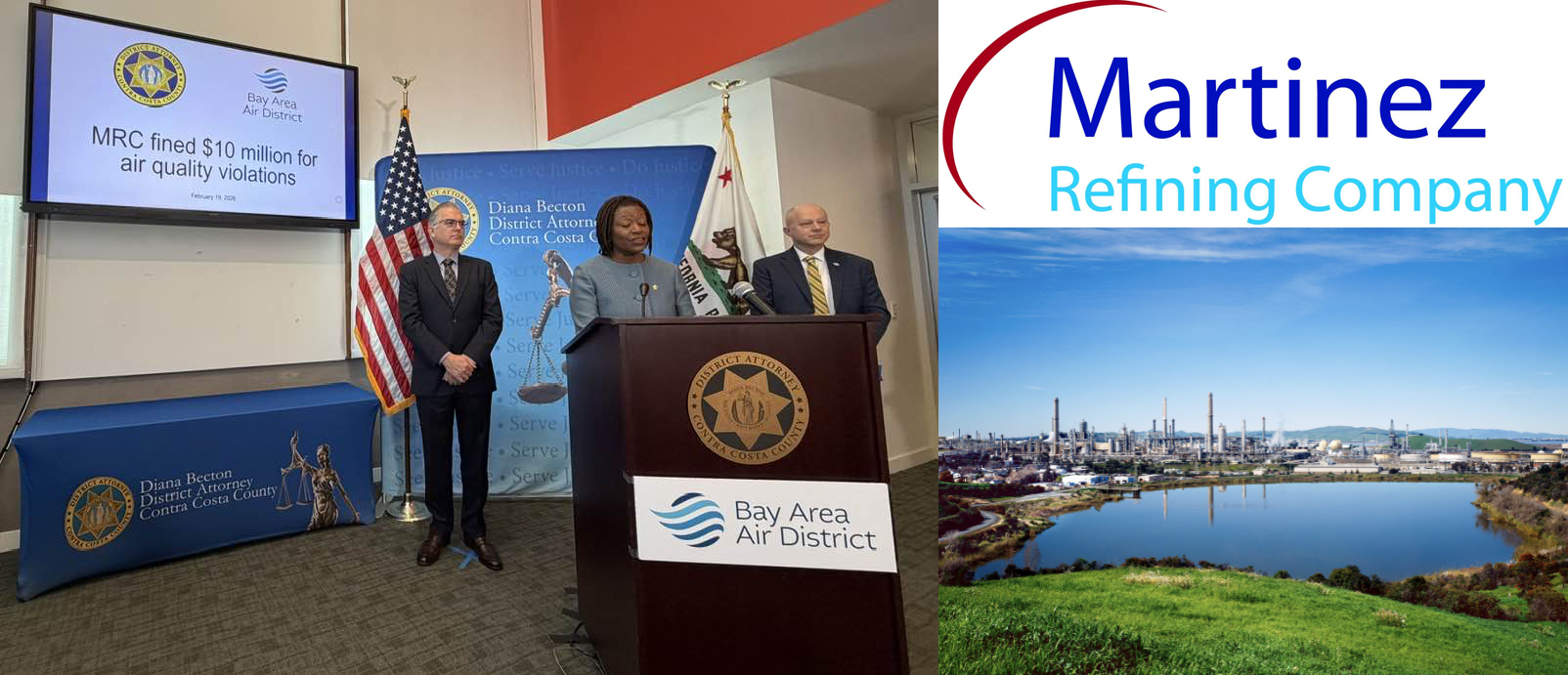
The Bay Area Air District and the Contra Costa County District Attorney’s Office understand the community’s concerns following the February 1, 2025, fire at the Martinez Refining Company. (See related articles here, here, here and here)

The Air District has been evaluating the fire’s air quality impacts and has issued three notices of violation to MRC for violating Air District regulations. These notices of violation were issued for creating a public nuisance, for failing to operate equipment as permitted, and for excessive smoke and soot fallout. The Air District’s investigations are ongoing, and the agency will issue further notices of violation for any additional violations uncovered.

Additionally, the Air District and the District Attorney’s Office continue the joint civil enforcement action against MRC for previous violations at this refinery. The two agencies are working collaboratively to take a comprehensive approach to ensure MRC’s compliance with all air quality regulations. While we understand the public’s interest, the confidential nature of the process prevents us from commenting on the status of this enforcement action.

Filed Under: Central County, Environment, Health, Industry, News

Martinez refinery discloses toxic chemicals released during recent fire

February 11, 2025 By Publisher 1 Comment

Fire at the Martinez refinery on Feb. 1, 2025. Photo: BAAQMD

“The combustion byproducts pose the greatest health concern.”

“This could have been much worse. We got lucky this time,” – County Health Officer Dr. Ori Tzvieli

By Contra Costa Health

The Martinez Refining Company (MRC), owned by PBF Energy, has told local health officials that chemicals and combustion byproducts from a recent fire at the refinery included chemicals that can cause cancer, as well as heart and lung disease.

Dr. Ori Tzvieli, the County’s health officer, said the community was fortunate that the wind blew most of the toxic smoke north of the refinery, away from populated areas.

“This could have been much worse,” Dr. Tzvieli said. “We got lucky this time. But our community shouldn’t have to rely on luck.”

Air-quality measurements taken by Contra Costa Health’s hazmat staff during the incident showed that concentrations of chemicals in the air during the event were mostly below the threshold considered dangerous. There was a short period when the smoke from the fire stayed closer to the ground and particulate matter immediately North of the refinery measured at a high level, but because that was not sustained over a long period it is not expected to have a significant health impact on most people. The Bay Area Air Quality Managment District (BAAQMD) also took air samples during the incident, which the health department will review after the results are available.

The blaze started at 1:30 p.m. on Feb. 1 as refinery workers prepared for a planned maintenance of a process unit that had been shut down earlier in the week. While opening equipment, hydrocarbon started to leak and ignited the fire, according to MRC’s 72-hour follow-up report to the County. Six refinery workers were evaluated by medical personnel and released.

The County initially issued a health advisory to residents in nearby Martinez, Pacheco and Clyde. Contra Costa Health later ordered a shelter-in-place to residents in Martinez north of the refinery when the smoke got closer to ground level. The shelter-in-place order was lifted later that night, although the health advisory remained in effect until the fire was completely put out on Feb. 4.

On Feb. 5, Contra Costa Health (CCH) sent MRC a letter asking the refinery to disclose what products were released or caught fire during the blaze.

In its response, MRC revealed that the following chemical products were involved: naphtha (petroleum), light thermal and light catalytic cracked; distillates (petroleum), light catalytic cracked; isobutane-rich C3-C4; diethanolamine; and distillates (petroleum), intermed cat cracked.

Combustion byproducts from the fire included particulate matter from the smoke, benzene, hydrogen sulfide, sulfur dioxide and xylene.

The combustion byproducts pose the greatest health concern. CCH will be working closely with a toxicologist to assess whether there may be any long-term health impacts, including potential impacts to soil and water.

MRC is scheduled to provide CCH a 30-day follow-up report in early March. The County is in the process of hiring a firm to do an independent root-cause analysis to determine why the accident happened and how it can be prevented from happening again.

“Like the community, I am concerned about the byproducts released during the fire and any health impacts they pose to residents,” said Contra Costa County Supervisor Shanelle Scales-Preston, whose district includes the area around the refinery. “I will work to ensure all reports and analyses done by or contracted by MRC, CCH, and the Air District are released fully and promptly. My top priority continues to be the health and safety of the community.”

“I want to thank all the first responders who bravely fought to contain the fire and monitored the incident for health impacts,” Scales-Preston added. “My goal for the future is that we don’t have accidents at the refinery that require first responders to get involved in the first place.”

The fire is the latest in a string of safety incidents at MRC over the past two-and-a-half years. In November 2022, the refinery accidentally released tons of toxic spent-catalyst dust in the surrounding community.

For more information, visit our Martinez Refining Company Oversight webpage.


Filed Under: Central County, Environment, Fire, Government, Health, Industry, News

DeSaulnier denounces U.S. Dep’t of Transportation’s upending electric vehicle use as “reckless”

February 7, 2025 By Publisher Leave a Comment

Rep. Mark DeSaulnier. Official photo.

Rescinds National Electric Vehicle Infrastructure Formula Program Guidance dated June 11, 2024, and all prior versions of this guidance

Congressman issues statement saying it, “leaves American drivers and consumers in the lurch.”

On Friday, February 7, 2025, Congressman Mark DeSaulnier (D-CA10) issued the following statement after the Trump Administration suspended implementation of the National Electric Vehicle Infrastructure (NEVI) Formula Program.

“The transportation sector is the leading source of greenhouse gas emissions in the United States. Electric vehicles (EVs) are crucial to reducing GHG emissions and curbing the existential threat of climate change while also having the potential to save drivers hundreds or even thousands of dollars in gas money annually. Given the obvious benefits of EVs, it is in everyone’s best interest to make it easier for Americans to drive them.

As a former member of the California Air Resources Board and Chairman of the transportation committees in both the California State Assembly and the California State Senate, I have seen firsthand how California’s forward-looking policies on climate change and greenhouse gas emissions drive innovation, economic growth, and job creation. That’s why I authored the Clean Corridors Act, which helped create and fund a $2.5 billion landmark new EV charging infrastructure program through the 2021 Bipartisan Infrastructure Law to make hydrogen fuel cell and electric battery powered cars more accessible and affordable for Americans.

The decision by the Federal High Administration of the Department of Transportation to suspend approvals of State Electric Vehicle Infrastructure Deployment Plans, which are required to receive NEVI funding, undoes the progress these two programs achieved, sets us back in the fight against climate change, and leaves American drivers and consumers in the lurch.

In 2024, China’s share of the global EV market grew to 76%, outpacing the U.S. in sales, and vastly surpassed the U.S. in number of public EV chargers with over 3.2 million public charge points. If the U.S. wants to be a leader in the transportation and energy sectors, we need a strong federal investment in electric vehicles and their charging infrastructure to meaningfully address climate change, help lower energy and transportation costs for Americans, and maintain global competitiveness. As a senior member of the Transportation and Infrastructure Committee, I urge the Secretary of Transportation to reverse this myopic and reckless decision.”

In a Feb. 6, 2025, letter to State Department of Transportation Directors, Emily Biondi, Associate Administrator of the Office of Planning, Environment and Realty wrote:

“The Federal Highway Administration (FHWA) administers several grant programs under which the applicable statutes require the Secretary to apportion grant funds to States under a prescribed statutory formula. The National Electric Vehicle Infrastructure (NEVI) Formula Program is one such program. Most statutory formula programs require the Secretary to make the prescribed apportionments to the States on a specific date and then make the funds available for obligation. See, e.g., 23 U.S.C. 104. The NEVI Formula Program, however, is unique in that this Program requires the Secretary to approve a plan for each State describing how the State intends to use its NEVI funds.1 The State plans are to be developed in accordance with guidance the Secretary provides on how States are to strategically deploy the electric vehicle (EV) charging network.2 The NEVI Formula Program requires the Secretary to approve each State’s plan prior to the obligation of NEVI Formula Program funds for each fiscal year.3

“The new leadership of the Department of Transportation (U.S. DOT) has decided to review the policies underlying the implementation of the NEVI Formula Program. Accordingly, the current NEVI Formula Program Guidance dated June 11, 2024, and all prior versions of this guidance are rescinded. The FHWA is updating the NEVI Formula Program Guidance to align with current U.S. DOT policy and priorities, including those set forth in DOT Order 2100.7, titled “Ensuring Reliance Upon Sound Economic Analysis in Department of Transportation Policies, Programs, and Activities.” The FHWA aims to have updated draft NEVI Formula Guidance published for public comment in the spring. After the public comment period has closed, FHWA will publish updated final NEVI Formula Guidance that responds to the comments received. As result of the rescission of the NEVI Formula Program Guidance, FHWA is also immediately suspending the approval of all State Electric Vehicle Infrastructure Deployment plans for all fiscal years.

“Therefore, effective immediately, no new obligations may occur under the NEVI Formula Program until the updated final NEVI Formula Program Guidance is issued and new State plans are submitted and approved. Instructions for the submission of new State plans for all fiscal years will be included in the updated final NEVI Formula Program Guidance. Since FHWA is suspending the existing State plans, States will be held harmless for not implementing their existing plans. Until new guidance is issued, reimbursement of existing obligations will be allowed in order to not disrupt current financial commitments.”

The letter includes the following footnotes and references:

1 See National Electric Vehicle Infrastructure Formula Program provisos 4-9 of paragraph (2) under the Highway Infrastructure Programs heading in Title VIII, Division J of the Infrastructure Investment and Jobs Act, Pub. L. 117-58; November 15, 2021; 135 Stat.1422. See also Paragraph 5c of FHWA Notice N 4510.895 Apportionment of Fiscal Year 2025 Highway Infrastructure Program Funds for the National Electric Vehicle Infrastructure Formula Program Pursuant to the Infrastructure Investment and Jobs Act as well as Paragraph 5c of FHWA Notices N 4510.863, N 4510.873, and N 4510.883 for the apportionments for Fiscal Years 22, 23 and 24, respectively. 2 See National Electric Vehicle Infrastructure Formula Program provisos 14-15 of paragraph (2) under the Highway Infrastructure Programs heading in Title VIII, Division J of the Infrastructure Investment and Jobs Act, Pub. L. 117- 58; November 15, 2021; 135 Stat.1423. 3 See National Electric Vehicle Infrastructure Formula Program provisos 4-9 of paragraph (2) under the Highway Infrastructure Programs heading in Title VIII, Division J of the Infrastructure Investment and Jobs Act, Pub. L. 117-58; November 15, 2021; 135 Stat.1422. See also Paragraph 5c of FHWA Notice N 4510.895 Apportionment of Fiscal Year 2025 Highway Infrastructure Program Funds for the National Electric Vehicle Infrastructure Formula Program Pursuant to the Infrastructure Investment and Jobs Act as well as Paragraph 5c of FHWA Notices N 4510.863, N 4510.873, and N 4510.883 for the apportionments for Fiscal Years 22, 23 and 24, respectively.

DeSaulnier represents California’s 10th Congressional District in the U.S. House of Representatives.

Allen D. Payton contributed to this report.

Filed Under: Environment, Government, News, Technology, Transportation

John Muir Land Trust announces acquisition of Point Buckler

January 24, 2025 By Publisher Leave a Comment

Point Buckler Island and area map. Source: John Muir Land Trust

29-acre island in Suisun Marsh to be permanently protected and restored as vital habitat

After years of legal battles, small island poised to become model of environmental stewardship

By Jay Dean, Creative Strategy Director, John Muir Land Trust & Blair Robertson, Information Officer, San Francisco Bay Regional Water Quality Control Board

MARTINEZ, CA — John Muir Land Trust (JMLT,) announces the purchase of Point Buckler, a 29-acre island situated in Suisun Marsh, the largest contiguous, brackish marsh on the west coast of North America and a vital part of the San Francisco Bay and Sacramento-San Joaquin Delta estuary. This acquisition is the latest milestone in JMLT’s Bay Delta Campaign, an initiative to conserve land in an ecosystem that protects clean water and preserves essential habitat for 700 species of California fish and wildlife. More than 25 million state residents depend on the Delta for drinking water, and the system supplies water to millions of acres of farmland.

“Point Buckler is one of three islands that form the last points of passage for fish moving to and from the Pacific Ocean, Carquinez Strait and the Sacramento-San Joaquin River systems”

The Bay Delta’s biologically rich ecosystem serves as a migration corridor for salmon and other anadromous fish. Extensive environmental restoration is needed at Point Buckler to restore a vital passageway. An unauthorized levee constructed a decade ago blocks all tidal channels. The levee has killed marshland vegetation and prevents sensitive fish species from entering the channels to forage for food. JMLT is launching a multi-year campaign to raise additional funds needed to remove the levee and restore the island back to health.

“Point Buckler is one of three islands that form the last points of passage for fish moving to and from the Pacific Ocean, Carquinez Strait and the Sacramento-San Joaquin River systems,” said Linus Eukel, Executive Director of JMLT. “John Muir Land Trust and many conservation partners are working to protect and restore the Bay Delta after decades of harmful human activity. At Pacheco Marsh, JMLT is reversing a century of harsh industrial abuse. In May we’ll open it as a unique opportunity for nature lovers to experience a salt marsh ecosystem firsthand. Last month JMLT acquired Hoover Ranch, a 600-acre haven for native waterfowl and bird species that migrate along the Pacific Flyway. Acquiring Point Buckler is the latest accomplishment in JMLT’s decades-long commitment to protecting one of the most important ecosystems on the continent.”

“This is the best outcome we could have hoped for,” said Eileen White, Executive Officer for the San Francisco Bay Regional Water Quality Control Board. “It is a win for all Californians that an organization with the qualifications and track record of John Muir Land Trust is now entrusted with the permanent protection and restoration of Point Buckler as critical wildlife habitat. A healthy Bay Delta region is essential to California’s fresh water quality and supply. Point Buckler is now in very good hands.”

JMLT purchased the Point Buckler property with a credit bid of $3.8 million on January 23rd at a public auction conducted by the Solano County Sheriff’s Office. A decade ago, the former owner constructed an unauthorized levee without permits or approvals from the San Francisco Bay Regional Water Quality Control Board and other agencies, resulting in an enforcement case to reverse negative impacts to wetlands considered among the most severe in the region. On December 11, 2024, the Superior Court of the State of California assigned credit rights in the case to JMLT.

“An opportunity to return to its natural state a place as ecologically important as Point Buckler is rare,” said Eukel. “Next steps for JMLT are developing detailed plans for restoration, fundraising for its implementation, and then getting to the work of removing the levee and thereby restoring the island’s tidal marsh ecosystem. This is vital to the health of California’s native fish populations that spawn in fresh water upriver and live adult lives in the ocean. The restoration will take years, but today the Bay Area conversation community is cheering its official start.”

After years of legal battles and environmental degradation, Point Buckler Island in Suisun Bay has been sold at auction to the John Muir Land Trust, a nonprofit environmental group that has committed to restoring the island’s wetlands and preserving its ecological significance.

Wednesday’s sale, overseen by the Solano County Sheriff, follows the former owners’ failure to comply with state judgments related to the unauthorized construction of a levee around the island in 2014 and 2015 that caused ecological harm to the Suisun Marsh. In 2016, the San Francisco Bay Regional Water Quality Control Board (SFBRWQB) issued a cleanup and abatement order directing the owners to restore the tidal circulation and marsh habitat at Point Buckler Island and imposed a $2.8 million fine that reflected the extent of the environmentally harmful activities.

White described the sale as a turning point:

“The prolonged legal issues were unfortunate. Instead of being cooperative and following the requirements of an order designed to protect water quality and aquatic life, the owners of the island chose not to comply,” she said. “The sale of Point Buckler Island offers a new path forward, and we are confident that the nonprofit John Muir Land Trust will restore it into an example of responsible environmental stewardship.”

The island is a key component of the Sacramento-San Joaquin Delta, one of the most biodiverse estuaries on the West Coast. Its restoration is expected to benefit endangered species, improve water quality and serve as a model for sustainable wetland management.

The island’s previous owners faced extensive fines and penalties — totaling millions of dollars — after refusing to remediate environmental violations that severely impacted the sensitive tidal ecosystem. Five years following the regional board’s enforcement actions, the California Court of Appeal affirmed the board’s orders and a related administrative order by the Bay Conservation and Development Commission that imposed substantial penalties as well as restoration and monitoring requirements.

The state administrative orders and ensuing appellate opinions are consistent with rulings issued by the United States District Court for the Eastern District of California in a case brought by the federal government that also required the former owners to restore the island due to their violations of the federal Clean Water Act.

Since 2021, the former owners repeatedly refused to comply with the state judgments and had been in contempt of court since August 2022.

The new owner of the island is required to ensure its restoration in compliance with the state and federal orders. The John Muir Land Trust’s mission to preserve, protect and steward vital habitat for local wildlife is in alignment with the state and federal restoration obligations. The trust plans to implement a comprehensive restoration plan to rehabilitate the island’s wetlands and comply with the cleanup and abatement order. Known for its commitment to conservation and environmental education, the trust says it sees the project as an opportunity to restore critical habitats while raising awareness about the importance of preserving the Delta’s fragile ecosystems.

“This is a victory not just for the environment, but for everyone who values the health of California’s Delta,” said Linus Eukel, executive director of the trust. “We are honored to take on the responsibility of restoring Point Buckler Island and ensuring it fulfills its ecological potential.”

The sale marks the conclusion of a contentious chapter in the island’s history and signals a renewed focus on collaboration and conservation. Any proceeds from the sale will be used to offset the state’s enforcement costs and support environmental restoration efforts.

About JMLT’s Bay Delta Campaign

Few conservation priorities are as important as restoring and protecting the San Francisco Bay and Sacramento-San Joaquin Delta. As a top strategic initiative for John Muir Land Trust (JMLT), the Bay Delta Campaign seeks to protect threatened places essential to the health of vital freshwater and marine ecosystems. The region is an environmental, economic, and cultural resource with almost no equal. Nearly half of California’s migrating waterfowl and shorebirds pass through the Bay Delta. Its salt marshes provide essential habitat for most fisheries species. This is the hub of California’s water supply, as it provides fresh water to millions of residents and to farms at the heart of the country’s food supply.

About John Muir Land Trust

Founded in 1989, John Muir Land Trust (JMLT) protects and cares for open space, ranches, farms, parkland and shoreline in Contra Costa and Alameda Counties. In a generation, John Muir Land Trust has become one of the leading forces for conservation in northern California. With over 4,600 acres protected, many beautiful places in the East Bay are permanently preserved for recreation, wildlife habitat, and spectacular scenic views. JMLT believes that the vitality of our open spaces is essential to the health of our earth, air, water, native plants and animals — and all of us. jmlt.org. Learn about JMLT’s East Bay 2049 vision at East Bay 2049 – John Muir Land Trust.

About SFBRWQB

The mission of the San Francisco Bay Regional Water Quality Control Board is to preserve, enhance and restore the quality of California’s water resources for the protection of the environment, public health and all beneficial uses, and to ensure proper water resource allocation and efficient use for the benefit of present and future generations

Filed Under: Central County, Environment, News

Padilla announces $19 million grant for North Richmond Community Resilience Initiative

December 16, 2024 By Publisher Leave a Comment

Part of over $216 million for California from environmental and climate justice Community Change Grants from Inflation Reduction Act

WASHINGTON, D.C. — Today, U.S. Senator Alex Padilla (D-Calif.) announced that the Environmental Protection Agency (EPA) awarded 15 California projects a combined $216.5 million to advance local, on-the-ground projects that reduce pollution, increase community climate resilience, and strengthen workforce development. The funding comes from the Inflation Reduction Act as part of the Community Change Grants Program, the largest nationwide investment in environmental and climate justice in history.

The Community Change Grants Program addresses the diverse and unique needs of disadvantaged communities by reducing air, water, and soil pollution, building resilient infrastructure to extreme weather events, and bolstering workforce development.

“Overlooked communities across California have struggled for generations with air pollution and unaffordable water and energy bills. The climate crisis has only underscored these vulnerabilities,” said Padilla. “Thanks to the Inflation Reduction Act, we’re delivering millions in environmental justice investments to reduce energy costs and improve air quality, while developing climate-resilient community workforces.”

Approximately $2 billion dollars in Inflation Reduction Act (IRA) funds were available for environmental and climate justice activities to benefit disadvantaged communities through projects that reduce pollution, increase community climate resilience, and build community capacity to address environmental and climate justice challenges. These place-based investments focused on community-driven initiatives to be responsive to community and stakeholder input.

“On day one of his Administration, President Biden promised to target investments to communities that for too long have been shut out of federal funding,” said EPA Administrator Michael S. Regan. “Today, thanks to President Biden’s Inflation Reduction Act, EPA is delivering on that promise. These selections will create jobs, improve public health, and uplift community efforts in all corners of this country, regardless of geography or background.”

California projects selected for Community Change Grants Program awards include:

  • North Richmond Community Resilience Initiative — $19.08 million. The North Richmond Community Resilience Initiative will build a community resiliency center at the North Richmond Farm to serve the community in the event of an emergency or disaster and provide community services during normal operations. The project will scale up existing efforts to increase North Richmond’s urban tree canopy and will plant 65 new trees along the Verde Elementary schoolyard to shield students from pollution generated by a new distribution center.
  • Treasure Island Connects — $19.50 million. This project focuses on Treasure Island and Yerba Buena Island in the San Francisco Bay Area. Treasure Island Connects aims to expand community access to clean public transportation resources through six projects. The project will launch a microtransit pilot to connect Treasure Island residents to key resources on mainland San Francisco and a community circulator shuttle. The project will also add one new electric bus to the Muni bus route servicing Treasure Island, create a bikeshare program, and install electric ferry charging infrastructure to support the planned conversion to zero-emission ferry service.
  • South Los Angeles All In – Good Jobs, Healthy Communities — $20 million. The Coalition for Responsible Community Development and the Los Angeles Trade-Technical College will support workforce development in South Los Angeles along four career tracks to reduce pollution, including lead abatement in buildings; welding for clean energy and transportation projects; hybrid and electric vehicle maintenance; and weatherization and energy auditing of buildings.
  • GREEN San Gabriel Valley — $20 million. In California’s San Gabriel Valley, Day One, Active San Gabriel Valley, and their partners will implement several environmental justice projects. They will mitigate extreme heat and build community resilience by expanding tree canopy and greening schoolyards with rain gardens and native plants. They will also provide incentives for the purchase of e-bikes, establish 60 public water stations, and reduce energy costs through the installation of solar, energy storage systems, and cool roofs.
  • Safe Drinking Water and Climate Resilience for Rural Pajaro Valley Disadvantaged Communities — $20 million. Focusing on households served by California’s Pajaro Water System (PWS), Sunny Mesa Water System (SMWS), and Springfield Water System (SWS), as well as households relying on private wells near the SWS in Northeastern Monterey County, this project will consolidate these water systems into a combined system with multiple compliant wells for redundancy and resilience to extreme climate events. Current systems do not have backup wells that meet water quality standards.
  • The San Diego Foundation — $20 million. Focused on San Diego’s historic central barrios, San Diego Foundation and the Environmental Health Coalition will take a holistic approach to improve local air quality, mitigate extreme heat, and expand green space. The project will improve residents’ access to clean and safe transportation, electrify homes, add energy storage, install air filters, and perform weatherization upgrades. It will also connect residents to clean energy job opportunities and apprenticeships in electrical and construction work.
  • Restoring Resilience: Enhancing Community and Environmental Sustainability through the Dos Pueblos Institute’s Climate Action Strategy — $19.99 million. The Restoring Resilience project will enhance disaster preparedness and response capabilities for the residents of disadvantaged communities on California’s Gaviota Coast. The project will establish the Gaviota Coastal Cultural and Historical Center, a resilience hub that will serve as a central location for educational programs and community events during “blue sky” days and as an emergency shelter and staging area during wildfires and other disasters.
  • Southeast Strong — $19.98 million. The City of Bakersfield and Building Healthy Communities Kern will improve community connectivity in central and southeast Bakersfield by expanding residents’ access to safe, clean, and convenient active transportation and public transit options. To reduce pollution and energy costs, they will fund energy efficiency retrofits at 30 single-family residential units and retrofit another 60 homes with solar panels and battery technologies. The project will also provide 150 residents with training to install solar panels, repair electric vehicles, and enroll in electrician apprenticeships.
  • Building Climate Resilient Communities in the Eastern Coachella Valley — $18.76 million. This project will build four geothermal, solar-powered commercial greenhouses with geothermal energy for cooling and heating. The greenhouses will support vertical hydroponic farming and will offer free training and 15 living wage jobs to newly trained “Controlled Environment Agriculture (CEA) workers from the Eastern Coachella Valley community. The project also will build the Center for Community Development and Resilience (CCDR), which will integrate climate-smart building elements, such as solar and heat pumps, as well as green infrastructure.
  • Greening North Franklin — $17.84 million. La Familia Counseling Center and Community Resource Project will implement several projects to reduce pollution and build climate resilience in south Sacramento. They will develop a community resilience hub to serve as a cooling center during extreme heat events and provide services to meet community needs in an emergency. To reduce energy costs and pollution, the project will provide energy efficiency upgrades, install solar on qualifying homes, and provide workforce training in electrification, housing retrofits, and solar installation.

A full list of California projects and descriptions is available here.

EPA is on track to obligate the majority of selected Community Change grants by January 2025. More information on the Community Change Grants Program is available here.

Senator Padilla has helped secure hundreds of millions from the Inflation Reduction Act to reduce pollution in underserved California communities. Earlier this year, Padilla announced nearly $500 million from the Inflation Reduction Act for the South Coast Air Quality Management District, which will help decarbonize the transportation and freight sectors and improve air quality for Southern California residents. Padilla also secured nearly $250 million for California’s Solar for All project to help deliver residential solar for low-income and disadvantaged communities across the state. Last year, he announced over $102 million in grants from the U.S. Department of Agriculture’s (USDA) Forest Service to combat extreme heat and climate change, plant and maintain trees, and create urban green spaces.


Filed Under: Environment, Finances, Government, News, West County

  • « Previous Page
  • 1
  • 2
  • 3
  • 4
  • …
  • 13
  • Next Page »
The Lemon Tree generic
RepublicServices-Antioch-ad (1)
Furn-Clrnc-Outlet-06-26B web
Monica's dinner 05-26 CCH
Celia's-07-26
Delta-RC-B 07-26
Deer-Valley-Chiro-06-22

Copyright © 2026 · · Contra Costa Herald · All Rights Reserved