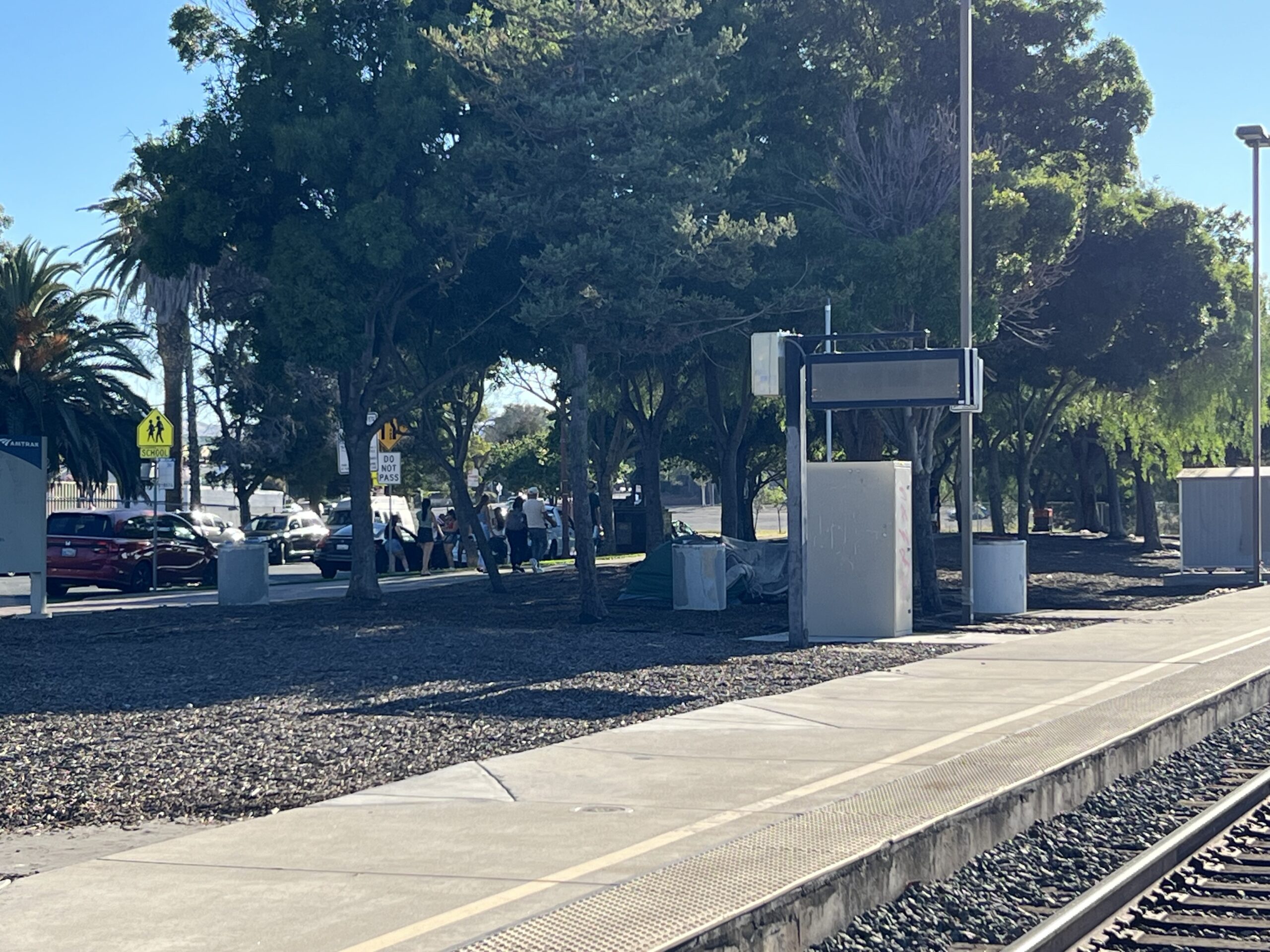
The Antioch Amtrak station on July 4, 2024. Photo by Allen D. Payton
Mayor Hernandez-Thorpe repeatedly blames former city manager Ron Bernal, his opponent in the November election, says Authority staff member told him
Bernal refutes saying he had no communication about closure with Authority while city manager only approved demolition of station structure
“If I had any form of written communication from a City Manager other than Mr. Johnson, I would have shared it with the Mayor before his appearance at the Board meeting. I never referred to Ron Bernal by name.” – Tamika Smith, SJJPA Director of Rail Services.
Only Oakley City Manager supported decommissioning of Antioch station
First mention of station closure in June 2021 among SJJPA staff
Former City Manager Con Johnson first informed in fall 2022 six months before SJJPA Board vote, denies he approved it, blames closure on Hernandez-Thorpe, city council
Special Authority Board meeting July 18 – see Board members’ names & contact info.
By Allen D. Payton
 It’s an election year whodunnit. Was the closure of the Antioch Amtrak Station, formally referred to as the decommissioning of the Antioch-Pittsburg San Joaquins Passenger Stop, approved by former City Manager Ron Bernal or not? That’s the question that was answered this month following accusations by Mayor Lamar Hernandez-Thorpe since last year and a two-month investigation by the Herald.
An accusation was also made against Bernal from one member of the public during the May 28th Antioch City Council meeting. Resident Nicole Arrington repeated the mayor’s claim and said, “Ron Bernal lied saying he didn’t know anything about the train stop being taken away because it’s in the paper. I can show you the article. We have people in positions that lie about simple things like a train stop being taken away, saying they didn’t know, but they did.” (See 1:56:00 mark of council meeting video)
So far, Bernal, who announced in February and pulled his nomination papers on Monday, July 15th – the first day possible – is the mayor’s only opponent in his bid for re-election in November.
Bernal Denies He Approved Station Closure, Only Demolition of Building
However, the first-time candidate for public office refutes the claims against him and says he only approved the demolition of the building at the Amtrak station not the decommissioning. “I’m not going to let this lie and take the blame for this,” Bernal said when reached for comment.
“Discussions were first held with the joint powers authority and included Mayor Sean Wright and myself,” he explained. “They were talking about a commuter train from the Centra Valley to Oakland by 8:30 every morning and how we could recognize and market Antioch and improve the Waldie Plaza area to compete against the Oakley Station and what they were developing, there.”
“It was never about decommissioning. That word was not used in our discussions,” Bernal stated.
“When the person was found sleeping on the roof the Authority asked about tearing down the building and putting in a shelter and benches. Why would we be talking about decommissioning it, why would we want to improve all the landscaping there, improve the platform experience?” Bernal asked.
The building at the station was demolished in 2019.
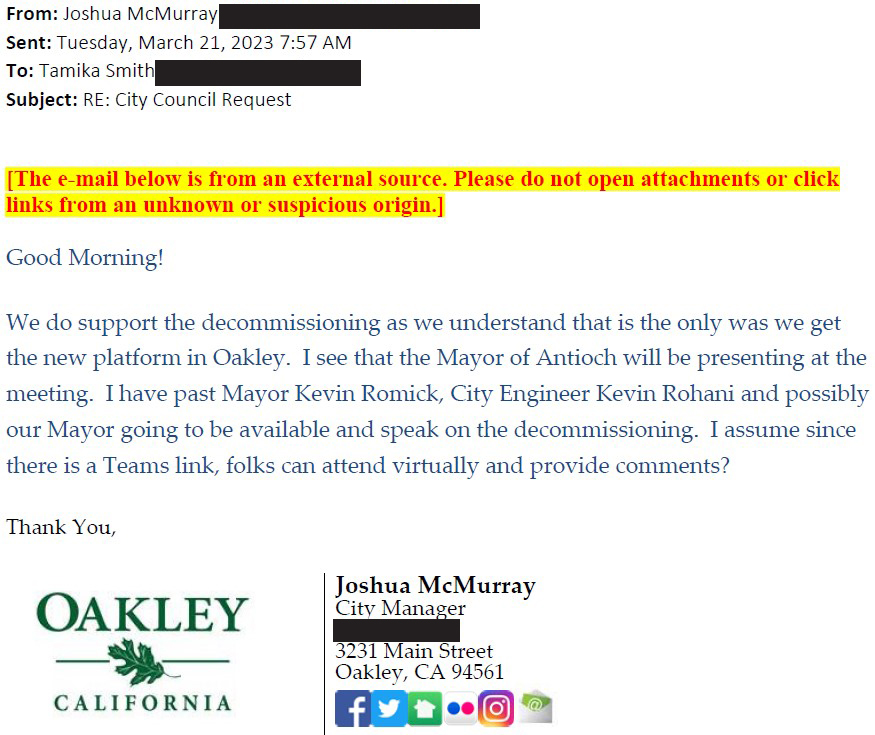
Email from Oakley City Manager Josh McMurray to Tamika Smith on March 21, 2023, approving Antioch station closure. Source: SJJPA (Redacted by the Herald)
Herald Investigation Shows Bernal Never Approved Station Closure, Only Oakley City Manager Did
Results of a two-month investigation by the Herald, including multiple Public Records Act (PRA) requests and one federal Freedom of Information Act (FOIA) request, support Bernal’s denial and show Hernandez-Thorpe was the first person to accuse the former city manager, and only official to ever mention his name as the person who approved the station’s closure. In addition, emails show the only current or former city manager to actually approve the Antioch Amtrak station closure was current Oakley City Manager Joshua McMurray in an email to SJJPA Director of Rail Services Tamika Smith on March 21, 2023. In response to her question asking, “Does the City of Oakley have a position regarding the decommissioning of Antioch?” he wrote, “We do support the decommissioning as we understand that is the only was we get the new platform in Oakley.”
The mayor based his accusation on a sentence in the agenda for the March 24, 2023, meeting for the Board of Directors of the San Joaquin Joint Powers Authority (SJJPA) which oversees operations of the Amtrak passenger rail service from Bakersfield through Antioch to Oakland. In the staff report by Tamika Smith, for agenda Item 9 entitled, “Approve a Resolution of the Governing Board of the San Joaquin Joint Powers Authority Approving the Decommissioning of the Antioch-Pittsburg San Joaquins Passenger Stop,” one of the reasons for the station’s closure provided was, “Due to the unhoused population challenges, the previous Antioch City Manager approved the decommissioning of the stop.”
Other reasons for the closure included crime in and around the station, assaults on train conductors and fare evasion. Smith’s staff report also included, “In September 2019, due to safety concerns with the unhoused population, the passenger shelter was demolished after a homeless individual was found residing on the roof.”
The mayor later said it was Ms. Smith who told him it was Bernal, but she said she never mentioned anyone’s name and specifically said she didn’t mention Bernal’s.
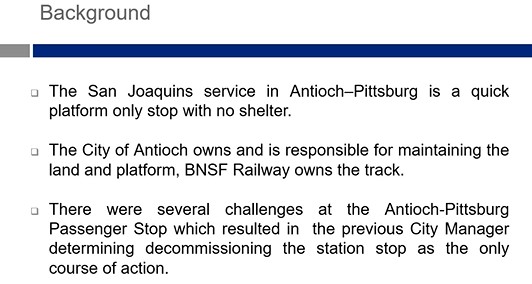
Slide from staff presentation for agenda Item #9 on Antioch station decommissioning during San Joaquin Joint Powers Authority Board of Directors meeting on March 24, 2023. Source: SJJPA
Hernandez-Thorpe Repeatedly Blames Bernal, Claims SJJPA Board Meeting Video Provides Proof
In spite of Bernal’s denial, the mayor continues to claim that he is the “previous Antioch City Manager” who approved the Amtrak station be decommissioned, and claims it is supported by the staff report for the March 24, 2023, SJJPA Board meeting. Hernandez-Thorpe repeated his accusation at the end of the Antioch City Council meeting on June 25, 2024, during discussion of bringing back a resolution for a vote to send to the SJJPA board and claims the board meeting video proves it.
The mayor said, “Whoever made the decision, according to the San Joaquins, and you’ve all seen the video – I sent it to you – that this was the city manager, former city manager Ron Bernal who made this decision. He never told us about it. He never asked us to make a decision or weigh in. For the city manager to singularly make that decision on his own, I just think it was inappropriate.” (See 3:24:00 mark of council meeting video)
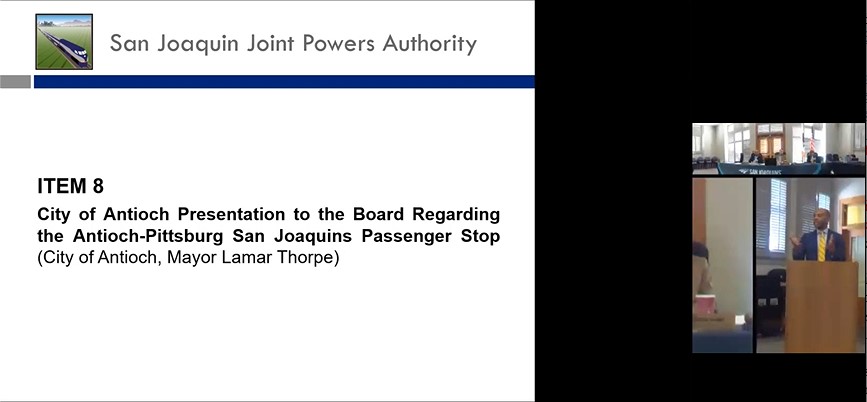
Video screenshot of Hernandez-Thorpe’s presentation to SJJPA Board during their meeting on March 24, 2023. Source: SJJPA
Mayor Was Only Person to Name Bernal as “Previous City Manager Who Approved Station Closure at SJJPA Board Meeting.
Before the SJPPA Board voted for the closure, Hernandez-Thorpe provided a presentation asking the Board to keep the station open. The title for the mayor’s presentation under Item 8 was, “City of Antioch Presentation to the Board Regarding the Antioch-Pittsburg San Joaquins Passenger Stop (City of Antioch) INFORMATION”. (See the 47:23 mark of the Board meeting video which was not provided to the Herald until June 24, 2024).
The mayor was the first and only person to name Bernal as the previous city manager who approved the Antioch station closure at the SJJPA Board of Directors meeting.
Hernandez-Thorpe stated, “We did not know that our city manager, former city manager Ron Bernal, had a conversation with your staff and agreed to shut down the station. As I said to Tamika, here, ‘who the heck voted for him?’ Nobody. People voted for me. People voted for my four colleagues…to represent and make decisions on behalf of the people. Not the city manager. The city manager works for me and the four members of the city council. So, that was inappropriate, and it was wrong.” (See 54:35 mark of SJJPA Board meeting video)
However, not only does Bernal say he never communicated with the Authority about the closure, the SJJPA’s staff report on the Board meeting agenda item did not include the name of the “previous Antioch City Manager”, the video shows Hernandez-Thorpe was the only person who mentioned Bernal’s name during his presentation and Tamika Smith’s presentation to the Authority’s Board. She merely repeated what the mayor said without using Bernal’s name.
During her presentation Smith said, “As the mayor mentioned, the previous city manager did greenlight the approval, or he approved the decommissioning of the station.”
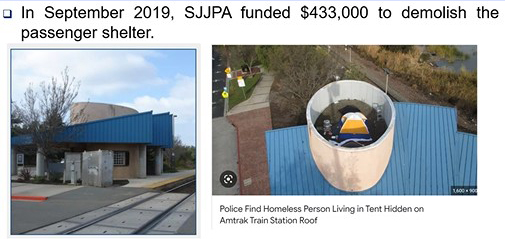
Slide from staff presentation for agenda Item #9 on Antioch station decommissioning during San Joaquin Joint Powers Authority Board of Directors meeting on March 24, 2023, showing drone photo from 2017 of homeless person camped in top of station building. Source: SJJPA
She then pointed out a photo of the station building showing an unhoused resident living on the roof in a tent and that Smith wasn’t sure if Antioch or Amtrak Police “removed him. But that was one of the situations that led the previous city manager, city manager’s approval to demolish the shelter and decommission the platform.” (See 1:27:00 mark)
According to the minutes of that meeting, on a motion by Contra Costa County’s then-alternate representative to the SJJPA, District 3 Supervisor Diane Burgis, the board voted, “to Approve a Resolution of the Governing Board of the San Joaquin Joint Powers Authority Approving the Decommissioning of the Antioch-Pittsburg San Joaquins Passenger Stop Amended to include the requirement for staff to work with other transportation agencies to provide alternative transportation options between the existing Antioch Station to the Oakley station, and not precluding recommissioning an Antioch Station in the future as technology and rail partners allow” by the following vote: AYES: 6 Alternate Burgis, Shuklian, Young, Vice Chair Espinosa, Vice Chair Verboon, Chair Hume; NOES: 0 ABSTAIN: 0 ABSENT: 4 Alternate Rodriguez, Haubert, Chiesa, Quintero (See 3:26:30 mark of SJJPA Board meeting video)
Further Proof Supports Bernal’s Denial, Refutes Hernandez-Thorpe’s Claim – No Antioch City Staff Member Approved Station Closure
Furthermore, the results of PRA requests to the SJJPA, City of Antioch, City of Oakley and Tri Delta Transit show no communication from any Antioch city manager or staff member approving the station’s closure, ever. The first communication provided in which the closure was discussed occurred in January 2023 between then-City Manager Cornelius “Con” Johnson and Tamika Smith when she informed him a vote on the closure would be placed on the March 24th board meeting agenda.
Asked by Director Rodriguez, “what other attempts have been made to bring in city officials…and what has been the reactions to them,” Ms. Smith said, “When I was with Amtrak we had connections with the City of Antioch and more recently staff has connected with the city manager, Mr. Johnson. We’ve been in discussions for about a year.”
That would have been the spring of 2022 after Bernal had retired on December 31, 2021. However, the first emails between SJJPA and City staff showing any mention of the Antioch station were in April, May and June 2018 when only the demolition of the building at the station was discussed and the first discussion of the station’s closure was not until fall 2022.
Hernandez-Thorpe Says, “According to SJJPA Ron Bernal Made the Decision”, “Council was Unaware”
Asked which previous city manager approved the decommissioning of the stop and since Cornelius “Con” Johnson had just been placed on administrative leave the week before and was still the city manager at the time the staff report was written, and the Board vote taken, and if Bernal approved it, Hernandez-Thorpe responded, “Yes, according to SJJPA Ron Bernal made the decision.”
Asked if he knew when the approval occurred and if Bernal did so following council direction and approval, the mayor responded, “Council was unaware which I made perfectly clear during my remarks at the meeting. I believe there is a recording of the meeting.”
The mayor was asked again if he knew when the approval occurred, and how, but did not respond.
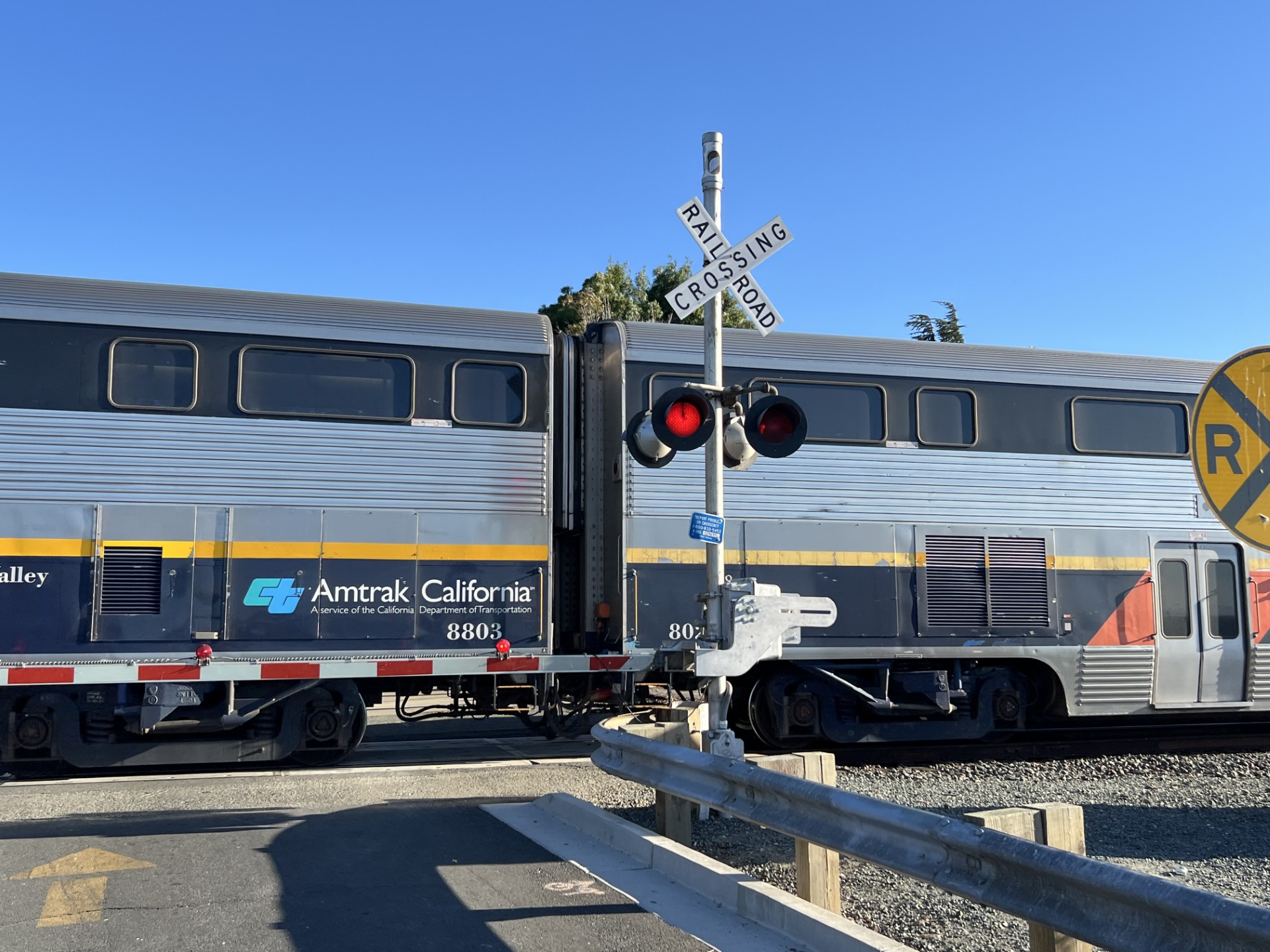
An Amtrak train passes the I Street crossing between the Antioch station and Monica’s Riverview on July 4, 2024. Photo by Allen D. Payton
Questions for Bernal
Bernal was asked which previous city manager approved the decommissioning of the stop and if he approved it. He was also asked, if he did, when and why he agreed to decommission the station, did he do so following council approval and direction and if not, did he inform the council that the station would be decommissioned.
Bernal was also asked how he informed the SJJPA about decommissioning the Antioch Amtrak station, if it was by email and if he copied the council members on the email or forwarded it to them, later.
Bernal Denies He Approved Station Closure, Communications Were About Improving Station Area
In response, Bernal wrote, “I never discussed decommissioning the Antioch Amtrak Station with the SJJPA or City Council because I was never made aware this was their intent or plan. There are no emails that I am aware of regarding this matter during my tenure as City Manager.”
“I did send a couple of emails to the Executive Director of the SJJPA last March when I heard that my name was being used in this context during a Board Meeting asking that any such statement be retracted as it wasn’t true,” he continued. “I was assured, by their staff at that time, that my name was not referenced in the context of this matter and was satisfied with this response. I also called and spoke with Mayor Thorpe at that time and told him the same.”
“Discussions were first held with the joint powers authority in 2017 and included Mayor Sean Wright and myself,” Bernal explained. “They were talking about a commuter train from the Central Valley to Oakland by 8:30 every morning and how we could recognize and market Antioch and improve the Waldie Plaza area to compete against the Oakley Station and what they were developing, there.”
“It was never about decommissioning. That word was not used in our discussions,” he stated.
“When the person was found sleeping on the station’s roof the Authority asked about tearing down the building and putting in a shelter and benches. Why would we be talking about decommissioning it, why would we want to improve all the landscaping there, improve the platform experience?” Bernal asked.
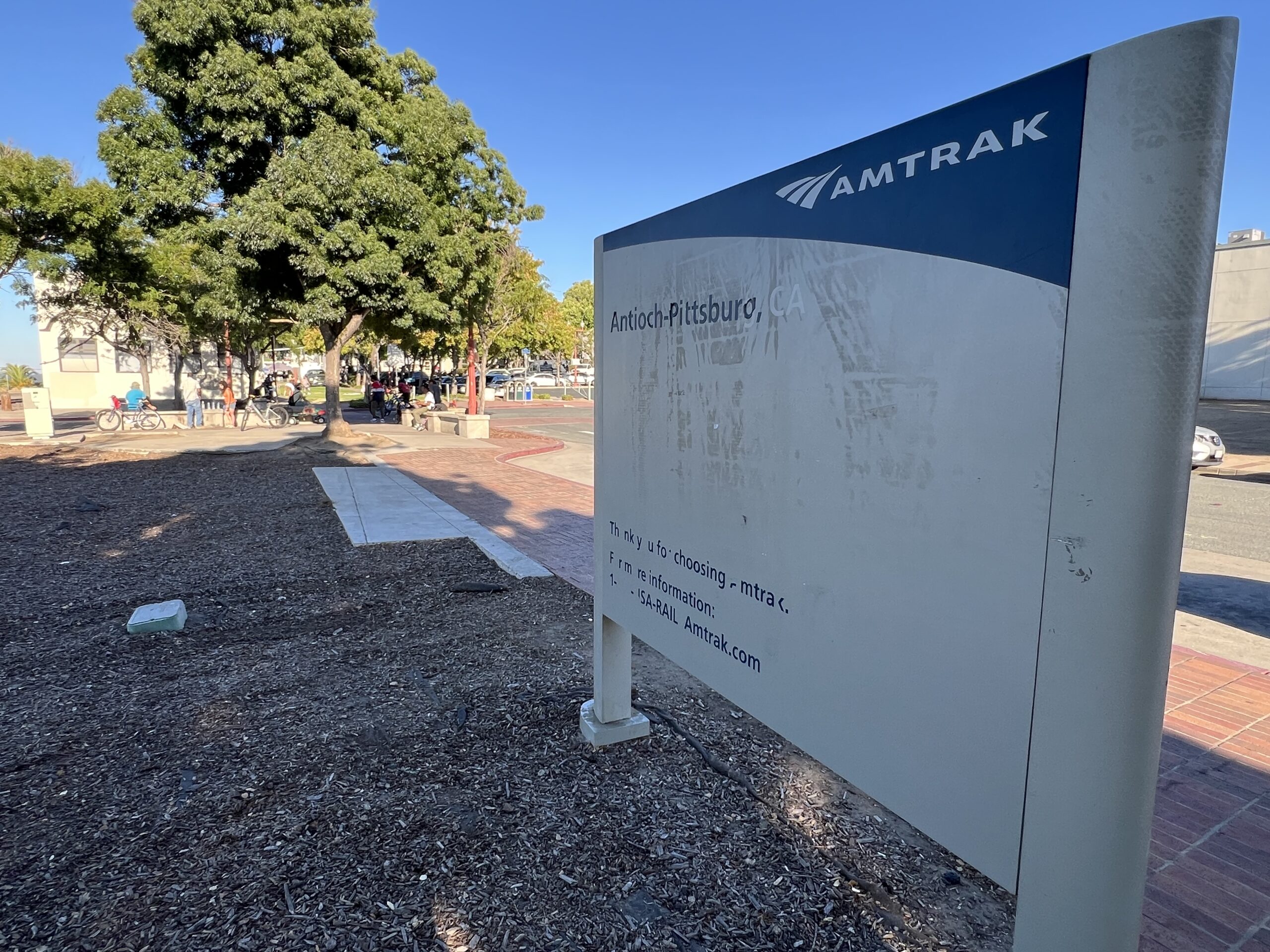
Vandalized Antioch Amtrak station sign on July 4, 2024. Photo by Allen D. Payton
First Record of Email from Bernal re: Amtrak Station was in May 2018 About Building Demolition, Landscape Improvements
In response to a PRA request to City staff, the only emails provided from Bernal while city manager, were about the demolition of the building and the improvements at and around the Antioch Amtrak station. The first email he was sent was on May 8, 2018, from then-Economic Development Manager Lizeht Zepeda to which he responded and copied her and Assistant City Engineer Lynne Filson. It read:
“From: Bernal, Ron
Sent: Tuesday, May 08, 2018 11:10 AM
To: Zepeda, Lizeht; Filson, Lynne
Subject: RE: Antioch Amtrak Station
Lizeht,
You will work with Anthony and our City Attorney to get an agreement in place and CIP will be responsible for coordinating the demo and reconstruction of concrete and landscaping
Lynne is setting something up with WRT to begin working on a landscape plan.
Thanks.
Ron Bernal
City Manager”
Later, in the email thread on that same day, Bernal copied the city attorney and wrote, “Can you please circle back with him to get an update on where he is on the scope. I don’t want the money San Joaquin claims they have to slip away.” He was referring to the $390,000 from SJJPA to help pay for the demolition. The City had initially budgeted $100,000 for the landscape and sidewalk improvements which was subsequently increased to $150,000. That amount is still in the 5-Year CIP budget adopted by the city council just last month, but the project title has been changed from Amtrak Station Improvements to I Street Improvements.
All Other Emails Between Agency Staff Members Copied to Bernal Were About Station Building Demolition, Area Improvements, Dealing With Homeless
In an email from then-SJJPA Operations Superintendent Anthony Chapa sent to Zepeda on May 18, he wrote:
“Subject: RE: Antioch Amtrak Station
Yes, we meet [sic] yesterday at Antioch to do a sight visit. Amtrak will be looking for a building engineer to help with the
demolition. I would like for use [sic] to start working on an agreement between Amtrak, city and my agency.”
A follow-up email was sent on May 23, 2018, by Chapa to Zepeda, copying Bernal, Tamika Smith, Alice Rose, the Western Region Real Estate Development Manager for the National Railroad Passenger Corporation, doing business as Amtrak, Robert “Bob” Nagel, Jr., Amtrak’s Senior Manager for Capital Construction, and Amtrak’s then-Capital Construction Manager, William “Bill” Callor. Chapa wrote:
“Subject: RE: Antioch Amtrak Station
Alice, Amtrak and the SJJPA will be sponsoring a station renovation at Antioch. Our goal is to demo the exiting [sic] building and replace it with some landscape and benches. Bill will have a scope of work done shortly. Can you start working with the city to get an agreement ready for this project. The city will be contributing 10% to the project cost. If you have any questions please give Bill or I a call.
The city of ACA is cc’ed.” That referred to the City of Antioch, California.
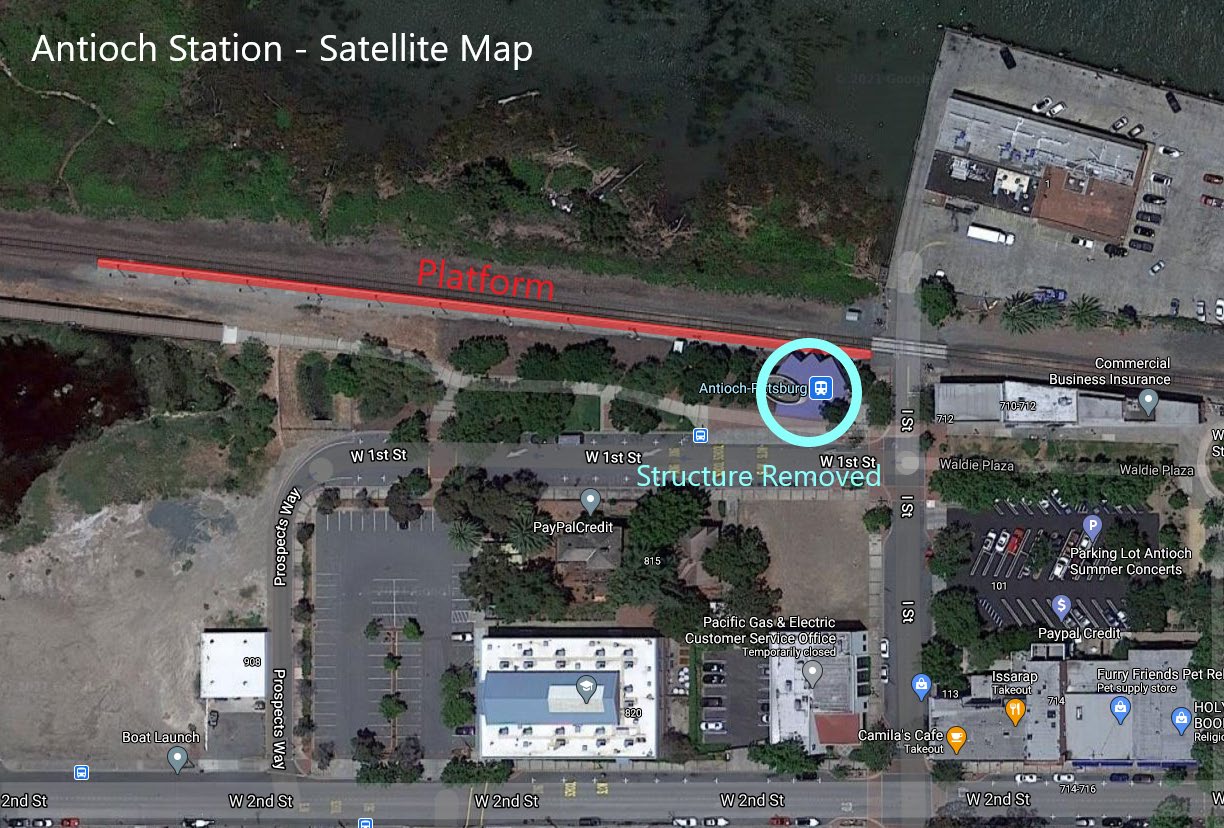
Antioch Amtrak station location map sent in email among SJJPA staff on March 15, 2021. Source: SJJPA
Station Building Demolition, Landscaping Improvements Budget and Authorized in April 2019
In an email on April 8, 2019, to Bill Callor and copying, Bob Nagel and Tamika Smith all of Amtrak at that time, as well as Jon Blank from Chapa gave “authorization to proceed with the ACA project” for demolition of the station building and the surrounding landscaping improvements. It also provided a cost estimate breakdown and the amounts to be contributed by each agency. The email read:
“From: Anthony Chapa
Sent: Monday, April 08, 2019 10:57 AM
To: Callor, William
Cc: Nagel, Jr., Robert; Smith, Tamika; Blank, Jon
Subject: RE: Antioch Estimate
Bill and Bob this email servers [sic] as your authorization to proceed with the ACA project. The additional 190,000 will be covered by the SJJPA and the City of Antioch.
Break Down.
SJJPA will supplement $90,000 above approved 300K
The City of Antioch will contribute $100,000 to the total of this project.
Totals
SJJPA $390,000
City of ACA $100,000
—————————
$490,000
John [sic] Blank is cc’ed to this email”
First Record of Closing Antioch Station was in June 2021 Emails Among SJJPA Staff
Emails on June 25, 2021, between SJJPA Executive Director Stacey Mortensen, and then-Senior Planner David Ripperda and Autumn Gowan, then-Contracts and Compliance Supervisor for the San Joaquin Regional Rail Commission, include the first recorded mention of a station closure without naming Antioch and that they were “going to/had cut a deal with BNSF to allow the addition of Oakley.”
That same email from Mortensen further includes, “What I am not clear on is whether Kevin got them to forgo BNSF requiring a station closure somewhere else,” also without naming which station, referring to former Director of Capital Projects Kevin Sheridan.
However, in his response email to Mortensen, Ripperda wrote, “I believe there had been some discussions about closing Antioch, but I don’t know if any deal was made with BNSF at this point.”
Mortensen responded, “I think more recently David L or Paul found that Antioch has more ridership than some of the southern valley stations.”
She was referring to SJJP spokesman David Lipari and former SJJPA Senior Planner Paul Herman.
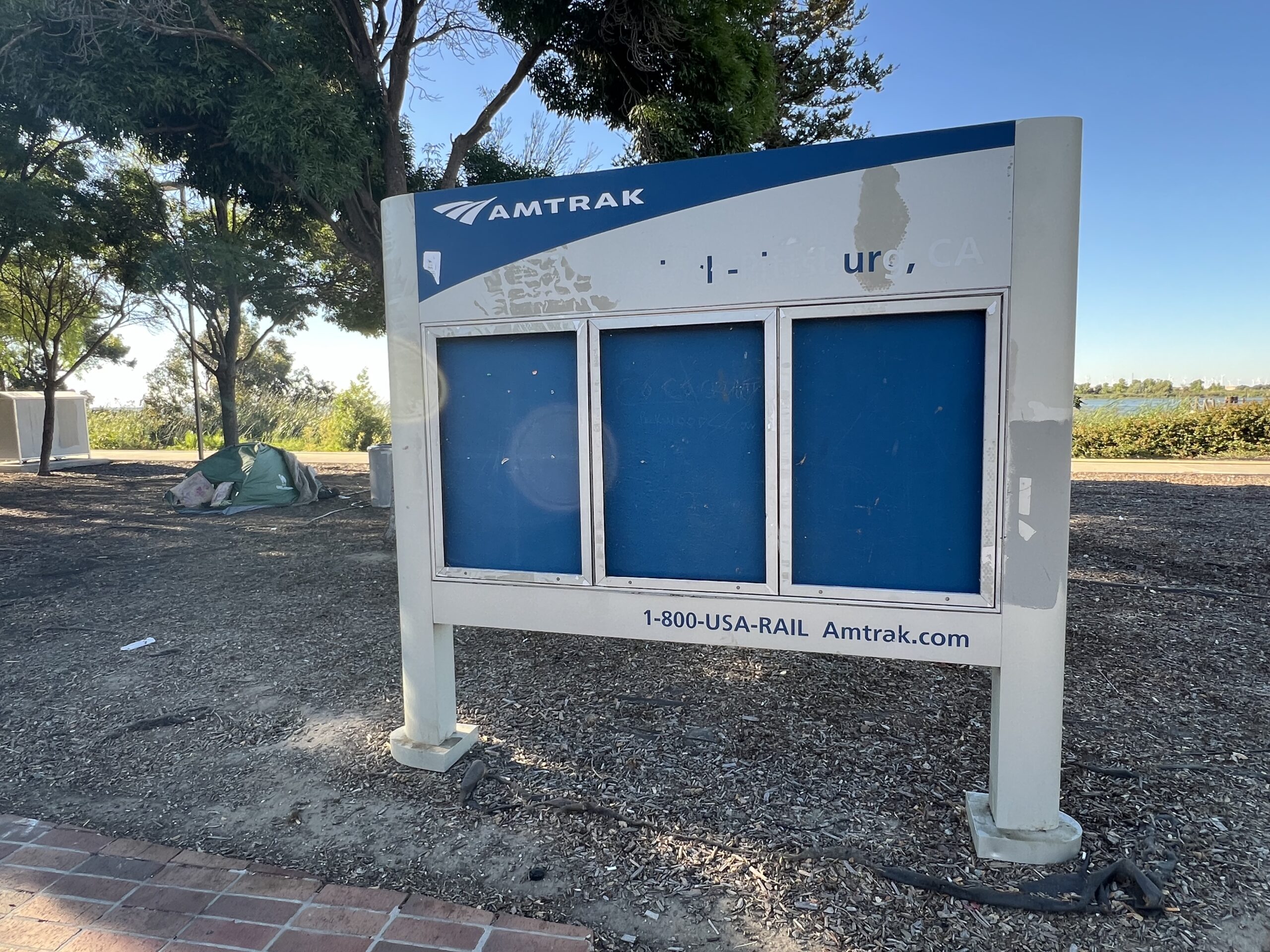
Vandalized Antioch Amtrak station sign and the tent of a homeless individual on July 4, 2024. Photo by Allen D. Payton
Johnson Also Denies Approving Station Closure, Claims Hernandez-Thorpe is Responsible
In response to questions about his meetings and emails with Ms. Smith, Johnson responded, “I clearly recalled the events leading up to the closure. Chief Ford and I were scheduled to give a presentation at the board meeting. We prepared complete presentations that were intended to keep the station open. The representative had inaccurate and misinformation that was used to initially justify the closure. At issue was the unhoused individuals that were allegedly loitering at the station. These incidents occurred prior to Chief Ford and my appointments. Nevertheless, Chief Ford and I were prepared to provide information to the contrary, which have possibly stayed the closure.”
“Mayor Thorpe was more concerned about suppressing crime reporting than the immediate threat of closing the station,” Johnson continued. “I informed Mayor Thorpe and kept him updated on the Amtrak closure and the pressing timeline. Mayor Thorpe was fully aware of the anticipated closure, but he wasn’t either concerned or cared about the adverse impact it would have on our residents. The truth is Mayor Thorpe is responsible for the closure when he decided to use divisiveness in spreading misinformation about the Antioch police than to address this pressing issue that impacted our residents.”
“Chief Ford and I had a plan to keep the station open, but Mayor Thorpe decided to remove me for political reasons,” the former city manager stated. “I didn’t approve any decommissioning of the stop. I wasn’t even aware that this issue was on the agenda. So, whoever prepared and approved the staff report blaming me is a liar.”
“The city council erroneously placed me on leave for matters that, to this day, was never brought to my attention. On March 17th, the council unanimously approved my administrative leave. So, I wasn’t even the city manager at the time of the staff report,” Johnson added.
In a follow-up phone conversation, Johnson again blamed the mayor for the station closure.
Mayor Claims Tamika Smith Told Him Bernal Approved Station Closure
Hernandez-Thorpe was asked who told him Ron Bernal was the “previous Antioch City Manager” referred to in the SJJPA staff report and that he stated in his presentation, if Con Johnson told him it was Bernal who had approved the station closure or another city staff member, Tri Delta Transit staff member, San Ramon Mayor Dave Hudson who was on the SJJPA board at the time or Supervisor Diane Burgis who was his alternate, and, if so, when did the mayor learn about it, and if it was in January 2023 after Johnson was informed by Tamika Smith. He was also asked if it was Tamika Smith, and if so, when did she tell him,
Finally, the mayor was asked if anyone had shown him any documentation supporting the claim that Bernal had approved the Amtrak station closure, and if he asked for that information before mentioning Bernal during the presentation at the Board meeting.
Hernandez-Thorpe responded simply, “It was Ms. Smith in two phone conversations prior to me presenting, which is why I said, what I said.”
He was then asked via email what Ms. Smith said to him in those phone calls, did she mention Ron’s name, if the mayor called her or she call him, why he had the phone conversations, had she been informed that he would be making the presentation instead of Johnson and Ford, and what was his reaction when he learned of the station closure from Ms. Smith.
Hernandez-Thorpe was also asked if he called Johnson or then-Acting City Manager Forrest Ebbs and talk to them about it, and to confirm if Johnson never informed the mayor either in January or possibly earlier after Smith informed him.
He was reminded of what he said during his presentation that, “We did not know that our city manager, former city manager Ron Bernal, had a conversation with your staff and agreed to shut down the station. As I said to Tamika, here, ‘who the heck voted for him?’ Nobody.”
The mayor was then asked if he said that to Ms. Smith the same day of the SJJPA Board meeting or in a phone call or virtual meeting, with her prior to the meeting, and, if so, when. He did not respond.
However, in a later phone interview Hernandez-Thorpe said, “Con Johnson was involved in this because Tamika reached out to him. He said, ‘what do you mean?’ She told him about the proposed closure of the station.”
“Con reached out to me and asked me if I wanted to do the presentation,” the mayor continued. “I said, ‘Con, I’m not going. You’re the city manager, you go’. Then things changed when we put Con on paid administrative leave.”
“Then I got the call from Tamika who asked who was going to give the presentation,” the mayor explained. “I asked her, ‘Why are you making this decision? Why are we just learning of this? She said, ‘you’ve always known because we’ve been in conversation with Ron Bernal.’”
“She said they had talked about it for quite some time. This had been years in the making,” Hernandez-Thorpe shared. “My questions were ‘who made that decision?’ She was very adamant and mentioned Ron’s name.”
She made it clear to me they had been in conversation about closing down the station for years with Ron,” the mayor continued. “She had been in conversation with Con.”
Asked about the discrepancies in the CIP budget items for the L Street Improvements and the Amtrak Station Improvements he said, “We never removed that because technically we were supposed to reimburse SJJPA because they were supposed to make the improvements themselves, not us. If my memory is correct.”
“The reason I’m saying Ron Bernal is because Tamika Smith said his name,” Hernandez-Thorpe reiterated.
Asked about Tri Delta Transit learning of Antioch’s station closure on the morning of the vote, the mayor stated emphatically, “Monica and I voted on items related to the Oakley station. We voted to move routes around, we voted for the Park & Ride. I would never have voted for it if I knew it meant the closure of the Antioch station.”
Emails in January 2023 First Record of Antioch Station Closure Mentioned to City Staff
An email dated January 25, 2023, from Ms. Smith to Johnson is the first record of a city manager or staff member being informed of the Antioch station closure. She wrote, “The next Board meeting is March 24, 2023, this is the Board meeting I will take two items: 1. Request to close Antioch Station. 2. Request to approve the platform design agreement with Amtrak for the Oakley station.”
First Email to Hernandez-Thorpe on March 15, 2023, Re: Station Closure & SJJPA Board Meeting
Additional communication was obtained including a text message on March 22, 2023, from Hernandez-Thorpe to SJJPA staff and emails between him and SJJPA staff regarding his in-person appearance at the March 24, 2023, Board meeting. The first email sent to or by the mayor or any council members about the Amtrak station was on March 15, 2023, while Johnson was city manager. It was sent from Tamika Smith regarding the SJJPA Board meeting nine days later and was copied to both City Attorney Thomas L. Smith and Susan Vasquez, the city manager’s executive assistant.
Ms. Smith wrote:
“Subject: Amtrak Antioch Station
Importance: High
Good afternoon,
My name is Tamika Smith, and I am the Director of Rail Services for the San Joaquin Joint Powers Authority (SJJPA). SJJPA is the managing agency for the Amtrak San Joaquins service operating through Antioch, CA.
I have met several times with the Antioch City Manager and once with the Chief of Police to discuss decommissioning the Antioch Amtrak stop.
Mr. Johnson requested an opportunity to speak before the JPA Board on March 24th ahead of my item requesting the board approve the decommissioning. SJJPA added an item to the agenda for the City of Antioch to explain why the stop should remain open.
Please let me know if anyone from the City will present to the Board on March 24th in Stockton; thank you very much.”
Two Former Police Chiefs Didn’t Meet with Tamika Smith, Only Ford, Bernal Does Not Recall Any Meeting
Former Police Chief Tammany Brooks, who left the City in October 2021, was asked if he had met with Ms. Smith regarding closure of the station. He said simply, “No.”
Antioch Police Captain Tony Morefield, who was acting police chief from fall 2021 through April 2022 when Ford was appointed, was asked the same question. He said, “that would have been Steve. I know nothing about it.”
When Ford was asked if he had any meetings with Smith he said, “I recall we had a Zoom meeting with me, Con, Tamika Smith and another guy from the SJJPA on the call.”
Bernal was also asked if had ever met with Smith, either in person or virtually to discuss the station closure. He responded, “I don’t remember meeting with Tamika and, like I’ve stated, didn’t have a discussion with her or others at SJJPA about closing or decommissioning the Antioch station. When you asked about 2017 emails, she said there were none which is my recollection as well.”
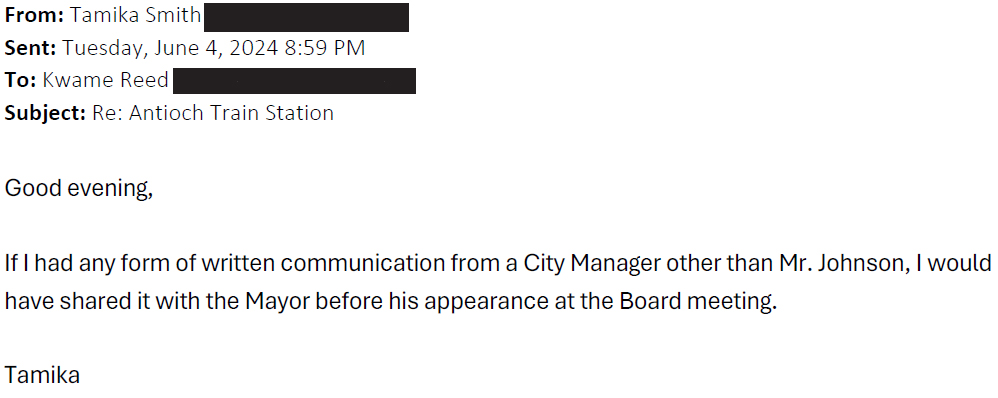
Email from Tamika Smith to Kwame Reed on June 4, 2024. Source: SJJPA (Redacted by Herald)
Emails Between Ms. Smith and Reed in June 2024 Show No Communication with Bernal Re: Station Closure
In emails dated June 4, 2024, Reed asked Ms. Smith, “Would you be able to re-send me the email that was sent to AMTRAK from the former City Manager in 2018/19?” She responded that same day, “I do not have access nor am I aware of an email sent to Amtrak by the former City Manager.”
In Reed’s follow up email to her he asked, “I thought you had an email from Ron Bernal that was either to AMTRAK or SJRRC? Didn’t we speak about that during our Teams call?” The SJRRC refers to the San Joaquin Regional Rail Commission which is the managing agency for the Altamont Commuter Express (ACE) Train Service between the Central Valley, Alameda County and San Jose, and is a member of the SJJPA.
Smith responded, “If I had any form of written communication from a City Manager other than Mr. Johnson, I would have shared it with the Mayor before his appearance at the Board meeting.”
She was referring to the aforementioned emails in 2023 between Johnson and SJJPA staff.
Questions for Reed and Bernal
Those emails were then shared with both Reed and Bernal. They were asked when the Teams call was held, did they recall if the closure of the station was discussed, who participated in it, if the virtual meeting was recorded and if so, a copy was requested. Neither of the two provided any documentation.
Johnson Again Blames Mayor for Closure
Informed of the communication between Reed and Tamika Smith last month, and the CIP budget items, former city manager Johnson was asked if, prior to the emails in 2023, he recalled ever speaking with SJJPA staff, either by phone or in virtual meeting, about the Antioch Amtrak station closure. He was also asked if so and if he had any record of it that he could share.
In response Johnson said, “Mayor Thorpe undermined the whole process. We were arguing and trying to lobby for Antioch to keep the station open. They were going by information they had that was outdated. So, I had the chief provide a presentation with updated information that would show a decrease in crime and get the homeless in check.”
“Everything went sideways in February with chief and me being pushed out, with Rolando and Lamar talking about some foolishness,” he continued. “(City Attorney) Thomas (Smith) was also ineffective in keeping the mayor in check. He was an enabler. That’s why it wasn’t addressed.”
“We were planning to give the presentation. Lamar did not have anything to do with that. He was all about giving a one man show. That was the City Manager’s job and responsibility to address that, dealing with crime issues, the unhoused,” Johnson shared. “All I know is we were prepared to debunk stats and data that were outdated and giving strong stats of why it should remain opened. We were prepared to address that. Unfortunately, we never had that opportunity. If we had I believe there would have been a slow rollback of the closure of the station. “That area was cleaned up and we made sure of it.”
“He did not have access to the data to make the argument,” the former city manager said about Hernandez-Thorpe. “I don’t know what the mayor said or who prepared it. The mayor should have had the chief with him to address crime. He wanted to be jack-of-all trades and not let us do our job.”
Regarding not informing the media of the pending closure vote Johnson said, “Lamar made it perfectly clear that he didn’t want us talking to you or Mike (Burkholder, publisher of ContraCosta.news).”
Tamika Smith Met with City Manager Johnson Three Times, Police Chief Ford Once, No Other City Staff
Johnson was asked if Smith was referring to him and then-Chief Steve Ford. The former city manager responded, “Chief Ford and I were scheduled to provide a presentation to SJJPA on March 24, 2023. Ms. Smith notified and informed me of SJJPA’s attempt to close the Antioch Amtrak station. I requested that SJJPA delay any closure, since the City (myself) was opposed to the closure due to the adverse impact it would have had on our residents.
“Additionally, I informed Ms. Smith that the information SJJPA had was not only outdated, it was inaccurate,” he continued. “I informed Ms. Smith that Chief Ford, Southern Pacific and BNS (Amtrak Security Police Officers) have developed and implemented an enforcement and resources strategy to address the unhoused problem near the station. Since my tenure, the city experienced a decrease in both Part I and Part II crimes in the area. I directed Chief Ford to compile the statistical data that demonstrated our efforts to decrease crime and address the unhoused problem. The strategy was to implement a balanced approach of enforcement from APD and provide wrap around services from our joint efforts with our unhoused coordinator, Jazmin Ridley, and the county CORE team.”
“Although we didn’t have any guarantees, Ms. Smith assured us that there was a good possibility that the SJJPA would delay its decision to decommission the station after our presentation,” Johnson shared. “I informed Mayor Thorpe, who was disinterested in the situation. I wasn’t sure if Ron had any knowledge of the closure because I didn’t discover any previous correspondence.”
“I also informed (City Attorney) Thomas (Smith) of the situation,” Johnson shared. “In the final analysis, the council and the city attorney made a grave mistake by placing me on administrative leave without giving me a reason why. Mayor Thorpe was both ill-equipped and unprepared to address this issue after I was placed on administrative leave.”
“Lastly, I am not sure who Ms. Smith was referring to when she referenced the ‘previous city manager’. I know she wasn’t referring to me, since I clearly was against any station closures,” Johnson stated. “Unfortunately, I never got a chance to make the City’s case. We had a good chance of getting a reprieve.”
Johnson was then asked if he met with Smith in-person or virtual, and if he remembered the first meeting at which she told him of the station closure.
The former city manager responded, “Ms. Smith initially contacted me in January 2023 to inform me that SJJPA was planning to close the Antioch Amtrak station and to open a new station in Oakley. According to Ms. Smith, the SJJPA based their decision to close the station due to alleged unhoused criminal activity. The meetings occurred in person at City Hall. I think I met with Ms. Smith on three occasions. We met once as an introductory, then two more meetings with Chief Ford, Ms. Smith and me.” (However, their first meeting was in fall 2022. See below)
“Our first meeting, Ms. Smith officially introduced herself as a representative of SJJPA. She also informed me that SJJPA was planning to close the Antioch station and move Amtrak operations to Oakley,” Johnson continued. “However, she wanted the City to have a chance to plead its case. I wasn’t sure if Ms. Smith told me she previously had spoken to Ron Bernal about the issue. I don’t know if Ms. Smith has spoken to any other staff. However, I told Mayor Thorpe and the city attorney about the closure. I recalled that neither Mayor Thorpe nor City Attorney Smith seemed too interested. Both were nonchalant about the closure.”
“Chief Ford and I prepared a presentation. We were prepared to present our position to the SJJPA Board on 3/24/23,” he shared. “I invited Mayor Thorpe to join us, but he had a falling out with Chief Ford, and declined to join us. I kept copious written notes, but I’m not sure if the city retained my files.”
“I want to be perfectly clear, at no point or time I approved to decommission the Antioch station,” Johnson reiterated.
Tamika Smith Said, “I Never Referred to Anyone by Name…I Never Referred to Ron Bernal by Name”
Questions were sent to Tamika Smith on July 11 informing her of what the mayor said about their phone conversation prior to the SJJPA Board meeting but she did not respond. When reached by phone on July 12, 2024, and informed of what Hernandez-Thorpe shared about their phone conversation, Ms. Smith denied it saying, “I have never referred to anyone by name. I would have to double check my records. I never referred to Ron Bernal by name.”
Asked about her meetings with Con Johnson she said they had, “One through Zoom, one by phone call and one in person. The one on Zoom included Chief Ford.”
Informed that both Bernal and Johnson deny ever approving the Amtrak station closure she said, “No. They didn’t. I don’t have anything in writing from Antioch to show that ever happened.”
Asked if there might have been a misunderstanding about the demolition of the building and closure of the station, Smith said she would check back through her notes of the meetings with Johnson.
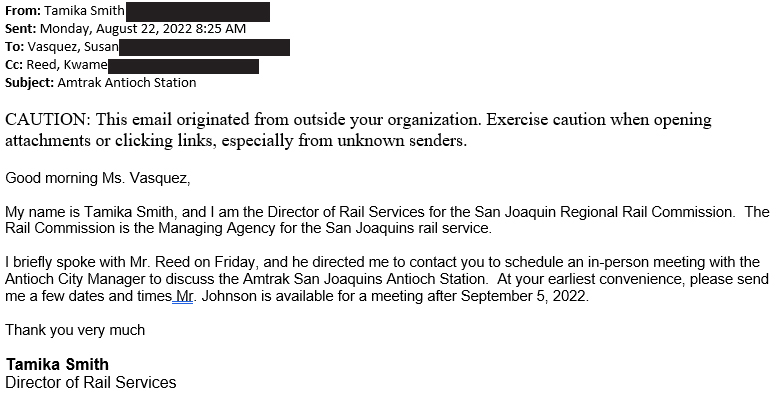
Email from Tamika Smith to city manager’s executive assistant, Susan Vasquez and Kwame Reed on Aug. 22, 2022, seeking meeting with Con Johnson. Source: SJJPA
Emails About Station Sent to Reed, Johnson from Tamika Smith in August 2022, No Mention of Closure or Bernal
On Tuesday, July 16, 2024, SJJPA staff provided emails between Tamika Smith and Susan Vasquez, the city manager’s executive assistant, copied to Economic Development Director Kwame Reed, with the subject line “Amtrak Antioch Station” were first sent on August 22, 2022. A second email to Vasquez copying then-City Manager Con Johnson with the same subject line sent on Aug. 24, 2022, seeking a meeting with him. The first email referenced a phone conversation she had with Reed the previous Friday, Aug. 19th. But the emails did not mention station decommissioning or closure nor Bernal’s name.
In her Aug. 22, 2022, email Ms. Smith wrote, “I briefly spoke with Mr. Reed on Friday, and he directed me to contact you to schedule an in-person meeting with the Antioch City Manager to discuss the Amtrak San Joaquins Antioch Station. At your earliest convenience, please send me a few dates and times Mr. Johnson is available for a meeting after September 5, 2022.” In response to Vasquez’s email offering possible meeting date and time options, Ms. Smith chose Sept. 9th for the meeting with Johnson.
Asked why he was involved and about the phone call Reed said, “The only thing I can really say about that is when
I first came on (Economic Development Manager) Lizeht (Zepeda) was overseeing that” referring to the Antioch Amtrak station demolition. “I became her boss so I’m overseeing it due to lack of staffing. There was no assistant city manager at the time.”
He also shared that Ms. Smith and he had a mutual acquaintance at Amtrak who might have suggested she contact Reed.
“I directed her that it was a city manager thing,” he said.
Asked what Ms. Smith said in the phone call Reed stated, “I do not remember what was said in that conversation.”
Johnson Says Ms. Smith “Revealed the SJJPA’s Intention to Close Antioch Amtrak Station” in Fall 2022, No Mention of Bernal
Johnson was also informed of the Aug. 2022 emails and asked about his initial meeting with Ms. Smith. He responded, “I met with Ms. Smith on three occasions. The first revealed the SJJPA’s intention to close the Antioch Amtrak station and move it to Oakley. As I previously stated, Chief Ford and I developed a plan to keep the station open. We were scheduled to give a presentation on March 24, 2024. I didn’t have any knowledge of any previous city manager’s decisions to either decommission or remove the reconstruction of the station from the City’s CIP projects.”
As it relates to Kwame Reed’s involvement, this is new to me. Since Reed, who was the Economic Development Director, was neither involved nor included in our discussion with Ms. Smith, it escapes my mind why he would have been part of any correspondence with Ms. Smith without my knowledge,” the former city manager continued.
“Once this issue was brought to my attention, I was hellbent on keeping the Antioch Amtrak station open,” Johnson shared. “At no point or time Ron Bernal was part of these discussions. I don’t have any independent knowledge of previous city managers’ involvement.”
“What I do know with a certain, I didn’t approve any decommissioning of the closure of the station,” he reiterated.
Johnson was then asked if he remembered having that first meeting on Sept. 9, 2022, as Ms. Smith chose in her email response to Susan and him, if not, what date did it occur, and was it in person, by phone or Zoom.
He responded, “Yes, I do remember having the first meeting with Ms. Smith. This can easily be confirmed by Susan Vasquez, who maintained my daily schedule. All the information thus far is adequate and correct. “
“I don’t usually blame anyone for possible mishaps, however, the Mayor and the entire council shared responsibility in the Amtrak station closure,” Johnson continued. “It was turbulent times during my tenure. Had the city council allowed me to do my job, which I was good at, I think the Amtrak station would have stayed open.”
“Have you read the Contra Costa County District Attorney Grand Jury report. It both spells out and identified the problems I had to endure and the failure of the administrative process that was designed and intended to protect city resources and assets like the City of Antioch Amtrak Station,” he stated.
“The story here, is not the closure of the Amtrak Station, but how was it allowed by our elected officials. The closure is only indicative of the petty politics that have infested our city government and put a detrimental strangle hold on our city’s progress,” Johnson shared. “The tyrannical and narcissistic behavior of the mayor and the complacent conduct of the four council members is the contributing factors which caused our great city to spiral into oblivion.”
“To think that a city elected officials would undermine the administrative branch (City Manager) of its own city for the sole purpose of political gamesmanship and selfish ambition, only proves that the mayor and the city council put politics above the people and residents of the City Of Antioch,” he continued. “And if political negligence and incompetency were crimes, this city the mayor and the city council would have been prosecuted.”
“After the numerous attempts to discredit me and tarnish my professional reputation, the city has suffered irreparable harm at the behest of the Mayor & city council,” Johnson wrote. “To aggrieve such personnel would be of no benefit, because no harm was caused to me. However, the harm that the Mayor caused, with the assistance of his cabal will take a decade, if not longer, to repair.”
So, as I previously stated, the real story is not the closure of the City of Antioch Amtrak Station, no sir,” he reiterated. “The real story is how was the Mayor allowed to violate city ordinances, interfere with the day-to-day operations of city Chief of Police, in general, and the responsibilities of the City Manager, who were diligently attempting to keep the station open to serve our residents?”
“It’s both my professional and personal belief that a qualified and skilled reporter, such as yourself, primarily duty is to search and report the truth. It’s said, ‘to find the truth requires an ongoing investigation.’ It’s now your job to investigate and report the truth. I did my job, it’s your turn. I appreciate all that you do,” Johnson added.
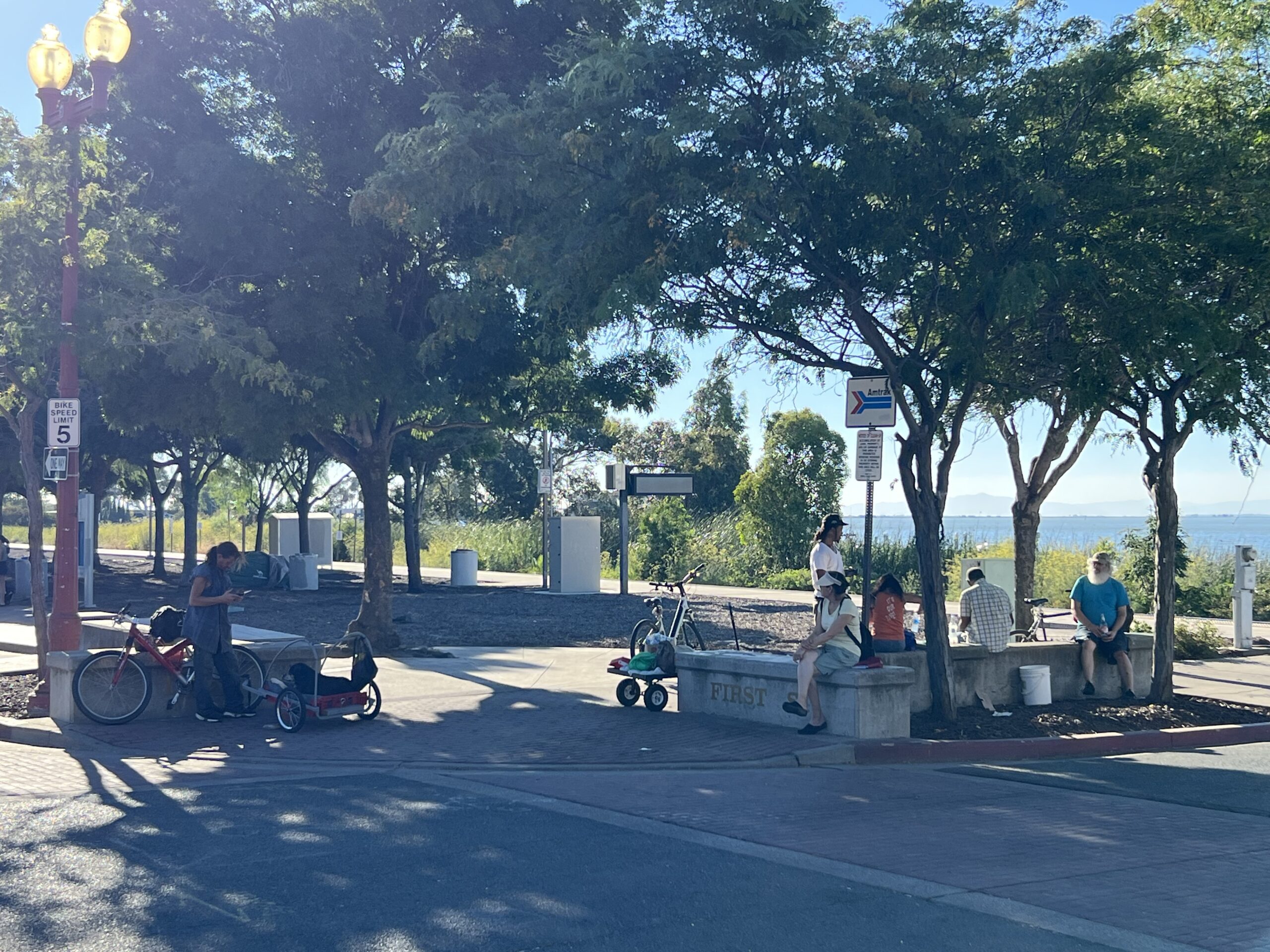
The Antioch Amtrak station on July 4, 2024, shows it no longer includes the building demolished in 2019. Photo by Allen D. Payton
Questions for Tamika Smith re Aug 2022 Emails & Phone Call with Johnson & Reed Go Unanswered
Additional questions were sent to her on July 16 asking her to check and see if she actually did hold a meeting with Mr. Johnson on Sept. 9, 2022, and, if so, if that was her first of the three meetings she had previously mentioned having with Johnson, including one Zoom meeting in with Chief Ford participated.
She was also asked if it was in her first meeting with Mr. Johnson that she mentioned the proposed station closure.
Efforts to reach Ms. Smith were unsuccessful prior to publication time.
Hernandez-Thorpe Doubles Down on Claim Tamika Smith Named Bernal
The mayor was informed of Ms. Smith’s denials, the Aug. 2022 emails and meeting with Johnson later that fall, and he was emailed questions asking if he is sure she said Bernal’s name or if he assumes that was to whom she referred when she wrote, “the previous Antioch City Manager approved the decommissioning of the stop” in her staff report for the SJJPA Board meeting on March 24, 2023. He was also asked if he mentioned Bernal’s name to her in their phone conversations before that meeting based on that assumption.
Hernandez-Thorpe was also asked when he recalled Johnson informing him of the meeting with Ms. Smith at which she informed the then-city manager, and if was in September 2022.
He responded, “She did. In my conversation with her, she mentioned both Ron and Con. Ron in relation to the station closure and Con regarding the presentation at the SJJPA Board meeting. First the train station closure was about distance, then it’s about homelessness, then it’s about Oakley making improvements to their park and ride, SJJPA needs to get their story straight.”
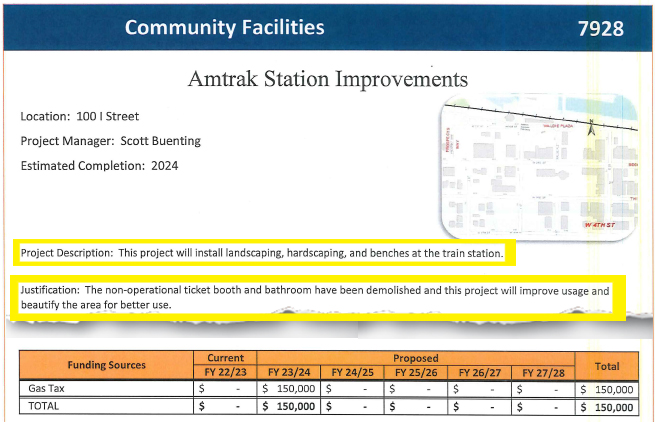
The Amtrak Station Improvements were still included in the 2023-28 CIP approved by the Antioch City Council during their meeting on June 13, 2023. Source: City of Antioch. (Herald highlight)
Capital Improvement Program (CIP) Budgets Show City Continued Pursuing Amtrak Station Improvements
In his defense, Bernal also pointed out the City’s annual 5-Year Capital Improvement Program (CIP) budgets, beginning in 2018 in his second year as city manager through 2023, that the council approved, as additional proof, because they each included funds for improving the Amtrak station.
“You can tell from the 5-Year CIP through my tenure as city manager the Amtrak station improvements stayed in the budget and described benches and beautification of the area to improve the train station use,” he stated. “That language was even included until this last year. The council approved the CIP budgets for the past six years.”
The Amtrak Station improvements were added to the City’s 5-Year Capital Improvement Program budget in 2018 which included $300,000 under the Community Facilities category using Prop 1B funds. The Project Description included “Demo current train station and replace with a simple shelter.” The Justification reads, “Current Station is subject to blight and loitering. There is a non operational ticket booth and bathroom. Area is not well lit and buildings are not necessary for current use.”
Proposition 1B was approved by the voters in November 2006 and enacted the Highway Safety, Traffic Reduction, Air Quality, and Port Security Bond Act of 2006 to authorize $19.925 billion of state general obligation bonds for specified purposes including transit and passenger rail improvements.
“That project, an improvement project in that area stayed on the books. It was still in the CIP last year when they brought it to council,” Bernal pointed out.
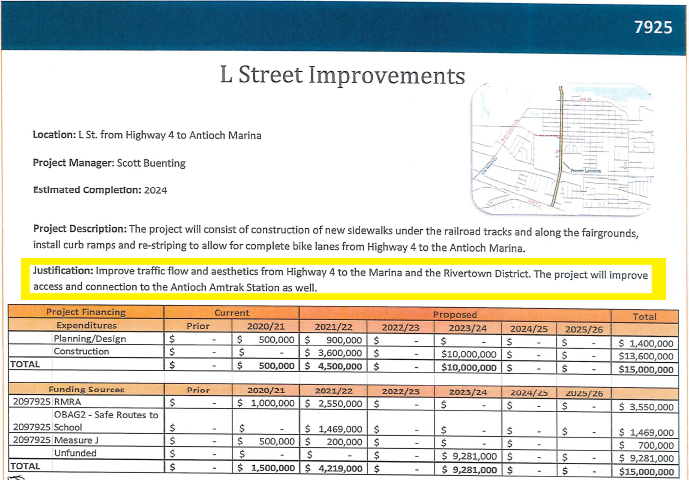
The 2021-26 CIP L Street Improvements show language referring to the Amtrak station in the City Council meeting packet for June 22, 2021. Source: City of Antioch
Between Federal Fiscal Year (FFY) 2018 (which begins Oct. 1st) and FFY2020, SJJPA funded $433,000 towards the following Minor Capital projects in Antioch-Pittsburg: Landscaping, Signage and Removal of Passenger Shelter.
Asked about the funds from the Authority to pay for the station demolition he said, “Their part of it was the $433,000 for tearing it down. Our part of it was improving it to make it unattractive for the homeless to be there.”
In 2019 the City’s CIP budget amount was reduced to $100,000 and the source was changed to Gas Tax funds instead, “because Amtrak paid for the demo,” Bernal stated. The budget was later increased to $150,000 in the 2020-25 CIP the following year and that amount has remained in each year’s CIP budget even through this year’s Draft CIP discussed by the city council during their meeting on May 28, 2024.
“There’s no way I would have brought to the council a CIP item for improving it every year if it was going to be decommissioned,” he explained.
“I left on December 31st in 2021 and it remained in the CIP budget through last year,” Bernal added.
That is the project entitled the “Amtrak Station Improvements”. In this year’s Draft 2024-29 CIP approved by the city council in June, the line-item number and budget amount have remained the same, but the description has been changed to “I Street Improvements”.
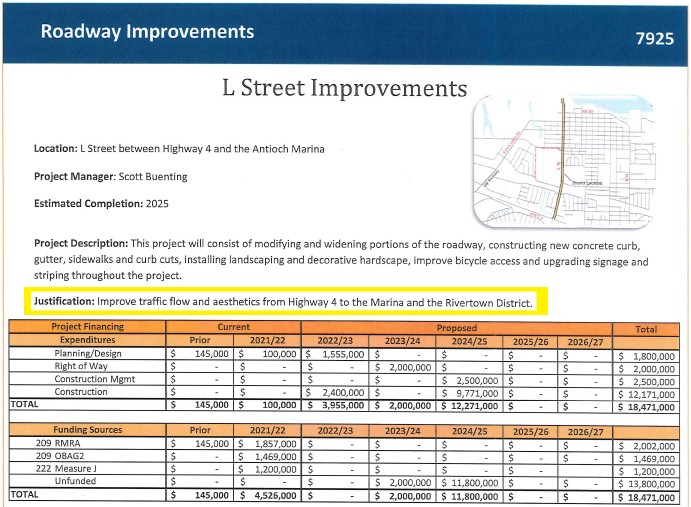
The L Street Improvements project in the 2022-27 CIP shows the language no longer referred to the Amtrak station as justification for the funding in the Antioch City Council meeting packet for June 14, 2022. Source: City of Antioch (Herald highlight)
L Street Improvements Grant Was Tied to Amtrak Station
In the 2021-26 5-Year CIP budget approved by the city council, grant funds for the widening of L Street between W. 18th and W. 10th Streets were added.
“The $14 million grant the City received was tied to transit and it appears in the L Street improvement project budget,” Bernal explained. “We had always intended, and we would be falsely advertising to include the Amtrak station in the justification for doing the L Street project if we planned to close it. We we’re asking for $10M which turned into $14M in grant funding to tie it to the Amtrak Station.”
The source of funds is listed as SS4A, which stands for the federal Safe Streets and Roads for All Grant Program from the 2021 infrastructure bill.
However, as of June 2022, when the 2022-27 5-Year CIP was adopted by the city council, six months after Bernal’s retirement, while then-City Manager Con Johnson was out on paid leave and Forrest Ebbs was Acting City Manager, the L Street Improvement project description no longer included the Amtrak station as justification for the grant funds. The City received those funds this year.
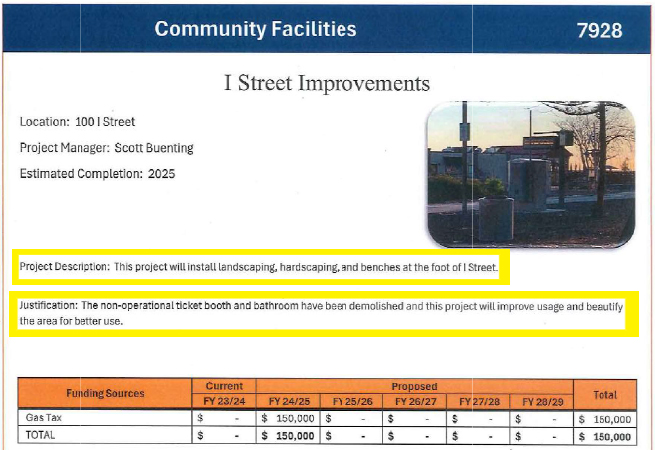
The Amtrak Station Improvements project was renamed the I Street Improvements in the Draft 2024-29 CIP presented to the Antioch City Council during their meeting on June 28, 2024. Source: City of Antioch. (Herald highlight)
Annual 5-Year CIP Budgets for Amtrak Station, L Street Improvements 2018-24
Each of the annual 5-Year CIP budget items for the Amtrak Station and L Street Improvement projects from 2018 through 2023 they included funds to improve the Amtrak station, until this year’s Draft 5-Year CIP budget. That line item is now entitled, “I Street Improvements” but has the same address of 100 I Street, same amount of $150,000, the same funding source of the Gas Tax, it is still listed under the Community Facilities category and includes the same justification for funding. But it now has a different description, no longer mentioning the Amtrak station.
Bernal Informs SJJPA Executive Director of False Accusation Against Him
In an email from Bernal to Mortensen on March 29, 2023, he wrote, “During my time working on the project to remove the buildings at the stop, there was never discussion about decommissioning the stop.” Bernal also wrote, “I think you can also understand the absurdity of the idea of a City Manager having the authority to decommission something as important as a passenger stop which involves millions of dollars to establish (e.g. Oakley’s new stop). At the very least, there should have been a resolution from the Antioch City Council to approve such an important and impactful decision. I would not have knowingly made taken such an action upon myself in the role as the city’s administrator.”
She did not respond, so, he sent another email on April 20th about the matter and wanting to know when the next Board meeting would be held so he could address them to set the record straight
Mortensen responded to Bernal on May 1st with apologies for not seeing his emails sooner and writing, “I must confess I [sic] there has been a lot of confusion over the years with the involvement of the City, Amtrak, Caltrans and the San Joaquin Authority. My understanding from the various parties was that the City had reluctantly agreed to the closure if the new landscaping and improvements (associated with the building removal) was not maintained and passenger and train crew safety issues did not improve. Somehow that did get attributed to you over the last couple years and if that is not accurate, I most certainly want to correct the record.”
Bernal then had a phone conversation with Tamika Smith, of which he later informed Mortensen on May 5, 2023. Emails btwn RBernal to SJJPA ED SMortensen 05-23
Bernal’s Phone Call with Tamika Smith
After being informed of what the mayor said of his phone call with Tamika Smith, Bernal was asked if he had ever spoken with her while city manager. He said, “No. Not that I’m aware of. The only time I spoke with her was last March after I emailed the general manager twice. She said, ‘There’s nothing in that staff report. We never mentioned your name.” (That phone call actually occurred between May 1st and 5th, 2023)
“I never spoke about decommissioning,” he continued. “I may have spoken to her. Her name doesn’t ring a bell. If I did, I never spoke to her about decommissioning. The council was aware of the demolition. I initiated it with City and their staff. There was no secret stuff going on. I never authorized decommissioning the station. I did work with them on the demolition of the station building.”
“She said, ‘We never did it,’ Bernal added about his phone call with Ms. Smith. “That’s when I called Lamar, and I told him I never said that. He said, ‘oh, yeah, yeah, yeah.’”
“If Tamika would have said, ‘you did say it,’ but she said, ‘I wasn’t saying you did that,’” the mayor’s opponent stated. “He just wanted to blame someone, and it was easy to blame me and thought I wouldn’t pay attention or even know.”
(ContraCosta.news publisher Mike) “Burkholder is the one who told me about it that Lamar threw me under the bus. That’s when I sent the email to the executive director. She didn’t respond to me. That’s why my second email was a little terse,” Bernal added.
Antioch Station Closure Now Scheduled for Late 2025
Joint Powers Authority Staff were later asked to clarify which year in the staff report regarding the opening of the Oakley Amtrak station is correct, either 2024 or 2025. Manager of Administration Jaclyn Miramontes responded, “The estimated date for Oakley is Q4 of 2025.”
That means the Oakley Amtrak station is expected to open in the fourth quarter of next year, which is sometime in October through December of 2025 not 2024. That’s when the decommissioning of the Antioch station will occur. However, the platform in Antioch will remain for possible “reintroduction” in the future.
Joint Powers Authority Board Members & Contact Information
Following are the members of the San Joaquin Joint Powers Authority and their contact information in order to ask them to reconsider their vote to close the Antioch Station, before their next meeting on July 19th. The ten Member Agencies that make up the SJJPA are: Contra Costa Transportation Authority, Alameda County, Fresno Council of Governments, Kings County Association of Governments, Madera County Transportation Commission, Merced County Association of Governments, Sacramento Regional Transit, San Joaquin Regional Rail Commission, Stanislaus Council of Governments, and Tulare County Association of Governments. To contact the commissioners:
DIRECTOR Contra Costa County District 3 Supervisor Diane Burgis – supervisor_burgis@bos.cccounty.us (925) 252-4500
CHAIR Patrick Hume, Sacramento County – PatHume@saccounty.gov (916) 874-5465
VICE CHAIR Rodrigo Espinosa, Merced County – Rodrigo.Espinosa@countyofmerced.com (209) 385-7457
VICE CHAIR Doug Verboon, Kings County – doug.verboon@co.kings.ca.us (559) 852-2366
DIRECTOR Vito Chiesa, Stanislaus County – chiesav@stancounty.com (209) 525-6440
DIRECTOR Leticia Gonzalez, County of Madera – district4@maderacounty.com (559) 662-6040
DIRECTOR David Haubert, County of Alameda – bosdist1@acgov.org (925) 719-8735
DIRECTOR Sal Quintero, County of Fresno – District3@fresnocountyca.gov (559) 600-3000
DIRECTOR Amy Shuklian, Tulare County Supervisor – ashuklian@tularecounty.ca.gov (559) 636-5000
DIRECTOR Nancy Young, City of Tracy – nancy.young@cityoftracy.org (209) 831-6000
Source: SJJPA
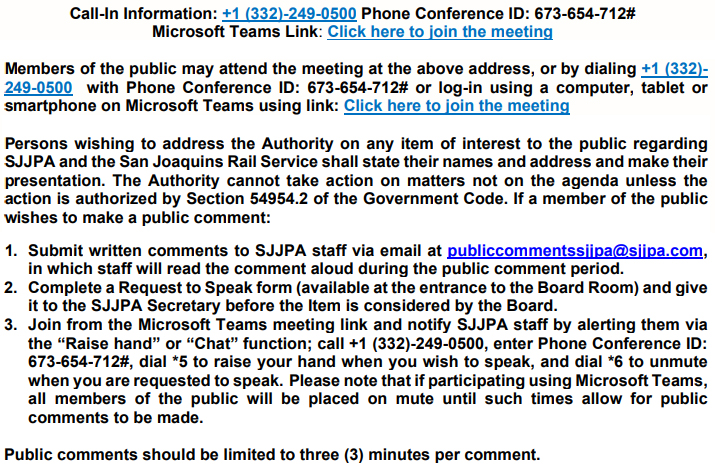
Opportunity for Public Comment on Antioch Amtrak Station Closure at Joint Powers Authority Meetings July 18 and Sept. 20
The next SJJPA Board meeting for July 19, 2024, has been cancelled. However, a special board meeting has been called for Thursday, July 18, beginning at 9:30 AM at which the public can speak during general Public Comments. SJJPA 07-18-24 Special Board Mtg Agenda
Following that, the next Board meeting will be held on Sept. 20, 2024, in Martinez, location to be determined. The public is welcome to attend and offer general comments at the beginning of the meeting or participate online via Zoom.
Look for the article to follow to learn, “Who dropped the ball on the Antioch Amtrak station closure?” for more details from the Herald investigation