• Home
  • About The Herald
  • Local Agencies
  • Daily Email Update
  • Legal Notices
  • Classified Ads

Contra Costa Herald

News Of By and For The People of Contra Costa County, California

  • Arts & Entertainment
  • Business
  • Community
  • Crime
  • Dining
  • Education
  • Faith
  • Health
  • News
  • Politics & Elections
  • Real Estate

South Gate Road to Mt. Diablo closed weekdays for 5 weeks starting May 28

May 24, 2024 By Publisher Leave a Comment

Source: CA State Parks

ROAD CLOSURE STARTS TUESDAY for construction of new bike turnouts

By CA State Parks

Starting Tuesday, May 28 South Gate Road will be closed weekdays to all traffic including cars, bicyclists, and pedestrians. Each week for approximately five weeks, the road will be closed from Monday 8 a.m. through Friday 2 p.m. It will be open weekends.

All trails and fire roads will remain open, and visitors who walk or cycle to the park will be able to access Summit Trail at the South Gate Entrance.

During the road closure period, camping at Live Oak Campground, and the Buckeye, Wildcat, and Barbecue Terrace Group Camps will only be available Friday and Saturday nights.

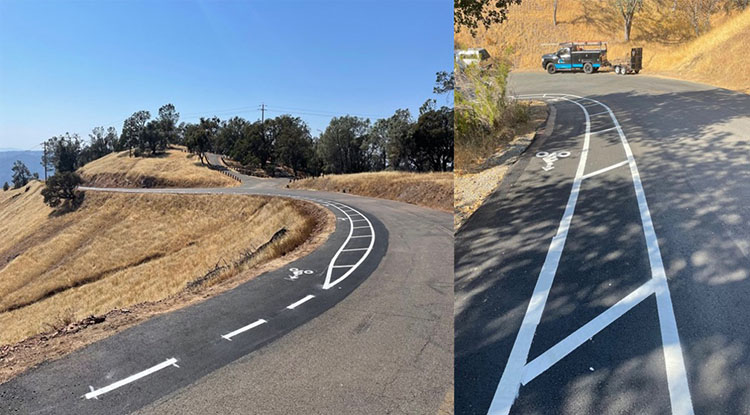
This closure is for the construction of additional bike turnout lanes to enhance road safety. This latest phase of the project was made possible by fundraising coordinated by our partner organization California State Parks Foundation.

Yellow circle indicates South Gate Road entrance. Map source: CA State Parks

There are three other entrances to Mount Diablo State Park: Mitchell Canyon Road, North Gate Road and Green Valley Road (Macedo Ranch). Please check under Brochures/Campground Map for more details. There is no vehicle access to the Summit from Macedo Ranch or Mitchell Canyon.

Thank you for your cooperation during this temporary closure.

For more information about Mt. Diablo click, here.

Allen D. Payton contributed to this report.


Filed Under: News, Parks, Recreation, San Ramon Valley, State of California, Transportation

Contra Costa Fair Board president says “two temporary staffers” robbed of “a little under $100,000” during bank deposit

May 23, 2024 By Publisher Leave a Comment

Photos of the 2024 Contra Costa County Fair by Allen D. Payton. See more photos on the @cocoherald Facebook page.

“Not any business, including any business I worked for would take a deposit at night” – Craig Cannon, Contra Costa County Fair Board President

Shares more details, says policies and procedures will be discussed at next Board meeting June 12

Positive Fair news: Mexican rodeo group working to bring Hispanic-themed events to former arena

By Allen D. Payton

Following the armed robbery of proceeds from the Contra Costa County Fair during an attempted bank deposit early Monday morning, May 20, 2024, after the end of this year’s fair Sunday night, on Thursday, Fair Board President Craig Cannon shared additional details about the incident. (See related article)

Asked to confirm the amount of $90,000 that was stolen he said, “I got it as a little under $100,000. I got that from the police. (Fair CEO) Joe Brengle’s not even talking to me.”

However, according to another board member, John Pence, Brengle sent out an email Wednesday night to him and the other board members about the matter. Cannon said he hadn’t seen it.

“Not any business, including any business I worked for would take a deposit at night,” Cannon continued. “It’s unusual. It’s one of the things I want to get the board together to talk about. Why would you make such a poor decision? The only one who has a deposit key is the fair manager.”

“A lot of information is not being shared when it’s supposed to be,” he stated. “It all boils down to the fair manager. He handles the overall money receipts, personnel, hiring and firing. But Joe works for the board. We hire and fire him.”

Asked if insurance will cover any of the loss, Cannon said, “I don’t believe so because it wasn’t during Fair hours or on property and it wasn’t in the bank. There’s a really thin line, there.”

Asked why the people depositing the funds weren’t joined by armed escorts by either the contracted security firm or county sheriff’s deputies, he responded, “That’s the question I’m trying to find out. But he’s (Brengle’s) not being forthright. That’s what we will discuss at the next board meeting. I’ve talked to the State of California, and they said I can’t have an emergency meeting. In my eyes, almost a hundred grand is a major crime against us.”

About the security firm, Praetorian and this year’s Fair, Cannon said, “They were great. This year’s fair was a good one and safe.”

He then reiterated what was shared with other media, that the loss of that amount of money could impact the fair’s music headliners and animal attractions for next year.

“This whole thing stinks,” he stated.

Two Temporary Staffers Handled Deposit

Asked who handled the deposit Cannon said, “Two temporary staffers hired by the Fair, this year in charge of parking and ticket sales. That’s another red flag. Something’s really wrong. Joe seems like a sensible guy. I don’t know why he would make that decision.”

Asked why the money wasn’t left in a safe on the fairgrounds and deposited during daylight, he said, “That’s a decision for the fair manager” and shared that the Fair, technically state’s 23rd District Agricultural Association, currently only has two full-time employees, Brengle and an administrative assistant who works in the office with him.

Since it’s the public’s money Cannon said, “That’s my concern. I also suggested the state bring in the CHP which oversees county fairs in the state. They delegate the authority to the county sheriff’s office.”

“I don’t work for the state,” he explained. “I’m appointed by the governor. Not this governor, the past one. The appointments are renewed. We can barely have a meeting quorum. If someone is sick, we can’t hold a meeting. The governor’s busy with the budget.”

Asked why the funds weren’t taken to the bank by the fair manager and a board member for a check and balance and if there is a procedure in place Cannon stated, “There will be. The Fair Board is all about policies and procedures. The manual is about 50 pages. But we don’t handle the day-to-day. Taking funds to the bank during daylight hours should be the policy.”

“He (Brengle) hasn’t been forthcoming to anyone on the board about this,” the fair board president reiterated. “This is crazy. It makes no sense at all.”

One positive thing Cannon shared is that a Mexican rodeo group is working to bring Hispanic-themed events to the former arena that was used as the paintball park.

The next board meeting, which is open to the public, will be held Wednesday, June 12 at 7:00 p.m. in the Fair Board Directors’ Room at the Contra Costa Event Center (fairgrounds) located at 1201 W. 10th Street in Antioch.


Filed Under: Crime, East County, Fairs & Festivals, News, State of California

Armed robbery of Contra Costa County Fair funds during bank deposit

May 22, 2024 By Publisher Leave a Comment

Possibly $90,000, police seek public’s help

By Antioch Police Department

On Monday, May 20, 2024, at approximately 2:18 AM, Antioch police officers responded to the 2500 block of Somersville Road for the report of an armed robbery.

When officers arrived, they contacted two victims. Officers learned the victims were employees of the Contra Costa County Event Park (Fairgrounds). The Contra Costa County Fair had ended, and two employees were tasked with conducting the night deposit. While conducting the night deposit at the BMO Bank they were approached by an unknown suspect. The suspect robbed the victims of the money and personal belongings at gunpoint.

Other news reports have pegged the amount stolen at $90,000. When asked, a county fair representative offered no comment but didn’t know how that amount was known by other media. Questions were emailed late Wednesday night to Fair CEO Joe Brengle asking if that’s correct, why the deposit was made at that time instead of leaving it in a safe on the fairgrounds and waiting until Monday morning to make the deposit, what is the usual procedure and for any additional information he could share.

We are asking for anyone with information regarding the incident to contact the Antioch Police Department Investigations Bureau. Additional inquiries or information can be directed to Antioch Police Detective Sgt. Palma at (925) 779-6876 or by emailing kpalma@antiochca.gov.

Please check back later for any updates to this report.

Allen D. Payton contributed to this report.

Filed Under: Crime, East County, Fairs & Festivals, News, Police, State of California

California State Parks encourages visitors to recreate safely, responsibly during Memorial Day Weekend

May 22, 2024 By Publisher Leave a Comment

Photos from top left: Riders wear helmets while on horseback in Auburn State Recreation Area. Life jacket loaner programs are available in many state parks and other recreation areas. A family practices safe riding in Hollister Hills State Vehicular Recreation Area. Hiking with a buddy amongst the big trees on a trail in Humboldt Redwoods State Park. Source: CA Department of Parks and Recreation

SACRAMENTO, Calif. – California State Parks invites Californians and visitors from around the world to recreate responsibly during the upcoming Memorial Day weekend, one of the busiest outdoor holiday weekends of the year. California’s diverse landscape has recreational activities for everyone, from swimming in lakes, rivers, and oceans to hiking among giant redwoods or sequoias to off-highway vehicle riding in deserts and mountains to camping along the coastline. Following simple safety precautions, such as wearing a properly fitted life jacket or proper riding gear, avoiding alcohol, and knowing one’s limits while engaged in aquatic activities, can help save lives.

With 280 state parks, California State Parks manages over 340 miles of coastline, 970 miles of lake and river frontage, and 5,200 miles of trails. There are plenty of outdoor opportunities to spend time with family and friends, reconnect with nature and enjoy the benefits state parks offer to your mental and physical health. But keep in mind, preparing for recreational activities should include simple precautions for safe recreation.

Safety around water is important as people seek cool activities during hot weather, as demonstrated by this swimmer wearing a life jacket at Caswell Memorial State Park. ©2009, California State Parks photo by Brian Baer

Here are some helpful tips to stay safe during this holiday weekend:

  • Wear a Life Jacket Around Water: Water-related accidents can happen suddenly and rapidly. Make sure you and those with you wear properly fitting, U.S. Coast Guard-approved life jackets, especially children. Wearing a life jacket is the best way to increase your chances of survival during an incident. View locations where public agencies and private organizations offer to loan life jackets to the public.
  • Prepare an Itinerary: No matter what type of recreational activity you are planning, leave an itinerary of your trip with a family member or friend with information such as the names and ages of all participants, your travel destination, and your expected return date. This will provide law enforcement personnel with essential information if an emergency response may be needed.
  • Know Before You Go: Prior to leaving home, check the statusof the state park you want to visit to find out what current restrictions and guidelines are in place. Have a back-up plan in case your destination is crowded. On arrival, park only in designated spaces.
  • Check the Weather:
    • Plan activities based on temperatures throughout the day.
    • Dress in proper clothing for the activities you are planning.
    • Shield yourself from the sun with a hat, sunglasses, and sunscreen.
    • Drink plenty of water and avoid alcoholic and caffeinated fluids.
  • Protect Your Loved Ones Around Water:
    • Always supervise children by appointing a designated “water watcher,” taking turns with other adults. Never assume someone is watching your children.
    • Know your limits. Swimming in a lake, ocean, or river is different than swimming in a pool. Waves, tides, strong rip currents, and other water hazards can appear quickly and provide little time to act.
    • If someone is in distress, seek help from a lifeguard or call 9-1-1 if one is not available.
    • Obey posted warnings and swim in designated areas or near a lifeguard tower, if available.
  • Avoid Alcohol: Operating a recreational vehicle, including a boat or an off-highway vehicle (OHV), with a blood alcohol concentration (BAC) of 0.08% or more is against the law. Impaired boaters can be arrested even with a lower BAC if the conditions are not safe and your boat can be impounded. Some parks do have alcohol bans. Check each specific park website to determine if there are local ordinances concerning alcohol.
  • Ocean Rip Currents:If you get caught in a rip current, stay calm and do not fight the current. Swim or float parallel to the shore until you are out of the current and then swim toward the shore.
  • Learn the Rules of Recreating in Boats and OHVs: There are laws specific to operating OHVs on public lands and boats on California’s waterways. Learn about these laws by visiting the webpage of your state park destination. For boating laws, please visit com. OHV regulationsare also available to review online.
  • Trails: Whether you are hiking, horseback riding, or operating an OHV, stay on designated trails. This includes boardwalks in sensitive ecological areas. You are not only protecting natural resources, but also ensuring you do not get lost. Check with State Park staff or volunteers about trails best suited for your abilities. Make sure to hike with a buddy.
  • Leave No Trace: Leave areas better than you find them by packing out all trash. Put food waste and other waste in the bags until it can be disposed of properly. For human waste, the use of waste alleviation (WAG) gel bags or other portable toilet options is recommended. WAG bags can be safely disposed of in regular trash. Do not disturb wildlife or plants.

You can find additional safety tips and information on backpacking, biking, camping, horseback trails, and laws at parks.ca.gov/SafetyTips.

California State Parks is honoring the service of veterans, and active and reserve military members, by offering free admission to 143 participating state park units on Memorial Day – Monday, May 27, 2024. The list of participating park units can be found at State Parks Memorial Day 2024.

About CA State Parks

The California Department of Parks and Recreation, popularly known as State Parks, and the programs supported by its Office of Historic Preservation and divisions of Boating and Waterways and Off-Highway Motor Vehicle Recreation provide for the health, inspiration and education of the people of California by helping to preserve the state’s extraordinary biological diversity, protecting its most valued natural and cultural resources, and creating opportunities for high-quality outdoor recreation. Learn more at parks.ca.gov.

Filed Under: Holiday, News, Parks, Recreation, State of California

State Controller responds to Newsom’s May Budget Revision, issues April Cash Report

May 10, 2024 By Publisher Leave a Comment

“…contains challenging financial choices for the Governor and the Legislature…”- Malia Cohen

Fiscal year-to-date revenues still trend below expectations

SACRAMENTO — California State Controller Malia M. Cohen today, Friday, May 10, 2024, issued the following statement in response to Governor Gavin Newsom’s May budget revision:

“This morning, Governor Newsom released the May Revision to his proposed 2024-25 State Budget. The blueprint to address the remaining shortfall contains challenging financial choices for the Governor and the Legislature to maintain the state’s commitment to protecting essential programs and services and continuing critical investments in the state’s future.”

“As the state’s chief fiscal officer, it is my job to ensure the state has sufficient cash to pay our bills and to make certain that expenditures are transparent, accountable, and align with their intended purpose and expected outcomes. My office stands ready to assist both the Governor and the Legislature as they make their final push to finalize and approve the 2024-25 budget.”

In addition, Cohen today released her monthly cash report covering the state’s General Fund revenues, disbursements and actual cash balance for the fiscal year through April 30, 2024. The state ended April with $95.8 billion in unused borrowable resources, while fiscal year-to-date receipts continue below estimates contained in the 2024-25 Governor’s proposed budget.

The Governor’s Budget estimated that the state would collect nearly $16.3 billion in personal income taxes in April. As shown on the State Controller’s Office April 2024 Personal Income Tax Tracker webpage, the state exceeded the revenue target by approximately $150 million.

“With April personal income tax revenues just tracking with the most recent budget estimates, fiscal year-to-date revenues continue at lower-than-expected levels,” said Controller Cohen. “The high level of borrowable resources is due in large part to the $26 billion the state has prudently built up and reserved for rainy days and economic uncertainties. Maintaining enough cash to cushion against economic downturns has been one of California’s strengths in its credit ratings, and ensures the state will continue to meet its payment obligations.”

Fiscal year-to-date receipts through April were $169.8 billion, nearly $4.8 billion below the Governor’s Budget estimates, or 2.7 percent. The state’s cash position is $7.6 billion better than expected with disbursements of $184.9 billion for the fiscal year nearly $12.4 billion, or 6.3 percent, less than proposed budget projections.

As the chief fiscal officer of California, Controller Cohen is responsible for accountability and disbursement of the state’s financial resources. The Controller has independent auditing authority over government agencies that spend state funds. She is a member of numerous financing authorities, and fiscal and financial oversight entities including the Franchise Tax Board. She also serves on the boards for the nation’s two largest public pension funds. Follow the Controller on Twitter at @CAController and on Facebook at California State Controller’s Office.


Filed Under: Finances, Government, News, State of California

California colleges agree on how to interpret in-state tuition law for illegal immigrant students

May 8, 2024 By Publisher Leave a Comment

Students between classes at California Polytechnic State University, San Luis Obispo. Credit: Ashley Bolter / EdSource

Some have been exempt from paying out-of-state tuition since 2001

By Zaidee Stavely, EdSource – Republished with permission

More than 20 years ago, California passed a law allowing some undocumented immigrant students to attend college with in-state tuition, if they meet certain requirements.

But immigrant rights advocates say many students who should have been eligible have been wrongfully denied in-state tuition because of confusion over requirements, misinformation and different interpretations of the law at different college campuses.

“We lose that incredible brain power and colleges are losing enrollment,” said Nancy Jodaitis, director of higher education for Immigrants Rising, a nonprofit organization that advocates for undocumented people to achieve educational and career goals.

Immigrants Rising brought together officials from all three public college systems — California Community Colleges, California State University and University of California — to discuss and agree on answers to frequently-asked questions about the law.

Source: Immigrants Rising

The result is a document called the Systemwide AB 540 FAQ, which all three systems have now signed. The document includes answers to 59 questions, such as:

  • What if a student graduated from a California high school (completing three years’ worth of high school credits), but did not attend three years at a California high school?
  • Does a student have to take classes full time for their attendance to count?
  • Does all their coursework have to be taken at the same school?

Spokespeople from UC, CSU and California Community Colleges all celebrated the document.

Paul Feist, vice chancellor of communications and marketing for the California Community Colleges Chancellor’s Office, said the document is particularly important because there are several different laws regarding the nonresident tuition exemption.

The first bill exempting some undocumented immigrants from out-of-state tuition, Assembly Bill 540, was signed into law in 2001. Since then, three other bills have been passed to expand the law, in 2014, 2017 and 2022.

“While the intent was to expand access to AB 540 financial assistance, they had the unintended effect of making it more difficult to navigate,” Feist said. “This FAQ is designed to provide clearer explanations and provide additional resources in advising students.”

Under current California law, students who are undocumented or have temporary protection from deportation such as Deferred Action for Childhood Arrivals (DACA), or who are U.S. citizens or permanent residents, are eligible for in-state tuition and state financial aid, if they attended at least three years of high school, adult school or community college in California and obtained a high school diploma or equivalent, an associate degree or fulfilled the minimum requirements to transfer to a UC or CSU.

Access to state financial aid and in-state tuition can be a critical factor for undocumented students, who are barred from receiving federal financial aid. Without the law in place, some of them would be charged tuition rates for international students, often much higher than in-state tuition.

“This is huge,” said Maria Gutierrez, a college counselor at Chabot College in Hayward and a doctoral student at San Francisco State University. “It helps us be aligned and have something in writing.”  Before the FAQ document, Gutierrez says college staff in charge of approving exemptions from out-of-state tuition were sometimes afraid to make decisions without written proof of how to interpret the law.

Gutierrez herself has benefited from AB 540. She came to the U.S. when she was 5 years old on a visa, which later expired. She attended elementary, middle and most of high school in California. She also graduated from high school in California. But when she applied to attend community college in California, different campuses disagreed on whether she was eligible for in-state tuition because she had spent two years of high school in Utah. At the time, a second law had recently been passed to allow colleges to consider years of attendance in elementary and middle school for AB 540 eligibility.

“One college that I went to in So Cal, I was approved for AB 540. When I had to go back to the Bay Area, I was not approved for AB 540. So then I was confused that there was this inconsistency,” Gutierrez said.

A few years later, when she applied to transfer to a four-year college, both UC and CSU campuses told her she was not eligible for in-state tuition, even though by then, a law had passed that clarified that attendance at community college could be counted toward the requirements. She spent a semester paying out-of-state tuition at San Jose State University, before the university finally acknowledged she was legally eligible for in-state tuition.

As a college counselor, Gutierrez continues to meet students who have been incorrectly told they are not eligible for in-state tuition.

“It’s crazy because in reality it hasn’t changed much,” she said. However, she said, the financial burden is harder now, because most students graduating from high school cannot apply for work permits under DACA, because the government has not accepted new applications since 2017.

“I see my students now and I see the struggles they’re going through. If I didn’t have DACA, I honestly don’t think I would be where I am now,” Gutierrez said. “There’s no way that I would’ve been able to pay nonresident fees or wait for whoever it is that is determining that to learn what they need to do for me to be able to go to college.”

Advocates say they hope the document will help colleges give correct information and avoid students having to research on their own for information.

California also recently streamlined the process for undocumented students to apply for financial aid and exemption from in-state tuition on the same application when they fill out the California Dream Act application. In the past, students had to both fill out a California Dream Act application and an AB 540 affidavit form for each college. Now, the AB 540 form will be part of the same application.

Diana Aguilar-Cruz said that change is significant. Aguilar-Cruz is currently pursuing a master’s degree in public health at Cal State Fullerton. When she first began her undergraduate education at Cal Poly Pomona, she was charged nonresident tuition, which was almost double the in-state tuition. She had immigrated to the U.S. from Mexico City in 2015, when she was 14 years old, and lived with her grandmother in Baldwin Park while attending high school.

She had completed a California Dream Act application, but no one told her she also had to complete a separate form. After researching it herself online, she found the form and completed it, at which point the university finally changed her tuition to in-state.

“If I didn’t find it in my Google search, would I be paying in-state tuition for my four years of college?” Aguilar-Cruz said. “I always think to myself, what would have happened if I was a more fearful student or a student who did not have a strong support system at home?”

According to the Renewing the Dream page on the California Student Aid Commission’s website, “In 2021-22,  only 29% to 30% of undocumented college students who applied for financial aid through the California Dream Act Application (CADAA) ultimately enrolled in school. Moreover, only 14% of California’s estimated undocumented student population in postsecondary education ultimately received state financial aid.”

Allen D Payton contributed to this report.


Filed Under: Education, Finances, Immigration, News, State of California, Youth

Senator Glazer to honor first and only CA Supreme Court Chief Justice to be voted out of office

May 6, 2024 By Publisher Leave a Comment

Former California Supreme Court Chief Justice Rose Bird (Photo: CSCHS) and Senator Steve Glazer. (Official photo)

For reversing death sentences; plaques to be unveiled for Rose Bird at new plaza named for her in Capitol World Peace Rose Garden during Tuesday ceremony

Glazer was her spokesman during her failed 1986 retention campaign

SACRAMENTO – Former California Supreme Court Chief Justice Rose Elizabeth Bird will be recognized Tuesday, May 7, for her trailblazing work as a jurist – the first such public dedication in California.

Current Chief Justice of the California Supreme Court, Patricia Guerrero, and retired Chief Justice Tani Cantil-Sakauye, will lead the 10 a.m. unveiling of two plaques at the new Chief Justice Rose Elizabeth Bird Justice For All Plaza at the State Capitol World Peace Rose Garden 25 years after her death in 1999.

Speakers will also include Stephen Buehl, former Justice Bird’s chief of staff, Senator Nancy Skinner, D-Berkeley, the chair of the California Legislative Women’s Caucus, and Kathryn Meola, president of the Women Lawyers of Sacramento.

“Honoring Chief Justice Rose Elizabeth Bird is long overdue,” said Senator Steve Glazer, D-Contra Costa, who authored a resolution, SCR 47 (2023) to create her place of honor in the Capitol Rose Garden. Senator Glazer was Bird’s spokesman during her retention campaign in 1986. “We now have the benefit of time in recognizing her courage and integrity in upholding the Constitution and rule of law – especially in protecting the poor and oppressed.”

Justice Bird was the first woman Chief Justice of California; the first woman Chair of the Judicial Council; the first woman on a California Governor’s Cabinet and the first woman deputy public defender in Santa Clara County. She served as the Chief Justice under Governor Jerry Brown from 1977-1986.

She was also the first and only chief justice in state history to be voted out of office. Bird and three other justices voted to reverse murderers’ sentences, and she, two of her colleagues, Reynoso and Grodin, were subsequently voted off the state supreme court. Bird was overwhelmingly removed in the November 4, 1986, election by a margin of 67% to 33%.

What: The Unveiling of the Chief Justice Rose Elizabeth Bird Justice For All Plaza

When: May 7, 2024, 10 a.m.

Where: State Capitol World Peace Rose Garden

Speakers: Senator Steve Glazer; Patricia Guerrero, Chief Justice of California; Tani Cantil-Sakauye, retired Chief Justice of California; Stephen Buehl, chief of staff to Chief Justice Rose  Bird, Senator Nancy Skinner, D-Berkeley, the chair of the California Legislative Women’s Caucus, and Kathryn Meola, president of the Women Lawyers of Sacramento.

Livestream: https://www.youtube.com/watch?v=yaE6NUxkuv0

https://sd07.senate.ca.gov/video/honoring-chief-justice-rose-elizabeth-bird

Allen D. Payton contributed to this report

Filed Under: History, News, People, State of California

CPUC follows State Senate Republicans’ recommendation, scraps income-based utility bill scheme

April 1, 2024 By Publisher Leave a Comment


Sacramento, CA – March 28, 2024 – After immense pressure from California Senate Republicans, the California Public Utilities Commission (CPUC) has finally listened and is scrapping the income-based utility bill scheme proposed by California’s largest utilities, which came to fruition as a result of Assembly Bill 205 (2022). The non-elective commission released a flat fixed rate proposal, with reduced charges for low-income customers, and is expected to vote on it on May 9, 2024. (See related article)

“I’m cautiously optimistic to see that CPUC’s preliminary decision on a new fixed-rate plan for electrical billing includes a flat rate rather than one of the ludicrous income-based charges that had been proposed,” said Senate Minority Leader Brian W. Jones (R-San Diego). “I’m looking deeper into the proposal and studying how it will affect my constituents and ratepayers across the state. Still, I hope this may be a compromise Californians can live with. At the same time, I anticipate that electricity rates will continue to be a huge affordability issue in California, even under this new flat rate proposal.”

“As vice chair of the Senate Energy, Utility and Communications Committee, l have strongly advocated for affordable and reliable energy for Californians, but the majority party’s misguided approach has been driving up the rates for years,” said Senator Brian Dahle (R-Bieber). “This income-based utility scheme was another disastrous measure. I appreciate the CPUC heeding Republicans’ advice to pause this nonsensical bill, and I will continue to work tirelessly with my colleagues to make energy reform a reality in our state.”

The CPUC’s fixed rate proposal has a 20-day comment period and is eligible for a vote at the next CPUC public meeting on May 9, 2024.

California Senate Republicans have been leading the fight against the income-based electricity charge after Capitol Democrats rammed it through budget trailer bill AB 205 in 2022. In 2023, and as recent as January 2024, Senate Democrats thwarted Senate Republicans’ efforts to provide Californians a lifeline by repealing AB 205. Additionally, this year, Senate Minority Leader Jones and the entire Senate Republican Caucus introduced SB 1326 to repeal the income-based fixed charge mandated by AB 205. Click here to learn more about the caucus’ efforts.

After immense pressure from California Senate Republicans, the California Public Utilities Commission (CPUC) has finally listened and is scrapping the income-based utility bill scheme, which came to fruition as a result of Assembly Bill 205 (2022). The non-elective commission released a flat fixed rate proposal and is expected to vote on it on May 9, 2024.

Filed Under: Energy, Finances, News, State of California

What to know about money waiting in CalKIDS state-funded savings accounts | Quick Guide

March 26, 2024 By Publisher Leave a Comment

Photo: EdSource.org

Webinar April 17

By Lasherica Thornton, EdSource.org

Over 3.6 million school-aged children across the state qualify for at least $500 in savings with the California Kids Investment and Development Savings program (CalKIDS), a state initiative to help children from low income families save money for college or career.

Just 8.3% of eligible students, or 300,000, have claimed their accounts as many families are unaware of CalKIDS or face challenges accessing the accounts once aware.  The money is automatically deposited into the savings account under a student’s name, but families must claim the accounts by registering online.

Here is information you should know about the state-funded accounts:

What is CalKIDS?

The CalKIDS program was created to help students, especially those from underserved communities, gain access to higher education. It helps families save for post high school training by opening a savings account and depositing between $500 and $1,500 for eligible low-income students in the public school system. Gov. Gavin Newsom, who launched the program in August 2022, invested about $1.9 billion in the accounts.

Who qualifies?

Low-income students and all newborns qualify.

According to program details, low-income public school students are awarded $500 if they:

  • Were in grades 1-12 during the 2021-22 school year
  • Were enrolled in first grade during the 2022-23 school year, or
  • Will be in first grade in subsequent school years.

An additional $500 is deposited for students identified as foster youth and another $500 for students classified as homeless.

For newborns,

  • Children born in California after June 2023, regardless of their parents’ income, are granted $100.
  • Those born in the state between July 1, 2022, and June 30, 2023, were awarded $25 before the seed deposit increased to $100.
  • Newborns get an additional $25 when they claim the account and an additional $50 if parents link the CalKIDS account to a new or existing ScholarShare 529 college savings account.

The California Department of Education determines eligibility based on students identified as low income under the state’s Local Control Funding Formula or English language learners. The California Department of Public Health provides information on newborns.

How can students use the money?

The money can be used at eligible higher education institutions across the country, including community colleges, universities, vocational or technical schools and professional schools, according to CalKIDS.

The funds can be used for: tuition and fees, books and supplies, on or off-campus room and board as well as computer or other required equipment, according to the CalKIDS program guide.

Click here to search for schools that qualify as an eligible higher ed institution. 

Does the CalKIDS account have restrictions similar to those for a 529 savings account?

CalKIDS accounts are a part of the ScholarShare 529 program — California’s official tax-advantaged college savings plan — and administered by the state’s ScholarShare Investment Board.

Transportation and travel costs are usually not considered qualified expenses for 529 savings accounts.

According to the guide for CalKIDS, if a student has no account balance with their higher education institution — which receives the CalKIDS distribution check —  the institution can pay the funds directly to the student.

Does the money in the CalKIDS accounts earn interest?

The deposits grow over time because CalKIDS accounts are interest-bearing.

How aggressive that growth is depends on the age of the student, said Joe DeAnda, communications director with the California State Treasurer’s Office, which oversees the CalKIDS program.

“If it’s a newborn, (the seed deposits are) invested in a fairly aggressive portfolio that assumes 18 years of investing time,” DeAnda said. “If they are school-aged, they’re invested in a more conservative portfolio that assumes a shorter investing timeline and is a more secure portfolio.”

Even among students, the younger a child is, the more aggressive the savings portfolio will be. The investment provides “opportunity to grow savings while the child is younger and better safeguard savings against market fluctuations when the child nears college age,” according to the CalKIDS program guide.

Specifically, accounts for newborns, each new class of first graders and students in grades 1-5 during the 2021-22 school year are invested in a portfolio that corresponds to the year that they’re expected to enter a program after high school, or at age 18. The portfolio will become more conservative as the child gets older.

For students in grades 6-12 during the 2021-22 school year, the accounts are invested with a guaranteed, or fixed, rate of return on the investment.

Can I add to the account?

No, you cannot add money to the CalKIDS account. Parents or guardians can open a ScholarShare 529 account, which can be linked to the CalKIDS account so they can view the accounts in one place.

In fact, CalKIDS encourages families to open a ScholarShare 529 college savings account, which is a way for families to save even more money for their children, DeAnda said.

What if my student already graduated? What happens to unclaimed money?

The accounts remain active under a student’s name until the student turns 26 years old. Up until that age, students can claim the money.

If the account is not claimed by age 26, the account closes, and the money is reallocated to others in the CalKIDS program, DeAnda said.

What if I’m not sure if my child is considered low income?

CalKIDS has sent notification letters of program enrollment to over 3.3 million eligible students and nearly 270,000 students in last school year’s class of first graders.

Without the letters, to check student eligibility, families must enter students’ Statewide Student Identifier (SSID), a 10-digit number that appears on student transcripts or report cards, according to the CalKIDS website.

The California Department of Education provides CalKIDS with data on first graders in the late spring or early summer and asks parents to wait until then before checking for their child’s eligibility.

How do I access that SSID number to check eligibility or to register the account?

The SSID may be found on the parent’s or student’s school portal, transcript or report card.

The CalKIDS website instructs families to contact their child’s school or school district if they’re unsure of how or unable to locate the number.

How do I access or ‘claim’ the account?

The notification letter that CalKIDS sends families contains a unique CalKIDS Code that can be used to register the accounts. Even without the code, families can register the accounts.

To claim the student account:

  1. Visit the CalKIDS registration page to claim the account. Click here to register. 
  2. Enter the county where the student was enrolled (for a student in grades 1-12 in the 2021-22 school year; for a first grader, where the student was enrolled in 2022-23 or subsequent years)
  3. Enter student’s date of birth
  4. Enter the SSID or CalKIDS Code from the notification letter
  5. Click Register
  6. Set up the account, either as the child or as the parent/guardian, with a username and password

To claim the newborn account, which should be available about 90 days after birth:

  1. Visit the CalKIDS registration page to claim the account.
  2. Enter the county where the child was born
  3. Enter child’s date of birth
  4. Enter the Local Registration Number on the child’s birth certificate or CalKIDS Code from the notification letter
  5. Click Register
  6. Set up the account, either as the child or as the parent/guardian, with a username and password

I still need help. How do I get additional support?

Contact CalKIDS at (888) 445-2377 or https://calkids.org/contact-us/

The CalKIDS team is also hosting an April 17 webinar to outline the program, eligibility, account registration, fund distribution and benefits. To sign up for the webinar, click here. 

How does my high school graduate make a withdrawal to use the money?

According to the CalKIDS program guide, to request a distribution, log into the claimed CalKIDS account and request a distribution, which doesn’t have to be for the entire amount. The funds are tax-free for the qualified expenses of tuition, books, fees, computers and equipment.

The student must be at least 17 years old and enrolled at an eligible institution.

The CalKIDS money, which will be sent to the institution, is considered a scholarship from the state of California.


Filed Under: Education, Finances, News, State of California

Richmond man arrested again, charged with multiple felonies for illegal weapons possession

March 22, 2024 By Publisher Leave a Comment

Guns seized from Hansen’s home in Richmond during his first arrest announced in February. Photos: CA DOJ

Cache of weapons included machine guns, assault rifles, silencers, homemade explosives

CA Attorney General announced first arrest in Feb., but state DOJ didn’t request prosecution and suspect was released, re-arrested March 17

By Ted Asregadoo, PIO, Contra Costa District Attorney’s Office

Martinez, California – The Contra Costa District Attorney’s Office filed a 21-count felony complaint against a Richmond man for possessing a large cache of illegal weapons, high-capacity magazines, and homemade explosives.

68-year-old Lawrence Robert Hansen (born 7/15/55) of Richmond is in custody after he was arrested on an outstanding warrant on March 17th by Richmond Police. Hansen is also listed on the Armed and Prohibited Persons System which tracks individuals who are barred from owning or possessing firearms.

Between 2022-2023, Hansen made several violent firearm-related threats to medical staff at a Walnut Creek clinic while seeking treatment. Staff members reported those threats to Walnut Creek Police on September 18th, 2023. In a separate incident, Hansen was transported to a hospital in Walnut Creek on September 26th, 2023, for a medical issue. During an examination, a staff member saw that Hansen had a handgun (later determined to be loaded) in his waistband area. The weapon was taken from Hansen and police were informed.

Because of the legal prohibition against Hansen possessing firearms, as well as threats made to medical employees, members from the Contra Costa Anti-Violence Support Effort Task Force, California Department of Justice’s (DOJ) Bureau of Firearms, and Contra Costa County Probation Officers searched Hansen’s residence with a court-ordered warrant in Richmond on January 31, 2024. During the search, agents found 11 machine guns, more than 130 handguns, 37 rifles, 60 assault rifles, 7 shotguns, 3,000 large capacity magazines, several grenades (inert), homemade explosives, incendiary ammunition, and around one million rounds of ammunition.

Hansen was arraigned on March 18th in Martinez. He entered a plea of not guilty and is being held without bail in the Martinez Detention Facility. A preliminary hearing is scheduled for March 27th in Department 23 at 8:30 am.

As previously reported, following the Jan. 31 search, California Attorney General Rob Bonta announced on Feb. 15 the arrest of Hansen. Asked why he was out of custody and arrested again on March 17, Asregadoo responded, “Upon receiving a request for prosecution (RFP) from the arresting police agency, a case undergoes review to determine whether to file charges. The RFP should include investigative reports and evidence relevant to the case. In the instance of Lawrence Robert Hansen, the arresting agency, Cal DOJ, did not immediately request prosecution at the time of arrest. Instead, Cal DOJ chose to finalize their investigation before submitting the request for prosecution along with associated reports and evidence to the Contra Costa District Attorney’s Office.”

According to the Contra Costa County Sheriff’s Office, Hansen is a 5-foot, 11-inch, 190-pound Hispanic man.

Case No. 02-24-00234 | The People of the State of California v. Hansen, Lawrence Robert

Allen D. Payton contributed to this report.

Filed Under: Crime, District Attorney, DOJ, News, State of California, West County

  • « Previous Page
  • 1
  • …
  • 9
  • 10
  • 11
  • 12
  • 13
  • …
  • 24
  • Next Page »
Antioch July 4th 2026 Sponsors (1)
RepublicServices-Antioch-ad (1)
Furn-Clrnc-Outlet-06-26B web
Monica's dinner 05-26 CCH
Celia's-07-26
Delta-RC-B 07-26
Deer-Valley-Chiro-06-22

Copyright © 2026 · · Contra Costa Herald · All Rights Reserved