• Home
  • About The Herald
  • Local Agencies
  • Daily Email Update
  • Legal Notices
  • Classified Ads

Contra Costa Herald

News Of By and For The People of Contra Costa County, California

  • Arts & Entertainment
  • Business
  • Community
  • Crime
  • Dining
  • Education
  • Faith
  • Health
  • News
  • Politics & Elections
  • Real Estate

Antioch Council settles lawsuit with Angelo Quinto’s family for $7.5 million

May 15, 2024 By Publisher Leave a Comment

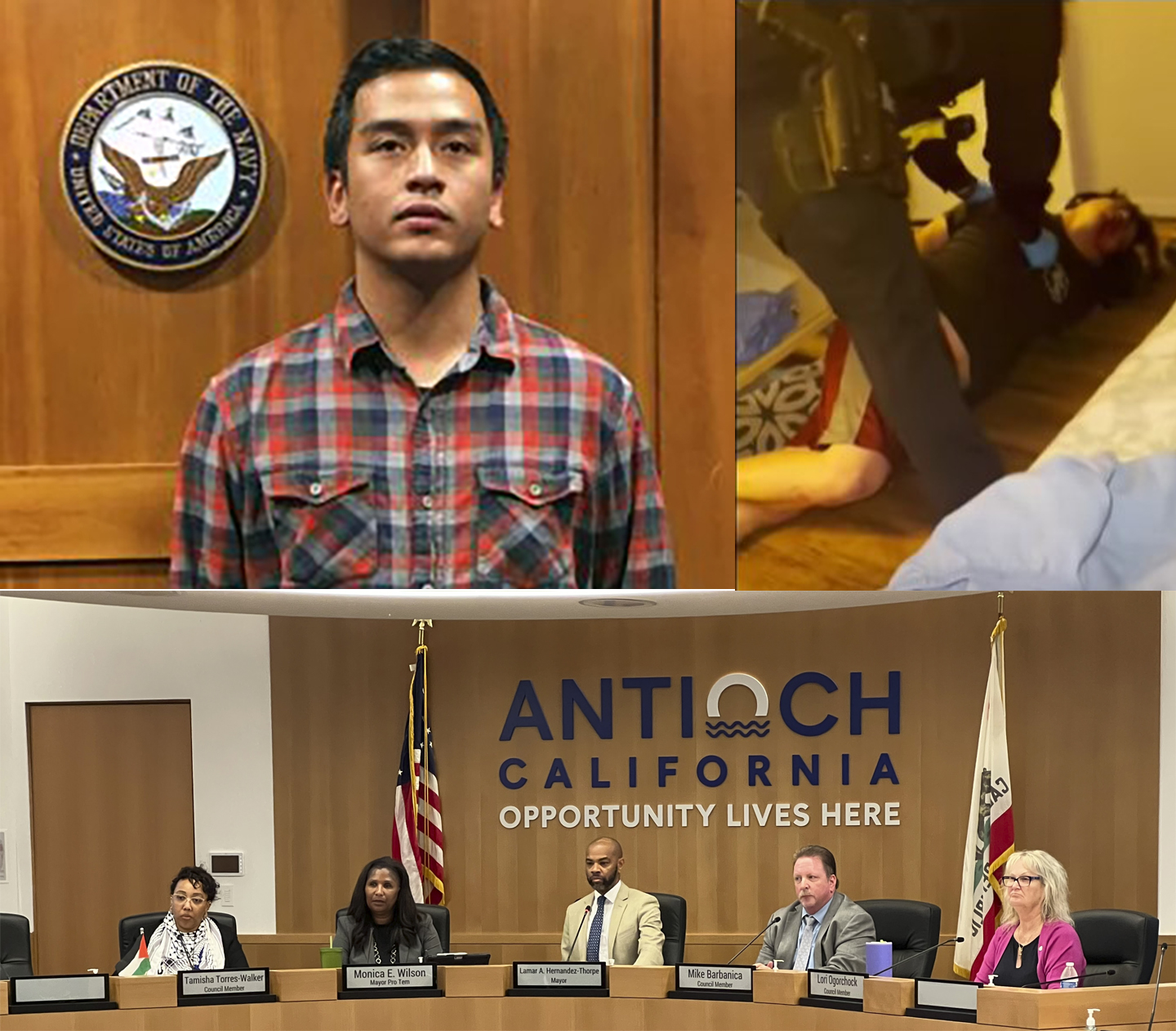
Angelo Quinto and with an Antioch Police officer during the incident on Dec. 23, 2020. (Herald file photos) The Antioch City Council settled the lawsuit with Quinto’s family for $7.5 million during their meeting on May 14, 2024. Photo by Allen D. Payton

5-0 vote costs City $50,000 including attorney’s fees

Mock trial held, court wouldn’t grant officers qualified immunity which contributed to decision

Officers responded to home in Dec. 2020 where he was strangling his mother

Died in the hospital 3 days later while not in police custody

Coroner’s autopsy determined died of drug intoxication, psychiatric conditions, physical exertion and cardiac arrest

Independent toxicology report found presence of Fentanyl in Quinto’s blood in addition to Modafinil and Levetiracetam.

DA reported, “an internal examination showed no bone fractures or damage to Quinto’s larynx and trachea” and “accounts of what transpired in the bedroom are consistent among all witnesses in that no police officer applied pressure to Quinto’s neck.”

By Allen D. Payton During a Closed Session meeting Tuesday night, May 14, 2024, after receiving information from a representative of the County’s insurance pool the Antioch City Council voted 5-0 to settle the lawsuit by the family of Angelo Quinto who died in December 2020 following an interaction with Antioch Police Officers, while attacking his family during a mental health crisis. The council agreed to settle with the family for $7.5 million. The Closed Session agenda item #1 read, “CONFERENCE INVOLVING JOINT POWERS AGENCY – Municipal Pooling Authority and California Affiliated Risk Management Authority (CARMA). Discussion will concern EXISTING LITIGATION pursuant to California Government Code section 54956.9 MARIA QUINTO-COLLINS, et al., v. CITY OF ANTIOCH, et al., United States District Court Northern District of California CASE NO.: 3:21-cv-06094-AMO; Name of local agency representative on joint powers agency board: Thomas Lloyd Smith, City of Antioch; Appearing on behalf of joint powers board: Linda Cox, Municipal Pooling Authority and Amanda Griffith, ERMA (Employment Risk Management Authority).” The Municipal Pooling Authority (MPA) is the County’s insurance pool and along with ERMA and CARMA determined the maximum amount of a settlement they would approve. Had the council not settled and continued fighting the lawsuit, the three authorities would not have paid for attorney’s fees and any settlement or amount determined by the judge or jury. Instead, it all would have had to be paid from the City’s General Fund, most of which pays for the police department. By settling the lawsuit, the City only has to pay its $50,000 deductible including attorney’s fees. Background On Dec. 23, 2020, Officers responded to the home of Quinto’s parents after dispatch received a call that the young 30-year-old Filipino-American Navy veteran was attacking them. As previously reported, Quinto’s sister placed the call telling police Angelo was strangling their mom, and the mother was not breathing. The sister told police Angelo took drugs. The sister had a hammer in her hands, which her brother had taken from her at one point, but she was able to get it back. Upon arrival, officers found Quinto being actively restrained by his mother on a bedroom floor of the home. Although claims were made by his family that officers restrained Quinto by using a knee to his neck for five minutes, that was proven false, as police claimed they had only placed a knee on his back. According to then-Chief Tammany Brooks, “At one point, during the handcuffing, for a few seconds an officer did have his knee across Angelo’s shoulder blade…taught at police academies for prone handcuffing.” Quinto died in the hospital three days later while not in police custody. (See related articles here and here) During Brooks’ report of the incident he said, “I have been in contact with the Coroner’s Office and the following four points have been jointly approved by multiple pathologists related to their findings thus far:
  1. Although the decedent had injuries consistent with a struggle with his family and law enforcement, none of the injuries appeared to be fatal.
  2. There were no fractures of the skull, torso, or extremities.
  3. A full examination of the neck revealed there was no evidence of strangulation or crushed airway.
  4. They are currently expanding toxicology testing because they were aware of reported past drug use.”
An autopsy was performed on December 28th by the Contra Costa County Coroner’s Office which ruled Quinto succumbed to excited delirium and prescription drugs during the physical altercation with officers. Further, the cause of death was determined to be Excited Delirium Syndrome due to drug intoxication, psychiatric conditions, physical exertion and cardiac arrest. (Excited Delirium being recognized as a valid medical diagnosis or cause of death has since been outlawed in California with the passage of a bill, AB-360, last October. It prohibits coroners, medical examiners, physicians or physician assistants from listing excited delirium on a person’s death certificate or in an autopsy report). On February 18, 2021, Quinto’s family, through their attorney, John Burris, filed a complaint against the Antioch Police Department. Burris had previously complained the officers didn’t have their body cameras turned on, but the council hadn’t yet approved the purchase of police body cams and the department did not implement them until 2021. On Friday, August 20, 2021, Contra Costa County Sheriff-Coroner David Livingston announced that a coroner’s jury reached a finding that Quinto’s death was an accident, not at the hands of another. Then, in September 2022, Contra Costa District Attorney Diana Becton determined, Antioch Police officers engaged with Quinto in a manner that was lawful and objectively reasonable under the circumstances and an internal examination showed no bone fractures or damage to Quinto’s larynx and trachea. According to the DA’s Office, “A toxicology report by the Coroner’s Office showed that Quinto had the presence of caffeine, Levetriacetam (a therapeutic for adults and children with epilepsy), and Modafinil – a drug to stimulate wakefulness – in his system. The Santa Clara County Medical Examiner-Coroner reviewed the autopsy findings and agreed with its conclusions. “The Quinto family commissioned an independent autopsy, and its findings note the cause of death was restraint asphyxiation. The private autopsy lists petechial hemorrhaging as the basis for such conclusion. An independent toxicology report also found the presence of Fentanyl in Quinto’s blood – in addition to Modafinil and Levetiracetam. “However, of critical importance to the investigation, an internal examination showed no bone fractures or damage to Quinto’s larynx and trachea. While there are conflicting medical opinions as to the cause of death, the accounts of what transpired in the bedroom are consistent among all witnesses in that no police officer applied pressure to Quinto’s neck. “After reviewing the evidence, the method of restraining Angelo Quinto by Antioch Police officers on December 23rd was objectively reasonable under the totality of the circumstances. Therefore, when applying the applicable law and the California District Attorney’s Uniform Crime Charging Standards, there is no evidence of a criminal offense committed by the Antioch Police officers involved in restraining Angelo Quinto.” Yet, according to a March 16, 2023, report by the San Francisco Chronicle, “During a deposition, the county contract doctor acknowledged the possibility that Quinto died of asphyxiation from restraint, according to a court filing by attorneys for Quinto’s family.” Councilmembers’ Actions, Comments Prior to Settlement The settlement vote by three of the council members was to be expected as they’ve been sympathetic and apologetic to Quinto’s family. During the council meeting on Oct. 25, 2022, Mayor Lamar Hernandez-Thorpe and Mayor Pro Tem Monica Wilson wore T-shirts with the message, “Justice for Angelo Quinto”, Wilson proposed naming the City’s emergency response team after the young man, which was supported by the entire council, and District 1 Councilwoman Tamisha Torres-Walker said, “I want to say to the Quinto family, you lost your son, that’s how we got here. Your loss has spurred some change, but it didn’t have to happen.” (See related article and the 2:35:42 mark of the council meeting video) In addition, Torres-Walker wore the same shirt at a later time and event. Plus, the mayor has repeatedly, falsely claimed Quinto died while in police custody. But the unanimous vote in favor of an out-of-court settlement was not expected. Barbanica Explains Reason for Settlement About his vote for the settlement, District 2 Councilman Mike Barbanica said, “these are extremely difficult cases. I’ve been very clear in open session that the DA’s office and Coroner’s inquest did not find that he died at the hands of the officers. I let those investigations speak for themselves. There was no criminal wrongdoing by any of the police officers.” “But when the insurance pool is paying for the City’s legal defense, if the council declines a settlement offer presented to them, and decides to continue to fight it, then the City will pay potential attorneys’ fees and any judgement that holds the City responsible,” Barbanica explained. “The City is paying $50,000 which includes attorney’s fees, and the insurance pool is paying up to the balance of $1 million, which is common in any settlement, limiting the exposure to the City’s General Fund.” “Once you get to $1 million, it kicks over to secondary insurance which paid the remaining $6.5 million balance,” he added. “In addition, the court did not grant the officers in the case qualified immunity. If we had continued in this case, we don’t know what it would have meant for the officers,” he stated. “The city attorney also made a very wise decision to hold what is called a mock trial in this case and is done in secrecy.” “That was all done during the course of the lawsuit with an actual jury because he wanted to know any potential outcome. Those were factors that went into the decision-making on the settlement,” Barbanica explained. “This was not a haphazard decision. There was a lot of research, and all of this was done prior to them coming to us with a proposed settlement.” Ogorchock Offers Her Reasons for Settling When reached for comment explaining her reason for supporting the settlement, Ogorchock said, “As with any lawsuit, if they would have found even one percent liability by the City, it could have opened up the General Fund to pay more than what was paid.” Asked if the insurance authorities said why they felt a jury would have been sympathetic to the family instead of the City, Ogorchock would not get into the details from the Closed Session discussion. Asked about who represented the City, Ogorchock said, “the city attorney (Thomas L. Smith) chose the attorney to represent the City in the case.” “We settled the case based on the city attorney’s and the insurance carrier’s advice. If we hadn’t, it would have opened up the City to the liability,” she added, reiterating the information shared by Barbanica. “In litigation cases, MPA will give us their advice and if we even have a small percentage of liability they will recommend a settlement amount. We as council, can choose to either accept or reject MPA’s recommendation. If we reject it, then we as the City take on the full, potential liability costs.” However, later Barbanica said, “The city attorney chose the attorney from a list of attorneys from the pooling authority.” Questions for City Attorney, Acting City Manager, Interim Police Chief The background information shared above, and the following questions were sent Tuesday night to City Attorney Thomas L. Smith, Acting City Manager Kwame Reed and Interim Police Chief Brian Addington: “Who represented the City in court against the lawsuit by Angelo Quinto’s family including the names of the law firm and attorneys? If the case had not yet been presented to a jury, were there any preliminary rulings by a judge in favor of Quinto’s family? Why settle if all the facts were in favor of the Antioch Police officers? What were the determining factors by the Municipal Pooling Authority, CARMA and ERMA which caused them to recommend settlement instead of defending the City and why that amount? Were any of the officers who responded to the Quinto home subjects of either the FBI investigation into ‘crimes of moral turpitude’ or the racist text scandal? If so, was that the reason for the settlement, the fear a jury would side against those officers and in favor of Quinto’s family? What language is included in the settlement? Does it claim culpability by the officers? According to then-Police Chief Tammany Brooks, Quinto was not in custody at the time he died in the hospital on Dec. 26, 2020. Is that correct? If not, when did that information get changed?” They were also asked for copies of both the lawsuit and any and all settlement documents. They did not respond prior to publication time. Please check back later for any updates to this report.

Filed Under: East County, Legal, News, Police

Natural gas ban lifted for new buildings in Contra Costa County

February 28, 2024 By Publisher Leave a Comment

Supervisors suspend all-electric requirements following U.S. Court of Appeals ruling

(Martinez, CA) – The Contra Costa County Board of Supervisors Tuesday suspended enforcement of its requirement that most new buildings be constructed as all-electric buildings.  The County’s all-electric building requirement, as part of the County’s building code, had prohibited the installation of natural gas infrastructure in most new buildings and required developers to use electricity as the sole source of energy in the building.  With Tuesday’s action, the County’s all-electric building requirement will not be enforced.

Last month, the U.S. Court of Appeals for the Ninth Circuit invalidated a City of Berkeley ordinance that prohibited natural gas infrastructure in new buildings. The court held that the federal Energy Policy and Conservation Act precludes cities and counties from adopting building codes that prohibit the installation of gas plumbing in buildings.

Contra Costa County’s all-electric building requirement, like the invalidated City of Berkeley ordinance, prohibits the installation of gas plumbing in new buildings.  The County is therefore suspending this requirement in response to the Ninth Circuit’s decision.

At the same time, the Board of Supervisors remains committed to the goals that prompted it to adopt the all-electric requirement: improving public health and fighting what they believe contributes to climate change. The Board referred the topic of reducing greenhouse gas emissions from buildings to its Sustainability Committee and directed staff to report on alternatives for advancing this objective at the Committee’s next meeting.

“Contra Costa County remains committed to reducing the use of fossil fuels in buildings and continues to support the construction of new buildings using all-electric technologies.  We are eager to identify new and innovative ways to continue to pursue our goal of reducing greenhouse gas emissions from buildings.” said Board Chair Federal D. Glover, District 5 Supervisor.

The County encourages residents and businesses to continue to install all-electric building systems and appliances. There are many benefits of all-electric construction, some of which include:

  • Cleaner air and better health outcomes from eliminating the emissions associated with burning fossil fuels, particularly indoors.
  • Not having to pay to install gas pipes in new buildings.
  • Taking advantage of financial incentives and rebates for all-electric appliances.
  • Resilience against power outages, particularly when electric technologies are paired with battery storage.
  • Hedging against high electricity costs by being able to schedule electric appliances to operate at times of day when electricity costs are lowest.
  • Preparing for the potential discontinuation of gas appliances in the future that could occur from possible regulatory actions by regional, state, or federal agencies.

There are many good resources on the benefits of all-electric buildings, including:

The County’s sustainability web site has information on state and federal incentives, rebates, and other ways to fund all-electric upgrades.

The Bay Area Regional Energy Network has information on training opportunities, rebates and incentives, and contractors.

MCE, the community choice energy provider for most of Contra Costa County, offers rebates and incentives.

The Switch Is On, sponsored by the Building Decarbonization Coalition, is a collaborative campaign to support all-electric home conversion by providing tools, support, and resources to Californians.

Rewiring America provides information about the benefits of all-electric technologies, and helps generate a personalized plan for individuals, including costs and savings.

PG&E also has resources on all-electric buildings, including rebates, incentives, rate plans, and design guides.

Allen D. Payton contributed to this report.

Filed Under: Business, Construction, Dining, Energy, Growth & Development, Legal, News, Supervisors

Antioch mayor changes name to honor Mexican immigrant foster parents who raised him

January 26, 2024 By Publisher Leave a Comment

Lamar Hernandez-Thorpe (left) with his Mexican family in 2007. Source: Lamar Hernandez-Thorpe

Judge grants petition to change his name to “Lamar A. Hernandez-Thorpe”

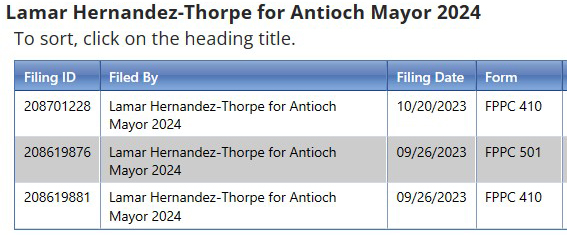
Changed name on 2024 campaign committee forms last September

By Allen D. Payton

After Antioch Mayor Lamar Thorpe added Hernandez to his last name on his 2024 re-election campaign committee name last September, it was made official on Monday, January 22, 2024. That day Thorpe was granted his petition by Contra Costa Superior Court Judge Virginia M. George to legally change his name to “Lamar Anthony Hernandez-Thorpe” to honor his Mexican foster parents who raised him.

List of 2024 Hernandez-Thorpe’s campaign finance documents filed last fall. Source: Antioch City Clerk

In 1981, Mayor Hernandez-Thorpe was born in prison to a mother addicted to heroin. At two days old, he was placed in foster care and raised by Mexican immigrants in East Los Angeles. As a result, his first language is Spanish. His parents, Guillermo O. and Teresa Hernandez, gave birth to two biological children and, as foster parents, adopted several others, all sharing their last name, “Hernandez”.

Hernandez-Thorpe hugs his father Guillermo at his 2020 election night party when he won the race for Mayor of Antioch. Source: Lamar Hernandez-Thorpe.

Hernandez-Thorpe’s foster parents fought to adopt him legally but failed as his biological mother retained her parental rights. While he is proud of his African American family and heritage, he is equally proud of his Mexican heritage instilled by his parents, the Hernandez’s.
In March of 2023, Mayor Hernandez-Thorpe announced that he would petition to change his name to “Hernandez-Thorpe”. Two days later, his father, Guillermo Hernandez, passed away from prostate cancer.

Hernandez-Thorpe said the process of changing his name was emotionally difficult.

Filed Under: East County, Legal, News, Politics & Elections

Federal court upholds Glazer’s Truth in Lending law

December 11, 2023 By Publisher 3 Comments

Benefiting 4 million small businesses

SACRAMENTO – A federal district court last week upheld Senator Steve Glazer’s Truth in Lending law in a summary judgment that declined to hear a lawsuit filed by a lender organization that argued the law did not apply to them.

Under legislation that Senator Glazer, D-Contra Costa, authored in 2018 (Senate Bill 1235), California became the first state in the nation to give small business owners the same protections that Truth in Lending laws have given consumer borrowers for more than half a century. The law became permanent this year when Governor Gavin Newsom signed Senator Glazer’s follow-up bill, SB 33.

The lawsuit, brought by online financers called the Small Business Finance Association, sought to invalidate regulations that the California Department of Financial Protection and Innovations (DFPI) adopted to implement Senate Bill 1235, which requires lenders and other finance companies to provide clear and consistent disclosures to small business owners when they offer them financing and when they close a deal.

CORRECTION: The court ruled in favor of the DFPI’s motion for preliminary injunction. The summary judgment (Motion for Summary Judgment) concluded that the disclosures required under the Department’s regulations were lawful under the First Amendment and were not preempted by federal law. 

In his 14-page order, the judge, R. Gary Klausner of the Central District of California, dismissed the plaintiffs’ arguments and praised state regulations implementing the law for protecting small business owners.

“The disclosures will help small businesses understand the cost of SBFs (Subscription Based Financing) and OECs (Original Equipment Costs) and do comparison shopping … Small businesses have asked for standardized disclosures that uncloak the true cost of financing and highlight useful information like “APR (Annual Percentage Rate), repayment amount, frequency of payments and prepayment penalties. The Regulations mandate such disclosures, thereby helping small businesses make informed credit decisions.”

DFPI Commissioner Clothilde Hewlett called Judge Klausner’s decision a “significant victory for small business owners and consumer protection in the State of California. SB 1235, and the accompanying DFPI regulations, ensure that more than four million California small businesses have protections like those enjoyed by consumers under the Truth in Lending Act for more than 50 years.

Hewlett continued: “These regulations empower small businesses to make informed credit decisions and better understand the cost of small business financing products, including merchant cash advances. The DFPI is committed to advancing opportunities for small business owners to achieve the California dream by ensuring a fair financial marketplace.”

The law is aimed at providing small business owners stronger footing in the rapidly evolving small business finance market, where fast-moving online lenders were replacing traditional banks in a largely unregulated world of loans and more innovative financing options.

“The federal district court agreed with the premise of my law, and that is that small businesses should be protected from abuses that were trapping them in a spiral of debt as the online lending industry evolved,” Senator Glazer said. “This law offers a modest measure – disclosure — to help level the playing field for small business owners. It is making California a leader in protecting the interests of small business owners as they seek the capital they need to grow.”

Previously, state and federal Truth in Lending laws applied only to consumer finance. Even the owners of the smallest companies were left to fend for themselves on the theory that they were sophisticated merchants who understood the world of finance. Increasingly, however, that is no longer true. Today’s small business owners are often immigrant entrepreneurs struggling to get their enterprises off the ground with little knowledge of the finance industry. Others are young people or early retirees with no background in finance.

Under the law, the financer must disclose the following at the time they offer financing of less than $500,000 to a business owner:

  • Total amount of financing
  • Total cost of financing
  • Term length
  • Frequency and amount of payments
  • Pre-payment policies
  • Annualized rate

Editor’s Note:  The Herald previously reported in this article based on incorrect information in a press release from Glazer’s office, that Judge Klausner had granted a preliminary injunction against Opportunity Financial LLC (OppFi).  That was in error.  Judge Klausner’s summary judgment order contained no such order and no motion against OppFi was before the court.


Filed Under: Courts, Legal, Legislation, News

FTC sues to block John Muir Health’s takeover of San Ramon Regional Medical Center

November 17, 2023 By Publisher 1 Comment

Claims proposed deal would threaten competition in I-680 corridor, leading to higher prices and reduced incentive to improve quality of care for patients; John Muir Health assessing options, issues response

The Federal Trade Commission today, Friday, Nov. 17, 2023, sued to block John Muir Health’s proposed $142.5 million deal to acquire sole ownership of San Ramon Regional Medical Center, LLC from current majority owner Tenet Healthcare Corporation, saying the deal will drive up health care costs. (See related article)

The Commission issued an administrative complaint and authorized a lawsuit in federal court alleging the proposed acquisition will eliminate head-to-head competition between John Muir Health (John Muir) and nearby San Ramon Regional Medical Center (San Ramon Medical). John Muir and San Ramon Medical operate in California’s I-680 corridor, which spans Contra Costa and Alameda Counties in the San Francisco Bay Area.

The deal would allow John Muir to demand higher rates at its two hospitals as well as San Ramon Medical for inpatient general acute care services (GAC), which are a broad range of essential medical, surgical, and diagnostic services that require an overnight hospital stay. The elimination of competition between John Muir and San Ramon Medical would also reduce incentives for these hospitals to invest in quality improvements.

“San Ramon Regional Medical Center has played an important role in ensuring Californians in the I-680 corridor have access to quality, affordable care for critical health care services, such as cardiac surgery and childbirth,” said Henry Liu, Director of the FTC’s Bureau of Competition. “John Muir’s acquisition of San Ramon Medical would increase already high health care costs in the area and threaten to stall quality improvements that help advance care for all patients.”

The FTC and the California Attorney General’s office closely cooperated throughout the investigation and will jointly file a complaint in federal district court.

John Muir Health, a non-profit corporation headquartered in Walnut Creek, California, operates two hospitals that provide inpatient GAC services along the I-680 corridor. Dallas-based Tenet operates 61 general acute care hospitals and hundreds of outpatient facilities nationally, including numerous facilities in California.

Currently, Tenet operates San Ramon Medical and holds a 51% interest in the medical center, while John Muir owns a 49% non-operating interest in San Ramon Medical. Under the terms of the proposed deal, John Muir would acquire Tenet’s remaining interest in San Ramon Medical and would become its sole owner and operator.

The complaint alleges that the proposed deal would allow John Muir to control more than 50% of the market for inpatient GAC services sold to commercial insurers and their enrollees in the I-680 corridor, eliminating competition between John Muir and San Ramon Medical to provide better services, high-quality care, and access that benefits patients in this region. Currently, San Ramon Medical is a lower-priced competitor seeking to offer inpatient GAC services in the I-680 corridor to enrollees. John Muir’s hospitals are close competitors to San Ramon Medical in terms of both patient preference and geographic location, according to the complaint. The proposed acquisition would lead to higher insurance premiums, co-pays, deductibles, and other out-of-pocket costs, or reduced benefits for commercial health insurance enrollees, the complaint alleges.

In addition to filing an administrative complaint, FTC staff will also ask a federal court to issue a temporary restraining order and preliminary injunction to prevent John Muir from taking control of San Ramon Medical pending the agency’s administrative proceeding.

The Commission vote to issue the administrative complaint and authorize staff to seek a temporary restraining order and preliminary injunction was 3-0. The federal court complaint and request for preliminary relief will be filed jointly with the California Attorney General in the U.S. District Court for the Northern District of California to halt the transaction pending an administrative proceeding. A public version of the complaint will be available and linked to this news release as soon as possible.

John Muir Health Assessing Options Following FTC Challenge of Acquisition

In response John Muir Health spokesman Ben Drew issued the following statement:

Today, John Muir Health (JMH) and Tenet Healthcare learned that the Federal Trade Commission (FTC) has decided to challenge JMH’s agreement with Tenet to acquire sole ownership of San Ramon Regional Medical Center (SRRMC). JMH has owned a 49% interest in SRRMC since 2013 and, under the proposed agreement, would acquire the remaining 51% interest from Tenet.


“We are disappointed by the FTC’s decision, and are discussing our options and next steps, including challenging the decision in court,” said Mike Thomas, president and CEO of John Muir Health. “We believe the proposed acquisition would benefit our community, caregivers and patients, as well as John Muir Health, San Ramon Regional Medical Center, and Pleasanton Diagnostic Imaging.”

For now, SRRMC will continue to operate under the current joint venture structure between JMH and Tenet with Tenet managing the operations of the hospital. Pleasanton Diagnostic Imaging (PDI), which is also part of the proposed agreement, will remain operated by United Surgical Partners International (USPI).

After announcing the agreement in January, JMH and Tenet learned in late March that the FTC intended to conduct a more in-depth review of the transaction. As part of the FTC’s review process, JMH and Tenet submitted a large volume of documents and data, as well as expert testimony on the Bay Area health care market and letters of support from local community leaders and government officials.

By acquiring SRRMC and PDI, JMH would be able to further enhance care for the community by:

  • Integrating SRRMC and PDI onto JMH’s version of Epic, the electronic health record used in the health system’s inpatient and outpatient facilities and by nearly 1,000 physicians and healthcare providers throughout the community.
  • Extending JMH’s quality enhancement and population health programs to SRRMC and the surrounding community.
  • Making investments in facilities and enhanced services at SRRMC to reduce the number of patients leaving the community for their care.

Acquiring SRRMC is consistent with JMH’s history and would further the health system’s mission to improve the health of the communities it serves with quality and compassion. In 1997, John Muir Medical Center and Mt. Diablo Medical Center came together along with the John Muir Physician Network to create John Muir Health to better serve the community.

“We appreciate the patience of John Muir Health, San Ramon Regional Medical Center and Pleasanton Diagnostic Imaging-affiliated employees and physicians throughout this process,” continued Thomas. “Once we determine our course of action, we will communicate with all impacted audiences.”

NOTE: The Commission issues an administrative complaint when it has “reason to believe” that the law has been or is being violated, and it appears to the Commission that a proceeding is in the public interest. The issuance of the administrative complaint marks the beginning of a proceeding in which the allegations will be tried in a formal hearing before an administrative law judge.

The Federal Trade Commission works to promote competition, and protect and educate consumers. You can learn more about how competition benefits consumers or file an antitrust complaint.

Allen D. Payton contributed to this report.


Filed Under: Government, Health, Legal, News

Serve on the Contra Costa County Public Law Library Board of Trustees

October 6, 2023 By Publisher Leave a Comment

Source: CCC Public Law Library Facebook page.

Applications due Oct. 27

The Contra Costa County Board of Supervisors is seeking applicants for the Public Law Library Board of Trustees. The Board of Trustees was established pursuant to State law and County Ordinance to maintain a law library in Martinez and a branch library in Richmond.

The Board of Trustees is the governing body for the Law Library with the authority to determine personnel, fiscal, and administrative policies to fulfill the legal information needs of the community. County residents who are members of the State Bar and have an interest in public policy and library administration are encouraged to apply for this non-paid volunteer opportunity. The County Board of Supervisors will appoint to fill one vacancy for a one-year term beginning Jan. 1, 2024 and ending on Dec. 31, 2024.   The Board of Trustees meets monthly for a midday meeting, time and date to be decided by the Board.

Application forms can be obtained from the Clerk of the Board of Supervisors by calling (925) 655-2000 or the application can be completed online by visiting the County website at  https://www.contracosta.ca.gov/3418.

Applications should be returned to the Clerk of the Board of Supervisors, County Administration Building, 1025 Escobar St., Martinez, CA  94553 no later than by 5 p.m. on Friday, Oct. 27, 2023.

Applicants should plan to be available for public interviews to be conducted virtually via Zoom on Monday, November 13, 2023.

More information about the Contra Costa Public Law Library can be obtained by calling Carey Rowan at (925) 646-2783 or Carey.Rowan@LL.cccounty.us , or visiting the Law Library website at http://www.cccpllib.org.


Filed Under: Government, Legal

Permanent injunction imposed against online education company for alleged violations of children’s privacy law

June 28, 2023 By Publisher Leave a Comment

Edmodo, LLC allegedly collected names, email addresses, phone numbers, device information, and IP addresses of approximately 36 million children under 13 for advertising purposes until approximately September 2022 and “retaining this personal information indefinitely”

The Department of Justice, together with the Federal Trade Commission (FTC), today announced that Edmodo, LLC (Edmodo) has agreed to a permanent injunction and a $6 million civil penalty in connection with its online educational platform, as part of a settlement to resolve alleged violations of the Children’s Online Privacy Protection Act (COPPA), the Children’s Online Privacy Protection Rule (COPPA Rule), and the Federal Trade Commission Act. The civil penalty is suspended due to Edmodo’s inability to pay.

The Edmodo educational platform, sold to schools throughout the United States, enabled teachers to interface with students, including children under 13 years old, to host virtual class spaces, conduct discussions, share materials, make assignments, and provide quizzes and grades, among other things. In a complaint filed in the U.S. District Court for the Northern District of California, the government alleges that, until approximately September 2022, Edmodo collected the personal information of children under 13, including their names, email addresses, phone numbers, device information, and IP addresses. Edmodo allegedly collected such information without providing notice to the children’s parents or obtaining parental authorization to collect such personal information, as required by the COPPA Rule, and used this personal information to enable third parties to display targeted advertising to student users between 2018 and September 2022.

According to a May 2023 article by Human Rights Watch, “Edmodo was a website and app widely used by children in kindergarten, elementary, and middle schools across the US until September 2022, when the company pivoted to only selling its product to governments. The company benefited from explosive demand in 2020, reporting a 1,500 percent increase in users in the first five months of the pandemic as governments and schools rushed to connect children to online learning.

An investigation by Human Rights Watch in May 2022 found that Edmodo was designed with the capacity to surveil children and harvest their personal data for advertising. Our technical analysis found that Edmodo could not only invisibly tag children and identify their devices for the sole purpose of advertising to them, but also enabled other advertisers to do the same by embedding ad-specific third-party code on its platform. After multiple requests for comment, Edmodo told Human Rights Watch in July 2022 that it did ‘not share [its students’] personal data with any Edmodo business partners or third parties.’”

The complaint further asserts that Edmodo was retaining this personal information indefinitely. As of March 2020, Edmodo retained the personal information associated with approximately 36 million student accounts, of which only one million were actively using the platform. This indefinite retention violated COPPA’s requirement that an operator not retain personal information of children for longer than “reasonably necessary to fulfill the purpose for which [the information] was collected.”

The stipulated order, entered by the federal district court yesterday, enjoins Edmodo from collecting personal information from children in a manner that violates the COPPA Rule and prohibits Edmodo from retaining children’s personal information for longer than reasonably necessary to fulfill the purpose for which it was collected. The order also enjoins Edmodo from collecting more personal information than reasonably necessary for a child to participate in any activity offered on its service. It also requires Edmodo to destroy personal information improperly collected from children under age 13 and to comply with reporting, monitoring, and recordkeeping requirements. Edmodo is also subject to a civil penalty judgment of $6 million dollars, which is suspended due to Edmodo’s inability to pay.

“Children do not lose their privacy protections when they use the internet,” said U.S. Attorney Ismail J. Ramsey for the Northern District of California. “Congress and the FTC have established rules to govern websites and apps collecting and storing the personal information of children. The settlement being announced today demonstrates the Department of Justice’s resolve to enforce those rules. We will continue to work with our partners at the FTC to safeguard children’s online privacy.”

“The Justice Department takes seriously its mission to protect the online privacy rights of children and their parents. This order spells out clearly to all online providers that it is unacceptable to collect children’s personal information without their parents’ consent,” said Principal Deputy Assistant Attorney General Brian M. Boynton, head of the Department of Justice’s Civil Division. “The department is committed to protecting against unauthorized online collection and retention of information, especially from children.”

“This order makes clear that ed tech providers cannot outsource compliance responsibilities to schools, or force students to choose between their privacy and education,” said Director Samuel Levine of the FTC’s Bureau of Consumer Protection. “Other ed tech providers should carefully examine their practices to ensure they’re not compromising students’ privacy.”

This matter was handled by Assistant U.S. Attorney Vivian Wang for the Northern District of California, Senior Trial Attorney James T. Nelson and Assistant Director Lisa Hsiao of the Civil Division’s Consumer Protection Branch, and Gorana Neskovic and Peder Magee of the FTC.

For more information about the Consumer Protection Branch and its enforcement efforts, visit its website at www.justice.gov/civil/consumer-protection-branch. For more information about the FTC, visit its website at www.FTC.gov.

Allen D. Payton contributed to this report.

Filed Under: Business, Children & Families, Crime, DOJ, Education, Legal, News, U S Attorney

49 state attorneys general file lawsuit against telecom company over billions of illegal robocalls

May 23, 2023 By Publisher Leave a Comment

An estimated 577 million robocalls sent to California phone numbers on National Do Not Call Registry 

Including Social Security, Medicare and employment scams

SACRAMENTO – California Attorney General Rob Bonta today, as part of a bipartisan coalition of 49 attorneys general, announced a lawsuit against Arizona-based Avid Telecom for allegedly initiating and facilitating billions of unlawful robocalls in California and around the country. Those robocalls included Social Security Administration scams, Medicare scams, and employment scams; two robocall examples can be heard here and here. Today’s complaint is the result of efforts by the nationwide Anti-Robocall Litigation Task Force, which Attorney General Bonta helped launch last year and is charged with taking legal action against telecommunications companies that perpetuate robocall traffic.

“As the People’s Attorney, I’ve been laser focused on protecting consumers since taking office, and stopping unwanted robocalls is an important bipartisan and nationwide effort,” said Attorney General Bonta. “In addition to being a daily annoyance, robocalls can and do cause real financial damage. I’m taking Avid Telecom to court for delivering not hundreds, or thousands, or millions of robocalls — but billions of robocalls. Our coalition alleges that Avid Telecom has violated federal and state laws, and we are confident that we will prevail.”

From December 2018 to January 2023, Avid Telecom sent or attempted to transmit over 24.5 billion calls to consumers. More than 90% of those calls lasted under 15 seconds, strongly indicating that they were likely robocalls. Further, Avid Telecom sent or transmitted over 7.5 billion calls to telephone numbers on the National Do Not Call Registry, an estimated 577,879,156 of those calls were to telephone numbers in California. Registering for the National Do Not Call Registry allows consumers to legally opt out from receiving telemarketing calls, but robocallers regularly fail to respect such legal prohibitions.

In the multistate coalition’s complaint, among other misconduct, Attorney General Bonta alleges that Avid Telecom:

  • Violated the Telephone Consumer Protection Act, which prohibits any person from making a call using an automatic telephone-dialing system or an artificial or prerecorded voice to any cellular telephone;
  • Violated the Telemarketing Sales Rule, which prohibits abusive and deceptive acts or practices by “sellers” or “telemarketers”;
  • Violated the Truth in Caller ID Act, which prohibits the transmission of misleading or inaccurate caller-ID information;
  • Violated California’s Unfair Competition Law, which prohibits unlawful, unfair, or fraudulent business acts and practices, by transmitting a colossal number of illegal robocalls into California.

In filing today’s complaint, Attorney General Bonta joined the attorneys general of Alabama, Arizona, Arkansas, Colorado, Connecticut, Delaware, Florida, Georgia, Hawaii, Idaho, Illinois, Indiana, Iowa, Kansas, Kentucky, Louisiana, Maine, Maryland, Massachusetts, Michigan, Minnesota, Mississippi, Missouri, Montana, Nebraska, Nevada, New Hampshire, New Jersey, New Mexico, New York, North Carolina, North Dakota, Ohio, Oklahoma, Oregon, Pennsylvania, Rhode Island, South Carolina, Tennessee, Texas, Utah, Vermont, Virginia, Washington, West Virginia, Wisconsin, Wyoming, and the District of Columbia.

A copy of the lawsuit can be found here.


Filed Under: Business, DOJ, Legal, News, State of California

Federal lawsuit filed against six Antioch Police officers in racist text scandal, three chiefs, City

April 20, 2023 By Publisher 1 Comment

The parties to the lawsuit from pages 1 and 2.

Seeks damages, department practice and policy changes, court monitoring; labels officers’ actions a “conspiracy”

By Allen D. Payton

Oakland civil rights attorney John Burris and associates filed a lawsuit in U.S. District Court for Northern California on Wednesday, April 19, 2023, against five current Antioch Police officers and one former officer, for their racist and other offensive texts and mistreatment of citizens, plus, three current and past police chiefs, the City of Antioch and Does 1-100. (See related articles here and here)

The texts sent and received by multiple officers on their personal cell phones mentioned at least one Antioch resident, as well as suspects in crimes being investigated by some of the officers.

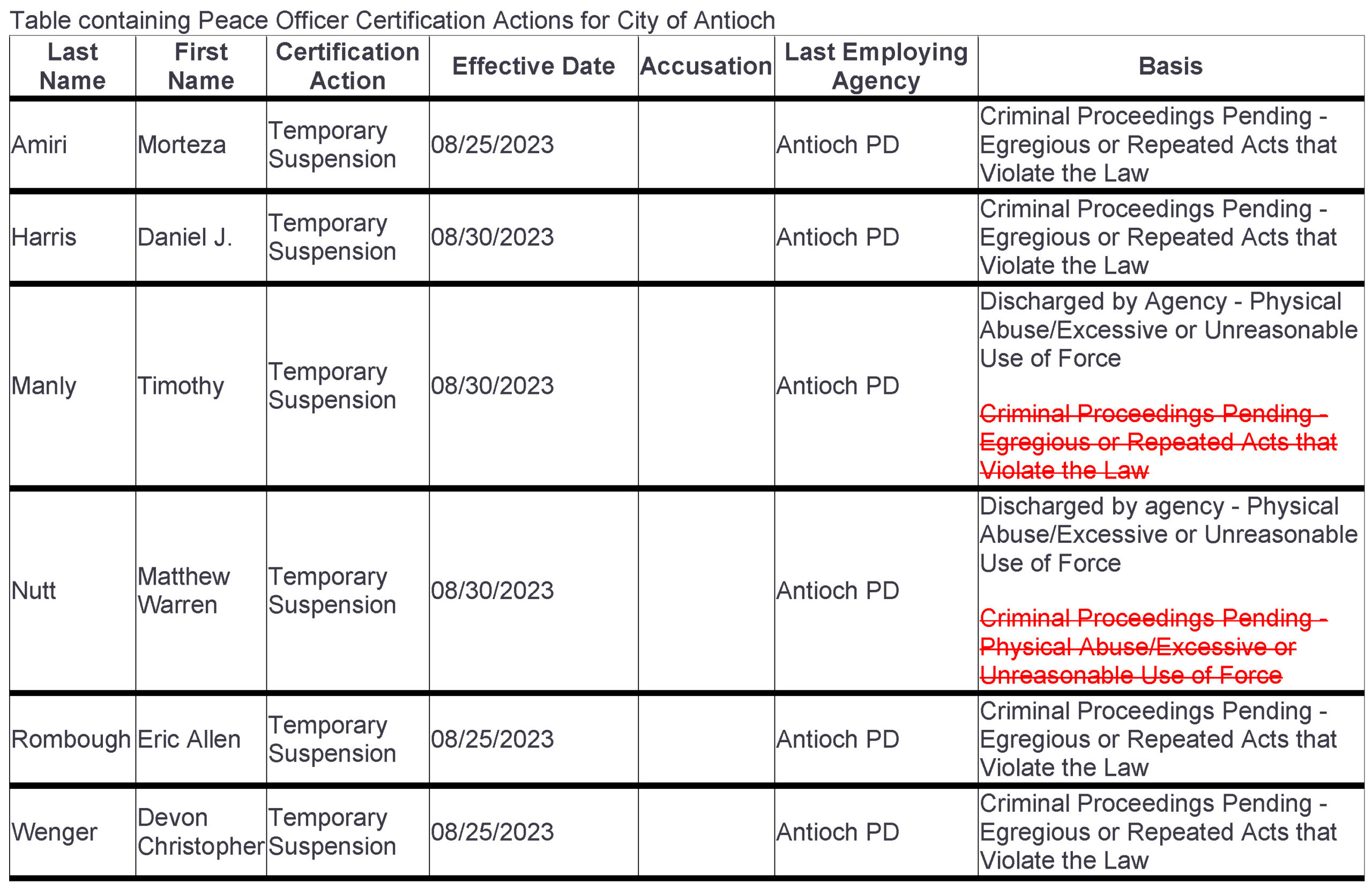
The suit includes defendants Sgt. Josh Evans, Officers Eric Rombough, Morteza Amiri, Scott Duggar, John Ramirez and Timothy Manly Williams, who left the department in 2021. The lawsuit also includes former Police Chief Tammany Brooks who left in October 2021, former Interim Police Chief and current Captain Tony Morefield, and current Chief Steve Ford, in spite of the fact he didn’t start as interim chief until late April 2022, at the end of the timeframe of the texts between December 2019 and April 2022. Ford was given his permanent position on October 23, 2022. Morefield served as interim chief from Oct. 10, 2021 through April 2022.

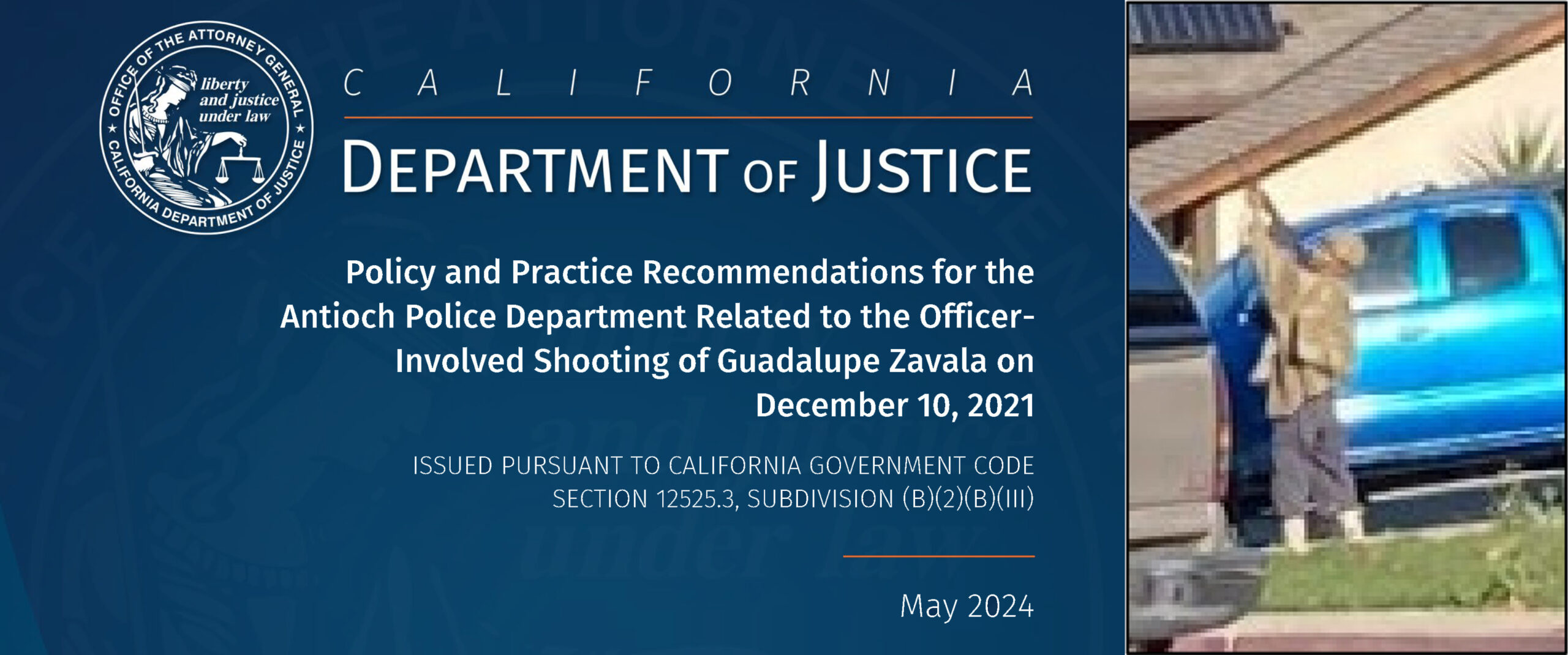
The plaintiffs include Antioch resident Shagoofa Khan, the 2017 Youth of the Year who was one of the lead protesters in the city in 2020, was arrested a few times including once for felony arson in January 2021 and at Brooks’ farewell party later that year, and was the subject of one of the vile texts; Adam Carpenter, Joshua Butler, Trent Allen, who is one of the suspects in the murder case that resulted in the release of the texts; plus, Diego Zavala, the son of Guadalupe Zavala, who was unarmed when he was shot and killed by police in 2021 after a seven-hour stand-off with police. (Their last name is listed as Savala in the lawsuit).

The suit describes what occurred between the named Antioch Police officers and the plaintiffs as a “conspiracy and/or conspiracies” and claims they were “the failure and/or refusal of Defendants Brooks, Morefield, Ford and Evans…to prevent or aid in preventing” them from occurring. The suit further claims the four department leaders “maintained customs, policies, and/or practices which encouraged, authorized, condoned, ratified, failed to prevent, and/or failed to aid in the prevention of wrongs conspired to be done by” the named officers.

The suit seeks multiple forms of damages including “past, present and/or future wage loss, income and support, medical expenses”; special damages, any and all permissible statutory damages, and attorneys’ fees. The lawsuit, Case #4:23-cv-01895-TSH, from the firm of Burris, Nissenbaum, Curry and Lacy also seeks department policy and practice changes and Court Monitoring. Burris previously represented the family of Angelo Quinto who died in 2021 in the hospital while not in police custody, three days after an interaction with Antioch Police who were called to their home to stop him from attacking them.

According to Antioch Police Officers’ Association attorney Mike Raines the officers don’t have to obtain their own legal counsel as they are entitled to representation by the City Attorney or a designated, outside law firm.

Filed Under: Courts, East County, Legal, News, Police

Antioch Police union’s attorney shares concerns about release of officers’ names in text scandal

April 19, 2023 By Publisher Leave a Comment

“some of the text communications between a relatively small number of officers reflected attitudes or beliefs which are not shared by the vast majority of APOA members.” – Statement from RLS Principal Attorney Mike Rains

On Wednesday, April 19, 2023, Mike Rains, the attorney for the Antioch Police Officers’ Association, of the Rains Lucia Stern St. Phalle & Silver law firm, issued the following statement in response to the release of names of officers in the scandal involving racist and other offensive texts. (See related articles here and here)

“This Office serves as General Counsel to the Antioch Police Officers’ Association (APOA) and its individual members.  We represent many, but not all, of the officers whose names were released by a Superior Court Judge as having involvement in text messaging which she criticized and declared “unworthy of (legal) protection.” As we will discuss below, we have serious concerns about the manner in which both the names of the officers and two separate reports prepared by an Inspector in the Contra Costa County District Attorney’s Office came to be public records before the law in California, codified in Penal Code section 832.7, declared them to be subject to public disclosure.  We also have serious concerns as to whether the text messages themselves, which were originally obtained by authorities in connection with a criminal investigation of only a portion of the Officers who were named by the judge, and which do not constitute criminal conduct, formed the basis of an administrative investigation, in potential violation of California’s Electronic Communications and Privacy Act (Penal Code section 1546).

“We are hopeful that the investigation will be thorough and objective and will determine culpability where it is deserved.”

 We understand the public scrutiny of police officers throughout the nation and acknowledge that revelations of text messaging such as that reported in this case can provoke emotional and even sometimes hateful responses. Nevertheless, police officers, even when accused of potential misconduct, should be afforded basic and fundamental rights of due process. We insist such rights be provided, even to persons who have committed the most grotesque and horrific crimes imaginable — why shouldn’t police also be afforded constitutional rights? Such rights ensure that investigators, prosecutors, and judges abide by existing laws before adjudicating anyone as “guilty,” and pronouncing judgment and sentence before a response from the “accused” is sought or considered. 

“We also hope the investigation will not disparage each officer and seek to end their career as a law enforcement officer, simply because they became the uninvited recipient of texts sent by others or responded with sarcasm.”

With those observations as a backdrop, we can say, on behalf of the entirety of the APOA membership, that some of the text communications between a relatively small number of officers reflected attitudes or beliefs which are not shared by the vast majority of APOA members.  Those officers, and many whose names were recited by the judge, have now suffered the injustice and indignity of condemnation simply because they work at the same agency as those whose communications were offensive.  Since our office represents thousands of police officers in the State of California, we understand the impact messaging of the type engaged in by a relatively small number of these officers can have on the public’s perceptions of law enforcement officers everywhere, even though we are reminded constantly by our clients everywhere that they do not support the rhetoric, and do not share the apparent mindset of those responsible for the rhetoric.

We are aware that the police chief has retained an “outside” investigator to interview each and every officer whose name appeared in any of the text messages in question.  Those officers have been named as subjects, whether the officer was simply one of numerous recipients of a “group text” and did not respond, or whether the officer took an active role in the messaging.  We are hopeful that the investigation will be thorough and objective and will determine culpability where it is deserved. We also hope the investigation will not disparage each officer and seek to end their career as a law enforcement officer, simply because they became the uninvited recipient of texts sent by others or responded with sarcasm.


Filed Under: East County, Legal, News, Police

  • « Previous Page
  • 1
  • 2
  • 3
  • 4
  • 5
  • 6
  • …
  • 8
  • Next Page »
Monica's-Riverview-Jan-2026
Liberty-Tax-Jan-Apr-2026
Deer-Valley-Chiro-06-22

Copyright © 2026 · Contra Costa Herald · Site by Clifton Creative Web