• Home
  • About The Herald
  • Local Agencies
  • Daily Email Update
  • Legal Notices
  • Classified Ads

Contra Costa Herald

News Of By and For The People of Contra Costa County, California

  • Arts & Entertainment
  • Business
  • Community
  • Crime
  • Dining
  • Education
  • Faith
  • Health
  • News
  • Politics & Elections
  • Real Estate

CoCoTax Luncheon with BART Director Debora Allen Oct. 25

October 2, 2024 By Publisher Leave a Comment

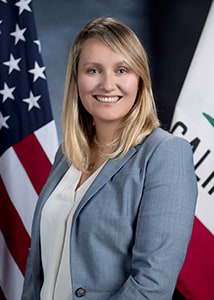
District 1 BART Board Director Debora Allen. Herald file photo.

The Contra Costa Taxpayers Association (CoCoTax) invites you to attend a Luncheon and Board  and  Members Meeting at Denny’s Restaurant 1313 Willow Pass Road, Concord, on Friday October 25, 2024, from 11:45 am to 1:10 pm.

Please register in advance on the CoCoTax website where you can pay online or bring cash or check on Friday and pay at the door-$25 for members, $30 for guests.

About Our Speaker: Debora Allen

Debora Allen was first elected to the BART Board of Directors in 2016 and re-elected in November 2020, representing eight cities in central Contra Costa County’s District 1. She leaves the BART Board at the end of this year having led the charge for improved fare gates, safe and reliable transit, and fiscal sanity.

In her lunch time remarks to CoCoTax, Debora will look back on her time on the BART board and discuss the transit district’s future.

Debora has over 30 years of financial and business management experience in both private and public sectors, primarily in construction and real estate industries. She received a Bachelor of Science in Business Administration (accounting) from CSU Sacramento and completed numerous continuing professional education courses in the areas of financial audit, taxation, accounting systems, institutional investing, and pension administration. She practiced as a Certified Public Accountant in California for almost 20 years and currently still holds an inactive CPA license.

Prior to election to BART, Debora spent decades volunteering on boards in youth sports programs, taxpayer oversight groups, and other non-profits including six years as a pension board trustee for the Contra Costa County Employees’ Retirement Association.

Since 2016, she served on regional transportation boards including Capitol Corridor JPA, Contra Costa Transportation Authority, West Contra Costa Transportation Advisory Committee, CCTA Accessible Transportation Strategic Policy Advisory Committee, and the Pleasant Hill BART Leasing Authority.  She has also served on several BART Board subcommittees.

For more information call (925) 289-6900 or email info@cocotax.org.

Filed Under: BART, Central County, Community, Government, Taxes, Transportation

Assemblywoman Wicks announces agreement with governor, big tech claiming to support work of CA journalists who oppose it, using private and taxpayer funds

August 22, 2024 By Publisher Leave a Comment

Instead of passing bill she carried – See UPDATE with details of “Deal Framework”

But CA journalists “oppose this disastrous deal”

“The future of journalism should not be decided in backroom deals…Not a single organization representing journalists and news workers agreed to this undemocratic and secretive deal with one of the businesses destroying our industry.” – Media Guild of the West

Senator Glazer who has his own bill on the matter opposes deal says it, “seriously undercuts our work toward a long term solution to rescue independent journalism” and doesn’t include Meta (Facebook, Instagram) and Amazon

By Allen D. Payton

Assemblymember Buffy Wicks (D-15, Oakland)

SACRAMENTO – On Wednesday, August 21, 2024, Assemblymember Buffy Wicks (D-AD15, Oakland) announced the establishment of a first-in-the-nation partnership with the State, news publishers, major tech companies and philanthropy, unveiling a pair of multi-year initiatives to provide ongoing financial support to newsrooms across California and launch a National AI Accelerator.

Together, these new partnerships will provide nearly $250 million in public and private funding over the next five years, with the majority of funding going to newsrooms. The goal is to front-load $100 million in the first year to kick-start the efforts. The total investment could increase over the next several years if additional funding from private or state sources becomes available.

“This agreement represents a major breakthrough in ensuring the survival of newsrooms and bolstering local journalism across California — leveraging substantial tech industry resources without imposing new taxes on Californians,” said Governor Gavin Newsom. “The deal not only provides funding to support hundreds of new journalists but helps rebuild a robust and dynamic California press corps for years to come, reinforcing the vital role of journalism in our democracy.”

Assemblymember Wicks, who represents portions of Western Contra Costa County, authored AB 886 to help ensure the sustainability of local journalism, as news outlets across the country are downsizing and closing at alarming rates. A Northwestern University study published last year found an average of two and a half newspapers in the United States close every week, and that our nation has lost two-thirds of its newspaper journalists since 2005. California has lost more than 100 newspapers in the last decade alone.

The new suite of initiatives includes multi-faceted support for publishers across California to address challenges that have impacted the depth and breadth of news coverage in the state. They will help ensure the sustainability of existing and new online publications – with an emphasis on small, local outlets and community-facing journalism.

“As technology and innovation advance, it is critical that California continues to champion the vital role of journalism in our democracy,” said Wicks. “This partnership represents a cross-sector commitment to supporting a free and vibrant press, empowering local news outlets up and down the state to continue in their essential work. This is just the beginning. I remain committed to finding even more ways to support journalism in our state for years to come.”

California news publishers will be the beneficiaries of a News Transformation Fund, to be administered by the UC Berkeley School of Journalism, providing financial resources that preserve and expand California-based journalism. The funding will include contributions from technology platforms and the State of California, supporting innovative new investments that promote local journalism. The funding will support California-based state and local news organizations, particularly those serving California local news deserts, underserved and underrepresented communities, and outlets that prioritize California coverage.

“The University of California is proud to partner with Governor Newsom and legislative leaders to bolster the critical work of local news organizations and journalists in California,” said UC President Michael V. Drake, M.D. “Californians depend on robust local and diverse news organizations to stay informed about their communities, and the University and specifically the UC Berkeley School of Journalism stand ready to support this endeavor.”

Funding for the initiative would be complemented by direct support from the State, helping news organizations keep and grow newsroom staff and offsetting the costs of producing local news and information.

“A vibrant press is crucial for strong communities and a healthy democracy. This is a first step toward what we hope will become a comprehensive program to sustain local news in the long term, and we will push to see it grow in future years,” said California News Publishers Association CEO Chuck Champion and Board Chair Julie Makinen. “We will work with the state and tech companies to make the most of this initiative. We’re grateful to Assemblymember Wicks for her passionate advocacy on behalf of our 700-plus member newsrooms.”

Partners in this initiative also reiterated their strong commitment to strengthening newsroom and ownership diversity for ethnic and underserved communities. The Governor also announced his support for AB 1511 (Santiago), which aims to increase the state’s ongoing commitment to place official marketing, advertising and/or outreach advertising with local and underrepresented media outlets.

“Ethnic and community media outlets in California have a long history of serving as trusted messengers of culturally responsive news to historically underrepresented and underserved communities,” said Assemblymember Miguel Santiago. “These initiatives ensure that California is embracing private sector innovation while developing partnerships with and seeding investments from the public sector to empower local publishers and journalists that are vital to a healthy, thriving democracy.”

Additionally, researchers and businesses will have access to new resources to explore the use of AI to tackle some of the most complex challenges facing society, and strengthen the workforce through a new National AI Innovation Accelerator. This will be administered in collaboration with a private nonprofit, and will provide organizations across industries and communities — from journalism, to the environment, to racial equity and beyond — with financial resources and other support to experiment with AI to assist them in their work. The AI accelerator will empower organizations with the new technology, and complement the work of the Journalism Fund by creating new tools to help journalists access and analyze public information.

“We appreciate the thoughtful leadership of Governor Newsom, Assemblymember Wicks, Chair Umberg, and Senator Glazer on these issues,” said Kent Walker, President of Global Affairs and Chief Legal Officer for Alphabet (Google’s parent company). “California lawmakers have worked with the tech and news sectors to develop a collaborative framework to accelerate AI innovation and support local and national businesses and non-profit organizations. This public-private partnership builds on our long history of working with journalism and the local news ecosystem in our home state, while developing a national center of excellence on AI policy.”

“A strong press is a key pillar of democracy, and we’re proud to be part of this partnership to utilize AI in support of local journalism across California,” said Jason Kwon, Chief Strategy Officer for OpenAI. “This initiative builds on our longstanding work to help newsrooms and journalists around the world leverage AI to improve workflows, better connect users to quality content, and help news organizations shape the future of this emerging technology.”

Work will begin immediately to stand up both initiatives, which will go live in 2025. Included below is a range of quotes from additional supporters.

What others are saying:

“The work of local independent publishers is essential to a well-functioning democracy, and this new public-private partnership provides immediate and needed relief. Lawmakers should be proud of this program, which builds on California’s innovative Local News Fellowship with millions of new dollars in a way that prioritizes small publishers and those serving underrepresented groups.” – Chris Krewson, Executive Director of Local Independent Online News (LION) Publishers, a national nonprofit with 76 of its 600 publisher members in California

“The new public-private partnership provides a pioneering, ambitious program that will offer significant help to local newsrooms that give Californians the information they need to participate in a healthy democracy. It’s encouraging that lawmakers and tech platforms found a way to work together to forge an innovative solution that can be a model for other states.” – Lance Knobel, CEO of Cityside Journalism Initiative, the nonprofit behind Richmondside, Oaklandside and Berkeleyside

“California is leading the way with this first-in-the-nation investment to protect the press and sustain quality journalism. This fund will help news outlets and journalists adapt to a changing landscape with new tools and funding to embrace emerging technologies. This is especially helpful for ethnic and community media which is comprised largely of under-resourced family businesses whose strongest connections are to their community.” – Regina Wilson, Executive Director, California Black Media

“California is home to the largest concentration of multilingual news outlets serving immigrant and ethnic communities in the US. This breakthrough public private partnership to support local journalism brings welcome recognition of the ethnic media sector’s indispensable role in connecting these diverse communities to each other and to the wider public realm.” – Sandy Close, Director of Ethnic Media Services (EMS), a California-based nonprofit which works with 2000 ethnic news outlets nationwide, including over 300 in California

“It represents an equity-media model for the nation,” added Julian Do, EMS Co-Director

“Protecting and rebuilding California’s robust media ecosystem and ensuring it serves immigrants, Latinos and communities of color equally requires an important role for philanthropy, our tech and private sector, and yes, California’s State Government. We see this historic agreement as just the first major step where the State of California can lead the way in building a sustainable media ecosystem for the most diverse state in the Union.” – Arturo Carmona, President of the Latino Media Collaborative

“This is a win for all Californians. Disinformation flourishes when quality journalism disappears. This critical funding will help local publishers survive and keep their communities informed and engaged.” – Neil Chase, CEO of CalMatters and former editor of The Mercury News and East Bay Times

“The revival of a strong, independent community-minded local press is vital for California. All things considered, this agreement both injects new money into doing that and helps spur the innovation, tech and otherwise, required at this moment. As a companion to the California Local News Fellowship, it’s another brick in the rebuilding of California journalism.” – Ken Doctor, Newsonomics news analyst and Lookout Local founder and CEO

“Supporting local news and journalism is vital to enabling a fully informed and engaged community. We are very pleased to see California as a leader in building this public-private partnership that will substantially impact local journalism and essential news coverage in communities throughout California. This vital funding will support our local news and will enable an expansion of our initiative to add to the depth of our bilingual coverage and journalists in Napa Valley – where 40% of the population is Latino.” – Marc Hand, CEO and Board Chair of Highway 29 Media, a publisher of newspapers serving communities in Napa Valley

California Journalists’ Guild Opposes Deal, Calls it a “Shakedown”

In addition, the Media Guild of the West, which represents journalists and had supported Wicks’ bill, issued a statement on Wednesday opposing the deal entitled, “California’s journalists do not consent to this shakedown.”

The guild’s representatives and signatories to the statement (see below) wrote, “This afternoon, Google, California Assemblymember Buffy Wicks, California Governor Gavin Newsom and many of California’s publishing lobbies announced ‘a first-in-the-nation partnership with the State, news publishers, major tech companies and philanthropy, unveiling a pair of multi-year initiatives to provide ongoing financial support to newsrooms across California and launch a National AI Accelerator.’

After two years of advocacy for strong antimonopoly action to start turning around the decline of local newsrooms, we are left almost without words. The publishers who claim to represent our industry are celebrating an opaque deal involving taxpayer funds, a vague AI accelerator project that could very well destroy journalism jobs, and minimal financial commitments from Google to return the wealth this monopoly has stolen from our newsrooms.

Not a single organization representing journalists and news workers agreed to this undemocratic and secretive deal with one of the businesses destroying our industry. Moments ago, the following opposition letter was filed with the California legislature:

We represent journalists and news workers who provide essential news for millions of Californians in print, digital, broadcast, commercial and nonprofit newsrooms.

The future of journalism should not be decided in backroom deals. The Legislature embarked on an effort to regulate monopolies and failed terribly. Now we question whether the state has done more harm than good.

California’s journalists and news workers OPPOSE this disastrous deal with Google and condemn the news executives who consented to it in our names.

Signed,

Matt Pearce, President, Media Guild of the West, The NewsGuild-CWA Local 39213
Jon Schleuss, President, The NewsGuild-CWA
Annie Sciacca, President, Pacific Media Workers Guild, The NewsGuild-CWA Local 39521
Carrie Biggs-Adams, President, NABET-CWA Local 51
Javad Ayala, President, NABET-CWA Local 53
Kevin Gallo, Regional Vice President 5, NABET-CWA
Frank Arce, Vice President, Communications Workers of America District 9

Glazer Also Opposes Agreement, Calls it “Inadequate”

State Senator Steve Glazer (D-SD7, Orinda)

State Senator Steve Glazer (D-SD7, Orinda), who represents most of Contra Costa County and has his own bill on the matter, SB911, also does not support the deal and on Wednesday issued the following “Statement on Wicks-Google Agreement”:

“Despite the good intentions of the parties involved, this proposal does not provide sufficient resources to bring independent news gathering in California out of its death spiral.

Google’s offer is completely inadequate and massively short of matching their settlement agreement in Canada, in supporting on-the-ground local news reporting.

Democracies live and die based on the free exchange of information and oversight between government and its people. Autocracies and dictatorships thrive when that information is constrained or manipulated.

The hollowing out of independent news gathering and the monopoly power of these digital platforms is an existential threat to our democratic republic.

This agreement, unfortunately, seriously undercuts our work toward a long term solution to rescue independent journalism

There is a stark absence in this announcement of any support for journalism from Meta (parent company of Facebook and Instagram) and Amazon. These platforms have captured the intimate data from Californians without paying for it. Their use of that data in advertising is the harm to news outlets that this agreement should mitigate.”

Questions for Wicks About the Agreement and Initiatives Go Unanswered

Questions were emailed Wednesday night to Wicks’ Director of Communications, Erin Ivie, asking, “Do you email out press releases to media that cover her district? Was there a press conference held announcing the agreement?”

Other local media publishers in Contra Costa County didn’t receive the press release about the agreement nor an invitation to any press conference at which it was announced, either.

She was also asked the following:

“Why didn’t she reach out to the local media that cover her district for our input like Congressman Mark DeSaulnier did for his legislation?

Which news publishers, major tech companies and philanthropy are party to the agreement?

Can you ease provide copies of the two initiatives mentioned in the press release or the link to where they can be found?

What are the definitions of ‘newsroom’, ‘local journalist’ and ‘local news outlets’ mentioned in the press release, including in a quote by the Assemblywoman?

Which newsrooms will qualify for the funds? Who will determine which newsrooms will receive the funds and how much they will receive?

Will the funds be provided directly from the tech companies and philanthropy to the newsrooms, or will they be funneled through a state government agency? Will there be an application process and to whom will the applications be submitted?”

Finally, Ivie was asked, “Who will be working on both initiatives? How does a local news publisher get involved in the process?”

UPDATE: Wicks’ Staff Provides Details of Deal

In response, Ivie provided the “Deal Framework, Measures to support democracy, journalism and AI innovation” (see below). In addition, she provided answers to the Herald’s questions:

“Eligible for the funding are nonprofit and for-profit news organizations who have been around for at least two years. The funding is awarded by headcount, overseen by a diverse board (outlined further down).

The one exception is commercial broadcasters, who were carved out of the agreement because they continue to generate healthy profits from advertising dollars.

The funds will be distributed by the UC Berkeley School of Journalism, by an approved claims administrator who typically handles complex distributions of class action settlements. Details of the application process are forthcoming, but in the meantime, anyone interested can contact our office to get on a list to receive those details.

The state is currently committed to providing a minimum of $70M over 5 years, and that commitment is limited to the journalism fund only. Google has committed to $110M minimum over the same time frame, plus $62.5M for their AI accelerator.

That means that taxpayer funds could be used to support the journalism fund, but not the work of the AI accelerator. It will not require legislation to be passed, but it will require a budget allocation (in January), which the Governor has already committed to.

Our office, Google, the UC Berkeley School of Journalism, plus a seven-member governing board. That board will consist of two CNPA members, one member from Ethnic Media Services, one from Local Independent Online News (LION), one from Latino Media Collaborative, one from California Black Media, and one from Media Guild of the West.

Any local news publisher who wants to get involved can email our office and be brought into the fold. If you’re interested, please email our Legislative Director Zak Castillo-Krings at zak.castillo-krings@asm.ca.gov.

The agreement was made in lieu of AB 886, and the bill will no longer move forward.”

Deal Framework

Measures to support democracy, journalism and AI innovation

  1. Summary: Creation of first-in-the-nation partnerships that will provide nearly $250 million in public and private funding over the next five years, with the majority of going to support newsrooms. The goal is to front-load $100 million in the first year to kickstart the efforts. Total investment could increase over the next several years if additional funding from private or state sources becomes available.
  2. State Contribution: 30mm in year one. 10mm in each of the next four years (years 2-5). All money will be contributed to a new fund established at UC Berkeley School for Journalism.
  3. Google Commitment to Journalism, up to 30mm a year, as follows:
  4. Year one:

$15mm to the Journalism Fund

$5mm to AI fund accelerator

$10mm in funding for existing journalism programs

  1. Years 2-5: Google continues its contribution to Journalism Fund at 10mm minimum. Google maintains 10mm in funding for existing journalism programs
  2. National AI Accelerator
  3. Managed by as-yet-to-be finalized non-profit organization, under terms to be

defined by funders

  1. Google commitment of additional 10mm to Accelerator
  2. Google commitment of additional 2.5mm to fund AI research
  3. Additional contributions from other tech companies
  4. UC School of Journalism non-profit public charity
  5. Administration costs are not to exceed a customary overhead
  6. Purpose is to bolster UC’s efforts to support and catalyze local news

throughout the state

  1. Overseen by a 7-member governing board:
  2. CNPA member
  3. CNPA member

iii. Ethnic Media Services

  1. Local Independent Online News
  2. Latino Media Collaborative
  3. California Black Media

vii. Media Guild of the West

  1. Funds allocated by board to be distributed by claims administrator
  2. 12% of funding reserved for locally focused publications and publications targeting underrepresented groups
  3. The function of the board will be to validate the distribution formula based on the number of journalists per publication. Funds to be distributed to eligible organizations by dividing the number of eligible journalism positions or

freelancers of each organization by the total number of overall eligible positions multiplied by the total eligible amount in the fund consistent with the current language of AB886. The board will have no other discretion relative o the distribution of funds.

  1. The definition of a journalist does not include broadcasters
  2. Additional State Support:
  3. California will work with its departments on plans to prioritize state government advertising in local publications and publications in underserved markets, with the goal of redirecting millions in advertising dollars.

Erin Ivie, Director of Communications, Office of Assemblymember Buffy Wicks and Steven Harmon, Communications Director for the Office of State Senator Steve Glazer contributed to this report.

Filed Under: Business, Government, Journalism, Labor & Unions, News, State of California, Taxes

Housing, transit advocates decry $20 billion regional housing bond measure pulled from Bay Area ballot

August 21, 2024 By Publisher Leave a Comment

Photo source: Transform

Transform’s leader calls it “a tragic missed opportunity” and “major setback for our climate and transportation goals”; labels opponents who successfully challenged measure, “extremist anti-housing and anti-government activists”

“RM4 barely polled 54% before we even had a chance to open our mouths about it. Are 46% of the citizens of the Bay Area ‘extremist anti-housing and anti-government activists’?” – 20 Billion Reasons campaign opposition leader Gus Mattammal

By Allen D. Payton

In an email to supporters and an announcement this week, Jenn Guitart, Executive Director of Transform decried the removal of the $20 billion Bay Area housing measure from the November ballot and demonized those who successfully challenged it. According to polling commissioned by the Bay Area Housing Finance Authority which placed the measure on the ballot, they found that only 54% of likely voters supported the bond. That’s much lower than the 66.7% support of voters required for it to pass. (See related articles here and here)  CCH: (See related articles here and here)

Labeled “What It Means for Our Movement” Guitart’s email and identical announcement on the Transform’s website read:

On Wednesday morning, the Bay Area Housing Finance Authority (BAHFA) unanimously voted to remove Regional Measure 4 from the 2024 ballot. The measure would have raised $20 billion to alleviate the Bay Area’s housing and homelessness crisis. Unfortunately, the measure was scuttled in response to a series of eleventh-hour challenges by extremist anti-housing and anti-government activists. This is a tragic missed opportunity for voters to say yes to urgently needed affordable housing and homelessness funding.

This decision is heartbreaking for Transform and other housing advocates, and, more importantly, for the hundreds of thousands of people in our region who now must wait longer for the affordable housing and homelessness solutions Bay Area residents need and deserve.

The decision is also a major setback for our climate and transportation goals. By funding the construction of over 40,000 new affordable homes near transit, the measure would have reduced greenhouse gas emissions by over three million tons and spurred an additional five million transit trips per year.

While it is frustrating that a well-resourced group of naysayers halted progress on housing and homelessness this election, Transform and our partners will continue to build the necessary power to win big on these critical issues.

Looking Forward

All is not lost in the fight for affordable housing. Transform and our partners will be working hard to pass Prop 5 this November, which will lower the voter approval threshold for housing and public infrastructure bond measures (from a two-thirds vote) to 55%. This measure is critical to advancing future affordable housing bond measures across the state.

Beyond November, our region continues to face significant challenges, from the housing and homelessness crisis to a looming transit fiscal cliff. New regional funding measures for both transportation and affordable housing are urgently needed. Passing both measures in the coming years will take unprecedented collaboration, creativity, and courage.

Transform will play a leading role in both these efforts as we continue our work to empower communities of color, innovate solutions, and advocate for policies and funding — all with the aim of helping people thrive and averting climate disaster. And we will need supporters like you in this fight to build up the necessary resources, political will, and movement organizing to beat the anti-taxers in future election cycles.

In the meantime, get ready to vote yes on Prop 5 in November, and stay tuned for future calls to action in the fight for housing, transportation, and climate justice for our region.

Transform Executive Asked Why She Demonized Measure’s Opponents

Guitart was asked why she would demonize the opponents to the measure when it only polled at 54% support prior to it being placed on the ballot, which is much lower than the 2/3rds vote currently required and also less than the 55% threshold required for a future vote should Prop 5 pass. She was also asked if she’s claiming 46% of the public who opposed it in the poll are also “extremist anti-housing and anti-government activists” and isn’t she risking angering those who opposed the measure from the start, some of whose support will be needed for passage of a future ballot measure.

Guitart was then asked with such a low level of support, shouldn’t the measure have been revised before it was placed on the ballot in order to address some of the concerns of the opposition to ensure a better possibility of it passing.

She was also asked instead wouldn’t it be better if Transform worked with the opponents to try and find common ground or a ballot measure that will be less anathema to them for a possible future vote or to achieve her organization’s goals

Finally, Guitart was asked if she is willing to offer a public apology to the measure’s opponents, revise her public statement removing the swipes at them and tone down the divisive rhetoric.

However, in response Guitart shared that she is unable to respond right now due to a family issue but wrote, “I will pass your concerns on to our team.”

Ballot Measure Opponent Leader Responds

When asked about the swipes at the opponents made by Transform’s executive director, Gus Mattammal, the leader of the opposition campaign, 20 Billion Reasons, responded, “I have a couple of responses to that characterization:

1) 20 Billion Reasons comprised Democrats, Republicans, Libertarians, and Independents – the entire political spectrum. And to be clear, Democrats were about half the group.

2) Almost everyone in the group has willingly voted for tax increases before, so it’s silly to label folks as ‘anti-tax’. If someone comes to you with an idea for a pizza with pickles, sardines, and mayonnaise, and you say ‘um, no thanks!’, does that make you anti-pizza? Or are you just anti- “this particular idea for pizza”?

No one in this group is against well-constructed policies to alleviate housing unaffordability. Unfortunately, nothing about Regional Measure 4 was ‘well-constructed policy’.

3) RM4 barely polled 54% before we even had a chance to open our mouths about it, and the polling was destined to only go down from there. That means 46% of the voters were against this from the beginning. Are 46% of the citizens of the Bay Area ‘extremist anti-housing and anti-government activists’? I’m a registered Republican, and I feel like our fortunes as a party would be very different here in the Bay Area if that were true.”

About Transform

Founded in 1997 as Bay Area Transportation and Land Use Coalition (BATLUC), according to the organization’s website, Transform works “with organizations, advocates, and community members for improved transportation and housing policies and funding. Together, we can invest in climate and equity, promote innovative transportation, support transportation shifts, and address climate-related housing issues.”

The group claims to have moved “the Overton window”, which is an approach to identifying the ideas that define the spectrum of acceptability of governmental policies that says politicians can act only within the acceptable range, “steadily toward equity and climate resilience.”

They, “envision vibrant neighborhoods, transformed by excellent, sustainable mobility options and affordable housing, where those historically impacted by racist disinvestment now have power and voice.”

For more information about Transform visit www.TransFormCA.org or call (510) 740-3150.

Filed Under: Bay Area, Growth & Development, News, Politics & Elections, Taxes

City of Lafayette explains use of property taxes

August 10, 2024 By Publisher Leave a Comment

Source: City of Lafayette

As council asks voters to increase sales tax

By City of Lafayette

Have you ever wondered where the revenue from property taxes goes?

As seen in the above graphic, the largest share (57%) goes to school districts, including the community college; 14.1% goes to the Contra Costa Fire District; 11.1% to the County; 3.9% to utilities (EBMUD & CentralSan); 3.4% to parks (including the East Bay Regional Park District); and 3.9% going to various other public agencies (including BART).  The City of Lafayette receives only 6.67%.  Thus, for a single-family house assessed at $1M, while the property owner will pay $10,000 annually for the Countywide tax; the City receives only $670.

“People think that because Lafayette is considered an affluent community with expensive homes that, the City must get plenty of money from property taxes,” says City Manager, Niroop K. Srivatsa; “however, that is not the case.”

In fact, the City of Lafayette receives a lesser percentage of the Countywide property tax revenue than most surrounding cities. “Many people are surprised to learn that the distribution of property tax varies widely among the incorporated cities,” Srivatsa points out.  In Contra Costa County, the rate ranges between 5.4% to 27.7%.”  As to why that is, the answer is somewhat complicated, but goes back to 1978 when Prop 13 was passed.  At that time, the City had not imposed any local property taxes while other cities had.  When Prop. 13 standardized the Countywide general 1% rate, cities got the same percentage of the Countywide tax that had previously been levied locally.   That percentage was zero in the case of Lafayette.  Over the course of the next 10 years, Lafayette’s rate has increased to the current 6.67%, and that is where it has been for the last 36 years.

When asked if the City can get a larger share of these property taxes, the City Manager answers, “Unfortunately No.”  She explains, “100% of the general property tax has been accounted for; thus, increasing Lafayette’s share would mean decreasing another agency’s share, which would be virtually impossible.”

Even with this “low” allocation, the City’s number one source of revenue is still property taxes, generating approximately $7M each year – about 35% of the total General Fund revenue. With the addition of other funding sources like sales tax, franchise, and service fees, the City provides Lafayette residents with important public services such as:

  •  Maintaining public streets and storm drains in their present condition and providing timely pothole repair.
  •  Wildfire preparedness activities.
  •  Keeping the number of sworn police officers at the current level
  •  Providing services for senior citizens.
  •  Landscaping and maintaining City parks, open spaces, paths, and playfields.
  •  Traffic safety programs for all public road and pathway users, including people driving, biking, and walking.
  •  Continuing support for our community partners like the Chamber of Commerce and the Lafayette School District.

However, mostly due to inflation, the City is now facing a deficit of more than $2M annually.  Without additional revenue, City officials will have to make difficult decisions about which programs and services to cut back or altogether eliminate.

As part of the budgeting process, City leaders evaluated several possible options for generating additional revenues. They determined that instead of asking voters to raise property taxes by an average of $200 per parcel, they are asking the voters to authorize a 1/2% increase in the City’s Sales Tax, which amounts to one-half of a penny for every taxable dollar spent locally.

A half-cent increase will generate approximately $2.4 million annually; enough to close the budget deficit and maintain the status quo but not enough to address new or unfunded projects and programs.  A sales tax is paid by visitors who dine and shop in Lafayette, as well as by residents; therefore, funds are brought into the community to benefit Lafayette residents by people who reside outside the City.

If authorized, Lafayette Sale Tax will increase from 8.75 to 9.25%, which is less than the rates in Moraga and Orinda.

The funding Measure will appear on the November 5, 2024 ballot. Passage requires simple majority support (50%, plus 1 vote).  Revenues from the Measure will be placed into the City’s General Fund.  The City Council will appoint an Oversight Committee to monitor the way these monies are spent, and there will be an annual audit, which will be made available to the public.

The City Manager concludes, “Our goal is to keep pace with existing services and programs, while maintaining the City’s finances.”

As previously reported, the Lafayette City Council is asking voters to approve a half-cent sales tax increase to 9.25% on the November 5th ballot. They claim it’s needed due to inflation, unfunded state mandates and would last seven years.

About The City of Lafayette

Lafayette is a charming small community located in Contra Costa County, 30 miles from The City of Oakland. It’s known for its beautiful green hills, excellent schools, and miles of hiking trails, making it an attractive place to live. The City has a population of more than 25,000 highly educated residents, with 75.2% of them holding a bachelor’s degree or higher. Additionally, 73.6% of the homes in Lafayette are owner-occupied. The median home value is $1,914,700, while the median household income is $219,250. The total area of the city is 15.22 square miles.

Allen D. Payton contributed to this report.

Filed Under: Central County, News, Politics & Elections, Taxes

Lafayette Council places sales tax measure for city services on November ballot

July 26, 2024 By Publisher Leave a Comment

City manager claims 1/2-cent increase to 9.25% needed due to inflation, unfunded state mandates; would last 7 years

By Suzanne Iarla, Communications Analyst/PIO, City of Lafayette

On July 22, 2024, the Lafayette City Council placed a funding measure on the November 2024 ballot, asking Lafayette voters to authorize a local sales tax increase of 1/2 cent (half a penny for every $1 spent locally) for seven years to maintain the current level of City services.  This measure will require a 50% +1 vote to pass.

At a previous City Council meeting, City Manager, Niroop K. Srivatsa, explained that due to inflation, prices on everything from materials, to insurance, to labor have continued to increase. Furthermore, the State continues to impose a number of unfunded mandates. As a result, the City is facing a structural deficit of more than $2M annually, beginning in fiscal year July 2024-25.

If approved by voters in November, all the revenue from the sales tax would go directly into the City’s General Fund; The General Fund provides funding for City services and facilities including:

  • Maintaining public streets and storm drains and providing timely pothole repair.
  • Sustaining wildfire preparedness activities.
  • Maintaining the number of sworn police officers at the current level.
  • Services for senior citizens.
  • Maintaining city parks, open spaces, paths, and playfields.
  • Traffic safety improvements on our streets and roads for all users including people driving, biking and walking.
  • Continuing support for our community partners like the Chamber of Commerce and the School District.

Lafayette’s current sales tax rate is 8.75%. If voters approve a ½ cent sales tax measure, Lafayette’s rate will increase to 9.25%, equal with the rate in Pleasant Hill and Walnut Creek and lower than Orinda, Moraga, and Concord. The new rate would go into effect starting April 1, 2025, for seven years.

“The half cent (1/2%) increase, if approved by Lafayette voters, would generate approximately $2.4 million annually, which, according to current projections, is enough to maintain the level of service presently being provided. If the voters do not pass the measure, the Council will have to make difficult decisions about which programs and services to reduce or eliminate,” said Administrative Services Director Tracy Robinson. “Filling a $2M annual deficit is approximately 10% of the City’s General Fund, and it would require cuts across all City departments, including police, public works, planning, engineering, parks and recreation, and administration,” Robinson added.

“One reason the City Council chose to place a sales tax measure on the ballot is because sales tax is paid by visitors who dine and shop in Lafayette, so funds would be brought into the community from people who reside outside the community but who utilize our public infrastructure and services,” explained Vice Mayor Wei-Tai Kwok.

For many years, the City has been able to balance its budget, build a healthy emergency reserve, and operate frugally, however the current state of the economy coupled with unfunded State mandates that cities are obligated to fulfill have all contributed to the structural deficit. The City has foregone new projects recently and froze the hiring of four staff positions, however, the City Council believes that the additional cuts in expenses to address the $2M deficit would negatively impact Lafayette residents, so instead are asking voters to consider increasing the sales tax rate for seven years.

More information about the City’s financial situation and the funding measure is available on the City of Lafayette’s website at www.lovelafayette.org/FiscalSustainability

 Watch a recording of the July 22, 2024 City Council meeting 


Filed Under: Lamorinda, News, Taxes

2024-25 County Assessment Roll shows over $11 billion increase in property tax base

July 2, 2024 By Publisher Leave a Comment

For total of $278.83 billion, San Ramon has greatest amount with about 10% of total

Martinez had highest increase at over 6%

“…the highest to date in Contra Costa County’s history” – Gus Kramer, County Assessor

By Office of the Contra Costa County Assessor

The “2024-2025” Assessor’s “Close of Roll Affidavit” was signed by Gus S. Kramer, Assessor, and subscribed and sworn to the County Clerk-Recorder’s Office, on June 28, 2024. The 2024-2025 Assessment Roll has been delivered to the County Auditor, as required by law.

Source: Contra Costa County Assessor’s Office

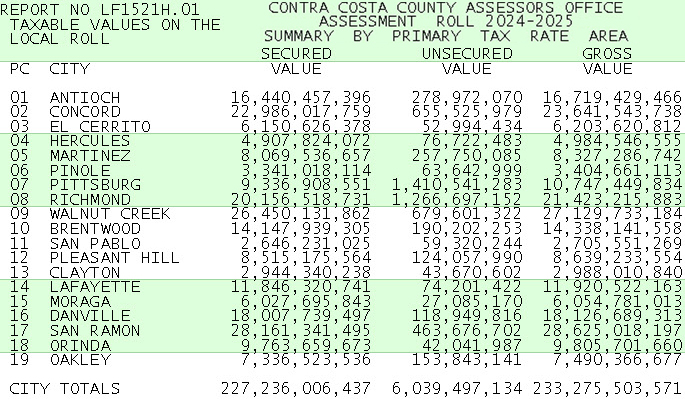
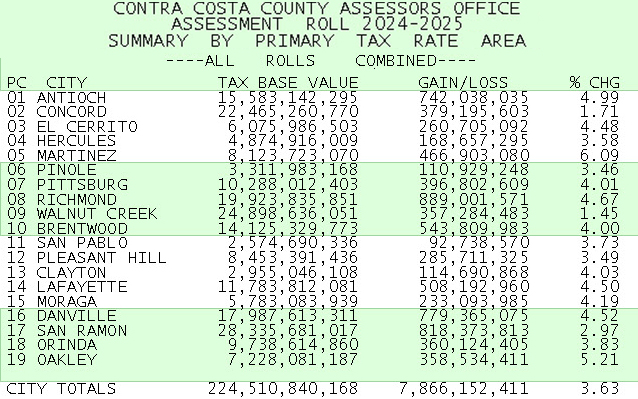
The increase to the local tax base for 2024-2025 is over $11.16 billion. This represents a 4.17% increase in assessed value and brings the total net local assessment roll to more than $278.83 billion. The 2024-2025 assessment roll is the highest to date in Contra Costa County’s history.  Of that amount $233.28 billion was from within the 19 cities and the balance from within the unincorporated areas of the county.

Cities with the largest increases in assessed value include Antioch, Oakley and Martinez with increases ranging from 4.99% and 5.21% to 6.09%, respectively. San Ramon, Concord and Walnut Creek saw the lowest assessed value increases ranging from 2.97% down to 1.45%. The assessment roll now consists of 380,681 parcels, an increase of 1,239 over the previous year.

Property value assessed increases by city. Source: Contra Costa County Assessor’s Office

Of the 19 cities in the county San Ramon has the greatest Gross Assessed Value, which includes both secured and non-secured at $28.63 billion, followed by Walnut Creek at $27.13 billion, Concord with $23.64 billion, Richmond with $21.42 billion, Danville with $18.13 billion and Antioch with $16.72 billion in assessed value.

“I would like to acknowledge and commend the employees of the Assessor’s Office for their continued dedication and hard work which resulted in the completion and delivery of the 2024-2025 assessment roll,” Kramer wrote in his annual letter to the Board of Supervisors.

UPDATE: Later, the County Assessor explained, some of the increases in the assessed values are due to the sales in new home developments and resale of older homes at higher prices, Kramer explained. “This doesn’t mean taxes are going up,” Kramer stated.

His letter and the complete 2024-2025 Assessment Roll Reports can be found, here.

Filed Under: Government, News, Real Estate, Taxes

Why does California’s gas tax keep increasing?

July 1, 2024 By Publisher Leave a Comment

State’s excise tax on gasoline increased July 1 from 57.9 to 59.6 cents per gallon and from 44.1 to 45.4 cents per gallon for diesel fuel.

No end in the law to annual increases based on state CPI

By Allen D. Payton

If you’re not already aware, the State of California gas tax increased today, July 1, 2024 according to the announcement in May by the Department of Tax and Fee Assessment (CDTFA). According to that notice as reported by the California Taxpayers Association, the state’s excise tax* on gasoline increased today “from 57.9 cents per gallon to 59.6 cents per gallon and from 44.1 cents per gallon to 45.4 cents per gallon for diesel fuel.”

According to the California Transportation Commission, “the Legislature passed and the Governor signed SB 1 (Beall, 2017)…increasing transportation funding and instituting much-needed reforms. SB 1 provides the first significant, stable, and on-going increase in state transportation funding in more than two decades.”

Contra Costa’s representatives at that time split on the bill, with then-Assemblyman Jim Frazier, who was chairman of the Assembly Transportation Committee, and Assemblyman Tim Grayson voting in favor, and State Senator Steve Glazer voting against.

Source: AAA

As of Monday, according to the American Automobile Association (AAA), which updates prices daily, drivers in Contra Costa County are paying an average of $4.869 per gallon of regular unleaded gas, while today’s Bay Area average is $4.943, California’s average is $4.794 and the national average is $3.491 per gallon.

Taxes & Fees in the Price for a Gallon of Gas

According to data from the California Energy Commission, drivers are now paying 90 cents in taxes per gallon of gas:

  • $0.596 on state excise tax
  • $0.184 on the federal excise tax
  • $0.10 cents on more state and local sales taxes
  • $0.02 for a state underground storage tank fee

Plus, $0.51 for state environmental programs fee for a total of $1.41 in taxes and fees per gallon of gas.

Source: CDTFA

But why does the state gas tax keep increasing each year? It’s due to the passage of a bill in 2017, not a vote of the people, as some folks misremember. According to the Metropolitan Transportation Commission (MTC), State Senate Bill 1 (SB1) entitled the Road Repair and Accountability Act of 2017, “was passed by a two-thirds majority in the California Legislature and signed into law by Governor Jerry Brown in 2017. As the largest transportation investment in California history, SB 1 is expected to raise $52.4 billion for transportation investments statewide over the next decade.” It marked “the first increase in the state excise tax on gasoline since 1994.”

It requires the CDTFA to annually adjust the rate by the increase in the California Consumer Price Index (CPI) which is as calculated by the Department of Finance (CDFI). According to the CADFI, the CPI “measures price changes in goods and services purchased by urban consumers.  The all urban consumer (CPI-U) represents the spending patterns of the majority of the population which includes professionals, the self-employed, the poor, the unemployed, and retired people, as well as urban wage earners and clerical workers (CPI-W).  The U.S. Bureau of Labor Statistics (BLS) compiles and publishes the CPI for the Los Angeles area monthly, the Riverside area bimonthly, San Diego County bimonthly, the San Francisco area bimonthly, and the nation each month.  A California CPI is calculated…as a population-weighted average of the BLS-published local area CPIs. The California CPI formula was developed by the California Department of Industrial Relations (CADIR).”

According to the CDIR, the CPI “Is a measure of the average change over time in the prices paid by urban consumers for a fixed market basket of goods and services. The CPI provides a way to compare what this market basket of goods and services costs this month with what the same market basket cost, say, a month or year ago.” This year, the California CIP was determined to be 3.3% in February and 3.8% in April.

History of Recent CA Gas Tax Increases

In addition, according to details provided by the CDTFA, “*Effective July 1, 2010, under the Fuel Tax Swap Law, purchases and sales of gasoline are exempt from the state portion of the sales and use tax rate (then 6 percent), and a corresponding increase in the excise tax rate on that gasoline was imposed.” Then, “Effective November 1, 2017, Senate Bill 1 imposed an additional $0.12-per-gallon gasoline tax.” Finally, “Effective July 1, 2020, Senate Bill 1…requires CDTFA to annually adjust the rate by the increase in the California Consumer Price Index.”

Proposed Use of Funds

The majority of the revenue from the state gas tax is intended for “Local Street and Road Maintenance and Rehabilitation” at $1.5 billion per year over 10 years and $1.9 billion for “State Highway Maintenance and Rehabilitation.”

Also, according to the MTC, “In the Bay Area, most of this money will be directed to cities, counties and public transit agencies to tackle the enormous backlog of maintenance and repairs for local streets, roads and transit systems. SB 1 money also will be available for new projects, including bicycle and pedestrian improvements.”

Asked if the law sunsets and the annual increases end or if they continue indefinitely a staff member for CDTFA responded, “CDTFA is required by law to adjust the motor vehicle fuel and diesel fuel excise tax rates annually based on the California Consumer Price Index as calculated by the Department of Finance.  SB1 did not include a sunset date.”

For additional information on SB1 see the answers by the California Department of Transportation (Caltrans) to the Frequently Asked Questions, here and by the California State Controller’s Office, here. Read the 2022 article by the CED entitled What Drives California’s Gasoline Prices.

Filed Under: News, State of California, Taxes, Transportation, Travel

Public asked to participate in CalTrans test on DeSaulnier’s per mile “Road Charge” to replace gas tax

May 26, 2024 By Publisher Leave a Comment

Video screenshot source: Caltrans

Due to purchase and use of hybrid and electric vehicles

Receive up to $400 in gift cards for 6-month Pilot program beginning Aug. 2024

By Allen D. Payton

Caltrans has launched a test on the proposed per mile Road Charge to possibly replace the state’s current gas tax and invites the state’s drivers to participate. The Pilot program will last six months and participants can earn up to $400 in gift cards.

With the passage of Senate Bill 1077 introduced in 2014 by then-State Senator (now-Congressman) Mark DeSaulnier, California began investigating a long-term, sustainable transportation funding mechanism as a potential replacement to the gas tax, known as a “road charge” due to the advent of hybrid and electric vehicles. As of 2022, state officials estimate that there were about 1.1 million electric cars and 1.3 million hybrids on California roads.

Source: Caltrans

Taking direction from the Legislature, California completed the largest road charge research effort to date piloting more than 5,000 vehicles that reported in excess of 37 million miles over a nine-month duration. According to the program’s report, the statistics only serve to reinforce Californians’ desire for mobility, a safe and reliable transportation system, and an improved overall quality of life. Below please find the California State Transportation Agency’s release of the California Road Charge Pilot Program final report.

History of Transportation Funding

According to the Road Charge Pilot Program Summary Report, Nearly all of the 350 billion miles driven each year on California’s highways and roads are  powered by gasoline or diesel fueled vehicles. Historically, the taxes on those fuels provided the majority of the revenue required to maintain and operate our transportation network. As future consumption of gasoline and diesel fuel declines, due to increased fleet efficiency, California will be challenged to sustain its $2.5 trillion economy. Continuing to depend on a consumption-based transportation model, while at the same time adopting policies to increase vehicle fuel efficiency and promote the reduction of vehicle miles traveled, puts into question the long-term viability of the gas tax as a sustainable revenue model.

Source: Caltrans

Historically, transportation funding has been impacted by two main factors: inflation and vehicle fuel efficiency. Until this year, with the passage of the Road Repair and Accountability Act of 2017 (Senate Bill 1), the state gas tax had not been adjusted for inflation since 1994, which significantly reduced its purchasing power. Senate Bill 1 adjusted fuel rates for past inflation and includes future inflation adjustments: hence, solving the inflation issue and delaying the expected transportation funding shortage by a decade or more. However, the impact of improving vehicle fuel efficiency remains an issue, especially as new vehicles sold in the coming decades are expected to be much more fuel efficient.

The report claims, “Without Senate Bill 1’s inflation adjustments, the transportation funding shortfall would be quickly approaching. The new Senate Bill 1 revenues, as illustrated in Figure 1, stabilize the state’s short-term transportation infrastructure funding needs and provides time to explore alternatives to continued reliance on fuel taxes.”

Source: Caltrans

How Transportation Funding Works

Currently, it costs approximately $8.5 billion annually to maintain California’s roads.

  • Approximately 80% of highway and road repairs are funded by a tax on gasoline charged at the pump when you buy gas. The more gas you buy, the more you pay in gas taxes and the more you contribute to highway and road repairs.
  • On average, Californians pay about $300 a year in state gas taxes.
  • Various state fees also support transportation. Trucks pay weight fees and zero-emission vehicle owners pay $118 each year, and all vehicle owners pay a transportation improvement fee.
  • Some counties also charge a local sales tax to further invest in road and transit needs or have tolls on bridges or certain highways.
  • The public may also pass state bonds to invest in additional transportation needs.

What is Road Charge?

California relies on gas tax and other fuel tax revenues to fund its roadway maintenance and repairs. But as cars get more fuel efficient or use other energy sources, such as electricity and hydrogen, the gas tax will no longer fund the infrastructure California needs. California is researching a potential gas tax replacement that’s both sustainable and equitable: road charge. A road charge is a “user pays” system where all drivers pay to maintain the roads based on how much they drive, rather than how much gas they purchase. Under a road charge, all drivers share roadway maintenance and repair costs based on what they actually use. (https://dot.ca.gov/programs/road-charge)

  • California could replace the gas tax with a mileage-based user fee charged to drivers who use the roads. The more you drive, the more you pay for highway and road repairs. The less you drive, the less you pay.
  • Everyone would pay their fair share for road repairs based on how much they drive, not the kind of car they own.
  • California is working to develop a road charge program that is fair, transparent, and sustainable so that it meets our road maintenance needs now and in the future.

Most States Pursuing Vehicle Miles Traveled Taxes

According to the Tax Foundation, most states are taking steps toward a vehicle miles traveled (VMT) tax. “Oregon was the first state to begin research into VMT taxes in 2001 and was the first to implement a program in 2015. Four states now have active programs for passenger vehicles and four other states have active programs targeting heavy commercial vehicles (Oregon has both), with pilot programs carried out in 16 states. Only Hawaii has a mandatory program, which requires EVs to participate by 2028 and all light vehicles by 2033.”

Video screenshot source: Caltrans

Calculator Compares Road Charge vs. State Fuel Tax Costs

The “Road Charge” vs. gas tax calculator for a sample cost comparison of paying the current gas tax of $0.579 per gallon as of July 1, 2023, versus a per mile road charge offers options of $0.02, $0.03 and $0.04. At two cents per mile the Total Monthly Road Charge would be less than the Total Monthly State Fuel Tax for a gas-powered vehicle. But at three cents per mile, the monthly cost of the Road Charge would be greater than the current fuel tax.

For a 2024 Chevrolet Equinox EV driven an average of 1,000 miles per month the Road Charge annual costs would be $240 at two cents, $360 at three cents and $480 at four cents per mile versus the current $118 annual fee. The calculator “Does not include any federal or local taxes” and shows, “Rates are hypothetical and would be set by the California Legislature.”

Video screenshot source: Caltrans

Participate in 2024 Road Charge Collection Pilot

The Road Charge policy idea is still being explored and developed. The public’s input and ideas can help inform what the best way might be to implement a program in California. Drivers are asked to participate in the 2024 Road Charge Collection Pilot and earn up to $400!

  • Receive up to $400* in gift cards
  • Participate for 6 months; Aug 2024 – Jan 2025
  • Pay road charges each month
  • Gas tax refunded end of pilot
  • Take 2 surveys to tell us about your pilot experience

*Complete all required activities throughout the Pilot and earn up to $400: $100 distributed in September 2024 and up to $300 will be distributed in February 2025.

To learn more and participate in the pilot program visit https://caroadcharge.com/engage/contact-us-pilot/, call (916) 619-6283 toll-free or email info@caroadcharge.com.


Filed Under: News, State of California, Taxes, Transportation

Contra Costa’s Measure X sales tax: Living Up to the Promise?

February 7, 2024 By Publisher Leave a Comment

Zoom discussion Feb. 16 sponsored by League of Women Voters, Contra Costa County Library, Contra Costa TV

Voters passed Measure X, a new countywide 20-year, half-cent sales tax to support health and human services for our neighbors and families, in November 2020. The ballot measure language stated that the intent of Measure X is “to keep Contra Costa’s regional hospital open and staffed; fund community health centers, emergency response; support crucial safety-net services; invest in early childhood services; protect vulnerable populations; and for other essential county services.” Learn whether it’s living up to what was promised to voters in a Zoom discussion on Thursday, February 16 at 4 p.m.

How is the Board of Supervisors providing accountability to the public about the impact of the tax monies? What did we learn from this first year of sales tax allocations? What does this mean for the future? A panel of experts will discuss what was funded by Measure X and what gaps remain:

  • John Gioia, Contra Costa County Supervisor
  • Marianna Moore, Chair of the Measure X Community Advisory Board
  • Kanwarpal Dhaliwal, Co-Director of RYSE, a non-profit for Richmond youth
  • Sara Gurdian, Contra Costa County Budget Justice Coalition

Shanelle Scales-Preston will moderate the panel discussion.

Decisions about the first year’s Measure X allocations, as analyzed by the Measure X Community Advisory Board, will be presented as well as the remaining gaps they identified. Other topics will include changes to the Advisory Board’s bylaws and any barriers encountered during the first year.

Register for the Zoom webinar with your email here.

REGISTER FOR THIS EVENT »

Information on how to access the Zoom webinar will be sent to your email address 24 hours before the program.

The Library will provide closed captioning for this event. The program will be recorded and posted on the following sites after the meeting:

LWVDV YouTube channel

Contra Costa County Library YouTube channel

Sponsors include the League of Women Voters of Diablo Valley, the League of Women Voters of West Contra Costa County, the Contra Costa County Library and Contra Costa TV.

Contact programs@lwvdv.org for more information.

Filed Under: Government, Taxes

MTC to seek legislature’s approval to place Bay Area Transportation tax measure on 2026 ballot

January 25, 2024 By Publisher Leave a Comment

Photo by MTC.

To generate at least $1 to $2 billion annually; priorities include transit, safer streets and roads, resilience

Commissioners considering a variety of tax options

By John Goodwin & Rebecca Long, Metropolitan Transportation Commission

The Metropolitan Transportation Commission (MTC) on Wednesday, Jan. 24, 2024 voted to pursue legislation in Sacramento this year that would enable Bay Area voters to consider a transportation revenue measure as early as November 2026.

The proposed measure aims to advance a climate-friendly Bay Area transportation system that is safe, accessible and convenient for all. This includes preserving and enhancing public transit service; making transit faster, safer and easier to use; repairing local streets and roads; and improving mobility and access for all people, including pedestrians, bicyclists and scooter and wheelchair users.

The vote was approved unanimously by all members present. There are 21 commissioners with three non-voting members. Oakland Mayor Sheng Tao and San Jose Mayor Matt Mahan who are voting members were both absent during the vote.

State Sen. Scott Wiener of San Francisco earlier this month introduced what is known as a spot bill that will be used as the vehicle for authorizing placement of the proposed measure on a future ballot in each of the nine Bay Area counties. The first opportunity to amend Wiener’s Senate Bill 925 will be in mid-February.

While the Commission has not yet identified a revenue source for the proposed measure, MTC Chair and Napa County Supervisor Alfredo Pedroza noted that he and his colleagues are considering a wide range of options.

“Voters traditionally have supported transportation through bridge tolls or sales taxes. Bridge tolls are not an option in this case and we think it’s smart to look at more than a regional sales tax. We’re proposing a few options so we have enough flexibility and enough time to get it right.”

Tax Options & Projected Revenue

Legislators, and MTC staff and commissioners, will consider several options for generating revenue. These may include a sales tax, an income tax, a payroll tax, a square footage-based parcel tax, a Bay Area-specific vehicle registration surcharge with tiered rates based on the value of the vehicle or a regional vehicle-miles traveled charge (VMT) charge subject to prior adoption of a statewide road usage charge not sooner than 2030.

MTC staff recommend raising at least $1 billion to $2 billion per year for robust investments in safe streets and other capital improvements, to improve and expand transit service, and to help Bay Area transit agencies operate their services.

Goals of the Regional Transportation Measure

The revenue measure’s core goal is to advance a climate-friendly transportation system in the Bay Area that is safe, accessible and convenient for all. Focus areas include:

  1. Protect and enhance transit service. Ensure that current resources are maintained and used effectively; and enhance service frequency and areas served.
  2. Make transit faster, safer and easier to use. Create a seamless and convenient Bay Area transit system that attracts more riders by improving public safety on transit; implementing the Bay Area Transit Transformation Action Plan; and strengthening regional network management.
  3. Enhance mobility and access for all. Make it safer and more accessible for people of all ages and abilities to get to where they need to go. Preserve and improve mobility for all transportation system users, including people walking, biking and wheeling.

Proposed Expenditure Categories

  1. Transit transformation: sustain, expand and improve transit service for both current and future riders; accelerate customer-focused initiatives from the Bay Area Transit Transformation Action Plan and other service improvements that are high priorities for Bay Area voters and riders; and help fund the transition to zero-emission transit.
  2. Safe streets: transform local streets and roads to support safety, equity and climate goals, including through pothole repair, investments in bicycle/pedestrian infrastructure, safe routes to transit and other safety enhancements.
  3. Connectivity: fund mobility improvements that close gaps and relieve bottlenecks in the existing transportation network in a climate-neutral way.
  4. Climate resilience: fund planning, design and/or construction work that protects transportation infrastructure and nearby communities from rising sea levels, flooding, wildfires and extreme heat.

Transportation Measure Highlights

This measure reflects feedback from Commissioners, key legislative leaders and other stakeholders, including:

  • Improving transit coordination by strengthening MTC’s role as regional transit network manager;
  • A focus on Bay Area Transit Transformation Action Plan (TAP) action items and other customer facing policies that would benefit from a regional approach, such as ambassadors to assist riders and support a safe atmosphere;
  • Flexibility in the amount of revenue requested, as well as the way that funding could be generated;
  • Flexibility in spending priorities as the region’s needs evolve with time; and
  • The “North Star” vision statement, which includes greenhouse gas emission-reduction tools, such as:
    • A Transportation Demand Management mandate that encourages Bay Area employees to commute to work in ways other than driving to work alone; and
    • A limitation on how money could be spent on highway-widening projects.

Just as MTC commissioners have proposed a range of tax options, so too have they identified multiple expenditure categories.

“We recognize that we’ll be asking voters to take on a heavy lift,” acknowledged Pedroza. “The big lesson from COVID is the need to transform both our transit network and the way we pay to operate it. But we also need to transform our local streets and roads to fix potholes and make the roads safer for walking and biking. We need to improve connectivity and do it in a way that doesn’t encourage people to drive more. And we need to make our transportation infrastructure more resilient to rising sea levels, flooding, wildfires and extreme heat.”

Measure Vision Statement

The commissioners also adopted the following Vision Statement for the measure: “The Bay Area needs a world-class, reliable, affordable, efficient and connected transportation network that meets the needs of Bay Area residents, businesses and visitors while also helping combat the climate crisis; a public transit network that offers safe, clean, frequent, accessible, easy-to-navigate and reliable service, getting transit riders where they want and need to go safely, affordably, quickly and seamlessly; local roads are well maintained; and transit, biking, walking and wheeling are safe, convenient and competitive alternatives to driving; enhancing access to opportunity, lowering greenhouse gas emissions, strengthening the region’s economy and improving quality of life.”

To learn more about the proposed tax measure click, here. To read the supporting documents considered by the Commissioners click, here.

MTC is the transportation planning, financing and coordinating agency for the nine-county San Francisco Bay Area.

Allen D. Payton contributed to this report.


Filed Under: Bay Area, Legislation, News, State of California, Taxes, Transportation

  • « Previous Page
  • 1
  • 2
  • 3
  • 4
  • 5
  • 6
  • …
  • 10
  • Next Page »
RepublicServices-Antioch-ad (1)
Monica's dinner 05-26 CCH
Delta-RC-B 07-26
Deer-Valley-Chiro-06-22

Copyright © 2026 · · Contra Costa Herald · All Rights Reserved