
• Home
  • About The Herald
  • Local Agencies
  • Daily Email Update
  • Legal Notices
  • Classified Ads

Contra Costa Herald

News Of By and For The People of Contra Costa County, California

  • Arts & Entertainment
  • Business
  • Community
  • Crime
  • Dining
  • Education
  • Faith
  • Health
  • News
  • Politics & Elections
  • Real Estate

Public workshops, hearings announced for Draft Plan Bay Area 2050

May 26, 2021 By Publisher Leave a Comment

Regional plan for transportation, housing, the economy, and the environment

Interested agencies, organizations and individuals are invited by the Metropolitan Transportation Commission (MTC) and the Association of Bay Area Governments (ABAG) to comment on the Draft Plan Bay Area 2050. As required by state and federal law, MTC and ABAG have jointly developed this regional plan for transportation, housing, the economy, and the environment, which will serve as the San Francisco Bay Area’s Regional Transportation Plan (RTP) and Sustainable Communities Strategy (SCS) upon its adoption. Draft Plan Bay Area 2050 is defined by 35 integrated strategies designed to advance the region towards a more equitable and resilient future.

A Draft Environmental Impact Report (DEIR) prepared on the Draft Plan Bay Area 2050 will be subject to public review pursuant to a separate notice.

The following online public workshops have been scheduled to receive comment on the Draft Plan Bay Area 2050:

ONLINE PUBLIC WORKSHOP

East Bay Workshop
Contra Costa and Alameda Counties
Monday, June 14, 5:00 to 6:30 p.m.
https://bit.ly/33uXj0y
Passcode: 179826
Webinar ID: 862 3482 0389

ONLINE PUBLIC HEARINGS

Additionally, MTC and ABAG will hold three (3) public hearings to receive oral testimony and written comments about the Draft Plan Bay Area 2050. Copies of the draft plan are on file with the Secretary of the Board of MTC and open to public inspection at planbayarea.org/learnmore. Should you require a hard copy of the draft plan, please submit your request to info@bayareametro.gov or call 415-778-6757 and one will be mailed to you.

The first public hearing will be held during the regular meeting of the Joint MTC Planning Committee with the ABAG Administrative Committee on:

Friday, June 11, 2021 at 9:40 a.m. (Remotely)
https://bit.ly/33xhpav
Webinar ID: 874 2787 4017
Bay Area Metro Center
Board Room, 1st Floor
375 Beale Street, San Francisco, CA 94105

In light of Governor Newsom’s State of Emergency declaration regarding the COVID-19 outbreak and in accordance with Executive Order N-29-20 issued by Governor Newsom on March 17, 2020 and the Guidance for Gatherings issued by the California Department of Public Health, the meeting will be conducted via webcast, teleconference, and Zoom for all participants. Detailed instructions on participating via Zoom are available at: https://mtc.ca.gov/how-provide-public-comment-board-meeting-zoom. The meeting accessibility instructions also will be posted to: https://mtc.ca.gov/whats-happening/events/public-hearings no less than 72 hours prior to the hearing.

Two additional online public hearings have been scheduled for:

Hearing 2
Tuesday, June 22, 5:30 p.m.
https://bit.ly/3y0ZiYp
Passcode: 177176

Webinar ID: 812 0345 4209

Hearing 3
Wednesday, July 7, 1:30 p.m.
https://bit.ly/2SIduFK
Passcode: 908706

Webinar ID: 854 5833 8822

The Draft Plan Bay Area 2050 will be available for public review beginning Wednesday, May 26, 2021, online at https://mtc.ca.gov/whats-happening/events/public-hearings,  https://abag.ca.gov/meetings-events/public-hearings, and planbayarea.org. In an effort to reduce printing costs and conserve paper and in accordance with EO N-29-20 and the Guidance for Gatherings issued by the California Department of Public Health, you are urged to review the Draft Plan Bay Area 2050 on the website listed above. Should you require a hard copy of the Draft Plan Bay Area 2050, please submit your request to info@bayareametro.gov or call 415-778-6757 and one will be mailed to you.

The public comment period for the Draft Plan Bay Area 2050 begins on Wednesday, May 26, 2021 and ends on Tuesday, July 20, 2021 by 5:00pm. All written comments must be received no later than Tuesday, July 20, 2021 by 5:00pm. All written comments on the Draft Plan Bay Area 2050 are being accepted via mail to MTC Public Information, Attn: Draft Plan Comments, 375 Beale Street, Suite 800, San Francisco, CA 94105; via e-mail to info@planbayarea.org; and online at planbayarea.org/learnmore. Comments also are being accepted by phone by leaving a voicemail at (415) 778-2292.

Public comment on the Draft Environmental Impact Report (DEIR) for the Draft Plan Bay Area 2050 will be sought pursuant to a separate notice. After considering public comment, MTC and ABAG are slated to adopt Plan Bay Area 2050 in fall 2021. For more information, call the MTC Public Information Office at (415) 778-6757.

Do you need an interpreter or any other assistance to participate? Please call 415-778-6757. We require at least three working days’ notice to accommodate assistance requests. For TDD or hearing impaired, call 711, California Relay Service, or 1-800-735-2929 (TTY), 1-800-735-2922 (voice) and ask to be relayed to 415-778-6700.

您需要口譯員或任何其他幫助才能參加嗎?請致電415-778-6757。我們要求至少提前三個工作日通知,以便滿足您的請求。對於TDD或聽障人士,請致電711,加州中繼服務,或1-800-735-2929(TTY),1-800-735-2922(語音),並要求轉接到415-778-6700。

¿Necesita un intérprete o cualquier otra ayuda para participar? Llame al 415-778-6757. Requerimos un aviso de al menos tres días hábiles para atender las solicitudes de asistencia. Para personas con discapacidad auditiva o TDD, llame al 711, California Relay Service, o al 1-800-735-2929 (TTY) o al 1-800-735-2922 (voz) y pida que lo comuniquen al 415-778-6700.
Filed Under: Bay Area, Economy, Environment, Growth & Development, News, Transportation

Save Mount Diablo sues Discovery Builders over development on major ridgeline shared with new regional park

May 21, 2021 By Publisher 2 Comments

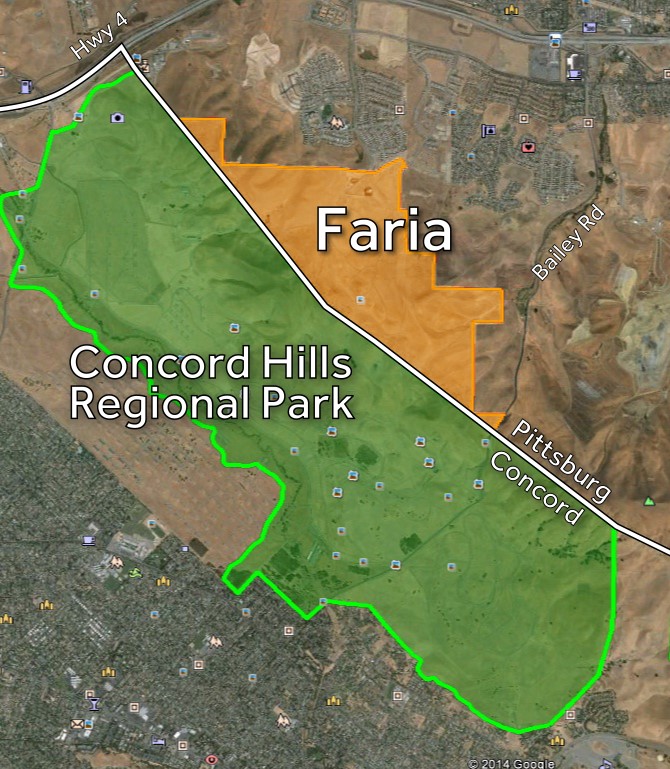
The new Concord Hills Regional Park is directly adjacent to the approved Faria project. Credit: Save Mount Diablo/Google Earth.

Developer’s attorney calls lawsuit “poorly drafted and baseless”; 1,650-home project requires LAFCO annexation approval

Save Mount Diablo issued a statement, Thursday, May 20, 2021 announcing they are suing the developer of the recently approved large housing project on the edge of Pittsburg’s southwest hills that abuts the future regional park on the Concord side of the ridge. The organization claims that Discovery Builders’ Faria project would damage the major ridgeline between east and central Contra Costa County, threaten views from throughout the region, and impact the new regional park.

The Pittsburg City Council voted 5-0 during a special meeting on Feb. 22, 2021 to approve the project, following approval by the city’s planning commission.

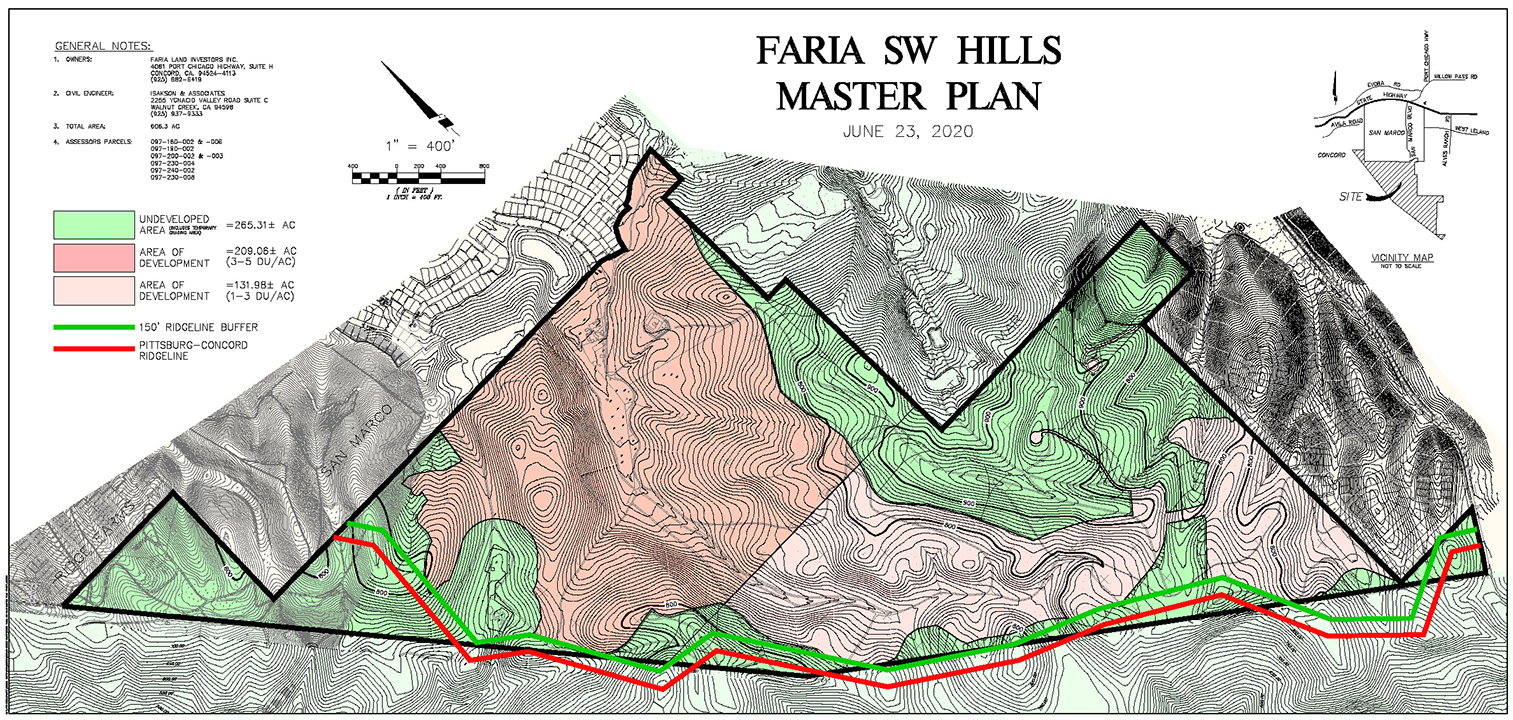
On March 30, 2021, Save Mount Diablo filed the lawsuit challenging the City of Pittsburg’s approval of the 1,650-unit Faria project, on the ridgeline between Pittsburg and Concord. According to the agenda item documents, the master plan overlay district encompasses approximately 607 acres of land. The district is generally bounded by Bailey Road and the approved but not yet constructed, “Bailey Estates” subdivision to the east; the Concord City Limits and recently closed Concord Naval Weapons Station (CNWS) property to the south and west; and the San Marco and Vista Del Mar residential subdivisions (substantially developed) along the northern boundary and other open space areas along the northeastern boundary.

Faria SW Hills Master Plan map. Source: City of Pittsburg

“Save Mount Diablo is simply trying to protect one of the East Bay’s most prominent and well-known ridgelines. The Pittsburg City Council approved Seeno-owned Discovery Builders’ Faria project.  If we do nothing, massive grading will take place; the project will be built; the ridge damaged; other natural resources, including scenic vistas, will be harmed; and the new regional park, which we advocated for over many years, will be negatively impacted,” said Ted Clement, Executive Director, Save Mount Diablo.

Asked why it took so long for the organization to respond to the project’s approval, Seth Adams, Land Conservation Director for Save Mount Diablo responded, “things take time.” Asked if they had a court date set, yet, he said, “No. We’re at the stage where we have a mandatory settlement conference and where the preparation of the administrative record, which includes all the public comments, etc. That’s what the whole trial is about.”

According to Save Mount Diablo, the Faria project violates Pittsburg’s General Plan, state planning and zoning law, and the California Environmental Quality Act (CEQA). CEQA requires legally adequate environmental review, consideration of appropriate alternatives, and implementation of mitigations to reduce impacts.

Save Mount Diablo’s lawsuit challenges the approval of the Faria project claiming the city council ignored hundreds of letters and public comments that opposed the project.

The Faria site is rugged, landslide prone, and badly suited for development, which will only be possible with massive grading, the environmental organization contends. The project as approved by the city authorizes the development of a major, new residential subdivision on 607 acres of ridgeline and hillside grazing land in what is currently unincorporated Contra Costa County, immediately south of the City of Pittsburg.

The biologically rich site supports sensitive wildlife species and rare plants and is in one of the most visible and most environmentally constrained areas of the county.

The Faria project would change the beautiful green hills forever by annexing the property to the City of Pittsburg and locating 1,650 new residences far from jobs, transit, and services, Save Mount Diablo claims. As a result, rare habitat for special status species would be lost. The extensive grading would increase landslide risks and degrade creeks and streams. Building in the wildland urban interface would create new wildfire risks and strain the City of Pittsburg’s existing firefighting services. Traffic on Bailey Road, San Marco Blvd., and Highway 4 would be made much worse.

The Pittsburg hills where the Faria project has been approved for construction, as seen from the San Marco neighborhood in Pittsburg. Photo: Scott Hein

Save Mount Diablo claims the Faria project would also impact the new Concord Hills Regional Park, which the East Bay Regional Park District (EBRPD) has long planned at the former Concord Naval Weapons Station at the Faria site’s southwestern edge. The Faria project would sit directly above the new park on a ridgeline, degrading views from surrounding areas. It would fragment open space and damage wildlife corridors.

The East Bay Regional Park District adopted the Land Use Plan for the new park last year on July 7, 2020. Discovery Builders and Faria Land Investors filed suit to stop the new regional park.

The Concord Hills Regional Park Land Use Plan provides for public access, preserves 95 percent of the area’s natural habitat, and honors the unique natural and human history of the land.

According to an August 21, 2020 media release by EBRPD: “This approval paved the way for the Park District to begin work on park and trail development of the 2,540-plus-acre regional park at the former Concord Naval Weapons Station and was the product of two decades of community advocacy and partnership amongst the Park District, U.S. Navy, National Park Service, City of Concord, with overwhelming support from the residents of Central Costa County.

“Despite a thorough environmental analysis of the new Regional Park’s plans, which include public access for recreation, permanent preservation of the land as natural habitat, and a joint visitor center with the National Park Services that will also honor the Black sailors who died in the massive Port Chicago explosion, Mr. Seeno’s Discovery Builders and Faria Land Investors filed suit to stop the new regional park. In their lawsuit, Mr. Seeno alleges that the Park, after a decades long collaborative planning efforts to protect and preserve open space, would cause undisclosed impacts on the environment and would impact their planned Faria residential development in Pittsburg on a 606-acre parcel adjacent to the ridgeline of the park,” stated the media release.

By comparison, next door and above the new park, Faria would include hundreds of acres of impacts, Save Mount Diablo claims. The City of Pittsburg prepared an Environmental Impact Report (EIR) that fell far short of CEQA’s requirements. Among other flaws, the EIR lacks adequate analysis of numerous impacts, including biological resources, water supply, wildfire, traffic, and land use. The EIR failed to provide an adequate project description, for example, by omitting information about the location of elements of the planned residential development and about related public services, such as water consumption rates. It also failed to discuss appropriate alternatives. And the mitigation adopted for many impacts is plainly inadequate or ineffective.

Save Mount Diablo is not opposed to all growth. Pittsburg has thousands of housing units already approved but not yet built, including units at Seeno’s San Marco, Sky Ranch II, Montreux, and Tuscany Meadows projects and now including Faria. A smaller or more compact Faria project could easily protect the beautiful ridge, expand the new regional park onto the Pittsburg side, and provide easy public access for Pittsburg residents.

According to Pittsburg’s Current Project Pipeline List, there are currently 5,853 housing units approved or under construction, 88 percent of them by Seeno’s Discovery Builders (5,141 housing units). Those units represent approximately 60,000 new car trips per day that will soon impact local roads and Highway 4, Save Mount Diablo claims.

According to Clement, “Throughout the East Bay, residents have worked hard to protect our ridges and views, and to defend our parks. Pittsburg residents deserve the same protections and quality of life.”

City of Pittsburg General Plan December 2011.

Developer’s Attorney Responds

In response, Discovery Builders’ attorney, Kristina Lawson, Managing Partner of Hanson Bridgett issued the following statement:

“The City of Pittsburg, as the lead agency, and the City’s environmental consultant have performed a comprehensive and extensive analysis of potential impacts of this project.  Their work was thorough and well done.  Following that analysis, planning and engineering staff at the City recommended approval of this project; the Pittsburg Planning Commission recommended approval of this project; and the City Council voted unanimously to approve this project.

Furthermore, Pittsburg voters approved this land to become part of the City of Pittsburg, and to be developed with much needed housing, consistent with the City’s General Plan which has long provided for this land to be developed for housing.

My client knows that the City Manager, City employees and City-appointed and elected officials all have the best interests of the City in mind and agrees with the many staff recommendations and City approvals for the project.  Given the City and their consultant diligently analyzed potential impacts of this project, my client is not concerned with this poorly drafted and baseless lawsuit filed solely for the purpose of delay.”

Allen Payton contributed to this report.


Filed Under: Central County, East County, Environment, Growth & Development, Legal, News

State says Measure T’s growth limitations in Antioch’s Sand Creek area “cannot…be adopted implemented or enforced”

April 1, 2021 By Publisher 2 Comments

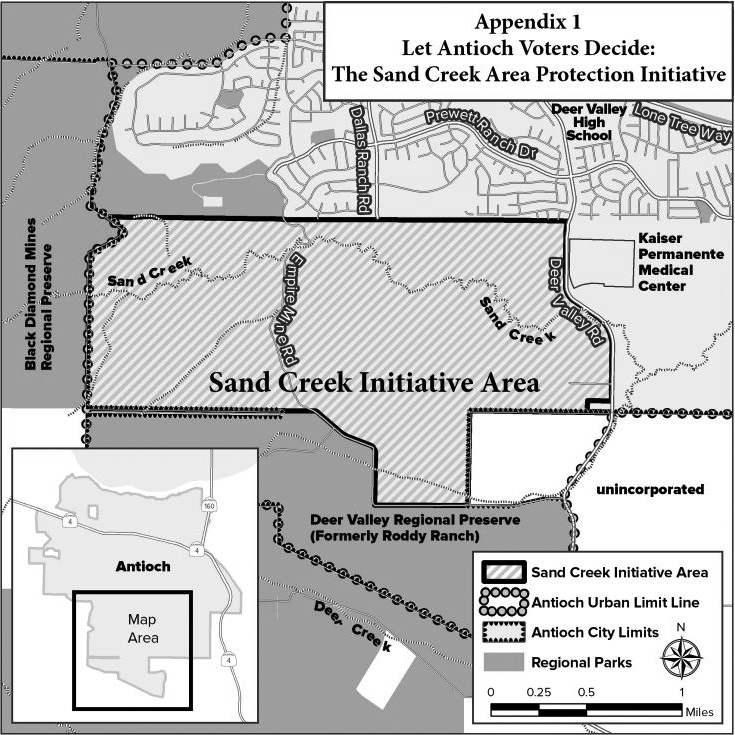
The Let Antioch Voters Decide: The Sand Creek Area Protection Initiative known as Measure T on the November 2020 ballot cannot be implemented.

Violates state law known as SB330, the Housing Crisis Act of 2019

Would have devalued property by over 99%, downzoning it from 2 homes per acre to 1 home per 80 acres

Cities and counties must approve new homes or face hefty fines which will fund low-income housing

By Allen Payton

As was reported in news articles and an editorial by the Herald during the 2020 fall election campaign, the state has issued an opinion letter confirming that the residential growth limitations in Measure T on the November ballot, “cannot permissibly be adopted, implemented or enforced.” That’s due to the passage of SB330, the Housing Crisis Act of 2019, which went into effect on Jan. 1, 2020, also as previously reported. Known as the Let Antioch Voters Decide: The Sand Creek Protection Initiative, the measure passed by almost 79% of the vote.

SB330 added Section 66300 to California Government Code so that cities cannot reduce zoning on residential property by either council action or citizen initiative until Jan. 1, 2025.  Also, if a city council doesn’t approve new housing within existing allowable zoning, the new law requires a court to fine the city a minimum of $10,000 per housing unit denied and force the city to approve the new homes.

SB330 and State Housing Law

The language of SB330 reads, “(c) It is the intent of the Legislature, in enacting the Housing Crisis Act of 2019, to do both of the following: (1) Suspend certain restrictions on the development of new housing during the period of the statewide emergency described in subdivisions (a) and (b). (2) Work with local governments to expedite the permitting of housing in regions suffering the worst housing shortages and highest rates of displacement.”

Furthermore, the act reads, “The Legislature finds and declares that the provision of adequate housing, in light of the severe shortage of housing at all income levels in this state, is a matter of statewide concern and is not a municipal affair…Therefore, the provisions of this act apply to all cities, including charter cities.”

In addition, the new law reads, “with respect to land where housing is an allowable use, an affected county or an affected city shall not enact a development policy… that would  have any of the following effects: Changing the general plan land use designation, specific plan land use designation, or zoning of a parcel or parcels of property to a less intensive use or reducing the intensity of land use within an existing general plan land use designation, specific plan land use designation, or zoning district below what was allowed under the land use designation and zoning ordinances of the affected county or affected city, as applicable, as in effect on January 1, 2018.”

Also, the new law amended Section 65589.5 of the Government Code that reads, “the court shall impose fines on a local agency… in a minimum amount of ten thousand dollars ($10,000) per housing unit in the housing development project on the date the application was deemed complete.” Furthermore, the law requires, “the local agency shall commit and expend the money” from the fines “for the sole purpose of financing newly constructed housing units affordable to extremely low, very low, or low-income households.”

So, not only will the new homes in the development that was denied be built, but the city will be fined and the funds from them must be used to build additional, low-income housing.

Finally, According to the HCD, “Since 1969, California has required that all local governments (cities and counties) adequately plan to meet the housing needs of everyone in the community. California’s local governments meet this requirement by adopting housing plans as part of their ‘general plan’ (also required by the state). General plans serve as the local government’s ‘blueprint’ for how the city and/or county will grow and develop and include seven elements: land use, transportation, conservation, noise, open space, safety, and housing. The law mandating that housing be included as an element of each jurisdiction’s general plan is known as ‘housing-element law.’

California’s housing-element law acknowledges that, in order for the private market to adequately address the housing needs and demand of Californians, local governments must adopt plans and regulatory systems that provide opportunities for (and do not unduly constrain), housing development. As a result, housing policy in California rests largely on the effective implementation of local general plans and, in particular, local housing elements.” Each of the regions in the state must develop a plan for their Regional Housing Needs Allocation and Housing Elements.

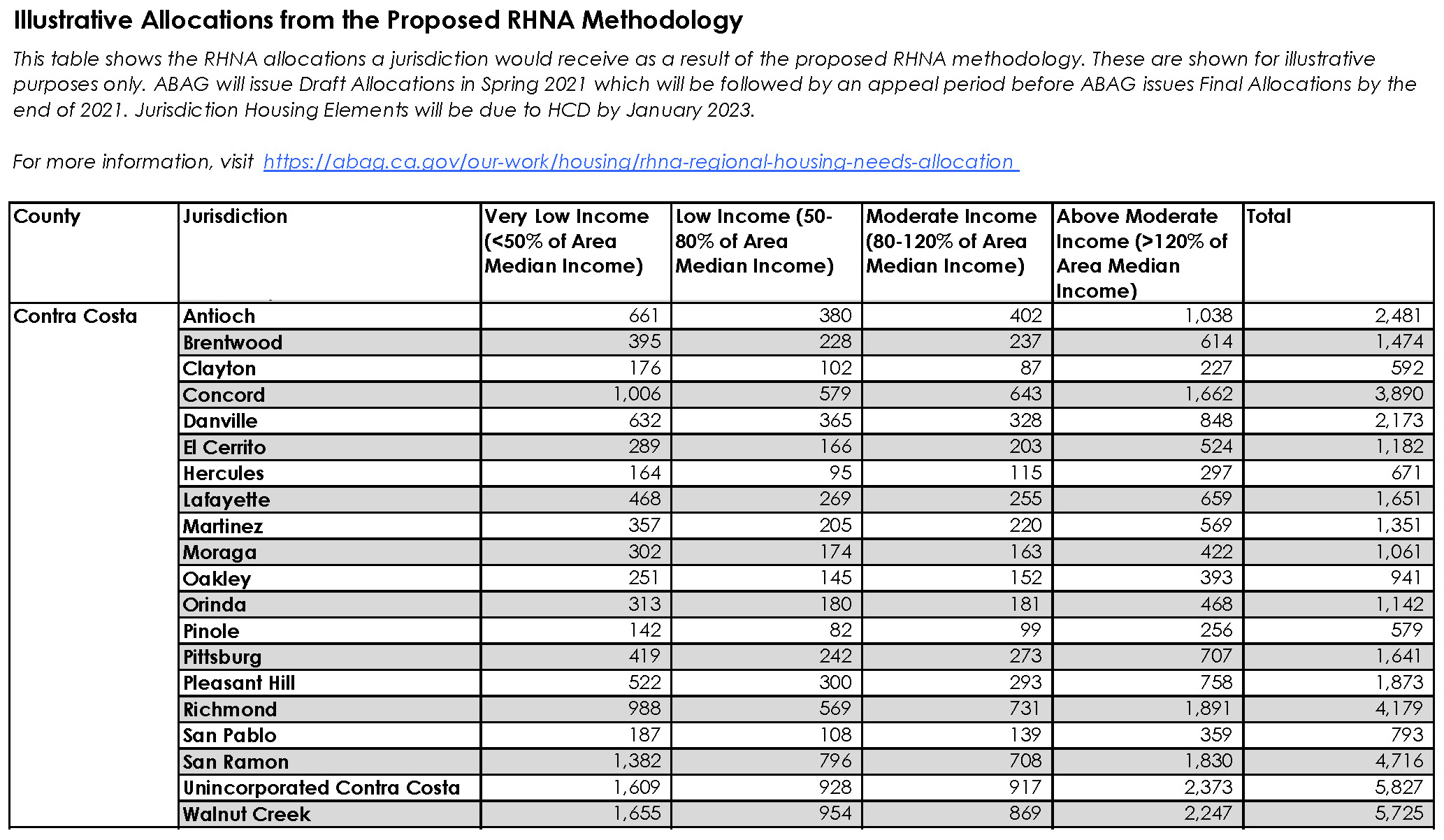
The Bay Area’s current Regional Housing Need Allocation Plan (RHNA) projected 187,990 units needed between Jan. 31, 2015 and Jan. 31, 2023 and another 441,176 units needed between 2023 and 2031, according to the HCD and the Association of Bay Area Governments. In the latest RHNA, it requires Antioch to add 2,481 more housing units by 2030. (See related article)

City of Antioch Letter to HCD Regarding Measure T & SB330

A letter was sent on Jan. 8, 2021 from an attorney hired by the City of Antioch to the California Department of Housing and Community Development (HCD) seeking their advice and opinion on implementing Measure T. In that letter, attorney David Mehretu of Meyers Nave asked Paul McDougall, Housing Policy Manager for HCD to review Measure T for a determination of its “validity under SB 330 as follows:

  1. Whether Measure T’s housing development restrictions are proscribed under Section 66300(b)(1)(A) of the Government Code.
  2. Whether, pursuant to Sections 66300(b)(1)(B)(i) and (ii) of the Government Code, Measure T’s housing development restrictions constitute “a moratorium or similar restriction or limitation on housing development . . . within [Sand Creek] . . . to specifically protect against an imminent threat to the health and safety of persons residing in, or within the immediate vicinity of [Sand Creek] . . . ”.
  3. Whether Measure T acts as an impermissible cap on housing pursuant to Section 66300(b)(1)(D)(ii) of the Government Code; and
  4. Whether Antioch may, consistently with SB 330, enforce Measure T’s housing development restrictions.”

Response Letter from HCD Explains Why Measure T Violates State Law

In a March 9th letter in response, McDougall wrote, “the City requested the California Department of Housing and Community Development’s (HCD) opinion as to the enforceability of a reduction in the intensity of land use included in the City’s voter-approved initiative Measure T.”

“HCD’s opinion is based on the mandatory criteria established by the Legislature with the passage of Senate Bill 330 in 2019, known as the Housing Crisis Act of 2019, which added section 66300 to the Government Code,” McDougall wrote.

“HCD finds that the less intensive use provisions of Measure T are impermissible under Government Code section 66300,” and “Measure T effectively acts as a ‘…cap on the number of housing units that can be approved…’, a violation of Government Code section 66300…”, he wrote.

McDougall offered one caveat writing, “the City could enforce the reduction in intensity contemplated in Measure T, notwithstanding this opinion, if and when it concurrently changes the development standards, policies, and conditions applicable to other parcels within the jurisdiction to ensure that there is no net loss in residential capacity.” However, he further wrote, “nothing in Measure T provides for an equal increase in intensity of land use elsewhere in the jurisdiction, therefore, these provisions of Measure T cannot be permissibly adopted, implemented, or enforced consistent with Government Code section 66300.”

He concludes his letter offering the state’s opinion that Measure T is impermissible.

“Measure T appears to have been drafted to assure that housing development in the City is restricted in a manner that preserves agriculture and open spaces (Measure T, section 1). However, there is minimal analysis in Measure T to support this outcome. Measure T language more readily suggests it was passed primarily with the intent to restrict future housing development as opposed to accommodating future residential growth as intended in the City’s general plan,” the HCD Housing Policy Manager continues.

“In sum, the provisions of the voter-approved Measure T result in a lesser intensity of land use and create a development cap, resulting in a reduction in the total number of housing units that can be built within the Initiative Area than what is currently allowed in the City’s General Plan. Accordingly, HCD is of the opinion that such a reduction in the intensity of land use created by Measure T cannot permissibly be adopted, implemented, or enforced consistent with Government Code section 66300,” McDougall concluded.

Measure T is Moot, Cities and Counties Must Approve New Homes or Face Fines

Therefore, as previously reported, the state has confirmed that Measure T, which would have devalued four privately owned parcels on the west side of Deer Valley Road by over 99% from two homes per acre to just one home per 80 acres, is moot and will have no impact on the development of new housing in Antioch. It would have affected less than 900 housing units remaining of the total 4,000 homes allowed in the City of Antioch’s Sand Creek Focus Area of the general plan. But now those housing projects will move forward in the planning process.

Furthermore, the council must adopt all new housing projects in the Sand Creek area and anywhere else in the city, as do all other cities and counties, until Jan. 1, 2025, which don’t require any zoning changes or general plan amendments, or the city will face state fines of $10,000 per unit, at a minimum, and the homes will still be approved and allowed to be built, and the fines fund additional, low-income housing in the city, according to SB330.


Filed Under: East County, Growth & Development, News, State of California

Plan Bay Area 2050: Final Blueprint Analysis released

January 6, 2021 By Publisher Leave a Comment

The Metropolitan Transportation Commission (MTC) and the Association of Bay Area Governments (ABAG) are pleased to announce the release of the Plan Bay Area 2050 Final Blueprint Outcomes – a major milestone in the development of Plan Bay Area 2050, the Bay Area’s long-range plan to guide the growth of our nine-county region for the next generation. The Plan Bay Area 2050 Final Blueprint, which is made up of the strategies, growth geographies, and regional growth forecast was approved by MTC and ABAG in September 2020.

Building on analyses of the Draft Blueprint, the Final Blueprint includes a set of 35 revised and expanded strategies to tackle the Bay Area’s transportation, housing, economic and environmental challenges while creating a more resilient and equitable future for the Bay Area. These strategies are either public policies or sets of investments that can be implemented in the Bay Area over the next 30 years.

Over the last several months, MTC and ABAG staff analyzed these strategies to determine how much more progress the Bay Area makes toward reaching Plan Bay Area 2050’s vision of ensuring by 2050 that the region is affordable, connected, diverse, healthy and vibrant for all. This analysis shows that continued progress has been made due to the new and expanded strategies featured in the Final Blueprint. The 35 strategies featured in the plan demonstrate how the region can:

  • Achieve the Bay Area’s 19% greenhouse gas emissions reduction target, as set by the California Air Resources Board;
  • Reduce overall housing and transportation costs for residents, especially for households with lower incomes;
  • Increase the production and preservation of affordable housing;
  • Create a more accessible and reliable transit network;
  • Reduce the risk of displacement for people with lower incomes;
  • Invest in parks and open spaces, particularly in historically disinvested communities;
  • Increase resilience against wildfires and sea level rise; and
  • Support a thriving economy with a more balanced regional pattern of jobs and housing.

Read more about the Final Blueprint strategies and their outcomes on planbayarea.org.

Staff will seek adoption of the Final Blueprint as the Preferred Alternative for environmental analysis purposes by the Commission and ABAG Executive Board in January 2021.

Related: Plan Bay Area, Plan Bay Area 2050, RHNA


Filed Under: Growth & Development, News

$40 million affordable housing project to be built as part of Pittsburg’s first transit oriented development

December 3, 2020 By Publisher 22 Comments

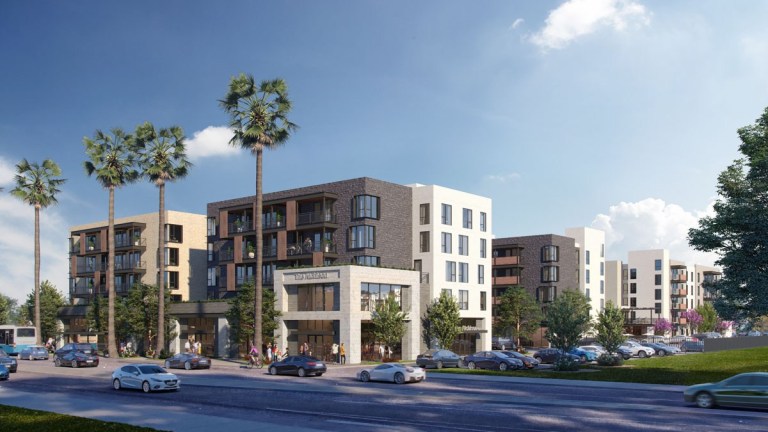
Artist’s rendering of The Atchison multifamily housing project planned for Railroad Avenue in Pittsburg. Courtesy of Integrated Community Development.

By Allen Payton

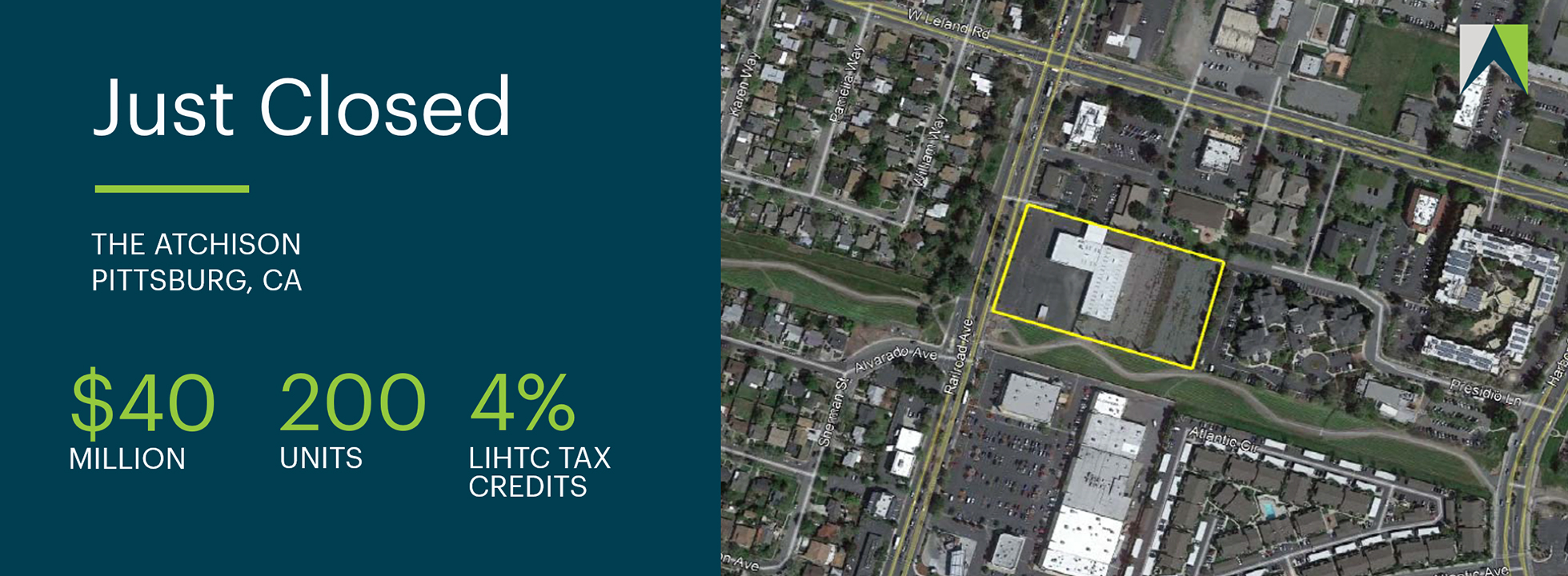
Alliant Capital announced on Tuesday the closing of their investment in The Atchison in Pittsburg, and the new development of over 200 affordable housing units. The $40 million project is part of a $90 million mixed use transit oriented development near the BART station, the first for the city. Alliant will work on the project with the not for profit Corporation for Better Housing and Integrated Community Development.

The 202-unit multifamily, Low Income Housing Tax Credit (LIHTC) project will be built on the site of the former Ford dealer at 2575 Railroad Avenue, less than half-a-mile from the Pittsburg BART Station. It is part of the city’s Railroad Avenue Specific Plan adopted by the city council in 2009.

“With the Atchison project, the City of Pittsburg is continuing to see the community’s vision of the Railroad Avenue corridor and the area around the Pittsburg Center BART Station come to life,” said Mayor Jelani Killings during a virtual ground breaking ceremony earlier this year. “This project addresses the need in Pittsburg for high quality and amenity-driven transit-oriented development, and shows that during these uncertain times, Pittsburg is a community that is working, building, and looking toward the future.”

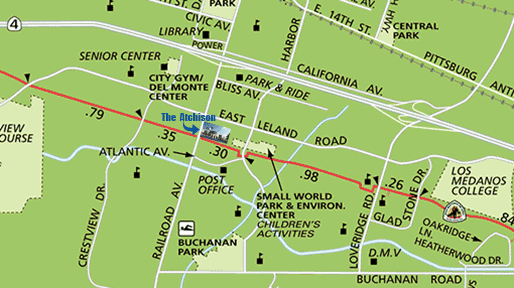
The overall project also includes developer funded improvements to the Delta De Anza Regional Trail that runs along the south side of the property.

Delta De Anza Trail (red line) and location of The Atchison adjacent. From East Bay Regional Park District.

“Integrated Community Development (ICD) is the Administrative General Partner of the partnership that owns the Atchison,” explained Managing Member Ben Lingo, about the company’s role. “ICD is the developer of the project and works closely with the Corporation for Better Housing, the development’s not for profit general partner.”

About The Atchison

The Atchison is the new construction of 202 apartment units. The projected construction timeline spans a 22-month period, culminating in October 2022.

When completed, The Atchison will consist of 20 efficiency units, 122 one-bedroom/one bath units, and 60 two-bedroom/one bath units. Of those, 100 units will be set aside for households whose income is at or below 50% of the area median income (“AMI”) and 100 units will be set aside for households whose income is at or below 70% of AMI. The overall average income for the project will be 60% of AMI. Two units will be used for on-site property managers.

The Atchison will help to provide new affordable housing opportunities within a pedestrian oriented neighborhood with access to transportation, job centers, retail, schools, and community services. The development will include 202 residential units and approximately 13,000 square feet of ground floor commercial and retail space. The development offers the residents a robust amenity package including a pool with a sunning deck, fire pits, outdoor BBQ areas, playgrounds, community business center, fitness center, lounge area and pool side clubhouse. The Atchison offers market rate amenities with mixed income rents.

Renderings courtesy of Integrated Community Development.

About Alliant Capital

The Alliant Company is a leading LIHTC firm focused on providing tax credit syndication for the development and financing of affordable multifamily rental housing. Founded in 1997 to assist in America’s critical need for affordable housing, today Alliant is among the nation’s top syndicators and has an unparalleled track record of success. With a dedicated team of experienced commercial real estate, asset management, legal and tax professionals, Alliant provides the highest level of fully integrated real estate and investment support services. We deliver rock-solid expertise with an innovative perspective.

About Corporation for Better Housing

Founded in 1995, Corporation for Better Housing (CBH) is a 501(c)(3) nonprofit organization. We believe community action changes lives, embodies the spirit of hope, and makes neighborhoods a better place to live. It’s our goal to provide the tools necessary, for these ideas to flourish long after construction is complete. We are committed to providing services free of charge to all our residents. Regardless of the nature of the development, Corporation for Better Housing remains dedicated to its residents, the public, and the communities it serves.

In our goal to eradicate the “poor and unsafe living conditions” that exist in underprivileged communities today, we pride ourselves on our “boots on the ground” approach. Our management teams are fully integrated into our development process during the construction stages and remain heavily involved in the completion of every development. We are committed to being proactive (and flexible), with the challenges that come with affordable housing.

The development of quality affordable housing has enabled Corporation for Better Housing to forge lasting and fruitful partnerships with many recognized leaders in the affordable housing industry. Alliant has syndicated deals for Corporation for Better Housing and continues to be an invaluable asset to our development team.

About Integrated Community Development

Integrated Community Development is a diversified firm that specializes in all aspects of real estate development including Land Acquisition, Environmental Law, Entitlement, Design, Finance, Construction, Asset Management, and Property Management.

Filed Under: East County, Growth & Development, News

Regional housing needs proposal allocates 43,942 units for Contra Costa cities between 2023-31

October 20, 2020 By Publisher 5 Comments

Photo: ABAG.

Methodology emphasizes equity for projected 441,000 additional housing units needed Bay Area wide

“Housing Element Law emphasizes that all Bay Area communities have to share the increased state planning number…” – ABAG President and Berkeley Mayor Jesse Arreguin

Public comment period begins Oct. 25

The Association of Bay Area Governments (ABAG)’s Executive Board at its meeting Thursday evening, Oct. 15 passed the Regional Housing Needs Allocation (RHNA) proposed methodology — a mathematical formula by which the state Department of Housing and Community Development (HCD)’s requirement that the Bay Area plan for more than 441,000 additional housing units during the 2023-2031 RHNA cycle will be distributed among the region’s nine counties and 101 cities and towns. New state laws — as well as the region’s strong economy and related job and household growth over the past decade — are also a significant reason for the growth in HCD’s determination, which will require the Bay Area to plan for 253,000 more units than required in the 2015- 2023 RHNA cycle. ABAG RHNA 10-15-20

Under the proposed methodology, communities in Contra Costa County would be expected to add 43,942 housing units, about 10% of the total, during the time period, with Walnut Creek, San Ramon, Richmond and Concord being allocated the highest number of housing units. Communities in Santa Clara County would be expected to account for about one-third of all new units to be incorporated into the housing elements of Bay Area jurisdictions’ general plans, and San Francisco, San Jose and Oakland are expected to have the highest expected planning numbers for individual cities.

From RHNA dated Oct. 15, 2020

ABAG President and Berkeley Mayor Jesse Arreguin commented, “Housing Element Law emphasizes that all Bay Area communities have to share the increased state planning numbers.  The adopted proposed methodology is the best way to share the housing responsibility among all our region’s local governments, to encourage housing in areas with good access to jobs and in locations designated by the state as high-opportunity areas, and to meet fair housing and greenhouse gas reduction requirements.”

With the Executive Board’s action, ABAG on Oct. 25 will open a public comment period on the proposed RHNA methodology. The comment period will include a public hearing at the Thursday,  Nov. 12 meeting of ABAG’s Regional Planning Committee, after which both the committee and the Executive Board will again weigh in on the methodology. If approved, ABAG will submit this draft methodology to HCD for review, likely in January 2021, and then use the state agency’s recommendations to develop a final methodology and draft RHNA allocation in spring 2021. Release of the draft allocation would then kick off an appeals period in the summer of 2021, with the final RHNA allocation assigned to each of the Bay Area’s local governments in late 2021.

According to the California Department of Housing and Community Development, “Since 1969, California has required that all local governments (cities and counties) adequately plan to meet the housing needs of everyone in the community. California’s local governments meet this requirement by adopting housing plans as part of their ‘general plan’ (also required by the state). General plans serve as the local government’s ‘blueprint’ for how the city and/or county will grow and develop and include seven elements: land use, transportation, conservation, noise, open space, safety, and housing. The law mandating that housing be included as an element of each jurisdiction’s general plan is known as ‘housing-element law.’

California’s housing-element law acknowledges that, in order for the private market to adequately address the housing needs and demand of Californians, local governments must adopt plans and regulatory systems that provide opportunities for (and do not unduly constrain), housing development. As a result, housing policy in California rests largely on the effective implementation of local general plans and, in particular, local housing elements.” Each of the regions in the state must develop a plan for their Regional Housing Needs Allocation and Housing Elements.

The allocation methodology is a formula for accommodating the Bay Area’s total housing need by quantifying the number of housing units — separated into above-moderate, moderate, low and very-low income categories — that will be assigned to each city, town and county.  The allocation must meet statutory objectives and be consistent with the forecasted development pattern from Plan Bay Area 2050. The final result of the RHNA process is the allocation of housing units by income category to each jurisdiction. Each local government must then update the Housing Element of its General Plan and its zoning to show how it can accommodate its RHNA allocation.

The proposed RHNA methodology was developed by ABAG’s Housing Methodology Committee (HMC) after nearly a year of meetings and technical analysis. The HMC process provided a forum for local elected officials, staff from city and county governments, various stakeholder groups, and members of the general public to formulate a data-driven proposal.  Members of the HMC were selected from a diverse pool of applicants and included representatives from each of the nine Bay Area counties.

President Arreguin praised the HMC for its challenging work: “The proposed methodology represents a big accomplishment not only for the HMC or for ABAG, but also for our region.  The committee members’ involvement in this complicated and sometimes contentious process brought together very diverse voices to develop a methodology that works for the entire Bay Area.”

Additional information about the proposed methodology and the RHNA process is available on ABAG’s website:  https://abag.ca.gov/our-work/housing/rhna-regional-housing-needs-allocation.

Founded in 1961, ABAG is the regional planning agency for the Bay Area’s nine counties and 101 cities and towns, and is recognized as the first council of governments in California.

Allen Payton contributed to this report.

Filed Under: Growth & Development, News

Seeno partners with Brentwood school district, agreement reached on valuable land for school site

September 11, 2020 By Publisher 2 Comments

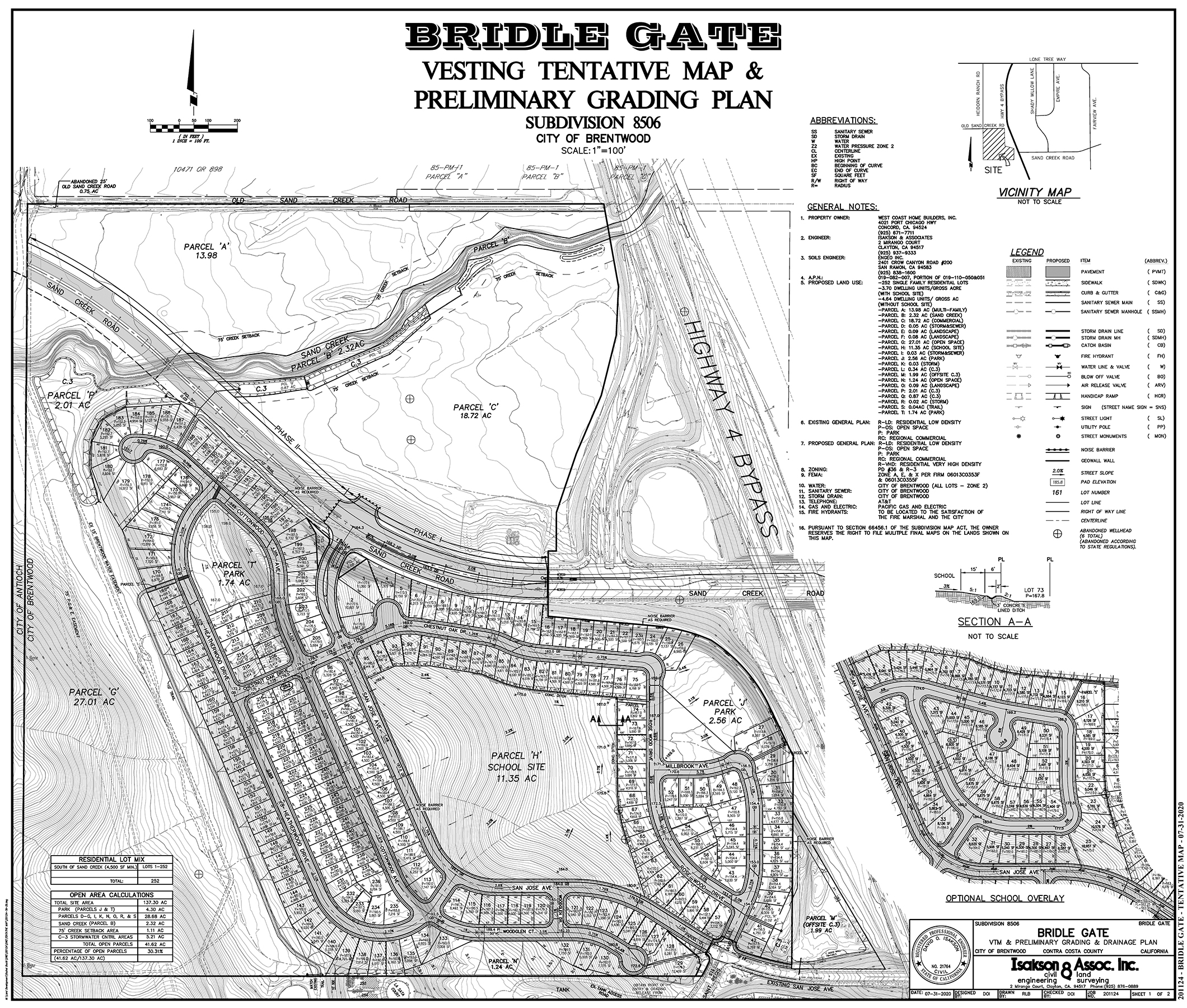
See the school site in the large open area toward the bottom of the site map, and the potential overlay of 63 additional homes to the right.

Results in 63 fewer homes built

BRENTWOOD, Calif., Sept. 11, 2020 – West Coast Home Builders, Inc., a development company owned by the Seeno family, and the Brentwood Union School District have entered into an agreement that opens the door for the district to acquire a prime piece of Bay Area real estate, well below market value, for the construction of a new elementary school.

School district staff recommended approval of the agreement, and the school board members unanimously approved the agreement on Aug. 19, 2020.

The Brentwood Union School District has been trying for years to find suitable land to build a much-needed elementary school to help relieve overcrowding at some of its elementary schools and accommodate future growth in the district. The agreement between West Coast Home Builders and the district is a significant step forward and an important opportunity toward making this new elementary school a reality.

The impact on the district will include reducing overcrowding, a lower student-teacher ratio, and reducing the use of portables.

“We’ve been negotiating a school site there for a very long time,” BUSD Board Trustee Emil Geddes confirmed. “We just hadn’t achieved the final solution with Seeno, until now.”

“We approved that we want that site,” he continued. “But we haven’t come to the final purchase price and agreement for the property.”

It will also mean 63 fewer homes will be built at the site, as was an option in the Vesting Tentative Map overlay. (See Site Plan above)

In 2016, Brentwood voters passed Measure B, a school bond measure that will fund much of the proposed elementary school construction costs. School construction costs have skyrocketed in California, so building a new school is very difficult for districts without some form of subsidy. In this case, West Coast Home Builders will be subsidizing the cost of the land, which is critical to making a new elementary school a reality.

The 11.35-acre school site is located within the proposed Bridle Gate community, west of Highway 4 (bypass) and south of Sand Creek Road in Brentwood, California. The proposed development will bring much-needed housing to the Bay Area, which has been chronically undersupplied for years, leading to the current affordability crisis. The project’s proximity to both highway and commercial areas, coupled with a school site that will be walkable for students and parents, also lowers environmental impacts to the area.

In a dramatic savings to the district, an appraiser will value the school site land as agricultural rather than residential. Residential land values are substantially higher than agricultural land values. This essentially means the district will be paying pennies on the dollar for the land. This is a true partnership between a growing school district and a longtime community builder, who is committed to supporting local schools and children.

The sale of this land to the district is contingent on West Coast Home Builders receiving the necessary environmental and project approvals from the Brentwood City Council for the Bridle Gate project. West Coast Home Builders has included this school site in its proposed development plan, and the city has included this school site in its environmental analysis of the housing project.

The project will be up for approval before the city council during a special meeting next Tuesday, Sept. 15 at 7:00 p.m. According to California Government Ethics Law in Government Codes §§ 87100 and 87103 a public official may not make, participate in, or influence a governmental decision that will have a reasonably foreseeable and material financial effect on the official, the official’s immediate family, or any of the official’s financial interests. Because Councilwoman Claudette Staton’s personal residence is too close to the project site, she will have to recuse herself and not participate in voting on the project, as it could affect the value of her home. The decision will therefore be left up to the other four council members.

State Letter Says Staton Can’t Vote on Project

UPDATE: Upon request from the Herald, Staton provided a copy of the August 10, 2020 letter from the state Fair Political Practices Commission (FPPC) to Brentwood Assistant City Attorney Katherine Wisinski which provides the reason why Staton cannot vote on the project due to her conflict of interest under the state’s Political Reform Act. In the letter, the FPPC asks the following question: “Under the Act, may Councilmember Staton take part in governmental decisions pertaining to a city development project that would involve the construction of hundreds of new homes, among other significant developments, and potentially affect property views, traffic levels, and air quality, given that she owns real property less than 1000 feet from the project site?”

The FPPC’s letter then answers the question writing, “No, given the scope and impacts of the project, as well as the proximity of Councilmember Staton’s real property, it is reasonably foreseeable that the project would have a material financial effect on Councilmember Staton’s property by changing its market value and income producing potential, and air quality. Accordingly, Councilmember Staton is disqualified from taking part in project decisions under the Act, and consequently must recuse herself from those decisions.” Read the entire four-page letter, here: FPPC Ltr re Staton Bridle Gate vote Final A-20-085

To read the agenda item and details click, here.

Allen Payton contributed to this report. 


’16 Measure B follow up, helping his budget etc.).

Filed Under: East County, Education, Growth & Development, News

Regional agencies seek input on the future of the Bay Area

July 10, 2020 By Publisher Leave a Comment

For transportation, housing, economy and environment for next three decades

Plan Bay Area 2050’s Draft Blueprint is available for public comment through August 10, 2020

SAN FRANCISCO, July 10, 2020 . . . The Metropolitan Transportation Commission (MTC) and the Association of Bay Area Governments (ABAG) are inviting the Bay Area public to provide input on the newly released Plan Bay Area 2050 Draft Blueprint, a 30-year regional vision that seeks to create a more affordable, connected, diverse, healthy and vibrant Bay Area for all. The Draft Blueprint is being released today for a public comment period that will run through August 10, 2020.

Given the myriad challenges the COVID-19 pandemic poses to the Bay Area, MTC and ABAG will hold virtual workshops and telephone town halls through August 7, 2020. Both organizations want to hear from all Bay Area residents in order to incorporate diverse voices from across our region. Input received by the agencies will be used to further refine the Final Blueprint to create a more resilient and equitable Bay Area for future generations. The Final Blueprint is slated for approval in late 2020 and will be integrated into Plan Bay Area 2050 prior to its adoption in 2021.

The Plan Bay Area 2050 Draft Blueprint weaves together transportation, housing, economic and environmental strategies, alongside an expanded set of growth geographies, to advance critical climate and equity goals. Designed to accommodate the 1.5 million new homes necessary to house future growth and address overcrowding, as well as 1.4 million new jobs, the Draft Blueprint integrates critical strategies to address our severe and longstanding housing crisis. With infrastructure investments in walking, biking and public transportation – as well as sea level protections designed to keep most Bay Area communities from flooding through 2050 – the Draft Blueprint makes meaningful steps towards the adopted Plan Bay Area 2050 Vision.

Plan Bay Area 2050 is a joint initiative of MTC and ABAG. For more information on Plan Bay Area 2050 or to provide comments on the Draft Blueprint, visit: www.planbayarea.org. The entire list of public events can be found here: www.planbayarea.org/meetings-and-events/upcoming-public-events.

See previous plans here – Plan 2040  Plan Bay Area

MTC is the transportation planning, financing and coordinating agency for the nine-county San Francisco Bay Area. ABAG’s mission is to strengthen cooperation and collaboration across local governments to build healthier, stronger communities.

Filed Under: Economy, Environment, Government, Growth & Development, Jobs & Economic Development, News, Transportation

Payton Perspective: If Brentwood voters don’t approve Measure L Antioch should annex the land and approve the homes

October 8, 2019 By Publisher 16 Comments

Area map showing the land for the planned development highlighted in gold that the passage of Measure L would annex to Brentwood. From the planning documents for the proposed Vineyards at Deer Creek development.

In November, Brentwood voters will have the opportunity to do what Antioch voters did in 2005 and that was to approve a new housing development and undo what the five members of the Board of Supervisors did to a few landowners and the plans by Antioch and Brentwood. On the ballot is Measure L, which will annex about 800 acres and approve 2,400 new, upscale homes, 80% of which will be for seniors.

The land in the Measure L plan has been inside both the City of Antioch’s and City of Brentwood’s planning areas for decades. However, it’s not been in either city’s sphere of influence or city limits. It was also inside the voter-approved Urban Limit Line, until the County Supervisors played political games and moved it out, in 2003. That included the land that was planned for the Roddy Ranch housing development surrounding the former Roddy Ranch golf course, as well as all the land north of the ridge line that runs on the south side of the former golf course and continues into Brentwood behind Heritage High School and Adams Middle School. So, it makes sense the land is moved back inside the Urban Limit Line and the homes built.

1998 was my final of four years serving on the Antioch City Council, the Contra Costa Transportation Authority, and the State Route 4 Bypass Authority. That year, while serving as chairman of the Bypass Authority, we bought the right-of-way for the extension to Highway 4 from Lone Tree Way to Balfour Road for four lanes of traffic and two lines of transit, down the center.

The plans and funding for the Highway 4 widening and bypass/extension, as well as the major roadways in Antioch, included those homes. In fact, a total of 12,000 homes were included in the planning for the regional roads in East County. Now, the plans in Antioch include only 4,000 homes, and the 700 homes at Roddy will never be built because that land was sold to the East Bay Regional Park District and is permanent open space.

The homes in Measure L will not create urban sprawl as some opponents are claiming. I laugh when I hear that about growth in Contra Costa County. I grew up in Southern California and was a chauffeur while attending college in Riverside, driving clients into Orange County and Los Angeles where I saw the results of urban sprawl. But, in our county, the Urban Limit Line protects about 65% of the land in the county from subdivision development. This land is inside the 35% of the land that the voters said could be built on. That’s why the land was purchased by developers years ago – before the Supervisors arbitrarily moved the line in.

It’s time either Brentwood or Antioch voters corrected their action.

If Brentwood doesn’t want them, those are the kind of homes Antioch wants and needs for our housing mix, especially now that Roddy Ranch is permanent open space and the homes planned for the western Sand Creek area might never be built.

Filed Under: East County, Growth & Development, Opinion

On split vote by Supervisors county to temporarily stop collecting “discriminatory” adult criminal justice fees

September 19, 2019 By Publisher Leave a Comment

Direct DA’s office to reopen 2005 Lafayette murder case; approve new land development fees

By Daniel Borsuk

On a thin 3-2 vote, the Contra Costa County Board of Supervisors on Tuesday slapped a temporary moratorium on the County’s collection and assessment of 14 Adult Criminal Justice Fees that will cost the county $1.8 million in revenue a year should the moratorium become permanent.

During Public Safety Committee meetings, Chairperson John Gioia of Richmond and Supervisor Federal Glover of Pittsburg agreed with citizen committee members the fees are discriminatory to persons of color and likely result in longtime economic or financial hardship for persons who had a criminal record.

An “aye” vote from District 3 Supervisor Diane Burgis of Brentwood meant the county will temporarily stop the collection of fees, including the Sheriff Central Administration’s Booking Fee that will generate about $40,000 in 2019/2020, and the Adult Probation Supervision Fee that potentially could have generated nearly $1.8 million in 2019/2020 revenue.

The temporary moratorium will be effective immediately with the Board expecting to reevaluate the moratorium’s progress no later than Dec. 31, 2019. Supervisors will reassess the value of the moratorium at a December meeting.

Even though the county’s coffers are plentiful, with supervisors also officially adopting on a 5-0 vote the county’s $3.6 billion 2019-2020 final budget, the county is spending funds at a rapid pace through newly inked employee-union labor agreements like a 3.44 percent pay hike for social workers, an 8 percent salary raise for county supervisors that went into effect in July, and tacking on an additional $7.5 million in costs to the new Administration Building and new Emergency Operations Center/Public Safety Building to improve the security and communication capabilities during emergencies.

During a three-hour discussion on the item, Board Vice Chair Candace Andersen consistently opposed the moratorium on grounds that by dropping the fees for all persons, individual with the financial resources will benefit the most. “There are a lot of people who are committing these crimes who have the ability to pay these fees,” said the supervisor from Danville. “There is no reason why we shouldn’t be assessing these fees.”

In arguing against the proposal, District 4 Supervisor Karen Mitchoff said the elimination of $1.8 million of criminal justice fees could financially impact social and health programs such as drug diversion programs that assist persons with criminal records. “I cannot support the moratorium at this time,” the supervisor from Pleasant Hill declared.

But there were a number of citizens in support of the proposal to eliminate the fees.

“There are many people I have represented who 15 to 20 years later did not know that they’d have their wages garnished or face the ongoing inability to pay even though they have jobs and families,” said Mary Sylla, an attorney at Rubicon Programs.

“We urge you to do the right thing,” pleaded Ali Saidi, head of the Contra Costa Public Defenders Association, “These fees impact people of color.”

Request to Reopen Lafayette Murder Case Referred to DA’s Unit

Antioch private investigator and former Antioch Councilman Ralph Hernandez’s pitch, to have the 2005 murder case of Pamela Vitale of Lafayette reopened, got the thumbs up from the board of supervisors. The case was referred to Contra Costa District Attorney’s newly created conviction integrity unit. In this instance, Scott Dyleski, who Hernandez represents, was convicted for the October 2005 murder of Vitale.

“Your assistance in directing such from your two agencies (D.A.’s Office and Public Defender’s Office) is more than warranted,” Hernandez said. “Fourteen years of Scott’s youth has already been denied him and he still faces many more if this very serious matter is just ignored by all. Pamela Vitale’s memory deserves that the truth be determined, not ignored.”

Supervisors did not comment openly about the case, but Gioia consented that at least the DA’s new conviction integrity unit review the case.

New Land Development Fees Approved

Without opposition from either supervisors or the public, supervisors unanimously approved new land development fees charged for services performed by the Department of Conservation and Development and the Public Works Department starting March 1, 2020.

Some fees like encroachment fees have not been adjusted since 1995 and in many instances, rates are decreasing “due to economy of scale,” John Kopchik, director of the Contra Costa County Department of Conservation and Development told the Contra Costa Herald.

Supervisors withheld action on a proposal to charge a $1,000 fee for the time and materials needed to submit and process applications for nomination of a building or cultural resource for consideration before the Historical Landmarks Advisory Committee.

“The Historical Landmarks Advisory Committee believes that the current and proposed fees of $1,000 deposit and time and materials required to submit and process applications to nominate historical and cultural resources to the County’s Historic Resources Inventory (HRI) are a deterrent to public participation in the program.

“The HLAC voted at their meeting held on August 8, 2019 to make a formal recommendation to the Board of Supervisors to reduce these fees to encourage organizations or individuals to nominate potential resources to be designated to the HRI,” Historic Landmark Advisory Committee staff member Dominique Vogelpohl wrote on August 26.

Filed Under: Crime, Growth & Development, News, Supervisors

  • « Previous Page
  • 1
  • 2
  • 3
  • 4
  • 5
  • 6
  • Next Page »
Monicas-11-25
Deer-Valley-Chiro-06-22

Copyright © 2026 · Contra Costa Herald · Site by Clifton Creative Web