• Home
  • About The Herald
  • Local Agencies
  • Daily Email Update
  • Legal Notices
  • Classified Ads

Contra Costa Herald

News Of By and For The People of Contra Costa County, California

  • Arts & Entertainment
  • Business
  • Community
  • Crime
  • Dining
  • Education
  • Faith
  • Health
  • News
  • Politics & Elections
  • Real Estate

Housing construction is key to Contra Costa’s economic rebound in “Post-COVID New World Order” Supervisors told

January 29, 2022 By Publisher Leave a Comment

Construction Activity in Contra Costa County. Source: Beacon Economics

By Daniel Borsuk

A housing boom in the single family and multi-family residential construction sectors will jump start Contra Costa County’s economy in the post-COVID 19 era, economist Dr. Christopher Thornberg told the Contra Costa County Board of Supervisors during their retreat on Tuesday.

“Housing, housing, housing is the wave of the future for Contra Costa County,” Dr. Thornberg of Beacon Economics said during a two-hour remote presentation entitled “The Post-Covid New World Order: It’s a seller’s market for now.”

In 2021, Contra Costa County outpaced other Bay Area counties especially San Francisco and Alameda counties in issuing single family and multi-family residential permits, the economist said.  Housing construction serves as an economic sparkplug for the local economy – stores and services, especially public schools.

From this increased economic activity, the county will draw increased sales tax revenue particularly from the newly voter approved Measure X sales tax measure.  County officials estimate Measure X will pump in $170 million of additional revenue for county health and social programs for the 2022-23 fiscal year.

Contra Costa County had issued 1,687 permits in 2021 for single family residential units, an increase of 466 permits from 2019 and 1,336 permits for multi-family residential units, an increase of 580 units from 2019, based on statistics that Dr. Thornberg showed.

In the meantime, San Francisco City and County issued only 86 single-family housing permits in 2021, an increase of only nine permits from 2020, and 2,075 multi-family residential unit permits in 2021, a decrease of 552 permits, from 2020.

Residential construction in Alameda County was down in both categories. Single family was declined 41 permits with 1,241 permits issued overall in 2021.  Multi-family residential construction was also down 126 units to 2,953 units multi-family residential unit permits overall.

“Offices are going to take a beating in the suburbs,” the economist forecast. More people are working from home, and it appears this remote trend is here to stay for a while, he said.

In San Francisco’s Financial District, where it is nearly deserted because of the pandemic, there are office buildings that are practically empty of workers, Thornberg said.  He said it would be very costly to convert unused office buildings into residential buildings in the city.

79.8 Percent Fully Vaccinated 

Meanwhile, Contra Costa County Health Services Director Anna Roth reported that 79.8 percent of the county’s population is fully vaccinated.

“Mask-wearing has become a priority and wearing cloth masks are not that protective,” said Roth

Even then there has been a surge in the number of COVID-19 cases in the county Deputy Health Officer Dr. Ori Tzvieli said with 281 patients hospitalized with COVID-19 or the Omicron variant.

Supervisors also learned the county on average administers 12,000 COVID-19 tests daily.

Nino Recommends Postponing $59 Million of American Rescue Plan Funds

Supervisors also, on the recommendation of County Administrator Monica Nino, voted 5-0 to postpone the acceptance of $59 million of the second-year allocation of American Rescue Plan funds “until the status of the COVID-19 pandemic and related impacts on Contra Costa County is better understood in January 2023,” she stated.

In the meantime, some $53 million in year two American Rescue Plan funds be accept by the county.

Nino had cited bureaucratic red-tape issues both at the state and federal levels for temporarily halting portions of the federal funds used for rental assistance, employment assistance and other federal government subsidy programs developed during the COVID-19 pandemic.



Filed Under: Construction, Growth & Development, Health, News, Supervisors

Contra Costa Supervisors on 4-1 vote approve all-electric buildings ordinance banning natural gas installations

January 19, 2022 By Publisher Leave a Comment


Starting June 1, 2022; 200-gallon natural gas tanks still permitted for rural users

“Many of my constituents view this ordinance as an overreach ordinance and I happen to agree with them” – Supervisor Andersen

By Daniel Borsuk

Starting June 1, Contra Costa County will be the first county in the Golden State requiring all new residential, business, commercial and hospitality developments have electricity, and outlawing natural gas installation. On a 4-1 vote Contra Costa County Board of Supervisors approved the ordinance that attracted scant public opposition. District 2 Supervisor Candace Andersen was the lone opposition vote.

The new ordinance applies to all new residential, commercial, office, and hospitality developments proposed for unincorporated Contra Costa County.  It does not apply to incorporated areas, except the City of Richmond that has adopted its own electricity building ordinance.

“Many of my constituents view this ordinance as an overreach ordinance and I happen to agree with them,” said Andersen of Danville, who cast the lone opposition vote.  “It is my concern this ordinance might impact commercial development nearby the Byron and Buchanan airports.”

There was no opposition to the Board’s ordinance that was up for second reading.

“This is a good environmental policy for the county,” said District 1 Supervisor John Gioia, who championed the resolution.

“I am concerned about the equity issue.  This could raise rents of low-income housing tenants,” said Board Chair Karen Mitchoff of Pleasant Hill, who voted in favor of the ordinance anyway.

“I am supportive of this ordinance,” commented District 3 Supervisor Diane Burgis after planning department staff answered her question on whether rural constituents could still own and use 200-gallon natural gas tanks for “emergency use.”  Planning officials confirmed 200-gallon natural gas tanks will be permitted for rural users.

“While this proposed ordinance has been charactered as an electrification ordinance, its purpose is to stop new buildings from burning fossil fuels,” wrote Gary Farber on behalf of the environmental group, 350 Contra Costa. “Therefore, solar thermal space heating and water heating systems ought to be allowed and encouraged.  We look forward to working with the County on additional programs to phase out fossil fuels in transportation and all buildings, new and existing.”

The move by the Board of Supervisors occurs when there is skepticism on whether the State has an adequate supply of wind and solar renewable energy in the Golden State to meet the demand for all electric homes and businesses.  The California Clean Energy Act of 2018 established a target for renewable zero-carbon resources to supply 100 percent of electrical needs throughout the state by 2045, 23 years from now.

Retain $2,500 Campaign Contribution Limit

Even though briefly considered a recommendation boost, the Election Campaign Contribution limit from $2,500 to $4,900, Supervisors voted to retain the Election Campaign limit at $2,500.

“I feel comfortable at the $2,500 limit,” commented District 2 Supervisor Andersen.

Supervisor Glover said as much as he’d preferred to go with the State-recommended $4,900 limit, he said “I’d vote for more money, but I don’t think we should.  Elections are getting more expensive.” Glover is not up for re-election this year.

44th Annual Dr. Martin Luther King Jr Ceremony Honorees

Supervisors also recognized 44th Annual Dr. Martin Luther King Jr. honorees – Gigi Crowder, an Antioch resident, who is the Executive Director of the National Alliance on Mental Illness as the Adult Humanitarian of the Year and Pittsburg resident, Kaia Morgan, a Senior at Ygnacio Valley High School as the Student Humanitarian of the Year. (See related articles here and here)


Filed Under: Business, Environment, Growth & Development, News, Supervisors

Final Regional Housing Needs Allocation Plan requires 441,176 more homes in Bay Area by 2031

December 17, 2021 By Publisher 2 Comments

Source: ABAG

44,000 more in Contra Costa

After two years of collaboration, plan to expand Bay Area’s housing opportunities approved during public hearing, Thursday night

“The next steps are for (the 110) Bay Area cities, towns and counties to update their housing elements by January 31, 2023…and plan for housing at all income levels.” – ABAG President and Berkeley Mayor Jesse Arreguín

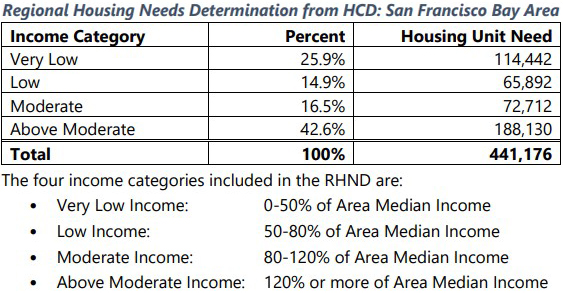
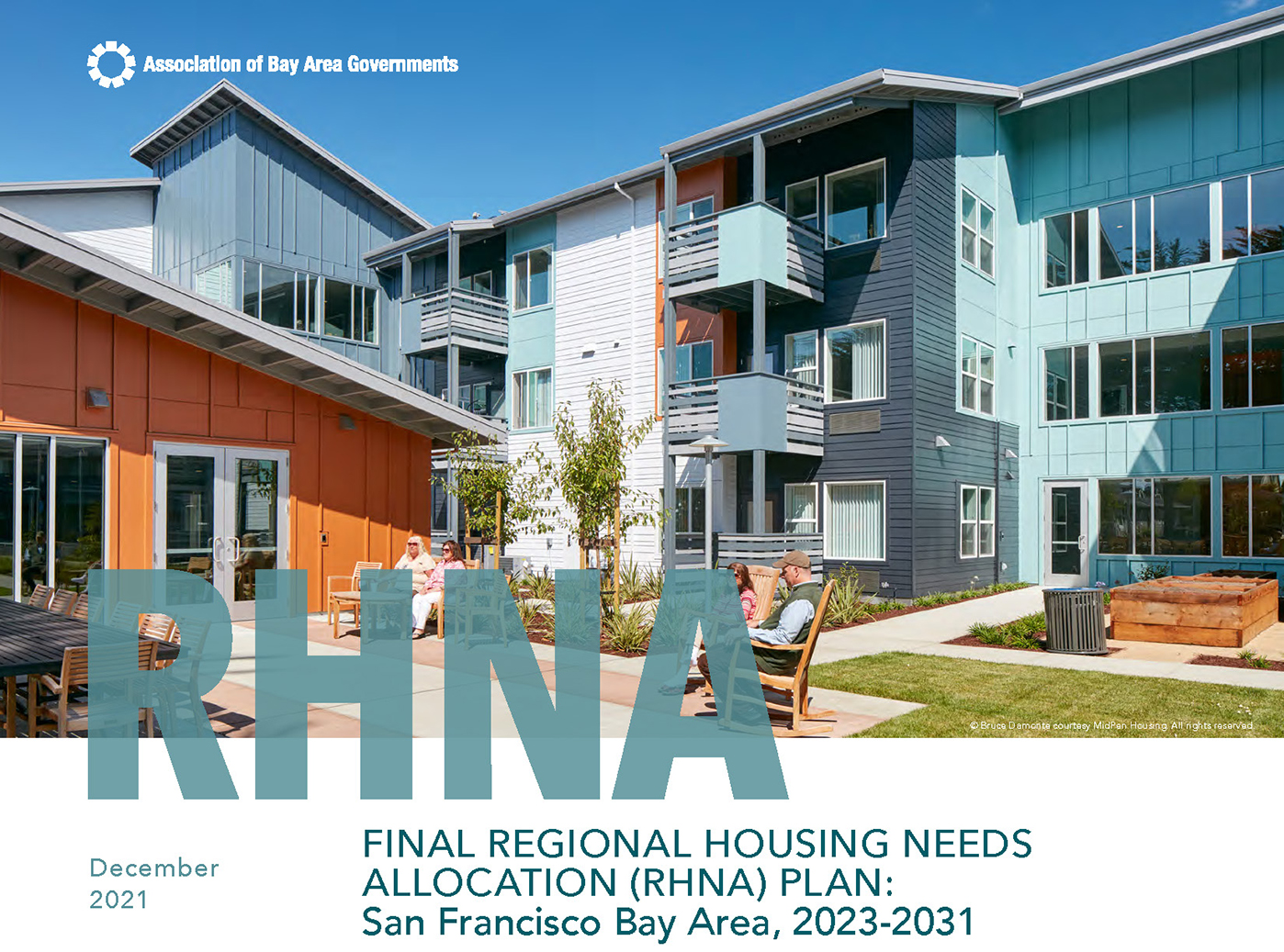
SAN FRANCISCO, December 17, 2021 . . . The Association of Bay Area Governments (ABAG) at last night’s Executive Board meeting approved the Final Regional Housing Needs Allocation (RHNA) Plan for the San Francisco Bay Area, 2023-2031.  The state Housing and Community Development Department requires the Bay Area to plan for and revise local zoning to accommodate 441,176 additional housing units during the 2023-31 period.  The approved final RHNA plan distributes this requirement among the region’s nine counties and 101 cities and towns, with allocations ranging from 72 units in the Napa County town of Yountville to more than 82,000 units in San Francisco.

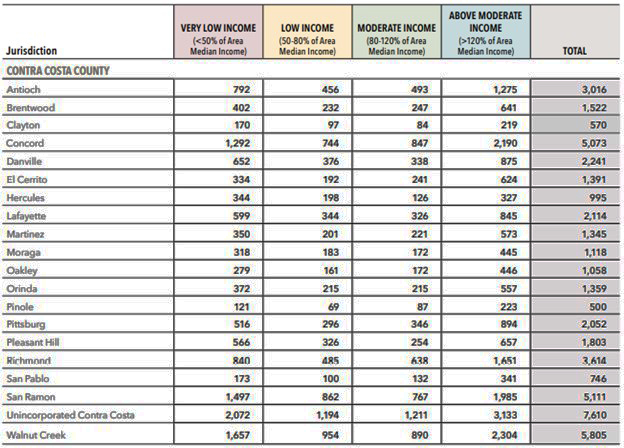
The plan requires communities in Contra Costa County to add 43,970 housing units, almost 10% of the total, during the time period, with Walnut Creek (5,805 units), San Ramon (5,111) and Concord (5,073) being allocated the highest number of housing units, followed by Richmond and Antioch being allocated 3,614 and 3,016 units, respectively.

Source: ABAG

“The Final RHNA Plan’s passage concludes a two-year regional collaborative process, reflecting hundreds of hours of work by staff, elected officials and stakeholders,” noted ABAG President and Berkeley Mayor Jesse Arreguín. “This is an important step in our region’s efforts to address our housing crisis. Every city and county must do their part to address our housing and homelessness crises. With this RHNA Plan, local governments will have to rezone and plan for significantly more housing than before. This plan also affirmatively furthers fair housing by distributing housing growth equitably throughout the region addressing decades of racial and economic segregation. This is also part of a much bigger effort being undertaken by ABAG and the Metropolitan Transportation Commission to provide resources and technical assistance to local agencies and generate new funding sources for affordable housing in the Bay Area.”

Source: ABAG

“The next steps,” Arreguín continued, “are for Bay Area cities, towns and counties to update their housing elements by January 31, 2023, to reflect the new RHNA allocations and plan for housing at all income levels. The Regional Housing Technical Assistance Program (RHTA) is ready to provide local jurisdictions with the financial support and technical assistance they need to complete these steps.”

Funded by the state’s Regional Early Action Planning grant, ABAG created RHTA to help local agencies update the housing elements of their general plans, ensuring that Bay Area cities, towns and counties take the steps to move from plans to implementation and remain competitive for various state funding programs to increase housing opportunities. RHTA includes some $11 million in direct assistance to local governments as well as other support.

Source: ABAG

The Bay Area Housing Finance Authority (BAHFA) is another part of ABAG’s and the Metropolitan Transportation Commission’s expanded regional housing portfolio. “As the first regional housing finance authority in California, BAHFA has the potential to raise hundreds of millions of dollars to help meet the Bay Area’s urgent housing affordability challenges,” explained Oakland Mayor Libby Schaaf, who chairs the BAHFA Oversight Committee. “The RHNA Plan establishes the housing at each income level that Bay Area’s communities need to plan for, but BAFHA provides an opportunity to fund the solution: providing more housing for everyone in the Bay Area. This makes it an important part of the Bay Area’s housing toolbox as we work together to protect existing affordable housing, to prevent displacement of current residents and to promote the construction of more new housing units.”

ABAG is the council of governments and the regional planning agency for the 101 cities and towns, and nine counties of the Bay Area. Additional information is available on the regional housing programs’ individual webpages:

RHNA: https://abag.ca.gov/our-work/housing/rhna-regional-housing-needs-allocation

RHTA: https://abag.ca.gov/our-work/housing/regional-housing-technical-assistance

BAFHA: https://abag.ca.gov/our-work/housing/bahfa-bay-area-housing-finance-authority

Allen Payton contributed to this report.

Filed Under: Bay Area, Growth & Development, News

Superior Court upholds City of Lafayette’s approval of 315-unit Terraces apartment project

November 18, 2021 By Publisher 1 Comment

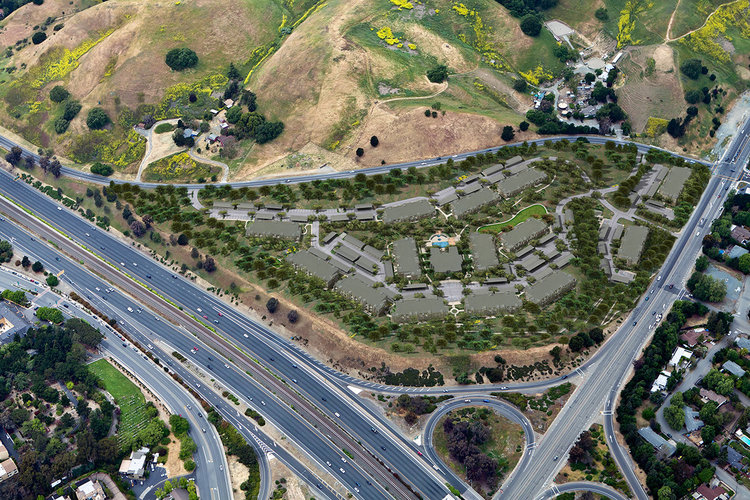
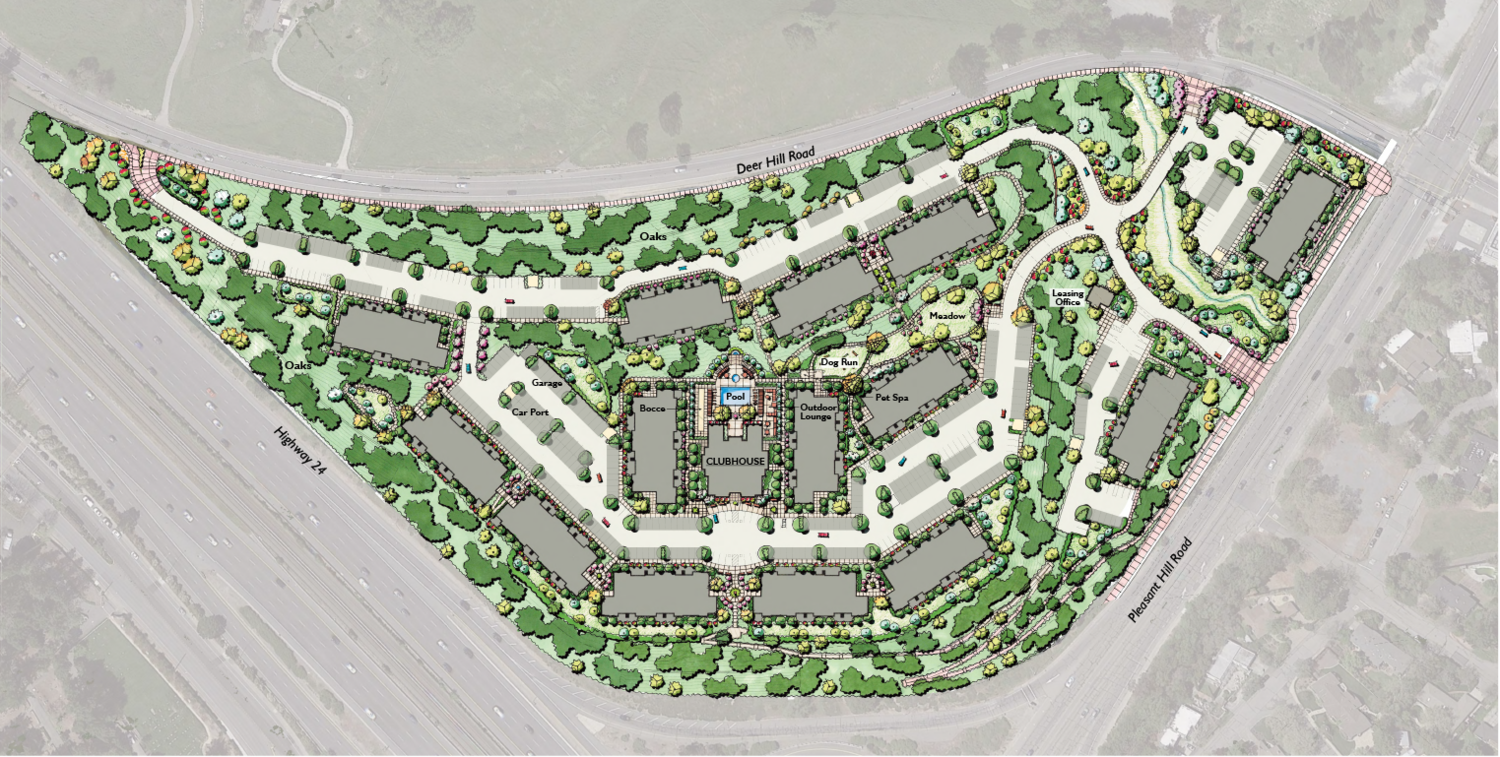
The planned Terraces of Lafayette apartment project that will overlook Highway 24. Source: O’Brien Land Company

By Suzanne Iarla, Communications Analyst, City of Lafayette

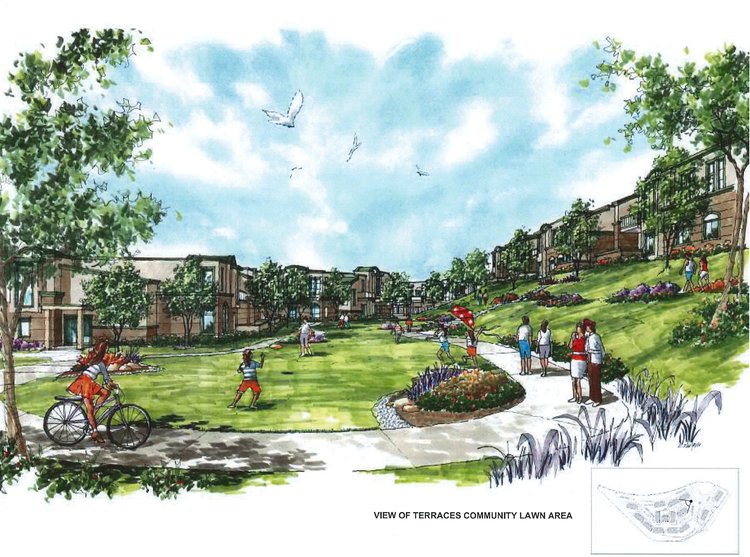
Terraces of Lafayette rendering. Source: O’Brien Land Company

On Friday, November 12, 2021, the Contra Costa Superior Court upheld the City of Lafayette’s approval of the Terraces of Lafayette project of the O’Brien Land Company. The project would build 315 apartments, including 63 affordable housing units, on a 22-acre parcel at the southwest corner of Deer Hill Road and Pleasant Hill Road. In its ruling, the Court rejected claims by Save Lafayette, a citizens group, and found that the City’s environmental review complied with the California Environmental Quality Act (CEQA) and that the Terraces project was consistent with the City’s General Plan.

The Terraces project has been in process for over ten years — the developer’s application dates back to March 2011.  Since then, the City has worked to address community and regional concerns, including by considering a proposed alternative 44 single-family home project with a community park. The City approved the alternative project in 2015. Save Lafayette initiated the referendum process to overturn that approval in 2018.

After the alternative project was rejected by the voters, the City resumed processing the original Terraces project application. In compliance with the strict requirements of State law, including the Housing Accountability Act, the City approved the Terraces project in August 2020.

Save Lafayette sued in September 2020 to overturn the approval, in an effort to stop the Terraces project on environmental and General Plan consistency issues.  After over a year of litigation, the Superior Court rejected Save Lafayette’s claims and affirmed that the City’s CEQA review and approval of the Project complied with the law. The Court’s ruling will become final unless Save Lafayette appeals within 60 days following the notice of entry of judgment.

Terraces of Lafayette Site Plan updated 2-11-20. Source: O’Brien Land Company.

Developer Calls Court Decision “Major Victory”

The developer issued their own press release announcing last Friday court’s decision:

In a major victory for housing rights, the Contra Costa Superior Court on Friday, Nov. 12 issued a ruling rejecting in full Save Lafayette’s lawsuit challenging the Terraces of Lafayette, a 315-unit apartment community by O’Brien Land Company.  After nearly 10 years of processing and 120 public hearings, the Lafayette City Council approved the project by a 4-1 vote in August 2020.

“We have had many local people reach out to us to ask when they can rent an apartment at the Terraces,” said Dennis O’Brien of O’Brien Land Company. “The need for this type of housing is apparent, and we look forward to no further delays so we can provide homes for those individuals and families.”

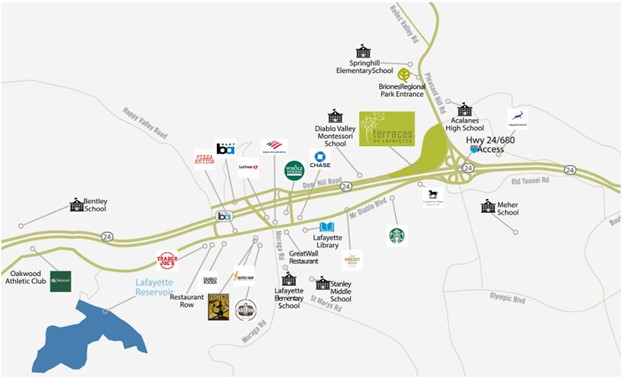
Terraces of Lafayette vicinity map. Source: O’Brien Land Company.

The project site is adjacent to Highway 24 and located one mile from the Lafayette BART station.  The Terraces is considered an affordable housing project under state housing law and will set aside 20%, or 63, of its dwelling units for lower income households.  This will substantially assist Lafayette in meeting its Regional Housing Needs Allocation (RHNA) for the lower income categories assigned to it by long-standing state law.

Despite the project’s robust legal protections under controlling state law, Save Lafayette has been opposing the project for years. The anti-development group also opposed a 44 single-family home compromise project by filing litigation and a ballot referendum that overturned the smaller project.  Once the voters rejected the smaller project, O’Brien and the City of Lafayette resumed processing the apartments.

Terraces of Lafayette clubhouse and pool area rendering.  Source: O’Brien Land Company.

Although the affordable housing development included a full Environmental Impact Report, Save Lafayette’s lawsuit claimed the City’s approval of the project violated the California Environmental Quality Act, a law frequently employed by anti-development groups to challenge new housing.  The lawsuit also claimed the project was not entitled to the protection of the Housing Accountability Act, which shields housing developments from changes in local land use laws after an application is deemed complete.  The Superior Court rejected Save Lafayette’s arguments and agreed that the City complied with the law.

“When people ask why we have a housing crisis in California, they should look no further than this project for answers,” Bay Area Council Senior Vice President Matt Regan emphasized. “Over 10 years of foot dragging, goalpost moving, ballot measures and lawsuits, finally the construction of these much- needed homes can now begin.  This saga highlights the need for more reforms to state law so that good housing projects no longer have to run this sort of gauntlet and can be approved swiftly and fairly.”

For more information on the project, visit www.lovelafayette.org/Terraces.

Allen Payton contributed to this report.

Filed Under: Growth & Development, Lamorinda, Legal, News

ABAG, MTC adopt final Plan Bay Area 2050 and Environmental Impact Report

October 25, 2021 By Publisher 1 Comment

“$1.4 trillion vision for a more equitable and resilient future for Bay Area residents” in the areas of housing, the economy, transportation and the environment

“Roadmap toward a more affordable, connected, diverse, healthy and vibrant region for all”

Includes “strategies that would produce more than 1 million new permanently affordable homes” and an effort to “Implement a statewide universal basic income” to “provide an average $500 per month payment to all Bay Area households”

The Association of Bay Area Governments (ABAG) and the Metropolitan Transportation Commission (MTC), during their joint meeting Thursday evening, Oct. 21, 2021, unanimously adopted Plan Bay Area 2050 and its associated Environmental Impact Report. The unanimous votes by both boards cap a nearly four-year process during which more than 20,000 Bay Area residents contributed to the development of the new plan.

All six representatives from Contra Costa County, including Supervisors Candace Andersen and Karen Mitchoff, Richmond Mayor Tom Butt and San Ramon Councilman Dave Hudson, who serve on ABAG, as well as Supervisor Federal Glover and Contra Costa City Representative Amy Worth, Mayor of Orinda, who serve on MTC, voted to adopt the plan.

Defined by 35 strategies for housing, transportation, economic vitality and the environment, Plan Bay Area 2050 lays out a $1.4 trillion vision for policies and investments to make the nine-county region more affordable, connected, diverse, healthy and economically vibrant for all its residents through 2050 and beyond. From housing strategies that would produce more than 1 million new permanently affordable homes by 2050 to transit-fare reforms that would reduce cost burdens for riders with low incomes and paths to economic mobility through job training and a universal basic income, the goal of a more equitable Bay Area is interwoven throughout the plan. With a groundbreaking focus on climate change, strategies also are crafted for resilience against future uncertainties, including protection from hazards such sea-level rise and wildfires.

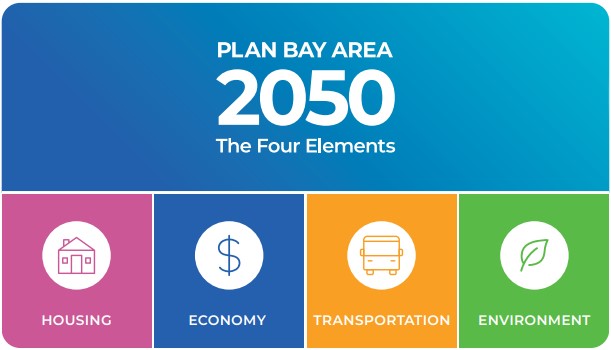
It is a long-range plan charting the course for the future of the nine-county San Francisco Bay Area. Plan Bay Area 2050 will focus on four key issues—the economy, the environment, housing and transportation—and will identify a path to make the Bay Area more equitable for all residents and more resilient in the face of unexpected challenges. Building on the work of the Horizon initiative, this new regional plan outlines strategies for growth and investment through the year 2050, while simultaneously striving to meet and exceed federal and state requirements. The Metropolitan Transportation Commission and the Association of Bay Area Governments are expected to adopt Plan Bay Area 2050 in fall 2021.

“Plan Bay Area 2050 reflects a shared vision that can’t be implemented by any single agency,” explained ABAG Executive Board President and Berkeley Mayor Jesse Arreguín. “To bring all these strategies to fruition will require ABAG and MTC to strengthen our existing partnerships and to form new ones — not just with our cities and counties and the state government, but also with the federal government, businesses and nonprofits.”

What will Plan Bay Area 2050 do? What won’t it do?

Plan Bay Area 2050 outlines a roadmap for the Bay Area’s future. While it pinpoints policies and investments necessary to advance the goal of a more affordable, connected, diverse, healthy and vibrant Bay Area, Plan Bay Area 2050 neither funds specific infrastructure projects nor changes local policies. Cities and counties retain all local land use authority. Plan Bay Area 2050 does identify a potential path forward for future investments – including infrastructure to improve our transportation system and to protect communities from rising sea levels – as well as the types of public policies necessary to realize a future growth pattern for housing and jobs.

Ultimately, Plan Bay Area 2050 reflects a shared vision – one that cannot be implemented by any single organization or government agency. Only through partnership with local, state and federal governments – as well as with businesses and non-profit organizations – will the Plan’s vision come to fruition. Before the Plan is adopted in 2021, MTC and ABAG, along with partner organizations, will create an implementation plan that will advance the strategies outlined in Plan Bay Area 2050.

MTC Chair and Napa County Supervisor Alfredo Pedroza acknowledged the work ahead. “Building and preserving affordable housing. Adapting to sea level rise. Getting more people closer to their jobs and more jobs closer to the people. Sharing prosperity equitably. All of these are big lifts. But the new plan can serve as a north star for the Bay Area’s journey to 2050.”

Among the features that distinguish Plan Bay Area 2050 from previous regional plans is an associated Implementation Plan that details the specific actions ABAG and MTC can take in the next five years to put the new plan into action.

“The Implementation Plan is a commitment to do hard things, not just think about them,” said ABAG-MTC Executive Director Therese W. McMillan. “Even if these steps have to be taken incrementally, they will lead us to a more equitable and resilient Bay Area.”

Housing Strategies

Costs for housing are estimated at $468 billion, with $237 billion budget to preserve existing affordable housing by acquiring “homes currently affordable to low- and middle-income residents for preservation as permanently deed-restricted affordable housing”. An additional $219 billion is budgeted for new, deed-restricted affordable housing and $2 billion to “further strengthen renter protections beyond state law” by limiting “annual rent increases to the rate of inflation, while exempting units less than 10 years old.”

Economic Strategies

The total cost for economic strategies in the plan is $234 billion. Of that amount $205 billion is budgeted to “Implement a statewide universal basic income” and “provide an average $500 per month payment to all Bay Area households to improve family stability, promote economic mobility and increase consumer spending.”

Transportation Strategies

The plan projects to spend a total of $578 billion is projected to be spent on transportation over the next 20 years, with most of that, $389 billion, to “restore, operate and maintain the existing system”. An additional $81 billion will be spent to “expand and modernize the regional rail network” to “better connect communities while increasing frequencies by advancing the Link21 new transbay rail crossing, BART to Silicon Valley Phase 2, Valley Link, Caltrain Downtown Rail Extension and Caltrain/High-Speed Rail grade separations, among other projects.” The third largest budget item for transportation is $32 billion to “enhance local transit frequency, capacity and reliability. Improve the quality and availability of local bus and light rail service, with new bus rapid transit lines, South Bay light rail extensions, and frequency increases focused in lower-income communities.”

Environmental Strategies

A total of $108 billion is programmed for Environmental Strategies. The largest portion of that is $30 billion to “modernize and expand parks, trails and recreation facilities”. An additional $19 billion is budgeted to “adapt to sea level rise” by protecting affected “shoreline communities…prioritizing low-cost, high-benefit solutions and providing additional support to vulnerable populations.

In addition, the plan includes $18 billion to “fund energy upgrades to enable carbon neutrality in all existing commercial and public buildings” through “electrification and resilient power system upgrades”, and another $15 billion to “provide means-based financial support to retrofit existing residential buildings.” To “protect and manage high-value conservation lands”, an additional $15 billion is included in the plan.

The adopted final Plan Bay Area 2050, the EIR, and all the supplemental reports accompanying the new plan are available online at planbayarea.org/finalplan2050.

ABAG is the council of governments and the regional planning agency for the 101 cities and towns, and nine counties of the Bay Area. MTC is the transportation planning, financing and coordinating agency for the nine-county San Francisco Bay Area.

Filed Under: Bay Area, Economy, Environment, Government, Growth & Development, News, Transportation

Supervisors aim for all electric, no natural gas for new houses by 2026

October 21, 2021 By Publisher Leave a Comment

Could add more than $2,200 to cost of a home; revise nepotism policy

NOTE: This article was inadvertently overlooked due to the publisher being sick at the time it was submitted. However, the information is still timely. Apologies for the delay in publishing it.

————————

By Daniel Borsuk

Will all new houses built in Contra Costa County feature all solar powered electric appliances and lights with no natural gas by Jan. 1 2026?

That’s the game plan of the Contra Costa County Board of Supervisors who on Tuesday, August 8 instructed the county’s Department of Conservation and Development (CCCDCD) to draft an ordinance that would require home builders to construct residential buildings with all electric powered appliances. (See Subcommittee Report and staff presentation)

Just when CCCDCD will have an ordinance ready for supervisors to consider is up in the air, but the supervisors’ action demonstrates their keen interest in environmental issues. Should the supervisors eventually pass an ordinance calling for all solar powered, electric new housing, natural gas-powered water heaters, heaters, stoves and clothes dryers will be taboo.  Everything will henceforth be solar powered. (See Cost-effectiveness Study)

Supervisors expect the proposed ordinance will go into effect on Jan. 1, 2026. (See Ad Hoc Committee on Sustainability Committee’s recommended Building Electrification Ordinance for New Construction)

Just when planning officials will have an ordinance prepared for supervisors to review and act on is up in the air, but Area 2 Supervisor Candace Andersen of Danville raised questions about the cost effectiveness of such a proposed ordinance.

“I have serious reservations about the California Energy Commission’s recommendations to replace natural gas with all electric powered homes,” said Andersen. “We need better cost analysis.  There are some estimates going around that all-electric could add $2,000 to the cost of a house.”

Andersen cast the one dissenting vote in instructing CCCDCD officials to draft an all-electric new residential ordinance.

Lisa Vonderbrueggen of the Building Industry Association of the Bay Area also cautioned supervisors about the genuine costs associated with electric powered versus natural gas-powered houses. She said a California Building Industry Association study found that an all-electric home is $421 less expensive to build, including the cost of appliance, “but estimates from homebuilders show increased costs of more than $2,200 per home.” BIA Contra Costa County All Electric Comment Letter

Vorderbrueggen wrote: “Will California’s aging electric grid hold up under an all-electricity design.  The state is already anticipating major demand increases from electric vehicle charging needs.”

While a letter from PG&E supporting the county’s move to promote all solar-powered electric homes generated scant interest from the general public, District 1 Supervisor John Gioia of Richmond said,“I appreciate PG&E’s statement and it has provided in-depth analysis. But I am very hesitant to move forward on it.”

“Do everything you can do to eliminate gas,” pleaded Richmond City Councilmember Eduardo Martinez. “I liken natural gas to the Covid-19 pandemic.”

“We need to act quickly,” said Lisa Jackson, an environmentalist.  “We cannot wait for the state to act. PG&E even supports this.  Let’s move forward to eliminate this potential safety hazard.”

Before casting his vote, District 1 Supervisor Gioia, who drives an electric-powered car said: “It’s all about full electrification as our main source of power.”

Nepotism Policy Revised

After not updating its nepotism policy since 2011, supervisors took the plunge and loosened its the rules on appointments on boards, committees and commissions for which the board of supervisors is the appointing body.

Supervisors voted 4-1, with supervisor Gioia casting the dissenting vote, brother-in-law and sister-in-law from the prohibited relationship list.

The revised policy now states:

“A person will not be eligible for appointment if he/she is related to a Board of Supervisors’ Member in any of the following relationships:

  1. Mother, father, son, and daughter.
  2. Brother, sister, grandmother, grandfather, grandson, and granddaughter.
  3. Husband, wife, father-in-law, mother-in-law, son-in-law, daughter-in-law, stepson, and stepdaughter.
  4. Registered domestic partner, pursuant to California Family Code section 297.
  5. The relatives, as defined in 1 and 2 above, for a registered domestic partner.
  6. Any person with whom a Board Member shares a financial interest as defined in the Political Reform Act  (Gov’t Code 87103, Financial Interest), such as a business partner or business associate.”


Filed Under: Growth & Development, News, Supervisors

Supervisors approve two home developments, one outside the Urban Limit Line

July 15, 2021 By Publisher Leave a Comment

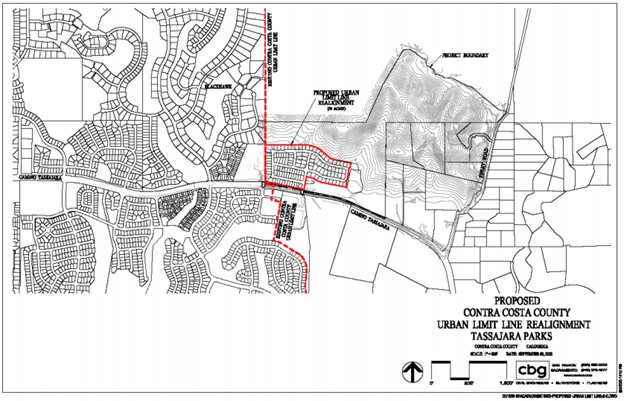
The approved Tassajara Parks Urban Limit Line realignment. From presentation.

Tassajara Parks in the San Ramon Valley and Pantages Bays in Discovery Bay will add 417 single family homes in Supervisorial District 3 with support of environmental groups

Approve Ameresco Renewable Natural Gas Processing Facility and Pipeline at Keller Canyon Landfill

Flash green light for further study moving Byron boys ranch to former Martinez Juvenile Hall

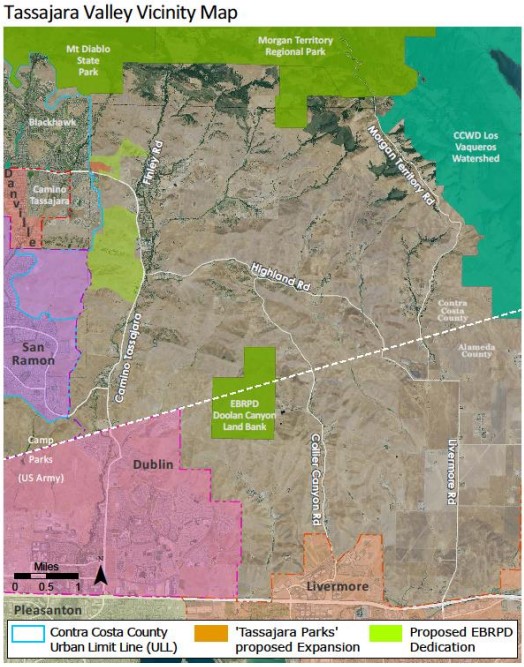
Tassajara Valley vicinity map. From presentation.

By Daniel Borsuk

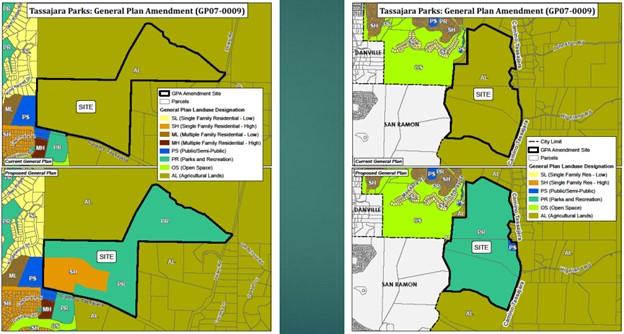
The Contra Costa County Board of Supervisors worked on solving the county’s complex housing shortage during their meeting on Tuesday by approving two major housing developments, the 277-single family housing unit Pantages residential project in Discovery Bay and the controversial 125-housing unit Tassajara Parks residential project near San Ramon, both in District 3, board chair Diane Burgis’ turf.

The more controversial Tassajara Parks Residential Project drew the support of major environmental groups like Green Belt Alliance, Save Mt. Diablo and East Bay Regional Parks District mainly because the developer’s moved to do a “fee simple transfer “of 727 acres of land to the East Bay Regional Park District.

“This fee simple conveyance to the EBRPD will ensure that the Dedication Area is protected and preserved in perpetuity for the following non-urban uses only: agriculture, open space, parks, recreation, scenic uses, wetland preservation and creation, and habitat mitigation,” the supervisors’ background information states.

Save Mt. Diablo Land Conservation Director Seth Adams called the land transfer “a great trade off” and will go a long way in the preservation of wildlife, especially raptors and eagles.

“It’s a 30-acre adjustment to the Urban Limit Line which is allowed by a four-fifths vote of the Board of Supervisors based on at least one of seven findings,” Adams shared with the Herald. “Here it was the creation of an ag preserve by two more agencies.”

The Danville city council opposed the project contending the open space trade offer was inadequate especially when California is in a drought. “The city council felt that the scope and magnitude of the project with 125 homes in exchange of open space was insufficient.  The city council did not feel it was worth the trade off, “said City of Danville Manager Joe Calabrigo.

Tassajara Parks General Plan Amendment land use maps. From presentation.

District 2 Supervisor Candace Andersen of San Ramon, who cast the lone dissenting vote, said she was concerned any action by the supervisors would require approval of the voters to adjust the urban limit line.

“I know we need the right mix of housing,” said Andersen. “If we move the urban limit line, that is up to the voters.  I have strong reservations about the environmental impact report.  Then there is no source of water for this project.”

Before supervisors approved the Tassajara Project on a 4-1 vote, District 1 Supervisor John Gioia successfully added to the board’s resolution several conditions, one that included that the developer must install solar panels and EV charging stations inside the garage or carport.  In addition, he added the installation of high efficiency appliances and insulation to zero net energy and to meet the standards to be solar-ready as defined by the California Building Standards.

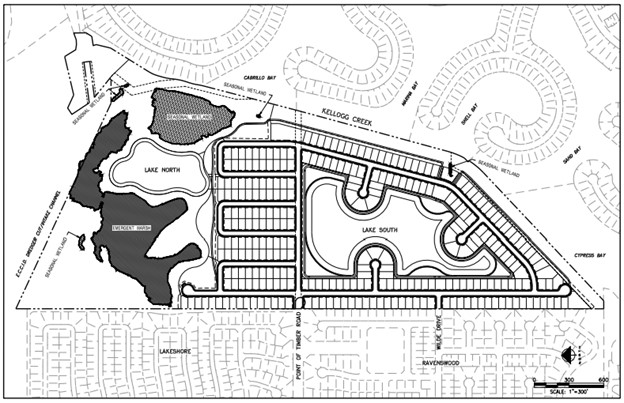
Pantages Bays site map. From presentation.

The developer agreed to Gioia’s additions to the project’s resolution of approval.

The Tassajara Parks project also garnered support from parents of Tassajara Hills Elementary School parents who were pleased the developer plans to make safety corrections to the school’s parking lot. The school is immediately west of the project’s northern side.

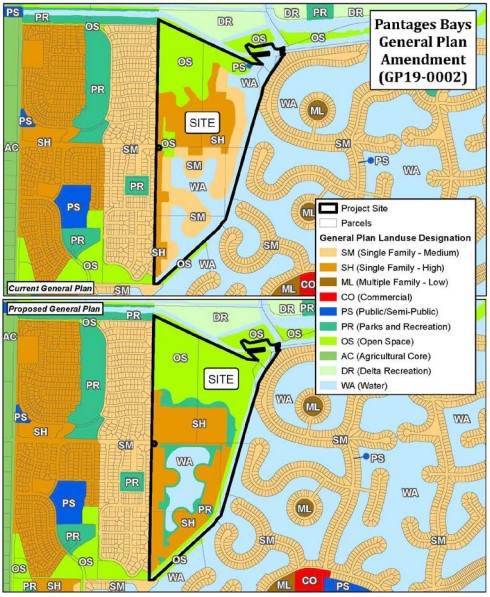
Pantages Bays General Plan Amendment maps. From presentation.

Dave Rehnstrom, EBMUD Manager of Water Distribution Planning, said contrary to the developer’s proposed water conservation efforts, “EBMUD finds this project’s water conservation measures are insufficient.”

Mainly because developers of controversial the Tassajara Parks Residential Project have proposed to dedicate 727 acres of land to the East Bay Regional Park District, that move won the support from a few environmental organizations especially Save Mt. Diablo.

After several failed attempts to obtain state and federal regulatory permit approvals since 2013, developers of the proposed Pantages Bays Project near Discovery Bay, the new project proposed would subdivide the same site into 277 residential lots, which is 15 lots less than the original 2013 project.

With two public trail systems providing 5,200 linear feet of trails and walkways, the proposed project consists of two lakes, Lake South approximately 23 acres in size, and Lake North, about seven acres in size.

Of the 277 units planned for Pantages Bay Project, about 42 units are required to be set aside as affordable housing units. Eighty percent of the affordable units, 33 units, would be affordable to Moderate income households and 20 percent of the required affordable units, 8 units, would be affordable to low-income households. “An in-lieu fee will be paid for the remaining 0.55 units,” the county planning department document states.

“This project will help alleviate a lot of the illegal dumping that occurs in that area,” Burgis observed.

Approve Amersco Natural Gas Processing Facility and Pipeline

Without receiving any public comments either in favor or in opposition, supervisors approved on a 5-0 vote Ameresco Renewable Natural Gas’s (ARNG) proposal to construct a new 48,000 square foot renewable natural gas facility on the Keller Canyon Landfill site in Pittsburg.

The publicly traded Ameresco that has been operating on the Pittsburg landfill site a RNG operation since 2009 now proposes constructing a newer RNG processing facility of about 48,000 square feet or 1.1 acres on a level pad of about 84,000 square feet. Operating 24 hours a day, seven days a week, the operation would be overseen by two operators for 40 hours per week.

According to a press release from Republic Services, which owns the landfill, “The dedication of the Keller Canyon Landfill gas-to-electricity project marks the second time this year that Republic Services, Inc. (NYSE:RSG) and Ameresco have partnered to develop and expand renewable energy sources for California and to provide power to residents of and businesses in Palo Alto and Alameda.”

“Most of the equipment would be less than 10 feet high except for the proposed enclosed flare, and a few larger pieces of equipment that would vary in height from 25 to 35 feet,” the Conservation and Development Department background document stated. “The proposed enclosed flare would be approximately 50 feet in height, similar to the two existing flares at the Keller Canyon Landfill enclosed flare facility.”

The project also calls for a new RNG underground pipeline to a proposed PG&E metering station located near the eastern edge of the Keller Canyon Landfill.  The Ameresco project has drawn some concern from Concord-based Discovery Builders that the proposed pipeline will be near a proposed residential development in Pittsburg.

A spokesman for Ameresco would not answer how much the new RNG facility and pipeline will cost.

During the supervisors’ meeting, Supervisor Federal Glover of Pittsburg said through his office, Ameresco has agreed to pay the county at least $50,000 a year into the Keller Canyon Land Fill Mitigation Fund to help moderate any economic or environmental impacts stemming from the RNG project.

Every year, millions of dollars collected from Republic Services, operation of the Keller Canyon Landfill, are distributed to nonprofit organizations in the Bay Point and Pittsburg area through Supervisor Federal Glover’s office.

Supervisors Seek More Information on Orin Allen Youth Rehab Center Closure

Supervisors also instructed Contra Costa County Chief Probation Officer Essa Ehmen Krause to proceed and collect additional information, including cost figures, about a proposal to potentially move juvenile inmates at Orin Allen Youth Rehabilitation Facility in Byron, (referred to as the Byron Boys Ranch) closing that facility and transferring the inmates to a renovated former juvenile hall on Glazier Drive in Martinez.  The former juvenile hall facility is now used or storage.

The proposal was presented to supervisors who are attempting to figure out how to best use resources and address the educational and psychological needs of juveniles at the aged Byron Boys Ranch, constructed in 1960 and is now out of compliance with the American Disability Act.

Due to state legislation and local juvenile rehabilitation efforts, there are now about 15 youths housed at the Byron Boys Ranch, which is used for youths convicted of non-capital crimes.  For youths convicted or charged for capital crimes, they are housed at the 209-bed John A. Davis Juvenile Hall constructed in 2005.  There are now about 24 inmates at juvenile hall, Krause told supervisors.

Expect Krause to give periodic updates on the potential closure of Orin Allen and the reuse of the former juvenile hall facility.


Filed Under: East County, Growth & Development, News, San Ramon Valley, Supervisors

New state budget includes funding for five Bay Area affordable housing pilot programs

July 14, 2021 By Publisher Leave a Comment

Photo: BAHFA

The fiscal 2021-22 state budget signed into law Monday by Gov. Newsom includes a $20 million appropriation for the Metropolitan Transportation Commission (MTC) to underwrite the work of the Bay Area Housing Finance Authority (BAHFA). BAHFA, which is jointly managed by MTC and the Association of Bay Area Governments (ABAG), plans to use this money to seed five new pilot programs designed to ease the Bay Area’s housing affordability and homelessness crises.

“BAHFA was established to transform how the Bay Area delivers on housing affordability and stability,” explained Napa County Supervisor Alfredo Pedroza, who also serves as Chair of both MTC and BAHFA. “We appreciate the Legislature investing some of the state’s budget surplus in BAHFA so we can start working immediately on the five pilot projects that take a comprehensive approach to solving the crisis. The state’s commitment will support many of the Bay Area’s most vulnerable residents today and put us firmly on the path to long-term change.”

The five BAHFA pilot programs include an online platform known as Doorway to connect residents with affordable housing opportunities throughout the Bay Area; financing and technical assistance to support and increase the acquisition and preservation of affordable housing to help combat the displacement of low-income residents; a database to track the development or “pipeline” of affordable homes across the region to help match available funding with projects in areas with the most urgent needs; establishment of an anti-displacement services network to link service providers focused on keeping tenants housed, share best practices and ensure the efficient and equitable distribution of rent-relief dollars; and a partnership with San Francisco-based nonprofit All Home to design and implement a regional homelessness prevention system.

Berkeley mayor and ABAG Executive Board president Jesse Arreguin emphasizes BAHFA’s regional approach to solving the Bay Area’s chronic housing affordability problems through what are known as the Three Ps: producing more new housing at all income levels, protecting current residents from displacement, and preserving existing affordable housing.

“The crisis is a combination of complex and inter-related problems that has been growing for decades. But by working together at a regional scale, our nine counties and 101 cities and towns no longer have to try to solve every problem on their own,” he said.

Established in 2019 by state Assembly Bill 1487, BAHFA is the first regional housing finance authority in California. While BAHFA is comprised of the same membership as MTC, its procedures also are managed by the ABAG Executive Board; and both boards must approve any decision to put a regional housing finance measure on a future ballot. Oakland mayor and MTC Commissioner Libby Schaaf serves as Chair of MTC’s BAHFA Oversight Committee.

ABAG is the council of governments and the regional planning agency for the 101 cities and towns, and nine counties of the Bay Area. MTC is the transportation planning, financing and coordinating agency for the nine-county San Francisco Bay Area.

Filed Under: Bay Area, Growth & Development, Homeless, News, State of California

Contra Costa Supervisors approve Regional Housing Needs Allocation

June 24, 2021 By Publisher Leave a Comment

Photo by MTC-ABAG.

Extend ban on residential rent increases through September 30; inadequate county housing policy fuels crisis

By Daniel Borsuk

The Contra Costa County Board of Supervisors on Tuesday unanimously voted to extend the prohibition on residential evictions and rent increases through September 30 even though a driving factor for the county’s housing crisis can be linked to the county’s preference to permit the construction of more high-income housing than low-and-moderate-income housing.

While supervisors heard citizens make requests that the rental moratorium be extended through December 30, supervisors resisted those pleas and preferred that extension go through September 30.

“If another extension is needed after September 30, we can then take it up at that time,” said District 4 Supervisor Karen Mitchoff.

The action the supervisors took on Tuesday marks the fourth rental moratorium that the elected officials have passed since the outbreak of the COVID-19 pandemic in March 2019.

“The trouble is we already have a blanket moratorium on any rent increase,” said District 2 Supervisor Candace Andersen.  “I don’t want to go through this again at the end of the year.”

Approve Housing Needs Allocation

But supervisors did not publicly comment on an approved consent item that reflects the county’s longstanding preference to have far more above moderate-income housing units – 3,147 units – constructed in the unincorporated areas of the county from 2023 to 2031, according to the recently released Association of Bay Area Government’s (ABAG’s) Final Regional Housing Needs Allocation (RHNA).

The ABAG RHNA item was passed as a supervisor’s consent item and was not publicly discussed at Tuesday’s meeting.

RHNA also shows Contra Costa County is designated to permit 2,082 very low-income housing units, 1,199 low-income units, and 1,217 moderate income units from 2023 to 2031.

Conservation and Development Department Director John Kopchick said the county will appeal ABAG’s RHNA findings on grounds the Draft Allocation is 5.59 times as high as the county’s allocation for the prior period (which was 1,367).

“As of the end of 2020 the County had issued building permits for 1,881 new housing units,” Kopchick wrote in a memo to the supervisors. “While we have met the overall allocation for the 2015-2023 period, we have so far met only 16% of the allocation for very-low income and 53% of the allocation for moderate income. Staff is concerned that an allocation that significant change is likely not achievable.”

Kopchick added, “The increase in the county’s allocation from prior cycle is larger than the increase for the Bay Area as a whole (5.59 times higher for the county versus 2.35 times for the region as a whole). In the view of staff, the amount of the increase relative to the region may not be equitable. The county’s draft allocation is almost 2,000 units higher than the largest allocation for any city in the county. The county’s allocation is the second highest allocation for a county in the Bay Area (only San Francisco is higher) and is the ninth highest among the 110 jurisdictions in the Bay Area.”

The county has until the July 9th deadline to submit an appeal of the Draft Allocation. ABAG will conduct public hearings in September and October on the RHNA appeal. ABAG will act on the final RHNA in January 2023.

Other Board Action

Among consent items supervisors approved were:

  • Sanjiv Bhandari of Alamo was appointed to a (District 2 – Supervisor Candace Anderson) four-year term to the Contra Costa County Planning Commission. Bhandari is president and chief executive officer of BK BC Architects, Inc. of Walnut Creek.
  • Discovery Bay resident Bob Mankin was reappointed to the District 3 seat on the Contra Costa County Planning Commission. Recommended by Board Chair Diane Burgis, he will serve a four-year term.
  • A $100,000 contract with Loomis Armored US, LLC for armored cash transportation services for the County Treasurer-Tax Collector for the period July 1, 2021 through June 30, 2024 with two possible one-year extensions. This marks the first time that the County Treasurer-Tax Collector has used another vendor for armored courier services to transport cash/check deposits because over the past several years, the County Treasurer’s Office became “increasingly dissatisfied with the quality of service provided by that vendor….”
  • Authorized Sheriff-Coroner David O. Livingston to applied and accept the United States Department of Justice Programs, DNA Program Backlog Reduction Grant in an initial amount of $250,000. This grant will reduce the number of backlogged DNA tests in the Sheriff’s Criminalistics Laboratory for the period of Jan. 1, 2022 through the end of the grant period.
  • An update on the formation of permanent regulations for the cultivation of industrial hemp will be presented to the board of supervisors by June 30. Kopchik said a draft ordinance is scheduled to be considered by the County Planning Commission at a public hearing on June 23.  Subject to the Planning Commission’s review of the draft zoning ordinance, staff expects that it will present both draft ordinances to the board of supervisors in July or August.

Supervisors Select September 14 to Resume In-Person Sessions

Supervisors set Tuesday Sept. 14 as their first in-person session meeting to be conducted in the new David Twa Public Administration Building in Martinez.

At a price tag of $60 million, the new building with 72,000 square feet will be open to the public with COVID-19 public health safeguards in place, in other words face masks if required.

Supervisors also promoted the hybrid meetings with both in-person and virtual or telephonic public comments.


Filed Under: Growth & Development, News, Supervisors

Project partners, city officials break ground for The Blossoms @ Brentwood luxury residential rental community

June 10, 2021 By Publisher 4 Comments

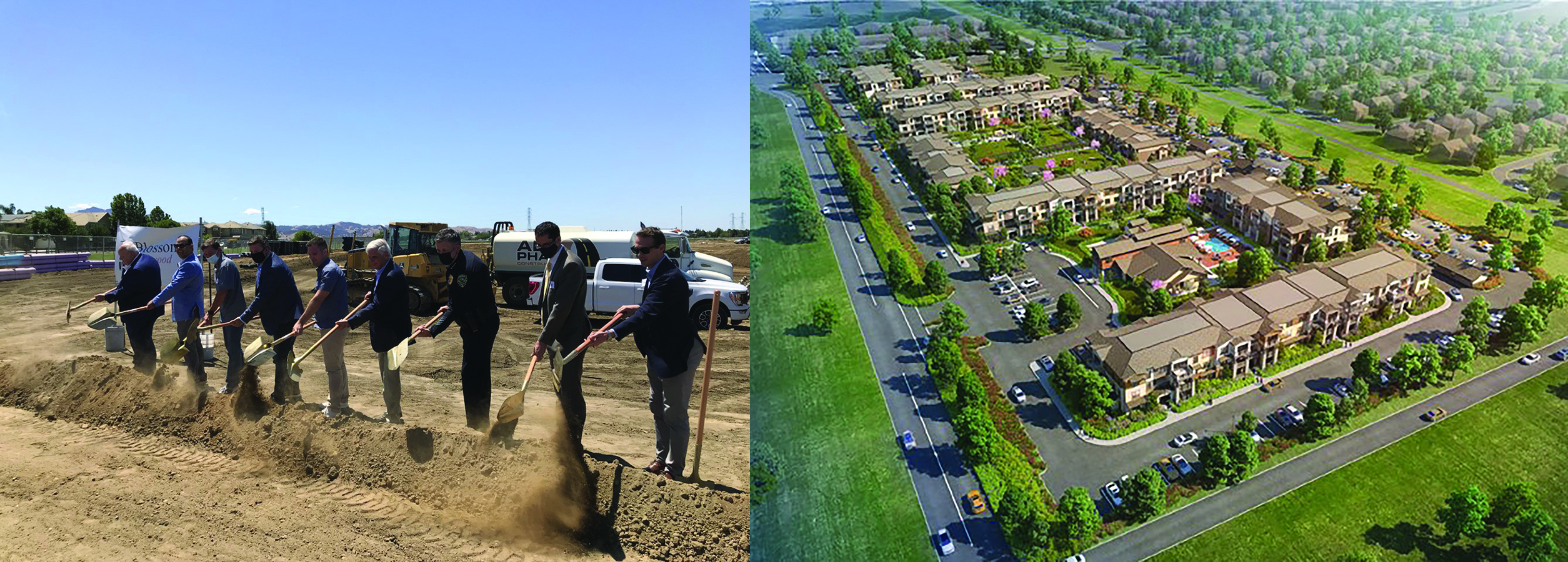
The ceremonial turning of the shovels of dirt by Mark Tekin of Tekin & Associates, Jim Previti and Rich Alexander of Guardian Capital and other Guardian team members, who were joined by Mayor Joel Bryant, Planning Commissioner Dirk Zeigler, City Manager Tim Ogden and Police Chief Tom Hansen, to officially break ground on the The Blossoms @ Brentwood. Photos by Allen Payton (Right) Rendering of the 288-unit project.

Located near the future BART Station; another Brentwood project from Tekin & Associates and Guardian Capital partnership; contribute $5,000 to Brentwood Regional Community Chest

Brentwood Mayor Joel Bryant (left), Planning Commissioner Dirk Zeigler, Police Chief Tom Hansen, Rich Alexander, Mark Tekin with (right side) Jim Previti, Guardian Development Manager Travis Adams and Guardian Senior VP Asset Management Russell Rodriguez with the banner showing name of the new community revealed during the groundbreaking.

Brentwood, California – June 10, 2021.  Tekin & Associates and Guardian Capital are pleased to announce today’s official groundbreaking of the 288-unit luxury residential rental community, The Blossoms @ Brentwood, which offers a wonderful Craftsman Style architecture, modern one- two- and three- bedroom luxury apartment homes with car ports, garages, private patios, and exceptional interior finishes.  A modern clubhouse complex with expansive mountain views, featuring a fitness center featuring the latest personal fitness equipment and an entertainment deck adjacent to a large swimming pool and spa, presents a resort-like, private amenity experience.

“We are extremely proud to bring such an amenity-rich, active lifestyle community to Brentwood,” stated Jim Previti, Founder and Chief Executive Officer of Guardian Capital.  “The Blossoms represents the first of three luxury rental communities with aggregate project costs in excess of $300 million that we will deliver during the next year with our partner, Tekin & Associates.”

Guardian Capital is a privately-held real estate investment firm with a portfolio in excess of $1 billion primarily in the Western United States and has in excess of $1 billion of assets in various stages of development.  Guardian currently operates more than 1,500 residential rental units and has more than 1,500 units under construction with an additional 2,500 units in its development pipeline.  In the last three years, Guardian has delivered ten residential rental communities valued at more than $650 million.  Based in Carlsbad, California with offices in Newport Beach and Sacramento, Guardian focuses primarily on the development and operation of institutional-quality multifamily communities, grocery-anchored retail centers and well-located office properties.

Tekin & Associates is a boutique commercial real estate firm focusing on real estate developments with fundamentally superior locations in mature markets with high barriers to entry.

The Blossoms @ Brentwood rendering.

“When we developed the General Plan, we had in mind that we could have a place for residents who were born here and left, that could come back and raise their families,” said Mayor Joel Bryant. “When we had the opportunity to partner with this project this is exactly the kind of project we envisioned. So, our students who go away to college can return and live here.”

“I’m excited about this project,” he added.

Developer Mark Tekin, of Tekin & Associates, which also has built the Shops @ Lone Tree Way between Highway 4 and Jefferey Way, shared his thoughts.

“About two-and-a-half years ago, we stumbled onto this project,” he said. “What has culminated here is a project that will fill a need for attainable housing.”

“We’re happy to be back in Brentwood as part of this Tekin community,” Previti added. “It’s a great project and a great location.”

“We build these, and we hold these, normally for 10 years,” Rich Alexander, Previti’s partner stated. “That makes us a part of the community.”

Jane Rodriguez and Lill Pierce of the Brentwood Regional Community Chest are presented with the ceremonial check by Mark Tekin (left) and Jim Previti.

He then introduced Lill Pearce, president of the Brentwood Regional Community Chest, to whom Tekin and Guardian contributed $5,000.

“I’d like to thank everyone here for your generous donation to our organization,” Pierce said. “We provide Christmas meals and toys to children. We also help the community in emergency situations with food and clothing, as well.”

A ceremonial check was then presented to Pierce and the organization’s treasurer, Jane Rodriguez by Tekin and Previti.

That was followed by the ceremonial turning of the shovels of dirt by Tekin, Previti, Alexander and other Guardian team members, who were joined by Mayor Bryant, Planning Commissioner Dirk Zeigler, City Manager Tim Ogden and Police Chief Tom Hansen, to officially break ground on the project that’s already under construction, and ahead of schedule.

Completion of The Blossoms at Brentwood community, located on Shady Willow Lane, along the future Amber Lane extension, and next to Jeffrey Way, across Highway 4 from the future Brentwood BART Station, is expected to be in early 2023 with leasing to begin in July 2022.

Filed Under: Community, East County, Growth & Development, News

  • « Previous Page
  • 1
  • 2
  • 3
  • 4
  • 5
  • 6
  • Next Page »
Monicas-11-25
Deer-Valley-Chiro-06-22

Copyright © 2026 · Contra Costa Herald · Site by Clifton Creative Web