• Home
  • About The Herald
  • Local Agencies
  • Daily Email Update
  • Legal Notices
  • Classified Ads

Contra Costa Herald

News Of By and For The People of Contra Costa County, California

  • Arts & Entertainment
  • Business
  • Community
  • Crime
  • Dining
  • Education
  • Faith
  • Health
  • News
  • Politics & Elections
  • Real Estate

Grayson cryptocurrency regulation bill signed into law

October 16, 2023 By Publisher Leave a Comment

Assembly Bill 39 will establish a licensing process for crypto exchanges and provide consumers with needed protections. Senate Bill 401 will establish safeguards for crypto kiosks. 

(SACRAMENTO, CA) – On Friday, Oct. 13, 2023, Assembly Bill 39, authored by Assembly Banking and Finance Chair Timothy Grayson (D-Concord) and co-authored by Senate President pro Tempore Toni G. Atkins (D-San Diego), Senate Banking and Financial Institutions Chair Monique Limón (D-Santa Barbara), and Assemblywoman Cottie Petrie-Norris (D-Irvine), was signed by Governor Gavin Newsom. AB 39 will establish a licensing program for crypto assets within the Department of Financial Protection and Innovation (DFPI) to protect Californians from bad actors and foster responsible innovation. The bill represents a major victory for responsible innovators and California consumers.

AB 39’s lead author, Assemblymember Grayson, released the following statement:

“Today California is taking the necessary step to regulate a market that is volatile, risky, and, in some cases, deliberately rigged against everyday consumers. Because of today’s action, Californians can be confident that crypto businesses, like any other company in financial services, must follow reasonable rules that will protect consumers and their money. Thank you to Governor Newsom for helping ensure that our state leads in fostering responsible innovation.”

Assembly Bill 39 is a companion bill to Senate Bill 401 (Limón and Atkins), which will set a regulatory framework for crypto kiosks, a part of the crypto industry rife with fraud and abuse. Crypto kiosks are ATM-like machines that allow consumers to purchase cryptocurrencies such as Bitcoin. However, these machines charge exorbitant fees and are hubs of criminal activity, scams, and consumer fraud.

“With the important frameworks established by AB 39 and SB 401, California will begin the challenging task ahead of us to regulate cryptocurrency and ensure that no Californian falls prey to scams, investment related fraud, or high-fee asset withdrawal schemes,” said California Senate President pro Tempore Toni G. Atkins. “Failures in crypto markets in recent years have emphasized the need for regulatory frameworks that have the backs of consumers, and Assemblymember Grayson and Senator Limón have led the way in doing just that.”

“California is taking a step in the right direction to protect California consumers from fraud, unnecessary risk, and potentially criminal activity with the signing of SB 401 and AB 39,” said Senator Monique Limón. “I am grateful that Governor Newsom sees the benefits to establishing a clear framework that allows for innovation without harming California consumers.”

Senate Bill 401 was signed into law, along with Assembly Bill 39. 

“The Consumer Federation of California thanks Governor Newsom for signing these two important bills protecting consumers in the crypto marketplace,” said Robert Herrell, Executive Director of Consumer Confederation of California. “California now retakes its rightful position near the top of states protecting consumers in the crypto market. We also profoundly thank Assemblymember Grayson and Senators Limón and Atkins for their perseverance on these issues. Consumers will be better protected in crypto thanks to these new laws.” 

With the Governor’s signature of these measures, crypto companies and crypto kiosk operators must obtain or apply for a license by July 1, 2025, to continue doing business in California. Additional information and the text of both bills can be found here. 


Filed Under: Finances, Legislation, News, Technology

BART Board president, GM say more state funds needed to avoid “severe cuts to service and staffing”

May 26, 2023 By Publisher Leave a Comment

From Board of Directors President Janice Li and General Manager Bob Powers:

BART is thankful for the recent action taken by the California State Legislature to restore $2 billion for the Transit and Intercity Rail Capital Program. The program is vital in funding transformative capital improvements to modernize public transportation systems such as BART.

The fate of transit operating budgets, however, presents a do-or-die decision point.

Each day BART moves closer to plunging off the fiscal cliff if the State does not provide short-term financial aid to fund transit operations.

One-time federal funds are dwindling even with BART’s stringent cost controls and will be exhausted by early 2025. If transit operations funding is not included in this year’s State budget, BART must begin making severe cuts to service and staffing, as early as this year. The State has the opportunity – and the power – to sustain BART or let BART and the Bay Area economy fail.
Here’s how failure looks:

  • Trains only once an hour.
  • No trains on weekends.
  • No trains after 9 p.m. on weeknights.
  • Reduced service to San Francisco International and Oakland International airports.
  • Some stations closed.
  • Entire lines potentially shuttered

Those who will pay the biggest price for these severe cuts are those who can afford it the least. Sixty-seven percent of BART riders identify as non-white. Forty-four percent do not have a vehicle. Thirty-one percent have an income of $50,000 or lower. Seven percent are disabled. If the State fails to act, those who rely on BART as a lifeline will be stranded.

Everyone will pay the price if BART fails – even those who don’t use it. Traffic stands to drastically worsen across our already congested roadways and bridges, and regional greenhouse gas emissions will increase, further fueling climate change. Just one trip in a car emits the same amount of C02 as thirty trips taken on BART.

Businesses will struggle to move their goods with thousands more vehicles on already strained roads. BART service cuts to SFO and OAK will make tourism and convention travel unpalatable.

The Bay Area is an economic engine for the entire state, which represents the fourth largest economy in the world. But the regional economy isn’t ironclad. It needs effective public transit – BART, Muni, and other agencies – to thrive.

BART staff, labor partners and Board are focused on increasing ridership by improving the system.

Some highlights:

  • Adding eight to 18 additional police officers to patrol trains each shift in addition to BART’s unarmed safety staff of Ambassadors, Crisis Intervention Specialists and Fare Inspectors on trains.
  • A September schedule change means no rider will wait more than 20 minutes for a scheduled train, including nights and weekends.
  • More than doubling the Clipper START discount for eligible low-income riders.
  • A project to install 700 new fare gates at all stations by 2026 to deter fare evasion and increase safety.
  • Thorough cleaning of train car interiors twice as often.
  • Increasing the number of deep-clean teams by 66% to scrub heavily used stations.

These hard-earned gains for riders would be wiped out by severe service cuts. It’s a recipe for a death spiral.

If the State fails to act, not only will BART fail, but Bay Area public transit will fail. Ninety percent of all transfer trips in the Bay Area involve a connection to BART.

For BART and the Bay Area we know and love to survive, we need State help NOW.

Filed Under: BART, Finances, State of California

Contra Costa Supervisors to discuss proposed $5.5 billion Fiscal Year 2023-24 budget Monday

April 21, 2023 By Publisher Leave a Comment

Source: Contra Costa County

By Allen D. Payton

The Contra Costa County Board of Supervisors will discuss the $5.515 billion Fiscal Year 2023-2024 Recommended Budget at 9 a.m. on Monday, April 24.

New this year is an updated online version, which increases accessibility through easier navigation, interactive content, additional performance measures, and customizable PDF printing options.

“This structurally balanced budget continues to reflect years of careful, comprehensive, and continuing review and refinement of our operations to cope with economic challenges.” said County Administrator Monica Nino. “At every opportunity, we continue to make changes to deliver services that residents need and expect from County government in ways that are more efficient and less costly.”

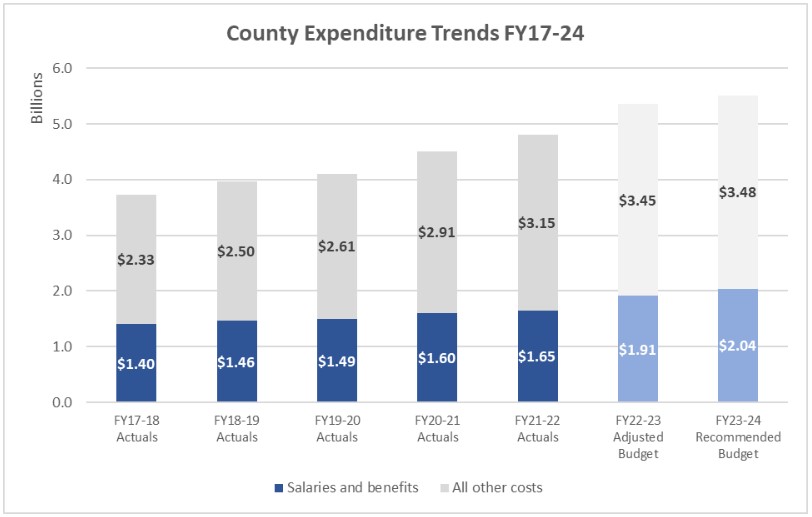
According to Nino’s report to the Board, “It is anticipated this year will be one of status quo in the delivery of services besides those program enhancements that are in the startup phase from the benefit of the Board-allocated Measure X funds for specific purposes. The increase in salaries and benefits totals $126.3 million, largely due to the second year of a 5% cost of living increase for over 80% of the County workforce received as part of a four-year labor agreement.

The Recommended Budget includes funding for 11,127.6 full-time equivalent positions (FTE), of which 6,836.4 are in the General Fund. The recommendation includes 85.4 new (60.0 General Fund) positions to be added for the fiscal year 2023-2024 (FY23-24). To structurally balance the budget, a number of our General Fund departments continue to have vacancy factors built into their recommended budget allocations. A vacancy factor accounts for cost savings related to personnel vacancies occurring within departments during the fiscal year. During the development of the Recommended Budget, there were approximately 2,013 vacant FTE positions, totaling $305.0 million, of which 1,395 FTE totaling $204.9 million are General Fund supported. Due to difficulties in recruitments, retention, and normal turnover, the following nine departments are maintaining vacancy factors totaling $101.5 million: Health Services, Sheriff-Coroner, Employment and Human Services, District Attorney, County Clerk-Recorder, Probation, Public Defender, Animal Services, and Assessor. We have continued the process of eliminating vacant/unfunded positions with the goal of more easily identifying funded vacant positions requiring recruitment during the fiscal year.

Source: Contra Costa County

General Purpose Revenue for FY23-24 totals $725.1 million, an increase of 9.3% over the prior year budget of $663.6 million. Of the major revenue sources, property taxes are the largest category and total $496.9 million, based on an assumed 4% growth over current year projected collections. The next largest sources are Measure X sales tax at $118.2 million, interest income at $30 million, and sales and use taxes at $22.2 million. Interest income is projected to be received close to double in FY22-23 of what is budgeted for FY23-24; this is as a result of increases in interest rates. This economic benefit is projected not to last and actual interest earnings will be monitored during the new fiscal year in the event an adjustment is necessary.

The following items are potential pressures to the recommended spending plan.

  • Persistent high inflation and economic uncertainty;
  • Unanticipated impacts from the Governor’s May Revised Budget proposal and shortfalls in Federal allocations;
  • Decreasing County revenue growth;
  • Disallowed FEMA reimbursement related to COVID-19;
  • Labor contract negotiations for agreements expiring June 30, 2023; and
  • Limited qualified workforce to fill job vacancies

The majority of the budget ($2.876 billion) is funded from State and Federal revenues. This means that for the majority of the programs funded, a program cut would also result in a loss of the revenue associated with the program. Salary and Benefit costs are broken out to show the growth, which consumes 37% of the County budget.”

Among the recommended budget highlights provided by Supervisor Diane Burgis’ office are:

  • Adds 26 positions in the Employment and Human Services Department to improve children and family services; youth programming and workforce development; In-Home Supportive Services case management; senior nutrition programs; CalAIM implementation; diversity, equity, and inclusion; and associated programs.
  • Adds three full-time Animal Services Officers to increase beat coverage and improve response times to dangerous animal cases and an additional two full-time positions focused on transfer partner and adoption programs and lost and found programs.
  • A $10 million allocation toward developing a new Bay Point Library branch. The branch is a new 10,000-20,000 square-foot space constructed in partnership with an affordable housing project.
  • $10 million in capital funding to provide a local match for grants that would allow the County to leverage state and federal funds for large infrastructure projects, such as roads and bridges, as part of the federal Infrastructure Investment and Jobs Act.

The Board discussion is tentatively scheduled to continue at 9 a.m. on Tuesday, April 25, if additional time is needed. The Board is scheduled to adopt the final budget on Tuesday, May 23.


Filed Under: Finances, Government, News, Supervisors

Senator Glazer resigns from Bay Area Transit panel

February 28, 2023 By Publisher Leave a Comment

State Senator Steve Glazer wants greater fiscal oversight of BART.

Says “Bay Area leaders have not stepped up to fix the fiscal oversight problems with BART…”

BART Board Vice Chair Foley responds, Director Allen applauds Glazer

By Allen D. Payton

SACRAMENTO – Senator Steve Glazer, D-Contra Costa, announced that he resigned today, Tuesday, Feb. 28, 2023 from his position as a member of the Senate Select Committee on Bay Area Public Transit, saying Bay Area leaders have failed to support fiscal oversight of BART.

Senator Glazer is a longtime supporter of public transit and is concerned about the financial problems facing Bay Area transit systems, which are essential to the health of the regional economy. But, he said, the status quo is unacceptable.

“Bay Area leaders have not stepped up to fix the fiscal oversight problems with BART, as well as the underfunding of the Inspector General’s office,” Glazer said. “When these problems are addressed, I will join with my colleagues and support greater transit funding.”

In June 2022, an Alameda County Grand Jury found that BART’s leadership has repeatedly blocked the Inspector General’s authority and autonomy.

Just two months later, former State Auditor Elaine Howle found that the BART office “lacked the authority and independence necessary to do its job…”

The BART inspector general was created by Senator Glazer as part of a transportation bill in 2017. Senator Glazer advanced legislation (SB 827) to the governor’s desk last year that enhanced independence for the IG, conforming its auditing standards and investigations with other transportation IGs. At the request of the BART Board, Governor Newsom vetoed the bill.

Senator Glazer’s letter reads as follows:

Dear Senator Wiener,

I hereby resign from the Senate Select Committee on Bay Area Public Transit, effective immediately. The failure of Bay Area leaders to hold BART financially accountable makes my participation in this transit support committee incompatible.

I recognize and support the pressing need for the state to invest in public transit agencies throughout the Bay Area given the financial uncertainty that looms over these systems. However, there is no guarantee that these agencies will spend taxpayer dollars sensibly without adequate oversight of their expenditures. I point to the recent alarming reports from BART’s Inspector General regarding BART’s financial mismanagement and brazen defiance of voter-mandated oversight.

In June 2022, an Alameda County Grand Jury found that BART’s leadership has repeatedly blocked the Inspector General’s authority and autonomy. Specifically, the Grand Jury found that BART’s board of directors and management engaged in a “pattern of obstruction” that has impeded the Inspector General’s ability to conduct independent oversight and “stymied OIG independence and the confidentiality of investigations.”

Just two months later, former State Auditor Elaine Howle, comparing the powers and responsibilities of the BART IG to other, similar offices, found that the BART office “lacked the authority and independence necessary to do its job according to the best practices recommended by national professional organizations that set standards in the accountability field.’ She also asserted in a letter to Governor Newsom that ‘(e)nsuring the independence of the BART Inspector General is critical to the credibility and effectiveness of the office.”

As BART and other regional transit systems seek additional state funding to stave off upcoming fiscal problems, the Legislature must ensure that the same systems spend public resources responsibly.

I wish you well with your important work.

———————

BART Directors Respond

When reached for comment about Glazer’s resignation from the committee and reason for it the four BART Board directors who represent Contra Costa County, including Vice Chair and District 3 Director Mark Foley, District 1 Director Deb Allen, District 3 Director Rebecca Stutzman and District 7 Director Lateefah Simon.

Foley responded writing, “I’d like to thank Senator Glazer for his continuing support of BART and public transit. I look forward to partnering with the senator on matters of mutual interest, including strengthening the Office of the Inspector General and helping support BART’s efforts to provide safe, world-class transit, invest in infrastructure renewal and address societal issues such as unhoused individuals within the BART system. I’m eagerly anticipating Chair Wiener’s appointment to this vacancy on the Senate Select Committee on Bay Area Public Transit.”

Allen responded writing, “I applauded CA Senator Glazer for standing up to Bay Area elected leaders to insist on accountability to transit riders and taxpayers. They deserve answers about how BART spends $2.5B plus annually and those answers aren’t easy to come by.

Senator Glazer and I have worked for over six years together to get answers and still continue to meet resistance in making meaningful independent oversight a permanent part of the BART culture. We have worked tirelessly over last 4 years on strengthening the role of the Office of Inspector General we created and built, while the majority of BART board directors, unions and executive staff continue to focus on the ‘more money please!’ approach. We saw it last week in BART’s annual Board Workshop and it seems Senator Glazer is seeing the same approach evolving from the Senate select Committee on Bay Area Public Transit. That will only produce more of the same failed policies we see now for BART.

I believe BART executive management and a majority of directors will continue to fight proper oversight. Unless our state leaders like Senator Glazer attach oversight strings to new funding at the state level to keep transit agencies accountable to the people who are paying for it, transit will continue to fail the riders, workers and the Bay Area.”

Filed Under: BART, Finances, Government, News

Contra Costa County provides payment details for out-of-court settlement in Thorpe sexual harassment case

September 19, 2022 By Publisher Leave a Comment

By Susan Shiu, PIO, Contra Costa County Office of Communications & Media

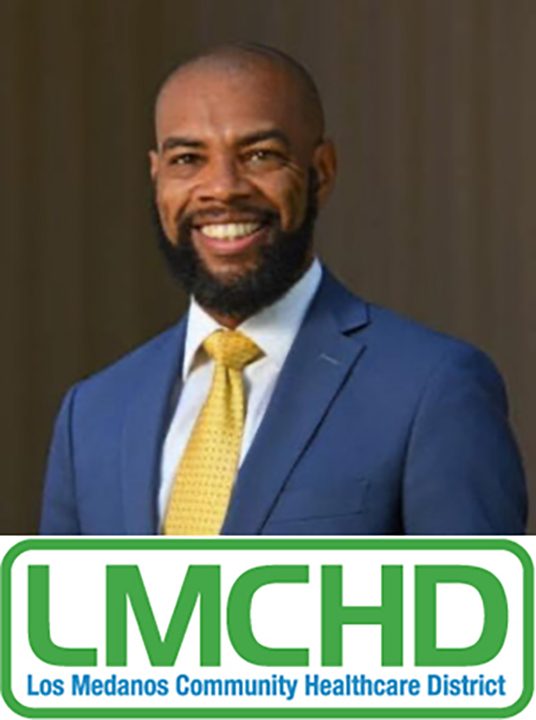
Former LMCHD executive director and Antioch Mayor Lamar Thorpe.

(Martinez, CA) – Sept. 19, 2022 – The Contra Costa County Board of Supervisors, in its capacity as successor agency to the Los Medanos Community Healthcare District (“District”), has approved an out-of-court settlement relating to claims submitted by Jasmine Cisneros and Jocelyn Munoz against the District and its former executive director, Lamar Thorpe.  (See related article)

The liability insurance carrier for the former District, RSUI Group Inc, handled this matter and provided counsel to defend the claims.  Following a mediation session among the parties, a settlement was reached.  The settlement was fully executed on August 23, 2022.

The total amount of the settlement of both claims was $350,000, inclusive of attorneys’ fees and costs. Of the settlement amount, $321,000 was paid by the former District’s liability insurance carrier. The remaining settlement amount of $29,000 was paid from the Los Medanos Community Healthcare fund, as an insurance deductible payment.

The Board of Supervisors approved the settlement solely in its capacity as the successor agency to the District. As the successor agency, the County was required to assume all liabilities of the District, including any claims filed against it. The settlement includes a release and waiver of all claims by Cisneros and Munoz against the District, the former executive director, and the County.  The settlement also avoids potentially expensive federal court litigation relating to the claims.

Filed Under: East County, Finances, Government, News, Supervisors

Travis Credit Union to offer free youth financial education at Diablo Valley College July 8

June 27, 2022 By Publisher 4 Comments

Source: Travis Credit Union

Mad City Money Youth Financial Boot Camp

Adulting can be challenging when it comes to finances. That’s why Travis Credit Union (TCU) is offering an in-person Mad City Money Youth Financial Boot Camp, designed to prepare the next generation with personal finance skills for the workforce. All young adults between the ages of 12 – 18 are encouraged to attend and learn these financial skills that will last a lifetime.

Mad City Money is a three-and-a-half-hour simulation that gives young adults the chance to make decisions regarding budgeting, spending, and saving in an assigned-life scenario. For example, each participant will be given a temporary identity that includes an occupation, salary, debt, marital status, children, etc. The goal is to show the reality of financial responsibilities and equip them with the skills needed to make better financial decisions.

Travis Credit Union is offering a free Mad City Money event in Pleasant Hill.

July 8, 11:30 a.m. to 3 p.m. at Diablo Valley College, 321 Golf Club Road.

Students will learn how to practice budgeting as an adult under realistic circumstances. They will be able to distinguish between good and poor financial decisions. and begin making good judgments regarding spending.

Admission to this event is free. To register, please visit traviscu.org/mad-city-money.


Filed Under: Business, Central County, Finances, Youth

Measure X Sales Tax – meeting the needs of our community?

January 26, 2022 By Publisher 2 Comments

Zoom webinar Feb. 17 at 4:00 p.m. to learn about first year allocations

By Gail Murray

Measure X, a new county-wide sales tax to support health and human services for our local neighbors and families, was passed by voters in November 2020. The tax money is being collected and decisions are being made on how to allocate the money in support of the values we hold as residents of Contra Costa.

The Measure X Advisory Committee was established by the Contra Costa Board of Supervisors to help prioritize spending of Measure X dollars to support health and human services in our county. The Committee has met over many weeks, days and hours, and has produced its report. The people of Contra Costa County have unmet human service needs, and they are growing fast, as documented by the Measure X Advisory Committee. The Board has weighed these growing needs with the limited dollars available to allocate this first year.

Join us Thursday, February 17 at 4:00 p.m. for a Zoom webinar to hear about the first year of allocations. What was recommended by the Advisory Committee, what was funded, and what are the gaps still remaining? Do these allocations support our values? What can we learn from this first year of sales tax allocations?  What does this mean for the future?

This expert panel will be moderated by Shanelle Scales-Preston, Vice Mayor and Pittsburg City Council member. Panelists are Mariana Moore, Chair of the Measure X Citizens Advisory Board; Dan Geiger from Budget Justice Coalition; and Supervisor Karen Mitchoff, Chair of the Contra Costa Board of Supervisors, representing District 4. 

Questions from the public will be taken in advance at Program@LWVDV.org. During the webinar, questions may be submitted thru Zoom Q&A function. 

Click here to register for the webinar. Information on how to access the Zoom webinar will be sent to your email address 24 hours before the program.

The program is a partnership among the League of Women Voters of Diablo Valley and of West Contra Costa County, along with the Contra Costa County Library. The Library will provide closed captioning for this event. 

The program will be recorded and posted on the following sites after the meeting:

LWVDV YouTube channel

Contra Costa County Library YouTube channel


Filed Under: Finances, Government, News, Taxes

Contra Costa Supervisors to consider COVID-related budget issues, Measure X fund allocations during Tuesday retreat

January 23, 2022 By Publisher Leave a Comment

Source: CCC

Administrator to recommend delaying allocation of $59 million in federal American Rescue Plan funds; projects 6% increase in property tax revenues

To hear presentation on “The Post COVID New World Order”

By Daniel Borsuk

Citing bureaucratic red tape, Contra Costa County Administrator Monica Nino will propose the Contra Costa County Board of Supervisors postpone spending $59 million in federal American Rescue Plan funds until at least January 2023 in her presentation during their retreat focused on COVID-19 era budget issues, Tuesday.

The retreat will be televised live starting at 9 a.m. on Comcast Cable 27 and WAVE Channel 32 and online.

“The challenge in lining up funds to maximize cost recovery requires constant monitoring (coordination) between departments,” County Administrator Nino stated in documents recommending the partial funding postponement.

At the same time, Nino will also recommend $53 million in American Rescue Plan funds be allocated to the Contra Costa Health Services Department to improve response to the COVID-19 pandemic during the upcoming 2022/2023 fiscal year.

Supervisors are also expected to learn that for the upcoming fiscal year, $107 million of Measure X sales tax revenues will be allocated for the budget and 15 percent of the county’s labor contracts, including the California Nurses Association contract, which will be up for renewal on June 30. The 2022/2023 fiscal year budget will mark the first time Measure X funds will be spent.

County Administrator Nino is also expected to announce property taxes are to increase six percent for fiscal year 2022/2023, 3.44 per cent for the county and 3.82 percent for the Contra Costa County Fire Protection District.

“County property taxes declined over 11 percent between 2009 and 2012 and then grew significantly between 2014 and 2019. Projecting an increase of 6 percent for fiscal year 2022/23,” Nino’s report states.

“The budget will be built on assumption of a 6 percent increase in assessed valuation. Fiscal year 2022/23 is projected to be significantly higher than normal,’ she wrote in the background document.

At the retreat, Dan Geiger will offer a presentation by the Contra Costa Budget Justice Coalition, consisting of 34 non-profit organizations focused on county fiscal accountability issues, that will showcase how the organization will monitor the supervisors’ budgetary process especially when in the 2022/2023 fiscal year $110 million of Measure X sales funds will be added to the general fund for the first time.

During their budget discussion, Supervisors will also receive departmental presentations from the Sheriff-Coroner, District Attorney, Public Defender, Health Services Director, Employment and Human Services Director and Animal Services Director.

Contra Costa County voters passed the Measure X countywide, half-cent sales tax increase on the November 2020 ballot.

The supervisors will also receive a report on Capital Projects, the Facilities Condition Assessment and the Facilities Master Plan.

The Post COVID New World Order presentation

Supervisors will also hear a report entitled, “The Post COVID New World Order – It’s a seller’s market for now,” delivered by Dr. Christopher Thornberg of independent economic research and consulting firm Beacon Economics. Thornberg predicts unemployment in the county should be 3.4 percent by the end of 2022, which is currently pegged at 4.6 percent.

“Labor tightness sets off an investment boom,” he will predict, but the economist will also warn, “Expect a sugar crash to come, combination of a tight federal budget and inflation.”

Allen Payton contributed to this report.                                            

Filed Under: Finances, Government, News, Supervisors

Your voice is needed to support the arts in Contra Costa

October 25, 2021 By Publisher Leave a Comment

Can you please write a letter to the Board of Supervisors by Nov. 2nd?

By Arts and Culture Commission of Contra Costa County

Measure X is Contra Costa’s new countywide half-cent sales tax. The Measure X Community Advisory Board was formed to identify unmet community needs and recommend spending priorities to the Board of Supervisors. The Measure X Community Advisory Board recommended funding for the Arts and Culture Commission to the Board of Supervisors. At the Nov. 2nd meeting, Supervisors will be making final recommendations.

The current Contra Costa County $31,000 grant match budget is only a $.06 per person investment: Napa $3.55, Solano $2.19, Santa Clara $0.92, and Alameda County $0.54.

Please support signature programs that provide services to Contra Costa County: Arts and Culture Prospectus of Contra Costa County, ABOUTFACE, Poetry Out Loud, Youth Advisor, Jump StArts California Arts Council grant, Impact Projects California Arts Council grant, Art Passages, and more!

Transformational ideas include:

  • District Public Art Program: Let’s build Contra Costa County’s first public art program following best practices of other Bay Counties.
  • Youth Advisor in each District: We want to expand equity and opportunity to every District!
  • Arts Connection: We want to connect artists and art organizations for quarterly meetings for advocacy, opportunities, and data collection.
  • Community Art Fund: Support up to 5 community art projects a year!
  • AIRS (Artist-in-Residency in the School) pilot program: Place teaching artists in CCC schools to work with students to create an art project.
  • Build Structures: Community creates policy for new and signature programs based on equity!

Ask: $625,000 at $.54 per resident!

Supervisors:

  • John Gioia, District 1 (Richmond to Pinole): john_gioia@bos.cccounty.us
  • Candace Andersen, District 2 (Lamorinda, Danville, San Ramon): supervisorandersen@bos.cccounty.us
  • Diane Burgis, District 3 (most of Antioch, Oakley, Brentwood & far east county): supervisor_burgis@bos.cccounty.us
  • Karen Mitchoff, District 4 (Pleasant Hill, Concord, Walnut Creek, Clayton): SupervisorMitchoff@bos.cccounty.us
  • Federal Glover, District 5 (Hercules, Martinez, Pittsburg & along Delta in Antioch): district5@bos.cccounty.us

​​District locator: https://www.contracosta.ca.gov/5715/Supervisor-Who-Represents-Me

Please send email by Nov. 2nd!

Sample email: The arts are important to me and to my community. Please increase funding for the arts in Contra Costa County from $31,000 to $625,000 annually. This will help the Arts and Culture Commission demonstrate support for the arts to be competitive for national and state grants. This will support signature programs that directly impact all communities including our youth to Veterans. It will help provide public art programs in each district, a Community Art Fund, a youth advisor in each district, an Artist-In-Residency in the School pilot program, the Arts Connection and Build Structures initiative and other great programs. It will help our County stabilize arts funding and be able to plan equitably for the future. Thank you.

Let’s build an arts foundation for Contra Costa County!


Filed Under: Arts & Entertainment, Finances, Opinion, Supervisors

In spite of opposition Contra Costa Supervisors approve COVID-19 vaccine anti-misinformation resolution

October 13, 2021 By Publisher Leave a Comment

“The Board…declares that COVID-19 health misinformation is an urgent public health crisis” – from resolution

“You are spreading misinformation that the vaccine is the be all and end all…” – county resident Carolyn Stream

“We are going to be as loud as we can be and as visible as we can be to put out information that is correct…” – Supervisor John Gioia

County might enter the less health restrictive yellow ranking by the end of October, currently has less than 75 COVID-19 patients hospitalized in county hospitals. – Contra Costa Health Officer, Dr. Chris Farnitano

Discuss $110 million Measure X half-cent sales tax revenue wish list

By Daniel Borsuk

The Contra Costa County Board of Supervisors, on a 5-0 vote, approved a resolution aimed at turning around rising public skepticism against the COVID-19 vaccines during their regular, weekly meeting on Tuesday. It is entitled “Declaring COVID-19 Misinformation as a Public Health Crisis”. (See resolution and below)

Supervisors listened to 50 speakers, mostly opposed to the resolution that “declares COVID-19 health misinformation is an urgent public health crisis affecting our entire community and the County of Contra Costa commits to combating health misinformation is an urgent public health crisis affecting our entire community and County of Contra Costa commits to combating health misinformation and curbing the spread of falsehoods that threaten the health and safety of our residents.”

“We are going to be as loud as we can be and as visible as we can be to put out information that is correct, science-based and corrects the general misinformation that’s out there,” resolution-co-author District 1 Supervisor John Gioia said.

“We are not making any judgement against anyone,” said co-author Supervisor Karen Mitchoff of Pleasant Hill. “We’re not infringing on anyone’s free speech rights.  This is not the case.  We are calling out the misinformation that leads some to not be vaccinated.”

One message in the resolution states: “The Board of Supervisors and County of Contra Costa is troubled by and actively discourages the spread of COVID-19 misinformation as it is a dangerous threat to public health.”

“There are ae people who don’t believe in public officials,” said District 2 Supervisor Candace Andersen of Danville. “I will support this resolution because it conveys prudent decisions based on scientifically based information.”

District 5 Supervisor Federal Glover went right to the point. “Get your shot and protect yourself and your loved ones.”

But supervisors got an earful of criticism from the 50 speakers who viewed the supervisors’ resolution as a move in the wrong direction, a direction towards infringements of freedom of speech, “freedom of medical choice,” and “freedom of medical information.”

One such speaker, Lucy Busto of Oakley bristled at the supervisors for considering a resolution that would “infringe on our medical freedom of choice.”  She said, “We have no idea what the long-term effects of these vaccines are.”

“You are spreading misinformation that the vaccine is the be all and end all when there are many unanswered questions about the vaccine,” said another speaker, Carolyn Stream.

But retired nurse Mary Schreiber urged supervisors to adopt the resolution saying, “This is really supported by our health care professionals.”

Contra Costa County Health Officer Dr. Chris Farnitano, who also reported the county might enter the less health restrictive yellow ranking by the end of October, currently has less than 75 COVID-19 patients hospitalized in county hospitals.

“You are infringing on our rights to medical information,” said Lucy Busto of Oakley. “We have no idea what the long-term effects of these vaccines are”

“You are spreading misinformation that the vaccine is the be all end all”, said resolution opponent Carolyn Strum.  “We should have the freedom for information. No one should have the right to control information.”

Supervisors’ Measure X Wish List

With the county expect to plow in $110 million in Measure X sales tax revenues, $23 million more than initially estimated prior to vote passage last November, supervisors began to reveal their funding priorities with the additional money that the county officials expect to flow into county coffers.

During a presentation from Measure X Community Advisory Board Chair Mariana Moore, supervisors indicated what county operations should receive Measure X funding priority for the upcoming 2022-2023 fiscal year.

Initially county officials expected the Measure X tax would drive in $87 million in revenues, but higher than expected consumer retail sales has pumped up the initial projection.

Code enforcement, transit, fire services, sheriff response and patrols were top Measure X priorities Supervisor Mitchoff listed. Mitchoff will serve as board chair next year, her final year in office.

Board vice chair Glover rattled off the office of racial justice and equity, the northern waterfront planning project, animal services, youth services center, and mental got top billing.

Trails and public transit were on District 2 Supervisor Candace Andersen’s Measure X list.

District 1 Supervisor John Gioia said county hospital, health clinics, transitionary housing and fire services especially in East County were on his Measure X list.

Improving fire services in East County, especially with the proposed consolidation for the Contra Costa County Fire District with the East Contra Costa County Fire District, was Chair Diane Burgis’ chief funding priority.

WHEREAS, Health misinformation has significantly undermined public health efforts and the unmitigated proliferation of health misinformation has created a culture of mistrust and has prolonged the COVID-19 pandemic, endangering the health and safety of all Contra Costa County residents and visitors; and

WHEREAS, The coronavirus (COVID-19) pandemic has resulted in over 95,000 cases and 921 deaths in Contra Costa County as of September 25, 2021; and

WHEREAS, The spread of COVID-19 has had a devastating impact on our health and safety, our regional economy, our elder residents, our communities of color, our mental health, the educational development of our children and every aspect of our lives; and

WHEREAS, In Contra Costa County, there are significantly lower vaccination rates for residents 20-29 years old, residents who identify themselves as White, Latinx (i.e. Latino/Hispanic), African-American, and more than one race/ethnicity, men, and in certain communities across the county and particularly in East and West County; and

WHEREAS, The COVID-19 vaccines have met the Food and Drug Administration’s (FDA) rigorous scientific standards for safety, effectiveness, and manufacturing quality and have been proven to be safe and effective; and WHEREAS, The Pfizer-BioNTech vaccine, brand name Comirnaty, has received full FDA approval and been proven to be highly effective in preventing serious disease, hospitalization and death from COVID-19 and that its benefits outweigh its risks; and

WHEREAS, The COVID-19 vaccine is available to everyone in Contra Costa County at no cost, regardless of income, residency within the county, health coverage or immigration status, and is administered by health professionals, like nurses and doctors; and

WHEREAS, misinformation has caused confusion and has led to eligible people declining COVID-19 vaccines, rejecting public health measures such as face coverings and physical distancing, and using unproven treatments; and

WHEREAS, On July 15, 2021, the United States Surgeon General issued his first advisory describing the “urgent threat” posed by the rise of false information of COVID-19 – one that continues to put “lives at risk” and prolong the pandemic; and

WHEREAS, Recent surges in infections and hospitalizations from COVID-19 in Contra Costa have highlighted the importance of clear and unequivocal communications from public officials that vaccines are the best protection against severe illness and hospitalizations; and

WHEREAS, Urgent action is needed to curb the spread of COVID-19 by combating misinformation, thereby supporting our healthcare system and saving lives; and

WHEREAS, There would be substantial detriment on Contra Costa County and its residents and visitors if not acted upon immediately; and

WHEREAS, Trusted community members, such as health professionals, faith leaders, educators, and leaders of Black, Indigenous, Latinx and other communities of color nationwide and in Contra Costa have spoken directly to their communities to address COVID-19 related questions by town halls, meetings, social media, and traditional media; and

WHEREAS, The Board of Supervisors and the County of Contra Costa is troubled by and actively discourages the spread of COVID-19 misinformation as it is a dangerous threat to public health; and

WHEREAS, Contra Costa Health Services continues to carry out its mission to care for and protect all Contra Costa County residents from COVID-19, especially our most vulnerable; and

WHEREAS, Contra Costa Health Services engages with our communities through building partnerships and trust with community organizations and residents, trusted messengers, and COVID-19 Ambassadors; and

WHEREAS, Contra Costa Health Services maintains a coronavirus website as a source of credible, up-to-date information regarding COVID-19 for Contra Costa residents at cchealth.org.

NOW, THEREFORE, BE IT RESOLVED, that the Board of Supervisors of Contra Costa County declares that COVID-19 health misinformation is an urgent public health crisis affecting our entire community and the County of Contra Costa commits to combating health misinformation and curbing the spread of falsehoods that threaten the health and safety of our residents; and

BE IT FURTHER RESOLVED the Board of Supervisors and the County of Contra Costa will develop and support policies and strategies that protect the health and safety of Contra Costa County residents through the promotion of evidence-based interventions, including face coverings and vaccination; and

BE IT FURTHER RESOLVED that Contra Costa Health Services will continue to share facts and scientific information about COVID-19, to correct misinformation including vaccine myths, to identify and give a platform to culturally relevant medical experts and trusted messengers, to respond to questions and requests for information on social media, and to work with our media and community partners to reach a broad audience with factual, timely information.

Allen Payton contributed to this report.

Filed Under: Finances, Health, News, Supervisors

  • « Previous Page
  • 1
  • …
  • 10
  • 11
  • 12
  • 13
  • 14
  • …
  • 17
  • Next Page »
RepublicServices-Antioch-ad (1)
Monica's Riverview 09-26 A (1)
Celia's-09-26B
Delta-RC-B 07-26
Deer-Valley-Chiro-06-22

Copyright © 2026 · · Contra Costa Herald · All Rights Reserved