
Contra Costa Supervisors on 4-1 vote approve all-electric buildings ordinance banning natural gas installations

Starting June 1, 2022; 200-gallon natural gas tanks still permitted for rural users
“Many of my constituents view this ordinance as an overreach ordinance and I happen to agree with them” – Supervisor Andersen
By Daniel Borsuk
Starting June 1, Contra Costa County will be the first county in the Golden State requiring all new residential, business, commercial and hospitality developments have electricity, and outlawing natural gas installation. On a 4-1 vote Contra Costa County Board of Supervisors approved the ordinance that attracted scant public opposition. District 2 Supervisor Candace Andersen was the lone opposition vote.
The new ordinance applies to all new residential, commercial, office, and hospitality developments proposed for unincorporated Contra Costa County. It does not apply to incorporated areas, except the City of Richmond that has adopted its own electricity building ordinance.
“Many of my constituents view this ordinance as an overreach ordinance and I happen to agree with them,” said Andersen of Danville, who cast the lone opposition vote. “It is my concern this ordinance might impact commercial development nearby the Byron and Buchanan airports.”
There was no opposition to the Board’s ordinance that was up for second reading.
“This is a good environmental policy for the county,” said District 1 Supervisor John Gioia, who championed the resolution.
“I am concerned about the equity issue. This could raise rents of low-income housing tenants,” said Board Chair Karen Mitchoff of Pleasant Hill, who voted in favor of the ordinance anyway.
“I am supportive of this ordinance,” commented District 3 Supervisor Diane Burgis after planning department staff answered her question on whether rural constituents could still own and use 200-gallon natural gas tanks for “emergency use.” Planning officials confirmed 200-gallon natural gas tanks will be permitted for rural users.
“While this proposed ordinance has been charactered as an electrification ordinance, its purpose is to stop new buildings from burning fossil fuels,” wrote Gary Farber on behalf of the environmental group, 350 Contra Costa. “Therefore, solar thermal space heating and water heating systems ought to be allowed and encouraged. We look forward to working with the County on additional programs to phase out fossil fuels in transportation and all buildings, new and existing.”
The move by the Board of Supervisors occurs when there is skepticism on whether the State has an adequate supply of wind and solar renewable energy in the Golden State to meet the demand for all electric homes and businesses. The California Clean Energy Act of 2018 established a target for renewable zero-carbon resources to supply 100 percent of electrical needs throughout the state by 2045, 23 years from now.
Retain $2,500 Campaign Contribution Limit
Even though briefly considered a recommendation boost, the Election Campaign Contribution limit from $2,500 to $4,900, Supervisors voted to retain the Election Campaign limit at $2,500.
“I feel comfortable at the $2,500 limit,” commented District 2 Supervisor Andersen.
Supervisor Glover said as much as he’d preferred to go with the State-recommended $4,900 limit, he said “I’d vote for more money, but I don’t think we should. Elections are getting more expensive.” Glover is not up for re-election this year.
44th Annual Dr. Martin Luther King Jr Ceremony Honorees
Supervisors also recognized 44th Annual Dr. Martin Luther King Jr. honorees – Gigi Crowder, an Antioch resident, who is the Executive Director of the National Alliance on Mental Illness as the Adult Humanitarian of the Year and Pittsburg resident, Kaia Morgan, a Senior at Ygnacio Valley High School as the Student Humanitarian of the Year. (See related articles here and here)
BBB Alert: Want a COVID-19 test? There’s a scam for that
By Better Business Bureau
The US Food and Drug Administration is warning people of fraudulent coronavirus tests, vaccines, and treatments as the pandemic continues. According to the Centers for Disease Control, since the arrival of the Omicron variant, the increase of testing for COVID-19 has become a concern. Scarcity often leads to potential scams for a product that doesn’t exist, the compromise of personal identifiable information, or the increase of deceptive advertising.
The Federal Bureau of Investigation (FBI) issued a warning last year about potential fraud related to the antibody tests. Scammers are selling unapproved COVID-19 antibody tests, which can give inaccurate results. In doing so, they are also collecting personal information, such as Social Security numbers and dates of birth. They may also be stealing health insurance or Medicare information that can be used in future schemes.
How the scam works
Robocalls are sent out to consumers directing them to a website that looks like a clinic or medical supply company offering COVID-19 tests. These tests allegedly identify if a person has been infected with coronavirus – even if they’ve recovered. Some even promise results in 10 minutes. However, to receive a test, a credit card or a form needs to be completed with personal information.
In some cases, the test involves an easy at-home testing kit. Other times, the tests are allegedly offered through a clinic. But in all versions, the person or website selling the test is short on details. They aren’t willing or able to provide any information about how the test works, where it is sourced, and what laboratory processes it.
Don’t fall for it! These tests are not US Food and Drug Administration approved and will not give accurate results. In fact, requestors may never even receive an actual test kit. Either way, scammers will have made off with the money and personal information.
In a new twist, Newsweek reports that scammers appeared at a testing site in Florida and conducted fake tests to people standing in line, as a ruse to get their personal information.
How to avoid fake coronavirus tests and related scams
- Want a test? Talk to your doctor. Reach out to your healthcare provider. They can help figure out if the test will be covered by insurance and where to find a legitimate clinic. If you don’t have a primary care physician, check out the official website of your local health department for more information on testing availability.
- Research before buying. Scammers put pressure on people to buy or commit without giving them time to do further research. Before agreeing to anything, investigate first. Research any claims the company makes. Start with searching BBB.org to see they are BBB Accredited, have good reviews, and if there are complaints or scam reports associated with their business name. In addition, review the warnings on FBI, Federal Trade Commission, Attorney General’s office, and BBB ScamTracker.
- Understand all options: The Center for Disease Control and Prevention has a detailed guide to testing for COVID-19. Understand the different tests available.
- Never share your personal information with strangers. Only make purchases and share your personal information with people and companies you know and trust. Be wary of anyone approaching you in line; ask for credentials if necessary. If you suspect your personal information has been compromised, report it to identitytheft.gov
- Check claims of FDA approval. Per the FBI, “Not all COVID-19 antibody tests have been approved by the U.S. Food and Drug Administration (FDA), and their efficacy has not been determined.” Check the FDA website for a list of approved tests and testing companies.
For More Information
BBB has additional tips for avoiding scams on BBB.org/spotascam and the BBB news feed.
If you’ve been the victim of a scam, please report it on the BBB.org/ScamTracker. Your report can help others to stay alert and avoid similar scams.
Victim of New Year’s Eve shooting at Concord mall was trying to help robbery victim
 By Concord Police Department
On December 31st at 3:44 p.m. the Concord Police Department was sent to the Sun Valley Mall, Lower level for a reported shooting.
Officers located one person who had been shot and he was transported to a local hospital where he is in critical, but stable condition. Initial investigation found this to be a robbery of an individual inside the mall. During the robbery a person trying to assist the robbery victim was shot by the suspects who fled the mall.
The mall was placed on lockdown and evacuated.
Read more and see videos in reports by ABC7 News and KPIX5 CBS SF Bay Area.
This is an ongoing investigation which is being investigated by the Concord Police Department, Major Crimes Unit and no other information is being released at this time.
If you have any details or were a witness to this shooting please call the Concord Police Department confidential “tip line” at (925) 603-5836.
Allen Payton contributed to this report.
Contra Costa Supervisors put Health Services Chief on hot seat over 13 COVID rule violating restaurants
“The time has come to shut down those establishments that don’t obey the code.” – District 4 Supervisor Karen Mitchoff
“There are no Omicron variant cases yet in our county.” – CC Health Services Director Anna Roth
Approve $95.5 million for new West County Reentry Treatment & Housing Facility; East County Groundwater Plan approved
By Daniel Borsuk
A defensive Contra Costa Health Services Director Anna Roth faced criticism from county Supervisors, especially emanating from District 4 Supervisor Karen Mitchoff on why 13 restaurants remain open in defiance of county COVID-19 health orders. As of Sept. 22, by order of the county’s Health Officer Dr. Chris Farnitano, restaurants, gyms, movie theaters and other entertainment venues must require patrons to show proof of vaccination or a recent negative COVID test in order to enter. (See related article)
“There is no change in enforcement,” Roth said at Tuesday’s supervisors meeting. As of November, 99 percent of restaurants in the county are compliant. We have 13 outstanding cases.”
But Roth’s statement did not satisfy Mitchoff, the supervisor who initially unveiled the code enforcement issue with the county health services.
“The time has come to shut down those establishments that don’t obey the code,” Mitchoff said. “We have done the education. We’ve done the warning.”
None of the owners of the 13 restaurants spoke at Tuesday’s supervisors meeting. Lumpy’s Diner in Antioch, and MJ’s Downtown Café are among eating establishments that the county has tagged as out of compliance of COVID-19 health code.
One of the 13 restaurants on the county’s red tag list, the In-n-Out in Pleasant Hill has been closed for indoor dining health code violations.
District 5 Supervisor Federal Glover of Pittsburg came to the defense of Roth and her department’s code enforcement division commenting, “I think you’re doing an outstanding job out there. The volume of people out there who are out of compliance is small. I enjoy eating inside a restaurant. I understand the stress,”
In the meantime, Roth reported that while 75.6 percent of Contra Costa County residents are fully vaccinated, twenty-seven persons are hospitalized in county hospitals with COVID-19 symptoms One patient dies daily on average from COVID-19 symptoms, she noted.
“There are no Omicron variant cases yet in our county,” said Roth.
In an interview for a KRON4 news report, County Health Officer Dr. Chris Farnitano said, “We don’t just jump right in there with a fine at the get go. We give the businesses the opportunity. Because our goal is to get to compliance for people to follow the order. Our goal isn’t to issue a bunch of fines.” The report also shared that Farnitano said only four restaurants in the county have been fined.
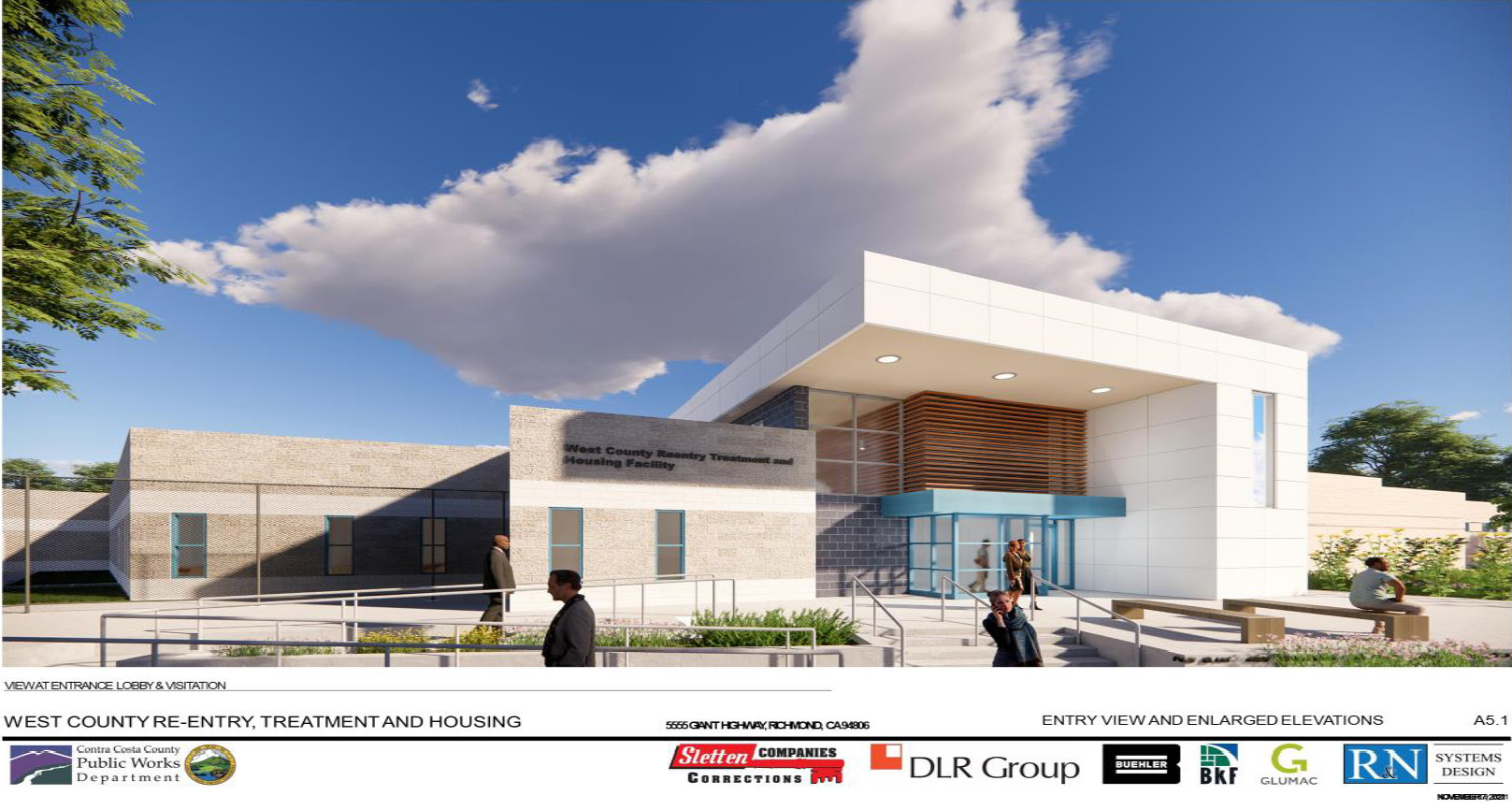
Rendering of the entrance of the West County Re-entry Treatment and Housing Facility. Source: Contra Costa County
$95.5 Million West County Detention Facility Expansion Plan Approved
Supervisors unanimously approved a $95.5 million design-build contract with Montana-based contractor Sletten Construction Company to design and build five secure housing units, a medical treatment center, reentry program space and building, and visitation facilities at the West County Detention Facility in Richmond. It will be known as the West County Reentry Treatment & Housing Facility. WRTH presentation CCCBOS120721
One of the objectives of the project is to reduce overcrowding by 128 inmate beds to 288 high-security inmate beds in five housing units. Ninety-six beds will still be mental health treatment beds.
Possible Relocation of Marsh Creek Shooting Range
In a related matter, supervisors approved as a consent item a report on the future use and potential relocation of the shooting range at the Marsh Creek Detention Facility possibly to the Concord Naval Weapon Station. At the low-security detention facility inmates learn wood making skills and other basic education skills.
Used also as a training facility for the Office of the Sheriff and law enforcement agencies from Contra Costa County and surrounding counties, the Marsh Creek Range Facility generates revenue for the county. The range will bring about $113,000 for fiscal year 2021-2022, wrote County Administrator Monica Nino in her report to the supervisors.
 East County Groundwater Sustainability Plan Approved
Supervisors also approved the East Contra Costa Subbasin Groundwater Sustainability Plan on a 5-0 vote. The $1.4 million groundwater study applies to the cities of Antioch and Brentwood, Byron-Bethany Irrigation District, Diablo Water District, Discovery Bay Community Services and East Contra Costa Irrigation District.
Even under drought like conditions, the plan found, “Groundwater conditions in the ECC Subbasin are favorable and reflect stability over the past 30 years or more. Using various analogies, the Subbasin can be described as generally full through various water-year types, including drought and is in good “health.” The favorable conditions are in part due to surface water availability that represents the largest sources of supply for municipal and agricultural uses in the Subbasin.”
Ryan Hernandez of the Department of Conservation and Planning said if the board of supervisors did not adopt the ECC-GSP, the county would be in violation of the Sustainable Groundwater Management Act, which would result in the State Water Resources Board intervening in local groundwater management.
Allen Payton contributed to this report.
Contra Costa Micro-Enterprise Relief Fund available for small businesses impacted by COVID

The Contra Costa County Micro-Enterprise Relief Fund offers grants to micro-businesses impacted by the COVID-19 pandemic in Contra Costa County cities except for Walnut Creek, Concord, Pittsburg, and Antioch which receive Community Development Block Grant (CDBG) funds, directly.
The Contra Costa County Micro-Enterprises Relief Fund is funded by the Contra Costa County CDBG program. The CDBG program is sponsored by the U.S. Department of Housing and Urban Development (HUD). This fund is administered by the nonprofit organization Renaissance Entrepreneurship Center’s East Bay office.
FOR THE PURPOSES OF THIS FUND, A “MICRO-ENTERPRISE” WILL BE DEFINED AS A FOR-PROFIT ENTITY WITH:
-A maximum of 5 employees (including owner)
-Less than $250,000 in annual business revenue
-Registered, in good standing with, and operating in Contra Costa County cities except for Walnut Creek, Concord, Pittsburg, and Antioch
ELIGIBILITY, BUSINESS MUST:
-Be an existing micro-enterprise with 5 employees of less (including owner)
-Have a business operating in Contra Costa County except for Walnut Creek, Concord, Pittsburg, and Antioch
-If resident lives outside of the county, business must be a brick and mortar in eligible cities
-Have a business license or permit
-Have a DUNS number (or able to obtain one prior to grant receipt)
-Be able to show their business financials from 2020 (tax returns, pay stubs, bank statements, POS reports, quarterly taxes)
-Have a household income that is low to moderate-income (varies based on household size) or the majority of employees are low income (must show proof of income)
-Be directly impacted by COVID-19
INELIGIBLE BUSINESSES:
-Operating one of the following types of businesses: adult entertainment, liquor, cannabis, franchise
-Gig-workers: Uber, Instacart, etc.
-Received over $25,000 in PPP or EIDL loan/grants, if so, grants must be used for different expenses.
EXAMPLE USE OF FUNDS (NOT AN EXHAUSTIVE LIST)
-Purchasing technology (i.e. laptops, printer, point of sale system)
-COVID-19 precaution supplies (PPE)
-Safety remodeling (plexiglass, spacing tape, construction labor)
-Façade improvements and signage
-Online platform fees and social media marketing to further online sales
-Commercial rents
-Employee salaries (must provide third party payroll vendor, 941 Form or W3 IRS Form)
-Funds cannot be used to pay debt or loans.
GRANT AMOUNT: $1,000.00- $10,000.00
To apply visit Contra Costa County Micro-Enterprise Relief Fund – Renaissance Center : Renaissance Center (rencenter.org)
IF YOU NEED ASSISTANCE, PLEASE EMAIL: EASTBAY@RENCENTER.ORG or CALL (510) 877-3738
Brentwood woman owner of Emeryville tax preparation company charged with tax fraud

Traci Austin and Emeryville Tax Services 2019 promo from their Facebook page.
Traci Austin allegedly aided in submission of more than 40 fraudulent tax returns and hosted “tax school” at which she taught prospective tax preparers how to compose fraudulent tax returns
Could face three years in prison and a $100,000 fine
By U.S. Attorney’s Office, District of Northern California, U.S. Department of Justice
OAKLAND – A federal criminal complaint unsealed today charges Traci Austin with aiding and assisting in the preparation of fraudulent tax returns, announced Acting U.S. Attorney Stephanie M. Hinds and Internal Revenue Service, Criminal Investigation, and IRS-Criminal Investigation Special Agent in Charge Mark H. Pearson.
The complaint describes Austin, 44, of Brentwood, CA, as the owner of a tax return preparation business called Emeryville Tax Services (“ETS”). According to the complaint, Austin prepared materially false and fraudulent tax returns for her clients by including false and/or inflated Schedule A expenses, false and/or inflated Schedule C income and expenses, and false dependents. By doing this, Austin fraudulently reduced her clients’ taxable income and tax liability, thereby resulting in larger refunds for the client and higher return preparation fee income for Austin. The investigation has revealed that Austin allegedly assisted in the preparation of at least 42 fraudulent tax returns and an estimated tax loss of well over $697,000 to the federal government.
In addition to the false and fraudulent tax return preparation scheme, the complaint also alleges that since 2016, Austin has hosted a “Tax School” through ETS and charged a fee of at least $200 for students to attend the tax school. According to the complaint, the goal of the tax school was to hire the attendees as preparers for ETS and prepare tax returns for ETS clients as well as the attendees’ own clients. During the tax school, Austin allegedly instructed prospective tax preparers how to fraudulently manipulate tax returns to generate the maximum tax refund, and thus the maximum tax preparation fee by listing fictitious side businesses under Schedule C and fake business expenses on Schedule A, for example, the complaint describes how Austin taught her students how she created a fictitious dog grooming business for a client, created a fictitious profit and loss statement for the fake business, and how she instructed the client to print out some photos of dogs to support the idea of her fictitious business.
Austin is charged with aiding and assisting in the preparation of false and fraudulent federal income tax returns, in violation of 26 U.S.C. § 7206(2).
The charges in the complaint are merely allegations and the defendant is presumed innocent unless proven guilty in a court of law.
If convicted, Austin faces a maximum penalty of three years in prison and a $100,000 fine; however, any sentence following conviction would be imposed by the court after consideration of the U.S. Sentencing Guidelines and the federal statute governing the imposition of a sentence, 18 U.S.C. § 3553.
Austin made her initial federal court appearance this morning before United States Magistrate Judge Kandis A. Westmore. Austin remains out of custody and her next scheduled appearance is at 10 a.m., on February 24, 2022, for a status conference before Magistrate Judge Westmore.
Assistant U.S. Attorney Abraham Fine is prosecuting the case with the assistance of Kay Konopaske and Helen Yee. The prosecution is the result of an investigation by the Internal Revenue Service, Criminal Investigation.
Sales taxes – how much, what are they for and who raised them

CCC Sales Tax Rate Breakdown chart and Chick-fil-A receipt.
I didn’t know that! Receipt from new Pittsburg Chick-fil-A raises questions – here are the answers
By Allen Payton
A post by someone, on Facebook, of their sales receipt from the new Chick-fil-A restaurant in Pittsburg, shows a breakdown of the sales tax they were charged. That started a discussion of what each of the line items is for.
I had never seen the sales tax broken down that way, previously, and I used to be a partner in a restaurant which collected sales tax and dealt some with it. I also served on the Contra Costa Transportation Authority for four years, but never knew the county received an additional .25% and the cities 1% in sales tax for transportation above the .5% for which we oversaw the expenditures. Nor have I seen the breakdown of the 6%, until now.
So, I set out on a quest to learn the details of the sales taxes we pay for many if not most of the purchases we make in Contra Costa County.
Once you read this, you too may say as I did, “I didn’t know that!”
County Finance Director Lisa Driscoll pointed out that on the Sales Tax page of the County’s website, each Quarterly Tax Report includes a breakdown of the sales tax, which answered most of my questions. She also mentioned the 1% “Bradley‑Burns” tax which is received by the cities for transportation.
On the State Auditor’s website, about The Bradley‑Burns Tax and Local Transportation Funds, it reads, “The tax charges 1.25 percent on the retail sale or use of tangible personal property in the State, of which 1 percent is allocated to counties or incorporated cities to use at their discretion and the other 0.25 percent is allocated to county LTFs.”
In Contra Costa County we also pay the voter-approved half-cent sales tax for BART operations, another half-cent sales tax from Measure J, passed in 2004, for transportation projects which is overseen by the Contra Costa Transportation Authority, a half-cent approved by the voters with the passage of Prop. 147 in 2019 for public safety, and another half-cent from Measure X, passed last year, which is allocated by the Board of Supervisors. (See related article)
Driscoll also shared, “The County does not actually collect any sales tax and the rate varies by location. Retailers engaged in business in California must register with the California Department of Tax and Fee Administration (CDTFA) and pay the state’s sales tax, which applies to all retail sales of goods and merchandise except those sales specifically exempted by law. The unincorporated rate is listed below.”
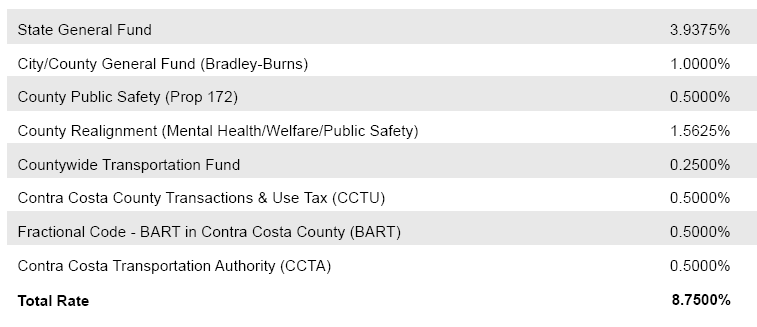
Source: Contra Costa County
Each city’s sales tax rate can be different because they might also have a local sales tax the voters passed, such as in Antioch where they passed two half-cent sales tax increases, mainly to pay for more police, and has a rate of 9.75%. The highest sales tax rate can be a whopping 10.25% and the only city in Contra Costa County to have the maximum is El Cerrito! To see the sales tax rate in your city or community, click here.
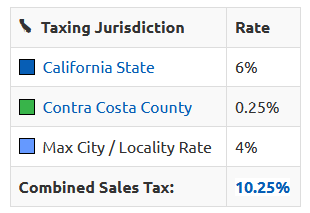
Source: Contra Costa County
As someone who advocates shopping local instead of online, to help support our local retailers and keep our sales tax revenue, you’d think I would know this stuff. But alas, no. So, this has been enlightening for me.
Plus, people, including me, tend to forget about the voter-approved taxes, including 2% of the sales tax in our county, and it’s good for us to be informed or reminded of why we’re paying them and who imposed the various taxes on “we the people”. Just like with the $9.5 billion for the California high-speed rail, about which I’m constantly having to remind people who complain about the state spending their tax dollars on it, that the voters approved that amount in bonds for the project. The same with the law making it only a misdemeanor for shoplifting less than $950 in goods due to Prop. 47. People, we did it to ourselves! LOL
As for the breakdown in the state sales tax and the 1% Bradley-Burns sales tax, say it with me, “I didn’t know that!” Well, now we do.
Contra Costa, 22 other DA’s reach settlement with gas station owner for underground storage tank environmental violations

Gas station underground storage tank diagram. Source: EPA
$1.1 million in civil penalties; 113 tanks statewide, seven in Contra Costa County
By Bobbi Mauler, Executive Assistant, Contra Costa County Office of the District Attorney
Contra Costa County District Attorney Diana Becton announced today that the Contra Costa County District Attorney’s Office, together with 22 other California District Attorneys and City Attorneys, have reached a settlement with the Orange, California-based Hassan & Sons, Inc., H&S Energy, LLC and H&S Energy Products, LLC (formerly known as Colonial Energy, LLC), (collectively referred to as “H&S Energy”) over allegations that the companies violated state laws regarding the operation and maintenance of motor vehicle fuel underground storage tanks (“USTs”). The settlement includes $1,100,000 in civil penalties, and investigative costs. H&S Energy has 113 fueling stations in California, of which, seven locations are in Contra Costa County. The settlement follows an investigation by local environmental health agencies of H&S Energy stations’ non-compliance with many provisions of the UST regulations.
The companies, started in 1996, have built and acquired gasoline and convenience stores throughout the state under the Chevron, Texaco, Shell, Extra Mile, and their own, Power Market brand, including locations in Bay Point, Brentwood, Oakley, Pittsburg and Martinez.
“UST owners and operators must comply with the applicable regulations in order to prevent potential harm to the environment,” said D.A. Becton. “H&S Energy was cooperative with the People’s investigation and expended significant resources in order to bring their stations into compliance.”
Under the settlement, which includes a Final Judgment and Permanent Injunction entered in Solano County Superior Court Case No. FCS057332 by the Honorable E. Bradley Nelson, H&S Energy must implement certain compliance assurance programs including hiring an environmental compliance manager and bi-annual environmental audits and reports submitted to the People. In addition, H&S Energy must pay $900,000 in civil penalties and $200,000 in costs. $550,000 is due within five days after entry of judgment, and the remaining $550,000 is due October 22, 2022.
Allen Payton contributed to this report.
Nine suspects sought in smash and grab robbery of Sun Valley mall jewelry store in Concord Monday

Nine suspects steal jewelry from Sun Valley mall store in Concord on Monday, Nov. 15, 2021. Source: Concord PD video screenshot
By Concord Police Department
On November 15, at approximately 7:30 pm, a group of nine people entered the Iceberg Diamonds jewelry store inside the Sun Valley Mall in Concord, armed with hammers. They began smashing the glass display cases and stealing jewels. Employees tried to intervene and were kept back by the hammer wielding criminals. The suspects got away before police arrived. (See surveillance video)
Some customers inside the mall called reporting what they thought were gunshots heard, but in actuality, they heard the sounds of the hammers breaking glass. No shots were fired.
The case is under investigation by Concord PD Detectives. Anyone with information regarding this case may contact Detective Christine Corey with CPD’s Financial Crimes Unit at 925-603-5828. CPD Case #21-11268
- « Previous Page
- 1
- …
- 16
- 17
- 18
- 19
- 20
- …
- 30
- Next Page »