• Home
  • About The Herald
  • Local Agencies
  • Daily Email Update
  • Legal Notices
  • Classified Ads

Contra Costa Herald

News Of By and For The People of Contra Costa County, California

  • Arts & Entertainment
  • Business
  • Community
  • Crime
  • Dining
  • Education
  • Faith
  • Health
  • News
  • Politics & Elections
  • Real Estate

Connect Bay Area campaign raises nearly $3 million to support signature gathering for regional transit tax measure

January 15, 2026 By Publisher Leave a Comment

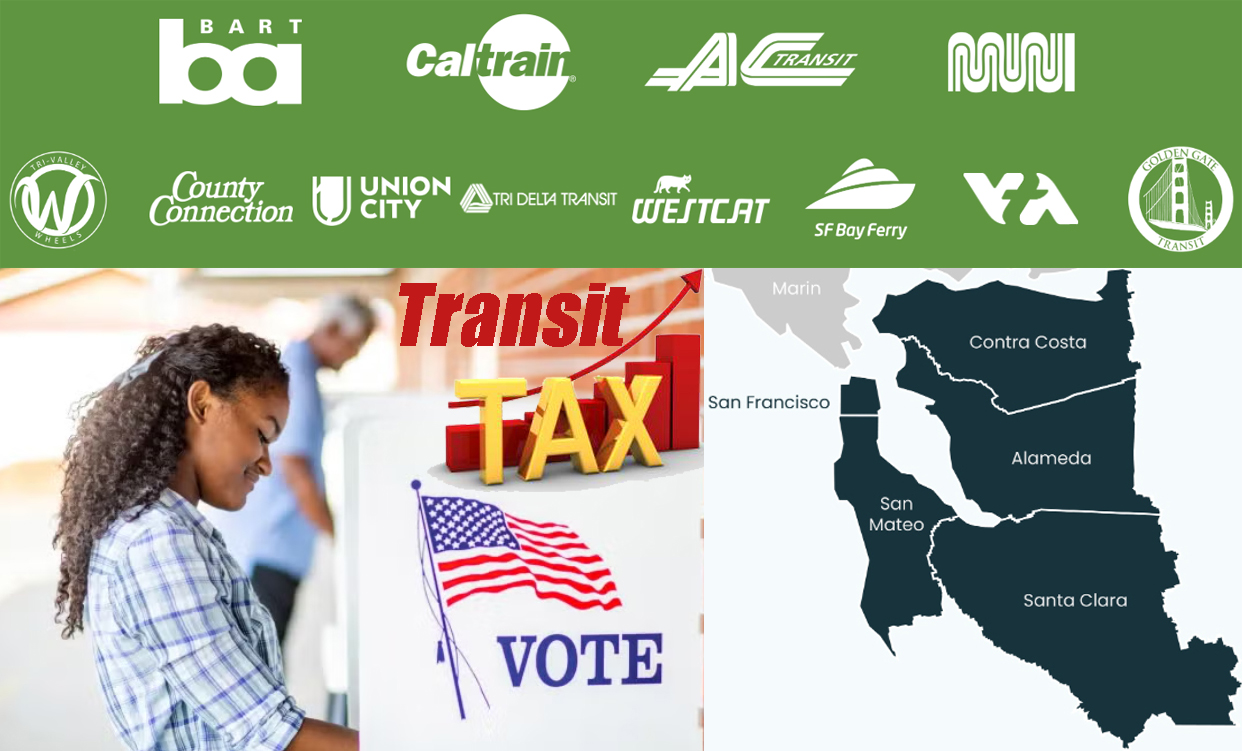
Multiple Bay Area transit agencies would benefit from the five-county sales tax measure. Photo: MTC. Graphics source: Connect Bay Area

Businesses, labor unions, civic foundations join effort for 5-county Nov. 2026 ballot measure to prevent threatened catastrophic transit service cuts, promote reliable, safe public transit

Includes Contra Costa; would generate about $1 billion per year

SAN FRANCISCO BAY AREA, CA — The Connect Bay Area Transit committee today announced that it has already raised nearly $3 million to support a region-wide effort to qualify Connect Bay Area, a voter-proposed regional transportation funding measure, for the November 2026 ballot. With strong early financial backing secured, the campaign will now begin signature gathering while continuing to fundraise to qualify and pass a five-county sales tax to save public transit.

About the Tax Measure

The measure if adopted would increase the sales tax in Contra Costa, Alameda San Mateo and Santa Clara Counties by a half cent and one cent in San Francisco County for 14 years. As previously reported, the measure would generate approximately $980 million annually across the five counties.

Revenue from the tax measure will benefit multiple transit agencies in the region including Tri Delta Transit, County Connection and WestCat, as well as AC Transit and BART which serve Contra Costa County residents.

Following is a county-by-county breakdown of the County Specific Dollars. It does not include money going to BART, Muni, AC Transit and Caltrain, or to regional improvements that aren’t designated by county, such as coordinated fare programs and accessibility improvements.

County Agencies:

  • Contra Costa County Transportation Authority (2.5%, $26.51M)
  • Alameda County Transportation Commission (1%, $10.26M)
  • San Mateo County Transit District (4.7%, $50M)
  • Santa Clara Valley Transportation Authority (25.1%, $264.07M)

Small Operators:

  • Contra Costa County small operators (1.5%, $15.75M)
  • Alameda County small operators (0.5%, $5.25M)
  • SF Bay Ferry (0.7%, $7M)
  • Golden Gate Transit (0.1%, $1M)

Without new and sustainable operations funding, the Bay Area will face a true emergency:

  • BART: Could shut down two of its five lines, reducing service from 4,500 trains per week to just 500, with trains running only hourly and no weekend service.
  • AC Transit: Would reduce service by 37%, bringing operations down to just half of pre-pandemic levels.
  • Muni: Would face 50% cuts to all bus and Metro lines, including elimination of entire neighborhood routes and San Francisco’s iconic historic trolleys and cable cars.
  • Caltrain: Trains would run only once per hour, end service by 9 p.m. on weekdays, and eliminate all weekend service.

The Connect Bay Area measure will support the future of public transportation in the Bay Area:

  • Protect and improve service on BART, Muni, Caltrain, SamTrans, VTA and AC Transit
  • Prevent catastrophic service cuts that could devastate the Bay Area
  • Keep traffic and emissions down, preventing gridlock and protecting climate progress;
  • Support the Bay Area’s economy, ensuring that downtown recovery and regional mobility remain strong.

The Connect Bay Area Transit measure will include strong accountability provisions. This ensures new funding delivers real improvements, not just short-term fixes. Transit agencies must:

  • Independent financial review and cost-efficiency: Operators will undergo a third-party financial review and be required to improve financial efficiency and use public funds wisely
  • Better regional coordination to benefit riders: Operators will be required to comply with MTC’s Regional Network Management Policies to coordinate across systems and simplify fares and signage to create a more seamless experience for riders.
  • Oversight Committee: An oversight committee will ensure that the expenditure plan is adhered to and hold MTC and operators accountable to all provisions of SB63.

About the Campaign

The campaign’s initial fundraising success reflects broad alignment across business, labor, philanthropy, and community leaders that a reliable, safe, and efficient public transportation system is vital to the future of the Bay Area. Major early donors include Chris Larsen, Herzog Contracting Corporation, Genentech, HNTB Corporation, Meta, and SEIU 1021. For a full list of donors, see below.

“Public transportation connects everyone. We are proud of the broad coalition uniting to prevent catastrophic service cuts and to build an affordable, safe, and efficient public transportation system,” said Jeff Cretan, a spokesperson for the Connect Bay Area Transit Committee. “The commitments we are seeing from business, labor, and civic leaders shows that everyone is ready to get this measure across the finish line in November.”

Connect Bay Area is a five-county regional tax measure designed to prevent catastrophic transit service cuts and provide reliable operating funding for major transit systems and local bus operators throughout the region. The measure also funds improvements to transit systems, capital projects within counties, and targeted road improvements. The measure is critical to supporting the Bay Area’s economy, promoting an affordable region, reducing traffic congestion, and ensuring access to jobs, schools, and healthcare.

Early financial support for the campaign includes commitments from:

  • Chris Larsen
  • Herzog Contracting Corporation
  • Genentech
  • HNTB Corporation
  • Meta
  • SEIU 1021
  • Jacobs
  • Silicon Valley Community Foundation
  • ATU Local 1555
  • PG&E
  • San Francisco Foundation
  • WSP
  • Golden State Warriors
  • AFSCME Local 3993
  • Boston Properties
  • Visa
  • AFSCME Council 57
  • T.Y. Lin
  • GILLIG
  • HDR, Inc.
  • Fehr & Peers
  • AFSCME 3916
  • Arup North America
  • Olson Remcho

Additional major employers, labor organizations, and philanthropic partners have indicated commitments that are expected to be finalized as the campaign continues to build momentum.

With signature gathering starting, the Connect Bay Area campaign will focus on qualifying the measure for the ballot while continuing to expand its coalition across the region. The Campaign must secure over 186,000 signatures from the five counties by June 6, 2026 to qualify for the November ballot.

The campaign’s early momentum comes as Bay Area transit agencies face an unprecedented funding crisis. Without a sustainable solution, public transportation in the the region could see devastating impacts, including:

  • BART could eliminate 2 full lines, stop service at 9pm on weekdays, and eliminate all weekend service.
  • Muni could eliminate entire routes, make 50% cuts to major bus and metro lines, gut historic train and cable car service.
  • Caltrain could cut weekday service to once an hour, stop service at 9pm on weekdays, and eliminate all weekend service.
  • AC Transit could cut up to 37% of overall service.

Recent polling on the proposed Connect Bay Area measure shows a clear path to passage, with strong support across counties and voter demographics. A survey conducted by EMC Research for the Metropolitan Transportation Commission found that 59% of Bay Area voters would support a proposed regional sales tax measure for public transportation. The threshold for passage for a signature-gathering initiative is 50%+1.

For more information about Connect Bay Area, visit ConnectBayArea.com.

About the Connect Bay Area Transit Committee

The Connect Bay Area Transit Committee is led by labor, business, and transit supporters, including the Bay Area Council, SEIU 1021, ATU 1555, SPUR, SAMCEDA, among others, as well as a broad advocacy council. The advocacy council includes more than 20 organizations including transit advocates, housing advocates, safe streets advocates, senior and disability advocates, and environmentalists. The Committee is focused on delivering a successful 2026 ballot measure that will strengthen public transportation to keep the Bay Area affordable for residents and support critical economic growth and climate resilience.

Allen D. Payton contributed to this report.

Filed Under: BART, Bay Area, News, Politics & Elections, Taxes, Transportation

Two Concord men among four charged in Fremont jewelry store heist

January 13, 2026 By Publisher Leave a Comment

20-year-old Jose Herrada-Aragon, 19-year-old Andres Palestino, two others stole $1.7 million of merchandise, each face 20 years in prison and $250,000 fine

By Michelle Lo, PIO, U.S. Attorney’s Office, Northern District of California

OAKLAND – A federal grand jury has indicted four defendants, Afatupetaiki Faasisila, 20, of San Bruno, Jose Herrada-Aragon, 20, of Concord, Andres Palestino, 19, of Concord, and Tom Parker Donegan, 19, of Fairfield, in connection with the June 18, 2025, robbery of a jewelry store in Fremont.  Faasisila and Palestino were arrested yesterday and made their initial appearances in district court today.  Herrada-Aragon and Donegan are currently in state custody on other charges and will be transferred to federal custody.

Faasisila, Herrada-Aragon, Palestino, and Donegan were initially charged by complaint on December 8, 2025, and subsequently indicted on December 18, 2025.  The indictment, unsealed today, charges each defendant with one count of robbery affecting interstate commerce.  According to the criminal complaint and other court documents, on June 18, 2025, over two dozen masked individuals conducted a takeover-style robbery of a Kumar Jewelers located on Mowry Avenue in Fremont.  Surveillance video captured a gray Honda ramming into the store’s front façade to force entry.  One individual brandished a firearm at the store’s security guard, while another held the guard’s arms and forced him to the ground.  Dozens of masked individuals, including Faasisila, Herrada-Aragon and Palestino, allegedly stormed the business, which was occupied at the time.  Once inside, the robbers used hammers and other tools to smash display cases and grab the jewelry contained within, resulting in an estimated loss of approximately $1.7 million worth of jewelry.  After ransacking the store, the robbers left with the stolen goods and got into waiting vehicles to flee. (See additional details in the NBC Bay Area news report)

The complaint alleges that Donegan drove one of the getaway vehicles, leading responding police officers on a vehicle pursuit before eventually crashing the car in another part of Fremont.  There, the four defendants exited the vehicle and attempted to flee on foot, only to be apprehended by officers.  Several pieces of stolen jewelry were recovered in the defendants’ flight path and the abandoned vehicle, which had also been reported stolen.

United States Attorney Craig H. Missakian and FBI Special Agent in Charge Sanjay Virmani made the announcement.

Palestino is next scheduled to appear in federal court in Oakland for an arraignment on January 14, 2026, and Faasisila is next scheduled to appear for a detention hearing on January 16, 2026.

A complaint or indictment merely alleges that crimes have been committed, and all defendants are presumed innocent until proven guilty beyond a reasonable doubt.  If convicted, the defendants each face a maximum sentence of 20 years in prison and a $250,000 fine for the count of robbery affecting interstate commerce in violation of 18 U.S.C. §§ 1951(a) and 2.  Any sentence following conviction would be imposed by the court after consideration of the U.S. Sentencing Guidelines and the federal statute governing the imposition of a sentence, 18 U.S.C. § 3553.

Assistant U.S. Attorneys Sloan Heffron and Wendy Garbers of the Violent Crime Strike Force are prosecuting the case with the assistance of Lakisha Holliman and Yenni Weinberg.  The prosecution is the result of a joint investigation by the FBI and the Fremont Police Department.

Anyone who has information relevant to this case can report it by contacting the FBI at (415) 553-7400 or tips.fbi.gov.

According to localcrimenews.com, Herrada-Aragon was also arrested on Aug. 31, 2025, by Concord Police for warrants or holds only.

According to the Alameda County Sheriff’s Office, as of this morning, Palestino was being transferred to another facility.

Further Information:

Case No. 25-cr-00435-HSG

Electronic court filings and further procedural and docket information are available at https://ecf.cand.uscourts.gov/cgi-bin/login.pl.  Judges’ calendars with schedules for upcoming court hearings can be viewed on the court’s website at www.cand.uscourts.gov.

Allen D. Payton contributed to this report.


Filed Under: Bay Area, Central County, Concord, Crime, DOJ, News, Police, U S Attorney

Richmond man sentenced to over 5 years for $80,000 retail theft spree across 11 Nor Cal counties

January 11, 2026 By Publisher Leave a Comment

Shawn Naputi faced 56 felony theft charges for more than 80 crimes from October 2023 to May 2025; arrested 16 times since 2021 for violent crimes, multiple counts of theft

By Allen D. Payton

According to the Sonoma County Office of the District Attorney, on May 8, 2024, Shawn Andre Naputi walked into the Friedman’s Home Improvement store on Santa Rosa Avenue in Santa Rosa, filled a trash can with more than $2,400 worth of Friedman’s merchandise, and headed for the exit. A sharp-eyed Friedman’s employee recognized Mr. Naputi and his vehicle from prior Friedman’s thefts and called the police. When employees started observing Mr. Naputi inside the store and Sonoma County Sheriff deputies arrived outside, Mr. Naputi abandoned the trashcan full of merchandise and walked out of the store. Sheriff Deputies spoke to the Friedman’s employees and connected Mr. Naputi to seven (7) other Friedman’s thefts, dating back to January 2024.

Once the case was referred to the District Attorney’s Office, it was forwarded to the Organized Retail Theft Unit. The Sonoma County District Attorney’s Office has been awarded grant funding from the State of California’s Organized Retail Theft Grant Program, administered by the Board of State and Community Corrections (BSCC), to combat organized retail theft. The grant funds are used by the office to establish a dedicated prosecutor and investigator focused on ensuring that perpetrators are held accountable by identifying gaps in the system and improving cooperation with retail operators and local law enforcement.

When the District Attorney’s Organized Retail Theft Unit started looking into prior Sonoma County thefts and speaking to counterparts in nearby counties, only then did the true breadth of Mr. Naputi’s criminal conduct become clear. Between October 6, 2023, and May 22, 2025, Mr. Naputi committed more than eighty (80) separate instances of theft from Bay Area retailers. The combined loss to these retailers, including Best Buy, Boot Barn, REI, Friedman’s Home Improvement, Dick’s Sporting Goods, Kohls, Lowes, and The Home Depot, was more than $80,000. The crimes occurred in Contra Costa County, Alameda County, San Mateo County, Santa Clara County, Sacramento County, Solano County, Placer County, San Francisco County, Yolo County, Marin County, and Sonoma County.

Without naming Naputi, the Vallejo Police Department reported that on May 21, 2025, a repeat thief was arrested after burglarizing a business. Officers assigned to the Vallejo Police Department Patrol Division responded to a call regarding a suspect wanted in connection with a burglary on the 1300 block of Tennessee Street.

The property owner reported having surveillance footage from May 20 showing a male suspect breaking into the business, ransacking the location, and leaving with multiple items, including professionally graded equipment. The suspect also caused approximately $500 in damage to the business.

The following morning, the business owner was alerted by her surveillance system that the thief had returned to the property. She drove to the location and confronted him. The thief was still in possession of her stolen equipment bag. She took her bag back and the thief fled on foot.

Later that day, the thief was observed loitering near a business on the 400 block of Broadway Street. Officers quickly detained the thief without incident. A records check revealed he was on felony probation out of Solano County for vehicle theft. He also had two outstanding arrest warrants related to stealing a dog, stealing another vehicle and initiating a pursuit in Vallejo.

A probation search revealed he had a glass-shattering tool commonly used to commit burglaries. After being Mirandized, the suspect admitted to the burglary, stating he needed to get out of the sun.

The thief was subsequently booked into the Solano County Jail on multiple charges, including burglary, probation violations and outstanding warrants.

About the sentencing, Sonoma County District Attorney Carla Rodriguez stated, “This case exemplifies the very reason that Proposition 36 was passed by the voters, to stop prolific thieves that repeatedly victimize our communities’ businesses which previously, under Proposition 47, provided little accountability and few consequences for retail theft.” The Naputi case “further highlights the impact of the Sonoma County District Attorney’s Organized Retail Theft Unit whose primary mission is to change expectations of criminal defendants, the public, and the criminal justice system by ensuring that there will be significant consequences if these crimes are committed in Sonoma County.”

Taking advantage of legislation passed under the recent Proposition 36 and designed to combat organized retail theft, the Sonoma County District Attorney’s Office assumed jurisdiction from the affected counties to prosecute all crimes under one criminal complaint. With jurisdictional approval in hand, the Sonoma County District Attorney’s Office filed an amended felony complaint charging Mr. Naputi with fifty-six (56) felony theft charges capturing his crime spree between October 2023 and May 2025.

On November 12, 2025, Defendant Naputi plead no-contest to six (6) felony theft charges in exchange for a prison term of 5 years and 4 months. Two years of that term will be served in actual custody, with the balance on Mandatory Supervision. On January 7, 2026, Defendant was sentenced to that term and agreed to several Organized Retail Theft Restraining Orders under the new Penal Code section 490.8. Defendant Naputi also agreed to $83,093.64 in restitution.

According to the Sonoma County Sheriff’s Office, he is 43 years old, was booked on May 28, 2025, and is being held in the Main Adult Detention Facility in Santa Rosa.

According to localcrimenews.com, the five-foot, nine-inch tall, 200-pound Naputi is Hispanic and has been arrested 16 times since 2021 by multiple agencies including Richmond PD, El Cerrito PD, Emeryville PD, Vallejo PD, San Rafael PD, Daly City PD, Sunnyvale PD, Contra Costa CHP, and the Contra Costa County and Solano County Sheriff’s Departments. He was charged with crimes including Assault with a Deadly Weapon or Assault with Force Likely to Produce Great Bodily Harm, Inflicting Corporal Injury on a Spouse/Cohabitant, Organized Retail Theft, Grand Theft, Burglary, Petty Theft, Obtaining property by theft where value exceeds $950, Shoplifting Not to Exceed $950, Taking a Vehicle without Owner’s Consent, Receiving/Etc. Known Stolen Property Over $200, Vandalism, Possession of a Controlled Substance, Possession of Narcotic Controlled Substance and Possession of Drug Paraphernalia.

Filed Under: Bay Area, Business, Crime, District Attorney, News, Sheriff

Law firm offers free New Year’s Eve Uber rides across California

December 31, 2025 By Publisher Leave a Comment

Source: Setareh Law, LLC

Includes major regions such as the Bay Area, Stockton, Santa Rosa, Sacramento, Modesto, Madera, Fresno, Bakersfield, Ventura/Oxnard, Salinas, Los Angeles and San Diego

By Karla Fernandez, Public Relations, Market My Market

New Year’s Eve is consistently one of the deadliest nights of the year to be on the road. According to the National Highway Traffic Safety Administration, alcohol-impaired driving accounts for about 37% of traffic deaths during the New Year’s holiday period, with fatal crashes peaking during late-night hours between 9 p.m. and 3 a.m.

Nationwide, the National Safety Council projects more than 500 traffic fatalities during major holiday travel periods, and NHTSA reports that roughly one-third involve alcohol-impaired drivers – a risk that intensifies during overnight celebrations like New Year’s Eve.

To help reduce that risk, Setareh Law is offering free Uber rides (up to $20 each) across eligible California counties, giving people a safe way to get home on New Year’s Eve without getting behind the wheel.

This initiative is part of a broader community safety effort aimed at reducing impaired driving and helping more people get home safely during one of the busiest travel nights of the year.

Daniel Setareh, Founder of Setareh Law, explains, “New Year’s Eve is a time for celebration, not tragedy. After fighting for justice for families who have been forever impacted by impaired drivers, we want to do our part to help prevent these accidents before they happen. If one free ride will keep someone safe, then this effort is worth every bit of it.”

Here’s How It Works (Step by Step):

Step 1: Request Your Voucher

Fill out the short form on the official campaign page to request your Uber voucher. Once approved, you’ll receive a unique Uber voucher link by email.

Step 2: Add Your Voucher to the Uber App

Click the link in your email and the voucher will automatically load into your Uber app.

Step 3: Take Your Free Ride (Dec 31–Jan 1)

Use the voucher anytime between:

5:00 PM on December 31 through 10:00 AM on January 1

Your ride must start or end in one of the eligible California counties.

Eligibility Requirements:

To qualify for the free ride, users must:

  • Be 21 years or older
  • Have an active Uber account
  • Take the ride during the campaign window (Dec 31–Jan 1)
  • Start or end the ride in an eligible California county
  • Limit: one voucher per Uber account
  • Offer is limited to the first 300 vouchers

The voucher covers one one-way ride up to $20 (tip not included).

Eligible California Counties

Contra Costa, Alameda, San Francisco, San Mateo, Santa Clara, Sacramento, Fresno, San Joaquin, Stanislaus, Sonoma, Kern, Ventura, Monterey, and Madera, Los Angeles, Orange, Riverside, San Bernardino and San Diego.

Only rides that start or end in an eligible county will qualify. The Uber app will automatically prevent the voucher from applying outside approved areas.

About Setareh Law

Setareh Law, APLC, is a California-based personal injury law firm dedicated to representing individuals and families harmed by negligence. Founded by attorney Daniel Setareh, the firm handles serious injury cases including car accidents, drunk-driving crashes, catastrophic injuries, and wrongful death. With offices across California, Setareh Law is committed to providing hands-on legal representation, personalized client care, and strong advocacy both inside and outside the courtroom.


Filed Under: Bay Area, Holiday, Legal, News, Transportation

Toll increases at 7 Bay Area bridges beginning Jan. 1

December 24, 2025 By Publisher Leave a Comment

Richmond-San Rafael Bridge. Credit: Karl Nielsen. Photos source: BATA

$8.50 for all regular two-axle cars & trucks

First in series of 5 increases each year through 2030 – not voter approved

Plus, new policies for carpool lanes on bridge approaches

By John Goodwin, Assistant Director of Communications & Rebecca Long, Director, Legislation & Public Affairs, Metropolitan Transportation Commission

With the new year starting next Thursday, the Bay Area Toll Authority (BATA) reminds drivers that tolls at the region’s seven state-owned toll bridges will go up by 50 cents on Jan. 1, 2026. This will be the first in a series of five toll increases to be phased in each January through 2030, with the additional funds to be used only to pay for the maintenance, rehabilitation and operation of the San Francisco-Oakland Bay Bridge and the Antioch, Benicia-Martinez, Carquinez, Dumbarton, Richmond-San Rafael and San Mateo-Hayward bridges, and to service debt on BATA bond issues.

Approved by the BATA board in late 2024, not the voters, the new toll schedule includes a tiered rate structure  aimed at encouraging more customers to pay electronically with FasTrak® toll tags. Because payment with FasTrak carries lower administrative costs than payment through a license plate account or by returning payment with an invoice received in the mail, customers will pay a premium for using a pre-registered license plate account or for invoiced tolling. To give customers ample time to sign up for FasTrak, BATA last year voted to delay the start of the tiered pricing structure until 2027.

Tolls for all regular two-axle cars and trucks will increase to $8.50 from the current $8 on Jan. 1, 2026. Tolls for customers who pay with FasTrak tags will then rise to $9 in 2027; to $9.50 in 2028; to $10 in 2029; and then to $10.50 in 2030. Tolls for customers who use a pre-registered license plate account will climb to $9.25 in 2027; to $9.75 in 2028; to $10.25 in 2029 and to $10.75 in 2030. Invoiced tolls will go to $10 in 2027; $10.50 in 2028; $11 in 2029; and $11.50 in 2030.

Tolls for large freight trucks and other vehicle/trailer combinations with three or more axles will rise by 50 cents per axle each year from 2026 through 2030.

History of Bay Area Bridge Tolls

Tolls include the $5 of voter approved toll increases on the region’s seven state-owned toll bridges. They include:

  • The $1 uniform base toll on the bridges from Regional Measure 1 approved by voters in 1988, except for tolls at the Richmond-San Rafael Bridge, which were already set at $1, and unchanged by passage of RM1.
  • Voters also approved Regional Measure 2 in 2004 which raised the toll price on the bridges by another $1.
  • The $3 from Regional Measure 3 approved by voters in June 2018 which raised tolls in three $1 increments that went into effect on January 1, 2019, January 1, 2022, and January 1, 2025.

Updated HOV Policies

BATA last year also set a Jan. 1, 2026, start date for updated policies about the use of high-occupancy vehicles on approaches to the Bay Area’s state-owned toll bridges. These include a uniform three-person occupancy requirement for half-price tolls during weekday commute periods at all seven bridges. Carpool vehicles approaching the San Francisco-Oakland Bay Bridge must use a dedicated carpool lane, but can use either a standard FasTrak tag or a FasTrak Flex tag set to the ‘3+” position to receive the 50 percent discount available weekdays from 5 a.m. to 10 a.m. and from 3 p.m. to 7 p.m. Carpoolers at the six other state-owned bridges must use a dedicated carpool lane and pay their tolls with a FasTrak Flex toll tag set to the ‘3+’ position to receive the peak-period discount.

The new policies also will allow vehicles with two occupants and a switchable FasTrak Flex toll tag set to the ‘2’ position to use the carpool lanes on the approaches to the Antioch, Benicia-Martinez, Carquinez, Dumbarton, Richmond-San Rafael and San Mateo-Hayward bridges. These two-occupant vehicles will not receive the 50 percent carpool discount but will be able to use the carpool lanes to save time traveling through the toll plazas. Use of the carpool lanes on approaches to the Bay Bridge still will require at least three occupants.

The new carpool policies are designed to improve safety on the toll bridge approaches by minimizing ‘weaving’ between lanes and to increase person-throughput by prioritizing access for buses and carpools. The policy change will optimize lane configurations as now-obsolete toll booths are removed as part of the coming transition to open-road tolling. The Richmond-San Rafael Bridge will be the first of the state-owned bridges to convert to open-road tolling. Crews are expected to begin work later this month on the construction and demolition projects at the Richmond end of the bridge needed to institute open-road tolling. Completion is scheduled sometime in the new year.

BATA, which is directed by the same policy board as the Metropolitan Transportation Commission (MTC), administers toll revenues from the Bay Area’s seven state-owned toll bridges. Toll revenues from the Golden Gate Bridge are administered by the Golden Gate Bridge, Highway and Transportation District, which joined with BATA to operate a single regional FasTrak customer service center in San Francisco. MTC is the transportation planning, financing and coordinating agency for the nine-county San Francisco Bay Area.

The 21 BATA board members aren’t directly elected by the voters but are appointed to represent the nine Bay Area counties and cities in each county, the mayors of San Francisco, Oakland and San Jose, plus, various agencies. Contra Costa County’s representatives are Chair Sue Noack, Mayor of Pleasant Hill, representing Cities of Contra Costa County, who was appointed in February 2023 (contact: 415-602-9929 or snoack@pleasanthillca.org) and District 2 Supervisor Candace Andersen representing the County, who was appointed January 2025 (contact 925-655-2300 or candace.andersen@bos.cccounty.us).

Allen D. Payton contributed to this report.

Filed Under: Bay Area, News, Taxes, Transportation

Tune in, give input on planning future of Bay Area – Public Hearings begin Nov. 14

November 12, 2025 By Publisher Leave a Comment

Source: Plan Bay Area

Draft Plan Bay Area 2050+ Is Here
《灣區規劃2050+(草案)》現已發布
El borrador de Plan Bay Area 2050+ ya está disponible

“To help the region build more homes, reduce commute times, and create vibrant downtowns and natural areas for everyone to enjoy.”

By MTC & ABAG

After more than two years of public discussion, technical analysis and refinement, the Metropolitan Transportation Commission (MTC) and the Association of Bay Area Governments (ABAG) have released the Draft Plan Bay Area 2050+ and the Plan Bay Area 2050+ Draft Environmental Impact Report (EIR) for review and comment. The plan contains 35 strategies representing public policies and investments that can be implemented in the Bay Area by 2050 to help the region build more homes, reduce commute times, and create vibrant downtowns and natural areas for everyone to enjoy. The plan’s strategies also aim to keep people safe from natural hazards, support a strong economy and provide stable housing for those who need it most.

Unique to this plan cycle is the parallel Transit 2050+ planning effort, which culminated in the first-of-its-kind plan to re-envision the future of Bay Area public transit, in partnership with transit operators across the region.

The first in a series of public hearings for Draft Plan Bay Area 2050+ will take place this Friday as part of the MTC Planning Committee and ABAG Administrative Committee.

The draft plan, along with the Draft EIR, the Draft Implementation Plan and accompanying supplemental reports, are all available for review and comment.

The schedule for public hearings on the draft plan and the Draft EIR is as follows:

Public Hearing #1 — MTC Planning Committee and ABAG Administrative Committee
Friday, November 14, 2025, at 9:40 a.m. or upon the conclusion of the Bay Area Infrastructure Financing Authority Network and Operations Committee, whichever is later.

Bay Area Metro Center
Board Room, 1st Floor
375 Beale Street, San Francisco
Instructions to join by Zoom

Public Hearing #2 — Fremont (hybrid)
Wednesday, December 3, 2025, at 6 p.m.

Zoom link: https://bit.ly/drafthearing2
Webinar ID: 875 7625 3306
Passcode: 178983
888 788 0099 US Toll Free

In-person location:
Olive Hyde Art Center and Gallery
123 Washington Boulevard, Fremont

Public Hearing #3 — Novato (hybrid)
Thursday, December 4, 2025, at 6 p.m.

Zoom link: https://bit.ly/drafthearing3
Webinar ID: 898 0347 9624
Passcode: 129009
888 788 0099 US Toll Free

In-person location:
Best Western Plus Novato Oaks Inn
215 Alameda del Prado, Novato

Each public hearing will begin with the Draft Plan Bay Area 2050+ hearing followed by the Draft EIR hearing. Oral and written comments will be received at the hearings.

See below for additional public participation opportunities.

Read Draft Plan Bay Area 2050+ and its supplemental reports at planbayarea.org/draftplan, review the Draft EIR at https://planbayarea.org/2050/environmental-impact-report-eir, and submit your comments by December 18, 2025 at 5 p.m.

Tell Us What You Think

Submit Written Comments

Draft Plan Bay Area 2050+

  • Use the online comment form at planbayarea.org/draftplan
  • Email info@planbayarea.org (subject line: “Draft Plan”)
  • Mail comments to:
    MTC Public Information Office
    Attn: Plan Bay Area

    375 Beale Street, Suite 800
    San Francisco, CA 94105

Plan Bay Area 2050+ Draft EIR

  • Use the online comment form at planbayarea.org/2050/environmental-impact-report-eir
  • Email eircomments@bayareametro.gov (subject line: “Draft EIR”)
  • Mail comments to:
    MTC Public Information Office
    Attn: Draft EIR Comments
    375 Beale Street, Suite 800
    San Francisco, CA 94105

Leave a Voicemail

Call the Plan Bay Area public information line at (415) 778-2292 and record your comment.

All comments must be received by 5 p.m. on Thursday, December 18, 2025.

Request assistance! | ¡Solicita ayuda! | 請求幫助!

For translation, interpretation and any other assistance, call (415) 778.6757. Three working days’ notice is required.

Para traducción, interpretación u otra asistencia, llame al (415) 778.6757. Se requiere aviso con tres días hábiles de anticipación.

如需翻譯,口譯或其他協助,請提前三個工作日致電(415) 778.6757。

Filed Under: Bay Area, Government, News

New calculator by transit advocates helps Bay Area residents view savings with Clipper 2.0

November 6, 2025 By Publisher Leave a Comment

Use it for trips on BART, County Connection, Tri Delta Transit, WestCAT, AC Transit and more

Multi-agency trip to Mount Tamalpais State Park Dec. 14 to celebrate

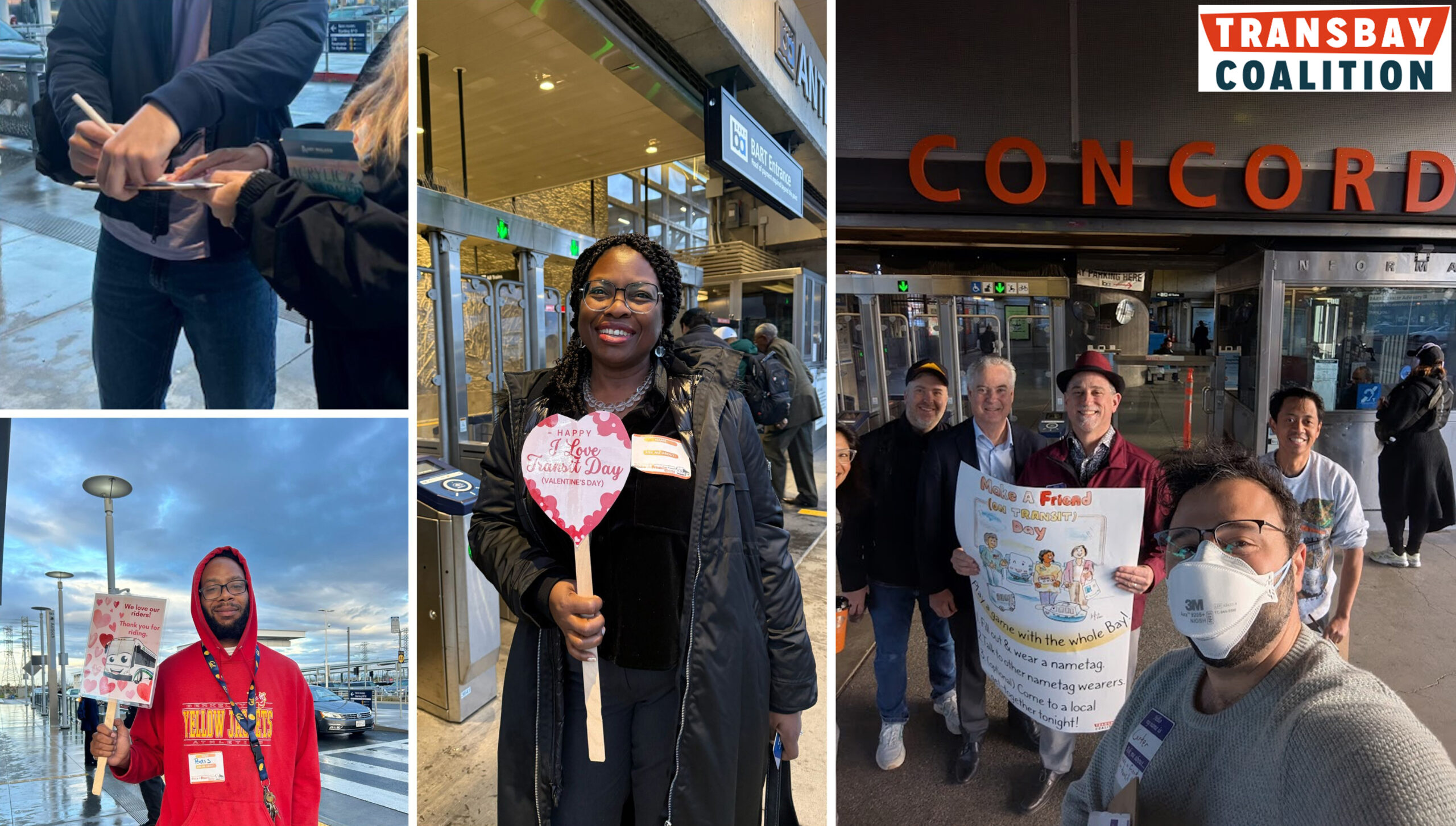
By Carter Lavin, Co-Founder, Transbay Coalition

The Bay Area transit advocacy group Transbay Coalition, along with Seamless Bay Area and Hiking By Transit has launched new calculator, created by Evan Tschuy, to help show Bay Area residents how much they will save with the new Clipper 2.0 set to launch in December. It will automatically provide discounts of up to $2.85 per trip to people when they transfer between transit agencies (e.g. AC Transit to WestCAT, Muni to BART, VTA to Caltrain, SolTrans to the Ferry, The Vine to the Ferry, Sonoma County Transit to SMART, etc).

You are about to be able to save a bunch of money when taking transit in the Bay Area. Right now, when you transfer between bus and rail services, you generally have to pay the full fare for both legs of the trip, or if you’re lucky you might get a small discount. But starting in December, when you transfer between agencies, your fare gets reduced by $2.85 — down to potentially free — with the new Clipper 2.0.

Plus, under Clipper 2.0 you will be able to tap on to transit with your credit or debit card – no Clipper Card needed. So next time you want to bring friends, family, and out-of-town visitors onto transit with you, they don’t need to get a new card, they can just use their credit or debit card to tap in.

Bay Area transit trips are about to get a lot more affordable, and to help folks understand how much they’ll save, Transbay Coalition launched The Clipper 2.0 Savings Calculator with our friends at Hiking By Transit and Seamless Bay Area. Go to the Calculator, enter in the information about a trip you want to take that would require switching between agencies and check out how much you’ll save.

For Clipper 2.0 fares, the following rules are applied:

  • Each time you transfer to a new agency, your next fare is discounted up to:
    • Adult: $2.85
    • Youth & Senior/RTC: $1.40
    • Senior/RTC on BART: $1.10 (to reflect the further Senior/RTC fare discount on BART)
  • The discount value does not depend on your previous fare, so AC Transit ($2.50) to BART will give a $2.85 discount off of your BART fare
  • AC Transit is introducing a new transfer policy with Clipper 2.0, allowing one free transfer between local buses

Example of a trip from Antioch using Tri Delta Transit and BART to the Embarcadero Station in San Francisco. Source: Clipper 2.0 Calculator screenshot

For example:

  • Take AC Transit to BART to Muni? A $9.85 trip will become just $4.65.
  • Visiting a friend in Palo Alto from your home in the Inner Sunset? A $13.90 trip will become just $8.20.
  • Taking Sonoma County Transit to SMART? Save an additional $1.35 per trip
  • The Napa Vine to the Ferry? You’ll save $2.85 per trip
  • Use the tool here: https://clipper2.hikingbytransit.com/.

Other agencies may have updated their transfer policies, but at this time this tool is not aware of any other changes. This tool does not take into account the transfer time limit; Clipper 2.0 interagency transfers have a 2-hour time limit from first tap, while Clipper 1.0 fares have various different time limits depending on the specific agency pairs.

Fares on the website are an estimation only, based on the current information provided by the Metropolitan Transportation Commission. As some details have yet to be released, some assumptions have been made. This website will be updated as possible to reflect new information.

Multi-Agency Trip to Mt. Tamalpais State Park Dec. 14

To celebrate this big transit win, Hiking by Transit is hosting a multi-agency trip to Mount Tamalpais State Park on December 14th to celebrate. Come on out!

Plus, this Sunday, you’re invited to the garden party joint fundraiser for Transbay Coalition & Seamless Bay Area – get your tickets here.

Want to know more about what Clipper 2.0 means for you? Check out the Transbay Coalition blog.

About Transbay Coalition

The Transbay Coalition is a grassroots public transportation advocacy group championing bold near-term solutions to the Bay Area’s regional transportation crisis. Founded to campaign for dedicated bus-only lanes on the Bay Bridge and its approaches, we’re striving to create an equitable and efficient public transit system and reduce greenhouse gas emissions. Learn more about the Transbay Coalition

About Seamless Bay Area

Seamless Bay Area is a not-for-profit project whose mission is to transform the Bay Area’s fragmented and inconvenient public transit into a world-class, unified, equitable, and widely-used system by building a diverse movement for change and promoting policy reforms. Learn more about Seamless Bay Area

About Hiking by Transit

Hiking by Transit connects people in the Bay Area to our beautiful parks and preserves, car-free, by providing maps and hiking guides across the nine-county region and through advocacy for increased access and increased understanding. Visit Hiking by Transit

Allen D. Payton contributed to this report.

Filed Under: Bay Area, Finances, News, Transportation

MTC, ABAG release draft of new long-range plan for Bay Area

October 22, 2025 By Publisher Leave a Comment

Source: Plan Bay Area

Public comment through Dec. 18 on Draft Plan Bay Area 2050+, EIR for housing, transportation, economic development and the environment

East Bay Webinar Nov. 5

By Veronica Cummings, Principal Public Information Officer, Engagement & John Goodwin, Assistant Director of Communications, Metropolitan Transportation Commission 

After more than two years of public discussion, technical analyses and refinement, the Metropolitan Transportation Commission (MTC) and the Association of Bay Area Governments (ABAG) today released Draft Plan Bay Area 2050+ and the Plan Bay Area 2050+ Draft Environmental Impact Report for public review and comment.

Draft Plan Bay Area 2050+ charts a course for the future of the Bay Area over the next 25 years. Designed to guide growth and investment across the region’s nine counties and 101 cities, the latest plan aims to advance an integrated vision for a Bay Area that is affordable, connected, diverse, healthy and vibrant for all. The plan contains 35 strategies for public policies and investments that can be implemented to help the Bay Area build more homes, reduce commute times, and create vibrant downtowns and natural areas for everyone to enjoy. These strategies also aim to keep people safe from natural hazards, support a strong economy and provide stable housing.

Unique to this plan cycle is Transit 2050+, a parallel and first-of-its-kind planning effort conducted by MTC and ABAG in partnership with Bay Area transit agencies to re-envision the future of Bay Area public transit.

Plan Bay Area includes all nine Bay Area counties and 101 cities. Source: Plan Bay Area

MTC and ABAG have scheduled a series of webinars and public hearings for comment on Draft Plan Bay Area 2050+ and associated supplemental reports, as well as on the Draft Environmental Impact Report for Plan Bay Area 2050+. All interested people, agencies and other organizations are encouraged to attend a webinar or public hearing, where they can ask questions and offer comments on these documents. Full event details are listed below:

  • Webinar #1 — North Bay
    Wednesday, October 29, 2025
    12-1:30 p.m.
    Zoom link: https://bit.ly/northbaywebinar
  • Webinar ID: 892 3077 8001
  • Passcode: 256814
  • 888-788-0099 US Toll Free
  • Webinar #2 — West Bay
    Wednesday, October 29, 2025
    6-7:30 p.m.
    Zoom link: https://bit.ly/westbaywebinar
    Webinar ID: 831 4140 5598
    Passcode: 096944
    888-788-0099 US Toll Free
  • Webinar #3 — South Bay
    Thursday, October 30, 2025
    6-7:30 p.m.
    Zoom link: https://bit.ly/southbaywebinar
    Webinar ID: 822 2561 7467
    Passcode: 356845
    888-788-0099 US Toll Free
  • Webinar #4 — East Bay
    Wednesday, November 5, 2025
    6-7:30 p.m.
    Zoom link: https://bit.ly/eastbaywebinar
    Webinar ID: 869 8283 4999
    Passcode: 682098
    888-788-0099 US Toll Free

In addition to these webinars, MTC and ABAG will host three public hearings around the Bay Area to provide opportunities for all interested agencies, organizations and individuals to comment on the Draft Plan and Draft Environmental Impact Report. The full list of hearings is as follows:

  • Public Hearing #1 — MTC Planning Committee and ABAG Administrative Committee
    Friday, November 14, 2025, at 9:40 a.m. or upon the conclusion of the Bay Area Infrastructure Financing Authority Network and Operations Committee, whichever is later.
    Bay Area Metro Center -or- Zoom
    Boardroom, 1st Floor
    375 Beale Street, San Francisco  Instructions to join by Zoom
  • Public Hearing #2 — Fremont
    Wednesday, December 3, 2025, at 6 p.m.
    Olive Hyde Art Center and Gallery -or- Zoom
    123 Washington Boulevard, Fremont
    Zoom link: https://bit.ly/drafthearing2
    Webinar ID: 875 7625 3306
    Passcode: 178983
    888 788 0099 US Toll Free
  • Public Hearing #3 — Novato
    Thursday, December 4, 2025, at 6 p.m.
    Best Western Plus Novato Oaks Inn -or- Zoom
    215 Alameda del Prado, Novato
    Zoom link: https://bit.ly/drafthearing3
    Webinar ID: 898 0347 9624
  • Passcode: 129009
  • 888 788 0099 US Toll Free

Interested Bay Area residents, agencies and organizations also are encouraged to view and comment on the draft plan online at planbayarea.org/draftplan. Comments will be reviewed by officials from both ABAG and MTC as they consider the adoption of Final Plan Bay Area 2050+, slated for early 2026.

Written comments will be accepted via mail to MTC Public Information Office, Attn: Plan Bay Area -or- Draft EIR Comments, 375 Beale Street, Suite 800, San Francisco, CA, 94105; or via email (Draft Plan Bay Area 2050+ inbox: info@planbayarea.org; Draft EIR inbox: eircomments@bayareametro.gov). Comments by phone can made at (415) 778-2292.

The comment period for all documents will close Dec. 18, 2025, at 5 p.m.

Questions? Visit planbayarea.org, email info@planbayarea.org or call (415) 778-6757.

Accessible Meetings

Do you need an interpreter or any other assistance to participate? Please call (415) 778-6757. For TDD or hearing impaired, call 711, California Relay Service, or (800) 735-2929 (TTY), (800) 735-2922 (voice) and ask to be relayed to (415) 778-6700. We require at least three working days’ notice to accommodate requests.

¿Necesita un intérprete u otra asistencia para participar? Por favor llámenos con tres días de anticipación al (415) 778-6757. Para telecomunicaciones para personas sordas y discapacitadas, favor de llamar al 711, el Servicio de Retransmisión de California (CRS) para TTY/VCO/HCO a Voz o para Voz a TTY/VCO/HCO al (800) 855-3000 y pedir que lo retrasmitan al (415) 778-6700.

您是否需要口譯或任何其他協助才能參加?請致電(415)778-6757。若需使用TDD或為聽障人士人士,請致電711,加州轉接服務,或(800)735-2929(TTY),(800)735-2922(語音),然後要求轉接至(415)778-6700。請至少提前三個工作日提出申請,以便我們能為您提供適當的口譯安排。

ABAG is the council of governments and the regional planning agency for the 101 cities and towns, and nine counties of the Bay Area. MTC is the transportation planning, financing and coordinating agency for the nine-county San Francisco Bay Area.

Filed Under: Bay Area, Economy, Growth & Development, Housing, Jobs & Economic Development, News, Transportation

Newsom signs bill authorizing Nov. 2026 Bay Area transit tax measure

October 14, 2025 By Publisher 2 Comments

Photo: MTC

Five-county half-cent sales tax would include Contra Costa County, last 14 years; in addition to existing half-cent BART operations sales tax

By John Goodwin, Assistant Director of Communications & Rebecca Long, Director, Legislation & Public Affairs, Metropolitan Transportation Commission 

Gov. Gavin Newsom today, Monday, October 13, 2025, signed into law state Senate Bill 63, authorizing a November 2026 ballot measure to prevent major service cuts at BART and other Bay Area transit systems and to make improvements to transit affordability, accessibility and reliability in the region. The new law allows the measure to be placed on the ballot either through action by a newly formed Public Transit Revenue Measure District governed by the same board as the Metropolitan Transportation Commission (MTC) or via a citizen’s initiative.

The half-cent sales tax would be in addition to the half-cent sales tax for BART operations in Contra Costa, Alameda and San Francisco counties in place since the 1960’s.

Enactment of the bill — authored by state senators Scott Wiener (D-11) of San Francisco and Jesse Arreguín (D-7) of Berkeley, and co-authored by Sen. Laura Richardson of Los Angeles County and Assemblymembers Mia Bonta (D-18) of Alameda County and Matt Haney (D-17) and Catherine Stefani (D-19) of San Francisco — clears the way for voters in Alameda, Contra Costa, San Francisco, San Mateo and Santa Clara counties to consider a 14-year regional transportation sales tax that would generate approximately $980 million annually across the five counties. The bill authorizes voter consideration of a half-cent sales tax in Alameda, Contra Costa, San Mateo and Santa Clara counties and a one-cent sales tax in San Francisco.

Approximately 60 percent of the revenue that would be raised if voters approve the measure will be dedicated to preserving service on BART, Muni, Caltrain, AC Transit — which an independent analysis confirmed face annual deficits of more than $800 million annually starting in fiscal year 2027-28 — as well as San Francisco Bay Ferry and smaller transit agencies providing service in the five counties to keep buses, trains and ferries moving. About one-third of the revenue would go to Contra Costa Transportation Authority, Santa Clara VTA, SamTrans and the Alameda County Transportation Commission, with flexibility to use funds for transit capital, operations, or road paving projects on roads with regular bus service.

If a regional tax measure wins voters’ approval next fall, about 4.5 percent, equivalent to $43 million in fiscal year 2027-28, will go toward improving the rider experience, funding priorities identified in the 2021 Bay Area Transit Transformation Action Plan.

“In addition to averting major service cuts for regional operators, MTC advocated for the measure to include dedicated funding to make Bay Area transit more affordable, reliable, and easy to use so that it becomes a system that will attract more riders,” noted Commission Chair and Pleasant Hill Mayor Sue Noack.

The suite of rider-focused improvements includes:

  • Free and reduced-fare transfers that could save multi-agency riders up to $1,500 per year and are estimated to increase transit ridership by some 30,000 trips per day.
  • Expansion of the Clipper START® program, which provides a 50% fare discount, to reach 100,000 additional low-income adults.
  • Improvements to accessibility for seniors and people with disabilities.
  • Transit-priority projects to make bus trips faster, and mapping and wayfinding improvements to make transit easier to use.

Bay Area transit riders take more than 1 million trips each day, with over 80 percent of these trips on Muni, BART, Caltrain or AC Transit. Riders include tens of thousands of students, seniors, people with disabilities, and low-income residents who can’t afford to own a car. Clipper START customers accounted for nearly 400,000 transit trips across the region in August 2025 and the fare-discount program is growing at a rate of more than 20,000 customers each year.

SB 63 includes several oversight and accountability provisions to reassure voters their tax dollars will be used responsibly. These include establishing an independent oversight committee to ensure expenditures are consistent with the law. Membership will include at least one representative from each county in the Public Transit Revenue Measure District, appointed by each county’s board of supervisors.

The new law also requires BART, Muni, Caltrain and AC Transit to undergo a two-phase independent third-party financial efficiency review overseen by its own oversight committee composed of four independent experts, four transit agency representatives, and an MTC Commissioner. MTC is responsible for procuring the third-party consultant to conduct the review and for staffing the Oversight Committee.

A maintenance-of-effort clause in SB 63 requires BART, Muni, Caltrain, AC Transit, Golden Gate Transit, SF Bay Ferry and the bus operators in Alameda and Contra Costa counties to maintain existing levels of funding for operating purposes if a 2026 tax measure is passed by voters. The legislature established this requirement to ensure the measure supplements, rather than replaces, current operations support, with provisions for exceptions that are subject to MTC approval.

To provide additional oversight regarding the quality of the transit service provided in each county participating in the measure, the legislation allows a county transportation agency or board of supervisors within the District’s geography to require review by an ad-hoc adjudication committee if they believe a transit agency funded by that county’s portion of the measure’s revenue is not applying standards (such as service levels, fare policy, cleanliness, maintenance, access and safety) consistently across counties or if those standards disproportionately disadvantage service or transit equipment/station quality in that county. The committee is composed solely of representatives from counties contributing revenue measure funds to the transit agency under review. Its determinations are binding and may result in withholding up to 7 percent of the transit agency’s funds, a strong incentive for agencies to deliver high quality service that follows consistent standards across all five counties.

What Local Transportation Officials are Saying: 

“The BART Board of Directors supported SB 63 because it will cover a significant portion of BART’s operating deficit caused by remote work and will allow us to maintain current service levels and improve the rider experience,” said BART General Manager Bob Powers.

“SB 63 is a step towards protecting essential Muni service and will equip us with resources to continue meeting the needs of San Francisco and the growing region,” said Julie Kirschbaum, San Francisco Municipal Transportation Agency Director of Transportation.

“Through Governor Newsom’s leadership and the support of voters, SB 63 will help protect transit for our more than three million monthly riders. In fact, this summer, we took proactive steps to preserve service by redesigning 103 bus lines through our new Realign network. Designed over two years, this all-new network maintains service at 85 percent of pre-pandemic levels. SB 63 gives voters a chance to ensure that these vital bus lines – and our riders’ lifelines – are protected for the future,” said AC Transit Board President Diane Shaw.

“Caltrain has been reinvented as a state-of-the-art rail system, delivering the best service this corridor has seen in its 161-year history. We are seeing the benefits every day with growing ridership, cleaner air, quieter trains, and less-congested roads. To sustain these benefits, it is essential that Caltrain be funded. We are deeply grateful to Governor Newsom and the California Legislature for their leadership in crafting and supporting this legislation, which gives voters the opportunity to consider the vital Connect Bay Area measure in November 2026,” said Caltrain Executive Director Michelle Bouchard.

“SB 63 represents a transformative opportunity to invest in the future of public transit,” she said. With this measure, we can deliver faster, more frequent service and ensure better connections for all riders across Santa Clara County,” said Carolyn Gonot, Santa Clara Valley Transportation Authority General Manager and CEO.

“We’re excited the Connect Bay Area Act is moving forward and voters will soon have the opportunity to shape the future of public transit along the Peninsula and surrounding Bay Area communities. Next November’s vote will be a pivotal moment to secure reliable, connected and sustainable transportation. With this measure, we can ensure SamTrans, Caltrain and our regional transit partners have the stable funding needed to serve riders for years to come,” said SamTrans Board of Directors Chair Jeff Gee.

MTC is the transportation planning, financing and coordinating agency for the nine-county San Francisco Bay Area.

BART Issues Statement of Support

BART issued the following statement on Governor’s signing transit funding measure SB 63:

“BART is grateful to Governor Newsom for signing Senate Bill (SB) 63 into law. The Governor has been a steadfast advocate of transit and BART specifically, recognizing our role in moving the region and strengthening the economy. SB 63 is a historic opportunity to allow voters in five counties of the Bay Area to consider a sales tax measure in November 2026 aimed at preserving and improving transit.

A regional transportation funding measure would provide a reliable funding source for BART and other agencies to address deficits caused by remote work. The BART Board of Directors supported SB 63 because it will cover a significant portion of BART’s operating deficit and allow us to maintain current service levels and improve the rider experience.

Before measure funds become available, BART will rely on internal cuts, efficiency measures, and a series of one-time solutions to pay for operations. BART will continue to identify additional cost savings and efficiencies to address our deficit, and we welcome the enhanced accountability measures and financial efficiency review included in SB 63.

BART is also grateful to Senators Scott Wiener and Jesse Arreguín for championing this legislation and their fierce advocacy for transit funding.”

Allen D. Payton contributed to this report.

Filed Under: BART, Bay Area, Legislation, News, Politics & Elections, State of California, Transportation

Park District investing $10.9 million to reduce fire fuels in the East Bay

May 20, 2025 By Publisher 1 Comment

Fire fuels reduction efforts in the East Bay parks. Photos: EBRPD

$8.3 million in grants; $2.6 million in district matching funds

By Dave Mason, Public Information Supervisor, Public Affairs, East Bay Regional Park District

The East Bay Regional Park District is set to spend $10.9 million over the next three years to reduce fire fuels at Anthony Chabot, Tilden, and Wildcat Canyon Regional Parks, Claremont Canyon Regional Preserve, and Carquinez Strait Regional Shoreline. The funding will help reduce wildfire risks by removing dead and dying trees and hazardous vegetation on over 600 acres. Dead trees burn hotter and faster and can cast embers long distances, igniting new fires.

These efforts are in addition to ongoing fuels reduction work districtwide, including large-scale projects at Anthony Chabot Regional Park (544 acres) and Tilden Regional Park (39 acres), a 16-person year-round fuels reduction crew, and annual goat, sheep, and cattle grazing. In 2024, the Park District’s fuels reduction crew removed hazardous fire fuels on 104 acres in 11 parks. Additionally, more than 86,800 acres of parkland are grazed annually by cattle, sheep, or goats.

2025 Grant Funding Allocations Map. Source: EBRPD

“The grant funding enhances our ability to protect the public and safeguard our natural landscapes,” said Park District Interim Fire Chief Khari Helae. “Securing the funding is a testament to the Park District’s efforts—from planning to permitting—to manage the detailed grant application process and its proven ability to carry out large-scale fuels reduction projects in support of the community.”

The $10.9 million for fuels reduction projects includes $8.3 million in grants, with $6.1 million coming from the Federal Emergency Management Agency (FEMA), $2.1 million from the California State Coastal Conservancy, and $100,000 from the U.S. Forest Service. FEMA funding was obtained in partnership with U.S. Sen. Alex Padilla, who secured $1.5 million in the 2023 budget, and U.S. Rep. Eric Swalwell, who secured $1.4 million in the 2024 budget.

Fire fuels reduction source of funds. EBRPD

An additional $2.6 million comes from required Park District matching funds, which include general funds and voter-approved local revenue measures like Measure FF. These local revenue measures enhance the Park District’s ability to qualify for and secure grant funding by providing required matching contributions.

“These projects are vital to reducing wildfire risks in the East Bay,” said Park District General Manager Sabrina Landreth. “We thank FEMA, Sen. Alex Padilla, Rep. Eric Swalwell, the California State Coastal Conservancy, the U.S. Forest Service, and Park District voters for their support and for prioritizing wildfire mitigation in the East Bay.”

For large scale vegetation management projects, the Park District utilizes a climate-friendly carbonizer to dispose of vegetation. The carbonizer burns organic matter at 1,300 degrees Fahrenheit with little oxygen, which produces very low emissions—especially compared to conventional disposal methods such as open pile burning or transporting debris long distances in diesel trucks. The resulting biochar is being used throughout the Park District to enhance soil health, improve water retention, and increase crop productivity, including at the District’s Ardenwood Historic Farm in Fremont.

Photo: EBRPD

The Park District Board of Directors will consider authorizing $1,883,261 in matching funds from Measure FF at their upcoming Board Meeting on Tuesday, May 20, 2025. Measure FF was passed in 2018 by voters in the communities of Alameda, Albany, Berkeley, El Cerrito, El Sobrante, Emeryville, Kensington, Oakland, Piedmont, Richmond, and San Pablo to provide funding to reduce fire risks, improve public access, and restore natural habitat. The Board of Directors previously authorized $500,016 in matching funds in March 2023.

The East Bay Regional Park District is the largest regional park system in the nation, comprising 73 parks, 55 miles of shoreline, and over 1,330 miles of trails for hiking, biking, horseback riding, and environmental education. The Park District receives an estimated 30 million visits annually throughout Alameda and Contra Costa counties in the San Francisco Bay Area.

Filed Under: Bay Area, Finances, Fire, Government, News, Parks

  • 1
  • 2
  • 3
  • …
  • 11
  • Next Page »
Monica's-Riverview-Jan-2026
Liberty-Tax-Jan-Apr-2026
Deer-Valley-Chiro-06-22

Copyright © 2026 · Contra Costa Herald · Site by Clifton Creative Web