• Home
  • About The Herald
  • Local Agencies
  • Daily Email Update
  • Legal Notices
  • Classified Ads

Contra Costa Herald

News Of By and For The People of Contra Costa County, California

  • Arts & Entertainment
  • Business
  • Community
  • Crime
  • Dining
  • Education
  • Faith
  • Health
  • News
  • Politics & Elections
  • Real Estate

Connect Bay Area campaign raises nearly $3 million to support signature gathering for regional transit tax measure

January 15, 2026 By Publisher Leave a Comment

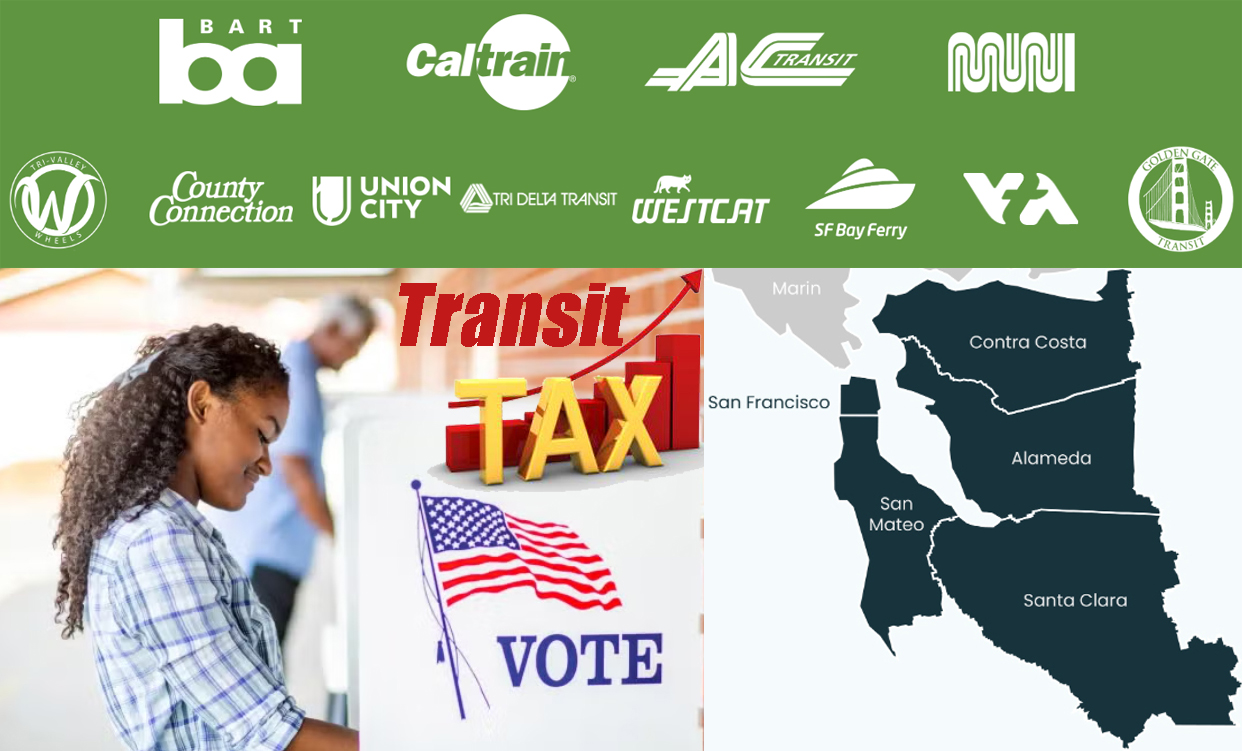
Multiple Bay Area transit agencies would benefit from the five-county sales tax measure. Photo: MTC. Graphics source: Connect Bay Area

Businesses, labor unions, civic foundations join effort for 5-county Nov. 2026 ballot measure to prevent threatened catastrophic transit service cuts, promote reliable, safe public transit

Includes Contra Costa; would generate about $1 billion per year

SAN FRANCISCO BAY AREA, CA — The Connect Bay Area Transit committee today announced that it has already raised nearly $3 million to support a region-wide effort to qualify Connect Bay Area, a voter-proposed regional transportation funding measure, for the November 2026 ballot. With strong early financial backing secured, the campaign will now begin signature gathering while continuing to fundraise to qualify and pass a five-county sales tax to save public transit.

About the Tax Measure

The measure if adopted would increase the sales tax in Contra Costa, Alameda San Mateo and Santa Clara Counties by a half cent and one cent in San Francisco County for 14 years. As previously reported, the measure would generate approximately $980 million annually across the five counties.

Revenue from the tax measure will benefit multiple transit agencies in the region including Tri Delta Transit, County Connection and WestCat, as well as AC Transit and BART which serve Contra Costa County residents.

Following is a county-by-county breakdown of the County Specific Dollars. It does not include money going to BART, Muni, AC Transit and Caltrain, or to regional improvements that aren’t designated by county, such as coordinated fare programs and accessibility improvements.

County Agencies:

  • Contra Costa County Transportation Authority (2.5%, $26.51M)
  • Alameda County Transportation Commission (1%, $10.26M)
  • San Mateo County Transit District (4.7%, $50M)
  • Santa Clara Valley Transportation Authority (25.1%, $264.07M)

Small Operators:

  • Contra Costa County small operators (1.5%, $15.75M)
  • Alameda County small operators (0.5%, $5.25M)
  • SF Bay Ferry (0.7%, $7M)
  • Golden Gate Transit (0.1%, $1M)

Without new and sustainable operations funding, the Bay Area will face a true emergency:

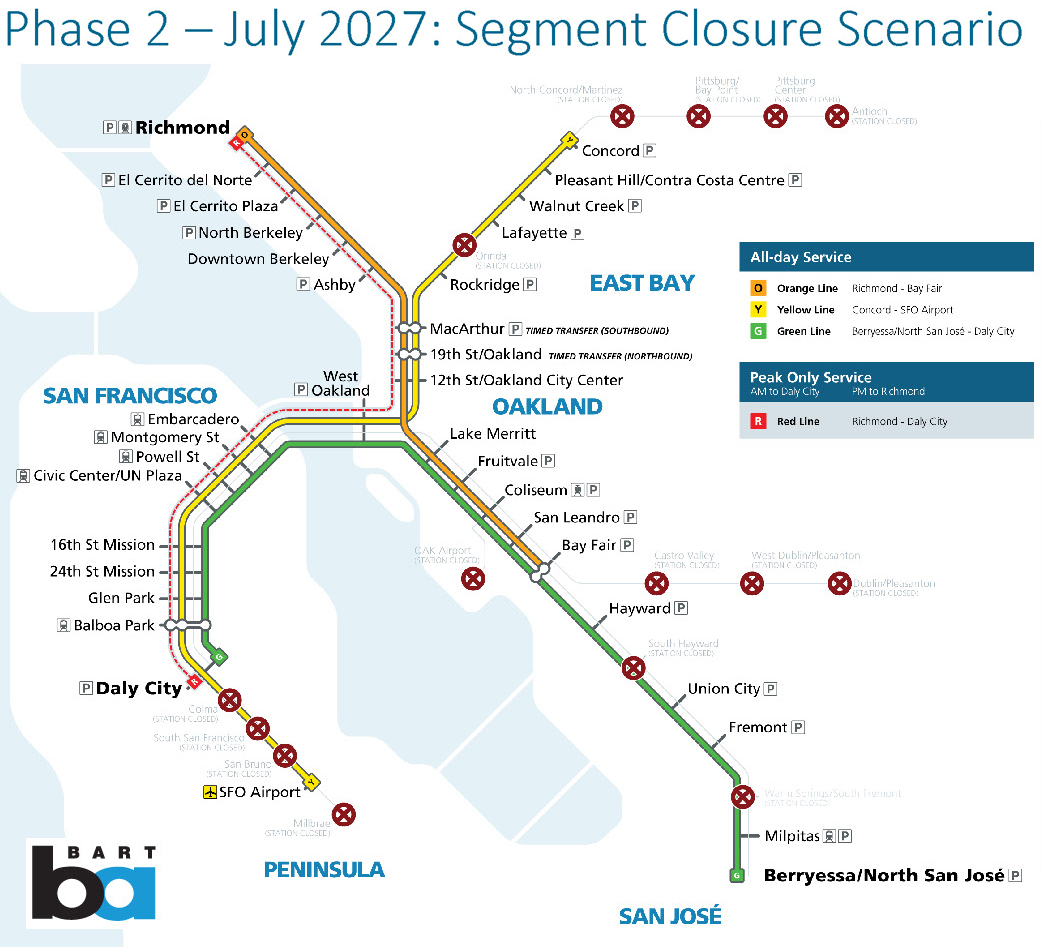
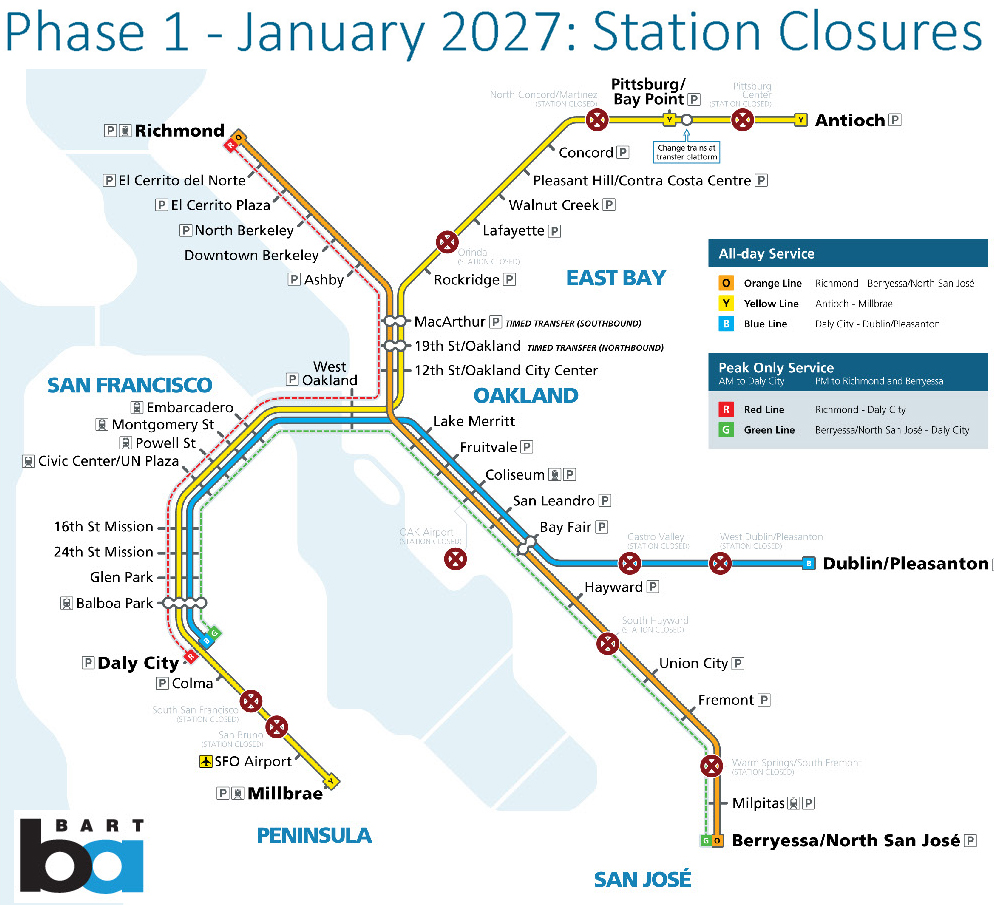
  • BART: Could shut down two of its five lines, reducing service from 4,500 trains per week to just 500, with trains running only hourly and no weekend service.
  • AC Transit: Would reduce service by 37%, bringing operations down to just half of pre-pandemic levels.
  • Muni: Would face 50% cuts to all bus and Metro lines, including elimination of entire neighborhood routes and San Francisco’s iconic historic trolleys and cable cars.
  • Caltrain: Trains would run only once per hour, end service by 9 p.m. on weekdays, and eliminate all weekend service.

The Connect Bay Area measure will support the future of public transportation in the Bay Area:

  • Protect and improve service on BART, Muni, Caltrain, SamTrans, VTA and AC Transit
  • Prevent catastrophic service cuts that could devastate the Bay Area
  • Keep traffic and emissions down, preventing gridlock and protecting climate progress;
  • Support the Bay Area’s economy, ensuring that downtown recovery and regional mobility remain strong.

The Connect Bay Area Transit measure will include strong accountability provisions. This ensures new funding delivers real improvements, not just short-term fixes. Transit agencies must:

  • Independent financial review and cost-efficiency: Operators will undergo a third-party financial review and be required to improve financial efficiency and use public funds wisely
  • Better regional coordination to benefit riders: Operators will be required to comply with MTC’s Regional Network Management Policies to coordinate across systems and simplify fares and signage to create a more seamless experience for riders.
  • Oversight Committee: An oversight committee will ensure that the expenditure plan is adhered to and hold MTC and operators accountable to all provisions of SB63.

About the Campaign

The campaign’s initial fundraising success reflects broad alignment across business, labor, philanthropy, and community leaders that a reliable, safe, and efficient public transportation system is vital to the future of the Bay Area. Major early donors include Chris Larsen, Herzog Contracting Corporation, Genentech, HNTB Corporation, Meta, and SEIU 1021. For a full list of donors, see below.

“Public transportation connects everyone. We are proud of the broad coalition uniting to prevent catastrophic service cuts and to build an affordable, safe, and efficient public transportation system,” said Jeff Cretan, a spokesperson for the Connect Bay Area Transit Committee. “The commitments we are seeing from business, labor, and civic leaders shows that everyone is ready to get this measure across the finish line in November.”

Connect Bay Area is a five-county regional tax measure designed to prevent catastrophic transit service cuts and provide reliable operating funding for major transit systems and local bus operators throughout the region. The measure also funds improvements to transit systems, capital projects within counties, and targeted road improvements. The measure is critical to supporting the Bay Area’s economy, promoting an affordable region, reducing traffic congestion, and ensuring access to jobs, schools, and healthcare.

Early financial support for the campaign includes commitments from:

  • Chris Larsen
  • Herzog Contracting Corporation
  • Genentech
  • HNTB Corporation
  • Meta
  • SEIU 1021
  • Jacobs
  • Silicon Valley Community Foundation
  • ATU Local 1555
  • PG&E
  • San Francisco Foundation
  • WSP
  • Golden State Warriors
  • AFSCME Local 3993
  • Boston Properties
  • Visa
  • AFSCME Council 57
  • T.Y. Lin
  • GILLIG
  • HDR, Inc.
  • Fehr & Peers
  • AFSCME 3916
  • Arup North America
  • Olson Remcho

Additional major employers, labor organizations, and philanthropic partners have indicated commitments that are expected to be finalized as the campaign continues to build momentum.

With signature gathering starting, the Connect Bay Area campaign will focus on qualifying the measure for the ballot while continuing to expand its coalition across the region. The Campaign must secure over 186,000 signatures from the five counties by June 6, 2026 to qualify for the November ballot.

The campaign’s early momentum comes as Bay Area transit agencies face an unprecedented funding crisis. Without a sustainable solution, public transportation in the the region could see devastating impacts, including:

  • BART could eliminate 2 full lines, stop service at 9pm on weekdays, and eliminate all weekend service.
  • Muni could eliminate entire routes, make 50% cuts to major bus and metro lines, gut historic train and cable car service.
  • Caltrain could cut weekday service to once an hour, stop service at 9pm on weekdays, and eliminate all weekend service.
  • AC Transit could cut up to 37% of overall service.

Recent polling on the proposed Connect Bay Area measure shows a clear path to passage, with strong support across counties and voter demographics. A survey conducted by EMC Research for the Metropolitan Transportation Commission found that 59% of Bay Area voters would support a proposed regional sales tax measure for public transportation. The threshold for passage for a signature-gathering initiative is 50%+1.

For more information about Connect Bay Area, visit ConnectBayArea.com.

About the Connect Bay Area Transit Committee

The Connect Bay Area Transit Committee is led by labor, business, and transit supporters, including the Bay Area Council, SEIU 1021, ATU 1555, SPUR, SAMCEDA, among others, as well as a broad advocacy council. The advocacy council includes more than 20 organizations including transit advocates, housing advocates, safe streets advocates, senior and disability advocates, and environmentalists. The Committee is focused on delivering a successful 2026 ballot measure that will strengthen public transportation to keep the Bay Area affordable for residents and support critical economic growth and climate resilience.

Allen D. Payton contributed to this report.

Filed Under: BART, Bay Area, News, Politics & Elections, Taxes, Transportation

Newsom signs bill authorizing Nov. 2026 Bay Area transit tax measure

October 14, 2025 By Publisher 2 Comments

Photo: MTC

Five-county half-cent sales tax would include Contra Costa County, last 14 years; in addition to existing half-cent BART operations sales tax

By John Goodwin, Assistant Director of Communications & Rebecca Long, Director, Legislation & Public Affairs, Metropolitan Transportation Commission 

Gov. Gavin Newsom today, Monday, October 13, 2025, signed into law state Senate Bill 63, authorizing a November 2026 ballot measure to prevent major service cuts at BART and other Bay Area transit systems and to make improvements to transit affordability, accessibility and reliability in the region. The new law allows the measure to be placed on the ballot either through action by a newly formed Public Transit Revenue Measure District governed by the same board as the Metropolitan Transportation Commission (MTC) or via a citizen’s initiative.

The half-cent sales tax would be in addition to the half-cent sales tax for BART operations in Contra Costa, Alameda and San Francisco counties in place since the 1960’s.

Enactment of the bill — authored by state senators Scott Wiener (D-11) of San Francisco and Jesse Arreguín (D-7) of Berkeley, and co-authored by Sen. Laura Richardson of Los Angeles County and Assemblymembers Mia Bonta (D-18) of Alameda County and Matt Haney (D-17) and Catherine Stefani (D-19) of San Francisco — clears the way for voters in Alameda, Contra Costa, San Francisco, San Mateo and Santa Clara counties to consider a 14-year regional transportation sales tax that would generate approximately $980 million annually across the five counties. The bill authorizes voter consideration of a half-cent sales tax in Alameda, Contra Costa, San Mateo and Santa Clara counties and a one-cent sales tax in San Francisco.

Approximately 60 percent of the revenue that would be raised if voters approve the measure will be dedicated to preserving service on BART, Muni, Caltrain, AC Transit — which an independent analysis confirmed face annual deficits of more than $800 million annually starting in fiscal year 2027-28 — as well as San Francisco Bay Ferry and smaller transit agencies providing service in the five counties to keep buses, trains and ferries moving. About one-third of the revenue would go to Contra Costa Transportation Authority, Santa Clara VTA, SamTrans and the Alameda County Transportation Commission, with flexibility to use funds for transit capital, operations, or road paving projects on roads with regular bus service.

If a regional tax measure wins voters’ approval next fall, about 4.5 percent, equivalent to $43 million in fiscal year 2027-28, will go toward improving the rider experience, funding priorities identified in the 2021 Bay Area Transit Transformation Action Plan.

“In addition to averting major service cuts for regional operators, MTC advocated for the measure to include dedicated funding to make Bay Area transit more affordable, reliable, and easy to use so that it becomes a system that will attract more riders,” noted Commission Chair and Pleasant Hill Mayor Sue Noack.

The suite of rider-focused improvements includes:

  • Free and reduced-fare transfers that could save multi-agency riders up to $1,500 per year and are estimated to increase transit ridership by some 30,000 trips per day.
  • Expansion of the Clipper START® program, which provides a 50% fare discount, to reach 100,000 additional low-income adults.
  • Improvements to accessibility for seniors and people with disabilities.
  • Transit-priority projects to make bus trips faster, and mapping and wayfinding improvements to make transit easier to use.

Bay Area transit riders take more than 1 million trips each day, with over 80 percent of these trips on Muni, BART, Caltrain or AC Transit. Riders include tens of thousands of students, seniors, people with disabilities, and low-income residents who can’t afford to own a car. Clipper START customers accounted for nearly 400,000 transit trips across the region in August 2025 and the fare-discount program is growing at a rate of more than 20,000 customers each year.

SB 63 includes several oversight and accountability provisions to reassure voters their tax dollars will be used responsibly. These include establishing an independent oversight committee to ensure expenditures are consistent with the law. Membership will include at least one representative from each county in the Public Transit Revenue Measure District, appointed by each county’s board of supervisors.

The new law also requires BART, Muni, Caltrain and AC Transit to undergo a two-phase independent third-party financial efficiency review overseen by its own oversight committee composed of four independent experts, four transit agency representatives, and an MTC Commissioner. MTC is responsible for procuring the third-party consultant to conduct the review and for staffing the Oversight Committee.

A maintenance-of-effort clause in SB 63 requires BART, Muni, Caltrain, AC Transit, Golden Gate Transit, SF Bay Ferry and the bus operators in Alameda and Contra Costa counties to maintain existing levels of funding for operating purposes if a 2026 tax measure is passed by voters. The legislature established this requirement to ensure the measure supplements, rather than replaces, current operations support, with provisions for exceptions that are subject to MTC approval.

To provide additional oversight regarding the quality of the transit service provided in each county participating in the measure, the legislation allows a county transportation agency or board of supervisors within the District’s geography to require review by an ad-hoc adjudication committee if they believe a transit agency funded by that county’s portion of the measure’s revenue is not applying standards (such as service levels, fare policy, cleanliness, maintenance, access and safety) consistently across counties or if those standards disproportionately disadvantage service or transit equipment/station quality in that county. The committee is composed solely of representatives from counties contributing revenue measure funds to the transit agency under review. Its determinations are binding and may result in withholding up to 7 percent of the transit agency’s funds, a strong incentive for agencies to deliver high quality service that follows consistent standards across all five counties.

What Local Transportation Officials are Saying: 

“The BART Board of Directors supported SB 63 because it will cover a significant portion of BART’s operating deficit caused by remote work and will allow us to maintain current service levels and improve the rider experience,” said BART General Manager Bob Powers.

“SB 63 is a step towards protecting essential Muni service and will equip us with resources to continue meeting the needs of San Francisco and the growing region,” said Julie Kirschbaum, San Francisco Municipal Transportation Agency Director of Transportation.

“Through Governor Newsom’s leadership and the support of voters, SB 63 will help protect transit for our more than three million monthly riders. In fact, this summer, we took proactive steps to preserve service by redesigning 103 bus lines through our new Realign network. Designed over two years, this all-new network maintains service at 85 percent of pre-pandemic levels. SB 63 gives voters a chance to ensure that these vital bus lines – and our riders’ lifelines – are protected for the future,” said AC Transit Board President Diane Shaw.

“Caltrain has been reinvented as a state-of-the-art rail system, delivering the best service this corridor has seen in its 161-year history. We are seeing the benefits every day with growing ridership, cleaner air, quieter trains, and less-congested roads. To sustain these benefits, it is essential that Caltrain be funded. We are deeply grateful to Governor Newsom and the California Legislature for their leadership in crafting and supporting this legislation, which gives voters the opportunity to consider the vital Connect Bay Area measure in November 2026,” said Caltrain Executive Director Michelle Bouchard.

“SB 63 represents a transformative opportunity to invest in the future of public transit,” she said. With this measure, we can deliver faster, more frequent service and ensure better connections for all riders across Santa Clara County,” said Carolyn Gonot, Santa Clara Valley Transportation Authority General Manager and CEO.

“We’re excited the Connect Bay Area Act is moving forward and voters will soon have the opportunity to shape the future of public transit along the Peninsula and surrounding Bay Area communities. Next November’s vote will be a pivotal moment to secure reliable, connected and sustainable transportation. With this measure, we can ensure SamTrans, Caltrain and our regional transit partners have the stable funding needed to serve riders for years to come,” said SamTrans Board of Directors Chair Jeff Gee.

MTC is the transportation planning, financing and coordinating agency for the nine-county San Francisco Bay Area.

BART Issues Statement of Support

BART issued the following statement on Governor’s signing transit funding measure SB 63:

“BART is grateful to Governor Newsom for signing Senate Bill (SB) 63 into law. The Governor has been a steadfast advocate of transit and BART specifically, recognizing our role in moving the region and strengthening the economy. SB 63 is a historic opportunity to allow voters in five counties of the Bay Area to consider a sales tax measure in November 2026 aimed at preserving and improving transit.

A regional transportation funding measure would provide a reliable funding source for BART and other agencies to address deficits caused by remote work. The BART Board of Directors supported SB 63 because it will cover a significant portion of BART’s operating deficit and allow us to maintain current service levels and improve the rider experience.

Before measure funds become available, BART will rely on internal cuts, efficiency measures, and a series of one-time solutions to pay for operations. BART will continue to identify additional cost savings and efficiencies to address our deficit, and we welcome the enhanced accountability measures and financial efficiency review included in SB 63.

BART is also grateful to Senators Scott Wiener and Jesse Arreguín for championing this legislation and their fierce advocacy for transit funding.”

Allen D. Payton contributed to this report.

Filed Under: BART, Bay Area, Legislation, News, Politics & Elections, State of California, Transportation

BART seeks professionals to serve as members for RR Bond Oversight Committee

August 1, 2025 By Publisher Leave a Comment

1 Civil Engineer, 1 Electrical Engineer and 1 Certified Public Accountant

By San Francisco Bay Area Rapid Transit District

BART is recruiting volunteer candidates to fill three vacant seats on the Measure RR Bond Oversight Committee. The committee provides diligent and public oversight of the expenditure of funds from bond sales associated with Measure RR, which is a $3.5 billion bond measure approved by BART District voters in 2016 to rebuild the system’s core infrastructure. Members of the Bond Oversight Committee represent a diversity of expertise, geography, and demographic characteristics. BART is looking for candidates to fill the electrical engineer, civil engineer, and Certified Public Accountant seats on the committee. All committee members are unpaid volunteers.

Candidates must live in either Alameda County, Contra Costa County or San Francisco City and County.

Source: BART

About Measure RR

Voters approved Measure RR, a $3.5 billion bond, in November 2016. The bond proceeds fund a portfolio of projects including replacing 90 miles of severely worn tracks, repair tunnels damaged by water intrusion and upgrade the aging train control system. Learn more at bart.gov/rebuilding/projects.

About the Committee

The independent Measure RR Bond Oversight Committee consists of five professionals in the areas of engineering, auditing, public finance, construction project management, and two members from the League of Women Voters. Learn more at bart.gov/bondoversight.

Committee Responsibilities

Members of the Committee are responsible for the following:

  • Assess how bond proceeds are spent.
  • Assess that work is completed in a timely, cost effective and quality manner.
  • Communicate its findings and recommendations to the public.
  • Publish an annual report.

Source: BART

Time Commitment

The minimum time commitment is about 10 to 15 hours per year. There are typically four in person meetings annually, which are open to the public

Compensation

Committee members are volunteers. However, BART will compensate members for their travel on BART to and from meetings.

INTERESTED?

Contact Rachel Russell at (510) 418-0859 or measurerrcommittee@bart.gov to discuss next steps.

DEADLINE

Friday, August 15, 2025, 5pm Pacific Time. Submit cover letter and resume to Rachel Russell for consideration.

Learn more about applying here.

Filed Under: BART, Finances, Government, Politics & Elections

Take BART to NBA All-Star Weekend events in the Bay Area Feb. 14-16

February 8, 2025 By Publisher Leave a Comment

BARTable and the NBA have partnered to reward riders for taking transit.

Events: Rising Stars, National Basketball Players Association Brotherhood Deli, NBA All-Star Concert Series at Pier 48, All-Star Saturday Night including Skills Challenge, 3-Point Contest & Slam Dunk and All-Star Game

By Bay Area Rapid Transit District

Friday, Feb. 14, marks the start of the 2025 NBA All-Star Weekend, hosted by the Golden State Warriors. BART looks forward to carrying fans to the games and events happening on both sides of the Bay. We’re also proud to partner with the NBA Players Association for the big weekend.

Follow our directions below to make your journey to games and events as smooth as Curry’s free throws. BART will adjust train lengths to accommodate ridership. For tickets and locations find a list of all the NBA All-Star Weekend events.

Win free tickets and prizes
Visit BARTable’s contests and deals page from now until Feb. 16 for a chance to win exclusive prizes and MVP experiences.

Those looking for more opportunities to get free tickets and other prizes, download the NBA Events app which has partnered with BART and other Bay Area agencies to encourage riding transit around the Bay.

After creating a free NBA ID account, visit the participating stations (see below), tap the tile on the dashboard corresponding with the station, and earn your check-in via your mobile device in mixed reality. Each check-in will also count towards unlocking NBA All-Star prizes through the NBA ID All-Star Rewards Program.

Participating stations:
• 16th St Mission
• Coliseum
• Embarcadero
• Lake Merritt
• Powell St

The Grand BART Prizes will be in the form of digital railgoods.com gift cards in amounts ranging from $10 to $100.

Take transit to Chase Center

Take BART to Powell St. Station and transfer to Muni T Third trains at Union Square Station. Signs on the platform and concourse will guide you to the right exit to catch Muni, and the special event trains will read “S Shuttle Mission Bay.” Disembark Muni at UCSF/Chase Center.

Take BART to 16th St./Mission Station and transfer to special Muni 78X bus service. Disembark at 16th St. & Illinois St. Your event ticket is your Muni ticket. Ride Muni to Chase Center for FREE with your event ticket (excluding cable cars). For more information, visit the Chase Center website.
• Friday, Feb. 14, 6pm: Castrol Rising Stars
• Saturday, Feb. 15, 5pm: State Farm All-Star Saturday Night
• Sunday, Feb. 16, 5pm: 74th NBA All-Star Game

Take transit to Oakland Arena


BART takes you directly to the Oakland Arena. Take BART to Coliseum Station and walk across the overpass and around the Coliseum to the arena. Use the arena’s North Entrance for a shorter walk.
• Friday, Feb. 14, 4pm: Ruffles NBA All-Star Celebrity Game
• Saturday, Feb. 15, 11am: NBA All-Star Practice presented by AT&T
• Saturday, Feb. 15, 2pm: NBA HBCU Classic presented by AT&T

Take transit to Moscone Center


Take BART to Montgomery Street Station and walk a short distance to Moscone Center.
• Friday, Feb. 14, to Sunday, Feb. 16: NBA Crossover interactive fan experience
• Sunday, Feb. 16: NBA G League Next Up Game

Take transit to the NBA All-Star Concert Series at Pier 48
The NBA will host a three-day concert series from Friday, Feb. 14, through Sunday, Feb. 16, at Pier 48. Headliners include Noah Kahan, The Chainsmokers, Zedd, and Flo Rida.

Take BART to Powell St. Station and transfer to Muni T Third trains at Union Square Station. Signs on the platform and concourse will guide you to the right exit to catch Muni, and the special event trains will read “S Shuttle Mission Bay.” Disembark Muni at Mission Rock and walk to Pier 48.

Take BART to Embarcadero Station and transfer to Muni N Judah trains on the upper level of the station. Disembark at King and 2nd streets and walk to Pier 48.

Take transit to the NBPA Brotherhood Deli at SPARK Social SF
The National Basketball Players Association (NBPA) will bring their Brotherhood Deli food truck – the only fan experience powered by the 450+ members of the NBPA – along with activations and programming to SPARK Social SF from Friday, Feb. 14, through Sunday, Feb. 16, 11am to 6pm. It’s a short walk from SPARK Social to Chase Center.

The celebration will include player appearances, photo opps, plant-based food, immersive gaming, and hourly slam dunk shows and fan shooting contests. To register and secure your spot during All-Star Weekend click, here: NBPA Brotherhood Deli.

Take BART to Powell St. Station and transfer to Muni T Third trains at Union Square Station. Signs on the platform and concourse will guide you to the right exit to catch Muni. Disembark Muni at Mission Rock and walk to SPARK Social.

Take BART to 16th St./Mission Station and transfer to the Muni 22 bus. Disembark at Mission Bay Blvd North and 3rd Street and walk to SPARK Social.

Are you excited for NBA All Star Weekend?
Share with us on social media at @SFBARTable and #SFBARTable! Keep up with us on Instagram and Facebook to see all of the best BARTable events, places to eat and where to have fun around the Bay.

Filed Under: Arts & Entertainment, BART, Bay Area, Sports

BART offers Valentraine Speed-Dating Event Feb. 14

February 7, 2025 By Publisher Leave a Comment

This Valentine’s Day, hop on the Valentraine and ride your way to love or friendship

On Valentine’s Day, join BART for the first-ever speed dating/friend making event on a moving BART train

On the evening of Friday, Feb. 14, BART invites adults ages 18 to 35 to join us for an on-the-rails mixer aboard a moving BART train. Ride BART into someone’s heart on a special train reserved just for this event! It’s time to get off the apps and get on Trainder. This is speed dating – literally. We’ll help grease the wheels with icebreaker activities, conversation starters, a raffle, and BART-themed Valentines that you can give to potential connections. All adults are welcome as are those looking to make friends rather than find romance. We will have name tags with a space to write in what you are looking for. Participants must be ages 18 to 35 (we’ll explore hosting a similar event for those 35+ in the future). What: BART speed dating/friend making When: Friday, Feb. 14, 6:45pm to approx. 8:35pm Where: Start at Downtown Berkeley Station and ride to 24th St./Mission before returning to Downtown Berkeley. The train will not stop for the duration of the ride. Who: Adults ages 18 to 35 looking for love and/or friendship RSVP Required: bartspeeddating.eventbrite.com RSVPing via the Evenbrite link above is a requirement for participation, and registration is limited. The e-ticket you receive from Eventbrite is NOT your BART fare. Every participant must have a Clipper card – make sure you have at least $7.10 (BART’s excursion fare) on your card. Here’s how things will go: • Arrive at Downtown Berkeley Station no later than 6:45pm for check-in. Late arrivals will not be allowed onboard. We will meet inside the station on the concourse level under the rotunda. Look for BART staff with signage. • Depart Downtown Berkeley at 7:10pm. • We’ll ride the Red Line to 24th St./Mission, where the train will turn around and head back to Downtown Berkeley. The train will not make stops for the duration of the ride. • Arrive at Downtown Berkeley Station at approx. 8:35pm. • If you plan to park and ride, we suggest parking in the lot at Ashby Station (one stop up the line) and ride BART to Downtown Berkeley. There are also multiple parking lots and limited street parking near the station. There will be additional staff and safety presence on each train car. BART has a zero-tolerance policy for sexual and gender-based harassment, consuming alcoholic beverages and illicit substances, and engaging in disruptive/disturbing behavior in our trains and stations. Read the full Customer Code of Conduct here. Violators will be removed from the train and face potential disciplinary action. BART is experimenting with hosting events on trains such as this speed dating/friend making mixer as a way to engage our community, spur connections, and encourage riding BART. We’ve heard so many stories of people meeting partners and friends onboard, as well as those who’ve taken a train to get married. We hope this event will generate even more stories! Find links to a selection of these articles below.

Filed Under: BART, East Bay, Holiday, News

BART’s schedule will change January 13, 2025, to launch construction of a modern train control system

December 16, 2024 By Publisher Leave a Comment

BART System Map for January 13, 2025, schedule change. Source: BART

On January 13, 2025, BART will make schedule changes to accommodate the launch of construction to replace BART’s aged train control system with a modern Communications Based Train Control System.

The schedule change is happening in coordination with the region’s other transit systems as part of a collective effort to synch schedules, reduce impacts, and improve transfers for transit riders in the Bay Area.

Minor Adjustments

Overall, some departure times will shift by a few minutes, and we encourage riders to check the schedule before January 13, 2025, to see if their trip is impacted. In the coming days, BART will post the new PDF timetables and will update the Trip Planner with the new schedule.

Late Night Construction between Colma and Millbrae for New Train Control System 

Crews will be working on the track between Colma and Millbrae nightly after 9pm to upgrade our train control system. To reduce delays from this work, the Yellow Line will terminate at SFO instead of Millbrae to provide the resiliency our system needs to keep trains running on time and as optimally as possible in this section of track during the construction.

Late Night Changes for Millbrae Riders

After 9pm, Millbrae station will be served by a train that will run every 15 minutes between Millbrae and SFO only and riders will have an easy cross platform transfer at SFO to board a Yellow Line train to finish their trip.

At Millbrae, two of the four trains each hour will be timed with Caltrain’s 30-minute service schedule to provide a good transfer between Caltrain and BART.

As previously noted, after Red Line service ends each night, Yellow Line trains will terminate at SFO instead of Millbrae. Once at SFO, riders heading to Millbrae will cross the platform to board the Millbrae train, it will be labeled as a Yellow Line train to Millbrae.

However, after midnight, the final four Yellow Line trains to SFO station will proceed to Millbrae (riders will not need to transfer for Millbrae service), similar to the current schedule. The final train of the evening will bypass SFO, as it always does, and go straight to Millbrae. This is consistent with the current schedule.

These late evening changes will be displayed in the PDF timetable and in the Trip Planner to guide riders. And the official BART system map online, and posted at stations, will indicate a change in trains is necessary between 9pm-midnight.

This nightly service plan for Millbrae riders is expected to last several years as BART has prioritized this section of track to be the first area to bring on Communications Based Train Control (CBTC) in the BART system. The state-of-the-art CBTC system will transform BART service by enabling trains to run closer together and by updating aged equipment. A modernized train control system will enable BART to increase projected Transbay capacity to 30-trains per hour per direction in the core system area, from the current limitation of 24-trains per hour per direction.

Transit Coordination – The Big Synch

Bay Area transit agencies are now syncing schedules in a whole new way with a focus on improving transfers between systems and making schedule changes at the same time.

Most Bay Area transit agencies are rolling out new schedules in mid-January in coordination with each other and have now aligned the timing of schedule changes twice each year, once in summer (mid-August) and once in winter (mid-January). Since 2022, the number of transit agencies with full schedule change alignment (changing schedules at the same time August and January) has increased from 4 to 19, for a 375% increase.

Advancing schedule change alignment is a key priority for Bay Area transit general managers who meet on a weekly basis to make transit more rider-focused and efficient.

Filed Under: BART, News

MTC, transit agencies debut Bay Area’s new transit maps and signs

December 14, 2024 By Publisher Leave a Comment

Source: MTC. Credit: Noah Berger

Test signs and maps now installed at El Cerrito del Norte BART station

By John Goodwin, Assistant Director Of Communications, Metropolitan Transportation Commission

SAN FRANCISCO, December 12, 2024…Bay Area transit agencies and the Metropolitan Transportation Commission (MTC) Thursday, at the El Cerrito del Norte BART station unveiled new test transit maps and signs designed to help make transit journeys easier to understand for both existing and new riders by delivering information that is clear, predictable and familiar across service areas and county lines. A new, comprehensive regional transit map, which will enable riders to discover key destinations they can reach on the Bay Area’s extensive bus, rail and ferry network, also was released.

Thursday’s event kicked off the start of an evaluation period for the Regional Mapping & Wayfinding project, in which MTC and its transit partners invite Bay Area residents and visitors alike to share their thoughts about the test signs and maps now installed at the El Cerrito del Norte BART station. Several “test” prototype signs and other communication materials also will be installed at the Santa Rosa Transit Mall/Downtown Santa Rosa SMART station later this month.

“Transit in the Bay Area and elsewhere is still suffering the effects of the pandemic,” said Sue Noack, Vice chair of MTC’s Regional Network Management Committee and Pleasant Hill City Councilmember. “But these maps and signs are tangible examples of the work MTC, and the transit agencies are doing together to make the Bay Area’s system simpler, easier to use and more affordable.”

Transit riders will be able to engage with the test materials during their journeys and share with MTC their ideas about how to make new signs and maps work better for them. This public feedback will help inform the next stage of the project, in which the new maps and wayfinding materials are expected to be installed at seven additional locations across the Bay Area in 2025 and 2026.

New BART station sign and map. Source: MTC Credit: Gordon Hansen

Members of the public who are unable to visit one of the test locations in El Cerrito or Santa Rosa are invited to take an online survey. Full details are available on the MTC website at mtc.ca.gov/MappingWayfinding.

A new, comprehensive regional transit map, which will enable riders to discover key destinations they can reach on the Bay Area’s extensive bus, rail and ferry network, also was released.

The new maps and signs are part of the larger Regional Mapping and Wayfinding initiative aimed at making it easier to ride transit in the Bay Area. Whether a rider is traveling by bus, rail, ferry or a combination, the signs, maps, screens and other communication systems will be consistent and easy to identify across all nine Bay Area counties.

The Regional Mapping and Wayfinding Project is the result of a first-of-its-kind effort — led by MTC with the partnership of transit riders, Bay Area cities and counties, and over two dozen Bay Area transit agencies — to redesign and harmonize maps and signage across all nine Bay Area counties to help people navigate transit more easily. This project is just one piece of a broader effort, outlined by the Bay Area Transit Transformation Action Plan, focused on making Bay Area transit easier and more convenient for riders of all ages and abilities to use.

The Regional Network Management Council includes top executives from MTC, the San Francisco Municipal Transportation Agency, BART, AC Transit, the Santa Clara Valley Transportation Authority (VTA), Caltrain, SamTrans and the Golden Gate Bridge, Highway and Transportation District as well as three general managers representing all other transit agencies serving Bay Area communities.

MTC is the regional transportation planning, financing and coordinating agency for the nine-county San Francisco Bay Area.


Filed Under: BART, News, Transportation, West County

BART fares will increase 5.5% on January 1, 2025

November 29, 2024 By Publisher Leave a Comment

While working to increase ridership currently averaging on weekdays about 40% of pre-COVID figures

By Bay Area Rapid Transit District

As BART strives to increase ridership, which is averaging about 40% of weekday pre-COVID figures, BART fares will increase January 1, 2025, to keep pace with inflation so that the agency is able to pay for continued operations and to work toward restoring financial stability. BART’s current funding model relies on passenger fares to pay for operations.

Fares will increase 5.5 percent on New Year’s Day. The increase is tied to the rate of inflation minus a half-percentage point. It’s the second such increase – the first took effect January 1, 2024.

The average fare will increase 25 cents, from $4.47 to $4.72. BART’s fare calculator and Trip Planner have been updated with the new fares for trips with the date 1/1/25 and beyond. Riders can learn how the increase will affect their travels by entering a 2025 date for their trip.

“We understand that price increases are never welcome, but BART fares remain a vital source of funds even with ridership lower than they were before the pandemic,” said BART Board Vice President Mark Foley. “My Board colleagues and I voted in June 2023 to spread necessary fare increases over two years rather than catching up all at once. At the same time, we voted to increase the Clipper START means-based discount from 20 percent to 50 percent to help those most in need.”

The fare increase is expected to raise about $14 million per year for operations. Combined with the previous year’s fare adjustment, BART will use this $30 million per year to fund train service, enhanced cleaning, additional police and unarmed safety staff presence, and capital projects such as the Next Generation Fare Gates project.

Discounts available for those who are eligible

The regional Clipper START program is an important resource for low-income riders of BART and other Bay Area transit systems. The program is for adult riders with a household income of 200% of the federal poverty level or less. Administered by the Metropolitan Transportation Commission, program participants receive a personalized Clipper card that cuts half the cost of fares on more than 20 transit systems.

  • Limited income riders get 50% off with Clipper START.
  • Youth 5-18 years old get 50% off with a Youth Clipper card.
  • Seniors 65 and over get 62.5% off with a Senior Clipper card.
  • The RTC Clipper card is a version of Clipper created for passengers under 65 with qualifying disabilities to provide 62.5% off.

Regular, predictable increases a long-term strategy

January’s fare increase is the latest adjustment in a strategy to provide BART funding while providing riders predictable, scaled changes to the costs of riding. In 2004, BART first implemented this inflation-based fare increase program that calls for small, regular, less-than-inflation increases every two years, allowing fares to keep up with the cost of providing reliable and safe service.

BART is also much less expensive than driving on a cost per mile basis. The Internal Revenue Service standard mileage rate for driver is 67 cents per mile; BART riders pay an average of 27 cents per mile, 60% less than the cost of driving.

Outdated funding model

BART’s current funding model relies on passenger fares to pay for operations. Even with the fare increase, BART is facing a $35 million operating deficit in FY26 and $385 million in FY27. Since BART’s outdated model of relying on passenger fares to pay most operating costs is no longer feasible because of remote work, the agency must modernize its funding sources to better match other transit systems throughout the country that receive larger amounts of public funding. BART needs a more reliable long-term source of operating funding and continues to advocate at the federal, state, and regional levels for the permanent funding needed to sustainably provide the quality transit service the Bay Area needs.

Addressing BART’s ongoing financial crisis will take a variety of solutions including securing new revenue and continuing to find internal cost savings. BART costs have grown at a rate lower than inflation, showing we have held the line on spending. We have implemented a service schedule that better matches ridership and we are running shorter trains, reducing traction power consumption and maintenance costs.

Allen D. Payton contributed to this report.


Filed Under: BART, Bay Area, Finances, Transportation

Legal earthquake: Federal jury in SF awards millions to BART workers denied religious accommodations

November 16, 2024 By Publisher Leave a Comment

Fired for not taking COVID-19 vaccine, one employee from San Pablo

San Francisco, CA. –  A federal jury on Wednesday, Oct. 23, 2024, delivered a stunning blow to Bay Area officials who denied every religious accommodation requested by workers to its COVID-19 vaccine mandate.

The eight-person jury deliberated for two days before unanimously awarding six former employees of San Francisco Bay Area Rapid Transit District (BART) more than $1 million each, for a total of about $7.8 million. The employees have been represented by Pacific Justice Institute since 2022.

On Friday, Oct. 18, the jury first determined that BART failed to prove an undue hardship in denying any accommodations to the employees. Yesterday, the jury further concluded that all of the employees had met their burden of showing a genuine conflict between their faith and the vaccine requirement, which was implemented in late 2021. The jury then accepted the numbers calculated by the plaintiffs’ economic expert for lost wages and added $1 million to each of those figures.

Brad Dacus, president of PJI, commented, “These verdicts are seismic—a 7.8 San Francisco legal earthquake. This amazing outcome represents so much hard work by our team, perseverance by these clients, and fairness from our judicial system.”

Kevin Snider, PJI’s Chief Counsel who served as lead trial counsel, commented, “The rail employees chose to lose their livelihood rather than deny their faith. That in itself shows the sincerity and depth of their convictions. After nearly three years of struggle, these essential workers feel they were heard and understood by the jury and are overjoyed and relieved by the verdict.”

During the trial, jurors heard compelling testimony from dedicated employees. One of the plaintiffs had worked for more than 30 years for BART, with a stretch of 10 years perfect attendance, before being unceremoniously dismissed. Another had been out on workers comp for months, with no scheduled return date, when she was fired. BART had also argued that several of the employees’ conflicts with taking the vaccine were more secular than religious. The jury disagreed.

PJI’s trial attorneys in this case consisted of Kevin T. Snider, Matthew B. McReynolds, and Milton E. Matchak. PJI was joined at trial by co-counsel Jessica R. Barsotti. Nationwide, PJI continues to represent hundreds of dedicated employees who lost their jobs after they sought and were denied religious accommodations to the COVID-19 vaccines. This week’s verdicts are expected to impact many of those pending cases.

The BART employees’ case number is 3:22-cv-06119-WHA.

California Family Council Comments on Court Victory

In addition, the California Family Council wrote the following on their website (republished with permission):

Victory for Conscience: Fired BART Employees Secure Million-Dollar Settlement Over Vaccine Mandate

In a case that sends a powerful message on the importance of religious liberty, a San Francisco jury awarded more than $7 million to former Bay Area Rapid Transit (BART) employees who were terminated for refusing the COVID-19 vaccine on religious grounds. Represented by the Pacific Justice Institute (PJI), these employees sacrificed their careers rather than compromise their deeply held convictions—a stand that has now been vindicated in court, both legally and morally.

A Stand for Faith Over Career

This case, centered on BART’s refusal to accommodate employees’ sincere religious objections, highlighted the tensions between public health policies and individual rights to religious freedom. For these former BART workers, faith was not just a private belief but a guiding principle that defined how they lived and worked. In the face of mounting pressures, they made a difficult choice: to lose their jobs rather than violate their consciences. According to Kevin Snider, PJI’s Chief Counsel and lead trial attorney on the case, “The rail employees chose to lose their livelihood rather than deny their faith. That in itself shows the sincerity and depth of their convictions. After nearly three years of struggle, these essential workers feel they were heard and understood by the jury and are overjoyed and relieved by the verdict.”

This lawsuit is part of a broader trend in the courts, where cases involving COVID-19 mandates and religious objections are increasingly ruling in favor of those who held firm to their faith. The jury’s decision represents a milestone in affirming that religious accommodations cannot be set aside, even amid unprecedented health crises. As Reuters noted, similar cases across the country are starting to see victories for individuals who stood by their beliefs rather than comply with mandates they found objectionable on religious grounds.

Pacific Justice Institute Defends Religious Rights in Court

Brad Dacus, President of PJI, emphasized the wider impact of this ruling, saying, “This case sets a legal precedent ensuring that all government agencies honor religious exemptions.” His statement underscores that this case has implications far beyond California and BART; it signals a renewed commitment to protecting religious rights across all sectors, reminding government agencies and private employers alike that religious liberty is a constitutional right, not an optional privilege.

Greg Burt, Vice President of the California Family Council, echoed this sentiment, stating, “Employers have an obligation to respect their employees’ religious beliefs by providing reasonable accommodations whenever possible. Religious freedom is foundational, and this decision underscores the importance of honoring that freedom in all facets of public life.” Burt’s comments resonate in a climate where religious rights are often viewed as secondary to policy mandates, reinforcing the idea that true religious freedom requires active respect from employers and institutions.

Integrity and Conviction in the Face of Institutional Pressure

The jury’s award of over $7 million was not merely a financial victory but a resounding affirmation of the workers’ commitment to their principles. It serves as a powerful testament to the fact that religious liberty extends into the workplace and that individuals should not be coerced into choices that violate their faith. The workers’ triumph speaks to the courage it takes to defend one’s beliefs against institutional pressures. The defendants’ win also addresses a broader legal and societal question: How do we, as a nation, protect the conscience rights of individuals amid public mandates? By securing this verdict, the former BART employees underscore the critical importance of faith-based resilience in a culture that increasingly prioritizes compliance over conviction.

This case does more than validate the BART employees’ religious rights—it represents an undercurrent of resistance where faith and courage fuel social change. Their unwavering stance mirrors that of others in history who’ve faced institutional pressures for their beliefs, reminding us that when one group stands firm, they often pave the way for countless others to reclaim their rights. With this landmark decision, these workers have become symbols of integrity and resilience, showing us all that the call to live authentically—faith and all—can transform society in profound ways.

An effort to contact one of the six plaintiffs who lives in San Pablo was unsuccessful prior to publication time. Please check back later for any udpates to this report.


Filed Under: BART, Faith, Finances, Health, Legal, News

CoCoTax Luncheon with BART Director Debora Allen Oct. 25

October 2, 2024 By Publisher Leave a Comment

District 1 BART Board Director Debora Allen. Herald file photo.

The Contra Costa Taxpayers Association (CoCoTax) invites you to attend a Luncheon and Board  and  Members Meeting at Denny’s Restaurant 1313 Willow Pass Road, Concord, on Friday October 25, 2024, from 11:45 am to 1:10 pm.

Please register in advance on the CoCoTax website where you can pay online or bring cash or check on Friday and pay at the door-$25 for members, $30 for guests.

About Our Speaker: Debora Allen

Debora Allen was first elected to the BART Board of Directors in 2016 and re-elected in November 2020, representing eight cities in central Contra Costa County’s District 1. She leaves the BART Board at the end of this year having led the charge for improved fare gates, safe and reliable transit, and fiscal sanity.

In her lunch time remarks to CoCoTax, Debora will look back on her time on the BART board and discuss the transit district’s future.

Debora has over 30 years of financial and business management experience in both private and public sectors, primarily in construction and real estate industries. She received a Bachelor of Science in Business Administration (accounting) from CSU Sacramento and completed numerous continuing professional education courses in the areas of financial audit, taxation, accounting systems, institutional investing, and pension administration. She practiced as a Certified Public Accountant in California for almost 20 years and currently still holds an inactive CPA license.

Prior to election to BART, Debora spent decades volunteering on boards in youth sports programs, taxpayer oversight groups, and other non-profits including six years as a pension board trustee for the Contra Costa County Employees’ Retirement Association.

Since 2016, she served on regional transportation boards including Capitol Corridor JPA, Contra Costa Transportation Authority, West Contra Costa Transportation Advisory Committee, CCTA Accessible Transportation Strategic Policy Advisory Committee, and the Pleasant Hill BART Leasing Authority.  She has also served on several BART Board subcommittees.

For more information call (925) 289-6900 or email info@cocotax.org.

Filed Under: BART, Central County, Community, Government, Taxes, Transportation

  • 1
  • 2
  • 3
  • …
  • 12
  • Next Page »
Monicas-11-25
Deer-Valley-Chiro-06-22

Copyright © 2026 · Contra Costa Herald · Site by Clifton Creative Web