• Home
  • About The Herald
  • Local Agencies
  • Daily Email Update
  • Legal Notices
  • Classified Ads

Contra Costa Herald

News Of By and For The People of Contra Costa County, California

  • Arts & Entertainment
  • Business
  • Community
  • Crime
  • Dining
  • Education
  • Faith
  • Health
  • News
  • Politics & Elections
  • Real Estate

BART Board to be presented with plans for station, segment closures by Jan., July 2027

February 6, 2026 By Publisher Leave a Comment

Source: BART

If new funding not identified such as if Nov. 2026 ballot measure sales tax increase doesn’t pass

East Contra Costa, North Concord, Orinda Stations could be shuttered

By BART

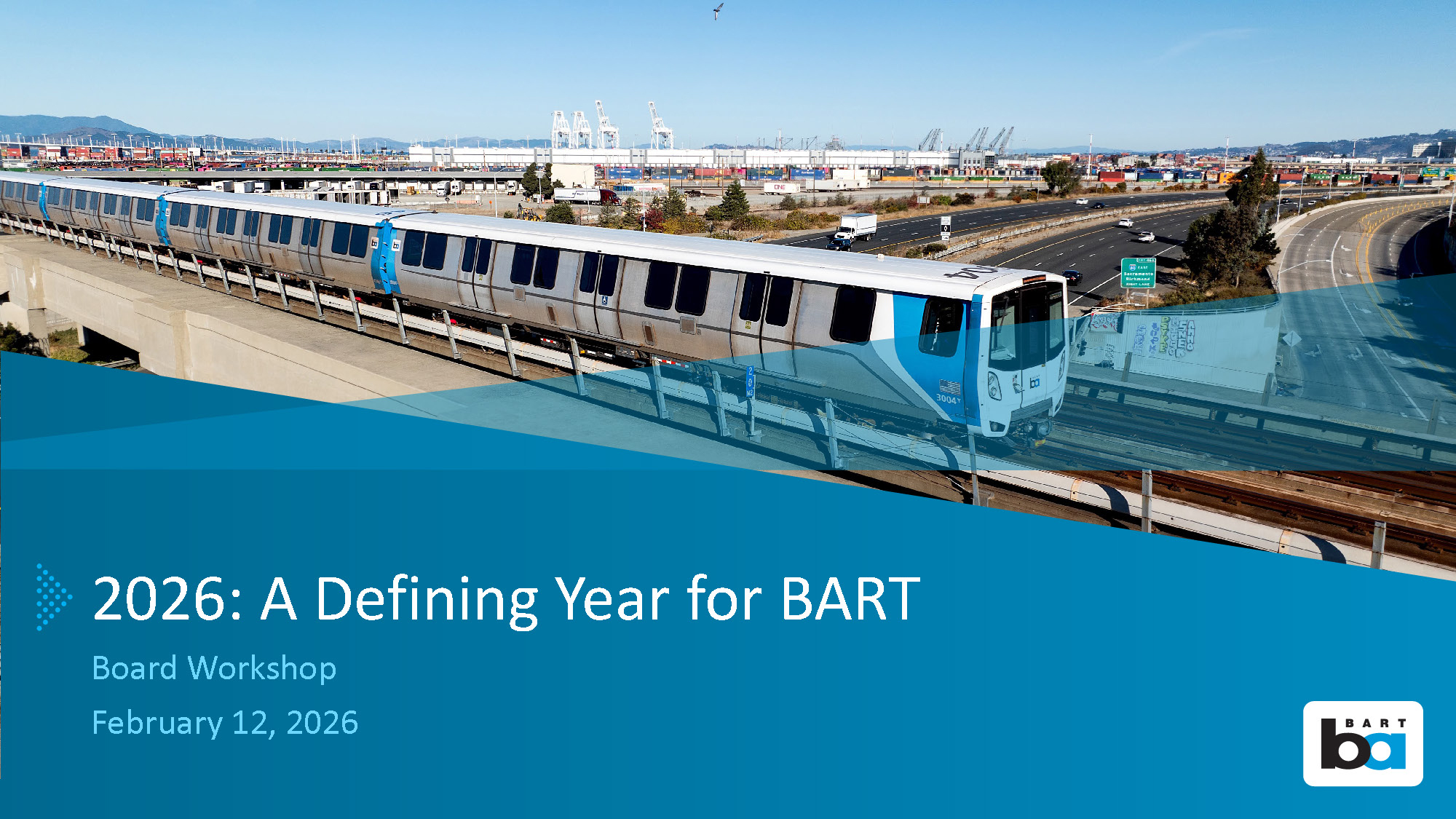
At the annual BART Board Workshop on Thursday, February 12, BART staff will present Directors with detailed plans for an alternative service framework if a November 2026 ballot measure fails and no other operating revenue source is identified. 10 stations could be closed by January 2027 and three segments by July 2027.

During the workshop, staff will outline the risks and tradeoffs for service and non-service reductions. Because rail has high fixed costs and low marginal savings, it is impossible to close the projected FY27 $376M deficit with service cuts and fare increases alone.

BART staff evaluated multiple aspects of service including routes, stations, headways, peak, evening, and weekend service and hours of operation. The proposed framework outlines, for the very first time, specific details including which stations would need to be closed due to a lack of operating funds and the recommended phased approach to triggering further cuts. The plan retains as many riders as possible, while still cutting service to realize savings. System support services would need to be reduced by 40% as cost savings from cutting service would be largely offset by the resulting lost fare revenue.

Source: BART

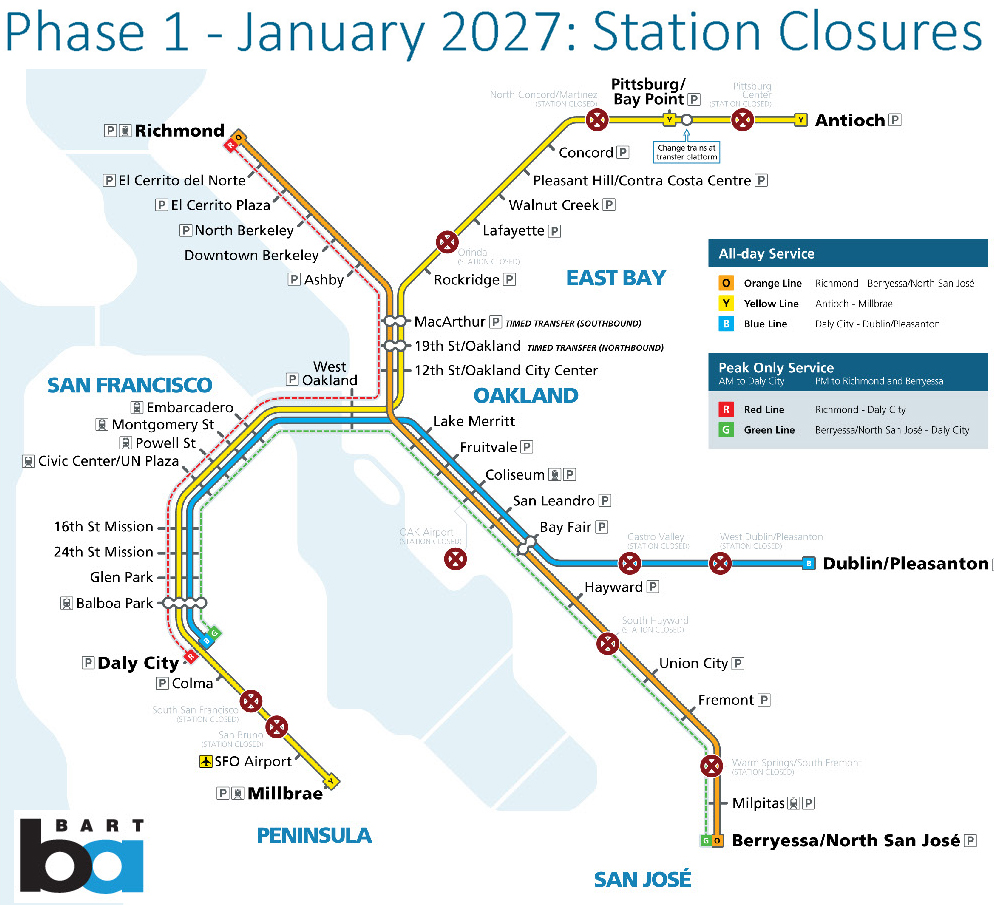
Phase 1 – North Concord, Orinda, Pittsburg Center Stations Would Close

The stations on the list for potential Phase 1 closure in January 2027 include the 10 lowest ridership stations: North Concord, Orinda, Pittsburg Center, Oakland International Airport, West Dublin/Pleasanton, Castro Valley, San Bruno, South Hayward, South San Francisco and Warm Springs/South Fremont.

In addition, the proposed Phase 1 proposal includes Service Frequencies of a 63% reduction in train hours; Reduced base schedule: 3-line base schedule each with 2 trains/hour and 240% more transfers (Percentage of trips requiring a transfer increases from 7% to 22%); Test retaining peak service: Peak Green/Red/Yellow trains operate in peak hours/direction only; and No evening service: the lines would Close at 9 PM (7 days) and Open at 8 AM (Saturday and Sunday).

Source: BART

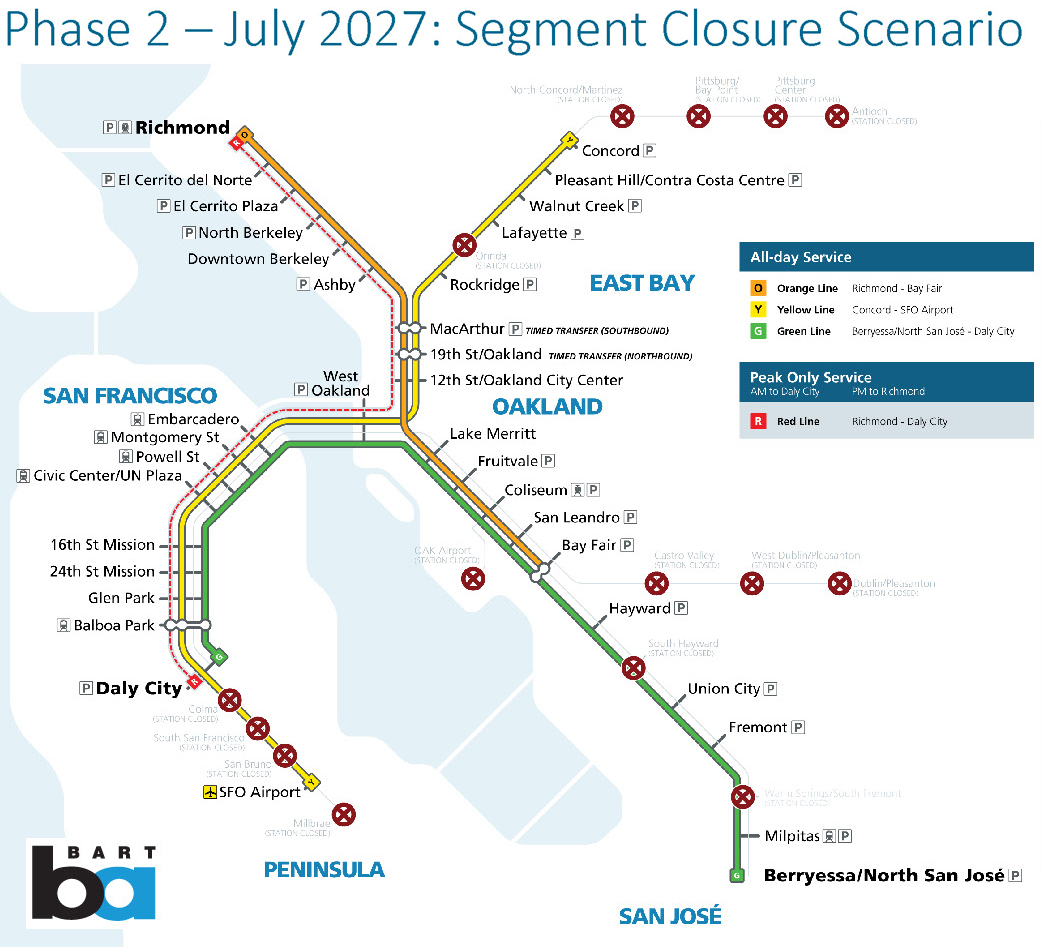
Phase 2 – Yellow Line Service Would End at Concord Station, Pittsburg/Bay Point & Antioch Stations Would Close

The Phase 2 – July 2027: Segment Closure Scenario, Contingent on Phase 1 implementation, would result in a 70% reduction in train hours and 25% reduction in system miles; Segment closures would stop service on most system segments opened after 1976: Yellow line service would end at Concord, shuttering the Pittsburg/Bay Point and Antioch Stations; Orange line service would end at Bay Fair,; Blue line service would be discontinued shuttering the West Dublin/Pleasanton Station; Most stations south of Daly City would be closed except for direct service to SFO would continue for revenue retention; Service continues to Milpitas and Berryessa due to terms of BART/VTA agreements.

Board Vote Scheduled for Feb. 26 Meeting

There will not be a Board vote at the workshop on February 12. After receiving feedback from Directors at the workshop, staff plans to return to the Board on Thursday, February 26, with a resolution to adopt a finalized alternative service framework that would be implemented if new funding is not secured.

You can read the full presentation here.

You can participate in the workshop. You may join in person (2150 Webster Street, Oakland, CA 94612) or via Zoom videoconferencing (https://us06web.zoom.us/j/89025424156).

Written comments may be addressed to the BART Board in advance via email to Board.Meeting@BART.gov, using “public comment” as the subject line, before 3:00 p.m. on Wednesday, February 11th.


Filed Under: BART, Finances, News, Taxes, Transportation

Connect Bay Area campaign raises nearly $3 million to support signature gathering for regional transit tax measure

January 15, 2026 By Publisher 1 Comment

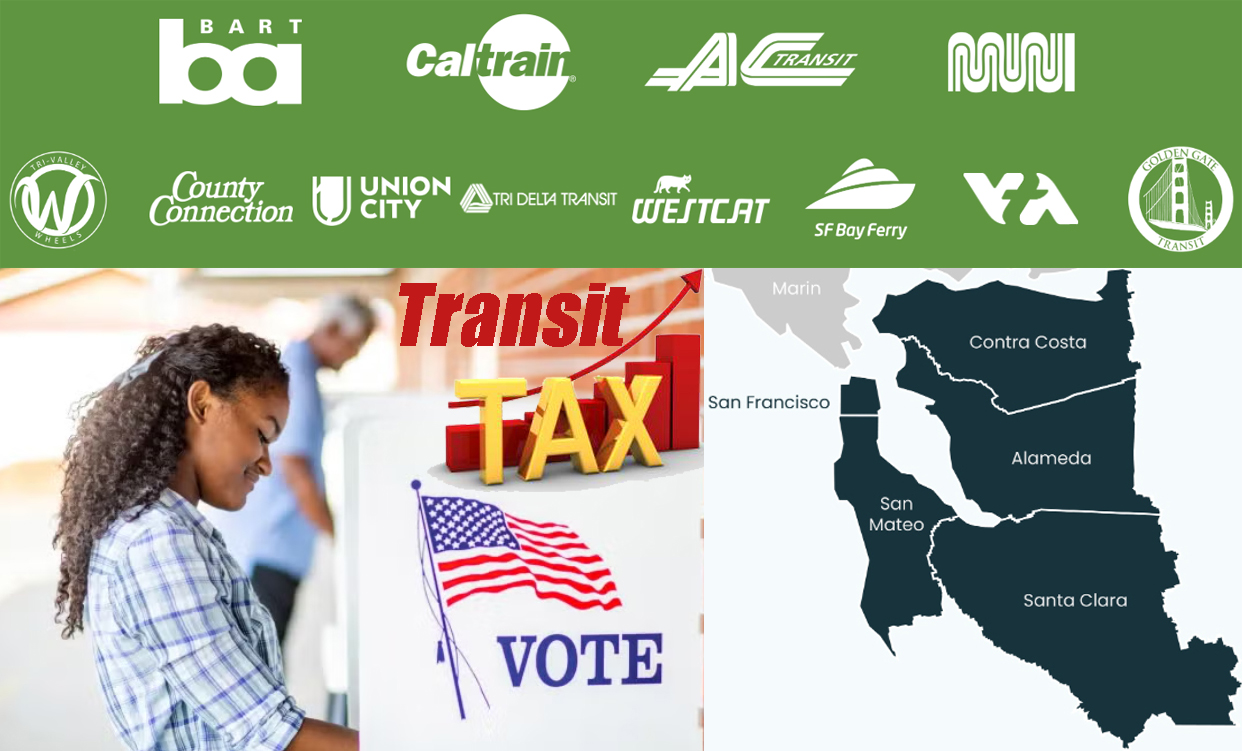
Multiple Bay Area transit agencies would benefit from the five-county sales tax measure. Photo: MTC. Graphics source: Connect Bay Area

Businesses, labor unions, civic foundations join effort for 5-county Nov. 2026 ballot measure to prevent threatened catastrophic transit service cuts, promote reliable, safe public transit

Includes Contra Costa; would generate about $1 billion per year

SAN FRANCISCO BAY AREA, CA — The Connect Bay Area Transit committee today announced that it has already raised nearly $3 million to support a region-wide effort to qualify Connect Bay Area, a voter-proposed regional transportation funding measure, for the November 2026 ballot. With strong early financial backing secured, the campaign will now begin signature gathering while continuing to fundraise to qualify and pass a five-county sales tax to save public transit.

About the Tax Measure

The measure if adopted would increase the sales tax in Contra Costa, Alameda San Mateo and Santa Clara Counties by a half cent and one cent in San Francisco County for 14 years. As previously reported, the measure would generate approximately $980 million annually across the five counties.

Revenue from the tax measure will benefit multiple transit agencies in the region including Tri Delta Transit, County Connection and WestCat, as well as AC Transit and BART which serve Contra Costa County residents.

Following is a county-by-county breakdown of the County Specific Dollars. It does not include money going to BART, Muni, AC Transit and Caltrain, or to regional improvements that aren’t designated by county, such as coordinated fare programs and accessibility improvements.

County Agencies:

  • Contra Costa County Transportation Authority (2.5%, $26.51M)
  • Alameda County Transportation Commission (1%, $10.26M)
  • San Mateo County Transit District (4.7%, $50M)
  • Santa Clara Valley Transportation Authority (25.1%, $264.07M)

Small Operators:

  • Contra Costa County small operators (1.5%, $15.75M)
  • Alameda County small operators (0.5%, $5.25M)
  • SF Bay Ferry (0.7%, $7M)
  • Golden Gate Transit (0.1%, $1M)

Without new and sustainable operations funding, the Bay Area will face a true emergency:

  • BART: Could shut down two of its five lines, reducing service from 4,500 trains per week to just 500, with trains running only hourly and no weekend service.
  • AC Transit: Would reduce service by 37%, bringing operations down to just half of pre-pandemic levels.
  • Muni: Would face 50% cuts to all bus and Metro lines, including elimination of entire neighborhood routes and San Francisco’s iconic historic trolleys and cable cars.
  • Caltrain: Trains would run only once per hour, end service by 9 p.m. on weekdays, and eliminate all weekend service.

The Connect Bay Area measure will support the future of public transportation in the Bay Area:

  • Protect and improve service on BART, Muni, Caltrain, SamTrans, VTA and AC Transit
  • Prevent catastrophic service cuts that could devastate the Bay Area
  • Keep traffic and emissions down, preventing gridlock and protecting climate progress;
  • Support the Bay Area’s economy, ensuring that downtown recovery and regional mobility remain strong.

The Connect Bay Area Transit measure will include strong accountability provisions. This ensures new funding delivers real improvements, not just short-term fixes. Transit agencies must:

  • Independent financial review and cost-efficiency: Operators will undergo a third-party financial review and be required to improve financial efficiency and use public funds wisely
  • Better regional coordination to benefit riders: Operators will be required to comply with MTC’s Regional Network Management Policies to coordinate across systems and simplify fares and signage to create a more seamless experience for riders.
  • Oversight Committee: An oversight committee will ensure that the expenditure plan is adhered to and hold MTC and operators accountable to all provisions of SB63.

About the Campaign

The campaign’s initial fundraising success reflects broad alignment across business, labor, philanthropy, and community leaders that a reliable, safe, and efficient public transportation system is vital to the future of the Bay Area. Major early donors include Chris Larsen, Herzog Contracting Corporation, Genentech, HNTB Corporation, Meta, and SEIU 1021. For a full list of donors, see below.

“Public transportation connects everyone. We are proud of the broad coalition uniting to prevent catastrophic service cuts and to build an affordable, safe, and efficient public transportation system,” said Jeff Cretan, a spokesperson for the Connect Bay Area Transit Committee. “The commitments we are seeing from business, labor, and civic leaders shows that everyone is ready to get this measure across the finish line in November.”

Connect Bay Area is a five-county regional tax measure designed to prevent catastrophic transit service cuts and provide reliable operating funding for major transit systems and local bus operators throughout the region. The measure also funds improvements to transit systems, capital projects within counties, and targeted road improvements. The measure is critical to supporting the Bay Area’s economy, promoting an affordable region, reducing traffic congestion, and ensuring access to jobs, schools, and healthcare.

Early financial support for the campaign includes commitments from:

  • Chris Larsen
  • Herzog Contracting Corporation
  • Genentech
  • HNTB Corporation
  • Meta
  • SEIU 1021
  • Jacobs
  • Silicon Valley Community Foundation
  • ATU Local 1555
  • PG&E
  • San Francisco Foundation
  • WSP
  • Golden State Warriors
  • AFSCME Local 3993
  • Boston Properties
  • Visa
  • AFSCME Council 57
  • T.Y. Lin
  • GILLIG
  • HDR, Inc.
  • Fehr & Peers
  • AFSCME 3916
  • Arup North America
  • Olson Remcho

Additional major employers, labor organizations, and philanthropic partners have indicated commitments that are expected to be finalized as the campaign continues to build momentum.

With signature gathering starting, the Connect Bay Area campaign will focus on qualifying the measure for the ballot while continuing to expand its coalition across the region. The Campaign must secure over 186,000 signatures from the five counties by June 6, 2026 to qualify for the November ballot.

The campaign’s early momentum comes as Bay Area transit agencies face an unprecedented funding crisis. Without a sustainable solution, public transportation in the the region could see devastating impacts, including:

  • BART could eliminate 2 full lines, stop service at 9pm on weekdays, and eliminate all weekend service.
  • Muni could eliminate entire routes, make 50% cuts to major bus and metro lines, gut historic train and cable car service.
  • Caltrain could cut weekday service to once an hour, stop service at 9pm on weekdays, and eliminate all weekend service.
  • AC Transit could cut up to 37% of overall service.

Recent polling on the proposed Connect Bay Area measure shows a clear path to passage, with strong support across counties and voter demographics. A survey conducted by EMC Research for the Metropolitan Transportation Commission found that 59% of Bay Area voters would support a proposed regional sales tax measure for public transportation. The threshold for passage for a signature-gathering initiative is 50%+1.

For more information about Connect Bay Area, visit ConnectBayArea.com.

About the Connect Bay Area Transit Committee

The Connect Bay Area Transit Committee is led by labor, business, and transit supporters, including the Bay Area Council, SEIU 1021, ATU 1555, SPUR, SAMCEDA, among others, as well as a broad advocacy council. The advocacy council includes more than 20 organizations including transit advocates, housing advocates, safe streets advocates, senior and disability advocates, and environmentalists. The Committee is focused on delivering a successful 2026 ballot measure that will strengthen public transportation to keep the Bay Area affordable for residents and support critical economic growth and climate resilience.

Allen D. Payton contributed to this report.
Filed Under: BART, Bay Area, News, Politics & Elections, Taxes, Transportation

Toll increases at 7 Bay Area bridges beginning Jan. 1

December 24, 2025 By Publisher Leave a Comment

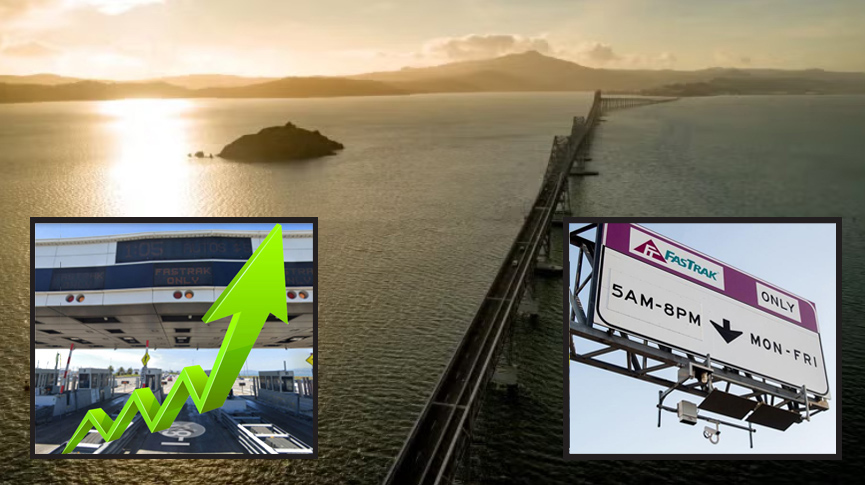
Richmond-San Rafael Bridge. Credit: Karl Nielsen. Photos source: BATA

$8.50 for all regular two-axle cars & trucks

First in series of 5 increases each year through 2030 – not voter approved

Plus, new policies for carpool lanes on bridge approaches

By John Goodwin, Assistant Director of Communications & Rebecca Long, Director, Legislation & Public Affairs, Metropolitan Transportation Commission

With the new year starting next Thursday, the Bay Area Toll Authority (BATA) reminds drivers that tolls at the region’s seven state-owned toll bridges will go up by 50 cents on Jan. 1, 2026. This will be the first in a series of five toll increases to be phased in each January through 2030, with the additional funds to be used only to pay for the maintenance, rehabilitation and operation of the San Francisco-Oakland Bay Bridge and the Antioch, Benicia-Martinez, Carquinez, Dumbarton, Richmond-San Rafael and San Mateo-Hayward bridges, and to service debt on BATA bond issues.

Approved by the BATA board in late 2024, not the voters, the new toll schedule includes a tiered rate structure  aimed at encouraging more customers to pay electronically with FasTrak® toll tags. Because payment with FasTrak carries lower administrative costs than payment through a license plate account or by returning payment with an invoice received in the mail, customers will pay a premium for using a pre-registered license plate account or for invoiced tolling. To give customers ample time to sign up for FasTrak, BATA last year voted to delay the start of the tiered pricing structure until 2027.

Tolls for all regular two-axle cars and trucks will increase to $8.50 from the current $8 on Jan. 1, 2026. Tolls for customers who pay with FasTrak tags will then rise to $9 in 2027; to $9.50 in 2028; to $10 in 2029; and then to $10.50 in 2030. Tolls for customers who use a pre-registered license plate account will climb to $9.25 in 2027; to $9.75 in 2028; to $10.25 in 2029 and to $10.75 in 2030. Invoiced tolls will go to $10 in 2027; $10.50 in 2028; $11 in 2029; and $11.50 in 2030.

Tolls for large freight trucks and other vehicle/trailer combinations with three or more axles will rise by 50 cents per axle each year from 2026 through 2030.

History of Bay Area Bridge Tolls

Tolls include the $5 of voter approved toll increases on the region’s seven state-owned toll bridges. They include:

  • The $1 uniform base toll on the bridges from Regional Measure 1 approved by voters in 1988, except for tolls at the Richmond-San Rafael Bridge, which were already set at $1, and unchanged by passage of RM1.
  • Voters also approved Regional Measure 2 in 2004 which raised the toll price on the bridges by another $1.
  • The $3 from Regional Measure 3 approved by voters in June 2018 which raised tolls in three $1 increments that went into effect on January 1, 2019, January 1, 2022, and January 1, 2025.

Updated HOV Policies

BATA last year also set a Jan. 1, 2026, start date for updated policies about the use of high-occupancy vehicles on approaches to the Bay Area’s state-owned toll bridges. These include a uniform three-person occupancy requirement for half-price tolls during weekday commute periods at all seven bridges. Carpool vehicles approaching the San Francisco-Oakland Bay Bridge must use a dedicated carpool lane, but can use either a standard FasTrak tag or a FasTrak Flex tag set to the ‘3+” position to receive the 50 percent discount available weekdays from 5 a.m. to 10 a.m. and from 3 p.m. to 7 p.m. Carpoolers at the six other state-owned bridges must use a dedicated carpool lane and pay their tolls with a FasTrak Flex toll tag set to the ‘3+’ position to receive the peak-period discount.

The new policies also will allow vehicles with two occupants and a switchable FasTrak Flex toll tag set to the ‘2’ position to use the carpool lanes on the approaches to the Antioch, Benicia-Martinez, Carquinez, Dumbarton, Richmond-San Rafael and San Mateo-Hayward bridges. These two-occupant vehicles will not receive the 50 percent carpool discount but will be able to use the carpool lanes to save time traveling through the toll plazas. Use of the carpool lanes on approaches to the Bay Bridge still will require at least three occupants.

The new carpool policies are designed to improve safety on the toll bridge approaches by minimizing ‘weaving’ between lanes and to increase person-throughput by prioritizing access for buses and carpools. The policy change will optimize lane configurations as now-obsolete toll booths are removed as part of the coming transition to open-road tolling. The Richmond-San Rafael Bridge will be the first of the state-owned bridges to convert to open-road tolling. Crews are expected to begin work later this month on the construction and demolition projects at the Richmond end of the bridge needed to institute open-road tolling. Completion is scheduled sometime in the new year.

BATA, which is directed by the same policy board as the Metropolitan Transportation Commission (MTC), administers toll revenues from the Bay Area’s seven state-owned toll bridges. Toll revenues from the Golden Gate Bridge are administered by the Golden Gate Bridge, Highway and Transportation District, which joined with BATA to operate a single regional FasTrak customer service center in San Francisco. MTC is the transportation planning, financing and coordinating agency for the nine-county San Francisco Bay Area.

The 21 BATA board members aren’t directly elected by the voters but are appointed to represent the nine Bay Area counties and cities in each county, the mayors of San Francisco, Oakland and San Jose, plus, various agencies. Contra Costa County’s representatives are Chair Sue Noack, Mayor of Pleasant Hill, representing Cities of Contra Costa County, who was appointed in February 2023 (contact: 415-602-9929 or snoack@pleasanthillca.org) and District 2 Supervisor Candace Andersen representing the County, who was appointed January 2025 (contact 925-655-2300 or candace.andersen@bos.cccounty.us).

Allen D. Payton contributed to this report.
Filed Under: Bay Area, News, Taxes, Transportation

CHP distributes over $35 million to fight impaired driving

July 10, 2025 By Publisher 1 Comment

Photo: CHP

Antioch, Danville, Pinole, Pleasant Hill, Richmond, San Ramon PD’s, Contra Costa Sheriff’s Dep’t among 148 Cannabis Tax Fund Grant Program recipients

CCC Sheriff Forensic Services Division will use funds for toxicology crime lab

By Tami Grimes, CHP Public Information Officer

SACRAMENTO – The California Highway Patrol (CHP) today announced more than $35 million in grant funding to 148 California law enforcement agencies, crime laboratories, local government agencies and nonprofit organizations to help address the dangers of driving under the influence of alcohol and/or drugs.

“As the legal cannabis market continues to grow, so do the state’s efforts to ensure Californians are recreating responsibly. By supporting the organizations that enforce and amplify our laws on the ground, we can keep everyone safer,” said Governor Gavin Newsom.

The grants from Proposition 64, the Control, Regulate and Tax Adult Use of Marijuana Act, assigned the CHP the responsibility of administering grants for education, prevention and enforcement programs aimed at helping communities tackle impaired driving. Additionally, funds are available for crime laboratories that conduct forensic toxicology testing. The funding for these grants comes from a tax on the sale of cannabis and cannabis products in California.

“This funding represents a major step forward in our ongoing mission to save lives and prevent impaired driving,” said CHP Commissioner Sean Duryee. “With over $35 million going to nearly 150 public safety partners across the state, we’re expanding our reach like never before. These resources will help those on the frontlines keep California’s roads safer for everyone.”

Source: CHP

These funds will go towards a variety of activities. One hundred twenty-six recipients of law enforcement grants will use the funding to combat impaired driving in their communities, including Antioch, Danville, Pinole, Pleasant Hill, Richmond and San Ramon Police Departments. The funds will also support drug recognition evaluator training to improve the identification of drug-impaired drivers, as well as public outreach campaigns, including educational presentations and community events.

Eleven recipients of education grants will use the funds to inform local communities about impaired driving laws while highlighting the dangers of driving under the influence of alcohol and/or drugs.

Source: CHP

Seven recipients of two-year toxicology crime laboratory grants, including the Contra Costa County Sheriff’s Department Forensic Services Division, will use the funds to eliminate backlogs in analyzing forensic science evidence and to purchase or upgrade laboratory equipment to enhance testing capabilities.

Four recipients of two-year medical examiner’s and coroner’s office grants will use the funds to improve and advance data collection in cases involving driving under the influence of alcohol and/or drugs.

With the passage of Proposition 64, the Control, Regulate, and Tax Adult Use of Marijuana Act (AUMA), California voters mandated the state set aside funding for the California Highway Patrol (CHP) to award grants to local governments and qualified nonprofit organizations, as described in Revenue and Taxation Code Section 34019(f)(3)(B).

The Cannabis Tax Fund Grant Program marks an important step toward reducing impaired driving crashes, increasing public awareness surrounding the dangers of impaired driving, and making California’s roadways a safer place to travel.

The application process for future grant funding is expected to reopen in early 2026. More information is available on the CHP website at CHP’s Cannabis Tax Fund Grant Program.

The mission of the CHP is to provide the highest level of Safety, Service, and Security.

Allen D. Payton contributed to this report.
Filed Under: Cannabis, CHP, Crime, News, State of California, Taxes, Travel

Contra Costa Assessor’s report shows 1,341 more parcels, $12 billion increase in property values

July 8, 2025 By Publisher Leave a Comment

In annual Assessment Roll

By Allen D. Payton

In a letter to the Contra Costa County Board of Supervisors, county Assessor Gus Kramer informed them of this fiscal year’s Assessment Roll for the purpose of collecting property taxes and the net value has increased by almost $12 billion over last year.

The report shows San Pablo and Danville had the greatest increase while Concord and Pittsburg had the least, as well as an increase of 1,342 parcels due new development in the county.

Source: Contra Costa County Assessor’s Office

Kramer’s letter reads:

“Dear Members of the Board of Supervisors,

I am pleased to report the completion and official delivery of the 2025–2026 Contra Costa County Assessment Roll to the County Auditor-Controller, as required by law.

This year’s assessment roll reflects a total net assessed value of $290.66 billion, an increase of $11.67 billion—or 4.18%—over the previous year. This represents the highest total assessed value in the County’s history. Cities with the highest percentage increases in assessed value include San Pablo with 5.81%, and Danville with 5.28%. Cities with the most modest growth include Concord at 3.10%, and Pittsburg at 2.96%.

The total number of assessed parcels now stands at 382,022, an increase of 1,341 parcels compared to the previous year. This growth reflects ongoing development and investment throughout Contra Costa County.

I would like to take this opportunity to express my sincere appreciation to the staff of the Assessor’s Office for their professionalism, dedication, and tireless efforts in preparing an accurate and timely assessment roll for the 2025–2026 fiscal year.

Sincerely,

Gus S. Kramer

Assessor”

The duties of the County Assessor’s Office include:

  • Discovering and assessing all property within the County
  • Producing and delivering an assessment roll by July 1 of each year
  • Valuing all real property
  • Auditing all entities doing business in the County and valuing all taxable personal property
  • Establishing and maintaining a set of 11,000 maps for assessment purposes, delineating every parcel of land in the County
  • Providing a public information service to assist taxpayers with questions about property ownership and assessment

To review your property’s value visit Review Your Value and for more information call the office at (925) 313-7400.

Filed Under: News, Real Estate, Taxes

Fact check: Claims swirling around CA gas tax increase to 61.2 cents per gallon July 1

June 30, 2025 By Publisher Leave a Comment

A legislatively mandated and voter-approved gas tax increase of 1.6 cents and updated fuel standards that could, according to experts, translate to 5 to 8 cents not 65 cents per gallon

What you need to know: There are many disingenuous claims swirling about California gas prices “set to soar” – the truth is that gas prices won’t come anywhere close to increasing by 65 cents, as many would have you believe.

By Office of the California Governor

SACRAMENTO – California gas prices are 20 cents lower than one month ago and 17 cents lower than one year ago – despite a swirl of misinformation drawing attention to current prices.

According to a 2024 report, thanks to major improvements in fuel efficiency, California drivers rank 45th in the nation for gasoline consumption and 21st in spending on gasoline per capita. Trump’s tariffs and policies impacting the price of crude oil stand to swing gas prices far more than any state policy.

Driven by misinformation pushed by Republican lawmakers and the oil industry, there remains a lot of speculation about California gas prices. Here are the facts.

CLAIM: California gas prices will go up by 65 cents or higher on July 1. 

FALSE. There are two separate changes to fuel prices expected on or around July 1 – a legislatively mandated and voter-approved gas tax increase of 1.6 cents and updated fuel standards that could, according to experts, translate to 5 to 8 cents.

  • Gas tax: California’s gasoline tax will increase by 1.6 cents per gallon, starting July 1, as required by law. This annual inflation increase was enacted by the Legislature in 2017 to help pay for road repairs – and overwhelmingly approved by voters in 2018 when they rejected a repeal attempt.
  • Fuel standard: Additionally, changes to the state’s Low Carbon Fuel Standard (LCFS) – which is not a tax – have been requested to go into effect on July 1. Experts at UC Davis estimate this program, first established by Republican Governor Arnold Schwarzenegger, could add between 5 and 8 cents per gallon – well below one extreme projection that showed 65 cents. In the long term, LCFS is estimated to reduce fuel costs for Californians per mile by 42% – translating to savings of over $20 billion in gasoline costs every year by 2045. Studies also show that LCFS credit prices have no correlation with gasoline prices.

CLAIM: Gas prices could top $8 a gallon by next year.  

FALSE. That number – widely reported in the media – comes from an unscientific analysis whose author has close ties with the oil industry and has been on the payroll of the Kingdom of Saudi Arabia. The author fails to provide evidence to support his main claim and only relies on vague references to models with no details on what those models are based on. Other experts, such as these Stanford economists, say gas price increases based on recent refinery announcements are likely to be negligible.

CalTax Says Gas Tax Will Increase to 61.2 Cents per Gallon

According to the California Taxpayers Association, California’s excise tax on gasoline will increase to 61.2 cents per gallon July 1, an increase of 1.6 cents per gallon over the current rate of 59.6 cents per gallon, the California Department of Tax and Fee Administration announced June 4.

The tax rate on diesel fuel – a matter of great interest for many businesses, especially those in the trucking and agricultural industries – will increase from 45.4 cents per gallon to 46.6 cents per gallon, likely leading to higher costs for consumers for many goods and services.

The tax increases are in addition to any other increases that may be imposed as a result of fuel standards developed by the California Air Resources Board (CARB). Increases resulting from CARB actions also would take effect July 1.

The gas tax rate has more than doubled during the past 10 years. The largest year-to-year increase occurred in 2017 as a result of SB 1 (Chapter 5, Statutes of 2017), which increased gas tax by 12 cents per gallon and increased the diesel tax by 20 cents per gallon (both effective November 1, 2017) and required that the rates be adjusted annually based on the California Consumer Price Index.

Although Californians often mention vehicle-related taxes as a topic of major concern – and cited an increase in the vehicle license tax as a major factor in their decision to recall Governor Gray Davis in 2003 – the CDTFA did not issue a news release or use its social media channels to alert the media or general public to the increase. Instead, the increase was posted on the agency’s website as a special notice to retailers of gas and diesel fuels.

Allen D. Payton contributed to this report.
Filed Under: News, State of California, Taxes, Transportation

CoCoTax June Luncheon to feature Oakland mayor recall leader

June 5, 2025 By Publisher Leave a Comment

The Contra Costa Taxpayers Association (CoCoTax) invites you to attend a Board and Members Meeting Luncheon at Denny’s Restaurant 1313 Willow Pass Road, Concord, on Friday June 27, 2025, at 11:45 am. Please register in advance on the CoCoTax website where you can pay online, or bring cash or check on Friday and pay at the door: $25 for members, $30 for guests.

MEET OUR SPEAKER: SENECA SCOTT

Seneca Scott moved to Oakland in 2012 to work as the East Bay Director for SEIU Local 1021, representing and negotiating improvements to wages and working conditions for thousands of workers in East Bay cities, most notably Oakland. He also co-founded community groups Bottoms Up Community Gardens and Oakhella.

In 2020, Seneca ran for City Council to bring a voice to his neighbors that he felt was being ignored.

His Neighbors Together movement has since exploded across the city, demanding accountability from its Mayor and City Council.

He later led the successful effort to recall Mayor Sheng Thao and started the YouTube channel Gotham Oakland. He also frequently posts on X about the failures of Oakland’s progressive leadership.

Seneca has worked as a Labor leader and community organizer for over 20 years. He earned his B.S. from Cornell University’s School of Industrial and Labor Relations.

Oakland’s Crisis and Its Implications for Other Cities and Counties

Despite levying high taxes, Oakland suffers from high crime, business closures, blight, and uncontrolled homeless encampments. The City has also faced repeated fiscal crises in recent years.

As Seneca will discuss, the explanations for Oakland’s problems include public corruption and the dominance of a progressive ideology which sounds noble but does a disservice to most residents.

We’ll also learn what lessons Oakland’s troubles might hold for neighboring cities, and whether we in Contra Costa County have anything to worry about

June 27, 2025  11:45 AM – 1:10 PM

Denny’s, 1313 Willow Pass Road, Concord

Registration

  • Member – $25.00
  • Non-Member – $30.00

www.cocotax.org/event-6189658/Registration

Paid advertisement

Filed Under: Education, Government, Non-Profits, Taxes

CoCoTax Lunch with Contra Costa Water District Board President Ernie Avila May 23

May 16, 2025 By Publisher Leave a Comment

Contra Costa Taxpayers Association’s May Luncheon will feature CCWD Board President Ernesto Avila as speaker. Photo: CCWD

  • When: May 23, 2025
  •  Time: 11:45 AM – 1:10 PM
  • Location: DENNY’S, 1313 Willow Pass Road, Concord
  • Spaces is Limited.

Registration

  • Member – $25.00
  • Non-Member – $30.00

The Contra Costa Taxpayers Association (CoCoTax) invites you to attend a Board and Members Luncheon Meeting at Denny’s Restaurant, 1313 Willow Pass Road in Concord, on Friday May 23, 2025, at 11:45 am. Please register in advance on the CoCoTax website where you can pay ONLINE, or bring cash or check on Friday and pay at the door – $25 for members, $30 for guests.

In addition to our speaker, we will be discussing planned updates to the County’s Urban Limit Line (which restricts development in unincorporated areas) and El Cerrito’s forthcoming library parcel tax measure.

SPEAKER TOPIC

Contra Costa Water District 2025 Update

With recent fires in Southern California and ongoing discussions about California’s public water systems and supply, Contra Costa Water District continues to serve as a leader among water agencies throughout the state. CCWD Board President Ernesto “Ernie” Avila will join us May 23 to give updates about ongoing capital improvement projects, how customer rates are used to provide a stable, long-term water supply, what resources and rebates are available to customers, and other initiatives underway to improve the reliability of our local water system. For more information visit Contra Costa Water District, CA | Official Website.

Speaker Bio

Ernesto A. Avila, P.E., was appointed to CCWD’s board in March 2016 to represent Division 3, which includes eastern Concord, Clayton, and part of Walnut Creek and Pleasant Hill, and began serving as Board President in May 2022. He has over 40 years of professional experience in planning, environmental compliance, regulation, design, and construction of water, wastewater and recycled water works and municipal facilities. He is currently Principal/Vice-President of a private engineering firm.

As a member of the Board, he brings his dedication to the community, passion for water issues, and his experience in the private and public sectors. For the community, he has volunteered for many citizen-based committees/organizations including the Walnut Creek Transportation Commission, the Concord Planning Commission, the John Muir/Mount Diablo Community Health Fund, the Knights of Columbus, the East Bay Leadership Council, and the St. Francis of Assisi School Board. While working full time, he has made volunteering in the community a priority, representing his neighbors and family on important issues that affect their everyday life.

He is passionate about water issues in his professional life, working on a variety of issues statewide during his career. Among several relevant positions, he served as Director of Engineering at Contra Costa Water District before moving on to become General Manager of Monterey Peninsula Water Management District. He also served as Executive Director for the California Urban Water Agencies, Program Director for the Multi-State Salinity Coalition, and was elected as Vice President of the Association of California Water Agencies for a two-year term beginning January 1, 2024. He has experience on water projects of all shapes and sizes, including water treatment plant improvements, dam retrofits, and watershed management and habitat conservation projects.

He lives in Clayton with his family and is a licensed civil engineer with a Bachelor of Science in Civil Engineering from Santa Clara University and a master’s degree in Business Administration from St. Mary’s College of California.

About CoCoTax

Founded in 1937, CoCoTax leads the way in providing fiscal oversight of local government.  We actively resist unwarranted taxes and fees, discriminatory regulations, ill-advised public expenditures and government secrecy, inefficiency and waste. For more information and membership visit www.cocotax.org.

Paid advertisement

Filed Under: Central County, Government, Taxes, Water

New poll indicates majority support for Bay Area transit revenue and reform measure

February 25, 2025 By Publisher Leave a Comment

Source: MTC

Contra Costa voters polled support two of three options; want potholes fixed on local streets, improved traffic flow and safety

Members of the Metropolitan Transportation Commission (MTC)’s and the Association of Bay Area Governments (ABAG)’s Joint Legislation Committee heard, on Friday, Feb. 14, the results of a January 2025 poll of Bay Area voters conducted by Oakland-based EMC Research on options for a potential transportation tax measure that could avert deep service cuts by BART, San Francisco Muni, Caltrain and other transit agencies; and could spur implementation of the Bay Area Transit Transformation Action Plan to improve the customer experience for transit riders. State senators Scott Wiener of San Francisco and Jesse Arreguín of Berkeley last month introduced Senate Bill 63 to authorize placement of such a measure on the November 2026 ballot. EMC Research, Inc. conducted the poll of 3,050 Bay Area voters to test support and overall attitudes regarding a potential transportation revenue measure, including a three-way split sample to test three different funding frameworks. They included the following:
  • Scenario 1A: A 10-year 1/2-cent sales tax focused on averting major transit service cuts and providing funding for Transit Transformation, generating at least $560 million annually and
  • Hybrid: A 30-year 1/2-cent sales tax plus $0.09 per building sq.ft. parcel tax including at least five counties and up to nine, providing a higher level of funding for transit operations in early years, funding for Transit Transformation, plus flexibility for local infrastructure priorities.
  • Variable Rate: ½-cent to 7/8-cent (0.875) sales tax for transit for 11 years, as proposed by San Francisco Municipal Transportation Agency, generating at least $640 million annually focused on transit operations with the goal of more fully addressing transit agencies’ operating funding needs. Note that this framework was included to maximize efficiencies and ensure “apples to apples” comparison of polling results. SFMTA is funding this portion of the poll.
The poll found that a majority (54%) of voters in the four counties of Alameda, Contra Costa, San Francisco and San Mateo would vote yes on a half-cent sales tax to avoid major transit cuts to BART, Caltrain, Muni and AC Transit. It also found majority support (55%) in these four counties for a variable tax option that included a half-cent sales tax in Contra Costa, Alameda and San Mateo and a higher (0.875 cent) sales tax in San Francisco. In Contra Costa County the results of 600 total voters polled, with 200 for each option, initially showed 53% support for Scenario 1A: 10-year 1/2-cent sales tax, 51% support for the Hybrid option and 54% support for the Variable Rate. But after hearing more information and opposition, 56% of Contra Costa voters opposed the Hybrid option, 53% supported the Variable Rate and just 51% supported the 1/2-cent sales tax. “While it’s good to see most voters would support a measure of these types, support is well below the two-thirds threshold that would be required if MTC were to place the measure on the ballot,” noted MTC Commissioner and Pleasant Hill City Councilmember Sue Noack. “This means any near-term path would need to be via a citizen’s initiative, which would require a broad coalition to gather the needed signatures as well as strong campaign leadership.” The poll results show transportation ranks comparatively low on the list of voters’ concerns when respondents were asked an open-ended question (affordable housing, drugs/crime and homelessness top the list) but awareness of the post-pandemic challenges faced by transit agencies is high, with over two-thirds of the voters polled saying Bay Area public transit needs more funding. “Transit has an irreplaceable role in our region, being the only source of transportation for many essential workers, people of color, and working-class families,” added Senator Arreguín. “As we continue our recovery from the pandemic, securing funding to public transit is required to ensure a stronger, more resilient economy for all of us in the Bay Area.” A third tax framework for which EMC Research polled Bay Area voters involved a measure that would be funded by a combination of a half-cent sales tax and a 9-cents per square foot parcel tax over 30 years to funds pothole repairs and highway improvements in addition to transit improvements. Support for this framework started at 51 percent but dipped to 44 percent after respondents heard opposing arguments. MTC in December 2024 approved several policy provisions for inclusion in state legislation that would enable voters to consider a future ballot measure. These include requiring stronger oversight of transit agencies’ financial information and requiring transit agencies to adopt policies to help improve the transit customer experience as a condition for receiving new funds. About MTC MTC is the transportation planning, financing and coordinating agency for the nine-county San Francisco Bay Area. The full presentation delivered to the MTC-ABAG Joint Legislation Committee may be accessed on the MTC website. Allen D. Payton contributed to this report.
Filed Under: Bay Area, News, Politics & Elections, Taxes, Transportation

New Year rings in toll increase at 7 Bay Area bridges

December 27, 2024 By Publisher Leave a Comment

Bay Bridge Toll Plaza. Photo by Noah-Berger. Source: MTC website.

Last of three voter-approved increases takes effect Jan. 1st; failed in Contra Costa County

BATA board also voted last week to increase tolls to $11.50 by 2030 for bridge maintenance and repairs

By John Goodwin, Assistant Director of Communications & Rebecca Long, Director, Legislation & Public Affairs, Metropolitan Transportation Commission

The Bay Area Toll Authority (BATA) reminds drivers that tolls at the region’s seven state-owned toll bridges will go up by $1 next Wednesday, Jan. 1, 2025. This will be the third of the three $1 toll increases approved by the California Legislature in 2017 through state Senate Bill 595 and by voters through Regional Measure 3 (RM3) in June 2018 which passed by 55.07% to 44.93%. The first of these toll hikes went into effect on Jan. 1, 2019, and the second on Jan. 1, 2022. It funds $4.45 billion slate of highway and transit improvements but did not include bridge maintenance and repairs. Regular tolls for two-axle cars and trucks (as well as for motorcycles) at the Antioch, San Francisco-Oakland Bay, Benicia-Martinez, Carquinez, Dumbarton, Richmond-San Rafael and San Mateo-Hayward bridges will rise to $8 from the current $7 on Jan. 1, 2025. Tolls for vehicles with three or more axles also will rise by $1 on Jan. 1, 2025, at all seven of the state-owned toll bridges: to $18 for three axles, $23 for four-axles, $28 for five axles, $33 for six axles, and $38 for combinations with seven or more axles. Regional Measure 3 continues the peak-period toll discount for motorcycles, qualifying carpools and qualifying clean-air vehicles crossing any of the state-owned toll bridges on weekdays from 5 a.m. to 10 a.m. and from 3 p.m. to 7 p.m. The discounted toll will rise to $4 on Jan. 1 from the current $3.50. To qualify for this discount, carpoolers, motorcyclists and drivers of clean-air vehicles must use FasTrak® to pay their tolls electronically and must use a designated carpool lane at each toll plaza. Contra Costa Voters Opposed Ballot Measure According to Ballotpedia, RM3 raised bridge tolls in the Bay Area—excluding tolls for the Golden Gate Bridge—by $3 over six years to fund the Bay Area Traffic Relief Plan, including a $4.5 billion slate of transportation projects. It was on the ballot for voters in the city and county of San Francisco and the following counties: Contra Costa, Alameda, Marin, Napa, San Mateo, Santa Clara, Solano and Sonoma. Voters in two of the counties most affected by the bridge tolls rejected RM3. The vote in Contra Costa County was 44.54% opposed to 55.465 in favor and Solano County voters overwhelmingly opposed it 30.03% to 69.97%. But voters in the other seven counties approved the measure. Alameda County where voters and commuters are also most affected by bridge toll increases passed RM3 by 53.89% to 46.11% The vote margin was closest in Napa County, where voters approved the measure 50.7 percent to 49.3 percent.

Source: Ballotpedia

Senate Bill 595 and Regional Measure 3 also established a 50-cent toll discount for two-axle vehicles crossing more than one of the state-owned toll bridges during weekday commute hours of 5 a.m. to 10 a.m. and 3 p.m. to 7 p.m. To be eligible for the toll discount, which is to be applied to the second toll crossing of the day, motorists must pay their tolls electronically with FasTrak®. Carpools, motorcycles and qualifying clean-air vehicles making a second peak-period toll crossing in a single day will qualify for an additional 25-cent discount off the already-discounted carpool toll. New FasTrak® customers can obtain toll tags at Costco warehouse stores and select Walgreens stores around Northern California. A complete list of participating locations — as well as an online enrollment and registration feature — is available on the FasTrak® Web site at bayareafastrak.org. Customers also may enroll in the FasTrak® program by phone at 1-877-229-8655; by calling 511 and asking for “FasTrak” at the first prompt; or in person at the FasTrak® customer service center at 375 Beale Street in San Francisco. FasTrak® can be used in all lanes at all Bay Area toll plazas. Major projects in the Regional Measure 3 expenditure plan include improvements to State Route 37 in the North Bay, freeway interchange improvements in Alameda, Contra Costa and Solano counties, the purchase of more new BART cars, extension of the BART system from Berryessa to downtown San Jose and Santa Clara, extension of the Caltrain corridor to the Salesforce Transit Center in downtown San Francisco, expansion of Muni’s transit vehicle fleet, expansion of San Francisco Bay Ferry service and more frequent transbay bus service, an improved connection between northbound U.S. 101 and the Richmond-San Rafael Bridge in Marin County, upgrades to the Dumbarton Bridge corridor, and extension of the SMART rail system to Windsor and Healdsburg in Sonoma County. In Addition to Recently Approved Bridge Toll Hikes Beginning Jan. 1, 2026

The Regional Measure 3 toll hike that takes effect next week is separate from the 50 cents per year toll hikes approved by BATA earlier this month, which will be phased in over five years, beginning Jan. 1, 2026, to pay for the maintenance, rehabilitation and operation of the seven state-owned toll bridges. It will increase tolls by 2030 to $11.50 for those who don’t use FasTrak and $10.50 for those who do. BATA this month also approved updates to the policies for high-occupancy vehicles on approaches to the state-owned bridges, which will similarly go into effect on Jan. 1, 2026. (See related article)

BATA, which is directed by the same policy board as the Metropolitan Transportation Commission (MTC), administers toll revenues from the Bay Area’s seven state-owned toll bridges. Toll revenues from the Golden Gate Bridge are administered by the Golden Gate Bridge, Highway and Transportation District, which joined with BATA to operate a single regional FasTrak® customer service center in San Francisco. MTC is the transportation planning, financing and coordinating agency for the nine-county San Francisco Bay Area. Allen D. Payton contributed to this report.
Filed Under: Bay Area, Finances, Infrastructure, News, Taxes, Transportation

  • 1
  • 2
  • 3
  • …
  • 8
  • Next Page »
Liberty-Tax-Jan-Apr-2026
Deer-Valley-Chiro-06-22

Copyright © 2026 · Contra Costa Herald · Site by Clifton Creative Web