• Home
  • About The Herald
  • Local Agencies
  • Daily Email Update
  • Legal Notices
  • Classified Ads

Contra Costa Herald

News Of By and For The People of Contra Costa County, California

  • Arts & Entertainment
  • Business
  • Community
  • Crime
  • Dining
  • Education
  • Faith
  • Health
  • News
  • Politics & Elections
  • Real Estate

California is not East Berlin. A wealth tax in the Golden State would expedite the exodus

January 24, 2024 By Publisher Leave a Comment

By Jon Coupal

Note: This column first appeared in The Press-Enterprise. Republished with permission.

Daily news reports on the great “California Exodus” are not just from conservative outlets. Left-leaning publications such as the Los Angeles Times and San Francisco Chronicle have recently reported on the outmigration of upper-income citizens who, even if not billionaires, still generate a lot of income tax revenue.

Earlier this month the California Legislature held a hearing on Assembly Bill 259 which would lay the foundation for the imposition of a wealth tax. The companion legislation to AB 259 is a proposed constitutional amendment that would, among other things, effectively sweep away Proposition 13’s limits on taxing property.

Fortunately, the idea that California would be the first in the nation to impose a highly unpopular wealth tax is so radical that the proposal was rejected by Democrats as well as Republicans on the Assembly Revenue and Taxation Committee. It didn’t take long for the Democrat chair of the committee to shuffle the bill to the “suspense” file where bad legislation goes to die.

Coincidentally, the wealth tax hearing occurred on the same day that Gov. Newsom released his proposed budget. Things got a little sparky during the presentation with Newsom pushing hard against the Legislative Analyst’s figure of a $68 billion deficit. Newsom contends that the deficit is “only” $38 billion. (But hey, what’s a $30 billion difference between friends).

Newsom saved his most animated criticism for those who highlight the state’s shortcomings, including the significant outmigration of California’s most productive citizens. He especially targeted the editorial page of the Wall Street Journal, which has never been reticent about commenting on the state’s well-deserved reputation for anti-business bias.

But to his credit, Newsom rejected the notion of a wealth tax – at least for now. For taxpayers, it matters little whether the governor’s stance is motivated by politics or a sincere policy position. Either way, we’ll take it.

The problems with the wealth tax proposal – even as half-baked as it is – are legion. But one issue should be especially troubling to anyone who believes both in fiscal restraint and basic constitutional freedoms. That is, could a wealth tax be applied to people who voluntarily leave the state for the specific purpose of avoiding California’s highest-in-the-nation income taxes? AB 259 contains a provision that applies the wealth tax to every “wealth-tax resident,” defined as someone who “is no longer a resident, and does not have the reasonable expectation to return to the state.”

The question here is not whether a resident of another state can be taxed when they have a “nexus” to California, for example income earned in California or owning property in the state. Rather, what about someone who no longer has any connection to California? The proposal to tax wealth on such people would likely be deemed to violate the U.S. Constitution’s Commerce Clause.

More fundamentally, an “exit tax” could be construed as an impairment to the right to travel. The U.S. Supreme Court affirmed in 1958 in Kent v. Dulles that citizens have a liberty interest in the right to travel: “[t]he right to travel is a part of the ‘liberty’ of which the citizen cannot be deprived without due process of law under the Fifth Amendment …”

Setting aside the practical and legal problems with this or any wealth tax proposal, a fundamental problem is the signal it sends to all productive California taxpayers as well as those in other states who might consider moving here.  California already has a horrible reputation for its treatment of taxpayers and businesses, why would we even consider another punishing tax?

The proponents of the wealth tax need to be reminded that, as much as they might want to prevent citizens from leaving, California is not East Berlin. The U.S. Constitution will not allow the state government to build a wall to keep citizens in, and then shoot tax bills at them when they try to escape.

Jon Coupal is president of the Howard Jarvis Taxpayers Association.


Filed Under: Legislation, Opinion, State of California, Taxes

Slay California’s Death Tax

January 19, 2024 By Publisher Leave a Comment

About 1.2 million signatures needed by February 5th to qualify the Repeal the Death Tax Act for November’s ballot

Download your petition below to help

By Katy Grimes

This article was first by the California Globe. Republished with permission.

Last week when Gov. Gavin Newsom was sharing his proposed 2024-2025 budget, he insisted that he was opposed to a proposed wealth tax. And sure enough, Assembly Bill 259 by Assemblyman Alex Lee (D-Palo Alto), which will impose an annual “worldwide net worth” tax of 1 percent on net worth above $50 million, rising to 1.5 percent on net worth over $1.0 billion, was killed in committee that afternoon.

However, the governor has been mum about another type of wealth tax – California’s sneaky Death Tax, which adds a new tax on property inherited by a family member, which was already was taxed over the years of ownership.

In 2020, Proposition 19 resurrected the Death Tax on families whose property is left to loved ones when they die, putting their homes, property and businesses at significant risk. While the initiative was cleverly disguised as a benefit for the elderly and disabled communities, Proposition 19 caused far more harm than good.

In May, Senator Kelly Seyarto (R-Murrieta) introduced Senate Constitutional Amendment 4, to restore taxpayers’ property rights by reversing the state’s “death tax” written into in Proposition 19. Deviously titled “the Property Tax Transfers, Exemptions, and Revenue for Wildfire Agencies and Counties Amendment,”

SCA 4 would have reversed one of the largest property tax increases in state history, a little-noticed provision of Proposition 19 that revoked the ability of families and parents to pass property to their children without any change to the property tax bill, according to the Howard Jarvis Taxpayers Association.

However, Democrats killed Seyarto’s SCA 4 in a legislative committee.

I remember when the Death Tax was first slayed.

“It was 1986 when the parent-child exclusion from reassessment was first added to the state constitution,” Susan Shelly recently wrote. “A growing number of Californians were angry to discover that state law treated death and inheritance as a “change of ownership” under Prop. 13, triggering reassessment to current market value just as if it was a sale. The legislature proposed a constitutional amendment that would allow parent-child transfers of a home and a limited amount of other property, such as a small business or a rental property, without reassessment.”

“The parent-child transfer protection passed by a unanimous vote in both houses of the legislature, and then was approved by 75% of voters statewide.”

Howard Jarvis Taxpayers Association elaborates on how Proposition 19 hurts taxpayers:

Proposition 19, had two main elements. The first was expanded “portability” of base-year property taxes. Homeowners who are 55 years of age or older, who are victims of a wildfire, or who are disabled may now move to a replacement home anywhere in the state, of any value, and take the base-year property tax assessment of the old home with them to a new home up to three times.

Now to the other part of Proposition 19. Previously under the state constitution, property transfers between parents and children, and sometimes grandparents and grandchildren, were excluded from reassessment. These family members could transfer a home of any value and up to $1 million of assessed value of other property, such as a small business property, a vacation cabin, or a rental property, without any increase in the property tax bill. This taxpayer protection was added to the state constitution in 1986 by Proposition 58 (parents and children) and in 1996 by Proposition 193 (grandparents and grandchildren) with overwhelming public support.

Proposition 58 was approved by more than 75% of California voters, and Proposition 193 was approved by nearly the same margin. Now, these taxpayer protections are gone.

Proposition 19 has replaced 58 and 193 with a very narrow exclusion for family transfers of property. Only a principal residence that the inheriting child occupies as his or her permanent primary residence is eligible for an exclusion from reassessment. Unless the new owner can move in within one year, the property is reassessed to market value. Business properties and rental properties lose the protection entirely.

So, what can be done?

Susan Shelly continues, “the Howard Jarvis Taxpayers Association, where I am on staff as VP of Communications, is collecting signatures to put an initiative on the ballot that would repeal the tax increase that was hidden in Prop. 19, without touching the other provisions in it. The official petition is available at RepealTheDeathTax.com and can be downloaded and printed on one sheet of ordinary letter-size paper. This enables instant distribution of the petition throughout the state. Theoretically, a million people could download the petition at the same time, fill it out and sign it, and have one other registered voter in the household also sign it.”

It’s easy. Click on RepealTheDeathTax.com and/or

Click here to DOWNLOAD the official petition RIGHT NOW

RepealTheDeathTax.com has more details HERE:

Read the Initiative here.

Please note: You must print and sign the petition with paper and ink. It’s not electronic.

Follow the easy instructions. And please note:

DEADLINE EXTENDED! Return signed petitions to HJTA postmarked by FEBRUARY 5

Download the official, legal petition to put the REPEAL THE DEATH TAX initiative on the November 2024 ballot.

Complete instructions are included in the pdf file.

Get your petition in the mail ASAP – before February 5th.

Katy Grimes, the Editor in Chief of the California Globe, is a long-time Investigative Journalist covering the California State Capitol, and the co-author of California’s War Against Donald Trump: Who Wins? Who Loses?


Filed Under: Opinion, Politics & Elections, State of California, Taxes

Opinion: County Assessor says Supes hypocritical in new Treasurer-Tax Collector appointment

January 10, 2024 By Publisher Leave a Comment

Dear Editor:

Once more the Contra Costa County Board of Supervisors has made fools of themselves and embarrassed the rest of the citizens of our county by its recent appointment to fill the vacancy of the County Treasurer-Tax Collector.

The Board of Supervisors, after months of pontificating, chest beating and self-congratulating each other for creating a new department with two department heads called the Department of Racial Equity and Social Justice, proved how hypocritical they truly are.

During the same board meeting, the board held public interviews for the County Treasurer-Tax Collector position, even though two of the candidates were current, high-level managers, with many years in the Treasurer-Tax Collector’s Office, and both women of color, who were eminently qualified and credentialed. Predictably, the board instead picked a white man from Yuba County.

Why should any of us ever believe anything these board members say or do about racial or social justice?

Sincerely,

Gus S. Kramer, Assessor

Filed Under: Government, Letters to the Editor, Opinion, Supervisors

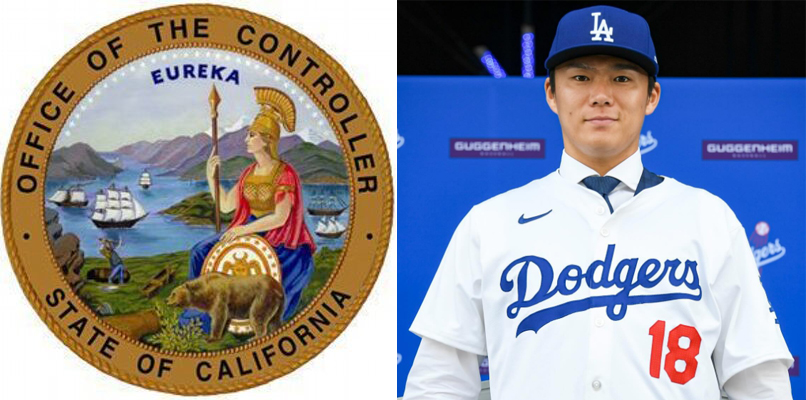
CA State Controller complains about inability to tax largest portion from L.A. Dodgers pitcher’s contract

January 8, 2024 By Publisher Leave a Comment

L.A. Dodgers’ pitcher Shohei Ohtani. Source: L.A. Dodgers Instagram

Wants Congress to approve caps on deferred compensation

SACRAMENTO — State Controller Malia M. Cohen released the following statement following last month’s announcement that the L.A. Dodgers signed a 10-year, $700 million contract with pitcher Shohei Ohtani. The contract is structured so that Ohtani will receive $2 million per year and defer the balance approximately 10 years, when he could potentially return to Japan and escape payment of California state income taxes on the deferred amount:

“The current tax system allows for unlimited deferrals for those fortunate enough to be in the highest tax brackets, creating a significant imbalance in the tax structure.” said Cohen. “The absence of reasonable caps on deferral for the wealthiest individuals exacerbates income inequality and hinders the fair distribution of taxes. I would urge Congress to take immediate and decisive action to rectify this imbalance.”

“Introducing limits on deductions and exemptions for high-income earners promotes social responsibility and contributes to a tax system that is just and beneficial for all. This action would not only create a more equitable tax system, but also generate additional revenue that can be directed towards addressing pressing important social issues and fostering economic stability,” Cohen stated.

About Controller Cohen

As the chief fiscal officer of California, Controller Cohen is responsible for accountability and disbursement of the state’s financial resources. The Controller has independent auditing authority over government agencies that spend state funds. She is a member of numerous financing authorities, and fiscal and financial oversight entities including the Franchise Tax Board. She also serves on the boards for the nation’s two largest public pension funds. Follow the Controller on X at @CAController and on Facebook.

Filed Under: Legislation, News, Opinion, Sports, State of California, Taxes

Opinion: CCTA experiment with “low cost” transit option could prove costly

December 26, 2023 By Publisher Leave a Comment

Glydways podcars and station rendering. Source: Glydways

By Marc Joffe

The Contra Costa Transportation Authority (CCTA) has announced plans to install a new type of transit system in a suburban area 45 miles northeast of San Francisco. The system, created by transportation startup Glydways, offers some compelling efficiencies, but its application in a relatively low‐​density area does not appear to be cost‐​effective. As such, CCTA’s plan merits a hard look from both local and federal taxpayers who will be obliged to fund it.

Glydways’ system uses small driverless vehicles (with a capacity of up to four passengers) on a narrow, dedicated guideway. Because the vehicles use rubber tires, there is no need to install rail tracks. Vehicles are available on demand, typically within two to five minutes of being summoned on the Glydways app.

The Glydways solution addresses several criticisms of traditional rail transit projects, which involve large (often empty) vehicles operating on fixed schedules piloted by operators entitled to generous pension benefits. Projects of this type, including New York’s Second Avenue Subway and BART’s Silicon Valley extension, not only cost billions to build but they are also expensive to operate.

As such, Glydways offers much needed innovation in public transportation, perhaps because it is looking at the challenge from a startup lens. Formed in 2019, the company has raised over $70 million from a group of investors that includes Bill Gates and Vinod Khosla. Their solution is an interesting attempt to apply ideas pioneered by Uber and Waymo to the requirements of public transit.

But innovation alone is no assurance that government will use taxpayer money effectively. Incentives also have a role to play. When companies simply sell products and services to a public agency, they do not have a strong motive to economize. Indeed, they often benefit from cost overruns.

But the CCTA project promises to resolve this incentive problem by using the public‐​private‐​partnership (or P3) model. The P3 charged with delivering the East Contra Costa County Dynamic Personal Micro Transit (DPMT) project includes Glydways and four other companies, along with CCTA and the local public sector bus operator.

Under a P3, companies are supposed to take some ownership of the project. If a P3 truly transfers risk to the corporate partners, their interests better align with those of the taxpayer. In a transportation context, risk transfer means that private sector players should be required to absorb construction cost overruns, excess operational costs, and lower‐​than‐​expected fare revenues. But from the CCTA press release, it is not clear what risk Glydways and the other companies will be expected to shoulder.

And the risks are substantial. Because this is a system that has yet to be tried in a real‐​world setting, a lot can go wrong with the vehicles and the dispatching technology. The unattended vehicles will be especially vulnerable to vandalism, which, unfortunately, is common in the San Francisco Bay Area.

Further, the cost and ridership projections for DPMT do not look promising. A 2021 presentation listed an annual ridership estimate of seven million, which works out to about 20,000 rides per weekday. The same presentation provided a capital cost estimate of $451 million. That seems like a lot of money to transport not too many people, and this is before operating costs are considered.

Further, if these numbers were re‐​estimated in 2024, they will probably look worse. General inflation has pushed up costs for all construction projects. Meanwhile, ridership on the connecting mass transit line (known as eBART) is running about half of 2019 levels. Since the ridership model for DPMT appears to be based on 2019 transit utilization rates, it is likely that a new model based on post‐​COVID transit use would project more modest ridership.

Potential utilization for DPMT is limited by the area’s relatively low population density. The four cities that would be served by the new transit system average about 4000 people per square mile, compared to over 7500 in Oakland and 17,700 in San Francisco.

Applying a new transit solution to this area sounds intriguing, but the relatively limited number of potential users may be more economically served by a new multi‐​use trail with shared e‑scooter and e‑bike stations.

This column first appeared on the CATO Institute website.

A resident of Walnut Creek, CA Joffe is a Federalism and State Policy Analyst with the CATO Institute.


Filed Under: East County, Opinion, Technology, Transportation

Opinion: Will California’s budget woes impact tax reform?

December 20, 2023 By Publisher Leave a Comment

By Jon Coupal, President, Howard Jarvis Taxpayers Association

The Taxpayer Protection and Government Accountability Act (TPA) is a proposed constitutional amendment which has already qualified for the November 2024 ballot. It is sponsored by taxpayer and business organizations to restore key provisions of Proposition 13 and other pro-taxpayer laws that give voters more control over when and how new tax revenue is raised.

Although TPA, unlike previous tax reform measures, doesn’t reduce or eliminate any state or local tax, it does impose both enhanced voter approval requirements for fee and tax increases as well as robust accountability and transparency provisions.

For obvious reasons, tax-and-spend interests hate TPA and have launched a multi-front assault hoping to either defeat it or keep it off the ballot entirely.

The motivation for these schemes is that politicians and their enablers are fully aware that TPA is highly likely to pass if it stays on the ballot. Californians are sick and tired of having the nation’s highest tax rates jammed down their throats, especially when these heavy tax burdens are not accompanied by higher levels of public services; in fact, the opposite is true, as evidenced by California’s high cost of living, crime, homelessness, hostile business climate, and other ills.

But now, there may be another reason why anti-taxpayer interests are waging this war on TPA. A recent report by the California Legislative Analyst’s office threw a bucket of cold water on progressives’ plans to continue to increase taxes with virtually no restraint. The LAO now estimates “2022-23 revenues to be $26 billion below Budget Act projections. Historical experience suggests this weakness is likely to carry into this fiscal year and next. Overall, our updated revenue outlook anticipates collections to come in $58 billion below Budget Act projections across 2022-23 to 2024-25.” (Note that in less than a week after this news, the LAO upped the shortfall from $58 billion to $68 billion).

If there is any saving grace to the current financial situation it is that California still has substantial budget reserves. That, plus some creative accounting, can probably blunt the negative impacts of a severe drop in revenues – at least for a while.

Nonetheless, if California’s tax revenue spigot is curtailed any significant amount, will the enemies of the Taxpayer Protection Act argue that this provides another justification for removing all restraints on raising taxes?

Economic growth in Texas and Florida is outpacing that in California, due in part to a top marginal income tax rate of zero. What is happening in other smaller states is less well known. The smart move would be to follow the lead of other states which are aggressively pursuing pro-growth strategies which in turn lead to more tax revenue.

Take Iowa for example. Defying critics who claimed that tax reductions would crush the state budget, Iowa’s Governor Kim Reynolds slashed top marginal tax rates, previously some of the highest in the nation. Not only did revenues not crash, but they shot up by huge percentage points. According to a report in Center Square, “Iowa led the ‘tax-cutting wave’ in 2022, with the most comprehensive and aggressive tax reform in the United States. This will gradually replace the nine-bracket, progressive income tax with a flat tax, bringing the top rate, which was close to 9 percent, down to a flat 3.9 percent by 2026.”

Other states have provided California with a roadmap for economic growth and healthy budgets by cutting taxes and pursuing other pro-freedom policies. However, the political realities in this one-party state – governed by hardcore progressives – render the odds of politicians even looking at the roadmap extremely slight.

That being said, if the Governor and the Legislature won’t do what’s necessary to prevent a budget disaster, the least they can do is get out of the way of those who have offered the Taxpayer Protection Act to the voters so that ordinary citizens can do what politicians won’t: impose fiscal discipline on a fiscally reckless state.

This column originally appeared in the Orange County Register. Republished with permission.

Filed Under: Finances, Opinion, State of California, Taxes

Payton Perspective: Remembering JFK 60 years later, it’s time for the public to have all the facts

November 22, 2023 By Publisher Leave a Comment

(Left) President John F. Kennedy and First Lady Jacqueline Kennedy arrive at Love Field, Dallas, Texas. (Right) Witnesses lay down in the grass immediately following the assassination of President John F. Kennedy. Bill and Gayle Newman cover their children, Clayton and Billy (hidden) at left. Photographers, including White House Motion Picture Photographer, Lieutenant Thomas M. Atkins (right), film in center. Dealey Plaza, Dallas, Texas. Credit: Cecil Stoughton. White House Photographs. John F. Kennedy Presidential Library and Museum, Boston

By Allen D. Payton, Publisher

While I usually focus on matters in Antioch and Contra Costa County, on this 60th anniversary of the assassination of President John F. Kennedy, I’m compelled to share my thoughts and views.

That’s because, for all of my life, the government has been lying to us about his assassination on November 22, 1963 and it angers me to this day that we,  the American people, still don’t know everything about it, the facts and truth. I was born just five-and-a-half months before and I’ve always felt a connection to him, even though as a baby I knew nothing about JFK, his presidency, policies or life, I’ve taken it upon myself to read and learn about him and that fateful day in American history.

I’m angered by JFK’s assassination, which was clearly a conspiracy, as well as the ensuing coverup and whitewash of the Warren Commission Report. They’ve tried to tell us there was a single gunman, Lee Harvey Oswald had acted alone, and a single, pristine bullet tore through both Kennedy and Governor John Connally’s bodies. But the testimony of so many eyewitnesses, many of whom were ignored by the commission and excluded from its report, has told us otherwise.

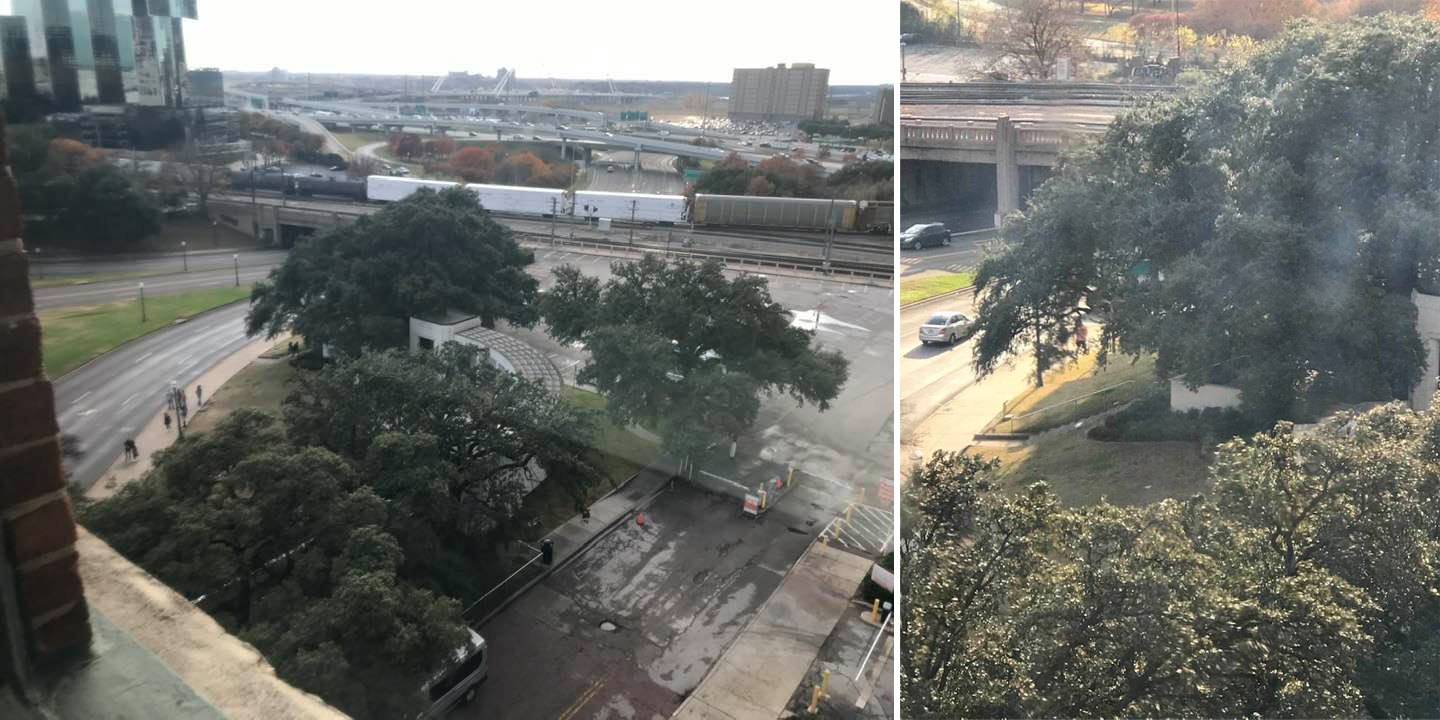
Views of the grassy knoll, the rail line and triple underpass to the west in Dallas’ Dealey Plaza from the seventh floor of the Texas School Book Depository building on Dec. 11, 2020. Photos by Allen D. Payton

A few years ago, my mother and I flew into Dallas to attend my youngest niece’s wedding, and I made it a point, for the first time, to visit Dealey Plaza, the site of the horrible event, as well as the Sixth Floor Museum of the School Book Depository building. I toured, saw the displays, watched and listened to the videos and found it most interesting that the southwest corner windows were covered with black shades preventing people from looking down upon the infamous grassy knoll. It’s as if they don’t want folks to question the official narrative. So, my mom and I went upstairs to the seventh floor where events are held, walk to the corner and lift the shades to look down upon the place where it’s clear the kill shot was taken.

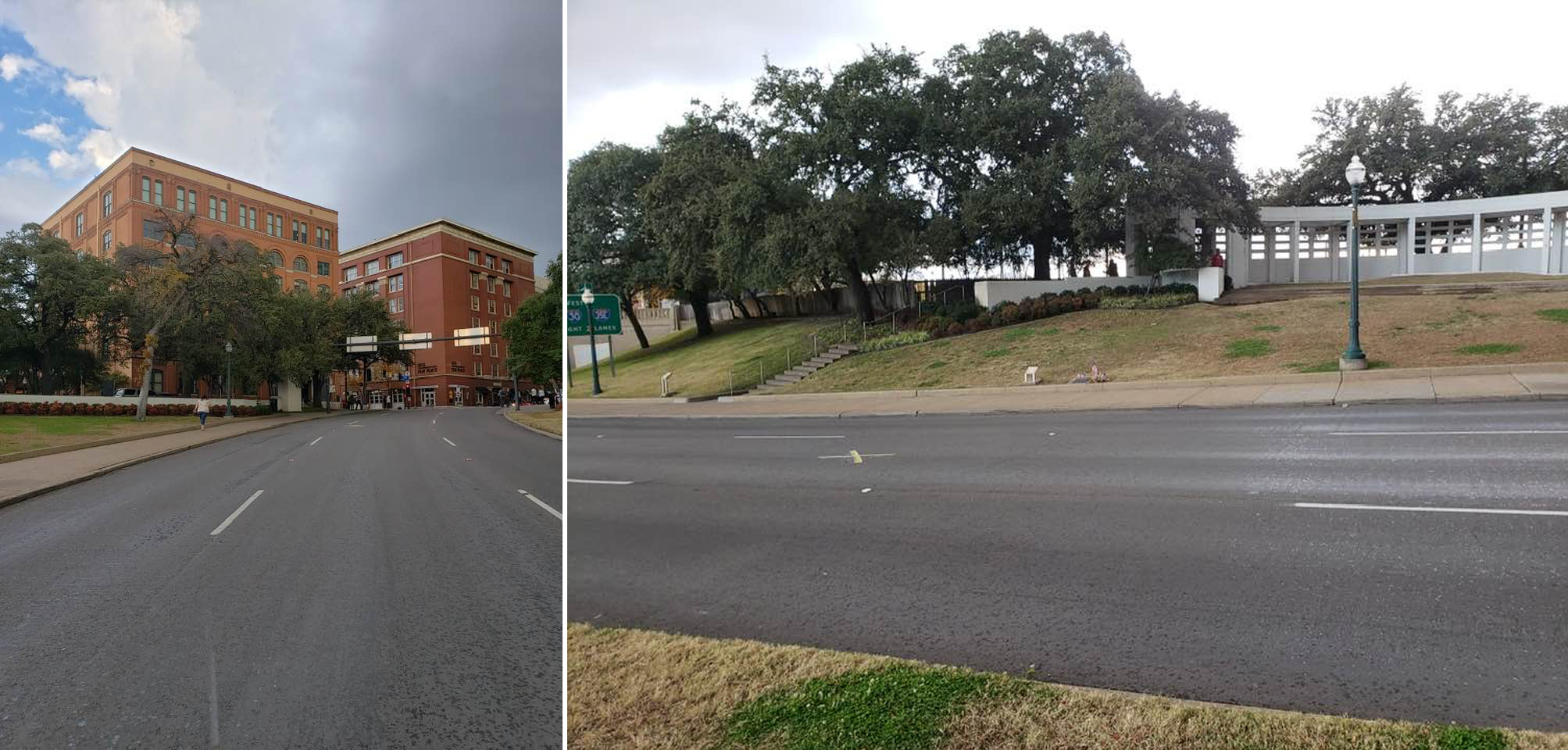
While there, I also stood in the middle of Elm Street on the X on the ground marking the location where Kennedy was riding in the presidential limousine when he was struck by the gunfire. I looked up at both the corner of the Sixth Floor perch of at least one gunman, and over to the grassy knoll and fence above it that still stands to this day.

Views of the Texas Book Depository building from and of the second X on Elm Street, and the grassy knoll and fence on Dec. 11, 2020. Photos by Allen D. Payton

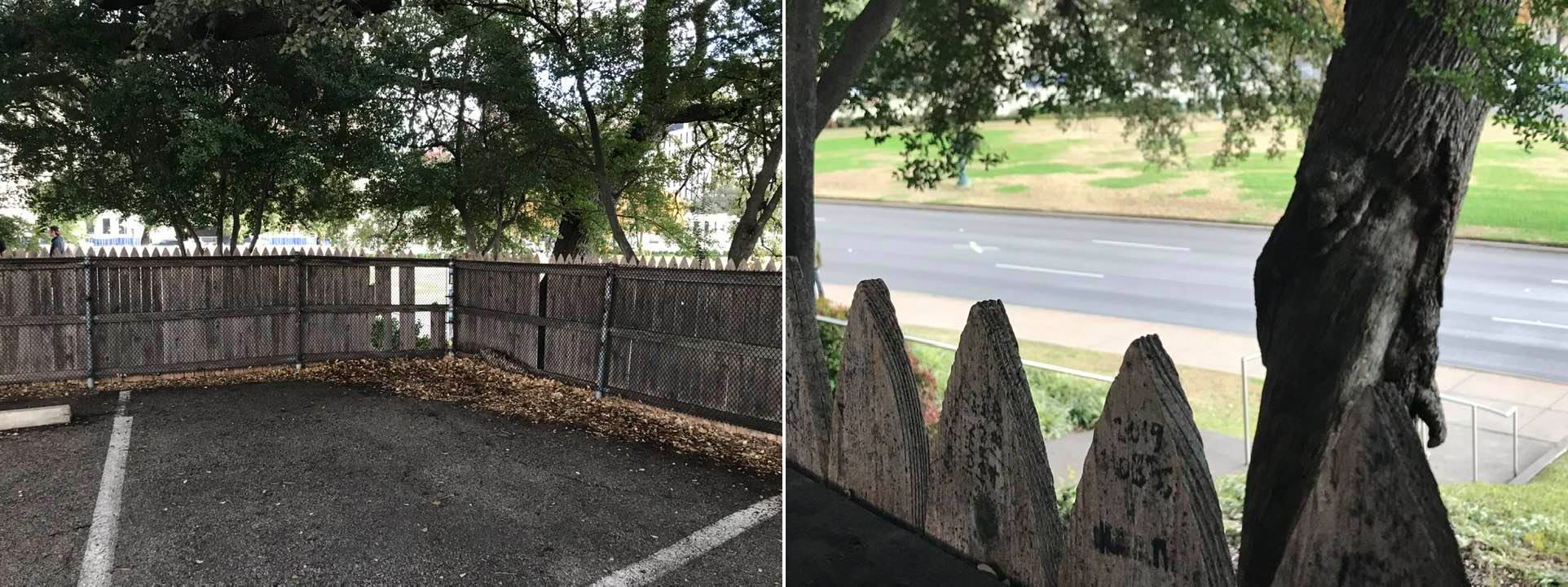
I walked to the back of the fence that so many people, including a few police officers, ran towards, after at least four shots were fired – including one that struck the front window of the limousine. That fence is the location where people said they saw a puff of smoke rise under the trees and at least one witness said he saw a man take apart a rifle and hand it off to another man in a suit who quickly walked away. As I stood there, as one of my sisters and my eldest niece, who had arrived and joined me in Dealey Plaza, stood nearby, I was moved by emotion realizing that was the place where our president’s life was taken with the fatal headshot. That emotion turned to anger.

Views from behind the fence atop the grassy knoll in Dallas’ Dealey Plaza and the second X on Elm Street on Dec. 11, 2020. Photos by Allen D. Payton

Whose president do the powers that be think he was? Whose government do they think this is? We the people, that’s who! For too long, too many have sat idly by and allowed them to lie to us, cover up their evil deeds and hope we’ll all just go on with our lives – which is what has happened – and maybe even forget. But I won’t. Many people won’t. While I applaud former President Trump for releasing most of the remaining JFK Assassination records, he failed to fulfill his promise to release them all.

As a November 21, 2018 report on History.com reads, “…despite the 25-year deadline established by the 1992 JFK Records Collection Act, not everything came out. Citing national security concerns, President Trump then elected to halt the release of some of the remaining classified files for an additional six months. Now that deadline has passed, and it’s still unclear how many records (or portions of the records) still remain under wraps, whether they will be ever released in full, and what—if any—new information they may contain.”

At that time, sources estimated “some 21,980 documents, totaling more than 368,000 pages, are still being withheld in full or in part” and “through a request under the Freedom of Information Act (FOIA), the (National) Archives itself put the total number at 22,933 documents (or 442,606 pages).

Since then, President Biden released over 1,000 records in 2021 and earlier this year he “declared that he has made his ‘final certification’ of files to be released, even though 4,684 documents remain withheld in whole or in part. Going forward, agencies will decide any future disclosures that may be warranted by the passage of time. Of roughly 320,000 documents reviewed since the law passed, 99 percent have been disclosed, according to the National Archives and Records Administration. But 2,140 documents remain fully or partially withheld as a result of Mr. Biden’s action…” (See JFK Assassination Records)

But the fact is many of the records “were partially or mostly redacted”. So, we the people still don’t know what’s in them.

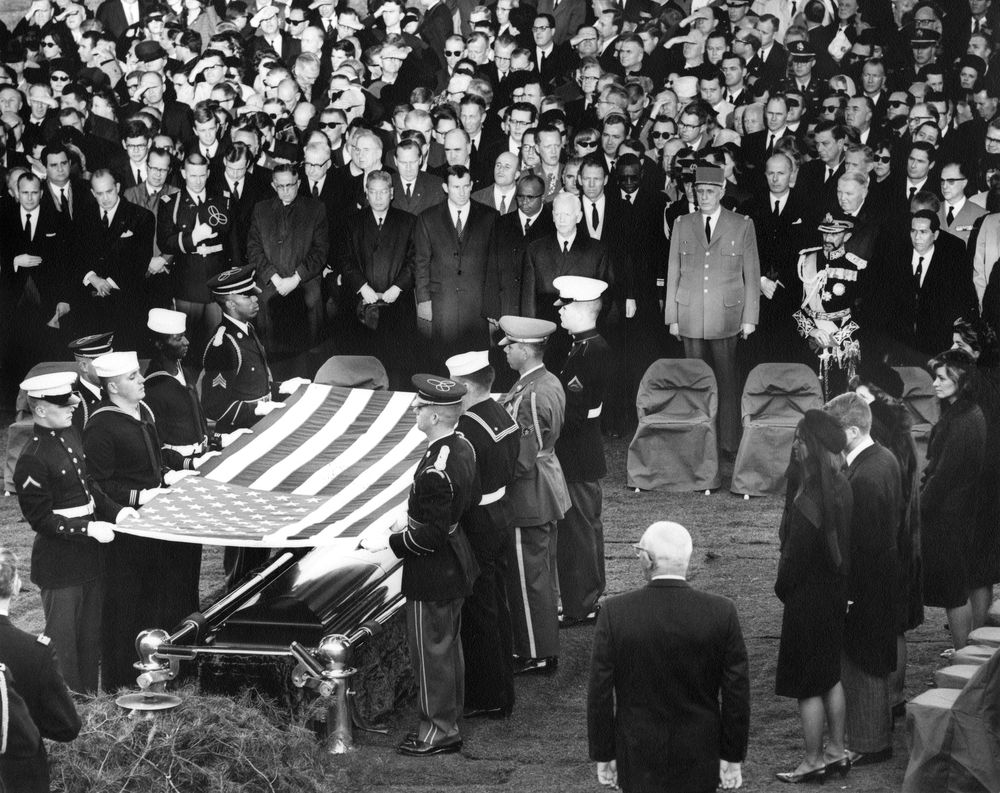
Members of the Kennedy family, officials and dignitaries attend graveside services in the state funeral of President John F. Kennedy as honor guard pallbearers lift the casket flag. Credit: Abbie Rowe. White House Photographs. John F. Kennedy Presidential Library and Museum, Boston

Who after 60 years could they possibly be trying to protect? Some of our federal government institutions? We’ve already learned we can’t completely trust them. Powerful individuals or their reputations? I say too bad. We have a right to know all the facts and see all the documents related to the events and individuals leading up to, involved in Kennedy’s assassination, and who participated in the cover up after the fact. No more soft-pedaling, no more waiting. The next president must issue an Executive Order and release the remaining documents and we the people need to make it an issue in next year’s campaign.

It’s long past time for the lies and coverup to end. It’s time we the people are provided all the facts and truth, and if some of the people are still alive, it’s time they were brought to justice because there are no statutes of limitation for capital murder – and should never be for the murder of our president.

Filed Under: History, Opinion

Writer asks Senators to support National Alzheimer’s Project Reauthorization Act

October 27, 2023 By Publisher 1 Comment

Shares story of caring for her mother for National Family Caregivers Month in November

I’d like to begin by reminding all of you that November is National Family Caregivers Month. It’s a time to recognize the incredible dedication and sacrifices of those who care for their loved ones, particularly those grappling with dementia, in any of its forms. I come to you not just as a speaker but as someone who has experienced the profound impact of dementia firsthand, a journey that started when my mother asked for my help back in 2014.

My mom’s story is one that many of you might find familiar. She was a vibrant woman who, as she approached her 68th birthday, began exhibiting signs of something amiss. Her social withdrawal, erratic medication intake, and a fainting episode that led her to the hospital in Walnut Creek were all red flags. It wasn’t until 2019 that a diagnosis was finally confirmed – vascular dementia. A young, dismissive doctor delivered the news, but our suspicions had been growing for years. The truth was that my mom had been prescribed what I’ve come to call “the dementia cocktail” in 2012, when she was just 61. It consisted of Aricept and Memantine, but her decline was slow, leading to moments of despair. By 2019, she had reached a point where she couldn’t care for herself, yet medical professionals seemed hesitant to make the diagnosis, leaving me feeling isolated in my role as her advocate.

However, my journey took an unexpected turn on my 40th birthday. That day, my mom embarked on a 36-hour odyssey across the Bay Area, signifying her fading independence. She drove across the Bay Bridge twice and even crossed the Golden Gate Bridge once. She was found disoriented and alone, wandering along Alemany Boulevard in Daly City at 3 am, having left her car in front of someone’s house, a silent testament to her deteriorating condition.

My 40th birthday celebration was anything but joyful; it marked the beginning of a deeply personal battle to protect and care for the woman who had once cared for me. My mom’s story is a vivid reminder of the complex and urgent challenge that dementia presents. It’s a disease that not only affects individuals but also places tremendous emotional and physical strain on their caregivers.

In addition to November being National Caregiver Month, let us also acknowledge the importance of the National Alzheimer’s Plan. This initiative has played a vital role in advancing research and support for individuals and families dealing with Alzheimer’s and related dementias. However, we cannot afford to let this plan expire. We must ensure its continued existence and strength.

I call upon our new Senator Laphonza Butler and Senator Alex Padilla to take a stand in this critical moment. I urge them to cosponsor the bipartisan NAPA (National Alzheimer’s Project Act) Reauthorization Act (S. 133) to renew and bolster the National Alzheimer’s Plan, ensuring that the needs of those affected by dementia are met, and research into this disease continues to progress.

In closing, if you or someone you know needs information or assistance in caring for a loved one with dementia, please reach out to the Alzheimer’s Association at 800.272.3900. Together, we can provide the support and resources needed for those battling this heart-wrenching disease. Thank you for your attention and let us work collectively to make a difference.

Latrice Phillips Brown

Pittsburg, CA


Filed Under: Health, Letters to the Editor, Opinion

Op-Ed: CCTA working to keep pedestrians safe

October 12, 2023 By Publisher 1 Comment

By Tim Haile, Executive Director, Contra Costa Transportation Authority

Tim Haile. Photo: CCTA

October marks Pedestrian Safety Month, an ideal time to shed light on pedestrians’ safety challenges while navigating our roads. With California’s diverse landscapes, vibrant cities, and outdoor lifestyle, the state naturally encourages walking and biking, while also facing some alarming statistics regarding pedestrian safety.

According to preliminary data from the Governor’s Highway Safety Association, California’s pedestrian fatality rate is significantly higher than the national rate coming in at 1.29 per 1000,000. 504 pedestrians were killed in crashes involving vehicles in California in 2022, a nearly 10% increase over 2019.

As Executive Director of Contra Costa Transportation Authority (CCTA), I find these numbers to be unacceptable. During Pedestrian Safety Month, it’s crucial to recognize the importance of safeguarding our most vulnerable road users: pedestrians. Every day, hundreds of Contra Costa residents walk to work, school, and leisure activities, contributing to our county’s sustainability and quality of life. The first step to making the streets safer for all is through smart transportation systems and plans.

CCTA, in partnership with Contra Costa County, is actively addressing these concerns through the Vision Zero Safety Policy and Implementation Guide. Vision Zero is a comprehensive strategy aimed at eliminating all traffic fatalities and severe injuries while promoting safe, healthy, and equitable mobility for all. Vision Zero has become a guiding principle in our efforts to enhance pedestrian safety. The key to Vision Zero’s success lies in its data-driven approach, which identifies high-risk areas and factors contributing to pedestrian collisions. By analyzing these insights, we can implement targeted interventions that prioritize the safety of our residents.

In our ongoing commitment to pedestrian safety, CCTA is also in the process of developing a Countywide Transportation Safety Action Plan. The plan will identify strategies to eliminate severe injuries and fatalities. It will consider how to improve safety for all people in the County, including people biking, driving, walking, and taking the train or bus, as well as freight transportation. This plan considers the insights and feedback received from our residents, ensuring that it reflects the real-world experiences and concerns of those who use our streets daily. Residents can use the CCTA’s map-based tool to show where safety is a concern for pedestrians, cyclists, motorists or people with disabilities.

Pedestrian safety also starts with you. Drivers play a pivotal role in ensuring the well-being of those on foot. Drivers can prevent death and injury by adhering to speed limits and slowing down at intersections, always being prepared to stop at marked and unmarked crosswalks, refraining from blocking crosswalks while waiting to turn, and never driving under the influence of alcohol or drugs. By following these guidelines, drivers can actively contribute to a safer environment for pedestrians and all road users, reducing the risk of collisions and promoting a culture of responsible and attentive driving.

When walking, it’s vital to prioritize safety by remaining alert and attentive, avoiding distractions. Whenever possible, make use of designated signalized crosswalks, as these are locations where drivers are more likely to anticipate pedestrian activity. Keep a vigilant eye out for approaching vehicles and always exercise caution when crossing streets.

As we celebrate Pedestrian Safety Month, let us not only acknowledge the importance of pedestrian safety but also recognize the role of efficient transportation planning and community input in achieving this critical goal. By prioritizing safety, investing in infrastructure, and fostering a culture of responsible transportation, we can ensure that pedestrians can move about our beautiful county with confidence, knowing that their safety is a top priority.


Filed Under: Opinion, Transportation

Social media experts warn parents of horrifying content from Hamas following terrorist attacks in Israel

October 11, 2023 By Publisher Leave a Comment

CEO of the Organization for Social Media Safety says Hamas has put your kids at great risk online, parents should lock down or take away kids’ devices  

By Bridget Sharkey, Prime Media Management via prnewswire.com

Social media has long been used as a weapon by terrorist groups like Al Qaeda. Now Hamas is using the power of the Internet to terrify, confuse, and demean its victims.

“Hamas is planting videos on sites like X that show gory and horrific acts of violence, including mass murders and defiled corpses,” said social media safety expert Marc Berkman, CEO of the Organization for Social Media Safety (OFSMS).

According to their website, the organization “is a nonprofit, consumer protection organization focused exclusively on social media. We protect against all social media-related dangers through a comprehensive approach that includes education, advocacy, and technology development. We are available to provide expertise for your story on social media-related dangers.”

Berkman says that these videos have millions of views, despite only being recently uploaded.

“Terrorist groups often use social media platforms to disseminate hate and extreme violence,” he continued. “Parents around the country are receiving alerts from schools and elected officials over concerns that terrorists plan to disseminate distressing videos, including of hostages, through social media. These officials urge parents to delete TikTok and Instagram from their children’s devices as a protective measure.”

Berkman and the OFSMS concur, saying now is a good time to make your kids log off. He also agrees that major social media platforms, including X, Facebook, YouTube, Reddit, and Discord, may be used as weapons of war, spreading graphic violence and hateful messaging.

“This is not a concern limited to TikTok and Instagram,” said the social media expert. “Many platforms already contain graphic, violent videos produced by terrorists. In the past, we have also seen videos of extreme violence shared through social media messaging-based platforms like Snapchat.”

The Organization for Social Media Safety urges all social media platforms to block or immediately remove any content disseminated directly by a terrorist organization. Berkman and the OFSMS share the following tips for parents:

  • Consider pausing children’s social media access to protect their mental health and well-being.
  • Talk with your children about what to do if they come across violent content (We strongly recommend teaching your child about blocking and reporting.)
  • Consider third-party safety software, like our endorsed choice, Bark, that can alert you if dangerous content, like extreme violence, is shared on your child’s social media account.

“We all have a responsibility to protect our community from the dangers of social media,” Berkman concludes. “Report and block! Don’t keep scrolling.”

Allen D. Payton contributed to this report.

Filed Under: Children & Families, International, Opinion, Technology

  • « Previous Page
  • 1
  • 2
  • 3
  • 4
  • 5
  • 6
  • …
  • 22
  • Next Page »
Furniture-Clearance-02-26B
Liberty-Tax-Jan-Apr-2026
Deer-Valley-Chiro-06-22

Copyright © 2026 · Contra Costa Herald · Site by Clifton Creative Web