• Home
  • About The Herald
  • Local Agencies
  • Daily Email Update
  • Legal Notices
  • Classified Ads

Contra Costa Herald

News Of By and For The People of Contra Costa County, California

  • Arts & Entertainment
  • Business
  • Community
  • Crime
  • Dining
  • Education
  • Faith
  • Health
  • News
  • Politics & Elections
  • Real Estate

Payton Perspective: Mt. Diablo school board renaming Concord High mascot from Minuteman to Bears ignores history

August 20, 2023 By Publisher 3 Comments

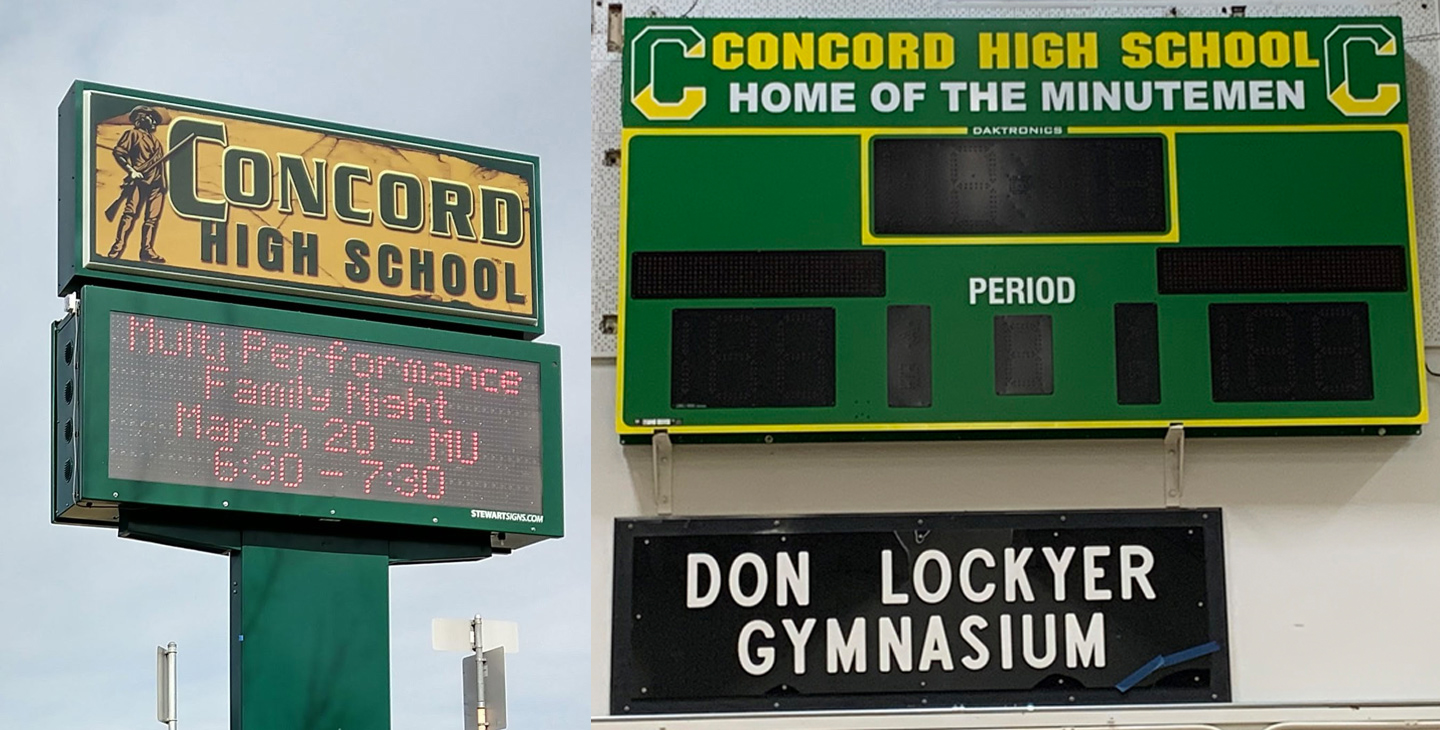
Concord High marquee showing the Minutemen mascot and the gym sign reading “Home of the Minutemen”. Photos courtesy of The Pioneer.

Follows lead of City, Concord Historical Society

Irony: only a British encyclopedia website offers the historical origin of the name of both the city and school

Contact school board members to reconsider their vote, or vote out two of them, next year

By Allen D. Payton

This past week, the Mt. Diablo Unified School Board voted 4-1 to change the name of the mascot for Concord High School from the Minutemen to the Bears, supposedly in response to a request by students, which is in dispute. According to a news report by The Pioneer, the change has many people upset including some students who say they weren’t asked during the process, as well as alumni.

“Several alumni spoke before the board vote, all in opposition to the change. One of those speakers mentioned that of 2,400 comments on the issue in an online forum there was not one comment in favor of the change.” Board members took “the action in order to make the school ‘more welcoming and inclusive’ to its students”, according to The Pioneer’s report.

According to USHistory.org, “Minutemen were a small hand-picked elite force which were required to be highly mobile and able to assemble quickly. Minutemen were selected from militia muster rolls by their commanding officers. Typically, 25 years of age or younger, they were chosen for their enthusiasm, reliability, and physical strength. Usually about one quarter of the militia served as Minutemen, performing additional duties as such. The Minutemen were the first armed militia to arrive or await a battle. By the time of the Revolution, Minutemen had been a well-trained force for six generations.”

They sound like pretty good examples for students at any school or any American to follow – elite, prepared, ready, responsive, enthusiastic, reliable, with physical strength and the first to arrive.

According to the staff report for the board meeting agenda item, “Concord High School, through the New Mascot Student Committee, is requesting the review and approval of a mascot change at Concord High School. The Student Body has conducted multiple petitions, town hall meetings, as well as conducted multiple rounds of student discussions and voting over several months, involving all stakeholders of the Concord High School community including students, alumni and staff. As a result of the discussions and multiple rounds of student voting, the Concord High School community has selected the mascot name ‘The Bears’ to replace the name ‘Minutemen’ as presented to the Board on May 10, 2023 and June 28, 2023.”

Supposedly, one of the reasons is because the “Latinx” students (the “woke” term they were referred to during the board meeting even though most Hispanic or Latino Americans don’t use that term to describe themselves) which make up the majority of the student body don’t share that culture.

The Pioneer article shares more about the decision. School Board Area 4 Trustee Cherise “Khaund said, ‘The Mt. Diablo Unified School District Governing Board is committed to providing equal opportunity for all individuals in education. We as a school district should listen carefully to student concerns, especially if they feel unwelcome or unsafe on our campuses.’ She also pointed to MDUSD board policy 0410 which states that ‘District programs and activities shall also be free of any racially derogatory or discriminatory school or athletic team names, mascots, or nicknames.’”

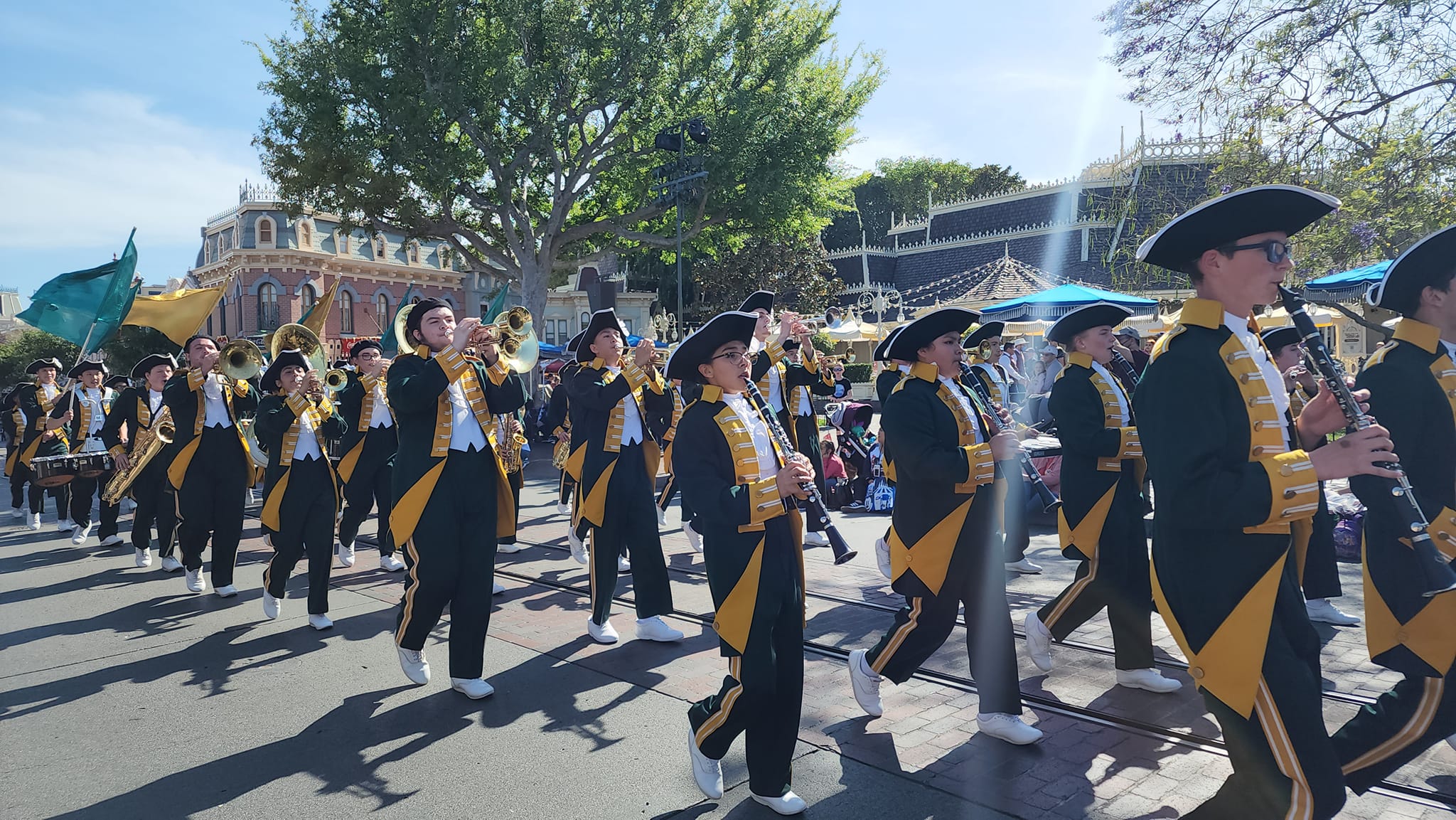
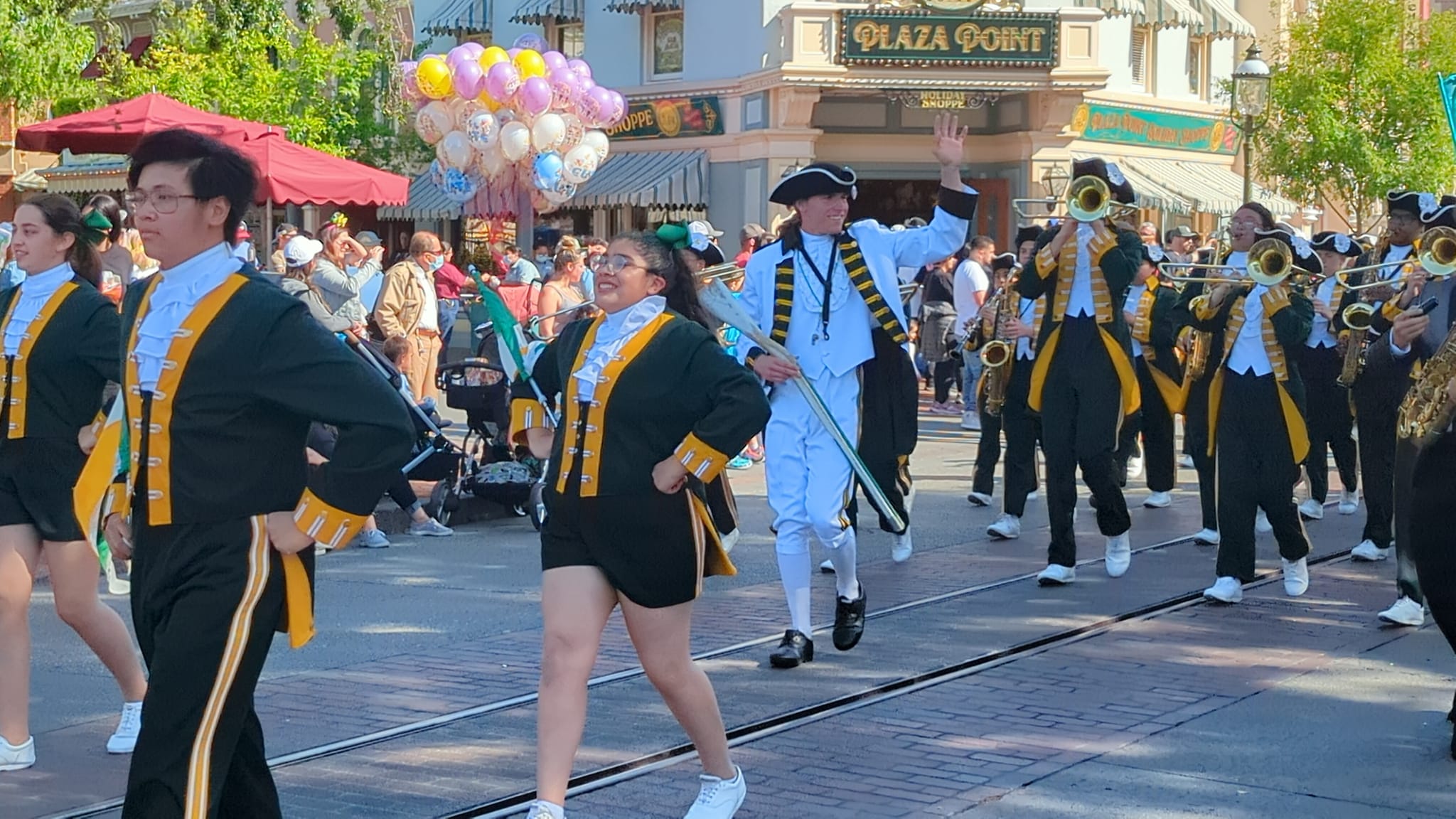
Girls in the Concord High Marching Band wear the same three-cornered hats and uniforms as the boys do in a parade at Disneyland on April 22, 2022. Source: Nelida Pulido on Facebook.

How is the Minutemen mascot racially derogatory or discriminatory? Because it refers to only men? Seriously? The women didn’t fight in the militia during the Revolutionary War in the 1770’s. How ignorant of history do you have to be to not understand that fact? How patronizing and actually racist to assume Latino students aren’t aware of or know the history of our country, or that it’s not part of their “culture”? If that’s truly the case, then work to make it part of their culture. Why do you think their ancestors who weren’t born here, came to this country? For the freedoms won during the Revolutionary War and the opportunities they afford.

Interestingly enough, girls in the school’s marching band wear the same three-cornered hat and uniform as the boys do.

How do any students feel “unwelcome or unsafe” with the Minutemen mascot? Nobody on any of the school’s sports teams, cheerleading squads, in the band nor any faculty or staff member actually carries a real musket or any other gun on the campus. Do they? Of course, not. (Well, maybe security personnel do. But that’s doubtful.)

Name Change Originated with Teachers, Not Students

Yet, while explaining the history of both the original name and its change, The Pioneer claims the proposal for a new mascot came from teachers not students.

“The name Minutemen was chosen as the mascot when the school opened in 1966 in honor of the men who formed the Minutemen militia in Concord, Massachusetts as the American Revolution was beginning in 1775,” the report reads. “The Pioneer first spoke to former Concord High principal Rianne Pfaltzgraff during the 2020-21 school year when she stated she had a discussion with some of her teachers when the idea was brought up that ‘Minutemen’ refers to only one gender and the symbol holding a rifle is not reflective of the school in the third decade of the 21st Century. At that time, it was not mentioned that students had brought the issue forward.”

Source: MDUSD

Board Votes Switch from 2-2 to 4-1

The board vote on June 28 to change the mascot name failed on a two-two tie with Trustee Khaund absent. But then with her in attendance at the board meeting on August 16 and Area 2 Trustee Linda Mayo flip-flopping, the mascot name change passed 4-1.

Decision Ignores and Attempts to Erase U.S. History

Whatever the reasons, the fact is the decision completely ignores our nation’s undisputed history.

It also shows the board’s disinterest in actually educating the students who attend the school about the rich history of the name of both the city in which it is located and the school itself, as well as what the Minutemen signify in the history of our nation, as shared by The Pioneer. They helped us win our freedom from the King of England and beat the British troops in the Revolutionary War! Hello?

Concord High Marching Band at Disneyland on April 22, 2022, with the Drum Major carrying a replica of a musket. Source: Nelida Pulido on Facebook.

Army National Guard logo with Minuteman.

Heaven forbid the Minutemen carried guns. Well, what do you think helped them fight and win the war? What do you think helped all of our military men and women fight and defeat the enemies in all the wars we’ve ever won? Guns! It was accomplished by bearing arms, as it’s written in the Second Amendment of the 10 Bill of Rights to the Constitution – another historical fact that should be taught to high school students. (I hope it still is during U.S. History classes in both 8th and 11th grades). That amendment mentions the militia as it reads, “A well regulated Militia, being necessary to the security of a free State, the right of the people to keep and bear Arms, shall not be infringed.”

Another interesting fact is the Drum Major of the Concord High Marching Band carries a replica of a musket while leading the band – even as of last year while in a parade at Disneyland.

Even today’s Army National Guard logo is of a Minuteman.

The School Board is Not Alone, Ironic Source for Name Origin

Yet, the school board is not alone in ignoring and even appearing to bury and hide the history of the origin of the name of both the city and school. The most ironic thing about this entire matter is, you have to find the origin of the name Concord, California on a British encyclopedia website. No joke!

On Britannica.com about Concord, California it reads, “the city was renamed in 1869 for Concord, Massachusetts.” For those who don’t remember their U.S. History classes, as The Pioneer reported, that was the city where the American Revolution began. (I learned as an adult after I bought a set, that the Encyclopedia Britannica is written from a British perspective, and at that time didn’t even include Niagra Falls as something important to Americans, while the Encyclopedia Americana is written from an American perspective).

But you won’t find that origin fact on the History page of the City’s website, the Concord Historical Society’s website nor even on the Wikipedia page about the city. The City’s website only provides links to other websites without mentioning anything about the city’s history. On the historical society’s concordhistory.com website’s chronology page, under the section entitled, “1860’s: Todos Santos Town Established”, it merely reads, “Name ‘Concord’ is used immediately by new settlers to re-identify town of Todos Santos.” On the Early History page it reads, “Within months after Todos Santos has been recorded as the official name, CONCORD was heralded by the Contra Costa Gazette as the actual name. In an article dated April 17, 1869, the paper, published in Pacheco town, congratulated the residents of Concord for adopting such a meaningful name for their new village. They highlighted the harmonious spirit and euphony of this fine name.” But there’s no mention of the origin of the name nor why it was so “meaningful”.

Concord Massachusetts Location of “Shot Heard Round the World”

Also, for an additional history reminder, it was during the battles of Concord and Lexington, Mass. on April 19, 1775, where the opening shot, referred to as the “shot heard round the world”, sparked the American Revolutionary War.

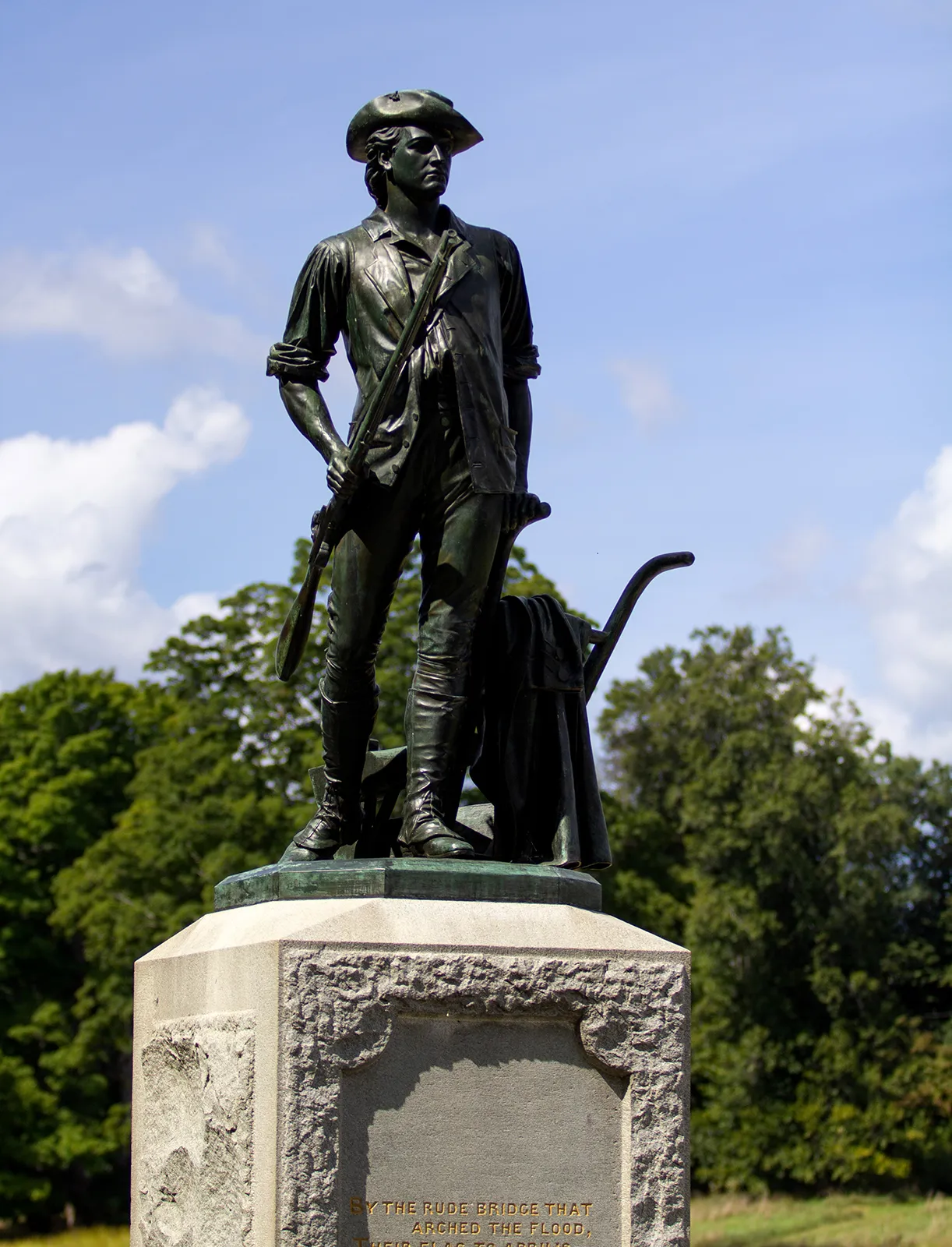
The Minute Man statue by Daniel Chester French erected in1875 in Minute Man National Historical Park in Concord, Massachusetts. Source: City of Concord, MA

In fact, in Concord, Mass. is The Minute Man statue by Daniel Chester French erected in 1875 and located in Minute Man National Historical Park, which looks a lot like the Concord High Minutemen mascot.

Board Spending $200K on Name Change

Oh, one more thing. The board is literally going to spend, actually waste, $200,000 of taxpayer money on the mascot name change at a time those funds could be spent in the classroom to actually help students obtain a better education – and maybe learn some U.S. history. The three-corrnered hats worn by the marching band members will have to be replaced, as they represent the hats worn by the Minutemen during the Revolutionary War. (That’s the same type of hat I wore as part of the uniform for the band I was a member of during my first semester in high school – the Marching Patriots of Patrick Henry High School in San Diego. As of last year, in front of the school, the mascot could still be seen wearing the three-cornered hat and – surprise – holding a musket with even a bayonet attached! Oh, and a painting of the American flag on the front wall could also be seen. Hope that doesn’t offend the four school members’ delicate sensibilities).

San Diego’s Patrick Henry High School mascot with musket in photo taken on Sept. 29, 2022. Courtesy of Margarito G. Perez on Facebook.

Their action follows the cancel culture decisions in professional sports to rename teams that some oversensitive people have found offensive – usually on behalf of others, such as the Washington Redskins to the Commanders. Guess what? Now, a group of Native Americans are petitioning to get the name changed back because they believe it honors rather than degrades them and promotes their history.

School Board Must Reconsider Their Vote

The board must reconsider its vote and spend the $200,000 educating the students at Concord High on the history of the school’s and city’s name and of our nation, and how the Minutemen played a significant role in obtaining the freedoms we enjoy, today – including property ownership and representative government in our constitutional republic.

If not, then Mt. Diablo School district voters need to replace the four who voted for this foolishness and who are failing their students by not educating them properly. Shame on those board members, especially the one who changed her vote, Trustee Mayo who caved between the meetings of June 28 and August 16, for some reason. Kudos to the one board member, Area 1 Trustee Debra Mason, who used wisdom and demonstrated having a backbone to stand up for common sense by voting both times against the change. (By the way, Common Sense is the name of the pamphlet published in 1775 by Thomas Paine, one of our nation’s Founding Fathers, that sparked the American Revolution, as it argued that the colonists had a natural right to self-government and independence from the British monarchy. Perhaps the $200,000 should be spent buying copies of that and distributed to the Concord High School students each year during their American History classes!)

Oh, and how do I know this information about U.S. history? Because I’m a graduate of Northgate High School in the Mt. Diablo Unified School District, where I attended the U.S. History class in my junior year (as required for graduation) taught by a great teacher, actually did my homework and learned the subject matter!

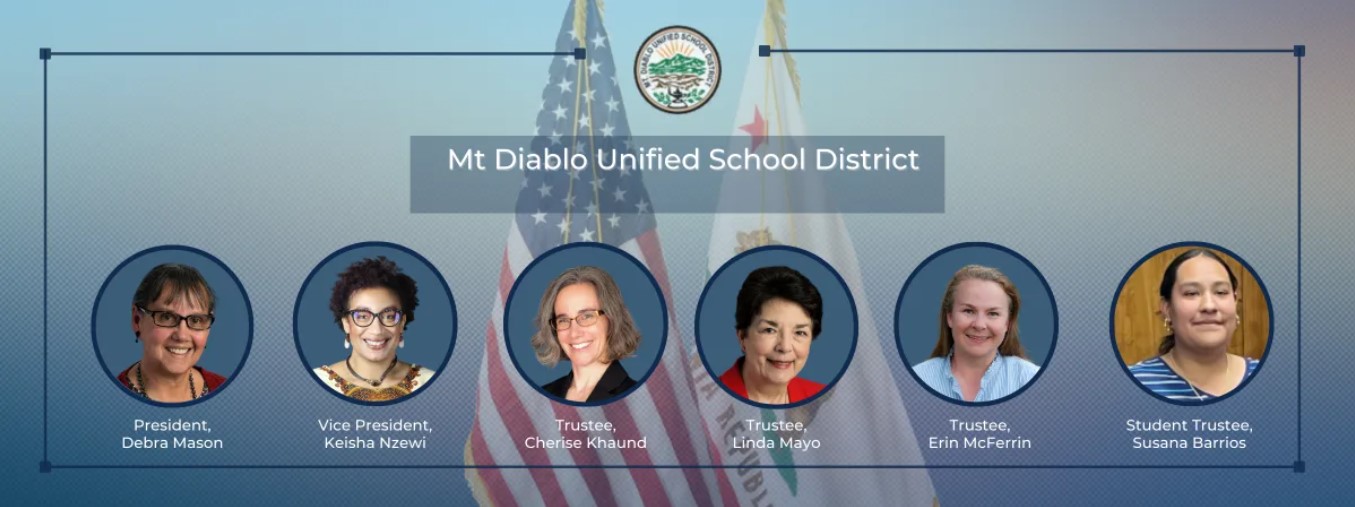
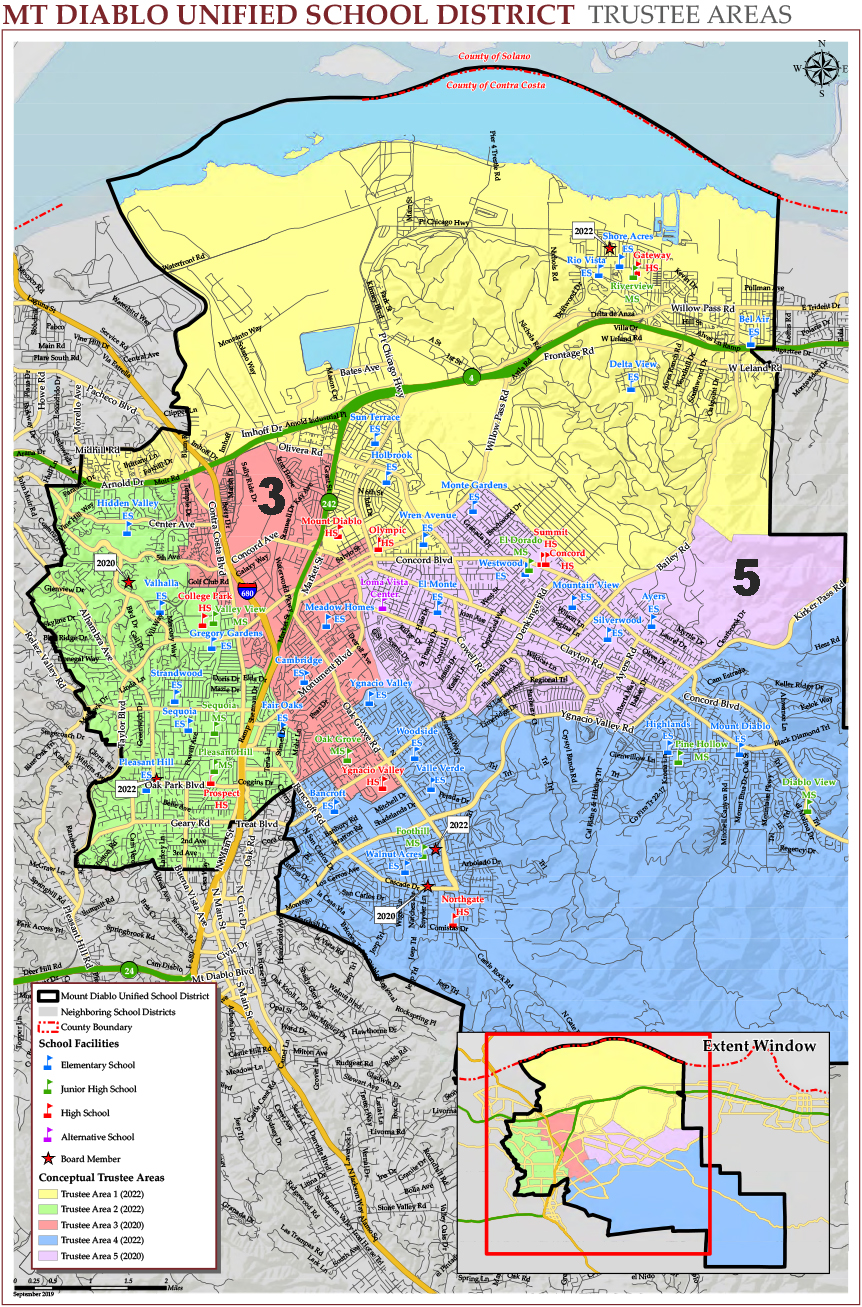
The terms for Trustees Keisha Nzewi and Erin McFerrin who both voted twice for the mascot name change expire following the November 2024 elections. Source: MDUSD

Two Trustees Who Twice Supported Change Face Re-Election Next Year

Seriously, voters in the district, there are only two trustees, who voted for the change both times, that are up for re-election, next year when their terms expire: Board President and Area 3 Trustee Keisha Nzewi and Board Vice President and Area 5 Trustee Erin McFerrin. If they don’t reconsider their vote and change the mascot name back, it’s indicative they don’t care about our nation’s history, the history of the City’s and school’s name nor about educating the students in your district and specifically, at Concord High, about it all. Take back your government from the foolish, wasteful, weak leaders who are contributing to the dumbing down of the education system in the largest school district in Contra Costa County. Just maybe, this latest decision will serve as a lightning rod to wake people up, get them to take action and change things for the better for our future and the benefit of our youth.

Here’s how to contact each of the five trustees by email:

Board President & Area 3 Trustee Keisha Nzewi, Term expires 2024 – nzewik@mdusd.org

Vice President & Area 5 Trustee Erin McFerrin, Term expires 2024 – mcferrine@mdusd.org

Area 1 Trustee Debra Mason, Term expires 2026 – masond@mdusd.org

Area 2 Trustee Linda Mayo, Term expires 2026 – mayol@mdusd.org

Area 4 Trustee Cherise Khaund, Term expires 2026 – khaundc@mdusd.org

Approved MDUSD Trustee Areas 2019. Source: MDUSD

Historical Society, City Must Stop Hiding History and Origin of Their Name

One final thing, to the Concord Historical Society, you really need to add the fact of the origin of the city’s name to your website and the Concord History website, and don’t make it so difficult to find; and to the City of Concord council members and staff, you should actually provide some history about your city on the history page of your website.

Filed Under: Central County, Concord, Education, History, Opinion, Sports, Youth

Op-Ed: Illinois joins California in offering law enforcement jobs to noncitizens

August 15, 2023 By Publisher Leave a Comment

By Joe Guzzardi

Illinois Gov. J.B. Pritzker caught up with California Gov. Gavin Newsom to see which of the Democratic leaders that oversee sanctuary states can do the most to accommodate their immigrant community at citizens’ expense.

Prior to Jan. 1, 2023, candidates for California police officers’ jobs were required to be either citizens or permanent residents to qualify. But a law Newsom signed, Senate Bill 960, opened law enforcement positions up to any California resident who possesses either a green card or a valid visa. The new law took effect January 1, 2023.

In July 2023, Pritzker signed HB3751, a bill similar to California’s, that will allow individuals who are legally authorized to work in the United States to apply for the position of police officer, deputy sheriff or special policeman, subject to satisfying that job’s specified requirements. Illinois’ applicant pool would, like California’s, include deferred action for childhood arrival recipients (DACAs), lawful permanent residents (LPRs) and temporary protected status (TPS) holders.

Illinois has more than 35,000 DACAs and about 30,000 LPRs. By-state statistics on TPS are unavailable, but because that program has expanded dramatically since President Biden’s inauguration, it represents a significant total. Currently, 15 nations have been granted TPS, and if history is a guide, their status will never be revoked. Instead, the TPS designees’ list will grow longer. Pritzker’s folly will begin January 1, 2024.

Founded in 1915, the Illinois-based Fraternal Order of Police, the nation’s largest organization of sworn law enforcement officers, strongly objected to HB3751. The group noted that police officers’ main function is to enforce the law and to ensure that people in their jurisdictions abide by all applicable laws. The union promised that it will “welcome these potential police recruits with open arms once their citizenship status is solidified, and look forward to the unique perspective they can bring to our profession.”

But the FOP asked what message does the legislation send when noncitizens become enforcers of our laws? “This is a potential crisis of confidence in law enforcement at a time when our officers need all of the public confidence they can get.” Making an important point that the FOP overlooked, Republican Illinois State Sen. Chapin Rose added: “It would be a ‘fundamental breach’ of democracy to allow noncitizens to arrest American citizens.”

Pritzker, in a half-truth-filled defense of his controversial legislation, said that about 20 years ago, post-9/11, Chicago and Illinois went on a hiring spree to safeguard against terrorist attacks. Those officers are now eligible for retirement and are leaving the force. Although Chicago’s crime rates are trending down this summer, they remain dangerously high. During a recent weekend, six people were shot and killed, and 27 others were wounded by gunfire, including innocent pedestrians.

Chicago’s police are increasingly frustrated by former Mayor Lori Lightfoot’s illogical limitations on their ability to carry out their duties. For example, officers can’t give chase to fleeing criminals because they’re suspected of having committed minor offenses. Under new Mayor Brandon Johnson, the road ahead for cops may be even rockier. Johnson promised during his campaign to eliminate Chicago’s gang database, a vital tool, and to redirect police funding to social services agencies. Johnson avoided using the phrase “defund the police,” but the end result will be the same. He also recently called events tantamount to riots just “large gatherings .”

If Newsom, Pritzker and Chicago’s administrators governed with more commonsense and less WOKENESS, Illinois and California wouldn’t have driven so many citizens out of those well-paid police jobs that include generous benefits packages. Often noncitizens’ backgrounds are murky; perhaps their ties to their homeland governments will outweigh their fealty to the U.S. If so, the bill put forth by Newsom and Pritzker will create long-term security risks.

Joe Guzzardi is a Project for Immigration Reform analyst. Contact him at jguzzardi@ifspp.org.


Filed Under: Opinion

Opinion: The importance of early civic engagement for teens

May 1, 2023 By Publisher Leave a Comment

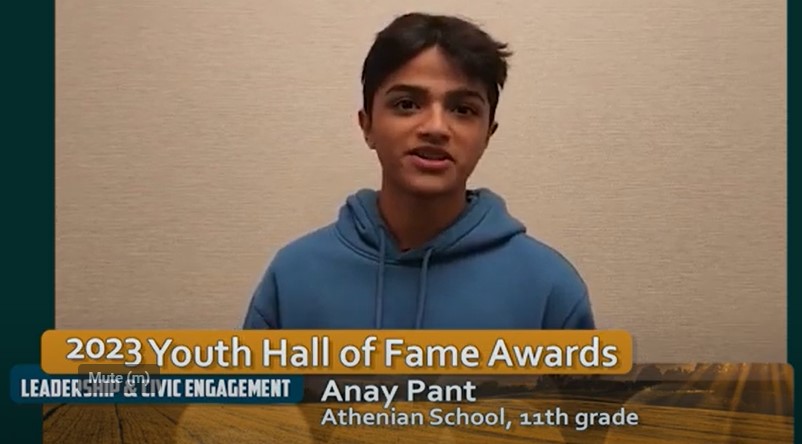
Anay Pant during his video presentation for the 2023 Youth Hall of Fame Awards. Video screenshot.

By Anay Pant

Last year I participated as a High School student poll worker in the 2022 November Midterm elections. This was the first time I felt civically engaged practicing democracy in some form in my country. In a couple of years, I can cast my vote!

Historically, youth voter turnout has stayed around the 25% mark in the USA. It does not indicate that the youth are averse to voting, however studies show that there are structural barriers for youth to participate.

One such barrier is early education and awareness. The USA high school curriculum requires at least 1 semester of American Government class. Topics include the constitutional framework, federalism, the three branches of government, bureaucracy, civil rights and liberties, political participation and behavior, and policy formation. However, the content is not realized in an interactive way, as most students stop at reading a few chapters or watching a documentary.

The reason I got inspired and action oriented was due to my teacher. My teacher gave us practical opportunities such as forums to hear from and interact with our elected representatives e.g., Rep. Mike Thomspon (CA-4), Monica Tranel (MT-02 runner up) and authors such as Mick Rappaport, who have written extensively on the subject.  We had lively discussions in class and homework assignments that did not feel like regular homework. We spoke about current events such as the Nov 2022 midterms, and the importance of student poll workers. I only wish I had been exposed to this subject and my teacher much earlier.

Another structural barrier is the individual themselves.  At home, early civic education largely depends on the motivation of parents and children’s interest in the subject.  Most teens spend little time (<120 minutes per day in the USA) with parents due to the many engagements and distractions.

Teens are constantly occupied (I know it firsthand!)  with daily activities such as schoolwork, sports, after school clubs, internships, hobbies, spending time with friends, social relationships, college admissions planning etc.  It is also a period of emotional growth and hormonal changes with ups and downs and mood swings. A smartphone is perhaps the biggest time sink. Research shows that 95% of US teens have access to smartphones today.

I am a second generation American, with interest in the subject. However, my parents are not well versed in this subject and are themselves learning their civic duties. Therefore, for the 7.2 million second-generation Americans, civic education at school might be the only option.

As an example, as a Junior, I spend about an hour with my parents daily, maybe two on weekends.  Our conversation is usually about academics, family, sports, our pet dog, a movie or food. In my case, my dad and I share a love of history and politics, so we occasionally talk about WWII or political satire from Saturday Night Live or John Oliver. For a second-generation teen like me, school becomes the most important and sometimes the only resource for civic education.

Considering these barriers, it makes sense to start civic education and engagement much earlier. I can also attest through experience that:

  1. Middle schoolers have more time than High Schoolers
  2. Middle schoolers are at the age where they start to form their own opinions about the world around them. Giving them a chance to get involved in their community can help them develop a sense of duty, ownership and responsibility.

Why is this so important?

It is important for each individual to understand their civic duty and make it a habit to vote. The habit should be inculcated in the younger years. Over time when diverse voices from all walks of life exercise their right to vote, it will lead to an equitable and just democracy that most communities can benefit from.

In the 2022 mid-terms, the youth (ages 18-24) turnout was the second highest in three decades6 and quite impactful. Young people across the country had their voices heard and were able to support causes they cared about. According to a Harvard poll around 40% of young voters indicated that they would vote in the election. Overall, around 27% youth ballots that were issued were cast in total.

So, in conclusion I urge my readers to advocate for civic education in Middle School and share the tips below with your school boards and community leaders.

What can schools do

  • Start civics education early – in middle school
  • Encourage students to participate as volunteers in polling stations – local or state-level
  • Expose students to experts, community leaders, and other activists
  • Allow students to organize and run creative programs such as podcasts, talks
  • Recognize students who participate in civic engagement programs

What can communities (Non-Profits, Community Leaders) do

  • Community leaders can create educational programs e.g. field visits to city hall, high courts, etc.
  • Recognize students who participate in Civic engagement programs
  • Nonprofits e.g. Campus Votes could expand their college programs to create school specific programs as well.

I would also love to hear more tips from the readers!

Research Links

[1] https://circle.tufts.edu/understanding-youth-civic-engagement/dispelling-myths-about-youth-voting#myth:-youth-voting-has-been-declining-for-decades

[2] https://circle.tufts.edu/understanding-youth-civic-engagement/dispelling-myths-about-youth-voting#myth:-young-people-are-all-liberal-college-students

[3] https://www.financialsamurai.com/the-average-amount-of-time-parents-spend-with-their-kids-a-day/

[4] https://www.pewresearch.org/internet/2022/08/10/teens-social-media-and-technology-2022/

[5] https://cis.org/Report/ForeignBorn-Population-Hits-Nearly-48-Million-September-2022

[6] https://circle.tufts.edu/2022-election-center#youth-turnout-second-highest-in-last-three-decades

[7] https://iop.harvard.edu/fall-2022-harvard-youth-poll

[8] https://www.campusvoteproject.org/

About Anay Pant

I am a Junior at The Athenian High School in Danville, California. I got interested in civic engagement during the American Politics class I took last semester. The class had a profound effect on me. I was motivated to participate as a student poll worker in the Nov 2022 midterms. I wanted to continue with finding ways to motivate my peers to become aware and action oriented. I launched a civic engagement platform called Qrated (https://qrated.weblium.site/) last year with some success. I am working towards finding avenues to help me outreach my platform

On April 4th, I was awarded the Contra Costa County – Youth Hall of Fame Awards for Leadership & Civic Engagement by the Contra Costa County Board of Supervisors. (See related article here)

https://www.linkedin.com/in/anay-pant/


Filed Under: Education, Opinion, San Ramon Valley, Youth

Payton Perspective: Rombough and Co. have to go

April 28, 2023 By Publisher 7 Comments

The five remaining Antioch Police Officers being sued in the racist text scandal must resign or be fired

It’s a sad, frustrating, embarrassing and difficult time in Antioch, right now. People are angry, want something done, especially our Black residents and rightfully so. The people of our city must have accountability from those paid to protect us and assurances that the racist and offensive texts sent by several Antioch Police officers will never happen again. Plus, our community needs healing. But things need to be done in a way that is fair to all concerned. (See related articles here and here)

The scandal is the real-life fulfillment of what’s written in the Bible verse, Numbers 23:32, “you may be sure that your sin will find you out.” After reading the texts sent on their personal cell phones and reading the federal lawsuit against them, it’s clear that one officer in particular, and four others should resign immediately to start that healing process and if they’re ever going to be considered men of integrity, again in their lives. Furthermore, they need to find another career path, seek counseling and guidance to become better human beings, be required to publicly ask the forgiveness of the people they texted about, as well as of the people of Antioch that they were sworn to protect, not cost us taxpayers any additional money on investigations, salaries or benefits, and not embarrass us any further. If they don’t quit, they must be fired as soon as the investigation is completed.

Antioch Police Officer Eric Rombough following his hire as a lateral officer from the Alameda County Sheriff’s Office on Feb. 14, 2017. Photo by APD

Clearly, the worst of them is Officer Eric Rombough, followed by Sergeant Josh Evans and Officer Morteza Amiri, as well as Officers John Ramirez and Scott Duggar, plus Timothy Manley Williams, who already quit in 2021. It’s no surprise they’re the officers listed in the lawsuit filed last week as they clearly have the most culpability. What they wrote is so disgusting, the fact they found humorous injuring suspects and violating their rights is horrendous, and offering a reward to anyone who would shoot, even with a non-lethal weapon, to injure a sitting city council member is horrific.

Others, including Sgt. James Stenger and Detective Robert Gerber, need to be demoted as a form of discipline within the department for their responses to the texts and not doing what was necessary to stop them. Sgt. Jimmy Wisecarver retired last November, so he can’t face any discipline for his part in commenting on the texts and apparently not doing anything to stop them.

To be fair to the officers, the texts in the two reports were clearly cherry-picked by the DA’s Office Investigator out of all the pages of text messages. (The Herald requested them on Thursday, April 27, 2023. They have 10 days to respond.) Since some mistakes have been found in the two reports, any and all texts between officers during the timeframe of September 2019 through April 2022 should be released. Plus, we should know if there are any texts from any of the department leaders telling the officers to stop what they were doing.

The officers who remain in the department must hold each other accountable, as well – be the first check and balance on the misbehavior and bad attitudes of other officers. They need to remember who pays their very generous salaries and benefits and who they are hired to serve – we the people!

But not all of the 44 APD officers named in the reports, including 13 to 15 remaining department leaders who received the texts, should be fired, nor should they lose their pensions. Nor does the department need the U.S. Attorney General or his Department of Justice to provide oversight. All such demands by officials and residents are a serious and unnecessary overreach. The politicians need to help calm things down and be voices of reason, instead of further stirring up emotions trying to appear sympathetic and pander to certain audiences to get votes.

For most of the others included in the text threads, there’s been an overreaction, specifically blowing out of proportion one text message sent by Antioch Police Officers Association president Rick Hoffman, who is also a sergeant in the department. He merely made fun of one of his fellow officers who claimed he was called a racist. Hoffman didn’t write any texts that were racist or offensive about any citizen.

Here’s that exchange:

On 05/04/2020, At 8:59 p.m., APD Sgt. Josh Evans text, “Kardell’s mom was yelling how we shot and killed someone today. That rumor getting around quick.”

At 9:00 p.m., APD Sgt. Jimmy Wisecarver text, “Laughed.” APD Sgt. Evans replies, “That was right after she called me a racist as cop….” APD Officer Rick Hoffman laughed at the above listed comment and stated, “Well she has a point.

——————–

While he and other leaders and officers were included in some of the group text threads, to be fair, how can they be held accountable for something they received, and didn’t respond to, as they may have not read those texts?

Ask yourself if you’ve ever been part of group text threads, group chats in Facebook Messenger or even participated in comments made below the post by someone else or yourself on Facebook or Twitter and may not have seen and read all the texts or comments. Just because somebody included you doesn’t mean you took the time to read what the others wrote. I know I’ve been included in text threads, in Facebook Messenger groups and in posts on Facebook, including my own posts, and haven’t had time to read all the texts or comments nor did I respond to all of them. Maybe I’ll respond to only one or two texts, or even a thread of comments under my own Facebook posts. But who has time to read all of them? I know I don’t. So, how can I or anyone be held accountable for something somebody else wrote that you or I didn’t even see, read or respond to? We can’t. Nor should any of the officers who merely were on the receiving end of one or more of the texts. Lumping all the officers into one group of the guilty is wrong, irresponsible and unfair.

Furthermore, had annual reviews been done for each officer – which haven’t been done for anyone in the department since 2017 – the texts sent or received using their personal cell phones would not have been included. So, the leadership would never have known about them anyway. So, that’s a non-issue as far as the text scandal is concerned. But I believe some of the leaders had to know at least the content of some of the texts and didn’t do enough to stop them.

There are what are referred to as sins of commission and sins of omission. While those leaders who received the texts may not have committed any wrongdoing because they didn’t send out any texts, they are guilty of either not doing what they should by reading the texts to know what those who serve under them were sharing or if they did, not doing something or enough to stop it. There’s only one text referenced in the reports in which one officer said to another that one of the leaders, Sergeant Matt Koch told them to knock it off.

The second report reads, On March 31, 2021 At 3:11 p.m., APD Officer Adams texted…“Haha. I forgot that Koch wanted us to stop sending dumb sh-t. Oops.” (a comment that Rombough “laughed” at)

——————–

As for Hoffman, he needs to be a good leader, fall on his sword and at least resign as APOA president for his sins of omission. Because as a sergeant, some of the officers, including Rombough, served under him.

But let’s all slow down a bit, and for all but the five officers still with the department who are listed in the lawsuit, let the investigations be completed before passing judgment. Everybody who screwed up needs to be held accountable however they can be, and that includes those in the Antioch Police Department, as well as the DAs office. That includes disciplining the staff members who merely semi-redacted the first report revealing officers’ phone numbers and the names of the officers included in the FBI investigation as well as the charges they’re facing, as well as to whom the redacted reports were sent and by whom. (See related article)

New Personal Cell Phone Use Prohibition Policy Must Be Implemented

According to Chief Ford, a new policy was implemented last year regarding use of personal cell phones and a restriction on the discussion of police business including suspects with anyone outside of the department. But he said officers can still use their personal cell phones, not just their department issued cell phones, while on duty. I believe that’s wrong, and a new policy must be implemented prohibiting the use of personal cell phones while on duty, and only on their lunch and other breaks, except in a family emergency. I don’t know what other employees are allowed to use their personal cell phones when they’re at work. Officers shouldn’t either. They should be focused on police work and only use their department issued phones while on the job.

Let’s be clear the racist and offensive texts are wrong, horrible, vile, offensive and hurtful whether they were sent on personal cell phones or not. They were egregious, shocking and the entire thing is embarrassing to those of us who live and/or have a business in Antioch and no doubt to the officers who had nothing to do with sending or receiving the texts, and I’m sure to many who merely received the texts and didn’t read them. The bottom line is the five remaining officers named in the lawsuit must be fired and frankly, if they’re going to demonstrate any kind of remorse, responsibility, maturity and respect for the residents of Antioch, resign immediately. Rombough and Co. have to go. That’s what’s necessary to improve the department and begin healing our community. Please join me in praying for that to occur.

Filed Under: East County, Opinion, Police

Contra Costa, other councilmembers warn SB 423 is state’s “endgame” to eliminate local control over development

March 30, 2023 By Publisher 2 Comments

Our Neighborhood Voices, a growing statewide coalition of communities, claims the bill is a permanent extension of SB 35, gives developers unlimited ability to develop nearly anything, anywhere in California

California lawmakers recently introduced legislation that would permanently strip local communities of nearly all important land use decisions. While the legislation – SB 423 – is touted as a tool to solve our affordable housing crisis, local elected leaders say that the legislation undermines local democracy by removing the ability of communities to plan and prepare for what is built in their neighborhoods. It also can accelerate damaging ‘Builders Remedy’ projects across the state that see massive projects built in residential neighborhoods without adequate planning for water, schools, transit, safety fire danger and other priorities.

SB 423 also removes vital protections in our Coastal Zones – something no other housing bill has dared to do. Californians have consistently supported protecting our coasts – this bill removes many of those protections forever.

“I was hoping SB 423 might be a tool to help us solve our affordable housing crisis, but it is not,” said Susan Candell, Lafayette City Councilmember. “Instead, it is the state’s final end game to undermine local democracy in cities and counties, and unleash unlimited development, including the ‘Builders Remedy,’ even in our treasured coastal zones.”

SB 423 can potentially release the ‘Builders Remedy’ where developers can just about build anything, anywhere. SB 423 is a permanent extension of SB 35 – a 2018 law that forces local governments to approve certain developments under a streamlined process if they fail to build, not just approve, but build enough housing to meet their Regional Housing Needs Allocation (RHNA) numbers. Complex interactions with many other bills lead cities again to be subject to the ‘Builders Remedy’ in 2025 for Southern California and 2027 in Northern California.

The RHNA numbers – which are set every eight years – “laid out impossible goals this cycle,” explains Jovita Mendoza, Brentwood City Councilmember. “Virtually no cities or counties will be able to meet their RHNA numbers. Cities and counties are now set up to fail, and as a result, local governments will lose their ability to have a say about what gets built in our communities. Instead, under SB 423, that approval process will be turned over to developers permanently.”

Coastal zones have been protected from profit-driven overdevelopment since the passage of the California Coastal Act of 1976. This new proposed legislation would virtually undo decades of work to protect California’s coastlines.

“Now local oversight, those who are the stewards of the coastal zone, is removed. Instead, those decisions are handed over to developers and their allies in Sacramento. We all know we need affordable housing in every part of California, but this bill drastically reduces the required affordable units,” said Redondo Beach City Councilmember Nils Nehrenheim.

Our Neighborhood Voices is a non-partisan coalition of residents and elected officials from every corner of California who believe that land use decisions should be determined by local communities and their elected leaders – not one-size-fits-all laws from Sacramento and for-profit developers.

To get these important questions in front of voters, Our Neighborhood Voices is organizing to qualify a citizen-led ballot initiative that would protect the ability of local communities to adopt laws that shape local growth, preserve the character of neighborhoods, and require developers to produce more affordable housing and contribute to the costs associated with it.

Filed Under: Growth & Development, Opinion

Op-Ed: Administration scheming to keep U.S. tech workers unemployed

March 28, 2023 By Publisher Leave a Comment

By Joe Guzzardi, Project for Immigration Reform

Within less than 72-hours, President Joe Biden bailed out the Silicon Valley Bank and the equally insolvent Signature Bank. The banks’ abrupt failures caused a withdrawal rush on other banks across the nation that Social Science Research Network analysts fear could force nearly 200 depositories to shut their doors. Even insured depositors – those with $250,000 or less in the bank – could have problems withdrawing their cash if these institutions faced the same run-on cash that Silicon Valley experienced a week ago.

The hastily contrived plan included providing SVB’s depositors with access to all their funds, effectively averting painful financial uncertainty and the threat of heavy losses for thousands of venture-backed startups. Signature Bank, which had followed SVB into insolvency, received the same guarantee.

More important, the Federal Reserve will provide a massive lifeline to the nation’s banks that would assure that similarly reckless lenders have access to funds that would keep them afloat and, hopefully, subdue any growing nationwide panic. Biden has since called for Congress to impose stiff penalties on executives at mid-sized banks whose ineptitude leads to bank collapse.

In short, the administration’s bailout plan handed SVB a blank check to cover all its depositors who not coincidentally are mainly Bay Area venture capitalists, Biden’s donor and voter base. All accounts are now covered with FDIC insurance, even those above the $250,000 limit. S&P Global, which provides intelligence and assessments to worldwide corporations, found that tech companies had $151.6 billion in uninsured deposits at SVB, or 93.9 percent of the company’s total holdings.

The SVB fallout has been headlines since Day One; the story is evolving. But, behind the scenes, the Biden administration is working feverishly to grant more favors to his tech pals. The tech industry, led by Lyft, Meta, Twitter and Amazon, has fired at least 150,000 workers. Among those laid off were foreign workers in the U.S. on temporary H-1B visas. The visa allows for a grace period of up to 60 days for those laid off to find another employer sponsor or they must return home. Before coming to the U.S., each H-1B visa employee knew and agreed to the guidelines which included the possibility that, if laid off and unable to find another job, they would have to leave.

Suddenly, however, the H-1B visa’s reasonable conditions are unfair and unacceptable. Led by Biden’s 25-member Advisory Commission on Asian Americans, Native Hawaiians and Pacific Islanders, lobbying to extend the job search period from 60 to 180 days has intensified. The Immigration and Citizenship Status Subcommittee’s final recommendations included not only extending the 60-day time allotment, but also granting the foreign nationals employment authorization documents (EAD), and travel permits to those who have approved I-40 employment documents in the E-1, E-2 and E-3 categories, and have waited in the immigrant visa backlog for five years, regardless of whether they’re able to file for adjustment of status applications.

To have meaning, immigration laws must be adhered to, enforced and not changed to satisfy the whims of special interests. Distributing EADs, mostly to Indians, before green cards become available would incentivize more foreign nationals to flood the immigration sponsorship program and increase the years-long backlog.

The tech layoff – with more to come – should provide employment opportunities for U.S. workers, displaced or denied opportunities for more than three decades since Congress created the H-1B visa in the Immigration Act of 1990. Instead, U.S. tech jobseekers will have to compete with the recent 85,000 H-1B visa winners in the just-completed 2023 lottery, and the recipients of the administration’s pending green card giveaway largess.

Consistent with its open border policy that puts migrants first, the Biden administration ignores U.S. tech workers’ needs and protects legally deportable aliens even though settled immigration law calls for their removal.

Big tech’s insistence that it needs an ever-higher H-1B total has always been suspect. But this year, with massive industry layoffs, the lottery should have been canceled. Furthermore, circumventing immigration laws to create more loopholes for fired H-1Bs, as the expansion lobby is doing, is indefensible.

ABOUT JOE GUZZARDI

Joe Guzzardi is a nationally syndicated newspaper columnist who writes about immigration and related social issues. Joe joined Project for Immigration Reform in 2018 as an analyst after a ten-year career directing media relations for Californians for Population Stabilization, where he also was a Senior Writing Fellow. A native Californian, Joe now lives in Pennsylvania.


Filed Under: Opinion

Guest Column: Don’t ignore China’s quest to replace U.S. as world leader in science

March 21, 2023 By Publisher Leave a Comment

By Andrei Iancu and David Kappos

Chinese President Xi Jinping is putting his money where his mouth is.

“We must regard science and technology as our primary productive force,” he recently said. He’s already raised his country’s research and development spending to unprecedented levels. Now, he’s filling the highest reaches of government with experts in such areas as artificial intelligence, biotech, and semiconductors.

The United States needs to take this challenge seriously. Many in Washington appear to. The Chips and Science Act, passed in August, directs $200 billion over the next few years into basic research in cutting-edge fields like artificial intelligence and robotics.

But bankrolling basic research alone won’t lead to more innovation down the line. We also need robust intellectual property protections, without which new inventions wither away after the initial discovery for lack of further investment.

The last several decades have taught us that money isn’t everything. For example, the United States now spends about 3% of gross domestic product on R&D annually — a higher proportion than it spent at the height of the Space Race in the early 1960s. And yet, total factor productivity — the best measure of how much value innovation adds to the economy — has shrunk to an annual growth rate of just 0.5%, compared to 1% back then.

In other words, Americans used to get more for less.

This recent lackluster performance is a byproduct of ongoing assaults on IP law, which send a discouraging message to the companies and funds that invest in technology. Consider, for example, a proposal at the World Trade Organization to waive international patent protections on Covid therapeutics and diagnostic tools — most of which have applications far beyond one disease. This would amount to a hand-out of historic proportions to our biggest economic competitors.

The waiver is unnecessary on its own terms in a world where Covid tests and treatments are already in abundant supply. Plus, it would deal a devastating economic blow to the United States, undermine the development of new medicines, and set a precedent that invites even more attacks on IP rights. Other countries could insist on a “right” to U.S. patented technology in areas ranging from renewable energy to agriculture and beyond.

Another case in point: Dozens of members of Congress are urging the Administration to twist the law so that the federal government can seize patents whenever it has contributed so much as a cent to R&D.

It takes an enormous investment to move research from the laboratory to the marketplace, and we can be sure companies would stop funding product development if the government could simply nullify patent rights based on political whim. Kill patents and you kill private investment in innovation.

How can the United States keep its place as the world leader in scientific innovation? For a start, by resisting calls to tamper with patent rights. There is no surer way to cede technological leadership to China.

Andrei Iancu served as the undersecretary of commerce for intellectual property and director of the U.S. Patent and Trademark Office from 2018 to 2021, under former President Donald Trump. David Kappos served as the undersecretary of commerce for intellectual property and director of the United States Patent and Trademark Office from 2009 to 2013, under former President Barack Obama. Both serve as board co-chairs of the Council for Innovation Promotion.

Filed Under: Opinion

Opinion: Tech workers brace for possible omnibus job-killer bill

November 29, 2022 By Publisher 1 Comment


The ‘EAGLE’ Act would revise portions of the Immigration Act of 1990 allowing more foreign workers to fill U.S. tech jobs

Co-sponsored by three Members of Congress currently representing or will represent Contra Costa County – Thompson, Swalwell and Garamendi

By Joe Guzzardi, Progressives for Immigration Reform

Source: U.S. Techworkers

Like the proverbial bad penny that keeps reappearing, lousy immigration bills are hard to kill off. Consider the EAGLE Act of 2022, also known as Equal Access to Green Cards for Legal Employment, or formally recognized as H.R. 3648. The newest proposed legislation is another iteration of the Fairness for High-Skilled Immigrants Act. Although it passed the House by a 365-65 vote, eventually it stalled in Congress.

Introduced by immigration lawyer, amnesty advocate, enforcement foe and expansionist champion Rep. Zoe Lofgren (D-Calif.), the new and the old versions of her proposed legislation both share the same ruinous-to-U.S. tech workers’ feature: the legislation would rob thousands of U.S. tech workers of access to well-paid, white-collar, high-skilled jobs in the science, technology, engineering and math fields, STEM jobs for which they are fully qualified.

Along with her like-minded congressional allies that include Rep. Tom Emmer (R-Minn.), who was just elected as House Majority Whip for the 118th Congress and thus became the third highest ranking Republican in the House, Lofgren has scheduled a vote on the EAGLE Act, which has bipartisan support, when Congress returns from its Thanksgiving recess.

Briefly explained, the EAGLE Act would dramatically revise portions of the Immigration Act of 1990. Almost any alien who has been on the visa waiting list for at least two years with an approved petition for an employment-based green card could apply for adjustment of his status which then wouldn’t count against existing numerical caps. Stated another way, employers can sponsor a temporary foreign-born worker for an H-1B nonimmigrant visa and convert that worker to permanent by merely sponsoring him for a green card. Aliens go from temporarily present to permanent residents. With the stroke of a pen, job searches become more challenging for U.S. tech workers – Congress’ twisted idea of sound legislation.

The bill also eliminates the per-country caps for employment-based visas, which means that within about a decade Indian and Chinese nationals will receive virtually all such visas, especially the H-1B; other countries’ nationals would have an uphill climb to obtain a visa. Under current law, no countries’ nationals can comprise more than 7 percent of any visa category. This provision ensures that skilled workers from around the globe have an opportunity to come to America. The EAGLE Act, however, seeks to entirely remove all caps from employment-based visas and more than double the existing family-preference visa from 7 percent to 15 percent, a hike that would, because of family reunification, ensure significant population surges. The proposed visa cap elimination is ironic because Lofgren and the EAGLE Act’s cosponsors claim to embrace diversity, but the bill heavily favors Chinese and Indian citizens to the exclusion of most others.

Moreover, dependent children of the aliens granted the new status would be allowed to retain their legal standing, a form of amnesty, as dependents of their parents for the duration of the green card application process; they would be protected from aging out while their parents move up in the backlog. An estimated 190,000 minors would be protected.

Time was when Democrats purported to care about America’s minority workers. But their empathy toward U.S. workers is long gone, and is now redirected to foreign nationals, particularly Chinese and Indians. Blacks, Hispanics and other minorities aspire to IT jobs, too. But they’ve had little luck in obtaining those coveted STEM jobs. Pew Research found that black workers make up 9 percent of the STEM workforce, while Hispanics also comprise about 9 percent. The low STEM representation among blacks and Hispanics is largely unchanged from 2016.

For rational thinkers, few and far between in Congress, a push for liberalized immigration laws and amnesty in light of the border surge and its 2 million-plus encounters in 2022 is beyond the pale. But those sound-of-mind types don’t understand the congressional mindset; nothing stops its amnesty drive. And if the EAGLE Act doesn’t get Senate approval, Lofgren always has the option to attach it to a must-pass Omnibus bill. With the 118th House about to transfer into GOP hands, EAGLE Act supporters view December as their last chance to subvert U.S. tech workers.

Joe Guzzardi is a nationally syndicated newspaper columnist who writes about immigration and related social issues. Joe joined Progressives for Immigration Reform in 2018 as an analyst after a ten-year career directing media relations for Californians for Population Stabilization, where he also was a Senior Writing Fellow. A native Californian, Joe now lives in Pennsylvania. Contact him at jguzzardi@pfirdc.org.

Filed Under: Immigration, Jobs & Economic Development, Opinion, Technology

Op-Ed: Help America’s universities keep transforming the world

October 7, 2022 By Publisher Leave a Comment

Bayh-Dole Act results. Source: Speedsprint.com

Bayh-Dole Act for intellectual property licensing designed to stimulate economic growth under attack

By Lita Nelsen

Lita Nelson. Source: LinkedIn

When I was a student at the Massachusetts Institute of Technology decades ago, Cambridge’s Kendall Square was a grubby, run-down warehouse district. Today, it’s known as the most innovative square mile on the planet.

The secret? The Bayh-Dole Act, or Trademark Law Amendments Act, a landmark piece of legislation passed in 1980 that allowed universities to keep the patents to any inventions they made. That meant that they could license these inventions to private companies, who would turn the new scientific knowledge into innovative products.

That one forward-looking law attracted hundreds of biotechnology companies to MIT’s backyard, helping to breathe new life into Kendall Square and revitalize Massachusetts’s economy. Cambridge, Mass., of course, wasn’t the only university community to thrive because of Bayh-Dole. Cities and towns surrounding hundreds of universities have prospered as a result.

Nevertheless, Bayh-Dole has recently come under attack by lawmakers who want to use the law as a mechanism to cut drug prices. Their goal of lowering drug prices for patients is admirable — but twisting the Bayh-Dole Act to use it as a price control tool would have disastrous consequences for America’s research universities, as well as U.S. consumers and patients, who will suffer as a result of any reduced investment in life sciences.

In a recent letter in support of this idea, lawmakers urged administrators at the Department of Health and Human Services to use Bayh-Dole to “march-in” and take away drug companies’ licenses to certain patents that stemmed from taxpayer-funded research. HHS could then relicense those drug patents to generic pharmaceutical companies that could create cheaper versions of the medicines.

That’s certain to make biotech investors and companies less willing to invest in university research. Why would any firm — small companies and startups especially — assume the risk of developing a new drug when the government could seize its patent rights if federal officials don’t like the price of the final product?

Lawmakers would do well to remember that Bayh-Dole fundamentally changed the research and development landscape in the United States for the better.

I should know. As the head of MIT’s Technology Licensing Office for almost three decades, I helped license thousands of technologies to the innovative companies that sprung up around campus.

Before Bayh-Dole, the government retained patent rights to any academic discoveries supported by public money and licensed just 5% of the nearly 30,000 patents it held. Consequently, while this pre-Bayh-Dole system worked to advance basic research, it failed to turn scientific advancement into usable, commercial products.

Bayh-Dole shifted that paradigm, providing a mechanism to translate academic research results into new technologies ranging from high-definition television and the page-rank algorithm that would become Google to FluMist® and CAR T-cell therapy. Companies exploiting Bayh-Dole inventions have contributed up to $1.9 trillion to the U.S. gross industrial output and up to $1 trillion to our GDP. They have supported nearly 6.5 million jobs and led to the creation of over 15,000 startups.

The bipartisan Bayh-Dole Act, as its authors clearly stated, was never meant to be a price-control mechanism. The law outlines four clearly defined instances where its march-in provisions can be exercised. Controlling prices is not one of them.

What today’s lawmakers don’t seem to grasp is that the unintended consequences of meddling with Bayh-Dole will outweigh any wished-for benefits.

Lita Nelsen retired from the Technology Licensing Office at the Massachusetts Institute of Technology after 30 years in the office. She was director of MIT TLO from 1992 to 2016. This op-ed originally ran in the Boston Herald.

Filed Under: Opinion

OPINION: Congressional Data Privacy Bill would unjustly enrich trial lawyers 

October 4, 2022 By Publisher Leave a Comment

By Timothy Lee

Several Members of Congress recently introduced legislation that aims to protect consumer data from misuse and abuse.

Unfortunately, the “American Data Privacy and Protection Act” (H.R.1852) contains significant defects unrelated to much-needed privacy protections for consumers or businesses.

Instead of simply safeguarding the personal information of ordinary Americans and simplifying legal obligations for companies, the bill would uncork a torrent of counterproductive lawsuits that would damage job creators and enrich trial lawyers.

There’s no question America needs a federal data privacy law. Due to the lack of a uniform federal standard, data privacy is governed by a patchwork of state laws and regulations. Consequently, American firms may needlessly spend up to $1 trillion over the next decade trying to navigate that legal maze and comply with the varying statutes — with $200 billion of that burden falling on small businesses.

A single, streamlined federal law would help reassure consumers that their data remains secure, regardless of where they live or where a company is located.

The legislation under consideration, however, contains two massive flaws that would unleash endless class-action litigation over minor or technical violations, allowing lawyers to reap millions while class members receive just a few dollars or, in many cases, nothing at all.

First, the proposed legislation includes a ban on class-action waivers in arbitration agreements, which could prohibit companies and consumers from having their disputes resolved on an individual basis. Arbitration offers a more efficient alternative to court litigation, relying on independent third parties to mediate conflicts. Essentially, the parties in dispute take their issues to a neutral party, present their respective arguments, and agree to abide by whatever the arbitrator decides.

Although trial lawyers are understandably loath to admit it, arbitration is generally better for consumers than traditional court litigation. It is typically cheaper, quicker, and less complicated than formal lawsuits. Consumers prevail 41% of the time in arbitration, versus 29% in court. Additionally, awards in cases decided by arbitration actually exceed courtroom awards — $80,000 versus $71,000, respectively. Arbitration cases are also resolved 27% more quickly on average, and there’s often no need to involve — and thus pay — a lawyer.

However, those benefits present big problems from trial lawyers’ perspective. They prefer huge, class-action lawsuits that, according to a 2015 study by the Consumer Financial Protection Bureau, net consumers an average of $32 while lawyers earn close to $1 million.

The bill’s second massive flaw would create a “private right of action,” which allows individuals to sue to enforce the law no matter how trivial the violation. When numerous individuals can file the same complaint, plaintiffs’ lawyers try to lump them all together in one big lawsuit against a business — even if most of the people in the class are unaware they’re part of a lawsuit. It’s perfectly clear how that benefits lawyers. But it’s uncertain how it would advance consumer privacy and data protection.

Data security and privacy remain serious, complex issues, and Congress should absolutely pursue a uniform national policy. People who steal our data, and businesses that fail to adequately protect it, must be held accountable.

As currently drafted, however, the American Data Privacy and Protection Act contains unacceptable provisions that would enable rich trial lawyers to get even richer while delivering scant benefits to ordinary Americans whose interests they claim to represent.

Timothy H. Lee is senior vice president of legal and public affairs at the Center for Individual Freedom. This piece was originally published by Inside Sources.

Filed Under: Legislation, Opinion

  • « Previous Page
  • 1
  • …
  • 4
  • 5
  • 6
  • 7
  • 8
  • …
  • 23
  • Next Page »
Antioch Juneteenth 2026
RepublicServices-Antioch-ad (1)
Furniture-Clrnc-Outlet-0626
Monica's dinner 05-26 CCH
Celia's-06-26
Delta-RC-A (2)
Deer-Valley-Chiro-06-22

Copyright © 2026 · · Contra Costa Herald · All Rights Reserved