• Home
  • About The Herald
  • Local Agencies
  • Daily Email Update
  • Legal Notices
  • Classified Ads

Contra Costa Herald

News Of By and For The People of Contra Costa County, California

  • Arts & Entertainment
  • Business
  • Community
  • Crime
  • Dining
  • Education
  • Faith
  • Health
  • News
  • Politics & Elections
  • Real Estate

Taxpayers Association president suggests merging Contra Costa bus agencies to save costs instead of tax increase

February 24, 2026 By Publisher Leave a Comment

By Marc Joffe

Bay Area transit agencies are seeking another half-cent sales tax in November. While most of the $980 million a year in new revenue will go to BART, Muni and AC Transit, smaller agencies will also receive extra tax money, evading the need to reform. Contra Costa County will continue to have multiple bus operators, including two sharing the territory east of the Caldecott. Before voters agree to pour more public money into this hodgepodge of agencies, they should ask whether there are opportunities for reform.

Central and Eastern Contra Costa County are currently split between two distinct bus agencies. Tri Delta Transit covers eastern communities like Antioch and Brentwood, while County Connection serves central hubs including Walnut Creek and Concord. Together, they cover a combined service area of more than 800,000 residents. Both feed riders into BART, yet they maintain completely separate executive teams, planning departments, procurement offices, and administrative staff. In 2024, these two agencies spent a combined $79.8 million to deliver 4.1 million bus rides at an average cost of $19.39 per trip—of which passenger fares covered just $1.33, leaving taxpayers to subsidize the remaining $18.07 per ride.

The financial unsustainability of this arrangement is glaring when looking at farebox recovery and utilization. Passenger fares cover just 7.8 percent of operating costs at County Connection and an even worse 5.5 percent at Tri Delta Transit, meaning taxpayers shoulder nearly the entire burden for systems where 40-foot buses frequently circulate with almost no one on board. The redundancy also affects riders, with Tri Delta’s Route 201X running deep into Concord and County Connection’s Route 93X crossing into Antioch.  Riders navigating this corridor face separate fare structures and schedules simply to preserve two entrenched bureaucracies where one would clearly suffice.

My recent California Policy Center analysis of the state’s 85 transit operators highlighted the need to consolidate smaller agencies to rein in administrative overhead, a problem acutely visible at County Connection. The agency employs 249 people directly and negotiates with three distinct labor unions, driving salaries and benefits to $28.7 million, which consumes 62 percent of its $46.4 million operating budget. Tri Delta Transit, conversely, demonstrates the fiscal advantages of leveraging private sector efficiencies. Rather than inflating a massive public payroll, Tri Delta contracts its bus operations to a private company, Transdev, keeping its own overhead lean while retaining fleet ownership. Tri Delta has also pioneered microtransit with its Tri MyRide app, recognizing that deploying a shared van is far more sensible than running a near-empty 40-foot bus on a fixed loop through low-density neighborhoods.

The perverse incentives of the current funding model guarantee that meaningful reform will be ignored in favor of demanding more tax revenue. Merging the two agencies under a single general manager and board, while competitively contracting all operations, could save millions in administrative, operating, and capital costs.

It is important to recognize that Contra Costa bus agencies are not providing a meaningful solution for climate change or congestion. Federal transit data cross-referenced with the Department of Energy’s Transportation Energy Data Book reveals that Contra Costa’s highly subsidized buses average just four passengers and burn 8,400 BTU of energy per passenger-mile, which is more than double the energy intensity of a typical SUV and triple that of a passenger car.  Furthermore, Google’s Environmental Insights Explorer indicates that buses account for a statistically insignificant 0.31 percent of all trips in the county, meaning that additional bus funding from the new sales tax won’t alleviate congestion on Interstate 680 or Highway 4.

Subsidized suburban transit should be viewed strictly as a social safety net for those who lack alternatives, not as a green infrastructure project or a cure for regional traffic. When voters go to the polls in November 2026, they should firmly reject the new sales tax measure. Until regional planners dismantle these redundant bureaucracies and implement competitive contracting across a unified eastern and central Contra Costa County transit network, taxpayers are merely subsidizing an inefficient status quo.

Marc Joffe is the President of the Contra Costa Taxpayers Association.


Filed Under: Central County, East County, Finances, Government, Opinion, Taxes, Transportation

Former Richmond teacher’s apology to a student she harmed and suggestions for remedies

February 23, 2026 By Publisher 1 Comment

I share this letter with your readers and hope for three things as a result.  One, that children who are physically abused at school report the teacher to their parents so that this teacher is somehow reprimanded and corrected by the school principal. Two, that school teachers find peaceful and rational ways to do classroom management. If they cannot do this, they should find another occupation.  And three, that Education Departments at colleges and universities teach orderly, rational classroom management skills.  This is not “discipline”. It is how to set up orderly procedures in one’s classroom so that the students know what to do, and want to do it.

This letter is an apology, a confession and also, will hopefully help young schoolchildren and teachers in Richmond public schools.  Maybe some Richmond adults who knew me when I taught school there, will read this and remember.

In the late 1960s I taught fourth grade at a school in Richmond. It was the first job I had since getting my Teaching Credential at San Francisco State. My professional goal was to share my own excellent education with school children, so that they, too, would love learning.

I have since learned that some people are “natural” teachers in public school classes. I am not one of those people. I teach very well, in a one-on-one setting, such as pull-out remedial programs, or, as I later did for 20 years, as an independent music teacher entrepreneur. I have taught hundreds of music students, in a loving and fun way.

The school I taught at in Richmond was considered to be in a rough neighborhood. It was an all-Black school. Teachers were Blacks and Whites. I am White. Many of the teachers there had “trouble controlling” their class. My coursework at San Francisco State did not teach classroom management, which is what natural school teachers seem to know how to do.

The two “worst classes” at the school I taught at were a second-grade class, and my own fourth grade class.

I was terrified, every day. I loved the children when I knew them individually before, after and during lunch breaks at school.  But when the whole class was together, I was emotionally unprepared.

Children at that school got into physical fights almost constantly at school.  This was boys, and also girls, who fought. On the playground, if there was a fight, hundreds of students ran over to watch and cheer. In my classroom, fights started, too.

The teacher next door to my classroom was a young black man. His class was perfectly behaved. I wanted to know how he did that. His advice to me was, “Hit some kid who hasn’t done anything wrong. That shows the other kids you are not playing favorites.”

There was probably only one child in my class who “hadn’t done anything wrong.”  He was a black child and had a physical disability. I hit him!

Less than two weeks later, a boy and a girl in my classroom — two of my favorite students — got into a fist fight — dashing each other across the classroom. I walked out the door and never went back to that school.  I resigned.

For my entire life, I have carried tremendous guilt and sorrow about hitting that young boy. I had wished I knew how to find him, to confess my cruelty and try to do something to make amends to him. This, of course, was not possible for me to do, or perhaps I was just too immature to know how to figure that out at the time.

Marian Drake, Ed.M.

Filed Under: Education, Letters to the Editor, Opinion

Contra Costa Taxpayers Association calls Supervisors’ ballot measure “Another Money Grab”

February 12, 2026 By Publisher Leave a Comment

5 years after raising sales tax with Measure X

By Denise P. Kalm, Contra Costa Taxpayers Association

Little more than five years after raising our sales taxes, the Contra Costa Board of Supervisors is going back to the well. On Tuesday, they voted unanimously to move forward with another sales tax increase, further increasing the costs of everyday essentials and making the County even more unaffordable for seniors and working families alike. (See related article)

Although Supervisors express pride over how 2020 Measure X sales tax revenue was spent, many of us question whether the money is going to core government functions. A recent oversight report listed these Measure X funded projects: Office of Racial Equity and Social Justice, Diversity, Equity and Inclusion in Democracy Initiative, African American Holistic Wellness Center & Resource Hub and a Guaranteed Income Pilot. While many readers may agree with these projects, many taxpayers do not, and so they should be privately funded.

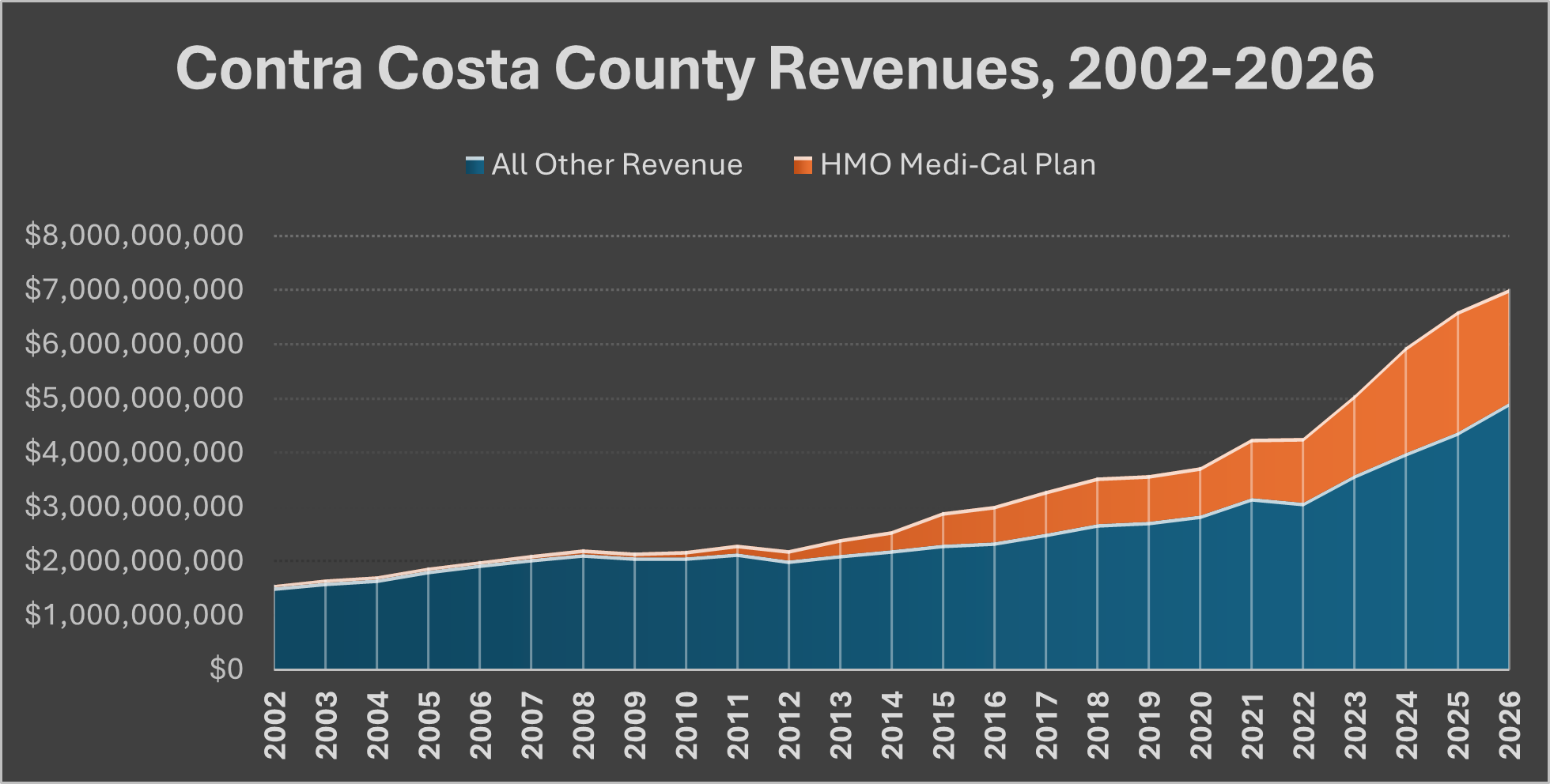
As the accompanying graph shows, County revenues have risen sharply in recent years with the passage of the Measure X and increased federal grants to County programs. When I quoted statistics from this graph, Supervisors questioned my accuracy, so let me assure them that the numbers come from the County’s own audited financial reports and budget.

Source: CoCoTax

A large share of the increase relates to Medi-Cal, a federal/state program that funds healthcare for low-income residents. Contra Costa County has aggressively involved itself in Medi-Cal, creating a pioneering Health Maintenance Organization (HMO) plan to provide care to Medi-Cal beneficiaries.

Between 2020 and 2025, the cost of Contra Costa County’s Medi-Cal Plan surged 157% from less than $900 million to almost $2.3 billion. A major contributor to this growth was the decision to extend Medi-Cal benefits to adult undocumented immigrants. According to state data, over 30,000 undocumented Contra Costa adults were receiving free healthcare through Medi-Cal last year.

Until recently, this was not a financial problem for the county because it was able to shift the cost onto the state and federal governments. But now this is becoming more difficult with Congressional Republicans, the Trump Administration and even the state government restricting reimbursements for undocumented immigrant coverage.

To continue growing this program, the Supervisors are now looking to residents to cover the tab by adding 0.625% to our sales taxes Countywide.

I realize that neighbors have a variety of views about immigration. Personally, I think the US should allow more of the talented people we need as well as a program to allow temporary, migrant workers to come here, which might go to support their request to immigrate here legally.

While I am for legal immigration, I do not agree that local communities should be on the hook to provide free medical care to anyone who comes here and completes an application. That policy is unsustainable, and unfair to the rest of us who pay a lot of money for healthcare. There are hundreds of millions of people around the world who would love to come to northern California and not have to worry about our high cost of living, including our high healthcare costs.

While I think we should welcome new neighbors, we should expect them to either shoulder the costs of living here or find friends, relatives, and charitable organizations that will help them do so.

Finally, the pro-tax side may portray your yes vote as a way to resist Trump and DC Republicans. But I urge you to hold two opinions simultaneously that may seem contradictory yet aren’t: you can hate the Administration’s hostile treatment of immigrants while also believing that local government should be fiscally responsible.  We have to manage our budgets carefully; those taking our tax money should be just as responsible.

If Supervisors are able to pass this sales tax in 2026 by a wide margin, there is every reason to think that they will come back for even more taxes in the years ahead with cities following them.  We already know that a transit sales tax increase of 0.5% is likely to be on the November ballot, another case of failing to manage BART and AC Transit money prudently.  So, I hope you’ll vote no in June, talk to your friends, and consider volunteering with our group to oppose this measure.

For more information about the Contra Costa Taxpayers Association visit www.cocotax.org.

Filed Under: Opinion, Politics & Elections, Supervisors, Taxes

Female athletes, lawmakers confront CIF over Title IX as political tensions flare at state meeting

February 9, 2026 By Publisher Leave a Comment

Female athletes and others listen as speakers share their opinions during the California Family Council press conference before the CIF’s Federated Council meeting last Friday morning, Feb. 6, 2026. Source: Screenshot of video by CA Family Council.

By Greg Burt, Vice President, California Family Council

LONG BEACH, CA — Outside a Long Beach hotel where the California Interscholastic Federation (CIF) convened its Federated Council meeting last Friday morning, Feb. 6, 2026, female athletes stood shoulder to shoulder with parents, advocates, and state lawmakers to deliver a clear and urgent message: girls’ sports are for girls.

The 111-year-old CIF, according to Wikipedia, is the governing body for public and private high school sports in California.

The February 6 press conference, organized by California Family Council’s Outreach Director Sophia Lorey, ahead of the CIF meeting, marked a significant moment in California’s ongoing debate over fairness and safety in women’s athletics. For the first time, two members of the California State Assembly publicly joined female athletes to confront CIF leadership over policies that allow males who identify as transgender to compete in girls’ sports and access female locker rooms, policies critics argue violate the original intent of Title IX. (Watch the press conference here…)

But the peaceful gathering also revealed the deep political divide surrounding the issue, as a prominent Democrat legislator representing the Long Beach area publicly criticized the presence of Republican lawmakers and dismissed concerns raised by female athletes.

Athletes Speak: “This Isn’t Fair. This Isn’t Safe.”

At the heart of the press conference were the voices of young women whose athletic careers have been directly impacted by CIF policies.

Reese Hogan, a varsity tri-sport athlete in track and field at Crean Lutheran High School, described the toll of repeatedly competing, and losing, against a male athlete in girls’ events.

“Track is not just something I do. It’s who I am,” Hogan said. “I train to push my limits, to compete fairly, and to earn every achievement through hard work. But over the past two years, that fairness has been taken away from me.”

Hogan detailed five separate competitions, spanning from May 2024 to January 2026, in which she lost to a male athlete competing in the girls’ division. One moment, she said, still stands out.

“At CIF finals, I broke my school record in the triple jump,” Hogan explained. “I jumped 37.2, earning a new personal record and breaking my school record. It was one of the proudest moments of my athletic career. That jump should have earned me first place.” Instead, a male athlete who jumped 4 feet farther placed first.

Hogan said the experience was devastating.

“CIF, why won’t you do anything?” she asked. “You are protecting males competing in women’s sports more than you are protecting the women the sport was created for.”

Hogan warned that allowing males into girls’ sports is not merely unfair, but dangerous.

“There is a reason sports are divided by sex,” she said. “It is not a matter of opinion; it’s a matter of fact.”

Locker Rooms and Lost Privacy

Another athlete, Audrey Vanherweg, a senior and four-year varsity athlete at Arroyo Grande High School, spoke about the consequences of CIF policies beyond the field of play.

Two years ago, Vanherweg said, she began hearing rumors that a boy was using the girls’ locker room. At first, she tried to ignore it. But when she learned that the same male student would also compete in girls’ track and field, the issue became unavoidable.

“I wasn’t going to go into a locker room and change in front of a boy,” Vanherweg said. Especially since he “wasn’t changing himself, but simply just watching all of us girls undress.”

Rather than risk her privacy, Vanherweg made a painful decision.

“I decided to go change in my car,” she said. “I’m more comfortable changing in my own car than in my own school locker room, where boys are welcomed to watch girls undress.”

As a thrower, she explained, competing against males also undermines fairness.

“Boys have a strength advantage,” she said, explaining that boys compete with the heavier implements in track and field competitions. “So, if a boy decides to throw as a girl, he not only has the strength advantage, but also a lighter implement.”

Vanherweg said she is speaking out not just for herself, but for future generations of girls.

“I’m speaking out against CIF policy, not only for myself, but for all other girls, girls who are too afraid to speak out, girls who don’t know what’s going on, and girls who haven’t been born yet,” she said.

Lawmakers Step In

Standing with the athletes were Assemblywoman Kate Sanchez (R–Murrieta) and Assemblyman David Tangipa (R–Fresno), the first time multiple Republican legislators have publicly joined female CIF athletes at such an event.

Assemblywoman Sanchez, author of AB 89, the Protect Girls’ Sports Act, said the rejection of her bill in committee last year did not end the fight.

“Politicians killed the bill, but they didn’t kill this movement,” Sanchez said. “And they didn’t silence these athletes.”

Sanchez emphasized that Title IX was designed to guarantee fairness and opportunity for women.

It was “never meant to be controversial,” she said. “It was meant to guarantee girls a fair shot, a fair race, a fair roster, and a fair opportunity to win.”

She warned that those protections are being eroded across California.

Girls “are losing podium spots, losing championships, losing scholarships… and some are even losing the basic right to privacy and safety in their own locker rooms.” Sanchez said. “That is not equality. That is not progress, and we will not pretend it is.”

Assemblyman Tangipa, a former Division I football player at Fresno State, challenged fellow lawmakers to stop referring to those who want female-only sports as Nazis. He also urged fathers to confront the reality facing young women.

“Why or how is it somehow believed [that it’s] Nazi ideology when you just wanna place to dress freely, and why and how is it Nazi ideology when you want to play in your sport freely?” Tangipa asked. “Why do we ignore safeguards and disregard biology and reality, which is insanity?

He urged fathers to step up.

“There are boys in your daughter’s locker room. There are boys in your daughter’s sports,” he said. “Where are you?”

Tangipa pledged continued action, including potential ballot initiatives, to restore protections for female athletes.

A Democrat Arrives—Then Attacks

In an unexpected development, Assemblyman Josh Lowenthal (D–Long Beach), the Speaker pro Tempore and representative of the district where the CIF meeting was held, appeared near the protestors, but not to support their cause.

Instead, Lowenthal criticized the presence of Republican legislators in his district, accusing them of staging a press conference “about trans kids in sports” without notifying him.

“We all know they don’t actually care about women,” Lowenthal said, adding that an upcoming budget vote funding $90 million for “women’s reproductive health, [abortion]” specifically for Planned Parenthood, would prove his point.

Assemblywoman Sanchez later responded by posting a video of Lowenthal’s remarks on X. (Watch this post here…)

“Respectfully,” Sanchez wrote, “I will stand up to protect girls’ sports in any city, and I’ll always stand with these brave women… No man, especially not you, will ever tell me otherwise.”

Sophia Lorey Challenges CIF

After the press conference, Sophia Lorey, Outreach Director for California Family Council and a former four-year CIF varsity athlete herself, addressed the CIF Federated Council directly, issuing a pointed challenge to its leadership. Lorey rejected the claim that CIF’s hands are tied by state law, arguing that the federation has the authority to act now if it chooses to do so.

“You have a policy in place,” Lorey told the board. “Until you remove the policy that allows males to be in female locker rooms and sports, you can’t say your hands are tied by the state. Remove that policy and stand up for these girls.” Lorey emphasized that female athletes should never have to resort to lawsuits to secure basic protections, adding that CIF leaders have a limited window to act. “Silence is no longer neutrality,” she warned, calling on CIF officials to work with advocates and restore fairness and safety in girls’ sports.

Many of the female athletes also went inside to address CIF leadership directly during the public comment period.

For them, the issue is not partisan.

“This isn’t about politics,” Sanchez said. “It’s about principle.” And as the athletes made clear, they are no longer willing to be silent.

“When you sideline girls,” Sanchez warned CIF leaders, “we will stand up. When you ignore them, we will amplify them. And we will not stop fighting.”

About California Family Council

California Family Council works to advance God’s design for life, family, and liberty through California’s Church, Capitol, and Culture. By advocating for policies that reinforce the sanctity of life, the strength of traditional marriages, and the essential freedoms of religion, CFC is dedicated to preserving California’s moral and social foundation.

Allen D. Payton contributed to this report.

Filed Under: Education, News, Opinion, Sports, State of California, Youth

Guest Commentary: There are better alternatives to BART’s cutback plan

February 9, 2026 By Publisher 2 Comments

“They should go back to the drawing board and give us a cost savings plan that demands more sacrifice from BART management, senior staff, and retirees.”

By Marc Joffe

BART has published a plan to balance its budget in the event voters reject the half-cent additional transit sales tax slated for the November 2026 ballot. BART’s plan appears to be well thought out but imposes far more inconvenience on riders than is necessary to close an expected $376 million deficit.

The most visible change is the station closures. Under its more extreme Phase 2 plan, BART would close 15 stations systemwide, including these five in Contra Costa: Orinda, North Concord, Pittsburg Bay Point, Pittsburg Center, and Antioch. Oakland Airport station would close, but SFO would stay open. Five other stations in Alameda County south of Oakland would be shuttered, as would four stations in San Mateo County south of Daly City. (See related article)

But most of these stations should not close. As BART itself recognizes, the savings from shuttering stations are not that large. And there is an alternative that would achieve a large portion of the expected savings, which is to operate the stations on an unstaffed basis. This idea may seem strange to BART riders expecting to see a station agent, but the fact is that many train stations in California operate without staff, including several on Capitol Corridor and Caltrain. Even Pittsburg Center on e-BART often operates without staff.

That said, both Pittsburg Center and North Concord have very low utilization (less than 1000 riders on an average weekday) and are reasonable candidates for closure. Indeed, BART should demolish the North Concord station and sell the parking lot to a developer for conversion to single family housing, a use consistent with the adjoining neighborhood.

Pittsburg Center, being in the median of Highway 4, does not offer a similar redevelopment option. It is one of three stations on the eBART extension connecting Antioch, Pittsburg and Bay Point using standard-gauge diesel multiple-unit trains which are incompatible with the rest of BART. The BART retrenchment plan envisions closing the whole eBART extension. A better choice would be to find a private operator to take it over.

That operator should be given discretion over fares and the option to convert the line to driverless technology in hopes of achieving a profit or at least minimizing the need for taxpayer subsidies.

As anyone who has visited an airport in the last few decades knows, driverless trains are nothing new. Outside the Bay Area, they are used for non-airport systems such as Honolulu’s Skyline and Vancouver’s Skytrain. Paris, Singapore, and other cities have successfully converted some of their lines to autonomous operation and Washington DC’s Metro is looking into doing the same thing.

Over the longer term, the entire BART system should be driverless: it could achieve large operational cost savings while maintaining or even increasing service frequency. Yet BART is not giving serious consideration to transitioning to driverless trains. When BART Director Matt Rinn spoke to CoCoTax in November I asked him about the idea and saw that he was unfamiliar with it. Staff should be discussing this option with the governing board.

They don’t do so because BART operates primarily for the benefit of staff and the labor unions that collect a portion of their salaries via dues. Riders are second, and taxpayers are a distant third.

Contra Costa taxpayers already pay plenty for transit, and, this November, it is time for us to tell BART and other agencies “no more.” They should go back to the drawing board and give us a cost savings plan that demands more sacrifice from BART management, senior staff, and retirees.

One change that should be considered is a 10% salary reduction for all BART employees receiving over $100,000 per year. Based on my analysis of 2024 wage and overtime data, this option would save $54 million. Costly overtime hours should also be limited: in 2024 alone five BART employees collected over $200,000 in overtime a piece.

BART’s plan defers advanced payments for retiree health benefits. This saves $38 million, but only by pushing the cost onto future taxpayers when the fund holding the advance retiree health funding is exhausted. Instead, the BART retiree health benefit should be eliminated just as it was for Stockton employees when that city went bankrupt in 2012. With BART facing functional bankruptcy in 2026, a similar economy is needed. Retirees can get subsidized healthcare through Covered California or Medicare just as those of us who work in the private sector usually do.

Salary and benefit cuts in addition to the layoffs BART already has planned may seem harsh, but these are the types of reductions companies have to make when they are losing money and there is less demand for their product. Because BART now needs more of our money, we have the power to veto any cost-saving plan that fails to prioritize the needs of beleaguered taxpayers and riders. Let’s exercise that veto. In November, say NO to the transit sales tax.

Marc Joffe is the President of the Contra Costa Taxpayers Association

Filed Under: BART, Bay Area, Finances, Opinion, Taxes, Transportation

Winter Prep: Protect your home from Mother Nature

November 18, 2025 By Publisher Leave a Comment

By Patrick McCarran, Real Estate Broker

We off to a good start for the Winter Weather and so “an once of prevention is worth a pound of cure”. Mother Nature can be harsh and is often fickle and the weather can change in a week or a day.  Get prepared now so you are ready for what comes next rain or shine, actions you take now can protect your property and prevent major damage.

One of the most important tasks is clean your gutters, often your gardener offers this service or check the Grapevine, the water can back up and leak in your house causing major damage. Check your down spouts to make sure they are clear and pointed away from the house or directed to the gutters in newer homes. Repair or replace roof shingles around any area that allows water to penetrate the roof sheathing. Don’t be fooled to think that tile roofs are maintenance free, the tiles break for various reasons and the rubber collars around vents deteriorate with age. So don’t wait for the leak in middle of a storm, call a roofer today to have them checked out. Check for holes or air leaks in the attic and crawlspace. Check that flashings, a thin metal strip, around the doors, windows, thresholds, chimney and roof are in tact. Apart from major flooding, most damage occurs when water seeps in through cracks and leaks. Make sure that windows and doors are well sealed. Seal any cracks and holes in the foundation and exterior walls.

Homeowners insurance can help protect you financially in case something happens to your property or its contents.  I know I have said this before, but it is very important to keep in mind that standard policies cover standard replacement, If you have significant upgrades see your insurance agent for a rider or increased coverage. Flood and earthquake damage is not covered under the traditional homeowners’ insurance policy and may be purchased separately. Periodically review your homeowner’s insurance policy to make sure that you are adequately covered to rebuild your home and replace its contents.

Now is a good time to call an HVAC company to have a checkup on your heater because we all know they tend to break on a Sunday or New Year’s Eve.

Install a spark arrestor on your chimney, eliminating brush and debris from around your property to prevent fires.

For earthquakes anchor appliances, dressers, TV, computer and other items to the wall you can buy straps at your local hardware store.  You may consider applying a safety film to non-tempered windows and glass doors to protect form shards of glass if broken. Install a gas auto shut-off device, any reputable plumber should be able to do this.

By taking precautions to protect your home, you can possibly help keep damage to a minimum when disasters strike; or in the case of severe damage, make sure that you have the financial means to rebuild.

For more information go to www.ibhs.org or www.fema.gov.

Patrick McCarran is a local Realtor and Broker DRE# 01325072. He can be contacted by phone or text at (925) 899-5536, pmccarran@yahoo.com or www.CallPatrick.com. In association with Realty One Group Elite DRE# 0193160. An independently owned and operated office. Equal Housing Opportunity.

Filed Under: Opinion, Real Estate

Opinion: Newsom signs AB 495 allowing anyone to pose as your child’s guardian

October 14, 2025 By Publisher Leave a Comment

Legal experts warn it’s “A Child Predator’s Dream Bill”

By Greg Burt, Vice President, California Family Council

SACRAMENTO, CA — Governor Gavin Newsom has once again proven his contempt for California parents. Yesterday afternoon, he signed AB 495, a bill that fundamentally undermines parental rights and opens the door for abuse, kidnapping, and government interference in family life, all while claiming it “protects parents and children.”

After months of warnings from parental rights advocates, faith communities, and constitutional attorneys, Newsom ignored every concern. In a calculated act of deception, his office released a statement claiming AB 495 safeguards parental authority. In reality, this law allows any adult, without verification, without parental consent, and without even notifying parents, to make medical and educational decisions for a child.

CFC President: Newsom’s Assault on Parental Rights Endangers Children

“Governor Newsom is deliberately trying to deceive parents by claiming this bill protects them, when in fact it does the opposite,” said Jonathan Keller, President of California Family Council. “AB 495 strips parents of their constitutional rights and hands them over to unverified strangers. It is unconstitutional, it is illegal, and no school or medical facility should recognize or accept the authority of a Caregiver’s Authorization Affidavit without a verified signature from a parent or legal guardian. Newsom knows exactly what this bill does, but he’s hoping the press and the public won’t read it for themselves.”

“AB495 allows…any adult claiming to be a relative within five degrees of kinship can sign a Caregiver Authorization Affidavit giving them the ability to ‘authorize any other medical care.’ And all this can be done with no parent signature, no notary, no verification and no parent notification required.”

Despite claims to the contrary, AB 495 allows ANY adult to use the new Caregiver Authorization Affidavit as “sufficient to authorize enrollment of a minor in school and authorize school-related medical care.” Then any adult claiming to be a relative within five degrees of kinship can sign a Caregiver Authorization Affidavit giving them the ability to “authorize any other medical care.” And all this can be done with no parent signature, no notary, no verification and no parent notification required. This law will allow unvetted adults to make medical decisions, enroll children in school, and act as de facto guardians, even though parents would remain legal guardians.

Legal Experts Warn: “A Child Predator’s Dream Bill”

“Governor Newsom deceptively describes AB 495 as a caregiver planning tool for undocumented immigrant parents. It’s more accurately described as a child trafficker’s and child predator’s dream bill,” said Dean Broyles, Esq., President and Chief Counsel of the National Center for Law & Policy. “Its sweeping application is not limited to immigrant families, does not require any parental notice or consent, and lacks even the most basic safeguards to protect children. Anyone falsely claiming kinship can easily sign the affidavit, access a child, obtain medical care, and enroll them in another school. Even the most basic safeguard of a notary is not required to confirm the true identity of the person accessing your child.  AB 495 violates fundamentally constitutionally protected parental rights, endangers California’s children, and will be appropriately legally challenged and struck down.”

“With AB 495, state-sanctioned kidnapping is now legal,” warned Julianne Fleischer, Senior Legal Counsel at Advocates for Faith & Freedom. “This is more than overreach — it is a betrayal of families and a blatant disregard for parental rights. This unprecedented intrusion into parental rights marks a deeply concerning moment for our state — one for which Gavin Newsom must answer.”

“Governor Newsom’s actions define him, not his smooth talk and 100-watt smile,” added Erin Friday, Esq., President of Our Duty – USA. “Behind that veneer, is a man who consistently signs bills that eviscerate parental rights. Handing a child over to an adult five degrees separated by marriage, divorce, or blood based upon an unverified one-page document with any pre-authorization of the parents, is beyond the pale.”

CFC Calls for Defiance and Parental Vigilance

California Family Council is calling on schools, hospitals, and clinics to refuse to accept any Caregiver Authorization Affidavit that is not verified or notarized by the child’s legal parent or guardian.

“Governor Newsom may have signed this bill into law,” Keller said, “but parents are under no moral or legal obligation to accept its legitimacy. This bill violates both the Constitution and common sense. No one, not a school administrator, not a doctor, not a government bureaucrat, has the right to override a mother or father’s authority.”

CFC urges parents to take immediate action to protect their families:

* Update emergency contact lists at schools and medical offices to include ONLY those adults you trust to make educational and medical decisions for your child.

* Submit written directives stating that NO ONE outside your listed contacts is authorized to pick up or make decisions for your child.

* Support efforts to legally challenge AB 495 and restore parental rights in California law.

“This coalition will not rest,” Keller concluded. “We will work with our partners, our attorneys, and thousands of California parents to overturn this unconstitutional law. Parents, not politicians, are the rightful guardians of their children.”

About California Family Council

California Family Council works to advance God’s design for life, family, and liberty through California’s Church, Capitol, and Culture. By advocating for policies that reinforce the sanctity of life, the strength of traditional marriages, and the essential freedoms of religion, CFC is dedicated to preserving California’s moral and social foundation.

Filed Under: Children & Families, Legislation, News, Opinion

Guest Commentary: Elections and constitutional law attorney offers reasons behind Texas’ redistricting vs. California’s Prop 50

October 10, 2025 By Publisher 1 Comment

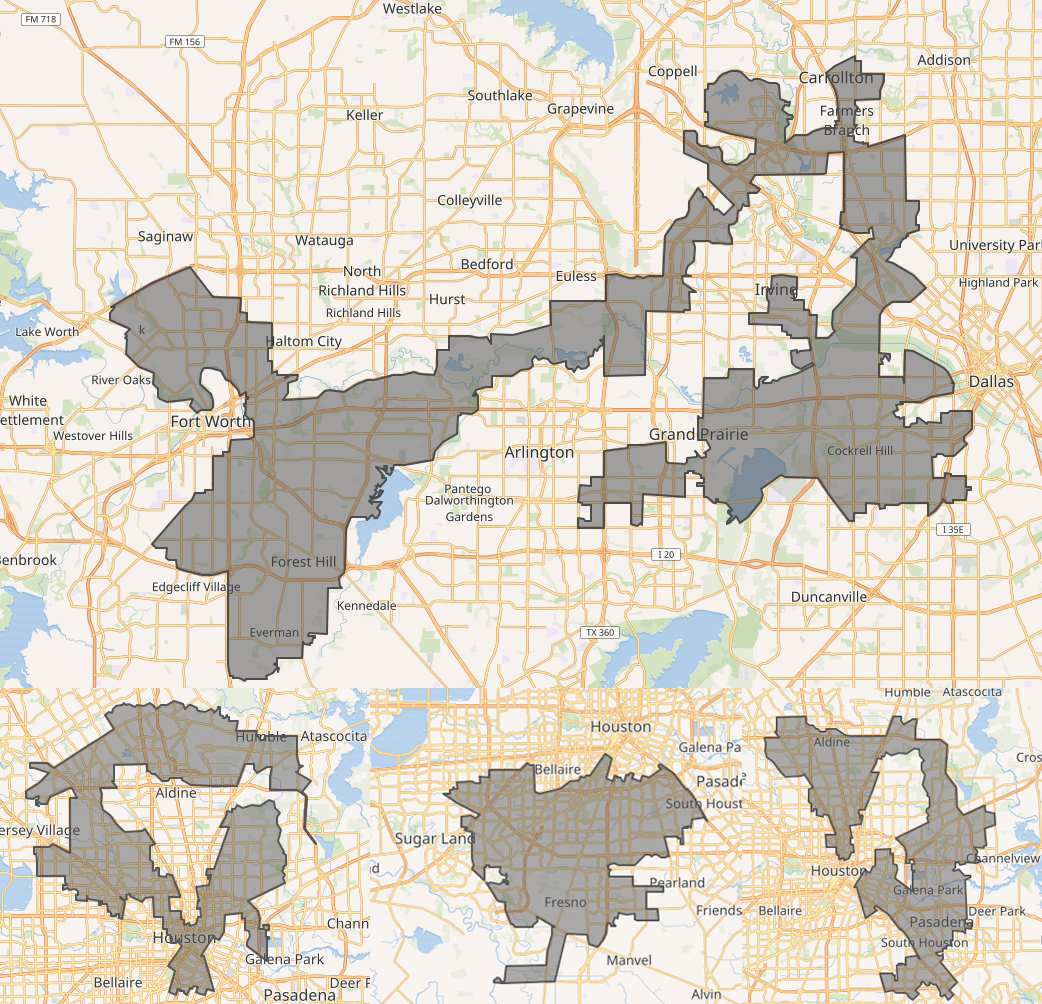
2021 Houston, Texas area Congressional District maps that the state was sued over by the Biden Administration DOJ. Source: Mark Meuser on X

“To put Proposition 50 on the ballot for the voters of California to decide, the California legislature had to violate the California Constitution multiple times.”

By Mark Meuser, Attorney

I am tired of hearing that California is redistricting to combat President Trump and Texas redistricting efforts. Texas was forced to redistrict because the Biden DOJ sued Galveston County and lost which changed the law thus making four Texas Congressional Districts unconstitutional.

When Texas drew its congressional districts in 2021, they created four congressional districts where they combined two minority communities to create a minority-majority district (Coalition minority districts).

On March 24, 2022, the Biden DOJ sued Galveston County Commissioners because Galveston did not draw a coalition minority district for the Black and Latino population.

On October 13, 2023, a Federal Judge agreed with Biden’s DOJ and found that Galveston County was required to draw a Commissioner seat by combining two minority communities.

On November 10, 2023, a three Judge panel of the 5th Circuit found that combining two minority groups to create a minority-majority district was unconstitutional and thus asked for an en banc panel to review the issue to overturn prior precedents.

On Aug. 1, 2024, the en banc panel of the Fifth Circuit concluded “that coalition claims do not comport with Section 2’s statutory language or with Supreme Court cases interpreting Section 2.” The Fifth Circuit ruled coalition minority districts are unconstitutional.

On July 7, 2025, President Trump’s DOJ sent a letter to Texas highlighting the 5th Circuit Order, pointing out that there are four coalition minority congressional districts that are now unconstitutional and that Texas needed to fix the problem.

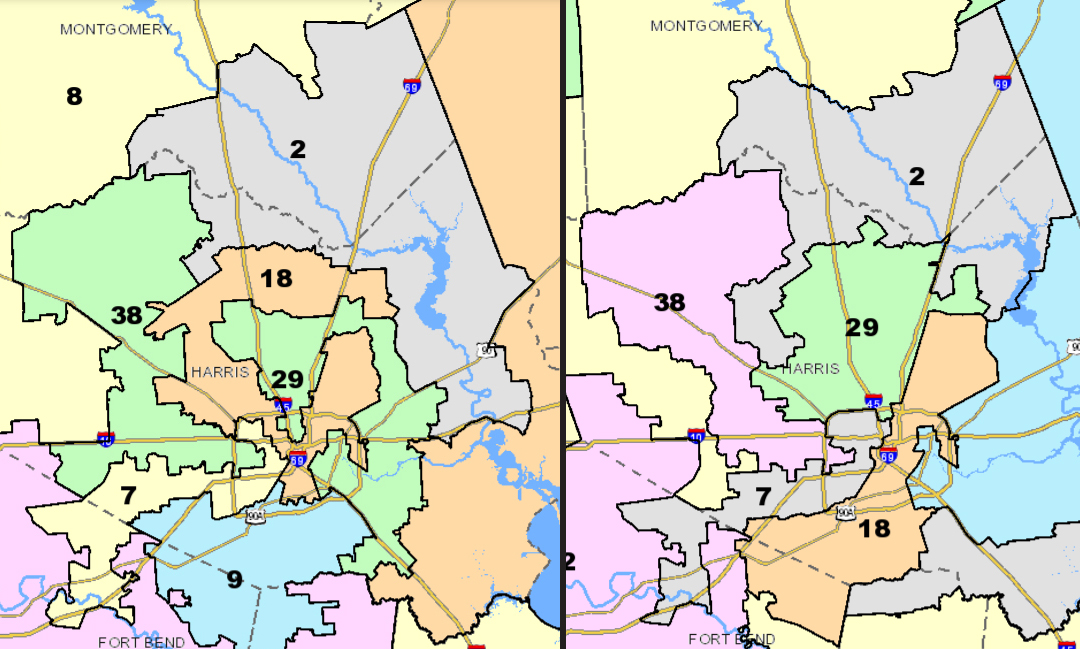
Texas Houston area Congressional District maps 2021 (left) and 2025 (right). Source: State of Texas

Texas made a prudent choice to redraw the congressional districts so as to save their taxpayers the expense of litigating the losing case of defending minority coalition districts.

Texas did not have to redraw four minority coalitions districts because of President Trump. Texas had to redraw the lines because Biden sued Galveston County and the law was clarified that coalition minority districts were unconstitutional.
It is important to understand that the 2021 lines drawn by the California Independent Redistricting Commission have never been challenged in Court as unconstitutional because districts were drawn to create coalition minority districts.
Since Texas law requires that the Texas legislature draw the congressional districts, the Texas legislature followed the law.

However, the California Constitution prohibits the California legislature from drawing congressional districts and instead places that responsibility on the Independent Redistricting Commission.

To put Proposition 50 on the ballot for the voters of California to decide, the California legislature had to violate the California Constitution multiple times.

The California legislature is asking the voters of California to forgive them for violating the California Constitution when they should have asked the voters for permission to draw the maps.

I was a part of two lawsuits filed before the California Supreme Court asking the Court to stop Proposition 50 before it went to the voters because the California legislature violated the California Constitution. Unfortunately, the California Supreme Court refused to require the California legislature to defend their unconstitutional acts and simply dismissed the Writ without even deciding the merits of the matter

While I am preparing the next lawsuit that will be filed, it is important that the voters of California stand up against the unconstitutional actions of Gavin Newsom and the California legislature by voting No on November 4th to Proposition 50.

The next time someone tells you that Newsom had to Gavinmander the State of California, remind them that the reason Texas had to redraw Congressional Districts is because Biden sued and lost which resulted in Texas having to redraw its lines.

Meuser practices election and constitutional law at the Dhillon Law Group.


Filed Under: Legal, Opinion, Politics & Elections

Pastor calls thousands to CA Capitol to stop “The Most Dangerous Bill We’ve Ever Seen”

August 7, 2025 By Publisher 1 Comment

Aug. 19th rally in Sacramento

By Greg Burt, California Family Council

SACRAMENTO, CA — In a stirring and impassioned announcement before his congregation last week, Pastor Jack Hibbs of Calvary Chapel Chino Hills (a congregation of over 10,000) issued an urgent call to action for Californians: mark your calendars and make your way to Sacramento on Tuesday, August 19th for a rally and lobby day opposing Assembly Bill 495, a bill critics say obliterates parental rights and creates legal loopholes making child kidnapping easy.

“I have to tell you, if this bill passes, I am going to ask you to leave the state of California,” Pastor Hibbs declared from the pulpit. “You got to get out. You got to run with your kids. You got to go.”

The bill is the first piece of legislation authored by newly elected Assemblywoman Celeste Rodriguez (D–San Fernando). She sold AB 495 as a “compassionate” solution for children of detained immigrant parents. But opponents warn the measure does far more, and far worse, than what its title suggests.

The Threat of AB 495: A Legal Loophole for Kidnapping?

The “Family Preparedness Plan Act of 2025” would allow unrelated adults, broadly defined as an “adult caregiver” with a “mentoring relationship with the child” to assume custody-like control over a child through a one-page Caregiver’s Authorization Affidavit. No court appearance. No notarization. No parental consent or notification. No background check. No verification of identity required.

“Presto, someone walks away with your child,” warned attorney and president of Our Duty-USA Erin Friday, who called AB 495 “a child trafficker’s and kidnapper’s dream bill.”

Attorney Nicole Pearson, founder of Facts Law Truth Justice, testified before the State Senate:

“California wants to let someone that is not related to your child remove her from school, enroll her in any other school in the state, authorize any medical treatment of her, including mental health services and drugs, without the parents’ notice and knowledge or consent. This is not fear-mongering. I’m not being hyperbolic,” she said. “These unintended consequences are terrifying, and they are unavoidable.”

Even medical decisions, including psychiatric drug prescriptions and sex-trait modification procedures, could be authorized by these unvetted adults without the knowledge or consent of the child’s parents.

August 19th Rally: Mobilizing for Parental Rights

Real Impact and Capitol Resource Institute have pulled together a coalition of parental rights advocates, legal experts, pastors, and concerned citizens, to hold the “NO on AB 495 Rally and Lobby Day” featuring Pastor Hibbs as keynote speaker. Other speakers include best-selling author and speaker Heidi St. John and Jonathan Keller, President of California Family Council, with more speakers to be announced soon.

“I’m going to ask all of you to drive, bus, fly, I don’t care how you get there,” Hibbs told his church. “We’re looking for a minimum of 5000 people to be there that day.”

Schedule – Tuesday, August 19, 2025

  • 1:00 PM PT – Rally Begins (West Steps of Capitol, 1315 10th Street, Sacramento)
  • 2:00 PM PT – Lobby Training
  • 2:30 PM PT – Legislative Office Visits

This isn’t the first time Hibbs has rallied thousands to the Capitol. A previous event back in 2022 drew nearly 2000 people to the Capitol to protest a bill to legalize infanticide. Organizers hope to top that turnout this time.

A State in Crisis

Hibbs’ warning is dire, and he isn’t mincing words. “I would not subject my child to one second in this public school system with this new law, AB 495,” he thundered.

California Family Council agrees the bill is incredibly dangerous. “AB 495 is a grave threat to the God-given responsibility of parents to raise and protect their children,” said Greg Burt, CFC’s Vice President. “It undermines every safeguard we have in place for child welfare and does so in the name of compassion. But compassion without guardrails is not mercy, it is madness.”

A Biblical Call to Courage

Pastor Hibbs was clear: this is a line in the sand.

“If you have kids in the state of California and this passes, you gotta go,” he said. “Your child’s safety is number one in your life, and I don’t care if you like the weather, and I never thought that day would ever come when I would encourage you to leave.

Watch Pastor Hibb’s announcement here: https://www.instagram.com/reel/DMyRHyHPhXb/?utm_source=ig_embed&ig_rid=d4429a01-f040-4f0f-9efa-f657888103ec

About California Family Council

California Family Council works to advance God’s design for life, family, and liberty through California’s Church, Capitol, and Culture. By advocating for policies that reinforce the sanctity of life, the strength of traditional marriages, and the essential freedoms of religion, CFC is dedicated to preserving California’s moral and social foundation.


Filed Under: Children & Families, Legislation, News, Opinion, State of California

Opinion: “Free” federal program blowing hole in state budgets

August 5, 2025 By Publisher Leave a Comment

340B Drug Pricing Program costing employee health plans $5B per year

“Hospitals realized they could buy heavily discounted drugs and resell them to insured, middle-class patients at huge markups.”

By Dan Crippen

An obscure, supposedly free federal program is blowing a hole in state budgets — by depriving state governments of billions in corporate tax revenue and inflating costs for their public employee health plans.

The culprit is the 340B Drug Pricing Program, which Congress established in 1992 to help safety-net hospitals. Once enrolled, qualifying hospitals and clinics and their partner pharmacies — collectively called “covered entities” — can purchase medicines directly from drug manufacturers or wholesalers at roughly 50% discounts.

Congress expected only about 90 hospitals to participate. Today, more than 2,600 hospitals are enrolled.

This explosive, unintended growth is the result of the program’s lax requirements. Covered entities are not required to expand charity care or even report how they use their 340B earnings.

Hospitals realized they could buy heavily discounted drugs and resell them to insured, middle-class patients at huge markups. In some cases, hospitals have charged cancer patients nearly ten times what they paid to acquire the drug.

The opportunity to upcharge patients has proven irresistible and fueled the program’s bloat. In 2023, covered entities purchased $124 billion worth of medicines — but only paid $66 billion, meaning they received roughly $58 billion in discounts.

Numerous audits have revealed that many hospitals use the funds to subsidize expansion in affluent neighborhoods, rather than support low-income or uninsured patients.

This perverse behavior harms state taxpayers. Because most 340B hospitals are technically non-profits, their earnings aren’t taxed. As a result, states collect about $3.5 billion less in corporate income tax and other tax revenue than they otherwise would. That’s money not available for public health, education, infrastructure, or employee benefits.

The 340B program hurts states in other ways, too.

The program incentivizes hospital systems to acquire independent clinics — which don’t qualify for 340B — and designate them as “child sites” that subsequently become eligible for 340B.

This leads to higher healthcare spending, since care at hospital-owned sites is more expensive than at clinics and independent practices.

Care at 340B hospitals tends to be more expensive than care at competing hospitals, too. The average per-patient prescription spending at 340B hospitals is 150% higher than non-340B hospitals.

All told, large employers and their workers spend over $5 billion more per year on health care as a result of 340B. Every extra dollar that businesses spend on health care is a dollar that’s deducted from their taxable income.

The program also inflates costs for state employee health plans. Utah recently found that its Public Employees Health Program is losing out on $3.9 million in rebate savings due to 340B.

Some state lawmakers are unwittingly compounding the damage by making it easier for pharmacies to contract with 340B hospitals and clinics.

Instead of boosting care for poor patients, 340B drains public resources while enriching large hospital systems. Reform is desperately needed.

Dan Crippen is the former Director of the Congressional Budget Office. This piece originally ran in RealClearHealth.

Filed Under: Drugs, Finances, Health, Opinion

  • 1
  • 2
  • 3
  • …
  • 22
  • Next Page »
Furniture-Clearance-02-26B
Liberty-Tax-Jan-Apr-2026
Deer-Valley-Chiro-06-22

Copyright © 2026 · Contra Costa Herald · Site by Clifton Creative Web