• Home
  • About The Herald
  • Local Agencies
  • Daily Email Update
  • Legal Notices
  • Classified Ads

Contra Costa Herald

News Of By and For The People of Contra Costa County, California

  • Arts & Entertainment
  • Business
  • Community
  • Crime
  • Dining
  • Education
  • Faith
  • Health
  • News
  • Politics & Elections
  • Real Estate

Kaiser Permanente Antioch Medical Center recognized for patient safety

May 28, 2024 By Publisher Leave a Comment

Photos: Kaiser Permanente

Named to 2024 Cal Hospital Compare Patient Safety Honor Roll for having a strong culture of safety

By Antonia Ehlers, PR and Media Relations, Kaiser Permanente Northern California 

With a commitment to providing high-quality, safe patient care, Kaiser Permanente Antioch Medical Center has been named to the Cal Hospital Compare 2024 Patient Safety Honor Roll.

The honor roll uses objective, publicly available patient safety measures to evaluate hospitals across a variety of domains, including hospital-acquired infections, adverse patient safety events, sepsis management, patient experience, and the Leapfrog Group’s Hospital Safety Grade.

This year, 72 of the state’s 306 adult, acute-care hospitals made the honor roll. Kaiser Permanente Northern California had 10 hospitals on the list – representing 14% of the hospitals recognized.

“The safety of our patients is our top priority,” said Pam Galley, senior vice president and area of Kaiser Permanente’s Diablo service area. “Our health care providers work hard to create a safe, exceptional patient-care experience.”

Kaiser Permanente Northern California hospitals are consistently recognized as among the country’s best for outstanding patient safety, positive care outcomes, and exceptional patient-care experiences.

“We are committed to providing excellent personalized care while keeping our patients safe from harm,” said Kaiser Permanente Antioch Medical Center Physician in Chief Sharon Mowat, MD. “We are very grateful for our extraordinary physicians, nurses and staff members who make a difference every day.”

Hospitals on the honor roll had to meet a rigorous threshold of performance by having at least two-thirds of measure results above the 50th percentile and no measure result below the 10th percentile and/or an “A” grade in the Leapfrog Hospital Safety Grade for the past three reporting periods.

This honor roll offers Californians a rigorously evaluated list of hospitals that have consistently demonstrated a strong culture of safety across multiple departments, according to Cal Hospital Compare.


Filed Under: East County, Health, Honors & Awards, News

Bay Area “Transit Transformation” gets $18 million boost

May 27, 2024 By Publisher Leave a Comment

First commitments spur near-term projects to improve bus, light rail service

County Connection’s routes in Concord’s Monument Corridor will benefit from more reliable service, reduced travel times

By John Goodwin, Assistant Director of Communications and Khristina Wenzinger, Principal, Public Information, Legislation & Public Affairs, Metropolitan Transportation Commission

SAN FRANCISCO – The Metropolitan Transportation Commission (MTC) last week approved an $18.3 million allocation to fund eight near-term transit priority projects in Concord, other East Bay cities, San Jose, San Francisco and Redwood City. These investments are the first to be made through the $30 million Bus Accelerated Infrastructure Delivery (BusAID) program established as part of the Bay Area Transit Transformation Action Plan to implement quick-build solutions designed to improve service at problem ‘hotspot’ locations identified by transit agencies throughout the region.

What Does Transit Transformation Mean?

  • Design, adequately invest in and effectively manage a public transit network that is equitable, inclusive, frequent, affordable, accessible and reliable.
  • Integrate with unified service, fares, schedules, customer information and identity.
  • Serve all Bay Area populations, resulting in increased transit ridership and reduced growth in vehicle miles traveled.

The Action Plan aims to improve the Bay Area’s public transportation network to create a more user-friendly and connected system. It identifies key targets and actions to make this vision a reality.

Map of County Connection’s routes in the Monument Corridor. Source: Central Contra Costa Transit Authority

Approved Projects

Each of the eight approved projects is slated for completion in the next one to three years:

  • Monument Corridor Transit Speed Improvements (Concord): This project will transit priority signals along Monument Boulevard between Detroit Avenue and Mohr Lane, and will relocate and reconfigure bus stops to improve efficiency and accessibility. County Connection routes 11, 14, 16, 311, 314, 611, 613, 616 and 619 will benefit from more reliable service and reduced travel times.(See pages 5-2 & 5-3 of the Monument Corridor Community-Based Transportation Final Plan)
  • Park Street Transit Signal Priority and Signal Optimization (Alameda): this project will install transit signal priority and optimize signal timing at four intersections along Park Street from Alameda Avenue to Otis Drive, reducing delays for AC Transit routes 20, 21, OX and 663.
  • International Boulevard Transit Lane Delineation (Oakland): this project will reduce delays for AC Transit’s Tempo (1T) line, reduce speeding by drivers on non-transit vehicles and improve corridor safety between 14th Avenue and 42nd Avenue through the installation of vertical treatments to separate the existing bus lanes from general purpose lanes, and by painting the bus lanes red to deter non-transit vehicles from using the bus lanes.
  • El Camino Real Bus Boarding Islands & Bus Stop Balancing (Redwood City): To reduce delay for SamTrans routes ECR, 79, 270, 278, 295, 296, 2960 and 397, this project will fund the planning and design of bus boarding islands at stops along El Camino Real between Whipple Avenue and Dumbarton Avenue in Redwood City and unincorporated North Fair Oaks.
  • K-Ingleside Rapid Project Ocean Avenue Quick Build (San Francisco): Spanning Ocean Avenue from Junipero Serra Blvd. to Geneva Avenue, this project will increase service reliability and reduce travel times for Muni’s K-Ingleside light rail line by installing longer and wider boarding islands, adding red transit lanes, and implementing signal timing refinements and turn restrictions.
  • VTA Frequent Network Cloud-Based Transit Signal Priority (San Jose): This project will install next-generation transit signal priority at 174 intersections along VTA’s Frequent Network in San Jose, reducing delays for numerous bus routes, including 25, 26, 61, 64A, 64B, 70, 71, 72, 73, 77 and 500.
  • Vision Zero Senter Road East San Jose Safety Corridor Project (San Jose): This project will reduce delays for VTA routes 70, 72 and 73 by installing bus boarding islands along Senter Road between Story Road and Monterey Road.
  • Alvarado-Niles Road Part-Time Transit Lane Pilot (Union City): To reduce congestion-related delays for AC Transit route 97 and Union City Transit routes 1, 3 and 5, this project will install for a two-year pilot period a part-time transit lane along Alvarado-Niles Road from Decoto Road to Almaden Boulevard, providing buses with a dedicated lane during hours with peak traffic congestion.

MTC approved funding for these projects at its regularly scheduled May meeting, after each had been endorsed last month by the multi-agency Regional Network Management Council. Project recommendations were developed based on a two-stage screening process that evaluated potential rider benefits (time savings), equity considerations, and feasibility and readiness. Each project will include pre- and post-implementation evaluation to quantify project benefits. The remaining balance of $12 million in BusAID funding will be used for future funding rounds, when additional projects are identified and ready for implementation.

MTC is the transportation planning, financing and coordinating agency for the nine-county San Francisco Bay Area. Caltrans owns and operates the state highway system.

Allen D. Payton contribute to this report.

Filed Under: Bay Area, Central County, Concord, Finances, News, Transportation

State allocates $10.2 million for Contra Costa transportation improvements

May 27, 2024 By Publisher Leave a Comment

Nearly $2 billion in statewide investments to improve, protect state’s infrastructure

By Edward Barrera, Division Chief of Public Affairs, California Department of Transportation 

SACRAMENTO — Earlier this month, the California Transportation Commission (CTC) allocated $1.9 billion to support transportation infrastructure projects that play a starring role in powering the world’s fifth largest economy. The approved funding provides significant investments for bridges, roadways, transit and improved facilities for people who walk and bike.

The latest allocations also include nearly $430 million from the federal Infrastructure Investment and Jobs Act of 2021 (IIJA) and $740 million via Senate Bill (SB) 1, the Road Repair and Accountability Act of 2017.

A total of $10.183 million was allocated for improvements in Contra Costa County with most of it for 20 miles of BART track and $3.6 million for I-680 in San Ramon and Danville.

Among the efforts spurred by the $1.9 billion commitment include several projects prioritizing the state’s vital bridge network, highlighted more than $4 million to repair bridge damage along Interstate 80 in Alameda County.

Also included are projects that will build or renovate shoreline embankments, bus, bicycle and pedestrian infrastructure, and railroad overcrossings.

“California’s transportation infrastructure is critical to the economic and cultural lifeblood of our state, and this funding provides key support in our mission to provide a safe, equitable and sustainable transportation system for all users,” said Tony Tavares, Caltrans Director.

Contra Costa County Projects

  • $6 million allocation for BART Expansion and Contraction of Steel Rail in Contra Costa County which will destress twenty miles of rail track within the BART operating corridor that has been identified as being affected by such conditions in Contra Costa County. (Funding description and source: Locally-Administered Local Transportation Climate Adaptation Program Project off the State Highway System – Resolution LTCAP-A-2324-04)
  • $3.6 million allocation for I-680 in San Ramon and Danville, from Alcosta Boulevard to north of Diablo Road. Rehabilitate pavement, upgrade guardrail, and upgrade facilities to Americans with Disabilities Act (ADA) standards.
  • $500,000 allocation for the Pavement Resurfacing Project, which will focus on applying pavement rehabilitation treatments in various streets located in the southeast area of the City of Martinez to improve the City’s overall pavement condition index and reduce on-going maintenance. Project will also include ADA curb ramp improvements, restoration of vehicle detection sensors at signalized intersections, striping restoration, and green infrastructure improvements. (Funding description and source: Locally-Administered SB 1 Local Partnership Program (LPP) (Formulaic) Projects Off the State Highway System – Resolution LPP-A-2324-38)
  • $83,000 allocation for the Morello Avenue sidewalk gap closure in Martinez will address gaps of concrete sidewalk on the east side of Morello Avenue, south of Village Oaks Drive; and the east side of Morello Avenue, north of Arnold Drive. Improvements will also new curb and gutter, and a new ADA curb ramp at the southeast corner of Morello Avenue/Village Oaks Drive. (Funding description and source: Locally-Administered SB 1 LPP (Formulaic) Projects Off the State Highway System – Resolution LPP-A-2324-38)

The Contra Costa projects funded are among multiple approved projects in District 4 – Bay Area / Oakland which includes Alameda, Contra Costa, Marin, Napa, San Francisco, San Mateo, Santa Clara, Solano and Sonoma counties.

IIJA, known as the “Bipartisan Infrastructure Law,” is a once-in-a-generation investment in our nation’s infrastructure to improve the sustainability and resiliency of our energy, water, broadband and transportation systems. Since 2021, California has received more than $42 billion in IIJA funds, including more than $29 billion for transportation-related projects.

In addition, SB 1 provides $5 billion in transportation funding each year that is shared between state and local agencies. Road projects progress through construction phases more quickly based on the availability of SB 1 funds, including those partially funded by SB 1.

See the complete list of the latest CTC-approved projects in each of the other nine Caltrans Districts in the state:

District 1 – Eureka (Del Norte, Humboldt, Lake and Mendocino counties)

District 2 – Redding (Lassen, Modoc, Plumas, Shasta, Siskiyou, Tehama and Trinity counties)

District 3 – Marysville / Sacramento (Butte, Colusa, El Dorado, Glenn, Nevada, Placer, Sacramento, Sierra, Sutter, Yolo and Yuba counties)

District 5 – San Luis Obispo / Santa Barbara (Santa Barbara, San Luis Obispo, Monterey, San Benito and Santa Cruz counties)

District 6 – Fresno / Bakersfield (Kings, Tulare, Fresno, Madera and Kern counties)

District 7 – Los Angeles (Los Angeles and Ventura counties)

District 8 – Riverside and San Bernardino counties

District 9 – Bishop (Inyo, Kern and Mono counties)

District 10 – Stockton (Alpine, Amador, Calaveras, Mariposa, Merced, San Joaquin, Stanislaus and Tuolumne counties)

District 11 – San Diego (San Diego and Imperial counties)

District 12 – Orange County

For more information about California transportation projects funded by IIJA and SB-1, visit RebuildingCA.ca.gov and www.build.ca.gov.

Allen D. Payton contributed to this report.


Filed Under: Finances, Infrastructure, News, State of California, Transportation

Public asked to participate in CalTrans test on DeSaulnier’s per mile “Road Charge” to replace gas tax

May 26, 2024 By Publisher Leave a Comment

Video screenshot source: Caltrans

Due to purchase and use of hybrid and electric vehicles

Receive up to $400 in gift cards for 6-month Pilot program beginning Aug. 2024

By Allen D. Payton

Caltrans has launched a test on the proposed per mile Road Charge to possibly replace the state’s current gas tax and invites the state’s drivers to participate. The Pilot program will last six months and participants can earn up to $400 in gift cards.

With the passage of Senate Bill 1077 introduced in 2014 by then-State Senator (now-Congressman) Mark DeSaulnier, California began investigating a long-term, sustainable transportation funding mechanism as a potential replacement to the gas tax, known as a “road charge” due to the advent of hybrid and electric vehicles. As of 2022, state officials estimate that there were about 1.1 million electric cars and 1.3 million hybrids on California roads.

Source: Caltrans

Taking direction from the Legislature, California completed the largest road charge research effort to date piloting more than 5,000 vehicles that reported in excess of 37 million miles over a nine-month duration. According to the program’s report, the statistics only serve to reinforce Californians’ desire for mobility, a safe and reliable transportation system, and an improved overall quality of life. Below please find the California State Transportation Agency’s release of the California Road Charge Pilot Program final report.

History of Transportation Funding

According to the Road Charge Pilot Program Summary Report, Nearly all of the 350 billion miles driven each year on California’s highways and roads are  powered by gasoline or diesel fueled vehicles. Historically, the taxes on those fuels provided the majority of the revenue required to maintain and operate our transportation network. As future consumption of gasoline and diesel fuel declines, due to increased fleet efficiency, California will be challenged to sustain its $2.5 trillion economy. Continuing to depend on a consumption-based transportation model, while at the same time adopting policies to increase vehicle fuel efficiency and promote the reduction of vehicle miles traveled, puts into question the long-term viability of the gas tax as a sustainable revenue model.

Source: Caltrans

Historically, transportation funding has been impacted by two main factors: inflation and vehicle fuel efficiency. Until this year, with the passage of the Road Repair and Accountability Act of 2017 (Senate Bill 1), the state gas tax had not been adjusted for inflation since 1994, which significantly reduced its purchasing power. Senate Bill 1 adjusted fuel rates for past inflation and includes future inflation adjustments: hence, solving the inflation issue and delaying the expected transportation funding shortage by a decade or more. However, the impact of improving vehicle fuel efficiency remains an issue, especially as new vehicles sold in the coming decades are expected to be much more fuel efficient.

The report claims, “Without Senate Bill 1’s inflation adjustments, the transportation funding shortfall would be quickly approaching. The new Senate Bill 1 revenues, as illustrated in Figure 1, stabilize the state’s short-term transportation infrastructure funding needs and provides time to explore alternatives to continued reliance on fuel taxes.”

Source: Caltrans

How Transportation Funding Works

Currently, it costs approximately $8.5 billion annually to maintain California’s roads.

  • Approximately 80% of highway and road repairs are funded by a tax on gasoline charged at the pump when you buy gas. The more gas you buy, the more you pay in gas taxes and the more you contribute to highway and road repairs.
  • On average, Californians pay about $300 a year in state gas taxes.
  • Various state fees also support transportation. Trucks pay weight fees and zero-emission vehicle owners pay $118 each year, and all vehicle owners pay a transportation improvement fee.
  • Some counties also charge a local sales tax to further invest in road and transit needs or have tolls on bridges or certain highways.
  • The public may also pass state bonds to invest in additional transportation needs.

What is Road Charge?

California relies on gas tax and other fuel tax revenues to fund its roadway maintenance and repairs. But as cars get more fuel efficient or use other energy sources, such as electricity and hydrogen, the gas tax will no longer fund the infrastructure California needs. California is researching a potential gas tax replacement that’s both sustainable and equitable: road charge. A road charge is a “user pays” system where all drivers pay to maintain the roads based on how much they drive, rather than how much gas they purchase. Under a road charge, all drivers share roadway maintenance and repair costs based on what they actually use. (https://dot.ca.gov/programs/road-charge)

  • California could replace the gas tax with a mileage-based user fee charged to drivers who use the roads. The more you drive, the more you pay for highway and road repairs. The less you drive, the less you pay.
  • Everyone would pay their fair share for road repairs based on how much they drive, not the kind of car they own.
  • California is working to develop a road charge program that is fair, transparent, and sustainable so that it meets our road maintenance needs now and in the future.

Most States Pursuing Vehicle Miles Traveled Taxes

According to the Tax Foundation, most states are taking steps toward a vehicle miles traveled (VMT) tax. “Oregon was the first state to begin research into VMT taxes in 2001 and was the first to implement a program in 2015. Four states now have active programs for passenger vehicles and four other states have active programs targeting heavy commercial vehicles (Oregon has both), with pilot programs carried out in 16 states. Only Hawaii has a mandatory program, which requires EVs to participate by 2028 and all light vehicles by 2033.”

Video screenshot source: Caltrans

Calculator Compares Road Charge vs. State Fuel Tax Costs

The “Road Charge” vs. gas tax calculator for a sample cost comparison of paying the current gas tax of $0.579 per gallon as of July 1, 2023, versus a per mile road charge offers options of $0.02, $0.03 and $0.04. At two cents per mile the Total Monthly Road Charge would be less than the Total Monthly State Fuel Tax for a gas-powered vehicle. But at three cents per mile, the monthly cost of the Road Charge would be greater than the current fuel tax.

For a 2024 Chevrolet Equinox EV driven an average of 1,000 miles per month the Road Charge annual costs would be $240 at two cents, $360 at three cents and $480 at four cents per mile versus the current $118 annual fee. The calculator “Does not include any federal or local taxes” and shows, “Rates are hypothetical and would be set by the California Legislature.”

Video screenshot source: Caltrans

Participate in 2024 Road Charge Collection Pilot

The Road Charge policy idea is still being explored and developed. The public’s input and ideas can help inform what the best way might be to implement a program in California. Drivers are asked to participate in the 2024 Road Charge Collection Pilot and earn up to $400!

  • Receive up to $400* in gift cards
  • Participate for 6 months; Aug 2024 – Jan 2025
  • Pay road charges each month
  • Gas tax refunded end of pilot
  • Take 2 surveys to tell us about your pilot experience

*Complete all required activities throughout the Pilot and earn up to $400: $100 distributed in September 2024 and up to $300 will be distributed in February 2025.

To learn more and participate in the pilot program visit https://caroadcharge.com/engage/contact-us-pilot/, call (916) 619-6283 toll-free or email info@caroadcharge.com.


Filed Under: News, State of California, Taxes, Transportation

CA Department of Justice clears Antioch Police of criminal charges in 2021 officer-involved shooting

May 24, 2024 By Publisher Leave a Comment

Cover of CA DOJ Policy and Practice Recommendations for APD and Figure 1. photograph from Brentwood Police Department drone footage showing Guadalupe Zavala taking aim and shooting at a police drone. Source: CA DOJ

Guadalupe Zavala caused 6-hour stand-off ending in his death while unarmed; son later sued City of Antioch

CA DOJ “commends APD” for manner in which they handled situation

CA Attorney General issues “policy and practices recommendations”

By California Department of Justice

OAKLAND – California Attorney General Rob Bonta, pursuant to Assembly Bill 1506 (AB 1506), today released a report on Guadalupe Zavala’s death from an officer-involved shooting involving the Antioch Police Department in Antioch, California on December 10, 2021. The report is part of the California Department of Justice’s (DOJ) ongoing efforts to provide transparency and accountability in law enforcement practices. The report provides a detailed analysis of the incident and outlines DOJ’s findings. After a thorough investigation, DOJ concluded that criminal charges were not appropriate in this case. However, DOJ recognizes the important lessons to be learned from this incident. As required by AB 1506, the Attorney General has issued specific policy and practice recommendations related to the incident.

Figure 2: Distance between Mr. Zavala’s house and the location where Officer Duggar and Sergeant Chang were when they fired their shots. Figure 6: This image shows that the distance between Officer Rombough and Detective McDonald (both positioned on the Antioch armored vehicle) and were about 103 feet from Mr. Zavala when they fired. Source: CA DOJ

“Loss of life is always a tragedy,” said Attorney General Bonta. “AB 1506 is a critical transparency and accountability tool, and our hope for this report is to provide some understanding and aid in advancing towards a safer California for all. The California Department of Justice remains steadfast in our commitment to working together with all law enforcement partners to ensure an unbiased, transparent, and accountable legal system for every resident of California.”

Figure 11: Bullet holes photographed in residence neighboring Mr. Zavala’s home where neighbors reported shots fired by Mr. Zavala. Figures 11A&B: Bullets holes in neighbor’s vehicles outside Mr. Zavala’s residence. Source: CA DOJ

On December 10, 2021, Antioch Police Department responded to multiple calls regarding a man who was barricaded in his home with a rifle after shooting at neighboring homes and vehicles. A standoff lasting more than six hours ensued, during which Mr. Zavala fired multiple rounds from various locations towards law enforcement personnel, vehicles, and nearby residences. De-escalation measures, communications from the crisis negotiations team, and attempts to coerce Mr. Zavala from his residence were unsuccessful. At one point, Mr. Zavala exited his front door carrying what appeared to be a “full AR-15 style rifle.” Two snipers with the Antioch Police Department each fired one round hitting Mr. Zavala, causing him to fall back. However, because Mr. Zavala was wearing body armor, he was able to regain his footing and moved back inside the residence. Later, a fire started in Mr. Zavala’s home, and he ran out and took cover in his backyard. When law enforcement knocked down the fence of Mr. Zavala’s yard with an armored vehicle, Mr. Zavala ran towards the armored vehicle and was fatally shot.

Zavala’s son, Diego Zavala, joined in a 2023 federal lawsuit against the City of Antioch and six Antioch Police officers. (See related articles here, here and here)

Figure 25: Still frame from armored vehicle video of Mr. Zavala getting up halfway after the first round of shots were fired by officers. Figure 4: Mr. Zavala lying prone outside the North side of his home, under a barbecue, with what the helicopter reported to possibly be a handgun in his hands (circled). Figure 9: Cellphone image from Mr. Zavala’s phone from the day of the incident. Source: CA DOJ

Under AB 1506, which requires DOJ to investigate all incidents of officer-involved shootings resulting in the death of an unarmed civilian in the state. DOJ conducted a thorough investigation into this incident and concluded that the evidence does not show, beyond a reasonable doubt, that the officers involved did not act in lawful self-defense or defense of others. Therefore, there is insufficient evidence to support a criminal prosecution of the officers. As such, no further action will be taken in this case.

Figure 19. Assault rifle found in the hallway of a bedroom in Mr. Zavala’s residence. Figure 21. Ballistic vest recovered from the backyard. Figure 23: A box of unfired .40 caliber S&W ammunition found in the safe of the master bedroom of Mr. Zavala’s residence. Source: DOJ

CA DOJ “Commends APD” for How They Handled Situation

In addition, the report shows the California DOJ Police Practices Section conducted a supplemental review of the information and “PPS commends APD for the manner in which they handled this volatile, dangerous situation, coordinating with neighboring agencies, exploring less-lethal options, and rapidly deploying the SWAT and CNT teams to the incident to attempt to achieve a peaceful surrender.”

Source: CA DOJ

CA DOJ Recommendations

As part of its investigation, DOJ has identified several policy recommendations that it believes will help prevent similar incidents from occurring in the future. These recommendations include:

COMMUNICATION

Antioch Police Department should ensure that officers are equipped with effective communications devices that can operate in the hilly areas covered by their department. Antioch Police Department can seek additional coverage or upgrades through their department-issued cell phone or radio carriers or, if that is impracticable or not feasible, examine whether there are other cell phone carriers or radio channels that would work in all areas they serve.

COMMUNICATION BETWEEN AGENCIES

Antioch Police Department should ensure that their officers can effectively and efficiently communicate with officers from other agencies in future incidents by setting up regional radio channel systems for interagency communication.

See CA DOJ APD Policy Recommendations from Zavala_AB1506 Report

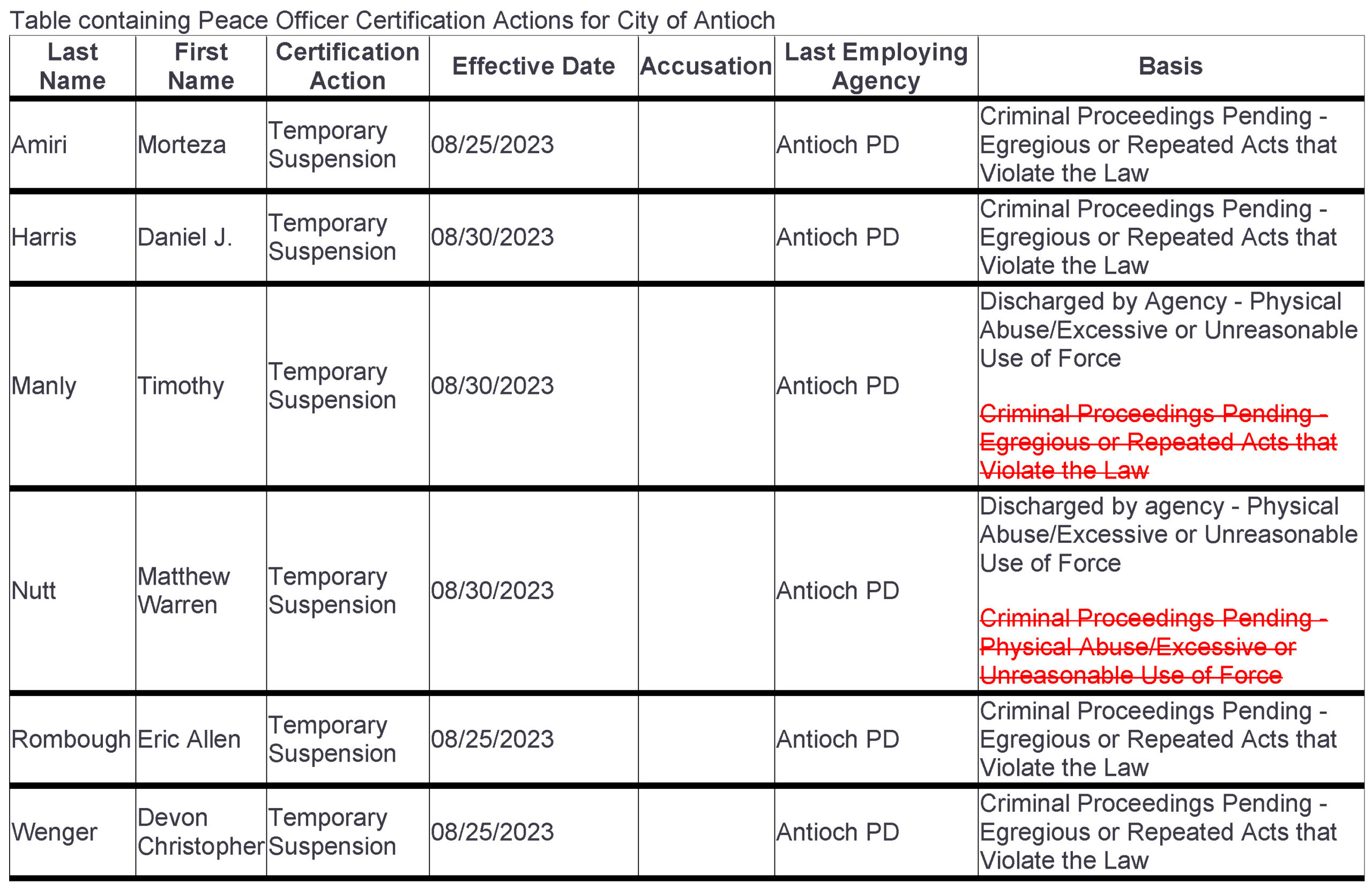
Emails were sent early Friday afternoon to Acting Antioch Police Chief Brian Addington, Antioch Police Officers Association leaders and their attorney, Mike Rains for comment on the report, as well as City Attorney Thomas L. Smith, Addington and Rains with questions regarding the 2023 lawsuit that included Zavala’s son. The efforts were unsuccessful prior to publication time, except for a response by Rains.

Early Friday evening he said, “That was good news from the DOJ. I think the findings were appropriate. The DOJ does a very good job, in my opinion, in these 1506 cases analyzing the facts and clearing the officers of any wrongdoing. I also see the PPS commends the department for de-escalation.”

About the lawsuit Rains said, “I don’t know on the civil side if the lawsuit is settled or not,” as Rains’ firm does not represent former officer Eric Rombough.

“We represented the officers in the 1506 case, including Duggar and Chang, who were the two primary officers who fired their weapons and were part of the DOJ investigation,” he added.

A copy of the complete report can be found here.

Please check back later for any updates to this report.

Allen D. Payton contributed to this report.

Filed Under: Attorney General, Crime, DOJ, East County, Legal, News, Police, State of California

South Gate Road to Mt. Diablo closed weekdays for 5 weeks starting May 28

May 24, 2024 By Publisher Leave a Comment

Source: CA State Parks

ROAD CLOSURE STARTS TUESDAY for construction of new bike turnouts

By CA State Parks

Starting Tuesday, May 28 South Gate Road will be closed weekdays to all traffic including cars, bicyclists, and pedestrians. Each week for approximately five weeks, the road will be closed from Monday 8 a.m. through Friday 2 p.m. It will be open weekends.

All trails and fire roads will remain open, and visitors who walk or cycle to the park will be able to access Summit Trail at the South Gate Entrance.

During the road closure period, camping at Live Oak Campground, and the Buckeye, Wildcat, and Barbecue Terrace Group Camps will only be available Friday and Saturday nights.

This closure is for the construction of additional bike turnout lanes to enhance road safety. This latest phase of the project was made possible by fundraising coordinated by our partner organization California State Parks Foundation.

Yellow circle indicates South Gate Road entrance. Map source: CA State Parks

There are three other entrances to Mount Diablo State Park: Mitchell Canyon Road, North Gate Road and Green Valley Road (Macedo Ranch). Please check under Brochures/Campground Map for more details. There is no vehicle access to the Summit from Macedo Ranch or Mitchell Canyon.

Thank you for your cooperation during this temporary closure.

For more information about Mt. Diablo click, here.

Allen D. Payton contributed to this report.


Filed Under: News, Parks, Recreation, San Ramon Valley, State of California, Transportation

Contra Costa Fair Board president says “two temporary staffers” robbed of “a little under $100,000” during bank deposit

May 23, 2024 By Publisher Leave a Comment

Photos of the 2024 Contra Costa County Fair by Allen D. Payton. See more photos on the @cocoherald Facebook page.

“Not any business, including any business I worked for would take a deposit at night” – Craig Cannon, Contra Costa County Fair Board President

Shares more details, says policies and procedures will be discussed at next Board meeting June 12

Positive Fair news: Mexican rodeo group working to bring Hispanic-themed events to former arena

By Allen D. Payton

Following the armed robbery of proceeds from the Contra Costa County Fair during an attempted bank deposit early Monday morning, May 20, 2024, after the end of this year’s fair Sunday night, on Thursday, Fair Board President Craig Cannon shared additional details about the incident. (See related article)

Asked to confirm the amount of $90,000 that was stolen he said, “I got it as a little under $100,000. I got that from the police. (Fair CEO) Joe Brengle’s not even talking to me.”

However, according to another board member, John Pence, Brengle sent out an email Wednesday night to him and the other board members about the matter. Cannon said he hadn’t seen it.

“Not any business, including any business I worked for would take a deposit at night,” Cannon continued. “It’s unusual. It’s one of the things I want to get the board together to talk about. Why would you make such a poor decision? The only one who has a deposit key is the fair manager.”

“A lot of information is not being shared when it’s supposed to be,” he stated. “It all boils down to the fair manager. He handles the overall money receipts, personnel, hiring and firing. But Joe works for the board. We hire and fire him.”

Asked if insurance will cover any of the loss, Cannon said, “I don’t believe so because it wasn’t during Fair hours or on property and it wasn’t in the bank. There’s a really thin line, there.”

Asked why the people depositing the funds weren’t joined by armed escorts by either the contracted security firm or county sheriff’s deputies, he responded, “That’s the question I’m trying to find out. But he’s (Brengle’s) not being forthright. That’s what we will discuss at the next board meeting. I’ve talked to the State of California, and they said I can’t have an emergency meeting. In my eyes, almost a hundred grand is a major crime against us.”

About the security firm, Praetorian and this year’s Fair, Cannon said, “They were great. This year’s fair was a good one and safe.”

He then reiterated what was shared with other media, that the loss of that amount of money could impact the fair’s music headliners and animal attractions for next year.

“This whole thing stinks,” he stated.

Two Temporary Staffers Handled Deposit

Asked who handled the deposit Cannon said, “Two temporary staffers hired by the Fair, this year in charge of parking and ticket sales. That’s another red flag. Something’s really wrong. Joe seems like a sensible guy. I don’t know why he would make that decision.”

Asked why the money wasn’t left in a safe on the fairgrounds and deposited during daylight, he said, “That’s a decision for the fair manager” and shared that the Fair, technically state’s 23rd District Agricultural Association, currently only has two full-time employees, Brengle and an administrative assistant who works in the office with him.

Since it’s the public’s money Cannon said, “That’s my concern. I also suggested the state bring in the CHP which oversees county fairs in the state. They delegate the authority to the county sheriff’s office.”

“I don’t work for the state,” he explained. “I’m appointed by the governor. Not this governor, the past one. The appointments are renewed. We can barely have a meeting quorum. If someone is sick, we can’t hold a meeting. The governor’s busy with the budget.”

Asked why the funds weren’t taken to the bank by the fair manager and a board member for a check and balance and if there is a procedure in place Cannon stated, “There will be. The Fair Board is all about policies and procedures. The manual is about 50 pages. But we don’t handle the day-to-day. Taking funds to the bank during daylight hours should be the policy.”

“He (Brengle) hasn’t been forthcoming to anyone on the board about this,” the fair board president reiterated. “This is crazy. It makes no sense at all.”

One positive thing Cannon shared is that a Mexican rodeo group is working to bring Hispanic-themed events to the former arena that was used as the paintball park.

The next board meeting, which is open to the public, will be held Wednesday, June 12 at 7:00 p.m. in the Fair Board Directors’ Room at the Contra Costa Event Center (fairgrounds) located at 1201 W. 10th Street in Antioch.


Filed Under: Crime, East County, Fairs & Festivals, News, State of California

Martinez: Briones Trails Pilot Project Community Dig Day Saturday, June 1

May 23, 2024 By Publisher Leave a Comment

Source: EBRPD

Briones Regional Park, Alhambra Creek Staging Area 9 AM – 2 PM

By East Bay Regional Park District

The Briones Trails Pilot Project is a unique opportunity to give back to the parks you love! Help us maintain and enhance Briones Regional Park and create exciting new recreational opportunities on single-track trails and repair impacted natural resources during our Dig Days. The next one will be on Saturday, June 1, 2024. We will make improvements to the P9 Trail (AKA the Desert Hiking Trail) including establishing a more sustainable trail route and restoring a steep and eroding segment.

The two-yearpilot project is intended to test a variety of trail management strategies. The pilot project is limited to a portion of Briones Regional Park in the northeast corner of the park. See Project Map (or below). The pilot project was launched on Friday April 21, 2023.

The Briones Pilot Project establishes specific rules limiting trail use within the Pilot Project Zone and for two trail segments adjacent to the Pilot Project Zone, such as hiking only, biking only, or biking/hiking only and direction of travel. On weekends, trail use within the Pilot Project Zone will alternate days between bicycle and equestrian use based on even and odd calendar dates (see table). A key component of the Project is the restoration of illegally built “bootleg” trails to protect natural habitat for wildlife.

Please make sure to bring a water bottle and be prepared to work! There is poison oak in the area, so please wear work pants, long sleeves and good close-toed work shoes.

You are welcome to ride in, but you will need to provide your own bike and helmet.

June 1st Dig Day – 9:00 AM meet-up and post-dig lunch at Alhambra Creek Staging Area, 273-181 Brookwood Drive in Martinez.

Registration and Info: ebrpd.samaritan.com/custom/501/opp_details/6729

  • Age Restrictions: Youth under the age of 18 must have a signed permission by parent or legal guardian. Youth under the age of 13 must be accompanied by an adult.
  • Description: Join us to maintain and improve select trails and restore habitat! Learn the basics of restoration and trail work during our dig-days lead by Regional Parks staff.
  • What to Bring: water bottle, helmet, mountain bike, gloves, and PPE.
  • What is Provided: Necessary tools. We will have work gloves and protective eye wear for participants.
  • Weather: Heavy rain or unsafe wildfire smoke conditions cancel the program. Please wear layers as Bay Area weather can be unpredictable.

The Briones Pilot Project reached its one-year mark on April 21, 2024. The two-year pilot project was planned and created to test new ways to safely share trails and improve the trail experience for all users while protecting habitat, wildlife, and watersheds. The pilot project is limited to a portion of Briones Regional Park in the northeast corner of the park. Share your thoughts and feedback on the past year of progress at the next in-person check-in meeting on June 15. Members of the community are invited to Briones to discuss the pilot project’s progress and share ideas with District staff and other trail users.

Briones Pilot Project Zone Map. Source: EBRPD

Why a Pilot Project?

Over the last decade, the number of visitors to District parks has increased significantly. The rise in numbers of visitors getting out onto trails has increased the potential for conflict between different types of trail users. Although the Park District is seeking to open new parks and provide more trails to reduce crowding on trails, the trail development process takes time. The pilot project will test some new ways to safely share trails and improve the trail experience for all users while protecting habitat, wildlife, and watersheds.

Project Objectives:

  • Protect Resources, Habitat, Wildlife, and Watersheds: The expansion of illegal bootleg trails is a significant issue for Briones and other East Bay regional parks. These user-built trails are often not built to sustainable trail standards with appropriate drainage and avoidance of sensitive natural habitats. Illegal trails can have negative impacts on wildlife and watersheds. The project will include a robust monitoring and patrol program to document and prevent the expansion of bootleg trails in the pilot project zone.
  • Restore Natural Habitat by Closing Illegal Bootleg Trails in the Pilot Project Zone: A primary objective of the project is to engage with the trail user community to join park staff in restoring natural habitats already impacted by illegal bootleg trails.
  • Enhance the Trail User Experience: The trail management strategies being tested during the two-year pilot project are intended to allow users to safely enjoy trails by providing specific days when certain user types are limited to create more space on trails.
  • Increase Volunteer Engagement in Trail Maintenance and Habitat Restoration: Community volunteers play an important role in helping park staff monitor and maintain park trails. The pilot project provides volunteer opportunities for trail users to join in trail maintenance and habitat restoration activities.

For more information visit Briones Trails Pilot Program or call Volunteer Services at (510) 544-2229.

Filed Under: Central County, Community, East Bay, News, Parks, Recreation

Armed robbery of Contra Costa County Fair funds during bank deposit

May 22, 2024 By Publisher Leave a Comment

Possibly $90,000, police seek public’s help

By Antioch Police Department

On Monday, May 20, 2024, at approximately 2:18 AM, Antioch police officers responded to the 2500 block of Somersville Road for the report of an armed robbery.

When officers arrived, they contacted two victims. Officers learned the victims were employees of the Contra Costa County Event Park (Fairgrounds). The Contra Costa County Fair had ended, and two employees were tasked with conducting the night deposit. While conducting the night deposit at the BMO Bank they were approached by an unknown suspect. The suspect robbed the victims of the money and personal belongings at gunpoint.

Other news reports have pegged the amount stolen at $90,000. When asked, a county fair representative offered no comment but didn’t know how that amount was known by other media. Questions were emailed late Wednesday night to Fair CEO Joe Brengle asking if that’s correct, why the deposit was made at that time instead of leaving it in a safe on the fairgrounds and waiting until Monday morning to make the deposit, what is the usual procedure and for any additional information he could share.

We are asking for anyone with information regarding the incident to contact the Antioch Police Department Investigations Bureau. Additional inquiries or information can be directed to Antioch Police Detective Sgt. Palma at (925) 779-6876 or by emailing kpalma@antiochca.gov.

Please check back later for any updates to this report.

Allen D. Payton contributed to this report.

Filed Under: Crime, East County, Fairs & Festivals, News, Police, State of California

Orinda: Grand Opening of Alder and Leatherwood Creek Restoration and Public Access Project & Eastport Staging Area Thursday

May 22, 2024 By Publisher Leave a Comment

The newly restored and daylighted Alder Creek flows through the former McCosker property in Sibley Volcanic Regional Preserve. Photo: EBRPD

Ribbon cutting for largest creek restoration project in East Bay Regional Park District’s history.

At Sibley Volcanic Regional Preserve

By Flora Csontos, Acting Public Information Specialist, Public Affairs, East Bay Regional Park District

Join East Bay Regional Park District on Thursday, May 23, 2024, at 11 A.M. to celebrate the completion of the Alder and Leatherwood Creek Restoration and Public Access Project at Sibley Volcanic Regional Preserve – the largest creek restoration project in the Park District’s history. The Alder and Leatherwood Creek Restoration and Public Access Project removed several culverts and opened up 3,000 linear feet of creek to a more natural run. The event will include a ribbon cutting ceremony to celebrate the restoration project and the reopening of the Eastport Staging Area.

Speakers will include East Bay Regional Park District General Manager Sabrina Landreth, Board President Ward 1 Member Elizabeth Echols and Ward 2 Board Member Dee Rosario.

The Alder and Leatherwood Creek Restoration and Public Access Project, previously referred to as the McCosker Project, provides natural habitat for special status or protected species, including the California red-legged frog, California foothill yellow-legged frog, Alameda whipsnake, San Francisco dusky-footed wood rat, golden eagle, Cooper’s hawk, loggerhead shrike, northern harrier, and white-tailed kite. Water quality and streamflow were also improved by the project, providing new habitat for rainbow trout.

Stabilizing jute protects the creek’s soil while plants begin to grow in December 2022. Photo: EBRPD

The project (Alder Creek Project), which began construction in 2020, daylights, or opens up and restores to natural conditions, approximately 2,900 linear feet (approximately half a mile) of previously culverted, or buried, creek and restores riparian habitat along portions of Alder, Leatherwood, and San Leandro creeks. The 250-acre site is situated within a deep canyon of dense oak woodland at the bottom of a ridgeline of rolling grassland hills.

The restoration also created habitat for the rainbow trout (a native salmonid species) by creating stream corridors, using a step-pool system that incorporates a mix of cascades and resting and pocket pools in steeper areas. This newly created stream channel with riparian vegetation and pool riffle complexes, allows sediment transport, slows flows and helps reduce erosion to provide benefits to aquatic organisms and provide spawning sites for rainbow trout. In fact, a young-of-year (juvenile) rainbow trout was observed in the channel in spring 2021. Engineers designed the restoration project using fundamental concepts in fluvial geomorphology and engineering principles to meet the goal of creating a dynamically stable and self-maintaining creek channels that require a low level of adaptive management and maintenance practices.

Plants sprout along the newly daylighted creek in January 2023. Photo: EBRPD

The restoration project also increased the carbon sink, flood capacity on site, removed invasive species, enhanced habitat, and added revegetation. In support of inclusive public access, additional enhancement work included new nature trails and future amenity areas.

The restoration area within Sibley Volcanic Regional Preserve is now opened to the public. It includes an 11-car staging area along Pinehurst Road, with trail connections for a loop trail (the McCosker Loop Trail) and trails that follow the creeks on the property.

The project was made possible through $4 million in funding secured by Assemblymember Rebecca Bauer-Kahan in the 2019 state budget. Additional funding came from the Park District’s voter-approved Measure WW and other state and federal grants from the U.S. Environmental Protection Agency, CA Natural Resources Agency, Wildlife Conservation Board, Coastal Conservancy, California State Parks and voter-approved Propositions 1, 84 and 50 allocated by the California Natural Resources Agency.

Source: EBRPD

The Sibley Volcanic Regional Preserve and Eastport Staging Area are located at 920 Pinehurst Road in Orinda.

The East Bay Regional Park District is the largest regional park system in the nation, comprising 73 parks, 55 miles of shoreline, and over 1,330 miles of trails for hiking, biking, horseback riding, and environmental education. The Park District receives an estimated 30 million visits annually throughout Alameda and Contra Costa counties in the San Francisco Bay Area.

Allen D. Payton contributed to this report.

Filed Under: East Bay, Environment, Lamorinda, News, Parks, Recreation

  • « Previous Page
  • 1
  • …
  • 63
  • 64
  • 65
  • 66
  • 67
  • …
  • 366
  • Next Page »
Liberty-Tax-Jan-Apr-2026
Deer-Valley-Chiro-06-22

Copyright © 2026 · Contra Costa Herald · Site by Clifton Creative Web