• Home
  • About The Herald
  • Local Agencies
  • Daily Email Update
  • Legal Notices
  • Classified Ads

Contra Costa Herald

News Of By and For The People of Contra Costa County, California

  • Arts & Entertainment
  • Business
  • Community
  • Crime
  • Dining
  • Education
  • Faith
  • Health
  • News
  • Politics & Elections
  • Real Estate

All four Contra Costa Assemblymembers vote to include illegal aliens in California home loan program

June 14, 2024 By Publisher Leave a Comment

Source: CalFHA

Grayson, Wilson, Bauer-Kahan, Wicks support offering up to 20% for down payment or closing costs, not to exceed $150,000

By Allen D. Payton

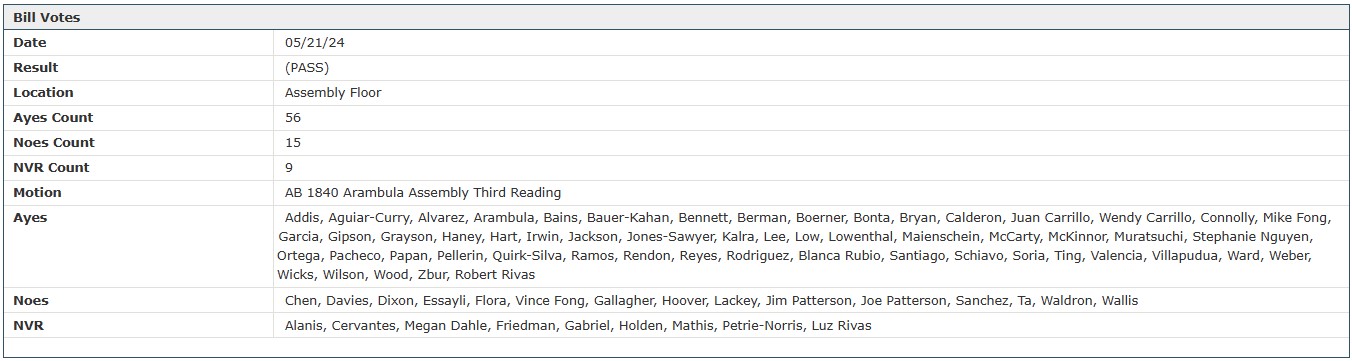
A bill to make illegal immigrants eligible for the California Dream for All Shared Appreciation Loan Program, which provides up to 20 percent of downpayment assistance to prospective homebuyers, passed the State Assembly last month on a vote of 56-15. All four members representing Contra Costa County, Tim Grayson (D-15), Lori Wilson (D-11), Rebecca Bauer-Kahan (D-16) and Buffy Wicks (D-14) voted in favor of Assembly Bill 1840.

Wicks also voted for the bill, authored by Assemblyman Joaquin Arambula (D-31), as a member of the Assembly Appropriates Committee.

AB1840 Assembly Floor vote on May 21, 2024. Source: leginfo.legislature.ca.gov

According to CalFHA, “The Dream For All Shared Appreciation Loan is a down payment assistance program for first-time homebuyers to be used in conjunction with the Dream For All Conventional first mortgage for down payment and/or closing costs. Upon sale or transfer of the home, the homebuyer repays the original down payment loan, plus a share of the appreciation in the value of the home.”

The program offers up to 20% for down payment or closing costs, not to exceed $150,000 and is not on a first come, first served basis. The homebuyer must register for a voucher and a randomized drawing will select registrants who will receive the voucher.  The program requires at least one borrower be a first-generation homebuyer and all borrowers must be first-time homebuyers.

According to the Legislative Counsel’s Digest, “Existing law establishes the California Housing Finance Agency in the Department of Housing and Community Development, and authorizes the agency to, among other things, make loans to finance affordable housing, including residential structures, housing developments, multifamily rental housing, special needs housing, and other forms of housing, as specified. Existing law establishes the California Dream for All Program to provide shared appreciation loans to qualified first-time homebuyers, as specified.

Existing law establishes the California Dream for All Fund, which is continuously appropriated for expenditure pursuant to the program and defraying the administrative costs for the agency. Existing law authorizes moneys deposited into the fund to include, among other moneys, appropriations from the Legislature from the General Fund or other state fund.

This bill would specify that an applicant under the program who meets all other requirements for a loan under the program, including, but not limited to, any requirements imposed by the Federal National Mortgage Association or other loan servicer, shall not be disqualified solely based on the applicant’s immigration status.

By expanding the persons eligible to receive moneys from a continuously appropriated fund, this bill would make an appropriation. The bill would recast the fund so that appropriations from the Legislature from the General Fund or other state fund are deposited into the California Dream for All Subaccount, which the bill would create and make available upon appropriation by the Legislature for specified purposes.”

AB 1840 is now up for votes by the State Senate Housing and Judiciary Committees before a possible vote on the floor.


Filed Under: Immigration, Legislation, News, State of California

California colleges agree on how to interpret in-state tuition law for illegal immigrant students

May 8, 2024 By Publisher Leave a Comment

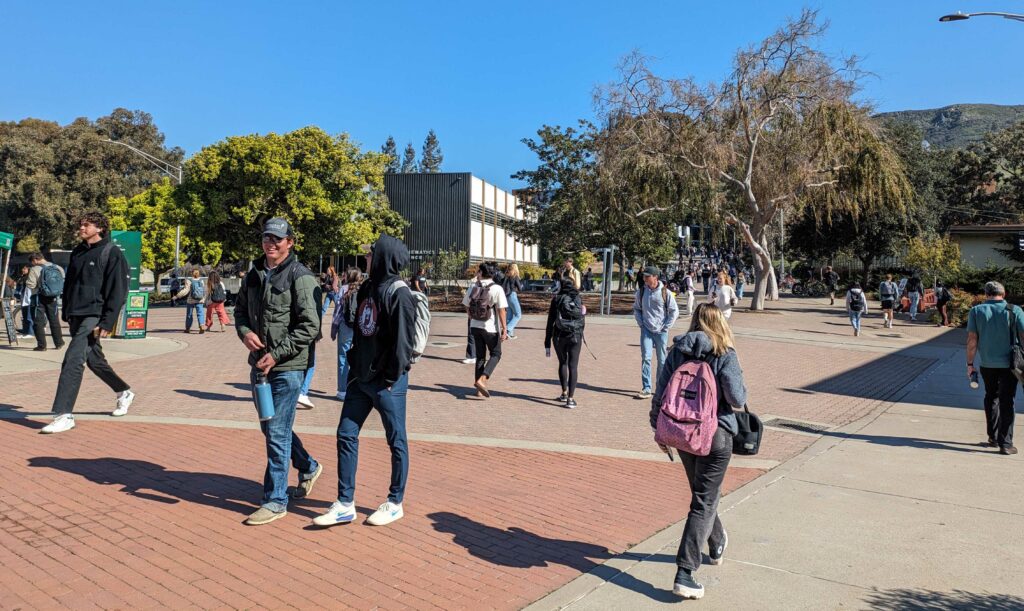
Students between classes at California Polytechnic State University, San Luis Obispo. Credit: Ashley Bolter / EdSource

Some have been exempt from paying out-of-state tuition since 2001

By Zaidee Stavely, EdSource – Republished with permission

More than 20 years ago, California passed a law allowing some undocumented immigrant students to attend college with in-state tuition, if they meet certain requirements.

But immigrant rights advocates say many students who should have been eligible have been wrongfully denied in-state tuition because of confusion over requirements, misinformation and different interpretations of the law at different college campuses.

“We lose that incredible brain power and colleges are losing enrollment,” said Nancy Jodaitis, director of higher education for Immigrants Rising, a nonprofit organization that advocates for undocumented people to achieve educational and career goals.

Immigrants Rising brought together officials from all three public college systems — California Community Colleges, California State University and University of California — to discuss and agree on answers to frequently-asked questions about the law.

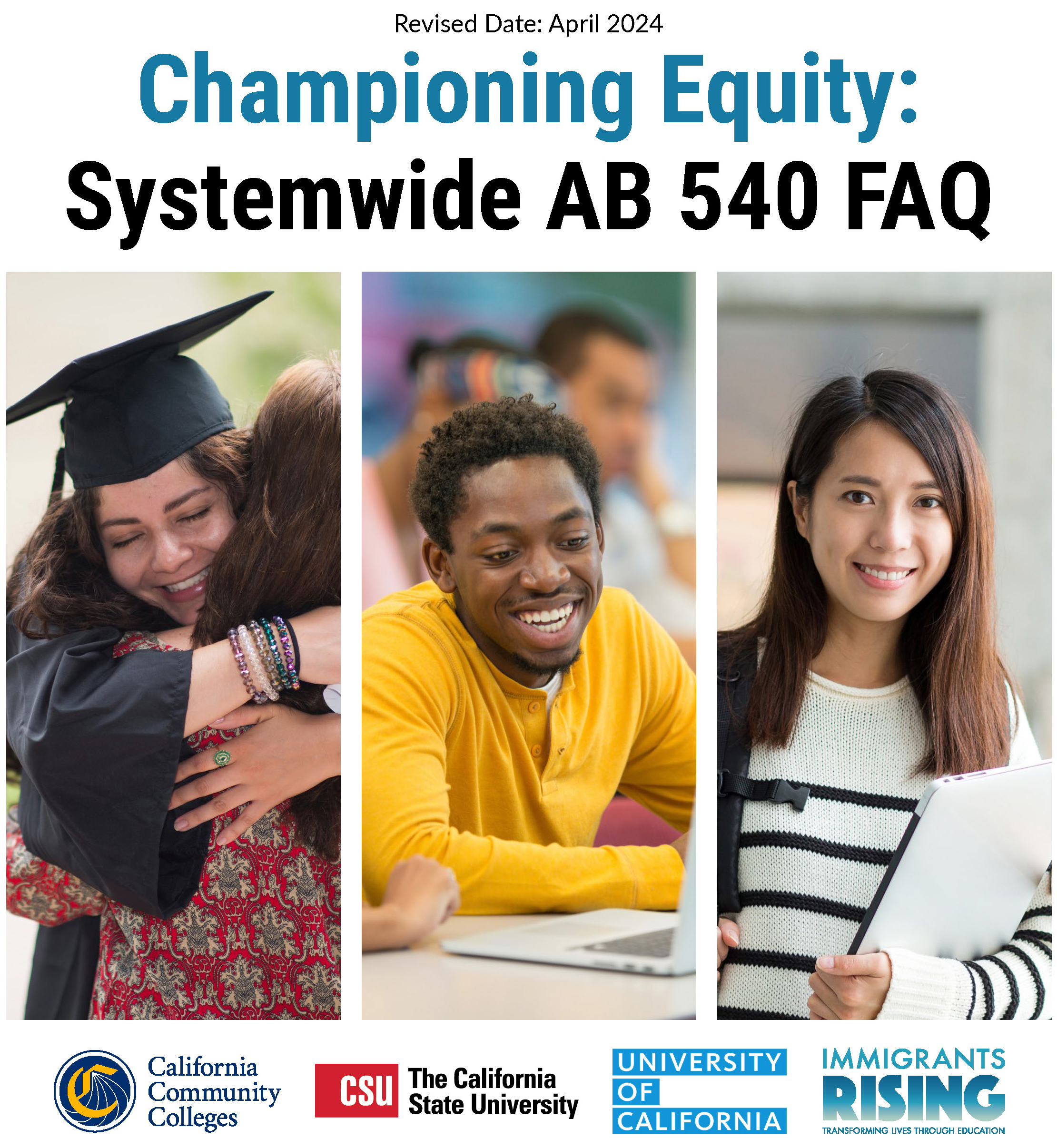
Source: Immigrants Rising

The result is a document called the Systemwide AB 540 FAQ, which all three systems have now signed. The document includes answers to 59 questions, such as:

  • What if a student graduated from a California high school (completing three years’ worth of high school credits), but did not attend three years at a California high school?
  • Does a student have to take classes full time for their attendance to count?
  • Does all their coursework have to be taken at the same school?

Spokespeople from UC, CSU and California Community Colleges all celebrated the document.

Paul Feist, vice chancellor of communications and marketing for the California Community Colleges Chancellor’s Office, said the document is particularly important because there are several different laws regarding the nonresident tuition exemption.

The first bill exempting some undocumented immigrants from out-of-state tuition, Assembly Bill 540, was signed into law in 2001. Since then, three other bills have been passed to expand the law, in 2014, 2017 and 2022.

“While the intent was to expand access to AB 540 financial assistance, they had the unintended effect of making it more difficult to navigate,” Feist said. “This FAQ is designed to provide clearer explanations and provide additional resources in advising students.”

Under current California law, students who are undocumented or have temporary protection from deportation such as Deferred Action for Childhood Arrivals (DACA), or who are U.S. citizens or permanent residents, are eligible for in-state tuition and state financial aid, if they attended at least three years of high school, adult school or community college in California and obtained a high school diploma or equivalent, an associate degree or fulfilled the minimum requirements to transfer to a UC or CSU.

Access to state financial aid and in-state tuition can be a critical factor for undocumented students, who are barred from receiving federal financial aid. Without the law in place, some of them would be charged tuition rates for international students, often much higher than in-state tuition.

“This is huge,” said Maria Gutierrez, a college counselor at Chabot College in Hayward and a doctoral student at San Francisco State University. “It helps us be aligned and have something in writing.”  Before the FAQ document, Gutierrez says college staff in charge of approving exemptions from out-of-state tuition were sometimes afraid to make decisions without written proof of how to interpret the law.

Gutierrez herself has benefited from AB 540. She came to the U.S. when she was 5 years old on a visa, which later expired. She attended elementary, middle and most of high school in California. She also graduated from high school in California. But when she applied to attend community college in California, different campuses disagreed on whether she was eligible for in-state tuition because she had spent two years of high school in Utah. At the time, a second law had recently been passed to allow colleges to consider years of attendance in elementary and middle school for AB 540 eligibility.

“One college that I went to in So Cal, I was approved for AB 540. When I had to go back to the Bay Area, I was not approved for AB 540. So then I was confused that there was this inconsistency,” Gutierrez said.

A few years later, when she applied to transfer to a four-year college, both UC and CSU campuses told her she was not eligible for in-state tuition, even though by then, a law had passed that clarified that attendance at community college could be counted toward the requirements. She spent a semester paying out-of-state tuition at San Jose State University, before the university finally acknowledged she was legally eligible for in-state tuition.

As a college counselor, Gutierrez continues to meet students who have been incorrectly told they are not eligible for in-state tuition.

“It’s crazy because in reality it hasn’t changed much,” she said. However, she said, the financial burden is harder now, because most students graduating from high school cannot apply for work permits under DACA, because the government has not accepted new applications since 2017.

“I see my students now and I see the struggles they’re going through. If I didn’t have DACA, I honestly don’t think I would be where I am now,” Gutierrez said. “There’s no way that I would’ve been able to pay nonresident fees or wait for whoever it is that is determining that to learn what they need to do for me to be able to go to college.”

Advocates say they hope the document will help colleges give correct information and avoid students having to research on their own for information.

California also recently streamlined the process for undocumented students to apply for financial aid and exemption from in-state tuition on the same application when they fill out the California Dream Act application. In the past, students had to both fill out a California Dream Act application and an AB 540 affidavit form for each college. Now, the AB 540 form will be part of the same application.

Diana Aguilar-Cruz said that change is significant. Aguilar-Cruz is currently pursuing a master’s degree in public health at Cal State Fullerton. When she first began her undergraduate education at Cal Poly Pomona, she was charged nonresident tuition, which was almost double the in-state tuition. She had immigrated to the U.S. from Mexico City in 2015, when she was 14 years old, and lived with her grandmother in Baldwin Park while attending high school.

She had completed a California Dream Act application, but no one told her she also had to complete a separate form. After researching it herself online, she found the form and completed it, at which point the university finally changed her tuition to in-state.

“If I didn’t find it in my Google search, would I be paying in-state tuition for my four years of college?” Aguilar-Cruz said. “I always think to myself, what would have happened if I was a more fearful student or a student who did not have a strong support system at home?”

According to the Renewing the Dream page on the California Student Aid Commission’s website, “In 2021-22,  only 29% to 30% of undocumented college students who applied for financial aid through the California Dream Act Application (CADAA) ultimately enrolled in school. Moreover, only 14% of California’s estimated undocumented student population in postsecondary education ultimately received state financial aid.”

Allen D Payton contributed to this report.


Filed Under: Education, Finances, Immigration, News, State of California, Youth

Opinion: Tech workers brace for possible omnibus job-killer bill

November 29, 2022 By Publisher 1 Comment


The ‘EAGLE’ Act would revise portions of the Immigration Act of 1990 allowing more foreign workers to fill U.S. tech jobs

Co-sponsored by three Members of Congress currently representing or will represent Contra Costa County – Thompson, Swalwell and Garamendi

By Joe Guzzardi, Progressives for Immigration Reform

Source: U.S. Techworkers

Like the proverbial bad penny that keeps reappearing, lousy immigration bills are hard to kill off. Consider the EAGLE Act of 2022, also known as Equal Access to Green Cards for Legal Employment, or formally recognized as H.R. 3648. The newest proposed legislation is another iteration of the Fairness for High-Skilled Immigrants Act. Although it passed the House by a 365-65 vote, eventually it stalled in Congress.

Introduced by immigration lawyer, amnesty advocate, enforcement foe and expansionist champion Rep. Zoe Lofgren (D-Calif.), the new and the old versions of her proposed legislation both share the same ruinous-to-U.S. tech workers’ feature: the legislation would rob thousands of U.S. tech workers of access to well-paid, white-collar, high-skilled jobs in the science, technology, engineering and math fields, STEM jobs for which they are fully qualified.

Along with her like-minded congressional allies that include Rep. Tom Emmer (R-Minn.), who was just elected as House Majority Whip for the 118th Congress and thus became the third highest ranking Republican in the House, Lofgren has scheduled a vote on the EAGLE Act, which has bipartisan support, when Congress returns from its Thanksgiving recess.

Briefly explained, the EAGLE Act would dramatically revise portions of the Immigration Act of 1990. Almost any alien who has been on the visa waiting list for at least two years with an approved petition for an employment-based green card could apply for adjustment of his status which then wouldn’t count against existing numerical caps. Stated another way, employers can sponsor a temporary foreign-born worker for an H-1B nonimmigrant visa and convert that worker to permanent by merely sponsoring him for a green card. Aliens go from temporarily present to permanent residents. With the stroke of a pen, job searches become more challenging for U.S. tech workers – Congress’ twisted idea of sound legislation.

The bill also eliminates the per-country caps for employment-based visas, which means that within about a decade Indian and Chinese nationals will receive virtually all such visas, especially the H-1B; other countries’ nationals would have an uphill climb to obtain a visa. Under current law, no countries’ nationals can comprise more than 7 percent of any visa category. This provision ensures that skilled workers from around the globe have an opportunity to come to America. The EAGLE Act, however, seeks to entirely remove all caps from employment-based visas and more than double the existing family-preference visa from 7 percent to 15 percent, a hike that would, because of family reunification, ensure significant population surges. The proposed visa cap elimination is ironic because Lofgren and the EAGLE Act’s cosponsors claim to embrace diversity, but the bill heavily favors Chinese and Indian citizens to the exclusion of most others.

Moreover, dependent children of the aliens granted the new status would be allowed to retain their legal standing, a form of amnesty, as dependents of their parents for the duration of the green card application process; they would be protected from aging out while their parents move up in the backlog. An estimated 190,000 minors would be protected.

Time was when Democrats purported to care about America’s minority workers. But their empathy toward U.S. workers is long gone, and is now redirected to foreign nationals, particularly Chinese and Indians. Blacks, Hispanics and other minorities aspire to IT jobs, too. But they’ve had little luck in obtaining those coveted STEM jobs. Pew Research found that black workers make up 9 percent of the STEM workforce, while Hispanics also comprise about 9 percent. The low STEM representation among blacks and Hispanics is largely unchanged from 2016.

For rational thinkers, few and far between in Congress, a push for liberalized immigration laws and amnesty in light of the border surge and its 2 million-plus encounters in 2022 is beyond the pale. But those sound-of-mind types don’t understand the congressional mindset; nothing stops its amnesty drive. And if the EAGLE Act doesn’t get Senate approval, Lofgren always has the option to attach it to a must-pass Omnibus bill. With the 118th House about to transfer into GOP hands, EAGLE Act supporters view December as their last chance to subvert U.S. tech workers.

Joe Guzzardi is a nationally syndicated newspaper columnist who writes about immigration and related social issues. Joe joined Progressives for Immigration Reform in 2018 as an analyst after a ten-year career directing media relations for Californians for Population Stabilization, where he also was a Senior Writing Fellow. A native Californian, Joe now lives in Pennsylvania. Contact him at jguzzardi@pfirdc.org.

Filed Under: Immigration, Jobs & Economic Development, Opinion, Technology

Biden-Harris Administration, House Democrats working to attract more foreign students, workers for American technology jobs

January 27, 2022 By Publisher 1 Comment

American tech workers not happy, say policy change “destroys the career prospects of young American graduates”

By Allen D. Payton

President Biden and Vice President Harris issued a statement on Friday, Jan. 21, 2022, announcing actions and policy changes their administration is taking to make it easier to attract foreign scholars, students, researchers, and experts to ultimately fill American technology jobs. In addition, on Tuesday, Biden issued a statement announcing his support for the America COMPETES Act of 2022 (H.R. 3593).

In addition, according to an announcement issued today by the Departments of Homeland Security and Labor, tomorrow, Friday, Jan. 28, the Biden administration will make 20,000 additional temporary nonfarm, H2-B work visas available for hiring through March, delivering on a demand from business groups.

“The supplemental H-2B visa allocation consists of 13,500 visas available to returning workers who received an H-2B visa, or were otherwise granted H-2B status, during one of the last three fiscal years. The remaining 6,500 visas, which are exempt from the returning worker requirement, are reserved for nationals of Haiti, El Salvador, Guatemala, and Honduras,” the joint statement reads. “The H-2B program permits employers to temporarily hire noncitizens to perform nonagricultural labor or services in the United States.”

Also, according to a Bloomberg Law article, published yesterday, Democrats have included a new entrepreneur visa in a House bill.

“Nonimmigrant visas for owners and key employees of start-ups as well as their family members and other STEM-boosting measures are part of legislation introduced by Democratic House leaders this week. The Senate last year passed its own version of the legislation, which President Joe Biden’s administration has identified as a key priority,” the article reads. “The bill, which also exempts immigrants with doctorates in science, technology, engineering, or mathematics fields from annual green card caps, is part of a broader legislative package released Tuesday that seeks to strengthen U.S. competitiveness with China in research and development.”

American Tech Workers Not Happy

But an organization of American technology workers, U.S. Tech Workers, which describes itself as a “nonprofit representing the voices of American workers harmed by the H-1B visa program and pushing Congress for reforms to protect workers”, are not happy with the Administration’s policies nor the Democrats’ legislation.

In a post on the group’s Twitter feed on Monday, Jan. 24, they wrote, “employers lobbied the US government for the ability to hire foreign workers via guest worker visa programs so they could rig the free-market in their favor.”

The group is also opposed to the changes in the H-2B visa and OPT programs. They said the changes will encourage companies to discriminate against American job applicants.

“This is exactly the kind of policy that destroys the career prospects of young American graduates,” the group posted on their Twitter feed. “USCIS (U.S. Citizenship and Immigration Services) is incentivizing employers to discriminate against US grads because the OPT program provides employers who hire foreign students: – FICA tax exemptions – No wage standards.”

An article on the group’s website written by Joe Guzzardi, a nationally syndicated newspaper columnist who writes about immigration issues, and joined Progressives for Immigration Reform in 2018, reads, “STEM OPT’s expansion…is significant since the thousands of new foreign-born workers entering the labor pool will adversely affect employed U.S. tech workers or recent U.S. STEM graduates whose prospective careers could be jeopardized.”

In addition, the U.S. Tech Workers tweeted, “Exempting a certain category of foreign workers counting towards numerical Green Card caps is a deceptive & crafty tactic of INCREASING overall immigration numbers. It basically means there’s an unlimited supply of GCs for PhDs & their family (spouse/kids).”

In another tweet about Biden’s statement on the America COMPETES ACT of 2022, the U.S. Tech Workers wrote, “House version of America COMPETES Act of 2022 sneakingly adds immigration provisions: – Exempts PhD foreign students & their family from counting towards Green Card cap – Creates new visas for entrepreneurs.”

According to a 2021 Bloomberg article, “Businesses that hire foreign students are exempt from paying Medicare and Social Security taxes, amounting to a discount of 7.65%.”

Biden-Harris Foreign STEM Talent Statement

The statement from the White House reads as follows:

FACT SHEET: Biden-⁠Harris Administration Actions to Attract STEM Talent and Strengthen our Economy and Competitiveness

JANUARY 21, 2022

“The Biden-Harris Administration believes that one of America’s greatest strengths is our ability to attract global talent to strengthen our economy and technological competitiveness, and benefit working people and communities all across the country.

In the fields of science, technology, engineering, and mathematics (STEM) – fields that are critical to the prosperity, security, and health of our Nation – our history is filled with examples of how America’s ability to attract global talent has spurred path-breaking innovation. This innovation has led to the creation of new jobs, new industries, and new opportunities for Americans across the United States. Our commitment as a nation to welcoming new talent has long provided America with a global competitive advantage, and we must continue to lead in this effort.

Today, the Departments of State and Homeland Security are announcing new actions to advance predictability and clarity for pathways for international STEM scholars, students, researchers, and experts to contribute to innovation and job creation efforts across America. These actions will allow international STEM talent to continue to make meaningful contributions to America’s scholarly, research and development, and innovation communities.

These announcements build on the Biden Administration’s efforts to remove barriers to legal immigration, such as under Executive Order 14012, Restoring Faith in Our Legal Immigration Systems and Strengthening Integration and Inclusion Efforts for New Americans, and to promote educational exchange, such as under the recent Joint Statement of Principles in Support of International Education issued by Secretaries Blinken and Cardona.

Today’s agency announcements include:

  • The U.S. Department of State’s Bureau of Educational and Cultural Affairs (ECA) is announcing an “Early Career STEM Research Initiative,” to facilitate non-immigrant BridgeUSA exchange visitors coming to the United States to engage in STEM research through research, training or educational exchange visitor programs with host organizations, including businesses. ECA is also announcing new guidance that will facilitate additional academic training for undergraduate and graduate students in STEM fields on the J-1 visa for periods of up to 36 months.
  • Department of Homeland Security Secretary Mayorkas is announcing that 22 new fields of study are now included in the STEM Optional Practical Training (OPT) program through the Student and Exchange Visitor Program (SEVP). The program permits F-1 students earning Bachelors, Masters, and Doctorates in certain STEM fields to remain in the United States for up to 36 months to complete Optional Practical Training after earning their degrees. Information on the new fields of study will be communicated to schools and students in a forthcoming Federal Register notice. The added fields of study are primarily new multidisciplinary or emerging fields, and are critical in attracting talent to support U.S. economic growth and technological competitiveness.
  • DHS is issuing an update to its policy manual related to “extraordinary ability” (O-1A) nonimmigrant status regarding what evidence may satisfy the O-1A evidentiary criteria.
  • O-1A nonimmigrant status is available to persons of extraordinary ability in the fields of science, business, education, or athletics. In this update, DHS is clarifying how it determines eligibility for immigrants of extraordinary abilities, such as PHD holders, in the science, technology, engineering, or math (STEM) fields.
  • The new update provides examples of evidence that may satisfy the O-1A evidentiary criteria and discusses considerations that are relevant to evaluating such evidence, with a focus on the highly technical nature of STEM fields and the complexity of the evidence often submitted.
  • The update also emphasizes that, if a petitioner demonstrates that a particular criterion does not readily apply to their occupation, they may submit evidence that is of comparable significance to that criterion to establish sustained acclaim and recognition. Additionally, it provides examples of possible comparable evidence that may be submitted in support of petitions for beneficiaries working in STEM fields.
  • With respect to immigration, DHS is issuing an update to its policy manual on how U.S. Citizenship and Immigration Services (USCIS), a DHS component, adjudicates national interest waivers for certain immigrants with exceptional abilities in their field of work.
    • The Immigration and Nationality Act (INA) provides that an employer can file an immigrant petition for a person of exceptional ability or a member of the professions with an advanced degree. The INA provides that USCIS may waive a job offer requirement, allowing immigrants whose work is in the national interest to petition for themselves, without an employer.
    • The USCIS policy update clarifies how the national interest waiver can be used for persons with advanced degrees in STEM fields and entrepreneurs, as well as the significance of letters from governmental and quasi-governmental entities. This update will promote efficient and effective benefit processing as USCIS reviews requests for national interest waivers. This effort is consistent with the Biden-Harris Administration’s priorities to restore faith in the legal immigration system.

Biden Statement on America COMPETES Act of 2022

Following is the statement by the President Biden on the America COMPETES ACT of 2022 issued on Tuesday:

Statement by President Biden on the America COMPETES Act of 2022

JANUARY 25, 2022

The House took an important step forward today in advancing legislation that will make our supply chains stronger and reinvigorate the innovation engine of our economy to outcompete China and the rest of the world for decades to come.

The proposals laid out by the House and Senate represent the sort of transformational investments in our industrial base and research and development that helped power the United States to lead the global economy in the 20th century and expand opportunity for middle class families. They’ll help bring manufacturing jobs back to the United States, and they’re squarely focused on easing the sort of supply chain bottlenecks like semiconductors that have led to higher prices for the middle class. Building on the historic investments in the Bipartisan Infrastructure Law that I signed last year – and on signs of progress like last week’s Intel announcement and today’s GM announcement – comprehensive competitiveness legislation will power our economy to create good-paying jobs for all Americans, no matter where you live or whether you have a college degree, and will help tackle the climate crisis.

I’m heartened by Congress’ bipartisan work so far, and its commitment to quick action to get this to my desk as soon as possible. Together, we have an opportunity to show China and the rest of the world that the 21st century will be the American century – forged by the ingenuity and hard work of our innovators, workers, and businesses.”

Filed Under: Education, Government, Immigration, Jobs & Economic Development, News

U.S. Citizenship and Immigration Services to conduct free virtual information sessions Nov. 3-30

November 2, 2021 By Publisher Leave a Comment

In multiple languages

By Sharon Rummery, Public Affairs Officer, U.S. Citizenship and Immigration Services

SAN FRANCISCO — Officers from U.S. Citizenship and Immigration Services will present six virtual information sessions from Nov. 3 to 30, including citizenship preparation sessions presented in Spanish and Thai. Those who need an accommodation should contact  SFSJ.CommunityRelations@uscis.DHS.gov.

What & When

Immigration Overview

Wednesday, November 3, 4 to 4:30 p.m.

Webex Link: https://uscis.webex.com/uscis/j.php?MTID=m63b4d5bc6ab478be3c96c4840fc7e8c8

Meeting number (access code): 2761 682 5187

Meeting password: CIS1234!goCA

Naturalization Information – How to Become a U.S. Citizen

Thursday, November 4, 5 to 6:00 p.m.

Webex Link: https://uscis.webex.com/uscis/j.php?MTID=me33ac665f22d8fc68daff3b52ef1572d

Meeting number (access code): 2763 827 2230

Meeting password: 6mXFBvJBU$34

ข้อมูลการแปลงสัญชาติ วิธีการเป็ นพลเมืองสหรัฐฯ

K̄ĥxmūl kār pælngs̄ ạỵchāti wiṭhī kār pĕn phlmeụ̄ xng s̄h̄rạṭ̄h‡

Naturalization Information – How to Become a U.S. Citizen (Thai language)

Sunday, November 7, 1:30PM to 3:00PM (Presenter: Jeff Hilliard, San Diego)

Webex Link: https://uscis.webex.com/uscis/j.php?MTID=m5fac5fbf94519a1111b0311c2c61fd64

Meeting number (access code): 2764 254 4630

Meeting password: JJbCU4GDM95*

Naturalization Information – How to Become a U.S. Citizen

Tuesday, November 9, 7:30 to 8:30 p.m.

Webex Link: https://uscis.webex.com/uscis/j.php?MTID=m3a3a7bb871d91993144ca57cf0e1bc7b

Meeting number (access code): 2764 823 6756

Meeting password: Sfrsnjsacfre123!

Como Convertirse en Ciudadano Estadounidense (Spanish only)

Viernes, 19 de noviembre, 5 a 6 p.m.

Webex Link: https://uscis.webex.com/uscis/j.php?MTID=ma5817ca55e2061eec5bb69b3f0ecf03c

Meeting number (access code): 2762 810 5758

Meeting password: 5iGixJbmN4$4

Options for Victims of Crimes

Tuesday, November 30, 3 to 4 p.m.

Webex Link: https://uscis.webex.com/uscis/j.php?MTID=m303d806b5b1626bc1e709aaba69159a0

Meeting number (access code): 2760 844 8368

Meeting password: CIS1234!goCA

How – Instructions for participating:

We encourage you to join 10 minutes early. Call in at 1-415-527-5035 and use the Meeting Number to join.

  1. If you are using a computer, use Google Chrome. Click on “Join from your browser” to join the meeting.
  2. If you are using a phone or tablet, it is best to download the Cisco WebEx Meeting App

(it is free).

  1. To request a disability accommodation, please contact us no less than 3 days prior to the event. USCIS strives to meet accommodation requests whenever possible.

www.uscis.gov USCIS Contact Center: 800-375-5283 (TTY 800-767-1833)

To find all USCIS webinars, go to https://www.uscis.gov/outreach/upcoming-local-engagements.

For more information on USCIS and its programs, please visit uscis.gov or follow us on Twitter, Instagram, YouTube, Facebook, and LinkedIn.


Filed Under: Government, Immigration, News

Contra Costa residents become U.S. citizens during first-ever ceremony in Pittsburg Thursday

October 30, 2021 By Publisher Leave a Comment

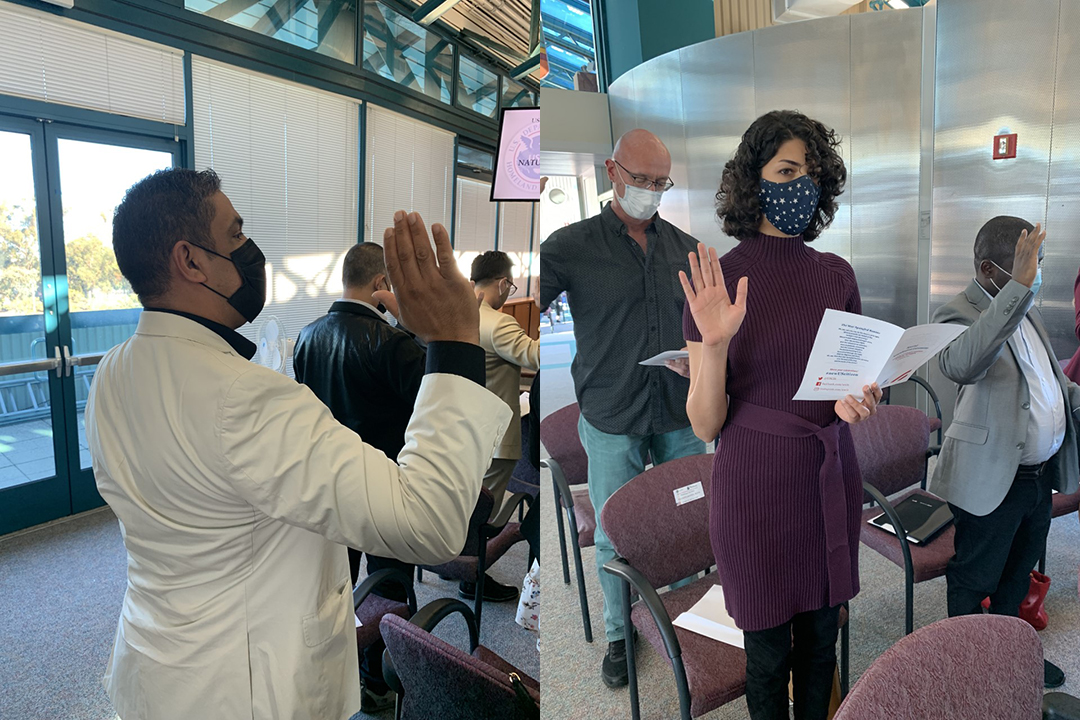
Antioch resident Sergio Roque Henriquez from El Salvador, Concord resident Roya Yousefelahiyeh from Iran, and Pittsburg resident Suku Varney from Liberia (right) take their oaths of citizenship on Thursday, Oct. 28, 2021. Photos by Sharon Rummery, Public Affairs Officer, U.S. Citizenship and Immigration Services

By Allen Payton

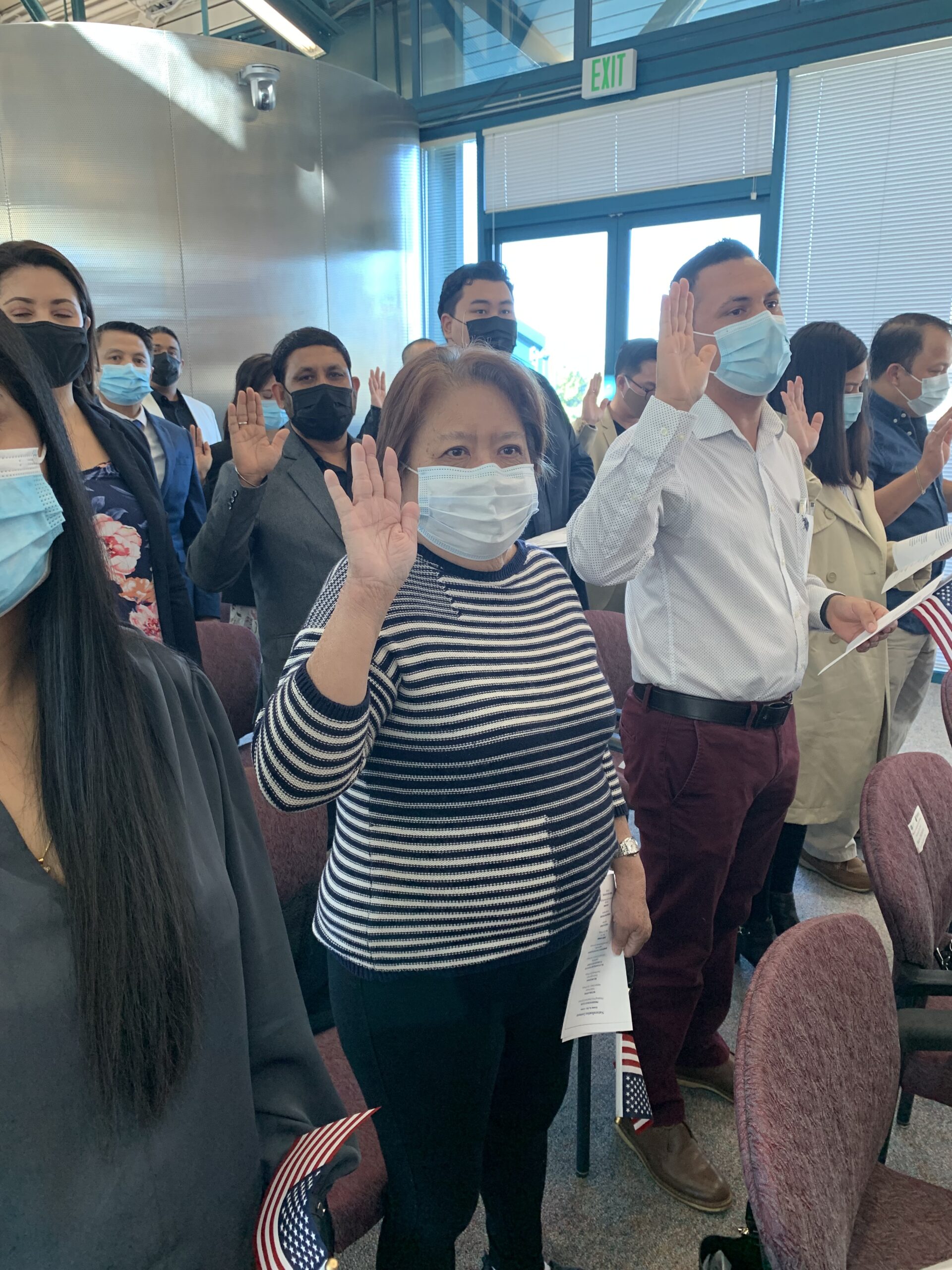
The U.S. Citizenship and Immigration Services (USCIS) San Francisco field office joined with the City of Pittsburg to present a special naturalization ceremony in the council chambers on Thursday, Oct. 28, 2021. At the event, 25 immigrants from 13 nations became U.S citizens. (See Zoom video – begins at 5-minute mark)

Pittsburg resident Suku Varney from Liberia, shows his U.S. citizenship document following the ceremony on Thursday, Oct. 28, 2021. Photo from his Facebook page.

Nine the new U.S. citizens were from the Philippines, three from Mexico, two each from India and the United Kingdom, and one each from El Salvador, Indonesia, Iran, Italy, Kazakhstan, Liberia, Mongolia, Nicaragua and Pakistan.

Four of the new citizens shared about themselves. Roya Yousefelahiyeh, of Concord, came here from Iran to study, and now works as a civil engineer in wastewater treatment.

Pittsburg resident Suku Varney from Liberia applied, as do millions of others, for the diversity visa. He was selected at random and got the golden opportunity to immigrate to the U.S. As a student at San Francisco State, he’s doing an internship in Superior Court, and hopes to go to law school.

Antioch resident Sergio Roque Henriquez came here from El Salvador at age 16, speaking no English.

“I had a goal, to go to school,” he said.

His cousins helped him get an exception and enter the local junior college’s English as a Second Language classes. Now, he’s married, dad of two, ages 16 and 11 and works as a chef.

Concord resident Liswana “Celilia” Judanu, formerly of Indonesia. She came here in 1978 to join her brothers after being rejected by the State Department for a visitor visa. Back home, Celilia had studied English, so she did well and wound up as a long-time employee of Wells Fargo, working now as a credit associate.

Concord resident Liswana “Celilia” Judanu, formerly of Indonesia takes her oath of citizenship on Thursday, Oct. 28, 2021. Photo by Sharon Rummery, USCIS

The keynote speaker was Pittsburg Mayor Merl Craft and opening remarks were presented by Councilwoman Shanelle Scales-Preston USCIS San Francisco District Chief of Staff Joseph Hamilton administered the Oath of Allegiance, and City of Pittsburg Assistant Director of Economic Development and Recreation Kolette Simonton sang the National Anthem.

“We are so proud to have hosted Pittsburg’s first-ever naturalization ceremony alongside USCIS,” said Melaine Venenciano of the Pittsburg Community Services Department.

“It was a wonderful event, and it went so smoothly,” said Joseph J. Hamilton, Chief of Staff, District 42, USCIS. “I have no doubt that our 25 newest citizens will forever have fond memories of their naturalization ceremony and the City of Pittsburg.”

USCIS naturalized approximately 625,000 people in fiscal year 2020. Many of them applied using USCIS online tools. More than seven million people have applied online for immigration benefits. To file online, individuals must first create a USCIS online account at USCIS naturalized approximately 625,000 people in fiscal year 2020. Many of them applied using USCIS online tools. More than seven million people have applied online for immigration benefits. To file online, individuals must first create a USCIS online account at https://myaccount.uscis.gov/.

USCIS encourages new U.S. citizens to share their naturalization photos on social media using the hashtag #NewUSCitizen.

Facts on Naturalization

Since our founding, the United States has welcomed immigrants from all over the world who have helped shape and define our country. During the last decade, U.S. Citizenship and Immigration Services welcomed more than 7.3 million new citizens into the fabric of our nation. Despite extended office closures and the impacts of the COVID-19 global pandemic, USCIS naturalized approximately 625,400 in fiscal year (FY) 2020.

Deciding to become a U.S. citizen is a personal decision and an important milestone in an immigrant’s life. Individuals who naturalize demonstrate a commitment to the principles that unify us as Americans and, in return, enjoy the rights and privileges that are fundamental to U.S. citizenship. We are committed to making the naturalization process more accessible to everyone who wants to start their citizenship journey.

About the Naturalization Process

People age 18 or older seeking to become U.S. citizens apply for naturalization by submitting Form N–400, Application for Naturalization. The N-400 application is available for online filing. An applicant must meet all the eligibility requirements in the Immigration and Nationality Act (INA) to naturalize.

These general eligibility requirements specify that the applicant must:

  • Be at least 18 years of age when they submit the N-400 application;
  • Be a lawful permanent resident (have a Green Card) for at least five years;
  • Demonstrate continuous residence in the United States for at least five years immediately before applying for naturalization;
  • Have been physically present in the United States for at least 30 months;
  • Be a person of good moral character;
  • Demonstrate an understanding of the English language including the ability to read, write, and speak basic English;
  • Have knowledge of U.S. government and history (civics);
  • Demonstrate attachment to the principles and ideals of the U.S. Constitution; and
  • Be willing and able to take the Oath of Allegiance.  

Special naturalization provisions modify these requirements for certain applicants or exempt them from one or more of these requirements. Among the applicants exempt from some of these requirements are spouses of U.S. citizens or members of the military.

  • Individuals may apply for naturalization as the spouse of a U.S. citizen just three years after they receive a Green Card, instead of waiting five years. They must have been physically present in the United States for at least 18 months.
  • Spouses of U.S. citizens stationed abroad may not have to meet any particular residence or physical presence requirements.
  • Members of the military who served honorably during certain periods of conflict may be eligible for naturalization even if they do not have a Green Card and even if they are under the age of 18.
  • Members of the military who served honorably for at least one year, at any time, and apply for naturalization within a certain time after their military service, are also exempt from the general residence and physical presence requirements.

Everyone filing an N-400 application who submits a complete application with all required documents will have an interview with a USCIS officer. Applicants we approve for naturalization are scheduled for a ceremony before a judge or with USCIS. They do not become U.S. citizens until they have taken the Oath of Allegiance.  

Naturalization Statistics

  • Since 2005, USCIS has welcomed approximately 730,000 citizens each year during naturalization ceremonies across the United States and around the world.
  • In FY 2020, 70 percent of all naturalized citizens lived in 10 states: California, Florida, Texas, New York, New Jersey, Maryland, Massachusetts, Illinois, Georgia and Virginia.
  • In FY 2020, the leading metropolitan areas of residence were New York-Newark-Jersey City, NY-NJ-PA (10 percent), Miami-Fort Lauderdale-West Palm Beach, FL (8 percent), and Los Angeles-Long Beach-Anaheim, CA (7 percent).
  • In FY 2020, the top five countries of origin for naturalized citizens were: Mexico (82,700), India (47,900), Philippines (33,100), Cuba (31,000), and China (23,000). Since 2002, we have naturalized more than 139,000 members of the U.S. military, both at home and abroad. We have held naturalization ceremonies in more than 30 countries from Albania to the United Arab Emirates. In the last five years (FY 2016-20), we naturalized almost 30,000 service members. In FY 2020, we naturalized more than 4,500 service members, about the same number as the previous year.
  • More than 40% of those we have naturalized since FY 2016 have been service members born in the Philippines, Mexico, China, South Korea and Jamaica—the top five countries of birth among citizens naturalized in that time span. Another 17% of military naturalizations from FY 2016-20 have been immigrants from the next five countries of birth: Nigeria, Nepal, India, Ghana and Kenya.

For more information on USCIS and its programs, please visit uscis.gov or follow us on Twitter, Instagram, YouTube, Facebook, and LinkedIn.

There are three U.S. immigration agencies within the Department of Homeland Security.

U.S. Citizenship and Immigration Services (USCIS), Immigration and Customs Enforcement (ICE) and Customs and Border Protection (CBP). Following are the responsibilities of each agency:

USCIS

  • Adjudication of applications to gain immigrant status, based on family or work petitions, refugee or asylee status or through the Violence Against Women Act.
  • Adjudication of naturalization applications
  • Adjudication of asylum and refugee applications
  • E-Verify employment verification
  • Help with foreign adoptions
  • Adjudication of work-related non-immigrant visas
  • Adjudication of T and U visas (victim visas)
  • E-Verify

ICE

  • Homeland Security Investigations
  • Preventing Terrorism
  • Illegal Movement of People and Goods
  • Immigration Enforcement
  • Fugitive Operations
  • Detention and Removal Management

CBP

  • Inspections involving customs law
  • Inspections involving immigration law
  • Border Patrol
  • USDA-APHIS agricultural quarantine inspections program

Sharon Rummery, Public Affairs Officer, U.S. Citizenship and Immigration Services contributed to this report.

Filed Under: Immigration, News

Contra Costa one of three California counties to win Gateways for Growth Challenge Award

November 19, 2020 By Publisher Leave a Comment

Contra Costa County is among 19 Localities to Join a Network Deploying Economic Research and Multi-sector Welcoming Plans for Promoting Inclusion and Economic Opportunity for All

By Tish Gallegos, Community/Media Relations Director, Contra Costa County Employment & Human Services Department (EHSD)

Contra Costa County Employment and Human Services Department (EHSD) and Contra Costa Health Services (CCHS) are pleased to announce that New American Economy (NAE) and Welcoming America selected Contra Costa County to receive a Gateways for Growth (G4G) Technical Assistance award as part of the fourth cohort of a nationwide initiative. G4G is a competitive opportunity for localities to receive research support and/or technical assistance to improve immigrant inclusion in their communities. Contra Costa County and this year’s awardees join 71 other recipients since the 2016 launch of the initiative.

In light of the scale and severity of the COVID-19 pandemic, the Gateways for Growth Challenge this year prioritized localities that demonstrated a public-private commitment to better integrating immigrants into recovery efforts and emergency management systems.

“The Gateways for Growth Award is a timely boost to Contra Costa County’s efforts of welcoming and immigrant inclusion, and we greatly appreciate the opportunity to enhance our work,” said Candace Andersen, Chair of the Contra Costa County Board of Supervisors.

The immigrant community in Contra Costa is wide and diverse, representing 25 percent of the county’s population. The partners involved in the Gateways for Growth effort will include both new arrivals and longtime residents, and a number of previously unengaged groups. In addition to seeking out language minority and immigrant communities, the County will bring in more small community-based and faith-based organizations to support this work.

As the country looks to rebuild and set a more inclusive path forward nationally, Contra Costa County, as part of the G4G 2020 cohort, will lay the groundwork and build the infrastructure for economic, civic, and social inclusion at the local level.

“We recognize the inequities that persist and are exacerbated by the COVID pandemic in our systems, and we are committed to advancing further inclusion and fairness in everything we do,” explained Erika Jenssen, Contra Costa Health Services Department. “As a result, plans to establish a County Office of Racial Equity and Social Justice are underway.” Technical assistance and research provided through the award will support the planning process for the new office.

“Respecting diversity by honoring individual differences is a core value for EHSD that echoes that of Contra Costa as a welcoming county,” said EHSD Director Kathy Gallagher. “Our County has strongly opposed federal rule changes that limited the scope of benefits under the public charge rule and affected immigrants on their path to citizenship. We remain committed to the continuation of the DACA program, and to supporting ongoing inclusion and long-term economic and social integration of newcomers to our community.”

“We are thrilled to see the Gateways for Growth Challenge expand to another set of localities that reflect the diversity of our nation,” said Christina Pope, Senior Network Director at Welcoming America. “With each cohort, there is an opportunity to support and connect local leaders making their communities more welcoming and resilient places where everyone, including immigrants, can prosper and belong.”

As in previous years, G4G awardees will receive a combination of:

  • Customized quantitative research reports from NAE on the demographic and economic contributions immigrants make in their communities; and/or
  • Tailored technical assistancefrom NAE and Welcoming America to help communities draft, execute, and communicate a multi-sector immigrant inclusion strategy.

In addition to Contra Costa County, this year’s awardees are:

  • Dayton, Ohio
  • Cleveland, Ohio
  • Columbus, Ohio
  • Erie, Pennsylvania
  • Gainesville, Florida
  • Lancaster County, Nebraska
  • Los Angeles, California
  • Mercer County, New Jersey
  • Miami-Dade County, Florida
  • Minneapolis, Minnesota
  • Ottawa County, Michigan
  • Passaic County, New Jersey
  • Reno/Washoe County, Nevada
  • Saint Paul, Minnesota
  • San Mateo County, California
  • Southwest Kansas
  • Spokane, Washington
  • Washtenaw County,Michigan

Year-round, NAE and Welcoming America maintain an interactive map at gatewaysforgrowth.org that serves as a clearinghouse for the successes of all current and prior G4G awardees.

Contra Costa County Employment & Human Services (EHSD)

Employment & Human Services partners with the community to deliver quality services to ensure access to resources that support, protect, and empower individuals and families to achieve self-sufficiency.  Based on the core values of delivering an exceptional customer experience, encouraging open communication, embracing change, practicing ethical behavior, and embracing diversity, EHSD envisions Contra Costa County will continue to be a thriving community where all individuals and families can be healthy, safe, secure and self-sufficient.  More information about EHSD is available at www.ehsd.org.

Contra Costa Health Services (CCHS)

Contra Costa Health Services (CCHS) is an integrated system of healthcare services, community health improvement and environmental protection. We are the largest department of county government, including a 166-bed full-service public hospital with eight satellite health centers, public health, behavioral health and homeless services, environmental health, a federally-qualified HMO serving more than 190,000 people and a hazardous materials response unit. We are also the county’s emergency medical response agency.

CCHS provides high-quality services with respect and responsiveness for all. Our mission is to care for and improve the health of all people in Contra Costa County, with special attention to those who are most vulnerable to health problems. Learn more at cchealth.org.

New American Economy

New American Economy (NAE) is a bipartisan research and advocacy organization founded to educate, empower and support policymakers, influencers, and citizens across the country that see the economic and social benefits of a smart approach to immigration reform. NAE has created a coalition of civic, business, and cultural leaders who span the political spectrum and represent all 50 states. NAE makes the case for smart immigration reform in four ways:

  1. We generate and usepowerful research to demonstrate how immigration impacts our economy;
  1. We organize champions at the grassroots and influencer levels to build support for immigration;
  2. We partner with state and local leaders to advocate for policies that recognize the value immigrants add locally; and
  3. We show immigrant contributions to American culture through film, food, art, sports, comedy, and more.

Visit NewAmericanEconomy.org to learn more.

Welcoming America

Welcoming America leads a movement of inclusive communities from across the world in becoming more prosperous by making everyone feel like they belong. Through a membership network of 200+ local governments and nonprofits, Welcoming America connects and supports place-based initiatives that work to reduce divisions and support greater civic, social, and economic participation among new and longtime residents alike. Through the Welcoming Network, participating members access peer learning opportunities, technical assistance, tools, and training to help transform their communities into more welcoming places. Visit WelcomingAmerica.org to learn more.


Filed Under: Health, Immigration

Rep. DeSaulnier announces reinstatement of Deferred Action possibly benefits Concord resident

September 20, 2019 By Publisher Leave a Comment

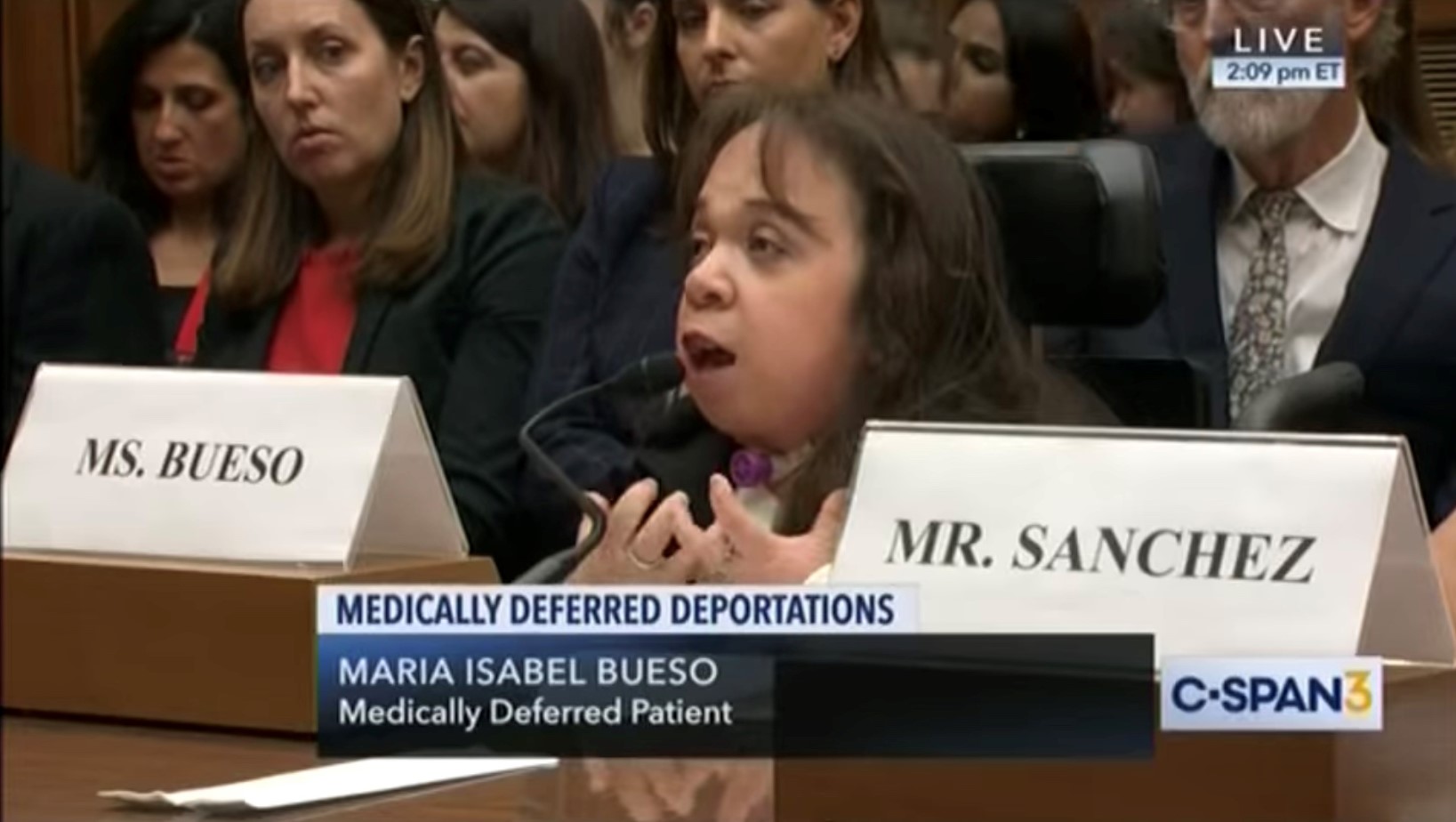
Screenshot of C-SPAN coverage of Isabel Bueso testifying before a Congressional Oversight and Reform Committee on Sept. 11, 2019.

Policy reversal signals that Isabel Bueso and other families will likely remain in the United States

Washington, DC – On Thursday, Sept. 19, Congressman Mark DeSaulnier (CA-11) issued the following statement after learning that U.S. Citizenship and Immigration Services (USCIS) will reinstate deferred action. The announcement signals that his constituent, Concord resident Isabel Bueso, and other families impacted by the initial decision to end the program will likely be allowed remain in the United States. (See related article)

“In a major victory, the Trump Administration will apparently reverse course and resume the deferred action program, allowing hundreds of deserving immigrants like Isabel Bueso to stay in the United States to receive life-saving medical care. We will continue to press the Administration for answers and assurances that this program is safe from future targeting and pursue our private bill to keep Isabel and her family in the United States permanently, but in the meantime, we breathe a sigh of relief. While I am dismayed that my colleagues and I had to step in to get the Administration to do what is right, I am grateful for the leadership of Chairman Jamie Raskin, Chairman Elijah Cummings, Congresswoman Ayanna Pressley, and the countless others who fought alongside me.”

Since Isabel Bueso and her family were denied deferred action, Congressman DeSaulnier has been actively working to save Isabel and her family from deportation. DeSaulnier has been actively working to save Isabel by:

  • Introducing a private bill (H.R. 4225) that would allow Isabel and her family to remain in the United States to continue to receive treatment for her rare, life-threatening disease.
  • Calling for an Oversight and Reform Committee hearing on the policy change. The hearing was held on Wednesday, September 11th, at which Isabel Bueso testified.
  • Sending a letter with Senator Kamala Harris (D-CA) petitioning the Acting Secretary of the Department of Homeland Security, Kevin McAleenan, to re-review the cases of the Bueso family.
  • Co-leading an effort with Immigration and Citizenship Subcommittee Chairwoman Zoe Lofgren (D-CA), Representatives Ayanna Pressley (D-MA), Judy Chu (D-CA), Lou Correa (D-CA), and Senators Edward Markey (D-MA) and Senator Elizabeth Warren (D-MA) and over 100 other lawmakers to DHS, ICE, and USCIS in demanding answers on USCIS’s decision to end consideration of non-military deferred action requests, including medical deferred action.

Filed Under: Central County, Concord, Government, Health, Immigration, News

DeSaulnier introduces private bill to protect Concord woman receiving medical treatment, and family from deportation

September 3, 2019 By Publisher 2 Comments

Rep. Mark DeSaulnier with Isabel Bueso. Photo from Facebook.

Washington, DC – Today, Tuesday, Sept. 3, 2019, Congressman Mark DeSaulnier (CA-11) announced the introduction of a private bill (H.R. 4225) to allow Maria Isabel Bueso, a resident of Concord, California, to remain in the United States to continue to receive treatment for her rare, life-threatening disease. Following a Trump Administration change, Isabel and her family face deportation. Yesterday, the United States Citizenship and Immigration Services (USCIS) said it will re-open deferred action cases that received denials like Isabel’s but, did not say whether it would reverse the policy change that led to the cancellation of deferred action.

“A few weeks ago, families were blindsided when they received notification from USCIS that they were being forced to leave the country within 33 days. Re-opening cases is no guarantee they will be allowed to stay, and it is not a permanent solution. These families need and deserve decisive action,” said DeSaulnier. “I am introducing legislation that would provide Isabel and her family with permanent resident status so they can remain in the United States without fear of removal. The Bueso family has followed every rule – they came here legally, paid their taxes, and Isabel’s participation in groundbreaking clinical trials has given hope to Americans with rare diseases. I will do everything in my power to help Isabel and her family remain here.”

“While I am thrilled that my deferred action status is being reconsidered, I was born with MPS 6; so, neither my condition nor my critical need for lifelong, weekly treatment will change in another two years’ time,” said Isabel Bueso. “We need to work together to find a more permanent solution that gives families like mine the guarantee that our lives won’t continue to be threatened. Congressman DeSaulnier and Senator Feinstein’s bill to give my family permanent status is part of that solution,” said Isabel.

“We are encouraged to hear that the administration is willing to reconsider our medical deferred action case,” the Bueso family stated. “We see this as a first step in revisiting our status as U.S. residents and will be working with lawmakers to find a more permanent solution that guarantees Isabel’s life is never put at risk again. Our hearts go out to all of the families involved in this sudden policy change and we won’t rest until they also have continued access to the life-saving medical care they deserve. Thank you to everyone who supported our family during this time – our hearts are overflowing with gratitude,” the Bueso family concluded.

Isabel came to the United States legally from Guatemala to receive treatment for Maroteaux-Lamy Syndrome, also known as Mucopolysaccharidosis Type VI. Her participation in drug trials helped identify an effective, life-saving treatment, which the drug manufacturer says Isabel cannot receive in her home country of Guatemala. Isabel and her family have lawfully resided in the East Bay since then, where she recently graduated summa cum laude from Cal State Easy Bay. Before her treatment was discovered, Isabel’s life expectancy was seven years old. She is now 24.

In a comment with a video posted on his Congressional Facebook page on Saturday, DeSaulnier wrote, “We have a sociopath in the White House who acts more like a mobster than the President. Our office is working hard to #SaveIsabel and stand up for immigrants with medical conditions that the #Trump Administration has targeted.”

In addition to introducing a private bill, Congressman DeSaulnier was joined by Senator Kamala Harris (D-CA) in sending a letter petitioning the Acting Secretary of the Department of Homeland Security, Kevin McAleenan, to re-review the cases of the Bueso family. He also co-led an effort with Immigration and Citizenship Subcommittee Chairwoman Zoe Lofgren (D-CA), Representatives Ayanna Pressley (D-MA), Judy Chu (D-CA), Lou Correa (D-CA), and Senators Edward Markey (D-MA) and Senator Elizabeth Warren (D-MA) to DHS, ICE, and USCIS demanding answers on USCIS’s decision to end consideration of non-military deferred action requests, including medical deferred action. In the letter, which was joined by over 100 additional lawmakers, he called on the agencies to reverse this decision and turn over any documents discussing the policy change by September 13, 2019.

Filed Under: Central County, Health, Immigration, News, People

Rep. DeSaulnier to host Immigration Town Hall in Concord Thurs., Aug. 22

August 17, 2019 By Publisher Leave a Comment

Rep. Mark DeSaulnier

Congressman Mark DeSaulnier (CA-11) announced that he will host an Immigration Town Hall on August 22nd at 6:30 p.m. at Meadow Homes Elementary School in Concord.

This is the second in a series of town halls Congressman DeSaulnier is hosting on immigration. During the town hall, Mark will provide a firsthand account of what he witnessed at detention facilities on his two visits to the southern border and discuss the work he is doing in Congress to protect immigrant rights and ensure detainees are treated with the dignity they deserve. He will also discuss the Administration’s attacks on immigrant communities including its changes to asylum law, fight to put a citizenship question in the Census, and recently launched raids.

A variety of organizations will be on hand to provide legal resources, services, and information about protecting your rights—regardless of immigration status. Translation services will be available during the event.

This will be Congressman DeSaulnier’s 89th town hall and mobile district office hour since coming to Congress four years ago.

Immigration Town Hall
Thursday, August 22nd
6:30 p.m. to 8:00 p.m.
Meadow Homes Elementary School
1371 Detroit Avenue, Concord

Doors open at 6:00 p.m.

This event is open to the public, press, and photographers.

To confirm your attendance, please RSVP online at https://desaulnier.house.gov/town-hall-rsvp or call 925-933-2660. To request ADA accommodations or for more information contact one of Congressman DeSaulnier’s offices in either Walnut Creek or Richmond.

Filed Under: Central County, Concord, Government, Immigration, News

  • « Previous Page
  • 1
  • 2
  • 3
  • 4
  • Next Page »
Liberty-Tax-Jan-Apr-2026
Deer-Valley-Chiro-06-22

Copyright © 2026 · Contra Costa Herald · Site by Clifton Creative Web