• Home
  • About The Herald
  • Local Agencies
  • Daily Email Update
  • Legal Notices
  • Classified Ads

Contra Costa Herald

News Of By and For The People of Contra Costa County, California

  • Arts & Entertainment
  • Business
  • Community
  • Crime
  • Dining
  • Education
  • Faith
  • Health
  • News
  • Politics & Elections
  • Real Estate

BART seeks applicants for public seat on Audit Committee

October 23, 2023 By Publisher Leave a Comment

BART is seeking applicants to serve as public members on its Audit Committee, which assists the Board of Directors in providing oversight for financial management, operational effectiveness, ethics and regulatory compliance.

The Audit Committee is comprised of five voting members, including three Board Directors and two public members with governmental financial expertise. It meets at least four times per year, with authority to convene additional meetings as needed.

Criteria for the position include:

  • Expertise: Have expertise in governmental accounting, financial management, or Performance auditing, or conducting investigations of fraud, waste, or abuse;
  • Technical Knowledge: Have technical knowledge of accounting, financial or performance auditing, financial reporting, and internal controls, including an understanding of and ability to apply the Government Auditing Standards, accounting standards issued by the Government Accounting Standards Board, and a recognized internal control framework;
  • Professional Certification: Possess a relevant professional certification, such as Certified Public Accountant, Certified Internal Auditor, Certified Fraud Examiner, Certified Inspector General, Certified Internal Controls Auditor, Certified Information Systems Auditor, or a similar certification. Relevant experience may substitute for such certification in the Board’s discretion;
  • No conflicts/recent affiliations: Within the past 10 years and other than in their role as a committee member, have no affiliation with the District or with a firm that has done business with the District.

Public members serving on the Audit Committee must be appointed by a majority of the full Board of Directors through this application process. Public members must possess the independence, experience, and collective technical expertise necessary to carry out the duties of the Audit Committee. Public members must be residents within the District’s boundaries and are subject to conflict-of-interest laws.

The application process has two phases. In Phase 1, all applications will be reviewed to meet all requirements and qualifications, letters of recommendations and any supplemental documents. In Phase 2, selected candidates will be invited to appear before the Board of Directors to briefly explain their interest in serving on the committee, followed by a Board vote.

Download the application form, Audit Committee Public Member appointment rules, and the  Audit Committee Charter.

Please contact the Office of the District Secretary with any questions via email at boardofdirectors@bart.gov.

Filed Under: BART, Finances, Government

Following split vote during contentious Contra Costa Supervisors appointment of new member as vice chair, board reverses course two weeks later

October 18, 2023 By Publisher Leave a Comment

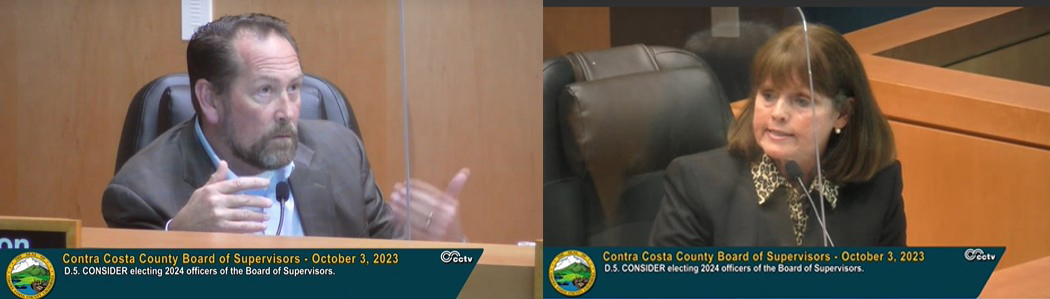
Supervisors Ken Carlson and Candace Andersen debate the appointment of the Board Vice Chairperson during the Oct. 3, 2023 meeting. Video screenshots.

Rotate in a current, female member or appoint a new and the first openly gay male member of the board were the choices offered

Carlson requested revote not wanting “anyone to feel marginalized” and for the “rotation of the representation of our districts”

Andersen instead appointed Vice Chair for 2024

By Allen D. Payton

Identity politics were center stage during their meeting on Tuesday, Oct. 3, 2023, when the Contra Costa County Board of Supervisors held a contentious discussion and vote on appointing new member, District 4 Supervisor Ken Carlson as vice chair instead of District 2 Supervisor Candace Andersen. Both she and District 3 Supervisor Diane Burgis wanted Andersen in the position who argued it was a matter of rotation from district to district and appointing a woman versus a man. But the three men outvoted the two women and appointed Carlson, as the first openly gay member to one of the board’s two leadership positions, as pointed out repeatedly by current Board Chair and District 1 Supervisor John Gioia.

All five supported District 5 Supervisor Federal Glover to be appointed board chair for the coming year.

But then during their much Oct. 17th meeting at the request of Supervisor Carlson, the board reconsidered appointing him Vice Chairperson with a much more conciliatory discussion.

“I appreciate the opportunity to bring this back for further discussion. I want to share my appreciation and gratitude to those who reached out. I appreciate all the opinions and all the thoughts that came to me, and everyone was heard,” he stated. “Prior to our October 3rd meeting Chair Gioia called me to let me know there is this tradition of a board proving an incoming supervisor an opportunity to be the Chair in their first term and therefor he was going to move my name forward as vice chair.”

“You know, I was honored and had no reason to believe that it would become controversial,” Carlson continued. “I came to the original discussion with an open mind and goal to work collaboratively across this board. But when identity was brought up I got emotional. I got protective. I have a responsibility to represent District 4. But being the first openly LGBTQ member of this board, I feel a greater obligation as well, to respect, represent and protect the LGBTQ community, my community. So, it’s never been, it never will be my intention in any work I do but here at the board specifically, to make anyone feel marginalized. I know what that feels like. So, I don’t want our work to do that.”

“This board has done a tremendous job over the last several years working to make our communities more inclusive and more accepting and we need to continue that work. There’s more to be done,” Carlson stated. “What I did get out of this was there’s no specific rotation. But it has been a female dominated board for the past 16 years until I came along, and I feel like I’m being very disruptive. The new guy comes and changes things and the dynamic. But it did show a disparity in the rotation of the representation of our districts. And that is really important to me.”

“Right now, across this country…we’ve seen what political polarization can do and how it impacts the work we actually can get accomplished,” he continued. “So, I think it’s very important that we are better than that. So, I apologize and want to make it very well known I want to work together, collaboratively because that’s how I think we’re going to accomplish more.”

Gioia then offered his thoughts saying, “When we all walked into our meeting two weeks ago…there were different interpretations…into how the board implemented its rotation policy. Unfortunately, the language turned into more personal…and we focused on the differences than how do we work together. Several of  us…did not agree with the framing and characterization that this was a men versus female thing. I think that is unfortunate.”

Glover spoke next saying, “I think it’s important that we recognize this board has worked collaboratively as a whole. Being someone who has been marginalized down through the years I certainly want to speak to the fact that we do need equity and we do need fairness.”

Burgis spoke next and said, “I always look at how do we prevent this from happening in the future. One of the things that Contra Costa County has a reputation for is to have a collaborative board. For me, again it was about districts. What I would like to make sure is that…I celebrate Ken. I supported him right from the bat. I’m so proud that we do have an LGBTQ leader and a really good human being and a smart person and someone that cares about the community. But I also wanted to stand up for my district. It did dissolve…sometimes we get defensive, or we get hurt feelings and anger turns into energy because we feel vulnerable and that’s what we saw. But I’m so proud of this board and appreciate that we can fix things because we can model that for the rest of the world.”

“Ken, I do want to thank you for bringing this back,” Andersen stated. “I know everyone on this board has been hearing from a lot of people…who also said there was a clear rotation. Trades took place but by assent, by agreement, by people cooperatively saying we want to make this change. It was collaborative. It was something we all agreed to. There’s certainty and there’s fairness. I was very, very surprised that my position, Diane’s position in rotation had been offered up to honor Ken. And I agree there are many, many ways we can honor Ken as the first openly gay member of this board. But I was uncomfortable that my turn in the rotation had been offered to him without any discussion to me, without any approach to me.”

“We have always worked collaboratively the majority of our votes have been 5-0 votes,” she continued. “So, I appreciate this is coming back…and to Ken, thank you for helping us right the board that was sort of spinning of our axis. I will always put the good of the county, the good of the board ahead of my feelings. Of course, I’m hopeful that we will be voting to go back to the original rotation.”

“I’m just looking at the facts of the chart,” Gioia added. “Under the Brown Act we can’t talk to each other. That’s what also creates the issue and makes it hard.”

“This was to me not a female, male, LGBTQ, straight, whatever kind of issue,” said Burgis. “This was about each district has an opportunity to be represented in the chair position and it should rotate every five years. I’m hoping that we can go back to this rotation.”

Carlson then made “the motion to nominate Supervisor Candace Andersen to be our Vice Chair in 2024.”

It was seconded by Burgis.

Following several public comments, Burgis responded to one of them saying, “It’s about equity for all the districts…so we can provide the services in all the districts.”

“When we were called misogynistic..I think that was totally out of bounds,” Gioia added. “That was a serious comment to make.”

“I’m going to try to do better, and I think all of us want to do better,” Burgis responded.

“Would you have brought this forward if we were both men?” Andersen asked. “It was the totality of the circumstances that made me, as a woman feel marginalized and feel that this was more than just a political decision which troubled me that we were even having, it be a political decision.”

“And as I said, I look forward to Ken continuing to be recognized for his status as the first openly gay member of this board,” she continued. “And I’m hoping that all we’ve been through is going to lead to much more positive ways of communicating where none of us feel marginalized. When we represent a district we know what the needs are.”

“I respect yours and everybody’s point of view on all of this,” Gioia responded.

The vote followed and the motion passed unanimously 5-0.

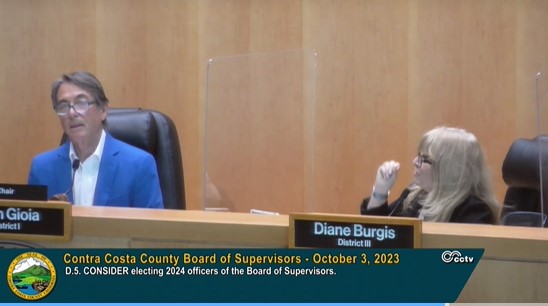
Board Chair John Gioia reacts as he listens to Supervisor Diane Burgis during discussion of the vice chair appointment on Tuesday, October 3, 2023. Video screenshot

October 3rd Meeting Board Discussion and Vote

“Over the last 20 years, there’s been a practice of moving the vice chair into the chair’s position. That has been done every year,” said Board Chair Gioia. “The vice chair we rotate amongst members so that the person who had it most distant past…rotates into the position of vice chair, then we insert the newly elected person into the rotation. They generally become the chair in their third or fourth year in office.”

“Actually, that’s not how it worked for me…you guys skipped me completely and I was fine with that,” District 3 Supervisor Diane Burgis said.

“Burgis became chair in her fifth year in office,” Gioia confirmed. “Of the seven new vice chairs one became chair in her fifth year and the other six became chair in their third or fourth year.”

“Can I also point out that in the last 10 years District 3 has been chair one time?” Burgis pointed out.

“District 1 has been Chair three times, District 2 two times, District 3 one time, District 4 three times and District 5 two times,” she added. “In the last 10 years.”

Burgis then moved to have District 2 be the vice chair.

“And I would make Federal chair. He has been vice chair, now three years,” said District 2 Supervisor Candace Andersen.

“Yes,” Burgis responded.

“And I would second that motion,” Andersen added.

“One of the hallmarks of this board is that we have sort of followed a rotation and one of respect…that we act with decorum, and we’ve been respectful of each other,” she continued. “I think it’s important we not come up with sort of a new system, or what someone might perceive as gamesmanship to alter that order.”

“I’ll say it…I think there are two practices that have gone on…that we rotate among existing board members based on who had it least…longest who would be Supervisor Andersen who is next up,” Gioia responded. “But we also have a practice over 20 years of incorporating new members. So, it is an uncontroverted fact that over 20 years new board members come into the rotation and that causes the individual who would normally get it of existing board members to wait an extra year.”

“Why didn’t you advocate for that for me when I was new on the board if that was an important thing?” Burgis asked.

“I don’t recall the discussion why that happened,” Gioia said.

“I do,” Andersen interjected. “It was agreed that a new member, there is a firehose of information, there is a learning curve, and it makes most sense to have a new member to have that person to rotate to the end of the progression so that by the time they reach that chair position they will have a much better understanding of the issues in the county.”

Andersen then made an emphatic plea to be appointed vice chair for the next 12 months.

“Since I’ve been on this board for the last…11 years never once have we suggested that we bring someone in new,” she continued.

Speaking to new board member, District 4 Supervisor Ken Carlson Andersen stated, “I like Ken. Ken, you’re wonderful, I’m delighted you’re on the Board. But to sort of say to these women on this board, ‘we’re going to push you back a little further’ to me is a little disingenuous in this current climate that we’re in. As I look at the strides women make to have men on the board say, ‘nope. You know what? It’s really your turn but we’re not going to let you have your turn.’ And one of the policies that is articulated in this is that while we’re in a four-year term we have the opportunity to have a leadership opportunity. I will be missing that if you skip over me and tell me I do not get my term as vice chair and my term as chair the following year in this four-year term I will not have that opportunity and I will be very concerned if we move in that direction.”

Burgis then said, “I just thought we would continue the process based on the rotation. I do feel that each district, whoever is representing them, that they do have the benefit of having a chair. To me the rotation is not only the person but it’s also the district. So, my expectation was that District 2 would be the vice chair next year…and that would put us back into the rotation.”

Gioia then reiterated his early comments about the practices over the past 20 years saying, “The new Supervisor has been inserted into the rotation in their third or fourth year in office.”

Carlson was elected last year and will be in his second year in office, next year.

At Gioia’s request Burgis restated her motion to appoint Glover chair and Andersen vice chair.

“If you look at that, while a new supervisor may have been brought in, the districts were fairly consistent,” Andersen stated reading off the order, “5, 4, 1, 2, 3, then 5, 3, 1, 2, 4. That is my concern.”

“There will be some that say, and I agree, that we have our first, also gay supervisor, out openly gay LGBT member,” Gioia stated. “There will be some that would say that ‘it is time an LGBT member is chair of our board’. And I believe that either approach is consistent with practice. There’s not some hard, fast rule and anyone that says there’s a hard fast rule, they’re wrong.”

“In the last 20 years you have served six times,” Burgis pointed out.

“Well, I’m also the longest serving member of the board,” Gioia responded.

Referring to a list of chairs and vice chairs over the last 23 years Gioia said she requested, Burgis reiterated, “No, no, no. I’m saying District 1 has been the chair six times, District 2 five times, District 3 four times, District 4 five times and District 5 four times. District 1 has definitely benefited.”

“Diane, let me be really clear. Let’s do the math,” Gioia responded while raising his voice. “All of us, generally have become chair every four years or so. I’m in my 25th year. If you divide that by four that comes out to about…six times. I’m not getting it more than…you’re characterizing it that I’m getting it more than I should be getting it. That is untrue.”

“My point, one of them has been, each district gets an opportunity. Not each person. Each district, not each person, is usually what it is,” Burgis responded. “I didn’t want to turn this into a fight. I just thought…”

“The rotation,” Andersen interjected. “I think we have all, since I’ve been on the board, there’s been a rotation. Here, on a county board of supervisors, where we each represent over 200,000 people…we each deserve an opportunity, in our right time, to be chair,” she continued. “And by skipping over someone I think you do lose…the opportunity for that district to have their voice heard in a different way.”

“Like I said, I love that Ken is on this board, I appreciate that he represents so well the LBGTQ community,” Andersen stated. “But to me, it’s the representation of our districts and given that District 4 was represented I’d like to suggest Ken rotate in at the appropriate time.”

Gioia then made a substitute motion, “that Supervisor Glover become chair and Supervisor Carlson become vice chair.”

“I’ll second that,” Carlson said.

“Let me say why I made that motion,” Gioia shared. “The person who had it the farthest back is top on the last and that would be Supervisor Andersen. Over the history on this chart, new members occasionally push down an existing member for a year. I respectfully disagree that you’re saying that this is out of rotation. The bottom line is it’s up to three members of this board. And I do think it’s about time that an LGBT member become chair of our board. We’ve never had one.”

“Appointing Ken as vice chair gets him into the rotation, the same year that Supervisor Bonilla and Supervisor Piepho became chair which was their third year in office,” he argued. “So, it’s not out of practice.”

“It’s out of district and that is the big difference,” Andersen reiterated. “There was some significant changes. Mark DeSaulnier was elected to the Assembly. That’s when Susan Bonilla came in.”

Gioia cut her off saying, “there’s a motion let’s go to public comments.”

Burgis then asked for clarification about the process for making motions and substitute motions.

County staff responded, “generally, the board’s practice is you vote on the second motion, first.”

Carlson then said, “Little did I know I would be the topic, when I came in this morning.”

Gioia then interjected, “I’m trying to show…respect within this rotation.

“John, you speak on behalf of women, often,” Burgis stated. “So, I would have thought you would have spoken up on behalf of me if that was such an important…” referring to her waiting until her fifth year on the board before being appointed chair.

“I don’t recall the disagreement,” Gioia shared.

“I don’t think it was ever discussed,” Burgis responded.

“Another woman got it instead of you, Diane,” Gioia stated. “That was Supervisor Andersen. So, I don’t understand. Supervisor Andersen was the chair the year before you. So, I’m not sure of the argument.”

“As we’ve had these discussions, John, ever since I’ve been in office it has been with a rotation,” Andersen reiterated. “It has never been an equity. It has been the camaraderie of this board and it is breaking rotation and there is no other way to say it. What you’re essentially saying to Diane and myself, ‘you have to go behind the men on this board’ and I will that because that is exactly what is happening.”

“You’re welcome to say that. That’s not what we did last time. In the year Supervisor Burgis said she would have been chair in 2020 it was Supervisor Andersen,” Gioia responded. “There wasn’t a favor of a man over a woman.”

“It was because she was newly elected,” Andersen responded. “Similarly, it was assumed Ken would come into the rotation particularly in the case, since District 4 had just been chair. It was a natural coming to the end of the rotation. Not because Ken is Ken or any other factor. That’s just how we did it.”

Carlson Weighs In

Carlson, a former member of the Pleasant Hill City Council which usually rotates their mayor and vice mayor each year, then said, “I appreciate the conversation and I did not personally, see a pattern. And if we’re locked into a pattern then we take away the opportunity and the flexibility to do other things. Would it be to not recognize Federal or Karen or the newly elected as they come onto or leave the Board of Supervisors? Because we’re strictly locked into a rotation. Because I don’t understand, Candace, your comment about your time. When is your time? Is it strictly based on your district number and the rotation? Or is it based on we want to give everybody the opportunity to be in the chair’s seat at some point during their term? And it’s hard because we’re a body of five and there’s only four years in your term. But if we’re locked into a rotation then we take ourselves out of the flexibility be of, one…someone who might not be the appropriate individual to represent us based on behavior or other aspects.”

“We modified the rotation,” Andersen responded.

“But how do you do that when you don’t make an exception for the new person or the LGBTQ person or you make it all about gender?” Carlson asked.

Gioia then opened up to public comment and only two call-in speakers shared their thoughts. There was no members of the public in the chambers who spoke on the matter.

Glover Disappointed With Discussion

Before the board vote, Glover offered his thoughts saying, “Let me just say that the gratitude I offered last year has led to a greater discussion that I’ve ever seen in terms of how we get to chair and vice chair. I don’t remember ever having these type of discussions and it’s somewhat saddening that we are having one. I think that this group has acted as a team for all the years that I’ve sit here and I want to remain that way. There’s too much work to get done to have this ceremonial position would get in the way of it.”

“We made history today with our appointment of the co-directors of Office of Racial Equity and Social Justice. And I think it’s history to also appoint as vice chair, for the first time, our first LGBTQ+ member of the board,” Gioia stated. “There’s been a lot of hate going around in all areas, with anti-semitic, racist and also anti-LGBTQ and I think it is important. I think this is historic, as well and I think we should celebrate it. And I look forward to serving with Supervisor Andersen as the vice chair the following year. I’m optimistic you’re going to be re-elected. We’re going to get to serve with you as vice chair and chair. It’s not taking away the opportunity for Supervisor Andersen to serve again as vice chair and chair. It just changes that timing by that one year. And I think we should just celebrate the history of having the first gay member be an officer of this board.”

“And I would respectfully disagree,” Andersen stated. “And I do feel that Diane and I are being marginalized. I will be voting no on this item.”

“I am abstaining,” Burgis shared. “My goal is to try and have a team that is all unanimous. I think I have been a team player. I’m very disappointed that my colleagues didn’t advocate for me to have that opportunity. Everybody should be treated that way. So, I do feel slighted because you didn’t take on this as something important in the past. So, I’m abstaining.”

“So, because I voted for Supervisor Andersen instead of you, that you’re criticizing me?” Gioia asked.

“You didn’t advocate for me to be able to be a vice chair in my…” Burgis responded before Gioia cut in.

“Neither did Supervisor Andersen,” he said.

“It was important to you,” Burgis shot back.

“Let me be honest. It was a unanimous vote in 2019 to appoint Supervisor Andersen as the vice chair,” Gioia explained. “She didn’t vote for you.”

“No. Because we had a rotation,” Andersen responded.

“Let me be clear. She didn’t advocate for you. So, why are you criticizing me?” Gioia asked Burgis.

Andersen again explained the discussion about giving new members, “the opportunity to learn more, to be on the board, to be on all the committees. Just as we do on CCTA (Contra Costa Transportation Authority)…where you don’t just jump into the leadership role until you’ve had that experience.”

“So, I do find it disingenuous to say we’d never had a rotation that we’ve never discussed this,” she continued.

“I do take it personally. So, let’s just move along,” Burgis added.

“I apologize. It’s not intended to be personal,” Gioia responded. “In fact, when we voted for two others to enter their third year, they were both women. Supervisor Piepho and Supervisor Bonilla.”

“And there were extenuating circumstances,” Andersen interjected.

“And I voted for both of them,” Gioia added. “So, I think it is really unfortunate for you to criticize based on gender. I voted for two women to come in in their third year.”

“Now, you’re voting to go over two women,” Burgis stated.

“Yep. So, you’ve changed,” Andersen added.

“There’s an honest difference of opinion,” Gioia responded.

“I think that in point of leadership some of the regional committees Ken was appointed to…he has displayed leadership,” Glover shared. “I wish this conversation was a little bit different. But if we talk about leadership and coming up to speed, those are positions that’s normally gone to individuals that have…”

Andersen spoke over him saying, “And I will point out that John made those appointments even though some of us requested to sit on those boards.”

Burgis said, “I hold Ken very highly.”

“People are starting to change history,” Gioia shot back. “Supervisor Andersen…I did not pick someone over you.”

“The discussion we had several times, John is I would much rather serve on the transportation board…and that’s the appointment you did not make,” Andersen responded.

“That’s correct,” Gioia stated.

“So, with the role as chair comes the opportunity to make very important appointments,” said Andersen. “And I think that’s one of the things that by bypassing my turn in the rotation then I will be losing that opportunity. I don’t know if that is behind this.”

“No,” Gioia interjected.

“So, I do feel it’s a little bit contrived, John and I don’t appreciate the process that you’ve orchestrated,” Andersen stated.

“Well, let me just say, I’ve said this, I think we’re making history by appointing an LGBT member of our board for the first time as an officer and I would hope you would recognize that, as well,” Gioia responded. “And I appreciate there’s different points of view, here. There’s not hard feelings. But I do feel the characterization which I think is inaccurate is that we’re breaking some practice.”

“Not the case the last 12 years,” Andersen reiterated. “The two times we considered Federal remaining vice chair we made it very clear it is out of rotation but we’re going to allow him to go ahead.”

The last time was done to allow former District 4 Supervisor Karen Mitchoff to serve as Chair in 2022 during her final year on the board.

“That really was the practice, John,” Andersen continued. “And so, calling it something else is, certainly you can try and justify it but you really, it’s disingenuous to say you’re doing anything other than skipping over Diane and me and that’s what it is.”

“Each of you will be in the rotation, just one year later,” Gioia reiterated. “No one is skipping over your turn.”

“Let’s just finish,” Burgis stated.

The two ladies’ arguments were of no avail as the board then voted on the substitute motion, and it passed 3-1-1 with Andersen voting against and Burgis voting to abstain. But as mentioned above, they prevailed as their efforts were successful two weeks later.


Filed Under: Government, News, Politics & Elections, Supervisors

Serve on the Los Medanos Health Advisory Committee

October 17, 2023 By Publisher Leave a Comment

For residents of or those who work in Pittsburg, Bay Point area of former healthcare district

Application deadline Nov. 17

The Los Medanos Health Advisory Committee was established by the Board of Supervisors in July 2018 as part of the plan to dissolve the Los Medanos Community Healthcare District, increasing funding available for healthcare programming in the Pittsburg and Bay Point areas. The Committee is charged with development of an area health plan to determine specific health needs of the community, identify priorities to address those needs, and facilitate a request for proposals process to make funding recommendations for health programs in the community to the Board of Supervisors. The Committee includes representatives from the local community and medical practitioners, making this a unique opportunity for collaboration.

The County is recruiting volunteers to fill one vacancy in the “At Large” seat for the three-year term of January 1, 2024, through December 31, 2026.  The County Board of Supervisors will make the appointment following a screening process conducted by the Board’s Internal Operations Committee. Residents and those who work in the territory of the District, which is primarily the Pittsburg and Bay Point area, are welcome to apply.  This is a volunteer appointment – no stipends or reimbursements are authorized for this Committee.

Application forms can be obtained from the Clerk of the Board of Supervisors by calling (925) 655-2000 or the application can be completed online by visiting the County website at  https://www.contracosta.ca.gov/3418.

Applications should be returned to the Clerk of the Board of Supervisors, County Administration Building, 1025 Escobar St., Martinez, CA  94553 no later than by 5 p.m. on Friday, November 17, 2023.

Applicants should plan to be available for public interviews to be conducted virtually via Zoom on Thursday, December 14, 2023.

More information about the Los Medanos Health Advisory Committee can be found in the authorizing resolution, available at http://64.166.146.245/docs/2018/BOS/20180710_1118/34028_Resolution%202018-436%20Final.pdf or by contacting committee staff, Ernesto De La Torre, at ernesto.delatorre@cchealth.org.


Filed Under: East County, Government

Contra Costa College President Rogers honored by Garamendi at Annual Women of the Year Awards

October 17, 2023 By Publisher Leave a Comment

By Tim Leong, Director, Communications & Community Relations, 4CD

Dr. Kimberly Rogers. Photo: 4CD

The Contra Costa Community College District (4CD) is proud to announce that Contra Costa College (CCC) President Dr. Kimberly Rogers was among the 20 residents from Contra Costa County honored by Congressman John Garamendi at his 11th Annual Women of the Year Awards ceremony held on Thursday, Oct. 12, 2023.

Dr. Rogers was chosen for her tireless dedication in higher education as an administrator and teacher over the past 20 years. She has spearheaded efforts to greatly expand student services such as launching the Free Lunch program, increasing mental  health services, extending housing assistance, expending access to professional attire and increasing staffing. CCC is located in San Pablo, CA.

“The service and dedication each honoree has shown their community is deserving of recognition, and by receiving this award, their work will be commemorated and chronicled at the Library of Congress in Washington, DC,” Garamendi said.

Another 33 women from Solano County were also recognized this year, and all 53 women from throughout his 8th Congressional District were acknowledged for making significant contributions to society through public service, business, education and the local economy.

“We congratulate Dr. Rogers and Contra Costa College for this wonderful recognition,” says Interim Chancellor Mojdeh Mehdizadeh. “It is a team effort to successfully serve the thousands of students each of our colleges and centers help every year, and it is our passion to continue our 75-year legacy of making a positive difference in the lives of our students and our communities.”

For more details about the 10th annual Women of the Year Event, awards program, bios and photos of all the honorees, and a link to the live streaming video of the event, see related article.

About 4CD 

The Contra Costa Community College District (4CD) is one of the largest multi-college community college districts in California. The 4CD serves 1.2 million residents, and its boundaries encompass all but 48 of the 734-square-mile land area of Contra Costa County. 4CD is home to Contra Costa College in San Pablo, Diablo Valley College with campuses in Pleasant Hill and San Ramon, and Los Medanos College with campuses in Pittsburg and Brentwood. The District headquarters is located in downtown Martinez.

Each college is individually accredited by the Accrediting Commission for Community and Junior Colleges. For more information visit www.4cd.edu.

Allen D. Payton contributed to this report.

Filed Under: Education, Government, Honors & Awards, News, West County

Contra Costa seeks new public rep for county transportation Citizen Advisory Committee

October 17, 2023 By Publisher Leave a Comment

Application deadline Nov. 30

Contra Costa County is seeking an individual to serve on the Contra Costa Transportation Authority (CCTA) Citizen Advisory Committee (CAC) as Public Representative on behalf of the County. The individual will serve a four-year term in a volunteer capacity. The individual selected for this position must:

  • Live in the unincorporated area of the County;
  • Attend virtual committee meetings on the 4th Wednesday of every month at 6 p.m.; and
  • Review agenda packets and develop input on agenda items beforehand.

The CCTA CAC reviews transportation programs and plans throughout the County, with the objective of advising and providing recommendations to the CCTA Board of Directors. This includes transportation projects and programs funded by the county half-cent transportation sales tax, which CCTA oversees. CCTA maintains its standing CAC in order to provide citizen perspective, participation, and involvement in the Measure J-funded and voter-approved Transportation Expenditure Plan and Growth Management Program. The CAC members have an opportunity to learn about and influence transportation and growth issues within Contra Costa County and in other jurisdictions through scheduled presentations by transportation experts, advocates, and CCTA staff.

Application forms are available from the Clerk of the Board of Supervisors or by calling (925) 655-2000.

Please submit completed applications to the Department of Conservation & Development, 30 Muir Road, Martinez, CA 94553 (Attn: Robert Sarmiento) or email transportation@dcd.cccounty.us with “CCTA CAC County Representative Application” in the subject line no later than November 30, 2023.


Filed Under: Government, Transportation

A decade of work means good roads in Orinda

October 17, 2023 By Publisher Leave a Comment

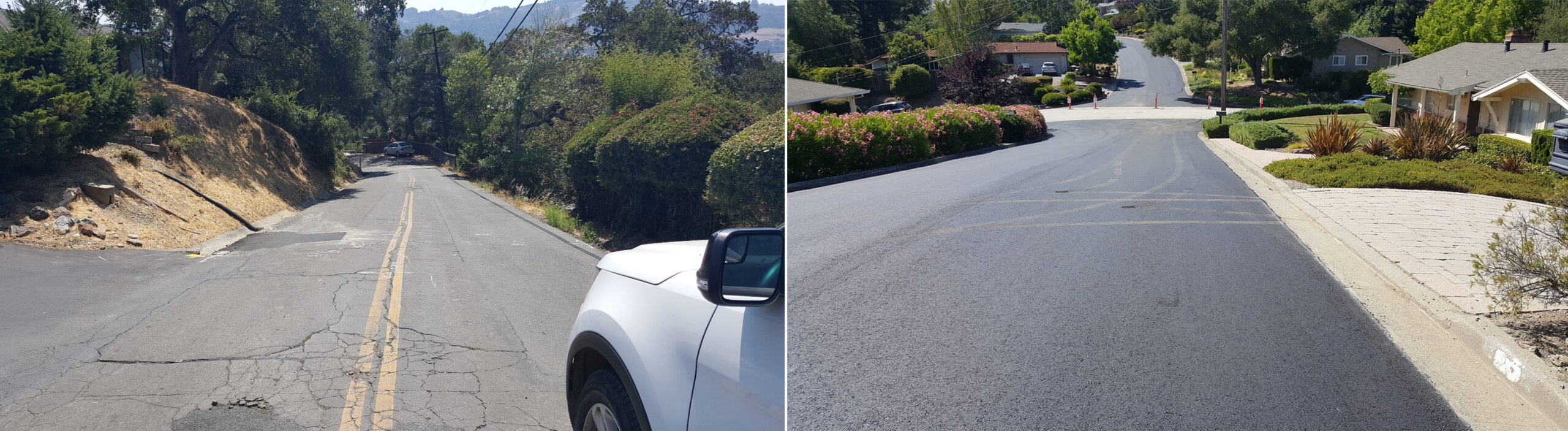
Before and after conditions of Orinda roads. Source: CalCities.org

By David Biggs, Orinda City Manager

First published on calcities.org

When it comes to voter issues, poor road quality is usually second only to housing or public safety. However, there often aren’t enough resources to repair every road, especially in smaller communities. So how did Orinda — a city with under 20,000 people in Contra Costa County — transform what were some of the Bay Area’s worst roads into its best roads?

A little over a decade ago, the city had an average Pavement Condition Index (PCI) of 48. Municipalities use the index to measure the severity and extent of distress on a pavement surface, like cracking and potholes. PCI ratings can range from 0 to 100. A lower rating signifies more roadway damage and conditions, which will require reconstruction rather than preventive maintenance. Reconstruction is much more costly than prevention.

Today, Orinda’s PCI is 84 — far higher than the Bay Area’s average PCI of 67 and the second highest in the Bay Area. This is a tale of community engagement, building trust, and keeping promises.

“It may seem trivial, but as a driver, you know how the road’s quality can greatly impact your driving experience and safety,” said Orinda resident and volunteer Bill Waterman. “No one wants to swerve around potholes and incur the additional costs of deteriorated streets. Plus, there is the basic civic pride in knowing the roads are back to high standards again.”

Road work in Orinda. Source: CalCities.org

Measure L: Just the beginning

Orinda was founded more than a century ago and was incorporated in 1985 after Proposition 13 (1978). As such, it inherited a 92-mile road network that suffered from a lack of investment and was developed for a rural community instead of a thriving suburb.

Orinda’s improved roads are largely thanks to voters’ decision to pass Measure L in 2012. The measure passed with a two-thirds majority — 7,569 to 3,311 votes. It wasn’t the first time the city had tried to pass such a measure, but it was the first time such a measure had passed.

“After testing the waters unsuccessfully previously about road funding measures, we turned to a group of community members with expertise in transportation and financing to develop a comprehensive road needs assessment and funding plan working with staff,” said Amy Worth, a former mayor and longtime council member. “That comprehensive plan was funded through successive measures presented and approved by the voters which built upon demonstrated success in improving street quality.”

Yet the 10-year funding source in the form of a half-cent sales tax override was just the beginning.

Continued investments yield long-term payoffs

Having seen the value in Measure L, voters in 2014 and 2016 approved two more bond measures totaling $45 million. Each year, property owners pay an average of just under $600 per parcel towards this strategic investment. This funding — in tandem with Measure L revenues, taxes, fees, funds, and grants — allowed the city to dramatically improve its PCI over the past decade.

Since 2013, the city has spent an average of $2.3 million per year on street maintenance and repair. But, even once upgraded, streets deteriorate due to normal wear and tear. With an eye to the future, the city council placed Measure R on the ballot in 2022 as Measure L’s 2023 expiration approached.

Since the approval of Measure L, the Citizens Infrastructure Oversight Commission presented an annual report to the city council that details the conditions of Orinda’s roads, spending, completed work, and projects on the horizon. Working with the commission, the city council convinced voters to approve the new full-cent sales tax by nearly two-thirds, Measure R.

This general tax provides for both public street maintenance and storm drain repair, as well as funding, for emerging needs, including wildfire risk reduction and emergency preparedness. Given the measure’s broader focus, the Measure L oversight commission was replaced with the Supplemental Sales Tax Oversight Commission.

The 2022 Annual Pavement Program utilized the last of the bond proceeds and Measure L revenues, along with some Measure R monies. It marked all but a few of Orinda’s public roads as completely rehabilitated, with the next few years calling for a more normal level of preventive maintenance.

Financing the future with local funding measures

Though the city has made great progress in repairing and improving infrastructure, there are further demands on the horizon. During a five-year, preventative maintenance period, Measure R funds will mostly go towards storm drain repairs — guided by a plan developed by the Citizens Oversight Commission — as well as wildfire prevention and emergency preparedness.

In early 2024, the city will re-evaluate options for addressing future roadway challenges, including those caused by recent weather and the state’s green infrastructure mandates, both of which will require more costly street work. Funding for future street maintenance will come, in part, from Measure R. However, city officials anticipate a funding shortfall in the long term due to higher costs.

Following a “fix it first” principle and extending the life of the city’s streets through strategic preventive maintenance will allow the city to avoid more costly reconstruction and accumulated deferred maintenance costs. These endeavors will be guided through collaboration with city partners, county, state, and federal agencies, and most importantly, residents.

This transformation highlights the importance of strategic funding and planned repairs and serves as a possible road map for other cities struggling with similar infrastructure challenges. It also serves as a reminder that passing local funding measures is never easy. Attempts to raise that threshold will only make it harder for cities to maintain their current levels of service — much less expand it to meet increased demand and mandates.

Gaining support for those measures — and protecting the ability of residents to dictate how their taxes are spent — is always worth trying!

The Cal Cities #LocalWorks initiative shines the spotlight on examples of local actions that are making a difference to their communities.


Filed Under: Construction, Government, Lamorinda, News

Antioch Mayor Pro Tem gives false testimony about Antioch cops in speech at UN meeting

October 11, 2023 By Publisher 8 Comments

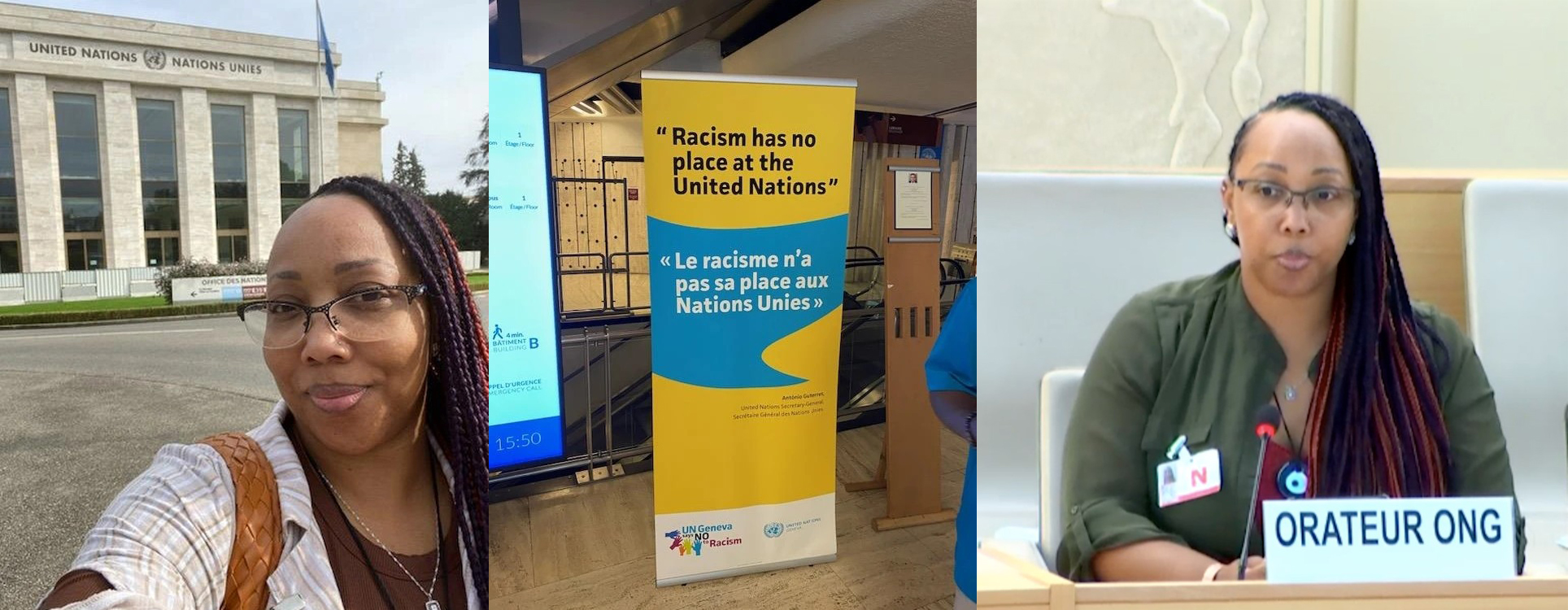
Antioch Mayor Pro Tem Tamisha Torres-Walker outside the UN building and speaking while at a conference in Geneva, Switzerland last week. Sources: (L & C) her official Facebook page and (R) Safe Return Project.

See 10/13/23 UPDATE with her responses to questions about her comments. Now claims “entire department…under review.”

Joined by another Contra Costa organization leader at Human Rights Council meeting in Geneva, Switzerland

“Tamisha Torres-Walker…has now misrepresented what is truly happening at the Antioch Police Department to the world…” – Mike Rains, APOA attorney

Fellow councilman also disputes her claims

By Allen D. Payton

In probably a first for an Antioch City Council member, according to an announcement by the Richmond, CA-based Safe Return Project, “on October 5, 2023, (Antioch Mayor Pro Tem) Tamisha Torres-Walker, (the organization’s) Executive Director and Co-Founder of, alongside James Heard, Director of Lift Up Contra Costa, sat in the grand auditorium in Geneva, Switzerland, at the United Nations to shed light on the decades of alleged racism and corruption of local law enforcement of nearly half the Antioch, CA police force and the impact on Black lives and civil rights at the 38th Meeting – 54th Session of Human Rights Council.”

The announcement also shared, “The United Nations Human Rights Council welcomed 45 speakers from around the globe who gave an enhanced interactive dialogue with the High Commissioner and the International Independent Expert Mechanism to Advance Racial Justice and Equality in Law Enforcement. The EDFU Foundation invited Tamisha for the prestigious honor of providing a statement before the Human Rights Council based on two reports, the EMLER and OHCHR.

The Human Rights Council will report back to the United Nations to make recommendations using the presented EMLER. OHCHR Report calls upon America to “do something” about the fundamental protection of human rights of Black people and their civil rights when it comes to cruel and unethical acts committed by the institution of American policing as well as ending the war on drugs, that has led to the incarceration and disenfranchisement of missions of Black Americans.

Torres-Walker’s statement to the Human Rights Council, United Nations, Geneva, Switzerland:

‘I was encouraged to see solutions to police corruption and use of force driven by community engagement stated prominently in the EMLER and OHCHR Reports.

Civilian oversight of law enforcement is a crucial and necessary mechanism that plays a vital role in ensuring transparency, accountability, and the protection of civil rights.

Antioch, CA, is the second most diverse city in the US Bay Area, with a population of over 115,000, with 20.2% of its population identifying as African American. It has a police department with more than 80% of its department sworn and non-sworn personnel under federal and state review for civil rights, use of force, and other violations of public trust.

Oversight serves as a check and balance and has the ability to promote sustainable solutions to public safety that are not simply alternatives to policing but have a higher success rate of preventing crime and harm while keeping communities safe.

Community-based solutions to public safety and protecting the rights of black Americans should be a priority, not over-policing and hypersurveillance. The city of Los Angeles’s police department’s budget, for example, is $3.2 billion annually and climbing; this is a budget the size of most developing countries’ military budgets. These sustainable solutions, like civilian peacemaker operations across America and elsewhere need to be funded at the same scale.

Again, thank you for this report, and thank Edfu Foundation for this opportunity.’”

False Information Corrected

However, part of what Torres-Walker shared is incorrect about the Antioch Police Department officers. As previously and extensively reported, the FBI and Contra Costa District Attorney’s Office have been investigating alleged “crimes of moral turpitude” involving a handful of Antioch officers. The larger number of officers caught up in the racist text scandal are undergoing an internal City investigation using an outside contracted investigator. (See related article)

Furthermore, of the 105 sworn officers currently on the Antioch Police force, 80% would mean 84 are under investigation which is not correct.

Questions for Torres-Walker Go Unanswered

Questions were sent to Torres-Walker asking her to back up her claims. She was asked, “where did you get your statistics and facts that you mentioned in your speech at the U.N. meeting last week? What state review of the sworn  and non-sworn personnel for civil rights, use of force and other violations of public trust is currently underway? Which agency is conducting it? Other than the FBI investigation, along with the CCDA’s office of the handful of officers for alleged ‘crimes of moral turpitude’ what federal review are 80% of the department’s sworn and non-sworn personnel undergoing? Which agency is conducting it? Why didn’t you say anything positive about our city? Do you think spreading negative and false information will benefit the Antioch Police Department and city? What good were or are you hoping to result from your speech? Are you wanting the United Nations to get involved in the current investigations of Antioch police officers? Did the City of Antioch pay for your trip?”

Questions for Chief, APOA VP & Attorney

Questions were also sent to Acting Antioch Police Chief Joe Vigil, APOA Vice President Lauren Bledsoe and APOA attorney Mike Rains asking for the details on the number of officers on the force and how many are under investigation.

APOA Attorney Says No State Involvement, Provides Correct Statistics

Michael Rains, of the Rains Luca Stern St. Phalle & Silver law firm, which represents the APOA responded with the following:

“Tamisha Torres-Walker is apparently not content simply misrepresenting the facts to the local media in Contra Costa County, or to the constituents in the City of Antioch.  She has now misrepresented what is truly happening at the Antioch Police Department to the world at a conference in  Geneva, Switzerland, which will no doubt give the City of Antioch a bad reputation internationally if someone cares to check the accuracy of her statement that ‘. . . 80% of (the Police Department’s ) sworn and non-sworn personnel are under federal and state review for civil rights, use of force, and other violations of public trust.’

First, she neglected to mention that the former Police Chief, Steven Ford, initiated a request on behalf of his Police Department for an ‘audit’ of the Department by the State of California Department of Justice. State DOJ stated that it was willing to conduct an audit but has not initiated any type of audit or review as of this date.

Civil rights attorney John Burris has ‘demanded’ that the federal government initiate an investigation of the department, but apparently, the federal government does not respond to Mr. Burris’ demands, and has thus not initiated an investigation or notified the department it intends to do so as of this date.

There is currently an administrative investigation underway relating to approximately 17 officers who have been placed on administrative leave by city officials (not at the direction of, or the concurrence by former Chief Steven Ford), for engaging in inappropriate text messaging on their personal cell phones. That pending administrative investigation has nothing to do with either civil rights violations or use of improper force.

The placement of those officers on administrative leave represents approximately 20% of the sworn workforce, not 80%, as stated by Torres-Walker, and of the 17 who have been languishing on paid administrative leave for over half this year, the incompetent City leaders (outside of the police department) who are supposedly ‘managing’ the administrative investigation by hiring ‘outside’ lawyers to interview the officers have only had about half of the officers interviewed thus far, and have no interviews at all scheduled for the other half.

Of the seven or eight officers who were interviewed, other than two who declined to answer questions and face discipline for that reason, there are no adverse findings in possession of the City against those officers.

Alternatively, the City leaders who are supposedly ‘managing’ the investigation, for whatever reason, including the fact that the findings by the outside lawyers do not play into the ‘racist culture’ narrative they have perpetuated, have not shared those findings with the officers or their attorneys.

It sounds like just another day of misrepresenting the truth to the public, but here the distortions were delivered to a much larger audience.”

Barbanica Disputes Torres-Walker

District 2 Councilman Mike Barbanica was also reached for comment and said in response, “I’m unaware of 80% of our department being investigated. I’m very proud of the city that I was raised in and still live in. Having the opportunity to speak on a world stage I would have personally used that opportunity to highlight the positives the city has to offer, while addressing those issues honestly and factually.”

“The investigation is going to weed out anyone who should not be part of our department. The system is designed to identify the bad cops and eliminate them and keep the good cops and make sure those who should be working are,” he continued. “It’s unfortunate, this issue is being dragged back into the news when the situation is being dealt with by the FBI, the DA’s office, the courts and internally through an independent investigator. But I want it to be reported factually. 80% of our officers being investigated is news to me.”

“What she could have said is there is a small number of officers that are being investigated by the FBI and DA’s office. The others are undergoing an internal investigation,” Barbanica added.

The announcement by Torres-Walker’s organization also shared, “The Human Rights Council will report back to the United Nations to make recommendations using the presented EMLER. OHCHR Report calls upon America to ‘do something’ about the fundamental protection of human rights of Black people and their civil rights when it comes to cruel and unethical acts committed by the institution of American policing as well as ending the war on drugs, that has led to the incarceration and disenfranchisement of missions of Black Americans.”

The others did not respond prior to publication time.

Watch the Full Session Enhanced ID: Excerpt Mechanism on Law Enforcement – 38th Meeting, 54th Regular Session of the Human Rights Council. See related documents: EMLER Report to OHCHR 2023 and OHCHR Report on EMLER 2023.

10/13/23 UPDATE: Torres-Walker Responds Doesn’t Back Up Her Claims

On Friday, Oct. 13, Torres-Walker responded to the emailed questions with general information and without providing details to back up her claims:

Q. Where did you get your statistics and facts that you mentioned in your speech at the U.N. meeting last week?

A. “The entire department has been under review that’s a fact. Not everyone has been indicted which is why my comments didn’t mention charges or terminations.”

Q. What state review of the sworn and non-sworn personnel for civil rights, use of force and other violations of public trust is currently underway? Which agency is conducting it?

A. “You as well as the public knows that there are officers and none sworn personnel facing federal and state charges not misinformation facts. There is also an internal investigation being led by the city attorney’s office again facts.”

Q. Other than the FBI investigation, along with the CCDA’s office of the handful of officers for alleged “crimes of moral turpitude” what federal review are 80% of the department’s sworn and non-sworn personnel undergoing? Which agency is conducting it? Why didn’t you say anything positive about our city?

A. “I was there to address the topic of law enforcement and its harmful impact on black people and people of color based on two UN Reports. Did you read the Reports? The issues facing the police department is public and has been devastating to the community what’s positive about that?”

Q. Do you think spreading negative and false information will benefit the Antioch Police Department and city? What good were or are you hoping to result from your speech? Are you wanting the United Nations to get involved in the current investigations of Antioch police officers?

A. “I also mentioned the budget of the Los Angeles police department the point was to get them to recommend investments in community based violence prevention and intervention programs as stated in my comments.”

Q. Finally, did the City of Antioch pay for your trip?

A. “Although I am a council member in Antioch and a resident of Antioch I attended the session as the director of Safe Return Project and a member of the lift up Contra Costa coalition. I included James if you have any questions for him on your fact finding mission.”

Torres-Walker was then asked, “which federal and state agencies are conducting a ‘review’ of the ‘entire department’?” She was also asked, “Where did you get your statistic of 80% of the department? What other personnel besides the sworn officers and the one CSO are under review or investigation?”

She responded simply, “You should be able to get that information from the city attorney.”

The questions and her responses were then sent on Saturday, October 14, to City Attorney Smith, Acting Police Chief Vigil and APD spokesmen asking for them to answer the questions posed to the councilwoman.

Please check back later for their responses and any other updates to this report.

Filed Under: East County, Government, International, News, Police

State Workforce Board awards $33 million to help rebuild California’s middle class

October 10, 2023 By Publisher Leave a Comment

The Resilient Workforce Program invests in opportunities that advance job quality, environmental resilience

Contra Costa Refinery Transition Partnership program receives $400K

By Anna Champe, Communications Manager, California Workforce Development Board

SACRAMENTO, CA – The California Workforce Development Board (CWDB), in partnership with the Labor & Workforce Development Agency, recently awarded $33,155,915 to nine projects across the state to advance High Road Training Partnerships (HRTPs) that move underserved populations into better jobs.

Monday’s funding announcement is part of a larger, multi-level investment to advance state workforce development efforts to prioritize equity, quality jobs, and climate resilience

while meeting regional labor market needs. With the addition of these nine new projects, California is investing more than $260 million in nearly 100 active state-funded HRTPs.

The Contra Costa Refinery Transition Partnership received $400,000 in RWF funding in Spring/Summer 2022.

“Funding for existing HRTPs, which invest in industry-led worker-informed efforts, deliver on Governor Newsom’s promise of a California for All,” said California Workforce Development Board Chief Deputy Director Curtis Notsinneh. “California continues to lead the nation in investments that recognize and lift up a middle-class, while meeting the skills needs of our employers to stay competitive and innovative.”

Projects receiving funding include:

  • $7.5 million for High Road to Tribal Forest Restoration and Stewardship – expands job pathways with living wages for underserved tribal and rural populations, including tree and native plant nursery work, forest health, and forest and meadow restoration.
  • $5.1 million for Early Care & Education Pathways to Success – this existing apprenticeship program will expand to new under-sourced regions and serve 655 new apprentices to earn certifications in education serving Pre-K to Third-grade students.
  • $5 million for Vocational English as a Second Language Home Care Immersion Training Program – Homebridge will partner with SEIU Local 2015 to provide language skills and advanced home care training to immigrant, refugee, and formerly incarcerated populations. Participants will immediately earn $25 an hour after graduating and have opportunities for advancement.
  • $5 million for Dental Assistant Training Program – will scale successful earn-as-you-learn bootcamps to more regions and fill the gap between unlicensed dental assistants and licensed Registered Dental Assistants. Target populations include low-wage workers, communities of color, youth, immigrants, and workers without a college degree.

Contra Costa Harnessing Change: Refinery Transition Partnership (CCRTP)

Contra Costa County (CCC) communities, particularly low-income communities of color, bear major health burdens inflicted by the refineries and their toxic emissions. Additionally, the Bay Area refineries emit significant amounts of climate warming greenhouse gasses, posing one of the state’s most significant challenges to climate resilience. As California works to establish a carbon neutral economy, the oil refining sector will unavoidably undergo a massive transition. This transition is already taking place in CCC, where two of the four refineries are transitioning to biofuels, resulting in a significant workforce reduction–most notably at the Marathon Martinez Refinery, which laid off approximately 700 workers in 2020.

The Contra Costa Refinery Transition Partnership (CCRTP) is the first effort to bring together frontline workers and community organizations to plan for refinery transition. CCCRTP brings together CCC oil refinery workers, the refinery community, allies, and high-road industry stakeholders to develop shared strategies to prepare for this significant economic shift, including leading research and developing policy recommendations to support refinery communities and workers, as well as the development of a regional high-road economic development vision to advance CCC’s economic resilience as the state transitions to a low-carbon economy.

This project addresses the critical need to plan for economic transition in one of California’s most oil-industry dependent counties, through deep engagement and shared visioning led by impacted workers and community members themselves, in partnership with the broader community of stakeholders.

Project Highlights

  • Strengthen the CCRTP for the long-term, as a coalition of frontline workers, community organizations and allies.
  • Complete and publish a detailed report and recommendations on planning for refinery transition in the Bay Area.
  • Complete and publish a Contra Costa High Road Economic Development Vision.

Key Partners

  • Contra Costa Central Labor Council
  • BlueGreen Alliance Foundation
  • United Steelworkers District 12
  • United Steelworkers Local 5
  • UA Plumbers & Steamfitters Local 342
  • Asian Pacific Environmental Network
  • California Labor Federation, Workforce & Economic Development (WED)
  • UC Berkeley Labor Center

A complete list of awardees can be found on CWDB’s website.

Allen D. Payton contributed to this report.

Filed Under: Environment, Government, Industry, Jobs & Economic Development, News

First meeting of Contra Costa committee formed to address modeled sea level rise Oct. 12

October 9, 2023 By Publisher Leave a Comment

Martinez Regional Shoreline Park by LisaVorderbrueggen. Source: CC County

Supes Gioia, Burgis lead Contra Costa Resilient Shoreline Ad Hoc Committee

Thursday from 10 a.m. to 11:30 a.m. via Zoom

By Ryan Hernandez, Principal Planner, Contra Costa County Department of Conservation and Development

With warmer temperatures and more extreme weather, sea level rise modeling indicates Contra Costa County’s shoreline, which includes a variety of residential, business, industrial, infrastructure, and natural sites, can expect to be subject to more severe and frequent flooding.

To address sea level rise, the Board established the Contra Costa Resilient Shoreline Ad Hoc Committee at the May 16, 2023, Board of Supervisors meeting. Supervisor John Gioia, whose district borders the San Francisco Bay, was appointed as Chair, and Supervisor Diane Burgis, whose district borders the Sacramento-San Joaquin Delta, was appointed as Vice-Chair of the Committee.

Funded through Measure X, the Committee will develop recommendations to the Board on work the County can do to plan for sea level rise and improve shoreline resiliency, which could potentially include a sea level rise resilience and adaptation plan. This would build on the County’s past work on collaborative regional efforts to characterize sea level rise risks with the San Francisco Bay Conservation and Development Commission and the Delta Stewardship Council.

The Plan could include recommendations for built and natural infrastructure improvements and potential land use planning changes, implementation strategies, and participatory engagement opportunities for stakeholders. With the creation of this Committee, the County will be better prepared to adapt to rising sea levels with strategies specific to the current and future needs of Contra Costa communities.

The Contra Costa Resilient Shoreline Ad Hoc Committee’s first meeting will occur on Thursday, October 12, 2023, from 10 a.m. to 11:30 a.m. via Zoom with in-person meeting locations listed in the published agenda packet. To sign up for email updates, visit the Contra Costa Legistar website.

Allen D. Payton contributed to this report.


Filed Under: Environment, Government

Antioch Council opposes returning to public comments via Zoom to avoid abuse, hate speech

October 6, 2023 By Publisher Leave a Comment

Antioch Mayor Pro Tem Tamisha Torres-Walker speaks on teleconferencing as District 2 Councilman Mike Barbanica listens during the city council meeting on Sept. 26, 2023. Video screenshot.

Joins other cities in ending the practice

Torres-Walker only Antioch council member to want it

East County Rabbi responds to hate speech during Brentwood Council meeting

By Allen D. Payton

During their meeting on Tuesday, Sept. 26, 2023, the Antioch City Council by a vote of 3-1-1 decided to not return to allowing call-in public comments via Zoom the same night the Brentwood City Council received a call filled with anti-semitic hate speech. Antioch joins other cities throughout the state ending the remote public comments due to the abuse of the medium which increased in use during the response to COVID. But Mayor Pro Tem Tamisha Torres-Walker who voted against the motion wasn’t happy about it and accused her fellow council members of voting based on politics, with District 4 Councilwoman Monica Wilson, who voted to abstain, running for State Assembly, District 2 Councilman Mike Barbanica running for County Supervisor and Mayor Lamar Thorpe facing re-election next year. (District 3 Councilwoman Lori Ogorchock’s seat is up for election next year, as well but she can’t run for it, as she was moved into District 4 due to gerrymandering during last year’s council redistricting process).

Following public comments on the item, Torres-Walker was the only council member to speak on the matter arguing in favor of allowing public comments via teleconferencing. (See 3:09:30 mark of meeting video)

“I keep asking for it to come back. If the council has to be here, the council has to be here. We ran to show up and there’s a large public that want to be here. There are rules that have been made up as we go. There’s a large part of the public that can’t be here in person”

“If we can’t take time to listen to the people whose business we’re doing then none of us should be up here. So, I think at least the public should be able to participate and teleconference in,” Torres-Walker said.

“I sat here for almost three years with people calling in over Zoom calling me everything but a child of God, grossly misinformed all the time, and I was told to get a thick skin. Nobody wanted to vote to take teleconferencing away until they started experiencing that same backlash. Now, it’s like if someone wants to talk crap to me they gotta show up in person. They should be able to use teleconferencing to do it and we all need to get a thick skin…and we should bring teleconferencing back for the public.”

“We are not making up rules as they go along. They’ve been written in the agenda for some time,” Thorpe responded. “Not making two comments at the meeting was pointed out by the City Clerk’s Office. We just didn’t enforce the rule and I was pointed out that we needed to enforce the rule by the City Clerk’s Office.”

Barbanica then moved approval, seconded by Ogorchock to continue holding city council, board and commission meetings in person without teleconferencing. Without any further discussion, the motion was adopted.

But it was at the end of the meeting, during the Council Communications and Future Agena Items portion, that Torres-Walker took a swipe at her fellow council members for their decision saying, “I’ve always been against ending teleconferencing. Because no matter whether I like to hear what the public has to say or not, I listen. Tonight, I think what we just saw was like, replay this because you just got to see people say they don’t want to hear you. And so, because we are coming up on an election year, they’re going to want to hear from you when they’re knocking on your doors, canvassing your neighborhood and they’re going to want to have your vote when you go to the ballot. So, I’m going to keep asking for this to keep coming back whether we vote for it or not.” She asked for it to return to an agenda for further discussion.” (See 3:36:04 mark of meeting video)

Her accusation didn’t sit well with Barbanica, who said later, “That was a ridiculous comment by her. Absolutely ridiculous. Let’s not allow people to abuse the system and target people.”

“So, if Tamisha doesn’t get her way, she’s going to weaponize others of us running for office?” he asked. “We never did that to her. I could not believe she made that statement.”

“As she was making that statement, the Brentwood Council fell victim to exactly the reason we made the decision to not to return to public comments by Zoom. It was abused,” the District 3 Councilman continued. “We had people appearing to be intoxicated, singing, using profanity. There are other cities that are having religious groups, etcetera being singled out. I was told by city administration that other cities have experienced people going on Zoom making pro-Nazi, anti-semitic comments, faking their names, using names of famous Nazis. That was the exact thing we were concerned with.”

“It was done during COVID when people couldn’t attend meetings in person,” he explained. “This has nothing to do with elections. We are still making sure people are heard. To sit at home and hide behind your keyboard and use Zoom as a weapon to spread hate speech and your own personal hate was never the intent.”

“Lamar and I had it happen to us during subcommittee meetings,” Barbanica shared. “They tried to put photographs up on the screen. We killed it. But it showed me right there how people have abused the system. When I was at Cal Cities, they had a talk about it, that people were weaponizing it for their own hate speech.”

Racist Comments on Zoom Call-In During Brentwood Council Meeting

An Oct. 1st tweet on X by the Brentwood Press confirmed Barbanica’s comment. It reads, “at our City Council meeting (Tuesday) night, a man called in to talk about kosher soap developed in Germany. He was cut off as this comment did not seem to be on topic, and he yelled, ‘Heil Hitler! White Power!’ before hanging up.” A resident submitted a letter to the editor decrying the hate speech.

According to an Oct. 4 ContraCosta.News report, Brentwood Mayor Joel Bryant apologized to the public for hearing the comment and Brentwood City Manager Tim Ogden issued a statement condemning the hate speech.

Brentwood Rabbi Responds

In response to the comments made during the Brentwood City Council meeting, Rabbi Peretz Goldshmid, Director of Chabad of the Delta said, “When it’s dark outside you don’t need to be told you need a flashlight. This is the time to call for everyone to stand up and say something positive in response.”

“When one idiot talks, we need a thousand people to stand up and respond. Instead of the story being hate speech it should be about the thousand people offering good speech,” he continued. “The only way to stop the damage is with positivity in general and specifically about this incident.”

Peretz issued the following statement on Oct. 4:

“Positivity is the best weapon against antisemitism. Such awful sentiments must be responded to! Every individual, and especially those with a platform, should make a clear statement that we do not accept such behavior and that, on the contrary, we stand with the Jewish community and all that stands for good.

When we do, the attempted attacker will learn that negativity will always be met with an outpouring of positivity. So, I invite you to be part of the positive response!

It is also important to remember that antisemitism is not just a problem for the Jewish community. It is a problem for all of us. When we stand up against antisemitism, we stand up for justice and equality for all people.”

Walnut Creek City Council Also Ends Remote Public Comments

Remote public comments during Walnut Creek City Council meetings were also discontinued City Manager Dan Buckshi announced during his report on Tuesday, Oct. 3, 2023. He said council meeting public comments have been hijacked throughout the state.


Filed Under: East County, Government, News

  • « Previous Page
  • 1
  • …
  • 12
  • 13
  • 14
  • 15
  • 16
  • …
  • 44
  • Next Page »
Furniture-Clearance-02-26B
Celia's-3-26-A
Delta-RC-A
Deer-Valley-Chiro-06-22

Copyright © 2026 · Contra Costa Herald · Site by Clifton Creative Web