• Home
  • About The Herald
  • Local Agencies
  • Daily Email Update
  • Legal Notices
  • Classified Ads

Contra Costa Herald

News Of By and For The People of Contra Costa County, California

  • Arts & Entertainment
  • Business
  • Community
  • Crime
  • Dining
  • Education
  • Faith
  • Health
  • News
  • Politics & Elections
  • Real Estate

Joint Contra Costa DA, Air District prosecution secures $10.6M from Martinez Refining Company

February 19, 2026 By Publisher Leave a Comment

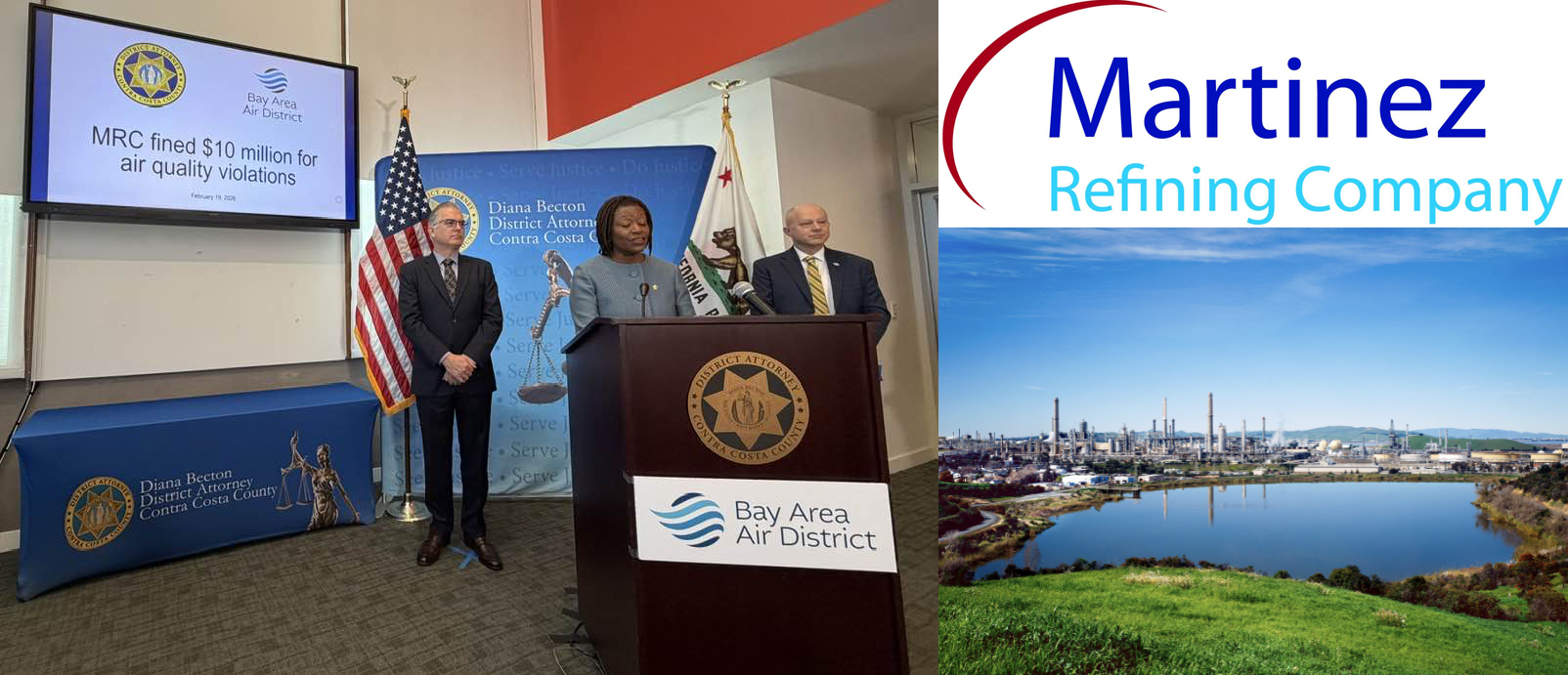
Contra Costa DA Diana Becton is joined by Deputy District Attorney Brian Tierney and Bay Area Air District General Counsel Alexander Crockett during a press conference on Thursday, Feb. 19, 2026. Photo courtesy of Supervisor John Gioia, Contra Costa County’s representative on the Air District Board.

For violations between 2020 and 2024, doesn’t include Feb. 2025 fire; will benefit multiple agencies

“We are committed to safe, reliable, and environmentally responsible operations and to being actively engaged locally.” – from MRC statement

By Ted Asregadoo, PIO, Contra Costa District Attorney’s Office

Martinez, California – A joint prosecution by the Contra Costa District Attorney and Bay Area Air District has resulted in a $10 million penalty against Martinez Refining Company (MRC), along with compliance improvements at its Martinez refinery, and $600,000 in mitigation payments for supplemental environmental projects.

Judge Benjamin T. Reyes, II signed the final judgment on February 18th, 2026. The case involved a number of violations that occurred at MRC’s refinery located at 3495 Pacheco Boulevard in the City of Martinez and unincorporated Contra Costa County between early 2020 and late 2024, including offenses under the health and safety code, business and professions code, and fish and game code.

The complaint stemmed from violations over four years, including MRC’s 2022 Thanksgiving Day release of spent catalyst that covered parts of Martinez in a white ash-like substance. Other major violations included illegal flaring, fires, leaking tanks, public nuisance-level odors in downtown Martinez, and releases of “coke dust” — a powdery oil refining byproduct — spreading beyond the refinery’s fence line onto neighboring properties. The violations are described in 163 notices of violation issued by the Air District.

This enforcement action does not include the February 1, 2025, fire at the MRC refinery. The Air District is addressing that incident through a separate enforcement action. (See related articles here and here)

District Attorney Diana Becton said, “The residents of Martinez deserve to feel safe in their communities. This civil action holds the Martinez Refining Company accountable for numerous violations, enforces compliance with the law, and reinforces our office’s dedication to protecting public health and safety through all available legal means, including civil action.”

Distribution of $10 Million Penalty

The $10 million penalty will be distributed as follows:

  • $6.35 million to the Air District, most of which will be reinvested in beneficial projects in Martinez and the surrounding areas that were impacted by these violations under the Air District’s Community Benefits Penalty Funds Policy
  • $3.5 million to the District Attorney’s Office Environmental Unit for enforcement efforts
  • $100,000 to Contra Costa Health Services
  • $50,000 to the California Department of Fish and Wildlife

In addition to the $10 million penalty, MRC will also pay $600,000 in mitigation payments to fund supplemental environmental projects. These payments include:

  • $450,000 for air filtration systems in public schools near the Martinez Refinery Company
  • $100,000 to the Certified Unified Program Agency for environmental regulator scholarships
  • $50,000 to Contra Costa County Fish and Game’s Community Propagation Fund to enhance the county’s fish and wildlife resources

Moreover, the judgment requires MRC to change how it operates its catalytic cracking unit to keep key emissions control equipment operational during startup and shutdown operations. The company is also required to install enhanced emissions monitoring systems on various other pieces of equipment.

“This enforcement action reflects significant air quality violations and makes clear that compliance with air quality laws is mandatory,” said Alexander Crockett, the Air District’s general counsel. “The penalty the Air District is collecting through this action will support local and regional projects that improve air quality and public health under our Community Benefits Policy. Strong enforcement ensures accountability while directing resources back to the communities most affected by pollution.”

The attorneys prosecuting the case include Deputy District Attorney Bryan Tierney; Assistant District Attorney Stacey Grassini; and Air District Assistant Counsel Brian Case.

MRC Responds

Asked if MRC had a response, Dominic Aliano, Community & Government Relations Manager for MRC, shared the following: “Martinez Refining Company (MRC) is pleased to announce the settlement of the joint civil enforcement action initiated by the Contra Costa County District Attorney (District Attorney) and the Bay Area Air District (Air District) in November 2023 involving multiple agencies, including the Air District, Department of Fish and Wildlife, and Contra Costa County Health. The parties agreed to the settlement without trial or adjudication of facts or law, and MRC has made no admission of liability to any of the underlying allegations and/or claims.  The settlement resolves all notices of violations issued by the Air District against MRC from February 1, 2020, to February 1, 2025, including those related to the November 2022 catalyst release, and the July 11 and October 6, 2023, coke dust releases, for total civil penalties of $6.35 million. (See related articles here, here, here, here and here)

“MRC will separately pay civil penalties of $100,000 to Contra Costa Health Services and $50,000 to the California Department of Fish & Wildlife for other notices of violations.  The Contra Costa County District Attorney’s Office will receive $3.5 million for its involvement in the action.

“MRC recognizes that we must earn the right to operate in Martinez and that we have a responsibility to be involved in and to give back to the Martinez community. We are committed to safe, reliable, and environmentally responsible operations and to being actively engaged locally. In resolving these matters, MRC included provisions directly for the benefit of the Martinez community. As a result:

  • MRC is providing $450,000 to fund high-performance air filtration systems projects at public schools in the vicinity of the refinery.  Allocation of the funds will be prioritized based on proximity of the applicant schools to the refinery.  The District Attorney and MRC will be providing further information on how public schools located in the City of Martinez can apply to receive the funds.
  • MRC is providing $50,000 to fund the Contra Costa County Fish and Wildlife Committee Propagation Fund to enhance the county’s fish and wildlife resources in the local community.
  • MRC is providing $100,000 to the Certified Unified Program Agency (CUPA) Forum Environmental Protection Trust Fund for scholarships to attend and participate in the annual California Unified Program Annual Training Conference and other trainings to benefit Contra Costa County local CUPAs.

“We thank our employees for their hard work and dedication to safe and reliable operations.  We also thank the District Attorney and Air District for working constructively with us to resolve these matters.

“We look forward to continuing to safely manufacture products that fuel the economy and help make modern life possible.”

City of Martinez responds to Martinez Refining Company violations, penalties

Martinez, CA — The City of Martinez acknowledges the recent announcement by the Contra Costa County District Attorney’s Office and the Bay Area Air District of a $10 million civil penalty assessment on the Martinez Refining Company (MRC), owned by PBF Energy and located in unincorporated Contra Costa County, for violations occurring between 2020 and 2024. In total, 163 notices of violation are addressed by this penalty, including the November 2022 spent catalyst release incident.

Mayor Brianne Zorn noted the significance of this development, stating, “This action is a meaningful first step in addressing the impacts our community has experienced. We appreciate that resources will soon begin to reach Martinez and help protect some of the most vulnerable members of our community, our children. We will continue to follow the process closely as grant funds are made available through the District’s Community Benefits Fund to improve the health and safety of Martinez and our neighbors.”

As outlined in the announcement, the Air District will receive $6.35 million and intends to allocate most of this amount toward community-focused grants under its Community Benefits Penalty Funds Policy, with the intention of funding projects beneficial to residents of Martinez and other affected communities. The grant process for these specific funds is not yet available for applications, and more information about the process and eligibility will be provided by the Air District as the grant process is finalized.

In addition to the $10 million penalty, MRC will also pay $600,000 in mitigation payments to fund supplemental environmental projects, including $450,000 towards air filtration improvements in schools located near the refinery. This initial investment will provide a necessary tangible benefit to students and school faculty within our affected community.

Moreover, the judgment requires MRC to change how it operates its catalytic cracking unit, and the company is also required to install enhanced emissions-monitoring systems on various other pieces of equipment.

This enforcement action does not address incidents that occurred in 2025, including the February 1, 2025 fire incident at MRC. Those matters remain under separate review by the appropriate regulatory agencies. The City will continue to monitor those processes and appreciates the ongoing commitment of the District Attorney’s Office and the Air District to advocate for our community’s health, safety, and wellbeing.

Information Resources:

Bay Area Air District Community Investments Office – https://www.baaqmd.gov/en/community-health/community-investments-office

About the Air District

The Bay Area Air District (formerly the Bay Area Air Quality Management District) is the regional agency responsible for protecting air quality and the global climate in the nine-county Bay Area. Connect with the Air District via Facebook, X, Instagram, YouTube and on their website at www.baaqmd.gov.

About Martinez Refinery Company

According to the company’s LinkedIn profile, the Martinez plant was built in 1915 and refines gasoline, diesel and jet fuel. As the first continuously running refinery in the United States, Martinez is considered the ‘birthplace of the modern refining process’. In 2020, Martinez became part of the PBF Energy Family of Refineries has 560 employees, 250 contract partners and is owned by New Jersey-based PBF Energy. According to the parent company’s website, it “is one of the largest independent petroleum refiners and suppliers of unbranded transportation fuels, heating oil, petrochemical feedstocks, lubricants and other petroleum products in the United States.” For more information visit https://martinezrefiningcompany.com.

Case No. C-26-00490 | The People of the State of California v. Martinez Refining Company, LLC

Filed Under: Central County, District Attorney, Environment, Government, Industry, News

CCWD Division 2 Director Burgh to step down March 31st

February 19, 2026 By Publisher Leave a Comment

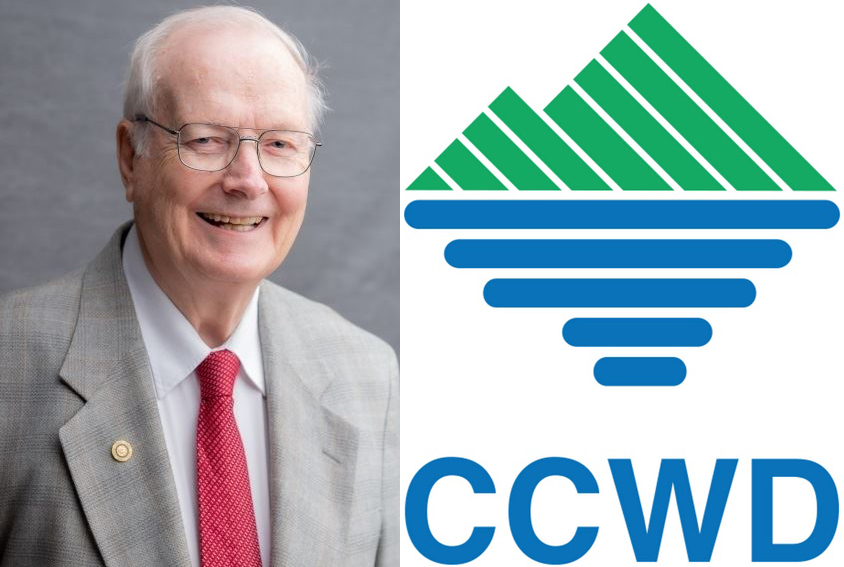
CCWD Division 2 Director John Burgh will step down after 22 years on March 31, 2026. Photo: CCWD

After representing Central County communities for 22 years on Board

“CCWD is on a solid path investing in the next generation of water service with a collaborative Board and innovative staff.” – Director Burgh

By Nicola McCluney, Management Assistant, Public Affairs, Contra Costa Water District

Concord – During the Board meeting on February 18, Contra Costa Water District’s Board Director, John A. Burgh, announced that after 22 years representing the community on water issues, he will step down from the Board effective March 31, 2026.

Director Burgh was appointed to the Contra Costa Water District (CCWD) Board of Directors in 2004. He represents Division 2, which includes Pleasant Hill, Martinez, Port Costa and a portion of Concord. During his 22-year tenure, he served on the Public Information & Conservation, Operations & Engineering, Finance and Retirement & OPEB Joint Advisory Committees.

Director Burgh’s 42-year professional career, working as an engineer on water and wastewater projects throughout the world, gave him a unique perspective joining the CCWD Board.  His technical expertise translated to thoughtful policy decisions ensuring CCWD makes sound investments in critical infrastructure to the benefit of all customers, including future generations. While serving on the CCWD Board, his highest priorities have been transparency in spending public dollars, regional collaboration and smart infrastructure investments based on the best available data.

“It has been my honor to represent my neighbors on the CCWD Board for 22 years,” said Burgh. “This Board operates at the highest level of transparency and accountability. I have learned so much from each of my colleagues and always appreciated the respectful discussions, especially when we had differing points of view.”

When asked about his decision to step down from the board, Burgh responded, “While a tough decision, CCWD is on a solid path investing in the next generation of water service with a collaborative Board and innovative staff. For my own personal reasons, this felt like the right time for me to step down and provide an opening for the next generation of water policy leaders.”

According to his bio on the CCWD website, Burgh is a retired engineer who has worked on water and wastewater projects throughout the world. He has a total of 42 years of experience in the administration, project management and design of public works projects.

For the last 30 years of his career, he worked for an environmental engineering consulting firm, where he retired as vice president.

Burgh holds a Bachelor of Science degree from the University of Notre Dame and a master’s degree in management from the University of New Mexico. He is a registered civil engineer in California and an Air Force veteran.

He is a past President of the Contra Costa County Historical Society. A resident of Concord for over 35 years, he is a member of the Pleasant Hill Rotary Club and is a volunteer driver for Meals on Wheels, delivering meals to shut-in senior citizens in the area.

Director Burgh’s last day is March 31, and the Board will need to decide to fill the vacancy for Division 2 by appointment or election.

Allen D. Payton contributed to this report.

Filed Under: Central County, Government, News, People, Politics & Elections, Water

Steve Hilton’s CAL DOGE claims $370M for substance abuse education funneled to “Leftwing political activism”

February 13, 2026 By Publisher Leave a Comment

“Califraudia” estimated at $250 billion of fraud, waste and abuse

By Jenny Rae Le Roux, Director, CAL DOGE

SACRAMENTO, CA — Today, CAL DOGE, the unofficial California Department of Government Efficiency, launched on Jan. 26th by candidates for governor, Steve Hilton and for state controller, Herb Morgan, announced it has untangled a web of funding from the Prop 64 (state marijuana legalization law) authorized California Cannabis Tax Fund (CCTF) – supposed to be used for substance abuse prevention – that instead is building the Democrat political machine in California.

An investigation into Elevate Youth California, which is one of the financial intermediaries that received $370M from the CCTF, found that Elevate Youth distributed 517 micro-grants, with an average grant size of $700K, to multiple organizations that do nothing related to substance abuse and instead build the Democrat voter base. These organizations explicitly fund “social justice youth development”, “civic engagement”, and “power building.”

According to Prop 64 and the supposed oversight group for Elevate Youth, The Center at Sierra Health Foundation, the tax is designated to support “funding and technical assistance for organizations that are developing or increasing community substance use disorder prevention, outreach and education focused on youth.” Instead, Elevate Youth is distributing funds to organizations – such as $1M for “civic engagement” to Young Invincibles, which has stated values of “Young Adult Power, Equity, Community, Collaboration, and Bold Ideas” but says and does nothing related to substance abuse prevention.

“After collecting $1 billion annually from the Cannabis Tax, that money should be spent on substance abuse prevention as stated in the law, not political organizing to keep Democrats in charge of California’s decline,” said Jenny Rae Le Roux, Director of CAL DOGE. “Funneling money through financial intermediaries to hundreds of non-profits that spend those funds on partisan Democrat political organizing must stop, and the age of accountability must begin.”

Other grantee organizations, such as the Jakara Movement Grant, which was provided $1M for Sikh youth empowerment and voter registration, and Asian Refugees United, which was granted $800K for LGBTQ+ Asian Storytelling, have no connection to substance abuse prevention.

Estimates $250 Billion of Fraud, Waste and Abuse

Based on a preliminary review by Hilton, and his running mate Morgan, entitled “Califraudia”, California’s exposure to fraud, waste, and abuse across major state programs is estimated at $250 billion. This estimate, based on independent analysis, underscores the urgent need for formal audits, investigations, and enforcement as a matter of basic fiscal responsibility.

Hilton added, “In seven days of work, CAL DOGE has already uncovered more fraud than Gavin Newsom and his regime have done in their seven years in power. And we’re not even elected yet! This is exactly why I set up CAL DOGE in the first place, to expose fraud and corruption in the system so we can act to stop it on day one. Democrats and their shadow network of leftist front organizations are stealing taxpayers’ money for their own partisan ends. We pay the highest taxes in the country yet get the worst results – and now we are finding out why, and where our money is really going. There is much more to come from CAL DOGE and its work will play a huge part in ending 16 years of Democrat one party rule this November.”

Following are additional details on the investigation and the team that connected the dots:

Californians Voted For the $370 Million in Cannabis Tax Dollars to Fund “Drug Prevention.” Instead, the Tax Bankrolls Leftwing Political Activism.

When California voters approved Proposition 64 in 2016, they were told cannabis tax revenue would fund youth substance abuse prevention. Six years and $370.25 million later, Rhetor’s AI-powered forensic audit — conducted in partnership with CalDOGE — reveals where that money actually went: into a sprawling network of 517 grants funding political organizing, voter registration drives and “social justice youth development,” all administered by a single nonprofit intermediary operating as a shadow agency of the state.

How the Money Moves

The California Department of Health Care Services does not distribute Proposition 64 cannabis tax funds directly to community organizations. Instead, they issue a master contract to The Center at Sierra Health Foundation, a 501(c)(3) that has become the de facto bank for the state’s equity, prevention and youth funding.

The Center at Sierra Health Foundation retains 15 to 20 percent in administrative fees then sub-grants the remaining funds to community-based organizations through its own application process.

The state does not pick who gets the grants. The intermediary does, bypassing the rigorous procurement processes mandated for direct government contracts under the Department of General Services and State Controller oversight.

The result is a three-stage pipeline — master contract to fiscal intermediary to sub-grants — that creates layers of separation between taxpayer dollars and their ultimate use.

Lining the Governor’s Pockets

The pipeline starts with the governor’s office, and the relationship between The Center at Sierra Health Foundation and the governor extends well beyond a standard contract. According to the California Fair Political Practices Commission’s Behested Payment Transparency Report (pg.19-20), in 2020 alone, Sierra Health Foundation was the third-largest payor of behested payments statewide at $14,747,724 and the single largest payee of behested payments statewide at $30,869,901 — payments Newsom solicited from private companies.

Newsom himself was the top behesting official in the state that year at $226.8 million total (pg. 20), and Sierra Health Foundation ranked among his top three financial partners in the system.

The financial trajectory of The Center at Sierra Health Foundation tracks accordingly. IRS Form 990 filings show The Center’s revenue exploded from $11.8 million in 2018 to $197 million in 2024 — with 96.5 percent of that revenue coming from government contracts. The Center’s CEO Chet Hewitt’s total compensation rose from $407,726 to $612,730 over the same period, a 50 percent increase that mirrors the growth in state contract volume almost perfectly. Behested payments are legal in California with no dollar limits, but the California Fair Political Practices Commission itself flagged the scale as concerning enough to implement new transparency regulations.

The Grants Say the Quiet Part Out Loud

The pipeline flows from the governor’s office to the The Center at Sierra Health Foundation, the fiscal intermediary, who determines grant recipients. Rather than awarding grants to recipients that qualify for Proposition 64’s original purpose — fighting substance abuse — The Center uses Prop. 64’s taxpayer dollars to fund leftwing activist organizations.

Elevate Youth, for example, the most significant vertical managed by The Center, is funded exclusively by Prop. 64 taxpayer dollars. Yet Elevate Youth’s grant application form explicitly names “social justice youth development” and “civic engagement” as criteria for grantees, terms that appear nowhere in the statutory language of Prop. 64’s Youth Education, Prevention, Early Intervention, and Treatment Account.

Similarly, grant recipients, like United Way of Santa Cruz County, which was awarded $834,075.00 from Elevate Youth, focuses on “activism” and “BILPOC (Black, Indigenous, Latino, and People of Color) and LGBTQ+ youth and families.”

Voters approved cannabis tax revenue for substance abuse prevention. DHCS redefined “prevention” to include political organizing — then buried it inside the grant criteria of a nonprofit intermediary most Californians have never heard of.

Political Activism at Clinical Prices

The math exposes the disconnect.

According to the DHCS YEPEITA report, the Elevate Youth program reached 89,727 participants. Divide $370.25 million by that figure and the cost per participant is $4,126.

Actual clinical substance abuse treatment costs between $2,000 and $5,000 per patient. Elevate Youth California is charging clinical-grade prices for non-clinical projects, including “civic engagement” workshops, leadership development seminars and “community mobilizing” training. These are not treatment programs. They are organizing programs priced like treatment programs.

The Receipts

Elevate Youth’s specific grant awards make the mislabeling undeniable.

Since 2020, the Jakara Movement has received $1.8 million for “Sikh youth empowerment and prevention.” Grant activities include voter registration drives. Under the program’s framework, registering voters is classified as substance abuse prevention.

Pacific Clinics received $1 million for its “Youth IMPACT Project” — designed to “strengthen the leadership skills” of immigrant youth and “mobilize people to achieve change.”

The Center does not hide its ideological aims. They are codified in its program descriptions. The San Joaquin Valley Health Fund lists “power building” and “civic engagement” as core pillars of its health equity strategy. The Center has funded partners to conduct door-to-door canvassing for the Census and voter registration — explicitly linking political capital to health outcomes.

Hidden in a Sea of Grants.

The $370.25 million was not distributed through a handful of large, auditable contracts. It was dispersed across 517 individual grants, averaging $716,150 each.

This fragmentation makes traditional auditing nearly impossible. No single grant is large enough to trigger intensive audit scrutiny. The dispersal prevents consolidated oversight of outcomes. And because The Center — not the state — manages the sub-granting process, no single state auditor has a comprehensive view of where the money lands or what it produces.

How Rhetor Found It

This is the kind of fraud pattern that manual auditors miss by design. When grants are deliberately fragmented across hundreds of recipients, the mislabeling only becomes visible at scale.

Rhetor’s AI analysis — deployed as part of its CAL DOGE partnership — cross-referenced RFA language, grant award descriptions, cost-per-participant calculations and program outcome reporting across the full portfolio of 517 grants. The pattern detection surfaced what no individual audit could: a systematic reclassification of political organizing as public health spending, replicated across hundreds of awards.

What This Means

Californians voted for youth drug prevention. They got a taxpayer-funded political organizing infrastructure — administered by an unelected nonprofit, shielded from procurement oversight and priced at clinical treatment rates for activities that have nothing to do with substance abuse.

The receipts are public. The grant guidelines are public. The cost-per-participant math is public. None of this was hidden. It was just fragmented enough that no one was supposed to connect the dots.

Rhetor and CAL DOGE connected them. The question now is whether Californians will act or wait until Sacramento sends the next $370 million into the same pipeline.

Note: The original figure cited for Elevate Youth’s funding for the Jakara Movement was $350,000. Our updated data found that Elevate Youth has granted $1.8 million to the Jakara Movement since 2020.

See CAL DOGE Elevate Youth report.

About CAL DOGE

The CAL DOGE team includes investigators, tech advisors and citizen journalists. If you have a tip, send it to Califraud.com, a secure whistleblower platform, paid for by the Steve Hilton for Governor 2026 campaign, that allows current and former state employees and members of the public to report fraud, waste, abuse and systemic mismanagement without fear of retaliation.

CAL DOGE, named after Elon Musk’s DOGE which was formed and worked to find wasteful spending, fraud and abuse in the federal government and disbanded last November, is not the same as California DOGE, started in Nov. 2024. The new effort publishes findings, tracks spending at the program level, and advances reform proposals to restore trust, lower costs, and make California government work again for the people who pay for it. For more information see https://caldoge.rhetor.ai.

Allen D. Payton contributed to this report.

Filed Under: Cannabis, Finances, Government, News, Politics & Elections, State of California

Serve on the Contra Costa County Treasury Oversight Committee

February 13, 2026 By Publisher Leave a Comment

Application Deadline: March 5

By Contra Costa County Office of Communications & Media

(Martinez, CA) –  The Contra Costa County Board of Supervisors is seeking individuals with sound knowledge and experience in the field of public and private finance, to serve on the Treasury Oversight Committee (Committee) for the seat representing the Alternate County Board of Supervisors, Public Representative Seat 1, and Public Representative Seat 2 for term May 1, 2026 to April 30, 2030.

The Board of Supervisors established the Committee on November 14, 1995. The Committee’s duties include reviewing and monitoring the County Treasurer’s Annual Investment Policy, and ensuring an annual audit is conducted to determine the County Treasurer is in compliance with Government Code §§27130-27137.

The annual audits, meeting agendas, and minutes of the Committee are available online: www.contracosta.ca.gov/690/Treasury-Oversight-Committee. Members of the Committee receive no compensation for their service.

To be considered, candidates must be County residents, may not be employed by an entity that has contributed to the reelection campaign of the County Treasurer or a member of the Board of Supervisors in the previous three years, may not directly or indirectly raise money for the County Treasurer or a member of the Board of Supervisors while a member of the Committee and may not work for bond underwriters, bond counsel, security brokerages or dealers, or financial services firms with whom the County Treasurer does business, either during his or her tenure on the Committee or for one year after leaving the Committee. (Government Code §27132.3).

The Committee meets bi-annually in March and September on the third Tuesday of the month at 3:00 p.m. at 625 Court St., Room B010, Martinez, CA 94553.  Each meeting lasts approximately one hour.

Application forms can be obtained from the Contra Costa County Clerk of the Board by calling (925) 655-2000 or by clicking on the following link: Submit an Application Online.  Applications should be returned to the Clerk of the Board, County Administration Building, 1025 Escobar Street, 1st Floor, Martinez, CA 94553 no later than Thursday, March 5, 2026, by 5 p.m.  Interviews will be held at the Internal Operations Committee (IOC) meeting, which will be conducted via Zoom at 10:30 a.m. to 12 p.m. on March 23, 2026.  More information about the Treasury Oversight Committee can be obtained by visiting the Treasurer-Tax Collector’s website at https://www.contracosta.ca.gov/690/Treasury-Oversight-Committee.

Filed Under: Finances, Government

Contra Costa Supervisors vote 5-0 to place 5-year 5/8-cent sales tax increase on June ballot

February 11, 2026 By Publisher 1 Comment

To pay for healthcare costs, offsetting cuts in federal budget

If passed, sales tax rate in 10 of the 19 cities in the county would increase by 0.625% to over 10%

By Allen D. Payton

During their regular, weekly meeting on Tuesday, Feb. 10, 2026, the Contra Costa County Board of Supervisors decided to tell the taxpayers that they love our money by giving an early Valentine’s Day gift of a 5/8-cent sales tax increase measure on the June ballot. As a general tax, a simple majority of voters will have to give it their support in order to pass. If they do, it will generate an estimated $150 million per year for five years for a total of $750 million, intended to pay for healthcare for county residents impacted by federal budget cuts.

To adopt the sales tax ordinance a 4/5 vote of the Board was required but it passed unanimously. According to the proposed “2026 Retail Transactions (Sales) and Use Tax Ordinance”, all of the proceeds from the tax will be placed in the County’s general fund and used for purposes consistent with general fund expenditures of the County.

Screenshot of Board of Supervisors 5-0 vote on Tuesday, Feb. 10, 2026, to adopt resolution placing sales tax increase on the June 2026 ballot.

Timeline to the Supes Vote

In the staff presentation for the proposed ordinance, the supervisors were provided with the timeline of events that led up to their vote: On November 18, 2025, the County Administrator’s Office offered a presentation on the State Budget and impacts of H.R.1, known as the One Big Beautiful Bill, passed by Congress and signed into law by President Trump which cuts healthcare expenditures. Then, on December 16th, the Health, Employment and Human Services departments provided an in-depth presentation on federal and state financial impacts. That was followed on January 20th by Board direction for seeking legislation allowing for an additional 0.625% general sales tax and development of a related taxing ordinance for a period of five years. Finally, during last Tuesday, February 3rd’s Board Retreat, presentations from Beacon Economics, the County Finance Director, California Welfare Director’s Association (CWDA) and the California Association of Public Hospitals & Health Systems (CAPH) were made to the Board.

Projected Sales Tax Levels by City

If the measure passes, the amount of sales tax collected in each city in the county will increase by 0.625% or 62.5 cents for each $100 spent on taxable items. The presentation shows the sales tax increase would cause 15 of the 19 cities in the county to be above the local sales tax cap, including the tax cap changes from SB1349. That law, passed in 2020, allowed Contra Costa County to impose a sales tax of up to 0.5% for transportation projects, which is exempt from the state’s 2% cap. According to an April 2025 Issue Brief on Sales and Use Tax by the California State Association of Counties, “Today, the statewide sales tax rate on eligible taxable goods is 7.25%.”

According to the CA Department of Tax and Fee Administration, “The…7.25%…is made up of three parts:

  • 6.00% State
  • 1.00% Local Jurisdiction
  • 0.25% Local Transportation Fund

Some components of the state rate go to various local revenue funds.”

In addition, “Cities may impose a rate of up to one percent (1%).”

In California, the local sales tax cap is generally set at 3.5% above the 6% state sales tax rate for a total of 9.5%.

Following is the list of the new sales tax amounts by city if the county measure passes:

Source: Contra Costa County

The cities with the highest current sales tax rates in the state are Alameda and Albany at 10.75%. With the proposed Contra Costa sales tax increase, El Cerrito and Pinole would have the highest sales tax rate in both the county and state at 10.875%. Antioch would have the second highest in the county at 10.375%. That does not include other sales taxes that may be passed in 2026 including the regional transit tax slated for the November 2026 ballot, which would be an additional 0.5% Countywide. (See related article)

Gioia Offers Comments on Facebook, in TV Interview

In a post by John Gioia on his Facebook page, today, Feb. 11th, he shared a video of his comments during a KTVU FOX2 interview “about why a unanimous bi-partisan Board of Supervisors is placing a 5/8 cent temporary 5-year sales tax on this June’s ballot to protect our county’s hard working families from Trump’s devastating health, human services and food assistance cuts.”

“The average Contra Costan would pay about $10 per month to prevent over 50,000 people from losing healthcare and crowding emergency rooms that we all use and protecting emergency response times,” he added.

Resolution Details

The Resolution adopted by the Board includes the following clauses, “On July 4, 2025, the President signed H.R. 1, which enacted the deepest cuts in our country’s history to Medicaid and the federal food assistance programs;

“Medicaid and Medicare are the largest sources of revenue for the County’s public health and hospital/clinic system, which provide lifesaving and essential care to county residents, including Medi-Cal beneficiaries, Medicare recipients, and uninsured residents.

“H.R. 1 immediately freezes supplemental Medicaid funding and blocks the County from drawing down expected supplemental payments, producing escalating negative impacts on the County’s budget, while simultaneously making significant eligibility changes which will cause thousands of county residents to lose health coverage;

“Lack of health coverage often causes people to delay medical care resulting in sicker residents and will increase demand for emergency care sought by residents no longer able to access preventative healthcare after losing insurance coverage;

“More than 335,000 County residents rely on Medi-Cal for their health care, and the County is the primary health-care provider for this population;

“H.R. 1 also makes substantial reductions to Supplemental Nutrition Assistance Program (SNAP), limiting food assistance relied upon by approximately 110,000 county residents;

“As a result of the federal funding cuts and rising costs, the County projects annual revenue losses exceeding $300 million by 2029;

“The combination of decreased federal funding with the increased demands on the County’s healthcare and social services threatens ALL County services, from public safety to homeless services;

“An additional five-eighths of one cent countywide general transaction and use tax (sales tax) would generate an estimated $150 million annually for five years…”

Adopted Proposed Ballot Measure Language

The resolution also includes the proposed ballot measure language pending approval by the County Clerk’s Office:

“To help Contra Costa County address deep cuts in federal funding; support critical local services such as health care, supplemental food assistance, and other general county services; and reduce the risk of closures at Contra Costa’s regional hospital and health clinics, shall Contra Costa County adopt a five-eighths of one cent general sales tax for 5 years, providing an estimated $150,000,000 annually, not available to the federal government and subject to annual audits and independent citizens oversight?”

The primary election will be held Tuesday, June 2, 2026.

For more details see Discussion Item D.2. on the Board Agenda for their meeting on Feb. 10, 2026, and watch the meeting video beginning at the 2:20:18-minute mark.

Filed Under: Finances, Government, Health, News, Politics & Elections, Taxes

Kit Jory promoted to role of Concord Public Works Director

February 10, 2026 By Publisher 1 Comment

Kit Jory is the new Public Works Director for the City of Concord.

By Colleen Awad, City of Concord Community Relations Manager

Concord, CA (February 10, 2026) – City Manager Valerie Barone announced today that Public Works Division Manager Kit Jory has been promoted to Public Works Director for the City of Concord, effective February 16, 2026. He replaces Director William Tarbox who served in the position since December 2021 according to his LinkedIn profile.

“Over the past several years, Kit Jory has demonstrated strong leadership and a deep understanding of the needs of our city’s residents. He has led numerous initiatives to effectively and efficiently deliver public works services to our community and to beautify our City; and I look forward to seeing the lasting impact of his leadership,” said Barone.

In this new role, Jory will be responsible for the City’s infrastructure maintenance (roads, trees, buildings, medians, sewer, stormwater, and parks) and will oversee a team of 94 skilled and dedicated public employees.

Since 2022, he has served as the Public Works Division Manager. In this role, he has led the City’s successful overhaul of maintenance operations across parks and made substantial advances in the City’s Urban Forestry Program.

Prior to joining the City of Concord, Jory served as Community Services Superintendent and City Arborist for the City of Fremont, and as an Operations and Management Crew Leader in Public Works for the City of Modesto. He brings over 20 years of experience in both private industry and public agencies. He holds a Master of Science Degree in Management and Leadership and a Master of Public Administration with an emphasis on organizational change.

On accepting the position, Jory said, “I am extremely grateful and excited for the opportunity to continue to serve such a diverse community, professional and collaborative City staff, and a forward-thinking City Council in this leadership role.”

For more information about the City of Concord Public Works Department visit Public Works | Concord, CA.

Allen D. Payton contributed to this report.


Filed Under: Central County, Concord, Government, News, People

Contra Costa County seeks members for Solid Waste Local Enforcement Agency Independent Hearing Panel

February 9, 2026 By Publisher Leave a Comment

Application Deadline: March 6

By Contra Costa County Office of Communications & Media

(Martinez, CA) – In 2013, the Contra Costa County Board of Supervisors established an Independent Hearing Panel for the Contra Costa Solid Waste Local Enforcement Agency (LEA).

Contra Costa Health’s Environmental Health Program is certified by the California Department of Resources Recycling and Recovery (CalRecycle) as the LEA for Solid Waste in the county. The LEA ensures that all solid waste disposal facilities and medical waste generators comply with applicable local, state and federal codes and regulations.

The three-member panel hears matters related to solid waste enforcement, permits and appeals.

County residents who have an interest in public policy and solid waste management are encouraged to apply for this volunteer opportunity.  Panelists receive a stipend of $50 on those days on which the panel meets.  The County Board of Supervisors will appoint to fill three vacancies for a four-year term ending on March 31, 2030.

Application forms can be obtained from the Clerk of the Board of Supervisors by calling (925) 655-2000 or by visiting the County webpage at: https://contra-costa.granicus.com/boards/forms/321/apply/

Applications should be returned to the Clerk of the Board of Supervisors, County Administration Building, 1025 Escobar Street, Martinez, CA  94553 no later than 5 p.m. on Friday, March 6, 2026.  Applicants should plan to be available for public interviews via video conference on Monday, March 23, 2026.

For more information about the LEA Independent Hearing Panel, contact Tim Kraus, Contra Costa County Environmental Health, at (925) 608-5549 or Tim.Kraus@cchealth.org.

Allen D. Payton contributed to this report.

Filed Under: Environment, Government

Drone operator charged for flight near Levi’s Stadium during NFL game

February 2, 2026 By Publisher Leave a Comment

Violated temporary restrictions at Rams vs. Niners contest on Nov. 9, 2025; faces one year in prison and $100K fine

No Drone Zones this week in S.F., at Levi’s Stadium for Super Bowl LX & related events; violators face up to $75K fine, more

By Assistant U.S. Attorney Michelle Lo, PIO, U.S. Attorney’s Office, Northern District of California

SAN JOSE – A San Francisco man was charged in a federal criminal complaint for flying a drone within restricted airspace surrounding Levi’s Stadium during a National Football League (NFL) game in violation of a temporary flight restriction (TFR) imposed by the Federal Aviation Administration (FAA).

According to the criminal complaint and court documents filed today, Junwei Guo, 27, operated a drone within the airspace surrounding Levi’s Stadium on Nov. 9, 2025, during a game between the San Francisco 49ers and the Los Angeles Rams.  As court documents describe, the FAA has issued a TFR that prohibits all aircraft, including drones, from operating within a three nautical mile radius of any stadium with a seating capacity of 30,000 or more people during, among other events, regular or post-season NFL games.  The “stadium TFR” classifies the airspace defined in the restriction as “National Defense Airspace” and remains in effect for a specified time period before, during, and after the qualifying event.

The complaint alleges that Guo flew the drone as high as approximately 2,300 feet above ground level, an altitude that raises significant concerns for public safety and the potential disruption air traffic control in the area.  Guo allegedly did not register the drone with the FAA, obtain a remote pilot’s certificate with the FAA, obtain FAA authorization to fly the drone in national defense airspace, or comply with the requirements of the FAA’s recreational use exception.

United States Attorney Craig H. Missakian and FBI Special Agent in Charge Sanjay Virmani made the announcement.

Defendant is scheduled to appear in federal court in San Jose on Feb. 27, 2026, for an initial appearance.

A complaint merely alleges that a crime has been committed, and the defendant is presumed innocent until proven guilty beyond a reasonable doubt.  If convicted, the defendant faces a maximum sentence of one year in prison and a $100,000 fine for the charged violation of national defense airspace under 49 U.S.C. § 46307.  Any sentence following conviction would be imposed by the court after consideration of the U.S. Sentencing Guidelines and the federal statute governing the imposition of a sentence, 18 U.S.C. § 3553.

Assistant U.S. Attorney Christina Liu is prosecuting the case with the assistance of Natachiana Burney.  The prosecution is the result of an investigation by the FBI, the Federal Air Marshal Service, and the Santa Clara Police Department.

No Drone Zone for Super Bowl LX Week

The FAA, in coordination with the FBI, has established a “No Drone Zone” for Super Bowl LX at Levi’s Stadium in Santa Clara on Feb. 8, 2026, with additional drone restrictions surrounding Levi’s Stadium and in downtown San Francisco during the days leading up to the event. Areas include the Moscone Center, The Pearl, The Ferry Building, Grace Cathedral and the Palace of Fine Arts.

Drone operators who enter restricted airspace without authorization may face fines of up to $75,000, drone confiscation and federal criminal charges, with the FBI identifying operators, seizing drones, and supporting prosecution

For more information, please visit: https://www.faa.gov/newsroom/faa-and-fbi-announce-strict-no-drone-zones-super-bowl-lx.

Further Information:

Case No. 26-cr-70083-MAG

Electronic court filings and further procedural and docket information are available at https://ecf.cand.uscourts.gov/cgi-bin/login.pl. Judges’ calendars with schedules for upcoming court hearings can be viewed on the court’s website at www.cand.uscourts.gov.

Allen D. Payton contributed to this report.

Filed Under: Bay Area, Crime, DOJ, Government, News, Sports, U S Attorney

City of San Pablo launches new Marketing and Branding Program for Economic Development and Housing

February 2, 2026 By Publisher 1 Comment

Source: City of San Pablo

$150,000 two-year agreement with Irvine-based consultant

The City of San Pablo is proud to announce the adoption of its new Marketing and Branding Program for Economic Development and Housing, a strategic initiative designed to strengthen the city’s identity, attract investment, and foster community engagement.

In partnership with Irvine-based marketing, technology and public affairs firm, Tripepi Smith & Associates, the City has developed a comprehensive economic corridor brand system that reflects San Pablo’s unique position in the Bay Area, its relative affordability and its business-friendly environment. This effort supports reinvestment, business attraction, and placemaking, key priorities outlined in the City Council’s Economic Development Strategy.

Residents and merchants will soon see the new branding come to life across the city, including street pole banners in commercial districts and other public and private spaces. The program introduces a family of corridor-level sub-brands, enabling the City to communicate more effectively about distinct areas and opportunities while building confidence among investors and strengthening resident engagement. With the new brand statement of: “Growing Forward, Grounded in Community”, city staff, partners and business community can lean into San Pablo’s sense of place that is shaped by diverse cultures, strengthened by community pride, that is positioned at the heart of the Bay Area.

During their meeting on March 3, 2025, the City Council adopted a resolution authorizing the city manager to execute a consulting services agreement with Tripepi Smith & Associates in an amount not to exceed $150,000 over two years. It passed on a 4-0 vote with Councilmember Abel Pineda absent.

“Tripepi Smith collaborated closely with City staff and community stakeholders to understand San Pablo, where we are today and where we are trying to go,” said Kieron Slaughter, Economic Development & Housing Manager. “The result is a clear, functional brand system that supports one of the City Council’s priorities and implements a key action from our Economic Development Strategy. This gives us a stronger platform to attract investment, support local businesses, and communicate our vision in a more coordinated way.”

The branding initiative included a robust discovery phase, ensuring that key messaging and logos are adaptable for multiple uses from business outreach to community-building communications. The resulting Branding Toolkit provides staff with practical tools for outreach, marketing, and partnership conversations, positioning San Pablo as a city that is thoughtful, prepared, and open to opportunity.

“San Pablo’s new branding program reflects our commitment to reinvestment, community pride, and a thriving local economy. By embracing a unified identity rooted in our diverse culture and strategic Bay Area location, we’re strengthening our ability to attract investment, support local businesses, and ‘grow forward’ together,” stated San Pablo Mayor Elizabeth Pabon-Alvarado.

As of February 2026, Tripepi Smith is working with the City on an implementation plan and communication materials to roll out the new brand system citywide.  

Allen D. Payton contributed to this report.

Filed Under: Government, News, West County

Agreement reached on $590 million loan for Bay Area transit agencies

January 31, 2026 By Publisher Leave a Comment

Benefits AC Transit, BART in Contra Costa County

Provides “fiscal bridge” until revenue from possible 5-county sales tax increase measure on November ballot kicks in

By Rebecca Long, Director, Legislation & Public Affairs and John Goodwin, Assistant Director of Communications, Metropolitan Transportation Commission

SAN FRANCISCO, Jan. 30, 2026… The Office of Governor Newsom, the California Department of Finance and the Metropolitan Transportation Commission (MTC) on Friday reached an agreement on a $590 million loan for Bay Area transit agencies that will avert major service cuts at AC Transit, BART, Caltrain and SF Muni during the 2026-27 fiscal year that begins July 1. Negotiated in close coordination with the affected transit agencies — which together face a projected deficit of more than $800 million in the next fiscal year — the new agreement will sustain operations used by hundreds of thousands of daily transit riders across the region.

“California is following through in our support for Bay Area transit and the riders who rely on it every day,” said Gov. Newsom. “This agreement between my Administration and the Metropolitan Transportation Commission provides essential short-term financing to support Bay Area transit operations while the region works together on long-term funding solutions. Public transit is essential to our economy and to communities across California, and through continued partnership with regional and local agencies, we are delivering a more stable and reliable system – now and for the future.”

A regional funding measure authorized by the Legislature last year via state Senate Bill 63, authored by senators Scott Wiener of San Francisco and Jesse Arreguín of Berkeley, may appear on the November 2026 ballot in Contra Costa, Alameda, San Francisco, San Mateo and Santa Clara counties. If the measure qualifies for the ballot and is approved by voters, it would establish a temporary 14-year sales tax to support transit operations. But these funds would not begin flowing until around July 1, 2027. The state loan provides a fiscal bridge until the sales tax dollars potentially could be available. (See related articles here and here)

“Today is a huge win for Bay Area transit and for both transit riders and drivers,” said Sen.  Wiener. “For the past year, we’ve worked hard to craft a bridge loan to ensure BART, Muni, Caltrain and AC Transit are not forced to enact massive service cuts — potentially going into a death spiral — as we build toward a regional revenue measure to stabilize and strengthen these systems for the long run. I’m proud of our work with regional stakeholders and the Governor to make this loan a reality. Public transportation is part of the Bay Area’s lifeblood, and we must do everything in our power to strengthen it and protect it from service cuts. So many Bay Area residents rely on transit to get to work, school, or family, and service cuts would also explode traffic congestion. We must not let this happen, and we won’t let it happen.”

Today’s agreement authorizes the loan to be funded no later than July 1, 2026, using money awarded but not yet allocated for Bay Area projects by the California Transportation Commission through the state Transit Intercity Rail Capital Program (TIRCP). Because many transit capital projects have long construction timelines and the TIRCP is continuously replenished, the loan is structured to uphold the state’s commitments to awarded projects while minimizing risk to project schedules.

“MTC greatly appreciates the time and energy the Department of Finance and the Governor’s office put into this loan negotiation,” said Commission Chair Sue Noack, who represents Contra Costa County and also serves as mayor of Pleasant Hill. “It was critical to reach agreement on funding that would avert major service cuts this year while also protecting the Bay Area’s priority capital projects and this agreement does just that.”

Consistent with state Senate Bill 105 enacted last fall, the loan agreement includes a clearly defined repayment structure, a guaranteed revenue source to secure the loan and an agreed-upon interest rate:

  • 12-year repayment term, with interest-only payments during the first two years.
  • Repayment secured by the “revenue-based” portion of State Transit Assistance (STA) that goes directly to the transit agencies.
  • Variable interest rate tied to the state’s Surplus Money Investment Fund, ensuring the state is fully repaid at the same rate it would have earned had the funds remained in state accounts.

BART General Manager Bob Powers noted that his agency, “is currently developing detailed budget plans for two funding scenarios to close our projected $376 million operating deficit for Fiscal Year 2027 through either new revenue and efficiencies or through service reductions, station closures, fare increases, layoffs, and across-the-board internal cuts. A state loan gives us reassurance money will be available to continue to deliver the best service possible for the Bay Area. We are thankful to Governor Newsom and the Department of Finance for finding a path to fund transit operations during such an unprecedented scenario brought on by the pandemic and remote work. We also thank the Bay Area Legislative Caucus for their supportive efforts and look forward to working with the Legislature on early action to include the loan within the state budget.”

“This bridge loan will help us maintain Muni service for one crucial year for everyone who depends on transit to get where they need to go,” said Julie Kirschbaum, Director of Transportation at the San Francisco Municipal Transportation Agency, which operates Muni. “We thank the Metropolitan Transportation Commission for its leadership and the Governor and the Department of Finance for their collaboration. We are deeply appreciative of the tireless efforts of Mayor Daniel Lurie, State Senator Scott Wiener, State Senator Jesse Arreguín, the Bay Area Legislative Caucus, the Board of Supervisors and the transit advocates who kept this loan alive last year. With this key agreement completed, securing the additional funding we need to address our ongoing deficit is the critical priority.”

“San Francisco’s recovery is essential to the success of our region and our state,” noted Mayor Daniel Lurie. “Our city cannot continue its comeback without a safe, reliable transit system. This agreement is a major step forward towards securing the bridge loan needed to sustain our comeback and ensure transit systems can continue serving the families, seniors, students, and workers who rely on them every day. We’re already delivering greater accountability and efficiency for Muni, and ridership is continuing to climb toward pre-pandemic levels. I’m grateful to our partners at MTC and Governor Newsom for finalizing the agreement and prioritizing our city and our region’s recovery.”

Caltrain General Manager Michelle Bouchard made a similar point, “We are so grateful to the Governor, our delegation members, and our state and regional partners for stepping in and supporting public transit in the Bay Area at this critical time. This loan will allow us to preserve the service that made Caltrain the fastest growing transit agency in the U.S.”

“For 65 years, AC Transit’s north star has been delivering safe, reliable, and affordable bus service to the East Bay,” said Salvador Llamas, AC Transit General Manager and CEO. “That legacy was put at risk by unprecedented pandemic-related budget shortfalls. This state loan safeguards existing service levels and brings immediate relief to the more than 3 million riders each month who were at risk of losing some of the service they rely upon for the essentials of life. We thank Governor Newsom and our local and state partners for making this possible, and while long-term funding challenges remain, today we celebrate a critical win for our riders and communities.”

Senate Bill 63 co-author Jesse Arreguín also sounded a note of thanks, “I am grateful to the Governor and my legislative colleagues for supporting Bay Area transit with this loan. This agreement is a huge win to keep our transit agencies running and ensure that the Bay Area can continue as a major economic engine, while not compromising critical transit projects. At a time when we are at risk of significant service cuts that would grind the region to a halt, this additional funding will provide a vital lifeline to the Bay Area’s major transit agencies and provide fiscal stability as we move forward on a broader regional self-help measure this year.”

Filed Under: BART, Finances, Government, News, State of California, Transportation

  • 1
  • 2
  • 3
  • …
  • 43
  • Next Page »
Furniture-Clearance-02-26B
Liberty-Tax-Jan-Apr-2026
Deer-Valley-Chiro-06-22

Copyright © 2026 · Contra Costa Herald · Site by Clifton Creative Web