• Home
  • About The Herald
  • Local Agencies
  • Daily Email Update
  • Legal Notices
  • Classified Ads

Contra Costa Herald

News Of By and For The People of Contra Costa County, California

  • Arts & Entertainment
  • Business
  • Community
  • Crime
  • Dining
  • Education
  • Faith
  • Health
  • News
  • Politics & Elections
  • Real Estate

Frazier to introduce bill to combat major cause of greenhouse gas emissions in California – wildfires

September 23, 2020 By Publisher Leave a Comment

Challenges CA Air Resources Board to “pause and think” about effectiveness of Cap and Trade program

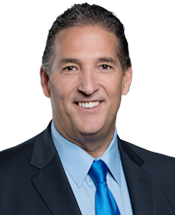
Assemblyman Jim Frazier

SACRAMENTO – Assemblymember Jim Frazier (D-Fairfield) announced today that he plans to introduce legislation in the upcoming session to fundamentally change the way California reduces greenhouse gas emissions.

  “While I believe the work the California Air Resources Board (CARB) has been doing is laudable, we need to shift gears and address the main cause of carbon emissions in California, and right now, that is unquestionably wildfires,” said Frazier. “The data is undeniable and staggering.”

  According the U.S. Geological Survey, in 2018 alone, the wildfires in California were estimated to have released emissions equivalent to roughly 68 million metric tons of carbon dioxide. By contrast, after seven years of reduction efforts from Cap and Trade funded projects to date, is estimated to be 45 million metric tons – at the cost of billions of dollars.

  Frazier went on to say that he believes CARB needs to “pause and think” carefully about their programs and overall efficacy of the resources devoted to them, and reprioritize Cap and Trade dollars to address the immediate threat and environmental devastation that wildfires are causing. In addition to the further advancement of global warming, these fires result in property damage, loss of life, economic peril, and long-term health issues.

  “The science and statistics of the devastation that wildfires are causing are not just limited to the land. These fires are pumping more pollution – far more toxic – than the burning of fossil fuels, and we must take a critical look at how we dedicate our precious financial resources to their reduction.  As we know, wildfires are a major contributor to the advancement of global warming.”

  Frazier will introduce a bill this December.

Filed Under: Economy, Environment, Fire, Health, Legislation, News

New Name. Same Game. Delta Conveyance Project – tunnel moves forward – Part 2: Stakeholders & Opposition

July 20, 2020 By Publisher 3 Comments

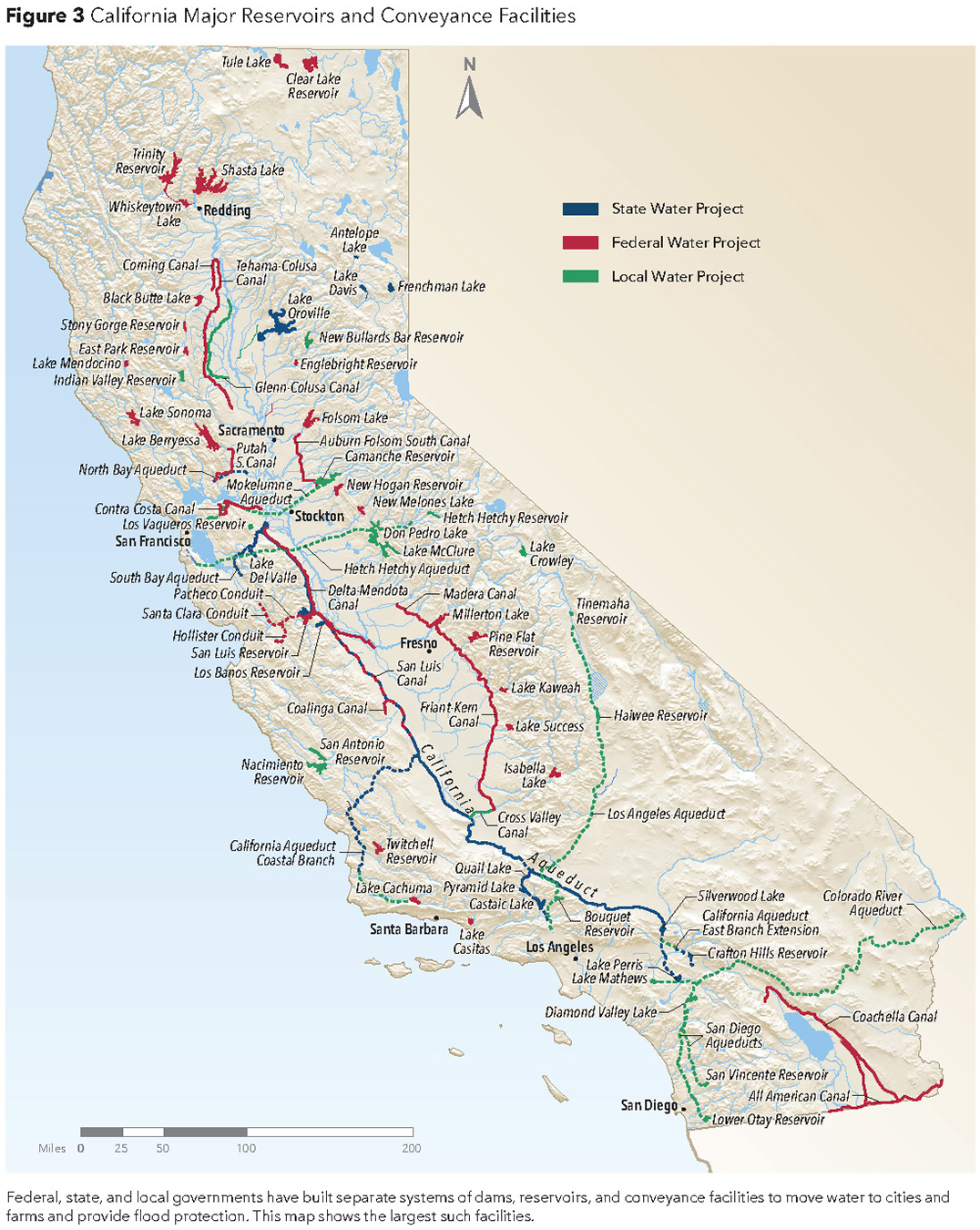
From California Water Resilience Portfolio 2019 Final.

County residents opposed to project work to limit impact and secure benefits if it is built

“We want to make sure they don’t screw anything up,” – David Gloski, Stakeholders Engagement Committee Member

By Allen Payton

What was planned as two tunnels beneath the California Delta to divert fresh water from north of the Delta to areas south, is now a single tunnel plan that is referred to as the Delta Conveyance Project (DCP). The effort is being led by the Delta Conveyance Design and Construction Authority (DCA) which was formed by and makes recommendation to the California Department of Water Resources (DWR).

In the first part of this two-part series, you read about the background and latest efforts to move the project forward. In this part, you will hear from local voices who serve on the Stakeholders Engagement Committee (SEC) and what they are doing to both fight the tunnel, and if it is built to limit its impact and to secure any benefits for our county and the Delta.

Stakeholders Engagement Committee – Local Voices

Because Contra Costa County and the water districts in the county either oppose or are neutral on the Delta tunnel project, no agency from the county is part of the DCA. But there are three people who live and one who works in Contra Costa County and serve on the Stakeholder Engagement Committee. They are Bethel Island resident and retired engineer David Gloski, Discovery Bay resident and real estate appraiser Karen Mann, Antioch resident Jim Cox, a retired fishing boat captain, and Oakland resident Michael Moran, who works for the East Bay Regional Park District as Supervising Naturalist at Big Break Regional Shoreline Visitor Center at the Delta in Oakley.

David Gloski, The Engineer – At Large Member

“I don’t want to understate that I’m against it and I appreciate the people fighting it,” said Gloski, who volunteered to be part of the SEC at the urging of others who also oppose the tunnel. “But I, having a home on the water and having an engineering background – and this DCA SEC group is more engineering focused – we want to make sure they don’t screw anything up.”

“The majority of the people on the stakeholder committee are probably against the tunnel,” he stated. “It includes the lady (Barbara Barrigan-Parrilla) from Restore the Delta. We’ve been effective in preventing them from doing things that don’t make sense and would negatively affect people in Contra Costa.”

“To me, they walk and chew gum at the same time. They’re working on designs and plans without having the permits. They have to do some of it or they don’t know what they’re asking to permit,” Gloski explained. “Similarly, we aren’t doing ourselves any benefit by just opposing it. Because if it does go through, we can get a lot of things done, like new roads, and parks. But you have to participate.”

“I’ve raised my hand to say, ‘if you’re going to build it, let’s get good things out of it, and make sure they don’t screw things up,” he reiterated. “I think the county is mistaken for not being more involved. The DCA made changes because of our inputs. Unfortunately, I’m not sure the inputs are the best from the county’s perspective. For example, an original plan included road and bridge improvements which were eliminated when we were successful in having a maintenance shaft moved further away from Discover Bay. So, you might have won the battle but lost the war.”

“I think we might benefit from more representatives. But right now, the county is just fighting it,” Gloski added.

To give your input to David Gloski, you can join his Facebook page, David Gloski DCA Stakeholder.

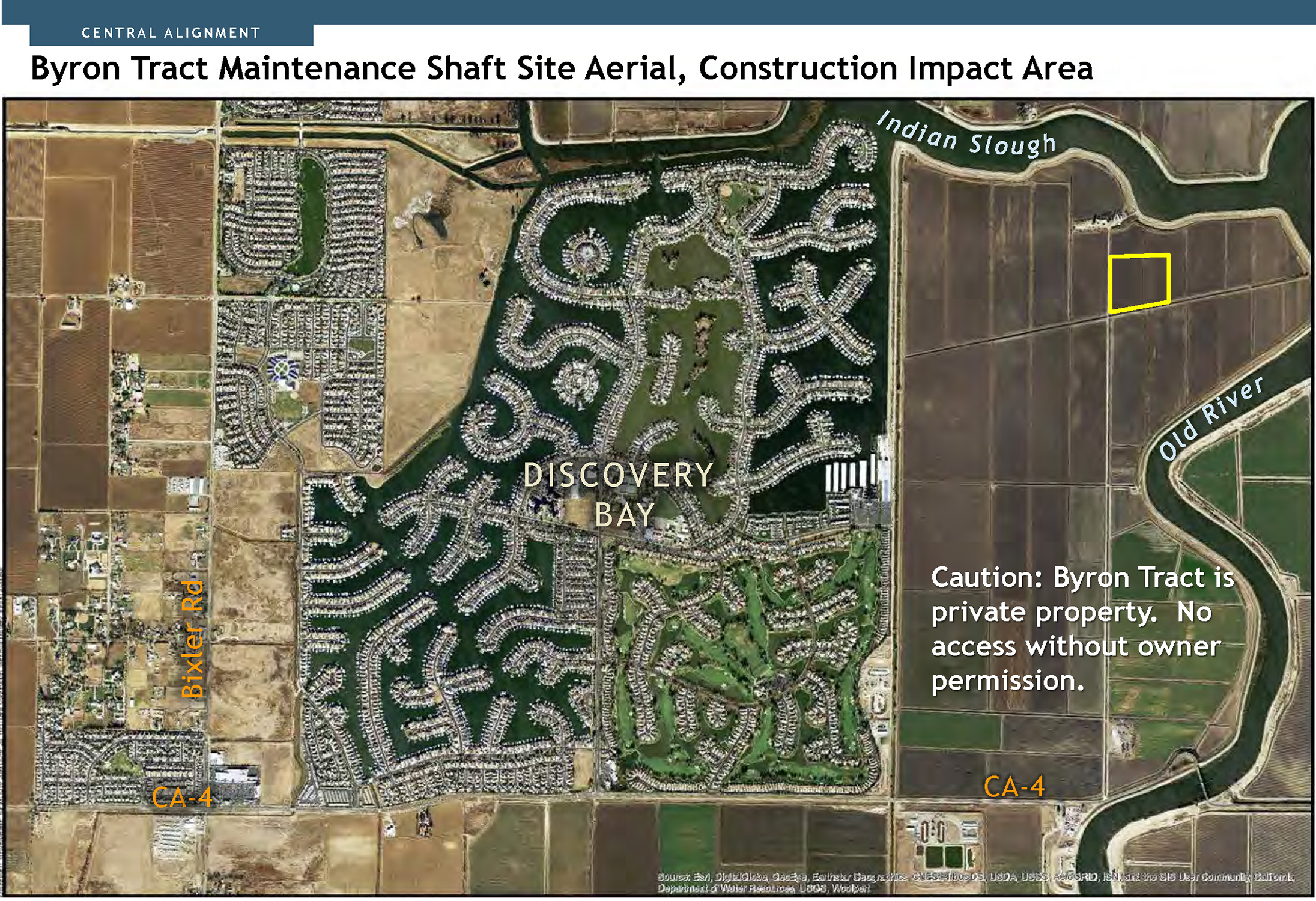
Mann expressed her concerns for the location and proximity to Discovery Bay of one potential Maintenance Shaft. From DCA 2020-05-27-UpdatedMapBooks.

Karen Mann – South Delta Local Business

Mann, an appraiser in Discovery Bay, is another member of the stakeholders committee who opposes the tunnel, as the issue literally hits close to home for her like Gloski.

“I’m fighting for our Delta,” she said. “As I’m talking to you my grandchildren are loading the boat, because that’s what we do as a family. We spend time on the Delta.”

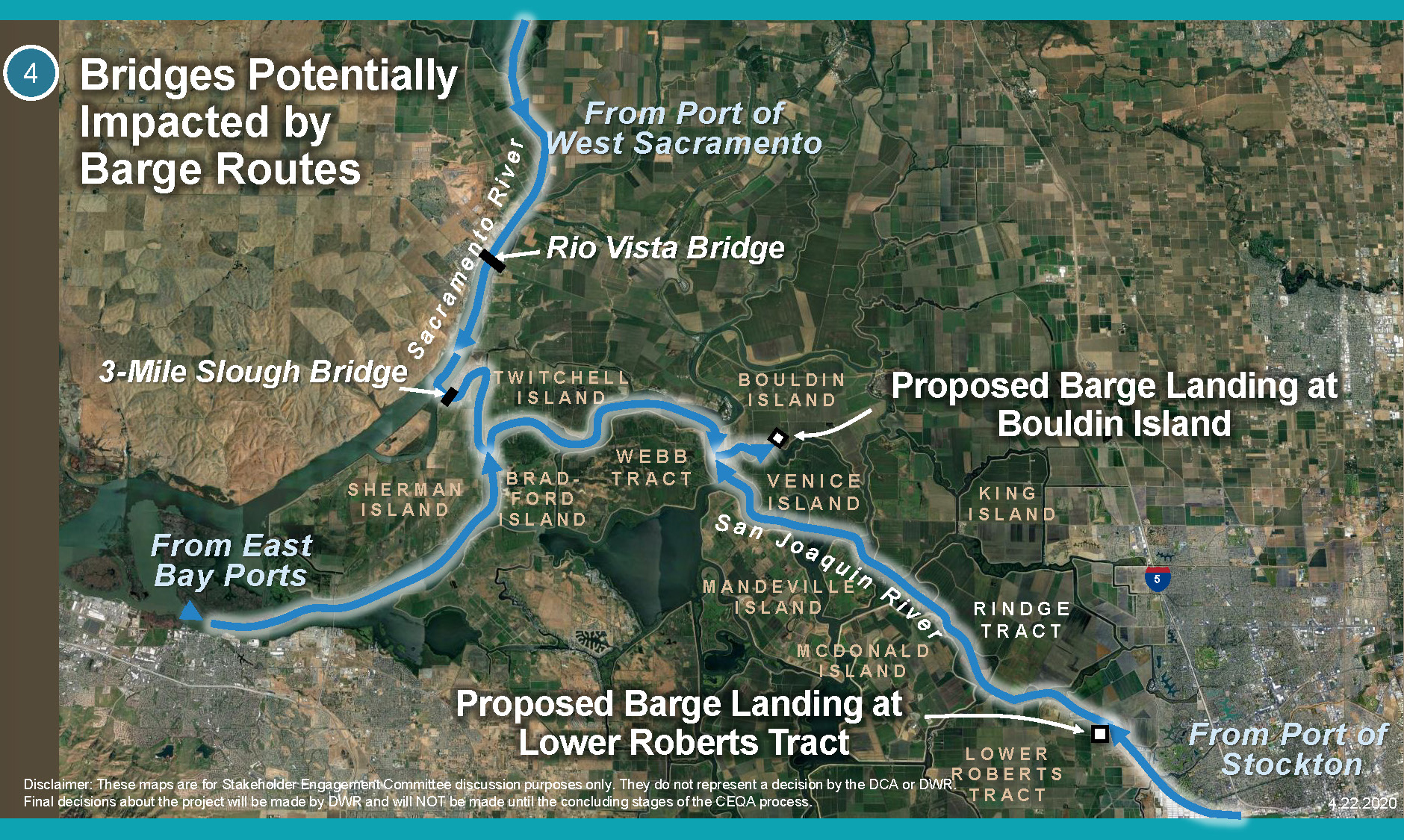
“I’m an active boater. I skipper my own 37-foot boat. I’m a very able-bodied skipper. My dad had me at the helm since I was 9 or 10 years old in San Pablo Bay,” Mann explained. “So, I’ve described to this group the terror that I had when I encountered a barge in the middle of Old River. That left me about 25’ (to get by it). My boat is 12-feet-wide. I could feel the propellers of the tugboat drawing me toward that barge. My boat weighs 22,000 lbs. Imagine if that was a ski boat with inexperienced skiers or a family with a father and his kids on board.”

“The number of barges every day that they were talking about loading, I told them ‘you better think twice. You will have lives of families and boaters on your hands,’” she continued.

From 2020-04-22-SECMeetingPresentation.

Effort to Postpone Meetings & Work Due to COVID-19 Unsuccessful

“Through this whole pandemic thing, myself and a bunch of others have said ‘let’s hold off on these meetings’ because we can’t meet with our people,” Mann stated. “The chief engineer said, ‘we’re going to move forward, and we hate to leave you behind. But that’s how it goes. Governor Newsom wants this going.’”

“I piped up and said ‘it appears to me Gov. Newsom his been very busy with this pandemic thing and his three-hour-long press conferences each day, and the Delta tunnel is probably not at the forefront of his thinking,” she shared.  “For us to be told, ‘no, that’s out of the question, we’re on a timeline’, this is just not right.”

According to a report by the Sacramento News & Review, the effort to postpone the committee meetings and the work got a Sacramento County Supervisor and the Delta Protection Commission involved.

“The dust-up has caused Sacramento County Supervisor Don Nottoli to challenge one state official about transparency, while the Delta Protection Commission has officially asked California planners to halt their work on the tunnel during the virus outbreak. So far, that hasn’t happened,” reported the SN&R.

Contra Costa County Supervisor Diane Burgis serves on the Delta Protection Commission, which  “is supposed to safeguard the environmental and community health of the estuary as part of California’s landmark 1992 Delta Protection Act.”

But the committee meetings are continuing, just online for now, as most if not all other government meetings are currently throughout the state.

No Project Funding or Route, Yet

“I asked them where are we getting the money from? Apparently, there’s no checkbook. There’s no limit. There’s no talk about expenses. It’s like carte blanch. Money is no object,” Mann stated. “There isn’t an official route, yet. Because they’re trying to decide if there is going to be a central corridor which would be within 600 feet of the Discovery Bay water treatment plan and homes on the golf course.”

“That’s not the best of it,” she continued. “The best of it is they’re using their maps of that central location they would have taken that tunnel underneath the only waste treatment plant in the area.”

“They would also be going through our artesian wells,” Mann added.

“If there were any problems, “they would shut off the water and waste treatment for Discovery Bay. How could we live here? We’re not a third world country,” she said with a laugh.

“I’ve been very passionate about those two items,” Mann stated.

She, Cox and Moran all expressed concerns about trucks on Highway 4 east of Discovery Bay and how the committee’s efforts got that stopped.

“There was also going to be a maintenance shaft near Discovery Bay which would require truck traffic on Highway 4. Heavy duty trucks carrying the muck and dirt. Those bridges are old and couldn’t handle it,” she explained.

“Now they’re talking about using the eastern corridor closer to Stockton. But they told us ‘don’t get too excited. Nothing is decided. We’ll take your recommendations, but we will make our own decisions.’” That didn’t sit well with Mann.

“Is this how government is supposed to work?” she asked. “I will say they did listen on the barge issue. I think health and safety got them.”

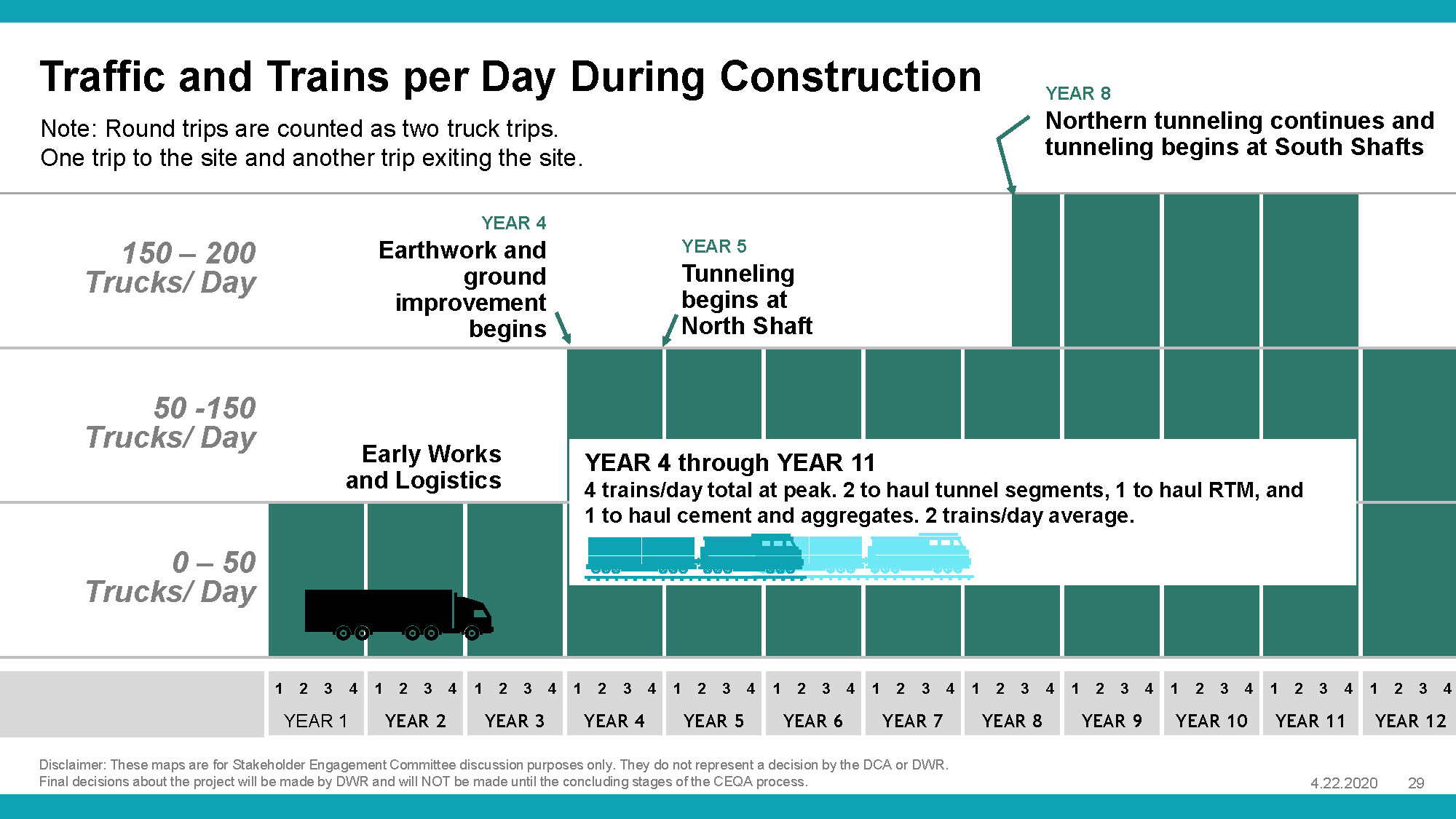
From 2020-04-22-SECMeetingPresentation.

Fire Marshal, DB Town Manager Shocked

“We took that information to the fire marshal and Discovery Bay Town Manager and they were shocked,” Mann shared. “Neither one of them knew about any of it. They both wrote impassioned letters. We have three fire stations that serve 128 square miles. The engineers thought we had nine stations.”

“So, who’s going to handle the issues…with a project like this?” she asked. “Someone’s going to get hurt and they’re going to need EMT’s. I guarantee you one of their trucks will have an accident and block traffic for hours, if not kill someone.”

“I’ve been sending the chief engineer photos of truck accidents and concerns that we have for our health and safety,” she continued. They had no idea of traffic count. They’re using traffic counts from five years ago from San Joaquin County and they don’t keep track of traffic on Highway 4 and the bridges in our county. So, their traffic counts are completely inaccurate.

“So, I’m wondering who’s really in charge here,” Mann said. “We’re supposed to trust them with building a tunnel 150 feet under ground? If they don’t have this basic information how can they handle the bigger issues?”

“The Delta has been something in my family since I was a child,” she shared. “It’s a way to keep families together. So, when you say Delta you’re talking about families. This life is too short, and you have to enjoy it while it lasts.”

Mann is both a residential and commercial appraiser, which is why she represents the business community on the committee.

She’s also the president of Save the California Delta Alliance.

“We have an attorney that got them to back out of the other tunnel project,” Mann shared.

“It’s just a bunch of homeowners. This is our home. The waterway is our backyard. Our playground. Don’t mess with it,” she concluded before heading out into the Delta for the weekend on the family boat.

From 2020-04-22-SECMeetingPresentation.

“Same Old Song and Dance” on Fish Protections Says a Frustrated Jim Cox – Sports Fishing

Antioch resident Jim Cox ran a six-pack, sport fishing charter boat for 23 years and has been in the Delta since the early 1980’s and is now retired.

“I’m there representing fishing interests,” he shared. “It’s been a very frustrating thing to be involved in. They want us to come back with input from our constituents. The most common thing I hear is ‘what’s going to happen with Clifton Court?’”

The Clifton Court Forebay is where the water is collected south of the Delta before being pumped further south.

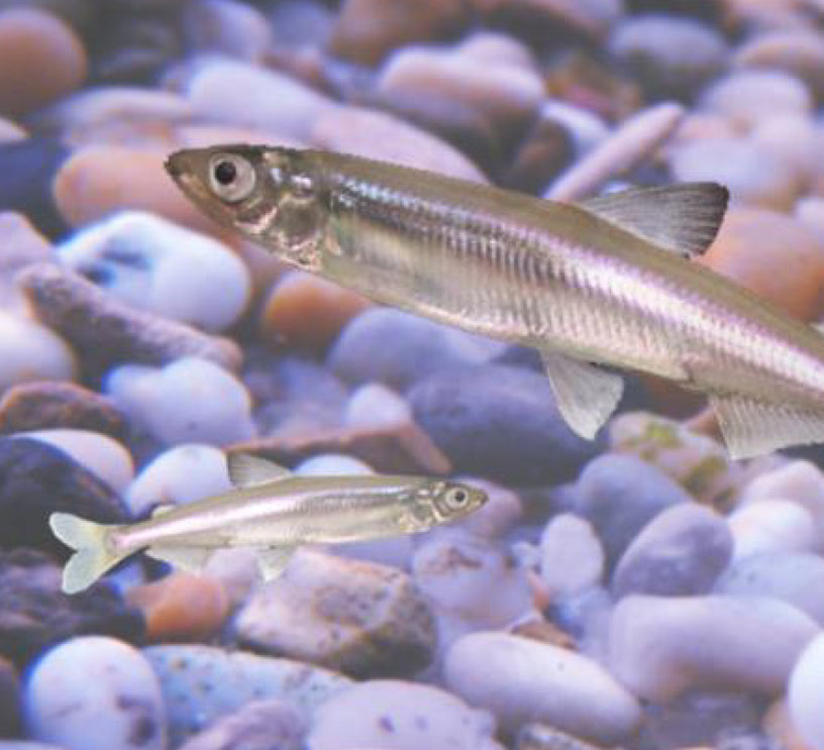
Delta Smelt. Photo from DCA SEC.

“When the current is flowing in there, it’s so strong the fish can’t get out,” Cox explained. “The screens on the pumps are not designed that well. Estimates are anywhere from 15-50,000 striped bass that are trapped in there. They’re only 8 or 9 inches but they’re fully matured fish.”

“They say Clifton Court Forebay is a separate project,” he continued. “I’ve had conversations with Terry Buckman from DWR. The Delta Improvement Act of 2009 has the two goals of habitat restoration and less reliance for water supply. They’re definitely focused on the water supply.”

“They call it EcoRestore, which is part of DWR and the ironic thing is they say ‘we’re not working on that for another year or so.’ This committee will be disbanded before then,” Cox stated.

“This is the same song and dance that fishermen have been told for the past 25 years,” he complained. “In 1994 there was the CalFed agreement. The water contractors were supposed to build state of the art screens across Clifton Court so fish couldn’t get in. But it’s still never been built. “

‘Most of these DWR folks are in their 40’s so they weren’t around…and they’re taking the word for it from others at DWR,” said Cox.

“The real problem is predation (preying of one animal on another), primarily for striped bass,” he continued. “It is a problem because the current flows in there, year-round, 24 hours a day. Larger fish just stick around at the entrance and pick off the smaller fish. They try to make it sound like it’s the striped bass. It’s not. It’s the fact they never built the screens.”

“We were told Fish and Game have plans to remove predators. They have no plans for any such thing. They say it’s a useless idea. Once you get rid of one predator another species will move in,” Cox shared. “Then they said the problem is the outer screens. There aren’t any outer screens. It consists of rabbit wire fence to keep boats and floating logs out of Clifton Court. It has nothing to do with fish.”

“They won’t say anything of how they’re going to make it better. This is why it’s becoming a frustrating endeavor for me,” he stated. “On the one hand they are being responsive to some complaints. But it all revolves around building the tunnel.”

From 2020-04-22-SECMeetingPresentation.

“They won’t even listen to the fishermen. I’ve been tempted to resign a couple times over this. But, if I’m not there who’s going to bring this up?” Cox asked, rhetorically. “First, they talked about having the committee a year. But now they’re talking about extending it.”

“It’s very frustrating trying to get them to listen,” he added.

On finances Cox said “we get told things in bits and pieces. The plan is for all of this to be paid for by the water users, the water contractors. The fine print is they’ve agreed to this in theory, but not in reality. They’re not going to agree to anything until they see the final plan. Over the last year, they’ve been trying to do what took them three years originally on the twin tunnels, to finalize this plan, to be able to move forward.”

“When this COVID thing hit, they said everyone wants to continue to work on this. That’s BS,” he said echoing Karen Mann’s comments. “No one wanted to continue to do this. But they kept pushing on this because they have financing deadlines. So, nope. They’re going to keep on going.”

“I feel in a lot of ways this committee is just going through the motions. I’m starting to feel like a pawn in a chess game,” he said with a chuckle.

Another financial issue Cox shared about was the pay for the DCA’s executive director Kathryn Mallon, who is earning $47,000 per month in her role. That’s in spite of the $54 billion deficit the state is projecting due to the impacts of the COVID-19 pandemic.

Another report by the Sacramento News & Review covers that issue and the opposition from the water agencies that are expected to reimburse the state for her compensation.

Proximity of proposed sites to existing recreation facilities. Arrow points to Big Break in Oakley. From 2020-04-22-SECMeetingPresentation.

Parks District Employee Offers Different Perspective: Mike Moran – Ex-Officio

Mike Moran, although an Oakland resident, represents Contra Costa County interests on the SEC, having worked in Eastern Contra Costa County for 26 years, as of August 1st. He works for the East Bay Regional Park District at the Big Break Regional Shoreline in Oakley.

“Big Break was an asparagus farm that flooded in 1927,” he shared. It’s a 1,688 acre park that’s mostly under water. The East County trail runs through there. Plus, they have a 1,200 square foot model of the Delta on the ground.

“In my position at the park commission and the SEC, we don’t take a pro or a con on this issue. We try to interpret this thing and why it’s being proposed, why it’s being opposed, and not just build it or don’t build it,” Moran explained. “I’m an ex-officio giving folks’ perspective from the East Bay Regional Parks point of view. There’s not a direct correlation on the tunnel.”

“We have land out here and we have folks paying taxes to get access to that land. So, what does this mean? What is the impact going to be where our constituents live?” he asked.

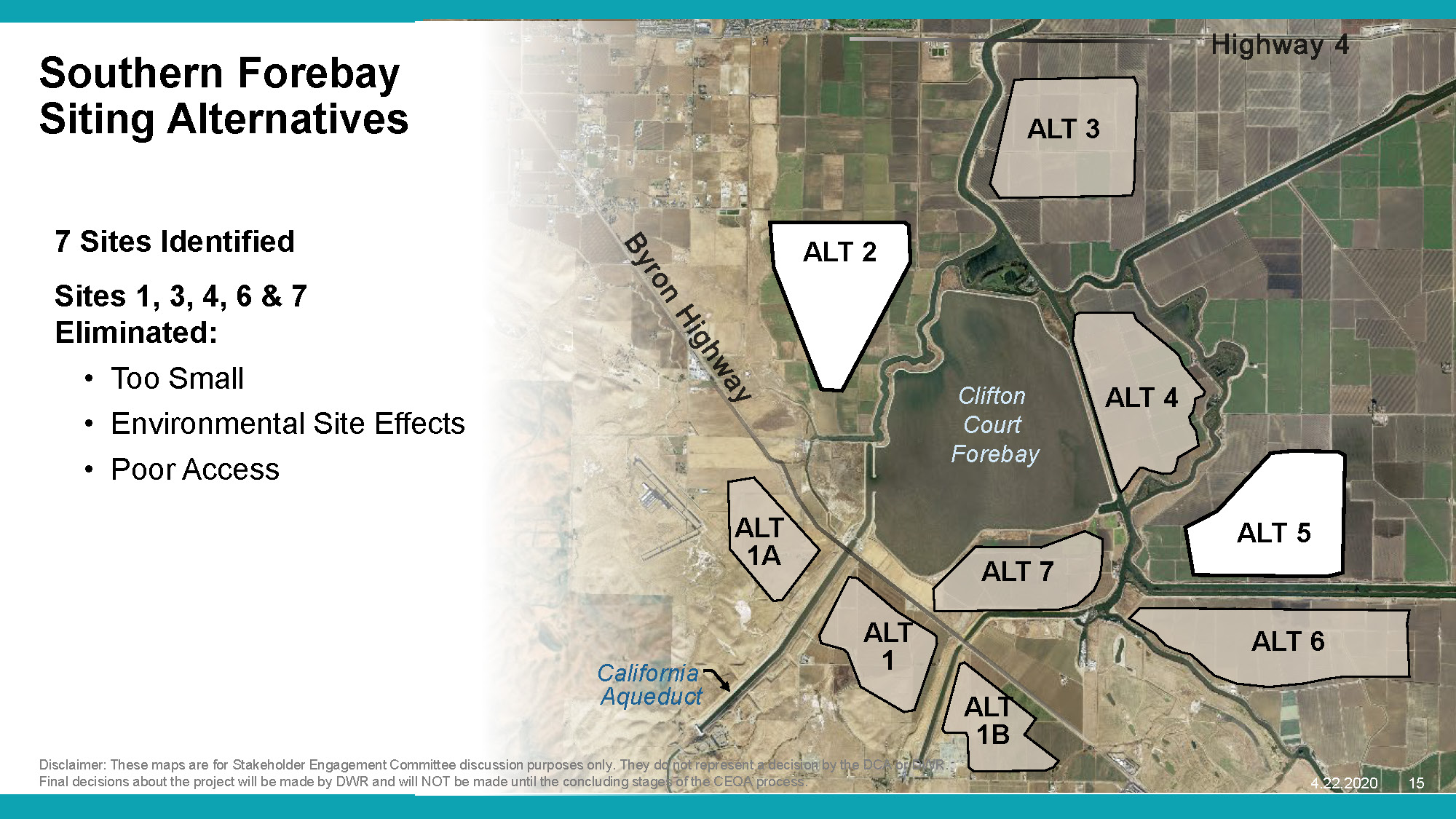
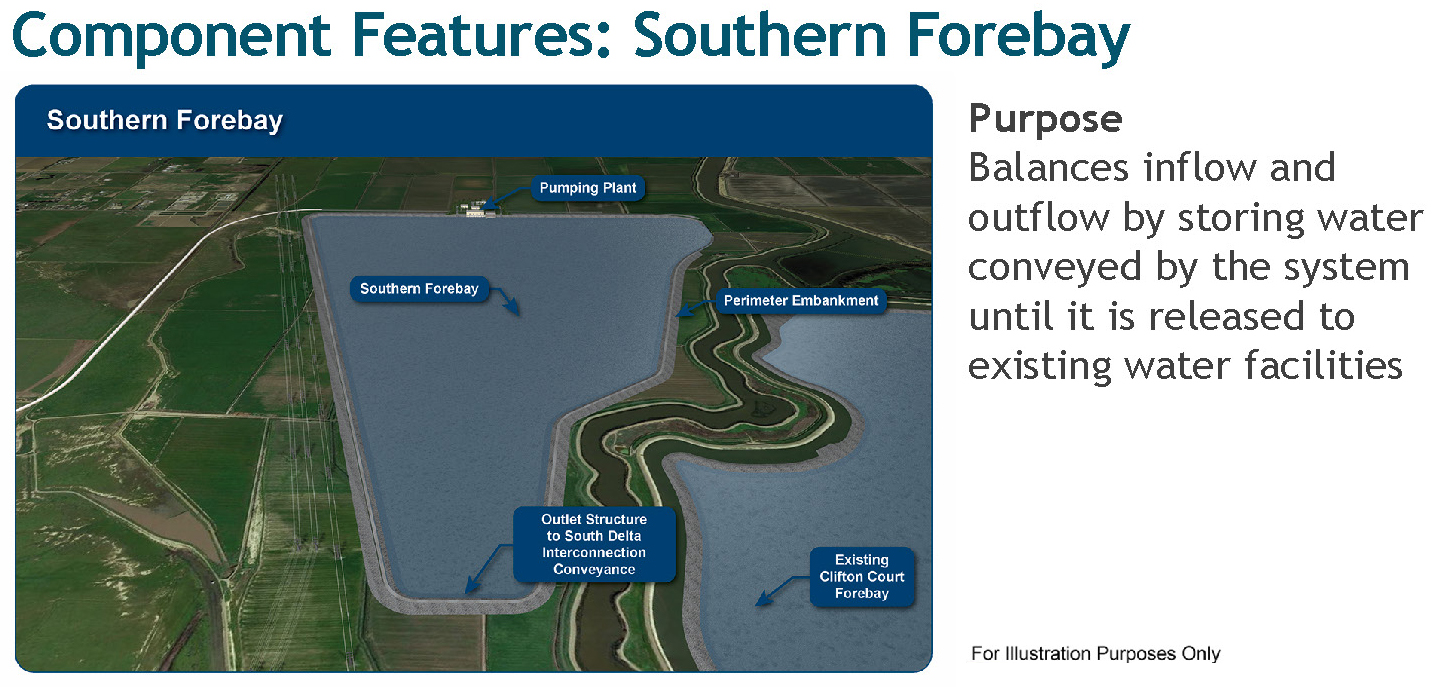
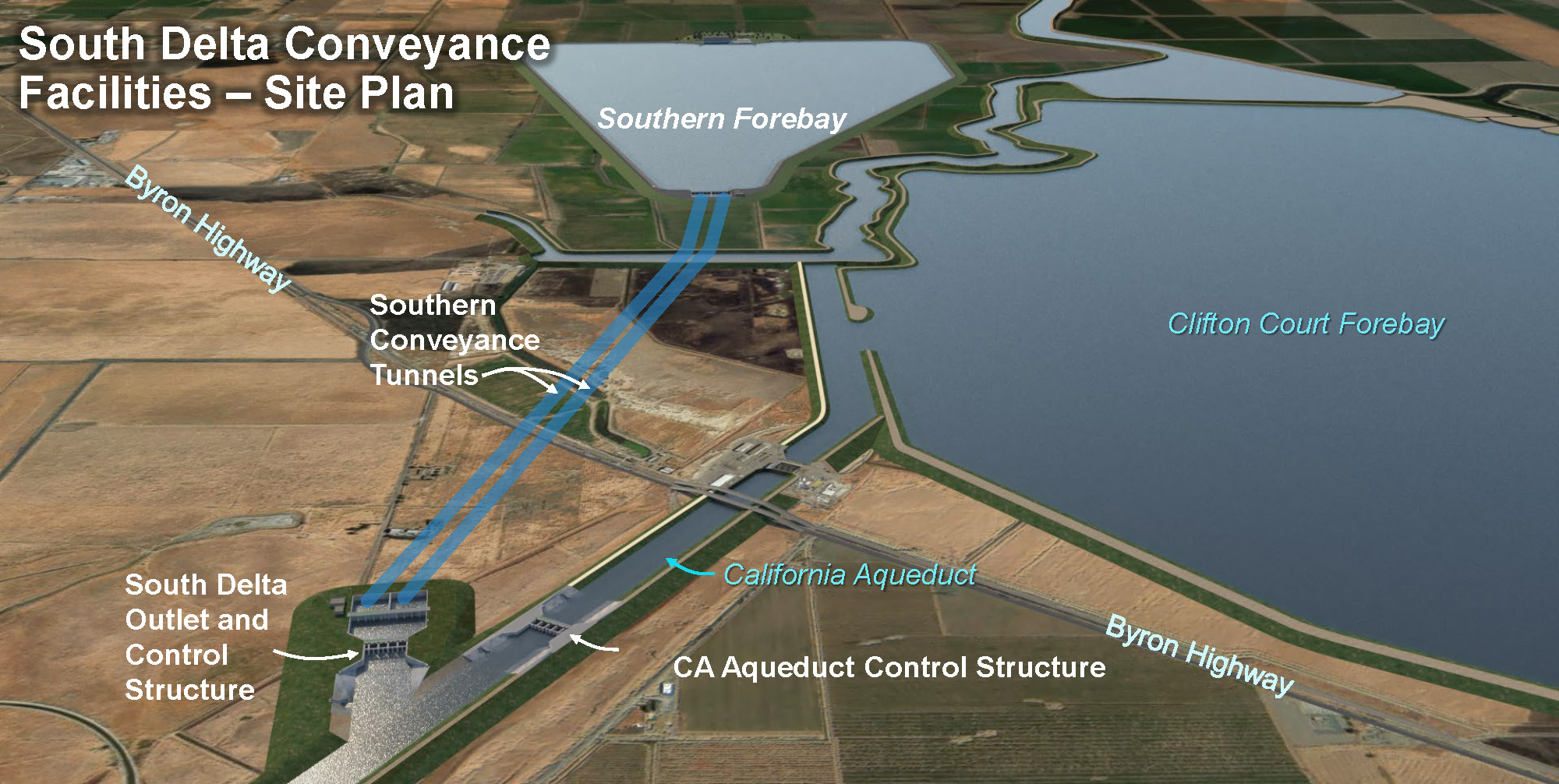
Proposed new Southern Forebay adjacent to Clifton Court Forebay. From 2019-12-11-DeltaConveyanceSystemOverview.

Moran also studied fisheries in grad school. Asked about the fish and Clifton Court Forebay that Jim Cox is concerned about, he said, “It’s part of the state water project, right now. The new forebay would be right next to Clifton Court, built to the west.”

However, Cox responded with, “The fact is that they still intend to use Clifton Court fifty-percent of the time. If the tunnel water was the only water heading into the canal then it would be fine, but that is not the case. Clifton Court will still be part of the water system and that is why I feel improvements to it should be part of the project, not a separate project.”

“The Harvey Banks Pumping Plant is part of the State Water Project. That water is sent through the California Aqueduct and the South Bay Aqueduct serving Alameda and Santa Clara Counties,” Moran explained.

“The feds will require an Environmental Impact Study on the project because it affects federal waters. That’s the Jones Pumping Plant, which is part of the federal water project. That water is pumped through the Delta Mendota Canal,” he shared.

“At the Clifton Court Forebay, as the water is drawn in, there’s a screen that screens out the fish. But it’s old school. It’s an old screen,” Moran explained. “Jim’s saying if we’re going to put in these high-tech screens north of the Delta, let’s do it at Clifton Court.”

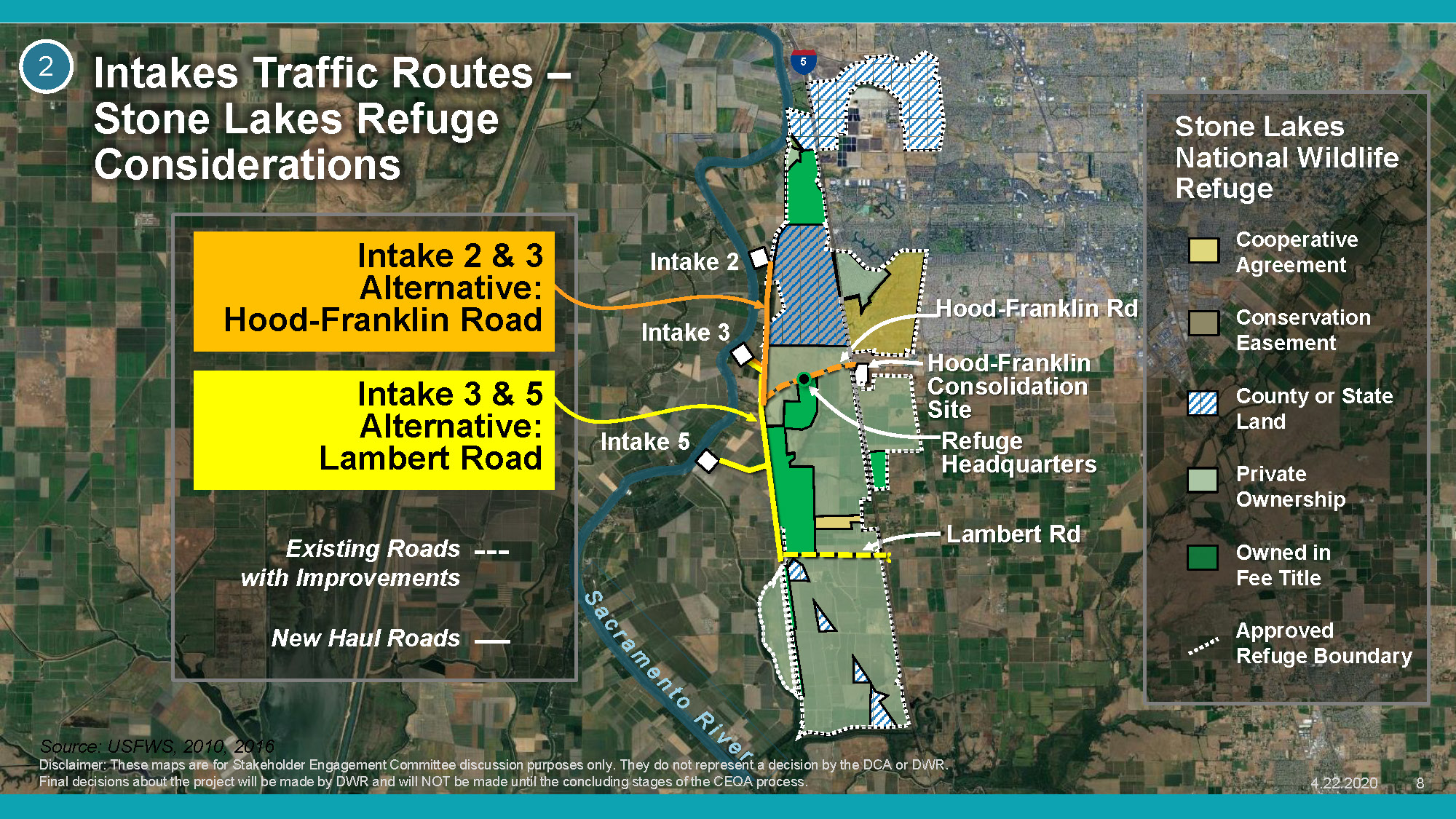
Proposed intakes near Hood. From 2020-04-22-SECMeetingPresentation.

“The screening for the proposed tunnel will be located in Hood (north of Elk Grove) on the eastern side of the Sacramento River. There will be three intakes and those would have brand new, top of the line fish screens,” he continued. “So, no fish will be put in that tunnel beyond those screens.”

“That’s one of the selling points for this whole project,” Moran stated. “What we have now, is the diversion is over the surface across the Delta. So, we’re bringing in both water and fish.”

He provided some history to the diversion of Delta water.

“The idea of diverting water, moving water from the north and east, through the Delta is from the 1910’s,” Moran shared. “A lot of the facilities we have now, are not the same thing, but they’re based on Robert Marshall’s plans. He ran the national parks and was pushing this big project of moving water around California. So, that’s part of the rationale of what we have, now.”

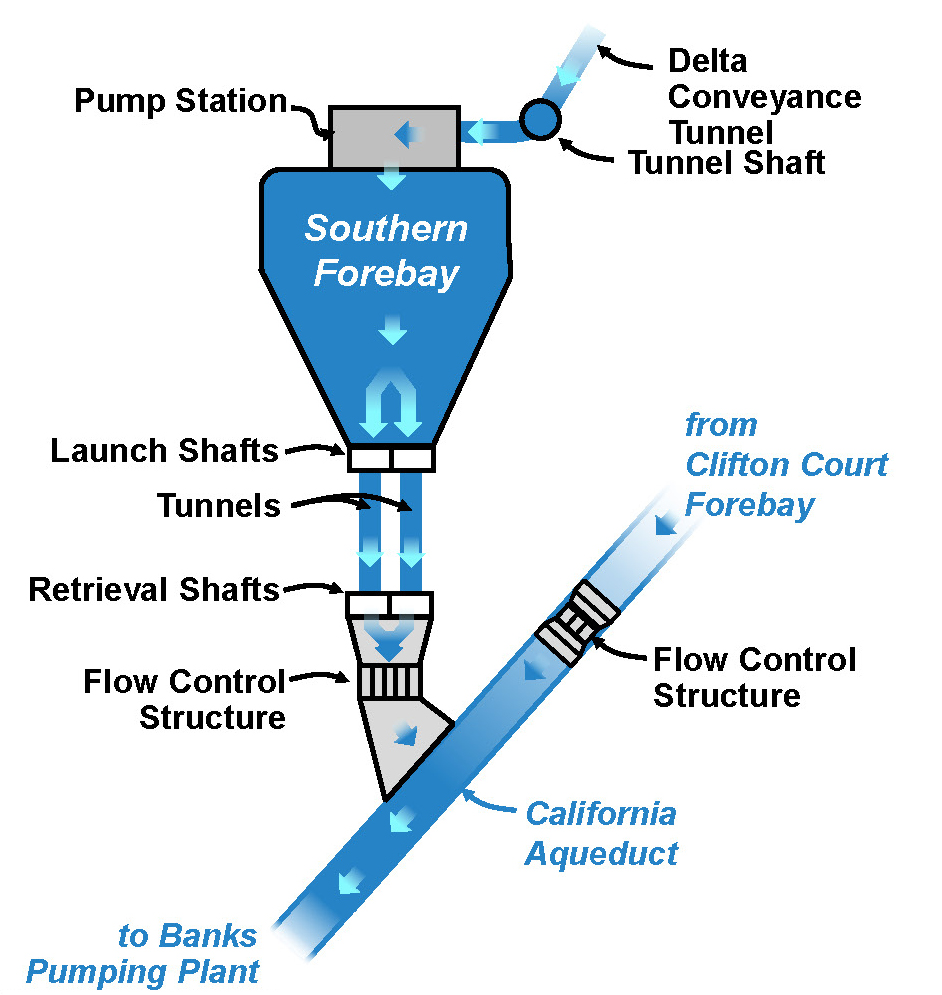
Proposed South Delta Facilities. From 2020-04-22-SECMeetingPresentation.

He also shared that “Antioch sued upstream water users in 1921 because of too much saltwater. So, this is nothing new.”

“Antioch is way ahead of the game putting in a brackish water plant. That’s a big, bold move,” Moran state. “But what are we going to do with saltwater intrusion up to CCWD?” (See related article)

Asked how the tunnel is a solution to the saltwater intrusion he answered, “It’s coming. If we divert or not, saltwater is coming. How do we prepare for that? In Antioch we build a desal plant. For those south of the Delta it’s a tunnel.”

“The way we’re doing things now, is water flows from the Sacramento River to the rest of the Delta. The pumps in Byron then pump it south,” Moran continued. “This water used to flow down the river and out into the Bay. Sometimes during the year, we have reverse flow, with the water from both the Sacramento and San Joaquin Rivers. When folks started taking water out in the Central Valley, less water comes out of the San Joaquin River. It was dry for 60 miles as recently as 1994. That was rectified through a court case.”

Proposed South Delta Conveyance Facilities Site Plan. From 2020-04-22-SECMeetingPresentation.

Because the San Joaquin River is diverted before it reaches and “punches through the Delta”, farmers in the Delta have been relying on Sacramento River water.

“The Sacramento River, high quality, great water, it’s pulled down to the pumps. Not all the water, it’s less than half,” he said. “That goes against the natural flow and messes up the ecology.”

“We’ve gotten a lot of benefit over the past 100 years,” with the current system, Moran shared.

“So, if we don’t do something, if saltwater comes up, or if a levee breaks or a beaver chews through, that’s going to stop the flow of water.”

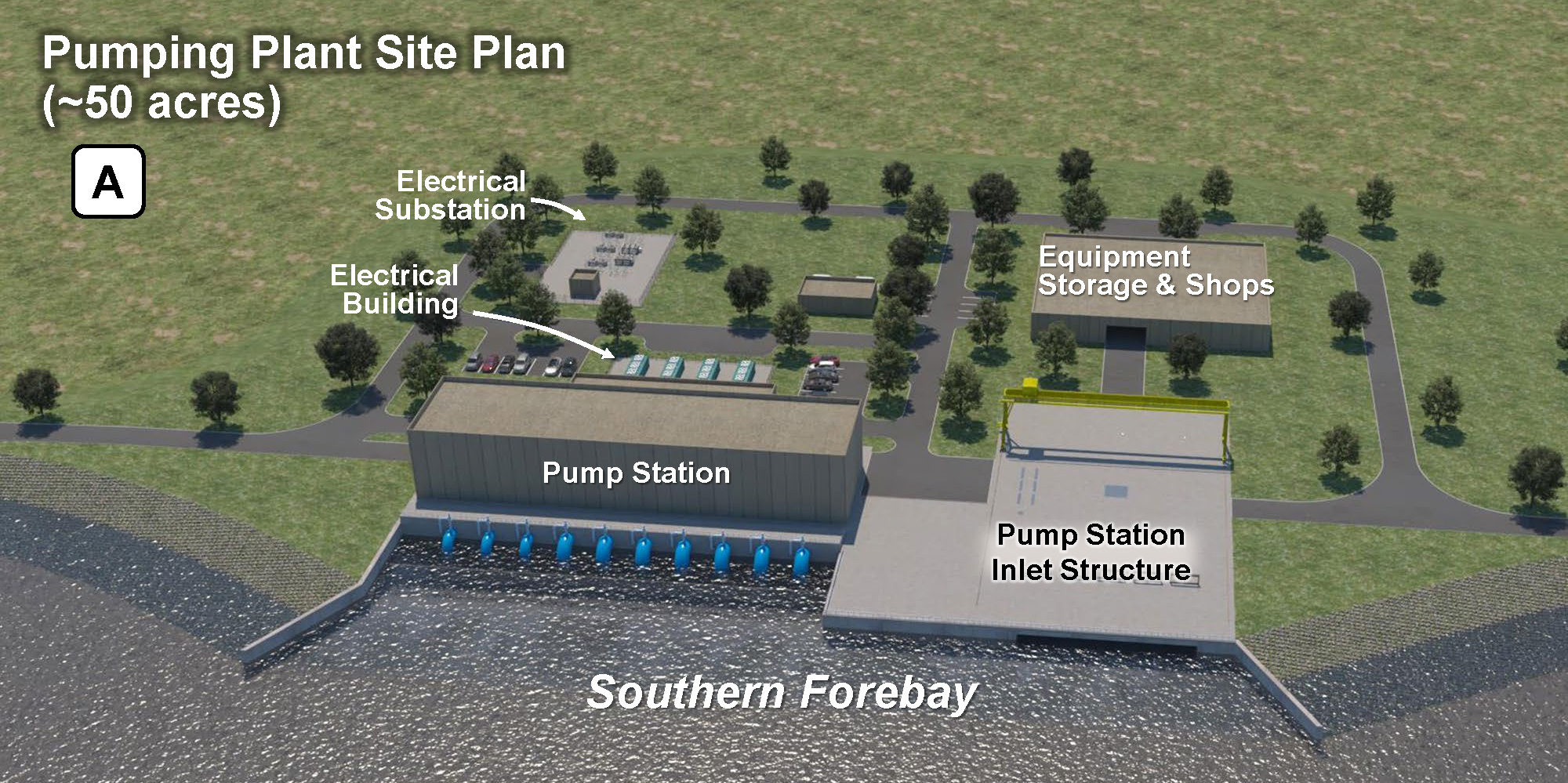
Rendering of proposed Pumping Plant Site Plan at the Southern Forebay. From 2020-04-22-SECMeetingPresentation.

“Much of the land in the Delta is under sea level because of that peat soil, which is great for farming,” he explained. “But because of decisions made over 100 years ago, because people in the Delta communities and economies, and their way of life, it’s not sustainable.”

“We’re only taking water out when there’s enough to come through,” said Moran. “Like we’re doing, now when there’s Delta Smelt at the pumps, and we have water quality going down the tubes, the feds tell them to stop pumping.”

“It’s these local folks who are members of the committee saying, ‘wait a minute, we have lives that will be affected, too,’” he shared about his fellow SEC members. “The premise is let’s pretend this is getting built. If that’s the case, all you folks around the Delta who have this local experience and expertise, to advise the experts from the DWR.”

“So, that the water can be used all year round. That’s the point of it,” Moran continued. “Is there enough storage south of the Delta? If you’re going to pump water out of the Delta where are you going to store it? There’s the San Luis Reservoir, are we going to raise the height?”

Rendering of proposed Pumping Plant at the Southern Forebay. From 2020-04-22-SECMeetingPresentation.

“Every governor has dealt with it, but Newsom is getting more traction,” he shared. “They have this portfolio plan which includes storage, moving water and ground water restoration. Not just sticking straws in the Delta and sucking it.”

“When it’s a common pool and we all have to drink out of the Delta and we all have to be responsible for it including maintaining the levees, and agriculture in the Delta,” Moran concluded.

No Committee Member Supports the Tunnel

Asked about the members of the stakeholders committee and how they were chosen, Nazli Parvizi, the Stakeholder Engagement lead for the DCA, said, “There is not a single member on the committee who supports this project. That’s based on what they wrote in their applications and others, what they’ve said over and over during the meetings.”

“It was an individual application. Not everybody represents their area of work. The requirement was if you live, work or recreate in the Delta in certain categories,” she explained. “If you have an ag person you balance it out with an environmental person. So, I think we have a good broad representation.”

“What we’re excited about Karen…she’s as reliable a source on waterways and boating as Jim Cox would be,” Parvizi shared.

“It’s not a voting body. We don’t make decisions as the DCA,” she explained. “We try to come up with the best engineering and design, the concepts and drawings and give them to Department of Water and it’s up to them.”

“We’re doing our best to take into account the Delta as place,” Parvizi continued. “So, they don’t just make sense from an engineering standpoint, but also as Delta as place. The folks who lead the DCA are representatives from DWR and the agencies that are members of the DCA. Kathryn Mallon, the Executive Director of the DCA is listening and took into consideration the Delta as place. The SEC is the result of that.”

About the committee members’ involvement, she said, “It’s trying to make the best of the worst, while at the same time trying to make sure it doesn’t happen. Karen has done a great job for Discovery Bay and boaters.”

“So, fight on your own time, protest, sue us, whatever and we’re OK with that and several are suing us,” said Parvizi. “We do want to make sure we are respectful of what you care about. They give us incredibly valuable feedback.”

“They fight their war, but on the battles they’re very collaborative,” she stated. “We give them all this information, being transparent as possible and half of them send it to their lawyers, which is fine. But they tell us which is better, A, B or C, and we make our recommendations to DWR.”

“We haven’t seen two groups fight it out,” Parvizi said, and explained how the members of the SEC work collaboratively. “If you move it (the tunnel) this way, it’s good for fish, but if you move it here, it’s good for birds. Or it’s good for animals. But if you put it here, it’s good for business.”

“We can come up with the pros and cons and I think that’s very valuable,” she added.

Opposition Efforts Continue

Efforts continue to stop the new Delta tunnel by groups such as Restore the Delta that have been fighting since the twin tunnels plan was first proposed. They along with Contra Costa County and the other members of the Delta Counties Coalition, Delta residents, Delta business owners, tribal representatives, fishing and non-governmental organizations and other Delta community-based organizations have all asked the Department of Water Resources (DWR) to pause Delta tunnel planning processes that require public participation due to the impact of the coronavirus pandemic. The Department of Water Resources has refused.

Contra Costa is represented on the DCC by County Supervisor Karen Mitchoff.

In their letter dated April 7, 2020, the DCC wrote California Natural Resources Agency Secretary Wade Crowfoot, “The Delta Counties Coalition (DCC) respectfully requests that you direct the Department of Water Resources (DWR) to pause all Delta Conveyance Project planning and engineering design processes that require Delta stakeholder engagement during the COVID-19 crisis, until the public can fully participate. We request that you ask the Delta Conveyance Design and Construction Authority (DCA) to pause its processes that require public participation, including Stakeholder Engagement Committee meetings, so that the Delta tunnel engineering design can be informed by meaningful public input. We also ask that you direct DWR and other resource agencies to extend public comment periods by at least 45 days beyond the end of the declared emergency.” 2020-04-07-Delta Counties Coalition-Letter-to-Secty-Crowfoot-re-Stay

The Secretary Crowfoot and the Department of Water Resources has refused, but have instead allowed the DCA and SEC to hold their meetings online.

Upcoming Meetings

The next meeting of the 20-member DCA Stakeholder Engagement Committee will be held on Wednesday, July 22, 2020 from 3-6 PM. Topics are expected to include: Scoping Update (DWR), Rehabilitation of construction impacted land, Final temporary and permanent boundaries, and Intakes Update (*subject to change). Ring Central Video Conference. Information Join from PC, Mac, Linux, iOS or Android: https://meetings.ringcentral.com/j/1489140415;  iPhone one-tap: US: +1(916)2627278,,1489140415#; or Telephone: US: +1(623)4049000 Meeting ID: 148 914 0415.

Ways to Stay Informed

To stay informed of plans and progress on the Delta Conveyance Project visit https://water.ca.gov/Programs/State-Water-Project/Delta-Conveyance; Twitter @CA_DWR; email DeltaConveyance@water.ca.gov; or call the Project Hotline at 866.924.9955.

Filed Under: Agriculture, Business, East County, Environment, News, Recreation, The Delta

New name. Same game: labeled Delta Conveyance Project the bypass tunnel diverting water south continues forward – Part 1 of 2

July 10, 2020 By Publisher 4 Comments

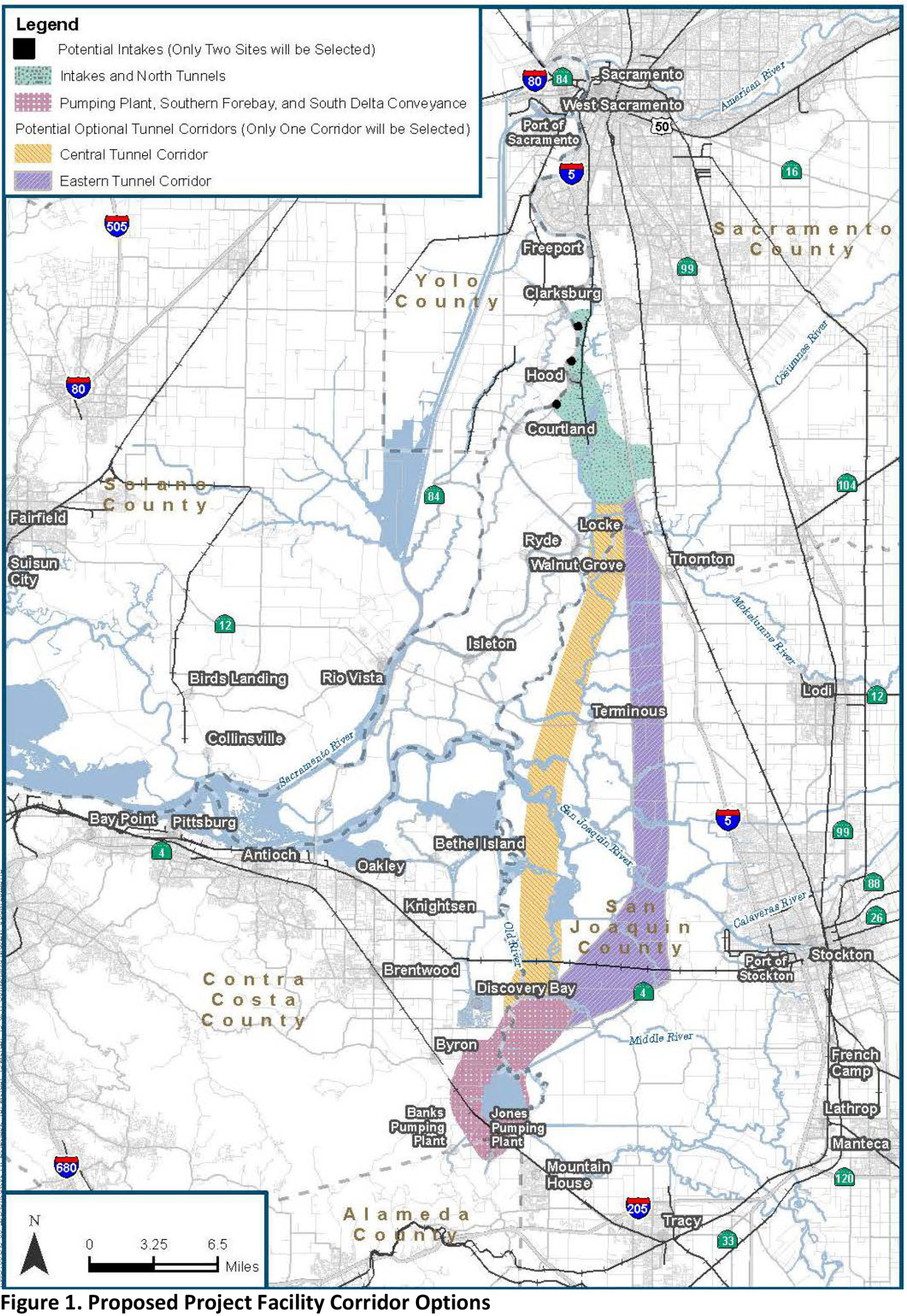
Proposed Delta Conveyance Project Facility Corridor Options. From Scoping Summary Report.

This week’s DCP Environmental Planning Update includes:

  • Adoption of a Mitigated Negative Declaration and Approval of Soil Collection Activities
  • Announcement of Federal Environmental Review

Delta Conveyance Project Scoping Summary Report Now Available

By Allen Payton

Photo by Department of Water Resources.

What was planned as two tunnels beneath the California Delta to divert fresh water from north of the Delta to areas south, is now a single tunnel plan that is referred to as the Delta Conveyance Project (DCP). The state previously referred to the two tunnel project as the WaterFix.

Although the state Department of Water Resources (DWR) rescinded all approvals of the WaterFix twin tunnel project last year, the Delta Conveyance Design and Construction Authority continues engineering and geotechnical work on the single tunnel project under DWR’s supervision.

On May 2, 2019 the DWR announced it was taking formal steps to withdraw proposed permits for the WaterFix project and began a renewed environmental review and planning process for a smaller, single tunnel project that will protect a critical source of water supplies for California. Those actions implement Governor Gavin Newsom’s direction earlier in 2019, to modernize the state’s water delivery infrastructure by pursuing a smaller, single tunnel project through the Sacramento-San Joaquin Delta. The project will be designed to protect water supply reliability while limiting impacts on local Delta communities and fish. The actions also follow the governor’s executive order directing state agencies to develop a comprehensive statewide strategy to build a climate-resilient water system.

The purpose of the new DCP is “to develop new diversion and conveyance facilities in the Delta necessary to restore and protect the reliability of State Water Project (SWP) deliveries and, potentially, Central Valley Project (CVP) water deliveries south of the Delta, consistent with the State’s Water Resilience Portfolio [WRP].”

California Natural Resources Secretary Wade Crowfoot described it as “A smaller project, coordinated with a wide variety of actions to strengthen existing levee protections, protect Delta water quality, recharge depleted groundwater reserves, and strengthen local water supplies across the state” that “will build California’s water supply resilience.”

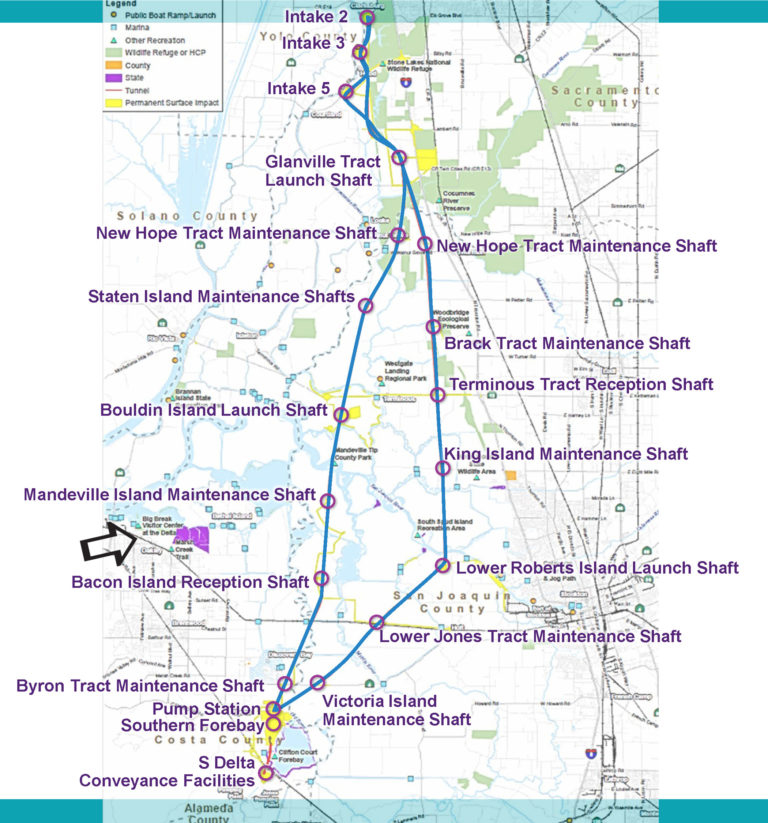
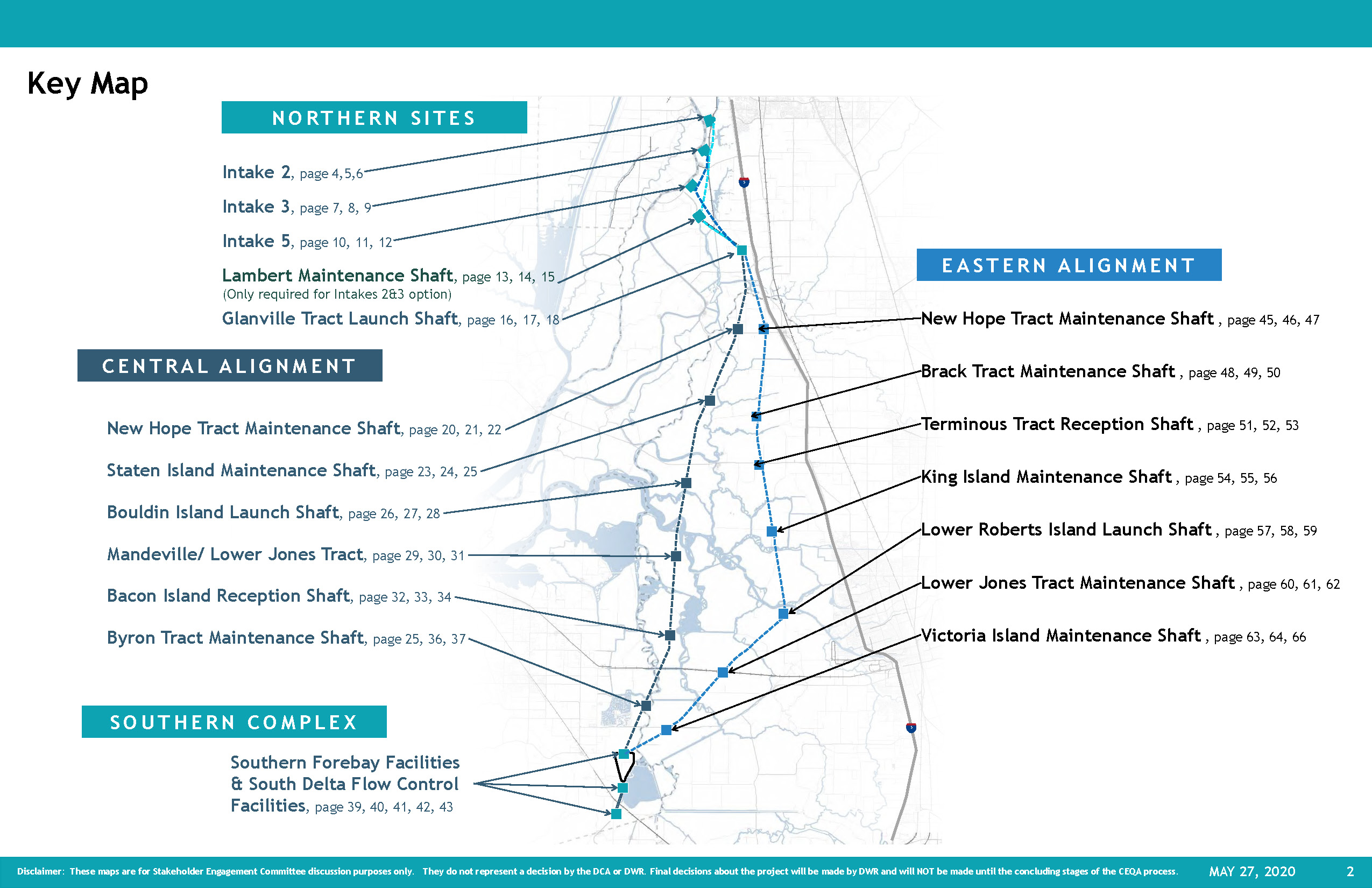
Map of intake, maintenance shaft and facility locations for the two alternative routes. From DCA 2020-05-27-UpdatedMapBooks

No Participation by Contra Costa County or Water Agencies

So, the effort to move fresh Delta water south, continues. But none of the water agencies in Contra Costa County are part of the DCA. They all either oppose or have chosen to remain neutral on the proposed tunnel in the face of almost complete opposition by county residents.

Instead, Contra Costa County is part of the five-member Delta Counties Coalition, along with Sacramento, San Joaquin, Solano and Yolo Counties all opposing the tunnel project.

However, there are four county residents who are members of the DCA’s Stakeholder Engagement Committee. Learn more about them, their opposition to the project and what they’re doing to limit and ensure the project mitigates any impact on county residents and businesses in Part 2 of this report.

The DCA participating state water contractors include the following agencies:

  • Alameda County Water District (At Large)
  • Alameda County Flood Control and Water Conservation District, Zone 7 (At Large)
  • Antelope Valley-East Kern Water Agency (At Large)
  • Coachella Valley Water District (At Large)
  • Metropolitan Water District of  Southern California (2 Permanent Seats)
  • Mojave Water Agency (At Large)
  • San Bernardino Valley Municipal Water District (At Large)
  • San Gorgonio Pass Water Agency (At Large)
  • Santa Clara Valley Water District (Permanent Seat)

DCA officers serve two-year terms. The SWC At Large Director and Alternate Director represent all participating State Water Contractors without a permanent Board seat. Directors and Alternate Directors are determined by the participating State Water Contractors. In addition, the Joint Powers Agreement allocates a Board seat to Kern County Water Agency. This seat is currently unfilled as Kern County Water Agency has not joined the DCA

$11 Billion Price Tag Could Quadruple

According to Barbara Barrigan-Parrilla, Executive Director of Restore the Delta, “the $11 billion figure quoted for construction of the Delta Conveyance Project is dated and incomplete. The $11 billion figure is in 2018 dollars. In 2018, Metropolitan Water District claimed inflation for construction should be calculated at 5% interest annually. That puts the project over $12 billion today without all the mitigation measures discussed by the Design Construction Authority in stakeholder meetings with Delta community members. These externalized mitigation costs will be absorbed by taxpayers.

Before bond interest, and with externalized mitigation costs, inflation roughly would put construction costs closer to $20 billion. Bond interest generally speaking would double the cost to $40 billion. And if the state is going to make Delta communities whole and leave the Delta ‘better off’ than it is presently, additional billions of dollars would need to be spent.”

Latest Updates & Reports

This week, the DWR issued an update and scoping report on environmental planning for the single tunnel project.

DWR Adopts Mitigated Negative Declaration and Approves Soil Collection Activities

On, Thursday, July 9, 2020, consistent with the requirements of the California Environmental Quality Act (CEQA), the Department of Water Resources (DWR) adopted the Final Initial Study/Mitigated Negative Declaration (IS/MND) for soil investigations in the Sacramento-San Joaquin Delta (Delta). As part of the CEQA process, DWR also formally approved the action and adopted a Mitigation Monitoring and Reporting Plan (MMRP). Soil investigations will include data collection, soil samples and surveys in support of DWR’s efforts to better understand the region’s geology to support the future evaluation of potential activities, including the proposed Delta Conveyance Project. As identified in the Final IS/MND, any potential significant impact will be avoided or otherwise mitigated with implementation of mitigation adopted as part of the project approval process. To access a copy of the Notice of Determination and Final IS/MND, which includes responses to comments and the adopted MMRP, visit the Delta Conveyance Environmental Planning page on DWR’s website.

U.S. Army Corps of Engineers to Prepare an Environmental Impact Statement Under the National Environmental Policy Act

The U.S. Army Corps of Engineers (USACE) has informed DWR that it will conduct federal environmental review of the proposed Delta Conveyance Project. USACE, which has regulatory authority over certain actions within specifically defined waters in the United States, will prepare an Environmental Impact Statement (EIS) under the National Environmental Policy Act (NEPA). Later this summer, USACE will issue a Notice of Intent officially announcing the start of preparation of the EIS. USACE’s letter to DWR can be found here.

The tunnel shaft will be drilled 150 feet below ground. From DCA SEC 2019-12-11-Delta Conveyance System Overview

Delta Conveyance Project Scoping Summary Report Now Available

The Department of Water Resources (DWR) has published a Scoping Summary Report for the proposed Delta Conveyance Project. This scoping report is a summary of the public scoping period that concluded in April. It includes all public comments received. The information collected during scoping will help inform the ongoing environmental analysis.
The scoping report includes: project overview, the purpose of scoping, a description of scoping activities, meetings, and notifications; a summary of public comments received and copies of all public comments received, including public scoping meeting transcripts.

The purpose of scoping is for DWR to gather feedback from the public and agencies on what to consider when preparing the proposed Delta Conveyance Project Environmental Impact Report. Specifically, DWR was seeking input on the range of project alternatives and potential environmental impacts to study further.

DWR will continue environmental review and analysis of the proposed Delta Conveyance Project, which is intended to maintain reliability of the state’s water system in the decades to come. For more information about the status of the environmental planning work, click here.

Upcoming Meetings

The next meeting of the Delta Conveyance Design & Construction Authority (DCA) Board of Directors will be held next Thursday, July 16 at 5:30 p.m. in the Tsakopoulos Library Galleria, 828 I Street in Sacramento (map). For details on watching and participating in the meeting online, click here.

Ways to Stay Informed

To stay informed of plans and progress on the Delta Conveyance Project visit https://water.ca.gov/Programs/State-Water-Project/Delta-Conveyance; Twitter @CA_DWR; email DeltaConveyance@water.ca.gov; or call the Project Hotline at 866.924.9955.

Filed Under: East County, Environment, News, The Delta, Water

Regional agencies seek input on the future of the Bay Area

July 10, 2020 By Publisher Leave a Comment

For transportation, housing, economy and environment for next three decades

Plan Bay Area 2050’s Draft Blueprint is available for public comment through August 10, 2020

SAN FRANCISCO, July 10, 2020 . . . The Metropolitan Transportation Commission (MTC) and the Association of Bay Area Governments (ABAG) are inviting the Bay Area public to provide input on the newly released Plan Bay Area 2050 Draft Blueprint, a 30-year regional vision that seeks to create a more affordable, connected, diverse, healthy and vibrant Bay Area for all. The Draft Blueprint is being released today for a public comment period that will run through August 10, 2020.

Given the myriad challenges the COVID-19 pandemic poses to the Bay Area, MTC and ABAG will hold virtual workshops and telephone town halls through August 7, 2020. Both organizations want to hear from all Bay Area residents in order to incorporate diverse voices from across our region. Input received by the agencies will be used to further refine the Final Blueprint to create a more resilient and equitable Bay Area for future generations. The Final Blueprint is slated for approval in late 2020 and will be integrated into Plan Bay Area 2050 prior to its adoption in 2021.

The Plan Bay Area 2050 Draft Blueprint weaves together transportation, housing, economic and environmental strategies, alongside an expanded set of growth geographies, to advance critical climate and equity goals. Designed to accommodate the 1.5 million new homes necessary to house future growth and address overcrowding, as well as 1.4 million new jobs, the Draft Blueprint integrates critical strategies to address our severe and longstanding housing crisis. With infrastructure investments in walking, biking and public transportation – as well as sea level protections designed to keep most Bay Area communities from flooding through 2050 – the Draft Blueprint makes meaningful steps towards the adopted Plan Bay Area 2050 Vision.

Plan Bay Area 2050 is a joint initiative of MTC and ABAG. For more information on Plan Bay Area 2050 or to provide comments on the Draft Blueprint, visit: www.planbayarea.org. The entire list of public events can be found here: www.planbayarea.org/meetings-and-events/upcoming-public-events.

See previous plans here – Plan 2040  Plan Bay Area

MTC is the transportation planning, financing and coordinating agency for the nine-county San Francisco Bay Area. ABAG’s mission is to strengthen cooperation and collaboration across local governments to build healthier, stronger communities.

Filed Under: Economy, Environment, Government, Growth & Development, Jobs & Economic Development, News, Transportation

Save Mt. Diablo acquires 29-acre Smith Canyon near Clayton for future recreational gateway to state park

May 7, 2020 By Publisher Leave a Comment

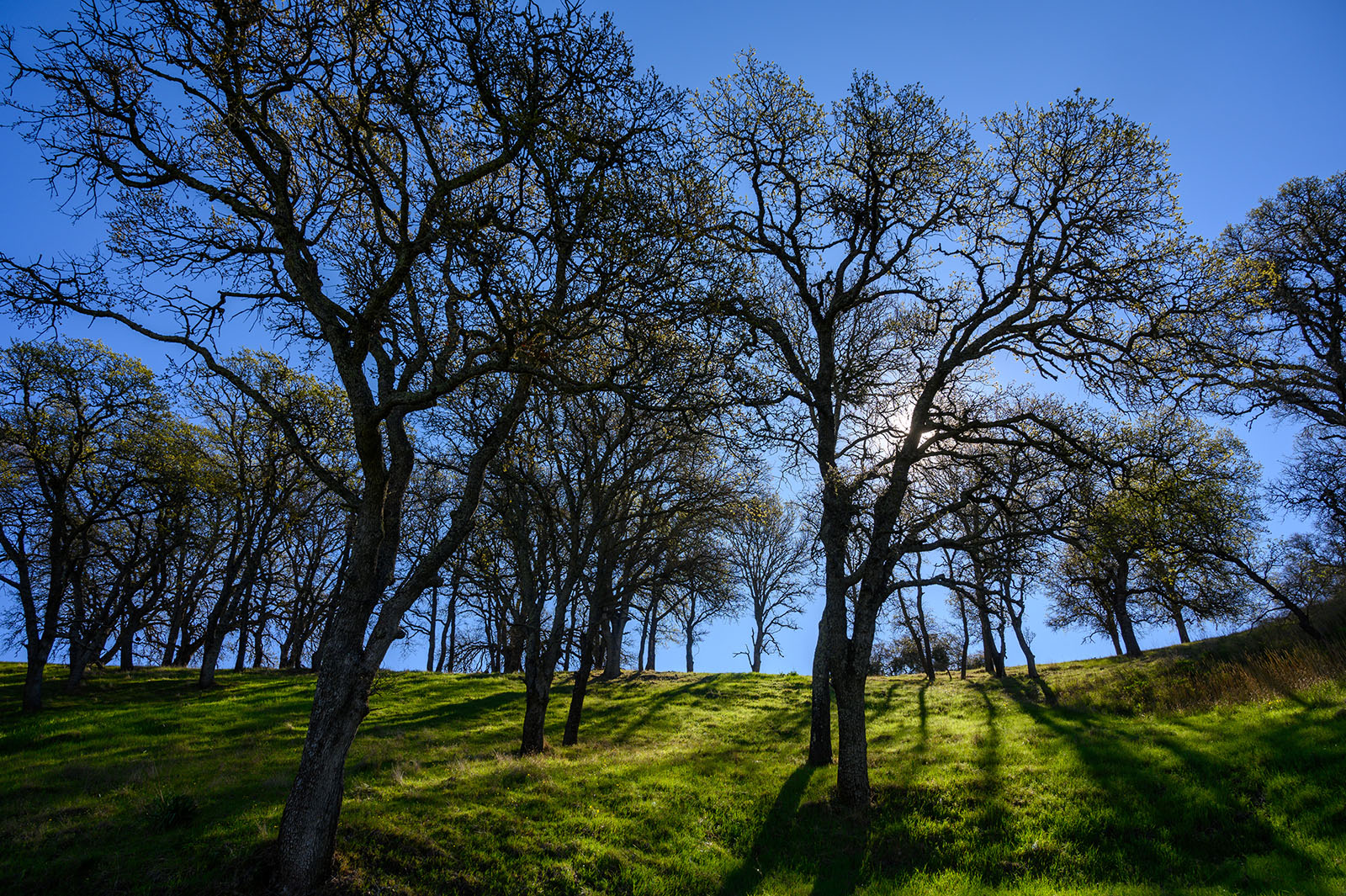
Smith Canyon’s oak woodlands. Photo by Scott Hein.

By Laura Kindsvater, Communications Manager, Save Mt. Diablo

Save Mount Diablo (SMD) has successfully closed escrow and become the proud new owner of the beautiful and strategic 28.73-acre Smith Canyon, east of Clayton. It could eventually be a recreational gateway to Curry Canyon and Mount Diablo State Park from Morgan Territory Road. It is one of several properties Save Mount Diablo is raising funds to protect with the final $2 million in fundraising of its $15 million Forever Wild Capital Campaign. (See related article).

Protection of 28.73-acre Smith Canyon provides legal and practical access from a public road to Save Mount Diablo’s conserved 1,080.53-acre Curry Canyon Ranch. Narrow Curry Canyon and Curry Canyon Road have been contemplated as an eastside entrance to Mount Diablo for more than 110 years, but complicated legal access issues have made public access difficult. Smith Canyon provides a second, alternate access route into Curry Canyon with clear legal access rights.

“The Smith Canyon property is an incredible recreational gateway to the magical Curry Canyon on the east side of Mount Diablo,” said Ted Clement, SMD’s Executive Director. “But what also strikes me about the property is that it has great potential as a beautiful stand-alone preserve by itself.

“You can imagine groups of school children experiencing it, working with volunteers to replant trees to restore former building pads, taking care of the land together, and hiking its trails up to the stunning view spots where they can sit to appreciate and connect with nature. I didn’t expect the beautiful vistas of North Peak and Mount Diablo that we discovered on the high points of the land.”

“How often do you get to save an entire canyon,” said Seth Adams, SMD’s Land Conservation Director. “Smith Canyon is lovely. It’s one main lushly wooded stream canyon with several smaller drainages rising to ridges on either side and toward a small peak on our neighboring Curry Canyon Ranch.

“Despite limited rain this spring, it’s bright green and wildflowers are appearing everywhere. There were several approved subdivisions on the property that luckily never took place, but the large building pads show how threatened it has been. Its purchase is another piece in our Curry Canyon puzzle and ends that threat forever.”

In addition to its value for recreational and other access, Smith Canyon is important from a conservation perspective. The land has blue oak woodlands, grasslands, and a live oak-bay riparian corridor. California red-legged frog and Alameda whipsnake are special status species likely to be present on the property. Further, the land is contiguous with Save Mount Diablo’s conserved Curry Canyon Ranch, so its protection adds to the important corridor of conserved lands in the Mount Diablo area, which is critical for wildlife and water resources. The land also affords beautiful scenic vistas to passersby on the public Morgan Territory Road.

View of Mount Diablo’s peaks from Smith Canyon. Photo by Scott Hein.

Further, the oak woodland, oak savanna, and grasslands on the property serve as a carbon sink. In August 2019, the UN Intergovernmental Panel on Climate Change issued a new report, Climate Change and Land, that focused on how land is under increased pressure from humans and climate change but also noted land is a critical part of the solution to climate change. Land conservation mitigates against climate change in lasting ways. For example, forests and other undeveloped lands absorb greenhouse gases, thereby acting as carbon sinks, keeping those gases out of the atmosphere.

“We’re looking for angels,” said Karen Ferriere, SMD’s Development Director, about the need to raise the $650,000 purchase price and replenish the acquisition funds that were used to cover the real estate closing, “and talking to everyone we can.”

The money that Save Mount Diablo is raising for this acquisition project is part of the organization’s Forever Wild Capital Campaign. This campaign has an ambitious $15 million goal to help Save Mount Diablo expedite its land acquisition efforts while also giving the organization the resources to steward and defend its conserved lands in perpetuity. To date, just over $13 million has been raised against the $15 million goal. These funds have enabled Save Mount Diablo to do strategic land acquisition projects, like its Curry Canyon Ranch and North Peak Ranch projects, while also building a sizable permanent Stewardship Endowment Fund for the ongoing care of the organization’s protected lands.

As part of the Forever Wild Capital Campaign, Save Mount Diablo also recently signed an option agreement that gave the organization two years to raise a little over $1.04 million to purchase a perpetual conservation easement on about 154 critical open space acres on the northeast slopes of Mount Diablo, a mile-wide property owned by the Concord Mt. Diablo Trail Association.

Map of the Smith Canyon acquisition and Concord Mt. Diablo Trail Ride Association planned conservation easement showing their adjacency to other protected lands as well as lands still potentially threatened with development. Map by Save Mt. Diablo.

History

Curry Canyon became well-known to generations of East Bay residents visiting the Curry Creek Park picnic area, which operated from 1925 to 1979, and then to the present day as a small trailer park. Sylvester Olofson, his wife Louise, and his brother Albert Olofson bought 1,430 acres on Curry Canyon in 1895; ran cattle; and in 1925, opened Curry Creek Park. Over time Curry Canyon was divided between the two brothers’ heirs. After World War II, Curry Creek Park and neighboring Wright Canyon were owned and operated by Sylvester and Louise Olofson’s grandson, Martin Wright, and his wife, Dorothy. The larger part of the property was a cattle ranch run by Albert’s sons Raymond and Robert Olofson.

In 1961 Ettore and Geraldine Bertagnolli bought most of the Olofson cattle ranch and renamed it Curry Creek Ranch, but it included limited access for anything but ranching. Ettore Bertagnolli soon started proposing small subdivisions, but he was blocked by the Wrights’ ownership of the road lower in the canyon. In 1968 he subdivided Smith Canyon off his property but retained a 60’ road easement, to be located and constructed later.  He used that “paper road” to complete several subdivisions in the canyon.

Albert and Bouwina Reyenga bought Smith Canyon in 1968 and proposed a four-unit subdivision there. Roads and large building pads were graded but without professional engineering.

The subdivision was approved in 1970, but subject to various improvements including engineering improvements to the roads and pads, and paving of the access easement to the Bertagnollis’ Curry Creek Ranch. The improvements were never completed, and the approval lapsed.

The same subdivision was proposed again by the Reyengas in 1992, but building regulations had become more stringent. For the first time Save Mount Diablo was involved, requesting that a public access into Curry Canyon be reserved.

The second subdivision wasn’t completed, once again because of the cost of the roads and other building improvements. In 2000 the Reyengas sold the property to the current owners, E & B Farms, who faced similar constraints including the access easement into Curry Canyon.

In 2013 Save Mount Diablo bought the 1,080-acre Bertagnolli property and renamed it Curry Canyon Ranch. The purchase included the partly improved and unrestricted access easement up Smith Canyon. Purchase of Smith Canyon has eliminated the threat of houses and further subdivision and avoided potential conflicts with access and recreational use.

Save Mount Diablo

Save Mount Diablo is a nationally accredited, nonprofit land trust founded in 1971 with a mission to preserve Mount Diablo’s peaks, surrounding foothills, and watersheds through land acquisition and preservation strategies designed to protect the mountain’s natural beauty, biological diversity, and historic and agricultural heritage; enhance our area’s quality of life; and provide recreational opportunities consistent with the protection of natural resources. Learn more at www.savemountdiablo.org.

Filed Under: Central County, Environment, News, Parks

Save Mt. Diablo expands efforts to protect the 150-mile long Diablo Range

April 9, 2020 By Publisher Leave a Comment

3. Map showing the northern Diablo Range. Save Mount Diablo recently expanded the area in which it works down to the Santa Clara County line. In addition to Contra Costa County between Highway 680 and the Byron Highway, Save Mount Diablo’s area of interest now encompasses portions of southeastern Alameda County and southwestern San Joaquin County, including a critical wildlife corridor linking Mount Diablo to the rest of the Diablo Range and a vulnerable region of spectacular biodiversity (Cedar Mountain, Corral Hollow, and the greater Mines Road area). Map prepared in collaboration by Save Mount Diablo and Nomad Ecology, LLC.

California’s next big conservation story right in our backyards

By Laura Kindsvater, Communications Intern, Save Mount Diablo

Save Mount Diablo has launched a campaign to connect Mount Diablo to the whole of the Diablo Range, a 150-mile long mountain range and biodiversity refuge that’s next door to millions of people, but that most people know nothing about.

“The Diablo Range is the missing piece of the California conservation map,” says Save Mount Diablo Land Conservation Director Seth Adams. “It’s California’s next great conservation story.”

“Seventy-five percent of the ecologically important area around Mount Diablo has been preserved,” explains Edward “Ted” Sortwell Clement, Jr., Save Mount Diablo’s Executive Director, “while in the full 150-mile range, only 24 percent of the landscape has any protection. We’re going to change that. Save Mount Diablo’s first step is defining the range as a whole for the conservation community and the public and educating them about its importance.”

View of the Diablo Range from the top of San Benito Mountain, at 5,241 feet the Diablo Range’s highest peak. The Diablo Range covers 12 counties and 5,400 square miles, but most people have never heard of it. Copyright Stephen Joseph; used with permission.

Save Mount Diablo’s public educational efforts will include the full 150-mile Diablo Range. As part of this campaign, Save Mount Diablo helped to sponsor a newly published cover story and supplement about the Diablo Range in Bay Nature magazine, with the Santa Clara Valley Open Space Authority. “The Spine of California,” by Bay Nature Digital Editor Eric Simons, explores the most rugged, plant-rich stretch of California you’ve never heard of.

The cover story is the first article ever published specifically about the Diablo Range, and it includes the first ever published map of the public and protected lands of the Diablo Range. “Our first effort is to put this place on the map,” notes Adams.

Serpentine ecosystems at San Benito Mountain. Copyright Stephen Joseph; used with permission.

Also, as part of the campaign, Save Mount Diablo recently expanded the geographic area in which it now does its land use advocacy; it now includes the three northern counties of 12 crossed by the Diablo Range. The organization’s primary acquisition focus remains north of Highway 580 and around the main peaks of Mount Diablo. The organization recently announced two acquisition projects on the main peaks, the 154-acre Trail Ride Association conservation easement on North Peak for which it needs to raise a little over $1,040,000 and the $650,000 Smith Canyon project adjacent to Curry Canyon.

In addition to working in Contra Costa County between Highway 680 and the Byron Highway, Save Mount Diablo now also works in southeastern Alameda and southwestern San Joaquin Counties.

This area includes an essential, 10-mile-wide wildlife corridor (Altamont Pass is part of it) that connects Mount Diablo to the rest of the Diablo Range. It also includes one of the most important and vulnerable biodiversity hotspots in California.

Panoche Valley and the Panoche Hills, part of the Diablo Range. The Diablo Range is threatened by both alternative and fossil-fuel based energy development, and in the Panoche Valley, large solar farms are beginning to pop up. Credit Al Johnson.

According to Simons, “The 150-mile range of mountains from the Carquinez Strait to the oil fields of the southern San Joaquin Valley holds some of the largest remaining wild places in California. It is a rugged, remote, difficult realm, a biodiversity ark incised by the San Andreas Fault. It is a historic mixing place, where Central Valley Yokuts and coastal Ohlones traded and danced, where California’s ever-more-diverse future residents will seek escape and recreation. And it is nearly unparalleled in ecological significance.”

The Diablo Range stretches from the Carquinez Strait all the way to the Antelope Valley in Kern County and contains some of the largest remaining unprotected wild places in California. The mountain range is huge, rugged, and remote. Bounded by Highway 101 to the west and Interstate 5 to the east, the 150-mile long, 40- to 50-mile wide area is a blank spot on the map for the public focused on its outer grassland foothills.

“Five miles in and 500 feet up,” Adams says, “oaks and chaparral appear, and it’s Mount Diablo multiplied.”

Serpentine ecosystems at San Benito Mountain. Copyright Stephen Joseph; used with permission.

The Diablo Range covers 5,400 square miles and has many peaks, some of which are taller than Mount Diablo. The tallest one is San Benito Mountain at 5,241 feet. Mount Diablo measures at 3,849 feet.

The range is extremely important for wildlife, crossed only by two major highways at Altamont and Pacheco Passes. It serves as a reservoir of biodiversity, a core habitat for wildlife in California.

Although golden eagle populations are declining in western North America, they’re stable in California because of the Diablo Range.

The northern Diablo Range supports the highest density of golden eagles on the planet. The Diablo Range could also be the source for replenishing the genetic diversity of mountain lion populations in the Santa Cruz Mountains.

Save Mount Diablo Executive Director Ted Clement (left) and Land Conservation Director Seth Adams waving from on top of San Benito Mountain, at 5,241 feet the highest point in the Diablo Range. Credit Al Johnson.

Tule elk, nearly hunted to extinction in the 1970s, have recovered quickly in the Diablo Range. Bay checkerspot butterflies have their last stronghold along Coyote Ridge just above San Jose. And the Diablo Range offers great habitat for California condors to expand into as they recover from the brink of extinction.

The Diablo Range is threatened by energy development (both alternative and fossil fuel-based energy), suburban sprawl, and proposed dams and reservoirs. Wind turbines endanger golden eagles and other birds. And the Panoche Valley, part of the Diablo Range, now has a 4,800-acre solar farm.

Headwaters of the San Benito River. Credit Al Johnson.

This mountain range harbors incredible biodiversity that supports many rare, endemic (plants or animals found nowhere else), or disjunct species (plants that are cut off from other populations and not expected to be there). It contains large swaths of land with serpentine soils, on which rare plant species that live nowhere else grow. And some of the soils are “vertic clays,” which also support rare and endemic plant species.

Cover of the Spring 2020 issue of Bay Nature magazine. Credit Bay Nature.

Although the Diablo Range is right next to some large cities, large areas of it have limited to no cell phone coverage, light pollution, or major roads, an indication of its habitat connectivity.

Read more about the Diablo Range and Save Mount Diablo’s work to protect it in the Bay Nature cover story.

About Save Mount Diablo

Save Mount Diablo is a nationally accredited, nonprofit land trust founded in 1971 with a mission to preserve Mount Diablo’s peaks, surrounding foothills, and watersheds through land acquisition and preservation strategies designed to protect the mountain’s natural beauty, biological diversity, and historic and agricultural heritage; enhance our area’s quality of life; and provide recreational opportunities consistent with the protection of natural resources. Learn more at www.savemountdiablo.org.

Filed Under: Environment, News

Contra Costa’s green future? Sierra Club to hold Green New Deal Town Hall in Antioch Feb 21

February 12, 2020 By Publisher Leave a Comment

The Green New Deal is a proposed package of legislation first introduced in Congress by freshman Member Alexandria Ocasio-Cortez and Massachusetts Senator Ed Markey. It has aroused support and controversy in equal measures.  The legislative proposal is their comprehensive approach to address claims of climate change and has become a central discussion point in the 2020 election. It combines the economic approach of President Roosevelts’ New Deal program and adds renewable energy and resource efficiency. It is being championed by self-described democratic socialist Senator Bernie Sanders, one of the front runners in the Democratic presidential primary race.

The two bills that make up the package are House Resolution 109 and Senate Resolution 59. In the Senate, Markey introduced the bill and it was defeated with no votes in favor and 57 votes against, and 43 Senators voting present in protest to there not being any debate or expert testimony. The House bill has not yet received a vote. However, the House Select Committee on Climate Crisis was created to study the list of proposals contained in the legislation.

But what does it mean for Contra Costa County?

The Sierra Club, one of America’s leading environmental protection organizations, is hosting a Town Hall in Antioch to discuss the plan and how Contra Costa communities will benefit and be impacted.

The event will take place on Friday, February 21st from 7:30 pm to 9:30 pm at the Antioch Community Center, 4703 Lone Tree Way, Antioch.

Featured speakers include Dr. Mark Stemen, professor of geography, planning, and civics from California State University, Chico. Stemen is a noted authority and a highly entertaining speaker who is much in demand.

Also speaking will be youth leaders from the Sunrise Movement of Northern California. The Sunrise Movement is at the vanguard of environmental activism, their tactics of organizing have demanded attention from both elected officials and the public.

In addition, Deirdre Des Jardins, principal with California Water Research, will discuss water challenges for the Delta Region. From the Sierra Club, Helen Fitzmaurice will speak about the importance and ways to educate schools and students on climate change. Public officials and candidates have also been invited.

In response to the proposed legislation it was announced on Wednesday, Feb. 12 that a new website was launched to expose the dangers of the Green New Deal by America Rising Squared, which, according to their website, is an organization “dedicated to promoting the principles of freedom, limited government, free enterprise, and a strong national security, and pushing back against big government liberal policies and the special interests that support them.”

The Green New Deal Town Hall in Antioch promises to be a stimulating and exciting discussion of Contra Costa County’s future.

Allen Payton contributed to this report.


Filed Under: East County, Environment, News

Rattlesnake Advisory: Rattlesnake safety in the Regional Parks

June 13, 2019 By Publisher Leave a Comment

Photo from Snakes of the EBRPD brochure.

As the weather heats up, rattlesnakes become more active in many of our parks, their natural habitat. They like to explore when the weather gets warm which can lead to more encounters with humans and dogs. The East Bay Regional Park District is advising that the public take snake safety precautions when visiting Regional Parks.

Safety Tips for Visiting Regional Parks

  1. Always hike with a friend so you can help each other in case of emergency.
  2. Look at the ground ahead of you as you are walking.
  3. Look carefully around and under logs and rocks before sitting down.
  4. Avoid placing your hands or feet where you can’t see clearly.
  5. Check the area around picnic tables, campsites, and barbecues before using them. If you encounter a rattlesnake in these areas, notify park staff.
  6. Keep pets on the designated trails and away from snakes if they see one.
  7. Bring plenty of water for yourself and your pets as many parks do not have a direct water supply.

What to Do If You See a Rattlesnake

Leave it alone – do not try to capture or harm it. All park wildlife is protected by law. If you see a snake on a trail, wait for it to cross and do not approach. Then move carefully and slowly away.

What to Do If Bitten by a Snake

  1. If bitten by a rattlesnake, stay calm and send someone to call 911. Remain calm by lying down with the affected limb lower than the heart. Do not waste precious time on tourniquets, “sucking,” or snake bite kits. If you are by yourself, walk calmly to the nearest source of help to dial 911. Do not run.
  2. If bitten by any other kind of snake, wash the wound with soap and water or an antiseptic and seek medical attention.
  3. If you are not sure what kind of snake bit you, check the bite for two puncture marks (in rare cases one puncture mark) associated with intense, burning pain. This is typical of a rattle snake bite. Other snakebites may leave multiple teeth marks without associated burning pain.

Snakes are an important resource in the natural environment. They are prime controlling agents of rodent, insect, and other reptile populations. They must be enjoyed from afar and left where they are found. It is illegal to collect, kill, or remove any plants or animals from the East Bay Regional Park District. Please help us to protect wildlife and their environment for present and future generations. Additional information is available at www.ebparks.org/parks/safety/#Snakes or download a PDF version of our Common Snakes.

Filed Under: Environment, News, Parks

National Resources Conservation Service announces new District Conservationist for county

May 21, 2019 By Publisher Leave a Comment

Clarimer Hernandez-Vargas. with permission.

The USDA Natural Resources Conservation Service (NRCS) is pleased to announce the appointment of Clarimer Hernández-Vargas as the new Contra Costa County District Conservationist, based in Concord.

“I am very excited to be in this position,” said Hernández-Vargas. “I am excited to meet the local farmers and see how we can help them address their resource concerns across the county.”

Popular conservation practices in the county include irrigation improvements on cropland and orchards, assistance to organic producers, and wildlife habitat, in addition to dozens of other conservation priorities.

Hernández-Vargas holds a bachelor’s degree in agriculture with a minor in animal science from the University of Puerto Rico-Mayagüez Campus. She is a native of Puerto Rico.

Hernández-Vargas started her NRCS career as a soil conservationist in Sioux Falls, S.D. She worked in different counties throughout South Dakota, before moving to Delaware. When this position became available in California, she jumped at the opportunity. Hernández-Vargas started her new position on March 18.

NRCS is a federal agency that works in partnership with resource conservation districts. With the mission of “Helping People Help the Land,” NRCS provides products and services that enable people to be good stewards of the nation’s soil, water, and related natural resources on non-federal lands.

The Contra Costa Resource Conservation District was formed in 1941. Their service area includes all of Contra Costa County and covers 516,191 acres. CCRCD is one of California ’s 103 Resource Conservation Districts. It is governed by a voluntary Board of Directors appointed by the County Board of Supervisors.

Allen Payton contributed to this report.

Filed Under: Agriculture, Environment, News, People

State withdraws twin tunnel WaterFix approvals, initiates planning, permitting for smaller single tunnel

May 2, 2019 By Publisher Leave a Comment

Photo: CA Dep’t of Water Resources.

SACRAMENTO – The Department of Water Resources (DWR) today is taking formal steps to withdraw proposed permits for the WaterFix project and begin a renewed environmental review and planning process for a smaller, single tunnel project that will protect a critical source of water supplies for California.

Today’s actions implement Governor Gavin Newsom’s direction earlier this year to modernize the state’s water delivery infrastructure by pursuing a smaller, single tunnel project through the Sacramento-San Joaquin Delta. The project is needed to protect water supplies from sea-level rise and saltwater intrusion into the Delta, as well as earthquake risk. It will be designed to protect water supply reliability while limiting impacts on local Delta communities and fish.

This action follows the Governor’s recent executive order directing state agencies to develop a comprehensive statewide strategy to build a climate-resilient water system.

“A smaller project, coordinated with a wide variety of actions to strengthen existing levee protections, protect Delta water quality, recharge depleted groundwater reserves, and strengthen local water supplies across the state, will build California’s water supply resilience,” said Natural Resources Secretary Wade Crowfoot.

DWR Director Karla Nemeth took action today to rescind various permitting applications for the WaterFix project, including those in front of the State Water Resources Control Board, California Department of Fish and Wildlife, and federal agencies responsible for compliance with the Endangered Species Act. Documents related to these actions are available here.

DWR will work with local public water agencies that are partners in the conveyance project to incorporate the latest science and innovation to design the new conveyance project, and work with Delta communities and other stakeholders to limit local impacts of the project.

Assemblymember Jim Frazier (D-Discovery Bay), co-chair of the California Delta Legislative Caucus, issued the following statement today after the state Department of Water Resources officially withdrew its permit application to build the twin tunnels.

“It’s very encouraging that after all these years we are finally being heard by the Governor’s Office. The withdrawal of the permit application acknowledges that alternative solutions have been either overlooked or ignored. I look forward to working with the Governor and Secretary Crowfoot to build a comprehensive water plan that is a benefit for all Californians.”

Filed Under: East County, Environment, News, The Delta, Water

  • « Previous Page
  • 1
  • …
  • 5
  • 6
  • 7
  • 8
  • 9
  • …
  • 13
  • Next Page »
Monicas-11-25
Deer-Valley-Chiro-06-22

Copyright © 2026 · Contra Costa Herald · Site by Clifton Creative Web