• Home
  • About The Herald
  • Local Agencies
  • Daily Email Update
  • Legal Notices
  • Classified Ads

Contra Costa Herald

News Of By and For The People of Contra Costa County, California

  • Arts & Entertainment
  • Business
  • Community
  • Crime
  • Dining
  • Education
  • Faith
  • Health
  • News
  • Politics & Elections
  • Real Estate

New poll indicates majority support for Bay Area transit revenue and reform measure

February 25, 2025 By Publisher Leave a Comment

Source: MTC

Contra Costa voters polled support two of three options; want potholes fixed on local streets, improved traffic flow and safety

Members of the Metropolitan Transportation Commission (MTC)’s and the Association of Bay Area Governments (ABAG)’s Joint Legislation Committee heard, on Friday, Feb. 14, the results of a January 2025 poll of Bay Area voters conducted by Oakland-based EMC Research on options for a potential transportation tax measure that could avert deep service cuts by BART, San Francisco Muni, Caltrain and other transit agencies; and could spur implementation of the Bay Area Transit Transformation Action Plan to improve the customer experience for transit riders. State senators Scott Wiener of San Francisco and Jesse Arreguín of Berkeley last month introduced Senate Bill 63 to authorize placement of such a measure on the November 2026 ballot. EMC Research, Inc. conducted the poll of 3,050 Bay Area voters to test support and overall attitudes regarding a potential transportation revenue measure, including a three-way split sample to test three different funding frameworks. They included the following:
  • Scenario 1A: A 10-year 1/2-cent sales tax focused on averting major transit service cuts and providing funding for Transit Transformation, generating at least $560 million annually and
  • Hybrid: A 30-year 1/2-cent sales tax plus $0.09 per building sq.ft. parcel tax including at least five counties and up to nine, providing a higher level of funding for transit operations in early years, funding for Transit Transformation, plus flexibility for local infrastructure priorities.
  • Variable Rate: ½-cent to 7/8-cent (0.875) sales tax for transit for 11 years, as proposed by San Francisco Municipal Transportation Agency, generating at least $640 million annually focused on transit operations with the goal of more fully addressing transit agencies’ operating funding needs. Note that this framework was included to maximize efficiencies and ensure “apples to apples” comparison of polling results. SFMTA is funding this portion of the poll.
The poll found that a majority (54%) of voters in the four counties of Alameda, Contra Costa, San Francisco and San Mateo would vote yes on a half-cent sales tax to avoid major transit cuts to BART, Caltrain, Muni and AC Transit. It also found majority support (55%) in these four counties for a variable tax option that included a half-cent sales tax in Contra Costa, Alameda and San Mateo and a higher (0.875 cent) sales tax in San Francisco. In Contra Costa County the results of 600 total voters polled, with 200 for each option, initially showed 53% support for Scenario 1A: 10-year 1/2-cent sales tax, 51% support for the Hybrid option and 54% support for the Variable Rate. But after hearing more information and opposition, 56% of Contra Costa voters opposed the Hybrid option, 53% supported the Variable Rate and just 51% supported the 1/2-cent sales tax. “While it’s good to see most voters would support a measure of these types, support is well below the two-thirds threshold that would be required if MTC were to place the measure on the ballot,” noted MTC Commissioner and Pleasant Hill City Councilmember Sue Noack. “This means any near-term path would need to be via a citizen’s initiative, which would require a broad coalition to gather the needed signatures as well as strong campaign leadership.” The poll results show transportation ranks comparatively low on the list of voters’ concerns when respondents were asked an open-ended question (affordable housing, drugs/crime and homelessness top the list) but awareness of the post-pandemic challenges faced by transit agencies is high, with over two-thirds of the voters polled saying Bay Area public transit needs more funding. “Transit has an irreplaceable role in our region, being the only source of transportation for many essential workers, people of color, and working-class families,” added Senator Arreguín. “As we continue our recovery from the pandemic, securing funding to public transit is required to ensure a stronger, more resilient economy for all of us in the Bay Area.” A third tax framework for which EMC Research polled Bay Area voters involved a measure that would be funded by a combination of a half-cent sales tax and a 9-cents per square foot parcel tax over 30 years to funds pothole repairs and highway improvements in addition to transit improvements. Support for this framework started at 51 percent but dipped to 44 percent after respondents heard opposing arguments. MTC in December 2024 approved several policy provisions for inclusion in state legislation that would enable voters to consider a future ballot measure. These include requiring stronger oversight of transit agencies’ financial information and requiring transit agencies to adopt policies to help improve the transit customer experience as a condition for receiving new funds. About MTC MTC is the transportation planning, financing and coordinating agency for the nine-county San Francisco Bay Area. The full presentation delivered to the MTC-ABAG Joint Legislation Committee may be accessed on the MTC website. Allen D. Payton contributed to this report.

Filed Under: Bay Area, News, Politics & Elections, Taxes, Transportation

Sand Creek Road Extension in Brentwood now open

February 11, 2025 By Publisher Leave a Comment

Eastbound and westbound views of the now open Sand Creek Road Extension including the bridge over the creek. Herald file photos.

Connects Hwy 4 to Heidorn Ranch Road and Hillcrest Avenue in Antioch

By Allen D. Payton

The City of Brentwood announced on Monday, “The Sand Creek Road Extension is NOW OPEN! We’re thrilled to bring this new roadway to the community and hope it enhances your travels. Please drive safely and enjoy the new route!”

About the delay in the road’s opening two weeks after the ribbon cutting, Assistant City Manager Darin Gale said, “The extension is a unique project because it starts at an intersection that’s controlled by Caltrans and ends at an intersection that’s controlled by Antioch.”

“There were still some items that needed to be completed before we could open the road,” he shared, reiterating what City Manager Tim Ogden said during the ribbon cutting ceremony on Jan. 28. (See related article)

“We appreciate the partnership with those two agencies in getting the road open as quickly as possible” Gale added.

“Part of the intersection built by the developer in Antioch had not yet been approved by the City of Antioch,” he explained as one of the reasons for the delay.

Aerial view of the Sand Creek Road Extension at Heidorn Ranch Road. Source: City of Brentwood

Gale was asked about the timing of the opening and if it had anything to do with the new Costco opening nearby.

He responded, “The City of Brentwood was moving forward with the Sand Creek Road anyway. However, the road does provide a connection to Costco. While it was coincidental to the timing of the opening of Costco, it helped us with attracting the store to Brentwood.”

“We look forward to Sand Creek Road serving the Brentwood Innovation Center (located to the north) and bringing jobs to the residents of East County,” Gale stated.

The new section of the road now connects to the Antioch section at Heidorn Ranch Road, then to Hillcrest Avenue and west to the road that runs north adjacent to Dozier Libbey Medical High School in Antioch.

Gale also reiterated what Antioch Mayor Ron Bernal said at the ribbon cutting, as previously reported. He said, “Richland Communities over to the west of us, they’re going to be starting this year, I’m told, on their subdivision that’s going to build that final link between Sand Creek Road, where it terminates right now, and Deer Valley Road. So, that’s going to be able to get residents and folks over to Kaiser, which is important, getting people off of Deer Valley Road.”

Sand Creek Road will eventually connect to Dallas Ranch Road in Antioch, on the west side of Deer Valley Road and run through The Ranch 1,177-new home subdivision developed by Richland Communities and approved by the Antioch City Council in July 2020.

Filed Under: East County, Infrastructure, News, Transportation, Travel

DeSaulnier denounces U.S. Dep’t of Transportation’s upending electric vehicle use as “reckless”

February 7, 2025 By Publisher Leave a Comment

Rep. Mark DeSaulnier. Official photo.

Rescinds National Electric Vehicle Infrastructure Formula Program Guidance dated June 11, 2024, and all prior versions of this guidance

Congressman issues statement saying it, “leaves American drivers and consumers in the lurch.”

On Friday, February 7, 2025, Congressman Mark DeSaulnier (D-CA10) issued the following statement after the Trump Administration suspended implementation of the National Electric Vehicle Infrastructure (NEVI) Formula Program.

“The transportation sector is the leading source of greenhouse gas emissions in the United States. Electric vehicles (EVs) are crucial to reducing GHG emissions and curbing the existential threat of climate change while also having the potential to save drivers hundreds or even thousands of dollars in gas money annually. Given the obvious benefits of EVs, it is in everyone’s best interest to make it easier for Americans to drive them.

As a former member of the California Air Resources Board and Chairman of the transportation committees in both the California State Assembly and the California State Senate, I have seen firsthand how California’s forward-looking policies on climate change and greenhouse gas emissions drive innovation, economic growth, and job creation. That’s why I authored the Clean Corridors Act, which helped create and fund a $2.5 billion landmark new EV charging infrastructure program through the 2021 Bipartisan Infrastructure Law to make hydrogen fuel cell and electric battery powered cars more accessible and affordable for Americans.

The decision by the Federal High Administration of the Department of Transportation to suspend approvals of State Electric Vehicle Infrastructure Deployment Plans, which are required to receive NEVI funding, undoes the progress these two programs achieved, sets us back in the fight against climate change, and leaves American drivers and consumers in the lurch.

In 2024, China’s share of the global EV market grew to 76%, outpacing the U.S. in sales, and vastly surpassed the U.S. in number of public EV chargers with over 3.2 million public charge points. If the U.S. wants to be a leader in the transportation and energy sectors, we need a strong federal investment in electric vehicles and their charging infrastructure to meaningfully address climate change, help lower energy and transportation costs for Americans, and maintain global competitiveness. As a senior member of the Transportation and Infrastructure Committee, I urge the Secretary of Transportation to reverse this myopic and reckless decision.”

In a Feb. 6, 2025, letter to State Department of Transportation Directors, Emily Biondi, Associate Administrator of the Office of Planning, Environment and Realty wrote:

“The Federal Highway Administration (FHWA) administers several grant programs under which the applicable statutes require the Secretary to apportion grant funds to States under a prescribed statutory formula. The National Electric Vehicle Infrastructure (NEVI) Formula Program is one such program. Most statutory formula programs require the Secretary to make the prescribed apportionments to the States on a specific date and then make the funds available for obligation. See, e.g., 23 U.S.C. 104. The NEVI Formula Program, however, is unique in that this Program requires the Secretary to approve a plan for each State describing how the State intends to use its NEVI funds.1 The State plans are to be developed in accordance with guidance the Secretary provides on how States are to strategically deploy the electric vehicle (EV) charging network.2 The NEVI Formula Program requires the Secretary to approve each State’s plan prior to the obligation of NEVI Formula Program funds for each fiscal year.3

“The new leadership of the Department of Transportation (U.S. DOT) has decided to review the policies underlying the implementation of the NEVI Formula Program. Accordingly, the current NEVI Formula Program Guidance dated June 11, 2024, and all prior versions of this guidance are rescinded. The FHWA is updating the NEVI Formula Program Guidance to align with current U.S. DOT policy and priorities, including those set forth in DOT Order 2100.7, titled “Ensuring Reliance Upon Sound Economic Analysis in Department of Transportation Policies, Programs, and Activities.” The FHWA aims to have updated draft NEVI Formula Guidance published for public comment in the spring. After the public comment period has closed, FHWA will publish updated final NEVI Formula Guidance that responds to the comments received. As result of the rescission of the NEVI Formula Program Guidance, FHWA is also immediately suspending the approval of all State Electric Vehicle Infrastructure Deployment plans for all fiscal years.

“Therefore, effective immediately, no new obligations may occur under the NEVI Formula Program until the updated final NEVI Formula Program Guidance is issued and new State plans are submitted and approved. Instructions for the submission of new State plans for all fiscal years will be included in the updated final NEVI Formula Program Guidance. Since FHWA is suspending the existing State plans, States will be held harmless for not implementing their existing plans. Until new guidance is issued, reimbursement of existing obligations will be allowed in order to not disrupt current financial commitments.”

The letter includes the following footnotes and references:

1 See National Electric Vehicle Infrastructure Formula Program provisos 4-9 of paragraph (2) under the Highway Infrastructure Programs heading in Title VIII, Division J of the Infrastructure Investment and Jobs Act, Pub. L. 117-58; November 15, 2021; 135 Stat.1422. See also Paragraph 5c of FHWA Notice N 4510.895 Apportionment of Fiscal Year 2025 Highway Infrastructure Program Funds for the National Electric Vehicle Infrastructure Formula Program Pursuant to the Infrastructure Investment and Jobs Act as well as Paragraph 5c of FHWA Notices N 4510.863, N 4510.873, and N 4510.883 for the apportionments for Fiscal Years 22, 23 and 24, respectively. 2 See National Electric Vehicle Infrastructure Formula Program provisos 14-15 of paragraph (2) under the Highway Infrastructure Programs heading in Title VIII, Division J of the Infrastructure Investment and Jobs Act, Pub. L. 117- 58; November 15, 2021; 135 Stat.1423. 3 See National Electric Vehicle Infrastructure Formula Program provisos 4-9 of paragraph (2) under the Highway Infrastructure Programs heading in Title VIII, Division J of the Infrastructure Investment and Jobs Act, Pub. L. 117-58; November 15, 2021; 135 Stat.1422. See also Paragraph 5c of FHWA Notice N 4510.895 Apportionment of Fiscal Year 2025 Highway Infrastructure Program Funds for the National Electric Vehicle Infrastructure Formula Program Pursuant to the Infrastructure Investment and Jobs Act as well as Paragraph 5c of FHWA Notices N 4510.863, N 4510.873, and N 4510.883 for the apportionments for Fiscal Years 22, 23 and 24, respectively.

DeSaulnier represents California’s 10th Congressional District in the U.S. House of Representatives.

Allen D. Payton contributed to this report.

Filed Under: Environment, Government, News, Technology, Transportation

Brentwood, East County officials celebrate completion of Sand Creek Road Extension

February 4, 2025 By Publisher Leave a Comment

Officials cut the ribbon on the Sand Creek Road Extension while standing on the bridge over the creek on Tuesday, Feb. 28, 2025. Photos by Allen D. Payton

Ribbon cutting, speeches highlight milestone for Brentwood section including bridge over creek

Bike lanes will have bridges

By Allen D. Payton

The City of Brentwood hosted a Ribbon Cutting Ceremony to celebrate the completion of the Sand Creek Road Extension, on a cold Tuesday morning, January 28, 2025, in anticipation of the road being open to the public in the coming weeks. This milestone project marks a major step forward in enhancing connectivity, reducing traffic congestion, and fostering economic growth at the Brentwood Innovation Center and the region overall. Due to limited parking at the event site and the road not being open to the public at this time, the ceremony will be an invitation-only event.

The ribbon cutting was held less than 18 months after the project’s groundbreaking ceremony on August 8, 2023.

“We’ll open it as soon as we can…once we get the traffic signal activated,” said City Manager Tim Ogden. “The City will release a public update on its website once the road is open and we hope everybody enjoys driving it.”

A variety of current and former officials attended the ceremony, including Brentwood Mayor Susannah Meyer, Vice Mayor Pa’tanisha Pierson, Councilman Tony Oerlemans and Councilwomen Jovita Mendoza and Faye Maloney, former Brentwood Mayor Joel Bryant and Antioch Mayor Ron Bernal. In addition, representatives from the offices of Congressman Mark DeSaulnier and Contra Costa County Supervisor Diane Burgis were attended the event. Ogden thanked a variety of key as well as City of Brentwood staff members who were instrumental in getting the project completed, including Director of Engineering Allen Baquilar.

Aerial photos of the Sand Creek Road Extension before (below) and after completion (above). Source: City of Brentwood

The Sand Creek Road Extension, an approximate $13 million infrastructure investment, expands Sand Creek Road westward from Highway 4 to Heidorn Ranch Road, which serves as the boundary line between Brentwood and Antioch. This essential addition will provide a southern access to the City’s Innovation Center—home to a future 100+ acre Business Park and Town Center and the highly anticipated Costco on Heidorn Ranch Road near Lone Tree Plaza Drive. It also provides a more direct access from the east to Kaiser Hospital and Medical Center on Deer Valley Road in Antioch. By easing traffic on key routes such as Lone Tree Way, Balfour Road and Deer Valley Road, the project aims to enhance both safety and accessibility for residents of Brentwood and Antioch, and other visitors to the area.

“We’d like to thank the city council for their funding support of this project on the construction approvals,” Ogden stated. “Our regional partners and other agencies who were very involved in this project, including ECCRFFA, or the East Contra Costa Regional Fee and Financing Authority who contributed $4.1 million towards the project. All of the other funds…have been paid for from development credits.”

“We also appreciate the City of Antioch and Tri Pointe Homes and Caltrans, who were very instrumental also in all the approvals, reviews and inspections,” he continued. “We worked extensively with the California Department of Fish and Wildlife, particularly with this creek, here, so we could put the bridge over it, ensuring that the native wildlife and the creek were minimally affected during construction. So, we appreciate everyone following those protocols and protecting the wildlife.”

Ogden also thanked the contractors saying, “So, I want to recognize the joint venture of Good Fellows and Sequoia…for diligently working on this project. And lastly my city staff who are recognized for managing, overseeing and inspecting the project.”

Reading from prepared remarks, Brentwood Mayor Susannah Meyer expressed her enthusiasm for the project’s completion, stating, “This has been a long time coming. This is a very exciting day for Brentwood but also for Antioch and the entire region…This is going to be really good for connectivity. It’s going to provide final connection to our upcoming Innovation Center…Lone Tree Plaza and our new Costco.”

“Sorry, Antioch,” she added with a laugh. (The Costco store in Antioch will remain open).

“We are going to provide residents with an alternate route to Kaiser, too. This is one of the things we hear about a lot from residents,” Meyer stated. “We don’t have a hospital in town. But now we have much closer access to Kaiser. That’s going to be very helpful.”

“There’s no current timeline as far as completion of the last segment to connect with Deer Valley Road. But it will be a top priority once the development is approved in Antioch,” the mayor continued. “This is only the first phase of Sand Creek Road with the rest of it to be completed by the adjacent development when it does occur. An additional travel lane will be added in each direction and sidewalks on both sides and a traffic signal at the Bridal Gate Drive intersection.” That will be located on the Brentwood side.

“The Sand Creek Road Extension is a shining example of Brentwood’s dedication to building a thriving and connected community,” Meyer added. “This new roadway will provide residents and first responders with improved access between two major roadways – great for both convenience and safety. It’s projects like these that make Brentwood an exceptional place to live.”

Ogden emphasized the long-term vision behind the extension, adding, “This is more than just a road; it’s a vital connection that will pave the way for economic growth and innovation in Brentwood. Extending Sand Creek Road from Highway 4 to Heidorn Ranch Road has been a strategic effort to alleviate traffic on Lone Tree Way and support new opportunities within the Innovation Center. Costco’s arrival marks just the beginning of exciting opportunities ahead for our community.”

With this new extension, residents will benefit from reduced travel times and strengthened economic and community development. The City of Brentwood looks forward to celebrating this achievement with the community and continuing to prioritize projects that enhance quality of life.

Westbound (left) and eastbound (right) views of the Sand Creek Road Extension, bridge over the creek and future bicycle lane sections. Photos by Allen D. Payton

Antioch Mayor Bernal spoke last before the officials cut the ribbon saying, “We want to be a good neighbor with Brentwood and our neighboring communities. So, seeing this open, seeing Costco, the different economic development opportunities that are opening for both of our communities.”

“Richland Communities over to the west of us, they’re going to be starting this year, I’m told, on their subdivision that’s going to build that final link between Sand Creek Road, where it terminates right now, and Deer Valley Road,” he stated. “So, that’s going to be able to get residents and folks over to Kaiser. Which is important, getting people off of Deer Valley Road. So, we’re excited about seeing that happen and we’ll keep people updated on that.”

“Mostly, I want to let everyone know Antioch is working towards becoming a community that’s safer and a better neighbor for Brentwood,” Bernal shared. “So, we’re excited for our neighbors, here and grateful to be part of this ceremony.”

The sidewalk is wider on the bridge than next to the other sections of the roadway. Asked about that, Ogden said, “They’re for bridges for bicyclists.”

The new roadway is anticipated to open to the public within the next few weeks once the traffic signals controlled by outside agencies at both ends of the project are activated to control traffic within the two expanded intersections. Sand Creek Road will eventually connect to Dallas Ranch Road in Antioch, on the west side of Deer Valley Road.

Darin Gale, Brentwood Assistant City Manager contributed to this report.

Filed Under: East County, News, Transportation

CA Office of Traffic Safety awards $208,475 grant to Contra Costa Health for Pedestrian and Bicycle Safety Program

February 1, 2025 By Publisher Leave a Comment

Graphics source: CA OTS

Contra Costa Health (CCH) announced Tuesday, Jan. 28, 2025, that it has received a grant from the California Office of Traffic Safety (OTS) for continued support of its Pedestrian and Bicycle Safety Program.

The program will promote safety among pedestrians and bicyclists and emphasize the drivers’ responsibility to look out for people using roads and paths. The grant program runs through September 2025.

Local data show an increase of nearly 30% in fatal crashes involving pedestrians over the past decade in Contra Costa County, and that pedestrians and bicyclists are 2.4 times more likely to be seriously injured or killed in a traffic crash compared to drivers. The OTS grant funds multiple efforts to improve safety for pedestrians and bicyclists.

“The safety of people walking and biking on our roads is a top priority for our office,” OTS Director Stephanie Dougherty said. “Everyone moves, and not always by car. It’s important that we invest in efforts to protect people walking, biking and rolling that helps establish a strong traffic safety culture where everyone on California roads can travel to and from places safely.”

Graphics source: CA OTS

Grant funds will support various activities focused on bicycle and pedestrian safety:
• Support for local jurisdictions to include public health principals in road safety plans and address the community conditions that create unsafe environments for non-motorized road users.
• Promote the CCH traffic safety campaign, “Slow Roads Save Lives.”
• Community bicycle and walk “audits” of streets with high rates of pedestrian or bicyclist fatalities and serious injury crashes.
• Bicycle training courses that teach youth skills to help them stay safe on the road.
• Community events that promote bicyclist and pedestrian visibility and the importance of sharing the road, slowing down, and staying alert to bicyclists and pedestrians while driving.

Funding for this program was provided by a grant from the California Office of Traffic Safety, through the National Highway Traffic Safety Administration.


Filed Under: Health, News, Recreation, State of California, Transportation

Your input needed: Help shape Contra Costa’s transportation future

January 21, 2025 By Publisher Leave a Comment

Source: CCTA

Be entered to win a $100 gift card

By Mike Blasky, CCTA Communications

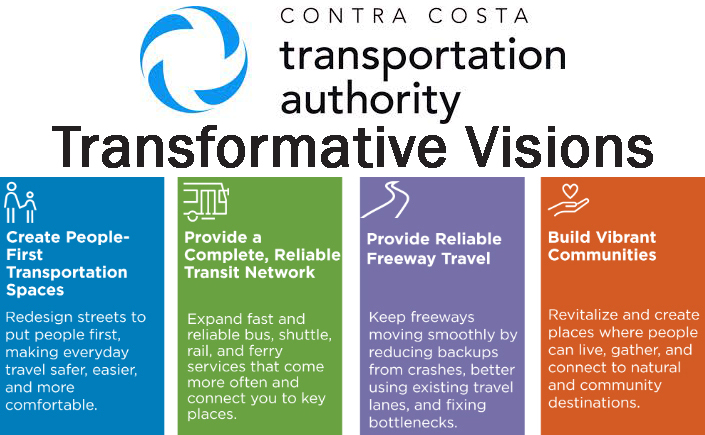
The Contra Costa Transportation Authority (CCTA) is inviting residents to provide feedback on the future of transportation in the county through the Countywide Transportation Plan (CTP) survey. This plan will guide improvements for roads, public transit, bike lanes, pedestrian pathways, and more. Your input is vital to creating a safer, more connected, and sustainable transportation system for everyone.

Take the Survey Today: [Countywide Transportation Plan – Survey]

Don’t miss your chance to help shape the way Contra Costa moves—every voice matters!

Filed Under: Opinion, Transportation

Innovative freight and transit plan proposed for Port of Oakland

January 11, 2025 By Publisher Leave a Comment

Renderings source: CyberTran International

Colliers and partners present practical underground solution to ease traffic, reduce emissions and boost regional economy with two West Contra Costa companies

In response to the Port of Oakland Request for Qualifications (RFQ) for use of the Charles P. Howard Property, the global real estate and investment brokerage firm Colliers is spearheading a proposal and negotiations for a joint collaboration between CyberTran International, EarthGrid PBC, UC Berkeley Partners for Advanced Transportation Technology (PATH), the County of Alameda, and the Corporation for Manufacturing Excellence (MANEX) and has submitted a visionary proposal to move freight underground from the Howard Property to an inland port to be established in Tracy, California area.

EarthGrid has developed patented plasma-boring technology that cuts through the hardest rock types exponentially faster than, and at a fraction of the cost of traditional tunnel boring techniques. The plasma boring system cuts through hard rock using a process called spallation, induced by thermal shock on the rock face. CyberTran International, Inc. is the final stage developer for full-scale demonstration and deployment of their Ultra-Light Rail Freight and Transit (ULRF&T) system technology which was originally developed by the US Department of Energy. Their innovative autonomous vehicle transit solution can provide both passenger and goods movement services at a quarter of the cost of a traditional transit system, with half the cost to operate and maintain, while providing on-demand and direct-to-destination travel without having to make stops.

EarthGrid’s groundbreaking plasma-boring technology allows for unprecedented flexibility in tunnel sizes, enabling the co-location of freight, power and fiber in the same reliable, resilient and efficient tunnel. This breakthrough drastically reduces our carbon footprint, taking millions of trucks transporting freight off the road. Together, the two cutting-edge technologies are poised to have a significant impact across multiple industry platforms.

“Yesterday’s transit technologies aren’t serving us well today; Automobiles have evolved, Aviation has evolved, Aerospace has evolved, it’s time for rail to evolve,” says Dexter Vizinau, CEO of Richmond, CA-based CyberTran. “Today’s grid cannot handle the rapidly rising demand for energy, freight transport, fiber, and water. This is an opportunity to evolve our infrastructure through a network of resilient underground tunnels that can efficiently distribute freight, power, water and fiber; all in one utility tunnel built for the 21st century. We must move away from relying on current vulnerable above-ground infrastructure prone to increasingly frequent weather events.”

“Our plasma-boring machines are the solution to our aging, inefficient grid.” says Troy Helming, CEO of Richmond, CA-based EarthGrid.

Renderings source: CyberTran International

Today, trucks are the only way to carry goods to the Tracy and Central Valley regions. Highway 580 is heavily congested with traffic, which also impacts air quality.

“The Port of Oakland has every right to increase cargo throughput. It’s key to maintaining a productive port, but not at the expense of more trucks on the road. My constituents don’t want to see more trucks added to an existing problem and will vehemently oppose it,” said Alameda County Supervisor Nate Miley. “Going underground to move goods and reducing truck traffic appears to be a viable solution and I hope all the Port of Oakland community embrace it and make use of the proposed system!”

“UC Berkeley PATH has been on the cutting edge of autonomous vehicle transportation for over 30 years. Going from vehicles in traffic to rail is a natural fit for the engineering science of PATH. Lately, we’ve been working on analysis and studies. We’re ready to build something and we believe the CyberTran ULRF&T system is it!” according to James Fishelson PATH Director and Lead Researcher. MANEX will be an instrumental factor in the design, planning, and implementation of a factory being proposed at an additional Port of Oakland site. The federally backed organization is well suited to assist in virtually every aspect of the vehicle production process. MANEX has experience with both transit and automobile vehicle manufacturing practices.

Vizinau added, “The Port must consider the needs of their customers during the proposal selection process. These companies want their goods quickly, more efficiently, and at the best possible cost obtainable. They must have a voice in this process!”

CyberTran is committed to having the factory and logistics facilities be Union Shops. Dockside operations will be negotiated with the ILWU, and construction jobs will be negotiated with the Building Trades. The In-Land Port will be a Union facility with which the union is yet to be identified.

The three massive structures being proposed will generate a significant amount of construction and permanent jobs that will add to the East Bay regional economy. The Howard Property proposes to house a 1,000,000 square foot on-dock logistics center, with a Ship to Shore operation where Ships, ULRF&T, Trucks, and possibly Heavy Rail will converge for import and export activity. The operation will result in approximately 1000 construction jobs, and 1500 permanent jobs. The structure is named IMODAL1.

A second property two doors west of the Howard Property called The Roundhouse is being proposed to be CyberTran’s Manufacturing Operations and Maintenance facility, aptly named M.O.M. This facility will birth transit vehicles for a global market. M.O.M. will also maintain the transport system. The 800,000 square foot M.O.M. facility will generate approximately 1000 construction jobs and 1200 permanent jobs.

IMODAL2 is proposed as a property site yet to be determined in the Tracy California area. It will operate as an In-Land Port for both import and export goods movement activities. The 1,000,000 square foot structure will employ 1000 construction jobs and 1500 permanent jobs.

Colliers International is pleased to be spearheading the Public Private Partnership proposal package and is available for questions.

About EarthGrid

EarthGrid, founded in 2016, is a plasma boring technology and infrastructure company specializing in proprietary, groundbreaking plasma tunnel-boring technology that can revolutionize the grid infrastructure in the U.S. Its goal is to create a network of underground tunnels to transmit clean energy, goods, and high-speed broadband across the U.S. In addition to expanding electricity capacity, EarthGrid aims to enhance the safety, security, and reliability of grid infrastructure, housing critical infrastructure underground to avoid the crippling effects of natural disasters. Follow EarthGrid on LinkedIn and YouTube.

(NOTE: The publisher of the Herald has a financial interest in CyberTran International.)


Filed Under: Business, News, Technology, Transportation, West County

CHP highlights new laws for 2025

December 28, 2024 By Publisher Leave a Comment

Includes reckless driving & sideshow enforcement, electric bicycle safety, autonomous vehicles, retail theft, more

SACRAMENTO – As we head into the new year, the California Highway Patrol (CHP) is highlighting the new public safety laws that were passed during this year’s legislative session and signed by Governor Gavin Newsom. Unless otherwise noted, the laws referenced below take effect on January 1, 2025.

Tools to Address Reckless Driving and Sideshows:

Vehicles: Speed Contests (AB 1978, Sanchez)

Assembly Bill 1978 permits storing a vehicle when an individual is arrested but not taken into custody for obstructing or placing a barricade a highway or off-street parking facility for purposes of aiding a speed contest or exhibition of speed.

Vehicles: Impoundment (AB 2186, Wallis)

Assembly Bill 2186 permits the arrest and custody of individuals engaged in an exhibition of speed in an off-street parking facility. It also permits the impounding of the individual’s vehicle for not more than 30 days.

Vehicles: Sideshows and Street Takeovers (AB 2807, Villapudua)

Assembly Bill 2807 defines a “sideshow” and a “street takeover” as the same type of event.

Vehicles: Removal and Impoundment (AB 3085, Gipson)

Assembly Bill 3085 provides authority to seize and impound a vehicle with a warrant when the vehicle was used in violation of a speed contest or exhibition of speed (including aiding or abetting). This bill also permits electronic service of the notices of impoundment and storage hearings.

Emergency Alert Information Sharing:

Electronic Toll Collection Systems: Information Sharing: Law Enforcement (AB 2645, Lackey)

Assembly Bill 2645 allows transportation agencies operating electronic toll collection systems to share real-time license plate data with law enforcement during active emergency alerts, such as AMBER, Ebony, or Feather Alerts. This legislation eliminates the need for a search warrant in such situations, enabling quicker responses to locate suspect vehicles linked to emergencies, such as child abductions.

Electric Bicycle Safety:

Electric Bicycles, Powered Mobility Devices and Storage (SB 1271, Min)

Beginning January 1, 2026, SB 1271 focuses on improving the safety standards for electric bicycles (e-bikes), powered mobility devices, and related lithium-ion batteries. It requires these devices and their components, such as batteries and charging systems, to be tested by accredited laboratories to meet specific safety standards. The bill also mandates labeling these products to show compliance with safety regulations, ensuring consumers are informed. Furthermore, it prohibits distributing, selling, or leasing e-bikes and related equipment unless they meet these standards, aiming to reduce risks like fire hazards and electrical malfunctions. Beginning January 1, 2028, the bill would prohibit a person from renting or offering for rental an electric bicycle, powered mobility device, charging system, or storage battery unless it has been tested to the specified safety standard.

Vehicles: Electric Bicycles (AB 1774, Gipson)

Assembly Bill 1774 prohibits modifying an electric bicycle’s speed capability to an extent it no longer meets the definition of an electric bicycle.  Also, it prohibits selling a product or device that can modify the speed capability of an electric bicycle to an extent it no longer meets the definition of an electric bicycle.

Vehicles: Electric Bicycles (AB 1778, Connolly)

Assembly Bill 1778 authorizes a local authority within the County of Marin, or the County of Marin in unincorporated areas, to enact an ordinance or resolution prohibiting a person under 16 years of age from operating a class 2 electric bicycle or requiring a person operating a class 2 electric bicycle to wear a helmet.

Vehicles: Electric Bicycles (AB 2234, Boerner)

Assembly Bill 2234 establishes the San Diego Electric Bicycle Safety Program and authorizes a local authority within the County of San Diego, or the County of San Diego in unincorporated areas, to enact an ordinance or resolution prohibiting a person under 12 years of age from operating a class 1 or 2 electric bicycle.

Photo Enforced Speed Enforcement Pilot Program:

The City of Malibu’s Speed Safety System Pilot Program (SB 1297, Allen)

Senate Bill 1297 establishes a five-year Speed Safety System Pilot Program in the City of Malibu. The bill defines a ‘speed safety system’ as a fixed or mobile radar or laser system, or any other electronic device that utilizes automated equipment, to detect a violation of speed laws and obtains a clear photograph of a speeding vehicle’s license plate. The bill establishes mandates regarding policy, enforcement, implementation, public notification, and a system evaluation report.

Clean Air Vehicle Sticker Extension:

Vehicles: High-Occupancy Vehicle Lanes (AB 2678, Wallis)

Assembly Bill 2678 permits vehicles with a Clean Air Vehicle decal to drive in High Occupancy Vehicle (HOV) lanes until January 1, 2027, if federal law permits.

Autonomous Vehicles:

Vehicle Equipment: Driver Monitoring Defeat Devices (SB 1313, Ashby)

Senate Bill 1313 prohibits using, possessing, or selling devices designed to interfere with driver monitoring systems in vehicles equipped with advanced driver assistance systems or autonomous technology. These systems monitor driver alertness and help ensure safety when automated features are used. Violating this law is classified as an infraction. Exceptions are provided for manufacturers testing new technology, vehicle repairs, and updates compliant with safety standards or modifications for disability accommodations. This law aims to enhance road safety by preventing tampering with critical monitoring systems.

Autonomous Vehicles Interactions with First Responders and Traffic Violation Notices – AB 1777 (Ting)

Upon the Department of Motor Vehicles (DMV) adoption of necessary regulations, AB 1777 creates new authority for a law enforcement officer to issue a “notice of autonomous vehicle (AV) noncompliance” to an AV manufacturer for an alleged traffic violation committed by one of their vehicles.  Beginning July 1, 2026, AB 1777 establishes additional requirements for how AVs that operate without a human operator in the vehicle interact with first responders, including a requirement for manufacturers to provide a two-way device in the vehicles to communicate with first responders.

Pedestrian Safety Around Buses:

Transit buses: Yield Right-of-Way Sign (AB 1904, Ward)

Assembly Bill 1904 authorizes a transit agency to equip a transit bus with a “yield” right-of-way sign on the left rear of the bus.  The sign may be a static decal or a flashing light-emitting diode (LED).

License Plate Manipulation:

License Plates: Obstruction or Alteration (AB 2111, Wallis)

Assembly Bill 2111 prohibits any alteration of a license plate’s reflective coating to avoid detection from any entity, not just law enforcement.

Property Theft from a Vehicle:

Crimes: Theft from A Vehicle (SB 905, Wiener)

Senate Bill 905 creates the crime of Unlawful Entry of a Vehicle, which addresses unlawfully entering a vehicle with the intent to commit a theft or any felony. It also adds the crime of Automotive Property Theft for Resale, which addresses possessing stolen property obtained from a vehicle with the intent to sell or exchange the property for value. The property’s value must be over $950.00 and not for personal use. The value of property can be combined within two years of separate acts.

Combating Retail Theft:

Crimes: Organized Theft (SB 982, Wahab)

Senate Bill 982 makes the crime of organized retail theft permanent and strengthens measures to address retail crime. The bill eliminates the expiration date for specific provisions targeting organized retail theft, ensuring long-term tools for law enforcement to combat this issue.

Crimes: Fires (SB 1242, Min)

Senate Bill 1242 amends Penal Code Section 452 regarding the unlawful setting of fires. It updates penalties and legal language to clarify offenses, including circumstances involving organized retail theft.

Sentencing Enhancements: Sale, Exchange, Or Return of Stolen Property (SB 1416 Newman)

Senate Bill 1416 focuses on combating organized retail theft by increasing penalties for those involved in the resale of stolen goods, often referred to as “fencing.” The bill, until January 1, 2030, creates sentencing enhancements for individuals who sell, exchange, or return stolen property for value, particularly when the property exceeds specific thresholds. Punishment increases from one year to four years based on a property value scale ranging from $50,000 to over $3 million.

Theft: Jurisdiction (AB 1779, Irwin)

Assembly Bill 1779 addresses the issue of organized retail theft by streamlining the prosecution process. Specifically, it allows district attorneys to consolidate charges for theft offenses committed across multiple counties into a single trial, provided all affected county district attorneys agree.

Crimes: Organized Theft (AB 1802, Jones-Sawyer)

Assembly Bill 1802 ensures that the crime of organized retail theft remains permanently defined in state law and extends the CHP’s Property Crimes Task Force indefinitely. This bill eliminates the “sunset” clause that would have otherwise allowed the statute and the task force to expire.

Regional Property Crimes Task Force (AB 1972, Alanis)

Assembly Bill 1972 expands the scope of the CHP’s Regional Property Crimes Task Force to include cargo theft as a property crime for consideration and requires the task force to provide logistical and law enforcement support for railroad police.

This bill emphasizes cargo theft as a specific priority and aims to strengthen resources for law enforcement agencies to combat these issues. As an urgency statute, AB 1972 went into effect immediately upon its passage in August 2024 to address these concerns promptly.

Crimes: Shoplifting (AB 2943, Zbur)

Assembly Bill 2943, also called the “California Retail Theft Reduction Act,” strengthens measures to combat organized retail theft by creating a specific crime for serial retail theft, allowing the aggregation of property value for thefts committed within 90 days to qualify as grand theft. It empowers law enforcement to make arrests using video evidence or sworn statements, shields businesses from lawsuits for reporting crimes and promotes rehabilitation through diversion programs for minor offenders. The bill aims to dismantle theft rings while balancing public safety and criminal justice reforms.

Crimes: Theft: Retail Theft Restraining Orders (AB 3209, Berman)

Assembly Bill 3209 creates a retail crime restraining order.  A court may issue a restraining order when sentencing an individual for specific retail theft-related crimes, including vandalism of a retail store and assaulting a retail store employee.  The restraining order prohibits the individual from entering or being on the grounds of the establishment and may include parking lots adjacent to and used by the establishment.

The mission of the CHP is to provide the highest level of Safety, Service, and Security.

Filed Under: Business, CHP, Crime, Legislation, News, State of California, Transportation

New Year rings in toll increase at 7 Bay Area bridges

December 27, 2024 By Publisher Leave a Comment

Bay Bridge Toll Plaza. Photo by Noah-Berger. Source: MTC website.

Last of three voter-approved increases takes effect Jan. 1st; failed in Contra Costa County

BATA board also voted last week to increase tolls to $11.50 by 2030 for bridge maintenance and repairs

By John Goodwin, Assistant Director of Communications & Rebecca Long, Director, Legislation & Public Affairs, Metropolitan Transportation Commission

The Bay Area Toll Authority (BATA) reminds drivers that tolls at the region’s seven state-owned toll bridges will go up by $1 next Wednesday, Jan. 1, 2025. This will be the third of the three $1 toll increases approved by the California Legislature in 2017 through state Senate Bill 595 and by voters through Regional Measure 3 (RM3) in June 2018 which passed by 55.07% to 44.93%. The first of these toll hikes went into effect on Jan. 1, 2019, and the second on Jan. 1, 2022. It funds $4.45 billion slate of highway and transit improvements but did not include bridge maintenance and repairs. Regular tolls for two-axle cars and trucks (as well as for motorcycles) at the Antioch, San Francisco-Oakland Bay, Benicia-Martinez, Carquinez, Dumbarton, Richmond-San Rafael and San Mateo-Hayward bridges will rise to $8 from the current $7 on Jan. 1, 2025. Tolls for vehicles with three or more axles also will rise by $1 on Jan. 1, 2025, at all seven of the state-owned toll bridges: to $18 for three axles, $23 for four-axles, $28 for five axles, $33 for six axles, and $38 for combinations with seven or more axles. Regional Measure 3 continues the peak-period toll discount for motorcycles, qualifying carpools and qualifying clean-air vehicles crossing any of the state-owned toll bridges on weekdays from 5 a.m. to 10 a.m. and from 3 p.m. to 7 p.m. The discounted toll will rise to $4 on Jan. 1 from the current $3.50. To qualify for this discount, carpoolers, motorcyclists and drivers of clean-air vehicles must use FasTrak® to pay their tolls electronically and must use a designated carpool lane at each toll plaza. Contra Costa Voters Opposed Ballot Measure According to Ballotpedia, RM3 raised bridge tolls in the Bay Area—excluding tolls for the Golden Gate Bridge—by $3 over six years to fund the Bay Area Traffic Relief Plan, including a $4.5 billion slate of transportation projects. It was on the ballot for voters in the city and county of San Francisco and the following counties: Contra Costa, Alameda, Marin, Napa, San Mateo, Santa Clara, Solano and Sonoma. Voters in two of the counties most affected by the bridge tolls rejected RM3. The vote in Contra Costa County was 44.54% opposed to 55.465 in favor and Solano County voters overwhelmingly opposed it 30.03% to 69.97%. But voters in the other seven counties approved the measure. Alameda County where voters and commuters are also most affected by bridge toll increases passed RM3 by 53.89% to 46.11% The vote margin was closest in Napa County, where voters approved the measure 50.7 percent to 49.3 percent.

Source: Ballotpedia

Senate Bill 595 and Regional Measure 3 also established a 50-cent toll discount for two-axle vehicles crossing more than one of the state-owned toll bridges during weekday commute hours of 5 a.m. to 10 a.m. and 3 p.m. to 7 p.m. To be eligible for the toll discount, which is to be applied to the second toll crossing of the day, motorists must pay their tolls electronically with FasTrak®. Carpools, motorcycles and qualifying clean-air vehicles making a second peak-period toll crossing in a single day will qualify for an additional 25-cent discount off the already-discounted carpool toll. New FasTrak® customers can obtain toll tags at Costco warehouse stores and select Walgreens stores around Northern California. A complete list of participating locations — as well as an online enrollment and registration feature — is available on the FasTrak® Web site at bayareafastrak.org. Customers also may enroll in the FasTrak® program by phone at 1-877-229-8655; by calling 511 and asking for “FasTrak” at the first prompt; or in person at the FasTrak® customer service center at 375 Beale Street in San Francisco. FasTrak® can be used in all lanes at all Bay Area toll plazas. Major projects in the Regional Measure 3 expenditure plan include improvements to State Route 37 in the North Bay, freeway interchange improvements in Alameda, Contra Costa and Solano counties, the purchase of more new BART cars, extension of the BART system from Berryessa to downtown San Jose and Santa Clara, extension of the Caltrain corridor to the Salesforce Transit Center in downtown San Francisco, expansion of Muni’s transit vehicle fleet, expansion of San Francisco Bay Ferry service and more frequent transbay bus service, an improved connection between northbound U.S. 101 and the Richmond-San Rafael Bridge in Marin County, upgrades to the Dumbarton Bridge corridor, and extension of the SMART rail system to Windsor and Healdsburg in Sonoma County. In Addition to Recently Approved Bridge Toll Hikes Beginning Jan. 1, 2026

The Regional Measure 3 toll hike that takes effect next week is separate from the 50 cents per year toll hikes approved by BATA earlier this month, which will be phased in over five years, beginning Jan. 1, 2026, to pay for the maintenance, rehabilitation and operation of the seven state-owned toll bridges. It will increase tolls by 2030 to $11.50 for those who don’t use FasTrak and $10.50 for those who do. BATA this month also approved updates to the policies for high-occupancy vehicles on approaches to the state-owned bridges, which will similarly go into effect on Jan. 1, 2026. (See related article)

BATA, which is directed by the same policy board as the Metropolitan Transportation Commission (MTC), administers toll revenues from the Bay Area’s seven state-owned toll bridges. Toll revenues from the Golden Gate Bridge are administered by the Golden Gate Bridge, Highway and Transportation District, which joined with BATA to operate a single regional FasTrak® customer service center in San Francisco. MTC is the transportation planning, financing and coordinating agency for the nine-county San Francisco Bay Area. Allen D. Payton contributed to this report.

Filed Under: Bay Area, Finances, Infrastructure, News, Taxes, Transportation

BATA board approves annual toll increases to $11.50, HOV lane policy changes

December 23, 2024 By Publisher 1 Comment

Photos source: BATA

For $2 billion in maintenance, preservation and operation of Bay Area’s seven state-owned bridges.

Contra Costa’s representatives voted in favor of 50-cent annual increases beginning Jan. 1, 2026.

By Allen D. Payton

After extending the period for public input, on Wednesday, Dec. 18, 2024, the Bay Area Toll Authority (BATA) Board of Directors voted 15-0-1 to approve toll increases and other toll policy changes for the Bay Area’s seven state-owned bridges beginning Jan. 1, 2026. Tolls will increase to as much as $11.50 by 2030.

According to BATA spokesman John Goodwin, the vote passed “by all 16 members present save one abstention from a brand-new commissioner, Alameda Mayor Marilyn Ezzy-Ashcraft, who represents the cities of Alameda County.”

The board consists of 21 members, with 18 voting members, he shared. Pleasant Hill Mayor Sue Noack, who represents the cities of Contra Costa, and Contra Costa District 5 Supervisor Federal Glover, who represents the County, both voted in favor of the toll increases.

A phased toll increase starting in 2026 is proposed to fund the Toll Bridge Capital Improvement Plan, which includes almost $2 billion of investment which will be used exclusively for the maintenance, preservation and operation of the San Francisco-Oakland Bay Bridge and the Antioch, Benicia-Martinez, Richmond-San Rafael, Carquinez, Dumbarton and San Mateo-Hayward bridges.

The Bay Area’s seven state-owned toll bridges are structurally sound and in good repair. State law requires BATA — working in partnership with Caltrans — to keep them that way.

The toll increases are separate from the $3 increase approved by Bay Area voters in 2018 through Regional Measure 3 to finance a comprehensive suite of highway and transit improvements around the region. The first of the three $1 Regional Measure 3 increases went into effect in 2019, followed by another in 2022. The last of the RM 3 toll hikes will go into effect Jan. 1, 2025, bringing the toll for regular two-axle cars and trucks to $8.

Summary of the 2026 Toll Increase

Toll rates include the last voter-approved Regional Measure 3 (RM 3) toll increase that goes into effect January 1, 2025.

To encourage electronic toll payment with FasTrak® tags, tolls and help recoup the increased costs of collecting tolls via pre-registered license plate accounts or invoices, on Jan. 1, 2027 will also rise by 25 cents for customers who pay with a pre-registered license plate account and on January 1, 2027 will rise by $1 for tolls paid by invoice.

Two-Axle Vehicle Toll increase schedule 2026-30. Source: BATA

Toll Increase: Two-Axle Vehicle Toll

The toll rate update includes an increase of 50 cents a year from 2026 through 2030 for two-axle vehicles. This phased-in approach is similar to the Golden Gate Bridge’s recent multi-year update to its toll schedule.

*HOV rate is 50% of two-axle FasTrak rate.

Three-Axle or More Vehicle Toll increase schedule 2026-30. Source: BATA

Toll Increase: Three-Axle or More Vehicle Toll

Tolls for multi-axle vehicles also will rise by 50 cents per axle per year from 2026 through 2030.

Multi-axle differential pricing:

  • Invoices: +$1.00 per transaction starting January 1, 2027
  • License plate account: + $0.25 per transaction starting January 1, 2027

A Precedent for Tiered Pricing

The Golden Gate Bridge, Highway and Transportation District has used a tiered pricing schedule at the Golden Gate Bridge since 2014.

Golden Gate Bridge tolls by July 2028 will range from $11.25 for FasTrak to $11.50 for license plate accounts to $12.25 for invoice customers.

Summary of the Changes to High-Occupancy Vehicle (HOV) Policies

BATA is also making changes to HOV policies. To provide regional consistency and to support the future deployment of open-road tolling at the state-owned bridges, the changes will establish a uniform three-person occupancy requirement for the discounted toll during weekday commute periods at all seven bridges. It will also allow vehicles with two occupants to use the carpool lanes on the approaches to all bridges except the San Francisco-Oakland Bay Bridge. These two-occupant vehicles will not receive the discounted toll but will be able to use the carpool lanes to save time traveling through the toll plazas.

BATA’s existing toll schedule allows vehicles with three or more occupants (HOV 3+) a discounted toll (half-price), with a two-person (HOV 2+) occupancy requirement for the discounted tolls at the Dumbarton and San Mateo-Hayward bridges. To provide regional consistency and to support the future deployment of open-road tolling at the state-owned bridges, the new policy will establish a uniform three-person occupancy requirement for the discounted toll during weekday commute periods at all seven bridges. The discounted toll rate is available weekdays from 5 to 10 a.m. and from 3 to 7 p.m.

The policy changes will also allow vehicles with two occupants to use the carpool lanes on the approaches to the Antioch, Benicia-Martinez, Carquinez, Dumbarton, Richmond-San Rafael and San Mateo-Hayward bridges. These two-occupant vehicles will not receive the discounted toll but will be able to use the carpool lanes to save time traveling through the toll plazas. There will be no change at the San Francisco-Oakland Bay Bridge, where volumes of vehicles with three or more occupants are much higher than those at other bridges. Use of the carpool lanes on approaches to the Bay Bridge will still require a minimum of three occupants.

In addition to establishing region-wide consistency for the carpool toll discount, the policy changes are designed to:

  • Improve safety on the toll bridge approaches by minimizing “weaving” between lanes.
  • Optimize lane configurations as now-obsolete toll booths are removed as part of the bridges’ transition to open-road tolling.
  • Increase person-throughput by prioritizing access for buses and carpools.

Read more about the BATA toll increases, here.

See BATA Board meeting agenda items 24-1571 through 24-1575. Watch meeting video.


Filed Under: Bay Area, Finances, Infrastructure, News, Taxes, Transportation

  • « Previous Page
  • 1
  • 2
  • 3
  • 4
  • 5
  • 6
  • …
  • 30
  • Next Page »
Monica's-Riverview-Jan-2026
Liberty-Tax-Jan-Apr-2026
Deer-Valley-Chiro-06-22

Copyright © 2026 · Contra Costa Herald · Site by Clifton Creative Web