• Home
  • About The Herald
  • Local Agencies
  • Daily Email Update
  • Legal Notices
  • Classified Ads

Contra Costa Herald

News Of By and For The People of Contra Costa County, California

  • Arts & Entertainment
  • Business
  • Community
  • Crime
  • Dining
  • Education
  • Faith
  • Health
  • News
  • Politics & Elections
  • Real Estate

Tree removal work on Miranda Avenue in Alamo Nov. 1 & 2

October 26, 2021 By Publisher Leave a Comment

Alamo tree removal work vicinity map 1101-0221. Source: CCCPWD

By Kelly Kalfsbeek, PIO, Contra Costa County Public Works Department

October 26, 2021, Alamo, CA – The Contra Costa County Public Works Department will perform work to remove one (1) tree on Miranda Avenue, near the intersection of Miranda Avenue and Bolla Avenue in Alamo. The work is scheduled for Monday, November 1, 2021 through Tuesday, November 2, 2021, barring unforeseen circumstances. Work will occur from 8:00 a.m. – 4:00 p.m., weather permitting. Appropriate traffic control measures will be implemented to safely direct pedestrians and vehicles through the work area. Drivers may experience some delays and may want to consider alternative routes during this period. A licensed arborist had assessed the tree’s declining health and recommended its removal for public safety reasons.

About Contra Costa County Public Works Department:

Contra Costa County Public Works Department (CCCPWD) maintains over 660 miles of roads, 150 miles of streams, channels and other drainage and over 200 County buildings throughout Contra Costa County. CCCPWD provides services such as Parks and Recreation, Sand Bag Distribution and Flood Control throughout unincorporated areas of Contra Costa County. For more information about CCCPWD, please visit us at www.cccpublicworks.org.


Filed Under: Construction, News, San Ramon Valley, Transportation

ABAG, MTC adopt final Plan Bay Area 2050 and Environmental Impact Report

October 25, 2021 By Publisher 1 Comment

“$1.4 trillion vision for a more equitable and resilient future for Bay Area residents” in the areas of housing, the economy, transportation and the environment

“Roadmap toward a more affordable, connected, diverse, healthy and vibrant region for all”

Includes “strategies that would produce more than 1 million new permanently affordable homes” and an effort to “Implement a statewide universal basic income” to “provide an average $500 per month payment to all Bay Area households”

The Association of Bay Area Governments (ABAG) and the Metropolitan Transportation Commission (MTC), during their joint meeting Thursday evening, Oct. 21, 2021, unanimously adopted Plan Bay Area 2050 and its associated Environmental Impact Report. The unanimous votes by both boards cap a nearly four-year process during which more than 20,000 Bay Area residents contributed to the development of the new plan.

All six representatives from Contra Costa County, including Supervisors Candace Andersen and Karen Mitchoff, Richmond Mayor Tom Butt and San Ramon Councilman Dave Hudson, who serve on ABAG, as well as Supervisor Federal Glover and Contra Costa City Representative Amy Worth, Mayor of Orinda, who serve on MTC, voted to adopt the plan.

Defined by 35 strategies for housing, transportation, economic vitality and the environment, Plan Bay Area 2050 lays out a $1.4 trillion vision for policies and investments to make the nine-county region more affordable, connected, diverse, healthy and economically vibrant for all its residents through 2050 and beyond. From housing strategies that would produce more than 1 million new permanently affordable homes by 2050 to transit-fare reforms that would reduce cost burdens for riders with low incomes and paths to economic mobility through job training and a universal basic income, the goal of a more equitable Bay Area is interwoven throughout the plan. With a groundbreaking focus on climate change, strategies also are crafted for resilience against future uncertainties, including protection from hazards such sea-level rise and wildfires.

It is a long-range plan charting the course for the future of the nine-county San Francisco Bay Area. Plan Bay Area 2050 will focus on four key issues—the economy, the environment, housing and transportation—and will identify a path to make the Bay Area more equitable for all residents and more resilient in the face of unexpected challenges. Building on the work of the Horizon initiative, this new regional plan outlines strategies for growth and investment through the year 2050, while simultaneously striving to meet and exceed federal and state requirements. The Metropolitan Transportation Commission and the Association of Bay Area Governments are expected to adopt Plan Bay Area 2050 in fall 2021.

“Plan Bay Area 2050 reflects a shared vision that can’t be implemented by any single agency,” explained ABAG Executive Board President and Berkeley Mayor Jesse Arreguín. “To bring all these strategies to fruition will require ABAG and MTC to strengthen our existing partnerships and to form new ones — not just with our cities and counties and the state government, but also with the federal government, businesses and nonprofits.”

What will Plan Bay Area 2050 do? What won’t it do?

Plan Bay Area 2050 outlines a roadmap for the Bay Area’s future. While it pinpoints policies and investments necessary to advance the goal of a more affordable, connected, diverse, healthy and vibrant Bay Area, Plan Bay Area 2050 neither funds specific infrastructure projects nor changes local policies. Cities and counties retain all local land use authority. Plan Bay Area 2050 does identify a potential path forward for future investments – including infrastructure to improve our transportation system and to protect communities from rising sea levels – as well as the types of public policies necessary to realize a future growth pattern for housing and jobs.

Ultimately, Plan Bay Area 2050 reflects a shared vision – one that cannot be implemented by any single organization or government agency. Only through partnership with local, state and federal governments – as well as with businesses and non-profit organizations – will the Plan’s vision come to fruition. Before the Plan is adopted in 2021, MTC and ABAG, along with partner organizations, will create an implementation plan that will advance the strategies outlined in Plan Bay Area 2050.

MTC Chair and Napa County Supervisor Alfredo Pedroza acknowledged the work ahead. “Building and preserving affordable housing. Adapting to sea level rise. Getting more people closer to their jobs and more jobs closer to the people. Sharing prosperity equitably. All of these are big lifts. But the new plan can serve as a north star for the Bay Area’s journey to 2050.”

Among the features that distinguish Plan Bay Area 2050 from previous regional plans is an associated Implementation Plan that details the specific actions ABAG and MTC can take in the next five years to put the new plan into action.

“The Implementation Plan is a commitment to do hard things, not just think about them,” said ABAG-MTC Executive Director Therese W. McMillan. “Even if these steps have to be taken incrementally, they will lead us to a more equitable and resilient Bay Area.”

Housing Strategies

Costs for housing are estimated at $468 billion, with $237 billion budget to preserve existing affordable housing by acquiring “homes currently affordable to low- and middle-income residents for preservation as permanently deed-restricted affordable housing”. An additional $219 billion is budgeted for new, deed-restricted affordable housing and $2 billion to “further strengthen renter protections beyond state law” by limiting “annual rent increases to the rate of inflation, while exempting units less than 10 years old.”

Economic Strategies

The total cost for economic strategies in the plan is $234 billion. Of that amount $205 billion is budgeted to “Implement a statewide universal basic income” and “provide an average $500 per month payment to all Bay Area households to improve family stability, promote economic mobility and increase consumer spending.”

Transportation Strategies

The plan projects to spend a total of $578 billion is projected to be spent on transportation over the next 20 years, with most of that, $389 billion, to “restore, operate and maintain the existing system”. An additional $81 billion will be spent to “expand and modernize the regional rail network” to “better connect communities while increasing frequencies by advancing the Link21 new transbay rail crossing, BART to Silicon Valley Phase 2, Valley Link, Caltrain Downtown Rail Extension and Caltrain/High-Speed Rail grade separations, among other projects.” The third largest budget item for transportation is $32 billion to “enhance local transit frequency, capacity and reliability. Improve the quality and availability of local bus and light rail service, with new bus rapid transit lines, South Bay light rail extensions, and frequency increases focused in lower-income communities.”

Environmental Strategies

A total of $108 billion is programmed for Environmental Strategies. The largest portion of that is $30 billion to “modernize and expand parks, trails and recreation facilities”. An additional $19 billion is budgeted to “adapt to sea level rise” by protecting affected “shoreline communities…prioritizing low-cost, high-benefit solutions and providing additional support to vulnerable populations.

In addition, the plan includes $18 billion to “fund energy upgrades to enable carbon neutrality in all existing commercial and public buildings” through “electrification and resilient power system upgrades”, and another $15 billion to “provide means-based financial support to retrofit existing residential buildings.” To “protect and manage high-value conservation lands”, an additional $15 billion is included in the plan.

The adopted final Plan Bay Area 2050, the EIR, and all the supplemental reports accompanying the new plan are available online at planbayarea.org/finalplan2050.

ABAG is the council of governments and the regional planning agency for the 101 cities and towns, and nine counties of the Bay Area. MTC is the transportation planning, financing and coordinating agency for the nine-county San Francisco Bay Area.

Filed Under: Bay Area, Economy, Environment, Government, Growth & Development, News, Transportation

Maintenance work on Vasco Road postponed until Nov. 1-4

October 25, 2021 By Publisher 1 Comment

Source: CCC Public Works

Contra Costa County Public Works Department will clean-up debris and replace delineators to enhance safety on Vasco Road. The work will occur approximately 1 mile south of the Camino Diablo/Vasco Road intersection to the Alameda County Line, a length of approximately 7.5 miles, and will include a rolling lane closure. The work is scheduled for Monday, November 1, 2021 through Thursday, November 4, 2021, barring unforeseen circumstances. Work will take place between 9:00 a.m. – 4:00 p.m., weather permitting. Drivers should expect delays. Message boards will be placed in advance to advise drivers of work and expected delays. This is essential work required for the public’s safety.

Filed Under: Construction, East County, News, Transportation

Road closures in Pacheco and Bay Point due to cleanup from storm

October 25, 2021 By Publisher Leave a Comment

Contra Costa County Public Works crews are working to clear mud, tree branches and debris on roads impacted by the storms.

The following roads in Contra Costa County are closed due to flooding. Drivers are asked to avoid these areas and limit travel. Do not attempt to cross flooded roads.

  • Pacheco Boulevard at South Buchanan Circle, Pacheco
  • Center Avenue Bridge at Grayson Creek, Pacheco
  • 2nd Street Bridge at Grayson Creek, Pacheco
  • Marsh Drive, Pacheco
  • Arthur Road at Pacheco Boulevard, Pacheco
  • Mary Ann Lane and Clearland Circle, Bay Point
  • Willow Pass Road near Clearland Drive, Bay Point

County Public Works Maintenance road crews maintain the storm drain inlets through a program of annual inspection and cleaning.  To report a clogged catch basin or drainage inlet please call the Public Works Maintenance Division at 925-313-7000 during work hours and after hours call Sheriff’s Dispatch at 925-646-2441.

http://www.cccounty.us/sandbags  – Contra Costa County Sandbag Locations

Filed Under: East County, News, Transportation

Parents: talk to your teen driver about safe driving during National Teen Driver Safety Week Oct. 17-23, 2021

October 19, 2021 By Publisher 1 Comment

National Teen Driver Safety Week is Oct. 17-23, 2021. Source: National Highway Traffic Safety Administration

Your teen is in the driver’s seat, but you’re in control

It’s National Teen Driver Safety Week.

This week, and every week, parents should have conversations with their teens about the important rules they need to follow to stay safe behind the wheel of a motor vehicle. These rules address the greatest dangers for teen drivers: alcohol, inconsistent or no seat belt use, distracted and drowsy driving, speeding, and number of passengers.

Facts about Teen Driver Fatalities:

According to the National Highway Traffic Safety Administration (NHTSA), motor vehicle crashes are the leading cause of death for teens (15-18 years old) in the United States.

In 2019, there were 2,042 people killed in crashes involving a teen driver, of which 628 deaths were the teen driver.

Parents can be the biggest influencers on teens’ choices behind the wheel if they take the time to talk with their teens about some of the biggest driving risks. You should let your teen drivers know that obeying the rules of the road is a must. Breaking the rules leads to walking, riding the bus, using rideshare or going back to begging for rides from mom and dad.

The Rules of the Road

Wear seat belts

The car doesn’t move until everyone is buckled up — front seat and back, on every trip, every time. Almost half of the passengers killed in cars driven by teen drivers in recent years weren’t buckled up in 2019.

No drinking and no drugs

Emphasize the fact that it’s illegal to drink before you’re 21 — and that driving drunk or high is unacceptable at any age. In 2019, 16% of teen drivers involved in fatal crashes had been drinking.

No distractions

Driving is the first and only task when behind the wheel. That means no phones or texting while driving, and not doing anything else — like eating, drinking, or fixing hair and makeup — when you should fully focus on driving. About 10% of all teen drivers involved in fatal crashes in recent years were distracted at the time of the crash. Teens should activate the “do not disturb” feature on their phones to eliminate the distractions notifications cause.

No speeding

About 27% of teen drivers involved in fatal crashes were speeding in 2019. Faster speeds rob inexperienced teen drivers of the extra reaction time they may need to avoid a crash. Emphasize that they must obey posted speed limits.

Limit extra passengers

Teen drivers are at a greater risk for a crash when they have others in their car. Passengers can serve as a distraction for inexperienced teen drivers, and that’s why many states’ graduated driver licensing (GDL) restrictions prohibit any passengers in vehicles with teen drivers. GDL laws also set other limits on teen drivers for safety.

Drowsy Driving

We all know how important sleep is, especially for your teens during the school year when studying can cause long nights. Remind your teen the importance of a good night’s sleep, and the dangers of drowsy driving.

Don’t just set the rules — set the example

Parents, you’re role models. When a teen driver sees you obeying the rules of the road, they get the message. If you’re breaking the rules, they may adopt those behaviors when they’re on the road. Check yourself: assess how you’re driving (whether you’re following the rules of the road) and think about what your driving communicates to your teen driver.

While National Teen Driver Safety Week is a great reminder to discuss safe driving as a family, keep the conversation going year-round. If you do, you’ll not only better protect your young driver, you’ll be contributing to safer roads in your community. For even more information, visit our Teen Driving section.

The Antioch Police Department contributed to this report.

Filed Under: News, Transportation, Youth

Contra Costa Transportation Authority awarded $400,000 for effort to reduce Vehicle Miles Traveled

October 9, 2021 By Publisher 1 Comment

Source: CCTA

WALNUT CREEK, CA – The Contra Costa Transportation Authority (CCTA) has been awarded $400,000 to develop a Vehicle Miles Traveled (VMT) Mitigation Framework that will ultimately help Contra Costa County fight climate change. The more miles vehicles travel, the more greenhouse gases and air pollution are emitted into the atmosphere. The VMT Mitigation Framework project is aimed to help CCTA better define, analyze, and develop options to mitigate the environmental effects of projects throughout Contra Costa.

With funding made possible through a California Department of Transportation Sustainable Planning Grant, one element of the study will explore allowing developers and transportation agencies–whose projects contribute to VMT increases–to offset emissions through payment into a “VMT Mitigation Program.” The VMT Mitigation Program funds could then support green projects that help reduce overall VMT in Contra Costa County, generating a positive impact on climate, the environment and public health.

“This groundbreaking study will set out a framework for a more holistic approach to analyzing future development and transportation projects that will not only help local agencies like ours plan for a more sustainable future but could serve as a model for agencies across the state,” said CCTA Executive Director Timothy Haile.

California Senate Bill 743 (SB 743) reformed the process for the California Environmental Quality Act (CEQA) to require that local jurisdictions evaluate traffic impacts of new development by measuring VMT, so that transportation-related environmental impacts are tracked for alignment with state greenhouse gas emission reduction goals. Undertaking this study is just one way that CCTA is working to mitigate the impact of vehicles miles traveled to reduce harmful pollutants and greenhouse gas emissions countywide.

CCTA is also lending their expertise to the SB 743 Implementation Working Group, a consortium of forward-thinking agencies providing thought leadership for the State on the topic of VMT mitigation.

About the Contra Costa Transportation Authority

The Contra Costa Transportation Authority (CCTA) is a public agency formed by Contra Costa voters in 1988 to manage the county’s transportation sales tax program and oversee countywide transportation planning efforts. With a staff of twenty people managing a multi-billion-dollar suite of projects and programs, CCTA is responsible for planning, funding and delivering transportation infrastructure projects and programs throughout the County. CCTA also serves as the county’s designated Congestion Management Agency, responsible for putting programs in place to manage traffic levels. More information about CCTA is available at ccta.net.

Filed Under: News, Transportation

I-680 Express Lane from Martinez to Walnut Creek tolling has started

September 2, 2021 By Publisher Leave a Comment

Photo: MTC

The Metropolitan Transportation Commission (MTC) reminds travelers that tolling operations for the new 11-mile Express Lane along southbound Interstate 680 from Martinez through Walnut Creek have now started.

By linking with the existing Express Lane from Rudgear Road in Walnut Creek to Alcosta Boulevard in San Ramon, this will create a continuous 22-mile southbound I-680 Express Lane through Contra Costa County.

The stretch of I-680 from Marina Vista Blvd. in Martinez to Rudgear Road currently operates as a traditional carpool lane. Tolling rules include:

  • All vehicles must have a FasTrak® toll tag to use the Express Lanes;
  • Carpools with two or more people, vanpools, buses and motorcycles travel toll-free with a FasTrak Flex toll tag set to the 2 or 3+ position;
  • Solo drivers of eligible clean-air vehicles (CAVs) pay half-price tolls with a FasTrak CAV toll tag. Eligible CAVs are those with red, purple, orange or blue decals; and
  • Other solo drivers pay the full toll to use the Express Lanes with either a standard FasTrak toll tag or a FasTrak Flex tag set to the 1 position.

Operating hours for Express Lanes are weekdays from 5 a.m. to 8 p.m. Tolls rise as traffic increases and fall as traffic declines. Digital signs over the roadway display the toll rates for various destinations. Customers always pay the toll displayed when they enter the Express Lane, even if toll rates change during their trip. Toll-paying customers pay for each toll zone they enter. There are five southbound toll zones from Martinez to San Ramon.

Express Lanes are designed to keep traffic moving reliably without congestion, and to encourage travelers to carpool or use transit to get a free and faster trip. Drivers can visit 511.org to learn everything they need to know to use Bay Area Express Lanes, how to find a carpool match, and how to sign up for FasTrak.

Filed Under: Central County, News, Transportation

DeSaulnier-authored initiatives in infrastructure bill to improve access to sustainable, reliable transportation pass House

July 1, 2021 By Publisher Leave a Comment

Source: The House Committee on Transportation and Infrastructure

13 provisions included in the INVEST in America Act

Rep. Mark DeSaulnier

Washington, DC – Today, July 1, 2021, 13 initiatives authored by Congressman Mark DeSaulnier (D, CA-11) and aimed at promoting sustainable transportation and improving access to safe and reliable public transit were included in the INVEST in America Act (H.R. 3684), which passed the U.S. House of Representatives by a vote of 221-to-201. The INVEST in America Act is a $715 billion surface transportation reauthorization and water infrastructure bill that will create good-paying jobs to rebuild and reimagine America’s surface transportation infrastructure, with investments in roads, bridges, transit, rail, and drinking water and wastewater infrastructure. 2021 Fact Sheet for INVEST in America Act

“California has long been a model for the country in the transportation space, particularly when it comes to reducing greenhouse gas emissions and investing in public transportation. The INVEST in America Act aligns with and furthers California’s goals through bold, innovative legislation that would put millions of Americans to work, speed up our economic recovery, and follow through on our commitment to reduce emissions with transformative investments in cleaner transportation,” said DeSaulnier.

DeSaulnier’s measures included in the bill would aid the transition to environmentally clean modes of transportation, improve accessibility of reliable and efficient public transit, increase road safety, and save taxpayer money. Among those provisions are:

  • Electric Vehicle (EV) Infrastructure Enhancement:Based on Congressman DeSaulnier’s Clean Corridors Act (H.R. 2012), the bill would quickly build out EV charging infrastructure nationwide to allow more Americans to shift to environmentally-friendly modes of transportation, saving gas money and our planet, while also creating jobs. The Biden Administration has signaled that this is a top priority.
  • Improved Transportation System Connectivity:Would provide grants to implement better public transportation investment allowing us to create a more interconnected, innovative, and efficient public transportation system that will in turn get more cars off the road, reduce congestion, create more equity, and help fight climate change. This language is part of Congressman DeSaulnier’s Jobs for a Carbon Free Transportation System Act and Incentivizing Value Capture for Greener Transportation Act (H.R. 2205).
  • Greater Transportation Accessibility:Originally included in Congressman DeSaulnier’s COMMUTE Act (H.R. 3581), this provision would enhance transportation planning and equity by improving access to essential services like jobs, health care and childcare facilities, and affordable housing.
  • Enhanced Trucking Safety and Oversight: The bill includes requirements that enhance motor carrier compliance with labor and workplace safety laws, ensuring that our truckers and other road users remain safe on the roads and that motor carriers are held accountable when they violate these protective laws.
  • Transportation Safety Improvement:Based on the Stop Underrides Act (H.R. 1622), co-led by Congressmen Cohen and DeSaulnier, the package directs the Department of Transportation to enhance underride guard protections to prevent deadly truck underride collisions.
  • Efficient Infrastructure Project Delivery:The bill would increase oversight of large infrastructure projects to minimize megaproject cost overruns, delays, and reduced construction quality. Based on Congressman DeSaulnier’s Megaprojects Accountability and Oversight Act (H.R. 2204), this measure would reduce waste, save taxpayer money, and ensure vital infrastructure projects are completed safely and without delay.

The bill still requires approval by the U.S. Senate.

Congressman DeSaulnier is a member of the House Committee on Transportation and Infrastructure. He previously served as Chair of the California State Senate Transportation and Housing Committee as well as the California Assembly Transportation Committee. He is also a former member of the California Air Resources Board (CARB) and has been a longtime leader in advocating for sustainable transportation as well as safe and efficient public transportation systems.

Allen Payton contributed to this report.
Filed Under: Infrastructure, Legislation, News, Transportation

Public workshops, hearings announced for Draft Plan Bay Area 2050

May 26, 2021 By Publisher Leave a Comment

Regional plan for transportation, housing, the economy, and the environment

Interested agencies, organizations and individuals are invited by the Metropolitan Transportation Commission (MTC) and the Association of Bay Area Governments (ABAG) to comment on the Draft Plan Bay Area 2050. As required by state and federal law, MTC and ABAG have jointly developed this regional plan for transportation, housing, the economy, and the environment, which will serve as the San Francisco Bay Area’s Regional Transportation Plan (RTP) and Sustainable Communities Strategy (SCS) upon its adoption. Draft Plan Bay Area 2050 is defined by 35 integrated strategies designed to advance the region towards a more equitable and resilient future.

A Draft Environmental Impact Report (DEIR) prepared on the Draft Plan Bay Area 2050 will be subject to public review pursuant to a separate notice.

The following online public workshops have been scheduled to receive comment on the Draft Plan Bay Area 2050:

ONLINE PUBLIC WORKSHOP

East Bay Workshop
Contra Costa and Alameda Counties
Monday, June 14, 5:00 to 6:30 p.m.
https://bit.ly/33uXj0y
Passcode: 179826
Webinar ID: 862 3482 0389

ONLINE PUBLIC HEARINGS

Additionally, MTC and ABAG will hold three (3) public hearings to receive oral testimony and written comments about the Draft Plan Bay Area 2050. Copies of the draft plan are on file with the Secretary of the Board of MTC and open to public inspection at planbayarea.org/learnmore. Should you require a hard copy of the draft plan, please submit your request to info@bayareametro.gov or call 415-778-6757 and one will be mailed to you.

The first public hearing will be held during the regular meeting of the Joint MTC Planning Committee with the ABAG Administrative Committee on:

Friday, June 11, 2021 at 9:40 a.m. (Remotely)
https://bit.ly/33xhpav
Webinar ID: 874 2787 4017
Bay Area Metro Center
Board Room, 1st Floor
375 Beale Street, San Francisco, CA 94105

In light of Governor Newsom’s State of Emergency declaration regarding the COVID-19 outbreak and in accordance with Executive Order N-29-20 issued by Governor Newsom on March 17, 2020 and the Guidance for Gatherings issued by the California Department of Public Health, the meeting will be conducted via webcast, teleconference, and Zoom for all participants. Detailed instructions on participating via Zoom are available at: https://mtc.ca.gov/how-provide-public-comment-board-meeting-zoom. The meeting accessibility instructions also will be posted to: https://mtc.ca.gov/whats-happening/events/public-hearings no less than 72 hours prior to the hearing.

Two additional online public hearings have been scheduled for:

Hearing 2
Tuesday, June 22, 5:30 p.m.
https://bit.ly/3y0ZiYp
Passcode: 177176

Webinar ID: 812 0345 4209

Hearing 3
Wednesday, July 7, 1:30 p.m.
https://bit.ly/2SIduFK
Passcode: 908706

Webinar ID: 854 5833 8822

The Draft Plan Bay Area 2050 will be available for public review beginning Wednesday, May 26, 2021, online at https://mtc.ca.gov/whats-happening/events/public-hearings,  https://abag.ca.gov/meetings-events/public-hearings, and planbayarea.org. In an effort to reduce printing costs and conserve paper and in accordance with EO N-29-20 and the Guidance for Gatherings issued by the California Department of Public Health, you are urged to review the Draft Plan Bay Area 2050 on the website listed above. Should you require a hard copy of the Draft Plan Bay Area 2050, please submit your request to info@bayareametro.gov or call 415-778-6757 and one will be mailed to you.

The public comment period for the Draft Plan Bay Area 2050 begins on Wednesday, May 26, 2021 and ends on Tuesday, July 20, 2021 by 5:00pm. All written comments must be received no later than Tuesday, July 20, 2021 by 5:00pm. All written comments on the Draft Plan Bay Area 2050 are being accepted via mail to MTC Public Information, Attn: Draft Plan Comments, 375 Beale Street, Suite 800, San Francisco, CA 94105; via e-mail to info@planbayarea.org; and online at planbayarea.org/learnmore. Comments also are being accepted by phone by leaving a voicemail at (415) 778-2292.

Public comment on the Draft Environmental Impact Report (DEIR) for the Draft Plan Bay Area 2050 will be sought pursuant to a separate notice. After considering public comment, MTC and ABAG are slated to adopt Plan Bay Area 2050 in fall 2021. For more information, call the MTC Public Information Office at (415) 778-6757.

Do you need an interpreter or any other assistance to participate? Please call 415-778-6757. We require at least three working days’ notice to accommodate assistance requests. For TDD or hearing impaired, call 711, California Relay Service, or 1-800-735-2929 (TTY), 1-800-735-2922 (voice) and ask to be relayed to 415-778-6700.

您需要口譯員或任何其他幫助才能參加嗎?請致電415-778-6757。我們要求至少提前三個工作日通知,以便滿足您的請求。對於TDD或聽障人士,請致電711,加州中繼服務,或1-800-735-2929(TTY),1-800-735-2922(語音),並要求轉接到415-778-6700。

¿Necesita un intérprete o cualquier otra ayuda para participar? Llame al 415-778-6757. Requerimos un aviso de al menos tres días hábiles para atender las solicitudes de asistencia. Para personas con discapacidad auditiva o TDD, llame al 711, California Relay Service, o al 1-800-735-2929 (TTY) o al 1-800-735-2922 (voz) y pida que lo comuniquen al 415-778-6700.

Filed Under: Bay Area, Economy, Environment, Growth & Development, News, Transportation

Amtrak San Joaquins Reinstates Cash Payments Onboard and at Staffed Stations

May 8, 2021 By Publisher Leave a Comment

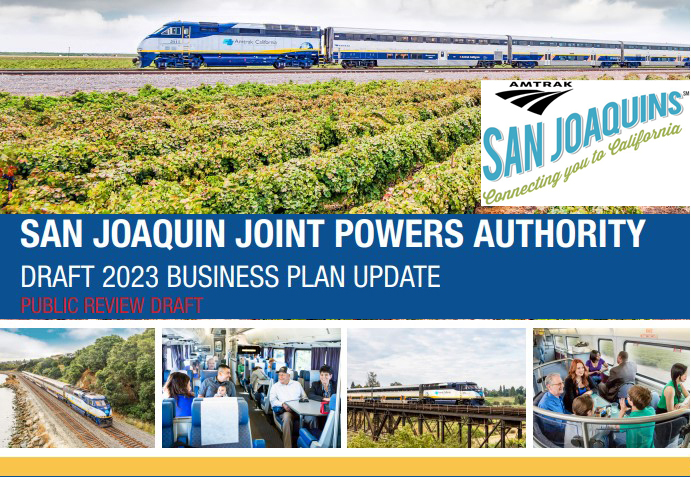
While cash sales were initially suspended in March 2020, Amtrak San Joaquins has resumed cash payments onboard and at all staffed stations. Reintroducing cash payments was the result of coordination among the San Joaquins Joint Powers Authority, Capitol Corridor Joint Powers Authority, LOSSAN JPA, the State of California, and Amtrak.

Historically, approximately 15% of San Joaquins ticket revenue has been generated by cash payments. Reintroducing cash payments provides improved rail and Thruway bus access to the unbanked and underbanked passengers that have been disproportionately impacted by this policy.

Onboard ticket sales are in place to accommodate passenger boarding at unstaffed stations. Passengers boarding at unstaffed station, including Richmond, Antioch, Lodi, Turlock, Madera, Wasco, and Corcoran can purchase their ticket directly from the conductor. Passengers boarding at staffed stations will pay a $10 surcharge in addition to the price of the ticket. The surcharge is a resumption of previous policy.

“We are pleased to begin accepting cash once again throughout our service,” said Stacey Mortensen, Executive Director of the San Joaquin Joint Powers Authority. “In response to the immediate COVID-19 crisis, we took all the necessary steps to ensure the health and safety of our travelers and staff; this included requiring contactless ticketing. In coordination with state officials and Amtrak, we have determined that cash exchange is not only safe, but also improves transportation access to cash dependent riders. The resumption of cash represents a positive step towards normalcy.”

As the state begins to reopen from COVID-19 restrictions, Amtrak San Joaquins is encouraging riders to also review the Visit California “Responsible Travel Code” for additional tips on how to plan thoughtful, safe, and respectful travel.

Customers are strongly encouraged to plan ahead and book early to guarantee available tickets. Amtrak’s new standard of travel includes:

  • Face coverings: Federal law and Amtrak policy require all customers and employees to wear a mask or covering that fully covers the entire mouth and nose, fits snugly against the side of the face, and secures under the chin at all times while onboard trains and in stations, even if state or local policies are different.
  • Station arrival: Customers are encouraged to arrive 30 minutes before departure and 60 minutes if in need of ticketing and/or baggage assistance.
  • Capacity indicator: When searching for travel, the percentage of seats sold displays next to each trip and adjusts as customers make reservations. This gives customers the opportunity to book a train that is less crowded. If capacity exceeds comfort levels, customers can change their ticket without incurring a fee (a fare difference may apply).
  • Amtrak app: Customers can book, board, check train status and access information from the convenience and safety of a mobile device. Amtrak continues to encourage boarding with eTickets, which conductors scan from the Amtrak app.
  • Air quality: All Amtrak trains are equipped with onboard filtration systems with a fresh air exchange rate every 4-5 minutes.
  • Physical distancing: Signage has been displayed at our stations to indicate safe distances in high traffic areas. In addition, protective plastic barriers have been installed at customer counters at our stations.

Passengers are encouraged to purchase tickets prior to boarding at stations, online at AmtrakSanJoaquins.com, on the Amtrak app, or at a station kiosk.

About the San Joaquin Joint Powers Authority (SJJPA)

Since July 2015, SJJPA has been responsible for the management and administration of Amtrak San Joaquins. SJJPA is governed by Board Members representing each of the ten (10) Member Agencies along the 365-mile San Joaquins Corridor. For more information on SJJPA see www.sjjpa.com.

Amtrak San Joaquins is Amtrak’s 6th busiest route with 1.1 million annual riders and 18 stations providing a safe, comfortable and reliable way to travel throughout California. Prior to service modifications due to the COVID-19 crisis, Amtrak San Joaquins ran 7 daily train round-trips and its Thruway buses provided connecting service to 135 destinations in California and Nevada including Los Angeles, Santa Barbara, San Diego, Napa Valley, Las Vegas and Reno. To book your next trip, visit www.AmtrakSanJoaquins.com or call 1-800-USA-RAIL.


Filed Under: News, Transportation

  • « Previous Page
  • 1
  • …
  • 15
  • 16
  • 17
  • 18
  • 19
  • …
  • 31
  • Next Page »
Furniture-Clearance-02-26B
Liberty-Tax-Jan-Apr-2026
Deer-Valley-Chiro-06-22

Copyright © 2026 · Contra Costa Herald · Site by Clifton Creative Web