• Home
  • About The Herald
  • Local Agencies
  • Daily Email Update
  • Legal Notices
  • Classified Ads

Contra Costa Herald

News Of By and For The People of Contra Costa County, California

  • Arts & Entertainment
  • Business
  • Community
  • Crime
  • Dining
  • Education
  • Faith
  • Health
  • News
  • Politics & Elections
  • Real Estate

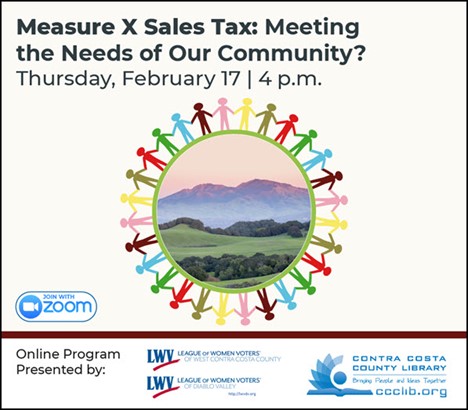
Measure X Sales Tax – meeting the needs of our community?

January 26, 2022 By Publisher 2 Comments

Zoom webinar Feb. 17 at 4:00 p.m. to learn about first year allocations

By Gail Murray

Measure X, a new county-wide sales tax to support health and human services for our local neighbors and families, was passed by voters in November 2020. The tax money is being collected and decisions are being made on how to allocate the money in support of the values we hold as residents of Contra Costa.

The Measure X Advisory Committee was established by the Contra Costa Board of Supervisors to help prioritize spending of Measure X dollars to support health and human services in our county. The Committee has met over many weeks, days and hours, and has produced its report. The people of Contra Costa County have unmet human service needs, and they are growing fast, as documented by the Measure X Advisory Committee. The Board has weighed these growing needs with the limited dollars available to allocate this first year.

Join us Thursday, February 17 at 4:00 p.m. for a Zoom webinar to hear about the first year of allocations. What was recommended by the Advisory Committee, what was funded, and what are the gaps still remaining? Do these allocations support our values? What can we learn from this first year of sales tax allocations?  What does this mean for the future?

This expert panel will be moderated by Shanelle Scales-Preston, Vice Mayor and Pittsburg City Council member. Panelists are Mariana Moore, Chair of the Measure X Citizens Advisory Board; Dan Geiger from Budget Justice Coalition; and Supervisor Karen Mitchoff, Chair of the Contra Costa Board of Supervisors, representing District 4. 

Questions from the public will be taken in advance at Program@LWVDV.org. During the webinar, questions may be submitted thru Zoom Q&A function. 

Click here to register for the webinar. Information on how to access the Zoom webinar will be sent to your email address 24 hours before the program.

The program is a partnership among the League of Women Voters of Diablo Valley and of West Contra Costa County, along with the Contra Costa County Library. The Library will provide closed captioning for this event. 

The program will be recorded and posted on the following sites after the meeting:

LWVDV YouTube channel

Contra Costa County Library YouTube channel


Filed Under: Finances, Government, News, Taxes

Glazer, 42 other state legislators from both parties call for increase to Renters’ Tax Credit 

January 12, 2022 By Publisher Leave a Comment

From $60 to $500 for single residents and $120 to $1,000 for single parents and couples in eligible households. Focused on poorest. Last changed in 1979.

State Senator Steve Glazer (D-7-Orinda)

SACRAMENTO – Low-income California renters who have been drowning in unaffordable housing costs would see much-needed relief under a bill unveiled Wednesday by State Senator Steve Glazer (D-Contra Costa) and co-authors representing more than one-third of the Legislature.

The legislation, SB 843, would increase the California renter’s tax credit for the first time in more than 40 years and would represent significant help to renters across California. Eligible households would receive $500 for single residents and $1,000 for single parents and couples. Currently, eligible renters have their tax liabilities offset by only $60 for single filers or $120 for joint filers.

The bill would make the tax credit more valuable to the poorest Californians by making single parents eligible for the same credit as couples and allowing people to receive the full credit even if the amount exceeds their tax liability.

“We’ve treated renters like the doormat outside California’s economic recovery house,” Glazer said. “We cannot make an economic comeback without renters having their rightful place inside. Renters have waited 42 years for a modest level of fairness in our tax code. We can’t make them wait any longer.

“An increase in the renters’ tax credit will mean that people don’t have to choose between putting food on the table, taking their kids to the doctor, and making the rent.”

Those eligible for the new renter’s credit would be single filers making $43,533 or less and joint filers making $87,066 or less. Nearly 2.4 million renters would be eligible for the tax credit, according to 2019 Franchise Tax Board estimates.

California has not increased the renter’s credit since 1979. The proposed increase accounts for inflation since then. SB 843 provides direct help to renters – those who typically struggle the most to find affordable housing, and who have been hit hard during COVID-19.

Glazer’s previous attempt to increase the credit – SB 248 – was described by CalMatters as the “most bipartisan bill of the year.”  That bill had 30 co-authors. SB 843 already has 43 — and counting — from across the state and all parts of the ideological spectrum.

Assemblyman Steven Choi, R-Irvine, a principal co-author, said: “Nearly half of the state’s residents are renters, but we simply have not done enough to help them with our state tax policies. This legislation can serve as one tool to make renting more affordable. It would be a real boost to working families who are struggling to make ends meet with the high cost of living in California.”

Too many renters have struggled for too long, said Senator Melissa Hurtado, D-Sanger.

“California renters have struggled to meet rent prior to the pandemic, and have faced rents that in some areas have tripled,” said Senator Hurtado. “Even with steps we have previously taken, many renters face homelessness. This tax relief credit will provide much needed relief for renters, and I am happy to support it.”

Senator Susan Rubio, D-Baldwin Park, said there couldn’t be a better time than now to help renters.

“We need to help California renters, many of whom are struggling, with permanent financial relief,” said Senator Susan Rubio. “I want to thank Senator Glazer for introducing this bill, and I’m happy to be a co-author. Increasing the renters tax credit, while we have a healthy budget surplus, will put money where it’s needed the most and help families now and in the future.”

Republican Leader Scott Wilk, R-Santa Clarita, said so many historic moments have come and gone without much help for renters. Until now.

“A lot has changed since 1979: my LA Clippers relocated to Los Angeles, the internet was ‘born,’ the Berlin wall fell, and a NASA spacecraft flew past Pluto,” Wilk said. “One thing that hasn’t changed? California’s $60 renter’s tax credit. Offering low-income renters such little assistance is inexcusable and reflects a bygone era. I am excited we are taking serious steps to put this behind us, too.”

Senator David Cortese, D-San Jose, said: “I’d like to thank Senator Glazer for his leadership as well as my colleagues for introducing this bill that will significantly expand our state’s renters tax credit and provide much needed relief to not only millions of low-income renters, but also our ‘missing middle’-income population that is often overlooked. And by doing so, this bill will provide stability to our families and prevent the displacement of valuable members of our communities – including our teachers, nurses, nonprofit employees as well other essential workers who are being forced to leave the state due to high cost of living and skyrocketing rents.”


Assemblyman Kevin Mullin, D-San Mateo, a co-author, said, “Renters have been disproportionately affected by the economic consequences of COVID-19. Until the pandemic is fully behind us and jobs can return to full capacity, some renters may continue to face a risk of homelessness or housing instability. Updating the renters tax credit is a way of providing critical direct relief to some of California’s most vulnerable.” 

Assemblywoman Janet Nguyen, R-Huntington Beach, said: “After a difficult two years throughout the COVID-19 pandemic, it is my priority to find and work toward solutions that lower the cost of living. This tax credit will help many families in our community not have to choose between paying for rent and providing food for their family. I look forward to continuing to work with my colleagues to get this bill passed through the Legislature and onto the Governor’s desk.”

Jiseon Kim, a University of California Los Angeles senior majoring in history and public affairs and Head of Advocacy at Swipe Out Hunger at UCLA, said that students are among the many Californians facing high housing costs today, “one of many obstacles they face in being able to earn their degrees. This bill would help address our cost of living issues and will contribute to all students’ overall educational success.”

Senator Brian Jones, R-Santee, said the bill recognizes the needs of working families.

“The State’s $45 billion budget surplus was built on the backs of hardworking Californians, including renters, who now deserve a break,” Jones said.

The Renter’s Tax Credit is a common-sense idea that offers urgently needed relief to California’s millions of families burdened with high rent, said David Knight, Executive Director of the California Community Action Partnership (CalCAPA). While California homeowners receive $5.8 billion in tax relief through mortgage deductions, renters’ relief has been barely a blip on the radar, Knight noted. The cost of the new renter’s credit would be around $1.2 billion, according to 2019 Franchise Tax Board estimates.

“It’s a matter of fairness,” Knight said. “California’s housing policies have favored homeowners for decades by offering them a tax credit for the interest on their mortgages. But, renters haven’t been granted similar benefits. CalCAPA is proud to support this important bill, which makes our housing policy more fair and equitable.”

Senator David Min, D-Irvine, said: “Housing remains a top issue for Californians in every corner of our state. From the rising cost of living to the COVID-19 crisis, California renters have faced no shortage of challenges in recent years. I’m honored to be a coauthor of SB 843, which will help thousands by making crucial and long overdue updates to the California Renters Tax Credit.”

The renter’s credit was established in 1972. Since its only increase in 1979, rents in California have more than quintupled while the renters credit remained flat. Median state rent exceeds $1,500 a month for a two-bedroom apartment, and rentals in cities like San Francisco average more than $2,700 a month.

Senator Bob Archuleta, D-Pico Rivera, said: “Expanding eligibility for the renters tax credit is incredibly important. Especially now, as Californians continue to struggle with the pandemic, it is important we do everything we can to make California more affordable for all Californians. I am proud to be a coauthor of Senate Bill 843, and thank Senator Glazer for his leadership on this issue.”

Assemblywoman Laurie Davies (R-Laguna Niguel), a co-author, said, “California is facing a housing crisis unlike anything we have ever seen before. In addition to a lack of housing, we also have one of the nation’s highest costs of living. The existing renters tax credit has not been raised since 1979 and due to inflation plus a stagnant economy, Californians are hurting now more than ever. Modernizing and updating this credit to keep up with 21st century living standards is the right thing to do to provide relief to low-and-middle income renters.”

Assemblymember Carlos Villapudua, D-Stockton, said: “The ever-rising cost of housing in California has led us to a worrying poverty rate that is unsustainable for our families today and for future generations,” said Assemblymember Villapudua. “Too many of us now spend well over 30 percent of our income on rent which forces struggling families into making difficult decisions and cutting priorities. An increase in this tax credit for renters across California would provide essential relief for these individuals as they work to meet these rising costs to keep a roof over their heads.”

Filed Under: Legislation, News, Taxes

Tolls on seven Bay Area bridges increased by $1 on New Year’s day to fund $4.45 billion of transportation projects

January 4, 2022 By Publisher Leave a Comment

The Richmond-San Rafael Bridge and Bay Trail. Photo: MTC

Second of three voter-approved increases, this one to $7; funds held in escrow pending State Supreme Court decision

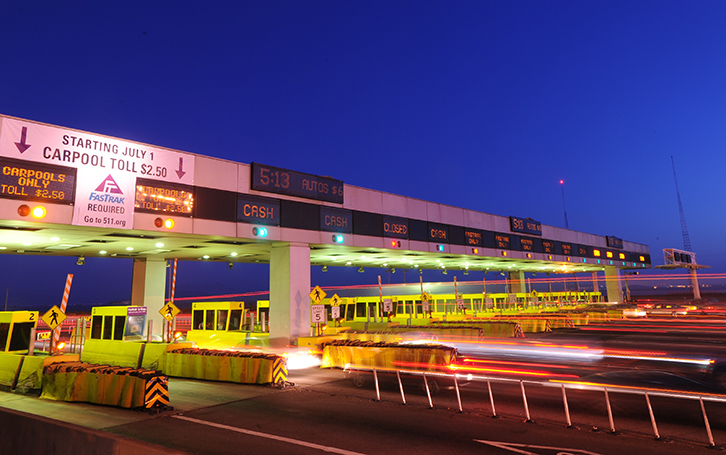
Bay Bridge Toll Plaza from MTC website. By Noah-Berger

By Bay Area Toll Authority

With the new year, the Bay Area Toll Authority (BATA) reminds drivers that tolls at the region’s seven state-owned toll bridges increased by $1 on Jan. 1, 2022. This is the second of the three $1 toll increases approved by the Legislature in 2017 through state Senate Bill 595 and by voters through Regional Measure 3 in June 2018. The first of these toll hikes went into effect on Jan. 1, 2019. The last of the Regional Measure 3 toll increases will go into effect on Jan. 1, 2025.

Regular tolls for two-axle cars and trucks (as well as for motorcycles) at the San Francisco-Oakland Bay, Antioch, Benicia-Martinez, Carquinez, Dumbarton, Richmond-San Rafael and San Mateo-Hayward bridges rose to $7 from the current $6 on Jan. 1, 2022.

Tolls for vehicles with three or more axles also rose by $1 on Jan. 1, 2022, at all seven of the state-owned toll bridges: to $17 for three axles, $22 for four-axles, $27 for five axles, $32 for six axles, and $37 for combinations with seven or more axles.

Senate Bill 595 and Regional Measure 3 continue the peak-period toll discount for motorcycles, carpools and qualifying clean-air vehicles crossing any of the state-owned toll bridges on weekdays from 5 a.m. to 10 a.m. and from 3 p.m. to 7 p.m. The discounted toll increased to $3.50 on Jan. 1, 2022, from the previous $3. To qualify for this discount, carpoolers, motorcyclists and drivers of qualifying clean-air vehicles must use FasTrak® to pay their tolls electronically and must use a designated carpool lane at each toll plaza.

Senate Bill 595 and Regional Measure 3 also established a 50-cent toll discount for two-axle vehicles crossing more than one of the state-owned toll bridges during weekday commute hours of 5 a.m. to 10 a.m. and 3 p.m. to 7 p.m. To be eligible for the toll discount, which is to be applied to the second toll crossing of the day, motorists must pay their tolls electronically with FasTrak®. Carpools, motorcycles and qualifying clean-air vehicles making a second peak-period toll crossing in a single day will qualify for an additional 25-cent discount off the already-discounted carpool toll.

Funding for Transportation Projects

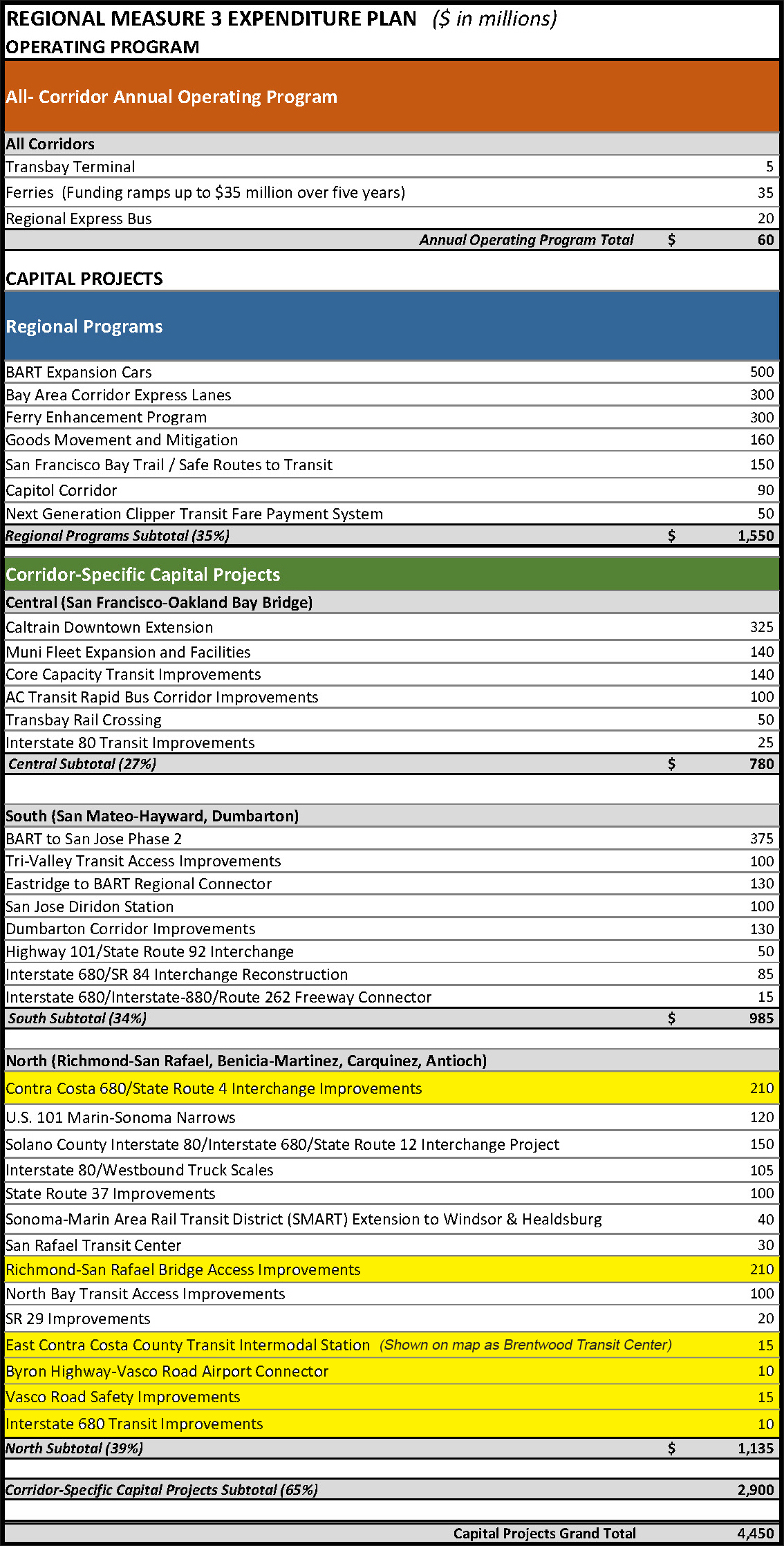
The funds collected from the additional toll will fund a $4.45 billion list of transportation improvement projects throughout the nine-county Bay Area, which includes $470 million in Contra Costa County.

Source: MTC

Source: MTC

New FasTrak® customers can obtain toll tags at hundreds of Walgreens and Costco stores around the Bay Area. A complete list of participating locations — as well as an online enrollment and registration feature — is available on the FasTrak® Web site at bayareafastrak.org. Customers also may enroll in the FasTrak® program by phone at 1-877-229-8655; by calling 511 and asking for “FasTrak” at the first prompt; or in person at the FasTrak® customer service center at 375 Beale Street in San Francisco. Phone service is available Monday-Thursday from 8 a.m. to 6 p.m. and on Fridays from 8 a.m. to 5 p.m. The walk-in customer service center is open Monday-Friday from 9 a.m. to 5 p.m. FasTrak® can be used in all lanes at all Bay Area toll plazas.

Because a legal challenge to Senate Bill 595 and Regional Measure 3 remains pending before the California Supreme Court, the January 1, 2022 toll increase, as collected, is placed into an escrow account managed by an independent trustee. Revenue from the 2019 toll increase also is being held in escrow. If BATA prevails in the litigation, the funds will be applied to BATA-approved programs.

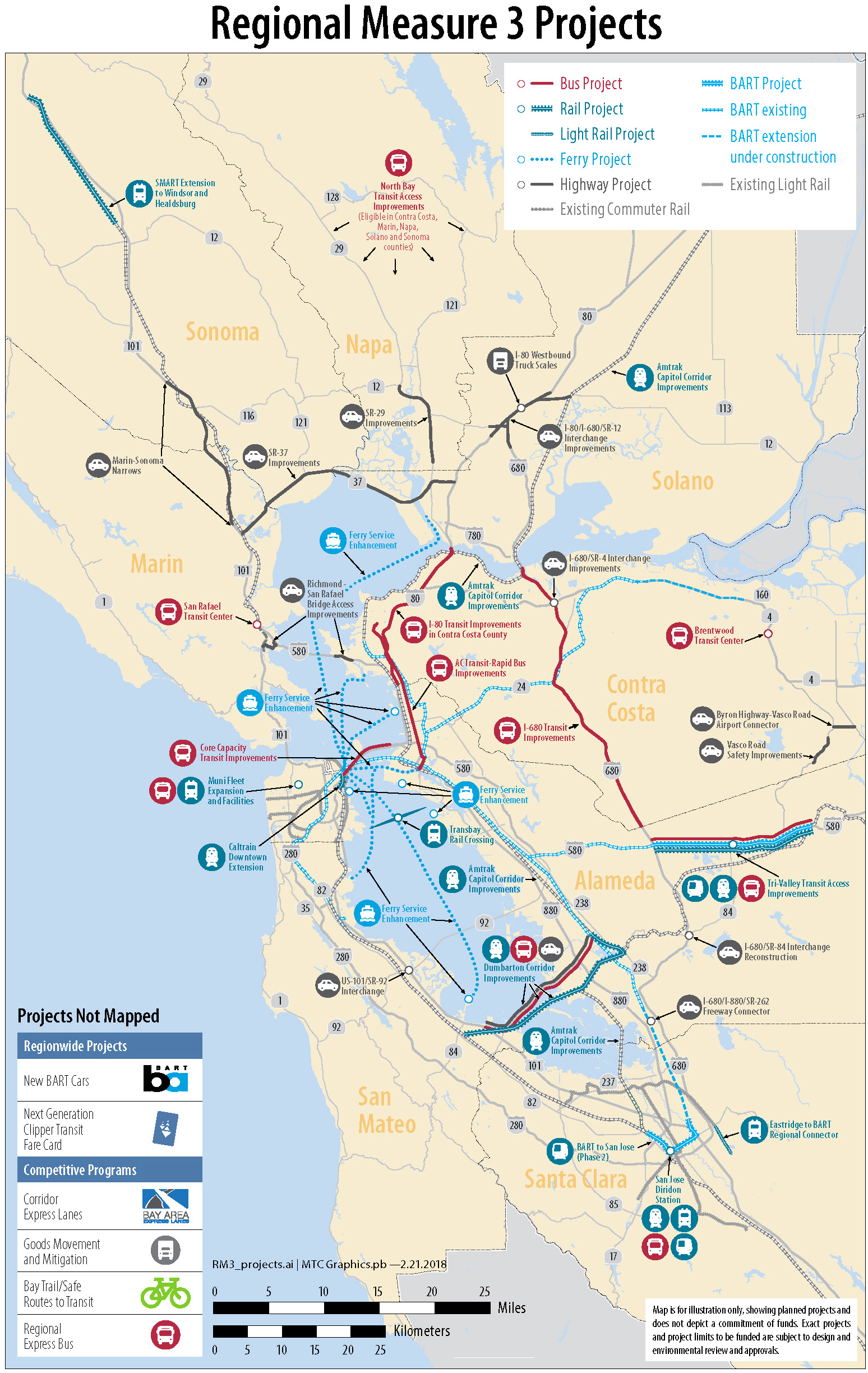
Major projects in the Regional Measure 3 expenditure plan include improvements to State Route 37 in the North Bay, freeway interchange improvements in Alameda, Contra Costa and Solano counties, the purchase of more new BART cars, extension of the BART system from Berryessa to downtown San Jose and Santa Clara, extension of the Caltrain corridor to the Salesforce Transit Center in downtown San Francisco, expansion of Muni’s transit vehicle fleet, expansion of San Francisco Bay Ferry service and more frequent transbay bus service, a direct freeway connector from northbound U.S. 101 in Marin County to the Richmond-San Rafael Bridge, upgrades to the Dumbarton Bridge corridor, and extension of the SMART rail system to Windsor and Healdsburg in Sonoma County.

BATA, which is directed by the same policy board as the Metropolitan Transportation Commission (MTC), administers toll revenues from the Bay Area’s seven state-owned toll bridges. Toll revenues from the Golden Gate Bridge are administered by the Golden Gate Bridge, Highway and Transportation District, which joined with BATA to operate a single regional FasTrak® customer service center in San Francisco. MTC is the transportation planning, financing and coordinating agency for the nine-county San Francisco Bay Area.

Allen Payton contributed to this report.


Filed Under: Bay Area, News, Taxes, Transportation

Brentwood woman owner of Emeryville tax preparation company charged with tax fraud

December 2, 2021 By Publisher Leave a Comment

Traci Austin and Emeryville Tax Services 2019 promo from their Facebook page.

Traci Austin allegedly aided in submission of more than 40 fraudulent tax returns and hosted “tax school” at which she taught prospective tax preparers how to compose fraudulent tax returns

Could face three years in prison and a $100,000 fine

By U.S. Attorney’s Office, District of Northern California, U.S. Department of Justice

OAKLAND – A federal criminal complaint unsealed today charges Traci Austin with aiding and assisting in the preparation of fraudulent tax returns, announced Acting U.S. Attorney Stephanie M. Hinds and Internal Revenue Service, Criminal Investigation, and IRS-Criminal Investigation Special Agent in Charge Mark H. Pearson.

The complaint describes Austin, 44, of Brentwood, CA, as the owner of a tax return preparation business called Emeryville Tax Services (“ETS”).  According to the complaint, Austin prepared materially false and fraudulent tax returns for her clients by including false and/or inflated Schedule A expenses, false and/or inflated Schedule C income and expenses, and false dependents.  By doing this, Austin fraudulently reduced her clients’ taxable income and tax liability, thereby resulting in larger refunds for the client and higher return preparation fee income for Austin.  The investigation has revealed that Austin allegedly assisted in the preparation of at least 42 fraudulent tax returns and an estimated tax loss of well over $697,000 to the federal government.

In addition to the false and fraudulent tax return preparation scheme, the complaint also alleges that since 2016, Austin has hosted a “Tax School” through ETS and charged a fee of at least $200 for students to attend the tax school.  According to the complaint, the goal of the tax school was to hire the attendees as preparers for ETS and prepare tax returns for ETS clients as well as the attendees’ own clients.  During the tax school, Austin allegedly instructed prospective tax preparers how to fraudulently manipulate tax returns to generate the maximum tax refund, and thus the maximum tax preparation fee by listing fictitious side businesses under Schedule C and fake business expenses on Schedule A, for example, the complaint describes how Austin taught her students how she created a fictitious dog grooming business for a client, created a fictitious profit and loss statement for the fake business, and how she instructed the client to print out some photos of dogs to support the idea of her fictitious business.

Austin is charged with aiding and assisting in the preparation of false and fraudulent federal income tax returns, in violation of 26 U.S.C. § 7206(2).

The charges in the complaint are merely allegations and the defendant is presumed innocent unless proven guilty in a court of law.

If convicted, Austin faces a maximum penalty of three years in prison and a $100,000 fine; however, any sentence following conviction would be imposed by the court after consideration of the U.S. Sentencing Guidelines and the federal statute governing the imposition of a sentence, 18 U.S.C. § 3553.

Austin made her initial federal court appearance this morning before United States Magistrate Judge Kandis A. Westmore.  Austin remains out of custody and her next scheduled appearance is at 10 a.m., on February 24, 2022, for a status conference before Magistrate Judge Westmore.

Assistant U.S. Attorney Abraham Fine is prosecuting the case with the assistance of Kay Konopaske and Helen Yee. The prosecution is the result of an investigation by the Internal Revenue Service, Criminal Investigation.


Filed Under: Business, Crime, DOJ, East County, News, Taxes, U S Attorney

Sales taxes – how much, what are they for and who raised them

November 22, 2021 By Publisher Leave a Comment

CCC Sales Tax Rate Breakdown chart and Chick-fil-A receipt.

I didn’t know that! Receipt from new Pittsburg Chick-fil-A raises questions – here are the answers

By Allen Payton

A post by someone, on Facebook, of their sales receipt from the new Chick-fil-A restaurant in Pittsburg, shows a breakdown of the sales tax they were charged. That started a discussion of what each of the line items is for.

I had never seen the sales tax broken down that way, previously, and I used to be a partner in a restaurant which collected sales tax and dealt some with it. I also served on the Contra Costa Transportation Authority for four years, but never knew the county received an additional .25% and the cities 1% in sales tax for transportation above the .5% for which we oversaw the expenditures. Nor have I seen the breakdown of the 6%, until now.

So, I set out on a quest to learn the details of the sales taxes we pay for many if not most of the purchases we make in Contra Costa County.

Once you read this, you too may say as I did, “I didn’t know that!”

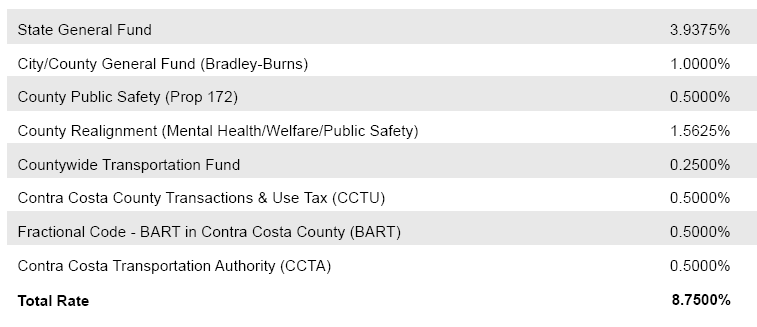
County Finance Director Lisa Driscoll pointed out that on the Sales Tax page of the County’s website, each Quarterly Tax Report includes a breakdown of the sales tax, which answered most of my questions. She also mentioned the 1% “Bradley‑Burns” tax which is received by the cities for transportation.

On the State Auditor’s website, about The Bradley‑Burns Tax and Local Transportation Funds, it reads, “The tax charges 1.25 percent on the retail sale or use of tangible personal property in the State, of which 1 percent is allocated to counties or incorporated cities to use at their discretion and the other 0.25 percent is allocated to county LTFs.”

In Contra Costa County we also pay the voter-approved half-cent sales tax for BART operations, another half-cent sales tax from Measure J, passed in 2004, for transportation projects which is overseen by the Contra Costa Transportation Authority, a half-cent approved by the voters with the passage of Prop. 147 in 2019 for public safety, and another half-cent from Measure X, passed last year, which is allocated by the Board of Supervisors. (See related article)

Driscoll also shared, “The County does not actually collect any sales tax and the rate varies by location. Retailers engaged in business in California must register with the California Department of Tax and Fee Administration (CDTFA) and pay the state’s sales tax, which applies to all retail sales of goods and merchandise except those sales specifically exempted by law. The unincorporated rate is listed below.”

Source: Contra Costa County

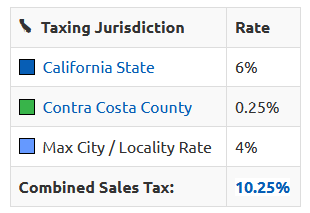
Each city’s sales tax rate can be different because they might also have a local sales tax the voters passed, such as in Antioch where they passed two half-cent sales tax increases, mainly to pay for more police, and has a rate of 9.75%. The highest sales tax rate can be a whopping 10.25% and the only city in Contra Costa County to have the maximum is El Cerrito! To see the sales tax rate in your city or community, click here.

Source: Contra Costa County

As someone who advocates shopping local instead of online, to help support our local retailers and keep our sales tax revenue, you’d think I would know this stuff. But alas, no. So, this has been enlightening for me.

Plus, people, including me, tend to forget about the voter-approved taxes, including 2% of the sales tax in our county, and it’s good for us to be informed or reminded of why we’re paying them and who imposed the various taxes on “we the people”. Just like with the $9.5 billion for the California high-speed rail, about which I’m constantly having to remind people who complain about the state spending their tax dollars on it, that the voters approved that amount in bonds for the project. The same with the law making it only a misdemeanor for shoplifting less than $950 in goods due to Prop. 47. People, we did it to ourselves! LOL

As for the breakdown in the state sales tax and the 1% Bradley-Burns sales tax, say it with me, “I didn’t know that!” Well, now we do.


Filed Under: Business, News, Taxes

Contra Costa Supervisors’ push to use Measure X sales tax funds to hire more Sheriff’s deputies fails on 3-2 vote

November 18, 2021 By Publisher 1 Comment

Requires super majority to approve; Gioia, Glover vote no

Do approve body worn cameras for sheriff deputies.

By Daniel Borsuk

Going against the spirit of the 2020 voter-approved the early education-medical services-social needs message of the Measure X sales tax measure, the Contra Costa County Board of Supervisors on Tuesday narrowly rejected a proposal to spend a chunk of the initial $212. 5 million in one-time Measure X funds for Sheriff David Livingston’s department to hire additional deputies to beef up patrols especially in under-patrolled areas of the county.

Supervisors also learned the county would draw approximately $128.4 million in ongoing Measure X tax revenue a year for at least 2027.

On a 3 to 2 vote, with District 4 Supervisor Karen Mitchoff, District 2 Supervisor Candace Andersen, and board chair District 3 Supervisor Diane Burgis casting votes calling for the expenditure of $6.4 million of Measure X funds for the hiring of patrol deputies designated for the under patrolled Bay Point, Saranap, and Rodeo areas, supervisors rejected a proposal to strengthen up patrols in those under-served areas of the county.

If approved, the proposal could have decreased response time by nearly 14 minutes and 21 seconds per call.

“Police and mental health services are my top priorities,” said District 2 Supervisor Candace Andersen of Danville. “Body cameras and patrols are needed.”

However, due to supervisors’ rules, locally generated tax funds require a super majority vote of four or more supervisors.  As a result, Andersen’s motion to increase patrols with Measure X funds failed.

Funds for the Sheriff’s Department are allowed in the measure that passed by over 58% of the vote last November. The ballot language read, “To keep Contra Costa’s regional hospital open and staffed; fund community health centers; provide timely fire and emergency response; support crucial safety-net services; invest in early childhood services; protect vulnerable populations; and for other essential county services, shall the Contra Costa County measure levying a ½ cent sales tax, exempting food sales, providing an estimated $81,000,000 annually for 20 years that the State cannot take, requiring fiscal accountability, with funds benefiting County residents, be adopted?” CCC_2021MeasureX_FullText

District 1 Supervisor John Gioia and District 5 Supervisor Federal Glover voted against the proposal to increase patrols. The 3-2 was insufficient for supervisors to designate Measure X for the hiring of additional deputies based on board of supervisors’ rules.

“I want funding for the sheriff to be part of the general fund budget discussion, not part of Measure X,” explained Supervisor Glover of Pittsburg. Gioia gave no clear reason why he voted against increasing deputy patrols, but earlier he had talked about bringing the item before the finance committee that he and District 4 Supervisor

“I support giving more money to the sheriff,” said board chair Diane Burgis of Brentwood. “We are under-funding protective services in the Eastern area of the county.”

Supervisors did approve on a 4 to 1 vote the expenditure of $2.5 million of Measure X revenues for body worn cameras for sheriff deputies. District 1 Supervisor Gioia cast the sole opposition vote, siding with more than 60 speakers opposed to the proposed allocation of any Measure X funds to the sheriff.

“Let’s keep the spirit of Measure X,” said Pittsburg resident Francisco Flores.  “Please don’t treat this money as pork for the use of the sheriff.”

Supervisors also voted 5-0 to transfer $6 million in Measure X funds designated for Contra Costa County Health Center capital improvement projects like a parking garage to county services that are financially neglected like the county library system and childcare.

All of the 60 speakers opposed spending any Measure X tax revenue for the sheriff.

Speakers said spending Measure X money for law enforcement purposes violated the spirit of the November 2020 voter approved tax revenue measure designed to ramp up revenue for underfunded public health and social service programs and services.

“Let’s keep the spirit of Measure X alive,” said Pittsburg resident Francisco Flores, a member of the community action group ACCE.

“You must follow the funding requests of the advisory board,” pleaded Measure X Advisory Board Chair Mariana Moore.

Proposed Expenditures

Some of the county programs or capital projects proposed for Measure X funds include:

$40 million parking garage for the Contra Costa Regional Medical and Health Center in Martinez.

$17.2 million for East Contra Costa County Fire District fire station construction projects.

$5 million to modernize the psychiatric ward at the Contra Costa Regional Medical and Health Center in Martinez.

$1.2 million for the Racial Equity and Social Justice office.

$250,000 for arts and culture programs.

$740,000 for the San Ramon Fire Emergency Medical Service.

Allen Payton contributed to this report.

Filed Under: News, Sheriff, Supervisors, Taxes

Contra Costa Assessor offers business, property owners chance to reduce tax due to COVID-19 impact 

April 29, 2021 By Publisher Leave a Comment

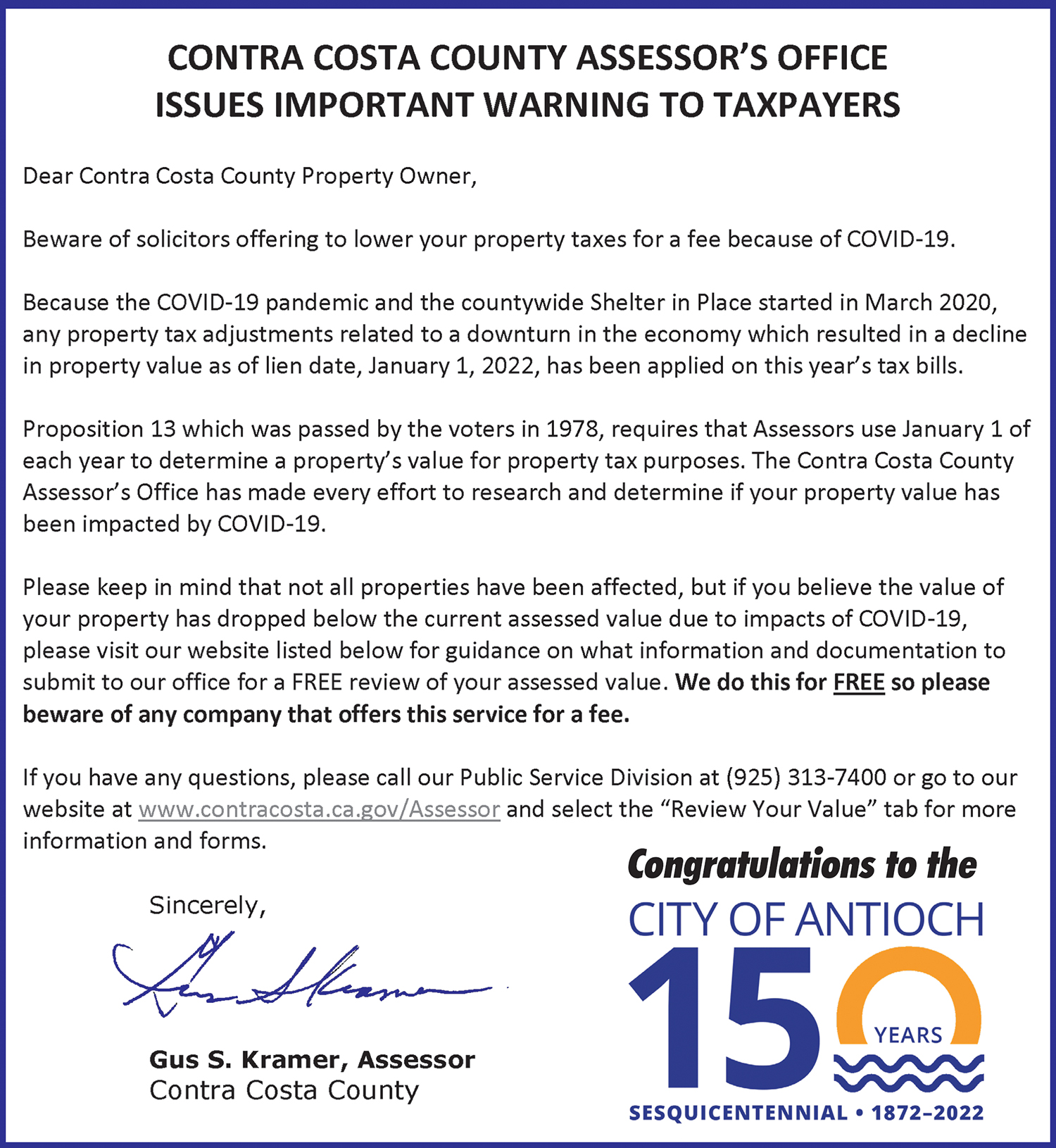
The Contra Costa County Assessor’s Office recognizes that COVID-19 restrictions may have severely impacted many businesses and commercial property owners and may have led to a reduction in property values.  In order to provide assessment relief to those who may have been impacted, the Assessor’s Office is legally required to have qualitative evidence to support a reduction in value.

Not all businesses and commercial properties have been affected, but if you believe the value of your business or commercial property has dropped below the current assessed value due to COVID-19, Assessor, Gus Kramer, urges you to please visit our website at the link below for guidance on what information and documentation to submit to our office for a FREE review of your assessed value.

For information and forms to request a 2021-2022 value review, please visit the link to the Assessor’s webpage “Review Your Value” at: https://www.contracosta.ca.gov/6919/Review-Your-Value.


Filed Under: Business, Government, News, Real Estate, Taxes

Supervisors appoint 17 members to Contra Costa’s Measure X sales tax Advisory Board

April 7, 2021 By Publisher Leave a Comment

Approve bylaws, but has COVID-19 put a dent in county’s finances?

By Daniel Borsuk

The Contra Costa County Board of Supervisors appointed 17 applicants to the Measure X Community Advisory Board on Tuesday that will oversee the disbursement of $81 million in new annual sales tax revenue county officials are counting on to fund vital operations.

Passed by 58.45% of the vote of Contra Costa voters, last November, Measure X increased the county’s sales taxes from 8.25 percent to 8.75 percent on everything except food sales. The additional annual revenue aims to support county services intended for the regional hospital, community health centers, emergency response, childhood services and protective services of vulnerable populations. (See related articles here and here) CCC_2021MeasureX_FullText

There was no public comment aired for either the 17 appointments or the bylaws established for the Proposition X Community Advisory Board.

But this observer questions if the newly formed Measure X Advisory Board will be put to the test at a time the county’s economy is recovering from the COVID-19 pandemic.  What if the panel learns that instead of the $81 million that the county counts on to be generated from the half-cent sales tax increase, that in the first year it might be only $50 million or $60 million because people are not spending like they used to?

The $81 million figure was generated before COVID-19 popped onto the global landscape and the county’s economy was in much better shape at a 3.2 percent unemployment rate compared to a 7.7 percent unemployment rate today.

The supervisors’ Finance Committee, comprised of District 4 Supervisor Karen Mitchoff of Pleasant Hill and District 1 Supervisor John Gioia of Richmond, interviewed more than 130 applicants for the Measure X panel.

“We had a high number of high-quality people apply for this board,” said Gioia. “It wasn’t easy to choose candidates.”

District 2 Supervisor Candace Andersen concurred with Gioia commenting, “We had amazing candidates!”

Each supervisor selected two Community Advisory Board members and one alternate.  Seven at-large representatives were selected as well as five at-large seat alternatives.

Housing advocates Brenda Williams and Edith Pastrano, both of Richmond were selected by Supervisor Gioia to serve on the Community Advisory Board.  El Cerrito psychotherapist Cathy Hanville was selected to serve as an alternate by Gioia.

District 2 Supervisor Andersen selected real estate expert Kathryn Chiverton of Alamo and investment banker Jim Cervantes of Lafayette to serve on the Community Advisory Board.   Supervisor Andersen picked Walnut Creek retired housing consultant Donna Colombo as an alternate.

NAACP East County Branch Past President Odessa Le Francois of Antioch and transitional housing agent David Cruise of Brentwood were named by District 3 Supervisor Diane Burgis to serve on the advisory board.  The board chair also selected housing expert Sandro Trujillo of Antioch as an alternate.

Supervisor Mitchoff selected to represent District IV, psychologist Dr. Michelle Hernandez of Concord and Meals on Wheels executive Sharon Quesada Jenkins of Concord.  Pello Walker of Concord was named an alternate. He is owner/organizer of the annual sustainable enterprise conferences in Contra Costa County.

District 5 Supervisor Glover picked work force specialist Michelle Stewart of Pittsburg and attorney Ali Saidi of Pinole to serve on the advisory panel. Antioch resident Gigi Crowder, a mental health professional, was selected by Glover as an alternate.

Selected as at-large members are founder and executive director of RYSE Kimberly Aceves-Inguez of Oakland, Dr. Ruth Fernandez of Concord who is director of First 5, senior citizen advocate Debbie Toth of Fairfield, social service expert Sandra Wall of American Canyon, executive legal assistant at UnCommon Law Susan Kim of Berkeley, and Senior Director of Ensuring Opportunity Campaign to End Poverty in Contra Costa Mariana Moore of Benicia, and Rodeo Hercules Fire Captain and Local 1230 Vice President Jerry Short of El Sobrante.

Named as at large alternates are San Pablo Mayor Genovea Colloway, First 5 Association Executive Director Melissa Stafford Jones of Walnut Creek, pediatrician Dr. Diana Hong of Orinda, East Bay Leadership Council policy director Lindy Lavender of Pacheco and physician Dr. Peter Benson of Alamo.

According to the Community Advisory Board’s by-laws that supervisors also approved in tandem with the selection of board appointments, meetings are to be conducted publicly and in compliance with the Ralph M. Brown Act and the Contra Costa County Better Governance Ordinance for Public Comment.

There is no compensation for serving on the Measure X Community Advisory Board. In addition, there is “no reimbursement to board members for any expenses incurred while conducting official business,” the bylaws state.


Filed Under: Government, News, Supervisors, Taxes

Contra Costa Community College District bond sale, refinance saves property tax payers $1.7 million

March 4, 2021 By Publisher Leave a Comment

By Timothy Leong, Public Information Officer, 4CD

On November 10, 2020, the Contra Costa Community College District (District) sold $110 million of new Measure E bonds and refinanced $35 million of previously sold general obligation bonds originally issued in 2014 following approval of voters by 57.58%.  Due in part to favorable Moody’s and S&P ratings, the refinancing collectively saves Contra Costa County property owners over $1.7 million through 2040, and savings will be passed on in the form of lower property taxes. Voters will see this change reflected in their 2020-21 property tax bills, with annual total savings for our taxpayers of over $150,000.

The new Brentwood Center and new Kinesiology and Student Union Complex at the LMC-Pittsburg campus were the first major District projects completed using Measure E funds. The $110 million sale of new Measure E bonds will help continue the transformation of additional facilities at District sites. These projects include the new Science Center and renovation of the PE/Kinesiology Complex at Contra Costa College, the Arts Complex and PE/Kinesiology Complex at Diablo Valley College (DVC)-Pleasant Hill Campus, and the new Library and Learning Center at the DVC-San Ramon Campus.

“This is the fourth time the District has refinanced previously sold bonds to reduce debt service for our taxpayers,” said Chancellor Bryan Reece. “We will continue to focus on our fiduciary responsibility of managing public funds and want to thank Contra Costa County voters for allowing us to make these critical investments in the community.”

The sales and refinancing transactions were handled by Morgan Stanley.  KNN Public Finance was the District’s financial advisor, and Orrick Herrington & Sutcliffe performed as bond counsel.

The Contra Costa Community College District (District) is one of the largest multi-college community college districts in California. The District serves a population of 1,019,640 people, and its boundaries encompass all but 48 of the 734-square-mile land area of Contra Costa County. The District is home to Contra Costa College in San Pablo, Diablo Valley College in Pleasant Hill, Los Medanos College in Pittsburg, as well as educational centers in Brentwood and San Ramon.  The District headquarters is located in downtown Martinez.


Filed Under: Education, Finances, News, Taxes

Supervisors query Contra Costa health officials on why few vaccine locations in West County

January 21, 2021 By Publisher Leave a Comment

Members of the Contra Costa Board of Supervisors and new County Administrator Monica Nino (top center) during their meeting on Tuesday, Jan. 19, 2021. Video screenshot.

Celebrate MLK day, honor Humanitarians of the Year, appoint 11 to Racial Justice Oversight Body, increase vehicle license fees

By Daniel Borsuk

During the Board of Supervisors meeting on Tuesday, Jan. 19, 2021, under the questioning of District 1 Supervisor John Gioia, Contra Costa County Public Health Director Anna Roth was asked why West County has the fewest vaccine locations, five, while other districts in the county have more sites where citizens can get vaccinated.

Gioia brought up the issue on why there are far fewer vaccination sites in the Richmond and El Cerrito area that has the highest COVID-19 incidence rates in the county because of its high percentage of Black and Latino residents. He noted that there were 10 vaccination sites in East County, 10 sites in the South County (San Ramon Valley) and seven locations in Central County.

Roth said she would report back to the Board on why West County had fewest vaccination sites, but District 2 Supervisor Candace Andersen of Danville said many of the vaccination locations in her district are drug stores or grocery stores.

Gioia brought up the disparity of vaccination locations in West County after Roth had reported that the County had given about 52,000 vaccine shots since Dec. 15.  She noted persons over 65 are now eligible to receive the vaccine and the vaccine is being distributed through Kaiser, Sutter and at Safeway stories.  The vaccine is being distributed at 960 doses a day.

“The vaccine is giving us hope” said Contra Costa Public Health Officer Dr. Chris Farnitano.  “Almost one third of the deaths in Contra Costa County were COVID-19 related.”

Velma Wilson, Kimyatta Newby Honored at MLK Ceremony

During the county’s 43rd Annual Martin Luther King Jr. Day Celebration, the Board Chair Diane Burgis presented a spectacularly produced video (see 2:34:00 mark) featuring Antioch activist Velma Wilson as the Humanitarian of the Year and Howard University student Kimyatta Newby as Student Humanitarian of the Year. (See related article)

Appoint 11 to Racial Justice Oversight Body

Supervisors approved, without discussion, the appointments of 11 residents to the Racial Justice Oversight Body, a multi-agency advisory body established by the Board of Supervisors in 2018 to oversee the implementation of the recommendations made by the Racial Justice Task Force to reduce disparities in the criminal and juvenile justice systems.  The 11 new members will serve their appointment throuogh December   31, 2023.

Richmond Police Chief Bisa French will serve as the Local Law Enforcement representative.  LaShanta Smith of the West Contra Costa Unified School District will serve as the school district representative.  Also appointed are Tamisha Torres-Walker, an Antioch Council Member; Jeff Landau, a County public defender; Michael Pierson, an Antioch lawyer; Chala Bonner, a political education organizer; Stephanie Medley, an attorney; Ronell Ellis, an entertainment company owner; Cheryl Sudduth, a Goodwill Industries director; Apollo Sulse, a pastor of The Bay Church; and Noe Gudino, a coordinator at Ryse Youth Center.

Vehicle License Fee Hike OK’d

Without hearing any citizen objection, supervisors unanimously approved increasing an annual vehicle license fee of $1.00 for all motor vehicles registered in Contra Costa County and an additional $2.00 for commercial vehicles to provide additional funding for the county’s CAL-ID program.  Used by the Contra Costa Sheriff’s Office and other law enforcement agencies in the county, the CAL-ID system provides funding for the Automated Fingerprint Identification System for persons who may be involved in driving under the influence of drugs or alcohol, vehicular manslaughter, or any combination of those and other vehicle-related crimes.

The fee increase will help cover a projected deficit of $1.1 million starting August 1, 2021.

Bay Point Fire Station Construction Contract Approved

Serving as the Contra Costa Fire Protection District Board of Directors, supervisors unanimously approved a $9,579,000 contract with C. Overaa & Co. to construct a new Fire Station 86 in Bay Point at 10 Goble Dr. even though the second lowest bidder for the project, D.L. Falk Construction Inc., with a bid of $9,714,000 had submitted an objection that was rejected by county officials.

No public objections were lodged about the contract during the Board of Directors meeting on Tuesday.

“Overaa’s bid is responsive and that County Public Works Department staff has thoroughly reviewed the bid and determined that Overaa has documented an adequate good faith effort to comply with the requirements of the County’s Outreach Program, as provided in the Project specifications.  Staff recommends that the construction contract for the Project be awarded to Overaa Construction Inc., the lowest, responsible bidder, in the nearly $9,579,000, as listed in Overaa’s bid,” said the Public Works Department statement.

A third bid of $10,088,000 had been submitted by Alten Construction, Inc. of Richmond.

The new Fire Station 86 will replace the asbestos-plagued, 60-year-old fire station that is so outdated and “is too small to accommodate the needs of the modern fire service,” Contra Costa Fire Protection District Chief Lewis Broschard III wrote in a recommendation to the supervisors. “The layout consists of unconnected buildings used for various purposes. This station itself is believed to contain asbestos …This project has had several starts and stops over the decades.  This fire station will serve Bay Point and the adjacent City of Pittsburg.  The Pittsburg area south of Highway 4 has seen significant growth in recent years.  This growth is anticipated to continue.”

Retiring EBRPD Director Doyle Recognized

Supervisors also recognized Robert Doyle for his 25 years of service at the East Bay Regional Park District, the past 10 years where he served as General Manager of the park district.  Among his numerous achievements at EBRPD, Doyle was instrumental in managing the parks during the current COVID-19 crisis in which park use increased dramatically.


Filed Under: Community, Government, News, Supervisors, Taxes

  • « Previous Page
  • 1
  • …
  • 3
  • 4
  • 5
  • 6
  • 7
  • 8
  • Next Page »
Liberty-Tax-Jan-Apr-2026
Deer-Valley-Chiro-06-22

Copyright © 2026 · Contra Costa Herald · Site by Clifton Creative Web