• Home
  • About The Herald
  • Local Agencies
  • Daily Email Update
  • Legal Notices
  • Classified Ads

Contra Costa Herald

News Of By and For The People of Contra Costa County, California

  • Arts & Entertainment
  • Business
  • Community
  • Crime
  • Dining
  • Education
  • Faith
  • Health
  • News
  • Politics & Elections
  • Real Estate

Supervisors approve spending $75 million of Measure X funds for new medical center facilities, Mitchoff goes on defense

December 16, 2021 By Publisher 1 Comment

Source: Contra Costa Health Services

Will provide garage, medical clinical office, and expanded radiology lab at Contra Costa Regional Medical Center in Martinez; following crackdown, one restaurant still violating COVID-19 health orders as cases in county increase; appoint new Public Defender, will earn $433,641 in pay and benefits

“If you want to send me an email and still want to call me a ‘b***’ go ahead.” – Supervisor Karen Mitchoff in response to critics of her crusade to crack down on restaurants out of compliance with county health orders

By Daniel Borsuk

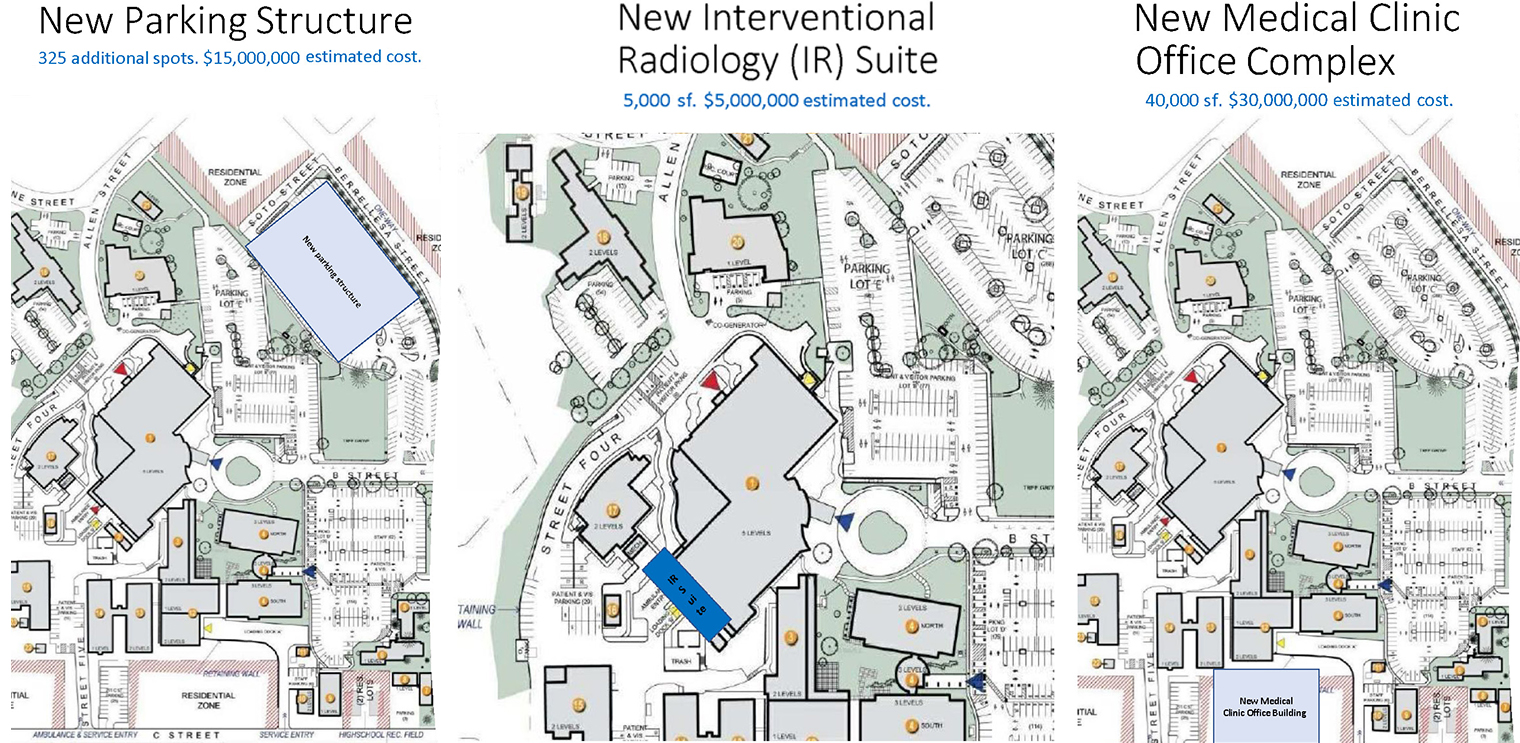
On a 4-0 vote, during their final meeting of the year on Tuesday, the Contra Costa County Board of Supervisors paved the way for officials of the over-used Contra Costa Regional Medical Center to spend $75 million of Measure X half-cent sales tax funds to construct a parking garage, a medical office complex and a state-of-the-art public health laboratory at Tuesday’s final board meeting of the year. (See CCRMC Proposed Master Plan)  CCRMC Measure X funding presentation CCCBOS121421

With Board Chair Diane Burgis absent because of the death of her husband Richard Clayton for whom supervisors adjourned the meeting in honor of, supervisors narrowly met the super-majority requirement to tap into 2020 vote-approved sales tax measure revenues for the purpose of enhancing facilities at the over-used medical complex in Martinez.

Contra Costa Public Health Director Anna Roth pitched the three CCRMC capital improvement projects based on the fact the publicly funded medical center in the past year has treated 142,000 patients due to COVID-19, a 540 percent increase.  The center has saved the lives of about 26,000 county residents, 70 percent of whom are on Medi-Cal. Seventy percent of the CCRMC patients do not speak English, Roth noted.

She said the medical center has been crushed with a 540 percent increase in patients seeking medical care over the past 20 years while the physical components of the medical center have been unchanged. Roth also shared there has been at least one case where a pregnant woman had safely delivered her baby in the medical center parking lot because of the unavailability of parking. According to the presentation, three babies were born in the parking lot during the last year. The proposed 325-space parking structure along with valet parking would help alleviate the parking problem, she asserted.

Marianna Moore, chair of the board of supervisors’ appointed Measure X Advisory Committee, cast concern that the supervisors’ action on the medical center capital projects might be premature and negatively hit future Measure X funding of other public services.

“This is a one-time expenditure,” responded District 4 Supervisor Karen Mitchoff of Pleasant Hill. “There will be money for other projects. The longer we delay on capital improvement projects like these the more expensive it becomes.”

Upon acknowledging Measure X chairperson Moore’s comments, District 1 Supervisor John Gioia remarked “I hear the concerns of the Measure X panel for this board to be transparent and open.” Yet, he pointed out how three major local nonprofit health providers – Kaiser Permanente, John Muir and Sutter Medical – skirt regulations that county-operated medical institutions must obey.

“They get an equity worth $25 billion in tax breaks and don’t have to encounter public scrutiny that publicly operated health care operations like Contra Costa County’s have to abide by. I am proud of the public health successes in Contra Costa County, but we need help from the nonprofit health care organizations too.”

In addition to the proposed parking garage, the supervisors’ action paves the way for the medical center to have a $30 million 40,000 square foot medical-clinical office building constructed and a $5 million 5,000 square foot state-of-the-art intervention radiology suite built.

One Restaurant Remains Out of Compliance With COVID-19 Health Order, Mitchoff on the Defense

In a follow up to last week’s meeting where Supervisor Mitchoff questioned the Health Department’s code enforcement capabilities in shutting down 13 restaurants willfully out of health code compliance, Roth announced there is currently only one eatery that is still not following health code requirements.

She did not identify the business. “All but one of the establishments are now in compliance,” said Roth.

Roth said her department has added four code enforcement officers since last week when Mitchoff blew the lid off the health department’s health code performance.

“I appreciate the progress the health department has made,” said Mitchoff. “There is still one restaurant to follow up on. One restaurant will probably have to close.”

Mitchoff, who will serve as board chair next year instead of vice chair Federal Glover of Pittsburg in recognition of her public service as she has announced she won’t seek reelection in 2022, attacked her critics on her crusade to shut down out-of-compliance restaurants.

“There’s recently been vitriolic and unclear language and comments lodged at me,” said Mitchoff, whose been a frequent target of hate emails. “If you want to send me an email and still want to call me a ‘b***’ go ahead. It would be much better if those who dislike me to write letters and that everyone gets vaccinated and wears masks. I hope to start the new year with much more appreciated language.”

County COVID-19 Cases Increase

In the meantime, Roth said Contra Costa County’s vaccination rate of 76.8 percent remains above the national average of 69.9 percent.

The county’s active COVID-19 case load stands at 1,463, an increase of 18.9 percent over a two-week period. Forty-three patients were in hospitals in the county because of COVID-19.

“Ninety-seven percent of the cases in Contra Costa County are of the Delta strain,” remarked Roth. She said there have been signs of the new Omicron variant appearing in wastewater in the county, but nowhere else.

Because of wintertime conditions forcing Californians to hunker down indoors, Contra Costa County Health Officer Dr. Chris Farnitano informed supervisors the State was expected to announce a new indoor public face mask order. The order would be in place through Jan. 15, 2022.

In a related action, supervisors adopted an ordinance calling for the continuation of remotely conducted meetings into January 2022.  The ordinance also applies to commissions and advisory committees.

Ordinance Temporarily Halts North Richmond Fulfillment Center Openings  

In response to increasing vehicle emission air pollution and traffic-pedestrian safety concerns issues stemming from the buildup of fulfillment centers in the unincorporated North Richmond and Richmond areas, supervisors imposed a 45-day moratorium on the opening of new fulfillment centers.

“Richmond and North Richmond have become a major destination for fulfillment centers,” said Supervisor Gioia, whose District 1 cover those areas. “We don’t want North Richmond to become a wall-to-wall fulfillment center magnet.”

The purpose of the ordinance Gioia has introduced is to compel these enterprises to deliver their products with electric vehicles.   It aims to have 33 percent of a company’s fleet of vehicles electrified immediately and by 2027 100 percent of a business’s fleet of vehicles must be electrified.

At least five fulfillment centers are either under construction or planning phase, said John Kopchick, director of the Contra Costa County Conservation and Development Department.

No one from the fulfillment center sector spoke on the ordinance regulating the electrification of vehicle fleets, but Donald Gilmore of North Richmond Recreation said the ordinance does not go far enough.

“North Richmond is significantly impacted by these warehouses and the traffic coming from them. Pedestrian safety is a pressing problem. We need more time to figure out a plan,” said Gilmore.

Appoint New Public Defender, Will Earn $433,641 in Pay and Benefits

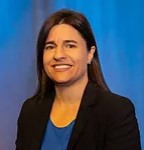
Ellen McDonnell. Source: CCPD

Supervisors promoted Deputy Public Defender Ellen McDonnell as Contra Costa Public Defender at an annual salary of $340,510 in addition to a $93,131 in pension annual compensation.  She will officially take over the role of Public Defender from the retiring Robin Lipetzky effective Jan. 1, 2022.

She started with the department in 2001 and will oversee a $36 million budget and 145 employees.

McDonnell holds a Juris Doctorate degree from California Hastings College of the Law and a Bachelor of Arts degree and double major in Spanish and Italian from Florida Atlantic University in Boca Raton.

She has been a member of the California State Bar since 2011. (Read more about McDonnell in a separate article.)

Filed Under: Government, Health, News, Supervisors

Ninth Circuit agrees to rehear lawsuit ruling Newsom unconstitutionally closed private schools during pandemic

December 10, 2021 By Publisher 1 Comment

Vacates court’s three judge panel ruling, will hear en banc

San Francisco — The Ninth Circuit Court of Appeals, at the request of Governor Gavin Newsom, agreed, on Wednesday, to vacate the court’s three judge panel ruling, earlier this year, in favor of the parents represented by the Center for American Liberty’s lawsuit Brach v. Newsom (#OpenCASchools), that Newsom’s COVID order barring private schools from in-person teaching, violated parents’ Due Process rights, and have the entire case reheard by the full Ninth Circuit Panel.

Click here to view and download the court’s order.

Click here to view and download the Ninth’s Circuit’s prior ruling

In the prior ruling for parents, the three-judge panel of the Ninth Circuit reasoned: “…the Supreme Court has long held that ‘the right of parents to make decisions concerning the care, custody, and control of their children is a fundamental liberty interested protected by the Due Process Clause,’ and that right includes ‘the right of parents to be free from state interference with their choice of the educational forum itself.’”

“It’s sad to see Governor Newsom so vigorously continue his assault on children’s education,” said Harmeet K. Dhillon, CEO of the Center for American Liberty. “The prior opinion from the Ninth Circuit was a clear victory for parents and students when the court correctly ruled that under the Constitution, parents – and not Gavin Newsom or faceless bureaucrats — have the right to decide how best to educate their children. I’m confident that the en banc panel will reaffirm that Governor Newsom’s anti-parent power grab was unconstitutional.”

“Although we believe that the original panel correctly held that Governor Newsom violated the Constitution when he closed private schools across the state, we look forward to making our case again to the en banc panel,” said Partner at Eimer Stahl LLP, Robert Dunn. “The school closure orders the Governor kept in place for nearly a year had a devastating impact on students throughout the state and plainly interfered with parents’ ability to control the education of their children. We are confident that the en banc panel will vindicate our clients’ fundamental rights and prevent the Governor from reinstituting such an order.”


Filed Under: Children & Families, Education, Government, Health, Legal, News, State of California

Homekey Program brings innovative interim housing for homeless to Contra Costa

December 8, 2021 By Publisher 1 Comment

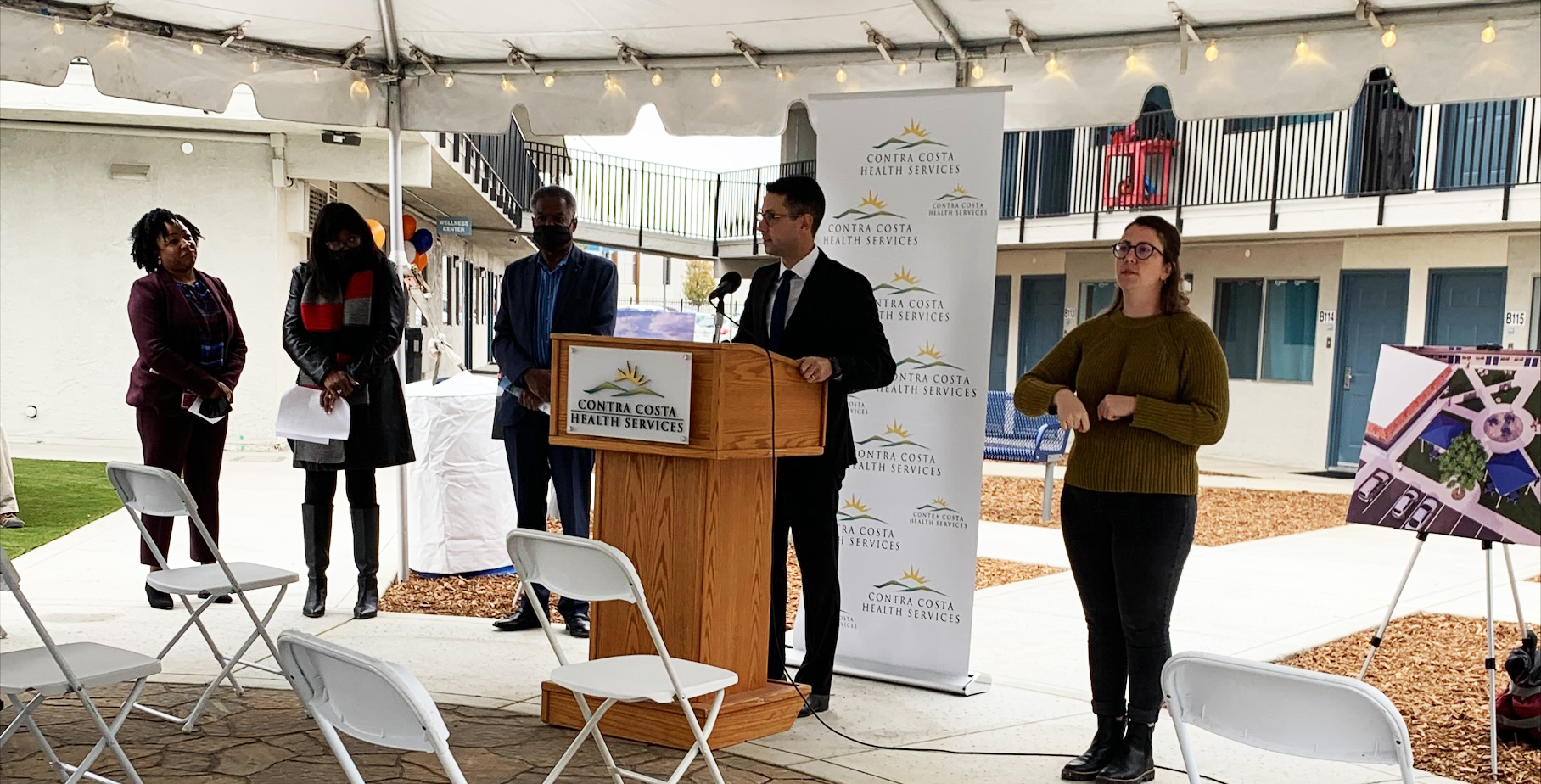
Jason Elliott, Senior Counselor to Gov. Gavin Newsom was joined by (L-R) Contra Costa Health Services Deputy Director Lavonna Martin, Pittsburg Mayor Merle Craft and Supervisor Federal Glover for the grand opening ceremony of Delta Landing. Photo by Karl Fischer.

State, local officials celebrate during grand opening of Pittsburg site for year-long program; will open later this month after extensive renovation is completed.

The Contra Costa Health Services hosted a grand opening ceremony for Delta Landing, a 172-unit interim housing site in Pittsburg, on Monday, Dec. 6, 2021. It will be among the first in California to open thanks to the state’s Homekey program to provide shelter and on-site services to help county residents experiencing homelessness to regain housing.

“We are going to ensure we will continue to serve as many as possible with this resource…as we open this site as a permanent fixture,” said Deputy Health Services Director Lavonna Martin. She is the former Director of Health, Housing, & Homeless Services for Contra Costa County Health Services.

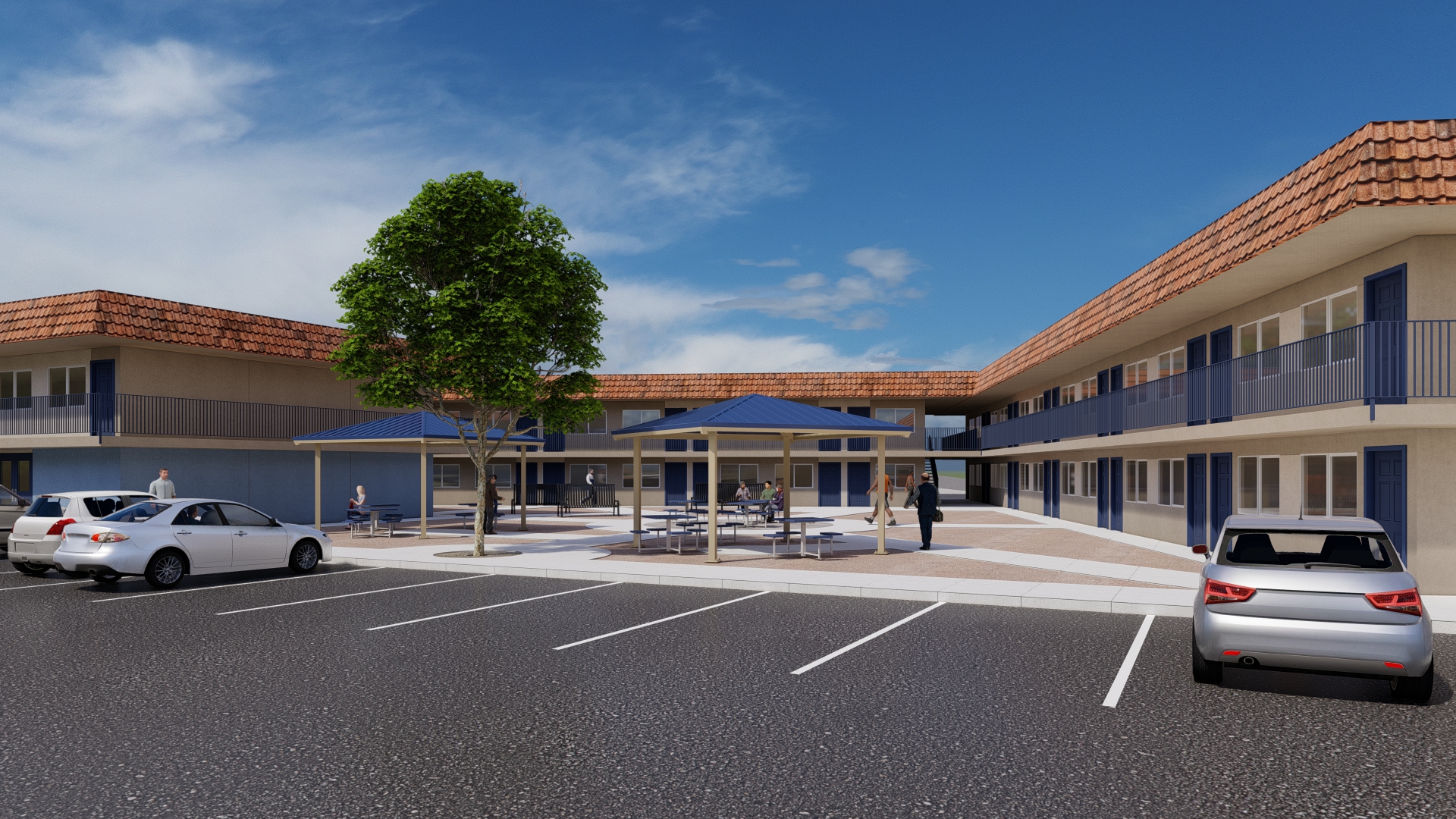
Rendering of the Delta Landing transitional housing site. Source: CCHS

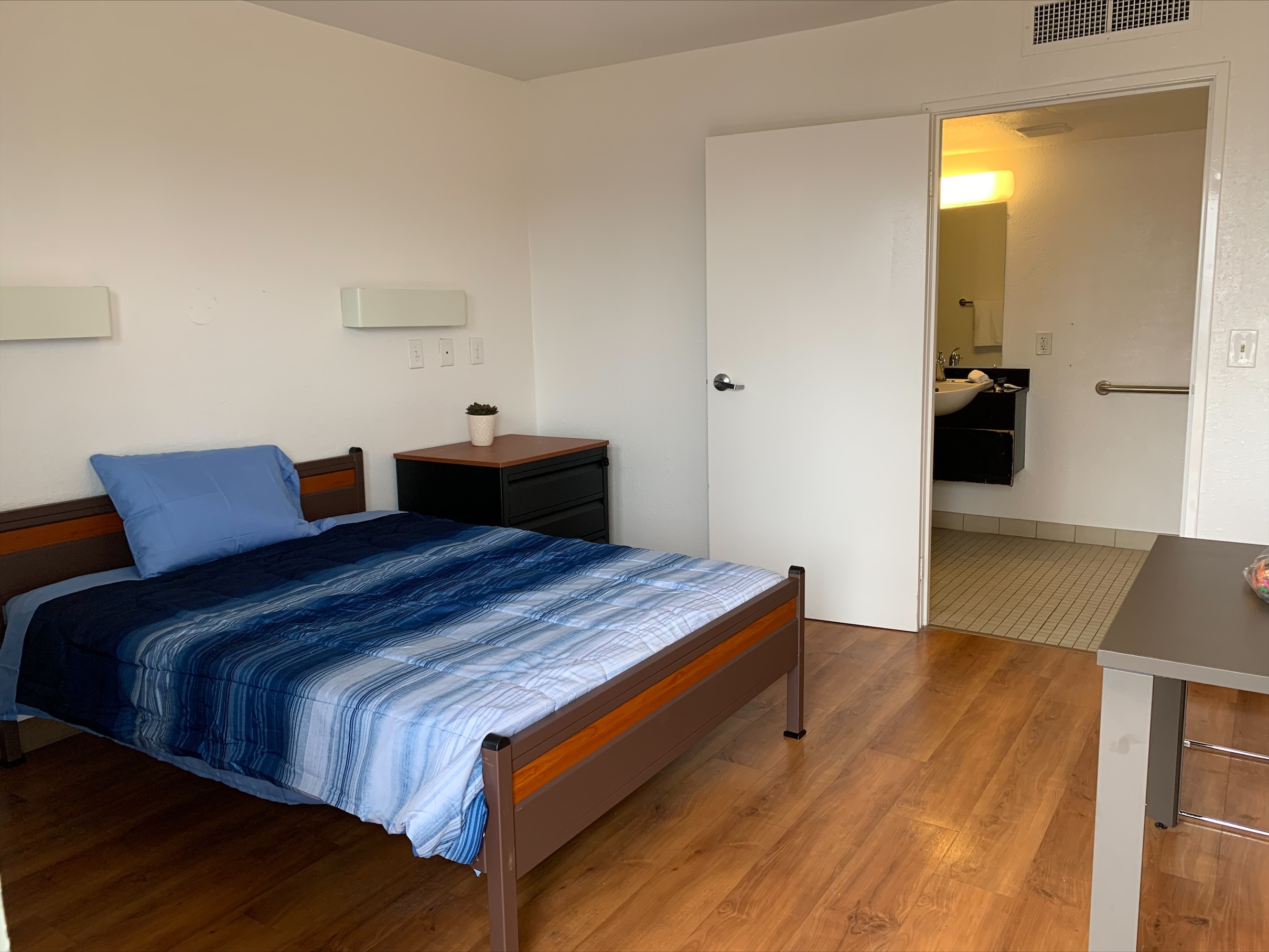
Delta Landing, recipient of a $21.5 million Homekey grant in 2020, will open later this month after extensive site renovation. In addition to new paint, roof, furnishings, laundry and fire sprinkler system, clients can make use of a new wellness center for physical and behavioral health needs and co-located services to help them regain permanent housing. (See related article)

“We are grateful to California and Gov. Gavin Newsom for the opportunity to add critically needed services in East County for residents without housing,” said Diane Burgis, chair of the Contra Costa County Board of Supervisors. “Historically there has been a severe lack of beds in this part of the county, and Delta Landing is a great first step toward addressing that need.”

The site at 2101 Loveridge Road was previously a Motel 6, used since the beginning of the COVID-19 pandemic as a non-congregate emergency shelter for county residents with funding from the state’s Project Roomkey program.

The Homekey award allowed Contra Costa to negotiate the purchase of the motel and provide the necessary renovations to make a state-of-the-art interim housing facility with services such as basic healthcare, housing navigation and case management provided on site.

One of the rooms at Delta Landing viewed during a tour of the facility following the grand opening ceremony on Monday, Dec. 6. Photo by Karl Fischer

“This is a bit of a full circle moment. 524 days ago, the governor stood right there at the end of this walkway, right there and announced the new thing in the state called Homekey. It didn’t exist. Now, we’re here today,” said Jason Elliott, Senior Counselor to Gov. Gavin Newsom and one of the governor’s point-people on housing and homelessness. “What we did was we created a program and we provided funding. What the local governments did was make this happen…172 units of critically needed housing.” (See related article)

Clients staying at the site were temporarily placed at other Project Roomkey locations in the county during renovations and will relocate back to Delta Landing this month.

“We know that the first service that people experiencing homelessness need is a stabilized living situation,” said Contra Costa Supervisor Federal Glover, whose district includes Pittsburg. “Delta Landing provides that stable place, so clients can make full use of the services and supports to transition into permanent housing.”

He previously shared that it is a year-long program that currently has a waitlist.

The county’s most recent homeless point-in-time count, in January 2020, showed that one-third of residents living outdoors in Contra Costa were in eastern Contra Costa – more than 500 people. But, before Delta Landing, there were only 20 available shelter beds in the county east of Concord.

Contra Costa’s Public Works Department led nearly $6 million renovation project. Homekey will also $4.196 million toward operation of this permanent facility, which is managed by Bay Area Community Services (BACS), a contractor of Contra Costa Health Services’ Division of Health, Housing and Homeless Services (H3).

Visit cchealth.org/h3 for information about services for people experiencing homelessness in Contra Costa County.

Allen Payton contributed to this report.

 

Filed Under: East County, Government, Homeless, News

College board president faces possible censure vote, investigation; chancellor faces possible removal

December 7, 2021 By Publisher 1 Comment

Contra Costa Community College District Board President Andy Li and Chancellor Dr. Bryan Reece. Photos: 4CD

Ward 4 Trustee Andy Li denies committing Brown Act violation.

By Allen Payton

Prior to the start of the regular meeting of the Contra Costa Community College Governing Board on Wednesday, Dec. 8, the trustees will meet in closed session beginning at 4:00 p.m. to discuss the discipline/dismissal/release/complaint of Chancellor Bryan Reece. This would be another attempt by board members to discipline or remove him after little more than a year in the position. (See related articles here and here)

Asked which trustee or trustees requested the closed session item, which employee is the subject and which district employees does the board hire, 4CD PIO, Timothy Leong responded, “Items for the closed and open session agenda are developed collaboratively by the Chancellor and the Governing Board, and includes consultation with legal counsel. This includes personnel matters.” He also wrote, “The Governing Board only hires one person: the Chancellor. They Governing Board may also have input on other contract administrator positions, but the final decision on those positions is made by the Chancellor.”

Board President Andy Li was asked the same questions. “The board only hires the chancellor,” he responded.

Regarding which trustee or trustees requested the item be placed on the closed session agenda, Li said, “I don’t think I can disclose that. You can talk to the chancellor about that. He knows better whether we can or cannot.”

Request for Investigation and Censure of Governing Board President

In addition, during the regular meeting, which begins at 6:00 p.m., a censure and investigation of Li will be discussed. According to the staff report, Board Policy 1024 and Education Code Section 72121.5 afford members of the public the opportunity to place items on the agenda of meetings of the Governing Board subject to reasonable regulations.

On November 10, 2021, four members of an organization called CCC Latinx for Inclusion, Maria Alegria, former Mayor of Pinole; Genoveva Calloway, former Mayor of San Pablo; Contra Costa County Board of Education District 1 Trustee Consuelo Lara,; and Antioch School Board Trustee Mary Rocha, submitted a request that the Governing Board initiate an investigation into comments made by Governing Board President Andy Li at the June 23, 2021, Governing Board Meeting and is requesting that Mr. Li be subject to censure based on that investigation (see Board Back-up No. 20D). Ms. Alegria will be afforded up to five minutes to make her proposal to the Governing Board and to state the reasons for her requested action. Request for Censure of Andy Li 12-08-21

In their letter to the board they wrote, “Unfortunately, Trustee Li, under your leadership as President, you’ve repeatedly violated the Brown Act and governed with two different sets of standards for transparency and accountability.”

The letter continues, “Trustee Marquez, the most senior member of the Board, has requested twice that your censure for violating the confidentiality of closed session at the June 23 board meeting be placed on the agenda. Yet this request continues to be ignored. President Li, I have reviewed that video of the Board’s discussion on Agenda Item 18B: Interact Communications $10M Contract, which you stated was discussed in closed session. You were also cautioned by Trustees Barrett, Marquez and Sandoval, as well as Attorney Meola about this.”

They then offered an example of Li’s Brown Act violations, writing, “For example, at the May 26, 2021 4CD Board Meeting you read a prepared statement on your reasoning for recommending censure of Trustee Marquez. You stated: that you had grave concerns with Trustee Marquez’s conduct as he violated the confidentiality of closed session discussion”. This recommendation of censure of Trustee Marquez was an ‘action’ by the Board and was not listed on the agenda, under closed session or as a regular agenda item. You gave the public no opportunity to participate on this matter.”

Li Denies Committing Brown Act Violation

Asked if he had a response to the allegations, Li referred to another meeting, saying, “It was the second meeting in June between the 32-minute and 38-minute marks. People can check and make their judgment.”

Asked if there was a Brown Act violation what would he do to cure it, Li responded, “I didn’t. I did nothing wrong.”

Other Agenda Items

The regular meeting will begin at 6:00 p.m. with the following three items:

  • a presentation from 4CD students to the Governing Board;
  • a special recognition for Diablo Valley College (DVC) and Los Medanos College (LMC) in the promotion of Associate Degrees for Transfer; and
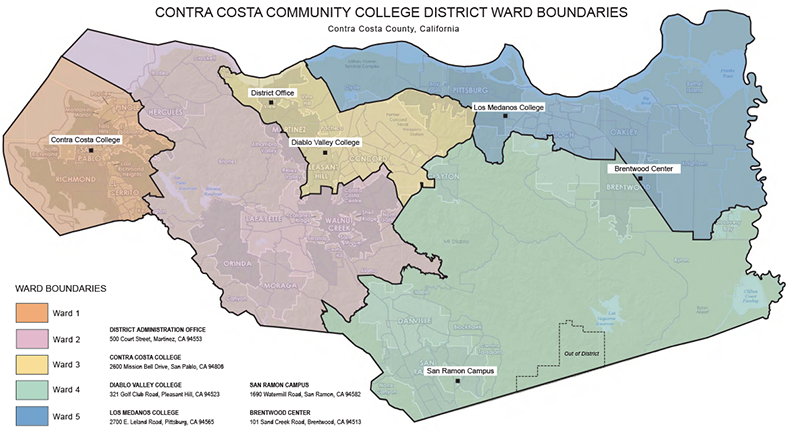
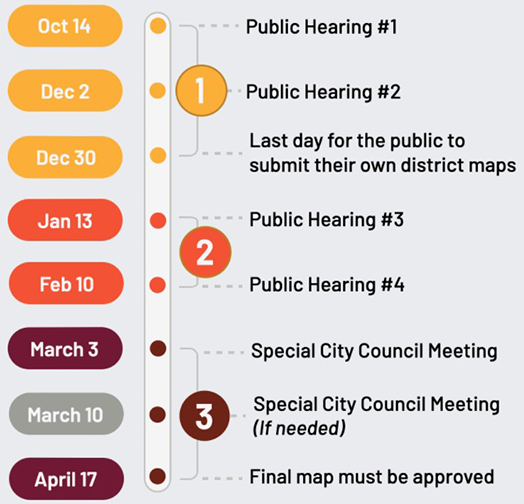
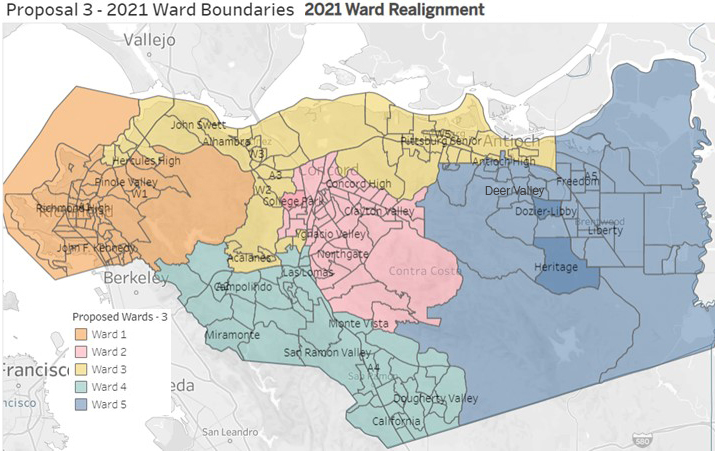
  • Board Report No. 20A a public hearing on ward equalization based on the 2020 Census presented for approval is a Resolution Approving Adjusted Trustee Ward Areas Based on 2020 Census. (See related article)

Other highlights of the meeting are:

  • Board Report No. 16A Contra Costa College will offer a new Associate in Science Degree for Transfer in Business Administration.
  • Board Report No. 16B DVC will offer a new Associate in Science Degree for Transfer in Business Administration.
  • Board Report No. 16D Your approval of this report will allow three different groups of DVC students to travel to Spokane, Washington, Honolulu, Hawaii and Washington, DC. These filed trips will allow students to participate in the Kennedy Center American College Theatre Festival, Aloha State Choral Festival and the National Student Advocacy Conference.
  • Board Report No. 19A As requested at the August 11, 2021, Governing Board meeting, an overview of ongoing work by Interact/SIG, including an expenditure report, timeline and market update will be presented.
  • Board Report No. 19C A listing of conferences of interest from January 2022 through February 2023 is presented for your information and planning purposes.
  • Board Report No. 20B In accordance with Education Code Section 72000, a regular Governing Board meeting on December 15, 2021, is proposed so that the annual organizational meeting to select officers for December 2021 to December 2022 can be held.
  • Board Report No. 20C This report is presented for approval to revise the 2021-22 Governing Board Meeting Calendar to accommodate the National Legislative Summit in Washington, DC that will be held in person in February 2022. Also presented for adoption is the 2022-23 Governing Board Meeting Calendar.

4CD Regular Governing Board Meeting – 12.8.21 agenda

The agenda for the above meeting and a memo highlighting certain reports are attached. The agenda can also be accessed at:  2021-12-08-GB Agenda

While Governing Board members will attend in person, audience members have the option of attending in-person or via Zoom.

If you are attending in person, public session will begin at 6:00 p.m. and will be held in the Second Floor Board Room.  Please note that according to Contra Costa Health Services and effective August 3, 2021, masks are required for everyone, regardless of vaccination status, in indoor public spaces such as businesses, classrooms and offices.

If you are attending remotely, please see the information below to access the meeting.

Meeting link:                https://tinyurl.com/2021-12-08-GB-Agenda

Meeting ID No.:           972 7628 0768

Passcode:                     205040

Phone option:               1.669.900.6833

Public Comment:  You may address an item on the agenda or a subject of your choice. The desired goal is to create an environment of mutual respect between participants of Governing Board meeting discussions; to enhance intellectual thought; and to insure that all present have an opportunity to present their views in an orderly fashion.  If you would like to make public comment at this meeting, please see the information listed on the attached agenda. A fillable public comment card is also attached within the agenda and included here: 4CD Board Mtg Public Comment Card

Filed Under: Education, Government, News

House passes Biden’s $2.2 trillion Build Back Better Act spending bill, see what’s in it

November 21, 2021 By Publisher 1 Comment

Source: U.S. House of Representatives.

All five Contra Costa Congressmen vote in favor; DeSaulnier praises passage calls it historic investment in American families; likely to be changed in the Senate, where support of all 50 Democrats is needed; CBO says it will increase deficit by almost $800 billion over next five years

By Allen Payton

The U.S. House of Representatives passed President Biden’s $2.2 trillion Build Back Better Act, H.R. 5376, also known as the budget reconciliation package, on Friday, on a mainly partisan vote of 220-213 with all Republican members and only one Democrat voting no. It now moves on to the Senate.

According to Roll Call, “Two key holdouts —West Virginia’s Joe Manchin III and Arizona’s Kyrsten Sinema — have yet to offer a public endorsement of the package. Senate Majority Leader Charles E. Schumer, (D-N.Y.), set a Christmas deadline for final passage.”

The 2,702-page bill passed following a record-breaking, 8 1/2-hour filibuster speech by Minority Leader Kevin McCarthy, (R-Bakersfield). He said, “it’s the most irresponsible spending bill in the history of America.”

According to the Summary of Cost Estimate by the Congressional Budget Office the legislation will increase the deficit by almost $800 billion through Fiscal Year 2026. However, “The CBO estimates that enacting this legislation would result in a net increase in the deficit totaling $367 billion over the 2022-2031 period, not counting any additional revenue that may be generated by additional funding for tax enforcement.”

According to the Committee for a Responsible Federal Budget, the legislation could result in a net deficit increase of $2.2 to $2.7 trillion if temporary provisions are made permanent without offsets.

DeSaulnier’s Statement on Passage

Today, Congressman Mark DeSaulnier (CA-11) issued the following statement upon passage of the Build Back Better Act (H.R. 5376), which passed the U.S. House of Representatives by a vote of 220-to-213.

“Today’s passage of the Build Back Better Act is a victory for families across the country and in Contra Costa. Through its historic investments in early, primary, and secondary education and childcare, we are finally ensuring that all children have the opportunity to thrive both in and out of the classroom, no matter where they live or how much their parents earn. From free preschool for three- and four-year-olds to lowering the cost of high-quality childcare, this bill would give over 90% of parents with young children the opportunity to reenter the workforce knowing their children are safe, cared for, and learning.

By finally calling on the wealthiest Americans and big corporations to pay their fair share, every provision in this bill is paid for and we are making a statement that our children are our priority. I urge the Senate to pass the Build Back Better Act without delay to deliver this much needed relief to families as quickly as possible. American families are counting on it.”

In addition, Build Back Better would:

  • Provide monthly payments of $300 per child under 6 and $250 per child ages 6 to 17 for more than 35 million families under the Child Tax Credit;
  • Devote the necessary resources to combat the climate crisis through expanded tax credits for clean energy and programs to drive down pollution;
  • Lower the cost of prescription drugs and expanding Medicare, Medicaid, and the Affordable Care Act;
  • Bring down costs of long-term care and supporting care workers;
  • Expand opportunities for workforce development programs; and
  • Create affordable housing.

Unpopular Provisions in Bill

According to polling, only 39% of battleground voters support “Build Back Better” while 46% oppose it.

Some of the most unpopular items in the bill include:

  • A natural gas tax that will increase home heating costs, electricity rates, and raise gas prices.
  • An eighty-thousand-dollar tax break to wealthy homeowners in New York, New Jersey, and California.
  • A $3,600 a year child tax credit to illegal immigrants for every child they bring into America or give birth to after arriving.
  • 87,000 new IRS agents to increase audits of taxpayers that will look through the bank accounts of every American earning or spending more than $600 per year to make sure they are paying enough taxes, disproportionally affecting small business owners.

What’s In the Bill

According to the National Review, the legislation includes:

$555 billion in subsidies to move America from one source of energy to another, including up to $12,500 per new electric car purchase;

$220 billion for clean energy & climate resilience;

$190 billion to establish or expand clean energy & electric tax credits;

$60 billion to establish or expand clean fuel & vehicle tax credits;

$75 billion to establish or expand other climate-related tax benefits; and

$10 billion to enact infrastructure & related tax breaks;

$400 billion for universal pre-school and day care, including $18 billion in the first three years to create universal pre-kindergarten. Then, the program would be funded by a mixture of federal and state funds;

$300 billion for restoration of the state and local tax (SALT) deduction eliminated in the Tax Cuts and Jobs Act of 2017. According to CNBC the bill, “raises the cap on the state and local tax deduction from $10,000 to $80,00 in 2021, which will benefit the richest households in the country, according to the Tax Foundation.”

$200 billion to extend and expand both the Child Tax Credit and the Earned Income Tax Credit, for four weeks of paid parental, sick or caregiving leave;

$90 billion for what the White House describes as “Equity and Other Investments”;

$38 billion in new energy taxes;

$9 billion to higher-learning institutions for “qualified environmental justice programs”;

$7 billion for service groups for projects related to “climate resilience and mitigation”;

$3.5 billion for ports to purchase “zero-emission” equipment;

$3 billion to fund pandemic preparedness;

$3 billion for better records and hospitals for veterans;

$3 billion in “climate justice block grants” that go into projects in disadvantaged communities. The criterion for grants is based on the race of the projects’ sponsors;

$450 million for nontraditional climate apprenticeship programs;

$350 million to “rebuild” the National Labor Relations Board and $321 million to “rebuild” the Equal Employment Opportunity Commission;

$275 million to upgrade the health-care system in Hawaii which also gets $5 million to save endangered plants;

$200 million to preserve Native American languages;

$150–$250 million (estimated) as tax credits to “local” news organizations, excluding government entities, except NPR and PBS. Note: “Local” is broadly defined, and appears to include almost all news organizations, including the New York Times and Washington Post. The bill also contains a rich new deduction for trial lawyers;

$124 million to combat substance abuse;

$85 million for studying the risks of climate change for “pregnant, lactating or post-partum individuals”;

$50 million to train and certify more doulas; and

$5 million to save desert fish.

According to CNBC, “To pay for the bill, House Dems are proposing increasing some taxes on businesses and the wealthiest Americans. It includes a 5% surtax on adjusted gross income (AGI) over $10 million for individuals and an additional 3% on AGI over $25 million.”

See more details on the Committee for a Responsible Federal Budget website.

Filed Under: Government, Legislation, News

Biden issues Executive Order on Implementation of the Infrastructure Investment and Jobs Act

November 21, 2021 By Publisher Leave a Comment

Executive Order on Implementation of the Infrastructure Investment and Jobs Act

NOVEMBER 15, 2021

By the authority vested in me as President by the Constitution and the laws of the United States of America, and in order to effectively implement the historic infrastructure investments in the Infrastructure Investment and Jobs Act (the Act), it is hereby ordered as follows:

Section 1.  Background.  The Infrastructure Investment and Jobs Act is a once-in-a-generation investment in our Nation’s infrastructure and competitiveness. It will help rebuild America’s roads, bridges, and rails; expand access to clean drinking water; work to ensure access to high-speed Internet throughout the Nation; tackle the climate crisis; advance environmental justice; and invest in communities that have too often been left behind.  It will accomplish all of this while driving the creation of good-paying union jobs and growing the economy sustainably and equitably for decades to come.

Critical to achieving these goals will be the effective implementation of the Act by my Administration, as well as by State, local, Tribal, and territorial governments.

President Biden signed the infrastructure bill during a ceremony on the back lawn of the White House surrounded by members of his cabinet, the House and Senate on Monday, Nov. 15, 2021. Source: U.S. Speaker of the House website.

Sec. 2.  Implementation Priorities.  In implementing the Act, all agencies (as described in section 3502(1) of title 44, United States Code, except for the agencies described in section 3502(5) of title 44), shall, as appropriate and to the extent consistent with law, prioritize:

(a)  investing public dollars efficiently, working to avoid waste, and focusing on measurable outcomes for the American people;

(b)  increasing the competitiveness of the United States economy, including through implementing the Act’s Made-in-America requirements and bolstering United States manufacturing and supply chains;

(c)  improving job opportunities for millions of Americans by focusing on high labor standards for these jobs, including prevailing wages and the free and fair chance to join a union;

(d)  investing public dollars equitably, including through the Justice40 Initiative, which is a Government-wide effort toward a goal that 40 percent of the overall benefits from Federal investments in climate and clean energy flow to disadvantaged communities;

(e)  building infrastructure that is resilient and that helps combat the crisis of climate change; and

(f)  effectively coordinating with State, local, Tribal, and territorial governments in implementing these critical investments.

Sec. 3.  Infrastructure Implementation Task Force.  (a)  There is established within the Executive Office of the President the Infrastructure Implementation Task Force (Task Force).  The function of the Task Force is to coordinate effective implementation of the Infrastructure Investment and Jobs Act and other related significant infrastructure programs within the executive branch.

(b)  The Assistant to the President for Economic Policy and Director of the National Economic Council shall serve as Co‑Chair of the Task Force.

(c)  There is established within the Executive Office of the President the position of White House Infrastructure Coordinator, who shall serve as Co-Chair of the Task Force.

(d)  In addition to the Co-Chairs, the Task Force shall consist of the following members:

(i)     the Secretary of the Interior;

(ii)    the Secretary of Agriculture;

(iii)   the Secretary of Commerce;

(iv)    the Secretary of Labor;

(v)     the Secretary of Transportation;

(vi)    the Secretary of Energy;

(vii)   the Administrator of the Environmental Protection Agency;

(viii)  the Director of the Office of Management and Budget;

(ix)    the Director of the Office of Personnel Management;

(x)     the Assistant to the President and Director of the Domestic Policy Council;

(xi)    the Assistant to the President and National Climate Advisor; and

(xii)   the heads of such other executive departments, agencies, and offices as the Co-Chairs may from time to time invite to participate.

(e)  The Co-Chairs may coordinate subgroups consisting of Task Force members or their designees, as appropriate.

Sec. 4.  General Provisions.  (a)  Nothing in this order shall be construed to impair or otherwise affect:

(i)   the authority granted by law to an executive department or agency, or the head thereof; or

(ii)  the functions of the Director of the Office of Management and Budget relating to budgetary, administrative, or legislative proposals.

(b)  This order shall be implemented consistent with applicable law and subject to the availability of appropriations.

(c)  This order is not intended to, and does not, create any right or benefit, substantive or procedural, enforceable at law or in equity by any party against the United States, its departments, agencies, or entities, its officers, employees, or agents, or any other person.

JOSEPH R. BIDEN JR.

THE WHITE HOUSE,

November 15, 2021.


Filed Under: Government, Infrastructure, News, Technology, Transportation

Contra Costa College District COVID-19 vaccine mandate for staff, students now in effect

November 20, 2021 By Publisher Leave a Comment

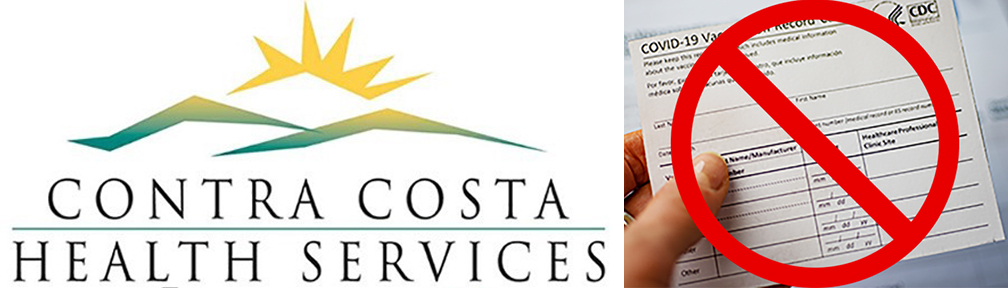
Photo source: CDC

Unanimous vote by trustees; all visitors, including vendors and subcontractors, required to complete health assessment prior to visiting a 4CD facility.

By Timothy Leung, Public Information Officer, Contra Costa Community College District

At their September 8, 2021, meeting, the Contra Costa Community College District (4CD) Governing Board passed a resolution on a unanimous vote establishing a COVID-19 vaccine requirement for all employees, and students who attend at least one in-person class or visits a 4CD facility or campus. All visitors, including vendors and subcontractors, are strongly encouraged to be vaccinated and will be required to complete a health assessment prior to visiting a 4CD facility. Ward 2 Trustee and Board Vic President Dr. Walters made the motion, and it was seconded by Ward 5 Trustee Fernando Sandoval. The vote was unanimous, including the student trustee. (See Item 21.A.)

The vaccine requirement became effective on Monday, November 1, 2021, in order to provide time for those currently unvaccinated to become fully vaccinated. The 4CD Governing Board determined that requiring vaccines for students and employees is necessary to ensure the health and safety of the 4CD community.

Employees and students can apply for a vaccination exception or deferral in the following situations: (a) medical excuse from receiving COVID-19 vaccine due to medical conditions or precaution; b) disability; (c) during the period of any pregnancy; or (d) religious objection based on a person’s sincerely held religious beliefs, practice or observance. When an exception or deferral has been approved, regular weekly COVID-19 testing with evidence of negative test results will be required for any unvaccinated person accessing District campuses or facilities.

4CD is evaluating various technology solutions that will track the vaccination status and test results in a secure system designed to protect the privacy of students and employees in accordance with applicable laws.

“In making this decision, 4CD reached out to its students, faculty, classified professionals, and managers and received overwhelming support to take this action,” said Chancellor Bryan Reece. “COVID-19 and its many variants will be with us for a while, so we must take prudent steps like this one so we can continue providing face-to-face instruction and services for our students, while ensuring we have a safe place to learn and work for our students and staff.”

4CD continues to monitor and adhere to health guidelines from federal, state and local health authorities, and advocates vaccination is the most effective way to prevent transmission and limit COVID-19 hospitalizations and deaths.

Visit 4CD’s website at https://www.4cd.edu/covid19/index.html for more information.

About the College District

The Contra Costa Community College District (4CD) is one of the largest multi-college community college districts in California. The 4CD serves a population of 1,019,640 people, and its boundaries encompass all but 48 of the 734-square-mile land area of Contra Costa County. 4CD is home to Contra Costa College in San Pablo, Diablo Valley College in Pleasant Hill, Los Medanos College in Pittsburg, as well as educational centers in Brentwood and San Ramon. The District headquarters is located in downtown Martinez. For more information visit www.4cd.edu.

Filed Under: Education, Government, Health, News

Supervisors approve address change of properties in Saranap area from Walnut Creek to Lafayette

November 14, 2021 By Publisher Leave a Comment

Lafayette Saranap Mailing Address Place Change Affected Parcels. Source: CCC

Unincorporated area between the two cities south and west of the 680-24 interchange

It might violate Proposition 19 and the property inheritance rights of children of current property owners – County Assessor Gus Kramer

County receives $7.4 million more in federal American Rescue Plan Act funds

By Daniel Borsuk

Over the objections of Contra Costa County Assessor Gus Kramer, the Contra Costa County Board of Supervisors on Tuesday approved the situs address change from Walnut Creek to Lafayette of 465 properties in the upscale Saranap area for purposes of the upcoming 2022 delivery of the secured property tax roll to the Auditor. Those properties are located within the Lafayette School District.

At the request of Area 2 Supervisor Candace Andersen of Danville, supervisors voted 5-0 to approve the unusual request that will very likely boost property values of the 465 properties tagged in the situs address change from Walnut Creek to Lafayette. Andersen told supervisors she had been approached by property owners in the Saranap area since 2019 to make the change because the properties are located within the boundaries of the Lafayette School District and are in the sphere of influence of the City of Lafayette.

But Kramer opposed the situs change contending it might violate Proposition 19 and the property inheritance rights of children of current property owners.

“I am concerned about the legal issues,” said the county assessor. “I suggest that you put this off a bit. It is a bit premature.”

Thirty-year Saranap homeowner Joyce Coleman told supervisors she supports the situs change because it will help future residents know what schools their children will attend.

“There’s always been confusion over whether children will attend Walnut Creek or Lafayette schools. This will help solve that problem,” she said.

Prior to the vote, Area 4 Supervisor Karen Mitchoff, who has announced she will not seek re-election in 2022, commented “It’s just beyond me. You’re already in the Lafayette school district. I am doing this only out of respect for Supervisor Andersen.”

Supervisor Andersen noted that after petitioning the United States Postal Service, the USPS approved the request to add Lafayette to its mailing routing system as a recognized city mailing address for the 465 properties. The postal service now recognizes both Lafayette and Walnut Creek as city addresses for the area, The Zip Code remains unchanged at 94595.

County Receives $7.4 million in American Rescue Plan Act Funds

Supervisors learned additional federal American Rescue Plan Act (ARPA) funds will be heading to county coffers in ensuing months after $7.4 million have been spent during the first quarter of 2021.

The county Employment and Human Services Department has received $4,694,377, the county Health Services Department has received $2,604,182 and the Department of Conservation and Development has received $90,215, said assistant County Administrative Officer Tim Elway.

Through Sept. 30, county departments spent $71.6 million ARPA funds for rental assistance services. The Health Services Department submitted an expenditure of $20.9 million for pandemic responses.

Last August, the County Administrator’s Office had identified $317,327.304 in ARPA funds allocated to the county. Of that amount, $127,606.231 had been received by the county and represents two of the largest funding sources for the county – $112,029,451 for the Coronavirus State and Local Fiscal Recovery Fund and $15,576,780 for the Emergency Rental Assistance Program.

Hire New Director of Child Support Services from San Joaquin County

Supervisors voted 5-0 to hire San Joaquin County Director of Child Support Services Lori Cruz as the new Contra Costa County Director of Child Support Services at an annual salary of $345,796 of which $56,489 are pension costs.

Cruz, a California licensed attorney, who holds a Juris Doctor from Catholic University of America, Columbus School of Law, and a Bachelor of Arts Political Science and Print Journalism from the University of Southern California, has served as the Director of Child Support Services in San Joaquin County, the same county where Contra Costa County Administrator Monica Nina was county administrator until her appointment late last year.

Cruz replaces the current director of child support services Melinda Self, who is retiring on Dec. 31, 2021.

Upon accepting the supervisors’ hiring, Ms. Cruz said, “I can bring my 31 years of child support experience to Contra Costa County and bring positive outcomes to your constituents.”

Cruz, who has been a member of the California State Bar since 1989, has served as director of San Joaquin County Child Support Services from April 2014 to present date. From June 2002 to April 2014, she was employed as the Deputy Director of Operations of the Los Angeles County Child Support Services Department. During her career she developed programs to analyze departmental data to measure performance and effectiveness of services, leading a statewide effort to obtain significant data to measure performance and effectiveness of services, and leading a statewide effort to obtain a new funding model for local child support agencies.

Filed Under: Central County, Government, News

U.S. Citizenship and Immigration Services to conduct free virtual information sessions Nov. 3-30

November 2, 2021 By Publisher Leave a Comment

In multiple languages

By Sharon Rummery, Public Affairs Officer, U.S. Citizenship and Immigration Services

SAN FRANCISCO — Officers from U.S. Citizenship and Immigration Services will present six virtual information sessions from Nov. 3 to 30, including citizenship preparation sessions presented in Spanish and Thai. Those who need an accommodation should contact  SFSJ.CommunityRelations@uscis.DHS.gov.

What & When

Immigration Overview

Wednesday, November 3, 4 to 4:30 p.m.

Webex Link: https://uscis.webex.com/uscis/j.php?MTID=m63b4d5bc6ab478be3c96c4840fc7e8c8

Meeting number (access code): 2761 682 5187

Meeting password: CIS1234!goCA

Naturalization Information – How to Become a U.S. Citizen

Thursday, November 4, 5 to 6:00 p.m.

Webex Link: https://uscis.webex.com/uscis/j.php?MTID=me33ac665f22d8fc68daff3b52ef1572d

Meeting number (access code): 2763 827 2230

Meeting password: 6mXFBvJBU$34

ข้อมูลการแปลงสัญชาติ วิธีการเป็ นพลเมืองสหรัฐฯ

K̄ĥxmūl kār pælngs̄ ạỵchāti wiṭhī kār pĕn phlmeụ̄ xng s̄h̄rạṭ̄h‡

Naturalization Information – How to Become a U.S. Citizen (Thai language)

Sunday, November 7, 1:30PM to 3:00PM (Presenter: Jeff Hilliard, San Diego)

Webex Link: https://uscis.webex.com/uscis/j.php?MTID=m5fac5fbf94519a1111b0311c2c61fd64

Meeting number (access code): 2764 254 4630

Meeting password: JJbCU4GDM95*

Naturalization Information – How to Become a U.S. Citizen

Tuesday, November 9, 7:30 to 8:30 p.m.

Webex Link: https://uscis.webex.com/uscis/j.php?MTID=m3a3a7bb871d91993144ca57cf0e1bc7b

Meeting number (access code): 2764 823 6756

Meeting password: Sfrsnjsacfre123!

Como Convertirse en Ciudadano Estadounidense (Spanish only)

Viernes, 19 de noviembre, 5 a 6 p.m.

Webex Link: https://uscis.webex.com/uscis/j.php?MTID=ma5817ca55e2061eec5bb69b3f0ecf03c

Meeting number (access code): 2762 810 5758

Meeting password: 5iGixJbmN4$4

Options for Victims of Crimes

Tuesday, November 30, 3 to 4 p.m.

Webex Link: https://uscis.webex.com/uscis/j.php?MTID=m303d806b5b1626bc1e709aaba69159a0

Meeting number (access code): 2760 844 8368

Meeting password: CIS1234!goCA

How – Instructions for participating:

We encourage you to join 10 minutes early. Call in at 1-415-527-5035 and use the Meeting Number to join.

  1. If you are using a computer, use Google Chrome. Click on “Join from your browser” to join the meeting.
  2. If you are using a phone or tablet, it is best to download the Cisco WebEx Meeting App

(it is free).

  1. To request a disability accommodation, please contact us no less than 3 days prior to the event. USCIS strives to meet accommodation requests whenever possible.

www.uscis.gov USCIS Contact Center: 800-375-5283 (TTY 800-767-1833)

To find all USCIS webinars, go to https://www.uscis.gov/outreach/upcoming-local-engagements.

For more information on USCIS and its programs, please visit uscis.gov or follow us on Twitter, Instagram, YouTube, Facebook, and LinkedIn.


Filed Under: Government, Immigration, News

ABAG, MTC adopt final Plan Bay Area 2050 and Environmental Impact Report

October 25, 2021 By Publisher 1 Comment

“$1.4 trillion vision for a more equitable and resilient future for Bay Area residents” in the areas of housing, the economy, transportation and the environment

“Roadmap toward a more affordable, connected, diverse, healthy and vibrant region for all”

Includes “strategies that would produce more than 1 million new permanently affordable homes” and an effort to “Implement a statewide universal basic income” to “provide an average $500 per month payment to all Bay Area households”

The Association of Bay Area Governments (ABAG) and the Metropolitan Transportation Commission (MTC), during their joint meeting Thursday evening, Oct. 21, 2021, unanimously adopted Plan Bay Area 2050 and its associated Environmental Impact Report. The unanimous votes by both boards cap a nearly four-year process during which more than 20,000 Bay Area residents contributed to the development of the new plan.

All six representatives from Contra Costa County, including Supervisors Candace Andersen and Karen Mitchoff, Richmond Mayor Tom Butt and San Ramon Councilman Dave Hudson, who serve on ABAG, as well as Supervisor Federal Glover and Contra Costa City Representative Amy Worth, Mayor of Orinda, who serve on MTC, voted to adopt the plan.

Defined by 35 strategies for housing, transportation, economic vitality and the environment, Plan Bay Area 2050 lays out a $1.4 trillion vision for policies and investments to make the nine-county region more affordable, connected, diverse, healthy and economically vibrant for all its residents through 2050 and beyond. From housing strategies that would produce more than 1 million new permanently affordable homes by 2050 to transit-fare reforms that would reduce cost burdens for riders with low incomes and paths to economic mobility through job training and a universal basic income, the goal of a more equitable Bay Area is interwoven throughout the plan. With a groundbreaking focus on climate change, strategies also are crafted for resilience against future uncertainties, including protection from hazards such sea-level rise and wildfires.

It is a long-range plan charting the course for the future of the nine-county San Francisco Bay Area. Plan Bay Area 2050 will focus on four key issues—the economy, the environment, housing and transportation—and will identify a path to make the Bay Area more equitable for all residents and more resilient in the face of unexpected challenges. Building on the work of the Horizon initiative, this new regional plan outlines strategies for growth and investment through the year 2050, while simultaneously striving to meet and exceed federal and state requirements. The Metropolitan Transportation Commission and the Association of Bay Area Governments are expected to adopt Plan Bay Area 2050 in fall 2021.

“Plan Bay Area 2050 reflects a shared vision that can’t be implemented by any single agency,” explained ABAG Executive Board President and Berkeley Mayor Jesse Arreguín. “To bring all these strategies to fruition will require ABAG and MTC to strengthen our existing partnerships and to form new ones — not just with our cities and counties and the state government, but also with the federal government, businesses and nonprofits.”

What will Plan Bay Area 2050 do? What won’t it do?

Plan Bay Area 2050 outlines a roadmap for the Bay Area’s future. While it pinpoints policies and investments necessary to advance the goal of a more affordable, connected, diverse, healthy and vibrant Bay Area, Plan Bay Area 2050 neither funds specific infrastructure projects nor changes local policies. Cities and counties retain all local land use authority. Plan Bay Area 2050 does identify a potential path forward for future investments – including infrastructure to improve our transportation system and to protect communities from rising sea levels – as well as the types of public policies necessary to realize a future growth pattern for housing and jobs.

Ultimately, Plan Bay Area 2050 reflects a shared vision – one that cannot be implemented by any single organization or government agency. Only through partnership with local, state and federal governments – as well as with businesses and non-profit organizations – will the Plan’s vision come to fruition. Before the Plan is adopted in 2021, MTC and ABAG, along with partner organizations, will create an implementation plan that will advance the strategies outlined in Plan Bay Area 2050.

MTC Chair and Napa County Supervisor Alfredo Pedroza acknowledged the work ahead. “Building and preserving affordable housing. Adapting to sea level rise. Getting more people closer to their jobs and more jobs closer to the people. Sharing prosperity equitably. All of these are big lifts. But the new plan can serve as a north star for the Bay Area’s journey to 2050.”

Among the features that distinguish Plan Bay Area 2050 from previous regional plans is an associated Implementation Plan that details the specific actions ABAG and MTC can take in the next five years to put the new plan into action.

“The Implementation Plan is a commitment to do hard things, not just think about them,” said ABAG-MTC Executive Director Therese W. McMillan. “Even if these steps have to be taken incrementally, they will lead us to a more equitable and resilient Bay Area.”

Housing Strategies

Costs for housing are estimated at $468 billion, with $237 billion budget to preserve existing affordable housing by acquiring “homes currently affordable to low- and middle-income residents for preservation as permanently deed-restricted affordable housing”. An additional $219 billion is budgeted for new, deed-restricted affordable housing and $2 billion to “further strengthen renter protections beyond state law” by limiting “annual rent increases to the rate of inflation, while exempting units less than 10 years old.”

Economic Strategies

The total cost for economic strategies in the plan is $234 billion. Of that amount $205 billion is budgeted to “Implement a statewide universal basic income” and “provide an average $500 per month payment to all Bay Area households to improve family stability, promote economic mobility and increase consumer spending.”

Transportation Strategies

The plan projects to spend a total of $578 billion is projected to be spent on transportation over the next 20 years, with most of that, $389 billion, to “restore, operate and maintain the existing system”. An additional $81 billion will be spent to “expand and modernize the regional rail network” to “better connect communities while increasing frequencies by advancing the Link21 new transbay rail crossing, BART to Silicon Valley Phase 2, Valley Link, Caltrain Downtown Rail Extension and Caltrain/High-Speed Rail grade separations, among other projects.” The third largest budget item for transportation is $32 billion to “enhance local transit frequency, capacity and reliability. Improve the quality and availability of local bus and light rail service, with new bus rapid transit lines, South Bay light rail extensions, and frequency increases focused in lower-income communities.”

Environmental Strategies

A total of $108 billion is programmed for Environmental Strategies. The largest portion of that is $30 billion to “modernize and expand parks, trails and recreation facilities”. An additional $19 billion is budgeted to “adapt to sea level rise” by protecting affected “shoreline communities…prioritizing low-cost, high-benefit solutions and providing additional support to vulnerable populations.

In addition, the plan includes $18 billion to “fund energy upgrades to enable carbon neutrality in all existing commercial and public buildings” through “electrification and resilient power system upgrades”, and another $15 billion to “provide means-based financial support to retrofit existing residential buildings.” To “protect and manage high-value conservation lands”, an additional $15 billion is included in the plan.

The adopted final Plan Bay Area 2050, the EIR, and all the supplemental reports accompanying the new plan are available online at planbayarea.org/finalplan2050.

ABAG is the council of governments and the regional planning agency for the 101 cities and towns, and nine counties of the Bay Area. MTC is the transportation planning, financing and coordinating agency for the nine-county San Francisco Bay Area.

Filed Under: Bay Area, Economy, Environment, Government, Growth & Development, News, Transportation

  • « Previous Page
  • 1
  • …
  • 18
  • 19
  • 20
  • 21
  • 22
  • …
  • 43
  • Next Page »
Furniture-Clearance-02-26B
Liberty-Tax-Jan-Apr-2026
Deer-Valley-Chiro-06-22

Copyright © 2026 · Contra Costa Herald · Site by Clifton Creative Web