• Home
  • About The Herald
  • Local Agencies
  • Daily Email Update
  • Legal Notices
  • Classified Ads

Contra Costa Herald

News Of By and For The People of Contra Costa County, California

  • Arts & Entertainment
  • Business
  • Community
  • Crime
  • Dining
  • Education
  • Faith
  • Health
  • News
  • Politics & Elections
  • Real Estate

Supervisors add North Richmond, Rodeo and Antioch mall area to Federal Opportunity Zone program for special investment

March 14, 2018 By Publisher Leave a Comment

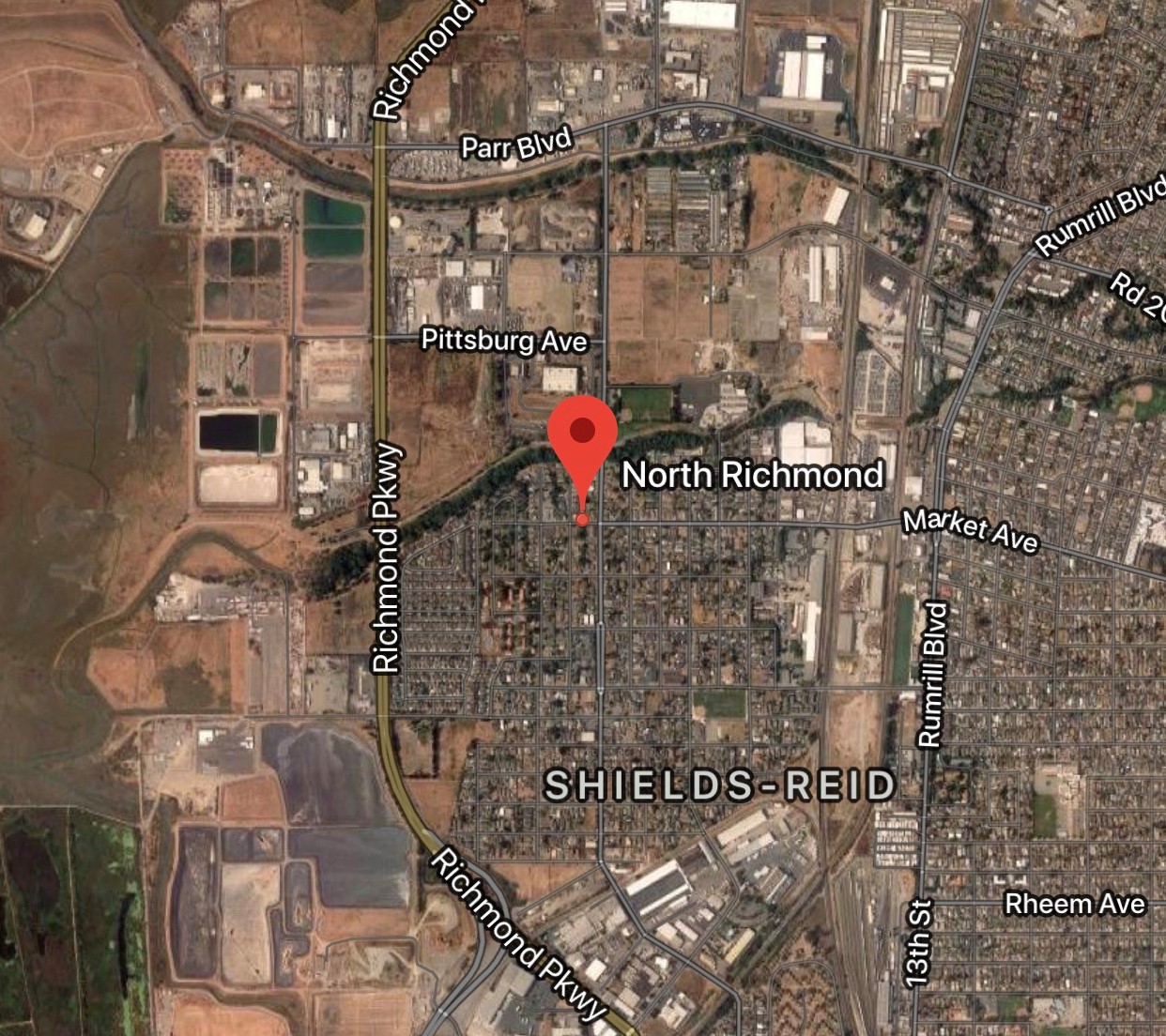
North Richmond. Courtesy of Google Maps.

Part of the Tax Cuts and Jobs Act of 2017

By Dan Borsuk

In a potential bid to receive federal Treasury Department aid for economically stagnating pockets of the county, Contra Costa County Board of Supervisors added the Somersville Towne Center mall area, Rodeo and tracts in the North Richmond area to the Federal Opportunity Zone program on Tuesday. Without hearing comments from the public, the supervisors unanimously voted to add the three census tracts to the county’s recommendation to the new Federal Opportunity Zone program.

Opportunity Zones are a new community development program established by Congress in the Tax Cuts and Jobs Act of 2017 to encourage long-term investments in low-income urban and rural communities nationwide. The program provides a tax incentive for investors to re-invest their unrealized capital gains into Opportunity Funds that are dedicated to investing into Opportunity Zones designated by the governors of every U.S. state and territory. (Read more about how the Opportunity Zones program works, as well as its history and community of supporters.)

According to their website, the Economic Innovation Group originally developed the concept in 2015 to help address the persistent poverty and uneven recovery that have left too many American communities behind. The idea has since been championed by a wide-ranging coalition of investors, entrepreneurs, community developers, economists, and other stakeholders.

Prior to the board’s action, the Contra Costa County Conservation and Development Department said the state had identified 11 tracts in the county that qualified for the Federal Opportunity Zone Program.  Those tracts either have poverty rates of more than 20 percent or median incomes below 80 percent of state or metropolitan areas.  Those areas include the cities of Richmond, San Pablo, Pittsburg, Concord, Antioch and the unincorporated areas of Bay Point and North Richmond.

The county had a deadline of Thursday, March 15 to submit its Opportunity Zone recommendation to the state.

However, there is the possibility the Federal Opportunity Zone Program may not kick into effect in either Contra Costa County or in the Golden State, said Amalia Cunningham of the Contra Costa County Conservation and Development Department.

“Private Investment Opportunity Zones would be eligible for lower federal capital gain tax,” Cunningham informed supervisors. “This is the only identified incentive.  There is no dedicated funding for the program nor has the state announced it will participate by lowering state capital gains tax for investment in Opportunity Zones.”

District 3 Supervisor Diane Burgis of Brentwood recommended that the area around the Somersville Towne Center in Antioch be added to the county Opportunity Zone Program based on a decline in economic activity in the area.

“We will be working with the city of Antioch on this proposal to include the Somersville area in the county Opportunity Zone proposal to the state,” said Cunningham.

The recommendation to add Rodeo came from District 5 Supervisor Federal Glover of Pittsburg and District 1 Supervisor John Gioia of Richmond recommended several tracts in North Richmond.

If the federal requirements are not enough to potentially squash the program, bureaucratic oversight might kill the program.  Cunningham told supervisors the county is under a tight deadline to submit an application, along with public comments.

“States have been given an abbreviated timeline from the federal government to submit their tracts.  The state’s draft list was made public on March 2 and local agencies comments are due by March 15,” she said.

Supervisor Mitchoff Faces June 5 Opponent

Supervisor Karen Mitchoff of Concord will face clinical psychologist Harmesh Kumar, 59, in a June 5 election for the District 4 board seat.

Kumar, who had unsuccessfully run for the Concord City Council in 2012 and recently withdrew plans to run for governor, said he wants to serve on the board of supervisors because “I want the people to win.”  He told the Contra Costa Herald the existing board of supervisors are “against the poor.”  He said Mitchoff and other supervisors represent the interests of the bureaucrats, not those of the people.

“I’m looking forward to a spirited debate on the issues facing District 4,” Mitchoff briefly told the Herald about her opponent and upcoming reelection.

Mitchoff has served on the board of supervisors since January 2011.

District 1 Supervisor John Gioia of Richmond, who is also up for reelection, but will not face an opponent since no one filed papers to run against the attorney on the filing deadline, Friday, March, 9.

Supervisors endorsed on a 5-0 consent action, state Senator Mike McGuire’s (D-North Bay) Senate Bill 833 that would create a red alert emergency system to issue and coordinate alerts following an evacuation order and requires the red alert system to incorporate a variety of notification resources.

Senator McGuire authored the bill in the aftermath of the massive wildfires that killed 40 persons, destroyed 6,000 houses and charred 170,000 acres in Lake, Napa, Sonoma and Mendocino counties.

Anti-Smoking Ordinance Passes

Supervisors also unanimously approved without public comment an ordinance banning smoking in approximately 10,000 dwelling units in unincorporated Contra Costa County.  The ordinance will go into effect July 1, 2019 when county health officials are expected to have completed an education program informing landlords and tenants about the anti-smoking law.

Diablo Valley College in Pleasant Hill and the Alameda County Emergency Operations Center were selected by the supervisors in a consent action item as alternative temporary county seats for Contra Costa County “in the event of war or enemy caused disaster or the imminence of such disasters.”

Allen Payton contributed to this report.

Filed Under: Business, East County, Finances, Jobs & Economic Development, News, West County

Supervisors brush off Contra Costa Budget Justice Coalition for upcoming hearings

January 31, 2018 By Publisher 1 Comment

Told they should focus on job training and housing in 2018 and beyond, during Tuesday retreat in Pleasant Hill

By Daniel Borsuk

The unveiling of a new citizens organization designed to inject more citizen involvement in the county’s budget development process was torpedoed by the Contra Costa County Board of Supervisors on Tuesday, Jan. 30.

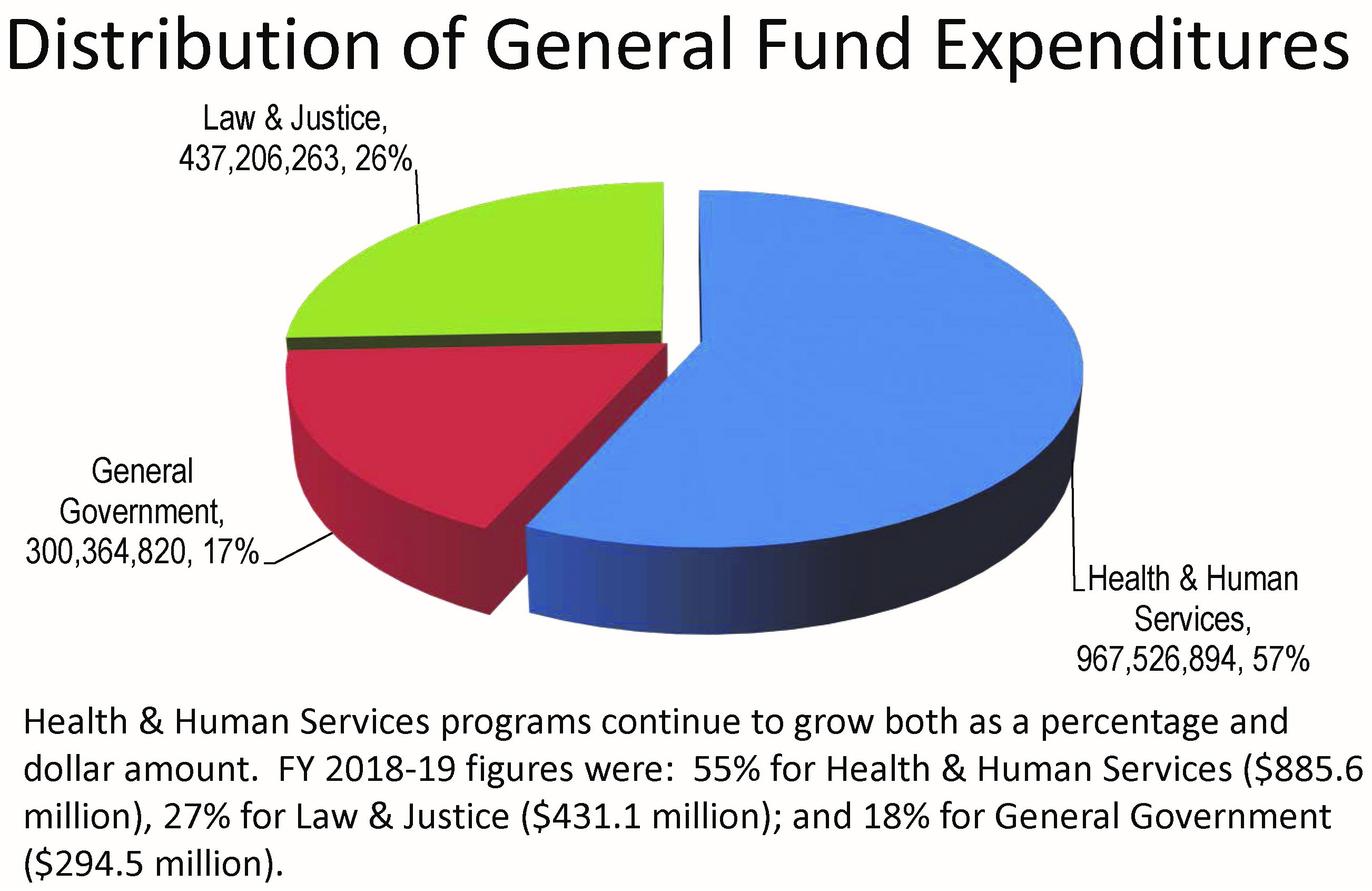
During a board retreat at the Pleasant Hill Community Center, supervisors informed representatives of the two-month-old Contra Costa Budget Justice Coalition that since 82 percent of next year’s proposed $3.4 billion 2018-2019 fiscal budget will come from federal and state funding sources, those funds are mandated for either health services at 55 percent and the sheriff-coroner at 27 percent and there is no room for discussion from the public.

The county’s current fiscal year budget is $3.1 billion.

Supervisors are scheduled to adopt the proposed budget on May 8.  They have scheduled a public hearing on the budget on April 17 with the possibility a second hearing on April 24 if one is needed.

Supervisors told coalition representatives that it would essentially be a waste of time to make a pitch about the budget either at the public hearing or by scheduling meetings with supervisors in their district offices.

“We have a lot of restrictions on our money,” said board chairperson Karen Mitchoff of Pleasant Hill.  “Go ahead with holding your community meetings about the county budget, but they will be limited.”

“We have very limited money,” District 5 Supervisor Federal Glover said.  “Our health and safety funds are mandated by the federal or state government agencies.”

“I am always open to have the public engaged in public policymaking, but we have to face the fact that our budget is mostly funded through mandated categorical sources, “said Supervisor John Gioia of District 1.

“We understand that the budget is already stacked up with required mandated funding, but there is still some flexibility in the process,” Dan Geiger of the Contra Costa Budget Justice Coalition and director of Human Services Alliance of Contra Costa told the Contra Costa Herald.  “We are asking the board to give us some say.”

“We will likely do what we have initially planned to do and that includes meet individual supervisors in their district offices to discuss budget issues,” Geiger said.  “We will also attend the April 17 public hearing.”

Geiger said the objective of the organization, which began with nine non-profit organizations in December and is growing with the potential 48 new organizations, is to open up the county’s budget process.

The new coalition aims to practice its “values-based budgeting principles” that promote safety and affordable housing, stable employment with fair wages, sufficient healthy food, essential health care, access to critical social services, quality early care and education.

Geiger said formation of the Contra Costa Budget Justice coalition occurs at a time there is mounting uncertainty about the future of federal funding coming out of Washington for the upcoming 2018-2019 fiscal year and beyond.  Those budget priorities include housing, health care for low income residents, children and youth services, and mental-behavioral health.

Economic Outlook: Housing Shortage and Job Training

The economic focus in Contra Costa County in 2018 and beyond should be on job training and housing county supervisors were told by Christopher Thornberg, Director of the University of California at Riverside Center for Forecasting and Development.

The economist presented his yearly Economic Outlook Focus on the Contra Costa Economy during the board of supervisors’ retreat.

While the nation’s economy experienced “good growth in 2017” at 2.6 percent in the fourth quarter, Thornberg said California, and especially Contra Costa County is facing two economic problems, a shortage of trained workers even though since 2010 there has been a phenomenal number of job openings and a severe housing shortage.

“We are running out of trained workers,” he said.  This is due to an increasing number of trained workers retiring.  Thornberg suggested as a partial solution to the worsening employment crisis is raising the Social Security retirement age requirement age by two years from 70 to 72.

“In Contra Costa County you have the jobs.  There are a lot of job openings.  Job training and housing should be your focus,” he said.

Thornberg said it is up to the supervisors to find ways to address the housing crisis with rising housing prices.

“We’re seeing a tighter housing market in Contra Costa County with the median house price at $550,000, “he said.

Filed Under: Finances, News, Supervisors

Data shows males earned $17,710 more than females in Contra Costa County in 2016

November 15, 2017 By Publisher Leave a Comment

But male income decreased by more than female income in the county between 2009 and 2015

By Kevin Pryor, Analyst

Recent data shows that the male median income in Contra Costa County was $17,710 more than the female median income.  In 2016, women in Contra Costa County earned $31,040 while men earned $48,750.  This leads to a difference in pay where females earned 64 percent of male’s yearly earnings in the county.

The study was conducted by pansop.com, a knowledge based sharing website.  In regards to this study, the data comes from the U.S. Census Bureau and represents the median income for individual males and females in the U.S aged 15 and up.

Figures show that Contra Costa County had a higher gender pay gap than state and national values.  California experienced a difference in pay of $11,550 between males and females while the nation had a $12,397 difference.  This contrast in pay means that Contra Costa County ranked among the higher pay gaps in the nation and the fourth highest in the state of California.

The information is best represented in the following graph.

The numbers illustrate how men generally make more money the women from county to national values.  Furthermore, Contra Costa County’s income gap outperformed California by $6,160 and the national gap by $5,313.  Such a large difference is partly due to the fact that Contra Costa County residents also earned a higher income last year when compared to state and national figures.

“The data shows that women in Contra Costa County have experienced a significant difference in pay than men.  Such a gap between the two genders represents how the national trend of gender pay is magnified here on the county level” said data analyst for Pansop, Kevin Pryor.

Further research shows that female income in the county decreased by 0.7 percent between 2009 and 2015 while the male median income decreased by 3.7 percent.

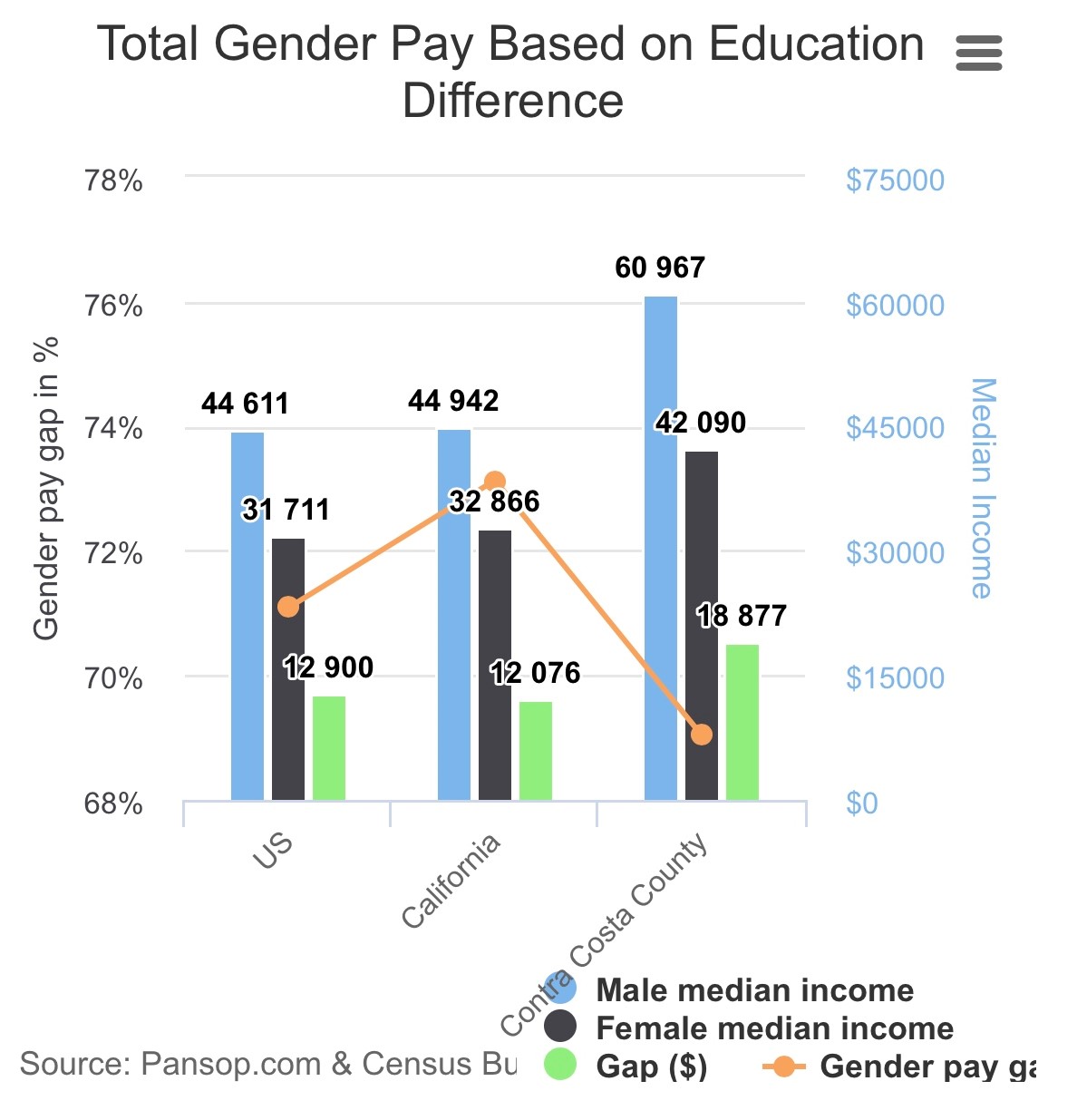
Pay Gap Based on Education

For this study we analyzed the 2016 employee pay data based on education level for geographical locations in the U.S.

The pay disparity is usually based on education attainment and is correlated to other factors such as occupation, gender discrimination, gender bias, payment decisions, and more.

In general, the individuals with graduate or professional degree tend to earn more than those who only complete a bachelor’s degree, associate degree, school graduates.

Our key findings for individuals with less than high school education

  • The gap between male and female median incomes in US for this group is $9,325
  • Males in this group make $8,999 more than females in California
  • Males in this group make $13,518 more than females in Contra Costa County
  • California’s gender pay gap for this group is less than US by $326
  • Contra Costa County’s gender pay gap for this group is more than California by $4,519

Our key findings for individuals with high school education

  • The gap between male and female median incomes in US for this group is $12,237
  • Males in this group make $9,743 more than females in California
  • Males in this group make $8,521 more than females in Contra Costa County
  • California’s gender pay gap for this group is less than US by $2,494
  • Contra Costa County’s gender pay gap for this group is less than California by $1,222

Our key findings for individuals with associate degree

  • The gap between male and female median incomes in US for this group is $12,217
  • Males in this group make $11,472 more than females in California
  • Males in this group make $12,743 more than females in Contra Costa County
  • California’s gender pay gap for this group is less than US by $745
  • Contra Costa County’s gender pay gap for this group is more than California by $1,271

Our key findings for individuals with bachelor’s degree

  • The gap between male and female median incomes in US for this group is $20,066
  • Males in this group make $20,897 more than females in California
  • Males in this group make $29,807 more than females in Contra Costa County
  • California’s gender pay gap for this group is more than US by $831
  • Contra Costa County’s gender pay gap for this group is more than California by $8,910

Our key findings for individuals with professional degree

  • The gap between male and female median incomes in US for this group is $28,155
  • Males in this group make $30,221 more than females in California
  • Males in this group make $41,102 more than females in Contra Costa County
  • California’s gender pay gap for this group is more than US by $2,066
  • Contra Costa County’s gender pay gap for this group is more than California by $10,881

Gender pay gap by education attainment

  • Gender pay gap for individuals with less than high school education in Contra Costa County is less than California by 9.5%
  • California’s Gender pay gap for individuals with high school education is 5.8% more than US
  • Gender pay gap for individuals with high school education in Contra Costa County is more than California by 7.1%
  • Gender pay gap for individuals with bachelors degree in Contra Costa County is less than California by 4.6%
  • Gender pay gap for individuals with professional degree in Contra Costa County is more than California by 5.2%

NOTE: Gender pay gap is measured as the ratio of female to male median yearly earnings. The above data for the population age above 25 years. To see the graphs for each education category, click here.

For more information, please contact Kevin Pryor at 203-518-2348 or email at kevin@gridlex.com.

Pansop.com is a product of Gridlex, which has a cross functional team of software engineers, data scientists, and analysts. Pansop.com is a knowledge based analytics service.  Team members research data from public sources such as the U.S Census Bureau and private databases to produce insightful studies.  Pansop’s data is aimed to serve niche industry professionals and organizations so they may gain further insight into market dynamics.

Filed Under: Finances, News

County Supervisors eye $3 billion budget

April 19, 2017 By Publisher Leave a Comment

Uncertainty as it relies on 48% of funds from federal government

By Daniel Borsuk

Contra Costa County supervisors took a peek at a proposed $3 billion budget on Tuesday that includes $250,000 to expand a popular health care program for low income citizens, $220,000 to reopen the shuttered Knightsen fire station in the East Contra Costa Fire District, and spend $500,000 for the Northern Waterfront Study Intiative.

Supervisors are scheduled to adopt the new spending plan at its May 9 meeting to replace the current $2.6 billion budget.

During the seven-hour hearing, some supervisors seemed to play the conservative card due to fiscal events that have developed in Washington, D.C. and how federal cuts in health care, education and housing might have a ripple effect at the state and county level.

County Administrator David Twa said the county receives 48 percent of its funds from the federal government so there is concern that funding cuts from Washington will impact county operations if not in the 2017-2018 fiscal year, it could occur in the 2018-2019 fiscal year when the county needs to renegotiate labor contracts with doctors, nurses. and fire fighters.

“This is one of the most difficult budgets to assemble,” Twa told supervisors, “because there is so much uncertainty at the state and federal levels.”

The fiscal uncertainty also affected the supervisors.

Supervisor Karen Mitchoff of Pleasant Hill said she would not approve the proposal for an additional $250,000 to expand the Contra Costa Cares health care program for low income residents.  The county allotment would be matched by the nonprofit organization to help access the health care program to 1,000 residents.   This current fiscal year the county spent $1 million and has proposed $1.25 million for the upcoming 2017-2018 fiscal year.

“There’s a large part of the community that doesn’t understand why we see a part of the undocumented community the way we do, but in this case, I cannot support spending an extra $250,000 for the Contra Costa Cares program,” Mitchoff said.

Mitchoff also raised doubts that Contra Costa Cares has the fundraising capabilities to collect $250,000 to expand the program.  “The hospital is not committed to contributing the $250,000,” she said.

“We’re seeing the rise of people awareness to their right to health care,” said Supervisor Diane Burgis of Brentwood.  She favors the extra funding for the health care program that drew about eight speakers in support of the health care program.  “I’m in support of expanding it,” she said.

Initially supervisors were reluctant in setting aside $220,000 to reopen the Knightsen fire station for fiscal years 2017-2018 and 2018-2019, but eventually caved in to reality that the station needed to opened.  Supervisors are frustrated over the way the ECCFD has managed its financial and business affairs.  The fire district had shuttered the fire station in order to open a new station in Brentwood..

Supervisors also voted 4-0, with Supervisor Candace Andersen absent, to designate $500,000 for the Northern Water Front Study Initiative, a project of Board Chair Federal Glover.  The funding would be spent on data development, parcel identification, engineering, and public outreach.

New Airport Safety Classifications Approved

Supervisors also approved the creation for four Airport Safety Office Classifications at the Byron Airport and Buchanan Field to replace three outdated classifications that should help the county improve the retention rate among safety personnel.  The county has a 60 percent retention rate among 17 personnel assigned to aircraft rescue and firefighting duties.

Filed Under: Finances, Government, News, Supervisors

Running Your Money: Are bank account opening bonuses for real?

January 4, 2017 By Publisher 2 Comments

By Harry Stoll

Are bank account opening bonuses for real?

Yes, but you will pass many dark dank alleys in a dicey neighborhood, so take care. Banks often have a third party do the pitch, such as Hustler Money, Money Crashers, and Nerd Wallet. They are very up- front about being paid by the banks. In many of them Chase is mentioned first. Being paid by the banks doesn’t make the offer phony. Often there is promotional code you must use. You can open the account online.

Two bits of advice: Always, always, print a copy of the offer and keep it at least until you have collected the money. And, always, RTFP (definition available in the Suburban Dictionary). I ignored my good advice in a recent deal with Wings Financial Credit Union; I read the fine print but didn’t print out a copy. When it came time to collect the puny $50 gift card, customer “service” said, “Ah, ah, ah, you have to agree to accepting paperless statements to earn the gift card.” I didn’t remember that but I was stuck.

Chase often puts pitches in that envelope of coupons including sewer repair and ridding your abode of rodents. I have taken several Chase offers. I like to open the account at a nearby branch. They always recognize me even though I enter the bank only to open an account; otherwise I go to the money wall.

I recently opened a Chase Business Account, depositing $1,500. The rep won’t be fussy about your business,  E just wants to close the deal and rack up brownie points. Chase will deposit $300 to the account about 70 days after opening, when  It will be available to withdraw. You must maintain a $1,000 minimum balance. To avoid a monthly fee keep at least $1,500 in the account That’s an annual percentage yield 40%. The fine print says if you close the account before 12 months, it will deduct the bonus. Well, nyah, nyah, nyah, what if I take the money and run before I close it? But they might not recognize me when I come in next year with the offer. It’s like guys on Hogs in black leather jackets with an eagle on the back; I don’t wish to incur their displeasure.

For an HSBC Bank: bonus of $350, initially deposit at least $25 dollars, pay two bills a month through them for three months and collect $350. No minimum payment is stated; I deposited $25 and for two months made two payments of $4. Account opening was arduous, I danced to their tune online and it took three weeks to open. They asked questions indicating they were seeking affluent depositors, but I have the account.

BMO Harris offered a $200 bonus and Tech CU a $150 bonus for opening an account and making a direct deposit of a paycheck or government check, such as Social Security. Residents of Northern California are eligible for membership in both institutions.

These offers appear and poof, all gone, but new offers will appear.

Filed Under: Finances, Opinion

Save money by slaying the energy vampires in your home, this Halloween

October 19, 2016 By Publisher Leave a Comment

Ghouls and goblins aren’t the only thing California residents have to worry about this Halloween. There’s another threat lurking in nearly every household: you can’t see or feel it, but it drains your hard-earned cash without you even realizing. This threat is the “energy vampire” – and it accounts for nearly 10% of all energy use in California homes.

“Energy vampires” (or standby power) is a term used for any electronic we leave plugged in that slowly sucks energy from our homes. These can be video game consoles, phone chargers, guitar amps, laptops, printers and more. What’s worse, the average U.S. household spends about $130 per year to power devices while they appear to be off.

So how can households reclaim some of these costs? Here are a few tricks and tips:

  • Unplug your devices.Perhaps the most obvious thing you can do to battle energy vampires is to unplug devices when they are not in use. Make it a habit to unplug your charger when your phone is fully charged, or your video game console, when you’ve finished playing. These small, simple behavior changes add up in energy savings – and in dollars and cents.
  • Enable ENERGY STAR power management settings. ENERGY STAR qualified computers and monitors offer a variety of power settings to help you monitor your energy use. By enabling these settings, you can have your devices go into power save mode when they are not actively in use.
  • Use Advanced Power Strips (APS). Replacing your conventional power strips with advanced power strips can help reduce electricity waste when devices are idle – without your having to change the way you normally use your electronics.  Advanced Power Strips work by preventing electronics from drawing power when they are off or not being used.

energy_upgrade_ca_10-16

Filed Under: Environment, Finances

  • « Previous Page
  • 1
  • …
  • 12
  • 13
  • 14
Liberty-Tax-Jan-Apr-2026
Deer-Valley-Chiro-06-22

Copyright © 2026 · Contra Costa Herald · Site by Clifton Creative Web