• Home
  • About The Herald
  • Local Agencies
  • Daily Email Update
  • Legal Notices
  • Classified Ads

Contra Costa Herald

News Of By and For The People of Contra Costa County, California

  • Arts & Entertainment
  • Business
  • Community
  • Crime
  • Dining
  • Education
  • Faith
  • Health
  • News
  • Politics & Elections
  • Real Estate

Writer wants Brentwood Council to choose application process, not waste money on special election or appoint Rarey to vacancy

December 24, 2020 By Publisher 4 Comments

Dear Editor,

Former Councilmember Karen Rarey knew that if she ran for mayor and lost, instead of running for re-election in District 3, she’d no longer be on the city council. She took that risk, ran and lost. Councilmember Susannah Meyer was elected in District 3 to replace her. Now, Meyer, the other new Councilmember Jovita Mendoza and their special interest group are trying to get Rarey appointed to Mayor Joel Bryant’s empty council seat to have three votes to the council. That’s not right.

Do we want a small, local, special interest group to control the majority of our council? Of course not. They need to accept the fact that Rarey lost. And she needs to be respectful of the people’s vote, gracious in defeat and step away, instead of trying to get back on the council and be the leader of a new majority coalition for a seat she can’t even run for in two years!

It’s time to give the new leadership that the people voted for a chance. Joel Bryant is that leader. The council needs to hold an application, interview and appointment process, not waste $200,000 of our tax dollars on a special election, and not appoint Rarey to his open seat.

They say politics is the art of compromise. Jovita and Susannah need to remember that and learn to compromise and find common ground with Mayor Bryant and Councilmember Johnny Rodriguez and appoint someone, preferably from District 4 to fill the seat for the next two years.

Please take the City Council survey on the city’s website by next Monday, Dec. 28 at www.brentwoodca.gov/gov/council/council_survey.asp. Join me in telling the council we want them to hold an application and appointment process, not a special election and not appoint Rarey. Thank you.

Pauline Giles

Brentwood

Filed Under: East County, Letters to the Editor, Opinion, Politics & Elections

Writers say Brentwood Council should choose application and appointment process for vacancy

December 22, 2020 By Publisher Leave a Comment

Dear Editor:

The City of Brentwood is now undergoing a process to decide how the vacant council seat should be filled.

Three options are now under consideration. The first, to hold a general election for the empty seat, which will be for a two-year period when the District 4 seat will again become available. This is a terrible choice. The city, now suffering a serious deficit due to the COVID-19 crisis, would incur more debt that could easily cost $200,000. By the time that all the election rules are put in place, the eventual winner may not get seated until mid-year 2021 and serve only one-and-a-half years in place. The election would potentially be open to all Brentwood residents as the seat would be an at-large position. When 2022 comes along, the person in place may not live in District 4 and not be eligible to run or be seated.

The second is to select one of the candidates that did not win during the past election, with the primary choice being the person that got the second most votes in the mayor’s race. However, each of those who lost in the council races may ultimately be a better choice but, got fewer votes simply because they only appeared on the district ballot in which they lived and ran. There is an ultimate unfairness in this approach.

The third, which appears to be the most fair, is to open the candidacy with an application to the city council for the temporary position in writing, allow the seated council members select the top five (or three or seven) and have them interview with the council for the best fit.

While it seems to be a lot of work on the part of the council, this should be more equitable to fill the council and most beneficial to the people of the City of Brentwood.

John Case

Olga Vidriales

Brentwood

Filed Under: Letters to the Editor, Opinion, Politics & Elections

Brentwood Council surveys residents on options to fill vacant council seat for remaining two years

December 22, 2020 By Publisher Leave a Comment

Deadline to participate Monday, Dec. 28

By Gregory Lawson, Public Information Officer, City of Brentwood

The Brentwood City Council unanimously voted to provide a survey for Brentwood residents to voice their opinions on the direction the Council should take on filling the vacancy on the City Council created by the election of former Vice Mayor Joel Bryant to the Office of Mayor. The survey will consist of three alternatives that residents can choose from:

  • Conduct a special election to allow voters to choose a new council member (Approx. cost $200,000)
  • Selection by City Council appointment, consistent with state election law, of the candidate who received the second highest number of votes in the 2020 mayoral race. (No Fiscal Impact)
  • Selection by City Council appointment, consistent with state election law, using an application process that allows any person who is an elector of the City and registered voter to apply. (No Fiscal Impact)

In addition, if an appointment by application process is to be used, survey respondents will have an opportunity to share what criteria they believe should be considered by the Council in selecting the new member. Residents are encouraged to participate in the survey by visiting the City’s website www.brentwoodca.gov and clicking on “Council Vacancy Survey” or by calling (925) 516-5187. The survey will end on Monday, December 28 at Noon. A Special City Council meeting has been scheduled for Tuesday, December 29 at 6 pm.

Filed Under: East County, Government, News, Politics & Elections

Special Report: Controversial Dominion Voting Systems technology used in Contra Costa elections since 2018

December 12, 2020 By Publisher 3 Comments

From Dominion’s Democracy Suite brochure.

“There haven’t been ‘glitches’ anywhere in the county.  It’s fake news.” – Assistant Registrar of Voters Scott Konopasek

Soros connections to Dominion and Contra Costa DA Becton

Contra Costa Machines not connected to internet, but flash drives used

Clause allowing altering of votes included in Contra Costa’s contract

By Allen Payton

It was rumored, recently that controversial Dominion Voting Systems technology was used for elections in Contra Costa County. The election services company, their software and equipment have come under scrutiny, following a variety of challenges in other parts of the country with elections offices using the technology, and accusations of votes being switched from President Trump to former Vice President Biden. That rumor proved true.

When asked if Dominion technology is used in Contra Costa elections and if so, how can the voting public in our county trust that there haven’t been any problems or “glitches” as there have been elsewhere in the country with those using Dominion products, Contra Costa County Assistant Registrar of Voters Scott Konopasek responded, “There haven’t been ‘glitches’ anywhere in the county. Its (sic) fake news.” Asked, again if the county uses Dominion technology, he responded simply, “Yes.”

In light of all the recent testimony during hearings on the elections where Dominion technology was used in other states and the problems and controversies associated with it, the following questions were sent to Konopasek and County Clerk-Registrar of Voters Deborah Cooper.

Dominion’s ImageCast X equipment purchased and used by Contra Costa Elections. From company brochure.

First Purchased in 2018, Software & Hardware Used

Asked when did the purchase of the Dominion technology by our county first occur/how long has our county been using their technology, Konopasek responded “the system was purchased in 2018 and used in all elections that year, including the statewide Primary and General elections.”

Asked which software and hardware of Dominion’s is used in our elections he shared, “Software – Dominion Democracy Suite 5.10a, Remote Accessible Vote By Mail (RAVBM) 5.10a. Hardware – ICE Optical Scanner, ICX (ImageCast X) Ballot Marking Device, Canon G1130 Scanner, InoTec H12 Hipro Scanner.”

Use of Dominion’s ImageCast-X. From 2020 brochure.

Asked if any of the Dominion equipment is connected to the internet or accessible by computers in the county or elsewhere and could that equipment be hacked and votes switched either in the county elections office or remotely, Konopasek responded, “No devices in the voting system network are connected to the internet or any county computer.  Votes cannot be ‘switched’ remotely. Layers of physical security, cyber hygiene, internal and public audit processes exist to prevent or discover ‘hacking’ or ‘tampering’ with result totals.”

He further explained, “RAVBM is a hosted website that military, civilian overseas, and voters that need an accessible ballot can access to mark and print their own ballot (similar to a ballot on a ballot marking device).  The printed ballot is returned in an envelope the same as all other vote by mail ballots.  Election staff access this site to set it up and maintain it through the county network and not through the voting system network.”

Dr Shiva, Phil Evans & Bennie Smith who discovered a weighted algorithm in the Dominion software. Video screenshot.

Weighted Race Algorithm That Transfer Votes from One Candidate to Another

Konopasek was asked if there is a weighted race feature in the software that Contra Costa County uses, as has been discovered in the Dominion software, elsewhere. He responded simply, “We do not know what you are referring to with this question.”

Additional information was shared with him, as explained by MIT educated Dr. V.A. Shiva Ayyadurai, as well as software engineer, data analyst and elections commissioner Bennie Smith and Phil Evans, an inventor, engineer and data analyst. They claim their analysis of the Michigan election results show “a computer algorithm that linearly transferred the votes from Trump to Biden.” It’s the same pattern found in Pennsylvania, according to a report by the Gateway Pundit.

Results from Dr. Ayyadurai’s analysis. Video screenshot.

In addition, a report by The Spectator claims, “All major voting machine vendors, including Dominion, have this feature. This system breaks votes down into fractions and then weights them for some reason. Dominion said the feature was built in for their condo or land ownership customers who may want to tabulate votes based on the amount of land each participant may own.”

Asked if the machines Contra Costa County use save images of all ballots that are inserted and run through the machines, Konopasek responded, “Yes, all scanned ballot images and audit records are saved and stored.”

County’s Agreement Allows Staff to Adjust Tally, More

Santa Clara County Elections also uses the Dominion Voting Systems technology. According to a report on NTD news, a 2019 agreement between Santa Clara County and Dominion shows the system allows staff to adjust the vote tally based on a review of scanned ballot images.

Konopasek was asked if that clause is also in the Contra Costa County’s contract with Dominion. He responded, “Yes, the clause is in our contract as well.  This is in reference to the adjudication process, wherein ballots that are flagged by the scanners with an issue (blank ballots, overvotes, write-ins, voting positions with marks falling below a certain filled threshold) are sent to be reviewed by election staff.  After review of the ballot the staff member makes a determination as to the voters’ intent and informs the system how to count the flagged vote.  The decisions are added to the audit log of each ballot image along with a user and date/time stamp.”

Copies of Agreements Provided

A copy of the complete Contra Costa County has with Dominion Voting Systems was requested on Thursday, Dec. 3. Cooper’s executive secretary, Melissa Hickok provided both a copy of  the 2018 contract and 2020 extension on Wednesday, Dec. 9 before the 10-day requirement for public records requests. They can be viewed here Dominion Contract_030118 and here Dominion_2ndAmendment_022520

Approved by Canciamilla and Supervisors, Contract Increased This Year

An extension to the contract with Dominion for an $183,000 to the original contract and $348,700 more for two additional machines, was signed by Konopasek on Feb. 25, of this year. It was countersigned by a staff member of the County Counsel’s office. Konopasek’s signatures raised the question of why he signed the contracts and not then-County Clerk/Registrar of Voters Joe Canciamilla in 2018 and the current Clerk/Registrar Cooper, who was appointed to fill the position in January, following Canciamilla’s resignation.

Konopasek responded, “I signed the contracts because I am one of the Clerk-Recorder’s authorized designees.”

Asked who approved the contracts, he responded, “The contract was approved by Joe, the CAO (County Auditor-Controller), County Counsel, and the Board of Supervisors in a public meeting.  Joe and I presented the proposal to the Board, took their questions and responded to public comments before they approved it.  All public record, in plain view and according to the book.”

Another question asked of Konopasek was will the county consider purchasing equipment from an American-based company to avoid concerns about using equipment from a foreign-owned company in U.S. elections and something different with all the flaws discovered with the Dominion technology. Rather than answer the question, he responded, “Dominion is a US Delaware Corporation headquartered in Denver.  Where are you getting your information?” (In response, the information below was provided to him).

Foreign Company

Although its headquarters is in Denver, Colorado, according to a form filed with the State of California in 2014, Dominion was first formed in 2003 in Toronto and then in 2009 in Denver. The company’s principal officers and mailing address, in 2014 were CEO John Poulos, CFO Ian MacVicar, and VP of Product Line Management James Hoover at 215 Spadina Avenue in Toronto.

Purchased in 2018 the Year Soros-Backed Becton Elected DA

The first contract for over $4.1 million was signed by Konopasek on March 1, 2018 and Contra Costa purchased the Dominion technology and used it in the elections, that year. That’s when current District Attorney Diana Becton was elected with the backing through contributions to her campaign by organizations connected to billionaire George Soros, including Real Justice PAC, which endorsed her.

According to a May 2018 L.A. Times report, “Soros, whose spending as of this week in California topped $2.7 million, is the most visible part of the national movement to sway county prosecutor races.” His efforts focused on nine candidates for District Attorney in the state, that year, and primarily targeting four, including Becton.

According to a January 2020 analysis on the Washington Times website, “In the last few years, Soros has taken to trying to take over local law enforcement agencies by pumping massive amounts of money into candidates he favors in key district attorney races.”

An August 2016 Politico report entitled, “George Soros’ quiet overhaul of the U.S. justice system” claims “Progressives have zeroed in on electing prosecutors as an avenue for criminal justice reform, and the billionaire financier is providing the cash to make it happen.”

In June 2019, the Washington Post reported that a “A political action committee funded by Democratic mega­donor George Soros has spent nearly $1 million to promote progressive challengers in the Democratic primary races for prosecutor in Arlington and Fairfax (Virginia) counties.” That report also reiterated previous reports that, “Soros-funded PACs have donated heavily to prosecutors’ ­races in counties and cities across the country in recent years as part of a strategy to push liberal criminal justice policies.”

Soros’ Connection to Dominion

According to a Nov. 17, 2020 investigative report by Heavy.com, Dominion has connections to Soros.

Heavy reported, “Since the 2016 election especially, Dominion and other large voting firms have faced increasing Congressional scrutiny. Dominion has ties to the Clinton Foundation. The company has used lobbying firms that employ lobbyists with ties to major figures like Georgia’s Republican governor and House Speaker Nancy Pelosi…it has also worked with firms tied to George Soros and Robert Mueller and gets some components from China. A former ambassador named by former President Barack Obama sits on the board of a company that acquired it in 2018.”

Further, the Heavy article reports, “The State of Texas rejected the company’s machines and problems arose with contracted company in the Philippines that has ties to George Soros.”

Ties Between Dominion and China

A Dec. 5 article on the New York-based NTD news website reported, “A $400 million SEC filing links Dominion, UBS and China.

The article reads in part, “Attorney Lin Wood claimed on December 1st that Communist China purchased Dominion Voting for $400 million dollars. Wood published a link to a Securities and Exchange Commission filing, showing Dominion Voting Systems’ parent company receiving $400 million dollars from a Swiss bank subsidiary. The transaction itself does not directly show what the attorney alleges it to be. However, it does show ties between the voting software company and the Chinese regime.”

Furthermore, NTD’s article reports, “…a closer look into the (UBS) New York subsidiary shows that among four of its board members, who are appointed by shareholders, three appear to be Chinese. One of them is Ye Xiang, a Chinese national who also served as a board member of Beijing’s based UBS subsidiary.

The person worked at the Chinese regime’s central bank, the state-owned Bank of China, as well as the Hong Kong government’s financial regulatory agencies.

UBS is the first foreign bank that’s allowed to have a fully-licensed securities joint venture in China’s very restricted financial market.”

Penn Wharton study chart on election systems companies’ share of U.S. market. By Penn Wharton.

40% of U.S. Market

According to a 2017 Penn Wharton study, three companies reach over 92% of U.S. voters and Dominion serves 40% of them, second only to Omaha, Nebraska-based Election Systems & Software. The third largest provider of election systems technology is Austin, Texas-based Hart InterCivic, which has a regional office in Sacramento.

Concerns of Democrat Senators, 2018 Vote Switching Incidents

The concerns are mainly being expressed, this year by Republican officials and attorneys, But according to an MSN news report just last month, “Massachusetts Senator Elizabeth Warren and Minnesota Senator Amy Klobuchar… co-signed letters sent to investors of the three major voting systems used in the U.S. last December, including a Dominion investor…did raise concerns about how investors might be influencing the funding and security of Dominion.”

“The letter drew attention to a handful of incidents during the 2018 midterm elections in which voters reported that the machines they used switched their votes, raising concerns about the machines’ security and the importance of updating voting machine technology whenever possible.”

Video Shows System Flaws Revealed in Georgia

In a two-part video on YouTube entitled “Dominion Voting Machine Flaws — 2020 Election Coffee County, Georgia” it shows how the same ballots can be run through the system multiple times, and that elections office workers can add or change votes on ballots inside the system. (Video Part 1 and Video Part 2)

Douglas Now, the newspaper and website based in Coffee County, GA, which posted the videos, commented on the test of the system, “The Dominion voting machines that Georgia and several other states use are unsecure and open to manipulation during the counting process. This first of two videos shows the weaknesses of the system and the ways in which an unscrupulous election official may alter ballots with virtually no chance of being caught.”

Asked if that is also possible in our county Konopasek responded, “I watched most of the videos.  The characterization of ‘changing’ votes is wrong and misleading.  The adjudication process interprets marks the voter made but the scanners could not decipher.”

Contra Costa Machines Not Connected to Internet, But Flash Drives Used

While the machines used by Contra Costa County are not connected to the internet it was learned by the Herald that flash drives are inserted and removed from the voting tabulation machines. New questions about the use of the flash drives were also asked, including how they are used and where do they and the data on them go before, during and after the ballot/vote count.

Konopasek responded with an explanation of the ballot and vote counting process in Contra Costa County.

“The ICE Scanner uses a Compact Flash Card (“CF card”) that contains the parameters for the election and polling site, it also stores the scanned ballot images from voting. Prior to the election two CF cards are formatted and programmed with the election definition and inserted into an ICE Scanner.  The scanner, and cards, are tested and the test results are reset. The cards are sealed inside the scanner with a serialized tamper evident seal.  Election day poll workers verify this seal is unbroken prior to voting.

After voting is completed the poll workers break the seal on one of the two CF cards, put the primary CF card into a transport container and seal the container.  The container is returned to the Elections Division on election night, the CF card is removed and the results and logs from that CF card are uploaded to the voting system.  The secondary card remains sealed in the scanner in case the primary card is damaged or will not properly upload.

After election night the ballot images from the CF cards are transferred to the voting system and stored along with the results and logs.  The secondary card is retrieved from all scanners.

After all images, logs, and results are in the voting system the CF cards are then reformatted for future use.”

Dominion Denies Allegations

In response to the accusations against their technology in last month’s elections, Dominion issued a lengthy statement on their website, updated December 7, 2020, denying any allegations of fraud. In addition, an opinion piece by the co-founder, president and CEO of Dominion, John Poulos, was published in the Wall Street Journal on Nov. 30, further responding to and denying the various accusations against his company’s technology.

Assistant Registrar of Voters Calls Reporting “Baseless Hoax, to Retire Dec. 31

Konopasek who announced, last week, his retirement at the end of the month, offered a comment in response to the questions from the Herald.

“From my perspective you are investigating and reporting on a baseless hoax intended to undermine confidence in our electoral institutions for the benefit of sore losers,” he said. “Bi-partisan experts, Federal, State and local election officials as well as the US the Attorney General and Department of Homeland Security announced the most secure election in recent history.”

National Lawsuits Continue

Additional lawsuits against the results in other states continue in the courts and as of Friday, Dec. 11 at least three have been filed with the U.S. Supreme Court.

Filed Under: News, Politics & Elections

Contra Costa voters on track to approve county’s Measure X half-cent sales increase

November 6, 2020 By Publisher 1 Comment

Early election results show strong countywide support; 70,000 votes left to count in the county

This week’s election results saw a wide majority of county voters vote in support of Measure X. As of the Friday afternoon results update on November 6, 58% of ballots counted were in favor of the measure. The 0.5% general sales tax is intended to fund services that county residents most need.

Semi-Official Results – Update #1 can be found by clicking here.

Following the latest results, County Supervisor John Gioia remarked,“Recent firestorms and health impacts from COVID-19 have underscored the need for services like firefighting, access to health care, early childhood programming and other safety net services. Measure X creates a new sustainable revenue source, which the state cannot take away, allowing us to maintain and increase these and other essential services at a time when they’re needed most.”

Measure X was grounded in the County Needs Assessment developed through a working group comprised of county nonprofits, community organizations and labor unions. The report highlighted public- and community-provided services in greatest need of funding to better serve county residents and families.

Measure X, which only required a simple majority to pass, received extensive support across the county. “I am really appreciative that we had such a broad and diverse group of support for this measure, from labor unions, to nonprofits, community and faith-based organizations, to the local business leaders,” said Josh Anijar of Contra Costa Central Labor and Co-Chair of the Working Group. “It’s not often that all of these groups come together to support a measure, but we all recognized the benefits Measure X will have for our county residents and workers.”

In a year that has left many county residents feeling insecure about meeting their most basic needs, the passage of Measure X will provide an opportunity to not only help service providers recover from the current crisis, but also address the long-term challenges they’ve faced.

“With Measure X election results moving in the right direction, a crucial next step is to establish a Measure X oversight body that holds supervisors accountable to efficiently and effectively spend the revenue as intended,” said Working Group Co-Chair and Ensuring Opportunity Senior Director Mariana Moore. “We look forward to providing community feedback to the board once the ballots are certified.”

Healthy and Safe Contra Costa, Yes on Measure X will generate an estimated $81 million annually to fund services most essential to Contra Costa County’s needs.

According to County Elections Office staff there are currently 70,000 ballots remaining to be counted, including 65,000 vote-by-mail ballots and 5,000 provisionals. The next update will be provided on Friday, November 13th at 5:00 p.m.


Filed Under: News, Politics & Elections, Taxes

Glover defeats Kramer handily in Supervisors election, incumbents losing in college district races, Board of Education Area 3 race

November 5, 2020 By Publisher Leave a Comment

Supervisor Federal Glover won re-election to a sixth term in District 5. Unofficial results as of Tuesday, Nov. 3, 2020 at 11:44 pm. Screenshot from CoCoVote.us.

Sandoval beating Enholm in college board Ward 5 seat; incumbent Gordon trailing former community college president Walters in Ward 2 seat;

Avila Farias leading incumbent in county Board of Education Area 3 race; incumbent Alleynne won’t claim victory yet in close race for Area 1

By Daniel Borsuk

Five-term Contra Costa County Board of Supervisors member Federal Glover won a sixth term of office on Tuesday, trouncing Contra Costa County Assessor Gus Kramer by almost two-to-one with 34,649 votes to 17,861 votes for Kramer, according to the latest update from the Contra Costa Elections Division.

Glover told the Herald: “I want to thank the people for this opportunity to serve. I have to recognize the hard work that the people on the ground put into my campaign.  I want to thank the people for their support for me over the years.”

Glover said he will work to provide the resources to “keep people safe from COVID-19.”

Over the upcoming four years Glover, a retired Dow Chemical worker who had served five years on the Pittsburg city council before starting his Board of Supervisors career, said he envisions the rollout of the Northern Waterfront Plan that will help ignite economic development along the county’s waterfront from Pinole to Oakley.

The supervisor said the recent announcement that Amazon will operate a 150,000 square foot operation at the Contra Costa Logistics Center in Oakley is a prime example of what the waterfront plan aims to create.  The Amazon Fulfillment Center will create more than 2,000 jobs.

Kramer, who is currently involved in a Superior Court case for “willful or corrupt misconduct for making unwelcome sexual comments to people in his office” told the Contra Costa Herald about his election defeat. “I wish Federal well.  I thought that the citizens of Contra Costa County deserved a choice and that I made that choice for them.”

The runoff election pitting Glover and Kramer was called when neither candidate mustered more than 50 percent of the vote in the March election when a third candidate, Martinez businessman and Planning Commissioner Sean Trambley also ran, splitting the vote.

Unofficial election results for Community College Board Wards 2 and 5 as of Tues., Nov. 3, 2020 at 11:44 pm. From CoCoVote.us.

Sandoval Beating Enholm for Community College Board Seat Ward 5

In another election race, Fernando Sandoval in his second attempt is defeating two-term Contra Costa Community College District Board Ward 5 Commissioner Greg Enholm drawing 26,836 of the votes to 22,279 votes for Enholm.  Ward 5 includes Pittsburg, Oakley, and portions of Antioch, Brentwood, Byron, and Discovery Bay.

Sandoval, who campaigned for educational excellence and fiscal accountability, defeated the retired college professor Enholm. Sandoval said in a statement, “I’d like to acknowledge Greg Enholm for his service to the District.  I am grateful to all the voters and my supporters for helping me to achieve this victory!  I am excited to turn my policy platform of education equity, fiscal transparency, expansion of innovative online learning approaches and strengthening private/public partnerships into action. I plan to hold myself accountable to further these goals and to bring ‘Community’ back into the Community College District.  Our students, faculty, staff and residents deserve this type of leadership and I look forward to working with my fellow trustees to take our district to the next level of excellence.”

An enthusiastic Sandoval told the Herald he was happy with the results and thinks the gap in votes will be too much for Enholm to overtake him.

UPDATE: When reached for comment Enholm responded, “It is very clear to me that voters are expressing their frustration and even anger about colleges and schools not having in-person classes for students. Both College Board incumbents, both County Board of Education incumbents, and many school district (K-5, K-12, and high school) incumbents could lose when the final vote totals are released. None of us incumbents caused the pandemic and we all made difficult decisions to assure safety of our students, staffs, and visitors by minimizing the risk of illness or death from the coronavirus. The voters have the right to remove incumbents from office for any reasons they choose.”

Walters Beating Gordon for College Board Ward 2 Seat

Career community college professional Judy Walters of Martinez, won the Ward 5 seat to the Contra Costa Community College District, with 37,776 votes or 49.6 percent of the total votes cast for the seat held by incumbent Vicki Gordon of Martinez who has been on the College Board since 2012. She garnered 28,095 votes or 36.9%, so far.  John Michaelson also ran, collecting 10,270 votes for third place.

UPDATE: When reached for comment Walters responded Thursday night Nov. 5, “I am honored by the trust voters have placed in me to be their representative on the Contra Costa Community College Board.  As promised, I will lead with integrity and use my experience to ensure the educational excellence of our colleges while keeping student success at the core of my decision-making.”

Ward 2 encompasses Lafayette, Orinda, Walnut Creek, Martinez, Rodeo, Crockett, and parts of Alamo and Pleasant Hill.

Unofficial election results for county Board of Education Areas 1 and 3 as of Tues., Nov. 3, 2020 at 11:44 pm. From CoCoVote.us.

County Board of Education Area 1 Race Too Close to Call

In the tight race for the Contra Costa County Board of Education Area 1 seat, incumbent Dr. Fatima Alleynne, had a narrow lead over challenger retired West Contra Costa Unified School District teacher Consuelo Lara, collecting 26,024 votes versus 25,586. “I do not feel comfortable claiming victory, as of yet,” she wrote in an email sent to the Herald. “Given the number of uncounted votes and how close the race is…I would prefer to wait for the process to conclude.”

The CCC Board of Education Area 1 includes El Cerrito, El Sobrante, Kensington, San Pablo, and parts of Pinole and Richmond.

Farias Leading Incumbent Chavez for County Board of Education Area 3 Seat

In another County Board of Education race, AnaMarie Avila Farias was leading with 30,257 votes or 52.9 percent of the votes over incumbent Vicki Chavez with 26,871 votes for the Area 3 seat.  The Area 3 trustee represents Pacheco and parts of Clayton, Concord, Martinez, Pittsburg, Pleasant Hill, and Walnut Creek. The former Martinez councilwoman, Farias had previously run unsuccessfully for Supervisor against Federal Glover in 2016.

Next Election Results Update Friday at 5:00 PM

The Contra Costa Elections Division is continuing to count the ballots that arrived by yesterday and will continue to arrive for as long as 17 more days including today. They have 28 days to finish the count and certify the election. So, final results may be as much as four weeks away. The next update of results is expected this Friday at 5:00 p.m.


Filed Under: Education, News, Politics & Elections, Supervisors

Halloween email from Glover against Kramer claim he’s guilty, Kramer responds it includes false accusations and attempted jury tampering

November 1, 2020 By Publisher Leave a Comment

Front page of the Glover campaign mailer included in Oct. 20th and 31st emails.

Lists seven accusations against him, including the charge Kramer is currently facing in court; claims he’s guilty although trial just began last week

“There’s nothing in the county’s accusation of sexual harassment. But rather ‘inappropriate behavior’. Period.” – Gus Kramer

Claims timing connected to revelation of county overpaying for Motel 6 in Pittsburg for homeless program

By Allen Payton

In a late campaign attack email sent by the Federal Glover for Supervisor 2020 campaign using the address “communityleaders@federalglover.com” on Halloween, Saturday, Oct. 31 it shows copies of a mailer sent out previously, referring to his opponent, Gus Kramer, as “Bad Boy Assessor” and listing the charges one of which he’s currently facing in court. It’s most of the same information Glover’s campaign also emailed out on Oct. 20.

The subject line of the first email reads, “Why we CANNOT vote for Gus Kramer – Who does this to women and remains in public office?” in an attempt to claim Kramer was guilty before his trial had begun, this past week. That email also included the following comment by Pittsburg Councilwoman Merle Craft:

It then shows three parts of the mailer with seven women, including Craft, Antioch Councilwoman Lori Ogorchock, Pinole Mayor Pro Tem Norma Martinez-Rubin and former Hercules Mayor Myrna De Vera, making various accusations against Kramer.

The second email included the following statement and quote of the endorsement editorial by Dan Borenstein of the East Bay Times:

In an email on Sept. 16 sent out by Pittsburg “Councilmember Holland Barrett White” using the same email address, and also paid for by the Glover campaign, the subject line reads, “Misconduct, Sexual Harrassment – Why Gus Kramer isn’t fit for office”, also claiming Kramer is guilty before his trial began. That email then included Borenstein’s entire endorsement editorial

At the bottom of each email they read, “Paid for by Federal Glover for Supervisor 2020 – ID No 991595”.

Kramer Responds

“Sounds like attempted jury influencing,” Kramer said when reached for comment. “Or jury tampering, seriously and if anyone knows better it’s Federal Glover. Considering what his campaign is doing is a felony, this would not be his first felony.”

“He should condemn his campaign people for their blatantly immoral, illegal act trying to influence,” Kramer continued. “He should be standing up and apologizing for such an egregious act.”

“In 2018 when the Grand Jury was investigating the whole case, Borenstein wrote an editorial calling for my resignation,” Kramer explained. “Then that was sent to the Grand Jury Alumni Association which in turn sent out a newsletter with Borenstein’s editorial in it, verbatim highlighting all the action words such as ‘expunge’ and ‘sexual harassment’ that went to every Contra Costa Grand Jury member.”

“It was the most blatant attempt at jury influencing. I was so shocked. I sent DA Becton a letter about it and she did not respond or do anything about it,” he continued. “This type of thing Federal is doing now, is typical of their strong-arm tactics that Federal and his allies are known for.”

“The Times has been on Glover’s side and protecting him for re-election for years,” Kramer said. “Two years ago, Borenstein wrote an editorial that I should be removed from office claiming I was accused of sexual harassment when that was not true. I was accused of inappropriate conversations.”

“In this whole case, no one had any sex, he explained. “I never asked anyone out to dinner, coffee, lunch, anything. I never attempted to touch, kiss or hug anybody. I never used any bad words. I never described any body parts or functions. Yet, here we are, today because Margaret Eychner and her posse of friends from the Assessor’s Office conspired to weaponize the ‘metoo’ movement to get me to retire mid-term so she could be appointed by the Board of Supervisors as Assessor. There’s documented testimony on her part and on her supervisor’s part that saying that which has come out in court in the last three days. It’s a matter of court record.”

“I wrote a letter to the editor telling them they better retract it or I will sue them,” Kramer said. “On Sept. 6 they did. They retracted it. But they put it on page four or six on the lower left corner and the print was so small, smaller than their regular type, the size of a legal notice. They called it a correction, not a retraction.”

“There’s nothing in the county’s accusation of sexual harassment. But rather ‘inappropriate behavior’. Period,” he stated.

Claims Supervisors Withheld Evidence From Grand Jury

“The Board of Supervisors wouldn’t release to the Grand Jury the two reports done by two separate attorneys hired by the county to investigate the allegations,” Kramer claimed. “But they’ve been released in court, now. Both reports state that there was lack of any evidence of sexual harassment. They knew that if the Grand Jury would read them that they would not have pursued the accusation.”

“In addition, Nakano, the Grand Jury foreman, demonstrated his prejudice early on, and then later when he destroyed notes and recordings of their secret proceedings on the case that would have exonerated me,” he continued.

“The only thing the county and Board released to the Grand Jury were “some screenshots of texting that were cut and pasted out of context.” One of the two women who is accusing Kramer did not supply the entire thread of the texts.

“When the reports from the private investigators are finally made public, which the Board of Supervisors commissioned and now are in court, they, the County Civil Grand Jury, the East Bay Times and the District Attorney will be dutifully embarrassed,” Kramer said. “And they will owe me, and more importantly the citizens of Contra Costa County, a huge apology for this wonton waste of public funds for this malicious prosecution of your county Assessor who has been working hard for you.”

“They are also wasting the court’s time, which is backed up and unnecessarily exposing hundreds of people to COVID-19, to draw a jury, while this pandemic is going on,” he continued. “It just shows how desperate the Board of Supervisors are to get me out of office, and the conspiracy they’re pursuing with the District Attorney that is totally irresponsible.”

“They’re spending when all the Board has to do is they made a mistake, admit they violated the Brown Act and say they were sorry. I’m not looking for money,” Kramer said, referring to his own lawsuit against the county. “They’ve spent over $200,000 which is the cost of one Deputy Sheriff and one clerk. Because the Board is lying and conspiring behind closed doors, even though a violation of the Brown Act is not even a misdemeanor, it’s an infraction. But, once the Board conspired collectively to cover up the violation, and to spend public money to cover it up it immediately becomes a felony and a RICO violation added to the charge. The FBI should be in there investigating this.”

“Something that will come out in court, beginning tomorrow is the fact that Eychner got really upset and started complaining about me, when she admitted, actually bragged to multiple people in the office, that she had not one, but two married boyfriends, not referring to me,” he continued. “One of her boyfriends was a big, union rep and the other was a local elected official, and she got caught by their wives and she was all bummed about it, that she got caught. That will come out in court as all the people in the office are going to testify about this next week.

“The reason Glover sent out that email on Saturday, is in response to the fact I called him out for overspending by $4 to $5 million on the Motel 6 in Pittsburg to use for the homeless, which wasn’t publicly known until they released the appraisal this past week,” Kramer added. “That’s also a RICO violation as a waste of taxpayer funds. The Grand Jury should be all over that, too.” (See related article)

Kramer shared more in an Oct 15th post on his campaign website.

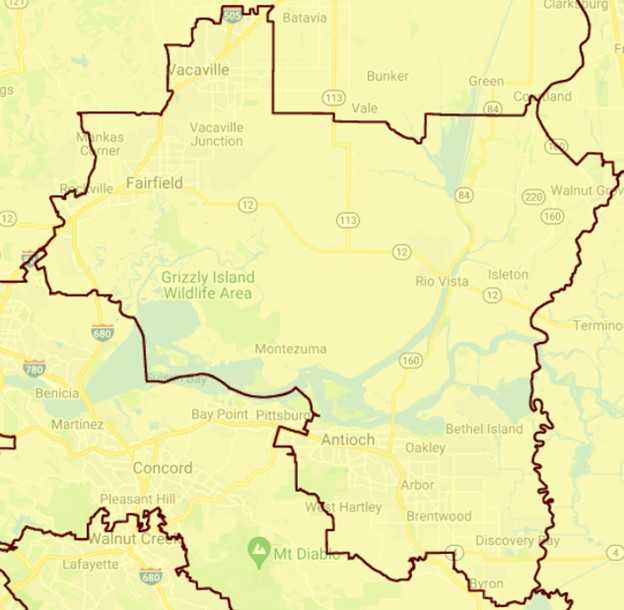
District 5 (V on the map, below) includes most or portions of the communities along Highway 4 in the northern part of the county. The election is Tuesday.

Contra Costa County Board of Supervisors District 5 Map.

Filed Under: News, Politics & Elections

Contra Costa DA Becton supports one-sided bill limiting police union influence in elections

October 31, 2020 By Publisher Leave a Comment

First-in-the-nation legislation labeled “Cure the Conflict” to require prosecutors recuse themselves from investigating, prosecuting police misconduct if they’ve received campaign contributions from police unions

Does not include similar provisions for contributions from criminal defense attorneys

Becton wants to take it further and ban contributions from police unions to DA candidates; refuses to answer questions

Contra Costa District Attorney Diana Becton. From CCC website.

By Allen Payton

In her continued effort to limit the influence of police unions in supporting and electing candidates for district attorney, Contra Costa DA offered support on Friday, Oct. 23 for the bill by California State Assemblymember Rob Bonta (D-Oakland) that will require elected prosecutors to recuse themselves from the investigation and prosecution of law enforcement misconduct if they accept financial contributions from law enforcement unions.  The legislation will be sponsored by the Prosecutors Alliance of California and co-sponsored by numerous District Attorneys.  It will be introduced when the new legislative session convenes in December.

“This is about trust in law enforcement, and trust in the independence of our elected prosecutors,” said Bonta.  “As people across our cities, states and our nation have come together to raise their voices and demand greater justice, we must cure the conflict of interest that gives, at minimum, the appearance that police are not held accountable due to the proximity and political influence of law enforcement associations and unions.”

“Now, more than ever, prosecutors have the responsibility to promote equal justice and build trust with the communities we serve. In order to do that, we must eliminate the conflict of interest existing when elected prosecutors accept police union support,” said San Francisco District Attorney Chesa Boudin.  “It is only when prosecutors are not financially beholden to law enforcement unions that the public can be confident in the decisions prosecutors make about holding police officers accountable.”

“Law enforcement unions generally finance the legal representation of an accused officer, and when prosecutors receive financial support from the entity funding the defense a conflict of interest arises for elected prosecutors,” said Contra Costa County District Attorney Diana Becton.  “To restore trust in law enforcement we must cure this conflict.”

Recently, the Prosecutors Alliance of California called on the State Bar to create a new rule of professional responsibility to preclude prosecutors from taking police union money.  The Alliance took this step in the wake of the murder of George Floyd and Breonna Taylor in an effort to increase the independence of prosecutors from police. The State Bar is scheduled to reconvene tomorrow to continue discussions on the topic.

According to a June 1st press release from Becton’s office, “The Prosecutors Alliance of California is a non-profit organization that provides public education, support and training to prosecutors and their offices. The Prosecutors Alliance of California Action Fund is a social welfare organization that advocates for criminal justice reform legislation, engages and educates the public on criminal justice ballot measures, and supports candidates for state and local office who advocate for comprehensive reforms to our justice system.” (See related article)

The bill by Bonta to be considered by the Legislature will take a different path. Rather than precluding prosecutors from soliciting or accepting law enforcement union contributions as Becton supported earlier this year, it requires a prosecutor that accepts a law enforcement union’s contribution to recuse themselves from the decision-making process if one of the organization’s members is suspected of criminal conduct. In such cases, the State Attorney General’s Office would be asked to handle the case.  This will help reassure family members, community stakeholders and the public that decisions are made based on the facts and the law, not political horse trading and back scratching.

According to Becton and Bonta, “by closing this loophole, the Legislature will reduce the presence of conflicts of interest and ensure independence on the part of elected prosecutors. This legislation also aspires to help reestablish community trust in the integrity of prosecutors at a time when national events have damaged that trust.”

A question was sent to Becton on Oct. 23 asking her if she also supports DA’s recusing themselves from cases involving prosecution of public defenders or criminal defense attorneys who have contributed to the campaigns of elected prosecutors.

That was along the same lines of the questions sent through Scott Alonso, her department’s public information officer, earlier this year to which Becton never responded. She was asked specifically, will she try to ban political campaign contributions to DA candidates from criminal defense attorneys and public defenders and not just police unions?

Following is the email message with questions sent to Alonso for Becton on June 1 regarding her press release entitled, “LAW ENFORCEMENT LEADERS CALL ON STATE BAR TO CREATE NEW ETHICS RULE TO END THE CONFLICT OF INTEREST BETWEEN PROSECUTORS AND POLICE UNIONS – New Ethics Rule Would Help Restore the Independence, Integrity, and Trust of Elected Prosecutors by Preventing Them From Taking Donations From Police Unions”

“Scott,

Please ask DA Becton to clarify her comment because it’s not clear what she’s trying to say and answer my questions, below.

“The legal representation of an accused officer is generally financed by their law enforcement union,” said Contra Costa District Attorney Diana Becton.  “It is illogical that the rules prohibit prosecutors from soliciting and benefiting from financial and political support from an accused officer’s advocate in court, while enabling the prosecutor to benefit financially and politically from the accused’s advocate in public.”

Is she saying that currently a prosecutor cannot solicit and benefit from financial and political support from an attorney representing a police officer accused of a crime while in court or during the court case? But the police officer’s attorney can support the prosecutor financially and politically when not in court or during the court case?

Please clarify who the accused is in her comment about the “accused’s advocate”. I assume it’s the same accused officer she refers to twice before in her comment. But, not sure.

Also, are she and the rest of the DA’s willing to forgo any financial contributions from criminal defense attorneys and public defenders? How about no financial support from any organization and only from individuals who live within their counties? How far should this go to ensure fairness in prosecutions? Isn’t this really one-sided? Also, if the police unions have so much influence in our county and they all backed Becton’s opponent in the last election how did she still win? Isn’t she in effect attempting to violate the free speech rights – which political campaign contributions have been defined as by the courts – of the police unions?

Alonso responded that because the questions were political, he could not respond, even though the press release was sent from the Contra Costa District Attorney’s office through his email account. Further efforts asking him to forward the questions to Becton and getting her to respond were unsuccessful.

The latest question about the proposed legislation by Bonta and the questions from June 1st were sent to Becton’s personal email address on Friday, Oct. 23

Previously, a phone call to her was made asking her about the issue, but Becton was watching a Zoom meeting and said she didn’t have time to discuss it.

To date, Becton has yet to answer any of the questions posed to her about her efforts to only limit the influence of police unions in elections for district attorneys and not also limit the influence by criminal defense attorneys.

Please check back later for any updates to this report.

Scott Alonso, Public Information Officer, Office of the District Attorney, Contra Costa County contributed to this report.

Filed Under: District Attorney, News, Police, Politics & Elections

Brentwood Council candidate Jovita Mendoza boasting of self-funding campaign filed bankruptcy didn’t repay $378,000 in 2017

October 30, 2020 By Publisher 5 Comments

Document showing Jovita Mendoza and her husband Michael Kleeman did not repay almost $378,000 through Chapter 13 bankruptcy finalized on Sept. 11, 2017.

Attacks other candidates for receiving campaign contributions, believes all candidates should self-fund

Jovita Mendoza. From her Facebook page.

By Allen Payton

Candidate for Brentwood City Council in District 1, Jovita Mendoza, has been boasting that she has been self-funding her campaign and attacking others in both her and two other races for city council and mayor for accepting contributions. However, in 2012 she filed for Chapter 13 bankruptcy which on Sept. 11, 2017 ended with Mendoza not repaying almost $378,000 of the debt.

In addition, in a letter to the editor published on this website, yesterday, the writer provided proof that Mendoza and her husband also had a judgment against them and their roofing company, at the time, from Ford Commercial Credit, Inc. of San Jose for over $100,000 in 2007, before the economic downturn occurred in 2008. The writer wrote self-funding her campaign is “easy to do and say when you don’t pay your bills and you’re spending your creditor’s money.”

According to the U.S. Courts website, “A chapter 13 bankruptcy is also called a wage earner’s plan. It enables individuals with regular income to develop a plan to repay all or part of their debts. Under this chapter, debtors propose a repayment plan to make installments to creditors over three to five years.” (See post of letter)

Document filed on Dec. 11, 2017 showing Jovita Mendoza and husband Michael Kleeman’s list of Scheduled Creditors with total debt in claim of $416,633.55 and amount repaid of $81,485.99.

Another document shows a list of creditors with a total of $416,633.55 in debt and total payments of $81,485.99. But that latter amount and the amount discharged of $377,964.93 is greater than the $416,633.55.

An email with the documentation and the following questions was sent to Mendoza at 8:11 a.m. Friday, with a deadline of noon for her to respond:

“How much was the original amount included in your bankruptcy filing? The total from the list of creditors was $416,633.55. But the $378K and $81K add up to more than that.

Have you paid back any of your creditors included in these documents other than the $81,485.99? If not, don’t you think it’s wrong to be paying out-of-pocket for your own campaign expenses instead of paying back at least some of those creditors with those funds?

Someone named Brian commented on the post of Ms. Hauck’s letter on the Contra Costa Herald that ‘Those bills have been paid years ago and Jovita is self funded.’

If that’s true and you have paid any or all of your creditors back, please provide proof, your answers and any other comments you would like to make by 12:00 pm, today.”

However, Mendoza did not respond by publication time of 12:55 p.m. Please check back later for any responses from her and any other updates to this report.


Filed Under: East County, Finances, News, Politics & Elections

Contra Costa Elections Division reports dozens of ballots missing from Richmond drop box

October 30, 2020 By Publisher Leave a Comment

Box in Richmond where ballots are alleged to have gone missing. Screenshot of NBC Bay Area news report 10-29-20.

“We have been able to confirm receipt of many of the ballots deposited into that box on the 12th but not all of them.”

“These concerns and reports are not widespread.”

By Scott O. Konopasek, Assistant Registrar of Voters

We are aware of reports by dozens of voters, and claims on social media, that they deposited their ballot into the Richmond City Hall drop box on October 12th and the County has not been able to confirm receipt of the ballot. These reports are limited to this site and date.

Our records document that the box was serviced and ballots retrieved by a two person team each day. We have been able to confirm receipt of many of the ballots deposited into that box on the 12th but not all of them. We have conducted an internal investigation and review of documents and processes and have not identified a cause for the complaints. We will continue to investigate throughout the election and canvass period.

We are taking the voters’ concerns seriously and we have tracked comments on NextDoor and have proactively reached out to the voters and advised them of their options for casting their votes for this election. We have re-issued ballots to many of the voters and advised others on the in-person voting options in their area.

Because voters returned their ballots early and used the various ballot tracking tools available, this office has been able to identify and resolve many ballot issues in advance of Election Day. Voters who want to verify receipt of their ballot can use the “Track My Vote by Mail” feature on our website, www.cocovote.us, or call our office at 925.335.7800.

These concerns and reports are not widespread. These reports are limited to dozens of voters using one box on one date. Nearly 150,000 ballots have been securely returned from ballot drop boxes from across the County so far. For more information, call 925-335-7800.

In a post on the Elections Division Twitter feed on Wednesday they wrote, “With an estimated 355,000 ballots received, we’ve surpassed the total number of ballots cast in March 2020 (330,514). We’ve also made it to 50% turnout! #cocovote“

For more details see NBC BayArea news report.

Allen Payton contributed to this report.

Filed Under: News, Politics & Elections

  • « Previous Page
  • 1
  • …
  • 19
  • 20
  • 21
  • 22
  • 23
  • …
  • 46
  • Next Page »
Monica's dinner 05-26 CCH
Celia's-05-26-A
Delta-RC-A (2)
Deer-Valley-Chiro-06-22

Copyright © 2026 · · Contra Costa Herald · All Rights Reserved