• Home
  • About The Herald
  • Local Agencies
  • Daily Email Update
  • Legal Notices
  • Classified Ads

Contra Costa Herald

News Of By and For The People of Contra Costa County, California

  • Arts & Entertainment
  • Business
  • Community
  • Crime
  • Dining
  • Education
  • Faith
  • Health
  • News
  • Politics & Elections
  • Real Estate

Contra Costa Supervisors appoint Monica Nino new county administrator amid labor leaders’ protests

December 9, 2020 By Publisher Leave a Comment

Vaccine on the way to county; Mitchoff calls for tougher COVID fines

Newly appointed Contra Costa County Administrator, Monica Nino. Photo: San Joaquin County

By Daniel Borsuk

Against protests from labor organization leaders, Contra Costa County Board of Supervisors voted 5-0 to appoint San Joaquin County Administrator Monica Nino to become the new county administrator, replacing David Twa, who is retiring after holding the powerful position since 2007.

Nino, who topped 47 other candidates for the post, will start her new position on Jan. 4.  She was given a five-year contract and will be paid $372,000 a year.

Before supervisors put their stamp of approval on an executive search firm’s selection, they got an earful of complaints from labor leaders that Ms. Nino’s labor track record in San Joaquin County, where she has overseen 7,500 employees in 26 departments and an annual budget of $1.9 billion, since 2013, had them concerned.

When she takes over the reins in Contra Costa County, Nino will oversee a $3.6 billion operating budget for 7,500 employees and 28 departments and a regional hospital.

“Ms. Nino is a known union buster in San Joaquin County,” said labor representative John Rowe, who was one of more than 10 labor representatives blasting the supervisors for their selection of Nino.  “This person has opposed the union movement.”

“You’ll get inaccurate information from Ms. Nino,” warned Lisa Harlow of the Contra Costa County Service Employees International Union (SEIU) clerks union, whose members, she said, earn 20 percent less than most other Bay Area county unionized clerks.

Even with the poor reviews from labor representatives, Nino received favorable endorsements from the five Contra Costa County supervisors and San Joaquin County Board of Supervisors Chair Kathy Miller, who said, “She has really set a very high standard for bringing in folks with experience and new ideas and she worked “very hard alongside the Board injecting the 21st century into the county as an organization.  She is leaving the county in a very good position.”

County Administrator Twa recommended Nino based on his work with her on state association projects. “She is very professional and very engaged,” he said of Nino, who would be the first woman and Hispanic to hold the county’s post in its 177-year history.

“She’ll do an excellent job,” Contra Costa County Board of Supervisors Chair Candace Andersen said.  “We need to be held accountable.  You cannot compare us to San Joaquin County. There’s going to be some significant changes.”

“I am very dissatisfied in our labor partners.  Nothing was done in secrecy,” said Supervisor Karen Mitchoff of Pleasant Hill.  “There’s no rush to judgement.”

In a related matter, supervisors approved a three-month contract extension with Twa during the January through March transition period to assist Nino settle into her new job. The board approved a contract extension with him, as well as a Position Adjustment Resolution creating a second county administrator position, to provide for the transition during the three months, at a cost of $95,000.

“I always had a goal to be either in the Bay Area or Southern California with a bigger urban county,” said Nino after the supervisors’ vote.  “It was a goal from the time I was in Stanislaus, so I am very complimented that the Board considered me.”

Prior to her position in San Joaquin County, Nino was employed in Stanislaus County in various leadership positions from 1988 to 2013, and appointed to Chief Executive Officer in 2011. She has a Bachelor of Science degree in Accounting and a Master’s degree in Public Administration. According to her bio, Nino values “making a difference in the community, offering greater transparency within and outside the organization by ensuring local government, community, and public services are delivered efficiently and effectively.”

“I thank the Contra Costa Board of Supervisors and look forward to working with them, the employees and the residents of the county,” Nino said. “I look forward to working to address the opportunities and challenges for the next, several years.”

“I’m very excited,” she added.

Mitchoff Wants Tougher COVID Fines

An adamant Supervisor Mitchoff proposed the county look into raising code enforcement fines because there are an increasing number of businesses defying the public health shut down orders over concerns that the orders will financially shutter their businesses.

“Code enforcement and the police will have to do something different If these business owners want to illegally stay open and spread COVID.  They will have to pay higher fines,” said Mitchoff.

Mitchoff’s request should be calendared for public hearing at next week’s board meeting, the final meeting of 2020.

Currently, businesses violating county public health ordinances are subject to a first fine of $250.  A second fine costs $500 and a third fine costs $1,000.

“I’d like to see $10,000, $15,000 and $20,000 fines,” Mitchoff said. “We have to do something different.  If these businesses want to stay open and to spread COVID, they have to pay the price.”

No one from the business community spoke out either in favor or in opposition to Mitchoff’s proposal, but there are an increasing number of businesses, especially restaurants and personal care – gyms and hair salons and barbershops – that are defying health code orders willing to pay the low fines in order to stay in business.

COVID-19 Vaccine on the Way 

With more than 2,000 COVID-19 deaths a day nationwide, Contra Costa Health Director Dr. Chris Farnitano informed supervisors said that the countywide COVID-19 positivity rate will soon be at 11 percent to 12 percent, but hope is around the corner with the delivery of a vaccine as early as next week.

Dr. Farnitano said the county could receive less than 10,000 doses of the vaccine next week.  High risk health care workers will receive the vaccine, he said.  “Our health department has a vaccine branch working with local hospitals.”

It will be late winter or early spring before the vaccine will become widely available for the general public, he said.

“In the meantime, hunker down and get through this winter.  Stay home.  Stay safe.  Wear a mask,” Farnitano added.

Saranap Area General Plan Approved

Supervisors approved, with no public comment, the Saranap Area General Plan.  With the proposed Saranap Village mixed used project near downtown Walnut Creek that consists of 235 multifamily residential units, 30,000 square feet of street level restaurant, retail, and off space parking located in four buildings.  The plan also calls for revised, improved on-road bicycle lanes, trails, and signage along Boulevard Way.

.


Filed Under: Government, News, Supervisors

Contra Costa Tax Collector’s online system crashes Wednesday, payments must be mailed or dropped off by Thursday

December 9, 2020 By Publisher Leave a Comment

By Anthony Dorado

The Contra Costa County Treasurer-Tax Collector’s online payment system crashed on Wednesday, December 9 just a day before the first installment deadline for property tax bills tomorrow. A Tax Collector’s office staff member said that they had experienced an influx of payments that overloaded and subsequently crashed the system.

Many residents utilize the online system as a cheaper, more efficient way to pay their taxes and with the current COVID-19 stay-at-home orders. Due to the nature of the system, most users wait until just days before the deadline to submit those taxes and are now seemingly at risk for penalty. No announcement was issued on the matter regarding the crash nor what was being done about it.

However, the staff member said they were doing everything in their power to fix the system and that it should be back up and running soon. While they understand and empathize with those inconvenienced, Tax Collector’s office is asking that people be patient and flexible.

Anyone who has not yet filed their first installment taxes can do so by mailing them by tomorrow, Thursday, Dec. 10. Those who mail their taxes by or before the deadline will have their taxes received and filed promptly according with their postage date. As long as the filing is postmarked by Dec. 10, there will be no penalties.

Taxes, paid by check only, must be mailed to Contra Costa Tax Collector P.O. Box 631, Martinez, CA 94553 or they can be dropped off in the box at the Main Street door of the county Finance Building at 625 Court Street, Suite 100 in Martinez.


Filed Under: News, Taxes

Pittsburg man charged with selling Fentanyl-laced pills that killed buyer in Walnut Creek

December 8, 2020 By Publisher Leave a Comment

Fentanyl overdose kills young adult who ingested counterfeit oxycodone pills

SAN FRANCISCO – The United States Attorney’s Office charged Gage Pascoe with the distribution of pills containing fentanyl that resulted in the overdose death of his customer, announced United States Attorney David L. Anderson and Special Agent in Charge Daniel C. Comeaux, Drug Enforcement Administration (DEA).

The federal complaint alleges that Pascoe, 22, of Pittsburg, California, sold counterfeit pills that appeared to be Oxycodone but instead contained the lethal drug fentanyl.  The young adult customer purchased the pills from Pascoe and shortly after taking the apparent Oxycodone pills at a Walnut Creek home died from an overdose of fentanyl.

“This sad, tragic death shows how easy it is to die from drugs bought from drug dealers,” said U.S. Attorney Anderson.  “Counterfeit pills marked and sold as one drug, such as Oxycodone pills with “M30” stamps, commonly contain fentanyl instead.  Even a tiny amount of fentanyl is deadly.  Drug buyers must be aware that pills bought from drug dealers may be laced with fentanyl.  Drug dealers should know we vigorously prosecute those who sell drugs that cause fentanyl overdoses.”

“Fentanyl is cheap, man-made and potent. Overdose can occur in the smallest amount and in this case it left a family with unimaginable loss,” stated DEA Special Agent in Charge Daniel C. Comeaux. “We will pursue those who distribute this deadly drug and continue to seek justice for those lives that have been lost.”

The complaint charging Pascoe describes how he was a repeat dealer of illegal drugs to the victim.  The complaint outlines that Pascoe communicated in the days before the death through a series of text messages with the victim, who he knew from attending the same high school, to sell Oxycodone to the victim.  The texts, outlined in the complaint, show that Pascoe offered “more oxy” to his victim customer and they eventually met up in Pittsburg at night for Pascoe to sell the purported Oxycodone pills to the victim.  The next day, June 17, 2020, the victim was found dead at a Walnut Creek home.  The complaint describes how the victim’s father found pills in the victim’s room with “M30” stamped on them, which is a common stamp on counterfeit Oxycodone pills containing fentanyl.  A lab analysis found those pills to contain fentanyl.  As the complaint further describes, an analysis of the victim’s body showed the victim died from a fatal fentanyl overdose.

Pascoe was arrested on Saturday, December 5, 2020, and made an initial appearance today in San Francisco federal court before United States Magistrate Judge Laurel Beeler.  Pascoe is currently being held in custody pending further proceedings.  He is scheduled to appear for a detention hearing before United States Magistrate Laurel Beeler on December 14, 2020, at 10:30 am.

The charges contained in the criminal complaint are mere allegations.  As in any criminal case, the defendant is presumed innocent unless and until proven guilty in a court of law.

Pascoe is charged with one count of distribution of fentanyl resulting in death or great physical injury, in violation of 21 U.S.C. § 841(a)(1) and (b)(1)(C).  If convicted of this count, he faces a maximum penalty of life in prison and a mandatory minimum of 20 years in prison, and a maximum fine of $1,000,000.  However, any sentence following conviction would be imposed by the court only after consideration of the U.S. Sentencing Guidelines and the federal statute governing the imposition of a sentence, 18 U.S.C. § 3553.

The case is being prosecuted by the Organized Crime Drug Enforcement Task Force (OCDETF) of the United States Attorney’s Office for the Northern District of California. The investigation of this case was conducted by the Drug Enforcement Administration, the Concord Police Department, and the Walnut Creek Police Department.

This investigation and prosecution is part of OCDETF, which identifies, disrupts, and dismantles the highest-level drug traffickers, money launderers, gangs, and transnational criminal organizations that threaten the United States by using a prosecutor-led, intelligence-driven, multi-agency approach that leverages the strengths of federal, state, and local law enforcement agencies against criminal networks.

Read the criminal complaint, here.


Filed Under: Concord, Crime, News, Police, U S Attorney

Investigation into suspicious death of North Richmond man in Tuesday morning fire

December 8, 2020 By Publisher Leave a Comment

By Jimmy Lee, Director of Public Affairs, Contra Costa County, Office of the Sheriff

Detectives from the Contra Costa County Office of the Sheriff and arson investigators from the Contra Costa County Fire Protection District (CON Fire) are investigating a suspicious death that occurred in a fire.

At about 4:45 this morning, deputy sheriffs were requested by CON Fire to assist with traffic control at a house fire on the 1800 block of Giaramita Street in North Richmond.

Deputies learned that an unresponsive man in the home was earlier transported to a local hospital where he was later pronounced deceased.

The person is identified as 23-year-old Virillio Patino-Cruz of North Richmond. An autopsy into the cause of death is scheduled for tomorrow.

Anyone with any information on this incident is asked to contact the Sheriff’s Office Investigation Division at (925) 313-2600 or through Sheriff’s Office dispatch at (925) 646-2441. For any tips, email: tips@so.cccounty.us or call (866) 846-3592 to leave an anonymous voice message.


Filed Under: Fire, News, Sheriff, West County

Kaiser Permanente awarding $1.1 million in grants to non-profits to improve community health

December 7, 2020 By Publisher Leave a Comment

Grants increase access to health care, improve economic security and address mental health and wellness

By Kerri Leedy, PR and Media Relations Manager, Kaiser Permanente Northern California

WALNUT CREEK, Calif., Dec. 7, 2020 – To address the health needs of the community, Kaiser Permanente in the Diablo Area has awarded $1.1 million in grants focused on increasing access to health care and coverage, improving economic security and addressing mental health and wellness.

The Kaiser Permanente funding to 28 non-profit organizations will help low-income, at-risk communities in Central and East Contra Costa County, and the Tri-Valley area of Alameda County.

The 28 grants are aligned with Kaiser Permanente’s mission of improving the health of our members and the communities we serve. Kaiser Permanente recognizes that many factors impact health including social, economic and environmental conditions in the community. Through support of local non-profit organizations, Kaiser Permanente is working toward improving health for all.

“Our communities are facing significant and unprecedented challenges,” said Marty Ardron, Senior Vice President and Area Manager for Kaiser Permanente’s Diablo Service Area. “These organizations are committed to helping by providing vital health and mental health care, housing, and food assistance. We are proud to support them.”

The following nonprofit organizations received support from Kaiser Permanente:

Increasing Access to Care:

Axis Community Health Supporting Complex Patients with Case Management Services
Brighter Beginnings Increasing Access to Healthcare in Antioch
Contra Costa County COVID-19 Ambassadors Project
District Council Contra Costa County Society of St. Vincent de Paul RotaCare Pittsburg Free Medical Clinic at St. Vincent de Paul
La Clinica de La Raza, Inc. Connecting Families to Health Care
Planned Parenthood: Shasta Diablo Inc., DBA Planned Parenthood Northern California (PPNC) Promotores: Increasing Access to Health Care
RotaCare Bay Area Provision of Healthcare to Contra Costa County’s Uninsured Population

Improving Economic Security:

Alameda County Community Food Bank Farm Fresh Produce Program
Contra Costa Crisis Center Thrive Local Contra Costa: Follow up services for homeless 211 callers
Food Bank of Contra Costa and Solano Food Distribution in Contra Costa County
FRESH APPROACH Access to Nutritious Foods in East Contra Costa County
Hope Solutions (formerly Contra Costa Interfaith Transitional Housing, Inc.) Key steps: Path to Permanent Housing and Healing
Loaves and Fishes of Contra Costa Nourishing Lives Through Food
Monument Crisis Center Ingredients for a Healthy 2020-21
Open Heart Kitchen of Livermore Inc Hot Meals Program
Opportunity Junction, Inc. Administrative Careers Training to Improve Economic Security for Low Income Adults
SHELTER, Inc. Supporting the Behavioral Health of Homeless Families
Trinity Center Walnut Creek Youth Wellness Advocacy

 Addressing Mental Health and Wellness:

Family Justice Center of Contra Costa Thrive Local Contra Costa
Antioch Unified School District Mental Health & Wellness Initiative
Counseling Options & Parent Education, (C.O.P.E.) Road to Recovery
Fred Finch Youth Center Contra Costa County School Based Services
Lincoln Trauma-Informed Care
Livermore Valley Joint Unified School District Parent Outreach Coordinator
Mindful Life Project Countering ACE’s with Innovative Mindfulness Programming in East Contra Costa County
Monument Impact Mentes Positivas En Acción
Rainbow Community Center of Contra Costa Educating the ARC of ACEs within out LGBTQ+ Communities through and Intersectional Lens
Rubicon Programs Inc. Wellness, Work, and Mobility

About Kaiser Permanente

For 75 years, Kaiser Permanente has been committed to shaping the future of health and health care — and helping our members, patients and communities experience more healthy years. We are recognized as one of America’s leading health care providers and not-for-profit health plans. Since July 21, 1945, Kaiser Permanente’s mission has been to provide high-quality, affordable health care services and to improve the health of our members and the communities we serve. We currently serve 12.4 million members in eight states and the District of Columbia. Care for members and patients is focused on their total health and guided by their personal Permanente Medical Group physicians, specialists and team of caregivers. Our expert and caring medical teams are empowered and supported by industry-leading technology advances and tools for health promotion, disease prevention, state-of-the-art care delivery and world-class chronic disease management. Kaiser Permanente is dedicated to care innovations, clinical research, health education and the support of community health. http://about.kaiserpermanente.org.


Filed Under: Community, Health, News

East Bay Regional Park District facilities closing Dec. 6 due to rise in COVID-19 cases

December 5, 2020 By Publisher 1 Comment

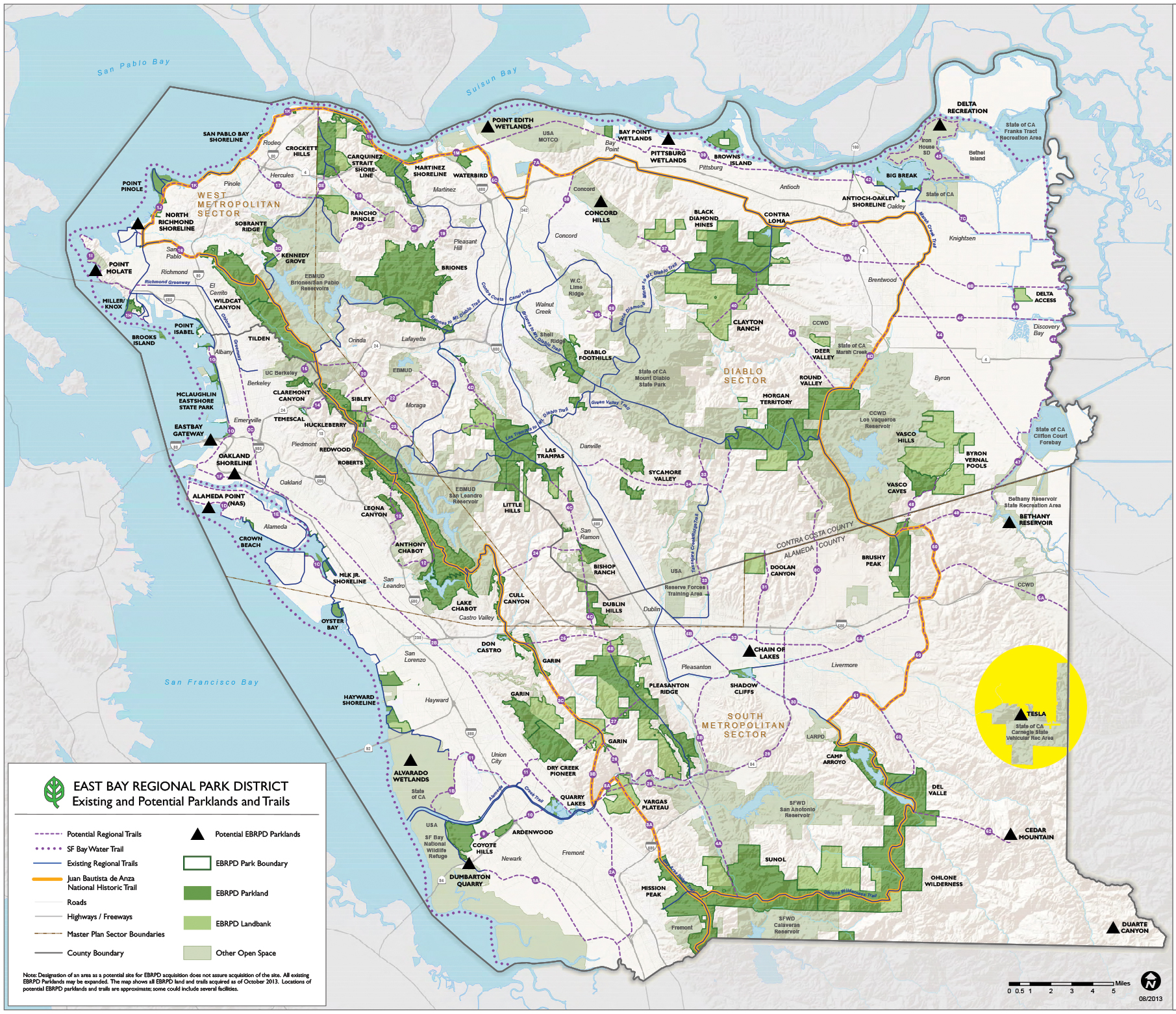
Photos by EBRPD.

By Dave Mason, Public Information Supervisor, East Bay Regional Park District

Effective 6:00 p.m. Sunday, December 6, 2020, all campgrounds, outdoor museums (visitor centers), and children’s playgrounds at East Bay Regional Park District locations will be closed until further notice as mandated by the six Bay Area county regional health officers’ order announced yesterday.

Facility Closures Include:

  • Ardenwood Historic Farm
  • Regional Parks Botanic Garden
  • Regional Park visitor centers remain closed, including Black Diamond, Big Break, Coyote Hills, Crab Cove, Sunol and Tilden

Campgrounds Closures Include:

  • Del Valle Regional Park (Livermore)
  • Anthony Chabot Regional Park (Oakland)
  • Robert Sibley Regional Preserve Backpack Campground (Oakland)

Future camp reservations through made through January 4 will be cancelled, including for the Sibley backpack camp, and customers will receive full refunds.

Outdoor activity is encouraged by health officials during the new Regional Stay Home Order. The Park District reminds visitors that spending time in nature is important for mental and physical health and wellbeing. To keep yourselves and Park District staff safe when visiting regional parks and trails, please wear masks when within six feet of others and recreate responsibly. Please keep parks safe for everyone by following all COVID-19 safety requirements.

The California sector closures and restrictions on activity under the State’s Regional Stay Home Order are described here.

Filed Under: Health, News, Parks, Recreation

Contra Costa County had third highest Census 2020 self-response rate in state, tops its Census 2010 rate

December 5, 2020 By Publisher Leave a Comment

By Matt Lardner, Census Outreach Coordinator, Contra Costa County

Contra Costa County achieved the third highest Census 2020 self-response rate of all California counties with a rate of 77.4% for the once-a-decade count of all residents. The County’s self-response rate also surpassed its Census 2010 rate of 72.1% by more than five points or a 7.4% increase.

The County’s Census 2020 self-response rate outperformed the country’s 67% and the state’s 69.6% self-response rates. Nearly all of the cities in the County surpassed their 2010 rates, and those that did not were within 1% of doing so. See response rates by city in Contra Costa County in this Census 2020 report.

Contra Costa County’s Complete Count Steering Committee and 67 community based organizations collaborated on the Census 2020 count. The County’s high response rate is owed in large part to the work of cities, agency and community partners, and trusted messengers who helped reach Contra Costa residents, including hard-to-count populations.

“Our success in Contra Costa County could not have happened without the strong partnerships with our local non-profits and community based organizations,” said District 3 Supervisor Diane Burgis, Chair of the Complete Count Committee. “We have built lasting relationships and capacity that will be mutually beneficial as we collaborate on outreach in all aspects of our work.”

“Thanks to all of the residents who responded to the Census. You have guaranteed that Contra Costa County will receive its fair share of representation and much-needed funding for critical programs and infrastructure for the next decade,” said District 2 Supervisor and Board Chair Candace Andersen, Vice-Chair of the Complete Count Committee.

Now the U.S. Census Bureau will prepare the data to present to the President on December 31, 2020. The redistricting process will begin in Spring 2021.

Information about Contra Costa County’s Census 2020 outreach and impact are available at www.cococensus.org.


Filed Under: News

Limited Contra Costa Superior Court closure beginning Monday, Dec. 7

December 5, 2020 By Publisher Leave a Comment

By Matt Malone, Public Information Officer, Superior Court of California, Contra Costa County

COVID-19 cases have spiked, resulting in a new stay-at-home order for the county effective this weekend. To limit the risk of COVID-19 transmission, the Court will enact a LIMITED COURT CLOSURE effective Monday, December 7, 2020, and until further notice.

THE COURT WILL BE CLOSED TO THE PUBLIC. Exceptions are criminal preliminary hearing witnesses, attorneys, and defendants in matters with time not waived. Masks are required for entry.

JURY TRIALS ARE SUSPENDED. Criminal preliminary hearings with time not waived will proceed.

JURY SERVICE. Jurors summonsed to report on or before January 11, 2021: Your service has been completed. You do not need to call or report for jury duty.

THE COURT WILL NOTIFY YOU OF RESET HEARINGS. If your matter is to be reset, the Court will notify you of the new date, with hearings to be by Zoom or CourtCall. Instructions and links for Zoom/CourtCall, public access to audio streaming where available, and court calendars may be found on our Court Calendar webpage.

ALL CLERK’S OFFICES WILL BE CLOSED TO THE PUBLIC. FILINGS WILL BE ACCEPTED BY MAIL OR DROP BOX ONLY. The limited closure is NOT a Court holiday for filing deadlines. Drop boxes will be available from 8 A.M. – 4 P.M at the following locations:

Civil: Main Street entrance of the Wakefield Taylor Courthouse in Martinez. o Criminal: Main Street entrance of the Wakefield Taylor Courthouse in Martinez.

  • Family: Main entrance of Family Law building in Martinez.
  • Juvenile: Main entrance of the Walnut Creek Courthouse.
  • Probate: Main Street entrance of the Wakefield Taylor Courthouse in Martinez.
  • Pittsburg and Richmond courthouses: These drop boxes are available only for filings in case types heard at those locations.

ALL COURT RECORDS OFFICES WILL BE CLOSED. See the Criminal Records and Civil Records webpages for the process for records requests by mail.

This public health situation is urgent and constantly changing. Accordingly, the Court anticipates further press releases providing more details on Court operations over the next 30-60 days. Please visit the Court website for updated information.

Filed Under: Health, Legal, News

Senator Glazer calls BART labor contract extension “premature”, “big mistake”, Director Allen one of two to oppose

December 4, 2020 By Publisher 1 Comment

State Senator Steve Glazer and screenshot of BART Board meeting, Thursday, Dec. 3, 2020.

Board approves contract “after secret negotiations were held during BART Directors’ campaign elections” he said.

“…giving space to someone who can’t pronounce our past GM’s name or spell eBART correctly and someone who makes false claim after false claim is a disservice to the public and spreads lies.” – BART Director Li

“These agreements offer BART budgetary stability as we plan our recovery from COVID-19.” – Board V.P. Foley who voted in support.

“The contract extensions come seven months before the contracts are due to expire, locking in employee costs at pre-pandemic levels…at the level that it was when we were carrying 410,000 riders each week day and now we carry about 50 (thousand).” – BART Director Allen

By Allen Payton

In an attempt to get them to reconsider the proposed labor contract with employee unions, State Senator Steve Glazer challenged the BART Board during their meeting on Thursday, Dec. 3. He asked why they were considering the contract long before it’s set to expire, and more is known about the impacts of COVID-19 next year. In response, he was called a liar by one director.

Nevertheless, the BART Board voted 7-2 in favor of the contract, with Directors Debora Allen from Contra Costa County and Liz Ames from Alameda County casting the votes against. Board Vice President Mark Foley who represents other portions of Contra Costa County voted in favor of the contract extension.

Glazer issued a statement earlier this week about BART’s announcement “on Thanksgiving eve…(about) a tentative labor contract with their represented groups, after secret negotiations were held during BART Directors’ campaign elections.”

“Along with other specific contract changes, this tentative agreement is premature and a big mistake and will likely harm BART riders, commuters and taxpayers through fare hikes and service erosion,” his statement continued.

Glazer read most of the statement during the Thursday meeting, but offering additional comment.

“I want to be clear what I have to say reflects my views of accountability and trust that the public expects from all of us,” he said. “I think we all agree that BART is in a financial meltdown due to the pandemic and it’s not clear to me that you have a clear plan for recovery. The district’s own financial analysis projects a shortfall of tens of millions of dollars by next summer amidst the steepest decline in ridership in your agency’s history. My view, the district needs all the flexibility it can to avoid a financial disaster. Yet, BART is tying its hands with this agreement.”

“In the first half of 2021 BART will have a clearer idea about the COVID-19 vaccine availability, ridership improvements, any potential financial bailout assistance from the federal government, and the results of your early retirement incentives that have already been offered to existing employees,” Glazer explained. “All of these potential outcomes will provide important budgetary insight that should shape any new contract terms. But instead of waiting for that information, you are now rushing to approve a contract, negotiated behind closed doors, with no public notice and it will prevent you from making any kind of targeted salary reductions if your revenues do not recover. This will likely lead to service reductions and fare increases which will hurt the very people you are here to serve.”

His statement issued on Monday adds, “BART is leaving few options but to lay off employees and curtail the number of trains, which would further depress ridership and deepen the agency’s financial crisis.

“So, I come here with a question,” Glazer continued during the meeting. “The current labor contract with your representative employee groups doesn’t expire until July 1st, 2021. So, why did the district make an early agreement with so many economic unknowns?”

“It’s my understanding that BART has not even done a salary survey of other transit districts and public agencies to determine if the current salaries called for in this agreement are needed to recruit and retain qualified employees, basic data needed to inform any effective negotiation,” he said. “I question whether the failure to conduct a salary survey is keeping with board policy and procedures.”

“Now, the public was never told when your negotiations started. I’m told these negotiations were initiated by the Board in September and October. If true, that means that directors were negotiating with BART unions on their salaries and benefits on one hand, while asking the same unions for campaign contributions with the other hand. This is an outrageous injection of politics in a hugely consequential employer-employee agreement. And by setting the terms of the agreement at three years rather than four years based on past contract durations, the future contract will be negotiated during another election year.”

“You know that, Board members, before you came to this board for the most of you, had worked for a long time to ensure the contract negotiations would not be immersed in politics and election year circumstances. So, that four-year duration was done purposely. You unravel that in this proposed contract before you.

“In this agreement, for the most part, you’ve abandoned any of the work rule changes that were central to the 2013 contract negotiations. Where have those work rules been laid out, publicly disclosed and discussed, so that we can understand why they’ve been abandoned in this agreement.”

“You know, when the strike happened in 2013, BART management was clear that the work rules were probably more important than the salaries and benefits being negotiated. It had that kind of consequence and impact on the agency. But there’s a complete void of understanding or knowledge about what efforts were made to negotiate those work rules.”

It reversed important e-BART reforms that were instituted by former General Manager Grace Crunican. Again, BART, the board members, and the management (were) very involved in establishing those eBART reforms which you’re throwing out in this proposed contract.”

So, it’s not surprising to me, that you are moving forward with due haste to approve these negotiations and rush this contract through with very little public review, and I think that it’s because the details and the consequences are uncomfortable.

“I would hope that you will reconsider what you are doing, today and take a more deliberate and cautious approach to these negotiations as you consider the full impact of the pandemic on our economy. It would be best for your financial well-being and more importantly for BART riders throughout the Bay Area.”

“In conclusion, let me just say that the foundation of your service as board members is to ensure that this transportation system is able to function during good times and bad times. This contract continues the limitation against training management to run the trains during a work stoppage. So, all of BART riders, many of them low-income people who can’t afford to stay home, will be prevented from getting to work under this contract provision. We’re talking about teachers and nurses, social workers, grocery clerks and other essential workers, who will all be left stranded if your trains stop running because you created this self-inflicted problem.”

“This strike protection provision is an abdication of your sacred duty and will limit future boards from helping the commuters when matters cannot be worked out at the bargaining table. And listen, we all would strongly hope that all matters can be worked out at the bargaining table.”

In  his issued statement, Glazer included, “BART’s management doesn’t want the public to see what they are doing because they know that BART riders and other Bay Area residents would not support this agreement if they understood its details and its consequences.”

The BART Directors then took up the issue of the labor union contract.

General Manager Robert Powers responded to Glazer, saying, “I was the one…negotiating these tentative agreements with our labor partners. There were no elected officials in those discussions. I was supported primarily by our chief labor negotiations officer as well as our AGM of Operations. I wanted to be…crystal clear that it was me leading these negotiations under the authorization granted to me by the BART Board.”

During public comments, Sal Cruz, president of AFSCME Local 3093 said, “Our work has accelerated during this pandemic at great risk to our employees, as we position ourselves for the recovery we know will come. Proper positioning will be critical for the survival of all transit and for the Bay Area economy that is now linked to BART. Thank you for your leadership during these challenging times. Every transit agency in the country is in the same position as you are, now. The decision before you, today, is not an easy one. But it allows us to focus on rebuilding o ur system, continuing to provide safe transportation for our essential workers and preparing for the return of our riders. The workforce is behind you, the riders are behind you and the Bay Area is behind you.”

Li Calls Out Glazer

BART Director Li speaks in favor of the contract. Video screenshot of board meeting, Dec. 3, 2020.

BART Director Janice Li, who represents District 8 which includes portions of San Francisco, spoke next calling out Glazer for lying, mispronouncing the past general manager and misspelling eBART (it was spelled “e-Bart” in his statement from earlier in the week.

“I am proud to vote yes on this action, today. A yes vote, today is a yes vote for BART, is a yes for our riders and a very, very important yes for our workers,” she said. “Voting no makes BART an enemy to our workers and our riders.”

“There has been a lot of talk about this decision coming forward as too early or as a result of private meetings. I just want to be very clear that this claim is factually not true,” she stated. “First, I’m a member of the board’s labor negotiations review committee. We have been meeting since May of this year, then again in July, then again in August. These meetings are open to the public. They are publicly noticed and at subsequent board meetings we always give updates during board reports.”

“Second, we have held multiple closed session meetings regarding labor relations in recent months, and once again they have always been noticed as part of our board agenda,” Li continued. “Third, people who are saying that this is too early are saying that because the financial situation ahead is so unclear and that the board should wait until more is known. The truth is that things will inevitably change. But our staff has been doing excellent work in scenario planning and being transparent about all the potential futures, both good and bad. Furthermore, this contract is not one in the same as our budget revisions. In fact, this does not mean layoffs can’t or won’t happen. So, saying that by voting, yes it ties our hands or limits our options is incorrect.”

“And fourth, respectfully, I strongly refute the false claims made by Senator Glazer. Honestly, giving space to someone who can’t pronounce our past GM’s name or spell eBART correctly and someone who makes false claim after false claim is a disservice to the public and spreads lies. The idea that this was timed with elections is wrong and I will speak for myself, I was not up for election, re-election and I have not raised a cent for re-election, this year and I was not even endorsed by unions when I first ran in 2018.”

“So, what we actually have before us is a result of an incredible collaboration between BART management and labor unions and at the end of the day, who benefits?” she asked. “It’s our riders.”

She then thanked “the entire BART team for rebuilding trust with our labor unions and of course I want to thank our labor union partners for being collaborative at an incredibly difficult time.”

“As a board member I’m incredibly grateful that this decision is coming to us sooner rather than later so we can get back to focusing on running a safe system for our essential workers and implement a successful recovery plan during and through the pandemic that has raged every public transit agency, every public institution and every aspect of our lives. Let’s vote yes on this, today and if you remember our new slogan from the board workshop, earlier this year which, I know feels like years ago, ‘Let’s Go,’” she concluded.

Allen Offers Arguments Against Contract

BART Director Debora Allen speaks during the board meeting on Thursday, Dec. 3, 2020. Video screenshot.

Director Allen spoke against the contracts and supported what Glazer said.

“First, I want to touch on the private meetings because that seems to be a contentious little dialogue. I believe that is absolutely how these contracts come to be,” she said. “It is unfortunate the board discussion about these agreements doesn’t happen in public session. I believe we shouldn’t be discussing the contract extensions in closed door sessions where board members may say things that they would not say in public. In addition, I really do believe not enough of our own closed board discussion has occurred prior to this day of ratification.”

“There’s so much operational uncertainty, right now for BART and I’m not comfortable that the financial projections and plan give us the data we need for this decision,” Allen continued. “It’s really hard to say whether these are fair contracts. But despite having received $377 million in federal CARES Act subsidies already, this year, BART  projects another $210 million deficit over the next 18 months and that is the case after we slashed the capital and pension funding allocations from the Fiscal Year ‘21 budget, along with the load shedding to the capital budget that has occurred throughout this year.”

“From my view we should be receiving regular updates of projected deficits for three years…and that information should be part of any decision by this board to extend labor contracts for three years out. They go together. Labor is 80% of our budget,” she stated.

“So, now we are all hopeful that another $377 million will come to us from D.C. and we’re hopeful that the retirement incentive will induce enough people to retire from exactly the right positions that we can afford to eliminate which we know is not really a reasonable assumption. We already know that some people are retiring from positions that we are going to have to turn around and refill,” Allen said. “We shouldn’t be budgeting to hopeful or aspiration. This is what we did back in June when we passed the budget, and it didn’t work out. We really projected far more revenue than we have. But, if even if those other things come true…it will likely only fund another three-quarters to one year of operating deficits. And it won’t do anything to make up for the lack of capital funding and pension funding that we put aside in ’21 and are likely to do, again in Fiscal Year ’22.”

“The contract extensions come seven months before the contracts are due to expire, locking in employee costs at pre-pandemic levels even as revenue projects remain wildly uncertain well into the next couple of years,” she explained. “Costs will be locked in at the level that it was when we were carrying 410,000 riders each weekday and now, we carry about 50 (thousand).”

Foley Speaks in Support

Board Vice President Mark Foley speaks on the matter during the meeting on Thursday, Dec. 3, 2020. Video screenshot.

Foley shared his thoughts in support of the contract.

“There was a lot of hard work that went in to making this happen. I am fully in support of this prudent approach to labor negotiations during the pandemic,” he said. “These agreements offer BART budgetary stability as we plan our recovery from COVID-19. A wage freeze, next year, coupled with two years, of at most, very modest increases, increases that are directly tied to returning ridership and BART’s financial recovery, is a responsible course of action to take.”

“More importantly, you know these contracts provide language to allow us to reopen negotiations, a necessary safety net during these challenging times,” Foley continued. “These proactive steps are being taken to hopefully avoid further service cuts, like closing stations, eliminating weekend service or laying off employees, employees that will be needed when we ramp up service.”

“And to those employees I say thank you. You are BART’s most important asset,” he stated. “We wouldn’t have been successful if not for the collaboration of your union leadership and union partners.”

“And lastly, I’d like to thank the district secretary’s office for bringing this item, publishing this agenda to the board, two days early rather than publishing it during the Thanksgiving holiday. This gave us additional transparency around this action. I urge my fellow board members to vote in support of these tentative agreements and I fully support this motion,” Foley concluded.

Other board members spoke, mainly in favor of the contract extension and they then voted 7-2 to approve.

Filed Under: BART, Finances, Labor & Unions, News

Contra Costa, Bay Area Health Officers implement Newsom’s new regional Stay-At-Home order starting Sunday

December 4, 2020 By Publisher Leave a Comment

Not waiting until local hospitals are near crisis to act

By Contra Costa Health Services

Public Safety Alert text sent Friday afternoon, Dec.. 4, 2020.

Yesterday, Governor Newsom announced that all sectors other than retail and essential operations would be closed in regions of the State where less than 15 percent of ICU beds are available under a new Regional Stay-At-Home Order. Although health officials throughout the Bay Area are glad to see the State take action in light of the rapidly escalating surge in hospitalizations statewide, many believe even more aggressive action is necessary in the Bay Area to slow the surge and prevent our local hospitals from being overwhelmed. (See related article)

Rather than waiting until Intensive Care Unit (ICU) bed availability reaches critical levels and delaying closures that are inevitable, the Health Officers for the Counties of Alameda, Contra Costa, Marin, San Francisco, and Santa Clara as well as the City of Berkeley are jointly announcing that they will implement the State’s Regional Stay Home Order now.

“It takes several weeks for new restrictions to slow rising hospitalizations and waiting until only 15 percent of a region’s ICU beds are available is just too late,” said San Francisco Health Officer Dr. Tomás Aragon. “Many heavily impacted parts of our region already have less than 15 percent of ICU beds available, and the time to act is now.”

“We are seeing a surge in COVID-19 cases and hospitalizations here in Contra Costa County and across our region,” said Contra Costa County Health Officer Dr. Christopher Farnitano. “The number of patients hospitalized with COVID-19 in our county has doubled in just the past couple of weeks, and we are at risk of exceeding our hospital capacity later this month if current trends continue.”

“We cannot wait until after we have driven off the cliff to pull the emergency break,” said Santa Clara County Health Officer Dr. Sara Cody. “We understand that the closures under the State order will have a profound impact on our local businesses. However, if we act quickly, we can both save lives and reduce the amount of time these restrictions have to stay in place, allowing businesses and activities to reopen much sooner.”

“Rising hospitalization rates across the region threaten not only our community members with severe COVID-19, but anyone who may need care because of a heart attack, stroke, accident, or other critical health need,” said Alameda County Health Officer Dr. Nicholas Moss. “By acting together now we will have the greatest impact on the surge and save more lives.”

“Each of us can fight the spread,” said Dr. Lisa B. Hernandez, the City of Berkeley Health Officer. “Keep your family safe by avoiding even small gatherings outside of your household and not traveling. We don’t want holiday gatherings and travel to create a spike of cases on top of the surge we’re already seeing.”

“Although Marin has fared better than some other counties in our region over the last few weeks, we know it is only a matter of time before rising case and hospitalization put pressure on our hospitals too,” said Marin County Health Officer Dr. Matthew Willis. “We must act now, and must act together to ensure all hospitals in the Bay Area have the capacity they need to care for our residents.”

Consistent with the State framework, the six jurisdictions are working to ensure that all sectors have at least 48-hour notice of these closures. Most of the Bay Area Health Officers will implement the State’s Regional Stay At Home Order as of Sunday December 6, 2020. In Alameda County, it is scheduled to take effect on Monday, December 7, 2020, and Marin County’s order will take effect Tuesday, December 8. The new restrictions will remain in place until January 4, 2021.

The sector closures and restrictions on activity under the State’s Regional Stay Home Order are described here.


Filed Under: Business, Health, News

  • « Previous Page
  • 1
  • …
  • 217
  • 218
  • 219
  • 220
  • 221
  • …
  • 374
  • Next Page »
Deer-Valley-Chiro-06-22

Copyright © 2026 · · Contra Costa Herald · All Rights Reserved