• Home
  • About The Herald
  • Local Agencies
  • Daily Email Update
  • Legal Notices
  • Classified Ads

Contra Costa Herald

News Of By and For The People of Contra Costa County, California

  • Arts & Entertainment
  • Business
  • Community
  • Crime
  • Dining
  • Education
  • Faith
  • Health
  • News
  • Politics & Elections
  • Real Estate

With minimal public input Contra Costa Supervisors choose redistricting map

November 14, 2021 By Publisher 1 Comment

Contra Costa County Board of Supervisors 2021 Redistricting Map D.

Endorse Map D keeping their districts mostly the same

Splits Concord minimally; keeps Antioch split but along different lines; reunites Pinole; moves Alamo, Blackhawk and Camino Tassajara into the same district as the rest of the San Ramon Valley

By Daniel Borsuk

With scant public testimony and only three complete community map submissions, during their meeting on Tuesday, Nov. 9, Contra Costa Supervisors decided to move forward with the 2021 redistricting effort by selecting Map D as the preferred alternative. It creates proposed supervisorial boundaries that will be in place for the next 10 years.  CCCBOS Redistricting 2021 NOV 9 presentation-part 1    CCCBOS Redistricting 2021 NOV 9 presentation-part 2

With the clock ticking for supervisors to wrap up the federally mandated redistricting effort by Dec. 15, county officials have not received an abundance of public input at public hearings and workshops on proposed supervisorial maps, but after supervisors again heard meager public input on the proposed maps, the elected officials decided to move forward to comply with federal law.

At the end of day, of the four maps proposed by county staff and the three complete alternative maps submitted by the public, supervisors chose Map D mainly because it presents the fewest revisions from the current districts. However, it offers districts with the greatest deviation of 9.77% in population between districts of all four maps offered by county staff. It only splits up the cities of Concord, Antioch and Walnut Creek.

Impacts

The chosen map results in Districts 3 and 5 with the least population, 11,568 and 11,425 fewer residents than average, respectively, and Districts 2 and 4 with the most population of 11,264 and 9,273 greater than average. So, Districts 3 and 5 Supervisors will represent about 21,000 to 23,000 fewer residents than Districts 2 and 4. District 1 will have the lowest deviation from average population of just 2,455 residents or 1.05%.

Map D reunites Pinole moving a portion from the current District 5 into District 1 in West County.

It moves Alamo, Blackhawk and Tassajara Valley from the current District 3 into District 2, allowing them to join the rest of the San Ramon Valley.

It keeps Antioch split in two between Districts 3 and 5, as the city currently is, but along different streets and the Union Pacific Railroad right-of-way, in one part.

It keeps the Rossmoor community of Walnut Creek split from the rest of that city, and leaves it in District 2, while the rest of the city will be in District 4.

The map also shifts a portion of Concord from District 4 into District 5.

District 4 Supervisor Karen Mitchoff, who announced she will not seek re-election next year, liked Map D because it presents the “least intrusion into Concord.”  District 4 would also pick up the Morgan Territory area.

“If I could have all of Antioch I would,” said Board Chair Burgis.

District 1 Supervisor John Gioia, whose seat is also up for election next year, acknowledged with Map D his district cannot go beyond Pinole and El Sobrante. The neighboring and nearby communities of Hercules and Crockett will be fully represented by District 5 Supervisor Federal Glover.

Contra Costa Herald proposed CCC Board of Supervisors Redistricting Map and statistics. (Note: The district numbers are incorrect as the Herald’s publisher couldn’t figure out how to choose the correct ones while using the county’s online mapping tool.)

Alternative Maps

There were only 12 community submissions with eight complete maps and four community of interest maps, using the county’s online mapping tool. Two of the complete maps were submitted by one person and three by another, So, only five people submitted complete, alternative maps.  CCCBOS Redistricting 2021 Community Submission Maps Oct05&19    CCCBOS Redistricting 2021 Community Submission Maps Nov09

Two of the complete maps offered total population deviations between the districts of 10.55% and 13.38%, which is greater than the 10% maximum deviation legally allowed. The population of each district can only be 5% greater or lesser than average. The other five maps split up communities of interest

The community submission of a complete map of the five districts, by the Contra Costa Herald, complied with the population deviation requirement of no greater or fewer than 5% from average. The map offers districts with the least population deviation of just 1.67% compared to the four maps proposed by county staff, while respecting both city and community boundaries, except for Concord and Antioch, the county’s largest cities. In general, the Contra Costa Herald map uses major city streets as the dividing lines, such as A Street in Antioch, and the districts are as compact as possible.

Allen Payton contributed to this report.
Filed Under: News, Politics & Elections, Supervisors

Supervisors approve address change of properties in Saranap area from Walnut Creek to Lafayette

November 14, 2021 By Publisher Leave a Comment

Lafayette Saranap Mailing Address Place Change Affected Parcels. Source: CCC

Unincorporated area between the two cities south and west of the 680-24 interchange

It might violate Proposition 19 and the property inheritance rights of children of current property owners – County Assessor Gus Kramer

County receives $7.4 million more in federal American Rescue Plan Act funds

By Daniel Borsuk

Over the objections of Contra Costa County Assessor Gus Kramer, the Contra Costa County Board of Supervisors on Tuesday approved the situs address change from Walnut Creek to Lafayette of 465 properties in the upscale Saranap area for purposes of the upcoming 2022 delivery of the secured property tax roll to the Auditor. Those properties are located within the Lafayette School District.

At the request of Area 2 Supervisor Candace Andersen of Danville, supervisors voted 5-0 to approve the unusual request that will very likely boost property values of the 465 properties tagged in the situs address change from Walnut Creek to Lafayette. Andersen told supervisors she had been approached by property owners in the Saranap area since 2019 to make the change because the properties are located within the boundaries of the Lafayette School District and are in the sphere of influence of the City of Lafayette.

But Kramer opposed the situs change contending it might violate Proposition 19 and the property inheritance rights of children of current property owners.

“I am concerned about the legal issues,” said the county assessor. “I suggest that you put this off a bit. It is a bit premature.”

Thirty-year Saranap homeowner Joyce Coleman told supervisors she supports the situs change because it will help future residents know what schools their children will attend.

“There’s always been confusion over whether children will attend Walnut Creek or Lafayette schools. This will help solve that problem,” she said.

Prior to the vote, Area 4 Supervisor Karen Mitchoff, who has announced she will not seek re-election in 2022, commented “It’s just beyond me. You’re already in the Lafayette school district. I am doing this only out of respect for Supervisor Andersen.”

Supervisor Andersen noted that after petitioning the United States Postal Service, the USPS approved the request to add Lafayette to its mailing routing system as a recognized city mailing address for the 465 properties. The postal service now recognizes both Lafayette and Walnut Creek as city addresses for the area, The Zip Code remains unchanged at 94595.

County Receives $7.4 million in American Rescue Plan Act Funds

Supervisors learned additional federal American Rescue Plan Act (ARPA) funds will be heading to county coffers in ensuing months after $7.4 million have been spent during the first quarter of 2021.

The county Employment and Human Services Department has received $4,694,377, the county Health Services Department has received $2,604,182 and the Department of Conservation and Development has received $90,215, said assistant County Administrative Officer Tim Elway.

Through Sept. 30, county departments spent $71.6 million ARPA funds for rental assistance services. The Health Services Department submitted an expenditure of $20.9 million for pandemic responses.

Last August, the County Administrator’s Office had identified $317,327.304 in ARPA funds allocated to the county. Of that amount, $127,606.231 had been received by the county and represents two of the largest funding sources for the county – $112,029,451 for the Coronavirus State and Local Fiscal Recovery Fund and $15,576,780 for the Emergency Rental Assistance Program.

Hire New Director of Child Support Services from San Joaquin County

Supervisors voted 5-0 to hire San Joaquin County Director of Child Support Services Lori Cruz as the new Contra Costa County Director of Child Support Services at an annual salary of $345,796 of which $56,489 are pension costs.

Cruz, a California licensed attorney, who holds a Juris Doctor from Catholic University of America, Columbus School of Law, and a Bachelor of Arts Political Science and Print Journalism from the University of Southern California, has served as the Director of Child Support Services in San Joaquin County, the same county where Contra Costa County Administrator Monica Nina was county administrator until her appointment late last year.

Cruz replaces the current director of child support services Melinda Self, who is retiring on Dec. 31, 2021.

Upon accepting the supervisors’ hiring, Ms. Cruz said, “I can bring my 31 years of child support experience to Contra Costa County and bring positive outcomes to your constituents.”

Cruz, who has been a member of the California State Bar since 1989, has served as director of San Joaquin County Child Support Services from April 2014 to present date. From June 2002 to April 2014, she was employed as the Deputy Director of Operations of the Los Angeles County Child Support Services Department. During her career she developed programs to analyze departmental data to measure performance and effectiveness of services, leading a statewide effort to obtain significant data to measure performance and effectiveness of services, and leading a statewide effort to obtain a new funding model for local child support agencies.

Filed Under: Central County, Government, News

California Citizens Redistricting Commission releases draft district maps for 2022 elections

November 12, 2021 By Publisher 1 Comment

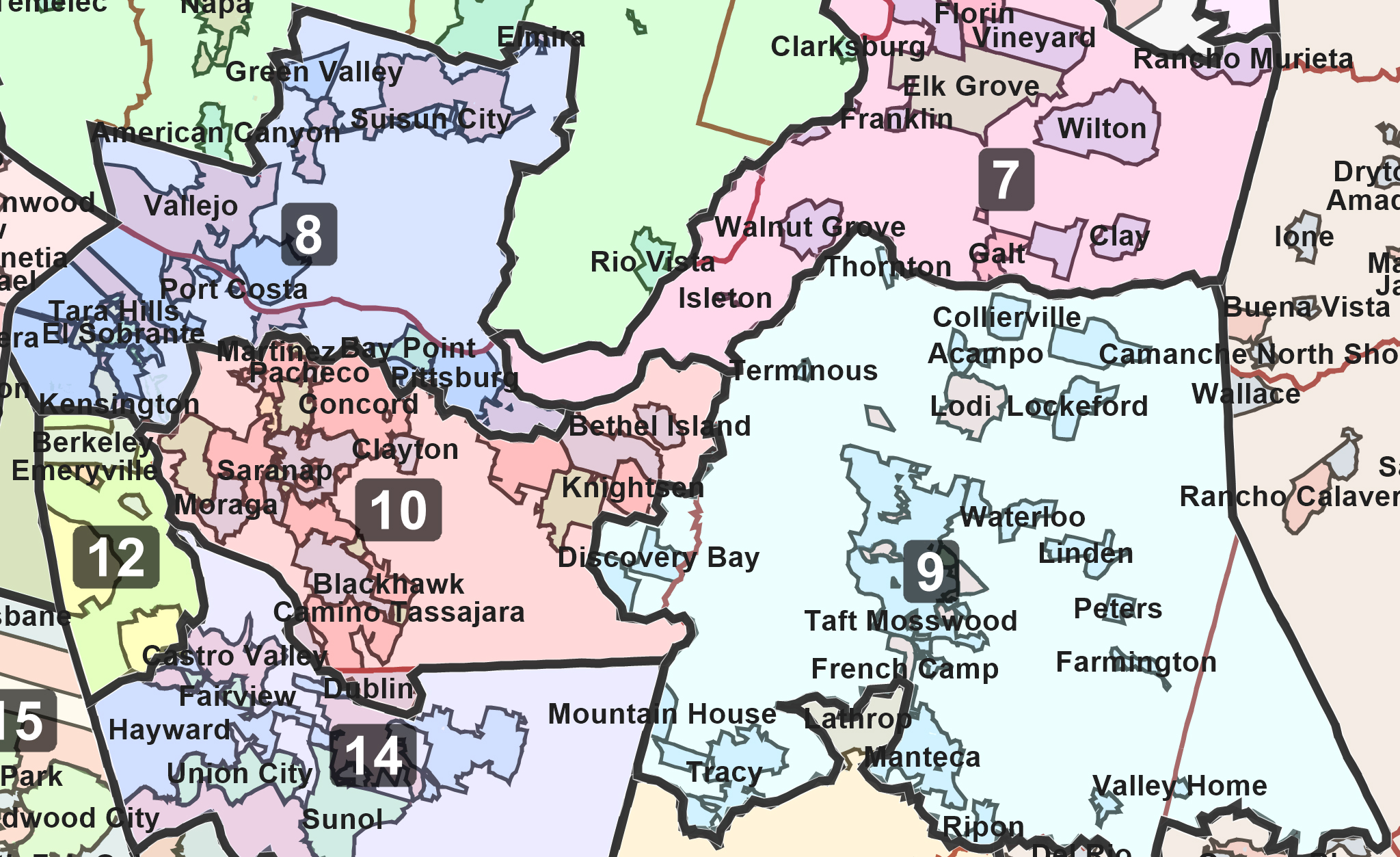
Proposed new Congressional Districts for Contra Costa for the next 10 years divide the county into two instead of among five districts, as it is currently. Source: California Citizens Redistricting Commission

For Congressional, State Senate, State Assembly, Board of Equalization districts; changes will affect who represents Contra Costa.

The draft State Senate district maps split Contra Costa into three districts, placing Brentwood with communities as far away as Rohnert Park, Calistoga and Dunigan.

More public input encouraged.

SACRAMENTO, CA—On Wednesday, the 2020 California Citizens Redistricting Commission released draft maps for the state’s Congressional, State Senate, Assembly and Board of Equalization districts ahead of the CA Supreme Court mandated November 15, 2021 deadline.

“We are finally here. We proudly present these draft maps to the people of California as a starting point for public discussion. These are not intended to be final maps and we strongly encourage Californians to continue weighing in until we get it right,” stated Commission Chair Trena Turner. “A global pandemic and delayed census data would not stop this commission from delivering on its promise to create maps that encourage fair representation. We will have final maps completed and certified by the December 27, 2021 deadline. There is still plenty of time for the public to get involved. We urge you to join us because everything is on the lines.”

A major consideration in redrawing the Congressional districts was the fact that California lost a seat in the decennial reapportionment due to population shifts away from the state. That reduces the delegation in the House of Representatives from 53 to 52. According to the U.S. Census Bureau, across the country, the Golden State was joined by Illinois, Michigan, Ohio, New York, Pennsylvania and West Virginia in losing one Congressional seat each. Oregon, Montana, Colorado, North Carolina and Florida each gained one seat, while Texas gained two Congressional seats.

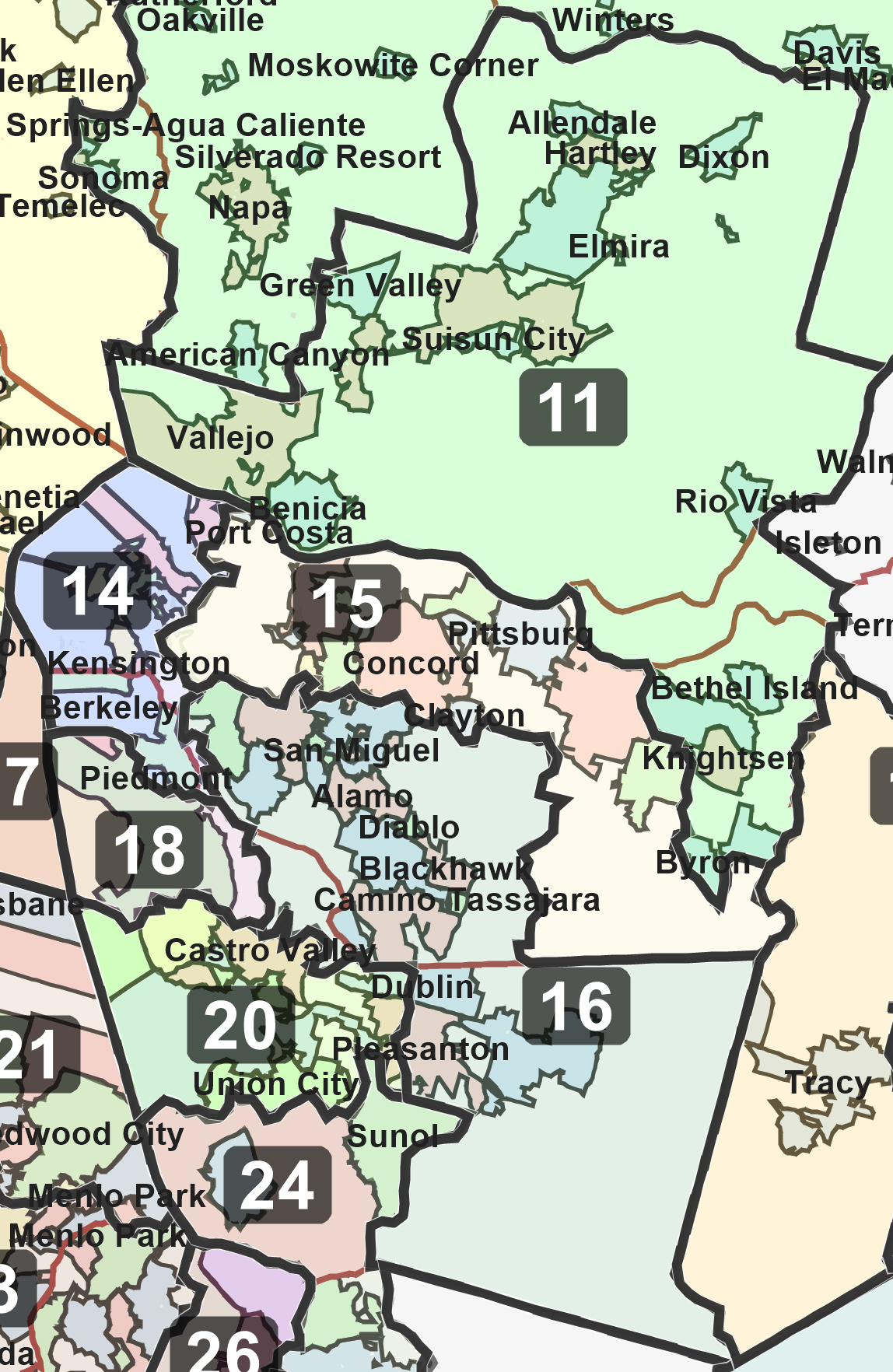
Proposed new State Senate Districts for Contra Costa County puts Far East County in the same district as all of Solano and Yolo Counties and portions of Sacramento, Napa and Sonoma Counties.

Impacts to Contra Costa County Districts

The draft maps show Contra Costa County split in just two Congressional districts compared to four, currently. The draft State Senate district maps split Contra Costa into three districts, with Far East County cities and communities of Brentwood, Oakley, Discovery Bay, Byron, Bethel Island and Knightsen included with all of Solano and Yolo Counties and portions of Sacramento, Napa and even Sonoma County communities as far away as Rohnert Park, Calistoga and Dunigan. The draft State Assembly districts map split the county into four districts, with Pinole, Hercules, Rodeo, Crockett and Port Costa included in the same district as Solano County.

According to an SFGate.com news report, “In the Bay Area…Contra Costa County has been the biggest source of complaints…some…Antioch residents have complained about African American neighborhoods being split up, while residents south of them in the Tri-Valley area are annoyed that San Ramon and Dublin were kept in separate congressional districts.”

Using the multitude of communities of interest testimony the Commission received throughout the summer, they assessed how that testimony could potentially inform district boundaries considering the tradeoffs that needed to be made in eventual maps. The Commission produced three sets of visualizations (October 27-29, November 2-4, November 7-9) that incorporated additional public input to evolve into draft maps.

Draft maps can be found here and below.

Approved Draft Maps
CONGRESS

  • 11.10.21 Congressional Draft Map
  • 11.10.21 Congressional Shape Files
  • 11.10.21 Congressional Equivalency Files

STATE SENATE

  • 11.10.21 State Senate Draft Map
  • 11.10.21 State Senate Shape Files
  • 11.10.21 State Senate Equivalency Files

ASSEMBLY

  • 11.10.21 Assembly Draft Map
  • 11.10.21 Assembly Shape Files
  • 11.10.21 Assembly Equivalency Files

BOARD OF EQUALIZATION

  • 11.10.21 Board of Equalization Draft Map
  • 11.10.21 Board of Equalization Shape Files
  • 11.10.21 Board of Equalization Equivalency Files

We encourage the public to provide feedback using this form.

Proposed new Assembly Districts for Contra Costa County would include Pinole, Hercules and Crockett with Solano County in the same district.

Public comment shall be taken for at least 14 days from the date of public display of the first preliminary statewide (draft) maps of the Congressional, State Senatorial, Assembly, and State Board of Equalization districts. The Commission shall not display any other map for public comment during the 14-day period.

Draft Map Public Input Meeting Schedule
November 17, 2021—Congressional District Feedback
November 18, 2021—Assembly District Feedback
November 19, 2021—Senate District Feedback
November 20, 2021—Board of Equalization & Any District Feedback
November 22, 2021—Any District Feedback
November 23, 2021—Any District Feedback

Public input meeting appointments can be made here.

In accordance with the California Constitution, the Commission followed these criteria, in this order, to draw district maps:

  1. Districts must be of equal population to comply with the U.S. Constitution.
  2. Districts must comply with the Voting Rights Act to ensure that minorities have an equal opportunity to elect representatives of their choice.
  3. Districts must be drawn contiguously, so that all parts of the district are connected to each other.
  4. Districts must minimize the division of cities, counties, neighborhoods and communities of interest to the extent possible.
  5. Districts should be geographically compact: such that nearby areas of population are not bypassed for a more distant population. This requirement refers to density, not shape. Census blocks cannot be split.
  6. Where practicable each Senate District should be comprised of two complete and adjacent Assembly Districts, and Board of Equalization districts should be comprised of 10 complete and adjacent State Senate Districts.

In addition, the place of residence of any incumbent or political candidate may not be considered in the creation of a map, and districts may not be drawn for the purpose of favoring or discriminating against an incumbent, political candidate, or political party.

Every 10 years, after the federal government publishes updated census information, California must redraw the boundaries of its electoral districts so that the state’s population is evenly allocated among the new districts.

In 2008, California voters passed the Voters First Act, authorizing the creation of the independent California Citizens Redistricting Commission to draw new State Senate, State Assembly, and State Board of Equalization district lines. In 2010, the Voters First Act for Congress gave the Commission the responsibility of drawing new Congressional districts following every census.

For more information, please visit www.WeDrawTheLinesCA.org.

Allen Payton contributed to this report.


Filed Under: News, Politics & Elections

CHP focuses on eliminating teen distracted driving

November 9, 2021 By Publisher Leave a Comment

Source: National Highway Traffic Safety Administration (NHTSA)

By Jaime Coffee, Information Officer II, California Highway Patrol

Source: NHTSA

Using cell phones, eating or drinking, adjusting a radio, or simply talking with friends are all activities teens engage in every day, but these activities become life-threatening hazards while driving.   Unfortunately, many of these distractions will lead to crashes resulting in an injury or death. 

To address these concerns, the California Highway Patrol (CHP) is partnering with traffic safety organizations promoting safe driving behaviors for teens.  The grant-funded Teen Distracted Drivers campaign consists of an education component that will allow for CHP officers and traffic safety partners to make appearances at schools and community events throughout the state. Distracted driving enforcement operations for this grant began October 1, 2021, and will continue through September 30, 2022.

According to the California Department of Motor Vehicles, there are nearly 750,000 licensed teenage drivers in California.  Data from the CHP’s Statewide Integrated Traffic Records System indicated that in 2019 there were nearly 44,000 crashes involving teen drivers between 15 to 19 years of age, including 231 fatal crashes.  Although preliminary figures for 2020 indicated a drop in total crashes involving teen drivers in California, the number of teen driver-involved fatal crashes increased to 258.

“The combination of inattention and inexperience behind the wheel can lead to tragedy,” said CHP Commissioner Amanda Ray.  “This grant will assist our officers in keeping California’s roads safe, while addressing California’s distracted driving crisis among the state’s teens.”

Funding for this program was provided by a grant from the California Office of Traffic Safety, through the National Highway Traffic Safety Administration.

The mission of the CHP is to provide the highest level of Safety, Service, and Security.


Filed Under: CHP, News, Youth

Three young Pittsburg men arrested, charged for armed robberies in five Contra Costa communities

November 8, 2021 By Publisher 3 Comments

Source: APD

Robbed 25 businesses, their employees and customers

By Detective Thomas Smith, Antioch Police Department

In August of 2021, the cities of Antioch, Pittsburg, Concord, Brentwood, Bay Point, and Clayton began experiencing a rash of armed robberies. Over approximately 90 days, an estimated twenty-five robberies occurred throughout the county. The responsible subjects were described as Hispanic males in their late teens or early twenties, with masks covering their faces. It was determined by investigators from each agency that the robberies were related, and they were able to establish several viable leads to identify the responsible parties.

On November 3rd, 2021, an armed robbery occurred in the city of Concord. Investigators from the Concord Police Department notified the other involved agencies, and the suspect vehicle was located and stopped in the city of Bay Point. All three occupants were residents of Pittsburg, CA, and were suspected of being responsible for the series of robberies in Contra Costa County. Evidence of the robbery(ies) was located inside the vehicle, and all three suspects were taken into custody.

Following their apprehension, investigators from the Pittsburg, Antioch and Concord Police Departments served several residential search warrants in the city of Pittsburg. During the searches, evidence linking the suspects to the robberies was located. On Friday, November 5th the cases were presented to the Contra Costa County District Attorney’s Office. The District Attorney’s Office reviewed the cases and filed felony charges with enhancements, on 18-year-old Samuel Banales-Melena, 20-year-old Jonathan Medina-Flores, and 18-year-old Rogelio Medina-Flores for their participation in the robberies.

This case was successful due to the collaboration of the law enforcement agencies involved in the investigation. This investigation weighed heavily on the implementation and use of technology, to include license plate reading cameras in the City of Antioch and other technological surveillance efforts. The Antioch Police Department would like to thank the Pittsburg Police Department for taking lead on the investigation, as well as the Concord Police Department for their diligent efforts in apprehending the suspects in these cases, bringing a violent crime spree to an end. As always, the investigation is on-going. If you have any information regarding these robberies, please contact the Antioch Police Department at your earliest convenience.

Anonymous tips or information about this – or any other incident – can be sent via text to 274637 (CRIMES) with the keyword ANTIOCH.

Filed Under: Central County, Concord, Crime, District Attorney, East County, News

Contra Costa Supervisors’ new chambers to remain publicly unused until at least January

November 6, 2021 By Publisher 4 Comments

New Contra Costa County Administration Building which was completed last year and dedicated in December. Source: KMD Architects

Blame placed on unvaccinated including children ages 5-11

“We need 92,000 more people to get vaccinated,” Contra Costa Health Services Director Anna Roth

Next redistricting hearing Nov. 9

By Daniel Borsuk

The Contra Costa County Board of Supervisors will not meet in their gleaming new state-of-the-art hearing room for the first time in the new $95 million Contra Costa County Administration Building until January, if then.

It all depends on how the county’s fight against COVID-19 goes. At least for now, Contra Costans will have to continue to remotely view and participate in supervisors’ meetings.

While the new three-story Contra Costa County Administration building at 1025 Escobar St. in Martinez is open for administrative services, the public hearing room goes unused by the public.

Only county administrative and county counsel use the hearing room during board of supervisors’ meetings.

On a 4-0 vote, supervisors approved, during their meeting on Tuesday, Nov. 2, its second consecutive order recommended from County Counsel Mary Ann Mason to extend for at least through December, the teleconference public meeting order that applies to all county governmental entities.

The edict also applies to the board of supervisors’ advisory commissions.  Meetings conducted for the planning commission, airports commission, library commission, merit board, and Proposition X advisory commission among other advisory panels must continue to be conducted via Zoom or other teleconference media.

The supervisors’ action to extend the COVID-19 public meeting teleconference order arose from the fact that 92,000 five- to 11-year-old children in the county are now eligible to get vaccinated, Contra Costa Health Services Director Anna Roth announced.

This announcement will add more burden to county health officials to vaccinate residents. She informed supervisors the county’s total vaccination rate is 73.2 percent.

“We need 92,000 more people to get vaccinated,” Roth informed supervisors.

Mason recommended supervisors adopt the resolution because “the COVID-19 case rate in Contra Costa County is in the ‘substantial’ community transmission tier, the second-highest tier of the CDC’s four community transmission tiers and the County Health Officer’s recommendations for safely holding public meetings, which recommend virtual meetings and other measures to promote social distancing, are still in effect.”

In October, supervisors had adopted a similar resolution authored by County Counsel Mason to continue teleconference meetings for public health reasons at least until November, but obviously the public health landscape had not improved sufficiently for state health officials to lift all the burdensome public meeting restrictions.

While county health officials reported the county is making progress in getting Contra Costa residents vaccinated, “A Statewide state of emergency and the Countywide local emergency continue to directly impact the ability of the Board of Supervisors, in all of its capacities, and its subcommittees and advisory bodies.”

Another COVID-19 oriented state of emergency edict ordering Contra Costa County governmental agencies to conduct meetings remotely means the board of supervisors won’t conduct its inaugural meeting until January, if then, in the new $95 million administration building in downtown Martinez.

In the meantime, the gleaming new public hearing hall remains closed to the public.

Redistricting Public Hearing on Nov. 9

The county’s fourth public hearing on supervisorial redistricting will be held starting at 9 a.m. on Tuesday, Nov. 9. The hearing will start at 9 a.m. during the Board of Supervisors meeting. The hearing will be held via Zoom and can be viewed online. (See related article)

“The County Board of Supervisors welcomes your community input in this important, decennial process,” said Board Chair Dianne Burgis of Brentwood. “We are committed to a robust Redistricting and public outreach process with public hearings, a dedicated website at CoCoRedistricting.org. public workshops, and multiple ways to share your input.”

Redistricting is based on the U.S. Census data, which was released in legacy format on August 12, 2021. The actual drawing of Supervisorial District Maps requires the official California State Adjusted Redistricting data, which was released Sept. 20, 2021 and includes updated data to ensure that individuals in the prison population are counted by each jurisdiction.

Acknowledge Black Maternal and Infant Health Day

Supervisors proclaimed Nov. 3, 2021 as Black Family Health Day to acknowledge the disparities in adverse birth outcomes among Black birthing patients and ways to turnaround those negative outcomes using pioneering technologies such as the early warning system, Partners in Pregnancy Fatherhood Program, Black Infant Health Program, and other programs.

From 2018 to 2020, 9.5 percent of Black mothers had preterm births compared to 5.8 percent of White mothers. Black babies are twice as likely to die within the first year of life as White babies (6.3/1,000 v. 3.2/1,000 from 2016 to 2020) and Black mothers experienced health-impacting, life-threatening events during childbirth at more than double the rate of White mothers from 2016 to 2018.

Filed Under: News, Politics & Elections, Supervisors

Delta Conveyance (tunnel) Project Case Study Workshop on community benefits programs Nov. 17

November 6, 2021 By Publisher 1 Comment

Proposed Delta Conveyance Project Facility Corridor Options. From Scoping Summary Report.

Learn from other projects

Haga clic aquí para ver este aviso en español.

As part of ongoing development of the Community Benefits Program for the proposed Delta Conveyance (tunnel) Project, the Department of Water Resources (DWR) is holding a virtual workshop on Wednesday, November 17th from 6:00pm – 8:00pm to hear and learn from representatives of several different example community benefits programs around the country. (See related articles here and here)

Members of the local Delta community are encouraged to attend this event and hear firsthand experiences about the development and implementation of these programs, including different organizational structures, development timing, important milestones and lessons learned.

There will also be an opportunity to ask the panelists questions and engage in dialogue about their experiences and insights. Although these types of programs are not uncommon, there are various ways to go about setting them up. This workshop gives both DWR and the local community the chance to learn more about how it could be done for the proposed Delta Conveyance Project. (See details of the proposed system, here)

The workshop panelists represent a diverse set of projects and community benefits programs from different parts of the country:

  • Oakland, California, Partnership for Working Families 
    • Ben Beach, Legal Director
  • North Charleston, South Carolina, LowCountry Alliance for Model Communities Port Authority Redevelopment and Transfer Station
    • Omar Muhammed, Executive Director, LowCountry Alliance for Model Communities
  • Morro Bay, California, Castle Offshore Wind Project 
    • Scott Collins, City Manager, City of Morro Bay

While no other project or community benefits program exactly matches the specifics of the proposed Delta Conveyance Project and what might be most appropriate for the Community Benefits Program for this project, the example projects that will be discussed in this workshop offer different and valuable perspectives and examples with varying structures, locations and challenges. In preparing for this workshop, DWR researched community benefits programs for large infrastructure projects that had long-term construction impacts, where the benefits of the project were not local, but impacts of the project were, and where location and potential for environmental justice and economically disadvantaged community concerns were also involved.

Photo: CA Dep’t of Water Resources.

Workshop Details & Registration

  • Wednesday, November 17, 2021 | 6:00pm – 8:00pm | REGISTER HERE
  • Workshop will be conducted on Zoom with a call-in option available

Agenda

  • Welcome and Introductions
  • Presentations from the three project representatives
  • Focused panelist discussion:
    • How did the idea develop in your project?
    • How did the community come together to provide input?
    • When in the project lifecycle did people come together?
    • How did you solicit priorities?
    • How did you formalize the program?
    • How are community benefit funds distributed?
    • How are you measuring and monitoring community benefits?
  • Public questions/discussion

Participation Accommodations & Additional Information

  • Closed captioning will be provided
  • Workshop materials will be available in English and Spanish, and a simultaneous Spanish translation will be offered
  • Workshop access information and materials will be sent out prior to the workshop through Eventbrite
  • If you cannot participate in the workshop but have questions, please email us at DeltaConveyanceCBP@water.ca.gov
  • A recording of the workshop will be posted on the project website, along with the background material, when available

To register, click here.

Filed Under: East County, Environment, News, Recreation, State of California, The Delta

BART board begins redistricting process to redraw election districts Nov. 10

November 5, 2021 By Publisher Leave a Comment

Public involvement is encouraged. Districts 1, 2, 3 and 7 currently include  portions of Contra Costa County

The BART Board of Directors’ Redistricting Committee is scheduled to hold its first meeting since receiving the 2020 Census data to begin the process of redrawing election districts to align with current population information. The virtual meeting will be held Wednesday, November 10, 2021 from 1 to 3pm.

The BART Redistricting Committee consists of Directors Lateefah Simon (Chairperson), Elizabeth Ames and Mark Foley.

BART election districts are redrawn every 10 years following the U.S. Census. The primary purpose of redistricting is to ensure population equality among districts.  This process is guided by traditional redistricting principles as well as the U.S. Constitution, the California Constitution, the federal Voting Rights Act and the BART District Act.

Information about current District boundaries

BART 2011 Election Districts Final Report – Adopted 12/1/2011 (10 Mb .pdf file)

All BART Districts
Counties Included: Alameda, Contra Costa, San Francisco
Map: All BART Districts (.pdf file)

District: 1
Counties Included: Contra Costa
Cities Included: Acalanes Ridge, Alamo, Alhambra Valley, Blackhawk, Camino Tassajara, Castle Hill, Clayton, Concord, Contra Costa Centre, Danville, Diablo, Lafayette, Martinez, Mountain View, Norris Canyon, North Gate, Pacheco, Pleasant Hill, Port Costa, Reliez Valley, San Miguel, San Ramon, Saranap, Shell Ridge, Vine Hill, Walnut Creek
Map: BART District 1 (.pdf file)

District: 2
Counties Included: Contra Costa
Cities Included: Antioch, Bay Point, Bethel Island, Brentwood, Byron, Clyde, Concord, Discovery Bay, Knightsen, Oakley, Pacheco, Pittsburg, Vine Hill
Map: BART District 2 (.pdf file)

District: 3
Counties Included: Alameda, Contra Costa
Cities Included: Albany, Ashland, Berkeley, Castro Valley, Cherryland, El Cerrito, Kensington, Lafayette, Moraga, Oakland, Orinda, Piedmont, San Lorenzo
Map: BART District 3 (.pdf file)

District: 4
Counties Included: Alameda
Cities Included: Alameda, Oakland, San Leandro
Map: BART District 4 (.pdf file)

District: 5
Counties Included: Alameda
Cities Included: Castro Valley, Cherryland, Dublin, Fairview, Hayward, Livermore, Pleasanton, Sunol
Map: BART District 5 (.pdf file)

District: 6
Counties Included: Alameda
Cities Included: Fremont, Hayward (partial), Newark, Sunol, Union City
Map: BART District 6 (.pdf file)

District: 7
Counties Included: Alameda, Contra Costa, San Francisco
Cities Included: Albany, Bayview, Berkeley, Crockett, East Richmond Heights, El Cerrito, El Sobrante, Emeryville, Hercules, Kensington, Montalvin Manor, North Richmond, Oakland, Pinole, Richmond, Rodeo, Rollingwood, San Francisco, San Pablo, Tara Hills
Map: BART District 7 (.pdf file)

District: 8
Cities Included: San Francisco
Counties Included: San Francisco
Map: BART District 8 (.pdf file)

District: 9
Cities Included: San Francisco
Counties Included: San Francisco
Map: BART District 9 (.pdf file)


Filed Under: BART, News, Politics & Elections

Beat a cyberbully – here’s how parents can help

November 2, 2021 By Publisher 2 Comments

Victims of cyberbullying can feel helpless and may not know what to do. Free resources on jw.org help children, teens and parents successfully deal with bullying.

Oakley parents share their approach

By Ezra Smith, Public Information Desk, Jehova’s Witnesses United States Branch 

While remote learning during the COVID-19 pandemic lowered reported instances of bullying, parents fear that, for some students, going back to school will mean going back to being bullied.

“With the prevalence of technology and social media, you’re forced to be concerned. Now kids can be bullied in the privacy of their own home,” said Tomas, a father of three who lives in Oakley.

Now 15 years after the inception of National Bullying Prevention Month in October, technology’s ever-greater presence in children’s lives has given bullying a new outlet. With just a click, cyberbullies can taunt, harass and threaten relentlessly, even reaching into the home via cellphone or computer. As a result, victims report feeling hopeless, isolated and even suicidal.

What can parents do to protect their kids? Taking an interest in their children’s online world can make a difference, says the National Parent Teacher Association.

This interest does not necessarily require parents to become tech experts. Instead, the federal stopbullying.gov site advises parents to watch for subtle clues that something is wrong, such as their child becoming withdrawn, hiding their screen when others are nearby or reacting emotionally to what is happening on their device.

For Tomas and his wife Leticia, that means being keenly aware of what “normal” looks like for three teenagers, ages 13, 14 and 17. “I can see by their body language or their mood if they had a good time [at school] or not,” Leticia said.

“It’s so important that we take time with our children,” Tomas added. “If we don’t take time, we won’t be able to know our kids and we won’t be able to know how to help them if they are going through something like cyberbullying.”

Talking with kids openly — and often — helps too. “The more you talk to your children about bullying, the more comfortable they will be telling you if they see or experience it,” UNICEF says in its online tips for parents.

As their two daughters enter their teens, Houston parents Thiago and Auboni have found that talking less and listening more works best. “We try to focus on being approachable and listening actively without reaction,” Thiago said.

Beyond talking, listening and observing their kids, parents should not be afraid to make and enforce rules for online activities, experts say.

Thiago and Auboni’s girls are allowed to play online games, but they are expected to turn off the live chat feature to limit interactions with strangers. “We reassure the girls that we trust them and respect their privacy, but they have to stay within the boundaries we’ve set,” Auboni said.

Tomas and Leticia take a similar approach. While they use an app to monitor their kid’s screen time, they recognize that balance is important. “As my kids are getting older, you do have to respect their privacy,” Tomas said. “They are rewarded as they build that trust. That shows that they are responsible.”

Both families cited the tips and reminders they have considered together with their kids from free resources available on jw.org, the official website of Jehovah’s Witnesses.

One of Leticia and Tomas’ daughters especially recommends one of the site’s short animated videos, “Beat a Bully Without Using Your Fists”.

“If being bullied, we don’t want to fight fire with fire,” she said. “Instead of being angry and fighting back, we can just give a calm response and leave the issue instead of making it even worse.”


Victims of cyberbullying can feel helpless and may not know what to do. Free resources on jw.org help children, teens and parents successfully deal with bullying.

Filed Under: News, Technology, Youth

EBMUD road closure for Highgate Road Cluster Pipeline Replacement Project in Kensington begins  Nov. 9

November 2, 2021 By Publisher Leave a Comment

Map of Highgate Road Cluster Pipeline Replacement Project in Kensington. Source: CCPWD

By Kelly Kalfsbeek, PIO, Contra Costa County Public Works Department 

Contra Costa County will be issuing a Road Closure permit to East Bay Municipal Utility District (EBMUD) to fully close a portion of Sunset Drive, between Franciscan Way & Arlington Avenue and Highgate Road, between Sunset Drive & Edwin Drive, and Highgate Court in Kensington. Traffic will be detoured via neighboring streets.

The purpose of this road closure is for EBMUD to install approximately 5,165 feet of 6-inch and 8-inch Earthquake Resistant Ductile Iron (ERDIP) water main. Work will begin on Tuesday, November 9, 2021 and last through June 2022, barring unforeseen circumstances. Work will occur between 7:00 a.m. through 4:30 p.m., Monday through Friday, weather permitting. The roadway will be reopened at the end of each workday.

Residents can expect pavement saw cutting, trenching, staging of equipment and materials, temporary road closures to through traffic and loss of some street parking, in phases. Some dust and noise can also be expected during the hours of construction. A portion of Sunset Drive, Highgate Road, and Highgate Court will be closed to through traffic (allowing residential and emergency access only). There will be traffic control throughout the work area so drivers can expect delays. “No Parking” signs will be posted 72 hours in advance of work. Final paving will follow several months after pipeline installation.

About Contra Costa County Public Works Department:

Contra Costa County Public Works Department (CCCPWD) maintains over 660 miles of roads, 150 miles of streams, channels and other drainage and over 200 County buildings throughout Contra Costa County. CCCPWD provides services such as Parks and Recreation, Sand Bag Distribution and Flood Control throughout unincorporated areas of Contra Costa County. To learn more about CCCPWD, please visit www.cccpublicworks.org.

CONTACT: For questions, call Community Affairs at 510-287-7208 or email construction-north@ebmud.com; Outside of normal business hours, call 1-866-403-2683

Filed Under: Construction, News, West County

  • « Previous Page
  • 1
  • …
  • 164
  • 165
  • 166
  • 167
  • 168
  • …
  • 363
  • Next Page »
Monicas-11-25
Deer-Valley-Chiro-06-22

Copyright © 2026 · Contra Costa Herald · Site by Clifton Creative Web