• Home
  • About The Herald
  • Local Agencies
  • Daily Email Update
  • Legal Notices
  • Classified Ads

Contra Costa Herald

News Of By and For The People of Contra Costa County, California

  • Arts & Entertainment
  • Business
  • Community
  • Crime
  • Dining
  • Education
  • Faith
  • Health
  • News
  • Politics & Elections
  • Real Estate

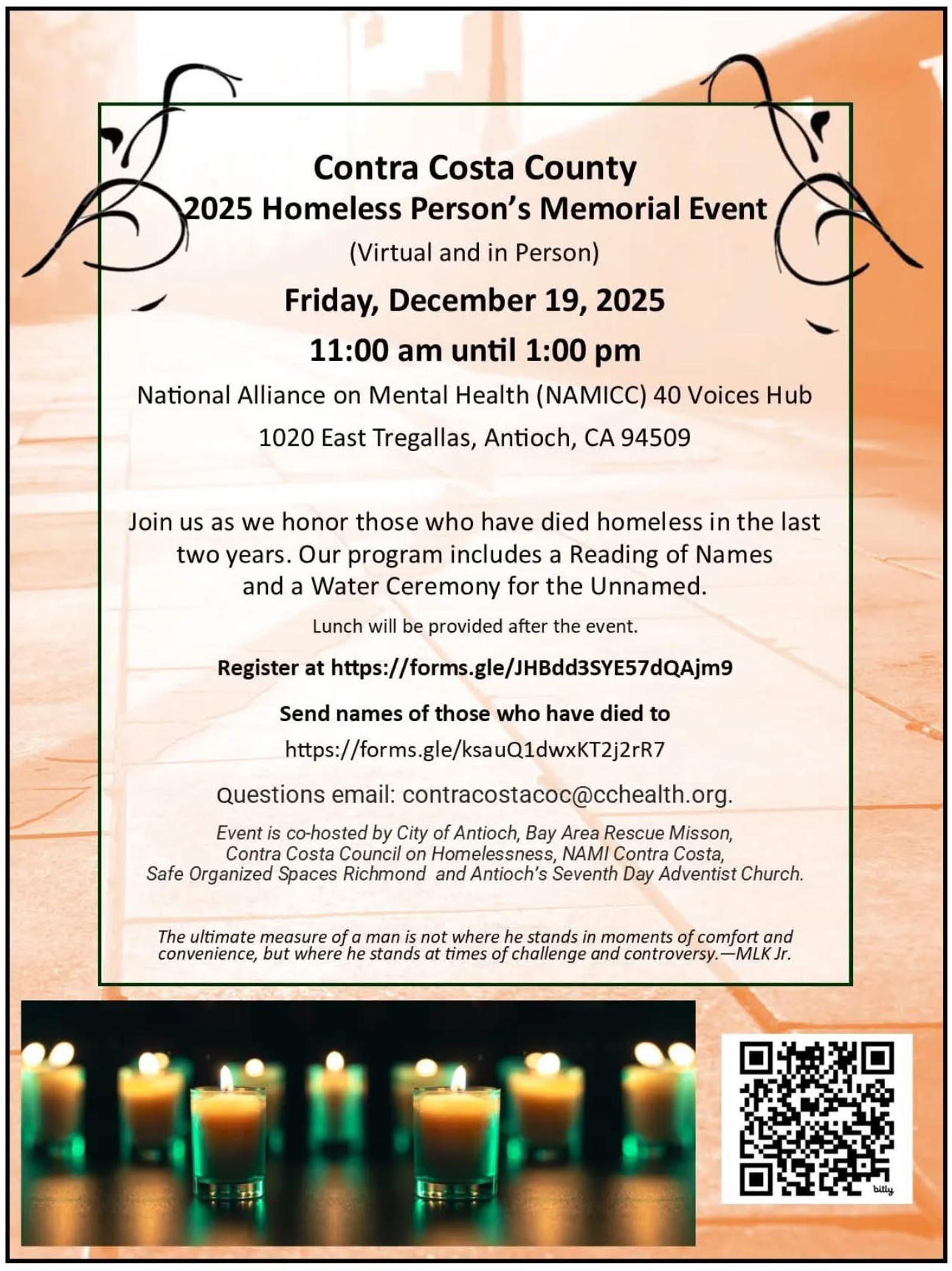
Contra Costa County Homeless Person’s Memorial Day event in Antioch Dec. 19

December 12, 2025 By Publisher 2 Comments

For those who have died in the past two years

Watch national ceremony online Dec. 18

By NAMI Contra Costa

Join us for Homeless Persons’ Memorial Day, where we will create a space to remember, honor and celebrate those in our community with a lived experience of homelessness who have died in the past two years. As part of the event, we will be reading their names and stories. You are invited to share the names of people whom you would like to be remembered here: https://forms.gle/ksauQ1dwxKT2j2rR7.

This hybrid (in person and online) event will take place:

Friday December 19, 2025

11:00 am – 1 pm

  • Reading of the names: 11:30 am
  • Lunch served: 12:30 pm

Physical Address:  NAMI CC – 40 Voices African American Holistic Wellness and Resource Hub, 1020 East Tregallas Road, Antioch

Zoom: https://homebaseccc.zoom.us/j/86971795919

Event co-hosted by Antioch Seventh Day Adventist Church, Bay Area Rescue Mission, City of Antioch, Contra Costa Council on Homelessness, NAMI Contra Costa, and Safe Organized Spaces Richmond.

If you have questions, please reach out to contracostacoc@cchealth.org.

National Homeless Persons’ Memorial Day Ceremony (Virtual Attendance)

Please join us from wherever you are on Dec. 18th for a livestream of this year’s Homeless Persons’ Memorial Day ceremony at 11 a.m. PST.

The National Coalition for the Homeless, the National Health Care for the Homeless Council, and the National Consumer Advisory Board, a member network of the Council, encourage our communities to organize or take part in Homeless Persons’ Memorial Day (HPMD) events on or around the winter solstice — the first day of winter and the longest night of the year.

At these events each year, we remember those who have died and we strengthen our resolve to work for a world where no life is lived or lost in homelessness. We state clearly, together with others in scores of communities across the nation, that no person should die for lack of housing.

List of  Speakers For the Memorial Event

Register at: 2025 Homeless Persons’ Memorial Day Ceremony Livestream.

About NAMI CC – Support. Educate. Advocate. Outreach.

Mission Statement – To provide support, outreach, education, and advocacy to individuals impacted by mental illness, their families, and the broader community.

NAMI Contra Costa is a 501(c)3 non-profit organization providing outreach, education, support and advocacy to individuals living with mental illness, their families, and the broader community. We have been serving in Contra Costa County and beyond for over 35 years. All our programs are free, so get involved today and help make a difference in your life, others’ lives, and in the local community.

NAMI Contra Costa is an affiliate of the National Alliance on Mental Illness. We are unique in our independence with long history of supporting individuals living with mental illness, their families, and the broader community.

NAMI CC has a commitment to serve the needs of all impacted by mental illness. We have staffed our agency to be reflective of those who are unserved, underserved, and inappropriately served. We have many support groups, classes, and services for these communities. Additionally, to help reach much of the homebound community, we provide almost all of our groups and classes via Zoom, and now more are in-person. So please visit our calendar page for group dates and times.

NAMI Contra Costa was named the 2023 California Nonprofit of the Year.

About the Delta Bay Wellness Hub

NAMI CC is committed to ensuring ALL individuals impacted by mental illness have their needs met and no one is left behind. We, therefore, lifted the 40 Voices Campaign to advocate for an African American Holistic Wellness & Resource Hub to improve outcomes for the African American community. Despite 40 Voices’ successful advocacy for a total of $8.9 million dollars from the Contra Costa Board of Supervisors, we have been asked to wait until 2029 for the physical site of the hub to be realized. We cannot afford to wait. NAMI CC CEO and Founder of the 40 Voices Campaign, Gigi Crowder, decided to move forward with the hub – primarily using her own personal funding and securing donations from others. If you would like to support this important effort, you can Zelle a payment (510-990-2670) or mail in a check (2151 Salvio Street, Suite V, Concord, CA 94520) or simply go to www.namicontracosta.org/donate to make a donation. All donations are tax deductible. Donations of $40 dollars or more will be recognized on a poster as a “Founding Contributor” of the 40 Voices African American Holistic Wellness & Resource Hub at Delta Bay. The renovations have resulted in a beautiful healing space.

For more information, contact: Gigi R. Crowder at (510) 990-2670 or gigi@namicontracosta.org.

Allen D. Payton contributed to this report

Filed Under: Community, East County, Homeless, In Memoriam/Obituaries, News

Delta Veterans Group to hold biennial Stand Down on the Delta in Antioch Sept.12-15

August 6, 2025 By Publisher Leave a Comment

To serve homeless veterans and others; volunteers needed

Community Day Sept. 13 is for anyone and everyone

By Delta Veterans Group

The Delta Veterans Group brings Contra Costa County (CCC) “Stand Down on the Delta” a Homeless Veterans’ “Hand Up” event every other year (2015, 2017, 2019….) DVG is proud to bring Stand Down on the Delta 2025, September 12-15, to the Contra Costa County Fairgrounds in Antioch.

This is a four-day event wherein U.S. military veterans receive services in Medical, Dental, Veterans Treatment Court, Housing, Job Placement, Mental Health and Drug and Alcohol Counseling.

We are also looking for volunteers. Please contact us through our website at Contact Us | Delta Veterans Group.

To date the Stand Down on the Delta biennial event has helped thousands of veterans and their families, served thousands of meals, given away over 1,100 pairs of boots, over 1,500 sleeping bags, over 1,300 pairs of new jeans, $500,000 in dental care, taken over 200 veterans fishing on our Delta shores and helped many more find permanent housing.

We work with over 70 different organizations during our four day Stand Down on the Delta event. In September of 2019 over 850 Volunteers from around the State of California and even as far as South Carolina came to Antioch to help us provide these great services to our veterans.

About DVG

Delta Veterans Group is 501(c)3 Veterans service non-profit that assists our Nation’s finest men and women with housing, employment, health, and education services. Founded in Contra Costa County in 2012 by Army veteran J.R. Wilson, DVG has now grown to provide services to surrounding Northern California areas including Alameda, Monterey, Napa, San Joaquin, San Francisco and Solano counties.

Filed Under: Community, East County, Health, Homeless, Veterans

Contra Costa Continuum of Care seeks volunteers for Jan. 30th Homeless Point in Time Count

December 22, 2024 By Publisher Leave a Comment

By Contra Costa Health, Housing and Homeless Services

What is the Point in Time Count?

The Point-in-Time (PIT) Count provides a comprehensive snapshot of individuals experiencing homelessness—both sheltered and unsheltered—on a single night in late January. Mandated by the U.S. Department of Housing and Urban Development (HUD), this annual count requires Continuums of Care to account for sheltered individuals who are in emergency shelters, transitional housing, and safe havens, as well as unsheltered individuals who live in places not meant for human habitation like cars, parks, sidewalks, and abandoned buildings.

As a result, the Continuum of Care (CoC) must submit PIT Count data to HUD. This data is collected across the country to estimate homelessness and provide information about the demographics of people experiencing homelessness.

This information is used to decide how much funding communities get to help with homelessness.

Source: CCC CoC

Data collected from the Point-in-Time Count helps identify

  • The causes of homelessness
  • Create better policies, programs and funding allocations
  • Track progress in reducing homelessness

What Am I Being Asked To Do?

  • Be part of a one-day, county-wide project to count unsheltered people in Contra Costa
  • Work in a pair [with someone you know or we can pair you with someone]
  • Either drive (if you have a car) or capture data on an iPhone-based app with someone else while they drive
  • Choose the area where you will do the count (with some limitations)

When Do You Need Me?

  • The week of January 13th for one (1) two hour IN PERSON Volunteer Training. You will select when/where you want to do the training when you register
  • Thursday, January 30th from 5:30 am – 9:00 am for the actual count!

How Do I Sign Up?

  • Click here:  Volunteer Registration

How do I learn more about the Point in Time Count?

  • Click hereto learn more

How do I tell my friends and family about this volunteer opportunity?

  • Download and share this flyerwith them!

Volunteers must follow these three steps!

  • Register: Complete Volunteer Registration Form
  • Train: Check Out Training Dates
  • Count: Kick-Off Site Locations

Questions?

  • Email contracostacoc@cchealth.org or call/text (925) 464-0152.

Filed Under: Finances, Government, Homeless, News

Contra Costa, Richmond, Antioch awarded state grants to house people living in homeless encampments

October 5, 2024 By Publisher Leave a Comment

Source: Office of the CA Governor

Governor Newsom awards $130.7 million in Round 3 of program to help 18 California communities

Also creating a collaborative program between the state and targeted communities to streamline the cleanup of encampments

SACRAMENTO – Oct. 4, 2024 — Expanding the state’s unprecedented support for local communities to create new housing and address homelessness, Governor Newsom announced Friday, the state is awarding $130.7 million to 18 local governments to clear homeless encampments and provide shelter, care and support. The grants are from Round 3 of the Encampment Resolution Fund (ERF) awards from the Department of Housing and Community Development. The Governor also announced new accountability measures, requiring award recipients to adhere to all state housing and homeless laws — as well as remain in compliance with their Housing Elements — or risk losing funding and face other enforcement actions.

The Round 3 funds awarded Friday will go to 12 cities, four counties and two Continuums of Care (CoCs) and are intended to resolve critical encampment concerns and address the housing and health and safety needs of 3,364 people living in encampments, and permanently house 1,565 people.

Of the total amount the City of Richmond was awarded $9,336,746, the City of Antioch will receive $6,812,686 and the County of Contra Costa was granted $5,708,516. Of the 18 agencies, Contra Costa County scored the highest followed by Richmond.

“We’re supporting local communities’ efforts to get people out of encampments and connected with care and housing across the state. It’s important and urgent work that requires everyone to do their part. The state has committed more than $27 billion to help local governments tackle the homelessness crisis — and we want to see $27 billion worth of results,” said Governor Newsom.

Source: CA Dept of HCD

$1 billion in funding to clear encampments

Governor Newsom has made unprecedented investments to address the housing and homelessness crises, with $40 billion invested to help communities create more housing and $27 billion provided to communities for homelessness. Today’s new grants are part of the state’s $1 billion Encampment Resolution Funds (ERF), which help communities address dangerous encampments and support people experiencing unsheltered homelessness.

So far, the program has invested $737 million for 109 projects or encampments across 21 counties, 41 cities and 5 CoCs to help 20,888 people throughout the state, helping 20,888 people transition out of homelessness.

“These grants will ensure local communities take a person-centered, trauma-informed approach as they help their most vulnerable residents transition to safe and stable housing,” said Business, Consumer Services and Housing Agency Secretary Tomiquia Moss. “The Encampment Resolution Fund grants are infusing critical resources in communities up and down California so that unhoused Californians can access the essential housing and supportive services they need to achieve long-term stability.”

Source: Office of the CA Governor

Greater accountability 

As a condition of receiving the funding, the awardees must agree to increased accountability and compliance measures. These new accountability measures build on the current requirements that all grantees adhere to state and federal laws, rules, and regulations related to construction, health and safety, labor, fair employment practices, environmental protection, equal opportunity, fair housing, and all other matters applicable and/or related to the ERF program.

The Governor’s new measures expressly require local governments to maintain a compliant housing element, as well as adhere to all planning, permitting, entitlement, fair housing, and homelessness laws.

Non-compliance with these measures may result in the state revoking and clawing back awarded funds in addition to potential enforcement actions by the state’s Housing Accountability Unit. This ensures that grant recipients remain accountable and protects state funding.

Source: Office of the CA Governor

Care, compassion, collaboration 

Today’s announcement follows the Governor’s executive order urging local governments to adopt policies and plans consistent with the California Department of Transportation’s (CalTrans) existing encampment policy.

Prioritizing encampments that pose a threat to the life, health, and safety of the community, Caltrans provides advance notice of clearance and works with local service providers to support those experiencing homelessness at the encampment, and stores personal property collected at the site for at least 60 days.

Since July 2021, California has cleared more than 12,000 encampments and has removed 267,611 cubic yards of debris from encampments along the state right of way in preparation for Clean California projects.

Source: Office of the CA Governor

Delegated Maintenance Agreements

The Governor also announced today a new collaborative program that will help streamline the cleanup of encampments by establishing agreements between the state and targeted local communities. The agreements will remove jurisdictional boundaries and allow locals to address encampments on state property and receive reimbursement for their efforts.

To help provide additional guidance and direction for local governments, the California Interagency Council on Homelessness has posted webinars and resources to help communities address encampments.

Below are the other 10 cities, three counties and two Continuums of Care awarded Round 3 ERF grants:

  • City of Berkeley – $5,395,637
  • City of Carlsbad – $2,994,225
  • City of Los Angeles – $11,351,281
  • City of Palm Springs – $5,106,731
  • City of Petaluma – $8,098,978
  • City of Redlands — $5,341,800
  • City of Sacramento — 18,199,661
  • City of San Jose —- $4,821,083
  • City of Victorville — $6,365,070
  • City of Visalia —- $3,000,000
  • County of Riverside — $12,612,779
  • County of San Bernardino — $11,000,000
  • City and County of San Francisco – $7,975,486
  • Humboldt County — Continuum of Care – $3,784,294
  • Pasadena –  Continuum of Care – $2,772,801

“Our team is energized by this opportunity to help bring people-centered, Housing First solutions to Californians who are unsheltered throughout the state,” said Gustavo Velasquez, Director of the California Department of Housing and Community Development (HCD), which has administered ERF since the start of the 2024-25 fiscal year. “Combined with the investments in permanent supportive housing made possible by voter approval of Proposition 1, the state has unprecedented momentum to make monumental progress on a crisis of homelessness that has been growing for decades.”

The awards announced Friday utilize all remaining FY 2023-24 ERF funds. An additional appropriation of $150 million in the FY 2024-25 State Budget allowed HCD to award all eligible ERF Round 3, Window 2 applicants. The budget also included $100 million in ERF funds for FY 2025-26, bringing to $1 billion this investment to address encampments through proven housing solutions.

Each agency was required to apply for the ERF program.

The grants will provide stable, safe housing for individuals living in encampments in their respective communities. The awarded proposals will assist individuals living in encampments with compassion and dignity by providing a range of housing solutions: permanent housing; interim housing for individuals seeking coordinated entry system resources or housing vouchers; housing navigation services and rapid rehousing subsidies; support for accessing permanent housing by providing security deposits and other moving expenses; and allowing awardees to acquire property for housing.

Each agency was required to apply for the grant program

Pablo Espinoza, Deputy Director of Communications, CA Department of HCD Media and Allen D. Payton contributed to this report.


Filed Under: East County, Finances, Homeless, News, State of California, West County

Bay Area Rescue Mission to hold Back to School Block Party in Richmond Saturday, Aug. 3

August 2, 2024 By Publisher Leave a Comment

The Bay Area Rescue Mission – recently ranked as one of the top 0.1% nonprofits in the nation, addressing those in crisis – is hosting its annual block party in downtown Richmond on Saturday, August 3rd. The event is just one very visual way in which the Rescue Mission is expanding its good works from San Francisco out to the rest of the Bay Area.

The Back to School Block Party will include a Saturday full of fun individual and family activities – from the Backpack Giveaway to a Blessing Boutique, and Food, Groceries and Housewares Giveaways to The Kid’s Fun Zone. The event will give those in need the ability to “shop” for free resources that will help attendees get ready for the school year, prepare for the cold winter months ahead, get complimentary haircuts and much more. All in all, the event promises to have a real impact on the community.

“The 1,200 backpacks we’re giving away on Saturday were all packed by Chevron employees. They’ve been spoken for as people registered for them,” shared CEO Bram Begonia. “This is a huge thing. We close down the streets. We have gently used and new clothes in our Clothing Boutique. We’ll have a grocery give-away.”

We have Contra Costa Community College giving out food. We’ll have 50 community partners, here,” he added.

Asked if people have to register Bram stated, “The only thing people had to sign up for ahead of time was the backpacks.

Located on MacDonald Avenue between 1st and 3rd Streets, the event will run from 10 AM to 2 PM.

For more information about the Rescue Mission visit www.bayarearescue.org.


Filed Under: Children & Families, Community, Faith, Government, Health, Homeless, West County

Gov. Newsom orders state agencies to address “dangerous” homeless encampments with urgency, dignity

July 25, 2024 By Publisher Leave a Comment

A state worker cleans out an encampment under a freeway overpass. Gov. Gavin Newsom contributes to the effort following the announcement of his executive order on Thursday, July 25, 2024. Video screenshots. Source: Office of the CA Governor

Following U.S. Supreme Court ruling

Encourages local governments to adopt similar policies

“We’re done. It’s time we move with urgency at the local level to clean up these sites. This executive order is about…getting the sense of urgency that’s required of local government to do their job.” – Gov. Newsom

What you need to know: Governor Newsom today issued an executive order directing state agencies to urgently address homeless encampments while respecting the dignity and safety of Californians experiencing homelessness. The Governor’s order, which follows the Supreme Court’s decision in Grants Pass, also urges local governments to use substantial funding provided by the state to take similar action.

SACRAMENTO, CA — Building on California’s ongoing work and unprecedented investments to address the decades-long issue of homelessness, Governor Gavin Newsom issued an executive order today ordering state agencies and departments to adopt clear policies that urgently address homeless encampments while respecting the dignity and well-being of all Californians.

With the recent U.S. Supreme Court decision in Grants Pass v Johnson, local governments now have the tools and authority to address dangerous encampments and help provide those residing in encampments with the resources they need.

“This executive order directs state agencies to move urgently to address dangerous encampments while supporting and assisting the individuals living in them — and provides guidance for cities and counties to do the same. The state has been hard at work to address this crisis on our streets. There are simply no more excuses. It’s time for everyone to do their part.” said Newsom. “We’re done. It’s time we move with urgency at the local level to clean up these sites. This executive order is about…getting the sense of urgency that’s required of local government to do their job.”

The governor’s executive order directs state agencies and departments to adopt humane and dignified policies to urgently address encampments on state property, including by taking necessary and deliberate steps to notify and support the people inhabiting the encampment prior to removal.

Governor Newsom has made record-level investments to address the housing crisis, investing over $24 billion across multiple state agencies and departments, including billions of dollars in funding to assist local jurisdictions in providing services and wrap-around support to people living in encampments. In Fiscal Year 2022-2023, these investments helped lift more than 165,000 people out of homelessness and into interim or permanent housing.

California blueprint

Governor Newsom’s order directs state agencies and departments to adopt policies and plans consistent with the California Department of Transportation’s (Caltrans) existing encampment policy. Since July 2021, California has resolved more than 11,000 encampments, and has removed 248,275 cubic yards of debris from encampments along the state right of way in preparation for Clean California projects. Prioritizing encampments that pose a threat to the life, health, and safety of the community, Caltrans provides advance notice of clearance and works with local service providers to support those experiencing homelessness at the encampment, and stores personal property collected at the site for at least 60 days.

The order encourages local governments to emulate the state’s successful model to adopt local policies and to use all available resources, including those provided by the state’s historic investments in housing and intervention programs, to address encampments within their jurisdictions.

Proposition 1 funding available for local governments

Governor Newsom also encourages local governments to apply for the newly available $3.3 billion in competitive grant funding from Proposition 1 to expand the behavioral health continuum and provide appropriate care to individuals experiencing mental health conditions and substance use disorders — with a particular focus on people who are most seriously ill, vulnerable, or homeless.

Proposition 1 includes two parts: a $6.4 billion Behavioral Health Bond for treatment settings and housing with services, and historic reform of the Behavioral Health Services Act (BHSA) to focus on people with the most serious illnesses, substance disorders, and housing needs. The state also recently released the Proposition 1 Behavioral Health Services Act: Housing Supports Primer (July 2024) for counties, which explains how to spend the projected $950 million annual BHSA revenue on housing interventions.

Unprecedented investments to support communities

Governor Newsom is tackling California’s homelessness crisis head-on. Since he took office, the state  has developed a Statewide Action Plan for Preventing and Ending Homelessness and the Governor has demanded unprecedented accountability from local governments to do their part to end the homelessness crisis through regionally coordinated action plans. The Governor has also pioneered nation-leading homeless and housing reforms and invested more than $24 billion to address this crisis with state and local support, including $4.85 billion for Homeless, Housing Assistance and Prevention Grants for local jurisdictions to prevent and reduce homelessness, $1 billion in Encampment Resolution Funding to assist local jurisdictions in providing services and supports to people living in encampments, and $3.3 billion for Homekey to rapidly expand housing for persons experiencing homelessness.

See Newsom’s announcement video on X.

A copy of today’s executive order can be found here and here:

EXECUTIVE ORDER N-1-24

WHEREAS California is experiencing a homelessness crisis decades in the making, with over 180,000 people estimated to have experienced homelessness on any given night in 2023, including 123,000 people who experienced unsheltered homelessness, living in tents, trailers, and vehicles across the state; and WHEREAS within the first year of my Administration I fast-tracked the development of shelter through Executive Order N-23-20, which directed departments to assess and facilitate the use of available state land and resources for short-term emergency homeless shelters; and WHEREAS since the beginning of my Administration, the State has made unprecedented investments to address the homelessness crisis head on, investing more than $24 billion across multiple state agencies and departments, including $4.85 billion in flexible funding to local jurisdictions to prevent and reduce homelessness through Homeless Housing, Assistance and Prevention grants, $1 billion in Encampment Resolution Funding to assist local jurisdictions in providing services and supports to people living in encampments, and $3.3 billion to rapidly expand housing for persons experiencing homelessness through Homekey; and

WHEREAS the State has redoubled its commitment to holding local jurisdictions accountable to reduce homelessness, including by strengthening and enforcing requirements that local jurisdictions plan for their fair share of housing and by conditioning state homelessness funding on rigorous reporting and measurable performance metrics; and

WHEREAS it is imperative to act with urgency to address dangerous encampments, which subject unsheltered individuals living in them to extreme weather, fires, predatory and criminal activity, and widespread substance use, harming their health, safety, and well-being, and which also threaten the safety and viability of nearby businesses and neighborhoods and undermine the cleanliness and usability of parks, water supplies, and other public resources; and

WHEREAS while every jurisdiction must do more to address encampments, state and local agencies taking proactive steps to remove encampments have been stymied in those efforts by lawsuits and injunctions, leaving officials without the tools or guidance necessary to address the crisis on their streets; and

WHEREAS in September 2023, I called on the United States Supreme Court to grant review in City of Grants Pass v. Johnson to clarify that state and local officials can take reasonable actions to resolve encampments while respecting the humanity of all Californians; and

WHEREAS in June 2024 the Supreme Court overturned Ninth Circuit Court of Appeals precedent that restricted the government’s authority to enforce laws regulating encampments, recognizing that jurisdictions may tailor their enforcement practices to reflect policy-driven approaches to addressing homelessness; and

WHEREAS with the threat of these types of injunctions removed, there is no longer any barrier to local governments utilizing the substantial resources provided by the State, in tandem with federal and local resources, to address encampments with both urgency and humanity, or excuse for not doing so; and WHEREAS guidelines that prioritize offers of shelter and services as a first step to resolving any encampment best respect the dignity of every Californian and provide meaningful paths to ending homelessness; and

WHEREAS the California Interagency Council on Homelessness leads California’s efforts to prevent and end homelessness; and

WHEREAS the California Department of Transportation maintains a policy directive that prioritizes removal of encampments that pose threats to life, health, and safety, while partnering with local governments and nonprofit providers to facilitate offers of shelter and supportive services in advance of a removal; and WHEREAS the California Department of Transportation has, since July 2021, removed 11,188 encampments and 248,275 cubic yards of debris from these encampments along the state rights of way.

NOW, THEREFORE, I, GAVIN NEWSOM, Governor of the State of California, in accordance with the authority vested in me by the State Constitution and statutes of the State of California, do hereby issue the following Order to become effective immediately:

IT IS HEREBY ORDERED THAT:

1) Agencies and departments subject to my authority shall adopt policies, generally consistent with California Department of Transportation’s Maintenance Policy Directive 1001-R1, to address encampments on state property, including through partnerships with other state and local agencies, and shall prioritize efforts to address encampments consistent with such policy. Such policies shall include the following:

  1. Whenever feasible, site assessment in advance of removal operations to determine whether an encampment poses an imminent threat to life, health, safety or infrastructure such that exigent circumstances require immediate removal of the encampment.
  2. Where exigent circumstances exist, as much advance notice to vacate as reasonable under the circumstances.
  3. Where no exigent circumstances exist, posting of a notice to vacate at the site at least 48 hours prior to initiating removal
  4. Contacting of service providers to request outreach services for persons experiencing homelessness at the encampment.
  5. Collection, labeling, and storage for at least 60 days of personal property collected at the removal site that is not a health or safety hazard.

2) All departments and agencies not under my authority are requested to adopt policies consistent with the guidelines in Paragraph 1.

3) Local governments are encouraged to adopt policies consistent with this Order and to use all available resources and infrastructure, including resources provided by the State’s historic investments in housing and intervention programs where appropriate and available, to take action with the urgency this crisis demands to humanely remove encampments from public spaces, prioritizing those encampments that most threaten the life, health, and safety of those in and around them.

4) The California Interagency Council on Homelessness shall develop guidance and provide technical assistance consistent with this Order for local governments to follow in implementing their local homelessness programs.

IT IS FURTHER ORDERED that, as soon as hereafter possible, this Order be filed in the Office of the Secretary of State and that widespread publicity and notice be given of this Order. This Order is not intended to, and does not, create any rights or benefits, substantive or procedural, enforceable at law or in equity, against the State of California, its agencies, departments, entities, officers, employees, or any other person.

IN WITNESS WHEREOF I have hereunto set my hand and caused the Great Seal of the State of California to be affixed this 25th day of July.

GAVIN NEWSOM

Governor of California

Allen D. Payton contributed to this report.

Filed Under: Homeless, News, State of California

Transient man arrested following discovery of woman’s burned body in San Pablo

July 17, 2024 By Publisher Leave a Comment

Held on $2.5 million bail

By San Pablo Police Department

San Pablo, CA – On Tuesday, July 2, 2024, at 1:23AM, San Pablo police officers were notified of a fire along San Pablo Creek, near the 1900 block of Road 20. The Contra Costa Fire Protection District (Con Fire) responded to the incident, and subsequently advised SPPD officers that a deceased subject, severely burned, had been located in the area of the extinguished fire.

Due to the condition of the decedent, SPPD investigators were unable to immediately determine the subject’s identity or cause of death. A subsequent autopsy revealed blunt force trauma injury to the subject’s head, indicating the possibility of criminal homicide.

During the course of the investigation, SPPD investigators identified 35-year-old William S. Ramirez (transient) as a person of interest, and a Ramey warrant, related to charges of murder and arson, was issued for his arrest.

On July 11, 2024, at approximately 7:00AM, SPPD officers served a search warrant in the 1800 block of 23rd Street, where Ramirez was taken into custody without incident. SPPD investigators subsequently recovered evidence linking Ramirez to the crime. Ramirez was booked on the Ramey warrant and remains in custody at the Martinez Detention Facility, pending filing of formal charges by the Contra Costa County District Attorney’s Office. There are no further outstanding suspects at this time.

The victim is believed to be a 40-year-old adult female (transient). According to Contra Costa County Deputy Coroner Sanchez she has not yet been identified and is listed as a “Jane Doe at this point.”

This incident remains an active investigation, and anyone with information is encouraged to contact the San Pablo Police Department at 510-215-3150.

Allen D. Payton contributed to this report.

Filed Under: Crime, Homeless, News, Police, West County

Innovative permanent supportive housing complex to open in San Pablo

July 13, 2024 By Publisher Leave a Comment

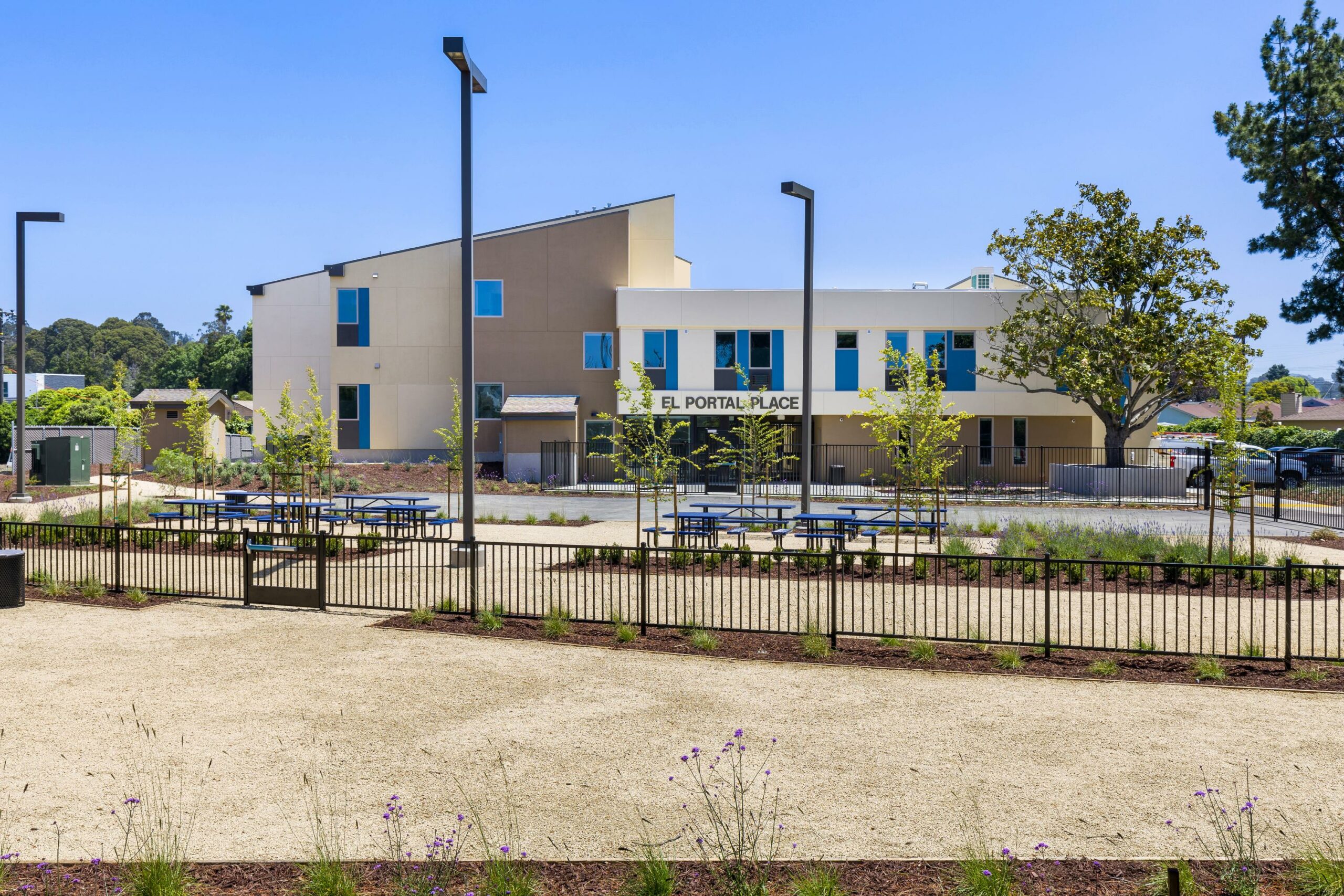
El Portal Place. Photo: Overaa Construction

$21.5 million in public funds for 540 micro-apartments for homeless adults with disabilities; on-site services provided

Originally built by grandfather, renovated by grandson 56 years later

By Contra Costa Health

Contra Costa County Supervisor John Gioia and Contra Costa Health (CCH) hosted a grand opening for El Portal Place, a 54-unit micro-unit apartment building for homeless adults with disabilities, on Saturday, July 13, 2024. The project is the second completed in Contra Costa using state Homekey project funding, as well as funding from the county’s Measure X half-cent sales tax. The event began with prepared comments by elected and CCH homeless services officials followed by guided site tours. will be on hand to interview regarding the project.

Contra Costa County has transformed the vacant office building at 2555 El Portal Drive to serve some of the county’s most vulnerable residents with permanent supportive housing that includes onsite services such as case management, community supports, and referrals to services such as behavioral health, benefits assistance, and healthcare.

According to Overaa Construction, the builder responsible for the renovations, the design-build, adaptive reuse project reimagined an old, two-level, 27,000 square-foot office building as small homes for 60 individuals. Jerry Overaa built the original office building in 1968 and fifty-six years later, his grandson, Jared, spearheaded its conversion. The architectural design for the project was by Studio T Square and Base Landscape architects. (See project video)

El Portal Place Floor Plan. Source: Overaa Construction

“El Portal Place is an innovative project connecting people in desperate need with quality housing and services to improve their health,” said District 1 Supervisor Gioia, whose district includes San Pablo. “We appreciate our strong partnership with the City of San Pablo, and the continued support from Governor Gavin Newsom. These homes help us achieve equity and improved health for county residents.”

The facility will become the first built by the county specifically for residents who meet federal criteria for chronic homelessness, meaning they have been unhoused for a long period of time and have disabilities that prevent them from maintaining permanent housing on their own.

When tenants arrive later this summer, each will live in a micro-unit apartment with bathroom, kitchenette and workspace, in a complex with a community room, courtyard, garden and dog park. Onsite staff will assist in coordinating a comprehensive range of services for residents, supported by federal and state funding.

“Providing stability for people experiencing homelessness not only lifts up those served, but it also lifts our entire community,” said Federal Glover, chair of the county Board of Supervisors. “El Portal Place is an example of putting public funds to work to do something about homelessness.”

Unit kitchenette. Source: Overaa Construction

Contra Costa’s Measure X, approved by county voters in 2020, contributed $5.2 million toward the project, to go along with a $16 million grant from California’s Homekey program, resulting in a cost of slightly more than $398,000 per unit.

A separate $21.5 million award helped the county build the first project, Delta Landing, a 172-unit interim housing site in Pittsburg, in 2022.

“Contra Costa, like all of California, is experiencing a profound housing crisis. Every partnership, collaboration, and new idea to address homelessness is crucial,” said Anna Roth, CEO of Contra Costa Health.

Contra Costa’s point-in-time survey of homelessness in the county in January estimated 2,843 people experiencing homelessness in the county on any given night, an increase of 18.5% from the previous year’s estimate. The county increased its daily capacity of temporary and permanent housing beds by 26% during the same period.

People who need assistance with housing in Contra Costa County can call 211 to reach CCH’s CORE homeless outreach team.

Allen D. Payton contributed to this report.

Filed Under: Construction, Homeless, News, State of California, West County

BAHFA to place $20 billion affordable housing bond measure on Nov. ballot in Bay Area counties

June 27, 2024 By Publisher Leave a Comment

Source: BAHFA

First-of-its-kind measure to help build, preserve more than 70,000 additional homes

Contra Costa County would receive $1.9 billion

By John Goodwin, Assistant Director of Communications & Rebecca Long, Director, Legislation & Public Affairs, Metropolitan Transportation Commission

The Bay Area Housing Finance Authority (BAHFA) on Wednesday, June 26, 2024, adopted a resolution to place a general obligation bond measure on the November 5 general election ballot in each of the nine Bay Area counties to raise and distribute $20 billion for the production of new affordable housing and the preservation of existing affordable housing throughout the region. BAHFA is jointly governed by the Association of Bay Area Governments (ABAG)’s Executive Board and by the BAHFA Board, which is comprised of the same membership as the Metropolitan Transportation Commission (MTC).

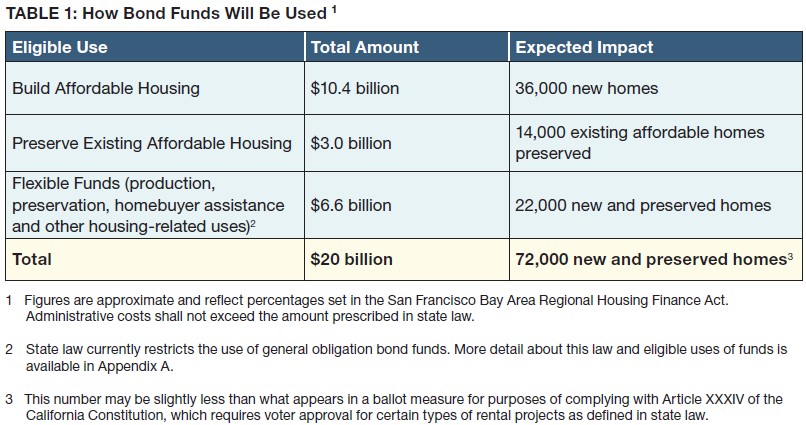
The bond could create 72,000 new affordable homes – more than double what would be possible without a bond. Without more funding, only about 71,000 affordable homes will be built or preserved in the Bay Area over the next 15 years – a status quo that is failing to meet the needs of the people who live and work here.

Currently, the Bay Area doesn’t have enough homes for the people who live here. As a result of the region’s housing shortage:

  • In 2022, 37,000 people were unhoused in the Bay Area.
  • 1.4 million people—23% of Bay Area renters—spend over half their income on rent.
  • High rents and home prices force people to live far from work, making congestion and pollution much worse, and putting a major strain on working families.
  • Too many Bay Area residents live in overcrowded and unsafe housing.
  • Vital employees and community members are leaving the area.

Wednesday’s unanimous vote by the BAHFA Board marks the final discretionary step in the process to place the measure on the November ballot. Under state law, each Bay Area county will now take a non-discretionary, ministerial vote to place the measure on the ballot in that county, in accordance with election deadlines.

The BAHFA bond measure currently would require approval by at least two-thirds of voters to pass. Voters throughout California this November will consider Assembly Constitutional Amendment 1 (ACA 1) — which would set the voter threshold at 55 percent for voter approval of bond measures for affordable housing and infrastructure. If a majority of California voters support ACA 1, the 55 percent threshold will apply to the BAHFA bond measure.

“Today’s vote is the culmination of so many years of effort by so many people all around our region,” observed BAHFA Chair and Napa County Supervisor Alfredo Pedroza. “The Bay Area’s longstanding housing affordability problems affect all of us, our friends, our neighbors and our family members. This vote is about preserving opportunity for everyone.”

Source: BAHFA

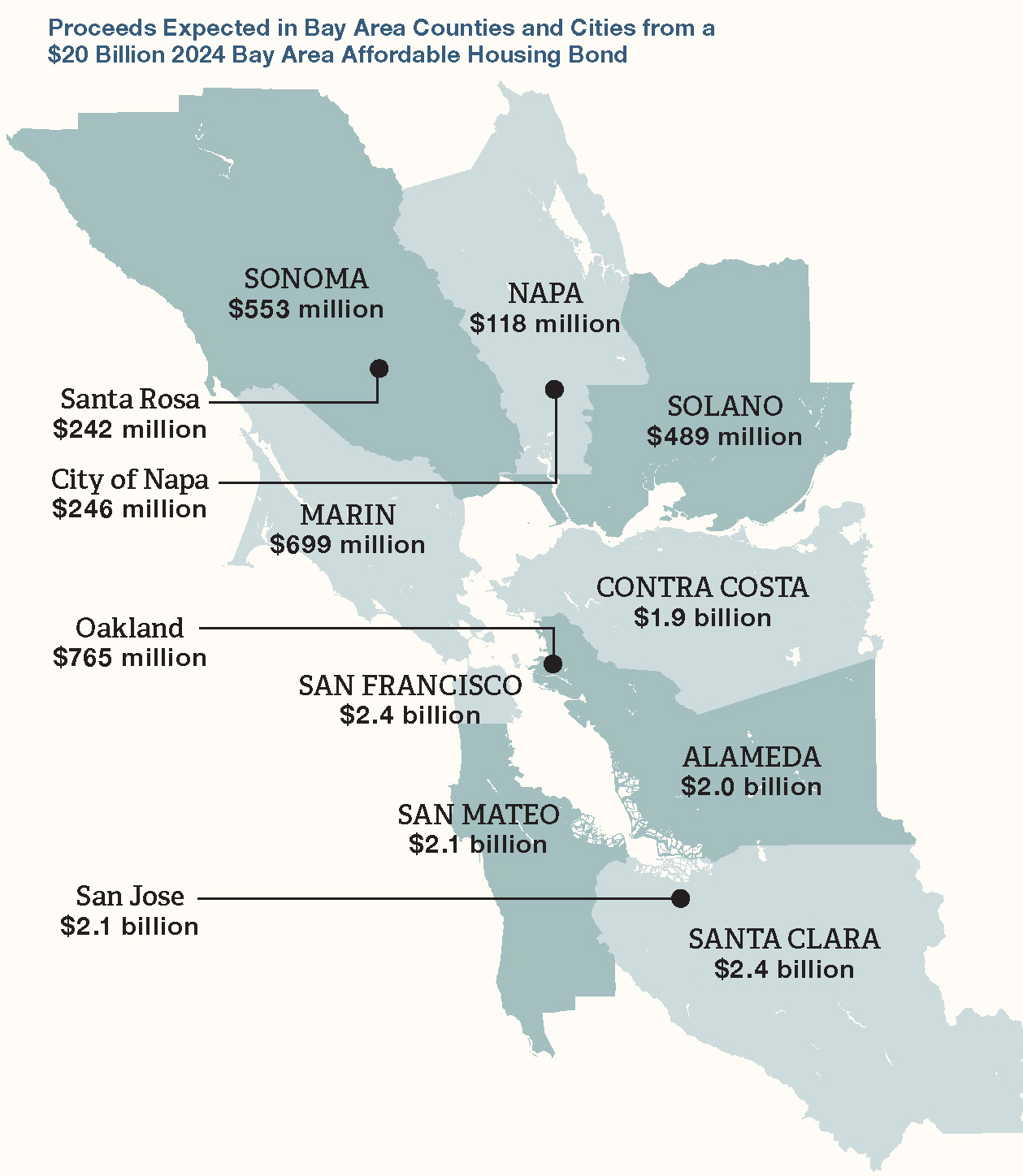
The proposed BAHFA bond measure calls for 80 percent of the funds to go directly to the nine Bay Area counties (and to the cities of San Jose, Oakland, Santa Rosa and Napa, each of which carries more than 30 percent of their county’s low-income housing need), in proportion to each county’s tax contribution to the bond. In consultation with its cities and towns, each county would determine how to distribute bond funds to best meet its jurisdictions’ most pressing housing needs. These distributions would include:

  • Contra Costa County: $1.9 billion
  • Alameda County: $2 billion
  • Marin County: $699 million
  • Napa County: $118 million
  • San Francisco County: $2.4 billion
  • San Mateo County: $2.1 billion
  • Santa Clara County: $2.4 billion
  • Solano County: $489 million
  • Sonoma County: $553 million
  • City of Napa: $246 million
  • City of Oakland: $765 million
  • City of San Jose: $2.1 billion
  • City of Santa Rosa: $242 million

The remaining 20 percent, or $4 billion, would be used by BAHFA to establish a new regional program to fund affordable housing construction and preservation projects throughout the Bay Area. Most of this money (at least 52 percent) must be spent on new construction of affordable homes, but every city and county receiving a bond allocation must also spend at least 15 percent of the funds to preserve existing affordable housing. Almost one-third of funds may be used for the production or preservation of affordable housing, or for housing-related uses such as infrastructure needed to support new housing.

Source: BAHFA

The California Constitution currently does not allow bond funds to be used for tenant protections such as rental assistance, but planned investments in new housing and affordable housing preservation will protect tens of thousands of low-income renters and vulnerable residents.

The BAHFA Board also adopted on Wednesday, resolutions approving the Authority’s Business Plan and its Regional Expenditure Plan, which explain the prioritization for use of the funds that would be directly administered by BAHFA.

Oversight and accountability provisions to be included in the BAHFA bond measure include the creation of a special bond proceeds account; establishment of a Citizens’ Oversight Committee that would review the expenditure of bond proceeds and report to the BAHFA and ABAG Executive Boards on whether the funds were spent appropriately; an independent annual performance audit; a requirement that all bond-projects be consistent with state laws on labor standards; a requirement that administrative costs not exceed the amount prescribed in state law; and a prohibition against any public official who voted to send the ballot measure to the voters bidding on any work funded with proceeds from the bond.

The ABAG Executive Board voted unanimously at its April meeting to adopt a resolution approving BAHFA’s Business Plan and its Expenditure Plan, as well as to endorse placement of the bond measure on the November ballot. In her remarks preceding the vote, ABAG President and Napa County Supervisor Belia Ramos noted, “This is a remarkable milestone moment for our region. Housing stability is essential for our community to thrive, and this proposal is a once-in-a-generation opportunity.”

Read the Bond Report and learn more about the bond measure, here and here.

Filed Under: Bay Area, Finances, Growth & Development, Homeless, News, Politics & Elections

Initiative to repeal Prop 47 soft-on-crime measure qualifies for Nov. ballot

June 11, 2024 By Publisher Leave a Comment

Photos: Californians for Safer Communities

Allows felony charges and increases sentences for certain theft and drug crimes, including fentanyl

Sacramento, CA – California Secretary of State Shirley N. Weber, Ph.D. announced that an initiative became eligible for the November 5, 2024, General Election ballot on June 10, 2024.

In order to become eligible for the ballot, the initiative needed 546,651 valid petition signatures, which is equal to five percent of the total votes cast for governor in the November 2022 General Election.

A measure can become eligible via random sampling of petition signatures if the sampling projects that the number of valid signatures is greater than 110 percent of the required number. The initiative needed at least 601,317 projected valid signatures to become eligible by random sampling, and it has exceeded that threshold today.

On June 27, 2024, the Secretary of State will certify the initiative as qualified for the November 5, 2024, General Election ballot, unless it is withdrawn by the proponent prior to certification pursuant to Elections Code section 9604(b).

While the proponents of the initiative, Californians for Safer Communities labeled it The Homelessness, Drug Addiction, and Theft Reduction Act. But Attorney General Rob Bonta’s official title and summary of the measure is as follows: ALLOWS FELONY CHARGES AND INCREASES SENTENCES FOR CERTAIN DRUG AND THEFT CRIMES. INITIATIVE STATUTE.

– Allows felony charges for possessing certain drugs, including fentanyl, and for thefts under $950—both currently chargeable only as misdemeanors—with two prior drug or two prior theft convictions, as applicable. Defendants who plead guilty to felony drug possession and complete treatment can have charges dismissed.

– Increases sentences for other specified drug and theft crimes.

– Increased prison sentences may reduce savings that currently fund mental health and drug treatment programs, K-12 schools, and crime victims; any remaining savings may be used for new felony treatment program.

Summary of estimate by Legislative Analyst and Director of Finance of fiscal impact on state and local governments: Increased state criminal justice system costs potentially in the hundreds of millions of dollars annually, primarily due to an increase in the state prison population. Some of these costs could be offset by reductions in state spending on local mental health and substance use services, truancy and dropout prevention, and victim services due to requirements in current law. Increased local criminal justice system costs potentially in the tens of millions of dollars annually, primarily due to increased court-related workload and a net increase in the number of people in county jail and under county community supervision. (23-0017A1)

According to Ballotpedia.com, the political action committee supporting the measure, Californians to Reduce Homelessness, Drug Addiction, and Theft, has raised over $7.2 million to support the effort. Of that amount $2.5 million was contributed by Walmart, $1.0 million from Home Depot, $500,000 from Target, $300,000 each from 7-Eleven and California Correctional Peace Officers Association Truth in American Government Fund.

The Secretary of State’s tracking number for this measure is 1959 and the Attorney General’s tracking number is 23-0017A1.

The proponent of the measure is Thomas W. Hiltachk of the Bell, McAndrews & Hiltachk law firm. They can be reached at (916) 442-7757. The address for the proponent is 455 Capitol Mall, Suite 600, Sacramento, CA 95814.

For more information about how an initiative qualifies for the ballot in California, visit https://www.sos.ca.gov/elections/ballot-measures/how-qualify-initiative/

Allen D. Payton contributed to this report.


Filed Under: Crime, Drugs, Homeless, News, Politics & Elections, State of California

  • 1
  • 2
  • 3
  • 4
  • Next Page »
Monica's-Riverview-Jan-2026
Liberty-Tax-Jan-Apr-2026
Deer-Valley-Chiro-06-22

Copyright © 2026 · Contra Costa Herald · Site by Clifton Creative Web