• Home
  • About The Herald
  • Local Agencies
  • Daily Email Update
  • Legal Notices
  • Classified Ads

Contra Costa Herald

News Of By and For The People of Contra Costa County, California

  • Arts & Entertainment
  • Business
  • Community
  • Crime
  • Dining
  • Education
  • Faith
  • Health
  • News
  • Politics & Elections
  • Real Estate

Kaiser Permanente issues statement on threatened strike

August 27, 2023 By Publisher 2 Comments

By Antonia Ehlers, PR & Media Relations, Kaiser Permanente Northern California

Kaiser Permanente is the largest union-represented health care employer in the U.S. – with nearly 75 percent of our employees represented by unions. We are currently bargaining with the Coalition of Kaiser Permanente Unions, which represents about 88,000 employees in a variety of roles. The Coalition is part of our historic, 26-year-long Labor Management Partnership, the longest-lasting partnership of its kind in the country.

Kaiser Permanente is fully committed to reaching an agreement with the unions affiliated with the Coalition just as we have done in every national bargaining since 1999. Our priority is to reach an agreement that is mutually beneficial and ensures we can continue to offer our people market-competitive pay and outstanding benefits. We are confident that we will reach an agreement that achieves that goal, before the contract expires on September 30. And we are confident that our new agreement will strengthen our position as a best place to work and ensure the high-quality care our members expect from us remains affordable and easy to access.

Strike Authorization Vote

Strike authorizations are a common bargaining pressure tactic that give union leaders the ability to call for a strike in the future. Throughout our negotiations we have seen Coalition leaders attempt to rally their unions’ members to threaten a strike despite important progress made through negotiations.

This tactic does not reflect any breakdown in bargaining, nor does it indicate a strike is imminent or will happen at all. It is a disappointing action considering our progress at the bargaining table. It does not reflect our commitment to reaching an agreement that ensures we can continue to provide market-competitive pay and outstanding benefits.

We urge our employees to reject any call for a strike and continue to focus on providing care and service to the patients who need them. We take any threat to disrupt care for our members seriously and have plans to ensure continued access to health care by our members, patients, and the communities we serve, should any union call for a strike. Our members, patients, and our communities need us to be there for them.

Allegations of Unfair Labor Practices

From the start, we have bargained in good faith to come to an agreement, working diligently in partnership to address the many complex issues at the table. This week, over the course of our sixth formal negotiation session since national bargaining began in April, we offered proposals on important issues including improvements to the performance sharing bonus plan (PSP) and an enterprise-wide guaranteed minimum wage for our Coalition-represented employees. In addition, committees met on staffing, operational savings, and local bargaining agreements.

As always, one of the key issues in this bargaining involves compensation and Kaiser Permanente has made clear we are standing by our proven commitment to provide market-competitive wages and excellent benefits. In fact, as a leading employer, our philosophy is to pay our employees above the local market, to attract and retain the best employees.

Bargaining is dynamic and involves give-and-take. Accusations from union leaders that Kaiser Permanente has not bargained in good faith are unfounded and counterproductive.

We take bargaining seriously and believe that our employees deserve market competitive wages and excellent benefits. We are hopeful union leaders will set aside the counterproductive tactics of this week, so we can focus on working together to deliver an agreement. We remain committed to bargaining with our Coalition unions in good faith and in the spirit of partnership. We will focus our energy on frank and productive discussions that lead to an agreement, and to doing our part to ensure there are no disruptions to the high-quality care we provide.

Staffing

We, like all health care organizations, have experienced staffing challenges driven by the pandemic and its lasting effects. For healthcare systems this has been made worse by the backlog in care and the increase in needs and acuity we’re seeing across the country.

While Kaiser Permanente has experienced the same pressures, through diligent work and an unwavering commitment to our people, we have weathered these staffing challenges better than most health care organizations. Kaiser Permanente’s average employee turnover rate of 8.5 percent, as of June 2023, is significantly lower than the rate of 21.4 percent across health care. Talented people who recognize the value of our current wage and benefit offerings want to work at Kaiser Permanente, which is why about 96 percent of candidates for Coalition-represented positions accept our employment offers—significantly above the industry average.

Kaiser Permanente and the Coalition have agreed to work together to accelerate hiring, and we set a joint goal in bargaining of hiring 10,000 new people for Coalition-represented jobs in 2023. Kaiser Permanente’s efforts to date have resulted in more than 6,500 positions filled, and we are aggressively recruiting to fill more.

Our staffing approach reflects our shared commitment to ensure every Kaiser Permanente patient receives extraordinary care, every time and in every place.

Wages and Benefits

We are leaders in employee wages and benefits, and we have reiterated our commitment in bargaining to continuing to provide market-competitive wages and outstanding benefits. In fact, our philosophy is to deliver compensation that provides wages above the local market (up to 10 percent above market) to attract and retain the best employees.

Kaiser Permanente also offers employees opportunities to learn new skills and grow their careers, and we’re committed to providing a safe and equitable work environment. In addition, we want to ensure that we help our employees build long-term economic security with low-cost health insurance, industry-leading retirement plans, and other benefit programs to support their health and well-being.

It’s also worth remembering that during the pandemic, we took extraordinary steps to support and protect our workforce, and to support their mental as well as physical health. We provided $800 million in employee assistance to ensure that front-line employees had access to alternate housing options, special child care grants, and additional paid leave for COVID-19 illness and exposure.

The unions’ current negotiating position is that wage increases should not be market-based. This prevents us from addressing wage disparities that exist in in many of Kaiser Permanente’s markets where, for some jobs, wages are significantly higher than our targeted wage level, and in other cases our employees’ wages are below other competitors in the market, impacting our ability to attract and retain the best people.

While being a best-in-class employer is a fundamental part of who we are, we cannot continue a national approach for determining wages and ignore local market conditions. We also have a responsibility to make health care more affordable for our patients, members, and customers, including government agencies. For many families and businesses, health care costs are increasingly unaffordable, and growing. Wages and benefits make up about half the cost of health care, across the country. We must work together with unions on the critical goal of ensuring that health care remains affordable.

We are committed to our philosophy of providing market-competitive pay and excellent benefits, and we’ve made that clear in bargaining. We are committed to addressing areas where staffing is challenging, and we are making great progress. And we are committed to doing all this while striving to help health care be more affordable.


Filed Under: Bay Area, Health, Labor & Unions, News

Labor’s next big fight in the Bay Area: Largest single-employer union negotiation in the U.S. inches closer to strike

August 27, 2023 By Publisher Leave a Comment

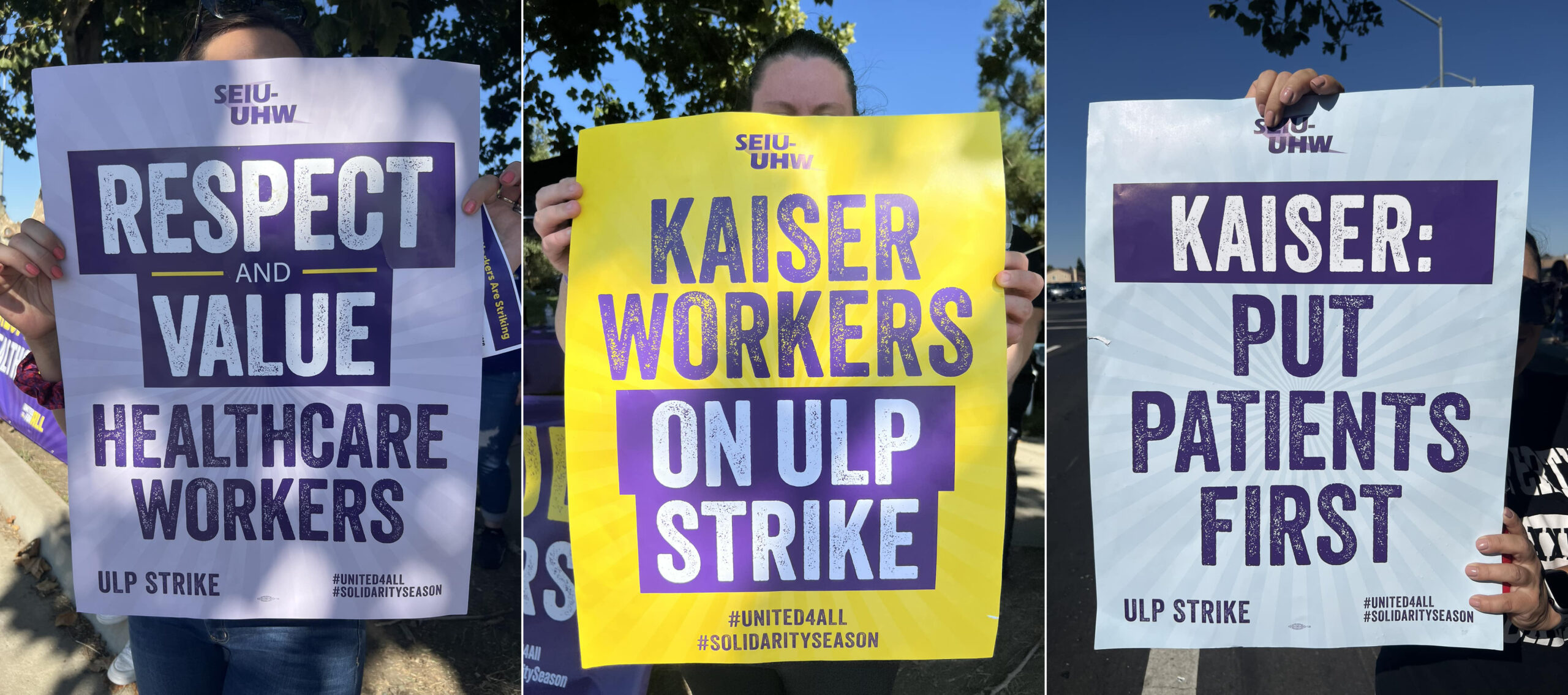
85,000 Kaiser Permanente healthcare workers to hold strike authorization vote Monday over what they claim are unfair labor practices, say chronic under-staffing is driving a growing patient care crisis

By Renée Saldaña, Press Secretary, SEUI – United Healthcare Workers West

A strike may be looming at one of the nation’s largest employers.

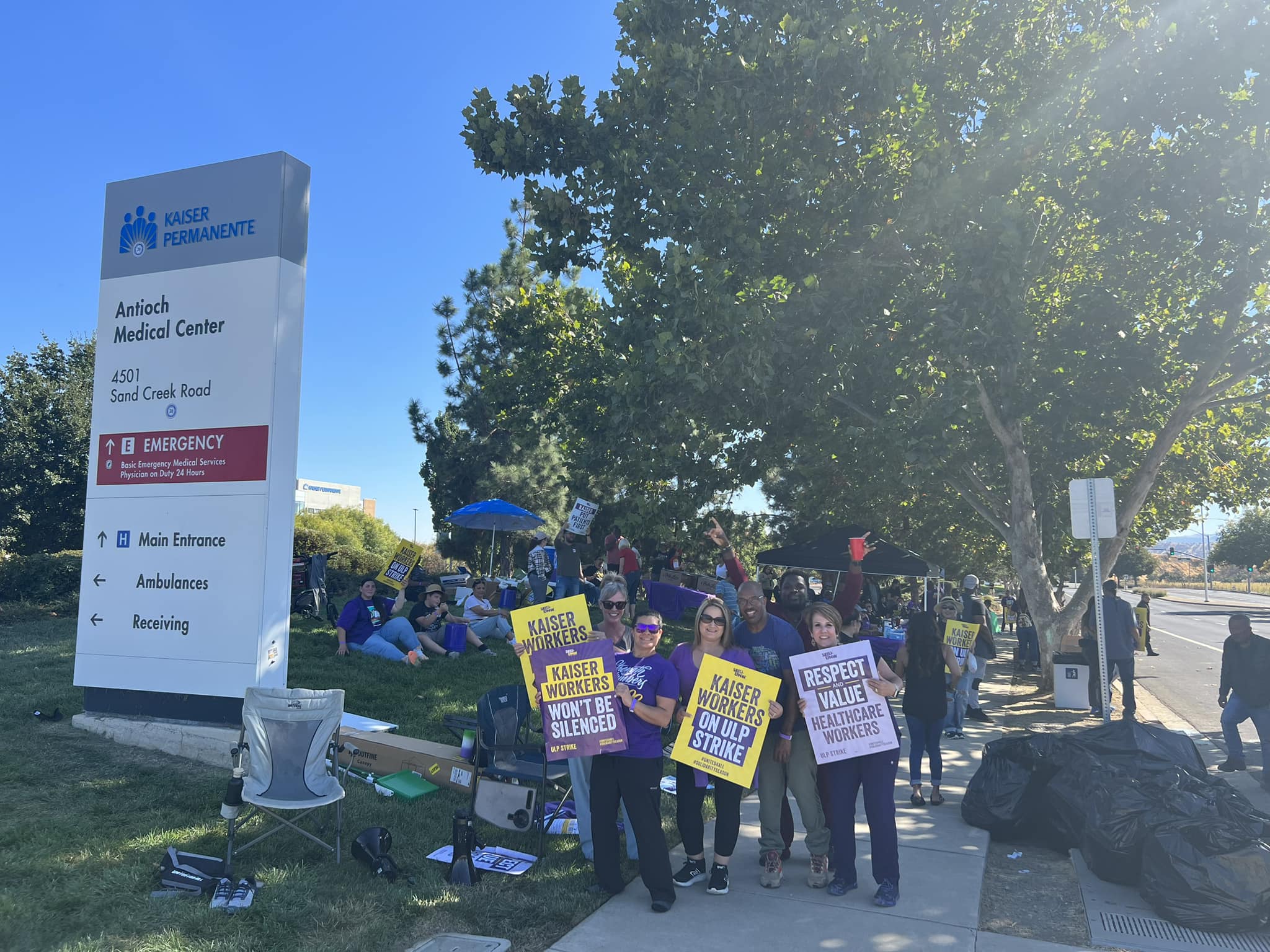
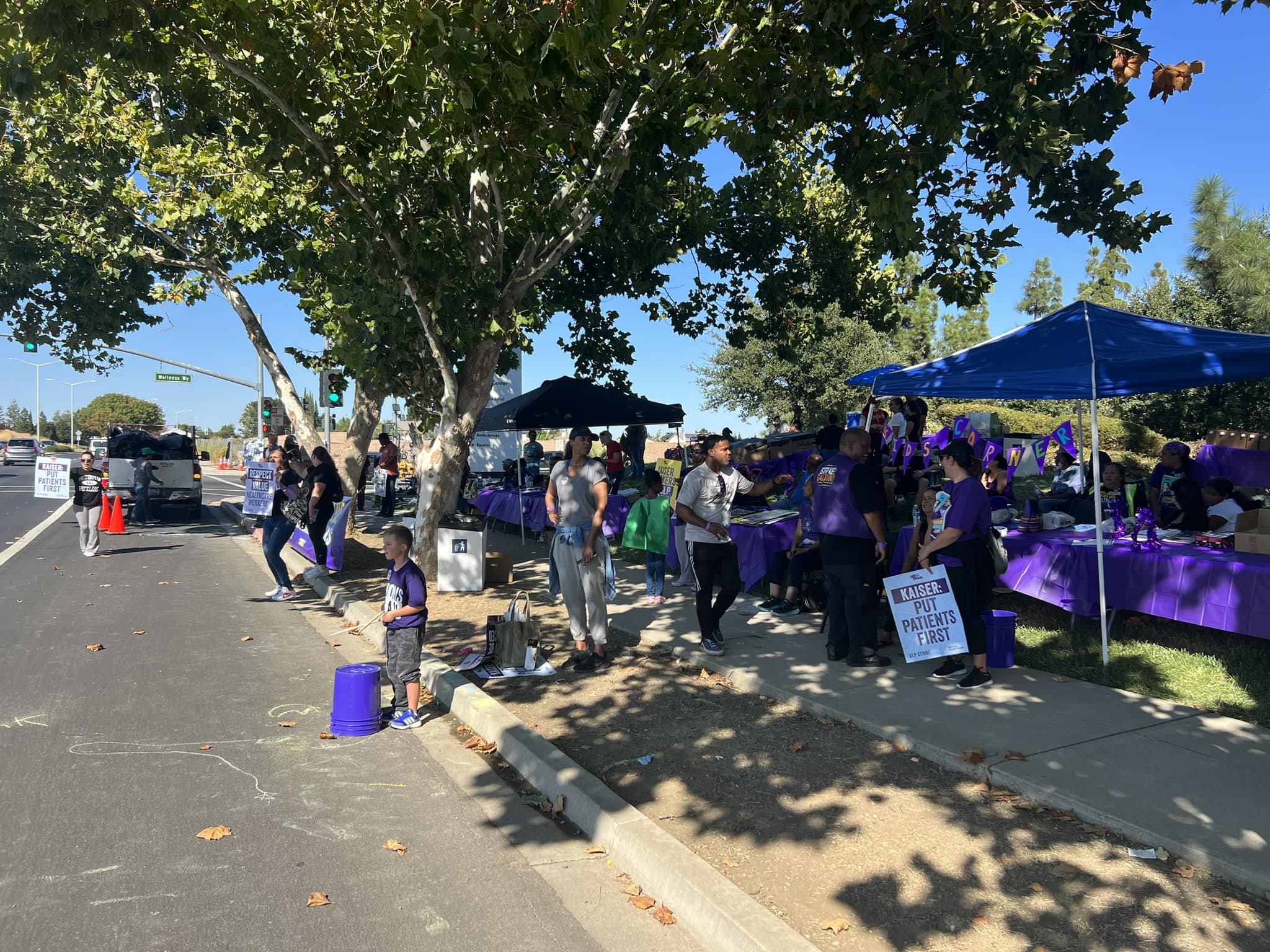
On Monday August 28, Kaiser workers in California, including Antioch, will start to vote to authorize a strike over unfair labor practices. The voting ends September 12th.   The unions will strike dates soon after we get the results of the vote. The contract expires for a large bulk of the Kaiser workers in the coalition (58,000) on September 30th, so a strike could potentially start as early as October 1.

We are expecting a majority of the workers to vote in favor of a strike. We will keep you posted on any other developments.

On Thursday, August 24, healthcare workers employed by Kaiser Permanente announced details of a potential strike authorization vote at a hybrid in-person and virtual press conference.

Following the UPS labor settlement with the Teamsters, the labor negotiations covering 85,000 Kaiser healthcare workers – represented by the Coalition of Kaiser Permanente Unions – have now become the largest single-employer labor negotiations occurring in the United States. The Coalition unites healthcare workers at Kaiser Permanente facilities in California, Colorado, Oregon, the District of Columbia, Hawaii, Maryland, Virginia, and Washington.

At issue, healthcare workers say, are a series of unfair labor practices related to contract bargaining, along with simmering staff concerns related to unsafe staffing levels that can lead to dangerously long wait times, mistaken diagnosis, and neglect.

If Kaiser executives don’t take swift action to rectify the unfair labor practices that detailed at the press conference, workers say they’ll have no choice but to strike. Workers also say the company needs to immediately and substantively address the growing care crisis at its hospitals and clinics.

Barring a breakthrough in the ongoing negotiations including a resolution of the unfair labor practices in question, the healthcare workers announced the strike authorization vote date and plans.

“Kaiser cannot keep bargaining in bad faith and committing unfair labor practices. Kaiser is facing chronic under-staffing because workers can’t afford to live in LA on the low wages they pay us,” said Miriam de la Paz, a unit secretary at Kaiser Permanente in Downey, California. “If Kaiser’s millionaire executives won’t work with us on a plan to hire more people so we can give every patient the attention they deserve, we’re prepared to vote for an unfair labor practice strike.”

“We want Kaiser to stop committing unfair labor practices, and bargain in good faith. It’s heartbreaking to see our patients suffer from long wait times for the care they need, all because Kaiser won’t put patient and worker safety first,” said Paula Coleman, a clinical laboratory assistant at Kaiser Permanente in Englewood, Colorado. “We will have no choice but to vote to strike if Kaiser won’t let us give patients the quality care they deserve.”

“Our patients expect more from a healthcare system that reported $3 billion in profits in the first half of this year alone, and so do we,” said Nahid Bokaee, a Pharmacist in Sterling, Virginia. “Kaiser can afford to end this dangerous understaffing, but they choose not to. For the sake of our patients and our colleagues, we’re prepared to authorize a strike because Kaiser cannot keep bargaining in bad faith and committing unfair labor practices.”

BACKGROUND

The Kaiser healthcare workers are members of the Coalition of Kaiser Permanente Unions, which represents more than 85,000 healthcare workers in seven states and the District of Columbia. In April, the Coalition began its national bargaining process. The Coalition and Kaiser Permanente last negotiated a contract in 2019, before healthcare workers found themselves on the frontlines of the COVID pandemic that has worsened working conditions and exacerbated a healthcare staffing crisis.

Tensions have been rising as the workers’ contract expiration looms. Earlier this month tens of thousands of healthcare workers picketed Kaiser hospitals across the U.S. to protest the company’s growing care crisis.

Workers say that Kaiser is committing unfair labor practices and also that under-staffing is boosting Kaiser’s profits but hurting patients. In a recent survey of 33,000 employees, two-thirds of workers said they’d seen care delayed or denied due to short staffing. After three years of the COVID pandemic and chronic understaffing, healthcare workers at Kaiser Permanente are calling on management to provide safe staffing levels.

Even as some frontline healthcare heroes live in their cars and patients wait longer for care, Kaiser released new financials this month indicating they made ​​$3 billion in profit in just the first six months of this year. Despite being a non-profit organization – which means it pays no income taxes on its earnings and extremely limited property taxes – Kaiser has reported more than $24 billion in profit over the last five years. Kaiser’s CEO was compensated more than $16 million in 2021, and forty-nine executives at Kaiser are compensated more than $1 million annually. Kaiser Permanente has investments of $113 billion in the US and abroad, including in fossil fuels, casinos, for-profit prisons, alcohol companies, military weapons and more.


Filed Under: Bay Area, Health, Labor & Unions, News

Kaiser eye doctor helps man see straight for first time since childhood

August 25, 2023 By Publisher 3 Comments

Patient Kyle Emard with Kaiser Permanente ophthalmologist Dr. Daniel Greninger. Photo by Allen D. Payton

“Strabismus” could affect as many as 30,000 people in Contra Costa and is correctable

“I look at the picture and go ‘wow’! I just feel good.” – patient Kyle Emard

“It’s an out-patient surgery. You go home the same day.” – Dr. Daniel Greninger

By Allen D. Payton

After living with being both cross-eyed and deaf for most of his life, 49-year-old Kyle Emard can now see straight thanks to the talent and skills of Kaiser Permanente ophthalmologist, Dr. Daniel Greninger, whose office is in Antioch. He corrected Emard’s vision impairment known as strabismus.

“After I was born my eyes would look straight ahead. But when I was five, my eyes started to go inward,” Emard shared through a sign language interpreter. “My mom asked me if I wanted surgery. I said, ‘no, no’.”

And he never did have the corrective surgery, until last year.

Kyle Emard before surgery. Photo Kaiser Permanente

“I never had any bullying,” Emard said. “I was playing football, wrestling and traveling all over the country. My grandfather had a travel agency. It didn’t bother me. People would ask me what was wrong with my eye. They thought I was blind in one eye. During conversations people would look past me, not sure which eye to look at. I’d think, ‘they’re not looking at me’. I’d say, ‘I’m looking at you’.”

“I graduated from high school. I got ready for college. Then I bought a house,” Emard continued. “My mom asked me, again if I wanted surgery, and I told her ‘no’.”

“Strabismus describes eye misalignment problems,” Greninger explained. “In Kyle’s case this is most likely attributed to accommodative esotropia. That’s a condition where a person’s eyes turn in excessively due to them trying to focus. Kyle is far sighted.”

“This is very common for eye misalignment problems,” the doctor added. “People have a hard time looking at those with strabismus.”

“Sometimes it would be a serious discussion and people would say, ‘look at me’, And I was,” Emard shared. “It was annoying.”

“For some people it’s more than annoying,” Greninger interjected. “For people with strabismus it’s a quality-of-life impact issue.”

“What is particularly unique for me from the doctor’s side of it is Kyle also has hearing impairment. He has to communicate visually,” he continued. “Sometimes people with strabismus and hearing impairment have double vision. Sometimes depth perception is affected.”

Kyle Emard wearing his first set of glasses at age 5. Photo courtesy of Kyle Emard.

Emard began wearing his first pair of glasses when he was five years old. But his vision progressively worsened, through the years.

“Kyle mainly looked out of one eye,” the doctor shared. “But surgery was done on both eyes. More on the right eye than the left.”

“For people with hearing impairment it’s called Usher Syndrome in which people have both hearing and vision impairment,” Greninger continued. “People assumed Kyle had that. Usher syndrome is a completely different genetic condition in which patients often have very significant hearing and vision deficits and are often functionally blind.  In Kyle’s case, I think people knew he was deaf, and then saw his eye drifting and assumed that he also couldn’t see due to Usher syndrome, which would be incorrect.”

“People assumed I was blind in one eye,” Emard shared.

Asked if it was difficult to read a book, watch TV or go to the movies, he said, “No.”

“His sight was fine. He could see 20/20 but he was only looking out of one eye,” the doctor replied. “If you have strabismus as a child, often the brain learns to ignore one eye to avoid seeing double.  In adults, acquired strabismus can often result in double vision. Kyle’s problem, accommodative esotropia, typically develops between 2-6 years of age, and is related to hyperopia, or far-sightedness.”

Emard said he continued to wear glasses, then mainly contacts in high school. He went snow skiing, snowboarding and dirt biking.

“I wouldn’t go up high places, just small hills,” he shared. “I played roller blade hockey, defensive end in football. That was all before.”

A graduate of Leigh High School in San Jose, Emard attended Gallaudet University in Washington, DC.

“It’s one of the best known colleges for the deaf. All the instruction is in ASL (American Sign Language),” Greninger added.

“It’s a muscle issue. There are six muscles that are attached to the eye that move it in different directions. Up and down, left and right, and torsion that twists the eye,” he explained. “In strabismus, sometimes it’s a disease of the eye muscles. More commonly it’s the brain not telling the eye to do something. Our brains are usually hardwired to know how much to turn to focus.”

Kyle Emard post-surgery. Photo Kaiser Permanente

The Surgery

Asked when he decided to have the surgery Emard responded, “After my mom passed away three years ago. My family had money. Everything I was doing was done for the deaf organization. I felt it was the right time.”

The surgery took place last September.

“I met Kyle in 2022 after I had received a referral from one of my colleagues, a consult request. We set up a video chat with an interpreter,” Greninger shared. “We do video consults, first. For this condition it’s important for me to know the history of the condition.”

“We had that first video visit. We used some remote tools which allowed Kyle to take photos and videos at home,” the doctor continued. “We were able to use the components of technology that we didn’t have five years ago. I then had him come in for a complete eye exam to make sure his eyes were healthy.”

Asked if the technology is better, Grenginer said, “It’s safer, now. It’s about an hour-and-a-half surgery.”

“I can’t go into the brain and turn a screw a quarter inch to change how the brain controls the eye,” he explained. “In the surgery, we put in an eyelid speculum, make a small incision over the white part of the eye and find where the eye muscle is located. We put in a small suture where the muscle connects to the white of the eye. Then I detach the muscle with surgical scissors and move it to a new position.  If we move it back, this creates some slack and decreases the force on the eye for turning.”

“I wear special surgical loops to help me see. But it’s all done with hands no lasers,” the doctor stated. “The amount we move the muscles is determined by the measurements we take in the office. Deciding which muscles to move and in which pattern based on the person’s problem are the intellectual work of my specialty.”

“I don’t want to over-compensate or under do it,” he continued. “It’s done in millimeter precision. We’re measuring the half-millimeter. Each millimeter moves the eye three degrees.”

“I knew I was nervous out of fear of losing my eye,” Emard shared.

“Each time I saw you I was more comfortable,” he said to the doctor.

“I don’t remember the surgery. When I woke up, I thought, ‘I’m ready’. But I looked and was shocked,” Emard exclaimed.

“It’s general anesthesia surgery so you’re asleep the whole time,” Greninger said. “We were able to get a sign language interpreter to be there in Walnut Creek the whole day, which I think is very important to give people the same level of care. I was really happy the leadership and nursing staff were able to provide that.”

“We had to move three muscles on Kyle’s eyes. One muscle on his left eye and two muscles on his right eye,” the doctor explained. “First, we relaxed the muscle on the left eye. Then on the right eye we tightened the outside muscle and relaxed the inside muscle.”

“I remember the right eye was much more red than the left,” Emard explained. “After surgery I did have double vision for a little while but then it went away. I had full vision. I could see all the way around. It was strange.”

“After the surgery I felt the same,” he added.

He used eye drops for a few a days, “but the redness lasted a few weeks,” Emard shared.

Asked how long the recovery time is Greninger said, “About six to eight weeks. I usually tell patients in two months’ time people won’t be able to tell they had the surgery. Kyle came back to see me about six months later to see if everything was fine, about March of this year.”

“Sometimes I forgot. ‘Did I have surgery?” Emard stated. “I posted and let everyone know on Facebook and showed the before and after photos and got almost a thousand likes. After my surgery I cried a lot because my mom wasn’t around to see it. But she’s happy, now.”

Emard lives in Livermore, works in Fremont as a middle school counselor and has one child, a 15-year-old son.

Asked what his son thought Emard said, “He said ‘wow!’ He was shocked. He just kept looking around my eye, opening my eye. He was used to looking at me inward.”

Kyle Emard today. Photo by Allen D. Payton

“On the day of my surgery my son was at school, and he was all worried. He said my dad’s fine and the teacher said, ‘good’. The week after he had a football game and my friend drove me. I sat alone by the goal post. I told people I didn’t want to talk yet I’m still healing. But I had to be there.”

Asked if it has impacted his job Emard said, “It’s about the same” then spoke of the difference between the school pictures from last year compared to this year.

Asked if he feels different about himself, he said, “Oh, yes. I look at the picture and go ‘wow’! I just feel good.”

“After surgery my friends were gathering and said they missed my lazy eye,” Emard said with a laugh. “I’m happy every day.”

Asked if people who have the surgery get counseling after, Dr. Greninger said, “The psycho-social impact of strabismus has been well studied.  Characters in movies with strabismus often are portrayed with other disabilities, and people may wrongly assume that all people with eye misalignment have other intellectual handicaps.  Studies have shown that childhood strabismus can negatively impact a teacher’s perception of a student’s motivation or focus.  In addition, strabismus in adulthood can sometimes be a barrier to success in the workplace or finding a romantic partner.”

“Even the term lazy eye – we don’t use that term,” he continued. “Some people despite having strabismus they use the term lazy eye. It has a certain connotation to it. We think if it as a negative There’s a misunderstanding of people with strabismus.”

30,000 County Residents Have Correctable Vision Impairment

With offices at Kaiser Permanente Antioch Medical Center on Deer Valley Road, Dr. Greninger grew up in San Ramon, graduated from Cal High and earned his undergrad at Dartmouth College. He did his residency at UCSF Medical Center in Ophthalmology followed by a Fellowship in Pediatric Ophthalmology and Adult Strabismus at Oregon Health Science University in Portland.

“I started at the Antioch Medical Center in 2013. It’s been about 10 years of offering the surgery in Contra Costa County,” the doctor shared. “About half of my practice is adult strabismus and about half are children. We do about 100 to 150 surgeries like this each year.”

“We estimate we have about 15,000 with eye misalignment problems in our service area,” Greninger stated. “Sometimes people can have a medical problem like a stroke, thyroid eye disease, a neurological condition or facial trauma from an accident or assault. They can cause eye alignment problems. Probably half my adult patients had it as children and it either came back or it was never dealt with.”

He also estimates there are as many as 30,000 people in Contra Costa County suffering from strabismus which is correctable.

“Many people have this and don’t know something can be done or has been on the back burner for a long time,” Greninger stated. “Sharing stories like Kyle’s is good to let people know something can be done. I have patients come to me and say, ‘I wish I had come to you earlier’.”

“I try to put myself in the patient’s shoes to see how they’re thinking. It’s a leap of faith for a patient. It takes a lot of bravery to trust a doctor with your eyesight,” he said.

“It’s an out-patient surgery. You go home the same day. Most of the eye surgeries are done in Walnut Creek,” Greninger added.


Filed Under: Central County, East County, Health, News, People

Lab results show Legionnaires’ Disease bacteria detected in samples linked to Richmond Spa

August 21, 2023 By Publisher Leave a Comment

Zen Day Spa front and hot tub. Source: Yelp

Two connected deaths; business remains closed

By Contra Costa Health

Laboratory testing results show that water and swab samples collected from a Richmond spa contained high levels of legionella bacteria, making it the likely source of Legionnaires’ disease among multiple customers.

Contra Costa Health (CCH) began investigating Zen Day Spa at 12230 San Pablo Avenue on Aug. 4, after area hospitals reported two deaths from Legionnaires’ disease. Both people visited the business before becoming ill.

The business voluntarily closed Aug. 5, and remains closed under a health order issued by CCH. CCH collected water and swab samples and, while still awaiting final reports from the lab, initial results show high concentrations of legionella bacteria.

CCH has contacted more than 30 recent customers of Zen Day Spa as part of its investigation, as well as recent cases of Legionnaires’ disease reported through community healthcare providers.

Beyond the two people who died with lab-confirmed Legionnaires’ disease, CCH has as of Aug. 21 identified two other people who visited the business and had lab-confirmed Legionnaires’ disease, and two people who reported becoming ill after visiting the business, whom investigators suspect had Legionnaires’ disease.

CCH will not release personal information about these people, in accordance with medical privacy laws.

Legionnaires’ disease can cause serious pneumonia. While legionella bacteria naturally live in fresh water, health concerns can arise in hot tubs and pools where the bacteria can grow if the water is not maintained properly. People can become infected after breathing mist containing the bacteria. The disease does not spread from person to person.

Hot tubs in commercial day spas or massage parlors generally require health permits and are regularly inspected by CCH. The tub at Zen Day Spa did not have a permit and was never inspected by CCH.

Given the preliminary laboratory results, CCH today issued an abatement order declaring the business a public nuisance and ordering it to contract for professional cleaning of the affected space and removal and disposal of the hot tub within 30 days to ensure the elimination of legionella. The business may not reopen until re-inspected by CCH.

CCH will be in communication with civic partners, such as municipal code enforcement programs, about investigating other spas and massage parlors across the county to ensure that those with hot tubs also have proper health permits to operate.

“Proper maintenance of hot tubs and pools is becoming increasingly important, both for businesses and private citizens who own tubs, as we continue to experience climate change,” said Dr. Ori Tzvieli, Contra Costa County health officer. “Higher temperatures make growth of legionella and bacteria more likely, and more prolific, in water that is not properly treated.”

Anyone can use CCH’s swimming pool and spa inspection database to see recent inspection results of permitted public pools and hot tubs in Contra Costa County.

People who suspect an establishment is operating a public spa without a health permit can file a complaint online or by phoning 925-608-5500. Links to both the database and complaint form are available at cchealth.org/eh.

Information about which pools and spas need permits, as well as advice and instructions about proper maintenance, are available at ccheath.org/eh/recreational-health.

Filed Under: Business, Health, News, West County

Applicants sought for Contra Costa County Hazardous Materials Commission

August 17, 2023 By Publisher Leave a Comment

WHAT: The Contra Costa County Hazardous Materials Commission seeks applicants for two open alternate seats.

The commission is a voluntary body appointed by the county Board of Supervisors that makes policy recommendations to the board and county staff regarding hazardous materials and hazardous waste.

WHO: The commission’s 14 members and alternates serve 4-year terms and include representatives from industry, labor, civic groups, environmental organizations, environmental engineers, the public and elected officials.

Open seats include the General Public Alternate and Environmental Organization Alternate seats. Alternates must be prepared to fill in as needed when commission members are not available to attend or vote.

Applicants must live or work in Contra Costa, have a demonstrated interest in hazardous materials issues, an understanding and commitment to the principles of environmental justice as defined in county policy, and be able to attend monthly meetings as needed. Candidates for the Environmental Organization Alternate seat should represent an environmental organization to which they belong.

HOW: Applications are available from Michael Kent, the executive assistant to the commission, at 925-250-3227 or mkent@cchealth.org, or from the Clerk of the Board at 1025 Escobar St., First Floor, in Martinez.

Applications may be submitted by email or by mailing them to the clerk of the board. An online application form is also available at contracosta.ca.gov/3418/Appointed-Bodies-Committees-Commissions.

WHEN: The deadline to apply is August 31. Interviews for qualified applicants will take place between 10 a.m. and 12 p.m. on September 8.


Filed Under: Government, Health

Groundbreaking maps dispel former misconception about gun homicides in California

August 9, 2023 By Publisher Leave a Comment

Source: California Gun Homicides 2014-2022 dashboard

The maps show that while urban centers are often characterized as the leading settings of gun violence, this data shows two-thirds of gun homicides occurred outside urban settings and California’s most populated cities.

By Antonia Ehlers, PR & Media Relations, Kaiser Permanente Northern California

Hope and Heal Fund in partnership with RomoGIS Enterprise today launched a groundbreaking statewide Geographical Information System (GIS) maps of gun homicides from 2014-2022. The California Gun Homicides 2014 – 2022 dashboard was collaboratively built to visualize available data of reported gun homicides and raise awareness about where gun-related homicides have occurred in California communities.

For the first time, Californians can view where gun violence happens in communities, filtered by county and showing street-level incidents. The maps reveal a compelling insight into the patterns of gun homicides in California. The maps show that approximately two-thirds of gun homicides over the past nine years occurred outside urban settings and California’s most populated cities. This finding underscores the urgent need to extend support beyond urban centers and address the rising rates of gun violence in rural, semi-rural, and suburban areas.

This research was made possible by grant funding from long-time gun violence prevention supporter Kaiser Permanente. With this support Hope and Heal Fund has also built a Northern California network of community leaders focused on gun violence data collection and mapping and to better understand when and where California gun-related deaths occur.

Cuco Rodriguez, Hope and Heal Fund’s Chief Strategist and Equity Officer led this initiative, sharing, “One important finding from the data is the need to separate and examine different types of gun homicides, particularly those related to intimate partner violence. Currently, general homicide data from law enforcement agencies often overlook the impact and frequency of intimate partner homicides, leading to misconceptions about the primary drivers of gun violence.”

Gun Homicides in Contra Costa County 2014-22.

Through further mapping and by analyzing disaggregated homicide data, we can better understand the unique challenges posed by intimate partner homicides and allocate appropriate resources to address this specific issue.

This effort initially set out to counter inaccurate assumptions regarding urban centers being drivers of gun homicides in California. With access to timely data, stakeholders should consider the implications of this information and data and how it can best be leveraged to develop opportunities that are strategic, focused, and surgical in reducing all forms of gun violence across the state.

“As a health care organization that is committed to improving health in our communities and addressing health equity, we are proud to support the work of the Hope and Heal fund to raise awareness and reduce gun-related homicides in California,” said Yvette Radford, Kaiser Permanente Northern California vice president for External and Community Affairs. “Far too often our clinical teams see the devastating effects of gun violence on individuals and families. Together with all health care organizations, we must do more to support evidence-based community interventions that prevent gun violence.”

To explore the GIS maps and gain insights into gun violence data, please visit our CA Gun Homicides GIS Mapping Report.

About Hope and Heal Fund

Hope and Heal Fund is the only state-based donor collaborative fund investing in a public health, racial equity, and community-based approach to decreasing firearm suicides and gun homicides, injuries, and trauma. Hope and Heal Fund partners with impacted communities on strategies to prevent and interrupt gun violence and heal from the trauma, harm, and generational iniquities exacerbated by the lethality and coercive effects of guns in homes and communities.

About RomoGIS Enterprises

RomoGIS Enterprises specializes in geospatial solutions, specifically GIS mapping and analysis. With its expertise in data visualization and interactive tools, RomoGIS empowers organizations to gain valuable insights and make informed decisions.


Filed Under: Crime, Health, News, State of California

Contra Costa Health investigating Legionnaires’ Disease deaths possibly linked to Richmond spa

August 5, 2023 By Publisher 2 Comments

Contra Costa Health (CCH) is investigating two recent deaths associated with legionellosis (Legionnaires’ Disease), potentially linked to visits to the Zen Day Spa at 12230 San Pablo Avenue in Richmond.

The deaths were reported to CCH on Thursday afternoon and Friday morning. Investigation of the deaths revealed both patients had reportedly visited the spa just days prior to the onset of their illnesses.

CCH is aware of a third person who was infected with Legionnaires’ Disease after using the jacuzzi tub at the Zen Day Spa in June. That patient recovered.

CCH’s Environmental Health inspectors conducted an assessment of the facility and found no existing records indicating the business has ever been issued a permit for a spa or pool. CCH closed the spa on Friday.

CCH is taking samples of the water at the spa and will send them for lab analysis to confirm the presence of legionella bacteria. Preliminary results are expected by early next week.

Legionnaires’ Disease presents as a severe form of pneumonia that can result in hospitalization yet, is treatable with antibiotics. The incubation period following exposure is typically 2 to 14 days.

CCH encourages anyone who may have recently visited Zen Day Spa to watch for symptoms of Legionnaires’ Disease. If they experience symptoms such as shortness of breath, fever, chills and cough, they should seek immediate medical care.

CCH strongly advises healthcare providers to test for legionella in patients with pneumonia who have visited Zen Day Spa within two weeks of their illness. Testing is also recommended for hospitalized patients with pneumonia of unknown cause.

Legionella bacteria are commonly found in natural freshwater sources such as lakes and streams. However, health concerns arise when these bacteria grow and spread in human-made water systems such as hot tubs.

People can become infected after breathing in small water droplets containing Legionella bacteria, which can become airborne through mist in a hot tub or via the use of hoses and faucets.

Individuals at higher risk of Legionnaires’ Disease include people over 50 years of age, those with a past or current smoking history, individuals with chronic lung disease, or those with a weakened immune system.

It is important to note that Legionnaires’ Disease does not spread from person to person.

CCH is actively working to investigate the source of the potential outbreak and to prevent further cases. Important updates will be posted on the CCH Facebook page at facebook.com/contracostahealth.

Filed Under: Health, News, West County

During labor negotiations dialysis caregivers to picket Fresenius Kidney Care, Satellite Healthcare over understaffing, low-wages, patient care crisis

August 2, 2023 By Publisher Leave a Comment

At Antioch and other locations in California; Fresenius says they’re “committed to bargaining in good faith”

By Renée Saldaña, SEIU-United Healthcare Workers West (SEIU-UHW)

Fresenius and Satellite Healthcare dialysis caregivers across California are the latest round of healthcare workers to join statewide protests over the short-staffing crisis in the state’s healthcare system. Protests will be held on August 9th and 10th at 21 locations, including Antioch, San Francisco, San Jose, San Diego, Riverside, and Orange.

“We are severely understaffed and stretched so thin. We used to have a one to three patient ratio, but over the years it’s become one to eight, and if someone calls out sick it becomes one to twelve. It happens a lot,” says Jose Manuel Gonzalez, a certified hemodialysis technician preceptor III at Fresenius Kidney Care for over 25 years. “We have to rush, to work as fast as we can, and the quality of service really suffers. I’m considering patient care, regardless of how the company treats us. The company should care more.”

In response to caregivers’ attempts to improve care and safety for dialysis patients, management has violated United States labor law. Both employers have threatened and intimidated caregivers, including firing caregivers for leading the organizing efforts and speaking out to improve patient care. The union has filed unfair labor practice charges with the National Labor Relations Board against both companies for these illegal acts, including one against Satellite Healthcare for canceling all bargaining sessions scheduled for July and August.

Legislators are also lending their support to the struggle of dialysis caregivers to improve conditions. In a letter of support, U.S. Representative Robert Garcia (D-CA-42), wrote:

“Across the industry, I understand that dialysis clinic caregivers continue to struggle with low wages, inadequate training, and chronically low staffing levels. These working conditions often lead to high turnover as caregivers leave the industry because of burnout or transfer to another healthcare sector where pay is higher. These factors deprive patients of experienced and consistent support.”

The ongoing protests by dialysis and other healthcare workers are part of a larger movement of workers across the country who are taking a stand against poor working conditions, low wages, exorbitant corporate profits, and excessive executive pay. Dialysis workers are joining over 85,000 Kaiser Permanente, Prime, and other healthcare workers who launched protests in July to improve patient care and staffing.

The chronic short-staffing in dialysis care has allowed for-profit dialysis corporations to make hundreds of millions in profits. Fresenius medical care made nearly $720 million in profits and paid its CEO nearly $5 million in compensation in 2022. Satellite Healthcare made $16.7 million in profits and paid its CEO $1.5 million in compensation in 2021.

In contrast, many dialysis caregivers make as little as $20 an hour and routinely hold two or more jobs just to make ends meet.

SEIU-UHW represents more than 600 dialysis caregivers at Fresenius and Satellite Healthcare in various job classes including registered nurses, patient care technicians, licensed vocational nurses, certified clinical hemodialysis technicians, dietitians, social workers, clinical administrative coordinators, and receptionists.

SEIU-United Healthcare Workers West (SEIU-UHW) is a healthcare justice union of more than 100,000 healthcare workers, patients, and healthcare activists united to ensure affordable, accessible, high-quality care for all Californians, provided by valued and respected healthcare workers. Learn more at www.seiu-uhw.org.

Fresenius Kidney Care Responds

In response, Fresenius issued the following statement: “There is nothing more important than the safety of our patients and our team members. In fact, in 2022, for the seventh consecutive year, Fresenius Kidney Care led the industry with 99.63% of our facilities, achieving 5-Diamond Patient Safety status, a program endorsed by the American Nephrology Nurses’ Association (ANNA) and several other organizations in the industry.

We use a staffing tool to align staffing needs with patient care requirements in order to provide safe and effective care. We constantly monitor census and staffing fluctuations and redeploy staff accordingly to maintain safe staffing levels. We maintain staff float pools and use both internal and external agency support to fill gaps.

Healthcare as an industry in general continues to face staffing challenges. We continue to address the recruitment needs where we provide care and are actively hiring for clinical care roles.

We recently began negotiations with SEIU-UHW and are committed to bargaining in good faith to reach agreements that are fair to team members and enable Fresenius Kidney Care to continue its mission of providing life-sustaining care to patients. 

We fully believe that the dedication and passion of all our team members should be recognized and rewarded. That’s why we offer competitive compensation, benefits and development programs that support our team members personally and professionally.”

Allen D. Payton contributed to this report.


Filed Under: Health, Labor & Unions, News

During bargaining Coalition of Kaiser Permanente Unions holding nationwide protests this week

July 26, 2023 By Publisher Leave a Comment

Kaiser says pickets, actions at hospitals July 24-29 aren’t strikes, facilities remain open

By Allen D. Payton

The 85,000-member Coalition of Kaiser Permanent Unions is holding nationwide pickets and actions at Kaiser hospitals and facilities, this week, July 24-29 to protest staffing shortage and wages, less than three months from their contract expiration on September 30. The two sides are in the midst of bargaining and the next session is scheduled for Tuesday, August 1. The protest at Kaiser Medical Centers in Antioch and Richmond were held yesterday, Tuesday, July 25 and the protest at Kaiser-Walnut Creek is occurring, today.

The Coalition unites 85,000 members of four international unions at Kaiser hospitals, clinics, and facilities throughout the United States.

In a July 13, 2023 post on their website labeled “Bargaining Update 4”, the coalition claims, “At bargaining this week, the ‘non-profit’ that pays its CEO $16 million a year gave a clear message to the EVS (environmental services) worker raising a family on $48K a year in LA: ‘You make too much money.’

It’s unbelievable. Kaiser pays 49 executives more than a million dollars a year, but they think a PCT (patient care technician) earning $52K a year in Portland is making Kaiser unaffordable. The corporation that has over $113 billion in investments – including questionable ventures around the world – believes they are paying healthcare workers $450 million a year too much in wages that are ‘over market.’

We will be submitting a full economic proposal – including wages – at our next bargaining session on August 1, but the fault lines in negotiations are becoming more and more clear: our Coalition spoke about how we are falling behind, struggling to afford living where we work, and losing ground to rising costs. Kaiser spoke about outsourcing more of our work to low wage, for-profit companies – undermining middle class jobs.”

The unions have offered a list of concerns and demands:

  • We want Kaiser to grow as a union company with leading wages, benefits, and quality care. Instead, Kaiser is spending $5 billion of our patients’ premiums to launch a non-union, non-partnership company that will lower labor standards.
  • We want a guaranteed PSP payout we can count on when we reach our goals. Kaiser is still defending their shameful decision to deny frontline caregivers our PSP while paying big bonuses to managers.
  • We want Kaiser to make meaningful investments in solving the staffing shortage: increase training funds, eliminate barriers to promotion, justify unposted vacancies, create paid externships, provide referral/ retention and recruitment bonuses, and dial back wasteful registry spending.

The coalition further claims, “It’s clear that the only way that we will get Kaiser to listen to us is to make some noise.”

Kaiser Responds: Not Strikes, Hospitals & Facilities Remain Open

Kaiser Permanent responded with a statement that the events are not strikes and their facilities remain open.

Following is the complete Statement from Kaiser Permanente on Coalition picketing July 24 to 29:

“It’s important for our members and patients to know that these events are not strikes. Our medical facilities will remain open and operate normally.

Kaiser Permanente is the largest union-represented health care employer in the U.S. — with nearly 75% of our employees represented by unions. We are currently bargaining with the Coalition of Kaiser Permanente Unions, which represents about 88,000 employees in a variety of roles and is part of our historic Labor Management Partnership.

Our priority is to reach an agreement that ensures we can continue to provide market-competitive pay and outstanding benefits. We are confident we’ll be able to reach an agreement that strengthens our position as a best place to work and ensures that the high-quality care our members expect from us remains affordable and easy to access.

Given where we are in the bargaining process, it’s clear the picketing by the Coalition isn’t about drawing attention to new issues, but rather an attempt to create bargaining leverage.

We have been and will continue to address the real issues that are affecting health care and our employees. On the heels of the global pandemic and given today’s economy, these challenges include inflation and rising costs to deliver health care, increasing competition from nontraditional businesses, labor shortages, supply chain disruptions, and increases in the demand for access to health care. We look to the Coalition to be a constructive partner in helping address these and other challenges affecting us all.

Staffing

The staffing challenges mentioned by the Coalition have been happening all across health care but are actually less true at Kaiser Permanente now than elsewhere.

It’s worth remembering that during the pandemic, we took extraordinary steps to support and protect our workforce. This included providing $800 million in employee assistance to ensure that front-line employees had access to alternate housing options, special child care grants, and additional paid leave for COVID-19 illness and exposure.

The average employee turnover rate across health care is 21.4% (Source: PwC Saratoga 2022 Survey). While it crept up a bit during the height of the pandemic, we are thankful that our current rate of 8.5% as of June 2023 is significantly lower than the rest of health care.

At the beginning of bargaining in April, Kaiser Permanente and the Coalition agreed to a joint goal of hiring 10,000 new people for Coalition-represented jobs in 2023. We are making great progress toward achieving that goal.

Talented people want to work at Kaiser Permanente, which is why 96% of candidates accept our employment offers, which is 5.3% above the U.S. health care industry average (Source: PwC Saratoga 2022 Survey).

Our staffing approach reflects our shared commitment to ensure every Kaiser Permanente patient receives extraordinary care, every time and in every place.

Wages and Benefits

We are one of the leaders in employee wages and benefits in every market we’re in. We offer employees market-competitive pay and outstanding benefits, opportunities to learn new skills and grow their careers, and we’re committed to providing a safe and equitable work environment. We also want to ensure that we help our employees build long-term economic security with low-cost health insurance, industry-leading retirement plans, and other benefit programs to support their health and well-being.

We have discussed with the Coalition that in some regions Kaiser Permanente is paying Coalition-represented employees up to 28% above the market average wage rates — impacting our overall costs and ability to attract new members. In other regions, we are paying at or slightly above the market average, which hurts our ability to attract new employees and retain the excellent employees we already have.

We look forward to continuing to work collaboratively with our union partners in bargaining. We will reach a great agreement. To get there, we all need to be responsible stewards of our members’ and customers’ needs and resources and be mindful of the rising costs of health care and our collective role in addressing it.”

Filed Under: Central County, East County, Health, Labor & Unions, News, West County

American Red Cross needs help to avert a blood shortage

July 26, 2023 By Publisher Leave a Comment

Chance at shark dive trip, $10 e-gift card for donors in August

Says COVID vaccines don’t pose risk to patients receiving blood transfusions

By Martin Gagliano, Regional Communications Manager, American Red Cross, Northern California Coastal Region

After a summer of declining donations, the American Red Cross needs the public’s help to prevent a blood shortage. When a donor makes and keeps an appointment to give blood or platelets in the weeks ahead, they can help ensure trauma patients, those undergoing cancer treatment, and people with lifelong blood disorders can get the blood they count on.

Right now, the Red Cross especially needs type O negative, type O positive and type B negative blood donors, as well as platelet donors. Donors of all blood types can schedule an appointment to give by downloading the Red Cross Blood Donor App, visiting RedCrossBlood.org or calling 1-800-RED CROSS (1-800-733-2767).

The Red Cross is teaming up with Warner Bros. for the theatrical release of Meg 2: The Trench to celebrate a summer of sharks and help stave off a summer blood and platelet shortage. All who come to give through Aug. 12 will be automatically entered for a chance to win a three-night New York getaway for two with a private shark dive adventure at Long Island Aquarium. Those who come to give throughout the month of August will also get a $10 e-gift card to a movie merchant of their choice. Details are available at RedCrossBlood.org/Movie.

Upcoming blood donation opportunities Aug. 1-15:

Contra Costa County

Brentwood

8/2/2023: 9 a.m. – 3 p.m., Summerset at Brentwood III, 1581 Regent Drive

8/15/2023: 9 a.m. – 3 p.m., Immaculate Heart of Mary Catholic, 500 Fairview Avenue

Danville

8/4/2023: 11:30 a.m. – 4:30 p.m., The Grange Hall, 743 Diablo Road

Hercules

8/4/2023: 9:30 a.m. – 3:30 p.m., City of Hercules, 102 Civic Drive

Pleasant Hill – Contra Costa Blood Donation Center, 140 Gregory Lane

8/1/2023: 12:15 p.m. – 6:45 p.m.,

8/2/2023: 12:15 p.m. – 6:45 p.m.,

8/3/2023: 11:45 a.m. – 6:15 p.m.,

8/4/2023: 7:45 a.m. – 2:15 p.m.,

8/5/2023: 7:45 a.m. – 2:15 p.m.,

8/6/2023: 7:45 a.m. – 2:15 p.m.,

8/7/2023: 7:45 a.m. – 2:15 p.m.,

8/8/2023: 12:15 p.m. – 6:45 p.m.,

8/9/2023: 12:15 p.m. – 6:45 p.m.,

8/10/2023: 11:45 a.m. – 6:15 p.m.,

8/11/2023: 7:45 a.m. – 2:15 p.m.,

8/12/2023: 7:45 a.m. – 2:15 p.m.,

8/13/2023: 7:45 a.m. – 2:15 p.m.,

8/14/2023: 7:45 a.m. – 2:15 p.m.,

8/15/2023: 12:15 p.m. – 6:45 p.m.

San Ramon

8/11/2023: 11 a.m. – 5 p.m., San Ramon Valley Seventh-day Adventist Church, 2260 Camino Ramon

Alameda County

Alameda

8/5/2023: 9 a.m. – 3 p.m., Alameda Community – Twin Towers United Methodist, 1411 Oak Street

Berkeley

8/10/2023: 11 a.m. – 5 p.m., Congregation Netivot Shalom, 1316 University Avenue

8/11/2023: 9 a.m. – 3 p.m., JCC East Bay, 1414 Walnut Street

Newark at Fremont – Newark Blood Donation Center, 39227 Cedar Boulevard

8/1/2023: 11:45 a.m. – 6:15 p.m.,

8/2/2023: 11:45 a.m. – 6:15 p.m.,

8/3/2023: 11:45 a.m. – 6:15 p.m.,

8/4/2023: 8:15 a.m. – 2:45 p.m.,

8/5/2023: 8:15 a.m. – 2:45 p.m.,

8/6/2023: 8:15 a.m. – 2:45 p.m.,

8/7/2023: 11:45 a.m. – 6:15 p.m.,

8/8/2023: 11:45 a.m. – 6:15 p.m.,

8/9/2023: 11:45 a.m. – 6:15 p.m.,

8/10/2023: 11:45 a.m. – 6:15 p.m.,

8/11/2023: 8:15 a.m. – 2:45 p.m.,

8/12/2023: 8:15 a.m. – 2:45 p.m.,

8/13/2023: 8:15 a.m. – 2:45 p.m.,

8/14/2023: 11:45 a.m. – 6:15 p.m.,

8/15/2023: 11:45 a.m. – 6:15 p.m.

Oakland Blood Donation Center, 5450 College Avenue

8/1/2023: 12:15 p.m. – 6:45 p.m.,

8/2/2023: 12:15 p.m. – 6:45 p.m.,

8/3/2023: 10:45 a.m. – 5:15 p.m.,

8/4/2023: 7:45 a.m. – 2:15 p.m.,

8/5/2023: 7:45 a.m. – 2:15 p.m.,

8/6/2023: 7:45 a.m. – 2:15 p.m.,

8/7/2023: 12:15 p.m. – 6:45 p.m.,

8/8/2023: 12:15 p.m. – 6:45 p.m.,

8/9/2023: 12:15 p.m. – 6:45 p.m.,

8/10/2023: 10:45 a.m. – 5:15 p.m.,

8/11/2023: 7:45 a.m. – 2:15 p.m.,

8/12/2023: 7:45 a.m. – 2:15 p.m.,

8/13/2023: 7:45 a.m. – 2:15 p.m.,

8/14/2023: 12:15 p.m. – 6:45 p.m.,

8/15/2023: 12:15 p.m. – 6:45 p.m.,

Pleasanton Blood Donation Center, 5880 W. Las Positas Boulevard, Suite 34

8/1/2023: 11:45 a.m. – 6:45 p.m.,

8/2/2023: 11:45 a.m. – 6:45 p.m.,

8/4/2023: 7:45 a.m. – 2:45 p.m.,

8/5/2023: 7:45 a.m. – 2:45 p.m.,

8/6/2023: 7:45 a.m. – 2:45 p.m.,

8/7/2023: 11:45 a.m. – 6:45 p.m.,

8/8/2023: 11:45 a.m. – 6:45 p.m.,

8/9/2023: 11:45 a.m. – 6:45 p.m.,

8/11/2023: 7:45 a.m. – 2:45 p.m.,

8/12/2023: 7:45 a.m. – 2:45 p.m.,

8/13/2023: 7:45 a.m. – 2:45 p.m.,

8/14/2023: 11:45 a.m. – 6:45 p.m.,

8/15/2023: 11:45 a.m. – 6:45 p.m.,

San Francisco – Blood Donation Center, 1663 Market Street, unless otherwise noted

8/1/2023: 11:45 a.m. – 6:45 p.m.,

8/2/2023: 11:45 a.m. – 6:45 p.m.,

8/3/2023: 11 a.m. – 4 p.m., The Ritz-Carlton, 600 Stockton Street

8/4/2023: 7:45 a.m. – 2:45 p.m.,

8/5/2023: 7:45 a.m. – 2:45 p.m.,

8/6/2023: 7:45 a.m. – 2:45 p.m.,

8/7/2023: 11:45 a.m. – 6:45 p.m.,

8/8/2023: 11:45 a.m. – 6:45 p.m.,

8/9/2023: 11:45 a.m. – 6:45 p.m.,

8/11/2023: 7:45 a.m. – 2:45 p.m.,

8/12/2023: 7:45 a.m. – 2:45 p.m.,

8/13/2023: 7:45 a.m. – 2:45 p.m.,

8/14/2023: 11:45 a.m. – 6:45 p.m.,

8/15/2023: 11:45 a.m. – 6:45 p.m.,

Santa Clara County

Gilroy

8/10/2023: 10 a.m. – 4 p.m., Interfaith – The Church of Jesus Christ of Latter-day Saints Gilroy, 7999 Miller Avenue

Los Altos

8/11/2023: 10 a.m. – 4 p.m., The Church of Jesus Christ of Latter-day Saints, Los Altos (Grant Road), 1300 Grant Road

Morgan Hill

8/8/2023: 10 a.m. – 4 p.m., Interfaith – The Church of Jesus Christ of Latter-day Saints Morgan Hill, 1790 E. Dunne Avenue

Mountain View

8/2/2023: 9 a.m. – 3 p.m., Intersect at Mountain View Chinese Christian Church, 175 E. Dana Street

San Jose Blood Donation Center, 2731 North First Street (unless otherwise noted)

8/1/2023: 12:15 p.m. – 7:15 p.m.,

8/2/2023: 10 a.m. – 4 p.m., Emmanuel Baptist Church, 467 North White Road

8/2/2023: 12:15 p.m. – 7:15 p.m.,

8/3/2023: 10:45 a.m. – 5:45 p.m.,

8/4/2023: 7:45 a.m. – 2:45 p.m.,

8/4/2023: 9 a.m. – 3 p.m., Central Christian Church, 2555 Meridian Avenue

8/5/2023: 7:45 a.m. – 2:45 p.m.,

8/6/2023: 7:45 a.m. – 2:45 p.m.,

8/7/2023: 12:15 p.m. – 7:15 p.m.,

8/8/2023: 12:15 p.m. – 7:15 p.m.,

8/9/2023: 9 a.m. – 3 p.m., Administrative Office Building (AOB), Building H, 2325 Enborg Lane

8/9/2023: 12:15 p.m. – 7:15 p.m.,

8/10/2023: 10:45 a.m. – 5:45 p.m.,

8/11/2023: 7:45 a.m. – 2:45 p.m.,

8/12/2023: 7:45 a.m. – 2:45 p.m.,

8/13/2023: 7:45 a.m. – 2:45 p.m.,

8/14/2023: 12:15 p.m. – 7:15 p.m.,

8/15/2023: 12:15 p.m. – 7:15 p.m.,

How to donate blood

To make an appointment, simply download the American Red Cross Blood Donor App, visit RedCrossBlood.org, call 1-800-RED CROSS (1-800-733-2767) or enable the Blood Donor Skill on any Alexa Echo device to make an appointment or for more information. A blood donor card or driver’s license or two other forms of identification are required at check-in. Individuals who are 17 years of age in most states (16 with parental consent where allowed by state law), weigh at least 110 pounds and are in generally good health may be eligible to donate blood. High school students and other donors 18 years of age and younger also have to meet certain height and weight requirements

Amplify your impact − volunteer!

A stable blood and platelet supply is critical to national preparedness. Additionally, as we approach the beginning of what is expected to be another active hurricane season, the Red Cross urges everyone to get ready now and consider becoming a volunteer to help people affected by the growing number of climate-driven disasters.

Support impacted communities by assisting at Red Cross shelters, using your professional skills as a licensed health care provider or becoming a member of the Red Cross Disaster Action Team. To learn more, visit redcross.org/volunteertoday.

Regarding the COVID-19 vaccines and blood donations:

  • Amid ongoing conversation about COVID-19 vaccinations and blood donation, America’s Blood Centers, the Association for the Advancement of Blood & Biotherapies (AABB), and the American Red Cross reiterate the safety of America’s blood supply and assure the public that vaccines do not pose a risk to patients receiving blood transfusions.
  • Blood donations from individuals who have received a COVID-19 vaccine approved or authorized for use in the U.S. are safe for transfusion. Similar to other vaccines such as those for measles, mumps or influenza, COVID-19 vaccines are designed to generate an immune response to help protect an individual from illness, but vaccine components themselves do not replicate through blood transfusions or alter a blood recipients’ DNA.
  • In summary, there is no scientific evidence that demonstrates adverse outcomes from the transfusions of blood products collected from vaccinated donors and, therefore, no medical reason to distinguish or separate blood donations from individuals who have received a COVID19 vaccination.
  • All blood collection organizations in the U.S. are required to follow Food and Drug Administration guidelines and regulations to collect, process and distribute blood products for patients in need. The FDA explicitly allows donors who have recently received approved or authorized COVID-19 vaccines to give blood as long as they are healthy on the day of donation and meet all other eligibility criteria. On multiple occasions, the Food and Drug Administration has confirmed that there is no evidence to support concerns related to the safety of blood donated by vaccinated individuals.
  • All Americans, including both blood donors and blood recipients, should feel confident that receiving a blood transfusion is safe. COVID-19 vaccines do not replicate, and all blood donations offer the same life-saving therapeutic benefits, regardless of the vaccination status of the donor.

Also, here is a joint statement from the AABB, the America’s Blood Centers (ABC) and the American Red Cross: https://www.aabb.org/news-resources/news/article/2023/01/30/blood-community-issues-new-joint-statement-to-combat-misinformation-regarding-vaccines-and-the-blood-supply

About the American Red Cross

The American Red Cross shelters, feeds and provides comfort to victims of disasters; supplies about 40% of the nation’s blood; teaches skills that save lives; distributes international humanitarian aid; and supports veterans, military members and their families. The Red Cross is a nonprofit organization that depends on volunteers and the generosity of the American public to deliver its mission. For more information, please visit redcross.org or CruzRojaAmericana.org, or visit us on Twitter at @RedCross.

Filed Under: Health, News

  • « Previous Page
  • 1
  • …
  • 10
  • 11
  • 12
  • 13
  • 14
  • …
  • 53
  • Next Page »
Monica's dinner 05-26 CCH
Celia's-05-26-A
Delta-RC-A (2)
Deer-Valley-Chiro-06-22

Copyright © 2026 · · Contra Costa Herald · All Rights Reserved