• Home
  • About The Herald
  • Local Agencies
  • Daily Email Update
  • Legal Notices
  • Classified Ads

Contra Costa Herald

News Of By and For The People of Contra Costa County, California

  • Arts & Entertainment
  • Business
  • Community
  • Crime
  • Dining
  • Education
  • Faith
  • Health
  • News
  • Politics & Elections
  • Real Estate

SF Bay Area road, bridge conditions, congestion and safety examined in new report

September 26, 2025 By Publisher Leave a Comment

Source: TRIP

Existing transportation funding strained by rising construction costs, population growth, potential decrease in state gas tax revenue

“115 of 1,374 bridges are rated poor/structurally deficient, with significant deterioration” – TRIP Report

By Carolyn Bonifas Kelly, Director of Communication & Research, TRIP

San Francisco, CA – While additional state and federal transportation funding is allowing California to repair and improve roads and bridges, a new report documents looming challenges including population growth, rising congestion, construction cost inflation and declining fuel-tax revenue. The report by The Road Information Program, TRIP, a national transportation research nonprofit based in Washington, DC, examines California’s road and bridge conditions, congestion and reliability, highway safety, economic development, vehicle travel trends, and the impact of recent state and federal transportation funding increases.

The TRIP report, “Keeping California Mobile: Providing a Modern, Sustainable Transportation System in the Golden State,” finds that throughout the state, traffic fatalities have increased significantly in the last decade despite recent downward trends, 50 percent of major roads are in poor or mediocre condition, five percent of locally and state-maintained bridges (20 feet or more in length) are rated poor/structurally deficient, and traffic congestion costs the state’s drivers $55 billion annually in lost time and wasted fuel. In addition to statewide data, the TRIP report includes regional pavement and bridge conditions, congestion data, highway safety data, and cost breakdowns for the Los Angeles, Riverside-San Bernardino, Sacramento, San Diego, San Francisco-Oakland and San Jose urban areas.

The TRIP report finds that 73 percent of major locally and state-maintained roads in the San Francisco-Oakland urban area are in poor or mediocre condition, costing the average motorist an additional $1,106 each year in extra vehicle operating costs, including accelerated vehicle depreciation, additional repair costs, and increased fuel consumption and tire wear. Statewide, 28 percent of California’s major roads are in poor condition and 22 percent are in mediocre condition. TRIP estimates that the state’s drivers lose $24.2 billion annually in extra vehicle operating costs as a result of driving on deteriorated roads.

In the San Francisco-Oakland area, eight percent of bridges (115 of 1,374 bridges) are rated poor/structurally deficient, with significant deterioration to the bridge deck, supports or other major components. This includes locally and state-maintained bridges that are 20 feet or longer. Statewide, five percent of California’s bridges are rated poor/structurally deficient. Most bridges are designed to last 50 years before major overhaul or replacement. In California, 54 percent of the state’s bridges were built in 1969 or earlier.

According to the TRIP report, traffic congestion in the San Francisco-Oakland area causes 111 annual hours of delay for the average motorist and costs the average driver $3,406 annually in lost time and wasted fuel. On average, San Francisco-Oakland drivers waste 38 gallons of fuel annually due to congestion. Statewide, drivers lose $55 billion annually because of lost time and wasted fuel due to traffic congestion. Due to the Covid-19 pandemic, vehicle travel in California dropped by as much as 41 percent in April 2020 (as compared to vehicle travel during the same month the previous year). By 2025, vehicle miles of travel in California had rebounded to five percent below 2019’s pre-pandemic levels. Congestion reduces job accessibility significantly. In California’s six largest metros, the number of jobs accessible within a 40-minute drive during peak hours were reduced by 44 percent in 2023 as a result of traffic congestion.

Source: TRIP

Traffic crashes in California claimed the lives of 24,508 people from 2019 to 2024. The state’s 2024 traffic fatality rate of 1.19 fatalities for every 100 million miles traveled was slightly lower than the national average of 1.2. The number of traffic fatalities and the fatality rate per 100 million vehicle miles of travel in California spiked dramatically in 2020 and 2021 before falling each year from 2022 to 2024. But, despite recent progress, from 2014 to 2024 the number of traffic fatalities in California increased 24 percent and the state’s traffic fatality rate increased 29 percent. From 2019 to 2023, 30 percent of those killed in California crashes involving motorized vehicles were pedestrians or bicyclists. In the San Francisco-Oakland area, 36 percent of traffic fatalities between 2019 and 2023 (306 of 934) were pedestrians or bicyclists.

“California’s future depends on transportation infrastructure that can withstand the challenges of a changing climate and a growing population,” said Senator Dave Cortese, chair of the California Senate Transportation Committee. “These investments don’t just move people and goods—they cut emissions, strengthen communities, create jobs, and spur economic growth. The TRIP report makes clear that smart infrastructure investments are among the most powerful tools we have to support California’s workforce and drive long-term economic prosperity.”

Improvements to California’s roads, highways and bridges are funded by local, state and federal governments. In April 2017, the California legislature enacted SB 1 — the Road Repair and Accountability Act. SB 1 increased state revenues for transportation by increasing the state’s gasoline and diesel taxes, implementing a transportation investment fee on vehicles and initiating an annual fee on zero emission vehicles. SB 1 is estimated to increase state revenues for California’s transportation system by an average of $5.2 billion annually through to 2027. In addition to state transportation funding, the Infrastructure Investment and Jobs Act (IIJA), signed into law on November 2021, provides $25.3 billion in federal funds to the state for highway and bridge investments in California over five years, representing a 29 percent increase in annual federal funding for roads and bridges in the state over the previous federal surface transportation program. The IIJA is set to expire on September 30, 2026.

“California’s transportation system is the backbone of our daily lives, connecting millions of people to work, school, and opportunity,” said Assemblymember Lori Wilson, chair of the California State Assembly Transportation Committee. “The TRIP report provides the proof points behind what we already know: our infrastructure needs are urgent and growing. As we transition to cleaner vehicles and more sustainable mobility, we must secure fair and reliable funding solutions to ensure tomorrow’s infrastructure serves Californians better than today’s.”

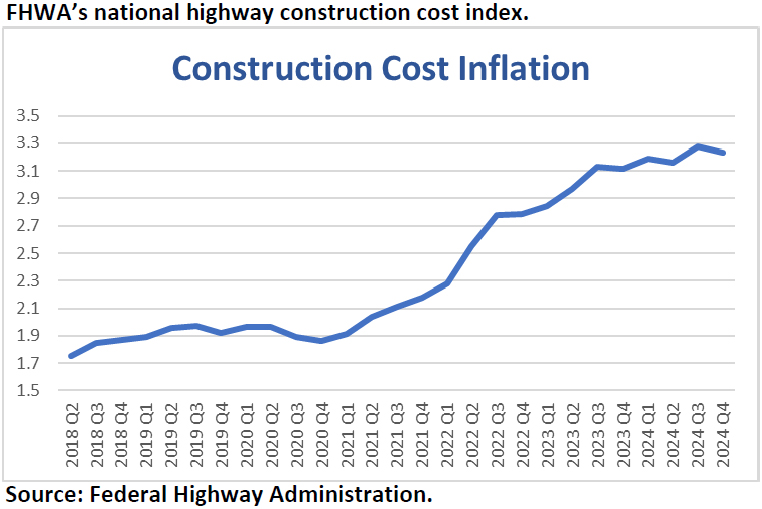
The ability of revenue from California’s motor fuel tax – a critical source of state transportation funds – to keep pace with the state’s future transportation needs is likely to erode as a result of increasing vehicle fuel efficiency, the increasing use of electric vehicles and inflation in highway construction costs. The Federal Highway Administration’s national highway construction cost index, which measures labor and materials cost, increased by 48 percent from the beginning of 2022 through the fourth quarter of 2024.

The California Legislative Analyst’s Office (LAO) found that steps taken by California to reduce greenhouse gas emissions, including programs and policies that are targeted at increasing the adoption of zero-emission vehicles (ZEVs), increasing the use of lower-carbon fuels, and reducing the number of vehicle miles traveled will reduce state transportation revenues by $4.4 billion over the next decade. This reduction in state transportation spending which is projected to result in poorer road conditions. However, the recent federal rollbacks to California strict emissions requirements will impact these programs and policies.

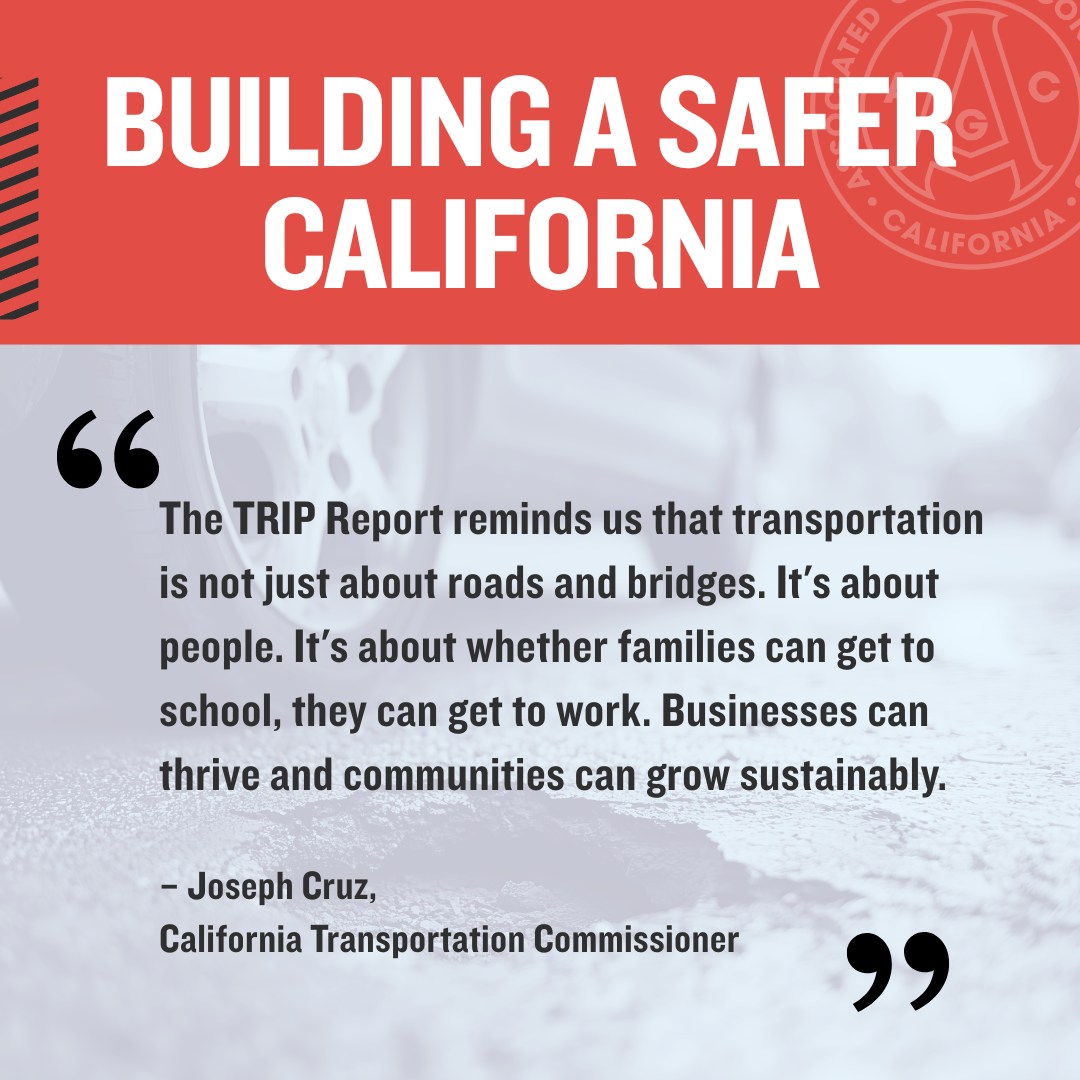
“Our deteriorating transportation system costs Californians lives, time, and money,” said California Transportation Commissioner Joseph Cruz. “Every investment in improving and maintaining our roads, bridges, and transit networks is an investment in people. These projects don’t just build infrastructure – they create good jobs, support local economies, and ensure California’s workforce is at the center of the solution.”

Source: TRIP

The efficiency and condition of California’s transportation system, particularly its highways, is critical to the health of the state’s economy. In 2023 California’s freight system moved 1.4 billion tons of freight, valued at $2.8 trillion. From 2022 to 2050, freight moved annually in California by trucks is expected to increase 65 percent by weight and 100 percent by value (inflation-adjusted dollars). The design, construction and maintenance of transportation infrastructure in California supports approximately 420,000 full-time jobs across all sectors of the state economy. Approximately 7.1 million full-time jobs in California in key industries like tourism, retail sales, agriculture and manufacturing are dependent on the quality, safety and reliability of the state’s transportation infrastructure network.

“California’s transportation dollars are already being stretched thin by increased inflation in construction costs and declining fuel tax revenue,” said Dave Kearby, TRIP’s executive director. “Without additional transportation investment, needed projects that would make the state’s roads safer, smoother and more efficient will not move forward.”

Filed Under: Finances, Government, Infrastructure, News, State of California, Transportation

Contra Costa Health Plan achieves high rating for patient care 

September 17, 2025 By Publisher Leave a Comment

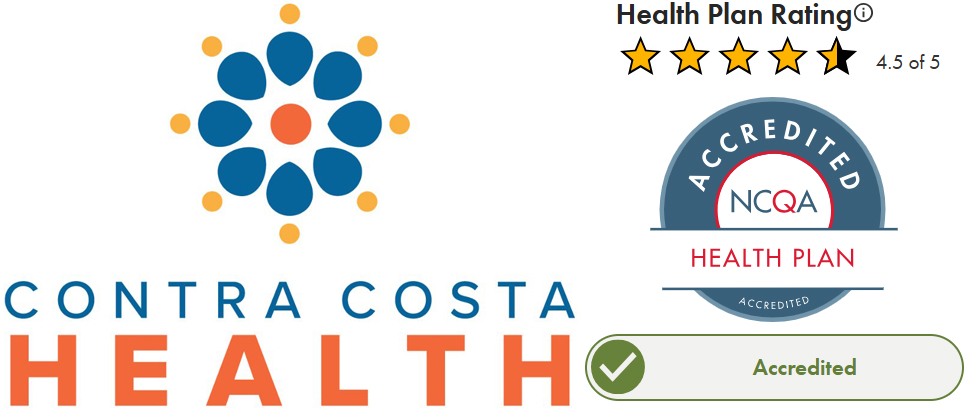
NCQA annual report card gives the HMO 4.5 out of 5 stars

The National Committee for Quality Assurance (NCQA), the national evaluator of health insurance plans, has once again recognized Contra Costa Health Plan (CCHP) as one of the highest rated health plans in the nation and among the best in California for patient experience and quality of care.

Among health maintenance organizations (HMOs) offering Medi-Cal, CCHP was one of the top three plans in California to be awarded 4.5 out of 5 stars, the highest level awarded this year, on NCQA’s annual report card.

CCHP was also one of just 14 Medicaid plans in the United States to receive 4.5 out of 5 stars, achieving exceptionally high marks among patients for treatment and preventative care including children and women’s care and cancer screening.

“Being recognized among the nation’s top health plans is a huge accomplishment for our staff, providers and partners,” said Supervisor Candace Andersen, Chair of the Board of Supervisors. “This rating shows that our community trusts and values the care that we provide and encourages us to keep pushing towards our goal to deliver high-quality care and improve the health of our community.”

For over 50 years, Contra Costa Health has provided high-quality, affordable coverage through CCHP. CCHP was the nation’s first federally qualified, state-licensed, county-sponsored HMO.

“I’m so proud of the work this team has done to enable us to get this excellent rating and to serve the people of Contra Costa County,” Contra Costa Health CEO Dr Grant Colfax said. “We will continue to address community health priorities, and we look forward to what we can accomplish together in this next year.”

CCHP’s high marks and recognition by NCQA are a direct result of the exemplary care and patient support provided by Contra Costa Regional Medical Center and Health Centers, community clinics in CCHP’s community provider network, and CCH’s Public Health and Behavioral Health divisions. Altogether, CCHP touches about 271,000 members, including 265,000 Medi-Cal enrollees.

Visit Contra Costa Health Plan to learn more about CCHP, including how to enroll if you need healthcare, or call 1-800-211-8040 weekdays.

About NCQA: NCQA is a private, nonprofit organization dedicated to improving health care quality. NCQA accredits and certifies a wide range of health care organizations. It also recognizes clinicians and practices in key areas of performance. NCQA’s Healthcare Effectiveness Data and Information Set (HEDIS®) is the most widely used performance measurement tool in health care. NCQA’s website (ncqa.org) contains information to help consumers, employers and others make informed health care choices. NCQA can also be found at Twitter/X @ncqa and on LinkedIn at linkedin.com/company/ncqa.

Filed Under: Government, Health, Honors & Awards, News

Contra Costa County’s 7th Annual Block Party in Antioch Aug. 28

August 22, 2025 By Publisher Leave a Comment

One Stop for Your County Services in collaboration with Supervisor Diane Burgis and the City of Antioch

Come to Contra Costa County’s 7th Annual Block Party!

Date: Thursday, August 28

Time: 4:00 PM – 7:00 PM

Location: Antioch Community Center, 4703 Lone Tree Way

Contra Costa County, in partnership with the City of Antioch and Supervisor Diane Burgis, is bringing its annual Block Party to East County.

Contra Costa County, the Clerk-Recorder-Elections Department, the Employment & Human Services Department, County Public Works and Contra Costa Health along with the City of Antioch are partnering to provide a fun, festive event that offers a wide variety of on-the-spot government services at one single location. This will be the seventh year of the increasingly popular event, providing opportunities throughout the County to learn what’s available to you as a Contra Costa County resident.
Please submit your request at least 72 hours in advance to help ensure availability.

Available services at the Block Party include: Sign-ups for CalFresh, Medi-Cal, and CalWORKs, information about childcare and preschool options, Records within Reach from Clerk-Recorder’s Office, Voter Registration, Contra Costa Television (CCTV) — and many more County programs.

County Departments & Programs                     

  • 4 Our Families Navigators (EHSD)
  • Clerk-Recorder-Elections
  • Community Services Bureau (EHSD)
  • Contra Costa Television
  • Information & Assistance (EHSD)
  • Public Works – Flood Control District
  • Public Works – Transportation Engineering
  • Supervisor Diane Burgis, District 3

If you require an accommodation to participate in the Contra Costa County Block Party, please contact Diane Truong, Public Facilities ADA Program Manager, at (925) 335-1436 or email Diane.Truong@riskm.cccounty.us.

Filed Under: Community, East County, Government

Board of Supervisors appoints new Contra Costa Health Director

August 16, 2025 By Publisher Leave a Comment

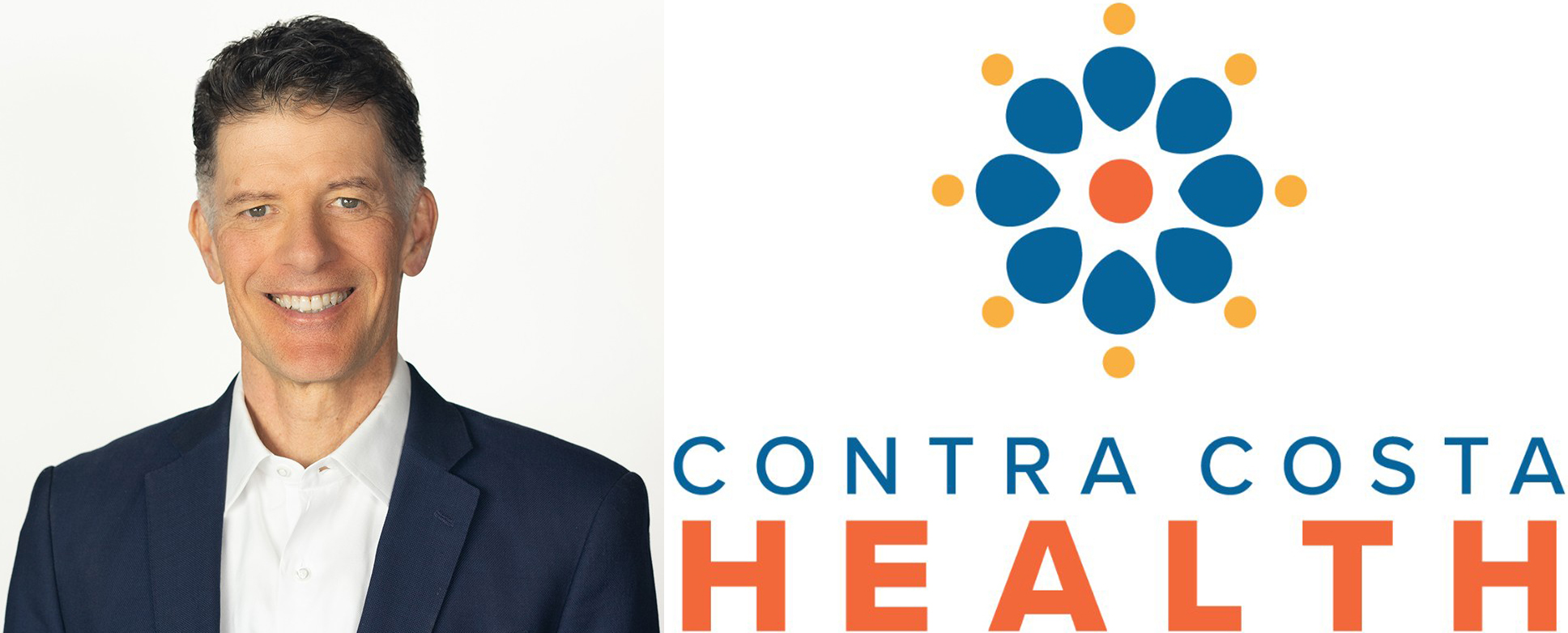
Dr. Grant Colfax. Source: Contra Costa County

Dr. Grant Colfax previously served in San Francisco & Marin counties, Obama administration

Will be paid $708,000 per year in salary and benefits

By Kristi Jourdan, PIO, Contra Costa County

(Martinez, CA) – The Board of Supervisors on Tuesday appointed Dr. Grant Colfax as the Director of Contra Costa Health (CCH), effective August 19, 2025. He replaces Dr. Ori Tzvieli who served as interim Director of Health Services following the February retirement of longtime CCH CEO and Health Director Anna M. Roth. Tzviele will continue to serve as the County’s Health Officer.

Dr. Colfax brings decades of experience in health leadership and a deep commitment to health equity, innovation, and community-centered care. He most recently served as the Director of Health for the City and County of San Francisco, where he guided one of the nation’s most robust local responses to the COVID-19 pandemic. He previously served as Director of the White House Office of National AIDS Policy during the Obama administration and as Director of HIV Prevention and Research at the San Francisco Department of Public Health.

While in San Francisco, Dr. Colfax led a 9,000-person health department with a $3.2 billion budget, overseeing an acute care hospital and Level 1 trauma center, behavioral health, primary care, detention health, and population health.

He holds a Bachelor of Science in Biology from Harvard College and a Doctor of Medicine from Harvard Medical School.

“We are thrilled to welcome Dr. Colfax to Contra Costa County,” said Board Chair Candace Andersen, District 2 Supervisor. “His visionary leadership and deep understanding of public health systems will be invaluable as we work to expand access to care, address longstanding health disparities, and support the overall well-being of our communities.”

Dr. Colfax replaces Dr. Ori Tzvieli, who served as interim director during the executive search and will remain Contra Costa County’s Health Officer.

“We thank Dr. Tzvieli for his steadfast leadership during this time of transition, and I want to express my gratitude that he will continue as the County’s Health Officer,” Supervisor Andersen added.

Dr. Colfax will oversee a comprehensive integrated health system that includes a nationally recognized public hospital, regional health centers, behavioral health services, emergency medical services, environmental health, and public health operations serving over 1.2 million county residents.

“I am honored to join Contra Costa Health and to serve a community that values collaboration, compassion, and equity,” said Dr. Colfax. “I look forward to working with the incredible staff and partners across the County to improve outcomes and ensure that every resident—regardless of background or circumstance—has access to quality, dignified care.”

The cost to fund the Director of Health Services for the remainder of the fiscal year is about $619,000. Annual ongoing costs are estimated at about $708,000. These expenses are budgeted for the 2025–26 fiscal year.

Asked about the figures Contra Costa County PIO Jourdan responded, “That $708,000 figure includes salary plus benefits. The $619,000 is what’s available given the time left in the fiscal year.”

About Contra Costa Health

Contra Costa Health (CCH) is a comprehensive county health system committed to providing high-quality services with a focus on equity and access. From its nationally ranked Contra Costa Regional Medical Center and Health Centers to its innovative Behavioral Health, Public Health, and Emergency Medical Services divisions, CCH serves as a cornerstone of wellness for more than a million residents across the county.

Allen D. Payton contributed to this report.

Filed Under: Government, Health, News, People

Martinez Animal Hospital to pay $20,000 to settle EEOC retaliation charge

August 8, 2025 By Publisher Leave a Comment

Hospital conciliates allegations that it fired employee for objecting to religious concepts in mandatory training

Commission staff refuse to share the religious content included

By Office of Communications & Legislative Affairs, U.S. Equal Employment Opportunity Commission

MARTINEZ, Calif. – Martinez Animal Hospital has agreed to provide $20,000 to a former employee following an investigation by the U.S. Equal Employment Opportunity Commission (EEOC), the federal agency announced on Tuesday, August 5, 2025.

According to the EEOC’s investigation, the hospital subjected an employee to mandatory training which he objected to because it incorporated religious content contrary to his beliefs; he also requested to be excused from any future trainings with similar content. The EEOC investigation concluded he was terminated within days.

Such alleged conduct violates Title VII of the Civil Rights Act, which prohibits retaliation by an employer because a worker engaged in protected activity, such as making a request for a religious accommodation.

“I expressed my concerns to management over training I was required to attend and was soon fired,” said the worker. “I’m very glad the EEOC defended my right to speak up and ask for a religious accommodation, such as an exemption from religious-based content that made me uncomfortable.”

“We commend Martinez Animal Hospital for their commitment to preventing any future retaliation,” said Carlos Rocha, federal investigator and director of the EEOC’s Oakland Local Office. “This case should serve as a reminder for employers to train supervisors and representatives to recognize what may constitute protected activity under federal EEO laws and how to respond in a way that does not interfere with workers’ rights.”

Following the investigation, the parties engaged in the EEOC’s pre-litigation conciliation process, resulting in a settlement requiring the hospital to provide back pay and compensatory damages; revise its non-discrimination policies and procedures; conduct training for all employees, managers and human resources personnel; post a notice concerning equal employment opportunity rights in English and Spanish; track all accommodation requests; and report to the agency for two years.

For more information on retaliation generally, please visit https://www.eeoc.gov/retaliation, and for guidance on retaliation in the context of religious accommodation, please see section 12–V, part B., in EEOC’s Guidance on Religious Discrimination.

The EEOC’s San Francisco District has jurisdiction over Northern Nevada, Northern California, Washington, Alaska, Oregon, Idaho and Montana.

The EEOC is the sole federal agency authorized to investigate and litigate against businesses and other private sector employers for violations of federal laws prohibiting employment discrimination. For public sector employers, the EEOC shares jurisdiction with the Department of Justice’s Civil Rights Division; the EEOC is responsible for investigating charges against state and local government employers before referring them to DOJ for potential litigation. The EEOC also is responsible for coordinating the federal government’s employment antidiscrimination effort. More information about the EEOC is available at www.eeoc.gov. Stay connected with the latest EEOC news by subscribing to our email updates.

Multiple efforts to reach Rocha and District Director Christopher Green asking what was the religious content in the training and for any documents from the investigation that can be shared were unsuccessful prior to publication time.

8/11/24 UPDATE: Later, an EEOC spokesperson responded, “We have no comment beyond the release.”

A federal Freedom of Information Act request was then submitted for any and all documents related to the case and the religious content included in the training.

Please check back later for any additional updates.

Allen D. Payton contributed to this report.

Filed Under: Animals & Pets, Central County, Government, Legal, News

Final vote by BCDC on Richmond-San Rafael Bridge lane use Thursday, Aug. 7

August 6, 2025 By Publisher Leave a Comment

To either keep the bike-pedestrian path open 24/7 or allow conversion to breakdown lane every Mon.-Thurs.

By 511 Contra Costa

On Thursday, August 7, 2025, the San Francisco Bay Conservation and Development Commission (BCDC) will decide whether to keep the Richmond-San Rafael Bridge bike-pedestrian path open 24/7 or allow it to be converted to a breakdown lane every Mon.-Thurs. Submit comments in advance or attend meeting (virtually or in person). The meeting will last from 10:00 am – 5:00 pm.

This Commission meeting will operate as a hybrid meeting under teleconference rules established by the Bagley-Keene Open Meeting Act. Commissioners are located at the primary physical location and may be located at the teleconference locations specified below, all of which are publicly accessible. The Zoom video conference link and teleconference information for members of the public to participate virtually are also specified below.

Primary physical location

Metro Center
375 Beale Street, Board Room, San Francisco

415-352-3600

Teleconference locations

  • Earl Warren Hiram W Johnson Building: 455 Golden Gate Ave., San Francisco, CA 94102
    • 100 Howe Ave., Ste. 100 South, Sacramento, CA 95825
    • City Hall: 701 Laurel St., Allied Arts Rm., Menlo Park, CA 94025
    • 675 Texas St., Ste. 6002, Fairfield, CA. 94533
    • 176 E. Blithedale Ave., Mill Valley, CA 94941
    • 197 Palmer Ave., Falmouth, MA 02540
    • 1195 Third St., Ste. 310, Napa, CA, 94559
    • 890 Osos St., Ste. H, San Luis Obispo, CA 93401
    • 500 County Center, 5th Fl., Buckeye Conf. Rm., Redwood City, CA 94063
    • 2379 Sheffield Dr., Livermore, CA 94550
    • 1021 O St., Sacramento, CA 95814

If you have issues joining the meeting using the link, please enter the Meeting ID and Password listed below into the ZOOM app to join the meeting.

Join the meeting via ZOOM

https://bcdc-ca-gov.zoom.us/j/87295886829?pwd=my206SeP5kGy5bSz3kcbUFbbbCgxYK.1

Live Webcast

See information on public participation

Teleconference numbers
1 (866) 590-5055
Conference Code 374334

Meeting ID
872 9588 6829

Passcode
891700

If you call in by telephone:

Press *6 to unmute or mute yourself
Press *9 to raise your hand or lower your hand to speak

Details: http://511cc.org/rsrbridge

For more information about the BCDC visit

Filed Under: Government, News, Transportation, West County

EXCLUSIVE: 44-year-old federal race-based hiring mandate named for Antioch resident ends

August 4, 2025 By Publisher Leave a Comment

Angel G. Luévano. Photo by Luis Nuno Briones. Source: Todos Unidos

Luévano Consent Decree determined in 1981 written civil service test unfair to Black and Hispanic applicants

“Today, the Justice Department removed that barrier and reopened federal employment opportunities based on merit—not race.” – U.S. Assistant Attorney General Harmeet K. Dhillon on Aug. 1, 2025.

“The Decree has had its usefulness and a tremendous effect on the country. Millions of minorities and women hold jobs because of that class action lawsuit. It wasn’t DEI. It didn’t just benefit minorities and women. The Outstanding Scholar Program…was actually used 70% by whites.” – Angel Luévano

By Allen D. Payton

On Friday, August 1, 2025, Assistant Attorney General Harmeet K. Dhillon announced that the Civil Rights Division of the U.S. Department of Justice (USDOJ) had ended a 44-year-old decree mandating race-based government hiring. It’s named for Antioch resident Angel G. Luévano, who, with a group of attorneys in 1979, brought a class action lawsuit on behalf of African Americans and Hispanics over the Professional and Administrative Career Examination (PACE). They claimed disparate impact against them based on their test results violated Title VII’s equal employment opportunity provision of the Civil Rights Act of 1964. Dhillon claimed the decree “imposed draconian test review and implementation procedures” on the Office of Personnel Management (OPM).

The 1979 Luévano v. Campbell lawsuit, against the then and first Director of the Officer of Personnel Management, Alan Campbell, resulted in a settlement during the final days of President Jimmy Carter’s Administration, just prior to President Ronald Reagan’s inauguration, eliminating use of the PACE test. According to court documents filed in March 2025 by the USDOJ, “on January 9, 1981, after two years of litigation, Plaintiffs and OPM jointly moved for ‘an order granting preliminary approval to a Consent Decree.’ Luevano, 93 F.R.D. at 72. The parties signed the Decree eleven days prior to the change in administration, and the Court accepted the Decree on February 26, 1981.”

In addition, according to the Civil Rights Litigation Clearing House Case Summary, in the Decree the “federal government in part agreed to…establish two special hiring programs, Outstanding Scholar and Bilingual/Bicultural.”

The lawsuit title was later changed to Luevano v. Ezell, named for Charles Ezell, the current Acting OPM Director. This year’s court filing reads, “Federal law requires many federal jobs be filled based on merit alone. Beginning in 1974, OPM employed a test to do just that. The Professional and Administrative Career Examination (‘PACE’) was a challenging, written examination that measured cognitive and other skills. It quickly proved an effective way of predicting future job performance, thereby increasing the efficiency and capability of the federal workforce. But it did not last long.”

In a Aug. 1 post on Dhillon’s official X (formerly Twitter) account she wrote, “Another federal government DEI program bites the dust! Today, the @CivilRights Division ended a 44-year-old decree that bound the federal government to use DEI in its hiring practices” and shared the news release from the USDOJ announcing the end to the decree:

“Today, the Justice Department’s Civil Rights Division ended a court-imposed decree initiated by the Carter administration, which limited the hiring practices of the federal government based on flawed and outdated theories of diversity, equity, and inclusion.

In Luevano v. Ezell, the Court dismissed a consent decree based on a lawsuit initially brought by interest groups representing federal employees in 1979. The decree entered in 1981 imposed draconian test review and implementation procedures on the Office of Personnel Management—and consequently all other federal agencies—requiring them to receive permission prior to using any tests for potential federal employees, in an attempt to require equal testing outcomes among all races of test-takers.

“For over four decades, this decree has hampered the federal government from hiring the top talent of our nation,” said Dhillon. “Today, the Justice Department removed that barrier and reopened federal employment opportunities based on merit—not race.”

“It’s simple, competence and merit are the standards by which we should all be judged; nothing more and nothing less,” said U.S. Attorney Jeanine Pirro for the District of Columbia. “It’s about time people are judged, not by their identity, but instead ‘by the content of their character.’”

Luévano Responds

In response to the decree’s dismissal, Luévano said, “I agreed to vacate the Decree through the Mexican American Legal Defense and Education Fund (MALDEF) because I don’t want to make bad law. There are two interveners on the other side that wanted to broaden the attack.”

Asked when he agreed to it, he said, “Last week. Attorneys for both sides met with the judge last Thursday to resolve the matter.”

“The Decree has had its usefulness and a tremendous effect on the country,” Luévano continued. “Millions of minorities and women hold jobs because of that class action lawsuit. The Decree affected 118 job classifications in federal hiring nationwide.”

“I’m extremely proud of the effect that it has had on federal hires and getting minorities and women into federal jobs,” he stated. “It affected my decision to join, it was the key for me to join federal civil rights compliance in the Labor Department.”

Asked why he was the lead plaintiff he said, “I took the PACE exam because I wanted to get into a federal job. I achieved an 80 on the test – a passing grade, even though it’s been reported I flunked the exam. That’s not true. The result was I did not get referred to federal openings. They were only referring people with a 100 on their tests to jobs.”

“I learned about the case through the Legal Aid Society which had brought many cases in the construction industry. Our unit was successful in getting the Freedom of Information Act (FOIA) to be effective. I went to them and said, ‘that happened to me’ in the Office of Personnel Management. That’s the lead HR department in the federal government. They’re the gatekeepers to federal employment.”

“I asked them, is there something we can do about this. They said, ‘funny you should ask. We are looking for someone to do something about this’ and we began working on the lawsuit,” he shared.

“One of the things I was able to achieve was alternatives to merit selection in federal employment, the Outstanding Scholar and Bilingual/Bicultural programs that each agency implemented,” Luévano stated.

“I gave up back pay and also the class, to get them to agree to the decree,” he continued. “When you win a case, you usually get a settlement. But I was the one who gave up back pay for myself and for the class to get those two remedies. That was really big. That is huge. Who gets alternatives to merit-based hiring at the national level? They used it to bring in minorities and women.”

“It wasn’t DEI. It didn’t just benefit minorities and women. The Outstanding Scholar Program as an alternative to discriminatory merit-based hiring was actually used 70% by whites,” he stated. “But that’s OK. I wanted to crack the discriminatory employment barriers to federal hiring.”

“When I was in D.C. I met with the second in command at the OPM, while we were in Puerto Rico. He said, ‘Angel, you know it’s not what you know. It’s who you know. I said to him, ‘I know you!’ He replied, ‘But I don’t have any power.’ I’ve learned that every where I’ve gone. As you go up the ladder it gets narrower and narrower and harder and harder.”

“We used the impact theory to prove there was discrimination. There are only two theories, that one and disparate treatment,” Luevano explained.

“I negotiated through my lawyers,” he continued. “We had a lot of attorneys. They included the Lawyers Committee for Civil Rights out of D.C., MALDEF, the Puerto Rican Legal Defense Fund, NOW, and the Legal Aid Society of Alameda County where I worked out of Oakland as a senior law clerk in the impact litigation unit.”

He started as a summer management intern with the General Services Administration as a GS-5 employee in 1972 while in law school. Then he went to work for the Department of Defense compliance division in Burlingame.

They merged all the compliance divisions under the Labor Department.

“They leaped me from a GS-9 to a 12,” he stated. “So, I skipped 10 and 11. I met all of the qualifications.”

He ultimately rose to the level of a GS-15 as Deputy Director of Program Operations for the Labor Department’s Office of Federal Contract Compliance Programs.

“I was number four in the agency nationwide and retired after 30 years in government,” Luevano shared. “That happened to a guy who wouldn’t have even gotten into a federal job because of PACE. Yet, I was qualified, I earned it and I moved up.”

“I had a great career. I helped write the regulations on how to detect employment system discrimination and I trained the trainers nationwide,” he continued. “That was because of my law background. I went to Hastings for four years. Even though I don’t have the degree, I have the equivalent of a Master’s in Law.”

About the timing for the lawsuit settlement Luévano shared, “Our lawyers showed up. Their lawyers showed up, the attorneys for the outgoing Carter Administration. The attorneys for the Reagan Administration showed up and wanted to put a stop to the resolution of the Consent Decree. The judge said, ‘No, you’re not in power, yet.’”

“We were all happy, we signed the Decree and made history,” he stated. “I’m humbled by this tremendous achievement.”

Luévano was recognized for his efforts at one of the conferences of LULAC, the League of United Latin American Citizens, in which he later rose to the level of California State Director and V.P for the Far West. Image de California gave him an award during one of their conferences at which he spoke about the Consent Decree.

“If we hadn’t accomplished that we’d still be back in the dark ages of discrimination,” Luévano stated.

“I’m actually writing a book, a memoir about it,” he added. “I’m working with Harvard on that.”

Luévano even has his own Wikipedia page.

He and his wife Argentina have been involved in the Antioch community with the Kiwanis Club of the Delta-Antioch, where he was president last year and Argentina is currently secretary. They both also served as Lt. Governors for the organization in Division 26, Area 9 in Northern California. Then Angel was elected as Trustee for the entire Division which includes California, Nevada and Hawaii.

In addition, since May 2004, Angel has also served as Executive Director for Todos Unidos, an Antioch-based non-profit organization established to raise the educational, economic, health and social outcomes of underserved communities along the Suisun Bay and the greater San Joaquin Delta area.

Filed Under: DOJ, East County, Government, Jobs & Economic Development, Legal, News

BART seeks professionals to serve as members for RR Bond Oversight Committee

August 1, 2025 By Publisher Leave a Comment

1 Civil Engineer, 1 Electrical Engineer and 1 Certified Public Accountant

By San Francisco Bay Area Rapid Transit District

BART is recruiting volunteer candidates to fill three vacant seats on the Measure RR Bond Oversight Committee. The committee provides diligent and public oversight of the expenditure of funds from bond sales associated with Measure RR, which is a $3.5 billion bond measure approved by BART District voters in 2016 to rebuild the system’s core infrastructure. Members of the Bond Oversight Committee represent a diversity of expertise, geography, and demographic characteristics. BART is looking for candidates to fill the electrical engineer, civil engineer, and Certified Public Accountant seats on the committee. All committee members are unpaid volunteers.

Candidates must live in either Alameda County, Contra Costa County or San Francisco City and County.

Source: BART

About Measure RR

Voters approved Measure RR, a $3.5 billion bond, in November 2016. The bond proceeds fund a portfolio of projects including replacing 90 miles of severely worn tracks, repair tunnels damaged by water intrusion and upgrade the aging train control system. Learn more at bart.gov/rebuilding/projects.

About the Committee

The independent Measure RR Bond Oversight Committee consists of five professionals in the areas of engineering, auditing, public finance, construction project management, and two members from the League of Women Voters. Learn more at bart.gov/bondoversight.

Committee Responsibilities

Members of the Committee are responsible for the following:

  • Assess how bond proceeds are spent.
  • Assess that work is completed in a timely, cost effective and quality manner.
  • Communicate its findings and recommendations to the public.
  • Publish an annual report.

Source: BART

Time Commitment

The minimum time commitment is about 10 to 15 hours per year. There are typically four in person meetings annually, which are open to the public

Compensation

Committee members are volunteers. However, BART will compensate members for their travel on BART to and from meetings.

INTERESTED?

Contact Rachel Russell at (510) 418-0859 or measurerrcommittee@bart.gov to discuss next steps.

DEADLINE

Friday, August 15, 2025, 5pm Pacific Time. Submit cover letter and resume to Rachel Russell for consideration.

Learn more about applying here.

Filed Under: BART, Finances, Government, Politics & Elections

Rep. DeSaulnier to host Virtual Town Hall with special guest CA Attorney General Rob Bonta Aug. 5

August 1, 2025 By Publisher Leave a Comment

Will talk about state’s 30 lawsuits against Trump Administration

Congressman Mark DeSaulnier (D, CA-10) announced he will host a virtual town hall with special guest California Attorney General Rob Bonta on defending constitutional rights and protecting Californians from the Trump Administration’s harmful policies on Tuesday, August 5th at 5:45 p.m. PT.

According to DeSaulnier, “Amid the Trump Administration’s attacks on immigrant and LGBTQ+ communities, federal funding, environmental protections, and more, A.G. Rob Bonta has been a staunch defender of the rule of law on behalf of us here in CA-10 (California’s 10th Congressional District) and across California. He’s joining us for a virtual town hall.”

Since President Trump was inaugurated in January, Attorney General Bonta has filed more than 30 lawsuits on behalf of Californians against what he claims are the Administration’s illegal and unconstitutional policies. DeSaulnier and Bonta will discuss recent successes in the courts and in Congress and the path ahead to check what are believed to be the President’s abuses of power. They will also take audience questions live.

Virtual Town Hall

Tuesday, August 5th

5:45 – 6:45 p.m. PT

Hosted on Zoom

Streamed to YouTube

To reserve your spot and receive a Zoom link or to request special accommodations, visit https://desaulnier.house.gov/town-hall-rsvp or call (925) 933-2660.

This will be Congressman DeSaulnier’s 240th town hall and mobile district office hour since coming to Congress in January 2015.

Filed Under: Government, Legal

Congressman DeSaulnier to host virtual Town Hall on the One Big Beautiful Bill Act July 10

July 9, 2025 By Publisher Leave a Comment

Rep. Mark DeSaulnier (D-CA10) will be hosting a town hall on Zoom this Thursday, July 10th at 4 p.m. to answer your questions about H.R.1, President Trump’s One Big Beautiful Bill Act and its impact on the health care, electricity bills, cost of college, and more for millions of Americans and how he is working to protect American families.

The Congressman will take live questions on both Zoom and YouTube and address how this bill will affect California and the East Bay.

Virtual Town Hall

Thursday, July 10th

4:00 p.m. PT

Hosted on Zoom

Streamed to YouTube

To reserve your spot and receive a Zoom link or to request special accommodations, visit https://desaulnier.house.gov/town-hall-rsvp or call (925) 933-2660.

This will be Congressman DeSaulnier’s 236th town hall and mobile district office hour since coming to Congress in January 2015.

Filed Under: Government, Legislation

  • « Previous Page
  • 1
  • 2
  • 3
  • 4
  • 5
  • 6
  • …
  • 43
  • Next Page »
Furniture-Clearance-02-26B
Liberty-Tax-Jan-Apr-2026
Deer-Valley-Chiro-06-22

Copyright © 2026 · Contra Costa Herald · Site by Clifton Creative Web