• Home
  • About The Herald
  • Local Agencies
  • Daily Email Update
  • Legal Notices
  • Classified Ads

Contra Costa Herald

News Of By and For The People of Contra Costa County, California

  • Arts & Entertainment
  • Business
  • Community
  • Crime
  • Dining
  • Education
  • Faith
  • Health
  • News
  • Politics & Elections
  • Real Estate

Guest Commentary: There are better alternatives to BART’s cutback plan

February 9, 2026 By Publisher 1 Comment

“They should go back to the drawing board and give us a cost savings plan that demands more sacrifice from BART management, senior staff, and retirees.”

By Marc Joffe

BART has published a plan to balance its budget in the event voters reject the half-cent additional transit sales tax slated for the November 2026 ballot. BART’s plan appears to be well thought out but imposes far more inconvenience on riders than is necessary to close an expected $376 million deficit.

The most visible change is the station closures. Under its more extreme Phase 2 plan, BART would close 15 stations systemwide, including these five in Contra Costa: Orinda, North Concord, Pittsburg Bay Point, Pittsburg Center, and Antioch. Oakland Airport station would close, but SFO would stay open. Five other stations in Alameda County south of Oakland would be shuttered, as would four stations in San Mateo County south of Daly City. (See related article)

But most of these stations should not close. As BART itself recognizes, the savings from shuttering stations are not that large. And there is an alternative that would achieve a large portion of the expected savings, which is to operate the stations on an unstaffed basis. This idea may seem strange to BART riders expecting to see a station agent, but the fact is that many train stations in California operate without staff, including several on Capitol Corridor and Caltrain. Even Pittsburg Center on e-BART often operates without staff.

That said, both Pittsburg Center and North Concord have very low utilization (less than 1000 riders on an average weekday) and are reasonable candidates for closure. Indeed, BART should demolish the North Concord station and sell the parking lot to a developer for conversion to single family housing, a use consistent with the adjoining neighborhood.

Pittsburg Center, being in the median of Highway 4, does not offer a similar redevelopment option. It is one of three stations on the eBART extension connecting Antioch, Pittsburg and Bay Point using standard-gauge diesel multiple-unit trains which are incompatible with the rest of BART. The BART retrenchment plan envisions closing the whole eBART extension. A better choice would be to find a private operator to take it over.

That operator should be given discretion over fares and the option to convert the line to driverless technology in hopes of achieving a profit or at least minimizing the need for taxpayer subsidies.

As anyone who has visited an airport in the last few decades knows, driverless trains are nothing new. Outside the Bay Area, they are used for non-airport systems such as Honolulu’s Skyline and Vancouver’s Skytrain. Paris, Singapore, and other cities have successfully converted some of their lines to autonomous operation and Washington DC’s Metro is looking into doing the same thing.

Over the longer term, the entire BART system should be driverless: it could achieve large operational cost savings while maintaining or even increasing service frequency. Yet BART is not giving serious consideration to transitioning to driverless trains. When BART Director Matt Rinn spoke to CoCoTax in November I asked him about the idea and saw that he was unfamiliar with it. Staff should be discussing this option with the governing board.

They don’t do so because BART operates primarily for the benefit of staff and the labor unions that collect a portion of their salaries via dues. Riders are second, and taxpayers are a distant third.

Contra Costa taxpayers already pay plenty for transit, and, this November, it is time for us to tell BART and other agencies “no more.” They should go back to the drawing board and give us a cost savings plan that demands more sacrifice from BART management, senior staff, and retirees.

One change that should be considered is a 10% salary reduction for all BART employees receiving over $100,000 per year. Based on my analysis of 2024 wage and overtime data, this option would save $54 million. Costly overtime hours should also be limited: in 2024 alone five BART employees collected over $200,000 in overtime a piece.

BART’s plan defers advanced payments for retiree health benefits. This saves $38 million, but only by pushing the cost onto future taxpayers when the fund holding the advance retiree health funding is exhausted. Instead, the BART retiree health benefit should be eliminated just as it was for Stockton employees when that city went bankrupt in 2012. With BART facing functional bankruptcy in 2026, a similar economy is needed. Retirees can get subsidized healthcare through Covered California or Medicare just as those of us who work in the private sector usually do.

Salary and benefit cuts in addition to the layoffs BART already has planned may seem harsh, but these are the types of reductions companies have to make when they are losing money and there is less demand for their product. Because BART now needs more of our money, we have the power to veto any cost-saving plan that fails to prioritize the needs of beleaguered taxpayers and riders. Let’s exercise that veto. In November, say NO to the transit sales tax.

Marc Joffe is the President of the Contra Costa Taxpayers Association

Filed Under: BART, Bay Area, Finances, Opinion, Taxes, Transportation

BART Board to be presented with plans for station, segment closures by Jan., July 2027

February 6, 2026 By Publisher 1 Comment

Source: BART

If new funding not identified such as if Nov. 2026 ballot measure sales tax increase doesn’t pass

East Contra Costa, North Concord, Orinda Stations could be shuttered

By BART

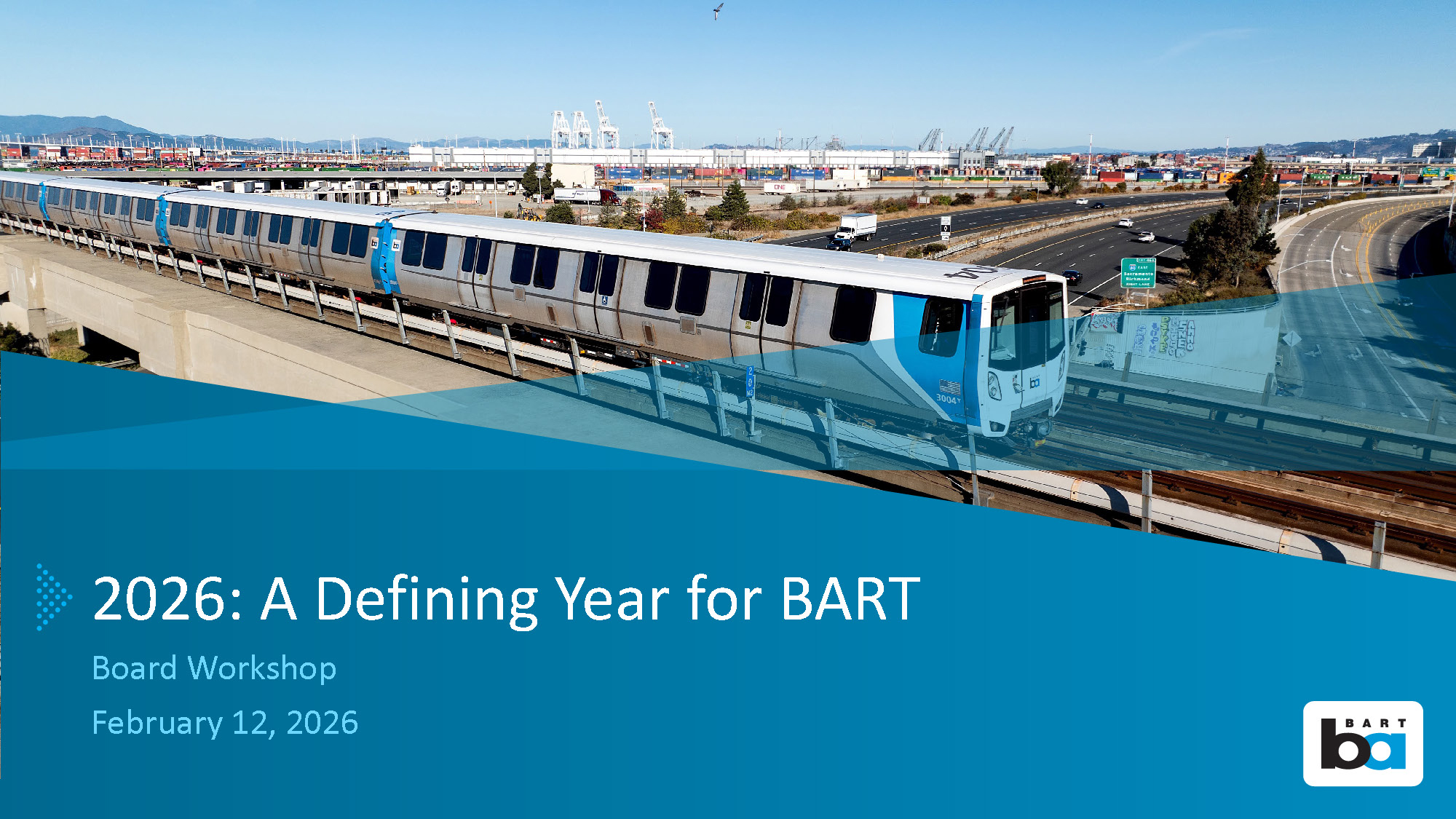
At the annual BART Board Workshop on Thursday, February 12, BART staff will present Directors with detailed plans for an alternative service framework if a November 2026 ballot measure fails and no other operating revenue source is identified. 10 stations could be closed by January 2027 and three segments by July 2027.

During the workshop, staff will outline the risks and tradeoffs for service and non-service reductions. Because rail has high fixed costs and low marginal savings, it is impossible to close the projected FY27 $376M deficit with service cuts and fare increases alone.

BART staff evaluated multiple aspects of service including routes, stations, headways, peak, evening, and weekend service and hours of operation. The proposed framework outlines, for the very first time, specific details including which stations would need to be closed due to a lack of operating funds and the recommended phased approach to triggering further cuts. The plan retains as many riders as possible, while still cutting service to realize savings. System support services would need to be reduced by 40% as cost savings from cutting service would be largely offset by the resulting lost fare revenue.

Source: BART

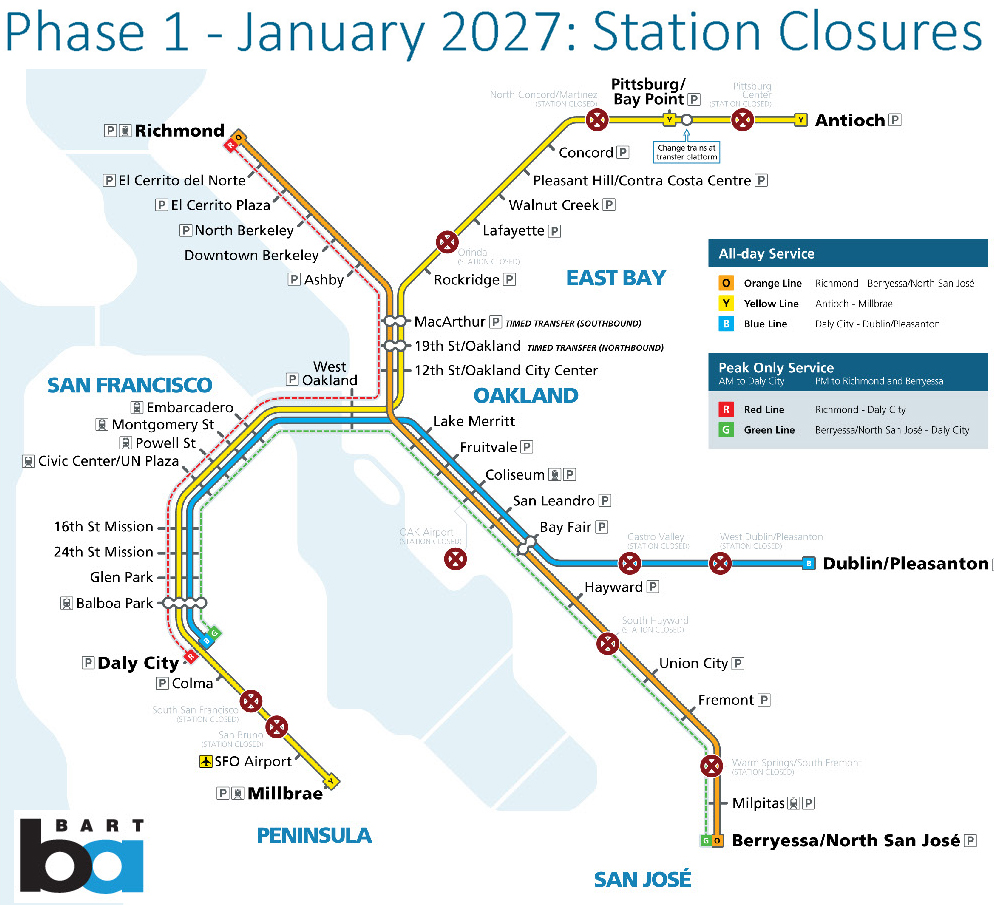
Phase 1 – North Concord, Orinda, Pittsburg Center Stations Would Close

The stations on the list for potential Phase 1 closure in January 2027 include the 10 lowest ridership stations: North Concord, Orinda, Pittsburg Center, Oakland International Airport, West Dublin/Pleasanton, Castro Valley, San Bruno, South Hayward, South San Francisco and Warm Springs/South Fremont.

In addition, the proposed Phase 1 proposal includes Service Frequencies of a 63% reduction in train hours; Reduced base schedule: 3-line base schedule each with 2 trains/hour and 240% more transfers (Percentage of trips requiring a transfer increases from 7% to 22%); Test retaining peak service: Peak Green/Red/Yellow trains operate in peak hours/direction only; and No evening service: the lines would Close at 9 PM (7 days) and Open at 8 AM (Saturday and Sunday).

Source: BART

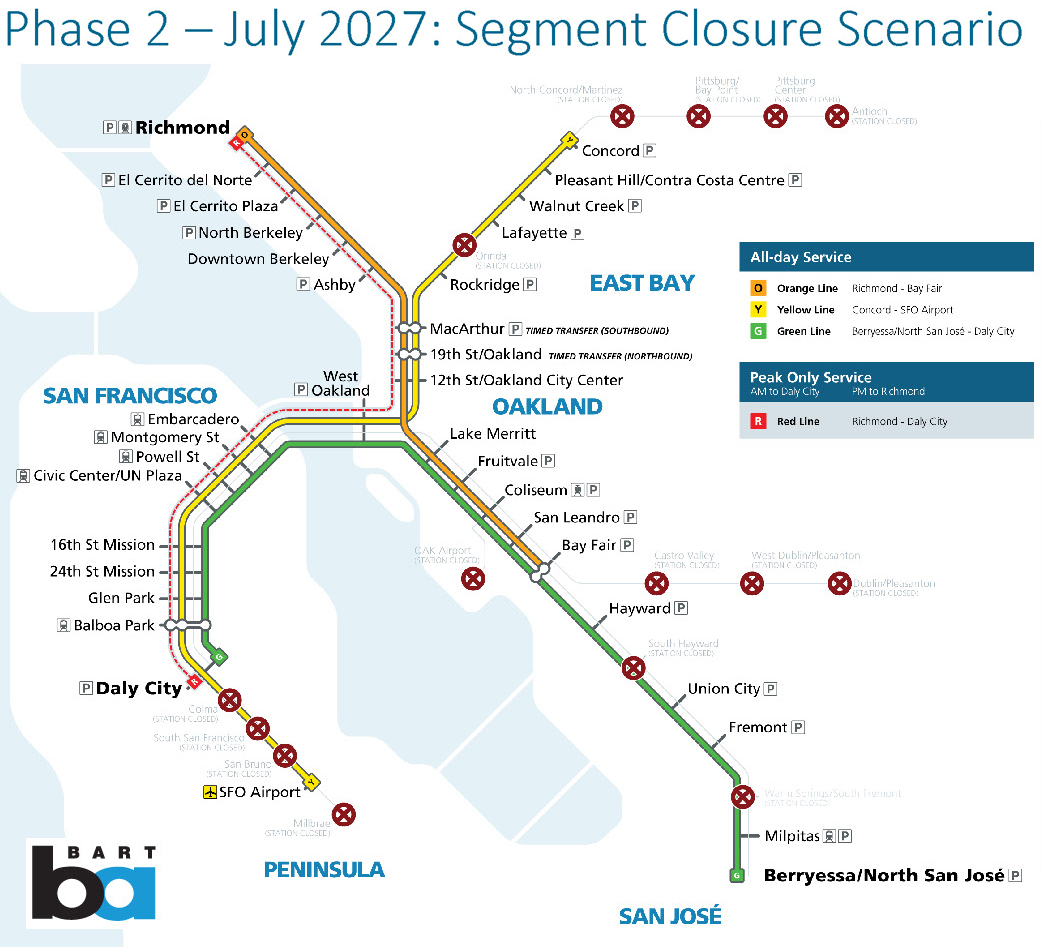
Phase 2 – Yellow Line Service Would End at Concord Station, Pittsburg/Bay Point & Antioch Stations Would Close

The Phase 2 – July 2027: Segment Closure Scenario, Contingent on Phase 1 implementation, would result in a 70% reduction in train hours and 25% reduction in system miles; Segment closures would stop service on most system segments opened after 1976: Yellow line service would end at Concord, shuttering the Pittsburg/Bay Point and Antioch Stations; Orange line service would end at Bay Fair,; Blue line service would be discontinued shuttering the West Dublin/Pleasanton Station; Most stations south of Daly City would be closed except for direct service to SFO would continue for revenue retention; Service continues to Milpitas and Berryessa due to terms of BART/VTA agreements.

Board Vote Scheduled for Feb. 26 Meeting

There will not be a Board vote at the workshop on February 12. After receiving feedback from Directors at the workshop, staff plans to return to the Board on Thursday, February 26, with a resolution to adopt a finalized alternative service framework that would be implemented if new funding is not secured.

You can read the full presentation here.

You can participate in the workshop. You may join in person (2150 Webster Street, Oakland, CA 94612) or via Zoom videoconferencing (https://us06web.zoom.us/j/89025424156).

Written comments may be addressed to the BART Board in advance via email to Board.Meeting@BART.gov, using “public comment” as the subject line, before 3:00 p.m. on Wednesday, February 11th.


Filed Under: BART, Finances, News, Taxes, Transportation

Supervisor Gioia announces $1 million grant program for non-profits to improve West Contra Costa

January 31, 2026 By Publisher Leave a Comment

Photo source: Office of Supervisor John Gioia

Anuncian un programa de subvenciones de 1 millón de dólares para mejorar la equidad en West Contra Costa

Application Deadline: February 27, 2026

Las solicitudes de subvención vencen en febrero 27, 2026

WHAT: Up to $50,000 grants for local nonprofits to improve equity in West Contra Costa County

WHEN: Applications open from February 1 through February 27, 2026

WHY:  Support innovative and impactful work to reduce health and economic disparities in West County

By Contra Costa County District 1 Supervisor John Gioia

I’m pleased to announce the opening of a Community Impact Fund Grant Program for Supervisorial District One. This program provides $1 million to support important projects that advance equity and reduce health and economic disparities in West Contra Costa County.

Grant amounts will be up to $50,000 each!

This grant program was established by the Contra Costa Board of Supervisors in June 2025, allocating $5 million countywide, with $1 million designated for each Supervisorial District. The goal is to invest in initiatives that strengthen community well-being and create long-term benefits for residents.

Our community shaped this grant program through ideas and priorities expressed at several Townhall meetings we held throughout West County. These funds will be used to improve health, housing, education, economic and environmental needs to achieve greater equity and reduce disparities.

Together, we’re building a stronger and more resilient future for all residents.

Nonprofit community-based groups are invited to apply for grant funds. Applications must be completed and submitted by Friday, February 27. Grant awards will be made by the end of March 2026.

This Grant Program was shaped by robust community input, including five town halls and a focus group, engaging over 275 residents, youth, organizational leaders, and advocates across District 1 in West Contra Costa County. These sessions provided a roadmap for equitable investments, emphasizing health, education, housing, economic and environmental improvements. Residents also called for transparency, local control, and sustainability.

To see the final report from the community Townhalls, please click here.

For more information on this grant program and how to apply, click here.

Español

QUÉ: Un millón de dólares en subvenciones para organizaciones sin fines de lucro locales con el fin de mejorar la equidad en el condado de West Contra Costa.

CUÁNDO: Las solicitudes estarán abiertas del 1 al 27 de febrero de 2026.

POR QUÉ: Para apoyar iniciativas innovadoras y de gran impacto que reduzcan las desigualdades en salud y economía en el oeste del condado.

Me complace anunciar la apertura del Programa de Subvenciones del Fondo de Impacto Comunitario para el Distrito Uno. Este programa destina 1 millón de dólares a apoyar proyectos importantes que promuevan la equidad y reduzcan las desigualdades sanitarias y económicas en el oeste del condado de Contra Costa.

¡El monto de las subvenciones será de hasta $50,000 cada una!

Este programa de subvenciones fue establecido por la Junta de Supervisores de Contra Costa en junio de 2025, asignando $5 millones para todo el condado, con $1 millón destinado a cada distrito supervisorial. El objetivo es invertir en iniciativas que fortalezcan el bienestar de la comunidad y generen beneficios a largo plazo para los residentes.

Nuestra comunidad dio forma a este programa de subvenciones a través de las ideas y prioridades expresadas en varias reuniones comunitarias que celebramos en todo el oeste del condado. Estos fondos se utilizarán para mejorar la salud, la vivienda, la educación, la economía y el medio ambiente, con el fin de lograr una mayor equidad y reducir las desigualdades.

Juntos, estamos construyendo un futuro más sólido y resiliente para todos los residentes.

Se invita a las organizaciones comunitarias sin fines de lucro a solicitar fondos de subvención. Las solicitudes deben completarse y presentarse a más tardar el viernes 27 de febrero. La adjudicación de las subvenciones se realizará a finales de marzo de 2026.

Este programa de subvenciones se diseñó con una sólida participación de la comunidad, incluyendo cinco asambleas públicas y un grupo focal, en los que participaron más de 275 residentes, jóvenes, líderes de organizaciones y activistas del Distrito 1 del condado de West Contra Costa. Estas sesiones proporcionaron una hoja de ruta para inversiones equitativas, haciendo hincapié en la salud, la educación, la vivienda y las mejoras económicas y ambientales. Los residentes también solicitaron transparencia, control local y sostenibilidad.

Para consultar el informe final de las reuniones comunitarias, haga clic aquí.

Para obtener más información sobre este programa de subvenciones y cómo solicitarlo, haga clic aquí.

Filed Under: Children & Families, Community, Finances, News, Non-Profits, West County

Agreement reached on $590 million loan for Bay Area transit agencies

January 31, 2026 By Publisher Leave a Comment

Benefits AC Transit, BART in Contra Costa County

Provides “fiscal bridge” until revenue from possible 5-county sales tax increase measure on November ballot kicks in

By Rebecca Long, Director, Legislation & Public Affairs and John Goodwin, Assistant Director of Communications, Metropolitan Transportation Commission

SAN FRANCISCO, Jan. 30, 2026… The Office of Governor Newsom, the California Department of Finance and the Metropolitan Transportation Commission (MTC) on Friday reached an agreement on a $590 million loan for Bay Area transit agencies that will avert major service cuts at AC Transit, BART, Caltrain and SF Muni during the 2026-27 fiscal year that begins July 1. Negotiated in close coordination with the affected transit agencies — which together face a projected deficit of more than $800 million in the next fiscal year — the new agreement will sustain operations used by hundreds of thousands of daily transit riders across the region.

“California is following through in our support for Bay Area transit and the riders who rely on it every day,” said Gov. Newsom. “This agreement between my Administration and the Metropolitan Transportation Commission provides essential short-term financing to support Bay Area transit operations while the region works together on long-term funding solutions. Public transit is essential to our economy and to communities across California, and through continued partnership with regional and local agencies, we are delivering a more stable and reliable system – now and for the future.”

A regional funding measure authorized by the Legislature last year via state Senate Bill 63, authored by senators Scott Wiener of San Francisco and Jesse Arreguín of Berkeley, may appear on the November 2026 ballot in Contra Costa, Alameda, San Francisco, San Mateo and Santa Clara counties. If the measure qualifies for the ballot and is approved by voters, it would establish a temporary 14-year sales tax to support transit operations. But these funds would not begin flowing until around July 1, 2027. The state loan provides a fiscal bridge until the sales tax dollars potentially could be available. (See related articles here and here)

“Today is a huge win for Bay Area transit and for both transit riders and drivers,” said Sen.  Wiener. “For the past year, we’ve worked hard to craft a bridge loan to ensure BART, Muni, Caltrain and AC Transit are not forced to enact massive service cuts — potentially going into a death spiral — as we build toward a regional revenue measure to stabilize and strengthen these systems for the long run. I’m proud of our work with regional stakeholders and the Governor to make this loan a reality. Public transportation is part of the Bay Area’s lifeblood, and we must do everything in our power to strengthen it and protect it from service cuts. So many Bay Area residents rely on transit to get to work, school, or family, and service cuts would also explode traffic congestion. We must not let this happen, and we won’t let it happen.”

Today’s agreement authorizes the loan to be funded no later than July 1, 2026, using money awarded but not yet allocated for Bay Area projects by the California Transportation Commission through the state Transit Intercity Rail Capital Program (TIRCP). Because many transit capital projects have long construction timelines and the TIRCP is continuously replenished, the loan is structured to uphold the state’s commitments to awarded projects while minimizing risk to project schedules.

“MTC greatly appreciates the time and energy the Department of Finance and the Governor’s office put into this loan negotiation,” said Commission Chair Sue Noack, who represents Contra Costa County and also serves as mayor of Pleasant Hill. “It was critical to reach agreement on funding that would avert major service cuts this year while also protecting the Bay Area’s priority capital projects and this agreement does just that.”

Consistent with state Senate Bill 105 enacted last fall, the loan agreement includes a clearly defined repayment structure, a guaranteed revenue source to secure the loan and an agreed-upon interest rate:

  • 12-year repayment term, with interest-only payments during the first two years.
  • Repayment secured by the “revenue-based” portion of State Transit Assistance (STA) that goes directly to the transit agencies.
  • Variable interest rate tied to the state’s Surplus Money Investment Fund, ensuring the state is fully repaid at the same rate it would have earned had the funds remained in state accounts.

BART General Manager Bob Powers noted that his agency, “is currently developing detailed budget plans for two funding scenarios to close our projected $376 million operating deficit for Fiscal Year 2027 through either new revenue and efficiencies or through service reductions, station closures, fare increases, layoffs, and across-the-board internal cuts. A state loan gives us reassurance money will be available to continue to deliver the best service possible for the Bay Area. We are thankful to Governor Newsom and the Department of Finance for finding a path to fund transit operations during such an unprecedented scenario brought on by the pandemic and remote work. We also thank the Bay Area Legislative Caucus for their supportive efforts and look forward to working with the Legislature on early action to include the loan within the state budget.”

“This bridge loan will help us maintain Muni service for one crucial year for everyone who depends on transit to get where they need to go,” said Julie Kirschbaum, Director of Transportation at the San Francisco Municipal Transportation Agency, which operates Muni. “We thank the Metropolitan Transportation Commission for its leadership and the Governor and the Department of Finance for their collaboration. We are deeply appreciative of the tireless efforts of Mayor Daniel Lurie, State Senator Scott Wiener, State Senator Jesse Arreguín, the Bay Area Legislative Caucus, the Board of Supervisors and the transit advocates who kept this loan alive last year. With this key agreement completed, securing the additional funding we need to address our ongoing deficit is the critical priority.”

“San Francisco’s recovery is essential to the success of our region and our state,” noted Mayor Daniel Lurie. “Our city cannot continue its comeback without a safe, reliable transit system. This agreement is a major step forward towards securing the bridge loan needed to sustain our comeback and ensure transit systems can continue serving the families, seniors, students, and workers who rely on them every day. We’re already delivering greater accountability and efficiency for Muni, and ridership is continuing to climb toward pre-pandemic levels. I’m grateful to our partners at MTC and Governor Newsom for finalizing the agreement and prioritizing our city and our region’s recovery.”

Caltrain General Manager Michelle Bouchard made a similar point, “We are so grateful to the Governor, our delegation members, and our state and regional partners for stepping in and supporting public transit in the Bay Area at this critical time. This loan will allow us to preserve the service that made Caltrain the fastest growing transit agency in the U.S.”

“For 65 years, AC Transit’s north star has been delivering safe, reliable, and affordable bus service to the East Bay,” said Salvador Llamas, AC Transit General Manager and CEO. “That legacy was put at risk by unprecedented pandemic-related budget shortfalls. This state loan safeguards existing service levels and brings immediate relief to the more than 3 million riders each month who were at risk of losing some of the service they rely upon for the essentials of life. We thank Governor Newsom and our local and state partners for making this possible, and while long-term funding challenges remain, today we celebrate a critical win for our riders and communities.”

Senate Bill 63 co-author Jesse Arreguín also sounded a note of thanks, “I am grateful to the Governor and my legislative colleagues for supporting Bay Area transit with this loan. This agreement is a huge win to keep our transit agencies running and ensure that the Bay Area can continue as a major economic engine, while not compromising critical transit projects. At a time when we are at risk of significant service cuts that would grind the region to a halt, this additional funding will provide a vital lifeline to the Bay Area’s major transit agencies and provide fiscal stability as we move forward on a broader regional self-help measure this year.”

Filed Under: BART, Finances, Government, News, State of California, Transportation

Contra Costa Sheriff’s Office Forensic Services Division receives state grant to help keep roads safe

January 24, 2026 By Publisher Leave a Comment

Photo: CCC Sheriff’s Office

$170,000 for Crime Lab

By Jimmy Lee, Director of Public Affairs, Contra Costa County Office of the Sheriff

The Contra Costa County Office of the Sheriff Forensic Services Division (FSD), a nationally accredited crime laboratory, has been awarded a competitive one-year grant of $170,000 to help keep our roadways safe from impaired drivers. Funding for this program was provided by a grant from the California Office of Traffic Safety, through the National Highway Traffic Safety Administration.

The FSD will use the funding to support the testing program for detecting alcohol and drugs in driving under the influence (DUI) cases. New equipment will be purchased to enhance the analysis of alcohol and other volatile substances in DUI cases. Supplies will also be purchased to support comprehensive analysis and enable detection of illegal, prescription, and over-the-counter drugs commonly found in DUI cases. Funding for the pro-grams runs through September 2026.

“This grant will improve testing capabilities, analysis, and turnaround times at the Forensic Services Division,” said Contra Costa Sheriff David Livingston. “Having rapid results will benefit county law enforcement agencies and prosecutors and improve public safety.”

Filed Under: Crime, Finances, News, Sheriff, State of California, Transportation

CA Office of Traffic Safety awards Contra Costa DA’s Office over $300k grant for DUI Prosecution Team

January 8, 2026 By Publisher Leave a Comment

By Ted Asregadoo, PIO, Contra Costa County District Attorney’s Office

Martinez, California – The Contra Costa County District Attorney’s Office received a grant from the California Office of Traffic Safety (OTS) of $323,500 to support a specialized prosecution team dedicated to alcohol and drug-impaired driving cases.

“We are grateful for this grant, which will allow us to focus specifically on holding individuals accountable for impaired driving and making the roads in our community safer for everyone,” District Attorney Diana Becton said. “Driving Under the Influence remains a significant danger on our roads. This funding strengthens our commitment to improving road safety and making sure justice is served effectively and efficiently.”

The specialized prosecution team will also partner with the statewide Traffic Safety Resource Prosecutor Training Program (TSRP) to train other prosecutors and investigators and collaborate with law enforcement agencies on best practices for handling and managing driving under the influence (DUI) cases.

“Through focused prosecution efforts and strong partnerships, we are working toward a future where all people will be safe on California roads,” OTS Director Stephanie Dougherty said. “Together, we’re holding impaired drivers accountable and encouraging safe, responsible choices that help build a culture where safety comes first.”

This is the first year the Contra Costa County District Attorney’s Office has received funding from the OTS for a specialized DUI prosecution program. The grant program runs through September 2026.

Funding for this program was provided by a grant from the California Office of Traffic Safety, through the National Highway Traffic Safety Administration.

Filed Under: District Attorney, Finances, News, State of California, Transportation

Start 2026 Strong by claiming your CalKIDS Scholarship

December 26, 2025 By Publisher Leave a Comment

Source: CalKIDS

Free money for college!

More than 60% of public-school students in grades 2-12 are eligible for up to $1,500

By Vanessa Vizard, Vizard Marketing & PR

Sacramento, CA — As the year comes to a close and families begin setting goals for the year ahead, California is reaffirming its commitment to young people through CalKIDS, the California Kids Investment and Development Savings Program. Backed by a $2 billion statewide investment for more than five million children, CalKIDS is the largest education-focused asset-building effort in the nation, providing automatic scholarship accounts to millions of California children and students to help pay for college or career training after high school.

As families think about meaningful gifts this holiday season and prepare for the opportunities a new year brings, claiming a CalKIDS Scholarship Account is a simple step with a lasting impact. Eligible children and students can receive between $175 and $1,500 in free scholarship funds, with no application, no essays, and no income verification required. These funds are already set aside for children and students and can be used for qualified higher education expenses, making CalKIDS one of the most accessible scholarships available to California families.

“CalKIDS has been an amazing success, with nearly 1 million scholarship accounts already claimed by California families,” said State Treasurer Fiona Ma, CPA, Chair of the ScholarShare Investment Board, which administers CalKIDS. “As we look ahead to the new year, families across the state still have a tremendous opportunity to claim scholarship dollars already set aside for their children and students, funds that can help lower the cost of college or career training and expand what’s possible for their future.”

More than 60% of public-school students in grades 2 through 12 are eligible for a CalKIDS Scholarship Account worth up to $1,500.  When CalKIDS launched in 2022, the program awarded scholarship accounts to students from elementary school to high school, meaning current college students may also be able to claim and use their CalKIDS Scholarship funds today. Awardees can use their funds until age 26.

Additionally, 100% of newborns born on or after July 1, 2022 in California automatically receive a CalKIDS Scholarship Account worth up to $175. This includes an initial scholarship awarded at birth, with additional incentives available when families claim the account and link it to a ScholarShare 529 College Savings Plan where they can continue saving on their own.

CalKIDS Scholarships can be used for tuition and fees, required books and supplies, computer equipment, and other qualified education expenses at accredited institutions nationwide making CalKIDS one of the simplest and most flexible scholarships students can claim this holiday season and in the year ahead.

To date, CalKIDS scholarship funds have been used by nearly 150,000 students towards their academic success at a college or career training program. For one awardee, Bryan a student at California State University, Fullerton, CalKIDS was described as: “A financial ease into pursuing a degree.”

Photo: CalKIDS

How Students and Families Can Claim a CalKIDS Scholarship:

Claiming a CalKIDS Scholarship takes only a few minutes at CalKIDS.org.

  • For public school students, including those who are now college-aged, families will need the Statewide Student Identifier (SSID), a 10-digit number found on school portals, report cards, or by contacting the public school the student attended during the 2021–22, 2022–23, or 2023–24 academic years.
  • For children born in California on or after July 1, 2022, families will need the child’s date of birth and the Local Registration Number, a 13-digit number found on the birth certificate.

Once an account is claimed, families can log in at any time to view their scholarship balance, link it to a ScholarShare 529 account, learn how the funds can be used, and request a disbursement once the student is enrolled in higher education or career training.

CalKIDS reflects California’s long-term commitment to expanding opportunity, reducing education costs, and investing early in the success of its young people.

Families are encouraged to check if they have a CalKIDS Scholarship Account available to claim this holiday season by visiting CalKIDS.org.

Photo: CalKIDS

About CalKIDS: The California Kids Investment and Development Savings Program (CalKIDS) is the nation’s largest child development account program, providing scholarships for higher education. Administered by the ScholarShare Investment Board, and Chaired by State Treasurer Fiona Ma, CPA, the program is designed to promote the pursuit of higher education statewide by empowering families to build assets, nurture savings habits, and raise their educational aspirations. Eligible public school students can receive CalKIDS Scholarships worth up to $1,500 and every child born in California on or after July 1, 2022, is awarded a CalKIDS Scholarship worth up to $175, ensuring more families have the resources needed to support their children’s education. To learn more, visit CalKIDS.org.

Filed Under: Children & Families, Education, Finances, News, State of California, Youth

Contra Costa preparing for Medi-Cal coverage loss, funding reductions

December 16, 2025 By Publisher Leave a Comment

By Contra Costa Health

Contra Costa County must prepare for significant reductions in Medi-Cal coverage and hundreds of millions of dollars in long-term funding loss as a result of recent federal and state policy changes, county officials said Tuesday.

New federal requirements under H.R. 1, the “One Big Beautiful Bill Act,” combined with state Medi-Cal eligibility and reimbursement changes, will make it harder for many residents to enroll in or keep healthcare coverage. While final details are still emerging, county estimates indicate that as many as 93,000 Contra Costa residents could be affected by 2029.

At the same time, Contra Costa Health (CCH) projects more than $300 million in cumulative state and federal funding reductions through 2029, driven by Medi-Cal disenrollment and cuts to supplemental funding that public hospitals rely upon. These impacts are expected to grow year over year and reflect a broader trend affecting counties and public health systems across California.

“These changes mean fewer people covered and fewer dollars coming into the system at the same time,” said Candace Andersen, Chair of the Contra Costa County Board of Supervisors. “Our responsibility is to face that reality head-on, plan carefully, and ensure the county continues to provide essential care for residents who have nowhere else to turn.”

During a presentation to the Board on Tuesday, leaders of CCH and the county’s Employment & Human Services Department (EHSD) emphasized that the projected impacts are a result of external policy decisions, not local performance, and that significant uncertainty remains around timelines, enforcement and the response from California.

Federal guidance on several provisions of H.R. 1 has not yet been issued, and California’s approach to mitigating coverage losses is still evolving.

The presentation outlined how specific provisions of H.R. 1 and recent state Medi-Cal policy changes are expected to reduce enrollment, increase administrative barriers to coverage, and lower reimbursement to safety-net providers. It also reviewed projected enrollment losses, funding impacts to CCH and Contra Costa Health Plan, and the anticipated timing of changes, along with areas of ongoing uncertainty.

The Board directed CCH to return in early 2026 with a proposal to update and strengthen the county’s existing supports for people who are not eligible for Medi-Cal and have no other healthcare options.

Contra Costa County will share additional updates as federal and state guidance becomes available and planning continues.

Filed Under: Finances, Government, Health, Legislation, News

Hercules Police Department awarded $75,000 STEP grant from state Office of Traffic Safety

December 7, 2025 By Publisher Leave a Comment

For Selective Traffic Enforcement Program

By City of Hercules

At the Nov. 12 City Council meeting, the Hercules Police Department accepted a $75,000 Selective Traffic Enforcement Program (STEP) Grant from the California Office of Traffic Safety (OTS). This funding will support traffic enforcement efforts that reduce impaired driving and other primary collision factors.

“This grant serves our commitment to keeping Hercules’ drivers and pedestrians safe,” said Police Chief Joseph Vasquez. “With this funding, we are able to further educate our community on safe driving practices and enforce regulations on speeding and impaired driving.”

According to the staff report for the agenda item, “The grant will allow the City to focus on a comprehensive approach to enforce, educate, and encourage compliance with seatbelt use, impaired driving, speed limit, and other traffic laws. Education and enforcement are two very important components of collision reduction. The acceptance of the grant will allow the Hercules Police Department to bolster its enforcement and education efforts in the aforementioned areas of concern.”

The STEP grant will enhance the City’s ongoing efforts to improve roadway safety by focusing on critical enforcement areas such as impaired driving, distracted driving, pedestrian safety and seatbelt and speed laws while also supporting community education initiatives that encourage safe driving behaviors. The funding will allow the Hercules Police Department to perform overtime operations for DUI checkpoints, saturation patrols and traffic enforcement operations linked to distracted and impaired driving.

Hercules has previously used STEP grant funding to purchase electronic citation writers, collision-investigation software and a speed trailer with a digital message board for special events, road closures and speed deterrence. This new funding will allow the Hercules Police Department to continue strengthening its enforcement and education efforts.

Filed Under: Finances, News, Police, Transportation, West County

Supervisor Carlson announces $1 million in District IV Community Impact Fund grants

December 2, 2025 By Publisher Leave a Comment

25 organizations benefit on Giving Tuesday

By Victor Benedict Tiglao, Communications Associate, Office of Supervisor Ken Carlson

PLEASANT HILL, CA (December 2, 2025) – Contra Costa County Supervisor Ken Carlson announced 25 local organizations selected to receive the District IV Community Impact Fund, following a review of more than 100 applications totaling $6.5 million in requests. Carlson noted his office spent over 160 hours evaluating proposals to ensure funds reached organizations making the greatest impact.

“I am proud to announce the 25 organizations selected to receive the District IV Community Impact Fund grants,” said Carlson. “These grants reflect the strength and resilience of our community. By investing in local nonprofits, we are ensuring that families, students, and residents across District IV have access to the resources and opportunities they need to thrive.”

The Mt. Diablo Education Foundation highlighted how the grant will benefit students:

“This program has pushed me out of my comfort zone and helped me find my voice. Having access to this program has opened doors I never knew existed and brought me places I never thought I’d go.” – Gabrielle, 12th Grade student at Ygnacio Valley High School

The Cancer Support Community (CSC) also shared how funding will expand services:

“I never thought I’d be diagnosed with cancer, but after treatments and surgeries my life was turned upside down. Finding the Cancer Support Community gave me strength, and for seven years I’ve relied on their programs. This grant will make in‑person support even more accessible for people like me.”– Daryl, CSC participant and Pleasant Hill resident

Other awardees include: 18 Reasons, Assistance League of Diablo Valley, Care Parent Network, Child Advocates of Contra Costa County, Choice in Aging, Clayton Pride, CoCo Kids, Community Violence Solutions, Contra Costa County Historical Society, Contra Costa Humane Society, Contra Costa Senior Legal Services, Empowered Aging, First Tee – Contra Costa, GANAS Community Organization, Hope Solutions, Joybound and Trinity Center, Meals on Wheels Contra Costa, Mental Health Connections, Monument First 5, The Network of Care, St. Vincent de Paul – St. Agnes, United Latino Voices of Contra Costa County, and Winter Nights Family Shelter.

“This Giving Tuesday, I encourage our residents to stand with these 25 organizations. Each one is doing extraordinary work. Your support amplifies the Community Impact Fund and helps these programs grow stronger, reaching more neighbors across Contra Costa County.”

First elected in 2022, Supervisor Carlson represents District IV on the Contra Costa County Board of Supervisors, which includes the cities of Concord, Pleasant Hill, Clayton, and parts of Walnut Creek.

Filed Under: Central County, Finances, Government, News, Non-Profits

  • 1
  • 2
  • 3
  • …
  • 14
  • Next Page »
Liberty-Tax-Jan-Apr-2026
Deer-Valley-Chiro-06-22

Copyright © 2026 · Contra Costa Herald · Site by Clifton Creative Web