• Home
  • About The Herald
  • Local Agencies
  • Daily Email Update
  • Legal Notices
  • Classified Ads

Contra Costa Herald

News Of By and For The People of Contra Costa County, California

  • Arts & Entertainment
  • Business
  • Community
  • Crime
  • Dining
  • Education
  • Faith
  • Health
  • News
  • Politics & Elections
  • Real Estate

After 65 Years, salmon are returning to the San Joaquin River

April 29, 2019 By Publisher Leave a Comment

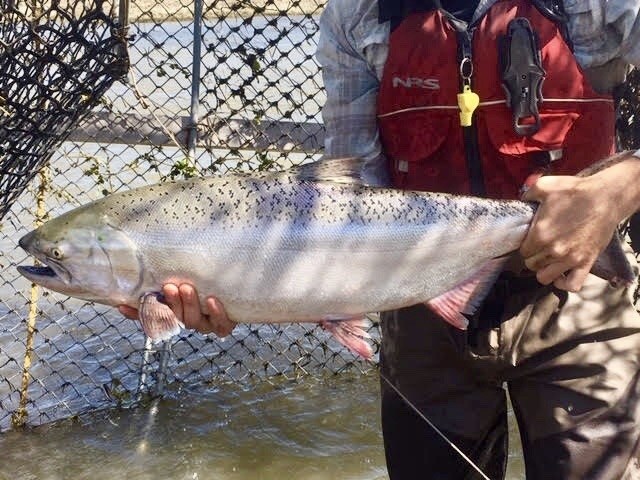
Spring-run Chinook. Photo by Bureau of Reclamation.

By Nick Cahill, Courthouse News Service

Surviving an exhaustive maze of manmade barriers and hungry predators, a hardy group of salmon have beat the odds and returned to spawn in one of California’s most-heavily dammed rivers.

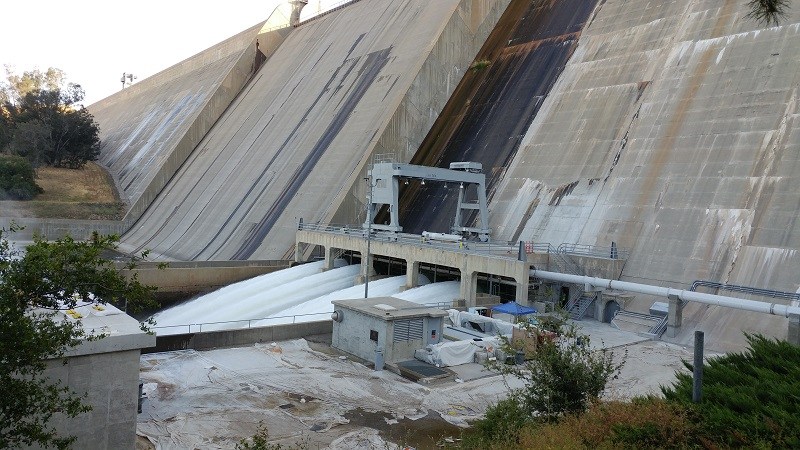
Friant Dam on the San Joaquin River. The dam impounds Millerton Lake, 15 miles north of Fresno, California. (Nick Cahill/CNS)

The U.S. Bureau of Reclamation says for the first time in over 65 years, threatened spring-run Chinook adult salmon have returned to the San Joaquin River near Fresno to complete their life cycle. The return of the hatchery-reared fish marks a huge milestone for a billion-dollar undertaking to revive an ancient population of salmon that disappeared in the 1940s with the opening of Friant Dam.

Officials announced that at least five adult spring-run Chinook born in fish hatcheries and released into the wild several years ago, have made the 370-mile trek from the Pacific Ocean back to the San Joaquin River.

Don Portz, who oversees the fish restoration program for the bureau, says the salmon that have been caught in nets prove that the joint-effort by the feds and state is going in the right direction.

“This is monumental for the program,” Portz said in a statement. “It’s a clear indication of the possibility for these fish to make it out of the system as juveniles and then return as adults in order to spawn.”

For years California’s second largest river teemed with salmon, providing food for Native American tribes and then settlers during the 1800s. But as the Gold Rush died down, Californians headed south and found the Central Valley ripe for farming.

3. Chinook salmon equipped with tracking tags being readied for release into the San Joaquin River in California. (Nick Cahill/CNS)

In their pursuit of water, farmers and government agencies ended up damming the river dry in some parts by the 1940s. Water was divvyed up and delivered in canals to farmers for crops like almonds and cotton, but the native salmon species and their spawning habitat vanished. Today, parts of the river go dry during certain times of the year and other sections have manmade barriers that prevent salmon from reaching their spawning beds.

Thanks to a nearly two-decade-long lawsuit fought by the National Resources Defense Council, things are changing on the San Joaquin. A settlement reached in 2006 with the federal government set goals of restoring native fish populations to “good condition” without overtly damaging water suppliers’ take of the river; the state and federal government plan to spend over a billion dollars to restore flows, wetlands and fish to the river.

The five Chinook captured this month returned from the ocean on their own, but had to be transported by researchers in a 500 gallon tank to bypass manmade barriers. The biologists confirmed that the fish were from a California hatchery because they were missing a small rear fin.

The five adult salmon and any others that may return will hold in the cool water below Friant Dam for the summer, before hopefully spawning in the fall.

“Now, that’s worth a toast!,” tweeted Kate Poole about the salmon’s return, senior director at the NRDC.

The long-term goal is to update the barriers to allow fish to swim upstream in the future without being transported, Portz said. Restoration efforts are meant to help spring and fall-run Chinook, Pacific lamprey and white sturgeon.

Filed Under: East County, Environment, News

Supervisors promote solar energy development in rural areas, parking lots, freeway cloverleafs

December 22, 2018 By Publisher 1 Comment

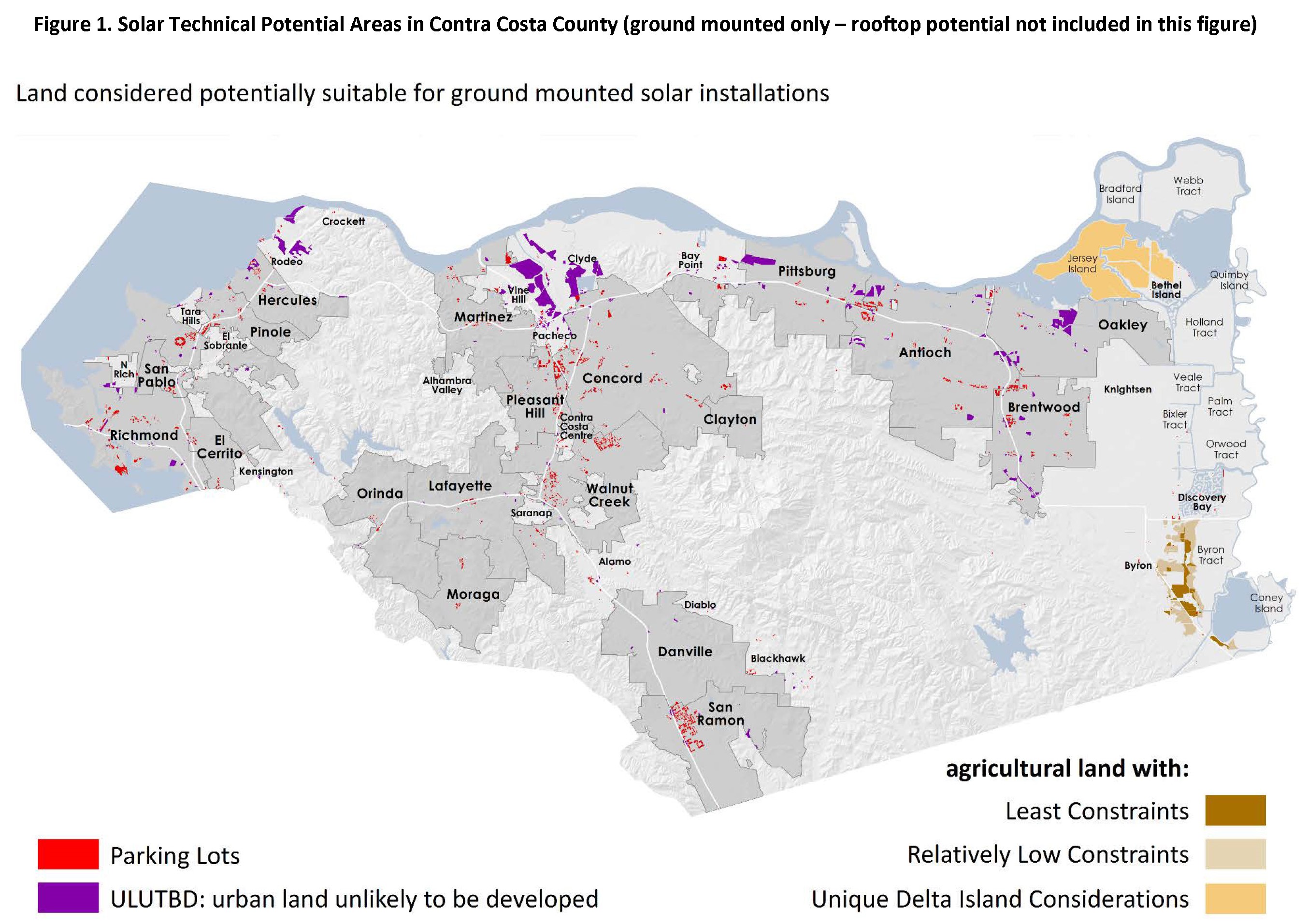
Courtesy CCC Department of Conservation and Development.

Forgive $5.8 Million in Library Book Late Fees Dating Back to 1995

By Daniel Borsuk

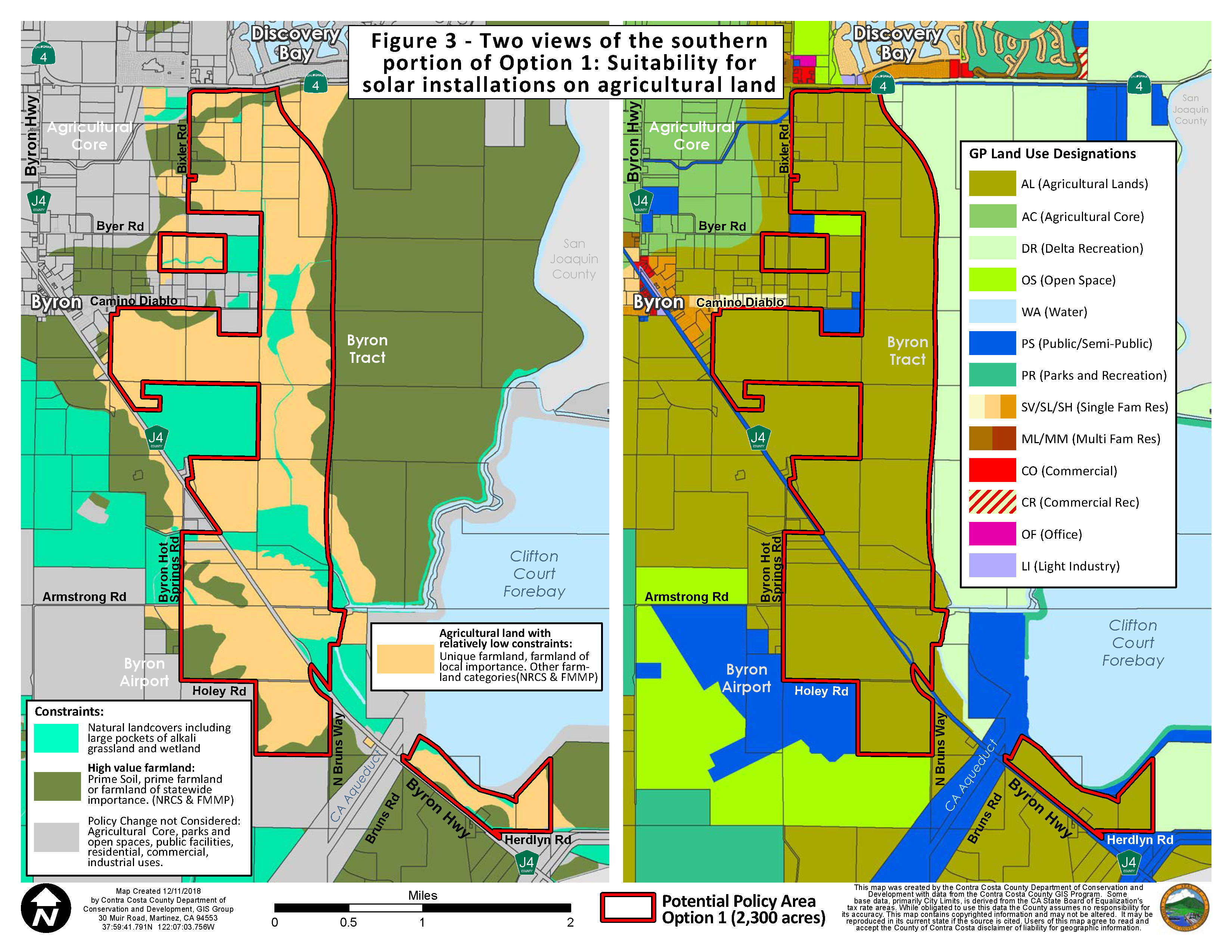
The Contra Costa County Board of Supervisors flashed the green light for Contra Costa County Development and Conservation Department (DCD) officials to conduct additional studies on how solar power can be expanded, especially in the Far East environmentally sensitive Delta areas of Bethel Island and Jersey Island.

Supervisors also allowed county planners to study the feasibility of identifying underutilized parking lots countywide that could be used as solar farms in partnership with MCE, the main electricity provider for unincorporated Contra Costa County and the cities of Concord, Danville, Martinez, Oakley, Pinole, Pittsburg, and San Ramon.

Freeway cloverleafs are also on the DCD’s list of potential new sites for renewable energy.

“Fifty to eighty percent of the county could be used for renewable energy,” Jody London, a DCD official, told supervisors.  London said solar energy represents 85 percent of the renewable energy that could be developed on rural land.  The remaining 15 percent would be energy generated from wind power or biomass.

London said the county could also expand solar energy by issuing more permits to homeowners to install solar panels on roofs.

The house rooftop option drew the support of District 3 Supervisor Dianne Burgis of Brentwood, whose district also covers Bethel Island and Jersey Island.  “I’d be open to option one,” she said.  “We have so many rooftops in Contra Costa County.  I’d like to work with MCE.”

Board chair Karen Mitchoff of Pleasant Hill cautioned DCD staff that she was uncertain the DCD recommendation concerning 450-acre Jersey Island as a potential solar power farm might run into opposition from the island’s owner, the Ironhouse Sanitary District.

London said she would look into that issue.

“We support development of solar energy on brownfield sites, parking lots and infill areas such as freeway cloverleafs,” Bill Chilson of the Mount Diablo Audubon Society wrote in a letter to the supervisors.  The environmental organization opposes wind and solar development in the Delta agricultural and wildlife areas, Chilson wrote.

Juan Pablo Galwan, Save Mt. Diablo Land Use Manager, criticized the plan, writing:

“Advances in solar technology may increase the frequency of collocation or allow an area of land to concurrently be farmed and produce solar energy without negatively impacting or perhaps even increasing crop productivity.  However, currently the most likely scenario is that solar development removes land from most or all ties of agricultural production for the duration of lease which may last several decades.  Therefore, the county renewable energy policies should not encourage solar development on viable agricultural land.”

A $47,000 grant from the California Strategic Growth Council developed the energy study for the County.

Supervisors Approve $362,505 State Grant for 2020 Census

The county is getting ready for the 2020 census and took its first step when supervisors unanimously accepted a $362,505 County-Option Outreach Agreement grant from the state.

The grant will aid the county in developing communications and outreach strategies that will target both geographic and demographic populations who are least likely to respond to the 2020 census.

Barbara Rivera of the Contra Costa County Administrators Office said the upcoming census will be the first one where Californians can respond by going online, but this raised cyber security issues from Julia Marks of the Asian Law Caucus.  “There is a lot fear over confidentiality,” said Marks.

Choice in Aging’s Debbie Toth Honored as Board Chair Recipient

Debbie Toth, the Chief Executive Officer of Choice in Aging, was honored by the Contra Costa County Board of Supervisors Chair Karen Mitchoff, as Board Chair Recipient for 2018.

Mitchoff, of Pleasant Hill, selected Toth, who was named CEO of Choice in Aging in 2012 that serves 600 senior citizens in residential facilities at the Bedford Center in Antioch and the Mt. Diablo Center in Pleasant Hill, for being an advocate for senior access to housing, health and transit.

Mitchoff, who was re-elected to the District 3 supervisorial seat in June, cited her personal experience with her mother as a key factor in nominating the CIA’s Chief Executive Officer for the award.

After Tuesday’s meeting, it is expected District 1 Supervisor John Gioia of Richmond will be elected as Chair of the Board   when supervisors reconvene at their next regular meeting slated for January 15, 2019.

Supervisors Forgive $5.8 Million in Library Book Late Fees

A week after the Board of Supervisors made the historic move to eliminate the practice of collecting overdue book and material fees, they approved on a 5-0 vote to discharge about $5,800,100 from public library patron accounts.

The agenda consent item did not attract public comment.

The bookkeeping item covers uncollected fees dating back to 1995 to the present, County Librarian Melinda Cervantes wrote in a report to the Board.  “Of this amount, 73 percent is the value of materials, not cash outstanding.”  There is no financial impact on the county general fund.

Last week supervisors adopted the library commission’s recommendation to cease the collection of overdue book fines beginning Jan. 1, 2019 based on the recommendations in a policy titled Project Equitable Access with the goal of ensuring everyone has access to library materials.

To view the entire meeting agenda, click here.

Filed Under: Environment, Government, News, Supervisors

Supervisors direct staff to develop ban on Styrofoam containers

December 6, 2018 By Publisher Leave a Comment

By Daniel Borsuk

County supervisors set in motion a potential environmental ordinance that would ban polystyrene, or Styrofoam food and beverage containers, in businesses in unincorporated Contra Costa County.  The proposed law would possibly go into effect sometime in May 2019.

On a 5-0 vote supervisors directed the county Public Works Department officials to develop the ordinance that would resemble as much as possible a mish-mashed compilation of banned polystyrene ordinances now enforced in 10 Contra Costa cities.  Cities with some form of a polystyrene ban ordinance in place include Richmond, San Pablo, El Cerrito, Walnut Creek, Pinole, Lafayette, Pittsburg, Hercules, Concord and Martinez.

While the banned use of polystyrene food containers applies in all 10 cities, the ban sale of food containers is barred only in Richmond, San Pablo, Pinole and Pittsburg.  Prohibiting the sale of packing peanuts is enforced only in Richmond, San Pablo, and Pittsburg.

As a result, crafting a county-wide ordinance banning polystyrene will be a difficult task.

“According to the US EPA, local governments in California spend as much as $411 million each year to prevent plastic food packaging and other commonly littered items from ending up on streets, storm drains, beaches, rivers and the ocean,” wrote Mark Murray, executive director of Californians Against Waste, in a November 6 letter to the supervisors.

The Bay Area counties of Alameda, Santa Clara, San Mateo, San Francisco, Marina, and Sonoma already have polystyrene ban ordinances in place.

Dominic Williams of Save the Bay encouraged the supervisors to move forward in developing the ban on polystyrene food and beverage containers.

“There are 117 ordinances in place in California banning polystyrene products,” Williams said.  “Polystrene is the type of product that never biodegrades.”

“Polystrene is not only an environmental issue, but it is an economic issue.   We pay more for what goes into the land fill,” said District 3 Supervisor Diane Burgis of Brentwood.

“We believe that imposing a ban on polystyrene will do little to reduce overall litter within the County of Contra Costa.  Focusing on one product is a discriminatory approach, and has proven to be ineffective,” wrote Allison Piccoli, Director of Local Government Affairs for the California Restaurant Association, which opposes the ban.

David Twa Named Top County CEO In California

Contra Costa County Administrator David Twa was recognized with the Distinguished Service Award from the California Association of County Executives at the association’s conference in San Diego held on Dec. 1-2.

The award is handed out for outstanding and meritorious work to a Chief Administrative Officer or Chief Executive Officer who has demonstrated respected leadership, shown exemplary work to benefit the community through long term positive results, and serves as a role model for others in cities, counties, and the state.

“We are proud to celebrate our county administrator David Twa’s selection as CAO of the year,” said Contra Costa County Board of Supervisors Chair Karen Mitchoff.  “We are fortunate to have David’s leadership in Contra Costa and so pleased that he has received this well-deserved award.”

Filed Under: Environment, News, Supervisors

Supervisors support national pricing on carbon emissions to reduce climate change on split vote

October 11, 2018 By Publisher 1 Comment

By Daniel Borsuk

The Contra Costa County Board of Supervisors went on record on Tuesday supporting the establishment of a national fee and dividend on carbon emissions.  Supervisors voted 4-1 to approve the proposal.

Supervisor Candace Andersen of Danville cast the dissenting vote on the grounds she opposed the dividend feature of the proposal that was acted on and endorsed by the Contra Costa Sustainability Commission at its June 25 meeting and was finally presented to the full Board of Supervisors Tuesday, more than three months later.

“I do support cleaner air, but I don’t see how this will produce the desired result,” said Andersen.  “This isn’t the plan for me.”

Contra Costa County can now be counted as one of a number of California counties backing the proposal lobbied by Citizens Climate Lobby for a federal revenue-neutral carbon-based fuel fee and dividend proposal to reduce catastrophic climate change from global warming.

Other counties already signing on in support of the Citizens Climate Lobby carbon emissions initiative are San Francisco, San Mateo, Sonoma, Santa Cruz, and Marin.  Bay Area cities that back the initiative include Alameda, Albany, Berkeley, El Cerrito, Los Altos, Oakland, Petaluma, Richmond, and San Carlos.

“We have 12 years to avoid the worst effects of climate change,” Citizens Climate Lobby member Doug Merrill, a resident of Lafayette, told supervisors in encouraging them to endorse the initiative.

“We need to pay for our air pollution problems,” said Betty Lobos, also a Citizens Climate Lobby supporter.

At the national level, the carbon fee and dividend concept is gaining traction, especially within the energy industry where ExxonMobil this month announced it will donate $1 million to Americans for Carbon Dividend founded by former United States Senators John Breaux and Trent Lott.

Ordinance Banning Polystyrene Food/Beverage Containers in the Works

Supervisors, most likely next year, will act on an ordinance that will ban polystyrene food and beverage containers to be used in stores located in unincorporated Contra Costa County.

The County Department of Public Works will draft the ordinance at a cost of $75,000 after completing a recent Regional Water Quality Control Board stormwater permit review in which it was found that in order for the county to improve stormwater quality it needs to reduce different types of trash, especially the most prevalent, polystyrene containers.

The Public Works Department request was unanimously approved as a consent item.  The department estimates it will cost about $25,000 a year to enforce the ordinance.

In late August, the Department of Public Works mailed letters to about 200 stores, markets and other businesses that would be affected by the proposed ordinance to inform them about why the county is proposing to adopt a ban on polystyrene food and beverage containers and what would be included in the proposed ban.

Increased Payment for Citizen Document Access Solution

Supervisors voted 5-0 to approve a contract amendment with Granicus, Inc. to increase the payment limit by $175,000 to a new payment limit of $825,816 for the continued hosting of the Citizen Document Access Solution.  The contract was also extended from Oct. 9, 2018 to Oct. 8, 2021.

“The increase of the payment limit includes annual maintenance, support charges, software charges and web hosting fees, “County Administrator David Twa explained a memo to supervisors.  “The new annual charges for October 9, 2018 to October 8, 2021 reflect a lower annual price of $9,708.  This is due to the new and more efficient hardware and decommissioning of old hardware and the subtraction of a module called Meeting Efficiency.”

Contracting with Granicus for a Citizen Document Access Solution supports the county in meeting the goals of the Better Government Ordinance, complying with new website posting provisions of the Brown Act and using improved technology to deliver to citizens.

Supervisors Add One Meeting in 2019

Supervisors approved a 2019 meeting schedule that will call for 31 meetings instead of 30 meetings as initially planned.  Supervisors scratched the meeting slated for February 19, figuring January would be a busy month with three meetings.  A March 19 meeting will be needed, even though supervisors are scheduled to meet on Cesar Chavez Day, March 26, where business might be light.  A meeting was added for December 17 because there was only one meeting originally scheduled that month, December 10.

Vice Chair John Gioia of Richmond is slated to become chair next year.  It is yet to be decided who will become vice chair in 2019, either District 2 Supervisor Andersen, who has served on the board since 2012, or District 3 Supervisor Diane Burgis, who has been on the board for two years.

Filed Under: Environment, Government, News, Supervisors

Keller Canyon Landfill/Hunters Point Naval Shipyard radiation probe agitates East County residents

June 25, 2018 By Publisher Leave a Comment

By Daniel Borsuk

Some 400 Bay Point and Pittsburg residents exited a community meeting at Ambrose Community Center with more questions than answers Thursday night about stories that radioactive materials had been mistakenly delivered to the Keller Canyon Landfill, located in southeast Pittsburg off of Baily Road. (See related article).

With representatives from county, regional, and state agencies and the Navy in attendance, but no one on hand from TetraTec, the contractor responsible for the removal of nuclear waste material from the former shipyard, residents learned that TetraTec has rejected a request to pick up the bill to pay for an independent investigation into how radioactive material waste entered the landfill on at least two instances.

Those two documented instances where radioactive materials from the shipyard were delivered to the landfill included the January 2014 case when 42 trucks dumped tainted soil with elevated lead.  The case was not considered to be an RCRA hazardous waste situation.  “All contaminated soil was removed from Keller Canyon Landfill,” said    Scott Anderson a Deputy Base Closure Manager of the U.S. Navy Base Realignment. “The Navy wants the community to know that the public is safe.”

In another instance, February 2015, Anderson said the Navy cleaned up at Keller Canyon Landfill after 218 tons of radioactive asphalt that had been delivered to the landfill.   “All the asphalt plus 102 tons of dirt were removed,” he said.

Residents were uncomfortable with the responses that the Navy, and especially Rick King, general manager of Keller Canyon Landfill, offered.  King defended how the landfill properly screens trucks loads with debris from multiple departure points, including Hunters Point Naval Shipyard.

Some speakers like Jeanette Burgess questioned if the landfill operator rigged the monitors at the entrance to allow truck laden with radioactive materials to enter.   “I question your testers,” she said.

“I don’t know where you get your information,” rebutted King, who defended how the Republic Services Co. personnel monitors the testers and that they meet regulations.

Contra Costa County Environmental Health Director Marilyn Underwood said while there is the possibility Republic Services, operator of the Keller Canyon Landfill, might have to redraft an environmental impact report, she said the county is in the midst of searching for an independent consultant to assess the two documented events as well as other potential radioactive deliveries.

Supervisor Federal Glover, whose District 5 includes Keller Canyon Landfill, urged attendees to ask questions.  “Don’t leave here without asking your questions,” he said.  “We’re trying to get an independent investigation. We’re trying to get the information.”

Since TetraTec has refused to pick up the tab to pay for the independent investigation, Dr. Underwood of the county environmental health department said Supervisor Glover is looking into other potential sources to pay for the investigation.

Filed Under: East County, Environment, Health, News

Public forum on potential disposal of radioactive materials at Keller Canyon Thursday night

June 18, 2018 By Publisher Leave a Comment

Keller Canyon Landfill. Photo courtesy of Comanco.

WHAT: Contra Costa Environmental Health and Contra Costa Supervisor Federal Glover will host a community forum to answer questions and provide current, accurate information about the alleged disposal of potentially radioactive materials from the Hunters Point Naval Shipyard at Keller Canyon Landfill in Pittsburg.

WHO: The forum is free and open to all, and residents of communities near Keller Canyon are encouraged to attend.

Technical experts from the Radiologic Health Branch of the California Department of Public Health, the United States Navy, the San Francisco Bay Area Regional Water Quality Control Board and other state and federal agencies will be on hand to answer questions following a presentation.

WHEN: The forum begins at 6:30 p.m. on Thursday, June 21.

WHERE: Ambrose Community Center, 3105 Willow Pass Road, Bay Point

WHY: In May it came to light that potentially radioactive material from the Hunters Point Naval Shipyard in San Francisco may have been improperly delivered to several landfills around California, including Keller Canyon in Pittsburg. (See related article) Contra Costa County and numerous other public agencies have been investigating to determine what happened, and if there is any potential health impact to surrounding communities. This meeting is an opportunity to bring the public up to speed on the investigation and answer questions from community members.

Filed Under: East County, Environment, Health, News

Supervisor Glover wants investigation into possible radioactive materials deposited at Keller Canyon Landfill

April 27, 2018 By Publisher Leave a Comment

Keller Canyon Landfill. Photo courtesy of Comanco.

Matter to be heard at next Tuesday’s Board meeting

Supervisor Federal Glover has directed Contra Costa County Staff at next Tuesday’s Board of Supervisors meeting to provide the Board with an update concerning the allegations of malfeasance by Tetra Tech EC Inc. at the Hunters Point Naval Shipyard. The allegations concern possible radioactive materials being deposited at landfills across the state including possible contaminated material that might have been sent to the Keller Canyon Landfill.
“I am very concerned about these allegations and want a full report from staff on this issue,” Glover stated.  Healso said that he expects County staff to follow up with further review of the issue after the Board meeting next Tuesday.

“I want staff to thoroughly investigate these allegations and determine whether or not the Keller Landfill was sent contaminated material,” Glover continued. “I want to make sure the residents of Contra Costa County are protected and that this matter is fully addressed.”

He said that the matter will be heard in front of the Board of Supervisors during its regularly scheduled session starting at 9:30 AM on May 1, 2018 in the Board Chambers at 651 Pine St., Martinez.


Filed Under: East County, Environment, News, Supervisors

Environmental group, Campolindo High join efforts to protect, honor Mt. Diablo for Earth Day

April 19, 2018 By Publisher Leave a Comment

Save Mount Diablo signed a Conservation Collaboration Agreement with Campolindo High School in honor of Earth Day. As part of the first component of the agreement, SMD staff then proceeded to teach 5 AP Environmental Science classes (about 150 students) about land conservation in the Mount Diablo area and Save Mount Diablo. / Image credit: Joanne McCluhan

Save Mount Diablo (“SMD”) and Campolindo High School (“CHS”) signed a Conservation Collaboration Agreement on April 16, 2018 to honor and help protect the Mount Diablo natural area in recognition of Earth Day. April 2018 Conservation Collaboration Agreement

SMD’s Conservation Collaboration Agreement program is one part of the organization’s larger Community Conservation initiative, and is built upon the wisdom of Aldo Leopold’s “Land Ethic,” the proven power of solos in nature, and the recognition that we must all do more than just business as usual to help address the widely documented “Nature Deficit Disorder” in our modern, wired society.

SMD’s Conservation Collaboration Agreement program is for local schools and businesses, and there are three parts to implementing each Agreement. First, SMD staff members provide in-class educational presentations about land conservation of the Mount Diablo area to participating students and/or employees. Second, SMD staff then lead the participating students and/or employees in an experiential environmental service project (e.g., planting native grasses and trees) on one of SMD’s conserved properties and this outing also includes a solo on the land for each participant where they do a contemplative journal writing exercise about nature and their part in nature. Finally, in an act of educational and participatory philanthropy, the students and/or employees raise funds so that they can become members of SMD.  SMD has a youth membership program with discounted rates.

Aldo Leopold is considered by many to be the father of wildlife ecology and the United States’ wilderness system, and his “Land Ethic” is famously captured in his following statement: “We abuse land because we regard it as a commodity belonging to us. When we see land as a community to which we belong, we may begin to use it with love and respect.”  He presented his “Land Ethic” as a set of values that naturally grew out of his lifetime of experiences in the outdoors.  Leopold wrote that “we can only be ethical in relation to something we can see, understand, feel, love, or otherwise have faith in.”  He believed that direct contact with the natural world was crucial in shaping our ability to extend our ethics beyond our own self-interest. 

The solo (i.e., quiet and contemplative alone time in nature) is a proven way for people to grow their roots in nature. The Outward Bound School has been successfully utilizing the solo in nature since 1961, and the power of a solo in nature has also been recognized and demonstrated by many Earth centered cultures and traditions for eons. 

On April 16th, after signing the Conservation Collaboration Agreement, SMD staff provided educational presentations about land conservation in the Mount Diablo area to 5 A.P. Environmental Science classes at CHS.  On April 23rd, CHS students and SMD staff will go to one of SMD’s conserved properties for an environmental service project and solo.

“Young people have the most at stake when it comes to the health and well-being of our natural world so we are grateful for the administration, teachers and students at Campolindo High School stepping up to ensure their students are better connected to nature, informed about the importance of land conservation in the Mount Diablo area, and helping steward our natural lands,” said Ted Clement, Save Mount Diablo’s Executive Director.

“The partnership between Save Mount Diablo and Campolindo High School will provide local students with a unique opportunity to both learn about our environment and serve the community,” stated CHS Principal John Walker. “The students will refine their scientific skills and learn how to become stewards of our local resources.”

“The Campolindo Science Department is passionate about providing our students with outdoor education and stewardship opportunities that connect them with the natural world. We are thrilled to be working with Save Mount Diablo, as they are providing our students with both, as well as providing excellent role models who are acting locally to protect land on behalf of people, and on behalf of wildlife. There is much bad news when studying environmental science – it is very encouraging and empowering for our students to engage with an organization that is accomplishing so much in terms of land conservancy and habitat restoration,” said CHS Teacher Jane Kelson.

CHS Teacher Tren Kauzer added, “Campolindo Environmental Science students are so excited to partner with Save Mount Diablo to turn their passion into action, practice what they have been learning about all year long, and work to restore such an important environment so close to their community.”

Save Mount Diablo

SMD is a nationally accredited, non-profit land trust founded in 1971 with a mission to preserve Mount Diablo’s peaks, surrounding foothills, and watersheds through land acquisition and preservation strategies designed to protect the mountain’s natural beauty, biological diversity, and historic and agricultural heritage; enhance our area’s quality of life; and provide recreational opportunities consistent with the protection of natural resources.  Learn more at www.savemountdiablo.org.

Campolindo High School

CHS has a mission to foster academic achievement and cultivate personal growth in a supportive educational community to prepare all students for a successful future. Learn more at www.acalanes.k12.ca.us/campolindo/

Filed Under: Environment, Lamorinda, News

Contra Costa Public Works hosts Earth Day event at Upper Sand Creek in Antioch April 21

April 18, 2018 By Publisher Leave a Comment

Contra Costa County Public Works and Supervisor Diane Burgis will host an Earth Day event at Upper Sand Creek on Saturday, April 21 from 9am – Noon.  The event will take place at 6600 Deer Valley road in Antioch.  Antioch High School, Friends of Marsh Creek Watershed, Contra Costa County Flood Control and Water Conservation District and Earth Team interns will also participate.

“I’m excited to see so many people come out to celebrate Earth Day by putting their hands in the dirt, clean up, and then learn about our watershed,” stated Supervisor Burgis.

Spend the morning in the beautiful Upper Sand Creek watershed, exploring an area that is usually closed to the public. In 2013, the Flood Control District held the first planting event to celebrate the completion of the detention basin. Come see for yourself how much the basin has changed!

The students will be showing off the skills they’ve learned over the year they spent interning with Earth Team.

Activities will include:

  • Trash Talking Showdown – Join a team to see who can pickup and properly identify, the most trash.
  • Help remove invasive species and plant the volunteer nursery with oaks – Since the initial planting in 2013, a lot has changed with the volunteer nursery, but we still need your help to keep it going!
  • Learn about your local creeks and why it is important to keep them clean!

You can sign up for this event at uscb2018.eventbrite.com.  Earth Day is celebrated around the world. It is a day celebrating environmental protection and raising awareness of how our actions affect the environment.

About Contra Costa County Public Works Department:

Contra Costa County Public Works Department (CCCPWD) maintains over 660 miles of roads, 150 miles of streams, channels and other drainage and over 200 County buildings throughout Contra Costa County.   CCCPWD provides services such as Parks and Recreation, Sand Bag Distribution and Flood Control throughout unincorporated areas of Contra Costa County.  For more information about CCCPWD, please visit us here.

Filed Under: East County, Environment

Frazier not happy So Cal water district voted to fund Delta twin tunnels plan

April 11, 2018 By Publisher Leave a Comment

California WaterFix Delta bypass twin tunnels route map. From californiawaterfix.com.

SACRAMENTO – Assemblymember Jim Frazier (D-Discovery Bay) issued the following statement today after the Metropolitan Water District of Southern California’s Board of Directors voted to finance the majority of the proposed Delta twin tunnels plan, known as the California WaterFix:

“Californians deserve comprehensive 21st century water management solutions in light of climate change and more frequent and devastating droughts, not a decades old plan that creates no benefit and picks the pockets of hard-working people.

The vote by the Metropolitan Water District of Southern California shows that proponents of this project have been deceitful the whole time. There’s never been a “statewide” approach as they’ve claimed. It’s never been about sustainability but a foolhardy plan to overdraw the Delta to sell a limited and precious natural resource to the highest bidder.

This boondoggle uses antiquated methods for water delivery to degrade the water quality for all Californians and places greater burdens farmers in the Delta and Central Valley.

Just like the Colorado River Compact, this project is built on false pretenses of water availability. Met has already proven they are bad actors by overcharging San Diego for water many times. Given this history, my concern is Met may try to overcharge Central Valley farmers too.”

A press release issued Tuesday explaining their action, it stated, the board of directors of the Metropolitan Water District of Southern California voted today to provide the additional financing necessary to allow for the construction of the full California WaterFix project.

The board authorized $10.8 billion for the project to modernize the state’s aging water delivery system, making Metropolitan the primary investor in the project and more than doubling the agency’s initially planned investment to ensure the project is completed as originally proposed and studied.  “For decades, we have sought a solution to the problems of the Bay Delta, problems that put Southern California’s water supply at risk,” Metropolitan board Chairman Randy Record said. “We finally have that solution, California WaterFix. We simply could not jeopardize the opportunity to move this long-sought and much-needed project forward.”

WaterFix will be paid for by the people and businesses that use the water it helps deliver via the retail water agencies and cities that serve those customers. Metropolitan’s financing of the full project is expected to cost households on average up to $4.80 a month, though that average cost would be reduced as Metropolitan recoups some of its investments from the agricultural sector. Metropolitan will be selling or leasing capacity in the tunnels to allow water deliveries or exchanges for other parties.

About 30 percent of the water that flows out of taps in Southern California comes from Northern California via the Sacramento-San Joaquin Delta. But the Delta’s delivery system is badly outdated, its ecosystem is in decline and its 1,100-mile levee system is increasingly vulnerable to earthquakes, flooding, saltwater intrusion, sea level rise and environmental degradation.

Attempts to help the Delta have led to regulatory restrictions that have reduced water exports from the region. California WaterFix would modernize the state’s water delivery system by building three new water intakes in the northern Delta and two tunnels to carry the water under the Delta to the existing aqueduct systems in the southern Delta that deliver water to cities and farms.

In October 2017, Metropolitan’s board initially voted to participate in WaterFix and contribute up to 26 percent of its $17 billion cost, or about $4.3 billion.  But the majority of federal agricultural contractors who also import supplies via the Delta have yet to commit to investing in the project, leaving part of the project’s costs unfunded. In February, the state proposed building the project in stages instead–starting with two intakes and one tunnel, with a capacity of 6,000 cubic feet per second. An additional intake and tunnel would be added when funding allowed.

In today’s action, Metropolitan’s board chose between supporting this staged construction of the project or helping finance the full 9,000 cfs project all at once, with the hope of recouping the investment from agricultural interests once the project is completed. Staging the project also would result in potential permitting delays associated with the change in approach.

Under the staged approach, the cost of building one tunnel would be about $11.1 billion, with Metropolitan’s share of those capital costs coming in at $5.2 billion. The board ultimately voted to support building the full project all at once at an estimated cost of $16.7 billion, with Metropolitan’s investment at about  $10.8 billion in today’s dollars.

“Two tunnels better accomplishes WaterFix’s co-equal goals of improving the environment and securing supply reliability,” said Metropolitan General Manager Jeffrey Kightlinger. “With them, we’re better able to capture the high flows of big storms that climate change is expected to bring. We’ll better address the reverse flows that disrupt the Delta’s ecology. And we’ll have more flexibility to operate the water delivery system.”

Kightlinger added that investing in WaterFix does not change Metropolitan’s commitment to local supply development and conservation.

“This investment is just one part of ensuring Southern California and its $1.3 trillion economy has a reliable water supply in the age of climate change,” he said. “We need a diverse portfolio, including water recycling, storm-water capture, and increased conservation. We will continue to work hard and invest in those projects.”

The Metropolitan Water District of Southern California is a state-established cooperative of 26 cities and water agencies serving nearly 19 million people in six counties. The district imports water from the Colorado River and Northern California to supplement local supplies, and helps its members to develop increased water conservation, recycling, storage and other resource-management programs.

Filed Under: East County, Environment, News, The Delta, Water

  • « Previous Page
  • 1
  • …
  • 6
  • 7
  • 8
  • 9
  • 10
  • …
  • 13
  • Next Page »
Monicas-11-25
Deer-Valley-Chiro-06-22

Copyright © 2026 · Contra Costa Herald · Site by Clifton Creative Web