• Home
  • About The Herald
  • Local Agencies
  • Daily Email Update
  • Legal Notices
  • Classified Ads

Contra Costa Herald

News Of By and For The People of Contra Costa County, California

  • Arts & Entertainment
  • Business
  • Community
  • Crime
  • Dining
  • Education
  • Faith
  • Health
  • News
  • Politics & Elections
  • Real Estate

See new fares from Pittsburg Center and Antioch Stations

January 4, 2018 By Publisher Leave a Comment

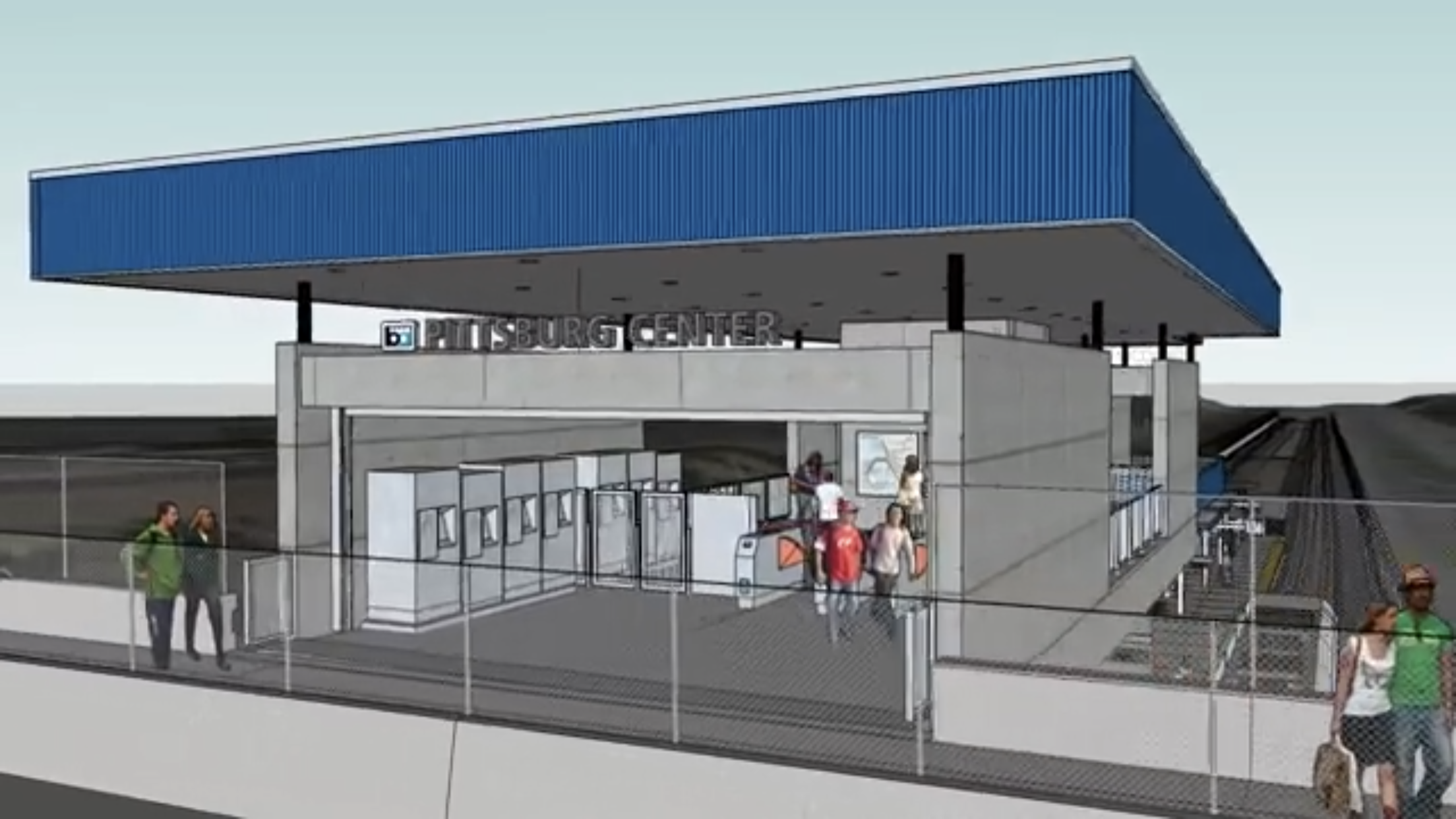
Screenshot of the Pittsburg Center BART Station animation. From BART.gov

New fare information available now


By Allen Payton

According to the BART website’s East County Extension page, parking permits for the new Antioch Station which is planned to open in May along with the Pittsburg Center Station, will be available for purchase beginning January 16. According to BART Director Joel Keller there will be 1,000 parking spaces and about 124 reserved spaces available. However, he said the reserved permits don’t get you a specific spot, just one of the reserved parking spots in the lot.

New Fares

The BART Board adopted the parking fees and fares at the December 7, 2017 board meeting.

BART is applying its existing distance-based fare structure to calculate fares for the new service.  For the 9.1-mile trip between Pittsburg Bay/Bay Point and Antioch Station, the Clipper fare will be $2.00 (starting Jan 1, 2018 there will be a $.50 surcharge on all paper ticket trips).  All BART discount programs will be applied to these fares.

The table below shows 2018 BART to Antioch sample fares using the adult Clipper card, a fare paid for with a paper ticket will be an additional 50 cents.

1/5/18 UPDATE: On Tuesday, January 16, 2018 at 11 AM, BART will open up the waitlist for passengers that would like to sign up to reserve a monthly permit, which guarantees a parking space until 10am each weekday. There will be a limited number of these permits available and they will be available on a first-come/first-served basis. The cost for the monthly permit will be $105 per month. You will only be charged for the permit if you are offered one and not until the extension officially opens. You may sign up to join when the waitlist at www.Select-a-Spot.com any time after January 16, 2018 at 11am. This website is also available through a link on the www.BART.gov/Parking webpage.

Monthly reserved permits will only be available at the Antioch Station. The Pittsburg Center Station will not offer any reserved parking permits, due to a limited number of parking spaces at the station.

There will be other parking options available as well:

Daily Fee Parking

Both stations will offer daily unreserved parking for a fee of $3. This parking is first-come/first-served in any marked “Fee” lot. Look at signs to the entrance to each section of the lot to determine if it is a “Fee” or “Permit” area. After 10am, any unused Permit spaces are open to all parkers for the Daily Fee.

Permit Parking

The Antioch Station will offer “Permit” parking. Customers with permits will be allowed to park in the designated areas of the parking lot. Permit spaces are available until 10am each weekday morning. After 10am all unused Permit spaces are available to anyone for the Daily Fee. All permits will be available on the www.Select-a-Spot.com website. There also will be a link to that website on www.BART.gov/Parking

Types of Permits:

  • Single Day reserved permits will cost $6 a day.
  • Airport/Long-Term Permits will cost $7 a day.
  • Monthly reserved parking permits will cost $105


To view the animation of the Pittsburg Center BART Station, click here. To view the animation of the Antioch BART Station, click here.

Filed Under: BART, East County, News, Transportation

BART Board to hear from public on Pittsburg, Antioch extension ride costs and parking fees, Nov 16 & Dec 7

November 9, 2017 By Publisher Leave a Comment

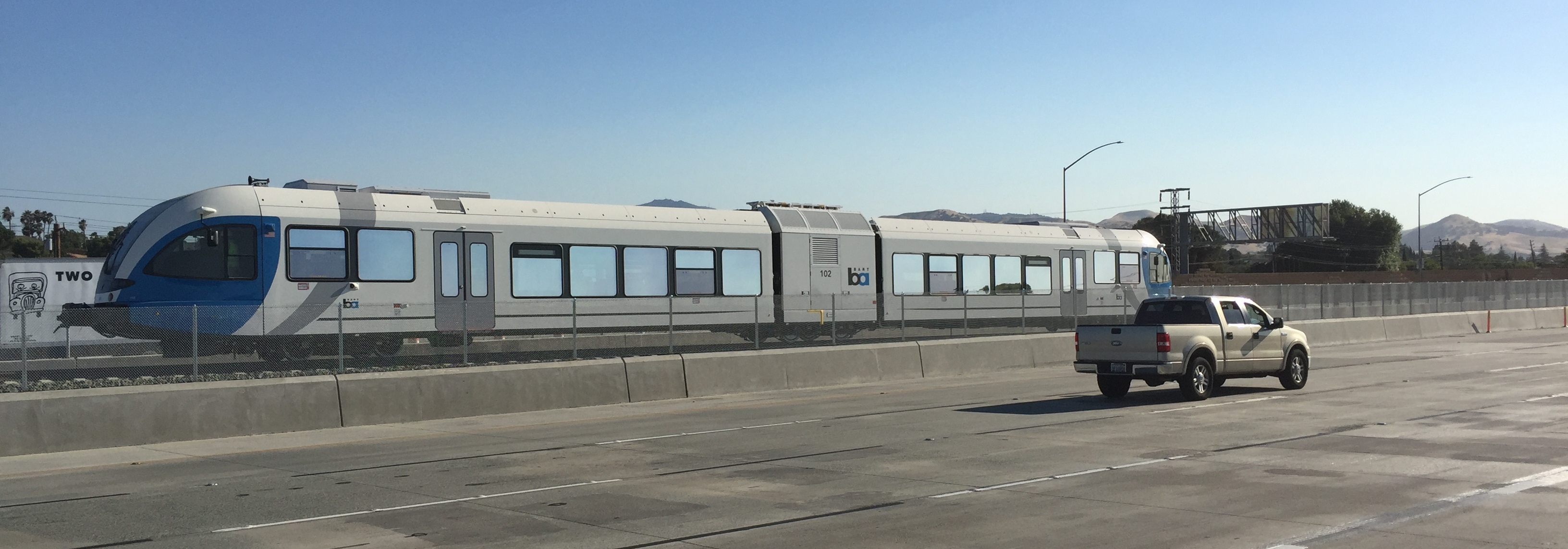
A two-car eBART train undergoes testing in the middle of Highway 4 between Hillcrest Avenue and A Street/Lone Tree Way on Friday evening, July 1, 2016 for the extension to Pittsburg and Antioch. Herald file photo by Allen Payton

BART Director Joel Keller. From BART.gov

By Joel Keller, District 2 Director, Bay Area Rapid Transit District

The BART Board will consider both BART to Antioch fares and BART to Antioch parking fees at a public hearing on November 16th meeting. On December 7th, the Board will be asked to approve the BART to Antioch fares and parking fees.

The proposal will extend BART’s distance-based fare structure for the Pittsburg Center Station and the Antioch station, resulting in a 15 cent increase at Pittsburg Center and an 80 cent increase at Antioch.

Sample BART to Antioch Fares:

Pittsburg/Bay Point to Embarcadero: $6.70

Pittsburg Center to Embarcadero: $6.85

Antioch to Embarcadero: $7.50

There will be 262 parking spaces on Bliss Avenue near Railroad Avenue serving the Pittsburg Center Station and 1012 parking spaces at the Antioch Station.

The parking fees are proposed to be effective upon commencement of operation of the Pittsburg Center and Antioch stations as follows:

Daily Fee Parking: $3.00 per day

Permit Fee Parking:

Monthly Reserved Permit: $105 per month

Single Day Reserved Permit: $6.00 per day

Airport/Long-Term Permit: $7.00 per day

Your opinion is valued and you can contact me directly at Joel.Keller@bart.gov or 510-915-7925 or you can let the entire Board know your thoughts by emailing BoardOfDirectors@BART.gov or calling 510-464-6095.

District 2 includes Antioch, Brentwood, Oakley, Pittsburg and portions of Concord and unincorporated Contra Costa County.


Filed Under: BART, News

Bridge toll increase bill includes Inspector General for BART proposed by Sen. Glazer

October 10, 2017 By Publisher Leave a Comment

SACRAMENTO – Gov. Jerry Brown on Tuesday signed a measure that will give Bay Area voters a chance to create an independent inspector general for BART to hold the sprawling transit district accountable for its spending, service to riders, and timely delivery of capital projects.

The inspector general was proposed by state Sen. Steve Glazer, D-Orinda, as part of a bill, SB 595, by Sen. Jim Beall (D-San Jose) that will ask voters to raise bridge tolls to fund transportation projects designed to relieve traffic congestion in the bridge corridors.

Glazer wanted voters to be given the option of creating the accountability czar as a condition of his support for placing the measure on the ballot. Other major transit agencies, including those in Washington D.C., New York, Chicago and Los Angeles, have long had inspector generals to serve as an independent check on the bureaucracy.

“If an independent check is good enough for transit systems in most of our major metropolitan areas, it should be good enough for BART,” Glazer said. “BART will get about one billion dollars from toll revenues generated by this measure, so it’s vital that riders and residents have someone who be the public’s eyes and ears and will hold BART’s administration accountable.”

If approved by voters, the inspector general would be appointed by the governor from a list of three finalists nominated by the BART board. The person could be fired only with a two-thirds vote of the board and the governor’s agreement.

The BART inspector general would be tasked with investigating fraud, waste and inefficiencies, conducting audits and recommending changes in the agency’s practices that will improve services to riders.

Glazer, who has been critical of management-union relations that resulted in eight days of strikes in 2013, required in the inspector general’s job description that they assess whether  management was using best practices to promote “positive and productive” relations with employees and their representatives.

“BART employees have as much to gain as the riding public by having an inspector general ensure that trains run on time, stations are safe and clean, and escalators and elevators work,” Glazer said. “They are hard-working, dedicated public servants who deserve an effective ally.”

Glazer also pushed for amendments to the bill that ensured Contra Costa and Alameda county commuters would see a fair share of congestion relief projects if the toll increases become a reality.

Projects to improve traffic flow on Interstate 680 and rebuild interchanges where 680 connects to state routes 4 and 84 were included in the final version of the proposed spending plan.

Glazer said he was proud of the collaborative process led by Sen. Beall, and Assemblymen David Chiu and Phil Ting of San Francisco and other members of the Bay Area legislative delegation. Members from throughout the region were able to provide input into the final proposal that included the crucial provision to oversee BART’s administration and spending.

“I look forward to voters determining whether to fund projects designed to relieve congestion throughout the entire region and providing independent oversight of BART,” Glazer said.


Filed Under: BART, Legislation, News

Contra Costa’s CyberTran awarded U.S. patent for Transportation Internet

October 2, 2017 By Publisher 3 Comments

Rendering of a CyberTran transit station. Renderings courtesy of CyberTran International, Inc.

Ultra-Light Rail Transit system vehicles travel throughout connected rail networks at low, medium and high speeds, direct to destination and at much lower capital deployment and maintenance costs

CONTRA COSTA COUNTY, CA – CyberTran International, Inc. (CTI) offers the most innovative approach to solving the world’s traffic congestion problems. The recent patent approval for fixed guideway transportation systems, with lower cost of ownership and optimized benefits, validates what they’re calling the Transportation Internet technology. This system can be thought of as the computer-controlled technology solution to the problems of mass transit cost overruns and inefficiency.

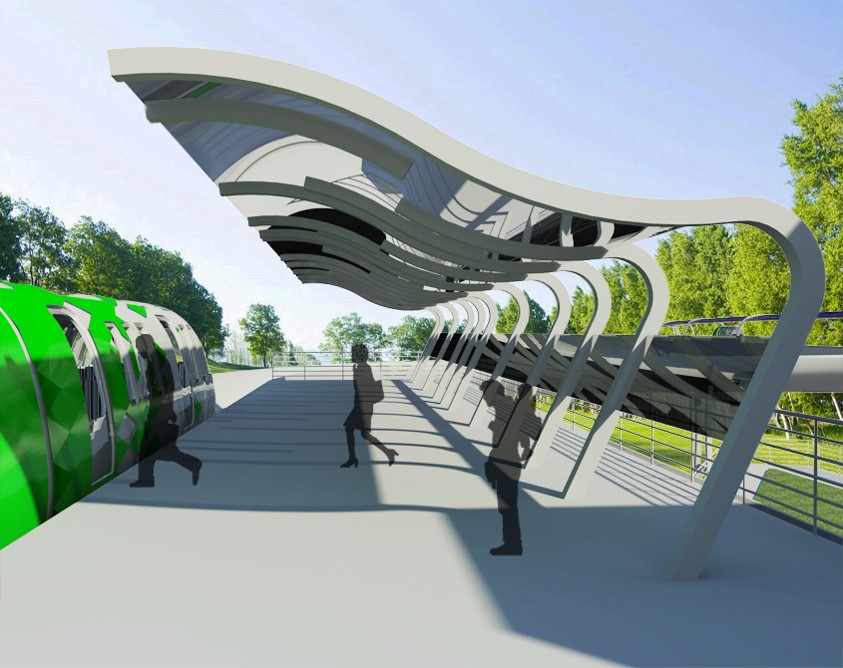
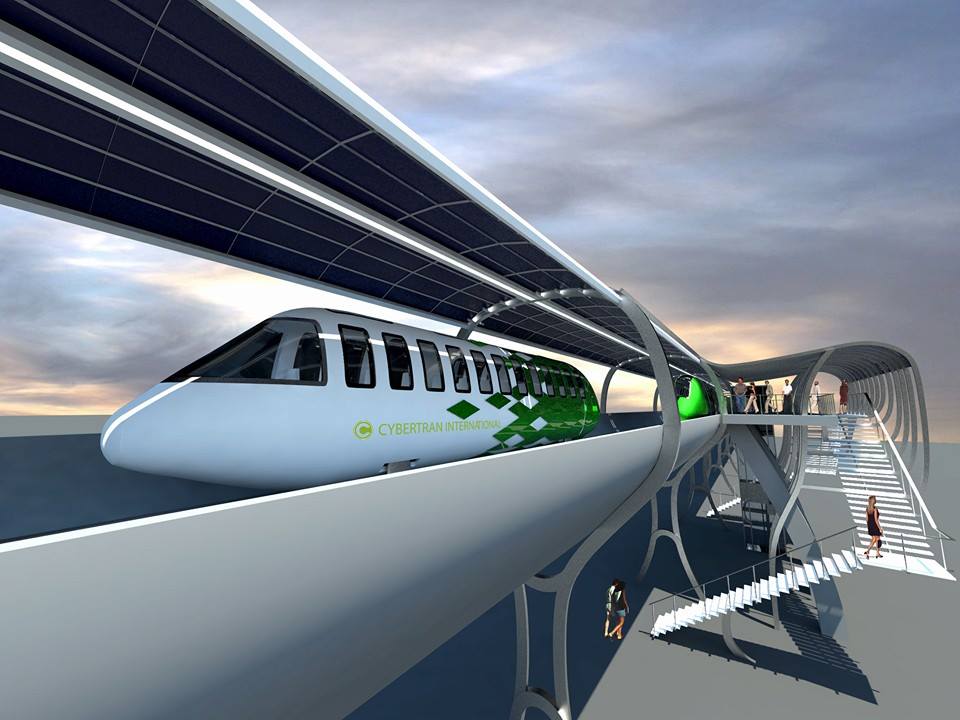
Artist rendering of a CyberTran vehicle and station with overhead solar panels generating the power to operate the system.

CTI’s Ultra-Light Rail Transit (ULRT) is a mass transit system with the ability to build out Urban Circulator systems, Commuter Rail systems and High-Speed Rail systems and connect them to one network where small rail vehicles carrying up to thirty passengers can travel throughout the network Direct-to-Destination (nonstop). This allows ULRT to serve three separate markets, low, medium and high speeds! Until today all three markets have been served by three separate distinct technologies that can only be connected at transfer points where passengers have to disembark one system only to transfer to another to reach their destination.

Currently, CTI is closing in on funding for the purpose of demonstration and deployment. “Everybody wants to be second, nobody wants to be first,” said Dexter Vizinau, President of CTI.

Transit officials are hesitant to take a chance on a small and innovative company. The BART system started out as a demonstration project and the technology was the first of its kind. Today, CTI has approximately ten cities that are willing to be first, he explained.

In every major metropolitan region of the world, people are stuck in traffic. Today’s solutions aren’t working.

“Expanding today’s transit systems are too costly to build and maintain, yet transit officials continue to approach this as a solution, with little result,” said Neil Sinclair, CTI Board Chairman. “There’s a $78 billion backlog in transit systems maintenance in the U.S. and the only way to pay for it is to raise taxes. In the meantime, we’re all stuck in traffic with no end in sight.” That is, until today.

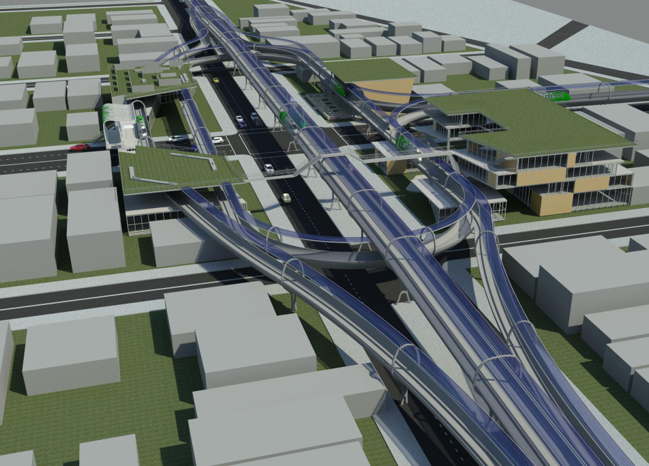
Overview rendering of the offline CyberTran stations.

“Our patent validates everything we’ve already proven,” Vizinau continued. “Two full-scale prototype vehicles have already been built and tested. The test vehicles have achieved speeds of up to 60 mph and have climbed a 10% grade, which means ULRT can go over the Sepulveda Pass in Los Angeles and also travel up the Grapevine Summit in Southern California. Bullet train systems and L.A. Metro-like systems cannot climb steep grades and therefore either have to tunnel or go around.”

By building out ULRT networks in cities at 35 mph, and then connecting them together throughout a region at 80 mph, ULRT becomes a commuter rail system like BART and Metro in Los Angeles. ULRT can handle the same throughput as BART during rush hour via the Transbay Tube. CTI can then connect regions with a high-speed line. The ULRT System design is flexible and can expand easily. Guideways and civil structures are manufactured offsite and assembled onsite allowing ULRT systems to be constructed more efficiently. CTI can construct long-distance systems in up to a quarter mile per day. The system was designed to reach speeds of up to 150 mph. (See related article)

CyberTran’s ULRT system also operates from solar power. Canopies of solar panels above the guideway can generate more than one megawatt per mile and eight times more energy than the system consumes, and supply renewable energy to surrounding communities resulting in a net gain to CTI.

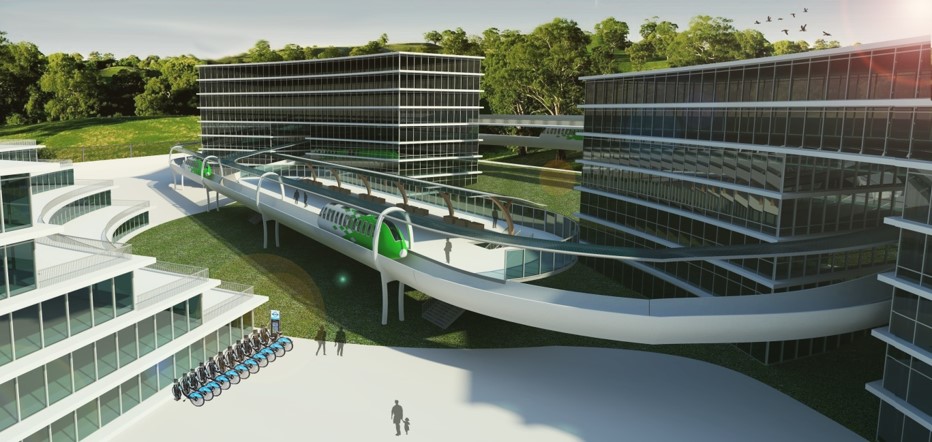
Rendering of a possible CyberTran station on the second floor of an office building and campus.

Transit officials currently purchase transit systems from foreign companies. CTI plans to manufacture ULRT transit systems for a global market in Contra Costa County. “We’ve been to China five times in as many years. There are six hundred cities in China that can use this,” says Sinclair. Councilmember Rich Kinney of the City of San Pablo states, “West Contra Costa County in particular has to solve the I-80 corridor congestion issue to attract more businesses and jobs to our cities. This is our opportunity to effectively address that issue. May we not continue to kick the proverbial can down the road – it’s time to embrace the full deployment of CyberTran right here at home.”

Earlier this year the city councils of Oakley, Brentwood and Antioch each voted unanimously to join the cities of Richmond and San Pablo to support efforts by CTI to obtain the needed funding for systems in both Western and Eastern Contra Costa County. (See related article) In addition, CTI has the support of U.C. Berkeley in their efforts to bring the technology to market. (See related article)

The next steps for CTI are to obtain funding to build two showrooms and a factory. This calls for one low-speed demonstration track up to 35 mph, and one rapid speed demonstration track up to 150 mph – in curves and with left and right banking. Both demo tracks and factory construction are to be done concurrently. There were no funding programs to support transit innovation, such as ULRT, at the federal level until CTI lobbied Congress to create one. Program legislation was created and approved in 2014 under a Republican-controlled Congress and Senate. CTI was hopeful that President Obama would release the program funding but it did not happen. CTI is hopeful about the President Trump’s infrastructure package and is encouraged by their reception in Washington, D.C.

Note: The publisher of the Contra Costa Herald has a financial interest in CyberTran International.

Filed Under: BART, Business, East County, News, Technology, Transportation, West County

Sen. Glazer’s legislation to create inspector general for BART approved by Senate

September 14, 2017 By Publisher Leave a Comment

SACRAMENTO – The state Senate on Thursday passed legislation that will give Bay Area voters a chance to create an independent inspector general for BART to hold the sprawling transit district accountable for its spending, service to riders, and timely delivery of capital projects.

The inspector general was proposed by state Sen. Steve Glazer (D-Orinda) as part of a bill by Sen. Jim Beall (D-San Jose) that will ask voters to raise bridge tolls to fund transportation projects designed to relieve traffic congestion in the bridge corridors.

The bill was approved by the Senate on a 27-13 vote.

Glazer, a longtime critic of BART, insisted that voters be given the option of creating the accountability czar as a condition of his support for placing the measure on the ballot. Other major transit agencies, including those in Washington D.C., New York, Chicago and Los Angeles, have long had inspector generals to serve as an independent check on the bureaucracy.

“BART stands to gain about a billion dollars from the toll revenues this measure would generate,” Glazer said. “It’s only fair that riders and residents get an extra set of eyes and ears inside the agency to hold the administration accountable.”

If approved by voters, the inspector general would be appointed by the governor from a list of three finalists nominated by the BART board. The person could be fired only with a two-thirds vote of the board and the governor’s agreement.

The BART inspector general would be tasked with investigating fraud, waste and inefficiencies, conducting audits and recommending changes in the agency’s practices that will improve services to riders.

And in a twist, Glazer, who has been at odds with BART’s unions in the past, insisted on adding a line to the inspector general’s mission requiring the office to assess whether management was using best practices to promote “positive and productive” relations with employees and their representatives.

“The vast majority of BART employees are hard-working, dedicated public servants who share their customers’ desire to have trains that run on time, stations that are safe and clean, and escalators and elevators that work when they are supposed to,” Glazer said. “I hope the employees and their unions will find an inspector general to be an effective ally in making those things a reality.”

Glazer also pushed for amendments to the bill that ensured Contra Costa and Alameda county commuters would see a fair share of congestion relief projects if the toll increases become a reality.

Projects to improve traffic flow on Interstate 680 and rebuild interchanges where 680 connects to state routes 4 and 84 were included in the final version of the proposed spending plan.

Glazer praised Sen. Beall, and Assemblymen David Chiu and Phil Ting of San Francisco and other members of the Bay Area legislative delegation for a collaborative process that allowed for input from throughout the region and a final proposal that included the crucial provision to oversee BART’s administration and spending.

“No one got everything they wanted, but this is a fair compromise that will give the voters an opportunity to fund projects designed to relieve congestion throughout the entire region while providing independent oversight of the district’s practices,” Glazer said.

Filed Under: BART, Legislation, News

BART reducing speed systemwide during heat wave until 8 p.m.

September 1, 2017 By Publisher Leave a Comment

As a precaution against potential rail movement, BART will be reducing speeds between noon and 8 p.m. on most outdoor parts of the system for the duration of this regional heat wave. Riders should anticipate travel time increases of 10 to 20 minutes.

BART is taking this unusual step in response to the extreme temperatures forecast for the Bay Area over the next several days. BART rail is heat-treated prior to installation, which allows for thermal expansion and contraction of the rail in the Bay Area’s widely varying temperatures.

However, when actual temperature variations reach extreme levels, the thermal forces exerted on the rail increase, making it possible—though unlikely—that there could be some rail movement. Train speeds are being reduced in targeted parts of the system as a precautionary measure to give Train Operators more time to react to any observed abnormal rail conditions.

BART anticipates these reduced speeds to be in effect through at least Sunday, though the final decision on the duration of these changes will be based on weather forecasts and observed track conditions on the BART system. 

As a reminder, BART crews will be rebuilding trackway in downtown Oakland during Labor Day weekend from the end of service on Friday through Monday, to make the system safer, quieter, and more reliable. No trains will run between 19th Street and Fruitvale stations or between West Oakland and Fruitvale stations and Lake Merritt station will be closed. Riders on the Warm Springs/So. Fremont, Dublin/Pleasanton, and Oakland Airport lines will be impacted.

BART crews cannot complete these critical trackway repairs during the overnight hours when we are normally closed for maintenance, which is why we require this extra time. For more information on the track closure, please visit: http://www.bart.gov/news/articles/2017/news20170814

Filed Under: BART, News

BART issues Rider Guide and route for Warriors Victory Parade on Thursday

June 13, 2017 By Publisher Leave a Comment

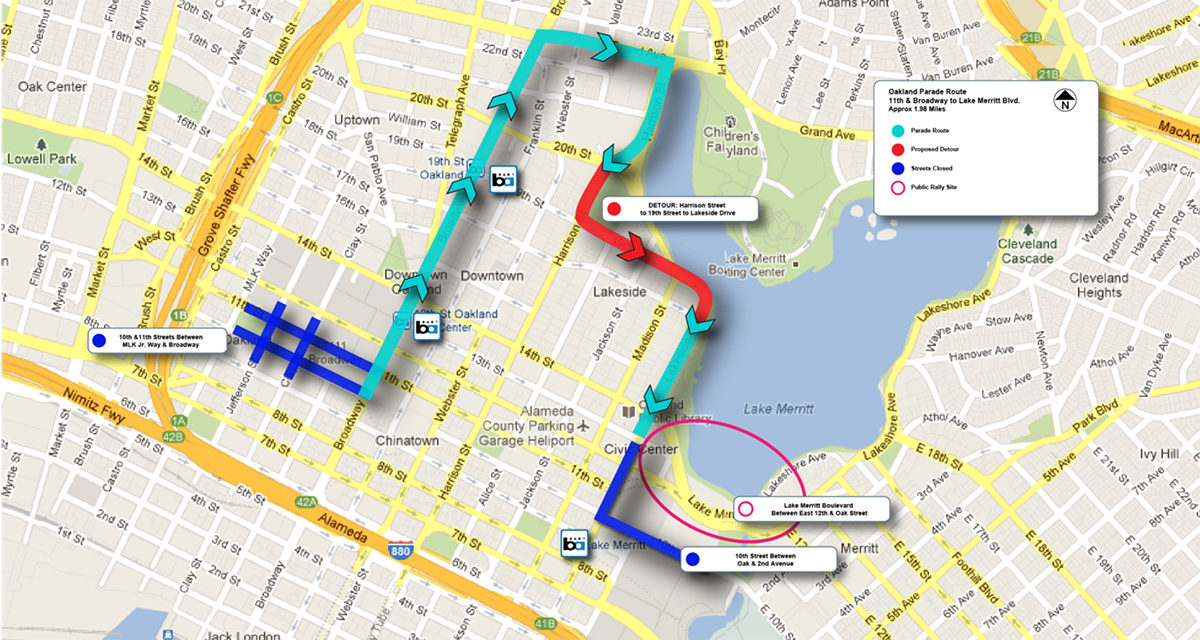
Warriors Victory Parade route for Thursday, June 15th.

The Warriors have taken care of business by bringing home another NBA championship and now it’s BART’s turn. We’re gearing up for an epic day Thursday when Oakland hosts a victory celebration starting at 10 a.m. We’ve put together some tips to help make your championship parade day safe and enjoyable.

Ten tips for riding BART to the victory celebration in Oakland

  1. Be patient, it’s going to get crowded; our busiest hours in 2015 were 8am-10am
  2. Use 19th Street Station, avoid the much smaller Lake Merritt Station
  3. Buy a Clipper card (clippercard.com) in advance to avoid extremely long lines at ticket machines
  4. Look for tables with cash only $15 Clipper card sales at 10 of our busiest stations
  5. Parking will be packed; think about taking the bus or walking to BART or getting dropped off
  6. “Permit” spaces in parking lots are for permit holders only, a citation will ruin the fun day
  7. When boarding trains, move to the center of the car so more can fit, remove backpacks
  8. Don’t jam a train door- it will take the whole train out of service and everyone will boo you
  9. Some trains may not stop at Lake Merritt if the Rally Zone has reached capacity or crowding
  10. Our service will not match the published schedule so listen and pay attention

The Details

First, know that BART is going to be crowded like you’ve never seen it before. On the day of the 2015 Warriors parade, BART carried 548,076 people – second only to the 568,061 people who rode BART when the Giants held a victory parade on Halloween 2012. If you’re not going to the celebration and will be taking BART to work or elsewhere, we suggest leaving home early – maybe even before 7 a.m.

Getting to the Station

If you must drive and park at a BART station, consider getting there very early. Parking will be packed so instead, if you can, we suggest taking the bus or walking to BART or getting someone to drop you off at your station. 

If you do drive and park, remember that “Permit” spaces are for passengers who have paid for monthly and single day permits in advance.  Those without a Permit may only park in the “Fee” areas, which are First-Come/First-Serve.  If you park in the “Permit” area without a permit, you are subject to citation.

The Lake Merritt Station permit parking lot (located near Laney College) will be CLOSED all day.

Overflow Parking (NEW!)

BART staff is working to gain permission from parking lots located near BART stations that can be used as overflow parking. We will continue to update this information.

Fremont Station- Riders can use the upper lot of the City of Fremont parking garage located at 39701 Civic Center Drive in Fremont at no cost. Please use upper lot only; not library or police parking. Map: https://tinyurl.com/y8zp8qnj

San Francisco Stations- SFMTA has several public parking garages in San Francisco that are located within walking distance to BART stations.

From Antioch Park and Ride to Pittsburg/Bay Point BART Station- Lots A & C (lot B is still under construction) of the Antioch Park and Ride have 400 spaces available for use. Address: 1474 Slatten Ranch Road, Antioch, CA (this address drops the pin on the road that gives access to the lots for map apps) Enter the lot at Sunset Drive & Hillcrest OR take SR-4 Map: https://tinyurl.com/y9uckvqv  

From there, take a Tri-Delta Transit bus to Pittsburg/Bay Point station. Routes that will take you to the Pittsburg/Bay Point Station: 300 (express), 380, 388, 390, 391, 392, 393, 394

Tri-Delta Transit System Map

Map of bus stops at Pittsburg/Bay Point (for return trip)

Tri-Delta Bus Schedules 

Purchasing Fares

Don’t be the person stuck in a line for the ticket vending machine while Steph and KD are waving to the crowd. We suggest you buy a Clipper card or ticket at least a day or two in advance.

Go to www.clippercard.com and find a retail location closest to you. 

If for some reason you don’t, BART will be selling $15 Clipper cards at special cash-only ticket tables at the stations listed below.  We picked these stations because they had long lines in 2015.  Be sure to keep these Clipper cards and register them. They work on other Bay Area transit.  

Stations with $15 cash only Clipper card table sales

 4am-10am

·         Fremont

·         Warm Springs

·         Dublin/Pleasanton

·         El Cerrito del Norte

·         Coliseum

·         Bay Fair

·         Millbrae

10:30am-2:30pm

·         12th Street

·         19th street

·         Lake Merritt

Heading to Downtown Oakland

We are doing extra maintenance now so we can put every available train out to carry passengers, but you’ll be joining a half million or more fellow riders. 

The Lake Merritt BART Station will be in the epicenter of the celebration so it’s best to avoid it. We strongly suggest taking BART to either 12th Street or 19th Street stations in Oakland. They are bigger and they’re right along the parade route so you’ll have more elbow room. They will also be your best options for starting your trip home.

Trains coming from Dublin/Pleasanton and Fremont Warm Springs towards Oakland may skip Lake Merritt after 8:30am if the rally zone has reached capacity and has closed or if the station becomes too crowded.  Listen to announcements and use 12th or 19th street instead. 

Service changes to be aware of

The Pittsburg/Bay Point morning service WILL NOT match the regular published schedule. Some trains will be rerouted to other crowded areas in the system.

Specifically:

The following trains that originate at North Concord in the morning will be redistributed to other areas and will not run on the Pittsburg/Bay Point line: 6:59 a.m., 7:14 a.m., 7:29 a.m

The following trains that originate at Pleasant Hill in the morning will be redistributed to other areas and will not run on the Pittsburg/Bay Point line: 8:12 a.m., 8:27 a.m., 8:42 a.m. 

After 8 am every other train from the Warm Springs to Daly City line will not go to San Francisco and instead go to Downtown Oakland to serve the parade route. These trains will terminate at MacArthur Station.

At any time, we may need to skip a station due to crowding, or hold riders outside the fare gates and wait until the platform clears to allow riders to enter the paid area.  Listen to instructions from BART workers- we’re here to help.

What we’re doing to prepare

Besides getting all the train cars ready, we are staffing up to make sure we can quickly respond to any issues that pop up. We will have extra paramedics on standby and extra police officers on patrol including the Transportation Security Administration’s Vipr team.

We’ll have extra escalator and elevator technicians in our stations, and train technicians ready to respond to an equipment problem on a train. 

Code of Conduct

Finally, it probably goes without saying but we’ll say it anyway: smile and have fun. We at BART enjoy serving you on what should be a joyous and memorable day. We only ask that you show common courtesy to your fellow riders, follow our simple rules and -if you start to get a little impatient- think about the folks in Cleveland who wish they had a parade.  

Filed Under: BART, News, Sports

BART Board backs Brentwood Transit Center

June 2, 2017 By Publisher Leave a Comment

The BART Board of Directors, at their May 11th meeting, approved a resolution of support for the proposed Brentwood Transit Center and Mokelumne Trail Bridge.  If built, the transit center could initially be served by Tri Delta Transit buses and could eventually become a station for a future eBART extension.

“This resolution from the BART Board is an important step in showing the strong regional support for building the Brentwood Transit Center,” said BART Director Joel Keller.  “The transit center would remove approximately 1,000 cars from Highway 4 for more than four miles past the Antioch eBART Station by providing parking for customers taking Tri Delta Transit to BART.”

The resolution calls on BART to work with the city of Brentwood, Tri Delta Transit and the Contra Costa Transportation Authority to explore the idea of the Brentwood Transit Center.  This would include working with Brentwood on the Specific Plan being initiated now.

The decision by the BART Board comes after the Brentwood City Council in March voted unanimously to explore building a transit center near the intersection of the Mokelumne Multi-use Trail and State Highway 4.  The Brentwood City Council is also supporting the construction of a pedestrian and bicycle bridge over Highway 4 to improve access to the site.

In 2014, BART conducted a next segment study to look at possible stops for a future eBART extension.  Six locations were studied and it was determined that the site near Highway 4 and the Mokelumne Trail was the preferred terminus of a future eBART extension beyond Antioch.  The transit center proposal is also on the list of projects for Plan Bay Area 2040 with partial funding.

The BART Board’s support for the transit center comes as construction is underway on the eBART line into eastern Contra Costa County.  That 10-mile extension will run from the Pittsburg/Bay Point Station in the median of Highway 4 and includes stops at the new Pittsburg Center Station and the Antioch Station near Hillcrest Avenue.  The eBART project will use independently propelled railcars known as Diesel Multiple Units (DMUs) that will operate on standard gauge rail.

It is anticipated that eBART service will launch in May of 2018.

Filed Under: BART, East County, News, Transportation

BART system expands with opening of Warm Springs/South Fremont Station, March 25

March 10, 2017 By Publisher Leave a Comment

BART Warm Springs/South Fremont Station. Photo from Wikipedia

BART’s Warm Springs Extension will open for service on Saturday, March 25, 2017. The 5.4-mile extension connects the existing Fremont Station to the new Warm Springs/South Fremont Station.

The new station includes 2,082 parking spots, including 42 electronic car charging stations as well as intermodal connections to A/C Transit and VTA buses.

“This will be history in the making,” said BART Director Tom Blalock, who serves Fremont and has been a leader in making the extension a reality. “This will bring BART service to the residents of fast growing south Fremont. They’ll have a reliable, environmentally-responsible alternative to driving on the sometime nightmarish Nimitz Freeway.”

The Warm Springs Extension also paves the way for BART to Silicon Valley, a Santa Clara Valley Transportation Authority project that’s underway and is expected to open for service later this year.

One day before beginning service, BART will host an Opening Celebration. At 10 until noon on Friday March 24, 2017, BART will welcome neighbors, elected leaders and anyone interested in the new station. on the day of the celebration, free shuttles will run from Fremont Station to the  new station every 15-20 minutes from 8:45 am to 1 pm. 

The station is located at 45193 Warm Springs Blvd.

Click here for a video of BART’s newest extension. In addition, view the video of the tour of the tunnel beneath Lake Elizabeth as part of the extension.

Filed Under: BART, News

BART to pay $1.275 million settlement in environmental prosecution case by DA’s of three counties

February 1, 2017 By Publisher Leave a Comment

Transit agency failed to implement plans notifying first responders of the presence of large quantities of hazardous materials at its facilities throughout the Bay Area

Martinez, , CA – The Contra Costa County Office of the District Attorney, along with District Attorneys from Alameda County and San Mateo County, announced today that Alameda County Superior Court Judge Morris Jacobson has ordered San Francisco Bay Area Rapid Transit District (BART) to pay $1.275 million as part of a settlement of a civil environmental prosecution alleging that the transit agency failed to implement hazardous materials business plans at facilities throughout the three counties as well as violating aboveground storage tank, underground storage tank, and hazardous waste laws.

The judgment agreed to by BART, resolves allegations made in a civil enforcement lawsuit filed January 31, 2017 in Alameda County and covers environmental violations dating back to January 2010.  The lawsuit claimed that at over 30 of BART’s 190 facilities throughout Alameda, Contra Costa, and San Mateo Counties, BART unlawfully failed to establish and implement a hazardous materials business plan for emergency response to a release or threatened release of hazardous materials.  These hazardous materials included large quantities of diesel fuel, petroleum, sulfuric acid contained in industrial batteries, and fire extinguishing chemicals.  The lawsuit further alleged that at these and other facilities, BART violated its environmental obligations related to its aboveground storage and underground storage of petroleum, and its hazardous waste.

“The protection of the public and the environment from dangerous hazardous materials through the enforcement of environmental protection laws is and always will be a high priority,” say District Attorney, Mark A. Peterson. “I am committed to ensuring both private and public entities comply with environmental laws enacted to protect our community and environment.”

In January of 2014, during routine compliance inspections, hazardous materials inspectors from the Alameda County Department of Environmental Health observed large aboveground storage tanks containing diesel at BART facilities in East Dublin/Pleasanton, West Dublin, and Castro Valley. These tanks, which contained 500 to over 1,700 gallons of diesel, fueled backup generators and were located in close proximity to areas accessed by thousands of BART commuters each day.  Despite the presence of large quantities of hazardous materials, BART had never implemented a hazardous materials business plan for any of these facilities as required by law.  These plans contain critical emergency response information for first responders, such as firefighters, and BART employees, should there be a release or threatened release of hazardous materials into the environment.  These hazardous materials business plans are designed to ensure the protection of the public and the environment in the event of a hazardous materials spill.

The violations were brought to the attention of the Alameda County District Attorney’s Office Environmental Protection Division who then conducted a follow up investigation with the District Attorney’s Offices’ Environmental Protection Units of Contra Costa County and San Mateo County.  The Contra Costa Health Services Hazardous Materials Program and San Mateo County Environmental Health Division also conducted inspections of all BART facilities in their respective Counties.  The follow up investigations revealed that BART’s failure to implement hazardous materials business plans was more widespread and covered over 30 BART facilities in the three counties.  The investigation also revealed that, at numerous other BART facilities, BART was committing violations of California’s aboveground storage tank, underground storage tank, and hazardous waste laws.

BART was cooperative throughout the investigation and worked hard to bring their agency into substantial environmental compliance.  During the investigation, BART hired an third party to conduct an audit of its environmental management programs and the audit identified areas of improvement related to hazardous materials, aboveground storage tanks, and hazardous waste. As part of the settlement, BART agreed to implement the recommendations from this audit.

Under the settlement, BART must pay $675,000 in civil penalties paid out, according to statute, to other government agencies, and $300,000 to reimburse the costs of the investigation.  As part of the settlement, BART must also commit $300,000 to an additional environmental compliance position, for a total of two such positions for the next two years.  BART will also be bound under the terms of a permanent injunction prohibiting similar future violations of law.

Filed Under: BART, District Attorney, Environment, Health, News

  • « Previous Page
  • 1
  • …
  • 10
  • 11
  • 12
  • 13
  • 14
  • Next Page »
The Lemon Tree generic
RepublicServices-Antioch-ad (1)
Furn-Clrnc-Outlet-06-26B web
Monica's dinner 05-26 CCH
Celia's-07-26
Delta-RC-B 07-26
Deer-Valley-Chiro-06-22

Copyright © 2026 · · Contra Costa Herald · All Rights Reserved