• Home
  • About The Herald
  • Local Agencies
  • Daily Email Update
  • Legal Notices
  • Classified Ads

Contra Costa Herald

News Of By and For The People of Contra Costa County, California

  • Arts & Entertainment
  • Business
  • Community
  • Crime
  • Dining
  • Education
  • Faith
  • Health
  • News
  • Politics & Elections
  • Real Estate

Governor Newsom announces Water Supply Strategy for a hotter, drier California in Antioch on Thursday

August 12, 2022 By Publisher Leave a Comment

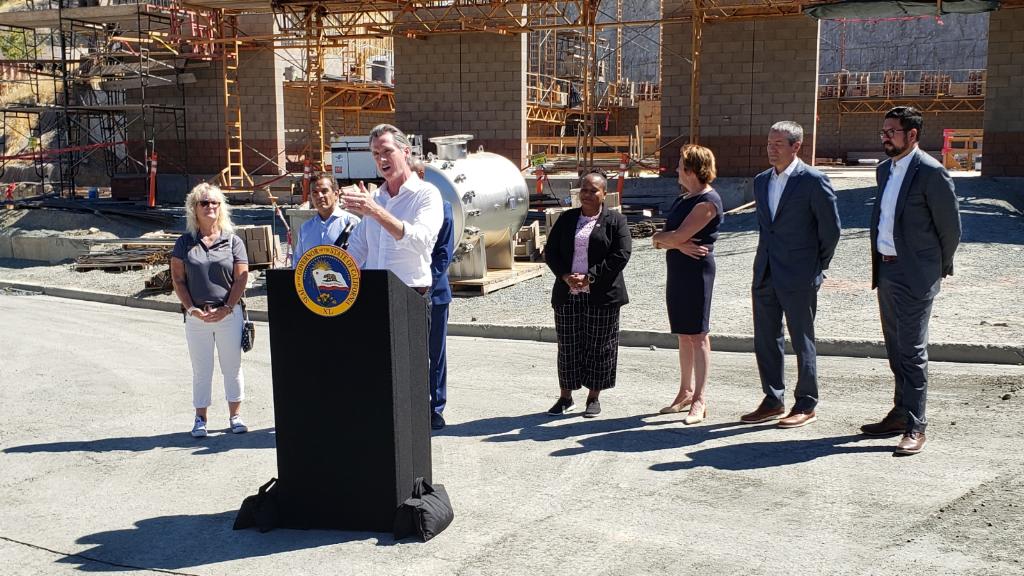
With local and state officials joining him, Gov. Newsom speaks during a press conference at the site of the Antioch Brackish Water Desalination project to announce his Water Supply Strategy on Thursday, August 11, 2022. Photos by Allen D. Payton

Outlines actions needed now to invest in new sources, transform water management

Without action, state officials believe California’s water supply could diminish by up to 10% by 2040

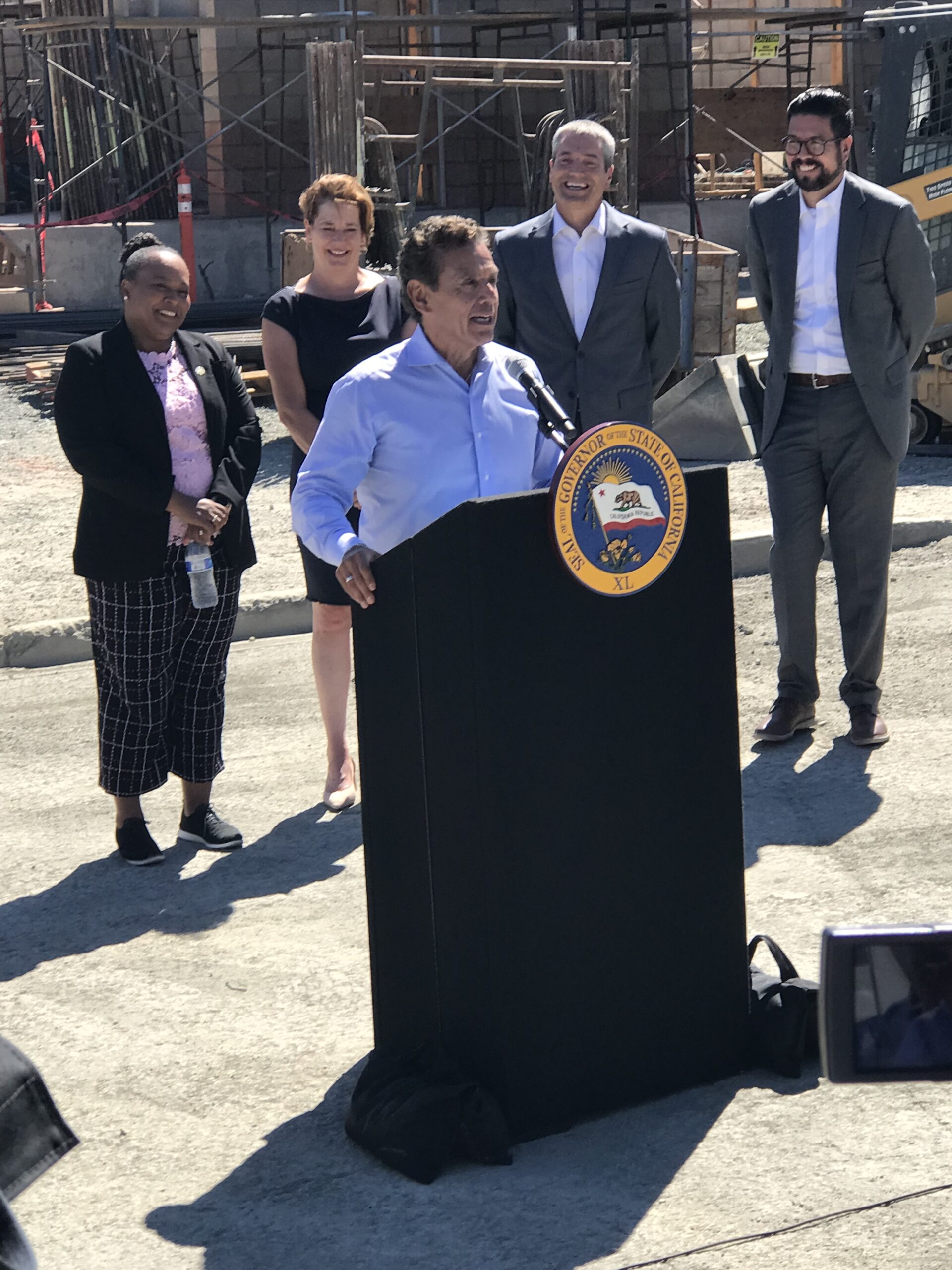
Introduces former L.A. Mayor Villaraigosa as state’s new infrastructure czar

Antonio Villaraigosa was introduced by the governor as the state’s new infrastructure czar.

ANTIOCH – Hotter and drier weather conditions could reduce California’s water supply by up to 10% by the year 2040. To replace and replenish what we will lose to thirstier soils, vegetation, and the atmosphere, Governor Gavin Newsom on Thursday announced in California’s latest actions to increase water supply and adapt to more extreme weather patterns caused by climate change. Click here to read California’s Water Supply Strategy.

Thursday’s announcement at Antioch’s $110 million Brackish Water Desalination project follows $8 billion in state investments over the last two years to help store, recycle, de-salt and conserve the water it will need, generating enough water in the future for more than 8.4 million households by 2040.

The actions, outlined in a strategy document published by the Administration called “California’s Water Supply Strategy, Adapting to a Hotter, Drier Future” calls for investing in new sources of water supply, accelerating projects and modernizing how the state manages water through new technology.

This approach to California’s water supply management recognizes the latest science that indicates the American West is experiencing extreme, sustained drought conditions caused by hotter, drier weather. The warming climate means that a greater share of the rain and snowfall California receives will be absorbed by dry soils, consumed by thirsty plants, and evaporated into the air. This leaves less water to meet the state’s needs.

“The best science tells us that we need to act now to adapt to California’s water future. Extreme weather is a permanent fixture here in the American West and California will adapt to this new reality,” Newsom said. “California is launching an aggressive plan to rebuild the way we source, store and deliver water so our kids and grandkids can continue to call California home in this hotter, drier climate.”

To help make up for the water supplies California could lose over the next two decades, the strategy prioritizes actions to capture, recycle, de-salt and conserve more water. These actions include:

  • Creating storage space for up to 4 million acre-feet of water, which will allow us to capitalize on big storms when they do occur and store water for dry periods
  • Recycling and reusing at least 800,000 acre-feet of water per year by 2030, enabling better and safer use of wastewater currently discharged to the ocean.
  • Freeing up 500,000 acre-feet of water through more efficient water use and conservation, helping make up for water lost due to climate change.
  • Making new water available for use by capturing stormwater and desalinating ocean water and salty water in groundwater basins, diversifying supplies and making the most of high flows during storm events.

These actions are identified broadly in the Newsom Administration’s Water Resilience Portfolio – the state’s master plan for water released in 2020 – but they will be expedited given the urgency of climate-driven changes. To advance the infrastructure and policies needed to adapt, the strategy enlists the help of the Legislature to streamline processes so projects can be planned, permitted and built more quickly, while protecting the environment.

Over the last three years, at the urging of the governor, state leaders have earmarked more than $8 billion to modernize water infrastructure and management. The historic three-year, $5.2 billion investment in California water systems enacted in 2021-22 has enabled emergency drought response, improved water conservation to stretch water supplies, and enabled scores of local drought resilience projects. The 2022-23 budget includes an additional $2.8 billion for drought relief to hard-hit communities, water conservation, environmental protection for fish and wildlife and long-term drought resilience projects.

Newsom also introduced former Los Angeles Mayor and Speaker of the Assembly Antonio Villaraigosa as the state’s new infrastructure czar.

“With this influx of federal dollars, we have an incredible opportunity to rebuild California while creating quality jobs, modernizing crucial infrastructure and accelerating our clean transportation progress, benefiting communities up and down the state,” Newsom said. “Antonio has the extensive experience and relationships to deliver on this promise and bring together the many partners who will be key to our success. I look forward to his collaboration with the administration as we build up communities across California.”

Antioch’s $110 million Brackish Water Desalination plant project is currently under construction.

Construction on Antioch’s desalination plant is expected to be completed next year, city Public Works Director John Samuelson shared following the governor’s press conference.

Filed Under: East County, Environment, Infrastructure, News, State of California, The Delta, Water

Harmful algae blooms reported in Discovery Bay

June 21, 2022 By Publisher Leave a Comment

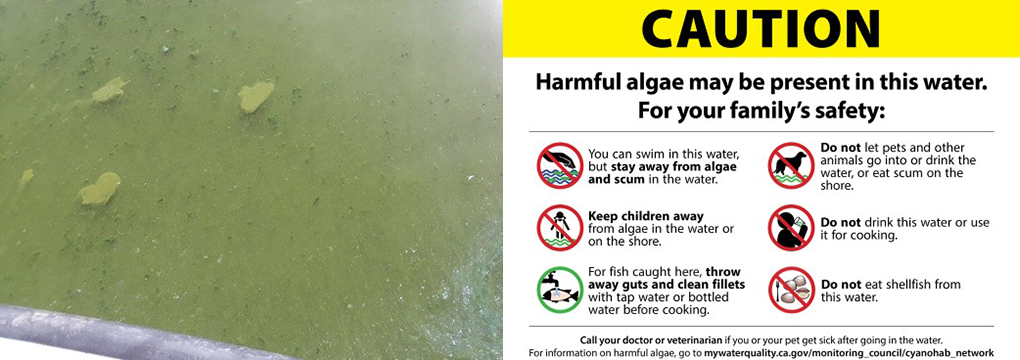
Source: CA Water Quality Monitoring Council

Stay away from algae and scum in the water. Do NOT let pets go in the water, drink the water, or eat scum on the shore. Keep Children away from algae. Do not eat shellfish from this waterbody.

Contra Costa Health (CCH) advises caution on the part of anyone who boats, fishes or swims in or around Discovery Bay after large blooms of blue-green algae were discovered in multiple locations in and around the community.

A bloom is a buildup of blue-green algae, or cyanobacteria, that creates a green, blue-green, white or brown coloring on the surface of slow-moving waterways. Contact with a toxin produced by the bloom can make people and pets very sick.

The state Water Resources Control Board recently sampled water at Discovery Bay after a person and a dog, in separate incidents, each developed minor symptoms consistent with exposure to cyanobacteria toxin after contact with water in the community. Sampling revealed elevated levels of harmful algae.

CCH has provided caution signs to Reclamation District 800 to post at the marina in Discovery Bay. Everyone should follow the instructions on the signs and stay away from algae and scum in the water.

Keep children and pets on shore, away from the blooms, and do not touch or handle algae in the water or scum on the shoreline. It is also unsafe to drink or cook with water in these areas, or to eat fish or shellfish caught in or near them.

Visit cchealth.org/eh/hab to learn more about harmful algae blooms. Visit mywaterquality.ca.gov/habs for more information and resources, including an online map showing where high concentrations of harmful algae have been reported across the state.

Filed Under: Animals & Pets, East County, Health, News, Recreation, Water

Contra Costa Water District asks customers for 15% conservation to address drought

April 29, 2022 By Publisher Leave a Comment

Public hearing June 15 on temporary drought surcharge of up to 15%

New reduction target, restrictions are consistent with state mandates

Facing a third consecutive dry year and responding to a new executive order from Gov. Newsom aimed at bolstering statewide water supplies, Contra Costa Water District’s Board of Directors adopted a new Drought Management Program at its April 20, 2022, meeting.

The move brings the District into Stage 2 of its Water Shortage Contingency Plan, adds new water use restrictions, and aims for an overall 15% reduction in water use as compared to 2020. Full details of the Drought Management Program are available at ccwater.com. Despite precipitation in late 2021, the beginning of this year has been among the driest on record.

“We know that further reductions can be a challenge, but our customers are conscientious water users who step up for their community,” said Lisa M. Borba, District Board President. “Setting our baseline year as 2020 protects those customers who voluntarily reduced their water use in 2021.”

The District’s water allocation from the federal Central Valley Project, which will provide only for minimum public health and safety levels this year, will be supplemented with local supplies and water stored in its Los Vaqueros Reservoir, which currently is about 58% of capacity.

To encourage conservation and to recover costs related to the ongoing drought, the District is proposing a temporary drought surcharge of up to 15%, or $0.79 per 748 gallons for treated water customers, effective for water delivered starting July 1. For the average customer using 260 gallons of water per day, the surcharge amounts to approximately $0.28 per day. A rebate to offset the drought surcharge for treated water customers who use 200 gallons per day or less, funded with non-rate revenues, is included in the District’s proposal. A public hearing to consider the temporary drought surcharge is set for June 15.

“We are committed to helping our customers use water as efficiently as possible,” President Borba said. “Our incentive programs help customers effectively reduce their water use, especially outdoors where nearly half of water is used during the summer months.”

The District offers numerous resources and rebates available for customers to reduce their water use – all available at ccwater.com/drought.


Filed Under: News, Water

Contra Costa Water board Division 1 vacancy to be filled by appointment, application deadline May 19

April 22, 2022 By Publisher Leave a Comment

CONCORD – The Contra Costa Water District (District) Board of Directors has decided to fill a vacancy on its Board by appointment, as provided under state law. The vacancy is due to the resignation of Division 1 President Lisa M. Borba. Division 1 includes the District’s service area in the cities and communities of Concord, Pacheco, Clyde, Bay Point, and Pittsburg. All applicants must reside within the boundaries of Division 1. (See related article) 

The Board set up a process that includes:

  • Confirming 5:00 p.m. Thursday, May 19 as the deadline for interested parties to submit an application (applications are now available at District offices and on the District’s website,ccwater.com/907).
  • Eligible candidates will be notified on Friday, May 27 if selected for the interview process.
  • Candidates selected will be provided the opportunity to present their qualifications at a regular meeting on Wednesday, June 1.
  • The Board intends to appoint the new Director at either the Board meeting of June 1 or June 15.

The Division 1 Director’s seat will be placed on the ballot for the November 8, 2022 general election. The newly appointed Director will hold the office until the general election results are certified.

To be eligible, applicants must live within the boundaries of Division 1 and be registered to vote. A map of Division 1 is available on the website at www.ccwater.com or applicants may contact the District Secretary at 925-688-8024 to confirm residency within the Division.

Applications must be received by the District Secretary, either through the website at www.ccwater.com/907 or at the District Center Building located at 1331 Concord Avenue, Concord, CA 94520 by 5:00 p.m. on Thursday, May 19, 2022.

Filed Under: Central County, Government, News, Water

Major Bay protection and restoration efforts in S.F. Estuary Blueprint get federal boost

March 24, 2022 By Publisher Leave a Comment

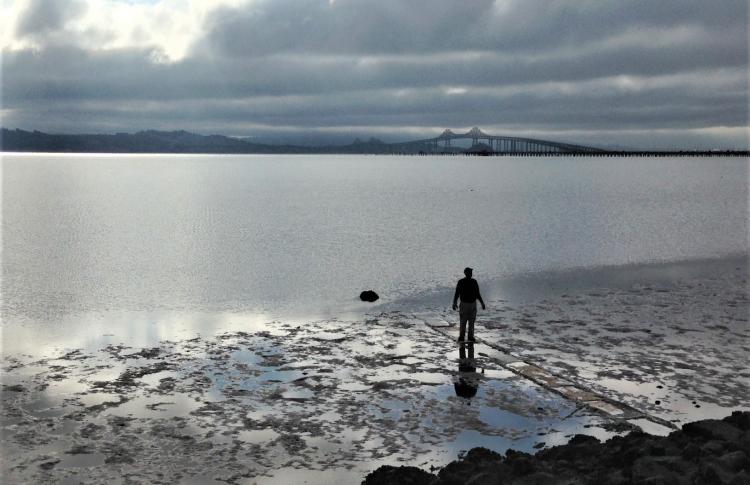
San Rafael Bay. Photo by Mark Prado

$24 million for clean water program

Money to restore San Francisco Bay and address impacts from climate change received a $24 million boost via the federal omnibus spending bill signed into law this week by President Biden.

The Consolidated Appropriations Act of 2022 provides funds to implement the priority actions identified in the San Francisco Estuary Partnership’s Blueprint. Specifically, the money will go toward the U.S. EPA’s San Francisco Bay Area Water Quality Improvement Fund, which has focused work on removing pollutants, improving wetlands and reducing runoff.

The $24 million annual earmark is the biggest increase to the fund since it began in 2008, with a push from Sen. Dianne Feinstein. The Water Quality Improvement Fund currently receives about $5 million annually to advance wetland restoration, water quality improvement and green urban development projects.

“Thanks to the efforts of Rep. Jackie Speier and our members of Congress, the new law provides funds to implement the priority actions identified in the Estuary Blueprint,” said Caitlin Sweeney, Director of the Estuary Partnership. “This is a huge development and is critical for the long-term health of San Francisco Bay.”

With the support from the Appropriations Act, federal funding for San Francisco Bay will be on par with regional funding from sources like the Bay Area’s Measure AA, which passed in 2016 and dedicates $25 million annually to fund multi-benefit shoreline projects that protect and restore the bay.

The new law also provides a bump in funding for the National Estuary Program, bringing the San Francisco’s Estuary Partnership appropriation this year to $750,000, a $50,000 increase.

Enactment of the omnibus spending bill augments the Bipartisan Infrastructure Law passed by Congress in November 2021, which allocates approximately $5 million annually over the next five years to the Water Quality Improvement Fund and dedicates about $4.5 million over the same period to the Estuary Partnership for implementation of the Estuary Blueprint.

The San Francisco Estuary Blueprint — being updated for 2022-2027 and due out later this year — is a five-year roadmap for restoring the estuary’s chemical, physical, biological, and social-ecological processes to health. The Blueprint identifies the top actions needed for thriving habitats and wildlife, improved water quality for animals and people, increased scale and pace of climate change adaptation and planning, and healthier human and wildlife communities.

Hosted by the Association of Bay Area Governments (ABAG), the San Francisco Estuary Partnership is a collaboration of local, state and federal agencies; non-governmental organizations; and academic and business leaders working to protect and restore the San Francisco Bay-Delta Estuary. The Estuary Partnership was established in 1988 by the state of California and the U.S. Environmental Protection Agency under the Clean Water Act’s National Estuary Program when the San Francisco Estuary was designated as an estuary of national significance.

Filed Under: Bay Area, Environment, News, Water

Contra Costa Supervisors put Health Services Chief on hot seat over 13 COVID rule violating restaurants

December 8, 2021 By Publisher Leave a Comment

“The time has come to shut down those establishments that don’t obey the code.” – District 4 Supervisor Karen Mitchoff

“There are no Omicron variant cases yet in our county.” – CC Health Services Director Anna Roth

Approve $95.5 million for new West County Reentry Treatment & Housing Facility; East County Groundwater Plan approved

By Daniel Borsuk

A defensive Contra Costa Health Services Director Anna Roth faced criticism from county Supervisors, especially emanating from District 4 Supervisor Karen Mitchoff on why 13 restaurants remain open in defiance of county COVID-19 health orders. As of Sept. 22, by order of the county’s Health Officer Dr. Chris Farnitano, restaurants, gyms, movie theaters and other entertainment venues must require patrons to show proof of vaccination or a recent negative COVID test in order to enter. (See related article)

“There is no change in enforcement,” Roth said at Tuesday’s supervisors meeting. As of November, 99 percent of restaurants in the county are compliant. We have 13 outstanding cases.”

But Roth’s statement did not satisfy Mitchoff, the supervisor who initially unveiled the code enforcement issue with the county health services.

“The time has come to shut down those establishments that don’t obey the code,” Mitchoff said. “We have done the education. We’ve done the warning.”

None of the owners of the 13 restaurants spoke at Tuesday’s supervisors meeting. Lumpy’s Diner in Antioch, and MJ’s Downtown Café are among eating establishments that the county has tagged as out of compliance of COVID-19 health code.

One of the 13 restaurants on the county’s red tag list, the In-n-Out in Pleasant Hill has been closed for indoor dining health code violations.

District 5 Supervisor Federal Glover of Pittsburg came to the defense of Roth and her department’s code enforcement division commenting, “I think you’re doing an outstanding job out there. The volume of people out there who are out of compliance is small. I enjoy eating inside a restaurant. I understand the stress,”

In the meantime, Roth reported that while 75.6 percent of Contra Costa County residents are fully vaccinated, twenty-seven persons are hospitalized in county hospitals with COVID-19 symptoms One patient dies daily on average from COVID-19 symptoms, she noted.

“There are no Omicron variant cases yet in our county,” said Roth.

In an interview for a KRON4 news report, County Health Officer Dr. Chris Farnitano said, “We don’t just jump right in there with a fine at the get go. We give the businesses the opportunity. Because our goal is to get to compliance for people to follow the order. Our goal isn’t to issue a bunch of fines.” The report also shared that Farnitano said only four restaurants in the county have been fined.

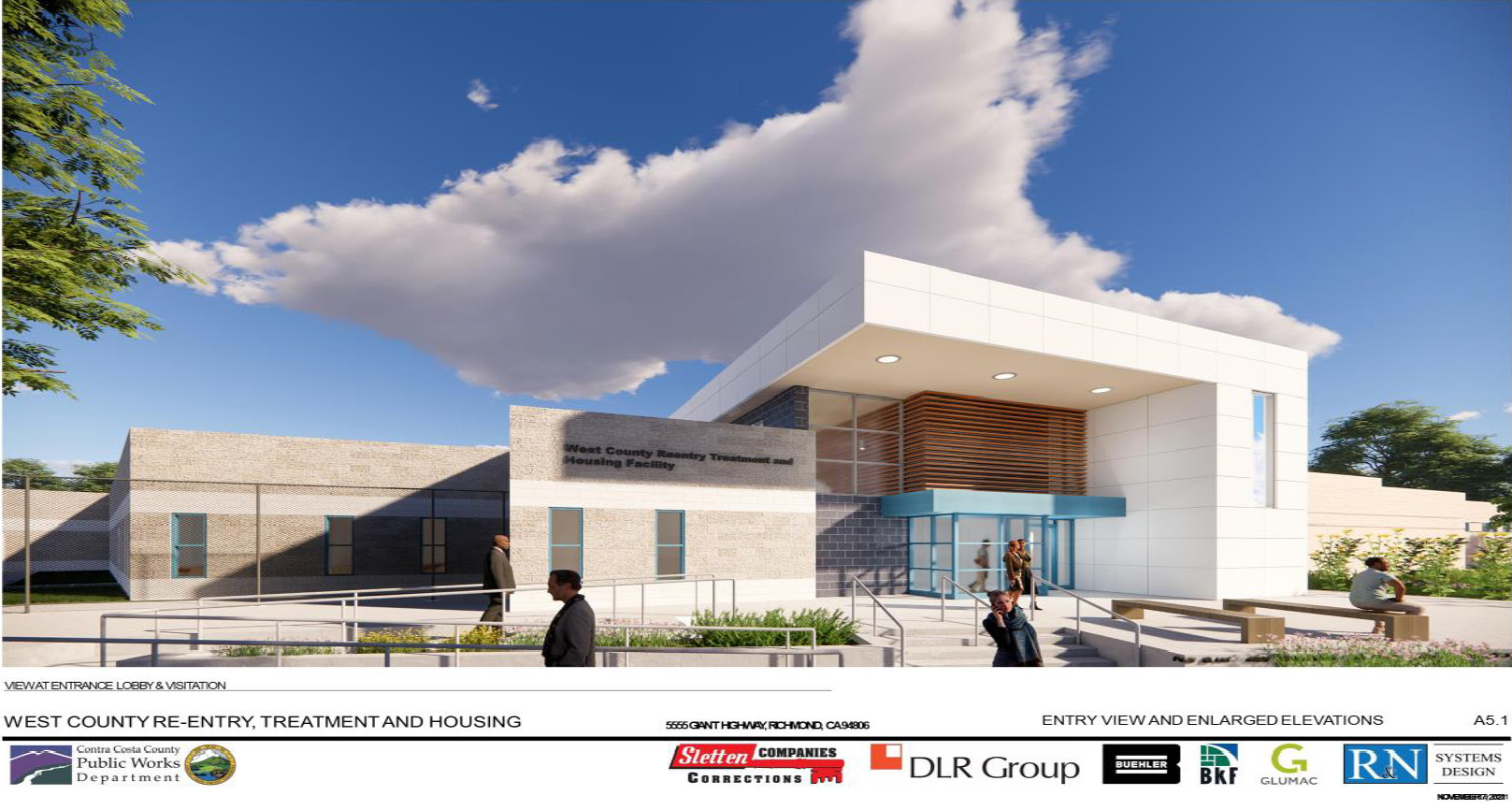
Rendering of the entrance of the West County Re-entry Treatment and Housing Facility. Source: Contra Costa County

$95.5 Million West County Detention Facility Expansion Plan Approved

Supervisors unanimously approved a $95.5 million design-build contract with Montana-based contractor Sletten Construction Company to design and build five secure housing units, a medical treatment center, reentry program space and building, and visitation facilities at the West County Detention Facility in Richmond. It will be known as the West County Reentry Treatment & Housing Facility.  WRTH presentation CCCBOS120721

One of the objectives of the project is to reduce overcrowding by 128 inmate beds to 288 high-security inmate beds in five housing units. Ninety-six beds will still be mental health treatment beds.

Possible Relocation of Marsh Creek Shooting Range

In a related matter, supervisors approved as a consent item a report on the future use and potential relocation of the shooting range at the Marsh Creek Detention Facility possibly to the Concord Naval Weapon Station. At the low-security detention facility inmates learn wood making skills and other basic education skills.

Used also as a training facility for the Office of the Sheriff and law enforcement agencies from Contra Costa County and surrounding counties, the Marsh Creek Range Facility generates revenue for the county. The range will bring about $113,000 for fiscal year 2021-2022, wrote County Administrator Monica Nino in her report to the supervisors.

East County Groundwater Sustainability Plan Approved

Supervisors also approved the East Contra Costa Subbasin Groundwater Sustainability Plan on a 5-0 vote. The $1.4 million groundwater study applies to the cities of Antioch and Brentwood, Byron-Bethany Irrigation District, Diablo Water District, Discovery Bay Community Services and East Contra Costa Irrigation District.

Even under drought like conditions, the plan found, “Groundwater conditions in the ECC Subbasin are favorable and reflect stability over the past 30 years or more. Using various analogies, the Subbasin can be described as generally full through various water-year types, including drought and is in good “health.” The favorable conditions are in part due to surface water availability that represents the largest sources of supply for municipal and agricultural uses in the Subbasin.”

Ryan Hernandez of the Department of Conservation and Planning said if the board of supervisors did not adopt the ECC-GSP, the county would be in violation of the Sustainable Groundwater Management Act, which would result in the State Water Resources Board intervening in local groundwater management.

Allen Payton contributed to this report.

Filed Under: Business, Dining, Health, News, Sheriff, Supervisors, Water

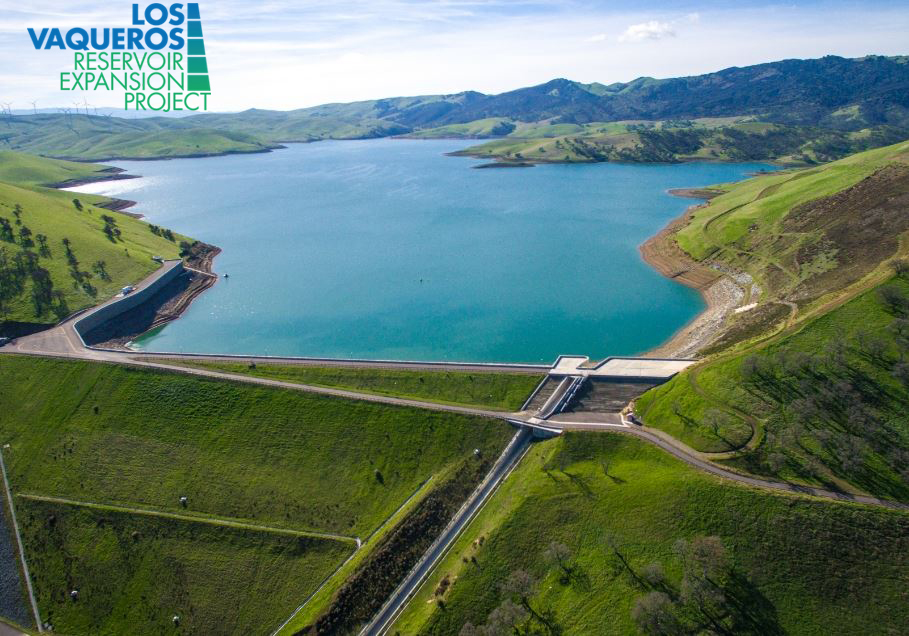
Los Vaqueros Reservoir Joint Powers Authority formed for capacity expansion of 275%

October 7, 2021 By Publisher 1 Comment

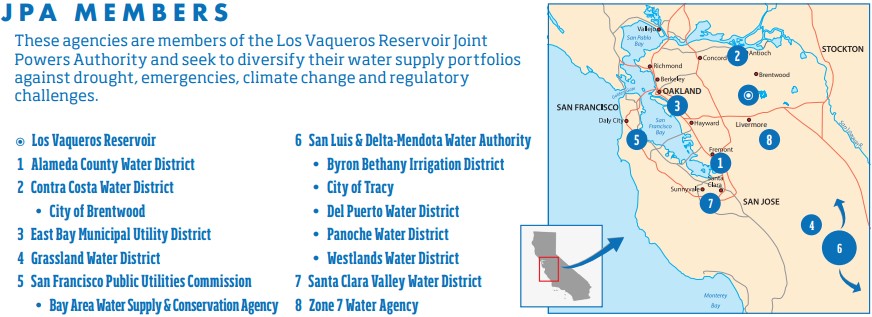
Los Vaqueros Reservoir JPA partners. Source: CCWD

It will be pretty dam big!

By Jennifer Allen, Director of Public Affairs, Contra Costa Water District

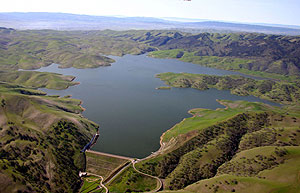
Los Vaqueros Reservoir. Source: CCWD

Brentwood – The Los Vaqueros Reservoir Expansion Project (Project) passed a significant milestone today, Thursday, Oct. 7, 2021, in officially filing agreements needed to form a Joint Powers Authority. This important milestone puts a group of Local Agency Partners one step closer to Project implementation.

Los Vaqueros Reservoir is an off-stream reservoir that was originally built by Contra Costa Water District (CCWD) in 1998. The original reservoir capacity was 100,000 acre-feet and in 2012, CCWD completed the first phase of expansion to hold 160,000 acre-feet.

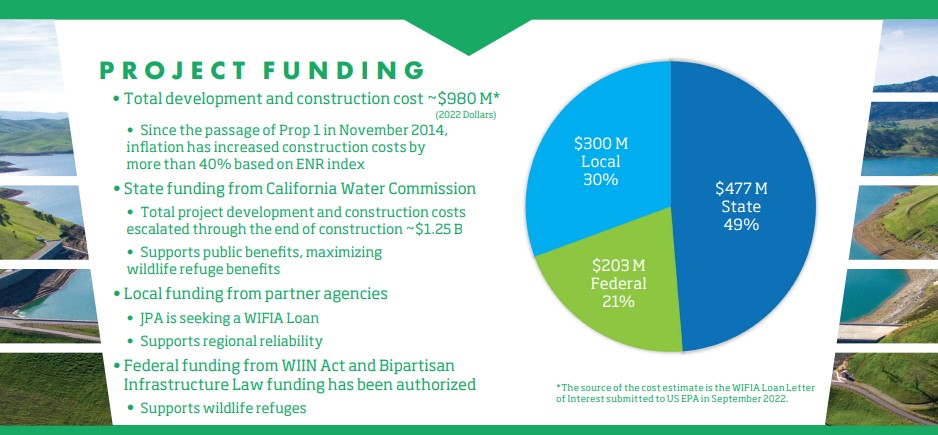
Expanding Los Vaqueros to a new capacity of 275,000 acre-feet and adding new conveyance facilities will provide environmental, water supply reliability, operational flexibility, water quality and recreational benefits. Those benefits earned the expansion $470 million of the $2.7 billion in water storage investments approved by voters when Proposition 1 passed. The remainder of the project costs will be covered by federal and local partners.

Transforming a local reservoir into a regional facility requires partnerships. Agencies in the Bay Area and Central Valley, serving urban areas, agricultural land and wildlife refuges, have come together to move this expansion forward. A critical step in forming this partnership is the creation of the Los Vaqueros Reservoir Joint Powers Authority (JPA).

“Contra Costa Water District looks forward to working with all of the partners on the JPA in making financing, construction, and operations decisions for the expansion,” said Lisa Borba, CCWD Board President. “As the owner and operator of the system, we know the valuable benefits that Los Vaqueros continues to provide our customers and growing those benefits for a larger region is a smart investment for future generations.”

The JPA establishes the governance of the Project among the partnering agencies and provides the organizational framework for Project design, construction, operation, maintenance and funding. JPA members will bring perspectives from the agency or agencies they represent and work collaboratively to meet the needs of all agencies involved. The JPA will hold its first official public meeting in mid-November.

“The Los Vaqueros Reservoir Expansion is not only important for EBMUD, but for the Bay Area and the region as a whole,” said John Coleman, EBMUD Ward 2 Director and Los Vaqueros JPA Board Member. “Along with efforts such as water conservation, water recycling, and supplemental supplies, EBMUD will continue to support mutually-beneficial regional reliability efforts to prepare for an uncertain future.”

Looking forward, the Project team is continuing work to secure the necessary permits, approvals and agreements to begin construction. At this point, construction is scheduled to begin in the winter of 2023.

More information about the JPA is available at www.losvaquerosjpa.com.

OTHER JPA PARTNER STATEMENTS

Zone 7 – Tri-Valley

“For the Zone 7 Board, participation in this project represents a lesson learned from the last drought. Our constituents were clear that they wanted the Agency to pursue additional local storage and this is a key step towards fulfilling that request,” noted Angela Ramirez Holmes, Zone 7 Board President. “In addition to local storage, this regional partnership also has the benefit of emergency conveyance which is critical for when there are pumping restrictions in the Delta preventing Zone 7 from accessing State Water Project water. This alternative conveyance will increase the Tri-Valley water system’s reliability.”

Alameda County Water District

“The current drought is a stark reminder of the importance of reliable water storage, and Alameda County Water District is proud of our partnership with Contra Costa Water District and other Bay Area and regional stakeholders on this multi-benefit project,” said Aziz Akbari, ACWD Board President.  “ACWD’s participation in the JPA is another example of interagency coordination for the benefit of our customers and our region as we help guide improvements in long-term water supply reliability along with wildlife and environmental benefits as California works to combat climate change.”

Bay Area Water Supply and Conservation Agency 

“The Bay Area Water Supply and Conservation Agency (BAWSCA) is pleased to see continued progress in the Los Vaqueros Expansion Project, including this most recent milestone of the JPA formation,” said Nicole Sandkulla, BAWSCA CEO/General Manager. “The project, when in place, will serve to augment the water supply reliability of the San Francisco Regional Water System (System) during times of drought, helping to address the critical needs of the water users in the BAWSCA region that rely on the System to meet a majority of their water supply needs.”

Grassland Water District

“Grassland Water District is pleased to be involved with the formation of California’s newest water JPA,” said GWD General Manager Ricardo Ortega. “The Los Vaqueros Reservoir Expansion Project is a bright spot for California’s water future and will provide increasingly important ecosystem water supplies for wildlife refuges.”

San Francisco Public Utilities Commission

“Regional Cooperation is crucial for a resilient and reliable water future for our customers given the stresses that global climate change and shifting regulations put on our water supplies,” said Michael Carlin, Acting General Manager for the San Francisco Public Utilities Commission. “The SFPUC is committed to working with our partners on regional solutions, such as the Los Vaqueros Reservoir Expansion Project.”

San Luis & Delta-Mendota Water Authority

“California’s increasingly variable water cycle – including our current devastating drought conditions – continues to reinforce the need to pursue an all of the above approach to increasing water supply reliability for our communities and ecosystems,” said Federico Barajas, Executive Director of the San Luis & Delta-Mendota Water Authority. “We know the solutions – increased water storage, improved water conveyance, operations that are responsive to changing conditions – and are pleased to be a partner to advance the next step in making the Los Vaqueros Reservoir Expansion Project a reality.”

Santa Clara Valley Water District

“Our Board is proactively exploring ways to secure enough water to help all our communities in Santa Clara County weather droughts,” Valley Water Board Chair Tony Estremera said. “Valley Water looks forward to working with our JPA partners on this important project that could improve the reliability of our region’s water supply.”

Filed Under: East County, News, Water

Facing water shortage Contra Costa Water District asks customers for 10% voluntary conservation 

July 8, 2021 By Publisher Leave a Comment

Los Vaqueros Reservoir currently is about 77% of capacity.

Concord –The Contra Costa Water District (CCWD) Board of Directors endorsed a Stage 1 water shortage level at its July 7, 2021 meeting and is now asking customers to voluntarily reduce water use by up to 10%. Water stored in Los Vaqueros Reservoir will also help meet customer demands this year. 

CCWD has a contract with the federal government to receive water through the Central Valley Project (CVP). Initial allocations provided in April 2021 indicated that CCWD would have adequate water to meet all customer needs, which are about 10-15% below demands seen prior to the 2014-15 drought.

Since April, contractors like CCWD learned that much of the anticipated inflow to rivers from snowmelt was instead absorbed by the dry ground. In May, CCWD was informed that its water allocation was reduced and would only receive enough supply to meet public health and safety needs.

Due to the reduced allocation and to preserve available water supplies, CCWD plans to use water stored in its Los Vaqueros Reservoir in addition to voluntary conservation to meet customer needs. Los Vaqueros currently is about 77% of capacity.

“Our customers are efficient water users and wise investors in water storage,” said Lisa M. Borba, CCWD Board President. “Asking customers to voluntarily conserve about 10% is appropriate in a year this dry. Without the water stored in Los Vaqueros for drought supply, we would be having a different conversation.”

In a unanimous vote on July 7, the Board approved moving CCWD into the first level of its Water Shortage Contingency Plan which includes the call for up to 10% voluntary conservation. The Board also noted the water waste provisions adopted during the last drought remain in place and will be enforced to prevent any wasteful use of a precious resource.

CCWD has resources and rebates available for customers to reduce their water use – all available at ccwater.com/drought.    


Filed Under: News, Water

Delta Conveyance aka tunnel Project Community Benefits Program Workshop 1 of 3 April 14

April 12, 2021 By Publisher Leave a Comment

Opportunity for neighboring community members to offer input of what they want from the impacts of the project

If you live or work in the Delta, we’d like to invite you to join an online workshop to provide feedback to the Department of Water Resources about the Community Benefits Program of the Delta Conveyance (tunnel) Project. On April 14, between 6:00 and 8:00 pm, Ag Innovations will facilitate a large online workshop to gather feedback from Delta residents on the Department of Water Resources (DWR), Community Benefits program.

To Register for the April 14 Workshop Email DeltaConveyanceCBP@water.ca.gov
Click Here for more information.

However, as of Monday, April 12, the day the Herald received the notification of the meeting on the 14th, registrations are closed. If you would still like to participate, please email us at DeltaConveyanceCBP@water.ca.gov. If you cannot participate in the workshop, but would like to provide input, please email us at DeltaConveyanceCBP@water.ca.gov. A recording of each workshop will be posted, along with the background material, at https://water.ca.gov/Programs/State-Water-Project/Delta-Conveyance/Community-Benefits-Program

About the workshop: DWR is developing a community benefits program to acknowledge that if the Delta Conveyance project is approved it could have potential adverse effects on communities through construction of major capital projects. The Community Benefits program could create economic, social, and other benefits in the local community. A Community Benefits Program could go beyond what traditional “environmental mitigation” typically affords.

Why participate: While people oppose the Delta Conveyance Project, DWR has no expectation that participating in the workshops signals any support for the Delta Conveyance Project. The community benefits program would only proceed if the project were approved. But participating now provides community members a chance to shape the program to best suit the needs of the local community.

Ag Innovations is a 501c3 nonprofit and is committed to reaching out to underrepresented voices and creating meaningful opportunities to provide input, including at a time when the COVID-19 pandemic makes this challenging.  Please let us know if you have ideas for how we might work with you to bring your input into this process.

Stay tuned for additional workshops on the Community Benefits Program future workshops will be on:

Thursday, May 6, 2021 | 6:00pm – 8:00pm.

CLICK HERE to REGISTER

Tuesday, May 25, 2021 | 6:00pm – 8:00pm.

CLICK HERE to REGISTER

What is the Delta Conveyance Project?

The state is studying the potential impacts and benefits of two possible routes for a tunnel in the Delta, labeled the Delta Conveyance Project. The proposal aims to protect the reliability of the State Water Project to deliver clean water to homes, farms, and businesses in the Bay Area, Central Coast, and Southern California.

The project would catch fresh water in the northern Delta – especially during storms – through two new intakes near the town of Hood. A deep underground tunnel would carry that water 40 miles to the southern Delta where it would be pumped into the State Water Project. The project would be constructed over approximately 16 years.

DWR is currently studying potential impacts on traffic, noise, air quality, and historical, cultural, recreational, and other resources.

They have launched the Environmental Justice Community Survey to better understand how the project may affect the resources, values, and priorities that are most important you.

(See related articles here and here)

Filed Under: Environment, News, The Delta, Water

City of Antioch breaks ground on historic, first desalination project in Delta 

February 20, 2021 By Publisher 4 Comments

Antioch City Council members and staff gather for the groundbreaking of the new Brackish Water Desalination Plant next to the Antioch Water Treatment Plant on Friday, Feb. 19, 2021. Photo: City of Antioch

$110 million Brackish Water Desalination Plant made possible by State and City partnership 

By Rolando Bonilla, Public Information Officer, City of Antioch

On Friday, Feb. 19, Antioch City Councilmembers and staff, along with state dignitaries, broke ground on the city’s new and historic Brackish Water Desalination Plant. At a price of $110 million, the project was made possible with $93 million in funding from the State, and $17 million from the City of Antioch.

It will be the first one in the entire California Delta and second in the Bay Area, in addition to the brackish water desalination plant built in Newark by the Alameda County Water District in 2003.

“Through this project, Antioch continues establishing itself as both a state and regional leader on environmental best practices,” said Mayor Lamar Thorpe. “I would like to thank Governor Newsom for California’s investment in making our Brackish Water Desalination Plant a reality. By working together, we exemplify the very best of our state and our city.”

It is a resiliency project that will mitigate the impacts of reduced fresh water flow and accomplish drought reliability improvements.  The use and redirection of fresh water upstream has reduced the pressure on and caused intrusion of saltwater from the ocean. Antioch’s intake pumps, located at the end of Fulton Shipyard Road, are at the lowest point on the river. The situation will only worsen should the Delta Conveyance project (tunnel) be built and redirect more fresh water from north of the Delta, south, near the Clifton Court Forebay. (See related articles here and here)

Once completed, Antioch will be firmly positioned to preserve its pre-1914 water rights and provide the City with a reliable source of drinking water for generations.

“Water is the most precious of resources,” said City Manager Ron Bernal. “This is not only important for Antioch but also others who can become part of this project in the future.”

The City could sell some of the water from the plant to industrial users and other agencies.

The Antioch Brackish Water Desalination Project will utilize existing infrastructure to the extent possible and construct new desalination facilities and associated infrastructure to improve the city’s water supply reliability and operational flexibility. Once constructed, the desalination facility, located at the existing water treatment plant at 401 Putnam Street, will provide for 6 million gallons per day (mgd) of capacity (producing up to 5,500-acre feet per year (ac-ft/yr).

The Antioch Brackish Water Desalination Project consists of the following components:

  •  New river intake pump station to replace the existing San Joaquin River intake pump station. The pump station will consist of three 8 mgd pumps (16 mgd firm capacity), each with a fish screen that meets the protective criteria of the California Department of Fish and Wildlife and National Marine Fisheries Service.
  •  New 3,000-foot pipeline connecting the City’s existing raw water pipeline to the City’s Water Treatment Plant to allow a direct connection and maximize the use of existing infrastructure
  •  New 6 mgd desalination facility (reverse osmosis, post-treatment systems, chemical feed and storage facilities, brine conveyance facilities, and other associated non-process facilities).
  •  Approximately 4.3 miles of a new brine disposal pipeline to convey discharge brine to the Delta Diablo Wastewater Treatment Plant for disposal into the San Joaquin River through an existing outfall. Discharge of brine water into the San Joaquin River will result in minor local increases in salinities that are within the tolerance range of native species.

Antioch is located along the San Joaquin River where it meets and mixes with the Sacramento River at the entrance to the Delta in Northern California, just off of Highway 4 in Contra Costa County.

Allen Payton contributed to this report.
Filed Under: East County, News, Water

  • « Previous Page
  • 1
  • 2
  • 3
  • 4
  • 5
  • Next Page »
Monica's-Riverview-Jan-2026
Liberty-Tax-Jan-Apr-2026
Deer-Valley-Chiro-06-22

Copyright © 2026 · Contra Costa Herald · Site by Clifton Creative Web