• Home
  • About The Herald
  • Local Agencies
  • Daily Email Update
  • Legal Notices
  • Classified Ads

Contra Costa Herald

News Of By and For The People of Contra Costa County, California

  • Arts & Entertainment
  • Business
  • Community
  • Crime
  • Dining
  • Education
  • Faith
  • Health
  • News
  • Politics & Elections
  • Real Estate

Highway 24 Caldecott Tunnel overnight Bore #3 closure for maintenance work

November 6, 2025 By Publisher Leave a Comment

Caldecott Tunnel Bore #3. Photo: Caltrans

Monday-Wednesday, Nov. 10-12th 10:00 PM-4:30 AM

By DeNise Harding, External Affairs/PIO, Caltrans

ALAMEDA AND CONTRA COSTA COUNTIES – Caltrans has scheduled overnight closures of Bore 3 of the Caldecott Tunnel on Westbound State Route 24 (SR-24) for tunnel washing and maintenance.

Starting Monday, November 10, 2025, through Wednesday, November 12, 2025, from 10:00 PM to 4:30 AM each night. Bore 3 of the Caldecott Tunnel on Westbound State Route 24 (SR-24) for tunnel washing and maintenance. During the work, all other bores in each direction will remain open. All work is weather dependent.

Traffic Control Measures:

Changeable message signs will be in place to assist motorists traveling in the area. Motorists are advised to expect delays and allow extra time. Please drive with caution through the construction zone. Slow for the Cone Zone.

For 24/7 traffic updates, follow 511.org on Twitter/X. For real-time traffic, visit Caltrans QuickMap at Quickmap.dot.ca.gov. For more information about D4 Projects, visit: Caltrans D4 Current Projects | CleanCA.com | #BeWorkZoneAlert | Twitter/X | Facebook | YouTube

Filed Under: Lamorinda, News, State of California, Transportation

California invests $5 billion for local projects, bridge repairs, alternative transport options, freight movement

October 23, 2025 By Publisher Leave a Comment

$5.3 million for Contra Costa projects in Danville, Richmond

By Edward Barrera, Division Chief, Caltrans Public Affairs

The California Transportation Commission on Friday, Oct. 17, 2025, approved $4.9 billion to improve safety and mobility on local streets and state highways as well as fund new alternative transportation options and zero emissions projects.

“California is investing in itself — in our communities, our people, and the places we drive, walk, and ride every day. We’re making our roads safer, our commutes smoother, and our transportation system cleaner and more connected,” said Governor Gavin Newsom.

More than half of the allocation will provide 600 local governments and regional transportation agencies with their annual funding to fix roads, bridges and other transportation needs statewide.

“This nearly $5 billion investment highlights California’s strong commitment to creating a modern, resilient transportation system that enhances local streets and strengthens connections between neighborhoods, job centers and schools. Thanks to Governor Newsom’s leadership, Caltrans’ work and the Commission, we are building a safer, more connected and future-ready transportation network that serves all Californians,” said Toks Omishakin, California Transportation Secretary

Among the projects approved is $700 million for repairs and critical upgrades needed for the Vincent Thomas Bridge, a 60-year-old span in the Port of Los Angeles that will soon undergo a major deck refurbishment. Another $140 million will fund truck climbing lanes among other improvements to Interstate 80 in the Sierra foothills between Applegate and Emigrant Gap, a major west coast freight thoroughfare.

“Our local partners are steadfast contributors and valued partners in keeping California’s vast transportation network safe and efficient. When added to the various highway projects also approved, this month’s action ensures that hundreds of essential improvements in our cities and neighborhoods will better enable people and goods to flow throughout the state and beyond,” said Caltrans Director Dina El-Tawansy.

Of the total allocation this month, $470 million comes through Senate Bill (SB) 1, the Road Repair and Accountability Act of 2017, and $4.2 billion from the federal Infrastructure Investment and Jobs Act. The larger than normal funding relates almost exclusively to the annual allocation provided to local governments and regional transportation agencies.

“The Commission is committed to ensuring that California’s transportation system is safe and reliable for everyone who uses it,” said Tanisha Taylor, California Transportation Commission Executive Director. “Today’s nearly $5 billion investment in projects will improve multimodal access to schools and employment centers, boost our growing economy, and reduce out-of-pocket expenses for all Californians.”

Pedestrian facilities also received support from the allocations, including an award of $97 million to replace a pedestrian bridge that connects neighborhoods south of the City College of San Francisco campus and other improvements to Interstate 280 between San Francisco and San Mateo counties. And $6.3 million will be spent on new sidewalks, bike lanes and traffic controls in the cities of Santa Barbara and Santa Rosa and in Santa Clara County.

Other notable Bay Area projects include $10 million to build a floating charging station for zero emission ferries in San Francisco Bay.

Contra Costa County projects include:

  • $5,040,000 In Danville, at the I-680 southbound onramp to El Cerro Blvd. Due to heavy winter rains during January and February 2025 caused damage at three locations due to saturated soils, erosion, and earth movement. The damage includes roadway settlement, leaning sound wall, and slope erosion. This project will repair roadway using polyurethane injection and grind and pave methods, replace damaged portion of sound wall, reconstruct guardrail, stabilize slope embankment, and place erosion control.
  • $276,000 Construction of widened and ADA-compliant sidewalks along Market Avenue, curb extensions at Giaramita Street/Verde Street intersection, and urban greening in Richmond. Construct 4,390 feet of widened sidewalks, narrowed travel lanes, install 4 curb extensions and 18 ADA-compliant curb ramps.

California is expected to receive nearly $42 billion in federal infrastructure funding over a span of five years. These investments will upgrade the state’s roads, bridges, rail, public transit, airports, ports and the electric vehicle charging network.

SB 1 has invested approximately $5 billion annually toward transportation projects since 2017. It provides funding split between the state and local agencies. Road projects progress through construction phases more quickly based on the availability of funds, including projects that are partially funded by SB 1.

For more information about transportation and other infrastructure projects funded with state and federal investments, visit build.ca.gov.

Allen D. Payton contributed to this report.
 

Filed Under: Construction, News, San Ramon Valley, State of California, Transportation, West County

Overnight lane closures on I-80 in Contra Costa County

October 22, 2025 By Publisher Leave a Comment

For median barrier electrical work, final striping, lighting installations

Schedule: Ongoing through Fall 2025 – Weeknights: 9:00 PM to 6:00 AM

By DeNise Harding, External Affairs/PIO, Caltrans

Caltrans District 4 is continuing overnight maintenance and safety upgrades along Interstate 80 (I-80) between Buchanan Street in Albany and Highway 4 in Hercules. Work includes striping of On and Off ramps, electrical work, and lighting installations.

Closure Information

  • Multiple lanes including on and off ramps will be closed in both directions of I-80 between 9:00 PM and 6:00 AM, Monday through Friday.
  • All closures are limited to overnight hours only.

Scheduled Work Details

  • Striping (EB & WB on and off ramps): From Buchanan Street (Albany) to San Pablo Avenue (San Pablo).
  • Electrical Work (EB & WB): From Richmond Parkway to State Route 4 (Hercules).

**All work is weather dependent and subject to change**

Changeable Message Signs (CMS) will provide advance notice for motorists traveling in the area. Drivers may experience minor delays and are advised to plan ahead and allow extra time. Be work zone alert, drive with caution through the work zone. For 24/7 traffic updates, follow 511.org on Twitter. For real-time traffic, visit Caltrans QuickMap.

Filed Under: News, Transportation, West County

MTC, ABAG release draft of new long-range plan for Bay Area

October 22, 2025 By Publisher Leave a Comment

Source: Plan Bay Area

Public comment through Dec. 18 on Draft Plan Bay Area 2050+, EIR for housing, transportation, economic development and the environment

East Bay Webinar Nov. 5

By Veronica Cummings, Principal Public Information Officer, Engagement & John Goodwin, Assistant Director of Communications, Metropolitan Transportation Commission 

After more than two years of public discussion, technical analyses and refinement, the Metropolitan Transportation Commission (MTC) and the Association of Bay Area Governments (ABAG) today released Draft Plan Bay Area 2050+ and the Plan Bay Area 2050+ Draft Environmental Impact Report for public review and comment.

Draft Plan Bay Area 2050+ charts a course for the future of the Bay Area over the next 25 years. Designed to guide growth and investment across the region’s nine counties and 101 cities, the latest plan aims to advance an integrated vision for a Bay Area that is affordable, connected, diverse, healthy and vibrant for all. The plan contains 35 strategies for public policies and investments that can be implemented to help the Bay Area build more homes, reduce commute times, and create vibrant downtowns and natural areas for everyone to enjoy. These strategies also aim to keep people safe from natural hazards, support a strong economy and provide stable housing.

Unique to this plan cycle is Transit 2050+, a parallel and first-of-its-kind planning effort conducted by MTC and ABAG in partnership with Bay Area transit agencies to re-envision the future of Bay Area public transit.

Plan Bay Area includes all nine Bay Area counties and 101 cities. Source: Plan Bay Area

MTC and ABAG have scheduled a series of webinars and public hearings for comment on Draft Plan Bay Area 2050+ and associated supplemental reports, as well as on the Draft Environmental Impact Report for Plan Bay Area 2050+. All interested people, agencies and other organizations are encouraged to attend a webinar or public hearing, where they can ask questions and offer comments on these documents. Full event details are listed below:

  • Webinar #1 — North Bay
    Wednesday, October 29, 2025
    12-1:30 p.m.
    Zoom link: https://bit.ly/northbaywebinar
  • Webinar ID: 892 3077 8001
  • Passcode: 256814
  • 888-788-0099 US Toll Free
  • Webinar #2 — West Bay
    Wednesday, October 29, 2025
    6-7:30 p.m.
    Zoom link: https://bit.ly/westbaywebinar
    Webinar ID: 831 4140 5598
    Passcode: 096944
    888-788-0099 US Toll Free
  • Webinar #3 — South Bay
    Thursday, October 30, 2025
    6-7:30 p.m.
    Zoom link: https://bit.ly/southbaywebinar
    Webinar ID: 822 2561 7467
    Passcode: 356845
    888-788-0099 US Toll Free
  • Webinar #4 — East Bay
    Wednesday, November 5, 2025
    6-7:30 p.m.
    Zoom link: https://bit.ly/eastbaywebinar
    Webinar ID: 869 8283 4999
    Passcode: 682098
    888-788-0099 US Toll Free

In addition to these webinars, MTC and ABAG will host three public hearings around the Bay Area to provide opportunities for all interested agencies, organizations and individuals to comment on the Draft Plan and Draft Environmental Impact Report. The full list of hearings is as follows:

  • Public Hearing #1 — MTC Planning Committee and ABAG Administrative Committee
    Friday, November 14, 2025, at 9:40 a.m. or upon the conclusion of the Bay Area Infrastructure Financing Authority Network and Operations Committee, whichever is later.
    Bay Area Metro Center -or- Zoom
    Boardroom, 1st Floor
    375 Beale Street, San Francisco  Instructions to join by Zoom
  • Public Hearing #2 — Fremont
    Wednesday, December 3, 2025, at 6 p.m.
    Olive Hyde Art Center and Gallery -or- Zoom
    123 Washington Boulevard, Fremont
    Zoom link: https://bit.ly/drafthearing2
    Webinar ID: 875 7625 3306
    Passcode: 178983
    888 788 0099 US Toll Free
  • Public Hearing #3 — Novato
    Thursday, December 4, 2025, at 6 p.m.
    Best Western Plus Novato Oaks Inn -or- Zoom
    215 Alameda del Prado, Novato
    Zoom link: https://bit.ly/drafthearing3
    Webinar ID: 898 0347 9624
  • Passcode: 129009
  • 888 788 0099 US Toll Free

Interested Bay Area residents, agencies and organizations also are encouraged to view and comment on the draft plan online at planbayarea.org/draftplan. Comments will be reviewed by officials from both ABAG and MTC as they consider the adoption of Final Plan Bay Area 2050+, slated for early 2026.

Written comments will be accepted via mail to MTC Public Information Office, Attn: Plan Bay Area -or- Draft EIR Comments, 375 Beale Street, Suite 800, San Francisco, CA, 94105; or via email (Draft Plan Bay Area 2050+ inbox: info@planbayarea.org; Draft EIR inbox: eircomments@bayareametro.gov). Comments by phone can made at (415) 778-2292.

The comment period for all documents will close Dec. 18, 2025, at 5 p.m.

Questions? Visit planbayarea.org, email info@planbayarea.org or call (415) 778-6757.

Accessible Meetings

Do you need an interpreter or any other assistance to participate? Please call (415) 778-6757. For TDD or hearing impaired, call 711, California Relay Service, or (800) 735-2929 (TTY), (800) 735-2922 (voice) and ask to be relayed to (415) 778-6700. We require at least three working days’ notice to accommodate requests.

¿Necesita un intérprete u otra asistencia para participar? Por favor llámenos con tres días de anticipación al (415) 778-6757. Para telecomunicaciones para personas sordas y discapacitadas, favor de llamar al 711, el Servicio de Retransmisión de California (CRS) para TTY/VCO/HCO a Voz o para Voz a TTY/VCO/HCO al (800) 855-3000 y pedir que lo retrasmitan al (415) 778-6700.

您是否需要口譯或任何其他協助才能參加?請致電(415)778-6757。若需使用TDD或為聽障人士人士,請致電711,加州轉接服務,或(800)735-2929(TTY),(800)735-2922(語音),然後要求轉接至(415)778-6700。請至少提前三個工作日提出申請,以便我們能為您提供適當的口譯安排。

ABAG is the council of governments and the regional planning agency for the 101 cities and towns, and nine counties of the Bay Area. MTC is the transportation planning, financing and coordinating agency for the nine-county San Francisco Bay Area.

Filed Under: Bay Area, Economy, Growth & Development, Housing, Jobs & Economic Development, News, Transportation

California invests $3 billion to enhance safety, improve travel times, boost multimodal travel options

October 22, 2025 By Publisher Leave a Comment

Over $107 million for Contra Costa projects including $46.9 million on Hwy 4 improvements in East County, $42.4 billion on 680 in San Ramon Valley and $14.6 million on Caldecott Tunnel

By Edward Barrera, Division Chief, Caltrans Public Affairs

In August, the California Transportation Commission (CTC) approved $3 billion in allocations to enhance safety and mobility across the state highway system and expand multimodal travel, including bike lanes and pedestrian pathways. Guided by Governor Gavin Newsom’s Build More, Faster – For All infrastructure agenda, these improvements will make California communities safer, cleaner and increase access to active transportation options.

Of the $3 billion allocated, $663 million derives from Senate Bill (SB) 1, the Road Repair and Accountability Act of 2017 and approximately $2 billion from the federal Infrastructure Investment and Jobs Act of 2021 (IIJA). The funds will serve as a catalyst to increase the capacity of the state’s transportation system, rehabilitate aging roadways and improve travel times, while balancing community impacts and promoting environmental benefits.

The “…investments reflect California’s long-term commitment to safer roads, smarter traffic management and expanded transportation choices that get people where they need to go,” said Caltrans Director Dina El-Tawansy.

“The funds allocated…reflect the Commission’s commitment to investing taxpayer dollars strategically. These investments will improve the safety and reliability of the state’s transportation network and support a thriving economy by improving the movement of freight and reducing out-of-pocket expenses for all California,” said Darnell Grisby, Chair of the California Transportation Commission.

Projects in Contra Costa County approved by the Commission include:

  • $46,900,000 on SR-4 in and near Antioch and Brentwood, from Hillcrest Avenue to Byron Highway, to rehabilitate pavement and drainage systems, upgrade facilities to ADA standards, install Accessible Pedestrian Signals (APS), high-visibility crosswalks, bike loop detectors, and construct Class II bike lanes. This will extend pavement service life and improve ride quality.
  •  $42,374,000 on I-680 in San Ramon and Danville, from Alcosta Boulevard to 0.1 mile north of Diablo Road, to rehabilitate pavement, upgrade guardrail, and upgrade facilities to ADA standards. This will extend pavement service life and improve ride quality.
  • $14,584,000 on SR-24 in Orinda, at the Caldecott Tunnel, to rehabilitate and upgrade the ventilation system in Bores 1, 2, and 3. This will ensure structural integrity and prolong tunnel service life.
  • $1,301,000 on SR-4 in Concord, 0.5 mile east of Port Chicago Highway, to reconstruct a failed slope embankment and repair a displaced down drain due to heavy rainfall in February and March 2025. Work includes installing Rock Slope Protection (RSP), and repairing the down drain, guardrail, and dike. This will enhance driver and pedestrian safety.
  • • $1,275,000 on SR-4 near Pittsburg, 0.3 mile west of Bailey Road, to reconstruct a slope embankment and repair a displaced down drain due to heavy rainfall in February and March 2025. Work includes installing Rock Slope Protection (RSP). This will improve roadway safety.
  • $999,000 on SR-24 in Lafayette, from 0.7 to 1.0 mile east of Acalanes Road, to rehabilitate pavement due to ponding and water seepage caused by heavy rainfall in February and March 2025, which led to cracking and settlement. This will extend pavement life and improve safety.

IIJA is a once-in-a-generation investment in our nation’s infrastructure to improve the sustainability and resiliency of our country’s energy, water, broadband and transportation systems. The total funding for California is nearly $54 billion. This includes investments to upgrade the state’s roads, bridges, rail, public transit, airports, ports, waterways and the electric vehicle charging network.

SB 1 has invested approximately $5 billion annually toward transportation projects since its adoption. It provides funding split between the state and local agencies. Road projects progress through construction phases more quickly, based on the availability of funds, including those partially funded by SB 1.

Visit build.ca.gov to learn more about transformative infrastructure projects happening in communities throughout the state.

Filed Under: Construction, Finances, Infrastructure, News, State of California, Transportation

New operating hours for Richmond-San Rafael Bridge bicycle/pedestrian path begin Oct. 27

October 22, 2025 By Publisher Leave a Comment

Source: MTC. Photo credit: Noah Berger

Right side of upper deck to be used as highway shoulder Monday-Thursday

By John Goodwin, Assistant Director of Communications, Metropolitan Transportation Commission 

The Metropolitan Transportation Commission (MTC) and the Bay Area Toll Authority (BATA) today announced that beginning next week, the bicycle/pedestrian path on the upper deck of the Richmond-San Rafael Bridge will be closed from Sundays at 11 p.m. until Thursdays at 2 p.m., with the barrier moved to allow the space now occupied by the path to be used as a highway shoulder for westbound traffic. The first weekday on which the shoulder will be available will be Monday, Oct. 27.

The bicycle/pedestrian path will be open from 2 p.m. on Thursdays through 11 p.m. on Sundays as well as on select weekday holidays. These include Memorial Day; Independence Day, if observed on a Monday; Labor Day; Thanksgiving week from Wednesday afternoon through Sunday night; and the Christmas-to-New Year week.

On days when the bicycle/pedestrian path is closed, a free shuttle with a bicycle trailer will be provided from 6 a.m. through 8 p.m. On the Richmond side of the bridge, the shuttle pick-up and drop-off location is at the AC Transit bus turnaround on Tewksbury Avenue in the Point Richmond neighborhood. The San Rafael pick-up and drop-off location is at the Vista Point parking lot near the intersection of East Francisco Blvd. and Main Street. Signs alerting bicyclists and pedestrians to the new operating hours already are in place on approaches to the bridge from both Richmond and San Rafael.

BATA, which is directed by the same policy board as MTC, administers toll revenues from the Bay Area’s seven state-owned toll bridges. MTC is the transportation planning, financing and coordinating agency for the nine-county San Francisco Bay Area.

Filed Under: News, Recreation, Transportation, West County

Newsom signs bill authorizing Nov. 2026 Bay Area transit tax measure

October 14, 2025 By Publisher 2 Comments

Photo: MTC

Five-county half-cent sales tax would include Contra Costa County, last 14 years; in addition to existing half-cent BART operations sales tax

By John Goodwin, Assistant Director of Communications & Rebecca Long, Director, Legislation & Public Affairs, Metropolitan Transportation Commission 

Gov. Gavin Newsom today, Monday, October 13, 2025, signed into law state Senate Bill 63, authorizing a November 2026 ballot measure to prevent major service cuts at BART and other Bay Area transit systems and to make improvements to transit affordability, accessibility and reliability in the region. The new law allows the measure to be placed on the ballot either through action by a newly formed Public Transit Revenue Measure District governed by the same board as the Metropolitan Transportation Commission (MTC) or via a citizen’s initiative.

The half-cent sales tax would be in addition to the half-cent sales tax for BART operations in Contra Costa, Alameda and San Francisco counties in place since the 1960’s.

Enactment of the bill — authored by state senators Scott Wiener (D-11) of San Francisco and Jesse Arreguín (D-7) of Berkeley, and co-authored by Sen. Laura Richardson of Los Angeles County and Assemblymembers Mia Bonta (D-18) of Alameda County and Matt Haney (D-17) and Catherine Stefani (D-19) of San Francisco — clears the way for voters in Alameda, Contra Costa, San Francisco, San Mateo and Santa Clara counties to consider a 14-year regional transportation sales tax that would generate approximately $980 million annually across the five counties. The bill authorizes voter consideration of a half-cent sales tax in Alameda, Contra Costa, San Mateo and Santa Clara counties and a one-cent sales tax in San Francisco.

Approximately 60 percent of the revenue that would be raised if voters approve the measure will be dedicated to preserving service on BART, Muni, Caltrain, AC Transit — which an independent analysis confirmed face annual deficits of more than $800 million annually starting in fiscal year 2027-28 — as well as San Francisco Bay Ferry and smaller transit agencies providing service in the five counties to keep buses, trains and ferries moving. About one-third of the revenue would go to Contra Costa Transportation Authority, Santa Clara VTA, SamTrans and the Alameda County Transportation Commission, with flexibility to use funds for transit capital, operations, or road paving projects on roads with regular bus service.

If a regional tax measure wins voters’ approval next fall, about 4.5 percent, equivalent to $43 million in fiscal year 2027-28, will go toward improving the rider experience, funding priorities identified in the 2021 Bay Area Transit Transformation Action Plan.

“In addition to averting major service cuts for regional operators, MTC advocated for the measure to include dedicated funding to make Bay Area transit more affordable, reliable, and easy to use so that it becomes a system that will attract more riders,” noted Commission Chair and Pleasant Hill Mayor Sue Noack.

The suite of rider-focused improvements includes:

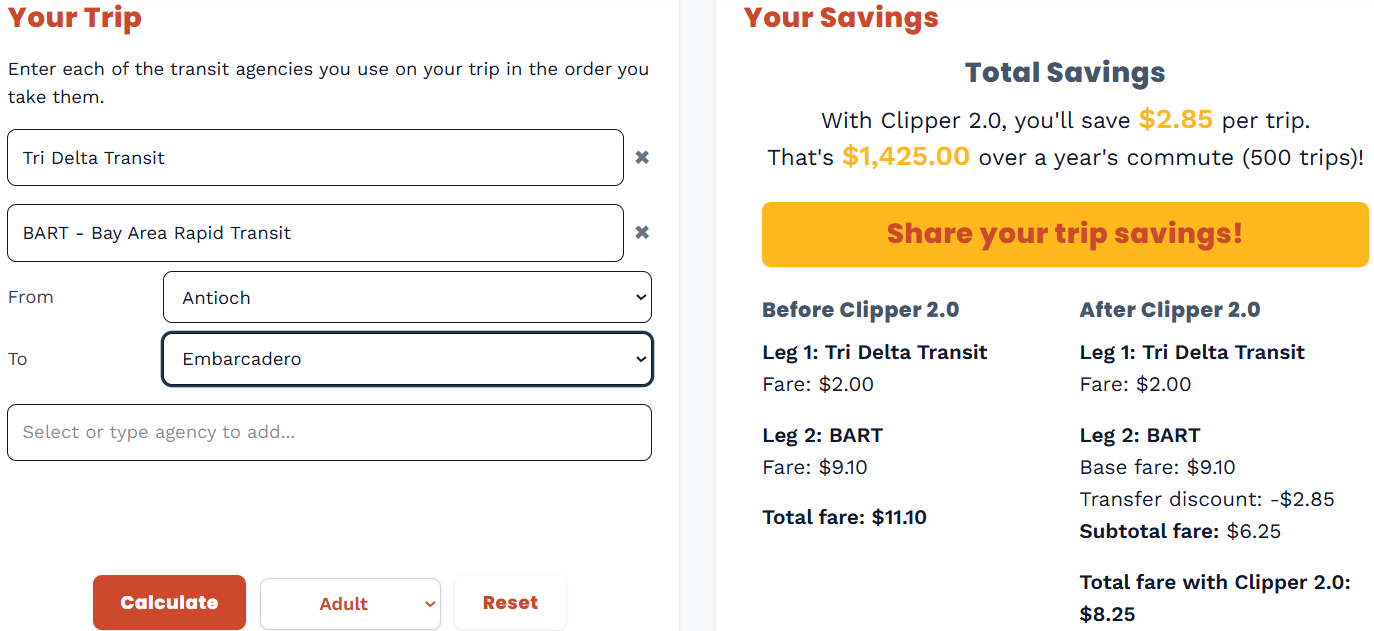
  • Free and reduced-fare transfers that could save multi-agency riders up to $1,500 per year and are estimated to increase transit ridership by some 30,000 trips per day.
  • Expansion of the Clipper START® program, which provides a 50% fare discount, to reach 100,000 additional low-income adults.
  • Improvements to accessibility for seniors and people with disabilities.
  • Transit-priority projects to make bus trips faster, and mapping and wayfinding improvements to make transit easier to use.

Bay Area transit riders take more than 1 million trips each day, with over 80 percent of these trips on Muni, BART, Caltrain or AC Transit. Riders include tens of thousands of students, seniors, people with disabilities, and low-income residents who can’t afford to own a car. Clipper START customers accounted for nearly 400,000 transit trips across the region in August 2025 and the fare-discount program is growing at a rate of more than 20,000 customers each year.

SB 63 includes several oversight and accountability provisions to reassure voters their tax dollars will be used responsibly. These include establishing an independent oversight committee to ensure expenditures are consistent with the law. Membership will include at least one representative from each county in the Public Transit Revenue Measure District, appointed by each county’s board of supervisors.

The new law also requires BART, Muni, Caltrain and AC Transit to undergo a two-phase independent third-party financial efficiency review overseen by its own oversight committee composed of four independent experts, four transit agency representatives, and an MTC Commissioner. MTC is responsible for procuring the third-party consultant to conduct the review and for staffing the Oversight Committee.

A maintenance-of-effort clause in SB 63 requires BART, Muni, Caltrain, AC Transit, Golden Gate Transit, SF Bay Ferry and the bus operators in Alameda and Contra Costa counties to maintain existing levels of funding for operating purposes if a 2026 tax measure is passed by voters. The legislature established this requirement to ensure the measure supplements, rather than replaces, current operations support, with provisions for exceptions that are subject to MTC approval.

To provide additional oversight regarding the quality of the transit service provided in each county participating in the measure, the legislation allows a county transportation agency or board of supervisors within the District’s geography to require review by an ad-hoc adjudication committee if they believe a transit agency funded by that county’s portion of the measure’s revenue is not applying standards (such as service levels, fare policy, cleanliness, maintenance, access and safety) consistently across counties or if those standards disproportionately disadvantage service or transit equipment/station quality in that county. The committee is composed solely of representatives from counties contributing revenue measure funds to the transit agency under review. Its determinations are binding and may result in withholding up to 7 percent of the transit agency’s funds, a strong incentive for agencies to deliver high quality service that follows consistent standards across all five counties.

What Local Transportation Officials are Saying: 

“The BART Board of Directors supported SB 63 because it will cover a significant portion of BART’s operating deficit caused by remote work and will allow us to maintain current service levels and improve the rider experience,” said BART General Manager Bob Powers.

“SB 63 is a step towards protecting essential Muni service and will equip us with resources to continue meeting the needs of San Francisco and the growing region,” said Julie Kirschbaum, San Francisco Municipal Transportation Agency Director of Transportation.

“Through Governor Newsom’s leadership and the support of voters, SB 63 will help protect transit for our more than three million monthly riders. In fact, this summer, we took proactive steps to preserve service by redesigning 103 bus lines through our new Realign network. Designed over two years, this all-new network maintains service at 85 percent of pre-pandemic levels. SB 63 gives voters a chance to ensure that these vital bus lines – and our riders’ lifelines – are protected for the future,” said AC Transit Board President Diane Shaw.

“Caltrain has been reinvented as a state-of-the-art rail system, delivering the best service this corridor has seen in its 161-year history. We are seeing the benefits every day with growing ridership, cleaner air, quieter trains, and less-congested roads. To sustain these benefits, it is essential that Caltrain be funded. We are deeply grateful to Governor Newsom and the California Legislature for their leadership in crafting and supporting this legislation, which gives voters the opportunity to consider the vital Connect Bay Area measure in November 2026,” said Caltrain Executive Director Michelle Bouchard.

“SB 63 represents a transformative opportunity to invest in the future of public transit,” she said. With this measure, we can deliver faster, more frequent service and ensure better connections for all riders across Santa Clara County,” said Carolyn Gonot, Santa Clara Valley Transportation Authority General Manager and CEO.

“We’re excited the Connect Bay Area Act is moving forward and voters will soon have the opportunity to shape the future of public transit along the Peninsula and surrounding Bay Area communities. Next November’s vote will be a pivotal moment to secure reliable, connected and sustainable transportation. With this measure, we can ensure SamTrans, Caltrain and our regional transit partners have the stable funding needed to serve riders for years to come,” said SamTrans Board of Directors Chair Jeff Gee.

MTC is the transportation planning, financing and coordinating agency for the nine-county San Francisco Bay Area.

BART Issues Statement of Support

BART issued the following statement on Governor’s signing transit funding measure SB 63:

“BART is grateful to Governor Newsom for signing Senate Bill (SB) 63 into law. The Governor has been a steadfast advocate of transit and BART specifically, recognizing our role in moving the region and strengthening the economy. SB 63 is a historic opportunity to allow voters in five counties of the Bay Area to consider a sales tax measure in November 2026 aimed at preserving and improving transit.

A regional transportation funding measure would provide a reliable funding source for BART and other agencies to address deficits caused by remote work. The BART Board of Directors supported SB 63 because it will cover a significant portion of BART’s operating deficit and allow us to maintain current service levels and improve the rider experience.

Before measure funds become available, BART will rely on internal cuts, efficiency measures, and a series of one-time solutions to pay for operations. BART will continue to identify additional cost savings and efficiencies to address our deficit, and we welcome the enhanced accountability measures and financial efficiency review included in SB 63.

BART is also grateful to Senators Scott Wiener and Jesse Arreguín for championing this legislation and their fierce advocacy for transit funding.”

Allen D. Payton contributed to this report.

Filed Under: BART, Bay Area, Legislation, News, Politics & Elections, State of California, Transportation

East County: 60-hour weekend closure of Hwy 160 Oct. 10-13

October 8, 2025 By Publisher 2 Comments

Southbound auxiliary lane

By Nathaniel Fowler, Health & Safety Specialist, Caltrans

Caltrans has scheduled a 60-hour weekend closure of the southbound State Route 160 (SR-160) auxiliary lane between Wilbur Avenue and East 18th Street/Main Street. The closure will begin Friday, Oct. 10, 2025, at 5:00 PM and remain in effect until Monday, Oct. 13 at 5:00 AM.

Please be advised that Wilbur Avenue On-Ramp to southbound SR-160 and E. 18th Street Off-Ramp on southbound SR-160 will remain closed throughout the closure. This extended closure is required to safely and efficiently complete construction activities in the area.

Detour signs will be posted, and Changeable Message Signs (CMS) will alert drivers of the closure. Drivers should expect delays, allow extra travel time and exercise caution while navigating the detours. All work is weather permitted. Caltrans appreciates the public’s patience and cooperation while crews perform this critical work.

For 24/7 traffic updates, follow 511.org on Twitter/X. For real-time traffic, visit Caltrans QuickMap.

Filed Under: Construction, East County, News, Transportation

Amtrak to run special trains to Colonel Allensworth State Historic Park 2025 Rededication Celebration, Oct. 11

October 7, 2025 By Publisher Leave a Comment

Photos: Amtrak San Joaquins and CA State Parks

Celebrating seven years of tradition, trains will once again bring visitors to honor site central to California’s African American history

Established in 1908, it was the state’s first self-governed Black township

By Harlo Pippenger, Consultant, Amtrak San Joaquins

(Stockton, CA) – Colonel Allensworth State Historic Park is holding its annual celebratory Rededication event on Saturday, October 11 from 11:00 AM to 4:00 PM. In partnership, Amtrak San Joaquins has scheduled a special stop at the park for multiple trains, bookable at exclusive half-price “Allensworth fares.”

Travelers from Northern California, the Bay Area, or the Central Valley are invited to experience a scenic day trip aboard the Amtrak San Joaquins, arriving directly at the gates of this historic landmark and celebration. Attendees are encouraged to book now to secure their seats and to enjoy further savings by combining discounts, as detailed on the Amtrak San Joaquins Deals webpage.

Hosted by California State Parks, the Annual Rededication of Col. Allensworth State Historic Park honors the park’s original dedication in 1976. The event will feature food trucks, arts and crafts, guided tours of historic buildings, performances of music and dance, interactive experiences with time-period docents, and remarks from descendants of Colonel Allen Allensworth.

This year’s special Rededication train marks the seventh anniversary of Amtrak San Joaquins’ service to the Colonel Allensworth State Historic Park Rededication Celebration. Since that first ride in 2018, ridership to the event has grown dramatically, from just 97 passengers to more than 300 in 2024 and over 500 individuals traveling by train to the most recent Juneteenth 2025 Festival. Each year, more Californians are discovering the ease and joy of traveling by train to celebrate this historic community and the lasting impact it has had on the state’s heritage. With direct service and exclusive discounted fares, Amtrak San Joaquins is making it easier than ever for riders from across the state to be part of this meaningful celebration.

Founded in 1908 by Colonel Allen Allensworth, a former enslaved man, the town was designed to be a self-sustaining community where African Americans could live, work, and thrive. Today, you can witness the legacy of this trailblazing community come alive with captivating re-enactments, storytelling, and tours of the lovingly restored and reconstructed early 20th century buildings. Step into the Colonel’s house, walk through the halls of the historic schoolhouse and explore the church and library for an inspiring journey through a pivotal moment in history.

“California State Parks is proud to celebrate seven years of partnership with Amtrak San Joaquins in bringing visitors directly to Colonel Allensworth State Historic Park,” said Lori Wear, California State Parks. “This special train service has helped thousands of Californians experience the rich history and enduring legacy of Colonel Allensworth in an accessible, affordable, and memorable way. We’re beyond excited for this year and continuing this progress into the future.”

The southbound trains running for the event include trains 702 (10:55am arrival), 710 (11:54am arrival), and 712 (2:54 arrival). Northbound trains include 713 (8:56am arrival), 715 (12:56pm arrival), 717 (2:56pm arrival). When purchasing train tickets, a discount will automatically be applied. If eligible, riders can then combine this reduced ticket with additional savings regularly available which include:

  • Infants under 2 years of age ride for free
  • Children 2-12 years old ride half-price every day
  • Seniors (62+ years of age) receive 15% off
  • Veterans & active military members receive 15% off
  • Disabled riders save 15% off
  • View deals

Visitors attending the Rededication Celebration via the Amtrak San Joaquins trains will arrive at the Allensworth station (CNL), which will serve as a special stop for this event. Upon arrival, a complimentary 35-passenger shuttle provided by Tulare County Area Transit will transport riders between the train platform and the historic schoolhouse. Typically, a whistle stop available only to pre-booked groups, the Allensworth station (CNL) will be fully activated for travelers on October 11, offering a rare and seamless opportunity to experience this historic park by rail.

Train tickets to Colonel Allensworth State Historic Park can be booked online at the Colonel Allensworth landing page or contact Carmen Setness, community outreach coordinator for San Joaquin Regional Rail Commission (SJRRC), at csetness@sjrrc.com.

About Allensworth State Historic Park

The town of Allensworth is located in the heart of the Central Valley, about 30 miles north of Bakersfield. Boasting a rich history that is of interest to students, families, history buffs, minority community organizations, and anyone else looking to spend a fun day exploring the historic community and its restored buildings. In 1908, Allensworth was established as a town founded, financed and governed by African Americans. There were a series of challenges impeding the town’s long-term survival, but it is celebrated as a key historical icon. In 1974 California State Parks purchased the land in order to maintain it as a site for visitors to learn and explore the Colonel’s house, historic schoolhouse, Baptist church, and library.

About the San Joaquin Joint Powers Authority (SJJPA) Since July 2015, SJJPA has been responsible for the management and administration of Amtrak San Joaquins. SJJPA is governed by Board Members representing each of the ten (10) Member Agencies along the 365-mile San Joaquins Corridor. For more information on SJJPA see http://www.sjjpa.com.

Amtrak San Joaquins is Amtrak’s 6th busiest route with 18 train stations throughout the Central Valley and Bay Area, providing a safe, comfortable and reliable way to travel throughout California. Amtrak San Joaquins is currently running six daily round-trips. In addition to the train service, Amtrak San Joaquins Thruway buses provide connecting service to 135 destinations in California and Nevada including Los Angeles, Santa Barbara, San Diego, Napa Valley, Las Vegas and Reno.

Filed Under: Fairs & Festivals, History, Parks, State of California, Transportation

West County: Eastbound Hwy 4, Richmond-San Rafael Bridge closures Oct. 7-10 & 13

October 6, 2025 By Publisher Leave a Comment

Detour map for eastbound Highway 4 in West County and Richmond-San Rafael for closures this week and next. Source: Caltrans

By Denise Harding, PIO & Nathaniel Fowler, Health & Safety Specialist, Caltrans

Caltrans will implement a full closure of eastbound State Route 4 (SR-4) between San Pablo Avenue in Hercules in Western Contra Costa County and Cummings Skyway, beginning Tuesday, October 7 through Friday, October 10, nightly and on Monday, October 13, 2025, nightly from 7:00 PM to 5:00 AM. On-ramps along eastbound SR-4 during this time, will be closed include San Pablo Avenue, Willow Avenue and Franklin Canyon Road. The closures are necessary to allow paving crews to complete work in the Cummings Skyway area. Westbound SR-4 traffic is not expected to be affected.

Detour Plan for EB SR-4 Traffic from I-80 to Cummings Skyway

  1. Continue EB 80 to Cummings Skyway Exit
  2. Exit on Cummings Skyway road;
  3. Right on Cummings Skyway road;
  4. Right on EB Hwy 4 Onramp

Detour Plan for EB SR-4 Traffic from Willow Avenue to Cummings Skyway

  1. Continue West on Willow Ave.;
  2. Right on Sycamore Ave.;
  3. Right on San Pablo Ave.;
  4. 80 to Cummings Skyway Exit;
  5. Exit on Cummings Skyway road;
  6. Right on Cummings Skyway road;
  7. Right on EB Hwy 4 Onramp

Richmond–San Rafael Bridge (I-580) Nighttime Lane Closures – Oct 7–10, 9PM–5AM (EB) & Oct 9–10, 8PM–5AM (WB) Maintenance work between Toll Plaza & Marin end.

Caltrans will be closing lanes on the Richmond-San Rafael Bridge (I-580), nightly starting Tuesday, October 7th through Friday, October 10th westbound 8:00 PM until 5:00 AM and eastbound 9:00 PM until 5:00 AM, the following morning due to maintenance. The lane closures will begin from the Toll Plaza to the west end of the bridge in Marin County. One lane will remain OPEN at all times. Expect delays & drive safely.  Detours in place – expect delays.

Closure Details:

  • Eastbound – Left Shoulder and Lane #2 will be closed Tuesday, Oct. 7th-10th, 9 PM to 5 AM.
  • Westbound – Lane #2 will be Closed Thursday, Oct. 9th & 10th, 8PM to 5AM

Traffic Control Measures:

Changeable Message Signs (CMS) will alert drivers of closure. Motorists should expect minor delays, reduce speed and plan extra travel time.

Please note this information is tentative and subject to change depending on weather conditions and construction progress. Please follow posted signs and detour routes during the closure periods. Motorists are advised to expect delays and allow extra time. For 24/7 traffic updates, follow 511.org on Twitter/X. For real-time traffic, visit Caltrans QuickMap.

Filed Under: Construction, News, Transportation, West County

  • « Previous Page
  • 1
  • 2
  • 3
  • 4
  • …
  • 30
  • Next Page »
Monica's-Riverview-Jan-2026
Liberty-Tax-Jan-Apr-2026
Deer-Valley-Chiro-06-22

Copyright © 2026 · Contra Costa Herald · Site by Clifton Creative Web