• Home
  • About The Herald
  • Local Agencies
  • Daily Email Update
  • Legal Notices
  • Classified Ads

Contra Costa Herald

News Of By and For The People of Contra Costa County, California

  • Arts & Entertainment
  • Business
  • Community
  • Crime
  • Dining
  • Education
  • Faith
  • Health
  • News
  • Politics & Elections
  • Real Estate

Supervisors approve five Verizon small cell wireless facilities in Alamo, Walnut Creek

February 28, 2019 By Publisher Leave a Comment

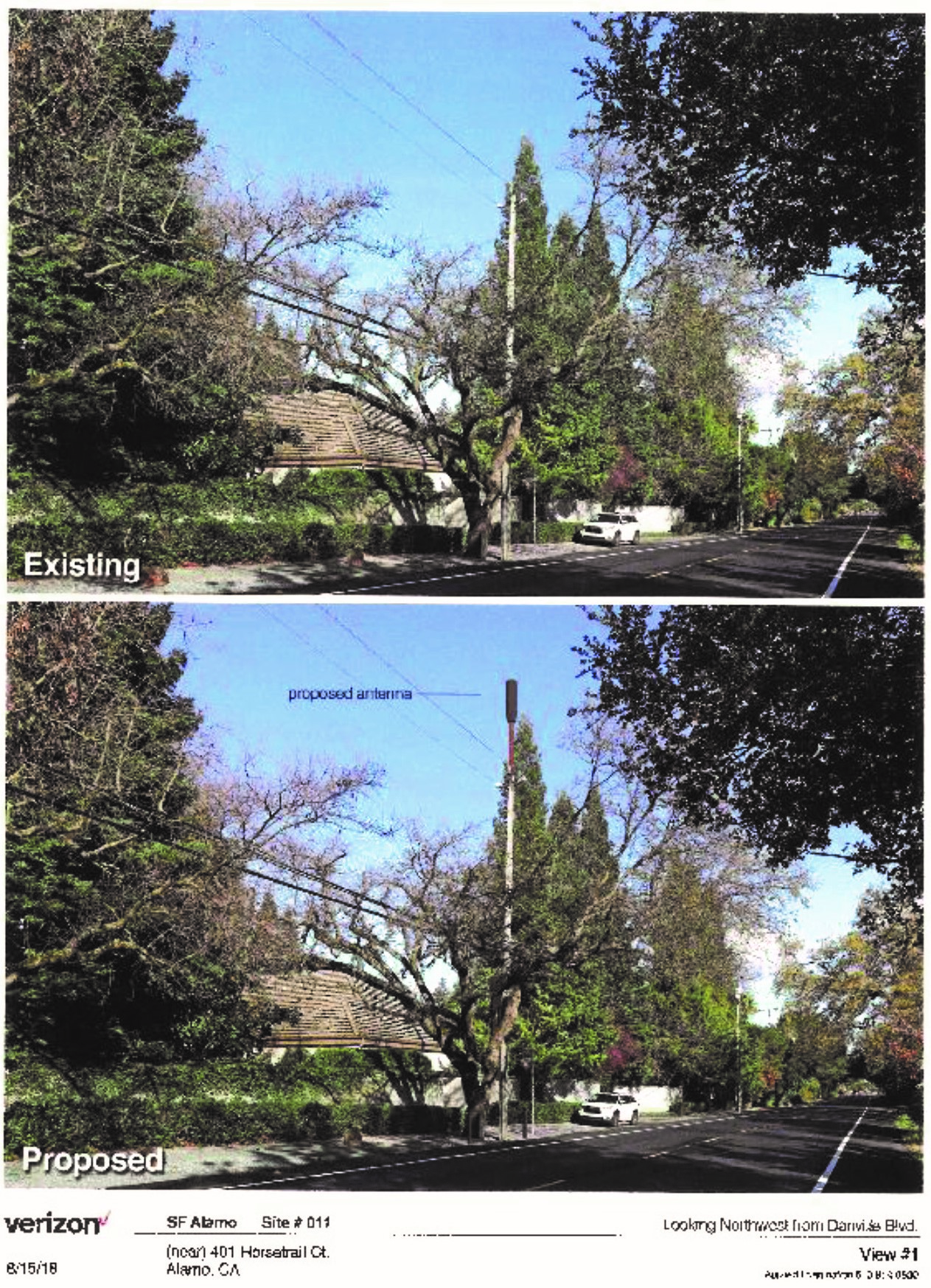
Before and After photos of proposed Verizon small cell wireless facility on Horsetrail Court in Alamo. Photo from Powerpoint presentation.

More appeals expected

By Daniel Borsuk

Over a volley of citizen complaints about potential neighborhood blight and health cancer risks concerns linked to Verizon Wireless’ plans to install five small cell wireless facilities on PG&E poles in bucolic unincorporated Alamo and Walnut Creek residential locations, the Contra Costa County Board of Supervisors unanimously upheld the county Zoning Administrator’s and Planning Commission’s rulings approving the telecommunication corporation’s requests on Tuesday, Feb. 26.

According to the staff report for agenda item, “On December 21, 2018, Ms. Alice Lee filed an appeal with the Department of Conservation and Development, Community Development Division, over the decision of the County Planning Commission to deny the appeal and uphold the decision of the County Zoning Administrator to approve the Wireless Facilities Access Permit. Ms. Alice Lee submitted a revised appeal letter on December 24, 2018.”

With Supervisor Diane Burgis of Brentwood absent from the meeting because she was recuperating from successful heart surgery on Monday, supervisors voted 4-0 to sustain favorable county zoning administrator and planning commission rulings on Verizon Cell Wireless’ requests to install five small wireless cell facilities in the right-of-way of 401 Horsetrail Court, 1524 Alamo Way, 184 Creekdale Road, 1955 Meadow Road and 20 Francesca Way, but threw in a carrot that might sway residents to feel more comfortable about Verizon Wireless installing the antennas. (See PowerPoint presentation, here).

Board Vice Chair Candace Andersen, who represents the unincorporated Alamo and Walnut Creek areas where Verizon Wireless plans to install the cell wireless facilities, each valued at an estimated $200,000, recommended that Verizon Wireless mail to affected homeowners living nearby the five proposed wireless cell antennas to be offered free, independently conducted, in-home health tests. Verizon Wireless will pick up the costs for the health tests.

Verizon Wireless attorney Paul Albritton said the communications company would agree with Supervisor Andersen’s in-home health test request. Other supervisors also approved Andersen’s proposal. Albritton said residents must live within 300 feet of a proposed small cell wireless antenna. He said the offer will be valid for one year.

Even with the in-home health inspection provision, one Alamo resident, Ruth Strong, who lives with her aged mother near a PG&E pole that is slated to have one of the Verizon Wireless antennas installed directly across from her mother’s bedroom window, told supervisors, “I don’t trust them (i.e. Verizon Wireless) from coming into my house.”

Dr. Alice Lee, one of the five appellants, told the Contra Costa Herald it is too early to tell what course of action she and other appellants might pursue. Dr. Lee said Verizon Wireless has plans to install as many as an additional 87 small cell wireless antennas on PG&E poles in unincorporated areas including Alamo, Walnut Creek, and Orinda. “There will be other carriers. There will be more towers,” she told supervisors.

Supervisor Karen Mitchoff of Pleasant Hill said it is difficult for counties to overturn requests of telecommunication communication companies requesting to install new equipment such as small cell wireless facilities on existing PG&E poles because of the federal Telecommunications Act of 1996 that has been amended numerous times. California counties and cities are contesting certain aspects of Telecommunications Act in the Supreme Court because the federal law supersedes local or state law.

Among consent item supervisors approved without comment from the public, were:

Hazardous Materials Response Vehicle Funding

Spending $1.3 million from the Contra Costa County Fire Protection District budget to buy a Type I Hazardous Materials Response Vehicle that will be owned and operated by the county fire district. The acquisition of a new Type I Hazardous Material Response Vehicle will allow the fire district to own and operate its own vehicle. Since the formation of the county’s Hazardous Materials Team in 2016, the team has operated a vehicle on loan from the California Office of Emergency Services. That vehicle was recently out of service for over 30 days while it received warranty related repairs in Sacramento. That compromised the Contra Costa County team’s ability to respond to hazardous response incidents. Buying this vehicle will permit the Contra Costa County Fire Protection District to respond to future hazardous material response incidents.

Emerging Aeronautical Technologies to Be Promoted at County Airports

Supervisors permitted County Airports Director Keith Freitas to promote and market Buchanan Field and Byron Airport as testing locations for emerging aeronautical and aeronautical related technologies. There will be no financial cost to the county general fund associated with the promotion and marketing campaign. Airport staff and any county counsel staff time will be charged to the Airport Enterprise Fund.

Kirker Pass Road Truck Lane Funding

Supervisors awarded a $14,153,763 contract to Granite Rock Company to construct the Kirker Pass Road Northbound Truck Climbing Lane project. Construction is set to begin this summer to add a truck lane on Kirker Pass Road from the Concord Pavilion to Hess Road. The addition of the lane is designed to reduce accidents caused by trucks traveling up Kirker Pass Road. Other contractors and their bids at the Jan. 22 disclosure were: Bay Cities Paving & Grading, Inc., $14,886,666; Ghilotti Construction Company, Inc., $15,225,077. 60; Gordon N. Ball, Inc. $15,528,038.20; Flatiron West, Inc. $15,528,038.20; Granite Construction Co, $16, 073, 185.10; O.C. Jones & Sons, Inc. $16,073, 788 and DeSilva Gates Construction, $17,500,000.

Waterfront Initiative Funding

Supervisors approved the new funding allocations of $142,500 to implement approved Northern Waterfront initiatives planned for 2019-2020. Those expenditures included $50,000 for the Hercules site exploration for bioscience, $12,000 for a May forum, $10,000 for State Lands/Crockett waterfront access, $70,000 for collaborative marketing and a marketing video. Supervisors had budgeted $500,000 in 2017 to cover Northern Waterfront Economic Development Initiative projects. Since the initiative’s launch, the only expenditure since then has been the $263,000 to consultant contracts or grant match.

Paying Additional $11,000 to Winchester for Sheriff’s Department Ammunition

Supervisors agreed to pay an additional $11,000 to buy Winchester ammunition for the Office of the Sheriff because after more than 20 years, Winchester has changed its ammunition distributor in Northern California from Adamson Police Products to Dooley Enterprises. In 2017, the Office of the Sheriff executed a new purchase order with Dooley Enterprises as the new Winchester ammunition distributor to meet future training and duty ammunition demands. As a result of the change in the purchase order. the county will have paid $411,000, not $400,000 for the purchase of ammunition for the period of July 1, 2017 through June 30, 2019.

To see the entire meeting agenda, click here.

Filed Under: Business, Central County, News, San Ramon Valley, Supervisors, Technology

Richmond’s CyberTran to host Alameda County Supervisors’ Transportation Committee meeting Thursday to discuss ultra-light rail transit system

July 18, 2018 By Publisher 3 Comments

Artist’s rendering of a CyberTran vehicle and station with overhead solar panels generating the power to operate the system.

The Alameda County Board of Supervisors’ Transportation/Planning Committee will be holding a first of its kind, off-sight meeting to learn about an “Ultra Light Rail Transit System in the Alameda County East Bay Region” known as CyberTran. The meeting will be held at the U.C. Berkeley Global Campus in Richmond, where CyberTran International, Inc. has their headquarters and lab.

Overview rendering of the offline CyberTran stations.

The meeting is being held in response to the recent action by the BART Board to vote down the extension to Livermore, as the Board of Supervisors looks for an alternative transit system from the Pleasanton BART Station east.

“Alameda County has critical needs when it comes to traffic congestion. We can help,” said Dexter Vizinau, President of CyberTran International.

The solar-powered CyberTran system has been tested including by BART’s engineering department, which determined it can be built for a fourth of the cost of a BART system and operate a fraction of the cost. It can move as many people per hour per direction as BART can through the Bay Tube, which is 17,000 passengers.

During the meeting, the supervisors who serve on the committee will discuss a resolution in support of using the CyberTran system in Alameda County. The agenda for the meeting can be viewed here.

For more information about CyberTran, visit www.cybertran.com.

Editor’s Note: The publisher of the Herald has a financial interest in CyberTran International, Inc.

Filed Under: News, Technology, Transportation, West County

Rep. McNerney to host net neutrality town hall meeting in Antioch Sunday, March 4

March 3, 2018 By Publisher Leave a Comment

From Congressman Jerry McNerney

As your representative in Congress, I take very seriously my responsibility to be your voice in Washington. So when you called, emailed and wrote letters by the thousands, expressing your concerns about the Federal Communications Commission’s (FCC) plan to eliminate net neutrality protections, I took action.

Prior to the FCC’s vote to repeal net neutrality, I submitted a formal request to address the full Commission. I wanted to make the case for maintaining a free and open internet, and to share some of the stories you’ve shared with me – stories of small business owners, veterans, students and so many more who rely on the internet for nearly every aspect of daily life. Unfortunately, FCC Chairman Ajit Pai denied my request.

Thankfully, there was someone on the Commission who wanted to ensure your voice and the voices of Americans across the country were heard. FCC Commissioner Mignon Clyburn, who stood strong and voted against the repeal, submitted a written statement on my behalf and read her own compelling dissent in opposition to the repeal of these crucial protections.

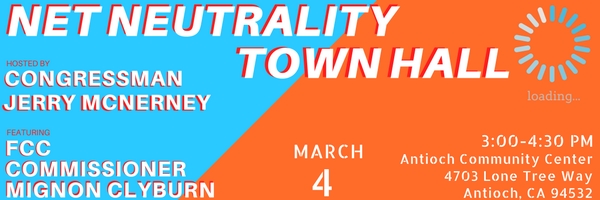
Commissioner Clyburn will be joining me this Sunday, March 4th from 3:00-4:30 PM at the Antioch Community Center for a town hall on net neutrality. We’ll be discussing your concerns and talking about how we move forward in the fight for a free and open internet.

For more information or to RSVP please call (925) 754-0716 or email McNerneyRSVP@mail.house.gov.

I hope to see you there.

Filed Under: East County, Government, Technology

Reps. DeSaulnier, Smucker introduce bipartisan bill to spur innovative changes to transportation systems

October 4, 2017 By Publisher Leave a Comment

Washington, DC – Today, Wednesday, October 4, 2017, as we recognize National Smart Cities Week, U.S. House Transportation and Infrastructure Committee Members Representatives Mark DeSaulnier (D-CA) and Lloyd Smucker (R-PA) announced bipartisan legislation that would establish $100 million in new grant funding for cities to invest in and use innovative technologies and solutions for the purpose of improving transportation and mobility. The Moving FIRST Act (H.R. 3901) was introduced to build upon the Department of Transportation’s Smart Cities Challenge, by increasing the funding available and making it an annual grant opportunity.

“Seventy five percent of all Americans are expected to live in urban areas by 2050. We need to invest in the best way to move our people and our goods in ways that reduce congestion, improve public health, and are tailored to the needs of our communities,” said DeSaulnier. “We’ve already seen how smart technologies succeed in the Bay Area and California, and I am proud to partner with my colleague Representative Smucker to create grant opportunities for cities across the nation, and of all sizes, to advance cutting edge technologies.”

“This week is National Smart Cities Week – a perfect time to refocus our efforts in support of innovative and creative solutions to help our cities work better,” said Smucker. “Investments in smart infrastructure projects help move people to job centers, products to market, and connect economic hubs. Expanding initiatives like the Smart Cities Challenge will help kick start improvements in transit and connectivity in cities like Lancaster and Reading. I am glad to work with Rep. DeSaulnier to introduce the Moving FIRST Act and I look forward to continuing my work to improve our nation’s infrastructure.”

H.R. 3901 would make annual grant awards available to communities of all different sizes which seek to advance projects like autonomous vehicle technology and sensor-based infrastructure in order to meet the transportation challenges they face. Specifically, the bill establishes the Strengthening Mobility and Revolutionizing Transportation (SMART) Challenge Grant, which will annually award:

  • A large city with up to $50 million in grant funding
  • A mid-sized city with up to $50 million in grant funding
  • Two rural communities or regional partnerships with up to $20 million in grant funding or 20% of the total funds available

Senators Catherine Cortez Masto (D-NV) and Richard Burr (R-NC) introduced companion legislation, S. 1809, in the Senate.

National Smart Cities Week brings together city leaders, innovative companies, and policymakers to engage in a national dialogue to better understand and prepare for the ways new technologies will impact the cities of the future.

Filed Under: Legislation, News, Technology, Transportation

Tri Delta Transit launches new mobile app for security

October 3, 2017 By Publisher Leave a Comment

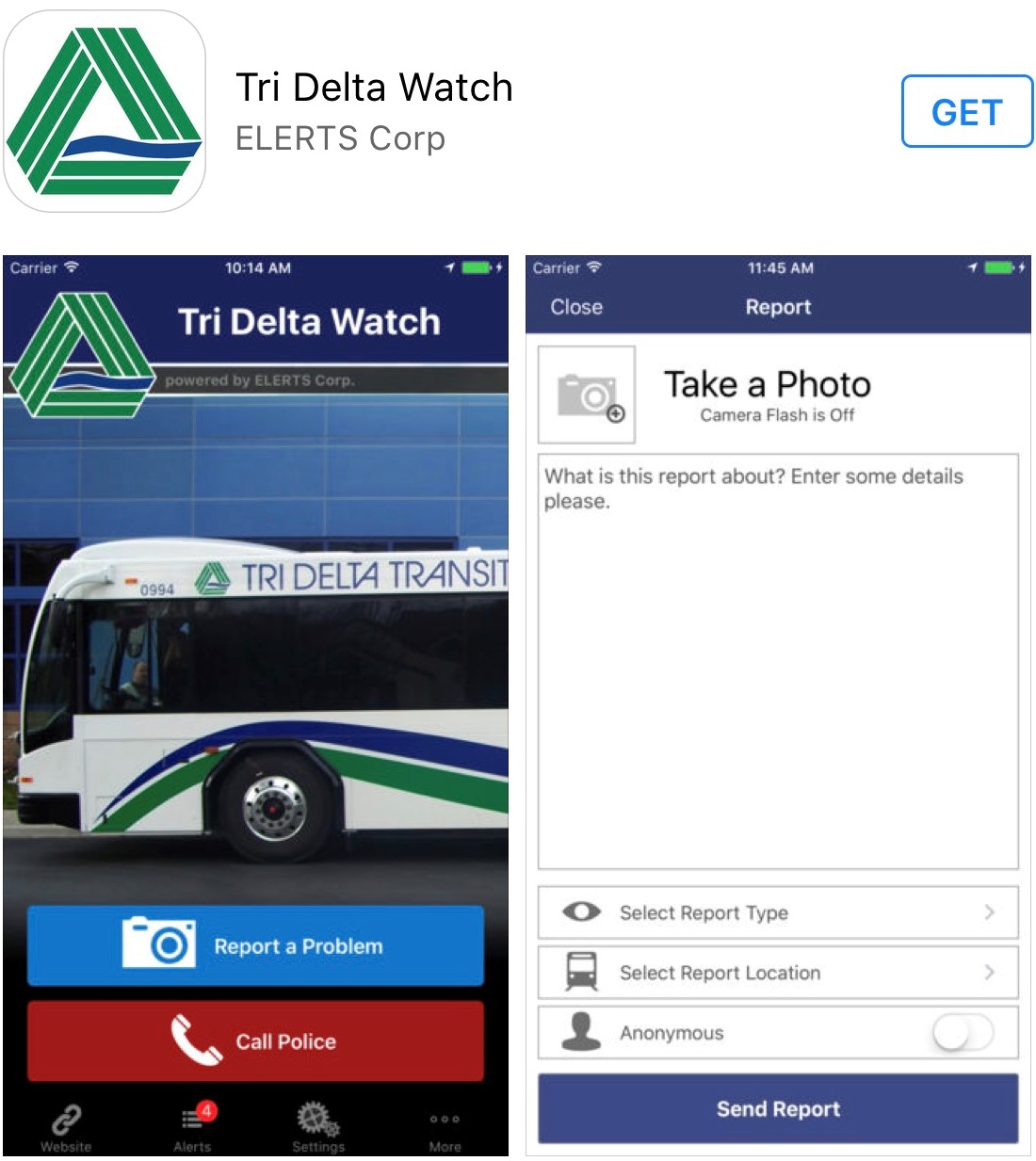
As of Monday, October 2, Tri Delta Transit is offering ‘Tri Delta Watch,’ a mobile security app that instantly allows riders to notify police or dispatchers of security incidents on buses and at bus stops. The free app allows riders to anonymously send text reports with pictures or videos to dispatchers who can respond to or address the problem. Contacting local police directly is an option of the app, which is made simple via a one-click 911 button for more serious situations.

The free security application is available at the Apple App Store and Google Play for iPhone and Android devices; search Tri Delta Watch. Once downloaded, riders can report suspicious activity, and incidents that might require law enforcement’s presence on board Tri Delta Transit buses.

“Occurrences that might merit the use of the app are extremely rare on our buses,” said Mike Furnary, Director of Marketing. “Having the app is just another means to help us keep it that way.”

Tri Delta Watch and similar security apps are important new components in the industry’s effort to enhance safety for customers and drivers. The U.S. Department of Homeland Security adopted the “If You See Something, Say Something” public awareness campaign in 2010. Transit agencies, including Tri Delta Transit, have launched a variety of advertising and outreach efforts to educate riders about the importance of being vigilant in reporting suspicious, illegal or inappropriate behavior and activities, as well as unattended packages.

The smartphone app allows customers to assist security efforts by reporting suspicious activity in a timely manner. When a rider sees a suspicious situation, with the click of a button, they can directly call police or discretely submit a report with photos or video, incident descriptions, and GPS coordinates to transit officials. If the user chooses to submit a picture or video, the camera flash is automatically disabled to not draw attention to the rider.

The mobile app allows riders to report incidents such as suspicious activity, disruptive behavior, crime in progress, and security or safety issues. Riders may also report immediately threatening situations such as fighting, or attacks on drivers.

Once a report is initiated, real-time two-way communication is enabled. Dispatchers may ask the rider for more details about the situation or provide instructions, as needed. In the event of an active incident, the dispatcher and reporter are able to communicate concerning details about those involved, what bus they are on, and assessment of the suspect’s behavior. The dispatcher can advise and communicate with the customer or contact the appropriate person or agency for assistance if necessary.

“Safety and security begins with all of us,” said Furnary. “If you see something, say something.”

Tri Delta Transit provides over 3,000,000 trips each year to a population of over 250,000 residents in the 225 square miles of Eastern Contra Costa County. They operate 13 local bus routes Monday – Friday, 4 local bus routes on weekends, door-to-door bus service for senior citizens and people with disabilities, and shuttle services to community events. For additional information about Tri Delta Transit, please visit www.trideltatransit.com.

Filed Under: East County, News, Technology, Transportation

Contra Costa’s CyberTran awarded U.S. patent for Transportation Internet

October 2, 2017 By Publisher 3 Comments

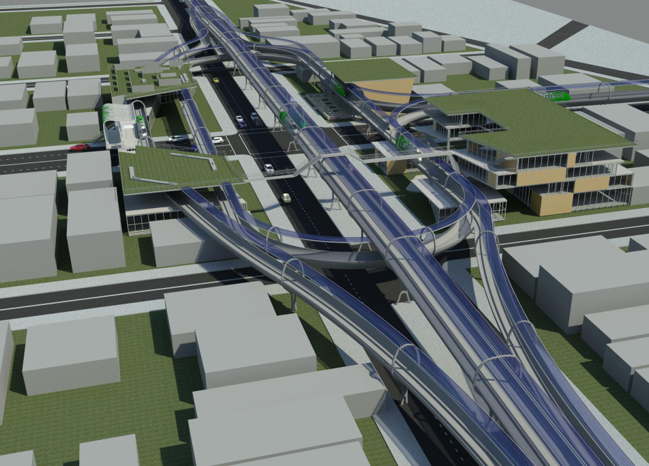
Rendering of a CyberTran transit station. Renderings courtesy of CyberTran International, Inc.

Ultra-Light Rail Transit system vehicles travel throughout connected rail networks at low, medium and high speeds, direct to destination and at much lower capital deployment and maintenance costs

CONTRA COSTA COUNTY, CA – CyberTran International, Inc. (CTI) offers the most innovative approach to solving the world’s traffic congestion problems. The recent patent approval for fixed guideway transportation systems, with lower cost of ownership and optimized benefits, validates what they’re calling the Transportation Internet technology. This system can be thought of as the computer-controlled technology solution to the problems of mass transit cost overruns and inefficiency.

Artist rendering of a CyberTran vehicle and station with overhead solar panels generating the power to operate the system.

CTI’s Ultra-Light Rail Transit (ULRT) is a mass transit system with the ability to build out Urban Circulator systems, Commuter Rail systems and High-Speed Rail systems and connect them to one network where small rail vehicles carrying up to thirty passengers can travel throughout the network Direct-to-Destination (nonstop). This allows ULRT to serve three separate markets, low, medium and high speeds! Until today all three markets have been served by three separate distinct technologies that can only be connected at transfer points where passengers have to disembark one system only to transfer to another to reach their destination.

Currently, CTI is closing in on funding for the purpose of demonstration and deployment. “Everybody wants to be second, nobody wants to be first,” said Dexter Vizinau, President of CTI.

Transit officials are hesitant to take a chance on a small and innovative company. The BART system started out as a demonstration project and the technology was the first of its kind. Today, CTI has approximately ten cities that are willing to be first, he explained.

In every major metropolitan region of the world, people are stuck in traffic. Today’s solutions aren’t working.

“Expanding today’s transit systems are too costly to build and maintain, yet transit officials continue to approach this as a solution, with little result,” said Neil Sinclair, CTI Board Chairman. “There’s a $78 billion backlog in transit systems maintenance in the U.S. and the only way to pay for it is to raise taxes. In the meantime, we’re all stuck in traffic with no end in sight.” That is, until today.

Overview rendering of the offline CyberTran stations.

“Our patent validates everything we’ve already proven,” Vizinau continued. “Two full-scale prototype vehicles have already been built and tested. The test vehicles have achieved speeds of up to 60 mph and have climbed a 10% grade, which means ULRT can go over the Sepulveda Pass in Los Angeles and also travel up the Grapevine Summit in Southern California. Bullet train systems and L.A. Metro-like systems cannot climb steep grades and therefore either have to tunnel or go around.”

By building out ULRT networks in cities at 35 mph, and then connecting them together throughout a region at 80 mph, ULRT becomes a commuter rail system like BART and Metro in Los Angeles. ULRT can handle the same throughput as BART during rush hour via the Transbay Tube. CTI can then connect regions with a high-speed line. The ULRT System design is flexible and can expand easily. Guideways and civil structures are manufactured offsite and assembled onsite allowing ULRT systems to be constructed more efficiently. CTI can construct long-distance systems in up to a quarter mile per day. The system was designed to reach speeds of up to 150 mph. (See related article)

CyberTran’s ULRT system also operates from solar power. Canopies of solar panels above the guideway can generate more than one megawatt per mile and eight times more energy than the system consumes, and supply renewable energy to surrounding communities resulting in a net gain to CTI.

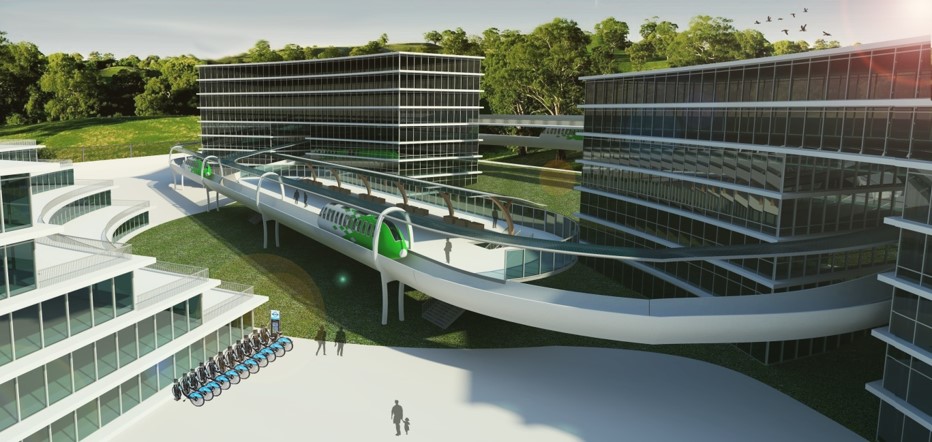
Rendering of a possible CyberTran station on the second floor of an office building and campus.

Transit officials currently purchase transit systems from foreign companies. CTI plans to manufacture ULRT transit systems for a global market in Contra Costa County. “We’ve been to China five times in as many years. There are six hundred cities in China that can use this,” says Sinclair. Councilmember Rich Kinney of the City of San Pablo states, “West Contra Costa County in particular has to solve the I-80 corridor congestion issue to attract more businesses and jobs to our cities. This is our opportunity to effectively address that issue. May we not continue to kick the proverbial can down the road – it’s time to embrace the full deployment of CyberTran right here at home.”

Earlier this year the city councils of Oakley, Brentwood and Antioch each voted unanimously to join the cities of Richmond and San Pablo to support efforts by CTI to obtain the needed funding for systems in both Western and Eastern Contra Costa County. (See related article) In addition, CTI has the support of U.C. Berkeley in their efforts to bring the technology to market. (See related article)

The next steps for CTI are to obtain funding to build two showrooms and a factory. This calls for one low-speed demonstration track up to 35 mph, and one rapid speed demonstration track up to 150 mph – in curves and with left and right banking. Both demo tracks and factory construction are to be done concurrently. There were no funding programs to support transit innovation, such as ULRT, at the federal level until CTI lobbied Congress to create one. Program legislation was created and approved in 2014 under a Republican-controlled Congress and Senate. CTI was hopeful that President Obama would release the program funding but it did not happen. CTI is hopeful about the President Trump’s infrastructure package and is encouraged by their reception in Washington, D.C.

Note: The publisher of the Contra Costa Herald has a financial interest in CyberTran International.

Filed Under: BART, Business, East County, News, Technology, Transportation, West County

Laser-equipped drone helps improve safety, efficiency on Hwy 4 improvement project

September 12, 2017 By Publisher Leave a Comment

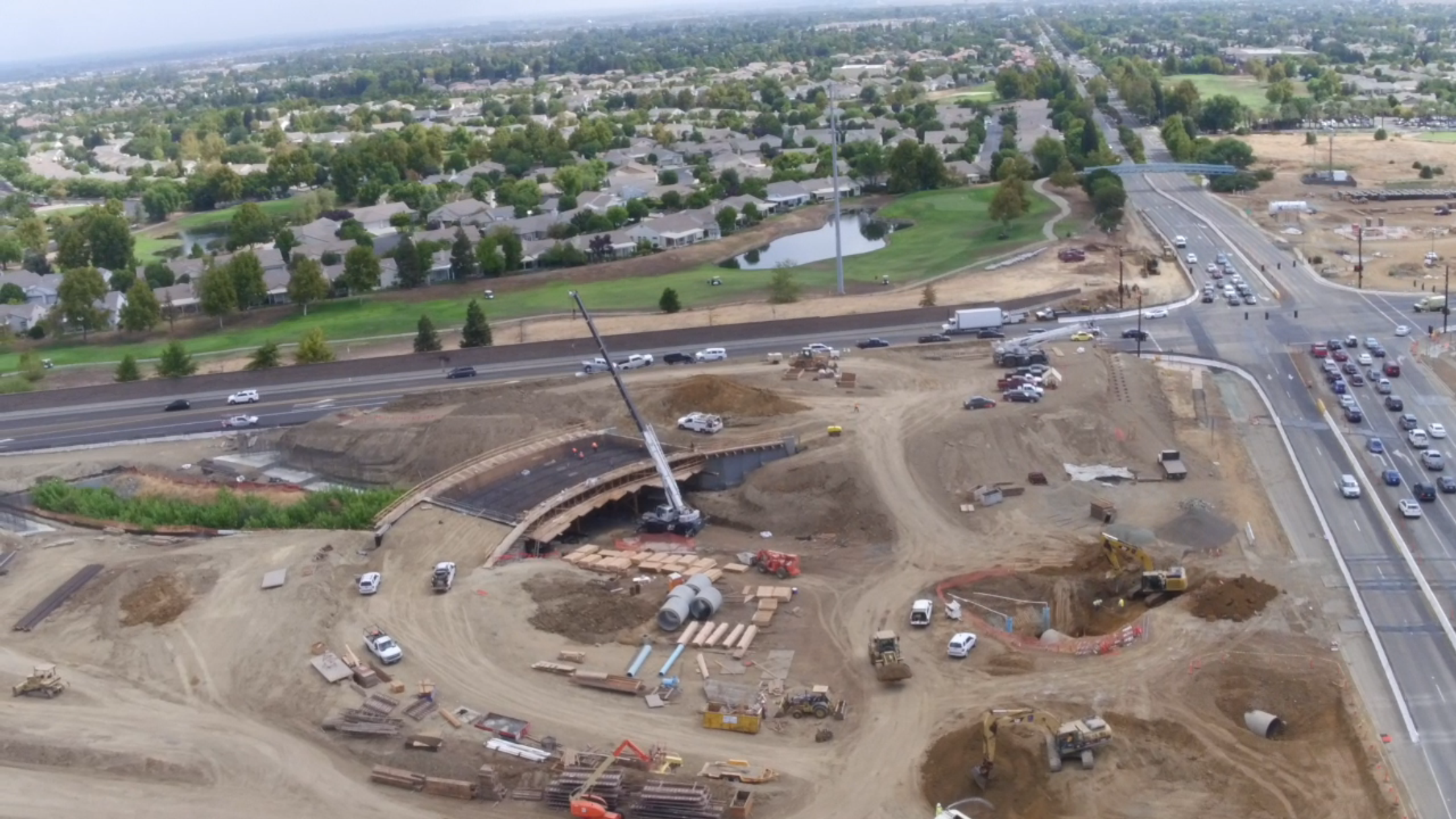
Screenshot from drone video of construction work at the Highway 4 and Balfour Road interchange in Brentwood, Tues., Sept. 12, 2017. Courtesy of Alta Vista Solutions.

Emerging drone technology moves construction and engineering into the future

On Tuesday morning, September 12, 2017, the Contra Costa Transportation Authority (CCTA) and Alta Vista Solutions showcased two emerging technologies on a construction project aimed to improve commutes on Highway 4 in Brentwood (aka the Bypass). Engineers piloted drones equipped with light detection and ranging (LiDAR) lasers–a surveying tool that uses a laser to create high-resolution geographical data.

The combination of the two emerging technologies has never been done in construction before and opens untold possibilities for unmanned aerial vehicle (UAV) technology and related jobs in the future.  CCTA featured the system in action by providing a live feed of a drone flight.  The feed from this morning’s drone flight can be viewed at altavistasolutions.com/media – bar .

With assistance from engineering firm Alta Vista Solutions (Alta Vista), who proposed the new method, CCTA is flying the LiDAR scanners to measure the volumes of earth that need to be moved during this $74-million project to rework the Balfour Road interchange. The drones ensure that the cut-and-fill earthwork goes efficiently. With LiDAR’s pinpoint accuracy, CCTA can now make needed calculations and monitor site conditions faster, eliminating the unavoidable guesswork involved in manual surveys. Putting LiDAR on drones gathers 15 gigabytes of precise, high-quality data per month, cutting down drastically on time spent surveying. The drones also improve safety by taking workers out of live traffic.

Drone capabilities enable CCTA to track construction progress firsthand as work on Highway 4 continues.

“We are always looking for new ways to increase safety and efficiency on construction projects,” said CCTA Executive Director Randy Iwasaki. “Drones give us aerial views of the site that were hard to come by before, making it safer for surveyors to do their job and helping us manage the large volumes of dirt that are being used to improve this intersection. This technology also allows us to monitor environmentally sensitive areas without disturbing the habitat.”

“This will change engineering and surveying,” said Ed Greutert, principal engineer at Alta Vista Solutions. “Innovations like combining LiDAR and UAVs are opening doors in infrastructure and making us efficient, effective, and safe in ways we couldn’t achieve before.”

Greutert also addresses fears of job loss as automation increases. “Using technology to do the surveying work can lead people to ask if this is the next step to the robot apocalypse – are drones going to take our jobs?” he speculates. “Not quite. It’s going to change jobs. It’s going to create new jobs in technology—and in the Balfour Road case, help people get to work faster.”

CCTA has faced challenges in being the first to test these technologies together.

“This has never been done. LiDAR on a UAV hasn’t worked until now – there are huge possibilities if we can be creative enough to really tap into them,” Greutert noted.

Handling the unprecedented quantity of data generated has also posed a challenge. However, in recent months, the team has succeeded in processing the hundreds of gigabytes collected.

“There are always challenges to pioneering new technology,” Iwasaki said. “But with the benefits this technology can provide in terms of keeping workers safe and managing a complicated construction project, I believe we’ll start to see more widespread use of drones on construction sites within a few years – especially as we discover new applications that can help save time and money. Right now, CCTA is excited to be leading efforts in this new frontier.”

About the Contra Costa Transportation Authority

The Contra Costa Transportation Authority (CCTA) is a public agency formed by Contra Costa voters in 1988 to manage the county’s transportation sales tax program and oversee countywide transportation planning efforts.  CCTA is responsible for planning, funding and delivering critical transportation infrastructure projects and programs that connect our communities, foster a strong economy, increase sustainability, and safely and efficiently get people where they need to go.  CCTA also serves as the county’s designated Congestion Management Agency, responsible for putting programs in place to keep traffic levels manageable.  More information about CCTA is available at ccta.net.

About Alta Vista Solutions

Alta Vista is a California-based engineering firm that has been recognized as the 20th fastest-growing engineering firm in America by Inc. 5000 and was named by Zweig Group as one of America’s Hot Firms. Alta Vista has quickly differentiated itself by performing customized quality management strategies for some of the most complex infrastructure projects in the world. Over the past decade, Alta Vista has worked with public and private organizations to complete large-scale engineering projects that better serve their regions. Known for engineering services that include engineering, inspection, testing, unmanned aerial systems, quality management, and structural health monitoring, Alta Vista has grown and diversified and has been acknowledged in 2017 by ENR Magazine and other media outlets for using innovative solutions and technologies to deliver infrastructure projects faster, better and more cost effectively.  For more information about Alta Vista, visit altavistasolutions.com.

Filed Under: East County, News, Technology, Transportation

Antioch Council joins Oakley, Brentwood, Richmond and San Pablo in endorsing cheaper, innovative rail lines

April 13, 2017 By Publisher 2 Comments

Rendering of a proposed CyberTran transit station. Courtesy CyberTran International, Inc.

By Dave Roberts

The Antioch City Council on Tuesday joined the city councils in Oakley and Brentwood in endorsing an innovative rail transit system that could extend the East County eBART line through far East County at significantly less cost.

The ultra-light rail transit (ULRT) system by a private company, CyberTran International (whose investors include a company partially owned by Contra Costa Herald publisher Allen Payton), is seeking funding to demonstrate the viability of the system on a track in Richmond, and then to roll out the above ground line possibly in East County connecting the Hillcrest eBART Station to stations in Oakley, Brentwood, Discovery Bay and the Byron Airport.

The eBART line now under construction from the Bay Point BART Station with stations at Railroad Avenue in Pittsburg and Hillcrest in Antioch costs $56 million per mile, CyberTran President Dexter Vizinau told the council. His ULRT system would cost about $30 million per mile and have the advantages of providing more stations, perhaps at shopping centers, and provide cars that would go nonstop from any station along the line.

“The problem is that [traditional] transit is too costly to build, operate and maintain,” Vizinau said. “There is a $78 billion backlog in transit maintenance in the country. The only way to pay is to raise taxes. Something has to change and it has to be innovative. We believe we solve that problem.”

Vizinau cited the support of U.C. Berkeley, and the three national labs, in the development of the CyberTran system. He also held up a letter from the U.S. Department of Transportation stating the system was further along technologically than any other innovative transit system in the country.

Mayor Sean Wright noted that few Antioch residents are likely to use the system. “It doesn’t affect Antioch – we’re done and through,” he said. But it does have the potential of reducing traffic from far East County residents on Highway 4 through Antioch, which pleased Council Member Lori Ogorchock. “Anything to reduce traffic and congestion,” she said.

Vizinau said his company has been working on the project for 23 years and is ready to break ground. The main challenge is finding the funding. A 10-mile ULRT line from Hillcrest Station to Brentwood would cost about $300 million.

The company was set to receive $42.9 million from the county’s Measure X half-cent sales tax hike that fell three percentage points short of passing in November, he said. Another tax-hike attempt could be made in two years, he said.

The council unanimously voted to support the project and the company’s efforts to obtain funding, which was a bit of déjà vu as the Antioch Council passed a similar resolution of support seven years ago for the project. That effort was successful in obtaining $15 million in federal funds for innovative transit in the U.S. But, President Obama failed to release the funds before he left office in January, Vizinau said.

The Oakley City Council unanimously approved a similar resolution at their meeting on February 14, and the Brentwood Council did the same at their March 14th meeting. Previously, the Richmond and San Pablo City Councils approved similar resolutions for a CyberTran system in West County, as well.

(Note: The publisher of the Herald has a financial interest in CyberTran International, Inc.)

Filed Under: East County, News, Technology, Transportation

Shared autonomous vehicles make U.S. debut at Bishop Ranch as part of pilot program

March 8, 2017 By Publisher Leave a Comment

EasyMile @ Bishop Ranch. Photo by Noah Berger

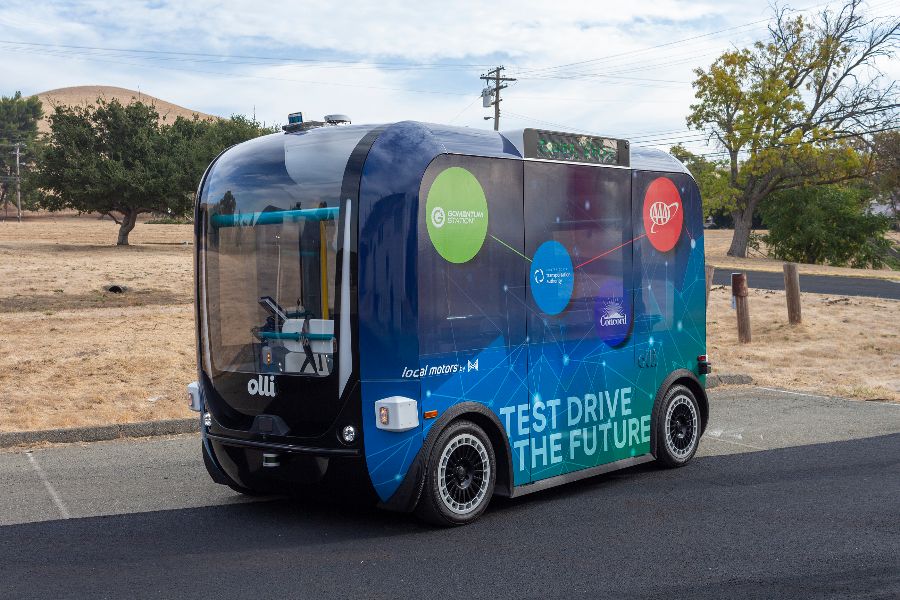
San Ramon, CA – Bishop Ranch, EasyMile, GoMentum Station and the Contra Costa Transportation Authority (CCTA) announced Monday that two EZ10 Shared Autonomous Vehicles (SAV) will begin operation at Bishop Ranch, northern California’s premier business park in San Ramon. This marks the beginning of the second phase of testing for a pilot demonstration project authorized as part of California Assembly Bill 1592, which enables testing of electric, low-speed, multi-passenger, autonomous vehicles that are not equipped with a steering wheel, brake pedal, accelerator or operator. This is the first such pilot program in California.

“We are excited to be at the cutting edge of innovation in driverless technology with the United States’ first pilot demonstration for EasyMile shuttles here at Bishop Ranch,” said Alexander Mehran Sr., Chairman and Chief Executive Officer of Sunset Development Company. “We’re continuously striving to find ways to elevate the customer experience at Bishop Ranch and deliver innovative and valuable amenities. Autonomous shuttles have the ability to improve safety, benefit the environment, reduce congestion and make existing roads more efficient.”

http://contracostaherald.com/wp-content/uploads/2017/03/Easy-Mile-515_8289_01.mp4

“The Contra Costa Transportation Authority and GoMentum Station look forward to partnering with Bishop Ranch and EasyMile to test the next generation of transportation in Contra Costa County. This technology offers an innovative new approach to helping travelers get to transit stations, business districts, and other local amenities without the hassle of driving and parking. We expect that EasyMile SAVs will solve the so-called “first-and-last-mile” challenge — a solution that could be replicated by many urban and suburban communities across the United States,” said Randell Iwasaki, CCTA’s Executive Director.

“At EasyMile, we are proud of our work to transform the way people move through cities around the world. Our shuttles allow commuters to quickly, easily, and safely get where they need to go, without having to depend on a car. We are excited to partner with Bishop Ranch, GoMentum Station and First Transit as our operating partner in bringing this technology to the United States,” said Gilbert Gagnaire, EasyMile President.

Founded in 2014, EasyMile is a high-tech company specialized in developing software for the automatization of all kind of transportation systems, powering autonomous vehicles for both goods transportation and smart mobility solutions. They have already successfully deployed SAVs in Finland, France, Spain, Norway, Australia, Germany, Sweden, Japan, Dubai, Singapore, and Switzerland. The Bishop Ranch pilot program marks the U.S. debut of the EasyMile SAVs, which if successful, is poised to become the first publicly accessible SAV technology for Mobility-on-Demand (MOD) in the country.

About EasyMile

EasyMile is a high-tech company specialized in developing software for the automatization of all kind of transportation systems. The company provides shared driverless transportation for the last mile that complement mass transportation solutions, the EZ10. This ‘green’ service addresses short distances that are too long to walk to, from a transport hub to a final destination where cars are either ‘off limits’ or where parking space is limited or non-existent. It also provides a service for short distances within confined sites. EasyMile autonomous vehicles operate either on demand or follow a set route calling at all stations.

About GoMentum Station

GoMentum Station in Concord, California is where the Contra Costa Transportation Authority leads and facilitates a collaborative partnership among multiple automobile manufacturers; original equipment manufacturers and Tier 1 suppliers; communications suppliers; technology companies; researchers and academia; public agencies and other partners. At GoMentum Station, technology, innovation and commercialization will converge to define the next generation of transportation network infrastructure. More information about GoMentum Station is available at gomentumstation.net

About Bishop Ranch

Bishop Ranch, owned and operated by Sunset Development Company, is built on a legacy of sound planning and smart growth. Located on 585 acres in the San Ramon Valley, it is the largest mixed-use business community in Northern California. For nearly four decades, Bishop Ranch has continually, carefully grown to become a dynamic center for the modern business. Today, the prosperous surrounding communities — 192,000 residents within a six-mile radius — enjoy an average household income of $162,000.

We are home to 30,000 employees at 600 companies in more than 30 industries. Among the tenants are many Fortune 500 companies including AT&T, Chevron, General Electric, IBM, PG&E, Robert Half, Bank of the West, Toyota and Berkshire Hathaway. Numerous small businesses in high tech, bio/clean tech, and social software, such as Affiliated Computer Services, Aon eSolutions, Cognizant Technology Solutions and AGIS Network have chosen to locate in this diverse and thriving business environment. Bishop Ranch offers a unique flexibility for the space requirements of companies large and small, and its tenants occupy spaces from 150 square feet to more than 1 million square feet.

Employees at Bishop Ranch enjoy a wide range of amenities and on-site services, including award-winning transportation programs, high-end food options, professional seminars and networking opportunities, special offers and discounts, gourmet food trucks and a farmers market.

About The Contra Costa Transportation Authority

The Contra Costa Transportation Authority (CCTA) is a public agency formed by Contra Costa voters in 1988 to manage the county’s transportation sales tax program and oversee countywide transportation planning efforts. CCTA is responsible for planning, funding and delivering critical transportation infrastructure projects and programs that connect our communities, foster a strong economy, increase sustainability, and safely and efficiently get people where they need to go. CCTA also serves as the county’s designated Congestion Management Agency, responsible for putting programs in place to keep traffic levels manageable. More information about CCTA is available at ccta.net.

Filed Under: News, San Ramon Valley, Technology

GoMentum Station named National Proving Ground by U.S. Department of Transportation

January 24, 2017 By Publisher Leave a Comment

Contra Costa testing facility selected to be part of first-ever “Community of Practice” for automated vehicle technology

GoMentum Station was named one of ten federally designated automated vehicle proving grounds by the U.S. Department of Transportation (DOT). The announcement was made by U.S. Transportation Secretary Anthony Foxx on Thursday, January 19, who noted that the pilot sites were selected to encourage testing and information sharing around automated vehicle technologies, foster innovations that can safely transform personal and commercial mobility, expand capacity, and open new doors to disadvantaged people and communities. GoMentum Station was selected from more than 60 applicants to help advance the safe deployment of automated technology.

“We are honored to have been selected as part of this elite group of test facilities,” said Contra Costa Transportation Authority (CCTA) Executive Director Randell Iwasaki. “When we established GoMentum Station a little over two years ago with our partners, our goal was to make it the country’s premier secure test facility of autonomous and connected vehicle technology. To be selected as a federally designated proving grounds is a confirmation of the significant value our facility adds to the field and its role in redefining the next generation of transportation.”

“The designated proving grounds will collectively form a Community of Practice around safe testing and deployment,” said Secretary Foxx. “This group will openly share best practices for the safe conduct of testing and operations as they are developed, enabling the participants and the general public to learn at a faster rate and accelerating the pace of safe deployment.”

Each of the ten sites have a unique testing environment. Among the qualities that set GoMentum Station apart is being one of the largest, secure proving grounds in the United States, which enables partners to safely push their technology to its limits while testing at GoMentum Station.  Founded in 2014, GoMentum Station is located at the former Concord Naval Weapons Station, making Contra Costa County a center of cutting-edge transportation research. The innovative technology being explored at GoMentum Station will reinvent the ways we will move through our communities over the next 25 years and beyond.

Contra Costa’s autonomous and connected vehicle testing facility is built on a public/private partnership model, allowing the private sector space to innovate and test while providing the public sector with access to new technologies as they are being developed. The work being carried out at GoMentum Station facilitates informed policy, regulation and planning decisions around the technology.

“We are excited that there may be opportunities to potentially collaborate with other test facilities around the nation.  If we can coordinate on testing, we can eliminate redundant and duplicative testing, learn from one another and accelerate our ability to bring this transformative technology to market,” noted Iwasaki. “We hope this designation will be valuable to our partners and the public in helping to further this life-saving technology. We’re looking forward to working with USDOT on advancing this technology for a public good.”

About GoMentum Station

GoMentum Station in Concord, California is where the Contra Costa Transportation Authority leads and facilitates a collaborative partnership among multiple automobile manufacturers; original equipment manufacturers and Tier 1 suppliers; communications suppliers; technology companies; researchers and academia; public agencies and other partners. At GoMentum Station, technology, innovation and commercialization will converge to define the next generation of transportation network infrastructure. More information about GoMentum Station is available at gomentumstation.net.

About The Contra Costa Transportation Authority

The Contra Costa Transportation Authority (CCTA) is a public agency formed by Contra Costa voters in 1988 to manage the county’s transportation sales tax program and oversee countywide transportation planning efforts. CCTA is responsible for planning, funding and delivering critical transportation infrastructure projects and programs that connect our communities, foster a strong economy, increase sustainability, and safely and efficiently get people where they need to go. CCTA also serves as the county’s designated Congestion Management Agency, responsible for putting programs in place to keep traffic levels manageable. More information about CCTA is available at ccta.net.

Filed Under: Central County, Concord, News, Technology, Transportation

  • « Previous Page
  • 1
  • 2
  • 3
  • 4
  • 5
  • Next Page »
Monica's-Riverview-Jan-2026
Liberty-Tax-Jan-Apr-2026
Deer-Valley-Chiro-06-22

Copyright © 2026 · Contra Costa Herald · Site by Clifton Creative Web