• Home
  • About The Herald
  • Local Agencies
  • Daily Email Update
  • Legal Notices
  • Classified Ads

Contra Costa Herald

News Of By and For The People of Contra Costa County, California

  • Arts & Entertainment
  • Business
  • Community
  • Crime
  • Dining
  • Education
  • Faith
  • Health
  • News
  • Politics & Elections
  • Real Estate

Supervisors ask fair board to ban gun shows at county fairgrounds

December 11, 2018 By Publisher Leave a Comment

By Daniel Borsuk

At their meeting on Tuesday, Dec. 4, 2018 on a 5-0 vote, supervisors sent a letter to the 23rd District Agricultural Association requesting that the association stop the gun shows at the state-owned Contra Costa County Fairgrounds in Antioch,  now known as the Contra Costa Event Park.

County supervisors were unsuccessful in seeking a ban on firearm possession and sales on county fairgrounds from the Agricultural Association in previous attempts in 1996 and in 2004.

“Gun violence and gun-related injuries and deaths continue to be critical public health concerns,” the supervisors’ letter states.  “The Board of Supervisors continues to support a policy that would prohibit the Contra Costa County Fairgrounds from being used in the proliferation of this critical public health hazard.

“As the nation grapples with the effects of mass shootings, the 23rd District Agricultural Association has the responsibility to determine if facilitating guns shows on public property is the message to be sending to the public.”

The supervisors’ letter notes the fairgrounds are near a number of sensitive public areas, including a Head Start kindergarten readiness facility that is located on the Fairground property.  Some 500 feet away from the Fairgrounds are Antioch High School and Fairview Park.  Nearby are Live Oak High School, Antioch Middle School and Fremont Elementary School.

Prompting the gun ban were a number of requests Supervisor Federal Glover received from constituents who complained about the gun shows at the Fairgrounds.  “This is an opportunity,” said Glover in reference to the election of a new governor, Gavin Newsom, who will replace Gov. Gerald Brown, who has vetoed gun legislation that would have banned gun shows at another state-owned fairgrounds, the Cow Palace in Daly City.

Alameda, Marin, Sonoma, San Mateo, and Santa Clara Counties have outlawed the possession of firearms and ammunition at their county-owned fairgrounds, and Los Angeles County has banned firearm and ammunition sales on its county-owned fairgrounds.

A spokesperson for the 23rd District Agricultural Association did not return a Contra Costa Herald phone call for comment on the board of supervisors’ letter.

Another gun expo hosted by Mountain Aire Promotions will be held this weekend at the Event Park.

Filed Under: East County, News, Supervisors

Supervisors direct staff to develop ban on Styrofoam containers

December 6, 2018 By Publisher Leave a Comment

By Daniel Borsuk

County supervisors set in motion a potential environmental ordinance that would ban polystyrene, or Styrofoam food and beverage containers, in businesses in unincorporated Contra Costa County.  The proposed law would possibly go into effect sometime in May 2019.

On a 5-0 vote supervisors directed the county Public Works Department officials to develop the ordinance that would resemble as much as possible a mish-mashed compilation of banned polystyrene ordinances now enforced in 10 Contra Costa cities.  Cities with some form of a polystyrene ban ordinance in place include Richmond, San Pablo, El Cerrito, Walnut Creek, Pinole, Lafayette, Pittsburg, Hercules, Concord and Martinez.

While the banned use of polystyrene food containers applies in all 10 cities, the ban sale of food containers is barred only in Richmond, San Pablo, Pinole and Pittsburg.  Prohibiting the sale of packing peanuts is enforced only in Richmond, San Pablo, and Pittsburg.

As a result, crafting a county-wide ordinance banning polystyrene will be a difficult task.

“According to the US EPA, local governments in California spend as much as $411 million each year to prevent plastic food packaging and other commonly littered items from ending up on streets, storm drains, beaches, rivers and the ocean,” wrote Mark Murray, executive director of Californians Against Waste, in a November 6 letter to the supervisors.

The Bay Area counties of Alameda, Santa Clara, San Mateo, San Francisco, Marina, and Sonoma already have polystyrene ban ordinances in place.

Dominic Williams of Save the Bay encouraged the supervisors to move forward in developing the ban on polystyrene food and beverage containers.

“There are 117 ordinances in place in California banning polystyrene products,” Williams said.  “Polystrene is the type of product that never biodegrades.”

“Polystrene is not only an environmental issue, but it is an economic issue.   We pay more for what goes into the land fill,” said District 3 Supervisor Diane Burgis of Brentwood.

“We believe that imposing a ban on polystyrene will do little to reduce overall litter within the County of Contra Costa.  Focusing on one product is a discriminatory approach, and has proven to be ineffective,” wrote Allison Piccoli, Director of Local Government Affairs for the California Restaurant Association, which opposes the ban.

David Twa Named Top County CEO In California

Contra Costa County Administrator David Twa was recognized with the Distinguished Service Award from the California Association of County Executives at the association’s conference in San Diego held on Dec. 1-2.

The award is handed out for outstanding and meritorious work to a Chief Administrative Officer or Chief Executive Officer who has demonstrated respected leadership, shown exemplary work to benefit the community through long term positive results, and serves as a role model for others in cities, counties, and the state.

“We are proud to celebrate our county administrator David Twa’s selection as CAO of the year,” said Contra Costa County Board of Supervisors Chair Karen Mitchoff.  “We are fortunate to have David’s leadership in Contra Costa and so pleased that he has received this well-deserved award.”

Filed Under: Environment, News, Supervisors

Following voter approval of tax supervisors move forward on marijuana business zoning regulations

November 15, 2018 By Publisher Leave a Comment

Lower bond, seek legislation to draw trash haulers to anti-litter program

By Daniel Borsuk

Now that Contra Costa County voters have passed Measure R, the commercial cannabis taxation measure by a 72 percent approval rate in the Nov. 6 election, the Contra Costa County Board of Supervisors requested the county’s Conservation and Development Department (CDD) to present at the Board’s Dec. 4 meeting a refined process to select applicants for types of commercial cannabis businesses.

While supervisors heard favorable comments from speakers about CDD proposed regulations, there are concerns, particularly among cultivators, that the permit review process could take up to two years before a cultivator could even plant a crop.

In developing County Cannabis Zoning Regulations, county planners have reviewed cannabis zoning regulations that are implemented in Alameda County and in the cities of Alameda, Benecia, Emeryville and Hayward.

Anti-Litter Program Changes

Since launching in March, a program aimed at legalizing non-commercial trash haulers via a program where private haulers would become licensed, performance bonded operators through the Contra Costa County Health Department, the county agency entrusted to oversee the program has not received one applicant, the Contra Costa County Board of Supervisors revealed Tuesday.

Going on a recommendation from the supervisors’ Internal Operations Committee, supervisors learned from Dr. Marilyn Underwood, the county Environmental Health Director, about the status of the Solid Waste Collection & Transportation Ordinance.

“While extensive outreach has been conducted, no permit applications have been received. More than 40 phone inquiries were received, but mostly to confirm exemption from the permit program,” Underwood reported to supervisors.

Dr. Underwood reasoned that the current administrative penalties may not provide enough inducement for compliance, noting that the cost for a $50,000 performance bond of approximately $500 far exceeds the penalty for the first and second violation of the ordinance and is equivalent to the penalty for a third violation in a year.  As a result, the Internal Operations Committee recommended that the performance bond be lowered from $50,000 to $20,000 to see if haulers will apply for performance bonds and qualify for permits.

Even with the Internal Operations Committee recommendation from supervisors Candance Andersen of Danville and Diane Burgis of Brentwood, not all the supervisors were onboard.  Board Chair Karen Mitchoff resisted lowering the bond stating, “We need to put teeth into this ordinance.  The bond should still be at least $50,000.”

District 1 John Gioia of Richmond voted to maintain the performance bond at $50,000 instead of lowering it to $20,000.

Supervisors also voted to seek a state anti-litter bill that would enact statewide penalties on anyone illegally dumping litter in California.

“We want to get the state involved in this problem,” Supervisor Federal Glover of Pittsburg said. “If Sacramento does not want to establish anti-litter penalties on a statewide basis, then perhaps it can be addressed on a Contra Costa County basis,” he said.

Keller Canyon EIR Contract Extended

Supervisors voted 5-0 to extend a Keller Canyon Land Fill contract with Environmental Science Associates Inc. from Dec. 31, 2018, to Dec. 31. 2020 at no additional change in contract cost of $402,588.

The landfill operator, Republic Services, plans to increase daily maximum tonnage at the landfill located on the southwest side of Pittsburg, off Baily Road, from 3,500 tons per day to 4,900 tons per day.  An environmental impact report will be required for that daily tonnage increase.

However, those plans have been temporarily shelved because of an investigation into allegations that shipments of radioactive material from the Hunters Point Naval Shipyard in San Francisco may have been deposited at the landfill.

In the meantime, Supervisor Glover told the Contra Costa Herald the Contra Costa Health Department will soon name an environmental consultant that will conduct an independent study of the landfill. The soils investigations will be paid through the Keller Canyon mitigation fund, a fund that annually distributes funds to Bay Point and Pittsburg non-profit organizations.

Veteran Affairs Administrator Jill Martinez Recognized for 39 Years of Service

After 39 years of service in Contra Costa County Veterans Affairs Office as an office administrator, Jill Martinez was recognized for her years of service to thousands of veterans during Veterans Day ceremonies Tuesday.

Well-respected among veterans because of her caring manner, Martinez told supervisors, veterans and the public attending the ceremony in the Board of Supervisors chambers in Martinez “I was fortunate that I had found my passion. We get calls from all over the county. The veteran community has grown so much that I’d work most weekends to keep up with the demands of the job.”

Martinez has no immediate plans of quitting.

Filed Under: News, Supervisors

Supervisors plug $1.2 Million gap for stormwater Regional Water Quality Board Permit

November 8, 2018 By Publisher Leave a Comment

By Daniel Borsuk

To address rising costs of meeting strict environmental water quality regulations, Contra Costa County Board of Supervisors on Election Day, Tuesday, unanimously approved a way to pay for a $5 million permit with the Regional Water Conservation District.

With scant discussion from supervisors and zero comments from the public, supervisors approved Contra Costa County Flood Control & Water Conservation District Division Manager Tim Jensen’s recommendation to pay for the five-year permit through service reductions.

Some jurisdictions, like San Diego and Santa Clara counties most notably have refused to pay rising storm water permit fees, Jensen said.

Jensen informed supervisors the county has about $3.2 million in funds set aside for the RWCD permit, but the there are no other funds available from the County’s General Fund to fill in a $1.2 million deficit for the certificate.

Jensen said his staff identified $510,000 of road funds and $75,000 of flood control funds that could be spent for program activities but, noted the road funds might be unavailable should state Proposition 6, the State Gas Tax measure wins in Tuesday’s election.  A Proposition 6 victory would deliver a financial blow to the county’s road fund. (NOTE: Prop. 6 failed)

The county flood control manager presented to supervisors a four-point service reduction plan that would help the county plug up the $1.2 million deficit to cover the RWCD permit.  The plan consists of:

  • Street Sweeping – Transfer street sweeping to the Road Fund even though this might not materialize if Proposition 6, the state gas tax measure, won at Tuesday’s election.
  • Inspections – Reduce inspections by 50 percent.
  • Outreach – Reduce the Public Information and Participation Program by 50 percent.
  • Calendar – Eliminate the annual calendar.

County Agricultural Crop Production Down 6 Percent

In other business, supervisors approved, on consent, the county’s 2017 Agricultural Crop Report that showed a 6% decline in gross value of agricultural crops.  During that year, agricultural crop gross value was $120,441,000, a decline of $7. 6 million from 2016, Humberto Izquierdo, Contra Costa County Agricultural Commissioner Sealer of Weights and Measures wrote in his report to the California Department of Food and Agriculture and the Contra Costa County Board of Supervisors.

Izquierdo’s report cited how high labor costs and an overall shortage of farm workers have been key factors behind the longstanding decline in the county’s asparagus industry.  Today there is only one asparagus grower in the county who sells strictly at the Certified Farmers’ Markets.  The total acreage in asparagus production has decreased to less than 50 acres.  “The loss of (a 25% tariff) protection, combined with rising labor costs, have resulted in an increase in imported asparagus from 10.8 percent of U.S. consumption in 1980 to 91.2 percent in 2015,” he wrote.

The county crop report also showed that 2017 sweet corn harvested was down to 37,500 tons compared to 44,300 tons in 2016.  That corn harvest produced $18.9 million in total value in 2017 compared to $23.3 million in 2016.  Tomato harvest was up in 2017, at 209,300 tons valued at $23.4 million in comparison to 169,000 tons at a value of $19.9 million in 2016.

Shelter in Place Recognized

Contra Costa County Shelter in Place Week received official recognition from the Board of Supervisors on Tuesday. Supervisors passed a resolution recognizing the 17th anniversary of Shelter in Place Day that was held November 7 at Garin Elementary School in Brentwood with a drill. At the presentation Board Chair Karen Mitchoff presented the resolution to A. J. (Tony) Semenza, executive director of Community Awareness Emergency Response, and Michael Dossey, an accidental release prevention engineer with the Contra Costa Health Services Hazardous Materials Programs.

Adoption Awareness Month

Also, at the meeting, Supervisors recognized November as Adoption Awareness Month.  Board Chair Karen Mitchoff presented a resolution recognizing the good deeds of the county’s Children and Family Services to Sandra Wohala of Concord who recently adopted two girls.

In order to adopt the girls, Wohala said that she had to move out of her 550 square foot condominium and into a house with a backyard. This year Children and Family Services placed its first ever non-minor dependent adoption. Some 2,000 children in the county receive adoption assistance.

Filed Under: News, Supervisors

County Supervisors eye new crackdown on illegal dumping

October 25, 2018 By Publisher Leave a Comment

Send letter to Homeland Security Secretary over changes to federal “public charge” rule changes which could adversely affect illegal immigrants

By Daniel Borsuk

Unlike 15 years ago, a new study with a potential crackdown on illegal dumping in unincorporated Contra Costa County might succeed, with an infusion of money, the possible assistance from the county’s two chief trash collectors, and the installation of surveillance cameras at hotspots where illegal haulers go to dump their loads.

Even though the county launched earlier this year its permit program for private haulers, there are telltale signs the program might be in trouble because not enough haulers can afford to buy the permits to legally pickup, haul and dump trash at authorized sites.

Supervisors are scheduled to receive an update from the county Health Department on the new trash haulers license program at their Nov. 6 meeting.

“I’ve seen haulers park their trucks in residential neighborhoods because they have no other place to go,” said District I Supervisor John Gioia of Richmond, whose district receives most of the illegally dumped litter in the county. He speculates those haulers probably illegally get rid of their hauls by dumping their load in empty dumpsters.  “There is more illegal dumping in North Richmond than anywhere else,” said Gioia.

Bay Point places second in luring the most illegal dumping. Bay Point is so serious that in less than a year the Bay Point Blight Program collected more than 13 tons of trash, the Illegal Dumping Think Tank County Interdepartmental Team reported. “Illegal dumping in Bay Point is so bad that at time it spills onto streets and sidewalks,” the report stated.

The illegal dumping problem is so bad countywide that last July the county launched a $1.82 million interdepartmental team activity to identify strategies to wipe out the county’s chronic illegal dumping problem that cost the county more than $1.2 million to clean up litter in 2017-2018, but had only budgeted $400,000 for a part-time private contractor to pick up illegal litter for the current fiscal year.

District 5 Supervisor Federal Glover of Pittsburg said he saw many of the same recommendations 15 years ago when another anti-litter study was conducted.

“We have not found the right mechanism that fits,” he said. “We still have the illegal haulers.  They can still pick up and dump illegally, especially in Bay Point.”

Supervisor Gioia agreed with Glover that 90 percent of the task force’s recommendations resemble those proposed in a 2003 study, but county Conservation & Development Department Director John Kipchak, who lead the illegal dumping think tank effort, listed six of the 55 recommendations that supervisors should pay particular attention.

Those recommendations include setting aside $10,000 for public outreach, budgeting $58,000 for mandatory garbage service, establishing a free mattress recycling program, on-call right-of-way debris removal by Public Works and on-call right-of-way clean-up by franchise haulers (Republic Services and Mt. Diablo Resource Recovery that will require increased garbage rates), dedicate two law enforcement deputies to investigate dumping crimes at an additional cost of $566,000 and the installation of surveillance high definition, license plate reader cameras at a cost of $50,000.

Supervisors were interested in in hearing how the city of San Pablo has curbed illegal dumping with the installation of 165 cameras located in strategic hotspots in a in a city that is six square miles, said city Public Works Director Jill Mercurio.   San Pablo has plans to install more cameras, Mercurio said, because they have proven to help law enforcement arrest the illegal dumpers at an economical cost.

Mt. Diablo Resource Recovery representative Sal Evola, who also serves on the Pittsburg City Council, said while the company and the county’s other major commercial garbage hauler, Republic Services, have not been involved in the county’s illegal dumping initiative, both companies would be willing to provide input at future meetings.  Getting the two garbage haulers involved in the county’s trash initiative could give the county’s illegal trash initiative an extra incentive.

Supervisors learned the county has a private contractor who picks up illegal dumped trash around the county at a yearly price tag of $400,000.  Contra Costa County Public Works Department Deputy Director Mike Carlson was unable to exactly answer supervisors’ questions as to how frequently the on-call contractor picks-up litter, but he said the contractor actually picks up litter two days a week for the county and the contractor may take up to four to six weeks before the contractor gets to a reported litter area for cleanup.

Supervisors Oppose Proposed Rules Changes to Federal Public Charge

Concerning a new United States Department of Homeland Security published proposed change to the “public charge” in the Federal Register, the Board of Supervisors voted 5-0 to instruct staff to send a letter to the secretary of the Department of Homeland Security, the U.S. Senate and House leader and the Contra County Federal Congressional Delegation to declare the board’s opposition to the proposed rule change to public charge.

A public charge is someone who is likely to become dependent on the government for subsistence.

Contra Costa County Employment and Human Services Director Kathy Gallagher, Contra Costa County Health Services Director Anna Roth, and Contra Costa Housing Authority Director Joseph Villarreal recommended that the rule change would impose “grave economic and health consequences” to the county’s immigrants.

“While the proposed public charge changes are primarily directed toward applications for Legal Permanent Residency for those already in the United States, there could be an overall chilling effect of causing uncertainty and confusion among immigrant families about using public programs for themselves and their children,” Contra Costa County Human Services Director Gallagher wrote in her recommendation to the supervisors.  “Not only would disenrollment or foregone enrollment lead to worse health outcomes and greater poverty risk for the families foregoing benefits, but public health at-large could be affected by sicker individuals in the community, increased emergency room use and uncompensated care.”

Rene Zimmer of the Contra Costa County Economic Opportunity Council urged supervisors to oppose the rule change by labeling it a “disturbing rule.”

Antioch City Councilman Lamar Thorpe said that this rule change promotes “unnecessary fear” in community.

$1.2 Million Landscaping Contract Awarded     

Supervisors awarded Dominguez Landscape Services, Inc. a $1.2 million contract to provide landscape maintenance services countywide from July 1, 2018 through June 30, 2021.

The county is searching for ways to reduce water usage at county facilities.  The contractor will convert the grass and green ground cover to drought resistant plants that require less water.

Capital Road Program OK’d

The county’s Capital Road Improvement Preservation Program for 2018/2019 to 20124/2025 was unanimously approved without comments from the public.  The county road improvement program for the next seven years is paid through state gas tax revenue, a source of revenue state voters will decide on the Nov. 6 ballot with Proposition 6.  The CRIPP lays out road projects for the Contra Costa Public Works Department for the next seven years.

Filed Under: Immigration, News, Supervisors

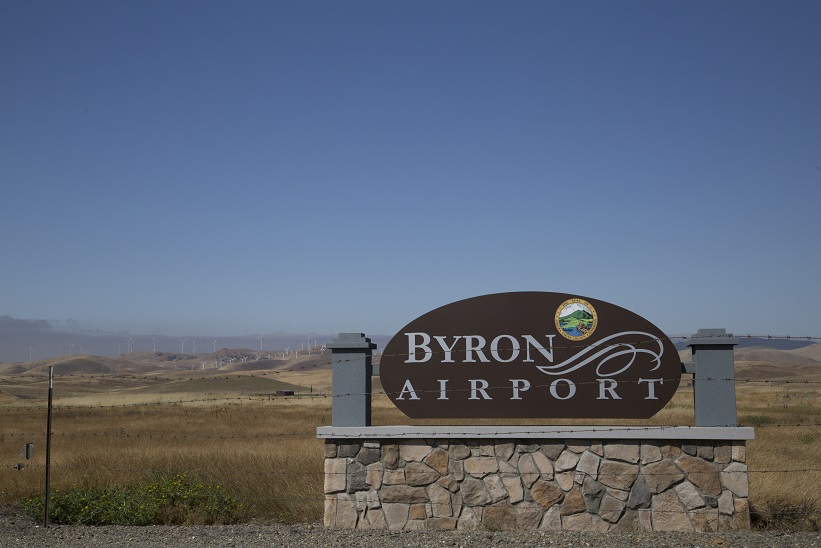
Supervisors cut hangar, tie-down rates at Buchanan, Byron Airports to compete

October 17, 2018 By Publisher Leave a Comment

Photos courtesy of Contra Costa County

Approve spending $41,000 for sideshow deterrence project

By Daniel Borsuk

Airplane tenants at the county’s two airports – Buchanan Field Airport and Byron Airport – will see hangar and tie-down rental rates decline as a result of the Contra Costa County Board of Supervisors concurring with an airports staff analysis that the rates charged at the two airports are non-competitive. The lower rates go into effect Jan. 1, 2019.

Photo courtesy of Contra Costa County.

Supervisors voted 5-0 in approving the rate reductions at a meeting on Tuesday in Martinez.

Overall, the lower rates will mean the county will receive $65,514 less annual revenue for the Airport Enterprise Fund, the fund that financially operates the two airports.  Unlike other county departments or operations, the two airports are run as financially self-sustaining public use facilities in accordance with the Federal Aviation Administration.

A market survey County Director of Airports Keith Freitas and his staff conducted on the county airports’ regional competitors including Livermore, Hayward, Napa, Sonoma, Stockton, and Nut Tree showed that rates at the two Contra Costa County airports were “on the high end of the rate range.”

“To best position Buchanan Field and Byron Airports to be regionally competitive, the new hangar and tie-down rates have been lowered and they will adjust every three years instead of annually,” Freitas wrote in his report to the supervisors.  This will permit the Airports Division to “react and behave more like a business in order to successfully compete for marketplace in the region.”

There is currently a six-month wait for a hangar at the two airports, the airports director said and he would like to see that wait period decline even more over time.

The county’s tie-down rates are less than 40 percent occupied, the airports director’s report stated.

Pleasant Hill resident Tom Weber, who is not a pilot, supported the lower airport rates because “We need to be competitive. Our rates have been too high.”

Supervisor Diane Burgis of Brentwood, who serves on the Airports Commission, foresees how the lower hangar and tie-down rates at the airports could potentially spark “so many opportunities” in the county.  She cited how the airports could be catalysts for “really good jobs for the Northern Waterfront,” an area currently undergoing an extensive county planning study for future development.

$41,000 Sideshow Deterrence Project OK’d

Without out any comment, supervisors approved a $41,000 anti-sideshow project at the intersection of Alhambra Valley Road and Bear Creek Road.  The supervisors approved the item on their consent agenda.

At the request of District 1 Supervisor John Gioia, who has received complaints from citizens about illegal sideshow activities (spinning circles and other illegal vehicular stunts) at the intersection, the county Public Works Department plans to take preventive action.

“The project consists of installing a series of 6-inch and/or 8-inch raised ceramic domes at the four approaches to the intersection,” Brian M. Balbas, Public Work Director/Chief Engineer wrote in this report to the board.

“The ceramic domes will be strategically placed along the centerline striping and in the shoulder areas.  The intent of the raised features is to provide a visual, auditory, and sensory deterrence, while minimizing the impact to most road users who follow the vehicle code.  The project will test if raised ceramic domes have intended deterrent effect on sideshow activities.”

But when the Contra Costa Herald contacted Balbas, the county public works chief wasn’t too optimistic that the ceramic domes will spoil the enthusiasm of the sideshow participants.  “They’ll find a way to either scrape them off or demolish the ceramic domes in order continue their sideshows,” he said.

Supervisors also heard Arthur Road resident Jonathan Katayanagi describe how sideshows and speeding cars have made his neighborhood dangerous for children and anyone living in the area.  Recently there was an auto accident on Arthur Road, sparking increased concerns about sideshows and dangerous auto stunts.  Katayanagi told the Herald perhaps his neighborhood should also get the ceramic dome street treatment like what Public Works will soon install at Alhambra Valley Road and Bear Creek Road.

Proclaim October Diaper Need Awareness Month

Supervisors unanimously proclaimed October as Diaper Need Awareness Month in Contra Costa County as part of a countywide effort to raise public awareness and action to donate diapers to diaper banks, diaper drives, and organizations that distribute diapers to families in need.

Supervisors acknowledged the works of Sweet Beginnings Family Resource Center for its work to be recognized as the 20th Diaper Bank in California and the work of SupplyBank.Org’s Diaper Kit Assistance that distributes 18,000 TalkReadSign branded diapers and 36,000 baby wipes per month through the Concord Women and Children (WIC) Program.

Citing how the high cost of diapers imposes a financial strain, especially on low income families, can account for 14 percent of a monthly budget.  Diapers can be purchased with Temporary Assistance for Needy Families (TANF) benefits, but only 27 percent of families with children in poverty receive TANF benefits.

Filed Under: Airports, News, Supervisors

Supervisors support national pricing on carbon emissions to reduce climate change on split vote

October 11, 2018 By Publisher 1 Comment

By Daniel Borsuk

The Contra Costa County Board of Supervisors went on record on Tuesday supporting the establishment of a national fee and dividend on carbon emissions.  Supervisors voted 4-1 to approve the proposal.

Supervisor Candace Andersen of Danville cast the dissenting vote on the grounds she opposed the dividend feature of the proposal that was acted on and endorsed by the Contra Costa Sustainability Commission at its June 25 meeting and was finally presented to the full Board of Supervisors Tuesday, more than three months later.

“I do support cleaner air, but I don’t see how this will produce the desired result,” said Andersen.  “This isn’t the plan for me.”

Contra Costa County can now be counted as one of a number of California counties backing the proposal lobbied by Citizens Climate Lobby for a federal revenue-neutral carbon-based fuel fee and dividend proposal to reduce catastrophic climate change from global warming.

Other counties already signing on in support of the Citizens Climate Lobby carbon emissions initiative are San Francisco, San Mateo, Sonoma, Santa Cruz, and Marin.  Bay Area cities that back the initiative include Alameda, Albany, Berkeley, El Cerrito, Los Altos, Oakland, Petaluma, Richmond, and San Carlos.

“We have 12 years to avoid the worst effects of climate change,” Citizens Climate Lobby member Doug Merrill, a resident of Lafayette, told supervisors in encouraging them to endorse the initiative.

“We need to pay for our air pollution problems,” said Betty Lobos, also a Citizens Climate Lobby supporter.

At the national level, the carbon fee and dividend concept is gaining traction, especially within the energy industry where ExxonMobil this month announced it will donate $1 million to Americans for Carbon Dividend founded by former United States Senators John Breaux and Trent Lott.

Ordinance Banning Polystyrene Food/Beverage Containers in the Works

Supervisors, most likely next year, will act on an ordinance that will ban polystyrene food and beverage containers to be used in stores located in unincorporated Contra Costa County.

The County Department of Public Works will draft the ordinance at a cost of $75,000 after completing a recent Regional Water Quality Control Board stormwater permit review in which it was found that in order for the county to improve stormwater quality it needs to reduce different types of trash, especially the most prevalent, polystyrene containers.

The Public Works Department request was unanimously approved as a consent item.  The department estimates it will cost about $25,000 a year to enforce the ordinance.

In late August, the Department of Public Works mailed letters to about 200 stores, markets and other businesses that would be affected by the proposed ordinance to inform them about why the county is proposing to adopt a ban on polystyrene food and beverage containers and what would be included in the proposed ban.

Increased Payment for Citizen Document Access Solution

Supervisors voted 5-0 to approve a contract amendment with Granicus, Inc. to increase the payment limit by $175,000 to a new payment limit of $825,816 for the continued hosting of the Citizen Document Access Solution.  The contract was also extended from Oct. 9, 2018 to Oct. 8, 2021.

“The increase of the payment limit includes annual maintenance, support charges, software charges and web hosting fees, “County Administrator David Twa explained a memo to supervisors.  “The new annual charges for October 9, 2018 to October 8, 2021 reflect a lower annual price of $9,708.  This is due to the new and more efficient hardware and decommissioning of old hardware and the subtraction of a module called Meeting Efficiency.”

Contracting with Granicus for a Citizen Document Access Solution supports the county in meeting the goals of the Better Government Ordinance, complying with new website posting provisions of the Brown Act and using improved technology to deliver to citizens.

Supervisors Add One Meeting in 2019

Supervisors approved a 2019 meeting schedule that will call for 31 meetings instead of 30 meetings as initially planned.  Supervisors scratched the meeting slated for February 19, figuring January would be a busy month with three meetings.  A March 19 meeting will be needed, even though supervisors are scheduled to meet on Cesar Chavez Day, March 26, where business might be light.  A meeting was added for December 17 because there was only one meeting originally scheduled that month, December 10.

Vice Chair John Gioia of Richmond is slated to become chair next year.  It is yet to be decided who will become vice chair in 2019, either District 2 Supervisor Andersen, who has served on the board since 2012, or District 3 Supervisor Diane Burgis, who has been on the board for two years.

Filed Under: Environment, Government, News, Supervisors

Supervisors quietly oppose Prop. 6, but publicly approve report in opposition to the measure on November ballot

September 28, 2018 By Publisher Leave a Comment

Would repeal gas tax increase

By Daniel Borsuk

Listed as a consent item, Contra Costa County Board of Supervisors voted without comment an agenda item aimed to oppose Proposition 6, the Nov. 6 state ballot initiative to repeal Senate Bill 1, otherwise known as the Road Repair and Accountability Act or gas tax, but in public session supervisors voted 3-0 to accept a Public Works Department report describing how passage of Prop. 6 will negatively hit county road projects.

During the meeting on Tuesday, Supervisors had approved their “oppose” position on Proposition 6 without any comment from either the public or the three supervisors in attendance – board chair Karen Mitchoff of Pleasant Hill, supervisor Candace Andersen of San Ramon, and supervisor John Gioia of Richmond – because it was posted as a consent agenda item, C-17.

County Public Works Department Chief Deputy Director Stephen Kowalewski told supervisors that, should Proposition 6 win at the polls, unincorporated Contra Costa County could lose, over the next nine years, $239.9 million or an average of $26.7 million per year.

During that nine-year period Contra Costa County could lose each fiscal year, provided Proposition 6 wins at the polls, $15.5 million in 2018/2019. $21.8 million in 2019/2020, $24.9 million in 2020/2021, $26.4 million in 2021/2022, $27.6 million in 2022/2023, $28.9 million in 2023/2024, $30,3 million 2024/2025, $31.6 million in 2025/2026 and $33.8 million in 2026/2027.

When the State Legislature enacted SB 1 in 2016, the measure raised gas taxes and Department of Motor Vehicle fees to drum up funds for the freeways and roads that were in a rapid state of deterioration.  One of the key features of SB 1 is an index tax provision that permits gas tax revenue to keep pace with inflation.

Kowalewski listed a number of county road projects that could be in jeopardy should Prop. 6 wins in November. Some of those projects include the Kirker Pass Road truck climbing lane, Vasco Road improvements, Byron Road improvements, Baily Road/State Route 4 interchange improvements, Bel Air Trail crossing safety improvements, Blackhawk Road green paint bike lanes, resurfacing of 43 miles of roadway, and the Orwood Road culvert repair that is already in progress.

Supervisors Award $1.5 million Pathologists’ Contract

Supervisors unanimously approved Sheriff-Coroner David O. Livingston’s request to award three two-year contracts totaling $1.5 million to pathologists to perform autopsy services through Sept. 20., 2020.

As a consent item, supervisors approved the sheriff’s bid to award $500,000 contracts each to Dr. Mark A. Super, Dr. Arnold R. Josselson, and to Dr. Ikechi Ogan.  Their contracts will be in effect from Oct. 1, 2018 through Sept. 30, 2020.  Dr. Ogan will serve as coroner.

The three pathologists had provided pathology services to the county sheriff under the entity of Forensic Medical Group, but as of Oct. 1 FMG will no longer provide the county pathologist services because the doctors have decided to dissolve the company.  The three doctors that made up Forensic Medical Group are able to provide services to the county under individual contracts.

There was no comment from either the public or three supervisors in attendance.

Kensington Hills Elementary School School Zone Speed Lowered

Supervisors reduced the school zone speed for three roads approaching Kensington Hilltop Elementary School from 25 miles per hour to 20 MPH over the safety concerns that there are few sidewalks in the area and the roads are narrow.   An engineering and traffic survey were conducted and found that the request by an unnamed applicant complied with Assembly Bill 321 that was passed in 2008.  AB 321 permits local jurisdictions to extend the 25 MPH speed limit in school zones or to lower the speed limit to 15 to 20 MPH up to 500 feet from school grounds under certain circumstances.

The school speed zones will be lowered on approaches 500 feet to Kensington Hilltop Elementary School.  These roads are Highland Boulevard, Arlmont Drive, and Kenyon Avenue.

Cannabis Ordinance Amended

Without any public comment, supervisors amended the county commercial cannabis ordinance on a 3-0 vote.  Supervisors added Knightsen to the list of unincorporated areas where the ordinance will not be enforced.  Along with Knightsen, Bethel Island, Alamo, Acalanes Ridge, Contra Costa Centre, Saranap and Sandamond Slough will also prohibit enforcement of the commercial cannabis ordinance.

Supervisors also amended the ordinance by adding vertically-integrated businesses that include both storefront retail and commercial cultivation.  Vertically-integrated businesses will not count toward the 10-permit limit for commercial cultivation.

The ordinance was also amended to require cannabis delivery businesses located outside of unincorporated Contra Costa County to possess a current County Health Permit.

The ordinance will become effective provided voters pass a tax ordinance measure on the ballot of the Nov. 6 general election.

September 30 Designated Gold Star Mothers’ Day

In recognition of the sacrifice and history of Gold Star Mothers in Contra Costa County and throughout the nation, supervisors approved a resolution designating Sunday, Sept. 30 as Gold Star Mother’s Day, founded during World War I.

Upon thanking the board for the resolution, Gold Star Mother Yolanda Bacon said, “We ask you don’t say ‘You’re sorry for your loss.’  Say instead “Thank you for your son’s or daughter’s service.”

Filed Under: News, Politics & Elections, Supervisors

Supervisors support one, split to stay neutral on another housing measure on Nov. ballot

September 25, 2018 By Publisher Leave a Comment

By Daniel Borsuk

Contra Costa County Board of Supervisors took a “support” position on Proposition 2, a state bond ballot measure to build housing for homeless individuals with mental illness but, took a “no position” on Proposition 10, another state ballot measure that would expand residential property rent control at last Tuesday’s meeting.

Supervisors voted 4-0 in favor of Proposition 2, but voted 3-1 to a remain neutral, with Supervisor John Gioia of Richmond in dissent, on the rent control measure – Proposition 10.  Supervisor Federal Glover of Pittsburg was absent.

Both Proposition 2 and Proposition 10 will appear on the November 6, 2018 general election ballot.

Before the meeting, supervisors were initially prepared to brand an “oppose” position on Proposition 2 that “Authorizes Bonds to Fund Existing Housing Programs for Individuals with Mental Illness Legislative Statute.” But supervisors reversed that recommendation from the board’s Legislation Committee from August 13 to recommend an “oppose” vote on Prop. 2 over concerns the county could lose about $2.8 million in state funds for mental health services.

For a while, Board Chair Karen Mitchoff of Pleasant Hill was concerned passage of Proposition 2 might jeopardize funding for another mental health and housing program for the homeless, the No Place Like Home Program, because a state Legislative Analyst Office report states passage of Proposition 2 would mean money would be borrowed from the 2016 enacted homeless housing program.

During the meeting, Dr. Matthew White, head of the Contra Costa County Behavioral Health Services, said the threat to the state funds, in the event Proposition 2 passes at the polls, will probably have little impact on county mental health services.  He said there is a major need for adequate housing for the homeless needing mental health services that will be integrated into new housing projects.

But some speakers were unconvinced Proposition 2 will not deteriorate county mental health services.

Retired physician Dr. Mark Cohen, who has an adult child with mental illness, urged supervisors to oppose Proposition 2 on grounds that the ballot measure’s passage would divert money away from the psychiatric care services for the severely mentally ill not housed in Proposition 2 funding developments.

County mental health commissioner Douglas Dunn opposes the measure because the county is bound to lose upfront money aimed for mental health services that would be diverted to construct housing for the homeless with mental and substance abuse issues.

In support of Proposition 2, Gloria Bruce, executive director of the East Bay Housing Coalition, said “Proposition 2 is the right way to go. Give high need people access to affordable housing.”

Danville resident Douglas Leach called for supervisors to support Proposition 2 because it would create safe housing for the homeless needing mental health and substance abuse assistance.

Supervisor Diane Burgis of Brentwood said she would support Proposition 2 based on the fact it is “difficult to find housing for the mentally ill,”

“These dollars are needed,” supervisor Candace Andersen of Danville said.  “We won’t see a reduction in programs. It will give us an addition tool.”

On Proposition 10, the Affordable Housing Act, supervisors voted to take “no position” on a 3-1 vote.  Supervisors John Gioia of Richmond cast the dissenting vote.  He supported Proposition 10 mainly because it would eliminate the 1998-enacted Costa-Hawkins Rental Housing Act that permits landlords to raise rents of residential apartments and houses as much as they want constructed after 1995, but not before 1995.  Costa-Hawkins allows landlords to raise the rent in any building before 1995 to the market value when it becomes vacant.

In other business, supervisors officially adopted the $3.2 billion budget for the 2018-2019 fiscal year without any public comments. The 2018-2019 budget is up from the $3 billion budget for the 2017-2018 fiscal year.

In other action, Supervisors recognized September 16-22 as Falls Prevention Awareness Week at their meeting on Tuesday. At the presentation were Meals on Wheels Mt. Diablo Region Chief Executive Officer Elaine Clark and Communications Specialist Maricel Kinsella.

Meals on Wheels Mt. Diablo Region and the Contra Costa County Fall Prevention Coalition will hold presentations on how to prevent senior citizens from falling in their homes, a leading cause of death or injury to persons 65 years old or more.

Filed Under: Legislation, Politics & Elections, Supervisors

Contra Costa County workers demand improved health benefits

September 25, 2018 By Publisher 2 Comments

Contra Costa County workers mounted a protest at the Board of Supervisors’ meeting on Tues., Sept. 18, 2018. Photo by Daniel Borsuk.

By Daniel Borsuk

A number of Contra Costa County workers turned out at last week’s Contra Costa County Board of Supervisors meeting to demand that they instruct County Administrator David Twa to negotiate with nine labor unions representing county employees to produce more affordable healthcare coverage.

County workers said they pay more than any other public workers in the nine county Bay Area.  They pay more than double than their county counterparts in San Francisco and triple that of city workers in Oakland for family coverage.  Premium rates are set to rise as much as 14.74 percent in January 2019 unless the unions and county strike a better deal.

In acknowledging the county will begin negotiations with the unions starting Wednesday, Sept. 19, Supervisor John Gioia of Richmond said, “We know health care costs are high and this is why these upcoming negotiations with the nine unions will resolve this issue.”

One major reason why Contra Costa County workers pay some of the highest health care costs in the region is because the county offers more plans than other counties and cities.

Filed Under: Government, News, Supervisors

  • « Previous Page
  • 1
  • …
  • 15
  • 16
  • 17
  • 18
  • 19
  • …
  • 23
  • Next Page »
Liberty-Tax-Jan-Apr-2026
Deer-Valley-Chiro-06-22

Copyright © 2026 · Contra Costa Herald · Site by Clifton Creative Web