• Home
  • About The Herald
  • Local Agencies
  • Daily Email Update
  • Legal Notices
  • Classified Ads

Contra Costa Herald

News Of By and For The People of Contra Costa County, California

  • Arts & Entertainment
  • Business
  • Community
  • Crime
  • Dining
  • Education
  • Faith
  • Health
  • News
  • Politics & Elections
  • Real Estate

Writer says county COVID health orders discriminate, segregate

December 17, 2021 By Publisher 1 Comment

Dear Editor,

Following is a letter I sent to Contra Costa County officials about the discriminatory and segregationist COVID mandates, with a few additions. I encourage other residents who are also fed up to join me and do the same. While there is an online form on the Contra Costa Health Services website, since there are no email addresses provided, I chose to fax my letter to the county health director, as well as the health officer who issues the mandates. I sent a similar letter to the Brentwood Mayor and City Council, City Attorney and City Manager at citycouncil@brentwood.gov; cityattorney@brentwood.gov; togden@brentwoodca.gov.

Anna Roth, RN, MS, MPH, Director

925-957-5403

 925-957-5409 fax

Chris Farnitano, MD, Health Officer

925-957-5403

925-957-5409 fax

Diane Burgis, District 3 Supervisor

supervisor_burgis@bos.cccounty.us

This is an open letter to you all.

I am emailing you to request our county be independent from the unlawful COVID mandates and to stop the discrimination and segregation.

I believe our governor and county have grossly overreached their authority. Unequal treatment for those unvaccinated is not okay. Taking rights away from people until they agree to do what the government says isn’t giving them a “choice” It’s punishing them until they concede to their demands. Normally we would refer to this type of behavior as manipulation or abuse. The CDC says, “vaccinated people can still become infected and have the potential to spread the virus to others” This is just like the unvaccinated. The science proves everyone should be treated equal-whether that be unvaccinated or vaccinated.

Since Dec 2020 there have been 946,463 reported adverse reactions to the vaccine. That is 200,000 more than any other vaccine since 1990. Masking up has been proven not to work and actually makes you unhealthy by not allowing enough oxygen into your system. To coerce citizens into taking a procedure that may end with dire consequences in order to participate in the common everyday occurrences such as eating indoors, buying food at the movies, working out at the local gym, this is segregation pure and simple. This is cruel and unusual punishment.

Segregation and unfair treatment violats both our Bill of Rights and the International Bill of Rights.

Fourth Amendment – “The right of the people to be secure in their persons”.

Fifth Amendment – “No person shall be…deprived of life, liberty, or property, without due process of law…

Article 5 – International Bill of Rights – “No person shall be subject to torture or to cruel, inhuman or degrading treatment and punishment.”

These unfair mandates have discriminated against me, my family and others in the community. The unkind comments while shopping at a local store, the staring, the learing, the blocking of shopping. Being shamed in public by community members just for living our lives. Being asked to leave a place of business. The threat of arrest and fines is despicable.

Having our city and county representatives pushing vaccines on the community and being told through social media we must do this to support our neighbors. This is segregation .. again. Being ostracized for not complying goes against our rights as citizens.

This is a pure example of the government overreach. I am demanding the county end these mandates! Let us choose. Give us what America was founded on…freedom.

We look forward to hearing from you all in hopes to stop this gross overreach of authority by our governor, county, etc.

Thank you,

Eileen Erickson

Brentwood

Filed Under: Health, Letters to the Editor, Opinion

Letters: Attorney reveals Contra Costa Democrats supported defunding police, sheriff’s office last year

December 8, 2021 By Publisher Leave a Comment

Former Central Committee member claims he was kicked out for voting against resolutions

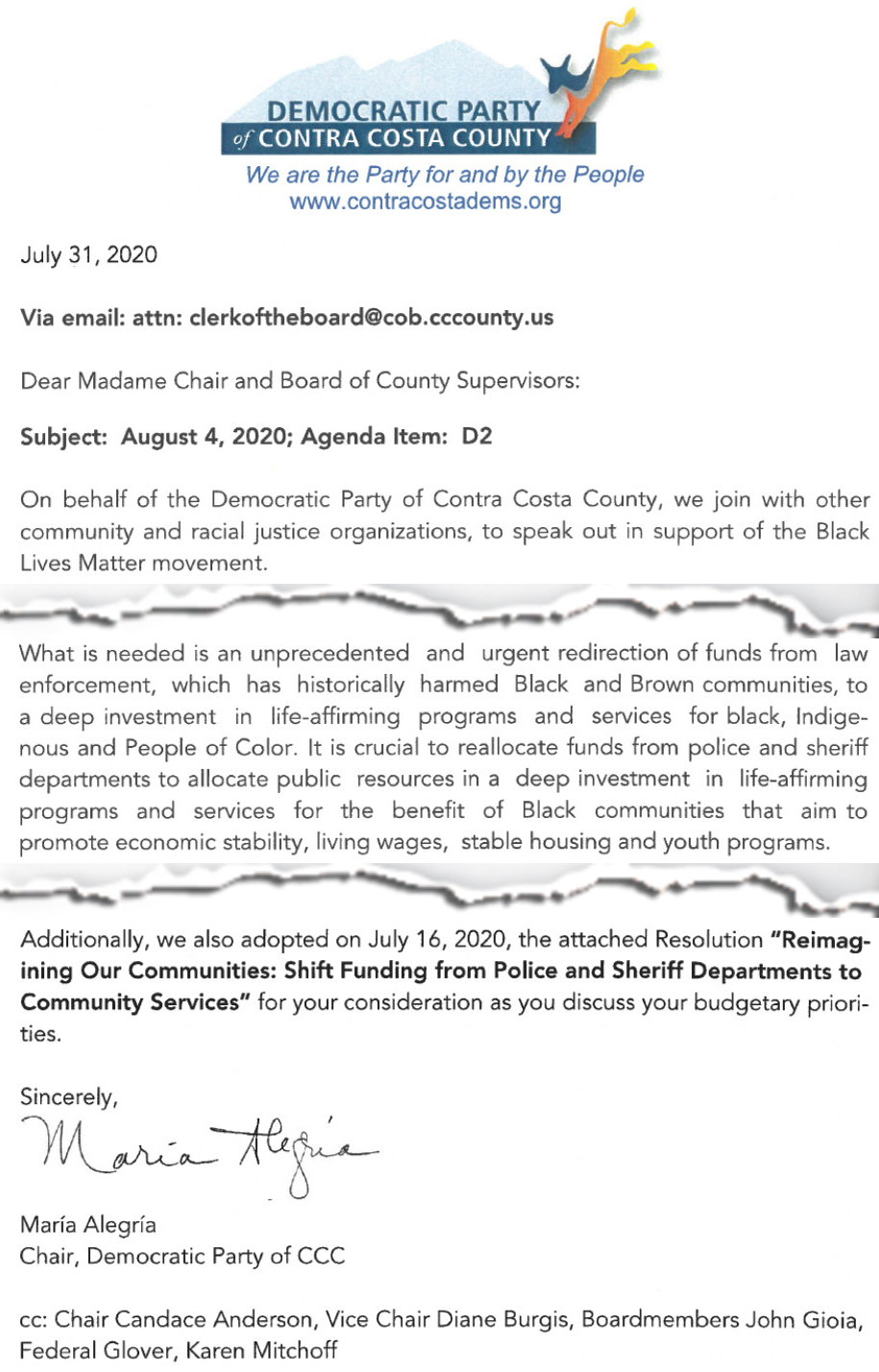
“It is crucial to reallocate funds from police and sheriff departments” – approved CCC Democratic Party resolution

Segments of the Contra Costa County Democratic Party July 31, 2020 letter to the Board of Supervisors. Source: Jason Bezis

Dear Editor:

Please see the PDF attachment, which I received from the County of Contra Costa this morning in response to a Public Records Act/Better Government Ordinance request. CCCDP – Alegria Communications (12.6.21 Response)

This is the Contra Costa County Democratic Party’s local homage to the national “Defund the Police” movement:

(1) In the July 31, 2020 County Democratic Party letter to the Contra Costa County Board of Supervisors: “What is needed is an unprecedented and urgent redirection of funds from law enforcement …  It is crucial to reallocate funds from police and sheriff departments …”

[The earlier version that the County Democratic Central Committee passed called for “divestment.”  After I protested use of the word “divestment”, due to its very strong connotation in connection with 1980s “divestment” from the South Africa apartheid regime, County Party leaders softened it with the language above.]

(2)  July 2020 Contra Costa County Democratic Party resolution: “Shift Funding from Police and Sheriff Departments to Community Services … Therefore, be it resolved that we, the Democratic Party of Contra Costa County, encourage city councils to decrease police department funding and that County Boards of Supervisors decrease Sheriff Department funding, and instead shift these funds …”

I voted “no” on both actions.  The County Democratic Party retaliated by kicking me out of their organization (as the Contra Costa Herald already has reported, in part, in April of 2021).

The Contra Costa County Democratic Party buffoons who approved this resolution and letter enabled the recent horrifying robbery at Broadway Plaza in Walnut Creek and similar criminal conspiracies at Stoneridge Mall in Pleasanton, Southland Mall in Hayward, and at Union Square in San Francisco.

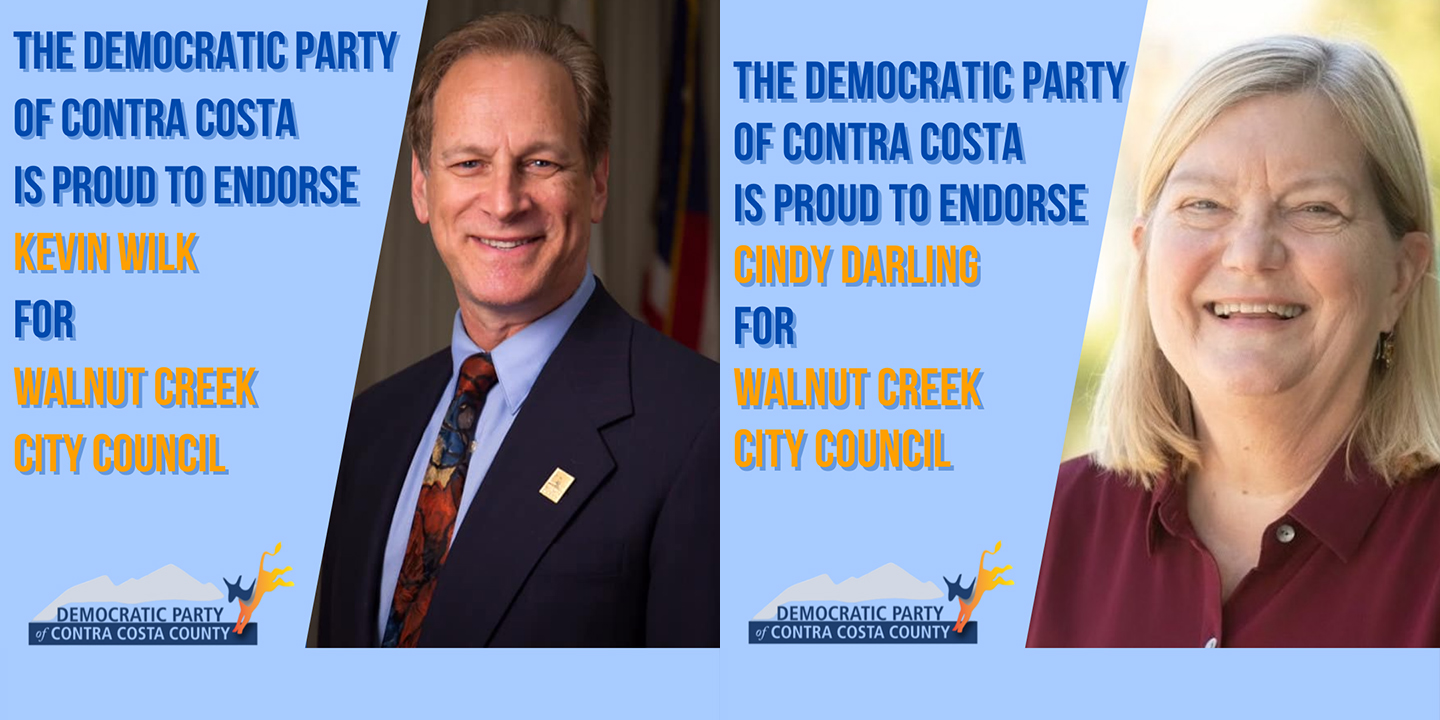
DPCCC 2020 endorsement promos for Kevin Wilk and Cindy Darling. Provided by Jason Bezis

Walnut Creek Mayor Kevin Wilk and Councilmember Cindy Darling sought and secured endorsements for their 2020 re-election campaigns from the County Democratic Party at the same time all of these “Shift Funds from Police” actions were taken by the County Democratic Party. The “Herald” should ask Wilk and Silva to publicly disclose their answers to Democratic Party written questionnaires in 2020, especially about any police funding questions.  Were they asked about police funding in oral interviews? (Police funding/oversight was a major issue in Walnut Creek in 2020 with the “Justice for Miles Hall” movement.) CADEM2020 Slate Cards – WalnutCreek

The “Herald” also ought to ask Sheriff Livingston and his announced opponent(s) about what they think of the July 2020 Democratic Party letter and resolution about police and sheriff funding.  I expect that candidates might make themselves unavailable for public comment. The District 4 Supervisorial District candidates (Birsan, Obringer, and ???) also should be asked whether or not they supported this resolution and letter, both then in 2020 and now in 2021 after the nationally notorious crime wave that struck Broadway Plaza.  Birsan now is on the Cal. Dem. Party Executive Board. Again, watch for candidates to be unavailable for public comment.

The PDF attachment is a public record.

Best regards,

Jason Bezis

Lafayette, Calif.

Filed Under: Letters to the Editor, Opinion, Politics & Elections

Candidate for Contra Costa DA, Mary Knox offers three-point plan to prevent smash-and-grab retail theft

November 30, 2021 By Publisher Leave a Comment

Sources: (Left) Herald file photo and (Right) Mary Knox for DA campaign.

The current DA has been slow to respond to flash mob robberies, and once she responds, she’s ineffective. Given my 36 years of experience as a Contra Costa Deputy District Attorney, I know the District Attorney can do more. We need to implement these three steps immediately:

  1. Convene a Bay Area-wide law enforcement response to track and apprehend suspects 

Contra Costa law enforcement agencies are partnered to provide mutual aid during emergency situations.  This “mutual aid” concept should be employed throughout the Bay Area to strategically shut down access routes for potential retail targets to intervene and prevent crime before it happens.

The investigative and technological expertise of this team will:

  • Identify the criminal syndicates who organize the smash-and-grab robberies
  • Intercept the “chatter” on social media planning these events
  • Share information between law enforcement agencies to quickly locate and arrest perpetrators

The ideal team to coordinate this activity is the DA/FBI Safe Streets Task Force, comprised of local, state, and federal task force agents who are partnered with prosecutors assigned to the Community Violence Reduction Unit (a unit that I created in the Contra Costa District Attorney’s Office).

Given the violence involved and the value of the merchandise being stolen, the Task Force will collaborate with the U.S. Attorney’s Office to charge qualifying cases under the Hobbs Act and prosecute them in federal court.

The criminal syndicates committing the smash-and-grab robberies, as well as strings of residential burglaries in Contra Costa, are mobile and active in surrounding counties.  During the past four years, regional law enforcement agencies have done an impressive job of sharing information to identify the true scope of the criminality of these crews and to provide investigative support.  The information supplied by this well-coordinated network provided me with the evidence required to file multiple counts following very significant organized retail theft and residential robberies.  I worked with the Walnut Creek and Pleasant Hill Police Departments through the investigative challenges of the looting in 2020 and filed charges on a number of suspects.  As District Attorney, I will continue to support this allied inter-county effort.

  1. Prevent the use of our freeways as crime corridors, deploy cameras 

Organized shoplifting gangs have been using the regional freeway system to quickly move between targets in neighboring law enforcement jurisdictions.  By the time an investigation starts at the first crime, the gang has moved on to loot another store in the next county.

Contra Costa’s Freeway Security Network has the technological capability to combat organized retail theft.  The Allied Freeway Agencies have received additional funding for the Network and direction to develop a plan to augment and expand the Network county-wide in order to provide technological leads in preventing and investigating criminal syndicates involved in the violent organized retail theft.

I am proud to have originated the creation of this freeway camera system to combat freeway shootings.  Since the network was installed, freeway shootings have been reduced by 90% in Contra Costa while remaining all too frequent in neighboring counties. I continue to work with law enforcement and elected leaders to propose that additional funding that Governor Newsom included in the state budget be used to incorporate additional technology to target organized retail theft into the Freeway Security Network.

  1. Disrupt the use of social media as a key enabler of looting 

Organized retail theft would not exist without social media, which is the key element to planning and profiting from these crimes.

Looting is coordinated through social media 

Social media platforms provide the means of communication which allows criminals to conspire to commit take-over robberies. These platforms are directly aiding and abetting the commission of large-scale crimes, which may result in criminal liability for the social media platforms.  I will call on the social media platforms, as well as private communication platforms, to monitor and immediately report to law enforcement any communications planning a smash-and-grab robbery or the “fencing” of stolen property.

We must make it clear to technology companies that failure to monitor and report the coordination of criminal enterprise should not be a protected business activity and should instead be considered as aiding and abetting that crime.

Stolen goods are sold via online marketplaces 

If a market for the merchandise that is being stolen did not exist, the criminal syndicates would have no motive to steal.  While I am out talking with community members, most are surprised to learn that the merchandise that is stolen from CVS, Walgreens, Lululemon and the high-end retailers is often sold on the internet via OfferUp, LetGo, and the Facebook and Amazon Market Places.

As District Attorney, I will actively engage and educate our community members about the crime occurring in our county and ways we can work together to combat it, such as not buying merchandise off the internet that does not have a means of guaranteeing that it is not stolen merchandise.  I will also work with retail stores to modify their return/exchange policies to ensure that they are not accepting the return of their own stolen merchandise.

———————————————————-

About Mary Knox: Mary Knox was born and raised in Walnut Creek and has 36 years of experience advocating and fighting for victims, their families, and the larger community. She is a lead prosecutor in the Contra Costa County District Attorney’s office, who has prosecuted and won high profile cases against some of the most notorious criminals in county history. She has broken the chokehold that criminal gangs have had on the most disadvantaged communities and has engaged in meaningful violence reduction by instituting effective strategies to reduce crime and prosecute violent criminals. Learn more about Mary at maryknox4da.com


Filed Under: Crime, District Attorney, Opinion, Politics & Elections

91 research studies affirm naturally acquired immunity to COVID-19: Documented, linked, and quoted

October 27, 2021 By Publisher 3 Comments

Source: humanimmuneresponse.webnode.com

BY PAUL ELIAS ALEXANDER

This article was first published by Brownstone Institute. Republished with permission.

We should not force COVID vaccines on anyone when the evidence shows that naturally acquired immunity is equal to or more robust and superior to existing vaccines. Instead, we should respect the right of the bodily integrity of individuals to decide for themselves.

Public health officials and the medical establishment with the help of the politicized media are misleading the public with assertions that the COVID-19 shots provide greater protection than natural immunity.  CDC Director Rochelle Walensky, for example, was deceptive in her October 2020 published LANCET statement that “there is no evidence for lasting protective immunity to SARS-CoV-2 following natural infection” and that “the consequence of waning immunity would present a risk to vulnerable populations for the indefinite future.”

Immunology and virology 101 have taught us over a century that natural immunity confers protection against a respiratory virus’s outer coat proteins, and not just one, e.g. the SARS-CoV-2 spike glycoprotein. There is even strong evidence for the persistence of antibodies. Even the CDC recognizes natural immunity for chicken-pox and measles, mumps, and rubella, but not for COVID-19.

The vaccinated are showing viral loads (very high) similar to the unvaccinated (Acharya et al. and Riemersma et al.), and the vaccinated are as infectious. Riemersma et al. also report Wisconsin data that corroborate how the vaccinated individuals who get infected with the Delta variant can potentially (and are) transmit(ting) SARS-CoV-2 to others (potentially to the vaccinated and unvaccinated).

This troubling situation of the vaccinated being infectious and transmitting the virus emerged in seminal nosocomial outbreak papers by Chau et al. (HCWs in Vietnam), the Finland hospital outbreak (spread among HCWs and patients), and the Israel hospital outbreak (spread among HCWs and patients). These studies also revealed that the PPE and masks were essentially ineffective in the healthcare setting. Again, the Marek’s disease in chickens and the vaccination situation explains what we are potentially facing with these leaky vaccines (increased transmission, faster transmission, and more ‘hotter’ variants).

Moreover, existing immunity should be assessed before any vaccination, via an accurate, dependable, and reliable antibody test (or T cell immunity test) or be based on documentation of prior infection (a previous positive PCR or antigen test). Such would be evidence of immunity that is equal to that of vaccination and the immunity should be provided the same societal status as any vaccine-induced immunity. This will function to mitigate the societal anxiety with these forced vaccine mandates and societal upheaval due to job loss, denial of societal privileges etc. Tearing apart the vaccinated and the unvaccinated in a society, separating them, is not medically or scientifically supportable.

The Brownstone Institute previously documented 30 studies on natural immunity as it relates to Covid-19.

This follow-up chart is the most updated and comprehensive library list of 91 of the highest-quality, complete, most robust scientific studies and evidence reports/position statements on natural immunity as compared to the COVID-19 vaccine-induced immunity and allow you to draw your own conclusion.

I’ve benefited from the input of many to put this together, especially my co-authors:

  • Harvey Risch, MD, PhD (Yale School of Public Health)
  • Howard Tenenbaum, PhD ( Faculty of Medicine, University of Toronto)
  • Ramin Oskoui, MD (Foxhall Cardiology, Washington)
  • Peter McCullough, MD (Truth for Health Foundation (TFH)), Texas
  • Parvez Dara, MD (consultant, Medical Hematologist and Oncologist)

Evidence on natural immunity versus COVID-19 vaccine induced immunity as of October 15, 2021:

Study / report title, author, and year published Predominant finding on natural immunity
1) Necessity of COVID-19 vaccination in previously infected individuals, Shrestha, 2021 “Cumulative incidence of COVID-19 was examined among 52,238 employees in an American healthcare system. The cumulative incidence of SARS-CoV-2 infection remained almost zero among previously infected unvaccinated subjects, previously infected subjects who were vaccinated, and previously uninfected subjects who were vaccinated, compared with a steady increase in cumulative incidence among previously uninfected subjects who remained unvaccinated. Not one of the 1359 previously infected subjects who remained unvaccinated had a SARS-CoV-2 infection over the duration of the study. Individuals who have had SARS-CoV-2 infection are unlikely to benefit from COVID-19 vaccination…”
2) SARS-CoV-2-specific T cell immunity in cases of COVID-19 and SARS, and uninfected controls, Le Bert, 2020 “Studied T cell responses against the structural (nucleocapsid (N) protein) and non-structural (NSP7 and NSP13 of ORF1) regions of SARS-CoV-2 in individuals convalescing from coronavirus disease 2019 (COVID-19) (n = 36). In all of these individuals, we found CD4 and CD8 T cells that recognized multiple regions of the N protein…showed that patients (n = 23) who recovered from SARS possess long-lasting memory T cells that are reactive to the N protein of SARS-CoV 17 years after the outbreak of SARS in 2003; these T cells displayed robust cross-reactivity to the N protein of SARS-CoV-2.”
3) Comparing SARS-CoV-2 natural immunity to vaccine-induced immunity: reinfections versus breakthrough infections,Gazit, 2021 “A retrospective observational study comparing three groups: (1) SARS-CoV-2-naïve individuals who received a two-dose regimen of the BioNTech/Pfizer mRNA BNT162b2 vaccine, (2) previously infected individuals who have not been vaccinated, and (3) previously infected and single dose vaccinated individuals found para a 13 fold increased risk of breakthrough Delta infections in double vaccinated persons, and a 27 fold increased risk for symptomatic breakthrough infection in the double vaccinated relative to the natural immunity recovered persons…the risk of hospitalization was 8 times higher in the double vaccinated (para)…this analysis demonstrated that natural immunity affords longer lasting and stronger protection against infection, symptomatic disease and hospitalization due to the Delta variant of SARS-CoV-2, compared to the BNT162b2 two-dose vaccine-induced immunity.”
4) Highly functional virus-specific cellular immune response in asymptomatic SARS-CoV-2 infection, Le Bert, 2021 “Studied SARS-CoV-2–specific T cells in a cohort of asymptomatic (n = 85) and symptomatic (n = 75) COVID-19 patients after seroconversion…thus, asymptomatic SARS-CoV-2–infected individuals are not characterized by weak antiviral immunity; on the contrary, they mount a highly functional virus-specific cellular immune response.”
5) Large-scale study of antibody titer decay following BNT162b2 mRNA vaccine or SARS-CoV-2 infection, Israel, 2021 “A total of 2,653 individuals fully vaccinated by two doses of vaccine during the study period and 4,361 convalescent patients were included. Higher SARS-CoV-2 IgG antibody titers were observed in vaccinated individuals (median 1581 AU/mL IQR [533.8-5644.6]) after the second vaccination, than in convalescent individuals (median 355.3 AU/mL IQR [141.2-998.7]; p<0.001). In vaccinated subjects, antibody titers decreased by up to 40% each subsequent month while in convalescents they decreased by less than 5% per month…this study demonstrates individuals who received the Pfizer-BioNTech mRNA vaccine have different kinetics of antibody levels compared to patients who had been infected with the SARS-CoV-2 virus, with higher initial levels but a much faster exponential decrease in the first group”.
6) SARS-CoV-2 re-infection risk in Austria, Pilz, 2021 Researchers recorded “40 tentative re-infections in 14, 840 COVID-19 survivors of the first wave (0.27%) and 253 581 infections in 8, 885, 640 individuals of the remaining general population (2.85%) translating into an odds ratio (95% confidence interval) of 0.09 (0.07 to 0.13)…relatively low re-infection rate of SARS-CoV-2 in Austria. Protection against SARS-CoV-2 after natural infection is comparable with the highest available estimates on vaccine efficacies.” Additionally, hospitalization in only five out of 14,840 (0.03%) people and death in one out of 14,840 (0.01%) (tentative re-infection).
7) mRNA vaccine-induced SARS-CoV-2-specific T cells recognize B.1.1.7 and B.1.351 variants but differ in longevity and homing properties depending on prior infection status, Neidleman, 2021 “Spike-specific T cells from convalescent vaccinees differed strikingly from those of infection-naïve vaccinees, with phenotypic features suggesting superior long-term persistence and ability to home to the respiratory tract including the nasopharynx. These results provide reassurance that vaccine-elicited T cells respond robustly to the B.1.1.7 and B.1.351 variants, confirm that convalescents may not need a second vaccine dose.”
8) Good news: Mild COVID-19 induces lasting antibody protection, Bhandari, 2021 “Months after recovering from mild cases of COVID-19, people still have immune cells in their body pumping out antibodies against the virus that causes COVID-19, according to a study from researchers at Washington University School of Medicine in St. Louis. Such cells could persist for a lifetime, churning out antibodies all the while. The findings, published May 24 in the journal Nature, suggest that mild cases of COVID-19 leave those infected with lasting antibody protection and that repeated bouts of illness are likely to be uncommon.”
9) Robust neutralizing antibodies to SARS-CoV-2 infection persist for months, Wajnberg, 2021 “Neutralizing antibody titers against the SARS-CoV-2 spike protein persisted for at least 5 months after infection. Although continued monitoring of this cohort will be needed to confirm the longevity and potency of this response, these preliminary results suggest that the chance of reinfection may be lower than is currently feared.”
10) Evolution of Antibody Immunity to SARS-CoV-2, Gaebler, 2020 “Concurrently, neutralizing activity in plasma decreases by five-fold in pseudo-type virus assays. In contrast, the number of RBD-specific memory B cells is unchanged. Memory B cells display clonal turnover after 6.2 months, and the antibodies they express have greater somatic hypermutation, increased potency and resistance to RBD mutations, indicative of continued evolution of the humoral response…we conclude that the memory B cell response to SARS-CoV-2 evolves between 1.3 and 6.2 months after infection in a manner that is consistent with antigen persistence.”
11) Persistence of neutralizing antibodies a year after SARS-CoV-2 infection in humans, Haveri, 2021 “Assessed the persistence of serum antibodies following WT SARS-CoV-2 infection at 8 and 13 months after diagnosis in 367 individuals…found that NAb against the WT virus persisted in 89% and S-IgG in 97% of subjects for at least 13 months after infection.”
12) Quantifying the risk of SARS‐CoV‐2 reinfection over time, Murchu, 2021 “Eleven large cohort studies were identified that estimated the risk of SARS‐CoV‐2 reinfection over time, including three that enrolled healthcare workers and two that enrolled residents and staff of elderly care homes. Across studies, the total number of PCR‐positive or antibody‐positive participants at baseline was 615,777, and the maximum duration of follow‐up was more than 10 months in three studies. Reinfection was an uncommon event (absolute rate 0%–1.1%), with no study reporting an increase in the risk of reinfection over time.”
13) Natural immunity to covid is powerful. Policymakers seem afraid to say so, Makary, 2021 Makary writes “it’s okay to have an incorrect scientific hypothesis. But when new data proves it wrong, you have to adapt. Unfortunately, many elected leaders and public health officials have held on far too long to the hypothesis that natural immunity offers unreliable protection against covid-19 — a contention that is being rapidly debunked by science. More than 15 studies have demonstrated the power of immunity acquired by previously having the virus. A 700,000-person study from Israel two weeks ago found that those who had experienced prior infections were 27 times less likely to get a second symptomatic covid infection than those who were vaccinated. This affirmed a June Cleveland Clinic study of health-care workers (who are often exposed to the virus), in which none who had previously tested positive for the coronavirus got reinfected. The study authors concluded that “individuals who have had SARS-CoV-2 infection are unlikely to benefit from covid-19 vaccination.” And in May, a Washington University study found that even a mild covid infection resulted in long-lasting immunity.”
14) SARS-CoV-2 elicits robust adaptive immune responses regardless of disease severity, Nielsen, 2021 “203 recovered SARS-CoV-2 infected patients in Denmark between April 3rd and July 9th 2020, at least 14 days after COVID-19 symptom recovery… report broad serological profiles within the cohort, detecting antibody binding to other human coronaviruses… the viral surface spike protein was identified as the dominant target for both neutralizing antibodies and CD8+ T-cell responses. Overall, the majority of patients had robust adaptive immune responses, regardless of their disease severity.”
15) Protection of previous SARS-CoV-2 infection is similar to that of BNT162b2 vaccine protection: A three-month nationwide experience from Israel, Goldberg, 2021 “Analyze an updated individual-level database of the entire population of Israel to assess the protection efficacy of both prior infection and vaccination in preventing subsequent SARS-CoV-2 infection, hospitalization with COVID-19, severe disease, and death due to COVID-19… vaccination was highly effective with overall estimated efficacy for documented infection of 92·8% (CI:[92·6, 93·0]); hospitalization 94·2% (CI:[93·6, 94·7]); severe illness 94·4% (CI:[93·6, 95·0]); and death 93·7% (CI:[92·5, 94·7]). Similarly, the overall estimated level of protection from prior SARS-CoV-2 infection for documented infection is 94·8% (CI: [94·4, 95·1]); hospitalization 94·1% (CI: [91·9, 95·7]); and severe illness 96·4% (CI: [92·5, 98·3])…results question the need to vaccinate previously-infected individuals.”
16) Incidence of Severe Acute Respiratory Syndrome Coronavirus-2 infection among previously infected or vaccinated employees, Kojima, 2021 “Employees were divided into three groups: (1) SARS-CoV-2 naïve and unvaccinated, (2) previous SARS-CoV-2 infection, and (3) vaccinated. Person-days were measured from the date of the employee first test and truncated at the end of the observation period. SARS-CoV-2 infection was defined as two positive SARS-CoV-2 PCR tests in a 30-day period… 4313, 254 and 739 employee records for groups 1, 2, and 3…previous SARS-CoV-2 infection and vaccination for SARS-CoV-2 were associated with decreased risk for infection or re-infection with SARS-CoV-2 in a routinely screened workforce. The was no difference in the infection incidence between vaccinated individuals and individuals with previous infection.”
17) Having SARS-CoV-2 once confers much greater immunity than a vaccine—but vaccination remains vital, Wadman, 2021 “Israelis who had an infection were more protected against the Delta coronavirus variant than those who had an already highly effective COVID-19 vaccine…the newly released data show people who once had a SARS-CoV-2 infection were much less likely than never-infected, vaccinated people to get Delta, develop symptoms from it, or become hospitalized with serious COVID-19.”
18) One-year sustained cellular and humoral immunities of COVID-19 convalescents, Zhang, 2021 “A systematic antigen-specific immune evaluation in 101 COVID-19 convalescents; SARS-CoV-2-specific IgG antibodies, and also NAb can persist among over 95% COVID-19 convalescents from 6 months to 12 months after disease onset. At least 19/71 (26%) of COVID-19 convalescents (double positive in ELISA and MCLIA) had detectable circulating IgM antibody against SARS-CoV-2 at 12m post-disease onset. Notably, the percentages of convalescents with positive SARS-CoV-2-specific T-cell responses (at least one of the SARS-CoV-2 antigen S1, S2, M and N protein) were 71/76 (93%) and 67/73 (92%) at 6m and 12m, respectively.”
19) Functional SARS-CoV-2-Specific Immune Memory Persists after Mild COVID-19, Rodda, 2021 “Recovered individuals developed SARS-CoV-2-specific immunoglobulin (IgG) antibodies, neutralizing plasma, and memory B and memory T cells that persisted for at least 3 months. Our data further reveal that SARS-CoV-2-specific IgG memory B cells increased over time. Additionally, SARS-CoV-2-specific memory lymphocytes exhibited characteristics associated with potent antiviral function: memory T cells secreted cytokines and expanded upon antigen re-encounter, whereas memory B cells expressed receptors capable of neutralizing virus when expressed as monoclonal antibodies. Therefore, mild COVID-19 elicits memory lymphocytes that persist and display functional hallmarks of antiviral immunity.”
20) Discrete Immune Response Signature to SARS-CoV-2 mRNA Vaccination Versus Infection, Ivanova, 2021 “Performed multimodal single-cell sequencing on peripheral blood of patients with acute COVID-19 and healthy volunteers before and after receiving the SARS-CoV-2 BNT162b2 mRNA vaccine to compare the immune responses elicited by the virus and by this vaccine…both infection and vaccination induced robust innate and adaptive immune responses, our analysis revealed significant qualitative differences between the two types of immune challenges. In COVID-19 patients, immune responses were characterized by a highly augmented interferon response which was largely absent in vaccine recipients. Increased interferon signaling likely contributed to the observed dramatic upregulation of cytotoxic genes in the peripheral T cells and innate-like lymphocytes in patients but not in immunized subjects. Analysis of B and T cell receptor repertoires revealed that while the majority of clonal B and T cells in COVID-19 patients were effector cells, in vaccine recipients clonally expanded cells were primarily circulating memory cells…we observed the presence of cytotoxic CD4 T cells in COVID-19 patients that were largely absent in healthy volunteers following immunization. While hyper-activation of inflammatory responses and cytotoxic cells may contribute to immunopathology in severe illness, in mild and moderate disease, these features are indicative of protective immune responses and resolution of infection.”
21) SARS-CoV-2 infection induces long-lived bone marrow plasma cells in humans, Turner, 2021 “Bone marrow plasma cells (BMPCs) are a persistent and essential source of protective antibodies… durable serum antibody titres are maintained by long-lived plasma cells—non-replicating, antigen-specific plasma cells that are detected in the bone marrow long after the clearance of the antigen … S-binding BMPCs are quiescent, which suggests that they are part of a stable compartment. Consistently, circulating resting memory B cells directed against SARS-CoV-2 S were detected in the convalescent individuals. Overall, our results indicate that mild infection with SARS-CoV-2 induces robust antigen-specific, long-lived humoral immune memory in humans…overall, our data provide strong evidence that SARS-CoV-2 infection in humans robustly establishes the two arms of humoral immune memory: long-lived bone marrow plasma cells (BMPCs) and memory B-cells.”
22) SARS-CoV-2 infection rates of antibody-positive compared with antibody-negative health-care workers in England: a large, multicentre, prospective cohort study (SIREN), Jane Hall, 2021 “The SARS-CoV-2 Immunity and Reinfection Evaluation study… 30 625 participants were enrolled into the study… a previous history of SARS-CoV-2 infection was associated with an 84% lower risk of infection, with median protective effect observed 7 months following primary infection. This time period is the minimum probable effect because seroconversions were not included. This study shows that previous infection with SARS-CoV-2 induces effective immunity to future infections in most individuals.”
23) Pandemic peak SARS-CoV-2 infection and seroconversion rates in London frontline health-care workers, Houlihan, 2020 “Enrolled 200 patient-facing HCWs between March 26 and April 8, 2020…represents a 13% infection rate (i.e. 14 of 112 HCWs) within the 1 month of follow-up in those with no evidence of antibodies or viral shedding at enrolment. By contrast, of 33 HCWs who tested positive by serology but tested negative by RT-PCR at enrolment, 32 remained negative by RT-PCR through follow-up, and one tested positive by RT-PCR on days 8 and 13 after enrolment.”
24) Antibodies to SARS-CoV-2 are associated with protection against reinfection, Lumley, 2021 “Critical to understand whether infection with Severe Acute Respiratory Syndrome Coronavirus 2 (SARS-CoV-2) protects from subsequent reinfection… 12219 HCWs participated…prior SARS-CoV-2 infection that generated antibody responses offered protection from reinfection for most people in the six months following infection.”
25) Longitudinal analysis shows durable and broad immune memory after SARS-CoV-2 infection with persisting antibody responses and memory B and T cells, Cohen, 2021 “Evaluate 254 COVID-19 patients longitudinally up to 8 months and find durable broad-based immune responses. SARS-CoV-2 spike binding and neutralizing antibodies exhibit a bi-phasic decay with an extended half-life of >200 days suggesting the generation of longer-lived plasma cells… most recovered COVID-19 patients mount broad, durable immunity after infection, spike IgG+ memory B cells increase and persist post-infection, durable polyfunctional CD4 and CD8 T cells recognize distinct viral epitope regions.”
26) Single cell profiling of T and B cell repertoires following SARS-CoV-2 mRNA vaccine, Sureshchandra, 2021 “Used single-cell RNA sequencing and functional assays to compare humoral and cellular responses to two doses of mRNA vaccine with responses observed in convalescent individuals with asymptomatic disease… natural infection induced expansion of larger CD8 T cell clones occupied distinct clusters, likely due to the recognition of a broader set of viral epitopes presented by the virus not seen in the mRNA vaccine.”
27) SARS-CoV-2 antibody-positivity protects against reinfection for at least seven months with 95% efficacy, Abu-Raddad, 2021 “SARS-CoV-2 antibody-positive persons from April 16 to December 31, 2020 with a PCR-positive swab ≥14 days after the first-positive antibody test were investigated for evidence of reinfection, 43,044 antibody-positive persons who were followed for a median of 16.3 weeks…reinfection is rare in the young and international population of Qatar. Natural infection appears to elicit strong protection against reinfection with an efficacy ~95% for at least seven months.”
28) Orthogonal SARS-CoV-2 Serological Assays Enable Surveillance of Low-Prevalence Communities and Reveal Durable Humoral Immunity, Ripperger, 2020 “Conducted a serological study to define correlates of immunity against SARS-CoV-2. Compared to those with mild coronavirus disease 2019 (COVID-19) cases, individuals with severe disease exhibited elevated virus-neutralizing titers and antibodies against the nucleocapsid (N) and the receptor binding domain (RBD) of the spike protein…neutralizing and spike-specific antibody production persists for at least 5–7 months… nucleocapsid antibodies frequently become undetectable by 5–7 months.”
29) Anti-spike antibody response to natural SARS-CoV-2 infection in the general population, Wei, 2021 “In the general population using representative data from 7,256 United Kingdom COVID-19 infection survey participants who had positive swab SARS-CoV-2 PCR tests from 26-April-2020 to 14-June-2021…we estimated antibody levels associated with protection against reinfection likely last 1.5-2 years on average, with levels associated with protection from severe infection present for several years. These estimates could inform planning for vaccination booster strategies.”
30) Antibody Status and Incidence of SARS-CoV-2 Infection in Health Care Workers, Lumley, 2021 “12,541 health care workers participated and had anti-spike IgG measured; 11,364 were followed up after negative antibody results and 1265 after positive results, including 88 in whom seroconversion occurred during follow-up…a total of 223 anti-spike–seronegative health care workers had a positive PCR test (1.09 per 10,000 days at risk), 100 during screening while they were asymptomatic and 123 while symptomatic, whereas 2 anti-spike–seropositive health care workers had a positive PCR test… the presence of anti-spike or anti-nucleocapsid IgG antibodies was associated with a substantially reduced risk of SARS-CoV-2 reinfection in the ensuing 6 months.”
31) Researchers find long-lived immunity to 1918 pandemic virus, CIDRAP, 2008
and the actual 2008 NATURE journal publication by Yu
“A study of the blood of older people who survived the 1918 influenza pandemic reveals that antibodies to the strain have lasted a lifetime and can perhaps be engineered to protect future generations against similar strains…the group collected blood samples from 32 pandemic survivors aged 91 to 101..the people recruited for the study were 2 to 12 years old in 1918 and many recalled sick family members in their households, which suggests they were directly exposed to the virus, the authors report. The group found that 100% of the subjects had serum-neutralizing activity against the 1918 virus and 94% showed serologic reactivity to the 1918 hemagglutinin. The investigators generated B lymphoblastic cell lines from the peripheral blood mononuclear cells of eight subjects. Transformed cells from the blood of 7 of the 8 donors yielded secreting antibodies that bound the 1918 hemagglutinin.” Yu: “here we show that of the 32 individuals tested that were born in or before 1915, each showed sero-reactivity with the 1918 virus, nearly 90 years after the pandemic. Seven of the eight donor samples tested had circulating B cells that secreted antibodies that bound the 1918 HA. We isolated B cells from subjects and generated five monoclonal antibodies that showed potent neutralizing activity against 1918 virus from three separate donors. These antibodies also cross-reacted with the genetically similar HA of a 1930 swine H1N1 influenza strain.”
32) Live virus neutralisation testing in convalescent patients and subjects vaccinated against 19A, 20B, 20I/501Y.V1 and 20H/501Y.V2 isolates of SARS-CoV-2, Gonzalez, 2021 “No significant difference was observed between the 20B and 19A isolates for HCWs with mild COVID-19 and critical patients. However, a significant decrease in neutralisation ability was found for 20I/501Y.V1 in comparison with 19A isolate for critical patients and HCWs 6-months post infection. Concerning 20H/501Y.V2, all populations had a significant reduction in neutralising antibody titres in comparison with the 19A isolate. Interestingly, a significant difference in neutralisation capacity was observed for vaccinated HCWs between the two variants whereas it was not significant for the convalescent groups…the reduced neutralising response observed towards the 20H/501Y.V2 in comparison with the 19A and 20I/501Y.V1 isolates in fully immunized subjects with the BNT162b2 vaccine is a striking finding of the study.”
33) Differential effects of the second SARS-CoV-2 mRNA vaccine dose on T cell immunity in naïve and COVID-19 recovered individuals, Camara, 2021 “Characterized SARS-CoV-2 spike-specific humoral and cellular immunity in naïve and previously infected individuals during full BNT162b2 vaccination…results demonstrate that the second dose increases both the humoral and cellular immunity in naïve individuals. On the contrary, the second BNT162b2 vaccine dose results in a reduction of cellular immunity in COVID-19 recovered individuals.”
34) Op-Ed: Quit Ignoring Natural COVID Immunity, Klausner, 2021 “Epidemiologists estimate over 160 million people worldwide have recovered from COVID-19. Those who have recovered have an astonishingly low frequency of repeat infection, disease, or death.”
35) Association of SARS-CoV-2 Seropositive Antibody Test With Risk of Future Infection, Harvey, 2021 “To evaluate evidence of SARS-CoV-2 infection based on diagnostic nucleic acid amplification test (NAAT) among patients with positive vs negative test results for antibodies in an observational descriptive cohort study of clinical laboratory and linked claims data…the cohort included 3 257 478 unique patients with an index antibody test…patients with positive antibody test results were initially more likely to have positive NAAT results, consistent with prolonged RNA shedding, but became markedly less likely to have positive NAAT results over time, suggesting that seropositivity is associated with protection from infection.”
36) SARS-CoV-2 seropositivity and subsequent infection risk in healthy young adults: a prospective cohort study, Letizia, 2021 “Investigated the risk of subsequent SARS-CoV-2 infection among young adults (CHARM marine study) seropositive for a previous infection…enrolled 3249 participants, of whom 3168 (98%) continued into the 2-week quarantine period. 3076 (95%) participants…Among 189 seropositive participants, 19 (10%) had at least one positive PCR test for SARS-CoV-2 during the 6-week follow-up (1·1 cases per person-year). In contrast, 1079 (48%) of 2247 seronegative participants tested positive (6·2 cases per person-year). The incidence rate ratio was 0·18 (95% CI 0·11–0·28; p<0·001)…infected seropositive participants had viral loads that were about 10-times lower than those of infected seronegative participants (ORF1ab gene cycle threshold difference 3·95 [95% CI 1·23–6·67]; p=0·004).”
37) Associations of Vaccination and of Prior Infection With Positive PCR Test Results for SARS-CoV-2 in Airline Passengers Arriving in Qatar, Bertollini, 2021 “Of 9,180 individuals with no record of vaccination but with a record of prior infection at least 90 days before the PCR test (group 3), 7694 could be matched to individuals with no record of vaccination or prior infection (group 2), among whom PCR positivity was 1.01% (95% CI, 0.80%-1.26%) and 3.81% (95% CI, 3.39%-4.26%), respectively. The relative risk for PCR positivity was 0.22 (95% CI, 0.17-0.28) for vaccinated individuals and 0.26 (95% CI, 0.21-0.34) for individuals with prior infection compared with no record of vaccination or prior infection.”
38) Natural immunity against COVID-19 significantly reduces the risk of reinfection: findings from a cohort of sero-survey participants, Mishra, 2021 “Followed up with a subsample of our previous sero-survey participants to assess whether natural immunity against SARS-CoV-2 was associated with a reduced risk of re-infection (India)… out of the 2238 participants, 1170 were sero-positive and 1068 were sero-negative for antibody against COVID-19. Our survey found that only 3 individuals in the sero-positive group got infected with COVID-19 whereas 127 individuals reported contracting the infection the sero-negative group…from the 3 sero-positives re-infected with COVID-19, one had hospitalization, but did not require oxygen support or critical care…development of antibody following natural infection not only protects against re-infection by the virus to a great extent, but also safeguards against progression to severe COVID-19 disease.”
39) Lasting immunity found after recovery from COVID-19, NIH, 2021 “The researchers found durable immune responses in the majority of people studied. Antibodies against the spike protein of SARS-CoV-2, which the virus uses to get inside cells, were found in 98% of participants one month after symptom onset. As seen in previous studies, the number of antibodies ranged widely between individuals. But, promisingly, their levels remained fairly stable over time, declining only modestly at 6 to 8 months after infection… virus-specific B cells increased over time. People had more memory B cells six months after symptom onset than at one month afterwards… levels of T cells for the virus also remained high after infection. Six months after symptom onset, 92% of participants had CD4+ T cells that recognized the virus… 95% of the people had at least 3 out of 5 immune-system components that could recognize SARS-CoV-2 up to 8 months after infection.”
40) SARS-CoV-2 Natural Antibody Response Persists for at Least 12 Months in a Nationwide Study From the Faroe Islands, Petersen, 2021 “The seropositive rate in the convalescent individuals was above 95% at all sampling time points for both assays and remained stable over time; that is, almost all convalescent individuals developed antibodies… results show that SARS-CoV-2 antibodies persisted at least 12 months after symptom onset and maybe even longer, indicating that COVID-19-convalescent individuals may be protected from reinfection.”
41) SARS-CoV-2-specific T cell memory is sustained in COVID-19 convalescent patients for 10 months with successful development of stem cell-like memory T cells, Jung, 2021 “ex vivo assays to evaluate SARS-CoV-2-specific CD4+ and CD8+ T cell responses in COVID-19 convalescent patients up to 317 days post-symptom onset (DPSO), and find that memory T cell responses are maintained during the study period regardless of the severity of COVID-19. In particular, we observe sustained polyfunctionality and proliferation capacity of SARS-CoV-2-specific T cells. Among SARS-CoV-2-specific CD4+ and CD8+ T cells detected by activation-induced markers, the proportion of stem cell-like memory T (TSCM) cells is increased, peaking at approximately 120 DPSO.”
42) Immune Memory in Mild COVID-19 Patients and Unexposed Donors Reveals Persistent T Cell Responses After SARS-CoV-2 Infection, Ansari, 2021 “Analyzed 42 unexposed healthy donors and 28 mild COVID-19 subjects up to 5 months from the recovery for SARS-CoV-2 specific immunological memory. Using HLA class II predicted peptide megapools, we identified SARS-CoV-2 cross-reactive CD4+ T cells in around 66% of the unexposed individuals. Moreover, we found detectable immune memory in mild COVID-19 patients several months after recovery in the crucial arms of protective adaptive immunity; CD4+ T cells and B cells, with a minimal contribution from CD8+ T cells. Interestingly, the persistent immune memory in COVID-19 patients is predominantly targeted towards the Spike glycoprotein of the SARS-CoV-2. This study provides the evidence of both high magnitude pre-existing and persistent immune memory in Indian population.”
43) COVID-19 natural immunity, WHO, 2021 “Current evidence points to most individuals developing strong protective immune responses following natural infection with SARSCoV-2. Within 4 weeks following infection, 90-99% of individuals infected with the SARS-CoV-2 virus develop detectable neutralizing antibodies. The strength and duration of the immune responses to SARS-CoV-2 are not completely understood and currently available data suggests that it varies by age and the severity of symptoms. Available scientific data suggests that in most people immune responses remain robust and protective against reinfection for at least 6-8 months after infection (the longest follow up with strong scientific evidence is currently approximately 8 months).”
44) Antibody Evolution after SARS-CoV-2 mRNA Vaccination, Cho, 2021 “We conclude that memory antibodies selected over time by natural infection have greater potency and breadth than antibodies elicited by vaccination…boosting vaccinated individuals with currently available mRNA vaccines would produce a quantitative increase in plasma neutralizing activity but not the qualitative advantage against variants obtained by vaccinating convalescent individuals.”
45) Humoral Immune Response to SARS-CoV-2 in Iceland, Gudbjartsson, 2020 “Measured antibodies in serum samples from 30,576 persons in Iceland…of the 1797 persons who had recovered from SARS-CoV-2 infection, 1107 of the 1215 who were tested (91.1%) were seropositive…results indicate risk of death from infection was 0.3% and that antiviral antibodies against SARS-CoV-2 did not decline within 4 months after diagnosis (para).”
46)  Immunological memory to SARS-CoV-2 assessed for up to 8 months after infection, Dan, 2021 “Analyzed multiple compartments of circulating immune memory to SARS-CoV-2 in 254 samples from 188 COVID-19 cases, including 43 samples at ≥ 6 months post-infection…IgG to the Spike protein was relatively stable over 6+ months. Spike-specific memory B cells were more abundant at 6 months than at 1 month post symptom onset.”
47) The prevalence of adaptive immunity to COVID-19 and reinfection after recovery – a comprehensive systematic review and meta-analysis of 12 011 447 individuals, Chivese, 2021 “Fifty-four studies, from 18 countries, with a total of 12 011 447 individuals, followed up to 8 months after recovery, were included. At 6-8 months after recovery, the prevalence of detectable SARS-CoV-2 specific immunological memory remained high; IgG – 90.4%… pooled prevalence of reinfection was 0.2% (95%CI 0.0 – 0.7, I2 = 98.8, 9 studies). Individuals who recovered from COVID-19 had an 81% reduction in odds of a reinfection (OR 0.19, 95% CI 0.1 – 0.3, I2 = 90.5%, 5 studies).”
48) Reinfection Rates among Patients who Previously Tested Positive for COVID-19: a Retrospective Cohort Study, Sheehan, 2021 “Retrospective cohort study of one multi-hospital health system included 150,325 patients tested for COVID-19 infection…prior infection in patients with COVID-19 was highly protective against reinfection and symptomatic disease. This protection increased over time, suggesting that viral shedding or ongoing immune response may persist beyond 90 days and may not represent true reinfection.”
49) Assessment of SARS-CoV-2 Reinfection 1 Year After Primary Infection in a Population in Lombardy, Italy, Vitale, 2020 “The study results suggest that reinfections are rare events and patients who have recovered from COVID-19 have a lower risk of reinfection. Natural immunity to SARS-CoV-2 appears to confer a protective effect for at least a year, which is similar to the protection reported in recent vaccine studies.”
50) Prior SARS-CoV-2 infection is associated with protection against symptomatic reinfection, Hanrath, 2021 “We observed no symptomatic reinfections in a cohort of healthcare workers…this apparent immunity to re-infection was maintained for at least 6 months…test positivity rates were 0% (0/128 [95% CI: 0–2.9]) in those with previous infection compared to 13.7% (290/2115 [95% CI: 12.3–15.2]) in those without (P<0.0001 χ2 test).”
51) mRNA vaccine-induced T cells respond identically to SARS-CoV-2 variants of concern but differ in longevity and homing properties depending on prior infection status, Neidleman, 2021 “In infection-naïve individuals, the second dose boosted the quantity and altered the phenotypic properties of SARS-CoV-2-specific T cells, while in convalescents the second dose changed neither. Spike-specific T cells from convalescent vaccinees differed strikingly from those of infection-naïve vaccinees, with phenotypic features suggesting superior long-term persistence and ability to home to the respiratory tract including the nasopharynx.”
52) Targets of T Cell Responses to SARS-CoV-2 Coronavirus in Humans with COVID-19 Disease and Unexposed Individuals, Grifoni, 2020 “Using HLA class I and II predicted peptide “megapools,” circulating SARS-CoV-2-specific CD8+ and CD4+ T cells were identified in ∼70% and 100% of COVID-19 convalescent patients, respectively. CD4+ T cell responses to spike, the main target of most vaccine efforts, were robust and correlated with the magnitude of the anti-SARS-CoV-2 IgG and IgA titers. The M, spike, and N proteins each accounted for 11%–27% of the total CD4+ response, with additional responses commonly targeting nsp3, nsp4, ORF3a, and ORF8, among others. For CD8+ T cells, spike and M were recognized, with at least eight SARS-CoV-2 ORFs targeted.”
53) NIH Director’s Blog: Immune T Cells May Offer Lasting Protection Against COVID-19, Collins, 2021 “Much of the study on the immune response to SARS-CoV-2, the novel coronavirus that causes COVID-19, has focused on the production of antibodies. But, in fact, immune cells known as memory T cells also play an important role in the ability of our immune systems to protect us against many viral infections, including—it now appears—COVID-19.An intriguing new study of these memory T cells suggests they might protect some people newly infected with SARS-CoV-2 by remembering past encounters with other human coronaviruses. This might potentially explain why some people seem to fend off the virus and may be less susceptible to becoming severely ill with COVID-19.”
54) Ultrapotent antibodies against diverse and highly transmissible SARS-CoV-2 variants, Wang, 2021 “Our study demonstrates that convalescent subjects previously infected with ancestral variant SARS-CoV-2 produce antibodies that cross-neutralize emerging VOCs with high potency…potent against 23 variants, including variants of concern.”
55) Why COVID-19 Vaccines Should Not Be Required for All Americans, Makary, 2021 “Requiring the vaccine in people who are already immune with natural immunity has no scientific support. While vaccinating those people may be beneficial – and it’s a reasonable hypothesis that vaccination may bolster the longevity of their immunity – to argue dogmatically that they must get vaccinated has zero clinical outcome data to back it. As a matter of fact, we have data to the contrary: A Cleveland Clinic study found that vaccinating people with natural immunity did not add to their level of protection.”
56) Protracted yet coordinated differentiation of long-lived SARS-CoV-2-specific CD8+ T cells during COVID-19 convalescence, Ma, 2021 “Screened 21 well-characterized, longitudinally-sampled convalescent donors that recovered from mild COVID-19…following a typical case of mild COVID-19, SARS-CoV-2-specific CD8+ T cells not only persist but continuously differentiate in a coordinated fashion well into convalescence, into a state characteristic of long-lived, self-renewing memory.”
57) Decrease in Measles Virus-Specific CD4 T Cell Memory in Vaccinated Subjects, Naniche, 2004 “Characterized the profiles of measles vaccine (MV) vaccine-induced antigen-specific T cells over time since vaccination. In a cross-sectional study of healthy subjects with a history of MV vaccination, we found that MV-specific CD4 and CD8 T cells could be detected up to 34 years after vaccination. The levels of MV-specific CD8 T cells and MV-specific IgG remained stable, whereas the level of MV-specific CD4 T cells decreased significantly in subjects who had been vaccinated >21 years earlier.”
58) Remembrance of Things Past: Long-Term B Cell Memory After Infection and Vaccination, Palm, 2019 “The success of vaccines is dependent on the generation and maintenance of immunological memory. The immune system can remember previously encountered pathogens, and memory B and T cells are critical in secondary responses to infection. Studies in mice have helped to understand how different memory B cell populations are generated following antigen exposure and how affinity for the antigen is determinant to B cell fate… upon re-exposure to an antigen the memory recall response will be faster, stronger, and more specific than a naïve response. Protective memory depends first on circulating antibodies secreted by LLPCs. When these are not sufficient for immediate pathogen neutralization and elimination, memory B cells are recalled.”
59) SARS-CoV-2 specific memory B-cells from individuals with diverse disease severities recognize SARS-CoV-2 variants of concern, Lyski, 2021 “Examined the magnitude, breadth, and durability of SARS-CoV-2 specific antibodies in two distinct B-cell compartments: long-lived plasma cell-derived antibodies in the plasma, and peripheral memory B-cells along with their associated antibody profiles elicited after in vitro stimulation. We found that magnitude varied amongst individuals, but was the highest in hospitalized subjects. Variants of concern (VoC) -RBD-reactive antibodies were found in the plasma of 72% of samples in this investigation, and VoC-RBD-reactive memory B-cells were found in all but 1 subject at a single time-point. This finding, that VoC-RBD-reactive MBCs are present in the peripheral blood of all subjects including those that experienced asymptomatic or mild disease, provides a reason for optimism regarding the capacity of vaccination, prior infection, and/or both, to limit disease severity and transmission of variants of concern as they continue to arise and circulate.”
60) Exposure to SARS-CoV-2 generates T-cell memory in the absence of a detectable viral infection, Wang, 2021 “T-cell immunity is important for recovery from COVID-19 and provides heightened immunity for re-infection. However, little is known about the SARS-CoV-2-specific T-cell immunity in virus-exposed individuals…report virus-specific CD4+ and CD8+ T-cell memory in recovered COVID-19 patients and close contacts…close contacts are able to gain T-cell immunity against SARS-CoV-2 despite lacking a detectable infection.”
61) CD8+ T-Cell Responses in COVID-19 Convalescent Individuals Target Conserved Epitopes From Multiple Prominent SARS-CoV-2 Circulating Variants, Redd, 2021and Lee, 2021 “The CD4 and CD8 responses generated after natural infection are equally robust, showing activity against multiple “epitopes” (little segments) of the spike protein of the virus. For instance, CD8 cells responds to 52 epitopes and CD4 cells respond to 57 epitopes across the spike protein, so that a few mutations in the variants cannot knock out such a robust and in-breadth T cell response…only 1 mutation found in Beta variant-spike overlapped with a previously identified epitope (1/52), suggesting that virtually all anti-SARS-CoV-2 CD8+ T-cell responses should recognize these newly described variants.”
62) Exposure to common cold coronaviruses can teach the immune system to recognize SARS-CoV-2,La Jolla, Crotty and Sette, 2020 “Exposure to common cold coronaviruses can teach the immune system to recognize SARS-CoV-2”
63) Selective and cross-reactive SARS-CoV-2 T cell epitopes in unexposed humans, Mateus, 2020 “Found that the pre-existing reactivity against SARS-CoV-2 comes from memory T cells and that cross-reactive T cells can specifically recognize a SARS-CoV-2 epitope as well as the homologous epitope from a common cold coronavirus. These findings underline the importance of determining the impacts of pre-existing immune memory in COVID-19 disease severity.”
64) Longitudinal observation of antibody responses for 14 months after SARS-CoV-2 infection, Dehgani-Mobaraki, 2021 “Better understanding of antibody responses against SARS-CoV-2 after natural infection might provide valuable insights into the future implementation of vaccination policies. Longitudinal analysis of IgG antibody titers was carried out in 32 recovered COVID-19 patients based in the Umbria region of Italy for 14 months after Mild and Moderately-Severe infection…study findings are consistent with recent studies reporting antibody persistency suggesting that induced SARS-CoV-2 immunity through natural infection, might be very efficacious against re-infection (>90%) and could persist for more than six months. Our study followed up patients up to 14 months demonstrating the presence of anti-S-RBD IgG in 96.8% of recovered COVID-19 subjects.”
65) Humoral and circulating follicular helper T cell responses in recovered patients with COVID-19, Juno, 2020 “Characterized humoral and circulating follicular helper T cell (cTFH) immunity against spike in recovered patients with coronavirus disease 2019 (COVID-19). We found that S-specific antibodies, memory B cells and cTFH are consistently elicited after SARS-CoV-2 infection, demarking robust humoral immunity and positively associated with plasma neutralizing activity.”
66) Convergent antibody responses to SARS-CoV-2 in convalescent individuals, Robbiani, 2020 “149 COVID-19-convalescent individuals…antibody sequencing revealed the expansion of clones of RBD-specific memory B cells that expressed closely related antibodies in different individuals. Despite low plasma titres, antibodies to three distinct epitopes on the RBD neutralized the virus with half-maximal inhibitory concentrations (IC50 values) as low as 2 ng ml−1.”
67) Rapid generation of durable B cell memory to SARS-CoV-2 spike and nucleocapsid proteins in COVID-19 and convalescence, Hartley, 2020 “COVID-19 patients rapidly generate B cell memory to both the spike and nucleocapsid antigens following SARS-CoV-2 infection…RBD- and NCP-specific IgG and Bmem cells were detected in all 25 patients with a history of COVID-19.”
68) Had COVID? You’ll probably make antibodies for a lifetime, Callaway, 2021 “People who recover from mild COVID-19 have bone-marrow cells that can churn out antibodies for decades…the study provides evidence that immunity triggered by SARS-CoV-2 infection will be extraordinarily long-lasting.”
69) A majority of uninfected adults show preexisting antibody reactivity against SARS-CoV-2, Majdoubi, 2021 In greater Vancouver Canada, “using a highly sensitive multiplex assay and positive/negative thresholds established in infants in whom maternal antibodies have waned, we determined that more than 90% of uninfected adults showed antibody reactivity against the spike protein, receptor-binding domain (RBD), N-terminal domain (NTD), or the nucleocapsid (N) protein from SARS-CoV-2.”
70) SARS-CoV-2-reactive T cells in healthy donors and patients with COVID-19, Braun, 2020 “The results indicate that spike-protein cross-reactive T cells are present, which were probably generated during previous encounters with endemic coronaviruses.”
71) Naturally enhanced neutralizing breadth against SARS-CoV-2 one year after infection, Wang, 2021 “A cohort of 63 individuals who have recovered from COVID-19 assessed at 1.3, 6.2 and 12 months after SARS-CoV-2 infection…the data suggest that immunity in convalescent individuals will be very long lasting.”
72) One Year after Mild COVID-19: The Majority of Patients Maintain Specific Immunity, But One in Four Still Suffer from Long-Term Symptoms, Rank, 2021 “Long-lasting immunological memory against SARS-CoV-2 after mild COVID-19.”
73) IDSA, 2021 “Immune responses to SARS-CoV-2 following natural infection can persist for at least 11 months… natural infection (as determined by a prior positive antibody or PCR-test result) can confer protection against SARS-CoV-2 infection.”
74) Assessment of protection against reinfection with SARS-CoV-2 among 4 million PCR-tested individuals in Denmark in 2020: a population-level observational study, Holm Hansen, 2021 Denmark, “during the first surge (ie, before June, 2020), 533 381 people were tested, of whom 11 727 (2·20%) were PCR positive, and 525 339 were eligible for follow-up in the second surge, of whom 11 068 (2·11%) had tested positive during the first surge. Among eligible PCR-positive individuals from the first surge of the epidemic, 72 (0·65% [95% CI 0·51–0·82]) tested positive again during the second surge compared with 16 819 (3·27% [3·22–3·32]) of 514 271 who tested negative during the first surge (adjusted RR 0·195 [95% CI 0·155–0·246]).”
75) Antigen-Specific Adaptive Immunity to SARS-CoV-2 in Acute COVID-19 and Associations with Age and Disease Severity, Moderbacher, 2020 “Adaptive immune responses limit COVID-19 disease severity…multiple coordinated arms of adaptive immunity control better than partial responses…completed a combined examination of all three branches of adaptive immunity at the level of SARS-CoV-2-specific CD4+ and CD8+ T cell and neutralizing antibody responses in acute and convalescent subjects. SARS-CoV-2-specific CD4+ and CD8+ T cells were each associated with milder disease. Coordinated SARS-CoV-2-specific adaptive immune responses were associated with milder disease, suggesting roles for both CD4+ and CD8+ T cells in protective immunity in COVID-19.”
76) Detection of SARS-CoV-2-Specific Humoral and Cellular Immunity in COVID-19 Convalescent Individuals, Ni, 2020 “Collected blood from COVID-19 patients who have recently become virus-free, and therefore were discharged, and detected SARS-CoV-2-specific humoral and cellular immunity in eight newly discharged patients. Follow-up analysis on another cohort of six patients 2 weeks post discharge also revealed high titers of immunoglobulin G (IgG) antibodies. In all 14 patients tested, 13 displayed serum-neutralizing activities in a pseudotype entry assay. Notably, there was a strong correlation between neutralization antibody titers and the numbers of virus-specific T cells.”
77) Robust SARS-CoV-2-specific T-cell immunity is maintained at 6 months following primary infection, Zuo, 2020 “Analysed the magnitude and phenotype of the SARS-CoV-2 cellular immune response in 100 donors at six months following primary infection and related this to the profile of antibody level against spike, nucleoprotein and RBD over the previous six months. T-cell immune responses to SARS-CoV-2 were present by ELISPOT and/or ICS analysis in all donors and are characterised by predominant CD4+ T cell responses with strong IL-2 cytokine expression… functional SARS-CoV-2-specific T-cell responses are retained at six months following infection.”
78) Negligible impact of SARS-CoV-2 variants on CD4+ and CD8+ T cell reactivity in COVID-19 exposed donors and vaccinees, Tarke, 2021 “Performed a comprehensive analysis of SARS-CoV-2-specific CD4+ and CD8+ T cell responses from COVID-19 convalescent subjects recognizing the ancestral strain, compared to variant lineages B.1.1.7, B.1.351, P.1, and CAL.20C as well as recipients of the Moderna (mRNA-1273) or Pfizer/BioNTech (BNT162b2) COVID-19 vaccines… the sequences of the vast majority of SARS-CoV-2 T cell epitopes are not affected by the mutations found in the variants analyzed. Overall, the results demonstrate that CD4+ and CD8+ T cell responses in convalescent COVID-19 subjects or COVID-19 mRNA vaccinees are not substantially affected by mutations.”
79) A 1 to 1000 SARS-CoV-2 reinfection proportion in members of a large healthcare provider in Israel: a preliminary report, Perez, 2021 Israel, “out of 149,735 individuals with a documented positive PCR test between March 2020 and January 2021, 154 had two positive PCR tests at least 100 days apart, reflecting a reinfection proportion of 1 per 1000.”
80) Persistence and decay of human antibody responses to the receptor binding domain of SARS-CoV-2 spike protein in COVID-19 patients, Iyer, 2020 “Measured plasma and/or serum antibody responses to the receptor-binding domain (RBD) of the spike (S) protein of SARS-CoV-2 in 343 North American patients infected with SARS-CoV-2 (of which 93% required hospitalization) up to 122 days after symptom onset and compared them to responses in 1548 individuals whose blood samples were obtained prior to the pandemic…IgG antibodies persisted at detectable levels in patients beyond 90 days after symptom onset, and seroreversion was only observed in a small percentage of individuals. The concentration of these anti-RBD IgG antibodies was also highly correlated with pseudovirus NAb titers, which also demonstrated minimal decay. The observation that IgG and neutralizing antibody responses persist is encouraging, and suggests the development of robust systemic immune memory in individuals with severe infection.”
81) A population-based analysis of the longevity of SARS-CoV-2 antibody seropositivity in the United States, Alfego, 2021 “To track population-based SARS-CoV-2 antibody seropositivity duration across the United States using observational data from a national clinical laboratory registry of patients tested by nucleic acid amplification (NAAT) and serologic assays… specimens from 39,086 individuals with confirmed positive COVID-19…both S and N SARS-CoV-2 antibody results offer an encouraging view of how long humans may have protective antibodies against COVID-19, with curve smoothing showing population seropositivity reaching 90% within three weeks, regardless of whether the assay detects N or S-antibodies. Most importantly, this level of seropositivity was sustained with little decay through ten months after initial positive PCR.”
82) What are the roles of antibodies versus a durable, high- quality T-cell response in protective immunity against SARS-CoV-2? Hellerstein, 2020 “Progress in laboratory markers for SARS-CoV2 has been made with identification of epitopes on CD4 and CD8 T-cells in convalescent blood. These are much less dominated by spike protein than in previous coronavirus infections. Although most vaccine candidates are focusing on spike protein as antigen, natural infection by SARS-CoV-2 induces broad epitope coverage, cross-reactive with other betacoronviruses.”
83) Broad and strong memory CD4+ and CD8+ T cells induced by SARS-CoV-2 in UK convalescent COVID-19 patients, Peng, 2020 “Study of 42 patients following recovery from COVID-19, including 28 mild and 14 severe cases, comparing their T cell responses to those of 16 control donors…found the breadth, magnitude and frequency of memory T cell responses from COVID-19 were significantly higher in severe compared to mild COVID-19 cases, and this effect was most marked in response to spike, membrane, and ORF3a proteins…total and spike-specific T cell responses correlated with the anti-Spike, anti-Receptor Binding Domain (RBD) as well as anti-Nucleoprotein (NP) endpoint antibody titre…furthermore showed a higher ratio of SARS-CoV-2-specific
CD8+ to CD4+ T cell responses…immunodominant epitope clusters and peptides containing T cell epitopes identified in this study will provide critical tools to study the role of virus-specific T cells in control and resolution of SARS-CoV-2 infections.”
84) Robust T Cell Immunity in Convalescent Individuals with Asymptomatic or Mild COVID-19, Sekine, 2020 “SARS-CoV-2-specific memory T cells will likely prove critical for long-term immune protection against COVID-19…mapped the functional and phenotypic landscape of SARS-CoV-2-specific T cell responses in unexposed individuals, exposed family members, and individuals with acute or convalescent COVID-19…collective dataset shows that SARS-CoV-2 elicits broadly directed and functionally replete memory T cell responses, suggesting that natural exposure or infection may prevent recurrent episodes of severe COVID-19.”
85) Potent SARS-CoV-2-Specific T Cell Immunity and Low Anaphylatoxin Levels Correlate With Mild Disease Progression in COVID-19 Patients, Lafron, 2021 “Provide a full picture of cellular and humoral immune responses of COVID-19 patients and prove that robust polyfunctional CD8+ T cell responses concomitant with low anaphylatoxin levels correlate with mild infections.”
86) SARS-CoV-2 T-cell epitopes define heterologous and COVID-19 induced T-cell recognition, Nelde, 2020 “The first work identifying and characterizing SARS-CoV-2-specific and cross-reactive HLA class I and HLA-DR T-cell epitopes in SARS-CoV-2 convalescents (n = 180) as well as unexposed individuals (n = 185) and confirming their relevance for immunity and COVID-19 disease course…cross-reactive SARS-CoV-2 T-cell epitopes revealed pre-existing T-cell responses in 81% of unexposed individuals, and validation of similarity to common cold human coronaviruses provided a functional basis for postulated heterologous immunity in SARS-CoV-2 infection…intensity of T-cell responses and recognition rate of T-cell epitopes was significantly higher in the convalescent donors compared to unexposed individuals, suggesting that not only expansion, but also diversity spread of SARS-CoV-2 T-cell responses occur upon active infection.”
87) Karl Friston: up to 80% not even susceptible to Covid-19, Sayers, 2020 “Results have just been published of a study suggesting that 40%-60% of people who have not been exposed to coronavirus have resistance at the T-cell level from other similar coronaviruses like the common cold…the true portion of people who are not even susceptible to Covid-19 may be as high as 80%.”
88) CD8+ T cells specific for an immunodominant SARS-CoV-2 nucleocapsid epitope cross-react with selective seasonal coronaviruses, Lineburg, 2021 “Screening of SARS-CoV-2 peptide pools revealed that the nucleocapsid (N) protein induced an immunodominant response in HLA-B7+ COVID-19-recovered individuals that was also detectable in unexposed donors…the basis of selective T cell cross-reactivity for an immunodominant SARS-CoV-2 epitope and its homologs from seasonal coronaviruses, suggesting long-lasting protective immunity.”
89) SARS-CoV-2 genome-wide mapping of CD8 T cell recognition reveals strong immunodominance and substantial CD8 T cell activation in COVID-19 patients, Saini, 2020 “COVID-19 patients showed strong T cell responses, with up to 25% of all CD8+ lymphocytes specific to SARS-CoV-2-derived immunodominant epitopes, derived from ORF1 (open reading frame 1), ORF3, and Nucleocapsid (N) protein. A strong signature of T cell activation was observed in COVID-19 patients, while no T cell activation was seen in the ‘non-exposed’ and ‘high exposure risk’ healthy donors.”
90) Equivalency of Protection from Natural Immunity in COVID-19 Recovered Versus Fully Vaccinated Persons: A Systematic Review and Pooled Analysis, Shenai, 2021 “Systematic review and pooled analysis of clinical studies to date, that (1) specifically compare the protection of natural immunity in the COVID-recovered versus the efficacy of full vaccination in the COVID-naive, and (2) the added benefit of vaccination in the COVID-recovered, for prevention of subsequent SARS-CoV-2 infection…review demonstrates that natural immunity in COVID-recovered individuals is, at least, equivalent to the protection afforded by full vaccination of COVID-naïve populations. There is a modest and incremental relative benefit to vaccination in COVID-recovered individuals; however, the net benefit is marginal on an absolute basis.”
91) ChAdOx1nCoV-19 effectiveness during an unprecedented surge in SARS CoV-2 infections, Satwik, 2021 “The third key finding is that previous infections with SARS-CoV-2 were significantly protective against all studied outcomes, with an effectiveness of 93% (87 to 96%) seen against symptomatic infections, 89% (57 to 97%) against moderate to severe disease and 85% (-9 to 98%) against supplemental oxygen therapy. All deaths occurred in previously uninfected individuals. This was higher protection than that offered by single or double dose vaccine.”

Author

  • Paul Elias Alexander

    Dr. Alexander holds a PhD. He has experience in epidemiology and in the teaching of clinical epidemiology, evidence-based medicine, and research methodology. Dr Alexander is a former Assistant Professor at McMaster University in evidence-based medicine and research methods; former COVID Pandemic evidence-synthesis consultant advisor to WHO-PAHO Washington, DC (2020) and former senior advisor to COVID Pandemic policy in Health and Human Services (HHS) Washington, DC (A Secretary), US government; worked/appointed in 2008 at WHO as a regional specialist/epidemiologist in Europe’s Regional office Denmark, worked for the government of Canada as an epidemiologist for 12 years, appointed as the Canadian in-field epidemiologist (2002-2004) as part of an international CIDA funded, Health Canada executed project on TB/HIV co-infection and MDR-TB control (involving India, Pakistan, Nepal, Sri Lanka, Bangladesh, Bhutan, Maldives, Afghanistan, posted to Kathmandu); employed from 2017 to 2019 at Infectious Diseases Society of America (IDSA) Virginia USA as the evidence synthesis meta-analysis systematic review guideline development trainer; currently a COVID-19 consultant researcher in the US-C19 research group.

Filed Under: Health, News, Opinion

Your voice is needed to support the arts in Contra Costa

October 25, 2021 By Publisher Leave a Comment

Can you please write a letter to the Board of Supervisors by Nov. 2nd?

By Arts and Culture Commission of Contra Costa County

Measure X is Contra Costa’s new countywide half-cent sales tax. The Measure X Community Advisory Board was formed to identify unmet community needs and recommend spending priorities to the Board of Supervisors. The Measure X Community Advisory Board recommended funding for the Arts and Culture Commission to the Board of Supervisors. At the Nov. 2nd meeting, Supervisors will be making final recommendations.

The current Contra Costa County $31,000 grant match budget is only a $.06 per person investment: Napa $3.55, Solano $2.19, Santa Clara $0.92, and Alameda County $0.54.

Please support signature programs that provide services to Contra Costa County: Arts and Culture Prospectus of Contra Costa County, ABOUTFACE, Poetry Out Loud, Youth Advisor, Jump StArts California Arts Council grant, Impact Projects California Arts Council grant, Art Passages, and more!

Transformational ideas include:

  • District Public Art Program: Let’s build Contra Costa County’s first public art program following best practices of other Bay Counties.
  • Youth Advisor in each District: We want to expand equity and opportunity to every District!
  • Arts Connection: We want to connect artists and art organizations for quarterly meetings for advocacy, opportunities, and data collection.
  • Community Art Fund: Support up to 5 community art projects a year!
  • AIRS (Artist-in-Residency in the School) pilot program: Place teaching artists in CCC schools to work with students to create an art project.
  • Build Structures: Community creates policy for new and signature programs based on equity!

Ask: $625,000 at $.54 per resident!

Supervisors:

  • John Gioia, District 1 (Richmond to Pinole): john_gioia@bos.cccounty.us
  • Candace Andersen, District 2 (Lamorinda, Danville, San Ramon): supervisorandersen@bos.cccounty.us
  • Diane Burgis, District 3 (most of Antioch, Oakley, Brentwood & far east county): supervisor_burgis@bos.cccounty.us
  • Karen Mitchoff, District 4 (Pleasant Hill, Concord, Walnut Creek, Clayton): SupervisorMitchoff@bos.cccounty.us
  • Federal Glover, District 5 (Hercules, Martinez, Pittsburg & along Delta in Antioch): district5@bos.cccounty.us

​​District locator: https://www.contracosta.ca.gov/5715/Supervisor-Who-Represents-Me

Please send email by Nov. 2nd!

Sample email: The arts are important to me and to my community. Please increase funding for the arts in Contra Costa County from $31,000 to $625,000 annually. This will help the Arts and Culture Commission demonstrate support for the arts to be competitive for national and state grants. This will support signature programs that directly impact all communities including our youth to Veterans. It will help provide public art programs in each district, a Community Art Fund, a youth advisor in each district, an Artist-In-Residency in the School pilot program, the Arts Connection and Build Structures initiative and other great programs. It will help our County stabilize arts funding and be able to plan equitably for the future. Thank you.

Let’s build an arts foundation for Contra Costa County!


Filed Under: Arts & Entertainment, Finances, Opinion, Supervisors

Op-Ed: Wildfires aren’t the only things burning in California

September 8, 2021 By Publisher Leave a Comment

Every year seems to bring one challenge after another, and in California, we’re used to tackling them head-on. But while Californians have become accustomed to wildfire season and the unpredictability it brings, patients in Contra Costa County have unfortunately also become accustomed to their quality of emergency medical services (EMS) going up in flames. To make matters worse, our state officials are considering legislation that would guarantee this inadequate patient care continues.

As many Contra Costa residents are well aware, the county fire departments have absorbed ambulance services – previously provided by private operators at a lower cost to taxpayers – to pad their already bloated pensions since 2016. What many residents probably don’t know, is that 60 to 80 percent of the fire department’s budget goes to paying off their pension obligations. The California Pension Tracker notes that the market basis pension liability per household is $81,634. That sum surpasses many residents’ annual income. To fund upcoming pension payments that are currently underfunded, fire unions have called for additional tax measures and service redistribution that ultimately leaves county residents at a disadvantage. So, while residents are seeing costs go up, they’re seeing EMS response times and quality of care diminish. That’s just not right.

In Contra Costa, our ambulance services are dictated by something deemed the Alliance model. This is where the fire department is given complete control of all emergency services, without the typical oversight of an EMS agency. This type of model breeds misbehavior because oversight is virtually non-existent, and the fire department can run ambulance services as they see fit. It’s no wonder that in 2018 the California Emergency Medical Services Authority (CEMSA) suspected that Costa Costa’s largest fire department, ConFire, colluded with the county’s local EMS Agency to rig bidding on contracts that supported public-private partnerships in ambulance services. They simply want the services for themselves, while subcontracting it to a private company for cheap. A win-win for ConFire, but a loss for everyone else.

Assemblyman Tim Grayson introduced legislation that would codify this backwards EMS services model at the state level, and Contra Costa’s misbehavior will become commonplace. Assembly Bill 389 (AB 389) allows a county to develop an EMS program where the fire department holds all decision-making power regarding ambulance services. AB 389 not only hurts the patients EMS programs serve, but it also hurts the programs’ workers too. This legislation hinders the worker’s ability to bargain over working conditions, like fatigue relief, and is one of the many reasons both AFSCME and SEIU have publicly opposed it.

As healthcare workers are already facing higher levels of burnout and exhaustion, now is not the time to diminish what benefits they are rightfully given. Instead of championing measures that support high-functioning workers and elevated patient care, state officials are being hoodwinked by fire unions to further their own agendas. I find it troubling that ConFire gave themselves a 15 percent raise in the middle of a pandemic, rather than putting money towards community services. Yet, state officials still think they are the poster child of success and other counties should follow their lead.

Our elected officials should support legislation where quality care for patients and quality pay for EMS workers are the foundation, not inflating pensions to keep with the current status quo. Fires are raging across our great state, and that’s where fire unions should keep their focus.

Mark Fernwood

Danville

Filed Under: Fire, Legislation, Opinion

Payton Perspective: Name new regional park in Concord for Federal Glover or Bay Miwok Chupcan tribe who lived there

May 8, 2021 By Publisher Leave a Comment

Contra Costa County Supervisor Federal Glover and map of new regional park in Concord.

Effort to name it Thurgood Marshall Regional Park – Home of the Port Chicago 50 to honor “contributions made by Contra Costa’s African American community”; district staff recommends it without any general public outreach

Naming it for Supervisor Glover would better fulfill that goal

Or choose the historical name of Bay Miwok Chupcan Regional Park

District Board Executive Committee will discuss matter during Tuesday, May 11 meeting

Also name Antioch’s new park Roddy Ranch Regional Park

Justice Thurgood Marshall. Official portrait 1976

By Allen Payton, Publisher

An effort, launched last fall, is underway asking the East Bay Regional Park District (EBRPD) Board of Directors to name their newest park, in Concord, after the late U.S. Supreme Court Justice Thurgood Marshall rather than for the Chupcan tribe of the Bay Miwok, who inhabited the area in the 1700’s, as had been planned. This past week, Antioch Mayor Lamar Thorpe announced his support for the effort.

Now, district staff is recommending that name without any general public outreach to seek input on possible names, other than comments made during board meetings. The board’s Executive Committee will consider the matter during their meeting this next Tuesday, May 11. (See agenda item #3 and process for public comment at the end of this editorial)

The 2,540-acre, temporarily named Concord Hills Regional Park, located on the south side of Highway 4 and encompassing most of the former Concord Naval Weapons Station land, was slated to be named Chupcan Territories Regional Park. But last year, during a Sept. 3 EBRPD Board meeting public comment, Lewis Thrower, a spokesman for Citizens for Historical Equity proposed naming it for Justice Marshall because there are no regional parks in Contra Costa County named after African Americans. Marshall’s local connection is, as an attorney, due to his representation of the Port Chicago 50, the name given to the 50 Black sailors, although unsuccessfully, during their mutiny trial. They defied orders of their Navy commanders to return to work after the disaster that took the lives of 320 sailors and civilians and injuring 390 others on July 17, 1944 during World  War II. That occurred while the stevedors were loading 5,000 tons of ammunition onto ships. The 50 sailors refused to return to work until safety measures had been put in place. They were each convicted on the charge of mutiny and given a sentence of up to 15 years imprisonment and dishonorable discharge from the Navy.

Port Chicago stevedores. Source: NPS

According to a NY Times report, almost all the sailors were released at the end of the war, including “47 who were paroled to active duty aboard Navy vessels in the Pacific Theater. Two of the 50 prisoners remained in the prison’s hospital for additional months recuperating from injuries, and one was not released because of a bad conduct record. Those of the 50 who had not committed later offenses were given a general discharge from the Navy ‘under honorable conditions’.”

According to the EBRPD Board meeting minutes, several other members of the public spoke in support of the naming proposal including Royle Roberts of Black Democrats, Willie Mims of the Black Political Association and Mable Minney of the Martin Luther King Jr. Freedom Center. A white paper and an addendum on Thurgood Marshall, and a petition with over 700 signatures were cited, as well.

Thorpe wrote on his mayor’s Facebook page on Thursday, May 6, “he has endorsed naming Contra Costa’s newest regional park– Thurgood Marshall Regional Park-Home of the Port Chicago 50.” The reason he gave is because, “the proposed name would be a major step towards expanding a county narrative that includes the contributions made by Contra Costa’s African American community.” He claimed that there were now 880 signatures of people in support of the effort.

Port Chicago disaster damage. Source: NPS

Thrower and Citizens for Historical Equity recommended one or more neighboring parks be named Chupcan Territories Regional Park, instead. Thorpe reiterated that in a comment below his Facebook post, which has since been deleted.

During the meeting, Diana McDaniel from the Friends of the Port Chicago National Memorial suggested the name be Port Chicago Memorial Regional Park so people don’t forget.

However, as the name of her organization demonstrates, there already is recognition with the Port Chicago Naval Magazine National Memorial which was established in 1994 at the site and on the 50th anniversary of the disaster to honor those who lost their lives. Then, in 2019, on the 75th anniversary of the tragedy, Representatives Mark DeSaulnier and Barbara Lee reintroduced a resolution, HR 49, which states its purpose in the first paragraph as, “Recognizing the victims of the Port Chicago explosion of July 17, 1944, the 75th anniversary of the greatest homeland loss of life of World War II, and exonerating the 50 African-American sailors unjustly court-martialed by the Navy.” It passed the House in December 2019 as part of the National Defense Authorization Act (S.1790) listed in Sec. 540N as “Sense of Congress on the Port Chicago 50”. But the exoneration of the sailors was removed by the Senate before it was signed into law by President Trump on Dec. 20.

Port Chicago National Memorial. Source: National Parks Service

According to the memorial’s Wikipedia page, “the Port Chicago Committee is working to expand the current memorial to encompass 250 acres of the former Port Chicago waterfront.” Recognition of the Port Chicago 50 and Justice Marshall could be included there.

Bay Miwok Chupcan Tribe

According to ConcordHistory.com, “a small tribelet of Chupcan (Bay Miwok) Indians composed the first inhabitants of our valley. Dominated by a great mountain to their south, the Chupcan lived along the valley’s streams which flowed north to the wide tule marshes on the edge of the Bay.”

According to the Bay Miwok Content by Beverly R. Ortiz, Ph.D. on the EBRPD website, there were about 1,800 to 2,000 Bay Miwoks living in the area in six different tribes before 1770. According to the Museum of the San Ramon Valley, “One of those tribes, or tribelets as scholars call them, were the Chupcan of Diablo Valley.”

Bay Miwok tribes map and SF Bay Area tribe maps. Source: EBRPD

While Marshall was the first Black U.S. Supreme Court Justice and represented the Port Chicago 50 while an attorney, he wasn’t from Contra Costa County. To honor him by naming a regional park for justice would not expand “a county narrative that includes the contributions made by Contra Costa’s African American community.”

A more appropriate place to honor the Port Chicago 50 would be at the national memorial by adding each of the sailors’ names, now that they’ve been exonerated. Justice Marshall’s name could be added to it, as well for his efforts in defending them at trial. Their names should be listed on the National Parks Service website for the memorial, as well.

Federal Glover or Bay Miwok Chupcan Regional Park

Concord Hills Regional Park. Photo by Stephen Joseph Fine Art Photography. Courtesy of EBRPD.

If the goal is to honor contributions made by Contra Costa’s African American community, then I think a more appropriate name would be the Federal Glover Regional Park, for the first African American to serve our county on the Board of Supervisors and who has done so for over 20 years. In addition, he served the City of Pittsburg, East County and the county on transportation boards while a council member, prior to that. I would say Federal is the African American who has contributed more to our county than any other and should be recognized instead of the former justice who had a fleeting connection.

If not, then it should be named for the historic tribe that inhabited that part of our county. Since it’s doubtful that even those familiar with the history of the native peoples of Contra Costa would recognize the tribal name of Chupcan – it was news to me – Bay Miwok should be included in the name. If that’s the direction, then the new park should be named the Bay Miwok Chupcan Regional Park.

Roddy Ranch Regional Park

Also, while the Board is considering names for the district’s regional parks, instead of Deer Valley Regional Park, the newest one planned for East County, on the land owned and sold to the district by long-time rancher Jack Roddy, it should instead be named the Roddy Ranch Regional Park to keep the historical significance.

Public Comments

Members of the public can listen to and view the EBRPD Board Executive Committee meeting on Tuesday, May 11 in the following way: Via the Park District’s live video stream, on the Park District’s YouTube channel, which can be found at: https://youtu.be/pvK6M5XWBPI (The YouTube link may not function properly when using Internet Explorer. The optimal browser for viewing the live stream of the meeting is Chrome.)

Public comments may be submitted:

  1. Live via Zoom. If you would like to make a live public comment during the meeting this option is available through the virtual meeting platform: https://ebparks.zoom.us/j/94499652339. Note that this virtual meeting platform link will let you into the virtual meeting for the purpose of providing a public comment. If you do not intend to make a public comment please use the Youtube link above to observe the meeting. It is preferred that those requesting to speak during the meeting contact Becky Pheng at bpheng@ebparks.org by 5:00 pm on Monday, May 10, 2021 via email or voicemail at 510-544-2005 to provide their name and subject of the public comment or item to be addressed.
  2. Via Email to Becky Pheng at bpheng@ebparks.org by 5:00 pm on Monday, May 10, 2021. Email must contain in the subject line “Public Comments – not on the agenda” or “Public Comments – agenda item #”.
  3. Via Voicemail at 510-544-2005. The caller must start the message by stating “Public Comments – not on the agenda” or “Public Comments – agenda item #” followed by their name and place of residence, followed by their comments.

Filed Under: Concord, History, News, Opinion, Parks

Struggle at LMC: Black professor questions her Black studies class being taught by non-Black professor

May 7, 2021 By Publisher Leave a Comment

Addresses other matter of Black students being told which colleges they should and shouldn’t apply to

Important issues of concern for the Black community

Iris Archuleta interacts with a student in her class at LMC.

By Iris Archuleta, J.D.

Following are the extended remarks of a statement I made during the Los Medanos College Academic Senate meeting on March 22, 2021. (Publisher’s note: This was received for publication in the publisher’s personal email, that day and was not seen until, today. However, the issue is ongoing and still timely).

First, I want to thank Willie Mims and NAACP President Victoria Adams for attending LMC Academic and Curriculum Committee meetings and making powerful statements about this madness.

At a time when the fight for equity and social justice should be embraced, and even as the new Contra Costa Community College District (CCCCD) Chancellor, Dr. Bryan Reece, is promoting and instituting serious strategies for equity and inclusion and is a strong advocate for anti-racist policies and behaviors throughout the district, a disturbing attack is underway by a non-Black faculty member and her so-called “Ethnic Studies Council” to take over a highly successful class I have been teaching since 2015, and have a non-Black professor, herself, teach it this fall.

I am an Adjunct Professor in Social Science at Los Medanos College. Since 2014, I have taught several courses, including American Government, Social Justice, and Issues Facing African Americans. In fact, in 2015, because of my background and experience, I was asked to teach, Issues Facing African Americans (SOCSC 045), when the professor teaching it unexpectedly did not show up for class on the first day.

I developed the curriculum and study materials and have been teaching the course every semester since then. In my classes, I have a no-cost textbook policy to save students money, and instead, my students are able to access the study materials that I have developed through research and that I provide through PowerPoints and links to free material. In addition, my students are taught to do their own research and provide presentations to the entire class to enhance student learning.

My students are empowered, and as a Black professor, I infuse in them a sense and level of pride and teach them about the resilience and power of Black people in this society. I have stayed in contact with many students over the years and helped them attain goals they never believed they could. I get a message almost every day from former students who thank me for awakening their thirst for knowledge and for the truths they learned about the struggles and successes of Black people in America.

I also make it a point to bring in guest speakers with expertise and experiences in a range of struggles and concerns facing African Americans. For example, my husband, Keith Archuleta, who is Black and Chicano, is a community leader in his own right, with several degrees, including African and African American studies with honors from Stanford University, is a guest lecturer on several subjects during each semester.

Not only that, but my husband and I have encouraged Black students to apply for their colleges of choice and not to shy away even from schools such as Stanford. In our class, Keith is able to share with them that as a student at Stanford, not only was he “accepted,” but he started the Black Media Institute and the Black Community Services Center. He and thousands of other Black students over the years have made Stanford a better place.

We are attempting to counteract what many Black students are being told, by this professor and others who are attacking me, that Stanford is a “white” school where they would not be accepted, so don’t even try to apply.

I recently sent out a link to faculty celebrating the graduation of over 60 Black Harvard Law School students this year, and I did not even get a comment from this professor to indicate anything had changed about her low expectations of Black students going to some of the best universities in the country.

I have received excellent performance reviews in all the courses I teach, and have earned preference, a designation meaning first choice when scheduling classes among adjuncts.

I work continually to improve my teaching methods and bring in new research, data, and issues to keep the course fresh, relevant, contextual, and interdisciplinary.

So, last year, when the new full-time professor in Social Justice, who is not a Black professor, asked to meet with me to discuss updating the curriculum for the Issues Facing African Americans course, I was happy to meet with her. We worked together to do a few updates, with the bulk of the curriculum that I created over time remaining intact.

She said she wanted to change the name of the course to Introduction to Black Studies. I saw no problem with that. However, she failed to mention at the time that not only did she plan to change the name, but that she was planning to take over teaching the course and discontinue my teaching of the course.

So, until fairly recently, I believed that in the fall semester I would be teaching the same course I am teaching this semester, Issues Facing African Americans, just updated and retitled Introduction to Black Studies, with the curriculum that I created.

However, just a few weeks ago, that professor approached me and asked if I would teach an additional class, Race and Ethnicity (SOCSC 150). Since I and other Black faculty and others had written the curriculum for Race and Ethnicity, that made sense. So, then I thought if I accepted the Race and Ethnicity class, that in the fall I would be teaching that course and Introduction to Black Studies.

However, later she informed me that she would be teaching Intro to Black Studies because the course now requires someone with a degree in Ethnic Studies to teach it. She feels she is more qualified because of her full-time status and her Doctorate in Chicana Studies. She is not, nor does she claim to be African American or Black.

It is ironic that in the name of Ethnic Studies, a class taught by a Black woman would be eliminated and the same course, now under a different title, would be set up to be taught by someone who is not Black.

When I think of racism it reminds me of our history of dealing with people who feel they are superior to others and have the inherent right to take from those they designate as inferior, which in this case happens to be me.

This is not acceptable. It is not acceptable to me; it is not acceptable to Black students; and in fact, it is not acceptable to any students of all backgrounds who have taken this course or plan to take it in the future. It should not be acceptable to the college.

Furthermore, her claim that only someone with a degree in Ethnic Studies is qualified to teach Intro to Black Studies makes no sense and in fact makes a mockery of the CCCCD Anti-Racism Pledge, which says, in part:

“Resolved, that the Academic Senates of the CCCCD encourage all CCCCD employees to commit to professional development, hiring practices, and/or curricular changes that work to dismantle structural racism.”

By excluding a Black professor from teaching a course she has been qualified to teach for over five years and allowing a non-Black professor to take over a course called Intro to Black Studies, would actually be strengthening structural racism.

Black in the context of Black Studies is a socio-political term defined as: “the collective struggle/experience of people of African descent to gain power and influence in the processes and institutions of government as a way of securing and protecting a diverse array of issues as American citizens.” Black Studies is typically associated with politics and law in the fight against racism.

Just as my background, training, and life experiences have more than qualified me to teach Issues Facing African Americans, my Political Science degree with honors and my Juris Doctorate (Law) degree with honors more than qualify me to teach Intro to Black Studies.

It has been courageous Black leaders such as Charles Houston, Thurgood Marshall, and other world-changing Black lawyers, such as Bryan Stevenson – the attorney responsible for getting more than 100 wrongly convicted African American and other prisoners off death row – that continue to inspire my life’s work and drove me to earn a degree in Political Science and an advanced degree in Law in the first place.

To rub salt into the wound, as this affront has been allowed to continue, this professor and her committee have doubled down on personal attacks and insults toward me and others at the college who support my position; and are now adding more false justifications for taking the course from me.

One of the things that they are promoting is what they refer to as “engagement in the African American community” as a prerequisite along with an Ethnic Studies degree for teaching Intro to Black Studies, implying that this is another requirement that would bar me from teaching this course.

Not many others at LMC have had anywhere near my experience in Black community engagement. First of all, my very life is rooted in the Black community and the solid relationships I have built in Eastern Contra Costa County and the Bay Area. I’ve really been blessed to grow up in San Francisco where I lived in a home that welcomed SNCC organizers and Black Panthers.

My husband and I are the founders of Emerald HPC International, LLC, a consulting company active, locally and globally, in community and economic development consulting, specializing in the design and implementation of systems change strategies and outcomes-based collaborative efforts through our trademarked, High Performing Communities Framework (HPC).

We invested our own funds and organized the Youth Intervention Network that served Antioch youth and families, with a 92% reduction in police calls for service, an 83% reduction in truancy, and an improvement in student GPA by an average of two grade points. Ninety-six percent of the students participating in YIN graduated from high school. Of these, 99% went on to postsecondary education. YIN was featured as one of three global best practices and a model urban anti-violence and peace building initiative at the 2012 opening celebration of the United Nations Peace University at The Hague and recognized by Attorney General Eric Holder during the Barack Obama administration with the U.S. Justice Department’s National Best Community Involvement Award.

We have also worked with Hispanic leaders on important projects such as Brentwood’s One Day at a Time (ODAT) and sponsored youth, including LMC students, to attend the international Corrymeela Peace and Reconciliation Center in Northern Ireland, to study racial and ethnic struggles worldwide.

We are currently working with Dr. Clay Carson, the Director of the Martin Luther King, Jr. Research & Education Institute, who has been entrusted with the original writings, letters and speeches of Martin and Coretta King, to continue the study of the unfinished work of the Civil Rights Movement and the on-going racist backlash to the anti-racist movement and the successes of the Black struggle for freedom.

We brought Rev. Jesse Jackson to Antioch for a talk with officials and citizens about social and economic justice. We have worked with Keith’s fellow Stanford BSU leader, Steve Phillips to launch PowerPac and Vote Hope that supported Barack Obama’s 2008 Presidential campaign, and we brought California and Bay Area Black clergy to Antioch to organize their support for that campaign and Black voter registration.

We don’t have space enough here to talk about most of our work locally and the myriad of local leaders, artists, and activists who are engaged in making life better not only for Black residents and young people, but all people here in Eastern Contra Costa County, especially those most impacted by racism and inequity. Students in my classes have access to these and other local, national, and international Black community leaders, who have been and still are on the frontline of the struggles facing Black people.

Before I close, let me show you how absurd this situation is by giving you the following scenario:

What if I, a Black woman, had majored in Ethnic Studies, and was recently hired at a community college as the new full-time professor to head up the Ethnic Studies department, that has no other full-time professors. I find out that a Chicana has been teaching a course in that department called Issues Facing Mexican Americans for five years as a part-time adjunct professor.

What if I, with all of my power as a full-time professor who is the nominal head of the department, then decided to change the name of the course to Intro to Latinx Studies, and because I have an Ethnic Studies degree, I am now automatically more qualified than a professor who is Chicana and has both a J.D. and a Political Science degree? What if I made this unilateral decision with no accountability either to that college or that community?

Still, I need to make sure you know this:

Even if I do not teach this class, it is important that someone else be hired who has the appropriate qualifications to teach Intro to Black Studies. It is my hope that LMC will recognize other brilliant brothers and sisters, especially the younger ones, with doctorates in African American studies and who are Black. If I am not to teach this class, I want LMC to respectfully hold off on posting this course until someone qualified is hired.

Finally, I appreciate all those who are willing to speak up, speak out, and distribute this information. I also appreciate all those who are making sure this information gets out to the community, including Laurie Huffman, my colleague and ally, who has also spoken out against this issue.

Please feel free to voice your concerns to:

  • Nikki Moultrie, LMC Dean of Career Education & Social Sciences: NMoultrie@losmedanos.edu
  • James Noel, Chair of LMC Academic Senate: JNoel@losmedanos.edu

Academic Senate meeting dates: https://www.losmedanos.edu/intra-out/as/

  • Name, Chair Curriculum Committee: mlynn@losmedanos.edu

Curriculum Committee meeting dates: https://www.losmedanos.edu/intra-out/cur/meetings.aspx

Thank you all for your support and your time and attention.

Iris Archuleta is Vice President of Community Engagement for Emerald HPC International, LLC and Adjunct Professor in Social Science at LMC.

Filed Under: East County, Education, News, Opinion

OpEd: Who will speak for me? Reflections of a classroom teacher during a pandemic

February 27, 2021 By Publisher Leave a Comment

By Elizabeth Terry, Antioch High School science teacher

My day starts early, and I do mean early. Stumbling into my kitchen, groggily grinding the beans, trying to clear the leftover fog of sleep, I begin to think about the day ahead. It’s 3:30 am when that god touched ichor finally hits and I’m thinking clearly enough to do my daily crosswords. I find the Washington Post’s crossword extremely difficult, but the NY Times’ puzzle fairly mundane. At 4 I’m ready to get myself ready for the day, have breakfast, then make the 30 second commute across the hall to my digital school room readying myself for the day’s lessons. It is now 5:30. As I power up my computer, the new one which I purchased to meet the moment of this odd teaching year, I’m reminded of an earlier time when I would get to school at 6 am ready to prepare the day’s labs, and I again wonder at how drastically different, yet still similar this school year has been. I click on Facebook and begin to again read the hateful comments on our local “news” outlet about how lazy teachers are being. Despite an overwhelming sense of crushing depression, I snap out of it and begin the day’s grades, with the news on in the background.

My ears perk up when the anchors are talking again about school closures. The anchors are railing against teachers, and I sit stunned, when the guests on the program again echo the anchor’s sentiments. The familiar anger takes over and I wonder who will speak for us. Who will advocate for our lives? After all, I remember a few short months ago at the end of last year when my profession was lauded and celebrated. Now, I feel spat on daily, hesitant to declare that I’m a teacher. The depressing part is that this is oftentimes coming from our friends and our families. I question how a profession who has one of the lowest ratios of education to salary could possibly be the cornerstone of society, as if somehow the fate of western society rests on our underpaid shoulders. I, like many of us are angry, burnt out, and frustrated because no one in power, not in the government, not in the CDC, nor in the current administration is actually sticking up for our lives. Instead, we are being vilified, crucified on the altar of the economy. Our efforts over the last year aren’t even seen let alone recognized. It’s enough to make a person quit.

They say we aren’t working. These comments are made by folks who took what happened last year as their measure of what is happening this year in our virtual classrooms. But what many people don’t know is that teachers have actually very little voice in the decisions that county health and school board make. During the March lockdowns, we were told that we couldn’t teach any new concepts, instead it was review only. More importantly, the students were told that they would pass regardless of their activity. And as teenagers often do, they did nothing. There was no incentive to do anything other than that. As a classroom teacher, I worked very hard to put together lessons that would inspire my students, even in a pandemic, I created digital lessons which were fun and engaging. Lesson that few students even showed up for. This included my AP kids. We were told to offer grace, which we did, and we did what teachers always do, we made it work. This was, of course, not ideal, but we made it work with what we had. I look back and think of all the glowing praise of our efforts and smile. It felt good to finally be recognized for the hard work we were putting in. But as a veteran teacher of 17 years, I knew the public good will wouldn’t last.

During the summer, myself and several colleagues and friends trouble shot the new program that we would be working on. We learned entirely new platforms, we taught ourselves how to use the district tools that were provided (without training I might add). We then taught our colleagues their uses as well. We waited anxiously to know how, when, and in what form we would start school again – we were quite literally, the last to know. The school board decided to delay opening, which meant the following year we would not have much of a summer, but what the board wants, the board gets.

The start of school saw a steep learning curve. As our students had never had technology before, we are in a title-1 school district after all, they had zero knowledge on how a PC operates. It was a brand-new digital world for them. We taught them how to use their computers. Soon they were using Word, PowerPoint, chatting in Teams, saving, and using the new programs. It was a struggle, but we made it through. We had to create all of our lessons over again, this time figuring out how to make it work in a digital environment. I teach 3 laboratory sciences. I had to completely redo all of my documents so that students could use excel to graph their data. Then I had to teach them how to use excel. Though frustrated at the drastically slower pace of learning, our students were learning and progressing through our curricula. This was hard, but we did it.

On top of our teaching duties, we had to reach out to students who were not coming. We had to figure out a way to get them into the classroom. We had to simultaneously offer grace, while holding high expectations. We had to speak for our students and watch out for their mental health, while no one was watching ours. And still, we did it. My students have tracked horse evolution through 65 million years, they have learned how to calculate carrying capacity, they have made survivorship curves using gravestone data and compared it to covid numbers. My biotech students have done Gel electrophoresis, learned how to use a spectrophotometer and have done macromolecule assays. All online, all virtual. However, if you read the public comments, we are lazy, the students aren’t learning anything, and we should take our slothful butts back into work or quit.

It’s now 8 am. I’m done entering grades, and I need to set up the electrophoresis chamber for the lab I’ll be doing in 1st period. On tap today is a DNA fingerprinting lab for first, and we will be doing a case study in my ecology class on competitive exclusion of bullfrogs. At 8:40 I am in class. I teach for an hour, going back and forth between my kitchen/lab, to my office/classroom. At 9:40, I finish up my attendance logs, and take a break between classes. At 9:50 am I get an email about a student who won’t attend today because she’s feeling blue. I call her and we chat for a few minutes in between classes. At 10:20 its time for class number two, followed by a short lunch break. During my break, I catch up on emails and grade the class warm-ups that were submitted by the first two classes. At 12:30, I teach my last class of the day. But I’m not done yet. I have office hours in the afternoon where I tutor struggling students. I send chats to those whose homework I’m missing, in the vain hope that at least some in my fourth period will turn in their work. And then I make the mistake of checking my Facebook.

“DISBAND the CTA (California Teachers Union)” I see in emblazoned headlines across my news feed. I know I shouldn’t but I click it anyway. Apparently, as a teacher I am do-nothing, morally bankrupt individual who just doesn’t want to work. Huh, I think, I wonder what I’ve been doing all day? I’m so tired of this. What the petitioner doesn’t understand is that teachers have little voice in the decisions to go back to school. This is a decision run by school boards. Additionally, it isn’t the school board’s decision either, rather the decision is made by the county health department. The county decides whether or not we can open based on the case data. The parents should be pointing the fingers at themselves. If they want the school to open, they should be wearing masks, using social distancing measures to drive down the cases.

The originator of the petition stated that “there has been no instances of Covid being transmitted from children.” You see I know, according to the Covid Monitoring project, that there ARE cases of high school students not only acquiring covid, but also transmitting it to their families in an asymptomatic way. As of this writing, 657,667 cases of students and staff have acquired Covid . Locally, I have 3 high school kids who are positive, and one was very sick. I also know that as a person who is on the older side, with an autoimmune disorder, I’m likely to die from this disease. If any of those three had come into school we would have all been on quarantine. In my house, which frankly I don’t go out from, I have zero chance of picking up COVID. Going back into the classroom increases my risk by 100%. Teachers are merely asking for two things before going back. One, to be vaccinated, have people in their households vaccinated and to have the safety items in place. I think to myself I didn’t sign up to be killed at work. Also, as stated, we don’t have anything to do with the decision to lock down anyway, but the public, frustrated, have no one else to blame but us. I’m just so tired, and I think, who will speak for us?

Teachers don’t want to be out of the classroom. We desperately want to see our students. However, we also don’t want to potentially die from our employment. Other professions have safety standards, why can’t we? Many of us work in dilapidated conditions, left behind from years of little to no improvements, left behind for getting equipment we need to do our jobs. As a science teacher I routinely spend at least 1000 dollars every year on supplies. No other profession is asked to pay for their supplies. Imagine telling a firefighter that she has to purchase her own hose…yet that is what we tell teachers to do. I had to purchase all the equipment I use to do my job. Why? Because the district laptops have 8gbs of ram, and the program we use, Teams require 8gbs, so you can’t have anything else running on your laptop, otherwise the whole computer crashes. Along with that computer, I bought two monitors, a webcam, and more. Yet, I’m being greedy and lazy, according to the authors of this asinine petition.

The CDC says teachers can go back to school, without being vaccinated IF proper mitigation is in effect. That IF is important, I can’t open my windows in my classroom, and neither can my friends because the one window pole we had has been lost. Therefore, no-one in my hall can actually open their windows. We are lucky that we HAVE windows as some of my colleagues teach in an interior classroom. Our school won’t have the “proper mitigation” any time soon. The good news is that the vaccines are starting to roll out. But it takes a minute to get an immune response. By the time our teachers are vaccinated, and we would have gotten immunity, there will literally be a month and a half left in the year. It is my suggestion to just ride it out. I think this for two reasons. First, the students are now used to the routine. If we came now, it would be a huge disruption, and if we went into quarantine due to a case, that would be worse. Secondly, hybrid offers us 1 day of instruction. I’m barely covering enough curriculum on 2 days per week, I can’t even imagine how little I will get through with one day of instruction.

I am sick of people, including folks in the Biden administration saying teachers should go back because “this is who they are.” As if we are all Mother Teressa. Um no, this is my profession. This is what I was trained to do, this is my art and my craft. But more importantly, this is my job. This job pays for my house, my children, my car, etc. I don’t work for free, and it is unfair to expect me to. We don’t expect doctors to work for free because its “who they are.” The only reason it happens to us teachers is because, in my opinion, teaching is viewed as “women’s work.” I guarantee if this profession was dominated by males, our salaries and our respect would rise dramatically.

Finally, I would ask the public to understand that unions, those that are meant to protect the health and well-being of our sector are made up of people. Men and women who sacrifice their sleep, their money, and their time to the education of your children. We are the people who make up the “union” and deserve some small measure of the respect that we are due. For all the days that we work during our unpaid summers, to the endless nights that we stay up grading papers, for the donated time we put in making phone calls to struggling students. Because if we don’t get that respect, if we are not recognized for the value that we bring to society, if we are not paid a fair wage that recognizes our talent and contributions, you may just find your students being educated by google – and that would be a tragedy.

It’s 5:25 I finally log out of my computer. That’s a 12-hour shift.

According to her LinkedIn profile, Terry is the Antioch High School Science Department Co-chair, Biology Chairwoman, Biotech program Lead, teaching AP Biology, Lab-Based Ecology and repeater Biology. She’s been a teacher at the school since August 2009. According to her teacher profile Terry’s education includes a Teaching Certification – 2003; BA Biological Sciences – 2001 and AA – Liberal Arts 1998 – Foothill College; AA – Liberal Arts 1998 – De Anza College; and an EMT Certification – San Francisco Community College 1992.

Filed Under: East County, Education, Letters to the Editor, Opinion

Writer concerned with Brentwood Councilwoman volunteering for and promoting sister’s non-profit

February 23, 2021 By Publisher 22 Comments

Editor:

Below is a letter I am submitting to Brentwood Coty Council. It is something residents should be concerned with.

I am writing in concern to the amount of time Councilwomen Rarey and Mendoza spoke about their work with Las Hijas del Campo.

As much as I appreciate the hard work Las Hijas are putting in, it is important to recognize that Councilwoman Mendoza has a conflict of interest allocating so much time and accolades to her sister’s organization.  In fact, since I wrote my initial comment, it has come to my attention that Councilwoman Mendoza is a founder of the organization.

The simple fact Councilwoman Mendoza has given public space and allocated her work as a public servant to a non-profit she has founded is a horrible use of her time as an elected official and a clear red flag. She is using her status as a public servant to highlight and provide accolades to an organization that she not only founded, but she is still doing a ton of work with.

Had Councilwoman Mendoza even taken the time to disclose her relationship to the organization, her capacity to make fair, unbiased decisions would not be in question.

Yet – it is clear she is using her position as a public servant to benefit personally.  At first, I was questioning her stance due to the immediate family relationship – yet the simple fact she is a founder and active shows there is a direct conflict of interest in her touting the organization and her position as a public servant.

It is a clear conflict of interest and unethical for her to dedicate most of the weekly reports (from the City Council meeting on Feb 9, 2021, at approximately the 30-minute mark of the meeting) to her contributions to the community to her sister.  In fact, Las Hijas del Campo is not yet a formalized, legal non-profit 501(C)3 entity. Currently, they have no federal or state documentation.  They do nice local work – however, it reflects poorly on the council, specifically Councilwoman Mendoza and the non-profit.  In fact, it looks poorly on the entire council when there is time allocated to an organization that has not taken the correct legal steps to work as a nonprofit.  And an organization in which Mendoza is a founder and has not taken the time to state her relationship with the organization as a founder.

There are dozens of certified, legal non-profit organizations in Brentwood. It would be wonderful if our elected officials would dedicate their time to actual organizations that are not directly associated with a family member — and the organizations that will not directly benefit from the free support of the local, elected officials because they are family.

I am the founder of a non-profit that has worked tediously with the local homeless population, including the same “campesino” population that Las Hijas de Campo works with.  Not only do I work with an overlooked population, but I have also sat down with Brentwood City leadership to seek support and partnership, including the City Manager, Chief of Police, and officers dedicated to the homeless.  I partner regularly with the City of Brentwood Parks and Recreation to provide food for feeding programs in the city and was able to work with the local fire department to provide Christmas trees to local families in need. My nonprofit also works with the students at Los Medanos in their weekly food distribution program.

It is a direct conflict of interest that Councilwoman Mendoza is using her platform as an elected official to support and give accolades to her organization.

Las Hijas can benefit directly from the support of Councilwoman Mendoza, in terms of financial gain, status, and increased opportunities for more support and access to resources. Councilwoman Mendoza is not disclosing the family relationship or the simple fact she is a founder. Why is she hiding this fact?

Her negligence in non-disclosure has shown she is untrustworthy and using her role as a public servant for personal gain.

Please reach out to me with more questions.  My non-profit was founded in 2013 and is in good standing with both federal and state government entities and serving the Brentwood community in collaboration with leadership.  Ms. Mendoza should be mindful of using her power for the personal gain and benefit of her family. It is unethical, makes Brentwood’s leadership look undesirable, and makes me question the other ways Ms. Mendoza will use her power to answer to her personal agenda and personal gain.

George A. Guevara

Founder of My Angel’s Inc

Brentwood

Filed Under: East County, Letters to the Editor, Opinion

  • « Previous Page
  • 1
  • …
  • 4
  • 5
  • 6
  • 7
  • 8
  • …
  • 22
  • Next Page »
Liberty-Tax-Jan-Apr-2026
Deer-Valley-Chiro-06-22

Copyright © 2026 · Contra Costa Herald · Site by Clifton Creative Web