• Home
  • About The Herald
  • Local Agencies
  • Daily Email Update
  • Legal Notices
  • Classified Ads

Contra Costa Herald

News Of By and For The People of Contra Costa County, California

  • Arts & Entertainment
  • Business
  • Community
  • Crime
  • Dining
  • Education
  • Faith
  • Health
  • News
  • Politics & Elections
  • Real Estate

Homelessness in Contra Costa increased 18.5% since 2023, East County has more than other areas

June 2, 2024 By Publisher Leave a Comment

Source: Contra Costa Health

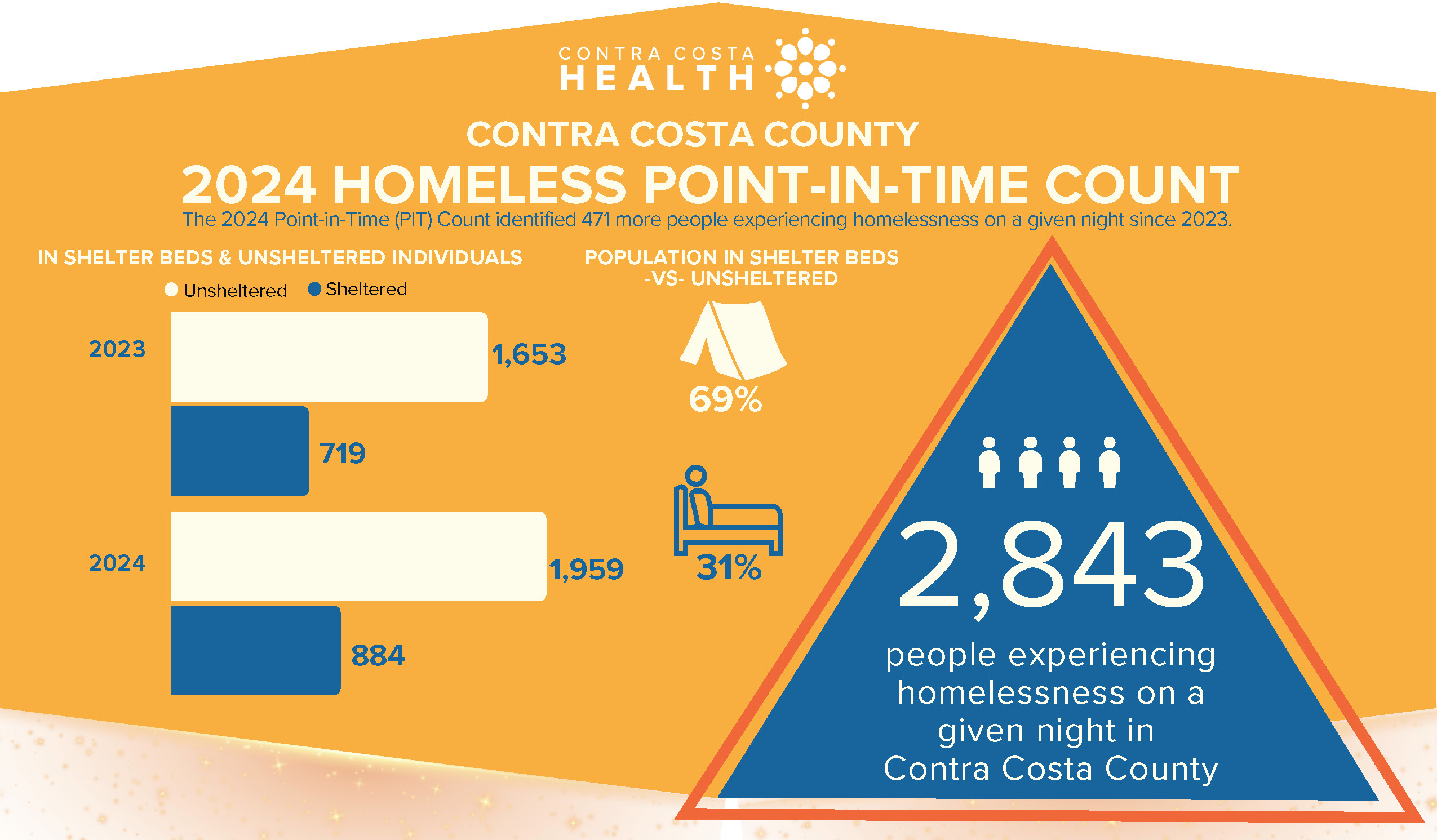
2024 Point-in-Time Count identified 471 more people experiencing homelessness on a given night

Shows 75% have been homeless for 10 years or more

By Allen D. Payton

Homelessness in Contra Costa County increased by 471 people this past year according to the 2024 Homeless Point-in-Time (PIT) Count conducted by county staff and volunteers in January. There were a total of 2,843 people experiencing homelessness on a given night in the county versus 2,372 in last year’s count. Of those amounts the unsheltered population increased 18.5% to 1,959 from 1,653 in 2023.

Each year Contra Costa Health Services’ Continuum of Care conducts the PIT, as an annual census and survey to identify the number of people experiencing homelessness in our county. It plays a crucial role in securing funding and improving our response to the needs of people experiencing homelessness.

Statistics

The report shows 69% or 1,949 of the county’s homeless residents were unsheltered while 31% or 884 were in emergency shelter beds or transitional housing, with 39% of the unsheltered either outdoors or in tents, 11% in recreational vehicles (RV’s), 14% in cars and 5% in vans. Each of this year’s total figures were increases over last year’s count of 1,653 unsheltered and 719 in shelter beds.

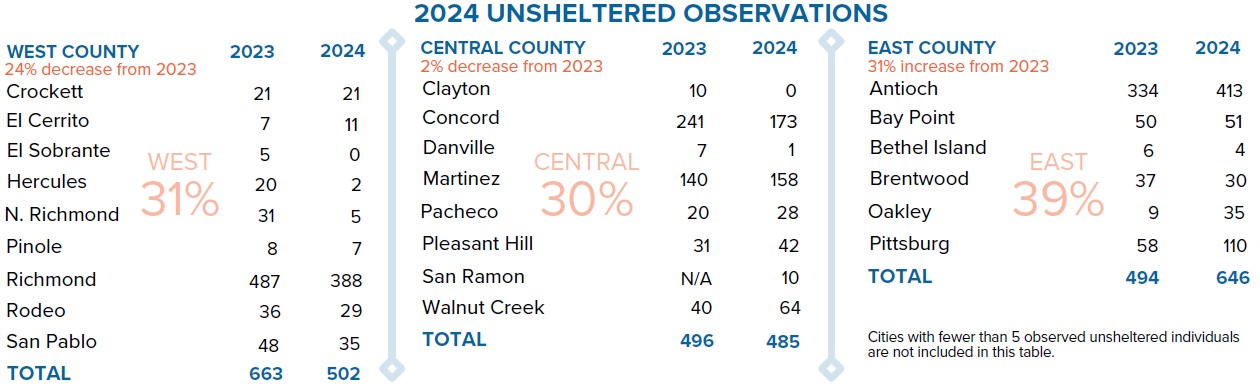
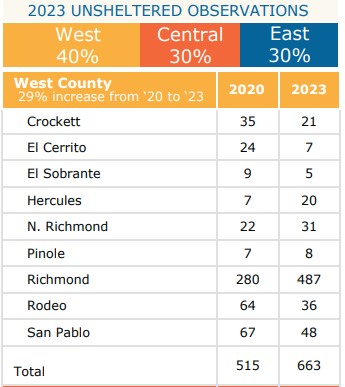
The cities with the most unsheltered homeless people were Antioch with 413, followed by Richmond with 388, Concord with 173, Martinez with 158 and Pittsburg with 110. Antioch’s homeless population increased from 334 in 2023 and 238 in 2020 while Richmond’s decreased by 99 from 487, Concord decreased from 241, while Martinez increased from 140 and Pittsburg also increased from 58 last year. The report shows East County had the highest homeless population at 39%, while West County had 31% and Central County which includes the San Ramon Valley had 30% of the homeless population in the county.

Source: CCHealth

The report shows 61% of the homeless were male, 38% female, and 0.6% identified as transgender or non-binary. The racial makeup of the homeless consisted of 39% White, 33% Black, 15% Hispanic/Latino and 9% multiracial. All other races made up 5% or less. Over half of the homeless population were aged 24-54 at 56%, while 29% were 55 and up, 7% were aged 18 to 24 and another 7% were under 18.

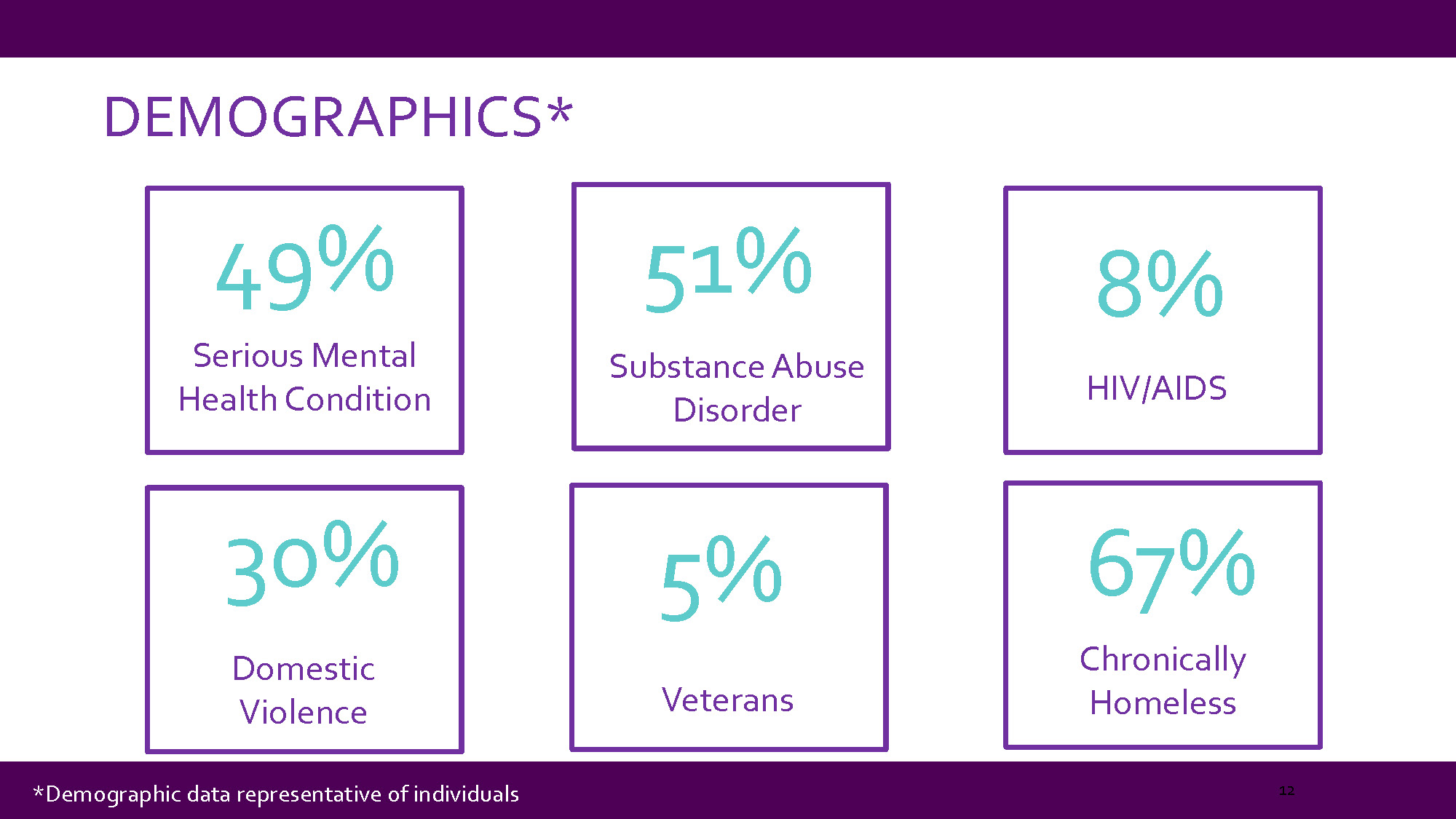
Under Population Characteristics, adult-only households made up the vast majority of the count at 95%, 57% were reported as chronically homeless, 5% were veterans, 15% of adults had been in foster care, and 45% of adults had spent one or more nights in jail or prison in the past year.

Under Self-Reported Health Conditions, the report shows 83% of households had at least one member with a disabling condition, 61% had a mental health condition, 59% had a substance use disorder, 49% had a chronic health condition, 49% had a physical disability, 17% were fleeing domestic violence and 1% had AIDS or HIV related illness.

The report also shows 75% had been homeless for 10 or more years, 10% from five to nine years, 11% from one to four years and 3% had been homeless for less than one year. Under the Age First Experienced Homelessness, 52% did while age 25-49, 24% while age 18-24, 13% under age 18 and 12% at age 50 or older.

26% Increase in Sheltered Individuals

The report provides some positive news that, “Contra Costa County increased temporary and permanent housing beds by 26% between 2023 and 2024” with gains in each of the five categories of Emergency Shelter, Transitional Housing, Rapid Rehousing, Permanent Supportive Housing and Other Permanent Housing from a total of 2,833 beds in 2023 to 3,561 this year.

Richmond Received $8.6 Million State Grant

UPDATE 1: According to District 2 Supervisor Candace Andersen’s weekly newsletter issued Friday, May 31st, “Some cities that sustained or strengthened efforts to address homelessness, particularly outreach, showed significant improvement, Richmond (-99) used an $8.6 million state grant to transition nearly 100 residents of a large encampment into housing. Concord (-68) has a homeless strategic plan and well-developed services for residents experiencing or at imminent risk of homelessness, including case management, housing navigation, household budgeting, and short-term rental assistance.”

Antioch wasn’t one of those cities, as the council voted last year to spend up to $2 million to lease and operate a motel to provide transitional housing. Andersen was the only supervisor or county staff member to so far provide the information about this year’s PIT Count to the public, other than the post of the report on the County’s website, as no press release was issued by Contra Costa Health on the matter.

Questions were emailed Monday morning, June 3rd, to Contra Costa Health and H3 staff, and all five supervisors asking why the information was being suppressed, how much money did county spend last year helping homeless residents get off the street and into transitional or permanent housing and if they know how much was spent by all of the cities in the county besides the $8.6 million grant in Richmond.

UPDATE 2: In a response later that morning, Contra Costa Health spokesman Karl Fischer wrote, “Contra Costa Health does not issue a media release regarding every report it produces. Most years, we do not issue a media release regarding data results from point-in-time counts.

The PIT infographic was posted at http://cchealth.org on Tuesday evening, May 28. Several of our media partners did publish the information later in the week, because they contacted our public information office requesting it, either before or after the graphic was posted, or because they found it on the website.

We’ve received your request for public records and will respond shortly.”

To date, the Contra Costa Health public information team has issued only one press release this year.

Methodology

The 2024 PIT Count methodology followed the Housing and Urban Development’s guidelines for a “night of” observational count followed by a random sample survey to gather demographic data and homeless experience. For more information about homeless services in the county see the Continuum of Care and the Contra Costa Health Services’ Health, Housing & Homeless Programs (H3). Please check back later for any additional updates to this report.

Filed Under: Homeless, News

San Pablo City Council approves new homeless outreach services partnership 

May 9, 2024 By Publisher Leave a Comment

The H3 Partnership is with City of El Cerrito, Contra Costa County Health, Housing and Homeless.

48 unsheltered San Pablo residents in county’s 2023 count

By City of San Pablo

San Pablo, CA – On May 6, 2024, the San Pablo City Council approved a new agreement to expand vital homeless outreach services to the unhoused and most vulnerable populations in San Pablo, through a new regional partnership with the City of El Cerrito and Contra Costa County Health, Housing and Homeless (County H3).

This new regional partnership establishes a one-year program to cost-share a County H3 Coordinated Outreach Referral, Engagement (C.O.R.E.) services team that works to engage and stabilize unhoused individuals through consistent outreach to facilitate and/or deliver health and basic-need services and secure permanent housing services.

Since 2018, the City of San Pablo has contracted with County H3 services for a C.O.R.E. services team in partnership with the City of Richmond. The original contract was entered into on December 1, 2018, and recently extended through June 30, 2026.  For the past five (5) years, the County H3 C.O.R.E. program has been successfully funded and integrated into the operations of the San Pablo Police Department, who regularly coordinate with a current County H3 C.O.R.E. services team to provide these critical homeless outreach services to the San Pablo community.

Source: Contra Costa Health

In Fall 2023, a new collaboration opportunity emerged to expand these County H3 CORE services with other local cities, who also are facing simliar impacts from increased homeless populations in their communities.  These discussions have resulted in the formation of a new partnership with the City of El Cerrito and County H3 to expand and cost-share another County H3 C.O.R.E. services team in the West Contra County region.

“San Pablo saw an opportunity with the City of El Cerrito to expand homeless outreach services and to partner with another local City to expand the availability of these much-needed services for our most vulnerable populations,” stated San Pablo Mayor Patricia Ponce.  “Regional partnerships with other nearby cities are key, and the County H3 CORE program continues to play a vital role in providing these services to our local communities to address an ongoing and critical issue facing local cities – homelessness.”

Since July 1, 2023, and with the new City of El Cerrito and County H3 partnership, the San Pablo City Council has now approved a total investment of $442,771 of City General Funds to expand homeless outreach services to four days/week (32 hours) using dedicated County H3 C.O.R.E services through June 30, 2026.

“In a time with limited budgets and available funding, regional partnerships with local agencies have become paramount when you look how effective these types of services can become if you have the right partnerships in place,” stated San Pablo City Manager Matt Rodriguez. “San Pablo is grateful to forge regional approaches and partnerships with our local neighboring cities of El Cerrito and Richmond, and County H3.”

According to the 2023 Contra Costa County Homeless Point-In-Time Count, there were 48 unsheltered residents in San Pablo, a decrease of 19 since the 2020 count.

The City of San Pablo hopes to generate additional revenue capacity and identify new sources, including grant opportunities, to expand opportunities to procure additional homeless outreach service providers in the future.

Filed Under: Government, Homeless, News, West County

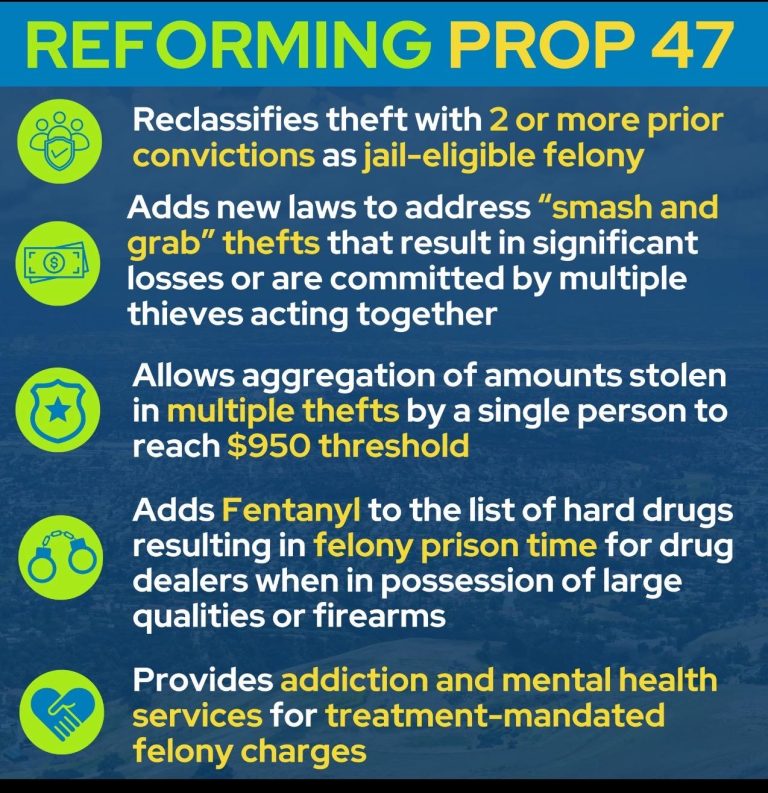
Homeless, Drug Addiction, Retail Theft Reduction Act to reform Prop 47 collects 75% of required California voters’ signatures

March 4, 2024 By Publisher Leave a Comment

Over 400,000 have signed petitions to place the measure that will stop theft and fentanyl crimes onto the November 2024 ballot

Gains support of Californians Against Retail and Residential Theft, over 30 mayors & local leaders

See below to get petition and help gather signatures

Over 400,000 California voters have signed the petition to place the Homeless, Drug Addiction, Retail Theft Reduction Act on the November 2024 ballot.

“We have seen a record number of voters seeking to sign the petition to place this measure on the ballot – sometimes waiting in line to do so,” said campaign chair Greg Totten who is also chief executive officer for the California District Attorneys Association. “This is consistent with polling that has shown that 70% of likely California voters support the Homeless, Drug Addiction, Retail Theft Reduction Act. The measure is commonsense and injects accountability back into our laws for repeat offenders of theft and for crimes involving fentanyl and other serious drug crimes.”

Californians Against Retail and Residential Theft endorses proposed initiative to reform Proposition 47

Californians Against Retail and Residential Theft (CARRT) announced last week its support for the proposed initiative called the Homeless, Drug Addiction and Theft Reduction Act.

“Our current system puts Californians at risk as crime continues to rise without any real repercussions. That is why Californians Against Retail and Residential Theft is supporting the Homeless, Drug Addiction and Theft Reduction Initiative,” said Matt Ross, spokesman for Californians Against Retail and Residential Theft.

“The initiative focuses on repeat offenders of retail crime. It provides an opportunity for those with substance abuse and mental health problems to seek help through diversion programs. At the same time, it also ensures that there are real consequences for individuals who continue to break the law.”

“Moreover, this initiative is a significant step towards putting an end to retail and residential theft in both Main Street and neighborhood areas.”

According to data from the Public Policy Institute of California, there has been a significant increase in commercial shoplifting, with a 28.7% rise in 2022 alone. Commercial burglary and robbery have also seen an increase of 5.8% and 9%, respectively. Furthermore, a recent survey revealed that 88% of retailers are experiencing more aggressive and violent shoplifters compared to the previous year.

CARRT is a diverse coalition consisting of over 200 business associations, local groups, and victim organizations. Their main goal is to advocate for California officials to take action and equip law enforcement with the necessary tools to reduce theft. Prominent members of the coalition include local Chambers of Commerce, California Asian Pacific Chamber of Commerce, California Business Roundtable, California Black Chamber of Commerce, California Grocers Association, California Peace Officers Association, Crime Victims United, Klaas Kids Foundation, and the National Federation of Independent Business.

CARRT has been engaging in discussions with local officials, law enforcement, and legislators to ensure that they comprehend the true impact of retail and residential crime. They aim to provide public safety officials with additional resources to effectively address this problem. For more information about CARRT, please visit their website at www.carrt.org.

Over 30 mayors and local elected leaders endorse Prop 47 reform initiative

Bipartisan support continues to grow with over 30 mayors and local elected officials from across the state have endorsed the Homelessness, Drug Addiction, Retail Theft Reduction Act. The measure will increase community safety by holding those who repeatedly steal or traffic hard drugs accountable. The measure has collected 75% of the needed signatures from California voters to place it on the November ballot.

“Our city has continued to prioritize safety for our residents, businesses and visitors. We realize that the laws must adapt to the circumstances we see on our streets today. Retail theft and drug offenders repeat their crimes without any accountability or consequence which is why I am supporting this ballot measure,” said Santa Monica Mayor Phil Brock. “We need smart changes to Prop 47 so that we can stop crime and hold repeat offenders accountable. Consequences act as a deterrent while at the same time, this measure prioritizes effective drug treatment and rehabilitation programs. This ballot measure will provide the tools our city needs to improve community safety.”

Local mayors and elected officials from every region across the state continue to endorse a measure that balances accountability and rehabilitation programs.

Bay Area Elected Leaders

Mayor Matt Mahan, City of San Jose

Mayor London Breed, City and County of San Francisco

Mayor Lily Mei, City of Fremont

Mayor Carmen Montano, City of Milpitas

Vice Mayor Renee Golder, City of Santa Cruz

Councilmember Shebreh Kalantari-Johnson, City of Santa Cruz
Former Mayor Ryan Coonerty, City of Santa Cruz

Vice Mayor Sherry Hu, City of Dublin

Councilmember Liang Chao, City of Cupertino (title for identification purposes only)

Councilmember Kitty Moore, City of Cupertino (title for identification purposes only)

Mayor Yan Zhao, City of Saratoga

Councilmember Rishi Kumar, City of Saratoga

Councilmember Javed Ellahie, City of Monte Sereno

Northern & Central CA Elected Leaders

Mayor Jerry Dyer, City of Fresno

Mayor Karen Goh, City of Bakersfield

Supervisor Rich Desmond, Sacramento County

Southern California Elected Leaders

Mayor Phil Brock, City of Santa Monica
Mayor Mark Arapostathis, City of La Mesa
Mayor Richard Bailey, City of Coronado
Mayor Keith Blackburn, City of Carlsbad

Mayor John Franklin, City of Vista
Mayor Lesa Heebner, City of Solana Beach
Mayor Rebecca Jones, City of San Marcos
Mayor Tony Kranz, City of Encinitas
Mayor John McCann, City of Chula Vista
Mayor John Minto, City of Santee

Mayor Ron Morrison, City of National City
Mayor Esther Sanchez, City of Oceanside
Mayor Steve Vaus, City of Poway
Mayor Bill Wells, City of El Cajon
Mayor Dane White, City of Escondido

A survey of likely California voters found that 70% of voters support the title and summary of the Homeless, Drug Addiction, Retail Theft Reduction Act. The overwhelming support was consistent across every demographic and geography including the Bay Area and Los Angeles. Furthermore, 89% of likely voters support amending Proposition 47 for stronger penalties for those engaged in repeated retail theft and trafficking hard drugs like fentanyl. The measure also includes incentives to complete drug and mental health treatment for people who are addicted to hard drugs. The survey was conducted online from November 8-November 13, 2023, with a margin of error of +/- 2.28%.

To qualify the measure for the November 2024 ballot, the law requires 546,651 valid signatures. The campaign is required to notify the Secretary of State after 25% of the signatures from California voters have been collected.

For more information, go to www.CASafeCommunities.com and to obtain a petition and help gather signatures visit https://blog.electkevinkiley.com/prop47/ .

Filed Under: Crime, Homeless, News, Politics & Elections, State of California

MTC, ABAG approve Plan Bay Area 2050+ Draft Blueprint Strategies and Growth Geographies

January 30, 2024 By Publisher Leave a Comment

Source: Plan Bay Area 2050+

Include non-transit transportation, environment, housing and economy strategy refinements

The Joint Metropolitan Transportation Commission (MTC) Planning Committee with the Association of Bay Area Governments (ABAG) Administrative Committee on Jan. 12, 2024 approved the revised Plan Bay Area 2050+ Draft Blueprint strategies and Growth Geographies.  This action enables staff to further study the strategies’ performance in meeting critical regional goals for an affordable, connected, diverse, healthy and vibrant Bay Area for all. Staff are aiming for adoption of the Plan Bay Area 2050+ Final Blueprint in summer 2024.

Given Plan Bay Area 2050’s solid foundation of 35 strategies, the Draft Blueprint phase for Plan Bay Area 2050+ is focusing on making targeted refinements to select plan strategies. These refinements reflect Plan Bay Area 2050’s implementation progress, the post-pandemic planning context and insights gathered during engagement with the public and partners in summer 2023.

What is the Plan Bay Area 2050+ Blueprint?

The Plan Bay Area 2050+ Blueprint will integrate strategies across the four elements of the plan — the economy, the environment, housing and transportation — to create a more equitable and resilient future for all.

Beginning in summer 2023 and wrapping up in late 2024, staff will develop the Blueprint over two phases: the Draft Blueprint and the Final Blueprint. Given Plan Bay Area 2050’s solid foundation of 35 strategies, the Draft Blueprint phase for Plan Bay Area 2050+ will focus on making targeted refinements to select plan strategies.

What are Growth Geographies?

Priority Development Areas — Places nominated by local governments served by transit and planned for new homes and jobs at densities necessary to support effective transit service.

Priority Production Areas — Industrial areas of importance to the regional economy and local communities that support middle-wage jobs.

Transit-Rich Areas — Places near rail, ferry or frequent bus service that were not already identified as Priority Development Areas.

High-Resource Areas — State-identified places with well-resourced schools and access to jobs and open space.

Staff previously shared proposed Draft Blueprint strategy refinements in October and November 2023, detailing which of Plan Bay Area 2050’s 35 strategies were likely to see major, minor or no changes in Plan Bay Area 2050+. This month, the MTC and ABAG committees approved moving forward with revisions for further study and analysis, including:

  • Non-transit transportation strategy refinementsfocused on prioritizing equity considerations, adapting to tighter fiscal constraints, promoting active transportation and safety, and expanding pricing strategies;
  • Environment strategy refinementsfocused on further reducing greenhouse gas emissions and proactively adapting to climate change; and
  • Housing and economy strategy refinementsfocused on addressing pressing challenges of housing affordability, homelessness and access to opportunity.

At this time the Draft Blueprint only includes a handful of modified transportation strategies, pending the development of a fiscally constrained Transportation Project List, which will integrate recommendations from the ongoing parallel Transit 2050+ effort. The complete suite of revised transportation strategies will be integrated as part of the Final Blueprint in summer 2024.

The Joint ABAG and MTC Committee also approved targeted updates to the Growth Geographies that were adopted as part of Plan Bay Area 2050. Growth Geographies are places that Plan Bay Area prioritizes for future homes, jobs, services and amenities and serve as a component of the plan’s housing and economy elements. Specifically, draft Growth Geographies for Plan Bay Area 2050+ will include five new Priority Development Areas (PDAs) and 16 modified existing PDAs nominated by local Bay Area jurisdictions; reflect up-to-date information on transit service, natural hazards and demographics; and integrate areas subject to MTC’s revised Transit Oriented Communities Policy.

The Draft Blueprint approval comes six months after MTC and ABAG kicked off the limited and focused update to Plan Bay Area 2050. In November 2023, staff shared progress-to-date with policymakers, including findings from the first round of engagement, core planning assumptions, the draft Regional Growth Forecast, a financial needs and revenue analyses and proposed strategy refinements.

The next round of public and partner organization engagement activities, which will inform the development of the Plan Bay Area 2050+ Final Blueprint, is planned to begin in spring 2024. MTC and the ABAG Executive Board are expected to approve Final Blueprint strategies in summer 2024.

Learn more about the Plan Bay Area 2050+ Draft Blueprint strategies and Growth Geographies. For additional technical resources, please visit the Plan Bay Area 2050+ Draft Blueprint Documents page on our website.

Filed Under: Bay Area, Business, Economy, Government, Homeless, Industry, Jobs & Economic Development, News, Transportation

ACA 1 going to voters in 2024 will make it easier to pass local special taxes, bonds if approved

November 17, 2023 By Publisher Leave a Comment

Source: MTC. Credit: Edmond Dantès photo via Pexels

Expected to boost Bay Area housing bond; Cal Chamber opposes; requires majority of voters to approve

By Allen D. Payton

MTC/ABAG-backed Assembly Constitutional Amendment 1, which would lower the vote threshold for local special taxes and bonds to fund affordable housing, transportation, resilience and other public infrastructure projects from two-thirds to 55%, will go to voters in November 2024.

The state Legislature in September approved sending the amendment, authored by Assemblymember Cecilia Aguiar-Curry, to voters with the backing of the entire Bay Area legislative delegation. MTC and ABAG sent letters of support to Sacramento and MTC/ABAG legislative staff actively lobbied the bill to help get it over the finish line.

Similar bills have been proposed over the past two decades but until now none were approved by the house of origin, a hurdle that itself requires a two-thirds vote. Other supporters included Nonprofit Housing Association of Northern California, Enterprise Community Partners, the California Professional Firefighters, and individual cities and counties.

The Bay Area is preparing to place a regional housing bond on the November 2024 ballot, with 80% of funds flowing to counties and several large cities and 20% designated for regionwide programs administered by the Bay Area Housing Finance Authority (BAHFA).

“While Bay Area voters have a long history of generously supporting taxes to fund transportation and housing improvements, measures in some parts of the region have repeatedly fallen short of the two-thirds margin,” MTC-ABAG Executive Director Andrew Fremier noted.  “ACA 1 would reinstate the ability of voting majorities to address vital community needs.”

The election of ACA 1 co-author Robert Rivas to the Assembly speakership helped build momentum for the proposed amendment, as did the nonprofit housing community’s raising of $10 million to gather signatures for a citizen’s initiative if the legislature didn’t approve the amendment.

California Chamber of Commerce Opposes

The constitutional amendment is opposed by the California Chamber of Commerce. In a report by policy advocate Preston Young before it passed, he claims ACA1 would increase costs for key sectors, will erode taxpayer safeguards and would harm California workers.

Preston wrote, “This would provide increased tax authority for many local government agencies in California—not just cities and counties, but thousands of potentially overlapping special districts.

In a letter sent to legislators recently, the CalChamber pointed out that while it’s important to improve infrastructure and increase housing availability, higher property, sales and parcel taxes on working Californians run counter to the goal of making the state more affordable for all.

Businesses engaged in manufacturing, research and development, teleproduction and post-production, and agriculture face a significant sales and use tax burden in California.

The sales and use tax is supposed to be a tax on the final point of sale of a product, yet many businesses—including businesses conducting research and development, manufacturing, filming activities, and agriculture—are taxed for equipment purchases.

Taxation of business inputs for these industries leads to a pyramiding effect throughout the production process, leading to higher costs for purchases made by consumers, the CalChamber explained in its letter. To counter this pyramiding effect and incentivize business growth in the state, California offers a partial state-level sales tax exemption for purchases made by these industries. However, purchases made by these businesses are still subject to local transactions and use taxes.

Equipment purchases represent a significant portion of capital investment for existing businesses and start-ups. Tax increases promoted by ACA 1 would defeat the purpose of the state-level exemption provided by the state and make it more cost-prohibitive to conduct these business activities in California, the CalChamber warned.

ACA 1 would allow local jurisdictions to approve Bradley-Burns sales tax increases with a 55% vote of the electorate, eliminating the uniformity and certainty provided by the Bradley-Burns sales tax.

This would represent a monumental change to sales and use tax policy in the state, the CalChamber said. Unlike the transactions and use tax—which is capped at 2% per county and requires statutory authority to exceed the cap—the local 1.25% sales tax (referred to as the Bradley-Burns sales tax) is uniformly applied across the state and voters are not authorized to approve increases to the rate.

“California already has the highest state-imposed sales tax in the country, and the combined sales tax rates in some jurisdictions are among the highest in the United States,” the CalChamber said. “Allowing localities to modify their Bradley-Burns sales tax rates, without a cap on rate increases, paves the way for excessive combined sales tax rates in parts of the state—increasing costs for residents and businesses.”

More than four decades ago, prompted by years of rising taxes, Californians resoundingly approved Proposition 13 to provide a check on local governments’ taxing authority, and to ensure a greater representative voice for those who would be taxed. Proposition 13 also limits taxes on property to 1% of the property’s assessed value.

Reducing the vote threshold would diminish the people’s voice on tax increases and would erode property tax safeguards. The CalChamber pointed out that a May 2022 Public Policy Institute of California poll found that 64% of registered voters believe Proposition 13 has benefitted taxpayers, and this support reaches across nearly every major demographic.

After comparing the costs of operating in California versus other states, many employers left the state in recent years. A Hoover Institution report found that from 2018 to 2022, at least 352 companies relocated their headquarters out of California—with many businesses citing the state’s tax burden as the deciding factor in their relocation.

The relocation of these companies and their employees to lower-cost states has a major impact on state and local tax revenue, causes unemployment for workers who cannot move to the new location, and is a sign that California must find ways to be more competitive, the CalChamber stressed.

“Tax increases such as those promoted in ACA 1 would be a step in the wrong direction and would encourage more companies to move workers and investments to other states,” the CalChamber said.

Indeed, Californians are sensitive to this problem. A 2020 Berkeley Institute of Governmental Studies poll found that 78% of voters “agreed that taxes in California were already so high that they were driving many people and businesses out of the state.”

Majority Vote Needed to Pass

According to a report by the California Globe,  Article XVIII, Section 4 of the California Constitution, “requires a proposed amendment or revision to be submitted to the electors and, if approved by a majority of votes, takes effect on the fifth day after the Secretary of State files the statement of the vote for the election at which the measure is voted on, but the measure may provide that it becomes operative after its effective date.”

Filed Under: Homeless, Infrastructure, News, Politics & Elections, State of California

Annual count shows slight increase in homelessness in Contra Costa County

May 11, 2023 By Publisher Leave a Comment

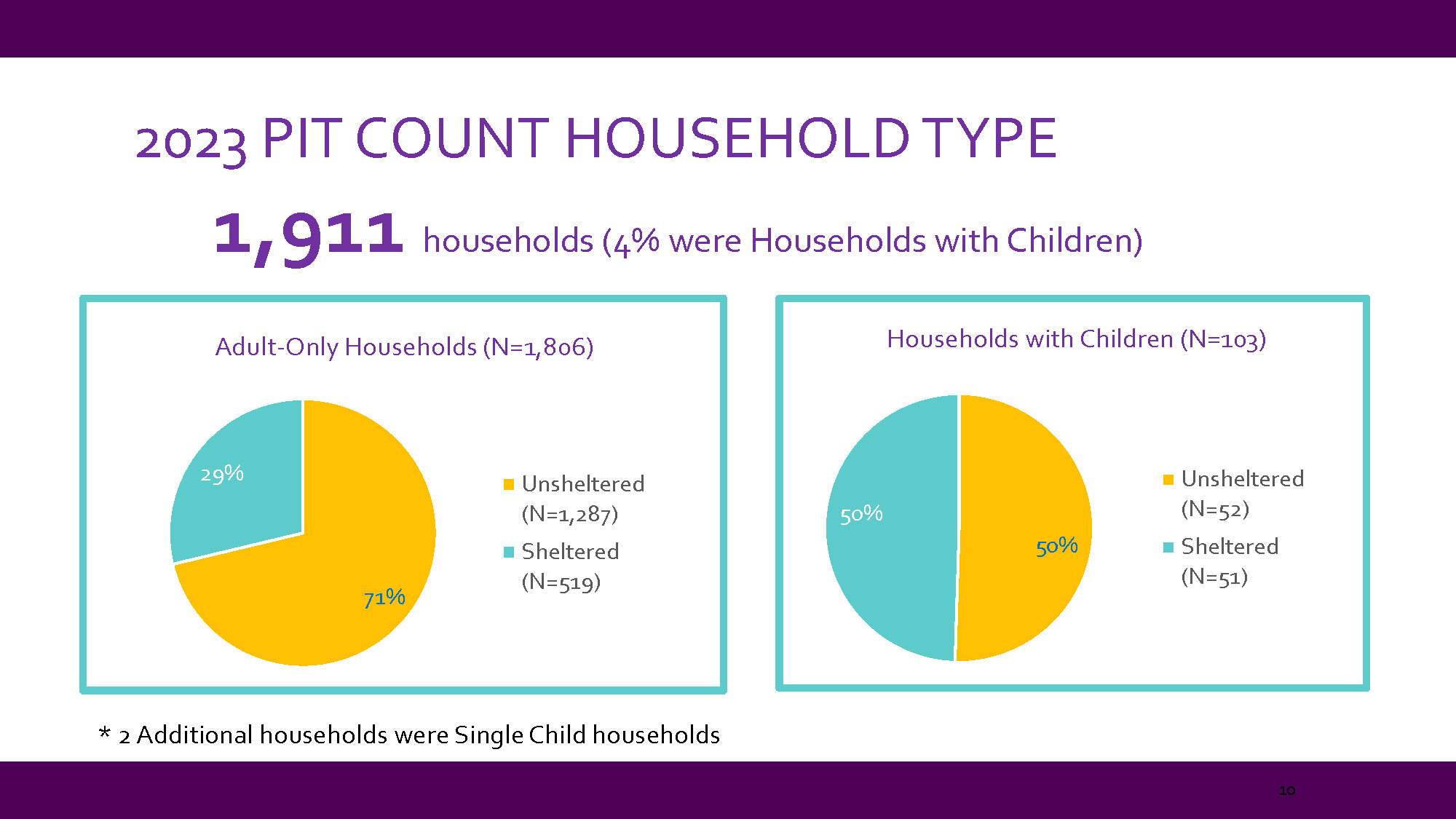
Contra Costa County Point In Time Homeless County on Jan. 25, 2023. Source: H3

95 more homeless residents than in 2020

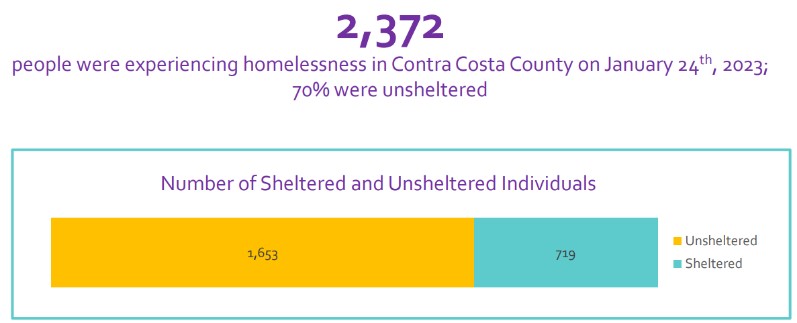
Contra Costa County’s annual survey to document people experiencing homelessness showed a four percent increase overall in 2023 compared to 2020, according to a report released by Contra Costa Health’s Health, Housing and Homeless Services team (H3).

H3 and its community partners, including more than 200 volunteers, canvassed across the county to count the number of people living in emergency shelters or outdoors on Jan. 25, 2023 and released preliminary findings of the 2023 Point in Time count (PIT) this week.

The PIT provides a one-day snapshot of homelessness in Contra Costa. It impacts funding, includes important data and demographics, and helps inform how Contra Costa Health (CCH) can most effectively provide services to people experiencing homelessness. (See Powerpoint presentation)

The preliminary findings show that 2,372 people were without housing during that 24-hour period, including 1,653 people who were unsheltered. That is a 4% increase from the 2020 PIT, which counted 2,277 people experiencing homelessness.

“There’s no one reason why people lose their housing,” said John Gioia, Chair of the County Board of Supervisors. “We are working hard on many fronts to create more housing opportunities with supportive services, including investing $12 million per year in a newly established Housing Trust Fund. Contra Costa County is also working with other counties statewide to reform the homeless system of care in California to link funding with accountability for outcomes.”

Since 2020, bed capacity in the county increased by over 560 beds and CCH opened Delta Landing thanks to the state’s Homekey program, which added critically needed services in East County.

“This year’s PIT count shows that homelessness rates in the county are relatively stable and similar to pre-pandemic numbers,” said H3 director Christy Saxton. “This is a testament to the services we work to provide to people who are experiencing homelessness in our communities, but there is more work to be done.”

The full PIT report, expected to be completed in June, will include additional geographic and demographic data. Visit cchealth.org/h3 for more information on homeless services and resources.


Filed Under: Homeless, News

Homekey Program brings innovative interim housing for homeless to Contra Costa

December 8, 2021 By Publisher 1 Comment

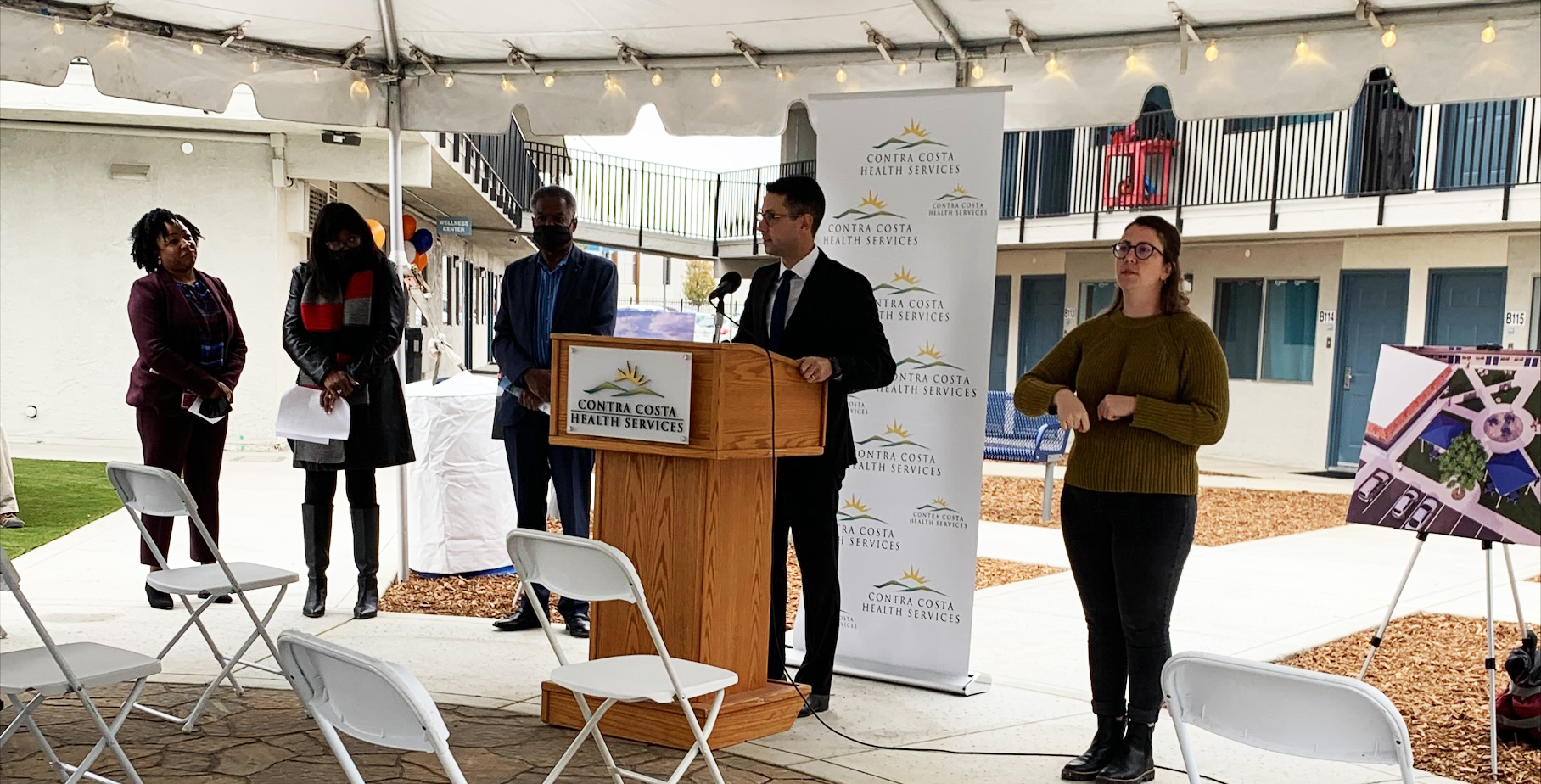
Jason Elliott, Senior Counselor to Gov. Gavin Newsom was joined by (L-R) Contra Costa Health Services Deputy Director Lavonna Martin, Pittsburg Mayor Merle Craft and Supervisor Federal Glover for the grand opening ceremony of Delta Landing. Photo by Karl Fischer.

State, local officials celebrate during grand opening of Pittsburg site for year-long program; will open later this month after extensive renovation is completed.

The Contra Costa Health Services hosted a grand opening ceremony for Delta Landing, a 172-unit interim housing site in Pittsburg, on Monday, Dec. 6, 2021. It will be among the first in California to open thanks to the state’s Homekey program to provide shelter and on-site services to help county residents experiencing homelessness to regain housing.

“We are going to ensure we will continue to serve as many as possible with this resource…as we open this site as a permanent fixture,” said Deputy Health Services Director Lavonna Martin. She is the former Director of Health, Housing, & Homeless Services for Contra Costa County Health Services.

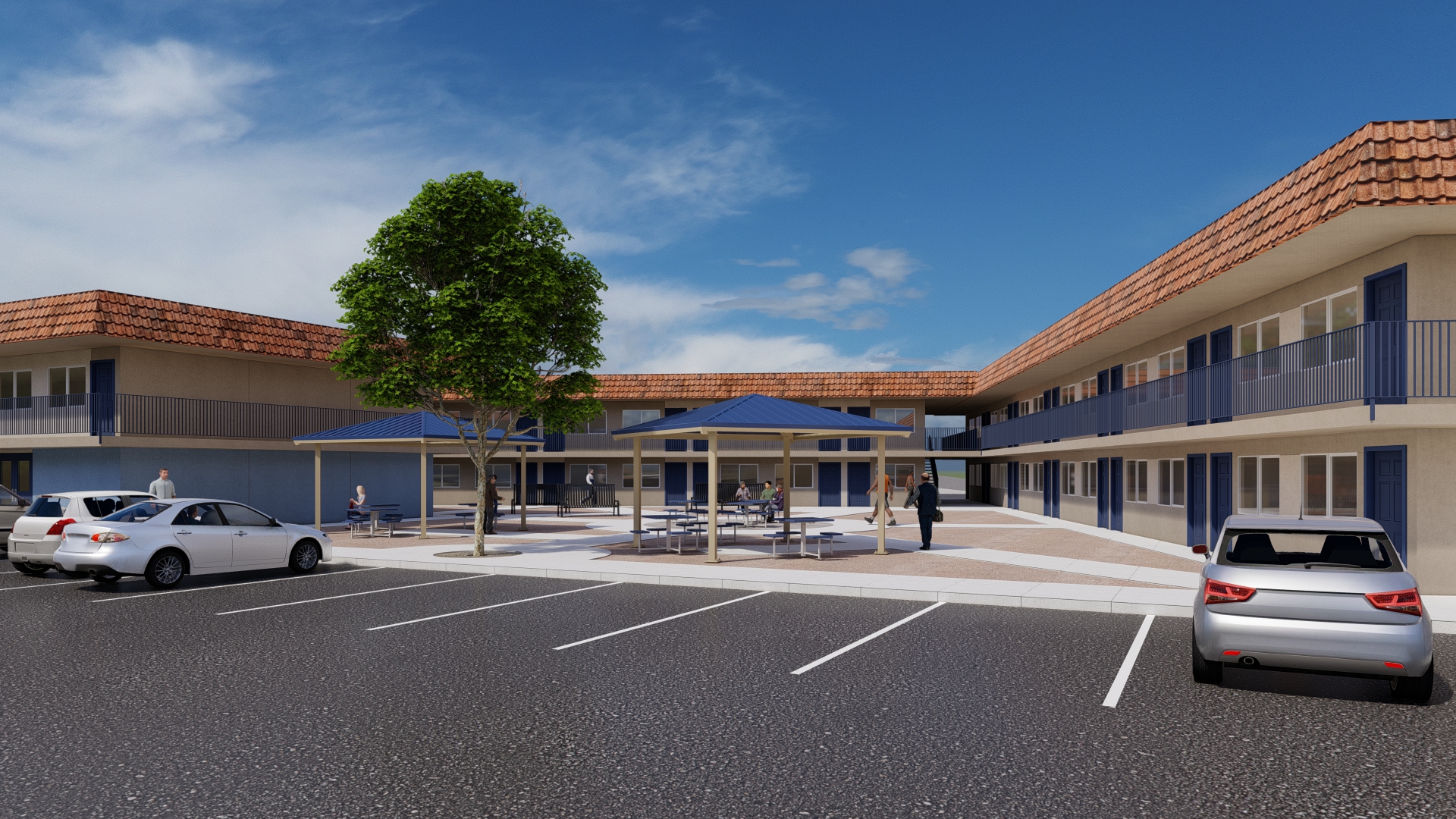
Rendering of the Delta Landing transitional housing site. Source: CCHS

Delta Landing, recipient of a $21.5 million Homekey grant in 2020, will open later this month after extensive site renovation. In addition to new paint, roof, furnishings, laundry and fire sprinkler system, clients can make use of a new wellness center for physical and behavioral health needs and co-located services to help them regain permanent housing. (See related article)

“We are grateful to California and Gov. Gavin Newsom for the opportunity to add critically needed services in East County for residents without housing,” said Diane Burgis, chair of the Contra Costa County Board of Supervisors. “Historically there has been a severe lack of beds in this part of the county, and Delta Landing is a great first step toward addressing that need.”

The site at 2101 Loveridge Road was previously a Motel 6, used since the beginning of the COVID-19 pandemic as a non-congregate emergency shelter for county residents with funding from the state’s Project Roomkey program.

The Homekey award allowed Contra Costa to negotiate the purchase of the motel and provide the necessary renovations to make a state-of-the-art interim housing facility with services such as basic healthcare, housing navigation and case management provided on site.

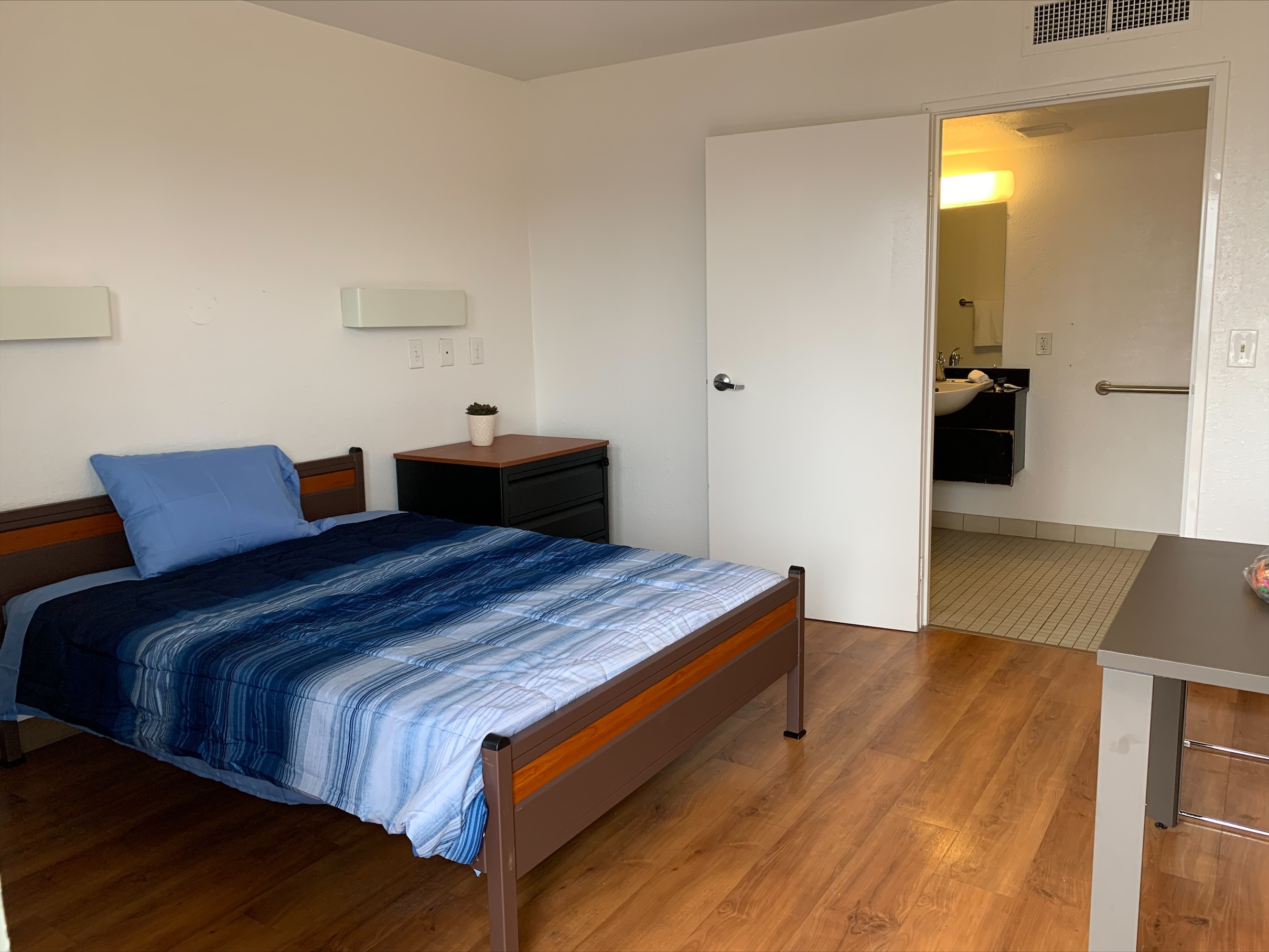
One of the rooms at Delta Landing viewed during a tour of the facility following the grand opening ceremony on Monday, Dec. 6. Photo by Karl Fischer

“This is a bit of a full circle moment. 524 days ago, the governor stood right there at the end of this walkway, right there and announced the new thing in the state called Homekey. It didn’t exist. Now, we’re here today,” said Jason Elliott, Senior Counselor to Gov. Gavin Newsom and one of the governor’s point-people on housing and homelessness. “What we did was we created a program and we provided funding. What the local governments did was make this happen…172 units of critically needed housing.” (See related article)

Clients staying at the site were temporarily placed at other Project Roomkey locations in the county during renovations and will relocate back to Delta Landing this month.

“We know that the first service that people experiencing homelessness need is a stabilized living situation,” said Contra Costa Supervisor Federal Glover, whose district includes Pittsburg. “Delta Landing provides that stable place, so clients can make full use of the services and supports to transition into permanent housing.”

He previously shared that it is a year-long program that currently has a waitlist.

The county’s most recent homeless point-in-time count, in January 2020, showed that one-third of residents living outdoors in Contra Costa were in eastern Contra Costa – more than 500 people. But, before Delta Landing, there were only 20 available shelter beds in the county east of Concord.

Contra Costa’s Public Works Department led nearly $6 million renovation project. Homekey will also $4.196 million toward operation of this permanent facility, which is managed by Bay Area Community Services (BACS), a contractor of Contra Costa Health Services’ Division of Health, Housing and Homeless Services (H3).

Visit cchealth.org/h3 for information about services for people experiencing homelessness in Contra Costa County.

Allen Payton contributed to this report.
 

Filed Under: East County, Government, Homeless, News

Grand opening of interim housing center for homeless Contra Costa residents in Pittsburg Monday

December 3, 2021 By Publisher 5 Comments

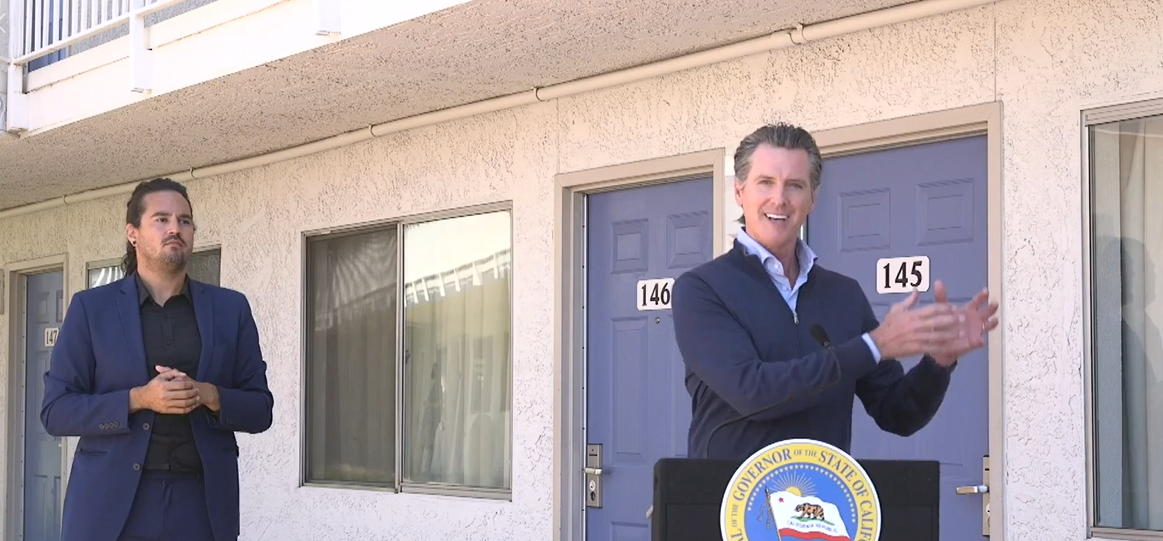
Gov Newsom speaks at Motel 6 in Pittsburg to announce the state’s new Homekey program on Tuesday, June 30, 2020. Herald file photo.

Former Motel 6 site is renamed Delta Landing; it’s been closed for renovations during which residents were relocated

By Allen Payton

Contra Costa Health Services (CCHS) will host a grand opening ceremony for Delta Landing, a 172-unit interim housing site that will provide shelter and on-site services to help county residents experiencing homelessness to regain housing. It’s located at the former Motel 6 which was purchased by the county, last year. (See related article)

Delta Landing is one of the first projects completed with funding from California’s Homekey Program, which allowed Contra Costa County to purchase, renovate and transform a motel into interim housing.

The site was previously used to house homeless residents during the pandemic through the state’s Project Roomkey. But the former motel has been undergoing renovations during which the residents were relocated according to Supervisor Federal Glover. “We didn’t put them back on the street,” he said. “We will have a grand opening next Monday.”

Glover didn’t know when residents would move in but added, “That will be shared during the event.”

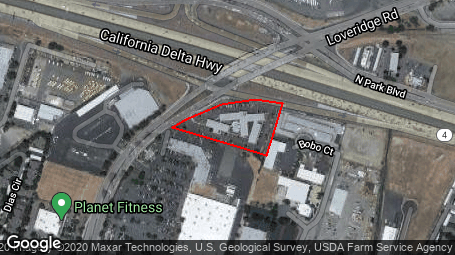
Google Map of site of Delta Landing. From ParcelQuest Lite.

The event will be held from 12 to 1 p.m. Monday, Dec. 6, 2021 at 2101 Loveridge Road, Pittsburg. The event begins in the central courtyard.

The event will begin with prepared comments followed by a question-and-answer session for news media and guided site tours including rooms, the site’s new wellness center and other features.

It will help Contra Costa County to address critical need for more services for residents experiencing homelessness in the eastern part of the county. The most recent point-in-time count showed about 500 East County residents may be without shelter on any given night. Prior to Delta Landing, there were only 20 shelter beds available east of Concord in Contra Costa County.

Filed Under: East County, Homeless, News

New state budget includes funding for five Bay Area affordable housing pilot programs

July 14, 2021 By Publisher Leave a Comment

Photo: BAHFA

The fiscal 2021-22 state budget signed into law Monday by Gov. Newsom includes a $20 million appropriation for the Metropolitan Transportation Commission (MTC) to underwrite the work of the Bay Area Housing Finance Authority (BAHFA). BAHFA, which is jointly managed by MTC and the Association of Bay Area Governments (ABAG), plans to use this money to seed five new pilot programs designed to ease the Bay Area’s housing affordability and homelessness crises.

“BAHFA was established to transform how the Bay Area delivers on housing affordability and stability,” explained Napa County Supervisor Alfredo Pedroza, who also serves as Chair of both MTC and BAHFA. “We appreciate the Legislature investing some of the state’s budget surplus in BAHFA so we can start working immediately on the five pilot projects that take a comprehensive approach to solving the crisis. The state’s commitment will support many of the Bay Area’s most vulnerable residents today and put us firmly on the path to long-term change.”

The five BAHFA pilot programs include an online platform known as Doorway to connect residents with affordable housing opportunities throughout the Bay Area; financing and technical assistance to support and increase the acquisition and preservation of affordable housing to help combat the displacement of low-income residents; a database to track the development or “pipeline” of affordable homes across the region to help match available funding with projects in areas with the most urgent needs; establishment of an anti-displacement services network to link service providers focused on keeping tenants housed, share best practices and ensure the efficient and equitable distribution of rent-relief dollars; and a partnership with San Francisco-based nonprofit All Home to design and implement a regional homelessness prevention system.

Berkeley mayor and ABAG Executive Board president Jesse Arreguin emphasizes BAHFA’s regional approach to solving the Bay Area’s chronic housing affordability problems through what are known as the Three Ps: producing more new housing at all income levels, protecting current residents from displacement, and preserving existing affordable housing.

“The crisis is a combination of complex and inter-related problems that has been growing for decades. But by working together at a regional scale, our nine counties and 101 cities and towns no longer have to try to solve every problem on their own,” he said.

Established in 2019 by state Assembly Bill 1487, BAHFA is the first regional housing finance authority in California. While BAHFA is comprised of the same membership as MTC, its procedures also are managed by the ABAG Executive Board; and both boards must approve any decision to put a regional housing finance measure on a future ballot. Oakland mayor and MTC Commissioner Libby Schaaf serves as Chair of MTC’s BAHFA Oversight Committee.

ABAG is the council of governments and the regional planning agency for the 101 cities and towns, and nine counties of the Bay Area. MTC is the transportation planning, financing and coordinating agency for the nine-county San Francisco Bay Area.

Filed Under: Bay Area, Growth & Development, Homeless, News, State of California

New report, agency chart course for tackling Bay Area’s chronic housing shortage and affordability problems

February 25, 2021 By Publisher Leave a Comment

Source: MTC & ABAG

MTC, ABAG launch Bay Area Housing Finance Authority and the Expanded Regional Housing Portfolio; possible future nine-county tax measure

The Metropolitan Transportation Commission (MTC) and the Association of Bay Area Governments (ABAG) today issued a detailed new report, entitled Momentum for Lasting Solutions, to serve as a roadmap for private investors as well as federal, state and local governments to combine forces in a comprehensive regional effort to deliver housing availability and affordability throughout the nine-county Bay Area.

Specific strategies identified in the report include securing billions of dollars in dedicated funding; fortifying cities’ and counties’ capacity to produce and preserve housing while also protecting residents from displacement; and launching new pilot programs to prevent homelessness, spur the preservation of existing housing, bolster rental and mortgage assistance, create a single regional platform for affordable housing applications, and establish a regional database to monitor the “pipeline” of new projects in the planning, permitting, financing and construction phases. Near-term actions proposed in the report are designed to lay a foundation for the Bay Area to efficiently and effectively deploy future capital resources, including funds from a potential nine-county ballot measure.

“The Bay Area’s housing crisis has been growing for decades,” noted Berkeley mayor and ABAG Executive Board president Jesse Arreguin, “The roots of the problem are deep and tangled, and they reach into every one of our communities. ABAG and MTC have been organizing a coordinated regional approach because the problem is too big for any one city or county to solve separately.”

One of the cornerstones of ABAG’s and MTC’s expanded regional housing portfolio is the Bay Area Housing Finance Authority. Established in 2019 by state Assembly Bill 1487, BAHFA is the first regional housing finance authority in California and gives the Bay Area a new set of tools that can be used in new ways in all nine Bay Area counties and in each of the region’s 101 cities. While BAHFA is comprised of the same membership as MTC, its procedures also are managed by the ABAG Executive Board; and both boards must approve any decision to put a regional housing finance measure on a future ballot.

Napa County Supervisor Alfredo Pedroza, who also serves as Chair of both MTC and BAHFA, acknowledges that meeting the Bay Area’s interrelated housing challenges will require the investment of dollars that are not currently available.

“As a result of the COVID-19 pandemic and the economic upheaval that followed, MTC and ABAG elected not to put a measure on the November 2020 ballot. But we have kept working on the ‘Three Ps’ to boost housing production, encourage the preservation of existing housing and protect vulnerable residents from displacement,” he said. “We’re building partnerships with Bay Area companies and foundations, and also working to secure state and federal dollars that can be used as seed money to kickstart the regional approach outlined by AB 1487 and the Momentum for Lasting Solutions report. And we will continue to evaluate the next viable opportunity to put a regional housing measure on the ballot. The bottom line is that the Bay Area has to deliver stable and affordable housing on a massive scale and with equitable outcomes — now more than ever.”

San Francisco Assembly Member David Chiu, who authored AB 1487, explained in 2020 that, “BAHFA is more than just a vehicle for voters to support affordable housing. It’s also a vehicle for collectively addressing our housing crisis, embracing bold ideas, testing innovative approaches, strengthening the partnership between ABAG and MTC through shared decision-making, and fostering new funding partnerships with foundations and the private sector.”

View the complete Momentum for Lasting Solutions report on the ABAG website.

MTC is the transportation planning, financing and coordinating agency for the nine-county San Francisco Bay Area. ABAG is the council of governments and the regional planning agency for the 101 cities and towns, and nine counties of the Bay Area.

Filed Under: Growth & Development, Homeless, News

  • « Previous Page
  • 1
  • 2
  • 3
  • 4
  • Next Page »
Monica's-Riverview-Jan-2026
Liberty-Tax-Jan-Apr-2026
Deer-Valley-Chiro-06-22

Copyright © 2026 · Contra Costa Herald · Site by Clifton Creative Web