• Home
  • About The Herald
  • Local Agencies
  • Daily Email Update
  • Legal Notices
  • Classified Ads

Contra Costa Herald

News Of By and For The People of Contra Costa County, California

  • Arts & Entertainment
  • Business
  • Community
  • Crime
  • Dining
  • Education
  • Faith
  • Health
  • News
  • Politics & Elections
  • Real Estate

Contra Costa Health Services adds more statistics, data to their coronavirus webpage

April 2, 2020 By Publisher 3 Comments

Only 31 currently hospitalized out of 276 confirmed cases in the county

By Allen Payton

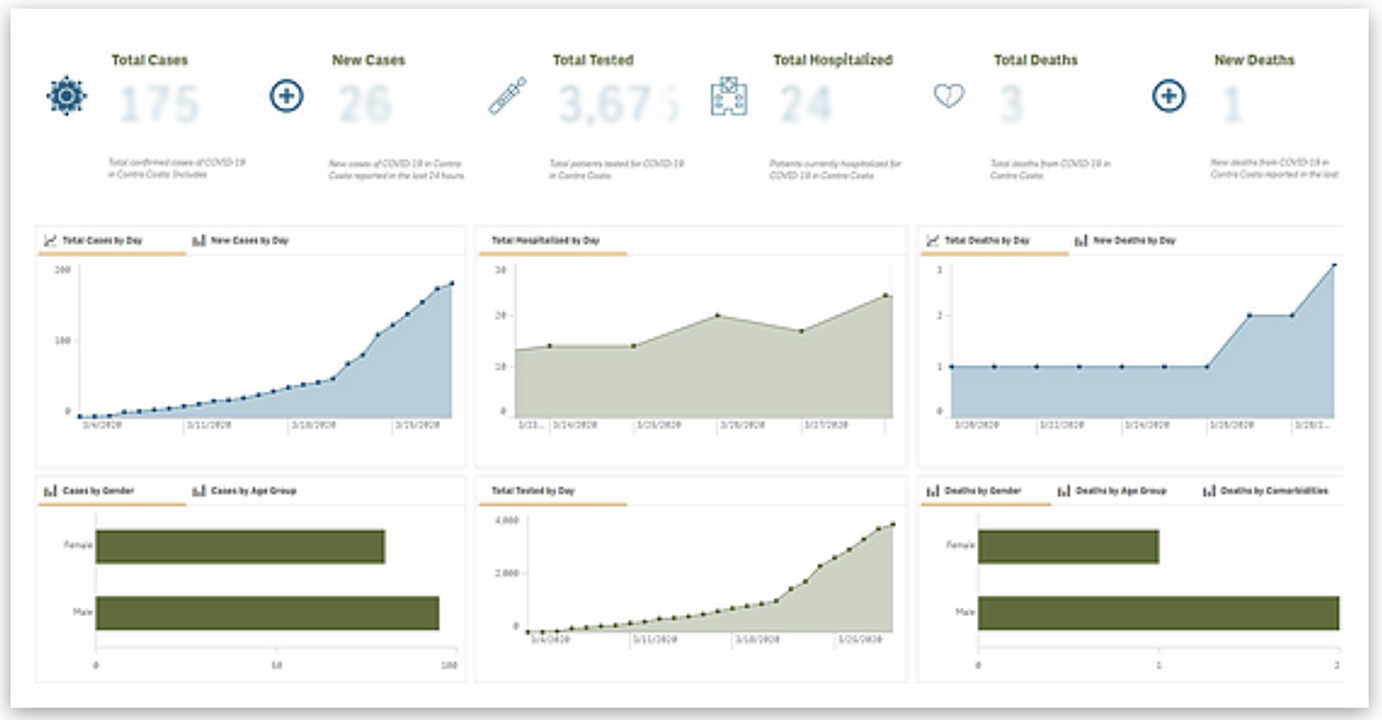
After requests by the public and the Herald, on readers’ behalf, the Contra Costa Health Services updated their webpage, today and are now reporting more statistics and information on what they refer to as the “dashboard.”

The only statistic not included that the public has been requesting, is the number of people diagnosed with the virus who have recovered.

“We’re working to get additional information to the public, as much as possible,” said Will Harper, Contra Costa Health Services spokesperson.

One bright spot in the additional statistics is that out of 276 confirmed cases in Contra Costa County, only 31 are currently hospitalized, which is a little over 11%, as of 1:00 a.m. Thursday morning, April 2. That’s out of 4,083 people who have been tested.

While the statistics show a greater number of people age 41-60 that have been diagnosed with COVID-19 than those age 61-100, which goes against international statistics, “What it doesn’t show is the severity of the cases,” Harper explained.

“We’re trying to prepare people for the fact that we haven’t seen the worst of it, yet,”

Filed Under: Health, News

Richmond’s Craneway Pavilion to be converted to a 250-bed federal Medical Station for COVID-19 patients

April 2, 2020 By Publisher Leave a Comment

The Craneway section of the Ford Assembly Building, Richmond, California. Photo by Billy Hustace Photography.

By Kim McCarl, Assistant to the Director, Communications, Contra Costa Health Services

As part of local emergency preparations, Contra Costa County officials are working with Federal and state partners to convert the Craneway Pavilion in Richmond into a 250-bed medical station for COVID-19 patients.

Inside the Craneway Pavilion. Photo from Kickstarter.

Beds and medical supplies are being brought in by the National Guard this week to begin transforming the Craneway Pavilion, a large event center on the Richmond waterfront, into a temporary medical facility. The goal is to have the facility ready to receive patients by the third week of April, when health experts predict the Bay Area will see COVID-19 cases begin to peak.

“This is one more step to be better prepared for the anticipated COVID-19 surge,” said Candace Andersen, Chair of the Board of Supervisors. “We are very grateful for the cooperation of so many private and public entities that are making their venues available to serve the health needs of our community in this unprecedented crisis.”

The federal medical station would serve as an alternate care site for COVID-19 patients who don’t need ICU-level care. It would be used only in the event local hospitals lack capacity to handle a surge of COVID-19 cases. While equipment and supplies are provided by the Federal Government, the County would coordinate medical staffing of the site.

“Dedicated County physicians, nurses and other professional staff will provide vital medical care in this historic building to help prevent our local hospitals from becoming overburdened by an expected surge in patients” said Supervisor John Gioia, who represents the area where this site is located.

The County is also establishing other alternate care sites, including using hotels for homeless residents.
Contra Costa and other Bay Area counties recently extended a regional stay-at-home order through May 3 hoping that continued social-distancing measures will reduce the impact of COVID-19 on area hospitals.

The site will be secured and not open to visitors.

Managed by the Division of Strategic National Stockpile, federal medical stations are rapidly deployable caches containing beds, supplies, and medicines which can quickly turn a preidentified building into a temporary medical shelter during a national emergency.

Richmond Mayor Tom Butt stated that “The Craneway played an essential part in winning World War II.  Today it is being repurposed to fight another global war.  This facility will help not only our local communities but contribute to the overall effort to contain COVID-19.”

The Craneway Pavilion, located in the Ford Building, was a Ford Auto Plant from 1928 to 1956 and switched to assembling jeeps, tanks and military vehicles during World War II.

According to the Public Health Emergency webpage for the U.S. Department of Health & Human Services:

The Federal Medical Station (FMS) “is an HHS deployable healthcare facility that can provide surge beds to support healthcare systems anywhere in the U.S. that are impacted by disasters or public health emergencies. FMS are not mobile and cannot be relocated once established.

Each FMS comes with a three-day supply of medical and pharmaceutical resources to sustain from 50 to 250 stable primary or chronic care patients who require medical and nursing services. Staffing for an FMS can be provided using displaced local, regional or EMAC providers, or can be provided by the federal government (primary federal staff are Officers of the U.S. Public Health Service Commissioned Corps). Potential roles for an FMS include the following:

  • Provide temporary holding and care for patients to decompress a local hospital (increase beds available for patients with disaster-related trauma or illness
  • Receive patients from nursing homes and skilled nursing facilities forced to evacuate due to the disaster
  • Provide low acuity care for patients with chronic illnesses whose access to care is impeded due to the disaster

Because the equipment and supply cache does not include tents, each FMS requires an appropriate building of opportunity* in which to operate. Significant preparation is needed to employ FMSs in support of local, State, Tribal, and Territorial emergency plans. An FMS must be established in a structurally intact, accessible building with adequate hygiene facilities and functioning utilities (hot and cold potable water, electricity, heating, ventilation, and air conditioning, and internet accessibility or capability).

A 250-bed FMS requires roughly 40,000 square feet of open space, while a 50-bed FMS requires about 15,000 square feet. In addition, wrap around logistical services must be coordinated and in place before an FMS can be operational. Some of these include a 10-12 person set up team, contracted support for patient feeding, laundry, ice, medical oxygen, and biomedical waste disposal. Fewer beds can be set up in smaller facilities, but building attributes and wrap around services remain the same.

Once a request for FMS has been approved, the cache of equipment and supplies will be delivered in 24-48 hours, after which 12 hours is planned for set-up. ASPR Regional Emergency Coordinators are the primary points of contact for FMS preparedness by State, local, Tribal and Territorial authorities. CDC Division of Strategic National Stockpile (DSNS) can assist with site surveys and training for receipt and set-up of FMSs.”

Filed Under: Health, News, West County

Gov. Newsom launches campaign to protect health of older Californians during COVID-19 pandemic

April 1, 2020 By Publisher Leave a Comment

To combat social isolation, ‘Stay Home. Save Lives. Check In.’ campaign urges all Californians to check in on vulnerable neighbors with a call, text or physically-distanced door knock.

In coordination with non-profit local 2-1-1 systems, California also launches hotline to help Californians answer questions.

SACRAMENTO – Governor Gavin Newsom today announced the “Stay Home. Save Lives. Check In.” campaign urging Californians to help combat social isolation and food insecurity among Californians who are over the age of 65 – a community that is uniquely vulnerable to COVID-19.

During California’s stay at home order, older Californians may need friends and neighbors to help them obtain basic necessities like groceries and prescriptions.

“The most important way for older Californians to stay safe is to stay at home,” said Governor Newsom. “No older Californian should be forced to go outside to get groceries or their medication. It’s on all of us across the state to check in on the older adults in our lives – our friends, family and neighbors – to help them during this outbreak. Each and every one of us must reach out in a safe way to make sure our older neighbors have someone to talk to and have enough food to eat during these difficult times.”

The campaign urges all Californians to check in on their older neighbors with a call, text or physically-distanced door knock to make sure they’re ok. In addition, the state is urging local non-profits and faith-based organizations to call to check in on all of the older Californians in their networks.

The Governor also announced the creation of a statewide hotline — 833-544-2374 — in coordination with the non-profit local 2-1-1 systems, so that Californians have a one-stop shop to answer their questions and get assistance during this crisis. For example, the 2-1-1 system is able to help older Californians access grocery and medication delivery while staying at home.

The state, in partnership with AARP, will also send a mailer to older residents, 65 and older, with useful resources and information to help adapt to the stay at home order.

“Social isolation can be difficult for older Californians even in the best of times,” said Kim McCoy Wade, director of the California Department of Aging. “We have to help aging Californians feel connected – and we must ensure we all have access to any needed services right now. This work will save lives.”

The campaign builds on existing efforts by California Volunteers and Community Emergency Response Teams (CERT) to help older Californians and those who need food assistance.

California Volunteers has launched their Neighbor-to-Neighbor campaign, which calls on neighbors to be the first line of support for California’s most vulnerable residents who have been advised to stay at home during the COVID-19 pandemic. The Neighbor-to-Neighbor campaign is focused on older adults and promotes ways to safely check on your neighbors, family and friends.

To make the most vulnerable Californians more resilient to disasters, Listos California has pivoted to helping these communities stay safe during the pandemic. Leading the charge statewide are Community Emergency Response Teams (CERT) comprised of volunteers with at least 20 hours of FEMA preparedness training. These teams are conducting welfare checks on seniors, as well as distributing essential food and supplies in Sacramento, San Diego, San Bernardino, San Francisco, Los Angeles and Napa counties to help them through the pandemic. Listos California has also partnered with trusted community-based organizations across the state and programs like Meals on Wheels and other local senior-serving non-profits to deliver services and preparedness resources.


Filed Under: Health, News, Seniors

County braces for jump in COVID-19 cases, big deficit expected for 2020-2021 budget

April 1, 2020 By Publisher Leave a Comment

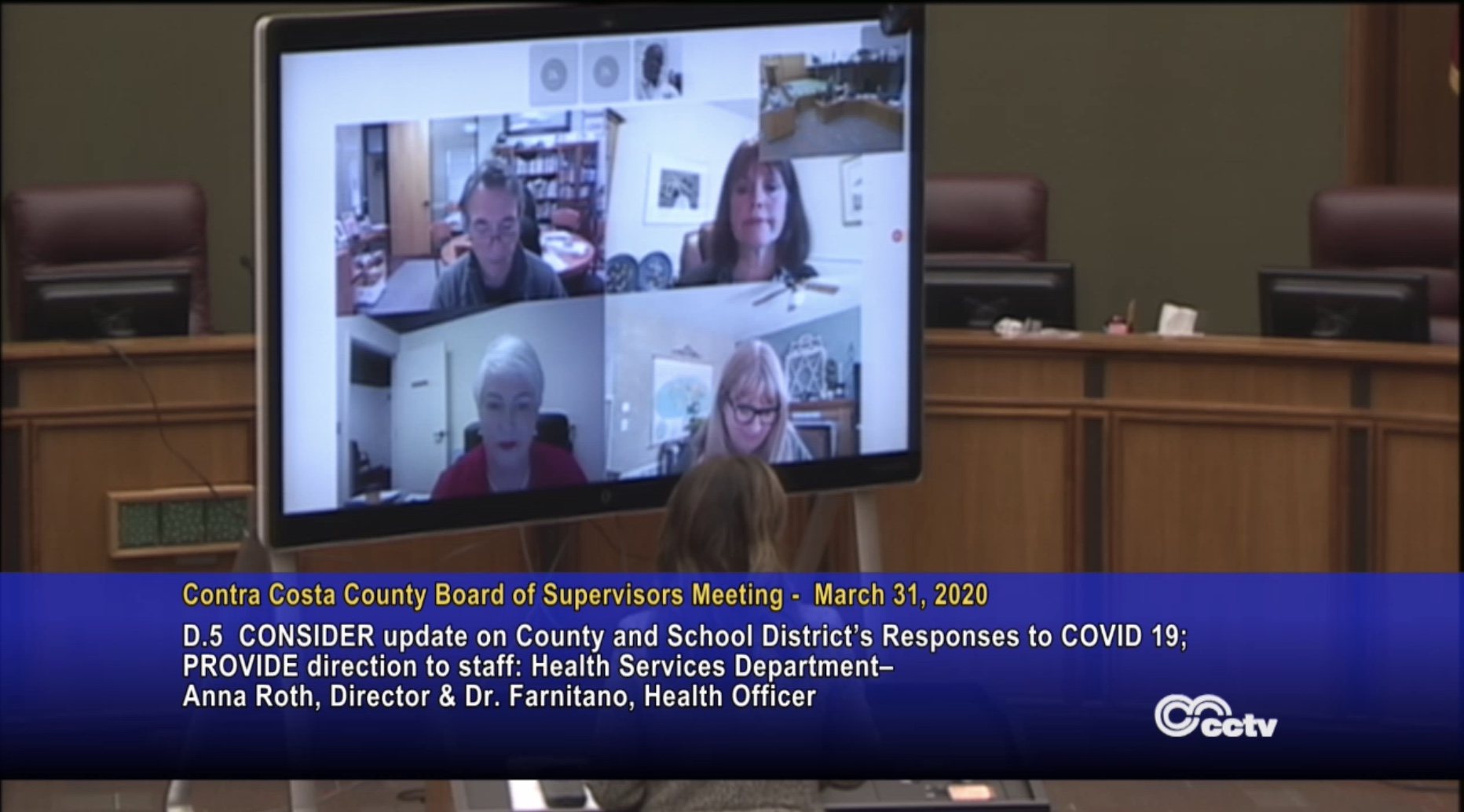
A county staff member addresses the members of the Board of Supervisors during their now, virtual weekly meeting, on Tuesday, March 31, 2020. Video screenshot.

Three deaths in county from 212 cases, so far

By Daniel Borsuk

Since the last time the Contra Costa County Board of Supervisors met two weeks ago, the number of Contra Costa residents with COVID-19 symptoms have tripled, Contra Costa County Health Services Director Anna Roth told Supervisors during a live-streamed meeting Tuesday.

Roth told supervisors the county had 212 cases of patients with COVID-19 symptoms and there had been three deaths. Two weeks ago, there 70 patients had COVID-19 symptoms and one patient had died from the virus.

In the meantime, county medical professionals are barely treading water in providing life-saving ventilators for COVID-19 stricken patients. County Health Officer Dr. Christopher Farnitano said hospitals have 76 ventilators in use and 100 more ventilators are on order, but over time additional equipment will be need.

“We are not going to save most of our patients who will need to be on ventilators. We will have 1,000 patients or more who will need to be on ventilators. Most will die. We need to reduce the number of people coming down with COVID-19 symptoms,” said Dr. Farnitano.

Dr. Farnitano said an alternate health care site is scheduled to open at the Antioch Fair Grounds next week to help accommodate additional COVID-19 patients.

County Administrator David Twa, who will retire at the end of the year, said rising health costs stemming from COVID-19 will force the county to plug up funding holes totaling $43 million a year for the next three years. The rising medical costs stem from recently signed labor agreements for hospital professionals and in-home care attendant workers.

Twa projected an 11 percent decline in property values will trigger a $27 million decrease in property tax revenue at least for the upcoming 2020/2021 fiscal year.

That projection from Twa caused District 4 Supervisor Karen Mitchoff of Pleasant Hill to warn her colleagues, “We may need to reduce the work force. We could be facing difficult times.”

Supervisors will get a better picture of the proposed 2020-2021 budget on April 21 when it is presented publicly. The budget will be formally adopted on May 12.

County Treasurer-Tax Collector Russell Watts said his office anticipates an increase in the number of property owners to file online penalty cancellation requests on April 10 because of COVID-19. Watts told supervisors he would inform property owners if any of the hundreds of financial institutions holding $450 million in impound escrow funds miss depositing funds in the county treasury the financial institutions will be held accountable. He also will report to the board of supervisors if any financial institutions fail to submit impound funds to the county.

“This revenue is essential for keeping the county, our cities and schools, and other local government agencies running and providing vital services that the public relies on, especially in times like these,” said Watts in a press release.

Under the current stay-at-home orders, the county’s more than 177,000 K-12 public school students are coping under while the stringent shelter-in-place mandate stays in place, Contra Costa County Office of Education Superintendent Lynn Mackey told supervisors.

Students are learning via distance learning although students in some school districts fall through the technology gaps more than others, said Mackey. Noting that 42 percent of the county’s students qualify for the free lunch program, the county superintendent said, “We are making sure that students don’t fall through the cracks in providing the computers and resources for distance learning.”

District 1 Supervisor John Gioia of Richmond succeeded in getting Supervisors’ support to have Deputy County Counsel Mary Ann Mason prepare a comprehensive report on the feasibility of the Board adopting a moratorium on evictions, a ban that Alameda, San Francisco, San Mateo, and Santa Clara Counties have already adopted.

The proposed imposition of an eviction moratorium was one of major topics supervisors heard from 120 emailed letters from residents. Other issues citizens wrote about connected to the COVID-19 pandemic were: Imposition of a moratorium on rent, Depopulating the county jails, and Protecting county social workers.

Temporary Emergency Worker Classification Created

Citing the possibility, the County might need temporary emergency workers during the COVID-19 pandemic, Supervisors unanimously approved County Administrator David Twa’s request to establish the classification with a salary range of $12 an hour to $35 an hour.

Supervisors approved County Administrator Twa’s request on a   5-0 vote even though Twa said he did not have the time to consult with labor representatives about the creation of the classification.

“Due to the COVID-19 pandemic, the county will need to hire additional workers to be able to continue providing current essential services to county residents, as well as services to provide information, protect health and save lives,” Twa’s request stated. “The County Administrator is recommending establishing the hourly classification of Temporary Emergency Worker.”

In other business, Supervisors appointed Walnut Creek-based commercial and residential developer Ross Hillesheim to fill the At-Large 2 seat on the Contra Costa County Planning Commission. Other applicants for the position, a four-year appointment, recommended by the Internal Operations Committee were former City of Concord planning commissioner LaMar Anderson, journalist Daniel Borsuk of Pittsburg, and North Richmond Residential Leadership team member Johana Gurdian.

Filed Under: Health, News, Supervisors

Gov. Newsom signs Executive Order providing relief to California small businesses

March 31, 2020 By Publisher Leave a Comment

Order provides 90-day extension in state and local taxes, including sales tax; extends licensing deadlines and requirements for a number of industries

SACRAMENTO – On Monday, Governor Gavin Newsom signed an executive order that will provide tax, regulatory and licensing extensions for businesses.

The executive order allows the California Department of Tax and Fee Administration (CDTFA) to offer a 90-day extension for tax returns and tax payments for all businesses filing a return for less than $1 million in taxes. That means small businesses will have until the end of July to file their first-quarter returns.

Additionally, the order extends the statute of limitations to file a claim for refund by 60 days to accommodate tax and fee payers.

The executive order also includes extensions that impact state government workers, as well as consumers. For instance, the Department of Motor Vehicles will limit in-person transactions for the next 60 days, allowing instead for mail-in renewals. Additionally, the Department of Consumer Affairs will waive continuing education requirements for several professions, also for the next 60 days.

Further, the order will extend the Office of Administrative Law’s deadlines to review regular department proposed regulations. The order also extends by 60 days the time period to complete investigation of public safety officers based on allegations of misconduct. Finally, deadlines for trainings, investigations, and adverse actions for state workers will also be extended.

A copy of the Governor’s executive order can be found here, and the text of the order can be found here.

For the latest on the state’s COVID-19 response, visit covid19.ca.gov.

Filed Under: Business, Government, Health, News, Taxes

Contra Costa, Bay Area Health Officers’ Stay-at-Home Order with new restrictions to last through May 3

March 31, 2020 By Publisher 2 Comments

More time and additional restrictions needed to slow the spread and reduce future impact on local hospitals from COVID-19

Essential businesses expanded to include service providers that enable residential transactions (notaries, title companies, Realtors, etc.); funeral homes and cemeteries; moving companies, rental car companies and rideshare services that specifically enable essential activities

As of Tuesday, March 31, 2020, health officers in seven Bay Area jurisdictions, including Contra Costa County, are extending a previous stay-at-home order through May 3, 2020 in order to preserve critical hospital capacity across the region.

The previous three-week order was set to expire on April 7. While the prior order has been effective in reducing the rate of transmission of the novel coronavirus (COVID-19), it is not enough. There has been a significant increase in the number of positive cases, hospitalization and deaths from COVID-19, which is beginning to strain healthcare resources.

The health officers have determined that more and stricter social distancing is needed to slow the rate of spread, prevent deaths, and stop the health care system from becoming overwhelmed.

“Extending the stay-at-home order should reduce the number of sick patients seeking care at one time, giving us time to acquire more medical supplies for providers who will be providing care to people sick with COVID-19. The extension will allow doctors and nurses to better treat those who do get sick, and save countless lives,” said Dr. Chris Farnitano, health officer for Contra Costa County.

The new stay-at-home order will supersede the previous order and go into effect at 11:59 p.m. on Tuesday, March 31. It is a complement to the indefinite statewide stay-at-home order issued by Gov. Gavin Newsom earlier this month.

Like the previous local order, the new order requires people to stay at home except for doing essential activities, such as grocery shopping, in six counties: Contra Costa, Alameda, Marin, San Francisco, San Mateo, and Santa Clara, as well as the city of Berkeley. Non-essential businesses will remain closed.

The new order adds some clarifying language around essential business and activities, as well as some new directives, including:

  • Use of playgrounds, dog parks, public picnic areas, and similar recreational areas is prohibited. These areas must be closed to public use.
  • Use of shared public recreational facilities such as golf courses, tennis and basketball courts, pools, and rock walls is prohibited. These facilities must be closed for recreational use.
  • Sports requiring people to share a ball or other equipment must be limited to people in the same household
  • Requires essential businesses to develop a social distancing protocol before April 3
  • Most construction—residential and commercial—is prohibited
  • Funerals limited to no more than 10 people attending
  • Essential businesses expanded to include service providers that enable residential transactions (notaries, title companies, Realtors, etc.); funeral homes and cemeteries; moving companies, rental car companies and rideshare services that specifically enable essential activities
  • Essential businesses that continue to operate facilities must scale down operations to their essential component only
  • Social distancing is the most powerful tool to slow the spread of COVID-19, a virus so new that it has no approved medicines or vaccines.

“What we need now, for the health of all our communities, is for people to stay home,” said Dr. Grant Colfax, director of the San Francisco Department of Public Health. “Even though it has been difficult, the Bay Area has really stepped up to the challenge so far, and we need to reaffirm our commitment. We need more time to flatten the curve, to prepare our hospitals for a surge, and to do everything we can to minimize the harm that the virus causes to our communities.”

For more information about COVID-19 activities in these areas, visit the Contra Costa, Alameda, Marin, Santa Clara, San Francisco, San Mateo, or Berkeley COVID-19 websites.

What are the Major Changes this New Order (March 31, 2020) Makes to the County Health Officer’s Prior Shelter Order Issued on March 16?

The new Order extends the shelter in place requirements until 11:59 p.m. on May 3, 2020.

The new Order is also more restrictive in a number of ways. Major new restrictions include:

  1. Social distancing requirements are mandatory. Unless strict compliance is explicitly waived, everyone must comply with the social distancing requirements at all times.
  2. Before Friday, April 3, 2020, essential businesses that continue to operate facilities in the County must complete, post, and implement a social distancing protocol for each facility that remains open, using the template attached to the Order.
  3. Essential businesses must maximize the number of employees who work from home, excepting only those employees who cannot perform their job duties from home.
  4. Essential businesses that continue to operate facilities in the County must scale down operations to their essential component only.
  5. Businesses that supply products needed for people to work from home are no longer essential businesses under the Order, and must cease operations (except minimum basic operations) at facilities in the County.
  6. Use of playgrounds, dog parks, public picnic areas, and similar recreational areas is prohibited. These areas must be closed to public use.
  7. Use of shared public recreational facilities such as golf courses, tennis and basketball courts, pools, and rock walls is prohibited. These facilities must be closed for recreational use.
  8. Sports or activities that require use of shared equipment, like frisbees, basketballs, baseballs, and soccer balls, may only be engaged in by members of the same household.
  9. Most construction—residential and commercial—is prohibited. Exceptions are made for healthcare facility construction directly related to the COVID-19 response; affordable housing; public works projects when designated as essential by the lead governmental agency; shelters and temporary housing; projects necessary to provide critical services to certain vulnerable individuals; construction necessary to secure an existing construction site; and limited essential residential or business repairs. The new Order also makes important clarifications. Major clarifications include:
  10. Crowding at beaches, public parks, and open spaces has been a problem. The Health Officer, government, or entity that manages the space may adopt restrictions to reduce crowding and risk of COVID-19 transmission, including limiting number of entrants, restricting vehicular access, or complete closure.
  11. Essential businesses must follow industry-specific guidance issued by the County Health Officer related to COVID-19.
  12. Childcare facilities may only provide care to children or dependents of individuals working for essential businesses, providing essential governmental functions, or performing minimum basic operations for non-essential businesses.
  13. Individuals may move residences only if it is not possible to wait until the Order expires, such as if a move is already planned or if it is necessary for safety or habitability.
  14. Landscapers and similar service professionals may only provide services necessary to maintain the sanitation, habitability, or operation of residences or businesses, or for safety reasons. They may not provide services that are cosmetic or for general upkeep. For a complete list of significant changes, see the “Detailed Summary of Changes.” See page 3: 2020-0331-Summary-Superseding-Order-Changes

Filed Under: Health, News

Op-Ed: Help keep East Bay regional parks safe and open

March 29, 2020 By Publisher Leave a Comment

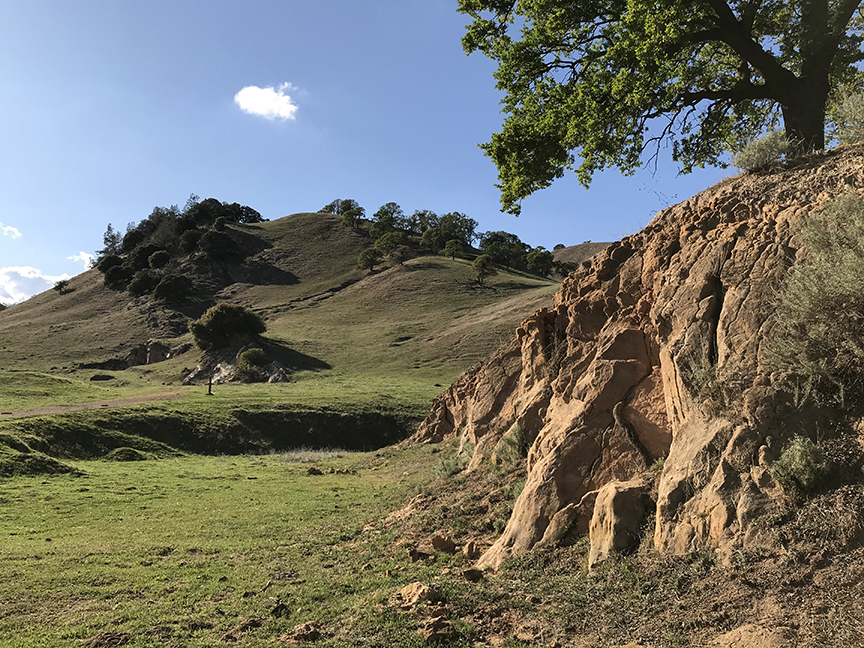
View from the Stewartville Trail in the Black Diamond Mines Regional Preserve on Sunday, March 22, 2020. Photos by Allen Payton.

A message from East Bay Regional Park District General Manager Robert E. Doyle

In the Bay Area we are blessed with over a million acres of beautiful public parkland. Californians love to get outdoors to enjoy nature and exercise, in fact they depend on it. For residents and their families, it is an essential and fundamental part of their daily lives. Parks make lives better.

We are all currently facing the greatest health pandemic of the last 100 years, and a “Shelter in Place” order that must be taken seriously.

View from the Stewartville Trail on Sunday, March 22, 2020.

We want to help get everyone through this crisis by keeping our parks open, but the safety of the public – and that of our employees – has to be the highest priority. Like you, many of our staff are sheltering in place, taking care of themselves and their loved ones. This creates a significant challenge for keeping our parks open.

We have tried to keep our 73 parks and over 1,300 miles of trails open through this crisis, but what happened this past weekend was unsafe and distressing. Thousands of Bay Area residents headed to nature – overwhelming parks, parking areas, and staff. Overcrowding has already forced many of our fellow park agencies to consider closing.

Our current limited staff is doing its best to keep up with the community’s need to exercise and get outside. However, staff still needs to respond to emergencies, remove hazardous trees, and work on fuels reduction as we prepare, along with CalFire, for another serious fire season. I want to express my appreciation to all park staff everywhere, working hard during this emergency.

Many of our building facilities have been closed for some time to reduce the potential spread of the virus, including children’s play areas and structures, picnic areas, visitor centers, and campgrounds. For health and safety reasons, park restrooms and drinking fountains are also not available.

View of Mt. Diablo from the Stewartville Trail in the Black Diamond Mines Regional Preserve on Sunday, March 22, 2020.

Bend The Curve

We need your help to keep our parks safe for you and our staff. Because of recent park overcrowding, use of picnic areas, and unsafe group gatherings and meet-ups, we have decided to “Temporarily Close” specific parks and park areas from Friday, March 27 through Thursday, April 30. A few parks are fully closed, while only some parking lots and access points are closed at others. We hope this will help us limit overcrowding and help “Bend the Curve.” For up-to-date information on park area closures go to www.ebparks.org/coronavirus.

We are coordinating with health departments daily. If unsafe overcrowding continues, or the public does not maintain social distancing – even for dogs – we may be forced to close additional areas. As Governor Newsom said last Monday, “We can’t bend the curve if everyone is out. I don’t want to close big, beautiful open spaces. But we can’t see what we saw over the weekend.”

I have received many emails, since we announced additional closures, concerned that their favorite park or parking area has been closed, or that restrooms are not open. On behalf of the Park District, I would like to thank the public for their understanding and cooperation. We have tried to spread closures across the District as best we can. However, safety is the priority.

The good news: as the largest regional park system in the nation, the vast majority of our parks, open space, and trails remain open, as are our 300-miles of paved regional trails.

If they are to remain open, we need your help. Together we can BEND THE CURVE!

Also, check our website before you go to see updates on any closures. Be sure to “go” before you go and wash your hands before and after your visit a park or trail. Bring hand sanitizer if you have it.

While the park district normally allows dogs off leash in many parks, because of the high use, for public safety and to maintain social distancing, the district is asking that dogs be on a leash.

Robert Doyle is general manager of the East Bay Regional Park District. Doyle has been with the Park District since 1975 and has served as General Manager since 2011. The East Bay Regional Park District is the largest park district of its kind in the United States with 73 regional parks on over 125,000 acres of open space.

Filed Under: Health, News, Parks, Recreation

OP-ED: COVID-19 mitigation is not vacation

March 29, 2020 By Publisher Leave a Comment

By Don Amador

With hospitals and emergency responders running out of masks and other PPE in California and elsewhere, it should come as no surprise that local, state, and federal land managers are expanding the scope of their COVID-19 temporary access restrictions to popular destination recreation sites that – are or have the potential to -attract large crowds of visitors.

For example, California State Parks issued a news release late last night that stated, it is taking additional safety measures to reduce crowds and help prevent the spread of COVID-19 (coronavirus). Many state parks and beaches received record visitation over the weekend which made it impossible for the public to implement appropriate social distancing practices.

LINK TO STATE PARKS ANNOUNCEMENT

https://www.parks.ca.gov/NewsRelease/945

The Nevada BLM issued a temporary closure order for the Sand Mountain Recreation Area near Fallon, Nevada.   As many of you know, the Sand Mountain OHV Area is a popular destination site for families and clubs that enjoy riding dirt-bikes, ATVs, SxSs, and 4WD vehicles.

LINK TO NV BLM CLOSURE OF SAND MOUNTAIN

https://www.blm.gov/sites/blm.gov/files/documents/Emergency%20Closure%20Order.pdf

Based on photos and stories posted on social media, it appears that many motorized and non-motorized recreationists have misinterpreted various “shelter-at-home” orders from state or county government as authorization for them to take a short or long-term vacation – often with large groups – on public lands.

Until we collectively “Flatten the Curve,”   recreationists should honor the stay at home directives and if they do go out for trail activities it should be close to home and/or in dispersed areas sans large crowds where social distancing is practiced. Respecting the seriousness of this issue will hasten its resolution and help expedite the withdrawal of closure orders and the reopening of public lands for both casual use and permitted events.

The professional healthcare workers, law enforcement officials, and park maintenance staff that I know, will be greatly appreciative of us doing our part to address the coronavirus.

Amador has 30 years in the recreation management and advocacy profession. Don is president of Quiet Warrior Racing, a recreation consulting company located in Oakley, CA. Don is also CEO of the Post Wildfire OHV Recovery Alliance, a non-profit group that works with volunteers and land agencies to recover, restore, and reopen recreation facilities damaged by wildfires. Don may be reached via email at: damador@quietwarriorracing.com

Filed Under: Health, Opinion, Recreation

Park District closes regional parks, restricts parking to limit overcrowding for public and staff safety, trails still open

March 29, 2020 By Publisher Leave a Comment

Additionally, park picnic areas are closed, and all group gatherings prohibited.

By Dave Mason, Public Information Supervisor, East Bay Regional Park District

The COVID-19 health emergency remains a serious and evolving situation. This past weekend, the Park District saw more people in parks than on a busy holiday. “We can’t bend the curve if everyone is out. I don’t want to close big, beautiful open spaces. But we can’t see what we saw over the weekend,” California Governor Gavin Newsom said Monday. On Monday, March 23, 2020, Governor Newsom ordered temporary closures for vehicular traffic at State parks in five California counties: Los Angeles County, Marin County, San Mateo County, Sonoma County, and San Diego County.

Unsafe overcrowding is a concern. While the Park District hopes to keep parks and trails open, some closures are necessary to limit overcrowding and maintain social distancing. The list below of parks, developed park areas, parking lots, and entrance points will be closed beginning Friday, March 27, 2020, through Thursday, April 30, 2020. Trails will remain accessible on a walk-in, bike-in basis.

“We are all in this together,” said Park District General Manager Robert Doyle. “We want to help everyone during this crisis by keeping parks open, but safety of the public and our employees is our top priority.”

“If parks are too crowded, please help us keep people safe by going home,” added Doyle.

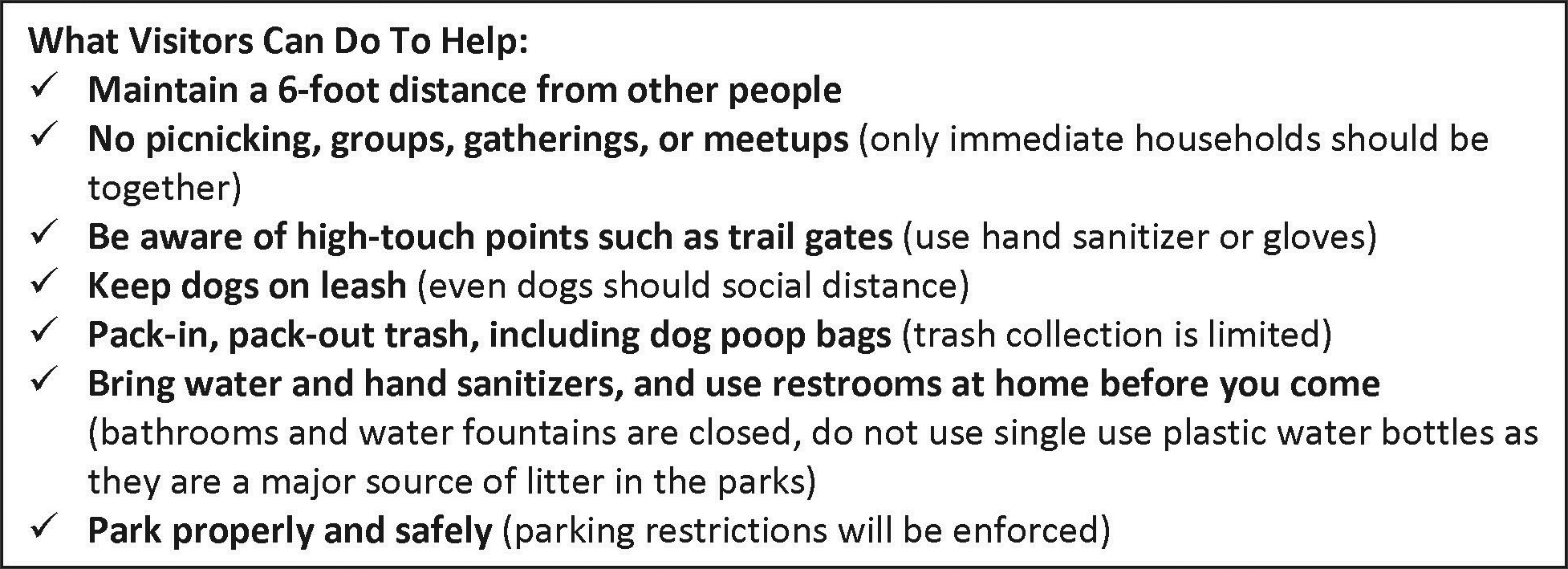
Ways the public can help keep parks open include:

  • Maintain a 6-foot distance from other people
  • No picnicking, groups, gatherings, or meetups (only immediate households should be together)
  • Pack-in, pack-out trash, including dog poop (there is limited trash collection during COVID-19)

Park visitation and park use will continue to be monitored closely, with additional closures possible. Currently, state and county health departments have told us they want East Bay Regional Parks to remain open and accessible for outdoor activity if possible. However, it may also be necessary to close more park areas based on overcrowding or additional orders from State or local health agencies.

We thank the public for their cooperation and understanding during the COVID-19 public health emergency. Keeping parks open for the public is challenging with limited staffing and the Park District is doing its best to balance the requirements of State and local health agencies’ “Shelter in Place” orders, and the community’s need for exercise and stress relief.

The public is encouraged to check ebparks.org for up-to-date information on closures.

COVID-19 CLOSURES THROUGH THURSDAY, APRIL 30, 2020:

(All picnic areas, restrooms, water fountains, swim facilities/areas, playgrounds, campgrounds, group campsites, backcountry campsites, sports fields, kiosks, and reservable facilities are closed.)

NEW CLOSURES BEGINNING FRIDAY, MARCH 27:

  • Black Diamond – Upper Parking Lot Closed (Parking available at Sidney Flat)
  • Castle Rock Recreation Area Closed
  • Contra Loma Closed (Trails Open from Frederickson Lane)
  • Crown Beach – Otis Parking Lot Closed (Walk-In Access Only)
  • Del Valle Closed (Trail Access from Arroyo Staging Area Only)
  • Diablo Foothills (Limited Parking for Trail Access)
  • Garin/Dry Creek – Meyer’s Garden Closed
  • Point Isabel – Main Parking Area Closed (Walk-In Access Only
  • Reinhardt Redwood Regional Park – Redwood Road Gate Closed
  • Piedmont Stables (Boarders Allowed to Care for Horses)
  • Roberts Regional Recreation Main Park Area Closed (Walk-In Access Only)
  • Shadow Cliffs Closed (Walk-In Access Only)
  • Sibley Volcanic Regional Preserve – Tunnel Road Entrance Closed (All Other Access Points Open)
  • Sunol Regional Wilderness Closed
  • Tilden Botanic Garden – Garden Closed

PREVIOUS CLOSURES (STILL IN EFFECT):

Anthony Chabot Closures

  • Marciel Gate
  • Chabot Equestrian Center Parking Lot (Boarders Allowed for Care for Horses)
  • Skyline Stables (Boarders Allowed for Care for Horses)

Ardenwood Closures

  • Ardenwood Closed

Bay Point Shoreline Closures

  • Closed Due to Construction

Big Break Closures

  • Big Break Visitor Center

Black Diamond Closures

  • Mine Closed
  • Sidney Flats Visitor Center
  • Greathouse Visitor Center

Briones Closures

  • Bear Creek Staging Area

Regional Trails Closures

  • Lafayette-Moraga Old Moraga Ranch Trail (Closed due to Landslide)

Coyote Hills Closures

  • Main Parking Lots
  • Coyote Hills Visitor Center

Crown Beach Closures

  • McKay Parking Lot (Walk-In Access Only)
  • Crab Cove Visitor Center

Del Valle Closures

  • Del Valle Visitor Center

Garin/Dry Creek/Pioneer Closures

  • Visitor Center
  • Apple Orchard

Lake Chabot Closures

  • Boat Ramp (No Boating/No Quagga Inspection)

Lake Temescal Closures

  • South Parking Lot

Leona Canyon Closures

  • Main Staging Area

MLK Shoreline Closures

  • Tidewater Staging Area
  • Tidewater Outdoor Recreation Office
  • Tidewater Oakland Strokes Operations

Quarry Lakes Closures

  • Boat Ramp (No Boating/No Quagga Inspection)

Sunol Closures

  • Sunol Visitor Center

Tidewater Closures (See MLK Shoreline)

  • All Areas Closed

Tilden Closures

  • All Picnic Areas Along Lake Anza and Brook roads
  • Fern Picnic Area Parking
  • Indian Camp Parking Lot, Playground, and Picnic Area
  • Lone Oak Parking Area
  • Lakeview Parking Lot
  • Mineral Springs Parking Lot – No Trails
  • Lake Anza Road and Parking Area
  • Tilden Golf Course
  • Golf Course Gated Lot (Bottom Half)
  • Steam Trains/Golden Gate Live Steamers
  • Merry-Go-Round
  • Native Here Nursery
  • South Park Drive (Continued Newt Closure Past April 1)

Tilden Botanic Garden Closures

  • Botanic Garden Visitor Center

Tilden Nature Area Closures

  • Tilden Nature Area Closed (Walk-In Access Only)
  • Tilden Little Farm
  • Environmental Education Center
  • Indian Camp Parking Lot

Wildcat Canyon Closures

  • Walk-In Entrance Trail into the Alvarado Picnic Area

The East Bay Regional Park District is the largest regional park system in the nation, comprising 73 parks, 55 miles of shoreline, and over 1,300 miles of trails for hiking, biking, horseback riding, and environmental education. The Park District receives more than 25 million visits annually throughout Alameda and Contra Costa counties in the San Francisco Bay Area.

Filed Under: Health, News, Parks, Recreation

Saturday Update: 168 cases, 3 deaths from COVID-19 in Contra Costa County

March 29, 2020 By Publisher 4 Comments

As of Saturday, March 28, 2020 at 1:00 p.m. Contra Costa Health Services is reporting a total of 168 cases of COVID-19 and three deaths from the virus in the county. The totals are updated daily and based on preliminary reporting. Numbers may change based on additional findings.

Filed Under: Health, News

  • « Previous Page
  • 1
  • …
  • 39
  • 40
  • 41
  • 42
  • 43
  • …
  • 53
  • Next Page »
Furniture-Clearance-02-26B
Celia's-3-26-A
Delta-RC-A
Deer-Valley-Chiro-06-22

Copyright © 2026 · Contra Costa Herald · Site by Clifton Creative Web