• Home
  • About The Herald
  • Local Agencies
  • Daily Email Update
  • Legal Notices
  • Classified Ads

Contra Costa Herald

News Of By and For The People of Contra Costa County, California

  • Arts & Entertainment
  • Business
  • Community
  • Crime
  • Dining
  • Education
  • Faith
  • Health
  • News
  • Politics & Elections
  • Real Estate

UPDATE: Contra Costa Sheriff issues misdemeanor citation to North Richmond church for holding Easter service

April 17, 2020 By Publisher Leave a Comment

All Nations Church of God in Christ from Google Maps and Pastor Wyndford Williams, Sr. from the church’s Facebook page.

UPDATE: Filed the case with DA’s office for prosecution; parishioners weren’t wearing masks nor practicing social distancing according to the Deputy Sheriff. Pastor denies those claims.

By Allen Payton

In a press release from the Contra Costa County Sheriff’s spokesman Jimmy Lee wrote, “at about 12:32 PM on Sunday, April 12, 2020, the Office of the Sheriff received an anonymous complaint of an unlawful assembly at the All Nations Church of God in Christ at 1225 York Street in North Richmond.

A deputy responded to the location and saw approximately 40 people inside the church. None of them were wearing a face mask and they did not practice social distancing.

The deputy first spoke to the deacon and asked to speak to the pastor who was in front of the parishioners. The pastor was uncooperative and refused to talk to the deputy.

The deputy left the location and wrote a report.

On April 13, 2020, a Deputy responded to the church and issued a misdemeanor citation for violation of the Health Officer order (California Health and Safety Code § 120295).

The Sheriff’s Office later filed a case with the Contra Costa DA’s Office for prosecution.

‘Our focus has been on education of the Health Officer Order and in the vast majority of cases we ask for voluntary compliance and that solves the problem,’ said Contra Costa Sheriff David Livingston. ‘This was different. The pastor refused to cooperate and put the lives of dozens of parishioners at risk.’”

Asked if the deputy attempted to interrupt the church service to speak to the pastor, Lee responded, “no” and reiterated that the deputy first spoke to the deacon. Asked if the deputy waited until after the church service was over to speak to the pastor, Lee responded, “I don’t have that detail but the Deputy made several attempts to talk to the pastor, who refused to talk to him.”

Attempts to reach the church’s pastor, Wyndford Williams, Sr., for comment by phone and email were unsuccessful prior to publication time. A message on the church’s Facebook page Thursday afternoon stated media inquiries were to be sent to the pastor’s email address and that “a reply will be sent within 24 hours.”

5:11 PM UPDATE: The following “official statement” was received from the pastor refuting the Sheriff Deputy’s claims in his report – “Easter Sunday is one of the most important celebrations in the Christian faith. A small service was held with approximately forty people in attendance. Masks were worn. Hand sanitizers were provided. Families that lived together sat together. Otherwise, social distancing was observed.”

On Monday, U.S. Attorney General Barr issued a statement on “Religious Practice and Social Distancing”.

In it, he wrote, “In exigent circumstances, when the community as a whole faces an impending harm of this magnitude, and where the measures are tailored to meeting the imminent danger, the constitution does allow some temporary restriction on our liberties that would not be tolerated in normal circumstances.

But even in times of emergency, when reasonable and temporary restrictions are placed on rights, the First Amendment and federal statutory law prohibit discrimination against religious institutions and religious believers.  Thus, government may not impose special restrictions on religious activity that do not also apply to similar nonreligious activity. For example, if a government allows movie theaters, restaurants, concert halls, and other comparable places of assembly to remain open and unrestricted, it may not order houses of worship to close, limit their congregation size, or otherwise impede religious gatherings.  Religious institutions must not be singled out for special burdens.”

The Department of Justice filed a Statement of Interest in support of a church in Mississippi that sought to hold “parking lot worship services, in which congregants listened to their pastor preach over their car radios, while sitting in their cars in the church parking lot with their windows rolled up.” That was because the “city (of Greenville) appears to have…singled churches out as the only essential service (as designated by the state of Mississippi) that may not operate despite following all CDC and state recommendations regarding social distancing… while permitting citizens to attend nearby drive-in restaurants, even with their windows open.”

In the case of the All Nations Church of God, neither the pastor nor parishioners were following the guidelines and practices of social distancing as outlined in the county health officer’s order of “no gatherings”. (See related article)

Asked if the Sheriff’s Office wouldn’t have cited the church if the parishioners had been wearing masks and practiced social distancing, or if it was because more than 10 people were gathered, Lee responded, “Everything we want to say is in the press release.”

See the complete statement by Attorney General Barr, here:

Attorney General William P. Barr Issues Statement on Religious Practice and Social Distancing; Department of Justice Files Statement of Interest in Mississippi Church Case

Attorney General William P. Barr issued the following statement:

“In light of the COVID-19 pandemic, the President has issued guidelines calling on all Americans to do their part to slow the spread of a dangerous and highly contagious virus.  Those measures are important because the virus is transmitted so easily from person to person, and because it all too often has life-threatening consequences for its victims, it has the potential to overwhelm health care systems when it surges.

To contain the virus and protect the most vulnerable among us, Americans have been asked, for a limited period of time, to practice rigorous social distancing.  The President has also asked Americans to listen to and follow directions issued by state and local authorities regarding social distancing.  Social distancing, while difficult and unfamiliar for a nation that has long prided itself on the strength of its voluntary associations, has the potential to save hundreds of thousands of American lives from an imminent threat.  Scrupulously observing these guidelines is the best path to swiftly ending COVID-19’s profound disruptions to our national life and resuming the normal economic life of our country.  Citizens who seek to do otherwise are not merely assuming risk with respect to themselves, but are exposing others to danger.  In exigent circumstances, when the community as a whole faces an impending harm of this magnitude, and where the measures are tailored to meeting the imminent danger, the constitution does allow some temporary restriction on our liberties that would not be tolerated in normal circumstances.

But even in times of emergency, when reasonable and temporary restrictions are placed on rights, the First Amendment and federal statutory law prohibit discrimination against religious institutions and religious believers.  Thus, government may not impose special restrictions on religious activity that do not also apply to similar nonreligious activity. For example, if a government allows movie theaters, restaurants, concert halls, and other comparable places of assembly to remain open and unrestricted, it may not order houses of worship to close, limit their congregation size, or otherwise impede religious gatherings.  Religious institutions must not be singled out for special burdens.

Today, the Department filed a Statement of Interest in support of a church in Mississippi that allegedly sought to hold parking lot worship services, in which congregants listened to their pastor preach over their car radios, while sitting in their cars in the church parking lot with their windows rolled up.  The City of Greenville fined congregants $500 per person for attending these parking lot services – while permitting citizens to attend nearby drive-in restaurants, even with their windows open.[1]  The City appears to have thereby singled churches out as the only essential service (as designated by the state of Mississippi) that may not operate despite following all CDC and state recommendations regarding social distancing.

As we explain in the Statement of Interest, where a state has not acted evenhandedly, it must have a compelling reason to impose restrictions on places of worship and must ensure that those restrictions are narrowly tailored to advance its compelling interest.  While we believe that during this period there is a sufficient basis for the social distancing rules that have been put in place, the scope and justification of restrictions beyond that will have to be assessed based on the circumstances as they evolve.

Religion and religious worship continue to be central to the lives of millions of Americans.  This is true more so than ever during this difficult time.  The pandemic has changed the ways Americans live their lives.  Religious communities have rallied to the critical need to protect the community from the spread of this disease by making services available online and in ways that otherwise comply with social distancing guidelines.

The United States Department of Justice will continue to ensure that religious freedom remains protected if any state or local government, in their response to COVID-19, singles out, targets, or discriminates against any house of worship for special restrictions.”


Filed Under: Faith, Health, News, Sheriff, U S Attorney

Contra Costa Health Officer issues new “Cover Your Face” order

April 17, 2020 By Publisher 1 Comment

N-95 face mask.

Violation of or failure to comply with this Order is a misdemeanor punishable by fine, imprisonment, or both. (California Health and Saf. Code, § 120295.)

By Kim McCarl, Assistant to the Director, Communications, Contra Costa Health Services

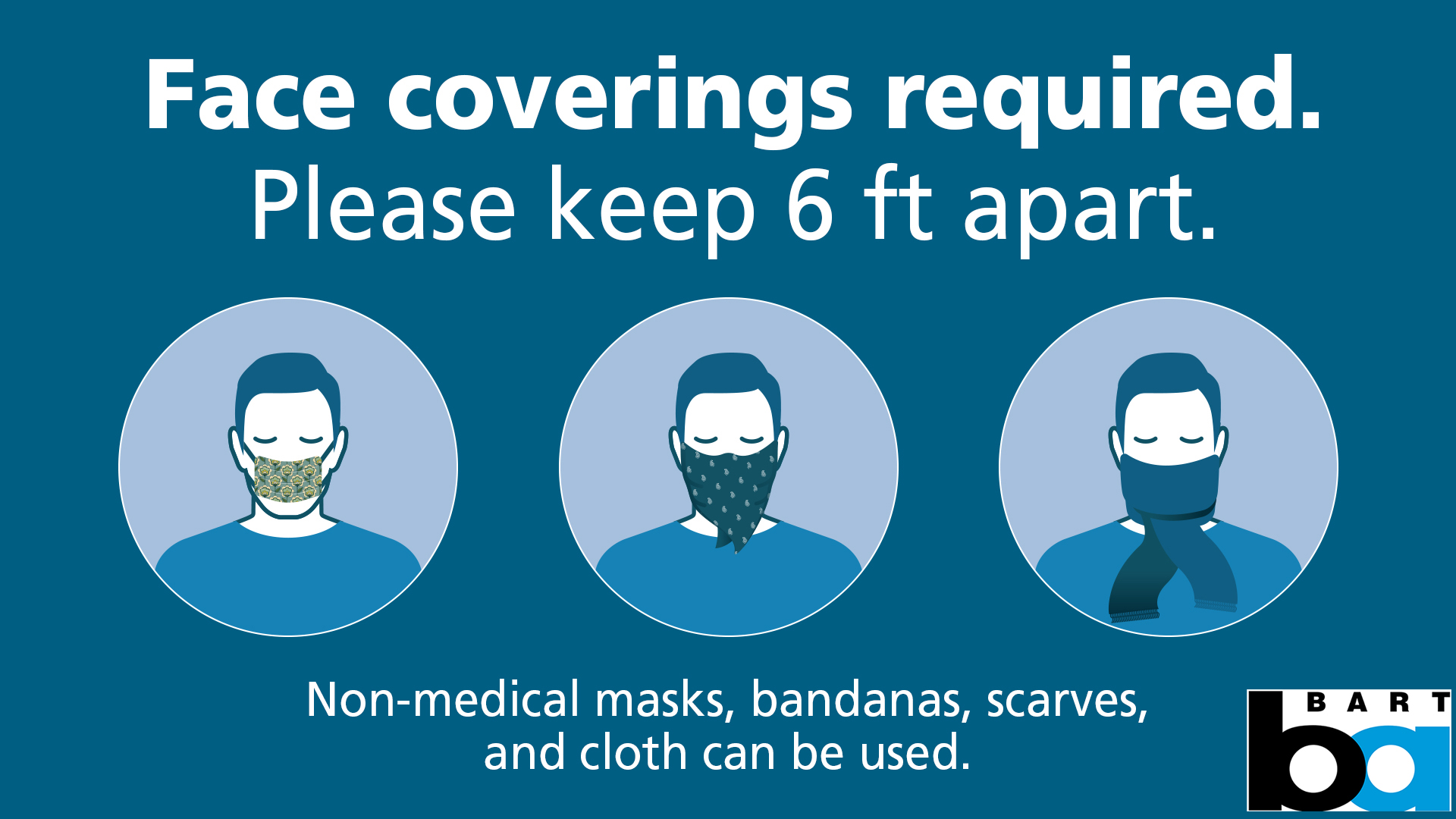
A new health order in Contra Costa County requires anyone working at or visiting an essential business, such as a grocery store or gas station, to wear face coverings to help reduce the spread of COVID-19.

The order, effective Wednesday, April 22, also requires public transit and government workers to wear masks when they come close to others, or where the public is likely to be present. (See the complete, six-page order, here.)

Members of the public must mask when they:

  • work at an essential business
  • are inside an essential business, such as a grocery store
  • visit a healthcare provider or facility
  • wait in line for or ride public transportation

Businesses must take reasonable measures, such as posting signs, to remind visitors about masking, and not serve customers who do not observe the order. Workers do not need to mask if they are alone in a personal office but must put them on when others enter.

“We now know that a significant number of people with COVID-19 lack symptoms, or become infectious before they start showing symptoms,” said Dr. Chris Farnitano, Contra Costa County’s health officer. “That is why we all need to start wearing cloth face coverings in public settings where it’s sometimes hard to maintain physical distancing, such as standing in line at the store.”

The new order does not extend to people driving in personal vehicles alone or with members of their households. Contra Costa residents are encouraged to continue to observe safe physical distancing when they go out to exercise or for recreation.

When outside, everyone must carry masks or face coverings and use them whenever they come near six feet of others outside their own households.

People engaged in more strenuous exercise, such as running or bicycling, should stay further apart from others while breathing heavily and take steps to avoid breathing on others, such as moving to the other side of the road to avoid pedestrians and wearing a mask if possible.

The new order does not replace the county’s stay-at-home health order or the need to maintain physical distancing, wash hands frequently and cover coughs and sneezes – all fundamental to reducing the spread of COVID-19.

“Stay in place, maintain your space, cover your face,” Dr. Farnitano said. “One key way the COVID-19 virus spreads is through respiratory droplets that people expel when they breathe or sneeze. By masking and observing physical distancing, we can help protect everyone in the community.”

The order does not require children 12 and younger to wear masks. Children 2 years old or younger must not wear them because of the risk of suffocation.

Face coverings can be anything made of cloth, fabric or other permeable material that covers the nose and mouth and the lower part of the face. Medical-grade masks are not required – a T-shirt or bandana works fine, Dr. Farnitano said.

Masks with one-way valves for easy breathing do not qualify as face coverings under the order because they can release respiratory droplets into the surrounding air.

Visit cchealth.org/coronavirus to read the order or for more information about COVID-19. Visit the Centers for Disease and Control at https://www.cdc.gov/coronavirus/2019-ncov/prevent-getting-sick/cloth-face-cover.html for video instructions to make and use cloth face coverings.

Filed Under: Health, News

Contra Costa Coronavirus Update: 631 cases, 16 total deaths in county

April 16, 2020 By Publisher Leave a Comment

CC Health Services Coronavirus Dashboard statistics as of April 16, 2020 at 11:30 a.m.

By Allen Payton

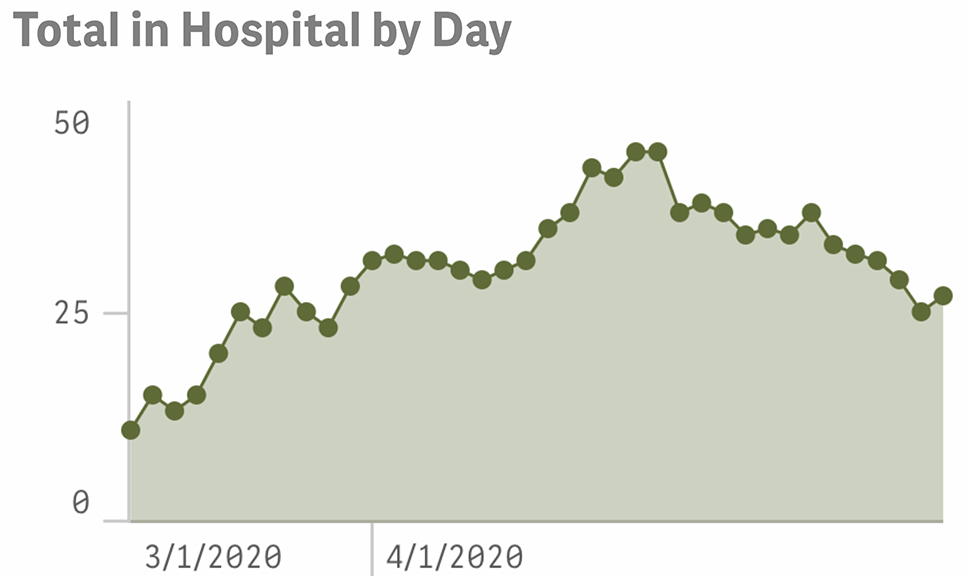
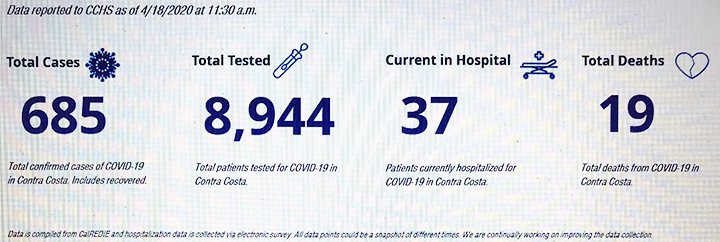
As of Thursday, April 16, 2020 at 11:30 a.m. Contra Costa Health Services (CCHS) is reporting a total of 631 cases of COVID-19/coronavirus, and a total of 16 deaths in the county on their dashboard. There are 37 people diagnosed with the virus currently hospitalized.

There were 41 new cases reported on Monday, 16 more on Tuesday and 18 more cases reported on Wednesday.

Of those who have tested positive in the county, the cities or communities with the most cases are as follows: Richmond has 66 cases, Concord has 60, Pittsburg has 49, Antioch has 46 cases, Brentwood has 40, Walnut Creek has 37, Orinda has 36 cases, Pleasant Hill has 32, Bay Point and San Pablo each have 31 cases, San Ramon has 27, Oakley has 25 cases, followed by Danville with 22.

A total of 8,282 people have been tested for the virus in the county.

The county’s coronavirus dashboard is now offering hospital information. It shows the daily Intensive Care Unit Occupancy Rate and Ventilator Utilization for all hospitals in the county.

The largest category of those who have been diagnosed with the virus continue to be people ages 41-60 with 227 cases, 188 cases for those age 21-40, 144 cases among those age 61-80, another 47 cases of those age 81-100 and 24 cases of those age 20 and under.

To see the all the statistics provided by CCHS, click here.

Filed Under: Health, News

County health officer suspends intakes, orders social distancing at homeless shelters

April 14, 2020 By Publisher Leave a Comment

ORDER OF THE HEALTH OFFICER OF THE COUNTY OF CONTRA COSTA

No. HO-COVID19-07

SUSPENDING INTAKES AT HOMELESS SHELTERS

SOCIAL DISTANCING AT HOMELESS SHELTERS

DATE OF ORDER: April 14, 2020   Please read this Order carefully. Violation of or failure to comply with this Order is a misdemeanor punishable by fine, imprisonment, or both. (California Health and Safety Code, § 120295.)

SUMMARY OF THE ORDER California is in a State of Emergency because of the Coronavirus Disease 2019 (COVID-19) pandemic. The spread of the novel coronavirus that causes COVID-19 is a substantial danger to the health of the public within the County of Contra Costa (“County”). COVID-19 can easily spread between people who are in close contact with one another. This Order is issued based on scientific evidence and best practices as currently known and available to protect vulnerable members of the public from avoidable risk of serious illness or death resulting from exposure to COVID-19. The age, condition, and health of a significant portion of the population of the County place it at risk for serious health complications, including death, from COVID-19. There is growing evidence of transmission risk from infected persons before the onset of symptoms. Thus, all individuals who contract COVID-19, regardless of their level of symptoms (none, mild or severe), may place other vulnerable members of the public at significant risk. Currently, there is no vaccine available to protect against COVID-19 and no specific treatment. The Health Officer of the County of Contra Costa has determined that there is an increased risk of COVID-19 among persons living in large homeless shelters, and that the shelters must be depopulated temporarily to help slow COVID-19’s spread and prevent the healthcare system in the County from being overwhelmed. On April 14, 2020, the depopulation of Bay Area Rescue Mission located at 200 Macdonald Avenue, Richmond CA 94801 (“the Shelter”), will commence.

UNDER THE AUTHORITY OF SECTIONS 101040 AND 120175 OF THE CALIFORNIA HEALTH AND SAFETY CODE, THE HEALTH OFFICER OF THE COUNTY OF CONTRA COSTA (“HEALTH OFFICER”) ORDERS:

  1. Commencing on April 14, 2020 at 2:00 p.m., the owner and operator of the Shelter (collectively “Shelter Operator”) and all staff members and volunteers who work in the Shelter shall suspend the intake of persons to reside at the Shelter, including but not limited to accepting applications, conducting interviews and background checks, or otherwise authorizing any person to stay overnight at the Shelter if the person is not a resident of the Shelter as of the time and date set forth above.
  2. To the extent that the Shelter Operator currently provides or arranges for services to be provided to residents of the Shelter or other homeless persons, other than providing space for overnight stays, those services may continue to be offered, but only on the condition that all participants practice social distancing as set forth in Paragraph 3.
  3. All residents of and other persons who enter the Shelter shall practice social distancing by remaining at least 6 feet away from all other persons while in the Shelter.
  4. This Order shall become effective at 2:00 p.m. on April 14, 2020 and will continue to be in effect until it is extended, rescinded, superseded, or amended in writing by the Health Officer.
  5. Copies of this Order shall promptly be: (1) made available at the Office of the Director of Contra Costa Health Services, 1220 Morello Avenue, Suite 200, Martinez, CA 94553; (2) posted on the Contra Costa Health Services website (https://www.cchealth.org); and (3) provided to any member of the public requesting a copy.
  6. If any provision of this Order or its application to any person or circumstance is held to be invalid, then the reminder of the Order, including the application of such part or provision to other persons or circumstances, shall not be affected and shall continue in full force and effect. To this end, the provisions of this Order are severable.
  7. Questions or comments regarding this Order may be directed to Contra Costa Health Services at (844) 729-8410.

IT IS SO ORDERED:

Chris Farnitano, M.D. Health Officer of the County of Contra Costa   Dated: April 14, 2020

Filed Under: Government, Health, Homeless, News

Gov. Newsom unveils six indicators he will consider before modifying stay-at-home order

April 14, 2020 By Publisher Leave a Comment

SACRAMENTO (April 14, 2020) – Governor Gavin Newsom today unveiled six key indicators that will guide California’s thinking for when and how to modify the stay-at-home and other orders during the COVID-19 pandemic. (View presentation here)

The Governor noted that the progress in flattening the curve, increased preparedness of our health care delivery system and the effects of other COVID-19 interventions have yielded positive results. However, these actions have also impacted the economy, poverty and overall health care in California. Any consideration of modifying the stay-at-home order must be done using a gradual, science-based and data-driven framework.

“While Californians have stepped up in a big way to flatten the curve and buy us time to prepare to fight the virus, at some point in the future we will need to modify our stay-at-home order,” said Governor Newsom. “As we contemplate reopening parts of our state, we must be guided by science and data, and we must understand that things will look different than before.”

Until we build immunity, our actions will be aligned to achieve the following:

  • Ensure our ability to care for the sick within our hospitals;
  • Prevent infection in people who are at high risk for severe disease;
  • Build the capacity to protect the health and well-being of the public; and
  • Reduce social, emotional and economic disruptions

California’s six indicators for modifying the stay-at-home order are:

  • The ability to monitor and protect our communities through testing, contact tracing, isolating, and supporting those who are positive or exposed;
  • The ability to prevent infection in people who are at risk for more severe COVID-19;
  • The ability of the hospital and health systems to handle surges;
  • The ability to develop therapeutics to meet the demand;
  • The ability for businesses, schools, and childcare facilities to support physical distancing; and
  • The ability to determine when to reinstitute certain measures, such as the stay-at-home orders, if necessary.

The Governor said there is not a precise timeline for modifying the stay-at-home order, but that these six indicators will serve as the framework for making that decision.

He also noted that things will look different as California makes modifications. For example, restaurants will have fewer tables and classrooms will be reconfigured.

For more information on California’s response, visit covid19.ca.gov.

Filed Under: Health, News, State of California

Newsom, Oregon and Washington governors announce western states pact for reopening economies

April 13, 2020 By Publisher Leave a Comment

States agree region will move toward reopening based on health outcomes

Gov. Newsom makes remarks. Photo: Office of the California Governor.

SACRAMENTO (April 13, 2020) — Today, California Governor Gavin Newsom, Oregon Governor Kate Brown and Washington Governor Jay Inslee announced an agreement on a shared vision for reopening their economies and controlling COVID-19 into the future.

Joint statement from the Governors:

“COVID-19 has preyed upon our interconnectedness. In the coming weeks, the West Coast will flip the script on COVID-19 – with our states acting in close coordination and collaboration to ensure the virus can never spread wildly in our communities.

We are announcing that California, Oregon and Washington have agreed to work together on a shared approach for reopening our economies – one that identifies clear indicators for communities to restart public life and business.

While each state is building a state-specific plan, our states have agreed to the following principles as we build out a West Coast framework:

–Our residents’ health comes first. As home to one in six Americans and gateway to the rest of the world, the West Coast has an outsized stake in controlling and ultimately defeating COVID-19.

–Health outcomes and science – not politics – will guide these decisions. Modifications to our states’ stay at home orders must be made based off our understanding of the total health impacts of COVID-19, including: the direct impact of the disease on our communities; the health impact of measures introduced to control the spread in communities —particularly felt by those already experiencing social disadvantage prior to COVID-19; and our health care systems’ ability to ensure care for those who may become sick with COVID-19 and other conditions. This effort will be guided by data. We need to see a decline in the rate of spread of the virus before large-scale reopening, and we will be working in coordination to identify the best metrics to guide this.

–Our states will only be effective by working together. Each state will work with its local leaders and communities within its borders to understand what’s happening on the ground and adhere to our agreed upon approach.

Through quick and decisive action, each of our states has made significant progress in flattening the curve and slowing the spread of COVID-19 among the broader public. Now, our public health leaders will focus on four goals that will be critical for controlling the virus in the future.

  • Protecting vulnerable populations at risk for severe disease if infected. This includes a concerted effort to prevent and fight outbreaks in nursing homes and other long-term care facilities.
  • Ensuring an ability to care for those who may become sick with COVID-19 and other conditions. This will require adequate hospital surge capacity and supplies of personal protective equipment.
  • Mitigating the non-direct COVID-19 health impacts, particularly on disadvantaged communities.
  • Protecting the general public by ensuring any successful lifting of interventions includes the development of a system for testing, tracking and isolating. The states will work together to share best practices.

COVID-19 doesn’t follow state or national boundaries. It will take every level of government, working together, and a full picture of what’s happening on the ground.

In the coming days the governors, their staff and health officials will continue conversations about this regional pact to recovery.”

Filed Under: Business, Government, Health, News, State of California

Contra Costa Health order requires masks, temperature checks for health facility visitors

April 13, 2020 By Publisher Leave a Comment

By Kim McCarl, Assistant to the Director, Communications, Contra Costa Health Services

Residential care and other licensed healthcare facilities in Contra Costa County must screen all staff and visitors for signs of illness and adhere to a strict masking policy, according to a new health officer order that begins Tuesday.

The order is intended to protect medically vulnerable patients and reduce the spread of COVID-19 within the facilities that care for them, Contra Costa Health Officer Dr. Chris Farnitano said.

“The age and health of many county residents, particularly those living in congregate care settings, places them at higher risk of serious health complications, including death, from COVID-19,” Farnitano said. “This order is another precaution we can take as a community to protect our vulnerable residents.”

The order applies to licensed residential care facilities, including nursing and senior care facilities, psychiatric facilities, group homes, residential recovery houses and homeless shelters.

Beginning Tuesday, April 14, anyone who is not a patient or resident at an applicable facility must submit to temperature and symptom screening, and facilities must exclude anyone who has had symptoms of respiratory illness or fever in the past seven days, or a temperature of 100 degrees Fahrenheit or higher.

The order does not apply to facility patients or residents, or people seeking care for their symptoms.

Facilities must now log screenings of staff and visitors, and staff and visitors must wear surgical masks, or cloth masks if surgical masks are not available, and practice physical distancing at the facility.

Facilities with known or suspected COVID-19 cases must notify emergency dispatchers and ambulance transporters of the presence of the virus at the facility, and the COVID-19 status of any patient transported to or from the facility.

Licensed care facilities are also now required to minimize the staffing of employees working at multiple facilities, and to keep records of any employees who worked at another healthcare facility during the previous 14 days.

Visit cchealth.org/coronavirus to read the order or for more information about COVID-19.

Filed Under: Health, News

Union agreement with Kaiser will help healthcare workers treating COVID-19 patients

April 13, 2020 By Publisher Leave a Comment

80,000 workers who are members of the Coalition of Kaiser Permanente Unions covered by agreement

By Steve Trossman, Service Employees Union International

OAKLAND, Calif. – An agreement with healthcare giant Kaiser Permanente will ease some of the major burdens facing workers on the frontlines of the coronavirus pandemic, including assistance with childcare and temporary shelter, and extra leave for workers who are tested or diagnosed with COVID-19.

The measures provide support for 80,000 workers who are members of the Coalition of Kaiser Permanente Unions, more workers than covered by any such agreement in the nation. They apply to full-time, part-time and per-diem employees and can serve as a model for other hospitals and health systems to protect healthcare workers and the public.

“As healthcare workers in the middle of this pandemic, we know our duty is to our patients and the community, and we take that duty very seriously. But we can only give our best if we know our own lives and our families are protected as well,” said Juanita Kamhoot, who works in surgical survices at Kaiser Sunnyside Medical Center in Clackamas, OR. “This agreement will make a real difference at a time when we need every healthcare worker on the job and focused on taking care of COVID-19 patients.”

The agreement focuses on three key areas:

CHILD-CARE ASSISTANCE: With schools closed, many healthcare employees are having difficulty finding affordable childcare. Under the agreement, Kaiser employees who work 32 hours a week or more in a KP facility will be eligible for a grant of $300 per week to pay for childcare for children 14 or younger (and disabled, dependent children). It can be used to pay for their own caregiver (as long as they are not a spouse or domestic partner) or to find childcare outside of the home.

The stipend will last until May 31, 2020 and will be pro-rated for employees who work between 20 and 32 hours (including per-diem employees) with a minimum of $210 a week.

TEMPORARY SHELTER: Kaiser will work with several hotel chains to provide alternative shelter for employees who:

  • Test positive for COVID-19;
  • Work a double shift;
  • Work multiple 12-hour shifts;
  • Have fewer than 8 hours between shifts; or
  • Have a household member who either has COVID-19 or is in a CDC-defined vulnerable group.

Eligibility applies to all employees working at least 20 hours per week (including per-diem employees) at a KP facility between April 13 and May 31, 2020.

EIGHTY ADDITIONAL HOURS OF LEAVE FOR EMPLOYEES WHO TEST POSITIVE FOR COVID-19: Employees working at a KP facility more than 20 hours a week (including per-diem employees) who test positive for COVID-19 will receive up to 80 hours of administrative leave. This is above and beyond regularly accrued leave. Employees who are sent home from Kaiser and are awaiting a test result will also be covered.

The Coalition of Kaiser Permanente Unions comprises labor unions in California, Oregon, Washington, Colorado, Hawaii, Virginia, Maryland and the District of Columbia, representing more than 80,000 Kaiser caregivers. To learn more, visit https://www.unioncoalition.org/.

Filed Under: Health, Labor & Unions, News

Rapid Response Fund formed to bring emergency relief to county residents impacted by COVID-19

April 11, 2020 By Publisher 1 Comment

Contra Costa Regional Health Foundation’s first round of grants will go to the Food Bank of Contra Costa and Solano, the Contra Costa Crisis Center, Shelter, Inc., Catholic Charities East Bay and White Pony Express

By Kim McCarl, Assistant to the Director, Communications, Contra Costa Health Services

MARTINEZ — Beyond its devastating health implications, COVID-19 is undermining basic living conditions for tens of thousands of people living in the Bay Area, especially those that are most vulnerable. The Contra Costa Regional Health Foundation (CCRHF) has established a COVID-19 Rapid Response Fund and has been selected as a lead partner organization in the newly formed COVID-19 Regional Response Fund supported by the Silicon Valley Community Foundation.  The COVID-19 Rapid Response Fund is also supported by the Chan Zuckerberg Initiative as well as individual donors.

The CCRHF Rapid Response Fund is moving quickly to help those individuals in desperate need. Locally, the Contra Costa Regional Health Foundation will play an important role in identifying highest risk populations and funding organizations to provide needed assistance.

“The economic impact of COVID-19 in the Bay Area is immense, with the biggest impact on people who have been living on the margins. These are families that can’t wait for government assistance in a few weeks, they are suffering and in jeopardy now,” explains CCRHF Chair Bette Felton. “Thanks to the amazing generosity of the Silicon Valley Community Foundation and the Chan Zuckerberg Initiative, as well as individual donors, we can now move rapidly, locate the organizations best suited to safeguard those people at high risk and make sure they have the funds and resources to help protect our communities.”

We understand this is a dynamic and changing situation.  Based on our understanding of the greatest needs at this time, the Fund is supporting four key areas: food distribution, financial assistance, shelter and emergency housing, and support for essential workers.

“Grants will be made on a timely basis to organizations best equipped to address these needs among the county’s most vulnerable populations. Given the urgency of the crisis, our priority is to find organizations with the proven capacity that can move quickly,” says Felton.

In light of that urgency, in its first round of funding, the CCRHF is extending grants to five organizations: the Food Bank of Contra Costa and Solano, the Contra Costa Crisis Center, Shelter, Inc., Catholic Charities East Bay and White Pony Express.  These initial grants will quickly amplify the impact these organizations are positioned to make.

Additional organizations will be considered in future funding cycles, based on:

  • the organization’s ability to reach populations most vulnerable to the economic or health risks posed by this public health crisis,
  • its capacity to move expeditiously and
  • the ability of the organization to deploy the funds expediently.

For additional information about the COVID-19 Rapid Response Fund and the Contra Costa Regional Health Foundation visit www.ccrhfcovid-19.org/

About the Contra Costa Regional Health Foundation

Established in 2003, the Contra Costa Regional Health Foundation is a 501 (c)3 non-profit organization that supports Contra Costa Health Services in its work to care for and improve the health of all the people in Contra Costa County with special attention to those who are the most vulnerable.

Filed Under: Community, Health, News

Contra Costa coronavirus Update: 2 more deaths for 11 total, 530 cases

April 11, 2020 By Publisher Leave a Comment

From CCHealth.org.

More cases in people ages 41-60 than any other age range

By Allen Payton

As of Saturday, April 11, 2020 at 11:30 a.m. Contra Costa Health Services (CCHS) is reporting a total of 530 cases of COVID-19/coronavirus, and two more deaths for a total of 11 in the county. There are 37 people diagnosed with the virus currently hospitalized.

A total of 6,938 people have been tested for the virus.

The majority of those who have been diagnosed are ages 41-60 with 195 cases, 165 cases for those ages 21-40, 126 cases among those ages 61-80, another 26 cases of those ages 81-100 and 17 cases of those age 20 and under.

To see the all the statistics provided by CCHS, click here.

Filed Under: Health, News

  • « Previous Page
  • 1
  • …
  • 37
  • 38
  • 39
  • 40
  • 41
  • …
  • 53
  • Next Page »
RepublicServices-Antioch-ad (1)
Furniture-Clrnc-Outlet-0626
Monica's dinner 05-26 CCH
Celia's-06-26
Delta-RC-A (2)
Deer-Valley-Chiro-06-22

Copyright © 2026 · · Contra Costa Herald · All Rights Reserved