• Home
  • About The Herald
  • Local Agencies
  • Daily Email Update
  • Legal Notices
  • Classified Ads

Contra Costa Herald

News Of By and For The People of Contra Costa County, California

  • Arts & Entertainment
  • Business
  • Community
  • Crime
  • Dining
  • Education
  • Faith
  • Health
  • News
  • Politics & Elections
  • Real Estate

Writer says county COVID health orders discriminate, segregate

December 17, 2021 By Publisher 1 Comment

Dear Editor,

Following is a letter I sent to Contra Costa County officials about the discriminatory and segregationist COVID mandates, with a few additions. I encourage other residents who are also fed up to join me and do the same. While there is an online form on the Contra Costa Health Services website, since there are no email addresses provided, I chose to fax my letter to the county health director, as well as the health officer who issues the mandates. I sent a similar letter to the Brentwood Mayor and City Council, City Attorney and City Manager at citycouncil@brentwood.gov; cityattorney@brentwood.gov; togden@brentwoodca.gov.

Anna Roth, RN, MS, MPH, Director

925-957-5403

 925-957-5409 fax

Chris Farnitano, MD, Health Officer

925-957-5403

925-957-5409 fax

Diane Burgis, District 3 Supervisor

supervisor_burgis@bos.cccounty.us

This is an open letter to you all.

I am emailing you to request our county be independent from the unlawful COVID mandates and to stop the discrimination and segregation.

I believe our governor and county have grossly overreached their authority. Unequal treatment for those unvaccinated is not okay. Taking rights away from people until they agree to do what the government says isn’t giving them a “choice” It’s punishing them until they concede to their demands. Normally we would refer to this type of behavior as manipulation or abuse. The CDC says, “vaccinated people can still become infected and have the potential to spread the virus to others” This is just like the unvaccinated. The science proves everyone should be treated equal-whether that be unvaccinated or vaccinated.

Since Dec 2020 there have been 946,463 reported adverse reactions to the vaccine. That is 200,000 more than any other vaccine since 1990. Masking up has been proven not to work and actually makes you unhealthy by not allowing enough oxygen into your system. To coerce citizens into taking a procedure that may end with dire consequences in order to participate in the common everyday occurrences such as eating indoors, buying food at the movies, working out at the local gym, this is segregation pure and simple. This is cruel and unusual punishment.

Segregation and unfair treatment violats both our Bill of Rights and the International Bill of Rights.

Fourth Amendment – “The right of the people to be secure in their persons”.

Fifth Amendment – “No person shall be…deprived of life, liberty, or property, without due process of law…

Article 5 – International Bill of Rights – “No person shall be subject to torture or to cruel, inhuman or degrading treatment and punishment.”

These unfair mandates have discriminated against me, my family and others in the community. The unkind comments while shopping at a local store, the staring, the learing, the blocking of shopping. Being shamed in public by community members just for living our lives. Being asked to leave a place of business. The threat of arrest and fines is despicable.

Having our city and county representatives pushing vaccines on the community and being told through social media we must do this to support our neighbors. This is segregation .. again. Being ostracized for not complying goes against our rights as citizens.

This is a pure example of the government overreach. I am demanding the county end these mandates! Let us choose. Give us what America was founded on…freedom.

We look forward to hearing from you all in hopes to stop this gross overreach of authority by our governor, county, etc.

Thank you,

Eileen Erickson

Brentwood

Filed Under: Health, Letters to the Editor, Opinion

Supervisors approve spending $75 million of Measure X funds for new medical center facilities, Mitchoff goes on defense

December 16, 2021 By Publisher 1 Comment

Source: Contra Costa Health Services

Will provide garage, medical clinical office, and expanded radiology lab at Contra Costa Regional Medical Center in Martinez; following crackdown, one restaurant still violating COVID-19 health orders as cases in county increase; appoint new Public Defender, will earn $433,641 in pay and benefits

“If you want to send me an email and still want to call me a ‘b***’ go ahead.” – Supervisor Karen Mitchoff in response to critics of her crusade to crack down on restaurants out of compliance with county health orders

By Daniel Borsuk

On a 4-0 vote, during their final meeting of the year on Tuesday, the Contra Costa County Board of Supervisors paved the way for officials of the over-used Contra Costa Regional Medical Center to spend $75 million of Measure X half-cent sales tax funds to construct a parking garage, a medical office complex and a state-of-the-art public health laboratory at Tuesday’s final board meeting of the year. (See CCRMC Proposed Master Plan)  CCRMC Measure X funding presentation CCCBOS121421

With Board Chair Diane Burgis absent because of the death of her husband Richard Clayton for whom supervisors adjourned the meeting in honor of, supervisors narrowly met the super-majority requirement to tap into 2020 vote-approved sales tax measure revenues for the purpose of enhancing facilities at the over-used medical complex in Martinez.

Contra Costa Public Health Director Anna Roth pitched the three CCRMC capital improvement projects based on the fact the publicly funded medical center in the past year has treated 142,000 patients due to COVID-19, a 540 percent increase.  The center has saved the lives of about 26,000 county residents, 70 percent of whom are on Medi-Cal. Seventy percent of the CCRMC patients do not speak English, Roth noted.

She said the medical center has been crushed with a 540 percent increase in patients seeking medical care over the past 20 years while the physical components of the medical center have been unchanged. Roth also shared there has been at least one case where a pregnant woman had safely delivered her baby in the medical center parking lot because of the unavailability of parking. According to the presentation, three babies were born in the parking lot during the last year. The proposed 325-space parking structure along with valet parking would help alleviate the parking problem, she asserted.

Marianna Moore, chair of the board of supervisors’ appointed Measure X Advisory Committee, cast concern that the supervisors’ action on the medical center capital projects might be premature and negatively hit future Measure X funding of other public services.

“This is a one-time expenditure,” responded District 4 Supervisor Karen Mitchoff of Pleasant Hill. “There will be money for other projects. The longer we delay on capital improvement projects like these the more expensive it becomes.”

Upon acknowledging Measure X chairperson Moore’s comments, District 1 Supervisor John Gioia remarked “I hear the concerns of the Measure X panel for this board to be transparent and open.” Yet, he pointed out how three major local nonprofit health providers – Kaiser Permanente, John Muir and Sutter Medical – skirt regulations that county-operated medical institutions must obey.

“They get an equity worth $25 billion in tax breaks and don’t have to encounter public scrutiny that publicly operated health care operations like Contra Costa County’s have to abide by. I am proud of the public health successes in Contra Costa County, but we need help from the nonprofit health care organizations too.”

In addition to the proposed parking garage, the supervisors’ action paves the way for the medical center to have a $30 million 40,000 square foot medical-clinical office building constructed and a $5 million 5,000 square foot state-of-the-art intervention radiology suite built.

One Restaurant Remains Out of Compliance With COVID-19 Health Order, Mitchoff on the Defense

In a follow up to last week’s meeting where Supervisor Mitchoff questioned the Health Department’s code enforcement capabilities in shutting down 13 restaurants willfully out of health code compliance, Roth announced there is currently only one eatery that is still not following health code requirements.

She did not identify the business. “All but one of the establishments are now in compliance,” said Roth.

Roth said her department has added four code enforcement officers since last week when Mitchoff blew the lid off the health department’s health code performance.

“I appreciate the progress the health department has made,” said Mitchoff. “There is still one restaurant to follow up on. One restaurant will probably have to close.”

Mitchoff, who will serve as board chair next year instead of vice chair Federal Glover of Pittsburg in recognition of her public service as she has announced she won’t seek reelection in 2022, attacked her critics on her crusade to shut down out-of-compliance restaurants.

“There’s recently been vitriolic and unclear language and comments lodged at me,” said Mitchoff, whose been a frequent target of hate emails. “If you want to send me an email and still want to call me a ‘b***’ go ahead. It would be much better if those who dislike me to write letters and that everyone gets vaccinated and wears masks. I hope to start the new year with much more appreciated language.”

County COVID-19 Cases Increase

In the meantime, Roth said Contra Costa County’s vaccination rate of 76.8 percent remains above the national average of 69.9 percent.

The county’s active COVID-19 case load stands at 1,463, an increase of 18.9 percent over a two-week period. Forty-three patients were in hospitals in the county because of COVID-19.

“Ninety-seven percent of the cases in Contra Costa County are of the Delta strain,” remarked Roth. She said there have been signs of the new Omicron variant appearing in wastewater in the county, but nowhere else.

Because of wintertime conditions forcing Californians to hunker down indoors, Contra Costa County Health Officer Dr. Chris Farnitano informed supervisors the State was expected to announce a new indoor public face mask order. The order would be in place through Jan. 15, 2022.

In a related action, supervisors adopted an ordinance calling for the continuation of remotely conducted meetings into January 2022.  The ordinance also applies to commissions and advisory committees.

Ordinance Temporarily Halts North Richmond Fulfillment Center Openings  

In response to increasing vehicle emission air pollution and traffic-pedestrian safety concerns issues stemming from the buildup of fulfillment centers in the unincorporated North Richmond and Richmond areas, supervisors imposed a 45-day moratorium on the opening of new fulfillment centers.

“Richmond and North Richmond have become a major destination for fulfillment centers,” said Supervisor Gioia, whose District 1 cover those areas. “We don’t want North Richmond to become a wall-to-wall fulfillment center magnet.”

The purpose of the ordinance Gioia has introduced is to compel these enterprises to deliver their products with electric vehicles.   It aims to have 33 percent of a company’s fleet of vehicles electrified immediately and by 2027 100 percent of a business’s fleet of vehicles must be electrified.

At least five fulfillment centers are either under construction or planning phase, said John Kopchick, director of the Contra Costa County Conservation and Development Department.

No one from the fulfillment center sector spoke on the ordinance regulating the electrification of vehicle fleets, but Donald Gilmore of North Richmond Recreation said the ordinance does not go far enough.

“North Richmond is significantly impacted by these warehouses and the traffic coming from them. Pedestrian safety is a pressing problem. We need more time to figure out a plan,” said Gilmore.

Appoint New Public Defender, Will Earn $433,641 in Pay and Benefits

Ellen McDonnell. Source: CCPD

Supervisors promoted Deputy Public Defender Ellen McDonnell as Contra Costa Public Defender at an annual salary of $340,510 in addition to a $93,131 in pension annual compensation.  She will officially take over the role of Public Defender from the retiring Robin Lipetzky effective Jan. 1, 2022.

She started with the department in 2001 and will oversee a $36 million budget and 145 employees.

McDonnell holds a Juris Doctorate degree from California Hastings College of the Law and a Bachelor of Arts degree and double major in Spanish and Italian from Florida Atlantic University in Boca Raton.

She has been a member of the California State Bar since 2011. (Read more about McDonnell in a separate article.)

Filed Under: Government, Health, News, Supervisors

Kaiser Permanente Nor Cal receives international recognition for life-saving advance alert monitor program

December 15, 2021 By Publisher Leave a Comment

Kaiser Permanente Northern California is recognized at the 44th World Hospital Congress. Pictured, far right, Carrie Owen Plietz, FACHE, president of Kaiser Permanente’s Northern California region accepts the award from representatives of Austco in Barcelona, Spain on Nov. 11, 2021. Source: Austco

The International Hospital Foundation recognizes Kaiser Permanente Northern California with the Autsco Excellence Award for Quality and Patient Safety

By Antonia Ehlers, PR and Media Relations, Kaiser Permanente Northern California

OAKLAND, Calif., – An early detection system that helps care teams predict when Kaiser Permanente Northern California’s hospitalized patients are at risk for clinical deterioration was recognized by the International Hospital Foundation with the Autsco Excellence Award for Quality and Patient Safety.

Kaiser Permanente Northern California received the Gold Award, the highest level possible, for its Advance Alert Monitor (AAM) program, which is in place at all 21 Northern California hospitals. The program is a sophisticated monitoring system that analyzes electronic hospital patient data to identify those at risk of deteriorating and alerts a specialized team of virtual nurses who determine if on-site intervention is needed. The nurses contact a rapid response team, which perform an assessment, and then work with the care team and the patient and/or family to develop a patient-centered treatment plan.

AAM predicts the probability that hospitalized patients are likely to decline, require transfer to the intensive care unit or emergency resuscitation, and benefit from interventions. Early warnings could be helpful for patients at risk of deterioration where intervention may improve outcomes.

An analysis of the program in a recent publication of the New England Journal of Medicine showed outcomes associated with lower hospital mortality, a lower incidence of ICU admission, and a shorter length of stay in the hospital.

“This program reflects our commitment to providing the safest care possible by using technology in the hands of our expert care teams to identify those patients who need immediate attention,” said Carrie Owen Plietz, FACHE, president of Kaiser Permanente’s Northern California region. “Because of this program, we are saving lives and providing the high-quality, exceptional care our patients and families deserve.”

The vital signs of Kaiser Permanente patient Erin Fowler-Jones of Pacifica triggered her to be included in the Advance Alert Monitor program when she was hospitalized last month after developing complications from foot surgery. She said she only knew that nurses were always rounding on her, making sure she was receiving the care she needed to recover.
“Staff was constantly monitoring me, which was a huge comfort,” said Fowler-Jones, a retired Kaiser Permanente nurse. “I had no idea I had been flagged for a special monitor program. I just knew that I was getting good care and safe care.”

The 2021 International Hospital Foundation Awards were revealed during the 44th World Hospital Congress in Barcelona, Spain. The IHF Awards celebrate and recognize hospitals and health care organizations with demonstrable excellence, innovations, and outstanding achievements in the health care industry. This year 250 entries were submitted from more than 38 countries/territories – a record since the awards were established in 2015.

Kaiser Permanente Northern California’s monitoring program was heralded as an example of how hospitals are committed to providing high-quality care and patient safety. The success of the program has reached other health care systems, which are inquiring about implementing it in their hospitals.

“This program demonstrates our expertise in using a predictive algorithm and standardized response workflow to provide the best care possible to our patients,” said Dr. Vanessa Martinez, DNP, MHA, RN, who is the Director of Virtual Nursing Care at Kaiser Permanente Northern California. “This innovative program is a major step forward in making sure our hospitals are the safest in the world and ensuring our patients are well-cared for as we focus on identifying problems, intervening early, and providing the appropriate medical treatment.”

Filed Under: Health, News

Contra Costa’s local indoor-masking order remains in effect with limited exceptions for gyms and offices

December 15, 2021 By Publisher Leave a Comment

By Contra Costa Health Services

A new statewide masking order now requires everyone to wear masks in indoor public spaces regardless of their vaccination through Jan. 15, 2022. Since Contra Costa already has a local masking order in place, the new statewide masking mandate doesn’t affect us – and we will retain limited exceptions for certain indoor settings not open to the general public such as offices and gyms where everyone is vaccinated.

People in Contra Costa, regardless of vaccination status, will have to keep wearing face coverings in public settings as they have been doing since August.

While cases in Contra Costa have gone up since Thanksgiving, the county has one of the highest vaccination rates in California and hospitalizations are far below levels seen during the past summer and lower than in many other counties.

“The limited exceptions we made are for very low-risk scenarios where everyone is vaccinated,” said Health Officer Dr. Chris Farnitano. “Our community already understands and is following these rules and it would be confusing to change them for just one month.”

Contra Costa’s indoor-masking order will stay in place unless the county meets criteria for lifting the local mandate. The order is as follows:

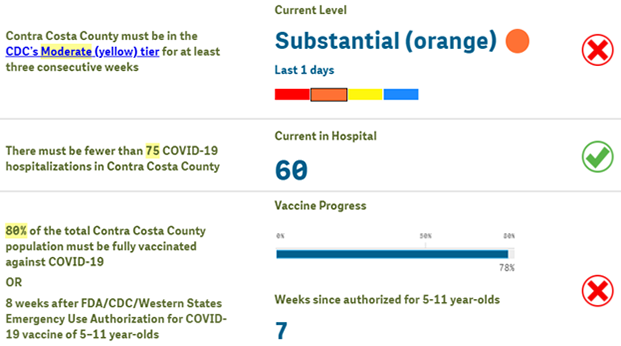
The counties of Alameda, Contra Costa, Marin, Napa, San Francisco, San Mateo, Santa Clara, Sonoma and the City of Berkeley will lift the indoor masking requirement in public spaces not subject to state and federal masking rules when all the following occur:

  1. The jurisdiction reaches the moderate (yellow) COVID-19 transmission tier, as defined by the Centers for Disease Control & Prevention (CDC), and remains there for at least three weeks;
    AND
  2. COVID-19 hospitalizations in the jurisdiction are low and stable, in the judgment of the health officer
    AND
  3. 80% of the jurisdiction’s total population is fully vaccinated with two doses of Pfizer or Moderna or one dose of Johnson & Johnson (booster doses not considered) OR Eight weeks have passed since a COVID-19 vaccine has been authorized for emergency use by federal and state authorities for 5- to 11-year-olds

To see our progress for meeting those criteria, visit our Indoor Mask Mandate Dashboard.

Filed Under: Health, News

Kaiser claims bargaining in good faith with striking engineers’ union, best compensated in profession

December 13, 2021 By Publisher 3 Comments

A large inflatable rat on display at the Antioch Kaiser strike on Thursday afternoon, Nov. 18, 2021. Photos by Allen Payton

On strike for nearly three months

By Antonia Ehlers, PR and Media Relations, Kaiser Permanente Northern California

Kaiser Permanente has been bargaining in good faith with Local 39 IUOE (International Union of Operating Engineers Local 39 Stationary Engineers), the union that represents about 600 Kaiser Permanente operating engineers, for several months. The union decided to call a strike and have kept employees out for nearly three months. Our proposals to Local 39 will keep our engineers among the best compensated in their profession, at an average of more than $180,000 in total wages and benefits. We are not proposing any take-aways. (See related article)

In bargaining with IOUE Local 39, we delivered a comprehensive proposal that offers across-the-board pay increases and cash payments that are similar to our other employees’ and continues to include all our industry-leading benefits. Further, engineers’ retirement benefit would continue to be substantial, with several improvements.

Right now, Local 39’s position is the same as before it went on strike. The union continues to insist it receive much more – in some cases nearly 2 times more – than other union agreements covering Kaiser Permanente employees. It simply is not in line with other employees, nor is it in line with our obligation to continue addressing the affordability of health care for our more than 4.5 million members.

We will continue to bargain in good faith, and we hope that Local 39 leaders will continue to do the same. That means more discussion, fresh ideas, and compromise. At this time, we do not have any further dates scheduled to meet.  We are optimistic that we can resolve the remaining issues with Local 39 at the bargaining table and reach an agreement that continues to reward our employees and supports health care affordability, just as we have with several unions recently.

Filed Under: Health, Labor & Unions, News

Ninth Circuit agrees to rehear lawsuit ruling Newsom unconstitutionally closed private schools during pandemic

December 10, 2021 By Publisher 1 Comment

Vacates court’s three judge panel ruling, will hear en banc

San Francisco — The Ninth Circuit Court of Appeals, at the request of Governor Gavin Newsom, agreed, on Wednesday, to vacate the court’s three judge panel ruling, earlier this year, in favor of the parents represented by the Center for American Liberty’s lawsuit Brach v. Newsom (#OpenCASchools), that Newsom’s COVID order barring private schools from in-person teaching, violated parents’ Due Process rights, and have the entire case reheard by the full Ninth Circuit Panel.

Click here to view and download the court’s order.

Click here to view and download the Ninth’s Circuit’s prior ruling

In the prior ruling for parents, the three-judge panel of the Ninth Circuit reasoned: “…the Supreme Court has long held that ‘the right of parents to make decisions concerning the care, custody, and control of their children is a fundamental liberty interested protected by the Due Process Clause,’ and that right includes ‘the right of parents to be free from state interference with their choice of the educational forum itself.’”

“It’s sad to see Governor Newsom so vigorously continue his assault on children’s education,” said Harmeet K. Dhillon, CEO of the Center for American Liberty. “The prior opinion from the Ninth Circuit was a clear victory for parents and students when the court correctly ruled that under the Constitution, parents – and not Gavin Newsom or faceless bureaucrats — have the right to decide how best to educate their children. I’m confident that the en banc panel will reaffirm that Governor Newsom’s anti-parent power grab was unconstitutional.”

“Although we believe that the original panel correctly held that Governor Newsom violated the Constitution when he closed private schools across the state, we look forward to making our case again to the en banc panel,” said Partner at Eimer Stahl LLP, Robert Dunn. “The school closure orders the Governor kept in place for nearly a year had a devastating impact on students throughout the state and plainly interfered with parents’ ability to control the education of their children. We are confident that the en banc panel will vindicate our clients’ fundamental rights and prevent the Governor from reinstituting such an order.”


Filed Under: Children & Families, Education, Government, Health, Legal, News, State of California

Contra Costa Supervisors put Health Services Chief on hot seat over 13 COVID rule violating restaurants

December 8, 2021 By Publisher Leave a Comment

“The time has come to shut down those establishments that don’t obey the code.” – District 4 Supervisor Karen Mitchoff

“There are no Omicron variant cases yet in our county.” – CC Health Services Director Anna Roth

Approve $95.5 million for new West County Reentry Treatment & Housing Facility; East County Groundwater Plan approved

By Daniel Borsuk

A defensive Contra Costa Health Services Director Anna Roth faced criticism from county Supervisors, especially emanating from District 4 Supervisor Karen Mitchoff on why 13 restaurants remain open in defiance of county COVID-19 health orders. As of Sept. 22, by order of the county’s Health Officer Dr. Chris Farnitano, restaurants, gyms, movie theaters and other entertainment venues must require patrons to show proof of vaccination or a recent negative COVID test in order to enter. (See related article)

“There is no change in enforcement,” Roth said at Tuesday’s supervisors meeting. As of November, 99 percent of restaurants in the county are compliant. We have 13 outstanding cases.”

But Roth’s statement did not satisfy Mitchoff, the supervisor who initially unveiled the code enforcement issue with the county health services.

“The time has come to shut down those establishments that don’t obey the code,” Mitchoff said. “We have done the education. We’ve done the warning.”

None of the owners of the 13 restaurants spoke at Tuesday’s supervisors meeting. Lumpy’s Diner in Antioch, and MJ’s Downtown Café are among eating establishments that the county has tagged as out of compliance of COVID-19 health code.

One of the 13 restaurants on the county’s red tag list, the In-n-Out in Pleasant Hill has been closed for indoor dining health code violations.

District 5 Supervisor Federal Glover of Pittsburg came to the defense of Roth and her department’s code enforcement division commenting, “I think you’re doing an outstanding job out there. The volume of people out there who are out of compliance is small. I enjoy eating inside a restaurant. I understand the stress,”

In the meantime, Roth reported that while 75.6 percent of Contra Costa County residents are fully vaccinated, twenty-seven persons are hospitalized in county hospitals with COVID-19 symptoms One patient dies daily on average from COVID-19 symptoms, she noted.

“There are no Omicron variant cases yet in our county,” said Roth.

In an interview for a KRON4 news report, County Health Officer Dr. Chris Farnitano said, “We don’t just jump right in there with a fine at the get go. We give the businesses the opportunity. Because our goal is to get to compliance for people to follow the order. Our goal isn’t to issue a bunch of fines.” The report also shared that Farnitano said only four restaurants in the county have been fined.

Rendering of the entrance of the West County Re-entry Treatment and Housing Facility. Source: Contra Costa County

$95.5 Million West County Detention Facility Expansion Plan Approved

Supervisors unanimously approved a $95.5 million design-build contract with Montana-based contractor Sletten Construction Company to design and build five secure housing units, a medical treatment center, reentry program space and building, and visitation facilities at the West County Detention Facility in Richmond. It will be known as the West County Reentry Treatment & Housing Facility.  WRTH presentation CCCBOS120721

One of the objectives of the project is to reduce overcrowding by 128 inmate beds to 288 high-security inmate beds in five housing units. Ninety-six beds will still be mental health treatment beds.

Possible Relocation of Marsh Creek Shooting Range

In a related matter, supervisors approved as a consent item a report on the future use and potential relocation of the shooting range at the Marsh Creek Detention Facility possibly to the Concord Naval Weapon Station. At the low-security detention facility inmates learn wood making skills and other basic education skills.

Used also as a training facility for the Office of the Sheriff and law enforcement agencies from Contra Costa County and surrounding counties, the Marsh Creek Range Facility generates revenue for the county. The range will bring about $113,000 for fiscal year 2021-2022, wrote County Administrator Monica Nino in her report to the supervisors.

East County Groundwater Sustainability Plan Approved

Supervisors also approved the East Contra Costa Subbasin Groundwater Sustainability Plan on a 5-0 vote. The $1.4 million groundwater study applies to the cities of Antioch and Brentwood, Byron-Bethany Irrigation District, Diablo Water District, Discovery Bay Community Services and East Contra Costa Irrigation District.

Even under drought like conditions, the plan found, “Groundwater conditions in the ECC Subbasin are favorable and reflect stability over the past 30 years or more. Using various analogies, the Subbasin can be described as generally full through various water-year types, including drought and is in good “health.” The favorable conditions are in part due to surface water availability that represents the largest sources of supply for municipal and agricultural uses in the Subbasin.”

Ryan Hernandez of the Department of Conservation and Planning said if the board of supervisors did not adopt the ECC-GSP, the county would be in violation of the Sustainable Groundwater Management Act, which would result in the State Water Resources Board intervening in local groundwater management.

Allen Payton contributed to this report.

Filed Under: Business, Dining, Health, News, Sheriff, Supervisors, Water

Contra Costa College District COVID-19 vaccine mandate for staff, students now in effect

November 20, 2021 By Publisher Leave a Comment

Photo source: CDC

Unanimous vote by trustees; all visitors, including vendors and subcontractors, required to complete health assessment prior to visiting a 4CD facility.

By Timothy Leung, Public Information Officer, Contra Costa Community College District

At their September 8, 2021, meeting, the Contra Costa Community College District (4CD) Governing Board passed a resolution on a unanimous vote establishing a COVID-19 vaccine requirement for all employees, and students who attend at least one in-person class or visits a 4CD facility or campus. All visitors, including vendors and subcontractors, are strongly encouraged to be vaccinated and will be required to complete a health assessment prior to visiting a 4CD facility. Ward 2 Trustee and Board Vic President Dr. Walters made the motion, and it was seconded by Ward 5 Trustee Fernando Sandoval. The vote was unanimous, including the student trustee. (See Item 21.A.)

The vaccine requirement became effective on Monday, November 1, 2021, in order to provide time for those currently unvaccinated to become fully vaccinated. The 4CD Governing Board determined that requiring vaccines for students and employees is necessary to ensure the health and safety of the 4CD community.

Employees and students can apply for a vaccination exception or deferral in the following situations: (a) medical excuse from receiving COVID-19 vaccine due to medical conditions or precaution; b) disability; (c) during the period of any pregnancy; or (d) religious objection based on a person’s sincerely held religious beliefs, practice or observance. When an exception or deferral has been approved, regular weekly COVID-19 testing with evidence of negative test results will be required for any unvaccinated person accessing District campuses or facilities.

4CD is evaluating various technology solutions that will track the vaccination status and test results in a secure system designed to protect the privacy of students and employees in accordance with applicable laws.

“In making this decision, 4CD reached out to its students, faculty, classified professionals, and managers and received overwhelming support to take this action,” said Chancellor Bryan Reece. “COVID-19 and its many variants will be with us for a while, so we must take prudent steps like this one so we can continue providing face-to-face instruction and services for our students, while ensuring we have a safe place to learn and work for our students and staff.”

4CD continues to monitor and adhere to health guidelines from federal, state and local health authorities, and advocates vaccination is the most effective way to prevent transmission and limit COVID-19 hospitalizations and deaths.

Visit 4CD’s website at https://www.4cd.edu/covid19/index.html for more information.

About the College District

The Contra Costa Community College District (4CD) is one of the largest multi-college community college districts in California. The 4CD serves a population of 1,019,640 people, and its boundaries encompass all but 48 of the 734-square-mile land area of Contra Costa County. 4CD is home to Contra Costa College in San Pablo, Diablo Valley College in Pleasant Hill, Los Medanos College in Pittsburg, as well as educational centers in Brentwood and San Ramon. The District headquarters is located in downtown Martinez. For more information visit www.4cd.edu.

Filed Under: Education, Government, Health, News

Kaiser Permanente issues statements about claims made by the California Nurses Association, bargaining with NUHW and claims they’ve made

November 19, 2021 By Publisher 1 Comment

By Antonia Ehlers, PR and Media Relations, Kaiser Permanente Northern California

Members of both the California Nurses Association and National Union of Healthcare Workers (NUHW) are participating in sympathy strikes on Friday, Nov. 19, at all Kaiser facilities in Northern California in support of the Engineers, Local 39 who have been on strike for 63 days, as of today.

Kaiser Permanente statement about claims made by the California Nurses Association

November 19, 2021

Note: Kaiser Permanente is not in bargaining with the California Nurses Association, whose contract runs through August 2022.

The last 20 months of this pandemic have been an incredibly challenging and stressful time to work on the front lines of health care. We are extremely grateful for our frontline health care workforce, including our nurses, whose commitment to providing care and service throughout the COVID-19 pandemic has been nothing short of inspiring.

And while staffing continues to be a challenge across health care, we have hired hundreds of nurses and other care team members in recent months and continue to support our teams and their need for respite by bringing in experienced temporary staff.  In fact, in spite of the acute shortage of nurses in the state, Kaiser Permanente Northern California will have hired an estimated 1,800 experienced nurses by the end of the year, in addition to adding 300 new nurses who will graduate from Kaiser Permanente’s nurse residency program.

We want to thank our nurses, who demonstrate resilience, expertise and compassion every day. We recognize and have worked hard to ease the stresses that this pandemic has caused our people. Since early in the pandemic response, Kaiser Permanente has provided nearly $600 million in employee assistance to ensure that our frontline employees had access to alternate housing, special childcare grants, and additional paid leave for COVID-19 illness and exposure. When it became clear at year-end that our workers’ performance bonuses could be reduced by the effects of the pandemic, we instead chose to guarantee all eligible union-represented employees at least a 100% payout of their performance bonus, amounting to thousands of dollars a person on average.

Kaiser Permanente statement about bargaining with NUHW and claims made by the union

November 19, 2021

Kaiser Permanente and the National Union of Healthcare Workers (NUHW), which represents nearly 2,000 of our mental health professionals in Northern California, began bargaining in late July. While the union is issuing press statements about staffing, the real issue at the table is how much therapists are paid. 

This strike is a bargaining tactic this union has used every time it is bargaining for a new contract with Kaiser Permanente, over the past 11 years of its existence. We are still bargaining and are committed to resolving the issues and reaching an agreement.  

There is a national shortage of mental health clinicians that was already a challenge before the pandemic, and over the past year-and-a-half the demand for care has increased everywhere. We have been taking action to address the shortage of caregivers and to ensure care is available to our members. Over the past five years we have added hundreds of new mental health clinicians to our workforce; we currently have more than 300 open positions. We’ve worked hard to expand the number of therapists in California and are investing $30 million to build a pipeline to educate and train new mental health professionals across the state, with an emphasis on expanding the number of bilingual and diverse students entering the mental health field.

We have significantly expanded our ability to provide virtual care to patients who want it, increasing convenience and access, even though NUHW initially objected to this effort. We also continue to scale up our collaborative care programs that have proven to effectively treat patients with anxiety and depression diagnoses. 

As a result of these efforts and more, Kaiser Permanente offers timely access to initial and return appointments that meets all state standards and is above the average of other California providers. While this is an accomplishment during this time of caregiver shortage and increased demand, we are not finished. We know that every appointment is important and matters to each patient, every person’s needs are unique and every Kaiser Permanente member who needs care deserves timely access to that care. 

We have the greatest respect and gratitude for our mental health professionals and we are dedicated to supporting them in their important work. In addition to working with us to improve access to high quality mental health care, we are asking NUHW to work constructively to help address future costs to ensure we continue to be affordable for our members. 

At the heart of the issues in bargaining is this: Health care is increasingly unaffordable, and escalating wages are half of our costs. Kaiser Permanente is indisputably one of the most labor-friendly organizations in the United States. We are committed to remaining an employer of choice for mental health professionals, and to continuing to offer our employees market-leading wages and benefits. But we cannot continue to allow costs to grow beyond what our members can afford.  

The wages our mental health care professionals receive are significantly higher than average in some markets. For example, in the San Francisco Bay Area, licensed marriage family therapists at Kaiser Permanente earn more than $126,000 on average, which is more than $21,000 higher than market average wages, and licensed clinical social workers make more than $128,000, which is more than $16,000 higher than the market average. The same trend is true in the other parts of Northern California. In Sacramento, licensed clinical social workers earn an average of more than $127,000 in wages, which is $24,000 more than the market average. In addition, we provide among the most generous benefits available. 

The challenge we are trying to address is that if we continue to increase costs so high above the marketplace, our members will not be able to afford to get the care they need. We have to work together to address this challenge in a way that honors and rewards our employees and recognizes the increasing difficulty our members and customers face in paying for care. 

NUHW leadership has called for strikes every time we are in bargaining. It is a key part of their bargaining strategy, and it is especially disappointing that they are asking our dedicated and compassionate employees to walk away from their patients when they need us most. We take seriously any threat to disrupt care. We urge our employees to reject any call for a strike, continue to focus on providing care, and work with us through the bargaining process to finalize a new agreement.

Filed Under: Health, Labor & Unions, News

NUHW holds solidarity strike in support of engineers, marches on Kaiser’s Oakland headquarters

November 19, 2021 By Publisher Leave a Comment

NUHW members hold sympathy strike in support of the engineers and march on Kaiser headquarters in Oakland on Friday, Nov. 19, 2021. Photo: NUHW

Contra Costa Supervisor John Gioia speaks during rally

In a forceful demonstration of solidarity with striking Kaiser Permanente engineers and outrage over Kaiser’s chronic underfunding of behavioral health care, National Union of Healthcare Workers (NUHW) members including social workers, therapists, and psychologists fanned out to Kaiser hospitals across Northern California for a one-day strike. (See videos here and here)

The picket lines formed before dawn and culminated with hundreds of red-clad NUHW members, along with allied nurses and engineers, marching through downtown Oakland for a rally outside Kaiser’s corporate headquarters.

“I want to thank the solidarity that we’ve had the last few weeks,” Mark Sutherland, a Kaiser engineer, told NUHW members in Oakland, recognizing that several NUHW members had also staged individual sympathy strikes with the engineers who had been on strike for 63 days.

Outside a nearby Kaiser corporate office building, mental clinicians, nurses, and engineers chanted together, “We’re all essential workers.”

The rallies were headlined by mental health clinicians, allies including Mental Health America of California President Heidi Strunk, and elected officials including Assemblymember Alex Lee, Santa Clara County Supervisor Cindy Chavez, San Francisco Supervisor Connie Chan, Santa Rosa Mayor Chris Rogers and councilmembers Natalie Rogers, Eddie Alvarez, and Victoria Fleming, Sacramento City Councilmember Katie Valenzuela, Oakland City Councilmembers Carroll Fife and Dan Kalb, and Contra Costa Supervisor John Gioia.

When Gioia told clinicians, “I know you don’t like having to tell your patients we can’t make your next appointment for another month,” one clinician responded, “Three months.”

Friday’s solidarity strike was an opportunity for clinicians to support the engineers, who went on sympathy strikes with NUHW and also inform the public that Kaiser is refusing to consider contract proposals to dramatically increase mental health staffing and improve access to care.

“You can say you are bargaining in good faith, but the results are in what shows up out here,” Jason Lechner, an addiction medicine therapist, told KPIX-5 from the Oakland picket line.

Mickey Fitzpatrick, a psychologist at Kaiser Pleasanton, told the Mercury News his next appointment isn’t until January.

“We’re grossly understaffed and caseloads exceeding into the hundreds,” Fitzpatick told the paper. “It’s unethical to force clients to wait one or two months, sometimes three months for therapy appointments, and it’s incongruent with their standard of care that suggests for therapy to be effective, for clients to be seen in intervals of one to two weeks.”

Joanna Manqueros told the paper that long waits for care can have devastating implications for patients. “Depression is a serious mental health condition and just like an untreated diabetic or an untreated person with a severe cardiac condition, serious ramifications can include death and this is true for many of the mental health conditions we treat.”

At the San Francisco rally, Kerry Levin, a Kaiser social worker in San Rafael, chronicled the deterioration of Kaiser’s mental health services.

“I have worked for Kaiser for 20 years and I have never seen it this bad,” he said. “I work in the emergency room. The overdoses, the suicide attempts, the people in crisis, it has multiplied by at least four times. It takes eight weeks for people who are suffering to get care. It’s unconscionable.”

Levin added, “In contract negotiations, via Zoom, Kaiser has nothing to bring to the table. They turn off their cameras after 10 minutes. They offer nothing.”

“Kaiser needs to provide the funding and staffing necessary to provide adequate health care,” Matt Hannon, a psychologist for Kaiser in Daly City, said during the rally. “It is typical for Kaiser patients to wait eight weeks between appointments. There is no form of therapy that works anywhere when the sessions are eight weeks apart. None. Zip. Nada.”


Filed Under: Health, Labor & Unions, News

  • « Previous Page
  • 1
  • …
  • 18
  • 19
  • 20
  • 21
  • 22
  • …
  • 53
  • Next Page »
Monica's dinner 05-26 CCH
Celia's-05-26-A
Delta-RC-A (2)
Deer-Valley-Chiro-06-22

Copyright © 2026 · · Contra Costa Herald · All Rights Reserved